




Abstract
Genetically modified organisms (GMOs) have caused considerable controversy in China in recent years. Uncertainty about the technology, ineffective channels for releasing official information and a lack of sufficient public trust in the government and scientists have led to rampant rumours about genetic modification technology, making it hard for the public to acquire scientific knowledge about it and a rational attitude towards it. In this paper, by using as an example the rumour that genetically modified (GM) soybeans cause cancer, we discuss the content and diffusion of rumours related to genetic modification technology in the new media environment. Based on an analysis of content on the social media platform Weibo one week after the rumour began, we discovered that the ensuing cyber discussions reflected reality, that netizens expressed anxiety and panic while stressing social injustice and reflecting conflict between social classes, and that they exhibited little trust in scientists and the government. On the mechanism of diffusion of rumours on Weibo, we observed that ‘evidence’ that directly or indirectly purported to show that GM soybeans cause cancer was added to the rumours and that the rumours were ‘assimilated’ into people's perception through the stigmatization of GMOs and through conspiracy theories.
Introduction
In the mid-1990s, genetic modification technology emerged as a source of polarizing debate. Since then, the use of genetically modified organisms (GMOs) has not been treated as a simple scientific issue in Europe and the United States. Instead, discussions about it have drawn on history, politics and international relations.
In China, the GMO controversy came to the fore with the Nestlé food incident in December 2002, when the Shanghai-based magazine The Bund reported a claim by Greenpeace Hong Kong that food sold by Nestlé in China contained unknown genes. That triggered media coverage on such topics as the safety of genetically modified (GM) foods and consumers’ ‘right to know’.
Extensive public interest in GMOs in China was sparked by the ‘golden rice’ incident in 2012. Researchers provided 72 primary school students in Hengyang City, Hunan Province, with GM rice developed by Syngenta AG, without the informed consent of the children being tested.
The subsequent cyber debate in 2013 and 2014, the banning of GM crops in Heilongjiang Province at the end of 2016 and other events have brought the debate on GMOs to the front of people's minds.
Genetic modification technology not only affects people's daily lives but also features in the national consideration of industrial policy and international trade. The doubts expressed by scientists and the public on this cutting-edge technology have not been addressed in the past several decades. On such specifics as the application and introduction of genetic modification technology, the public is excluded from the decision-making process, and the government lacks timely and smooth channels for information dissemination. This results in the coexistence of, and competition and antagonism between, the official and the civilian spaces for discourse on the issue (He and Chen, 2010). In addition, due to the decline of public trust in the government caused by the friction between the old and new economic systems and differentiation in social interests, as well as the waning of public trust in scientists owing to increased scientific misconduct, public opinion about GMOs is full of conflicts and contradictions. Consequently, in addition to cyber controversies, a number of rumours about GMOs have spread. This is a reflection of public panic about the safety of GM food, ecological security and industrial security. Widely circulated false and erroneous messages, such as ‘GM maize has reduced the production of sows and wiped out mice in Shanxi Province’ and ‘purple potatoes and cherry tomatoes are GM varieties’, have greatly compromised the scientific community's efforts to popularize GMOs while preventing the public from acquiring a scientific and rational understanding of them. To a certain extent, even public decision-making has been affected.
Thoroughly exploring the process of diffusion of rumours about GMOs and its consequences is important for understanding the occurrence of such rumours and curbing them. Using the rumour that ‘GM soybeans cause cancer’ as an example, this paper explores the content and cyber diffusion of rumours about GMOs and the mechanisms of diffusion.
Literature review
Rumour: Its definition, generation and diffusion
The definition of ‘rumour’
In the 1940s, the notion of rumour formally became an academic concept. Knapp (1944) defined it as ‘a proposition for belief of typical reference disseminated without official verification’. Allport and Postman (1947a: ix) claimed that a rumour is a ‘specific (or topical) proposition for belief, passed along from person to person, usually by word of mouth, without secure standards of evidence being present’.
Starting from the 1960s, a number of scholars criticized the psychological perspective on rumours and claimed that social factors cannot be ignored in the generation and diffusion of rumours. Shibutani (1966: 62) held that rumours are collective transactions and ‘improvised news generated in the process of discussion by a group of people’. Similar viewpoints are as follows. A rumour is information about current events passed along by word of mouth but without any factual basis (Morin, 1971); rumours are ‘public communications that reflect private hypotheses about how the world works’ (Rosnow, 1988); and they are ‘information that is neither not yet publicly confirmed by official sources nor denied by them’ (Kapferer, 2008: 15).
Systematic research on rumours in China began with A Perspective in Rumours, which considered all rumours to be false (Jiang, 1991: 17). This was a common opinion among scholars of early communication in modern China. For example, Liu (2002: 211) claimed that rumours often have defamatory tendencies and are ‘negative public opinions of a critical nature’. Guo (2011: 88) held that ‘rumours are intentionally fabricated news or information out of thin air.’ In recent years, a new generation of scholars has paid greater attention to the social background of rumours and examined them from a neutral perspective. Zhou (2012: 14) even highlighted a positive side of rumours: although not officially confirmed, they emerge from public discussion, including assumptions about the real world, and can be used to help people understand ambiguous but important situations.
Misinformation and disinformation are two concepts related to rumours. The former expresses erroneous information and assertions that cause panic and confusion owing to unintentional dissemination, whereas the latter expresses erroneous, false information disseminated intentionally. Iyengar and Massey (2019) noted that misleading and biased information is responsible for people's mistrust of the scientific enterprise and the resulting misperceptions about knowledge.
The generation and diffusion of rumours
Allport and Postman (1947a: 17–18) used psychological experiments to review rumours in wartime and proposed a formula for them: Rumour = Importance x Ambiguity. They believed that story-related themes are important for both the spreader of the rumour and its recipient, whereas a certain degree of ambiguity conceals authenticity. Therefore, without either of importance and ambiguity, rumours cannot exist.
Specifically, the generation and diffusion of rumours are related to personal psychological factors and social environmental factors.
As far as psychological factors are concerned, initial studies showed that the human behaviour of forming and spreading rumours is one of mutual mapping with inner sentiment, and is driven by such personal emotions as anxiety, desire and fear (Allport and Postman, 1947b).
A large number of subsequent studies in social psychology have identified five factors related to the motivation for spreading rumours (Bordia and DiFonzo, 2002; Rosnow, 1991; Walker and Blaine, 1991): uncertainty; importance or outcome-relevant involvement; lack of control; anxiety; and belief. In their review of literature related to each of those variables, DiFonzo and Bordia (2006) examined why the variables affect the transmission of rumours and found that, in the specific context of rumour dissemination, the purposes of personal participation in spreading rumours can be described by three motivations: fact-finding, relationship enhancement and self-enhancement.
With regard to social factors, rumours often have the characteristics of the time and region in which they emerge. For example, the famous ‘Maid of Orleans’ rumour, which circulated in France in the mid-1960s, was about clothing stores being used to traffic white women. This rumour was related to ‘sex’ and ‘Jews’, reflecting the still unstable and complex ethnic estrangement and social contradictions after World War II. In China, the ‘Soul Stealers’ case that affected 200 million people and swept across 12 provinces during the Qianlong years of the Qing Dynasty, the ‘Hairy Man Water Monster’ scare that spread in north and east China from 1946 to 1954, rumours of the spread of AIDS propagated by natives of Henan and Xinjiang in the late 20th century, and recent rumours about ‘kidney removal’ and ‘child kidnapping’ are all closely related to the social context in which they spread.
Hu (2009) classified rumour-generating scenarios into three categories. First, rumours arise from the absence of official channels of information, and ‘improvised news’ is the ‘collective transaction’ through which people interpret their environment. Second, some problems caused by environmental and social changes undermine the overall value and interests of society, plunging people into panic, crisis and uncertainty. Rumours thus occur and stimulate the intensification of uncertainty. Third, rumours are a way of expressing social protest: ‘the payback to authority’ (Kapferer, 2008: 16).
In different contexts, rumours serve as ‘an oral outlet to relieve tension’ (Allport and Postman, 2003: 20), a ‘distorting mirror’ to monitor public opinion in special contexts (Wang and Hou, 2012) and a ‘weapon for the weak’.
The diffusion of rumours in social media
The media environment influences the efficiency of rumour dissemination. Compared with the early stages of word-of-mouth transmission and mass communication dominated by the print media, new media have brought structural changes and accelerated the propagation of rumours. In recent years, global network penetration has been on a continual rise and has increased the availability of network equipment but lowered the access threshold, making it possible for people to access the internet quickly. In addition, the anonymity afforded to online users has caused an end to the ‘spiral of silence’. However, there is a lack of effective supervision of online speech. Some netizens freely vent emotions and disseminate false information. With the intervention of commercial interests, the use of algorithms renders the environment of rumour dissemination more complex, resulting in echo chambers.
The mechanisms of distortion in the traditional media are also changing in new media. Proven distortion mechanisms for rumour dissemination include:
levelling, which is the ignoring of a large number of details and gradual shortening of the length of the rumour to make it easier to understand and narrate
adding, which involves the addition of details and content and is also called ‘snowballing’ (Rosnow, 1991), invention and elaboration (Allport and Postman, 1947a)
sharpening, which emphasizes part of the information in rumours
assimilation, which reshapes the rumour by levelling, adding and sharpening to make it more consistent with people's cognition.
In the social media environment, due to the one-click forwarding function, the details of a rumour are not lost or exaggerated in the dissemination process (Xu and Wang, 2015), but the headlines of posts about rumours are usually written to make them succinct and powerful (Zhou, 2012). In addition, as ‘collective transaction’ behaviour is strengthened, everyone can release information freely, and rumours can be constructed and enriched by ‘adding’ information that conforms to the intention of the disseminator, thus achieving ‘assimilation’.
A study of 126,000 tweets on Twitter (Vosoughi et al., 2018) showed that false news spread six times faster than real news and had a probability of being forwarded nearly 70% higher than that of real news. False news could easily be forwarded more than 100,000 times. Research has shown that factors of online social media platforms in addition to the greater novelty of the content of false news influence the spread of rumours. First, a large number of socialbots are active on social media platforms (Lazer, et al., 2018). From 9% to 15% of active accounts on Twitter and Facebook are held by 60 million socialbots. They are also believed to have influenced the 2016 US presidential election and the 2017 French election to some extent. Second, the rapid spread of rumours originates from the characteristics of social media: the overall web relationship features ‘preferential attachment’ (PA). In their research on Twitter, Doer et al. (2012) found that rumours spread faster in the PA mode than in a network of random relationships; the specific user relationship was characterized by a ‘push–pull’ mode; that is, the boundary between the releaser and the recipient of information was blurred (Chierichetti et al., 2011). This mode further promotes the occurrence of collective transactions.
Research questions
GMOs have been controversial since that subject first arose in China. All kinds of rumours about them have been remarkably resilient and have made wide and repeated appearances on traditional and new media platforms. The rumours have significantly affected people's understanding of scientific issues, which in turn has substantially compromised efforts by the scientific community to build a benign and timely mode of communication and exchanges with the public on the issue. Based on rumour theory and the characteristics of rumour dissemination in the new media environment, and taking the dissemination of rumours about GMOs as the unit and basis for analysis, this paper poses two questions:
RQ1: What is the content of cyber discussions on rumours about GMOs?
RQ2: What is the mechanism of dissemination of rumours about GMOs on social media?
Research methods
Case selection: ‘GM soybeans cause cancer’
In June 2013, the Chinese Ministry of Agriculture approved and issued agricultural GMO security certificates for four types of soybeans, applied for by Monsanto Far East Ltd and Basf Agrochemical Products Co. Ltd. The event sparked public outcry and fierce criticism of the ministry. Subsequently, several senior officials of the ministry said that people had questioned GM food purely out of ignorance. That led to an even greater public backlash.
A week later, on 20 June 2013, www.cctv.com published an article titled ‘Heilongjiang Soybean Association: GM soybeans are highly coorelated with tumors’. The author noted that an analysis by Heilongjiang Soybean Association had shown that GM soybeans were highly correlated with the incidence of tumours, and the results were shocking. The article also mentioned that foreign countries had already disclosed information on the correlation between them, citing studies by Russian scientist Alexey Surov in 2010 and French scientist Gilles-Eric Seralini in 2012 as evidence. This article attracted considerable attention. Despite denials by professional media and scientists the following day, the rumour that ‘GM soybeans cause cancer’ spread rapidly.
Data collection
We searched on Sina Weibo using the keywords ‘GM soybean causing cancer’. Because discussions on the issue began immediately after the event, and rumours often immediately follow the relevant events, we set the period of the search to within one week of the publication of the report, from 21 to 27 June 2013. The scope of the search covered all Weibo users in China for a total of 2,027 Weibo posts. After similar posts were excluded, 1,888 posts remained. The collected Weibo content was analysed based on the focal points discussed by Weibo users and the mechanisms of rumour dissemination.
Research findings
From the real world to the web: What were Weibo users discussing?
Real-world–web resonance
Following its publication on social media, the ‘Heilongjiang Soybean Association’ article immediately spawned wide-ranging discussion on Weibo. Figure 1 shows the numbers of daily posts on the topic on the Sina Weibo platform from 00:00 on 21 June to 24:00 on 27 June. There were as many as 700 separate discussions in the first two days, but the number of posts declined gradually over subsequent days.
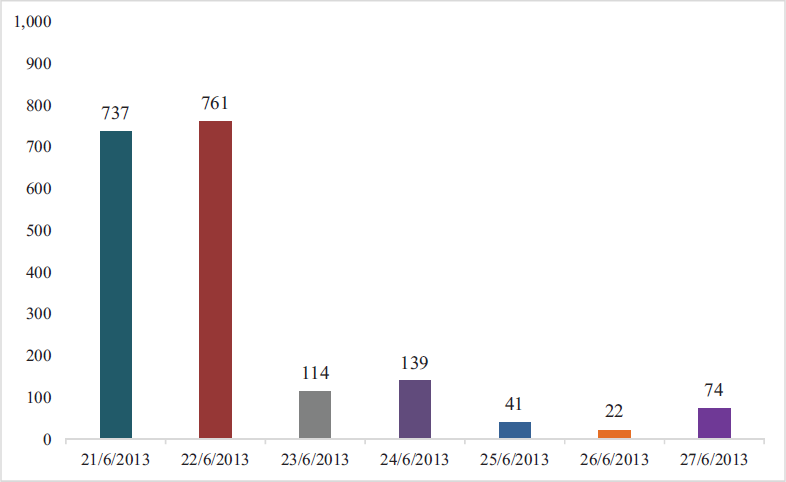
Frequency of occurrence of Weibo posts discussing the rumour about GM soybeans causing cancer, 21–27 June 2013
Beyond the internet, experts on traditional mass media platforms repeatedly denied this rumour (Figure 2). The participants in such discussions were experts and scholars from GMO-related fields of research. They debunked rumours centred on the content of the report, especially the relationship between GM soybeans and cancer.
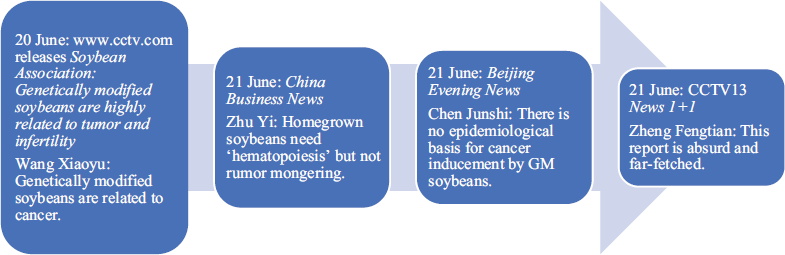
Media coverage of the ‘GM soybeans causing cancer’ issue
Online discussions coincided with offline discussions and exhibited two stages of development.
Stage 1
Before 13:27 on 21 June 2013, when www.yicai.com published ‘Expert rejects claim that GM soybeans cause cancer: Homegrown soybeans need “hematopoiesis” but not rumour mongering’, discussion on Weibo focused on whether GM soybeans are safe. A total of 286 Weibo posts were published, representing three views (see Figure 3).
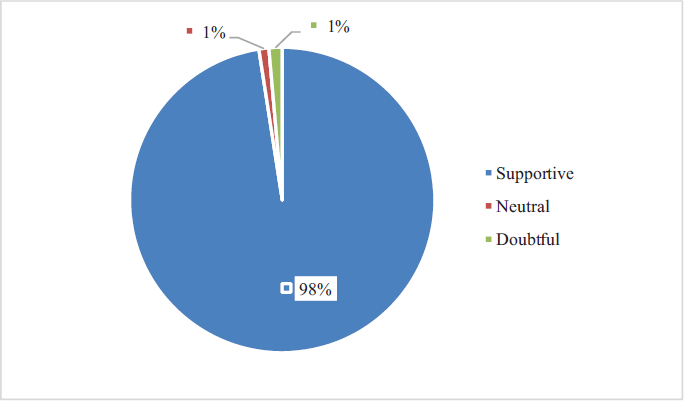
Frequency of attitudes to the claim that ‘GM soybeans cause cancer’
The largest group tended to agree that GM soybeans are indeed related to cancer (279 posts). Authors of these posts claimed that they would not eat GM soybean oil, while expressing concern about the safety of such soybean products as soymilk and tofu. However, some of these users did not explain why they believed that GM soybeans cause cancer. The second view was neutral and called for a scientific and authoritative confirmation of the safety of GM soybeans. There were three Weibo posts in this category. For example, the author nicknamed Haitian Mengzhilan asked:
Is it credible that GM soybeans cause cancer? Is there any authoritative person or department that can clearly state whether there are problems or not with GM foods, including GM soybeans and GM soybean oil? 1
The third view claimed that it was logically impossible to draw a conclusion about the relationship between GM soybeans and cancer. At the same time, these users also cast doubt on the identity and stance of the workers mentioned in the report. There were four Weibo posts in this category. For example, the author nicknamed Guyun Laoge wrote: ‘Those selling homegrown soybeans say imported soybeans cause cancer.' 2 Another author, nicknamed Mr_Felix, asked: ‘Are the people of the Soybean Association doctors or scientists? Is it a rigorous inference that GM soybeans can cause cancer? Do they put their own interests first?' 3
Stage 2
The focus of public discussion subsequently shifted to whether experts’ opinions should be trusted. After experts appeared in newspapers as rumour deniers, words such as ‘expert’, ‘academician’ and ‘scientist’ hit the sensitive nerves of the public and also affected the fragile chain of trust between the public and scientists. Some Weibo users changed their unconditional belief that GM soybeans cause cancer and asked experts to provide scientific evidence for claims that ‘GM soybeans do not cause cancer’ and ‘GM foods are completely healthy and harmless’: ‘Please come up with data and do not make subjective assumptions’ (@Management_IPO Consulting). 4 The identity of the experts and their positions and motivations for refuting rumours, as well as the decision of the government, were all under scrutiny: ‘Don't deceive people with the false skins of academicians’ (@Sanzhuogong). 5 Some Weibo users even began to make personal attacks: ‘It is totally bullshit false experts [sic]’ (@Liangjian 7258). 6
Data analysis has shown that the rumours about GM soybeans causing cancer led to emotions of pessimism, panic and anxiety among users on Weibo.
Please tell your family members and friends to keep away from harmful food. It is too terrible. GM oils used to be considered good. Alas, what else could we eat? (@Hongda Zhanpeng Decoration Design) 7
What can we do to save the world? (@Hu Ge and Wu Song) 8
In discussions among netizens, food—a necessity of life—became a risky prospect. People were afraid to bear the consequences of the risk but felt they could not escape it. In 1991, Rosnow pointed out that one of the four factors contributing to the spread of rumours is personal anxiety. On the one hand, rumours are generated and spread through the anxiety of individuals and groups; on the other hand, rumours, by expressing a mood of anxiety, subjectively ease individuals’ anxiety by playing the role of ‘emotional coordinator’. However, rumours consolidate and duplicate this emotion at the group level. Weibo users generally expressed concerns about the safety of GM soybeans and related foods.
In their linguistic expression, Weibo users often used exaggeration, exclamation and other rhetorical devices to produce sensational effects. The heated discussions on the rumour were largely due to the passion of online expressions. On the one hand, netizens lamented that they were excluded from the government's decision-making and could only passively accept what they were given. They had no say in the government's approval of the import of GM soybeans and did not even know the foods that were processed from GM crops and whether GM soybeans were safe. For example, some netizens called themselves ‘shitizens’, the victims of a China–US community of interests, the target of US ‘cleansing’ of the Chinese population, and ‘laboratory mice’ in GMO research: ‘There is no need for public experiments. Aren't the Chinese people already under in vivo experiment?’ (@Mumu's Forest 78). 9 On the other hand, netizens made the Chinese Government, represented by the Ministry of Agriculture, and the experts the objects of banter, expressing their indignation at the privileged classes of the government and authorities, which are different from grassroots citizens.
Lack and transfer of trust
Two nouns repeatedly mentioned by Weibo users in rumours about GM soybeans causing cancer were ‘the Ministry of Agriculture’ and ‘experts’. The Ministry of Agriculture was the main body that approved the GM soybeans, while experts were not only members of the group that had approved them but were also the main rumour deniers. In addition, ‘civil servants’ and ‘leaders’ frequently appeared in the discussions. In the view of most Weibo users, experts were in the same camp as the Ministry of Agriculture, the government and civil servants.
Doubts harboured by many Weibo users about experts focused on three things:
The authority of the experts: Were they authentically expert? How long had they been engaged in research on the relationship between GM soybeans and cancer, on the basis of which they drew their conclusions.
The behaviour of the experts: Did they and their family members eat GM foods?
The purpose of the experts’ denial of the rumour: Had they been tempted by offers from the Ministry of Agriculture, the government or Monsanto? How reliable were their characters and morals?
Many Weibo users believed that the experts belonged to a privileged class that distinguished itself from the public. The scientists had lost their role as spokespersons for science. One netizen said: ‘I believe in science, but I don't believe in the opinions of domestic experts (only this expert himself knows on what stance he expresses an opinion that GMO is harmless)’ (@tl0222). 10 Experts were considered to lack scientific rigour. ‘Experts, what do you offer when you say that others are baseless?’ (@RualDLZhang). 11
Weibo users lacked trust in what the experts said. They believed that it would be more convincing if experts, leaders, civil servants and officials of the Ministry of Agriculture ate GM soybeans: ‘I will believe them if the leaders themselves also eat GM soybeans’ (@hunter_luna); 12 ‘Please explain to me why the following words are written on the big plaque of the Ministry of Agriculture's kindergarten: “This kindergarten has NO GM food”’ (@bobo you and me). 13
The experts’ refutation of the rumour was regarded as an endorsement of the government: ‘Everyone knows that our country's experts serve vested interests’ (@Chengcheng 520). 14 One netizen even asked, naming one of the experts who had refuted rumours: ‘Is there anybody who knows how many benefits Zhu Yi has taken from America?’ (@Minzhuhua). 15
According to our analysis of Weibo posts, when the Ministry of Agriculture and the experts could not win the trust of the public, many Weibo users regarded European countries and the United States as a reference frame to judge whether GM foods were safe. They believed that China lacked authoritative scientific institutions, and even considered the Chinese Government ‘incompetent’, calling for international organizations to voice their stance: ‘It seems that the interpretations made by the Chinese are useless! Let's call upon the World Health Organization for help’ (@Ni Xiaoping). 16
The levelling and sharpening of rumour
The spread of the rumour that GM soybeans cause cancer embodied the mechanisms of levelling and sharpening. Specifically, the content of the rumour itself came from media reports, and most Weibo users chose to express their attitudes towards this issue by way of making simple comments and forwarding the original report. Their posts generally contained a link to the original article and used concise words to express their positions. Compared with the conclusion that GM soybeans cause cancer, the process of drawing the relationship between the two (GM soybeans and cancer) seemed less important to the public. In communication, the netizens were more easily guided by the stirring headline while ignoring the process of arriving at this judgement.
Adding information and shifting topics
Our analysis revealed that information had been added and topics had been moved during the dissemination of the rumour. The information added was mainly in two categories.
One category focused on the evidence of ‘how GM soybeans cause cancer.’ For example, there were two recurring mentions of studies in discussions. One study was by Russian scientist Alexey Surov in April 2010, which had found that the offspring of hamsters fed with GM soybeans had such problems as a falling sexual maturity rate, a reduced growth rate and loss of fertility. The other study was by the Seralini team of the University of Caen, published in Food and Chemical Toxicology in 2012. It claimed that mice fed with GM maize and Roundup-contaminated feed were more susceptible to cancer and visceral damage. However, the research institute where Alexey Surov worked yielded no information to suggest that he had done the above research, while the Seralini team's research was later retracted by the journal that had published it, and its conclusions were also considered invalid by the European Union in 2018.
A second category of added information consisted of ‘facts’ that showed that GM foods were unsafe, as inferred from related information. For example: ‘Academician, can you tell me why the food of the Olympic Games and the World Expo in our country is completely free from GM food?’ (@Hu Lantao Alex); 17 ‘How much money have you taken from others? The United States does not even allow the addition of GM materials into animal feed!’ (@Wolf Falling in Love With Sheep 1796680897). 18 Claims that ‘there is no GM food in the Olympic Games and the World Expo in China’ and that ‘there is no GM food in the animal feed of the United States’ were two rumours widely circulated on the internet.
Our data also showed a shift of topics during rumour dissemination.
First, topics related to genetic modification technology were discussed in rumour dissemination, such as the 2012 Hunan golden rice incident, which caused a major controversy in China:
Scientists who were punished in the ‘golden rice incident’ were from the mainstream research institutions, showing that some scientists are also blinded by greed! (@Often Walking Along the Seashore_12981) 19
The Ministry of Agriculture and the so-called ‘experts’ say that there is no basis that GM soybeans cause cancer. I want to say that there is of course no basis because you have done no experiment. You have used children in Hunan for the golden rice experiment. Have the Americans given you data? And, the so-called corn experiment has been rejected by the European Food Safety Agency. What the hell! (@U Still Shining After Seeing the Vast World) 20
Second, other related incidents, such as ‘gutter oil’, ‘Sudan Red’ and ‘PX’ had featured in food safety, ecological security and environmental security controversies in recent years and were frequently mentioned on social media. As Slovic (1986) noted, the experience of a major accident or risky event can enhance the public's memory and imagery of hazards, thereby improving the public's perception of risks. In the Weibo users’ posts, the following statements were notable:
We already have gutter oil. Why should we bother about GMO? (@Li Xingbin) 21
In China, there are many other carcinogens (such as toxic milk, lean meat powder, gutter oil, vitamin C tablets). But, it does not mean that GM soybeans are safe. (@Toxic tongue Xiaotai) 22
Compared with melamine and Sudan Red, GM food is the ultimate biological weapon. If it can be said that melamine destroys an industry, then GM food may destroy a regime. (@Mr.Cheng's Assistant) 23
Assimilation: Stigmatization and conspiracy theories
The rumour featured multiple emotions, including public anger, worry, fear and anxiety. The assimilation of rumours is a process of change due to personal preferences, interests and prejudices, which makes the rumour more consistent with people's cognition. This process is reflected in the stigmatization of genetic modification technology and conspiracy theories about why GM crops were introduced to China.
Stigmatization refers to the labelling of a person, region, technology or product that is given such specific attributes as abnormality, flaw, defect or unpopularity (Zeng and Dai, 2015: 24). Kasperson et al. (1988) noted that stigmatization is closely related to risk perception, which can amplify the public perception of risk. The stigmatized labelling of GMOs was achieved by emphasizing the insecurity of GM soybeans.
Our text analysis showed that Weibo users considered GMOs to be unsafe, unhealthy and dangerous and as a means for the United States to ‘cleanse’ the population of China. Also stigmatized were the Ministry of Agriculture and experts. The ministry was described as a ‘ministry for punishment and killing’ (@e Primary Meridian), 24 and critics claimed that it regarded the Chinese people as ‘laboratory mice’:
From the use of GM food, we can see the determination of the government to pursue its family planning policy. In addition, is this a trap set up by countries in the world other than China, so as to lessen the burden on the Earth? (@Snow and Ice Record) 25
Conspiracy theories thrive in the dissemination of rumours. Unlike in the controversy over GMOs in the West, one popular point of view in China's GMO controversy is that this technology is being promoted not only for surreptitious economic interests of enterprises, but also for more mysterious, malicious motives. Through this attribution, the rumour that ‘GM soybeans cause cancer’ was packaged into ‘truth’.
In the context of this rumour, the conspiracy theory had two outlooks. First, many Weibo users believed that European countries and the United States had manipulated GMO-related projects to launch financial and political wars against China and that such projects were harming China's interests. Second, they thought that genetic modification technology had been manipulated by privileged interest groups across the world to harm the interests of the lower classes worldwide. Frequently mentioned privileged groups were the Freemasons and Monsanto. China's ‘elite’ class, such as government officials and scientists, were claimed to have been controlled and driven by an international privileged class. The public thus found a ‘reasonable’ explanation for the claim that GM soybeans cause cancer. This helped exacerbate fears that GM soybeans may lead to ‘national extinction’, while the commercial promotion of the product was described as something ‘to make Chinese people wear their “sick man's hat” again’:
In the past, the bad officials of the Qing government brought opium and harm to our people. Now, the bad experts and officials in China are helping Western countries to introduce GM food to harm our people. The purpose is to eliminate our population from the Earth. (@xwtcwh) 26
As a result, the dissemination of the rumour turned into a ‘cyber carnival’. Some Chinese netizens resorted to conspiracy theories and cyber bullying against those whom they distrusted to confront Europe and the United States as well as the authoritative classes of China. This constitutes the current situation of Chinese society's ‘struggle’ against the existing social system and policies. This process is full of people's political imagination, which makes the rumour about GM soybeans develop as people have assumed it to be true and have eventually ‘assimilated’ it into their thought.
Conclusions
By using online discussions on the rumour that GM soybeans cause cancer as an example, our study used data mining and text analysis to examine the content discussed by netizens regarding the GMO rumour and the mechanism of the online transmission of the rumour.
On the matter of the rumour's content, we found that experts’ refutation of the rumour formed a dividing line. Before experts refuted the rumour, netizens generally believed that GM soybeans were related to cancer. Once the experts had stepped forward to refute it, the focus shifted to the experts’ credibility. In their discussions, netizens expressed anxiety and panic in both sorrowful and playful ways.
On the matter of the transmission mechanism, the ‘evidence’ for GM soybeans causing cancer, and other incidents related to GMOs and food safety, were ‘added’ to the rumour, which ultimately achieved ‘assimilation’ with the stigmatization of GMOs and conspiracy theories ‘explaining’ why GM crops were introduced to China.
Widespread rumours about GMOs are inseparable from a lack of public trust in scientists and the government in China. They are also related to the current social system. Communication on controversial scientific issues is often full of unknowns and worries. The lack of trust can exacerbate people's fears, risk perception, anxiety and even anger over GM crop (Griffin et al., 2008). Once the government disregards the public's right to know, it leaves the public with a negative impression. In similar subsequent situations, the public forms inductive expectations based on experience and concludes that the government is incompetent.
In addition, in China's current social system, few institutionalized channels and modes of participation are available for citizens, while such practices as information control and ‘black box’ operations have increased public distrust of institutions that manage risks (Sun, 2012). Owing to a lack of pathways and channels for citizens to participate in risk management, distrust has become a means of self-defence by the public through which people expect to enhance their ability to perceive risks (Fang, 2013).
Given those conclusions, to curb rumours and minimize their impact on the public, the public's trust in the government and scientists needs to be rebuilt by making decisions transparent, creating smooth channels for transmitting information, maximally respecting the public's right to participate and know, implementing interaction between the public and the government and scientists, and avoiding falling into the ‘Tacitus Trap’ and the politicization of social issues. A necessary step to respond to rumours is to encourage the scientific community to participate in the dissemination of correct and easily understandable information concerning, in the case of this rumour, GMOs.
Funding
The study was supported by the Science Popularization and Risk Communication of Transgenic Biotechnologies project (grant ID: 2016ZX08015002).
Footnotes
All Weibo posts cited could be accessed on 10 October 2019.

Author biographies
Sujia Jiang is a lecturer at the School of Public Administration and Communication of the Beijing Information Science and Technology University. Her research interests include science communication and new media.
Wei Fang is a lecturer at the School of Public Administration and Communication of the Beijing Information Science and Technology University. Her research interests include new media and society.