



Abstract
The rise of studies on the culture of science at the beginning of the 21st century in China is not merely an extension of studies on the split between scientific culture and the culture of the humanities, which stemmed directly from the introduction of CP Snow's thesis into China, but also a consequence of the re-meeting, conflict and fusion of Western and Chinese cultures since the 1980s. From the perspective of cultural conflict and cultural integration, the author examines the development of studies of the culture of science and some resulting academic tensions over the past 20 years. He points out that the new direction of contemporary Chinese culture lies in the promotion of the culture of science, which is, together with the building of a culture of innovation to make the economy more prosperous, aimed at the promotion of national intelligence.
Keywords
In the past 20 years, studies of the culture of science have become a multidisciplinary research project involving scholars from such disciplines as the history of science, the philosophy of science, science and technology management, science communication (the popularization of science) and other fields. The task of developing the culture of science, as a related social practice, has progressed with support from the China Association for Science and Technology (CAST), the Chinese Academy of Sciences (CAS), the Ministry of Science and Technology and other government departments. Research groups and institutions have been founded in several universities and national research institutions, and ‘professional committees on the culture of science’ have been established within the framework of the Chinese Society for the History of Science and Technology, the Chinese Society for Dialectics of Nature, and the Chinese Association for Science of Science and S&T Policy. It is expected that a national research society for the culture of science will be founded in the near future.
This paper discusses the development of studies of the culture of science from the perspective of collision and fusion between different cultures. Since the 1980s, the re-encountering and re-collision between Western culture and Chinese culture—between exotic cultures and the local or traditional culture— have caused a new process of cultural integration and amelioration in which promoting the culture of science has played an essential role and has become a remarkable new direction of cultural development in contemporary China.
The initiation and publication of the English-language journal Cultures of Science gives us an opportunity to review the researches and practices conducted by Chinese scholars on the culture of science in the past 20 years, to discern their different approaches and to predict the future development of the discipline.
Promoting the culture of science: A new direction of cultural integration between Chinese and Western cultures at the turn of the 21st century
The term ‘scientific culture’, with a culturological meaning 1 , was introduced into contemporary Chinese academic thinking along with CP Snow's thesis (Chen and Liu, 1987) 2 . Snow described opposing phenomena among Western intellectuals as:
the opposition between the sciences and the humanities, or between scientists and humanists
cultural division and confrontation between the ‘scientific culture’ and the ‘traditional culture’.
He argued that the integration of the two cultures was an urgent, worldwide problem demanding resolution.
In Snow's thesis, ‘traditional culture’ refers to the culture of the humanities, which had, at least until the time he wrote, occupied the dominant place in the intellectual history of the Western world. Some readers might intuitively understand that Snow's thesis is one of opposition between the scientific culture and the culture of the humanities, but would find on second thoughts that scientific culture, as he implied, originated from and developed in Western traditional culture, and subsequently replaced the culture of the humanities and became the core of the whole Western culture. The future of Western culture, he believed, depended upon the integration of the two cultures. In fact, Western humanist intellectuals had foreseen the substitution and began to lament it as early as mid-1900s (Gaukroger, 2006, 2016).
Snow's thesis focused on division and integration within Western culture. However, differing from Snow's thesis to some extent, Chinese thinkers have been concentrating on approaches towards the reformation and renaissance of Chinese society and culture during the massive collision between Western and Chinese cultures. Similar thinking appeared as early as the turn of the 20th century. Domestic cultural and ideological barriers were weakened as a consequence of China being forced to open its doors to the world at the end of the 19th century and the ‘reform and opening-up’ policy from the 1980s. A movement of emancipation of the mind and a deep cultural collision and fusion inevitably followed.
During the first round of cultural collision, as China struggled for national salvation, Chinese thinkers sometimes had to consider ‘cultural salvation’ and think about the necessity and possibility of ‘enlightenment’ in Chinese society. They usually considered Western culture as a whole and saw science as only an instrumental component of it. Few people were willing to scrutinize the value and meaning of the culture of science from the perspective of the ontology of culture; that is, to consider science as a culture and Western culture as its background. 3
It is well known that the urgency of ‘salvation’ outweighed ‘enlightenment’ during the subsequent historical process. Chinese thinkers began by comparing Chinese and Western societies and cultures, and then sought a possible approach to the salvation of their nation involving three steps:
intensively criticizing traditional Chinese culture
initiating the strategy of learning skills and advantages from foreigners in order to counteract them
and, when that did not work, thoroughly adopting the Western form of social organization.
To these thinkers, whatever their differences, science was undoubtedly a necessary tool.
Many apologists for traditional Chinese culture and critics of Western culture held a countervailing view. The former declared that science could not solve problems of the philosophy of life based upon traditional cultural resources, while the latter brought into China the nihilism, anarchism and pessimism that emerged in Western culture at the end of the First World War.
In the 1980s, China began a process of ‘reform and opening up’, which accelerated both the modernization of China and the collision between Chinese and Western cultures. While advocates for the humanities recalled and praised the spirit of Chinese literati as ‘bearing justice with our unyielding shoulders, composing literature with our smart minds’, scholars specializing in the history and philosophy of science spoke of ‘illumining ourselves with the light of science’.
Guided by the principle that ‘practice is the only criterion for truth’, the sciences and humanities resonated harmoniously and greatly invigorated the intellectual life of Chinese thinkers and scholars. Based on that resonance, the process of the re-institutionalization of both the sciences and the humanities was restarted. It was carried out in line with international standards and strongly led and supported by the government. However, the method of teaching courses of science and humanities separately and the unbalanced distribution of resources during re-institutionalization (science was appreciated, while the humanities were depreciated) worsened the split between the two. The phenomenon described by Snow began to emerge clearly, and his thesis on cultural division and integration gradually caught the attention of both academics and the government.
Discussions on Snow's thesis and related cultural phenomena in China had stipulated a need for studies of the culture of science. However, the overall rise of studies of the culture of science was caused by a second round of cultural collision and integration after the 1980s. In this sense, we can say that discussions of Snow's thesis themselves constitute an aspect of the cultural integration mentioned above.
It is commonly known that China's communication with Western cultures was blocked for decades because of the Cold War and the ‘Cultural Revolution’. After communication was re-established in the 1980s, Western cultural resources poured into China and became essential tools for Chinese intellectuals and thinkers working to reconstruct culture in the late 20th and early 21st century.
Cultural conflict and fusion in the new century has been very different from a century ago.
First, these waves of cultural conflict and subsequent cultural evolution were guided and controlled by China's mainstream ideology, which was far beyond the power or even the imagination of the government a century ago. When reflecting on the ‘salvation of the nation’ mission, which was accomplished in the first half of the 20th century, a clear conclusion can be reached. Although the Western principles and values of science, democracy and freedom were used in the national salvation movement and played a positive role, the fundamental power of ‘salvation’ was twofold:
social revolutionary theory (most importantly, Marxist revolutionary theory)
the unified belief of the Chinese nation and the unified pattern of organizing and operating society, which was shared by both the Communist Party of China and the Kuomintang and is still effective today.
With the proposal of such concepts and terms as ‘science and technology are the primary productive forces’, ‘science and technology innovation’, ‘innovation-driven’ and so on, the ideology of social revolution has gradually changed into a science and technology revolution.
Second, the cultural conflict of the last century happened between a premodern China and a modern Western world. This time, the cultural conflict was between a continuously advancing and modernizing China and a postmodern Western world. Chinese intellectuals and thinkers met the tide of postmodern Western thought without a deep understanding of logical empiricism and modernity. However, the experience of Western modernity is critical for China's development, which was hard for Chinese intellectuals and thinkers one hundred years ago to contemplate and absorb due to historical limitations and the urgency of national salvation. The lack of continuous and deep understanding of the history of Western academic knowledge, thought and social culture means that Chinese researchers and scholars must gain that understanding of a long history in a short period of time.
Third, with the rapid development of its economy, China at the turn of the 21st century could no longer be seen as the weak and poor country of a hundred years ago, yet the ‘reform and opening up’ policy did not promote China's cultural development as well as its economic development. The contrast between development in the economy and in the culture highlighted a serious lag in cultural renewal. On the one hand, the pace of ideological liberation was slowed and political reformation never started; on the other hand, bureaucratism and money-worship in the society seriously affected its cultural development.
In those circumstances, what were the opportunities for cultural progress? With the gradual replacement of political revolution by the scientific revolution and with the Chinese Government establishing the goal of building an innovation-driven country, the task of fostering a culture of innovation was now on the agenda. The culture of science, as one of the most innovative cultures, drew much attention from the government, scholars and the public. If we say that we are building a culture of innovation in order to develop the economy, then we can say that we are promoting a culture of science, or a scientific culture, in order to promote social intelligence. Only on the basis of a solid culture of science can we expect a real modern culture to be established. The culture of innovation and the culture of science demonstrated this new direction in China's cultural development at the turn of the 21st century.
In 1998, the CAS launched the Knowledge Innovation Program and initiated and promoted the construction of a culture of innovation in the whole CAS and all individual institutes. Guo Chuanjie, who was then the deputy party secretary of CAS, was personally in charge of the scheme's design and the whole process. In 2002, CAS started to support studies of the culture of science. The Science and Culture Research Group was established in the Institute for the History of Natural Sciences (IHNS, CAS) by Professor Liu Dun, a research fellow and the director of IHNS, and was upgraded to the Science and Culture Research Center in 2010. In 2003, Science & Culture Review, China's first journal specializing in the culture of science, was established under the supervision of IHNS and the Bureau of Policy of CAS. The joint chief editors were Liu Dun and Cao Xiaoye, who was then the director of the Bureau of Policy and deputy general secretary of CAS.
Shortly after the establishment of the Science and Culture Research Group, Professor Liu Dun stated in an interview that research on scientific culture was an open academic field, and that there was a national demand to carry out related research. On the question of ‘What is a scientific culture’, Liu said that it was better not to give a definition, but that if he had to, he would prefer Snow's definition of ‘two cultures’, even though that definition had caused a lot of criticism in academia (as cited in Xiong, 2003). In 2003, when Science & Culture Review was first published, it was given a twofold mission by the co-editors:
to encourage Chinese intellectuals to focus on various scientific–cultural phenomena in China and around the world, and to guide Chinese culture towards ‘disenchantment’ and a rational development path (Liu, 2006)
to push forward the construction of the scientific culture within Chinese science and technology circles, to enhance the autonomy of science and to counteract the erosion of science and technology by bureaucracy and money-worship.
In 2007, CAST extended its focus on the development of the culture of innovation to the culture of science. It initiated a series of large projects related to research on the culture of science and the construction of that culture, including projects titled ‘The Disciplinary History of Science in China’, the ‘Scientist Academic Growth Data Acquisition Program’, the ‘Study on Scientists’ Academic Genealogy in Contemporary China' and ‘The Culture of Science Translations’. These projects aimed at publicizing the history and current status of science and scientific culture in China, as well as promoting the construction of the culture of science. Several leaders of CAST, including Han Qide (former chairman), Wang Chunfa (former director of the Department of Research and Publicity and Secretary of the Secretariat), Shen Aimin (former director of the Department of Academic and Social Affairs), and Luo Hui (former director of the China Research Institute for Science Popularization, or CRISP), have been focusing on and devoted to the design, organization, coordination and administration of the projects.
In 2015, CRISP first introduced the concept of ‘culture of science’ used by the Organisation for Economic Co-operation and Development and in the United Kingdom, Canada and other countries, and used the term to denote traditional ‘science popularization’ studies and construction activities. Scholars specializing in the history of science, the philosophy of science and the sociology of science and technology, together with about 200 societies directly affiliated with CAST, participated in the research work in the large-scale projects organized and conducted by CAST. In 2017, CAST began to consider integrating the platforms for research on the culture of science, launching publications on the culture of science and leading studies of the culture of science towards a new stage of institutionalization.
In the past 20 years, studies of the culture of science have gradually developed into a notable academic field, and the construction of the culture of science has also grown into a highly significant social practice. In retrospect, we can say that the emergence of studies of the culture of science and related practices in contemporary China has not been a planned cultural renovation movement implemented after a top-level design was completed by theorists. Instead, leaders and scholars from multiple departments and fields have been involved and have introduced different ideas and proposals on the subject of cultural reform.
This has led to some tensions in the academic community, rather than to one common consensus. For instance, when people rethink the division of scientific and humanistic culture (in other words, Snow's thesis), there is general agreement on communicating the sciences and humanities, but a division between two groups of scholars promoting the scientific spirit and opposing scientism. Thinking about the rejuvenation of Chinese culture based on the rapid development of the economy, scholars stepped beyond instrumentalism and began to realize that the construction of the culture of science is the goal of social development rather than a tool to achieve economic innovation. However, at the intersection of all aspects of communication and collision between the Chinese and Western cultures, and facing the real problem of how to evaluate traditional Chinese culture and Western culture, there still are deep differences and even radical conflicts between various scholars' ideas and corresponding schemes of cultural construction. In summary, contemporary research on the Chinese culture of science is far from entering the stage of what Thomas Kuhn called ‘paradigm’ research, and perhaps an agreed ‘paradigm’ will never appear. Researchers and practical participants with different positions or from different perspectives form an academic union full of tension, but not an academic community following a common paradigm.
An examination of the following three questions will help us to grasp the basic contours of the research and practice of contemporary Chinese culture of science, and to discern the positions of the academic groups holding different views and the strategies they adopt.
Views on science: To promote the scientific spirit, or oppose scientism in contemporary China?
All China's political leaders in the 20th century had positive attitudes towards science, so the theme of saving and rejuvenating the nation with science played out throughout Chinese society. Unfortunately, few scholars systematically and completely studied the historical process of the transplantation, transmission and reconstruction of the culture of science in China, as well as its practical role in China's social revolutions and national development in the 20th century. Most scholars today believe that, in a society or a culture, appreciation of science and technology will contribute to the foundation and development of science and technology and will help to realize the goal of modernization.
In analyses of the basic attitude of Chinese society towards science in the 20th century, Guo Yingyi (1990), a scholar abroad, labelled it ‘scientism’. At the beginning of the 21st century, some Chinese scholars followed Western postmodernists' criticism of science, raised the banner of ‘anti-scientism’ and made a wide range of academic declarations through new media.
Western postmodernists' critique of science and technology originated in Europe after World War II. The criticism concentrated on ‘the negative effects of science and technology or modernization’, and interpreted modern science after Francis Bacon as ‘power-orientated science’ and Bacon's argument that ‘knowledge is power’ as a betrayal of Socrates' declaration that ‘knowledge is virtue’. Moreover, in some extreme views, Newton's Mathematical Principles of Natural Philosophy (Philosophiae Naturalis Principia Mathematica) was called ‘Newton's Rape Manual’, which fully embodied the hostility of such thinkers against science, technology and modernization. A few Chinese scholars also followed this idea and understood science as the opponent of the humanities. They focused on the inevitable negative effects of science and technology in their social application and were more radical than the early 20th century thinkers who had declared that ‘science could not solve problems of the philosophy of life’ during the controversy over science and Chinese metaphysics. They denied the role of science and technology in modernization, and modernization itself, and even the idea of ‘Mr. Sci’ (science) promoted after the May 4th Movement (the New Culture Movement, 1915–1923).
We will not discuss here whether Western ‘anti-scientism’ has been favourable in the development of Western society. Instead, we must explore whether or not this trend is appropriate to the whole society and culture in contemporary China. In his later years, Gong Yuzhi discussed this issue in successive works. He made a clear critique of Guo Yingyi's interpretation of China's ‘appreciating science’ as ‘scientism’ in the first half of the 20th century. In his comments on the May 4th Movement, Gong (2004) pointed out that ‘the “May 4th Movement” is not what some called “scientism”, instead, it is a new culture movement introducing scientific ideas and renewed humanistic concepts such as morality, politics, marriage, family, literature and arts.’ Also, he noted that the outbreak of the ‘war on science’ showed that Western postmodern ‘science studies’ did not function to integrate the two cultures, but further enlarged the gap between them. When discussing the need to oppose ‘scientism’ in contemporary China, Gong (2004) made it clear that modern science has no original sin, and that ‘it is not timely and appropriate to interpret “anti-scientism” in China (especially on the level of popular culture) as a fashion.’
In Gong's assessment of the May 4th Movement, he examined not only the values of science and technology in productivity, but also their values in culture and human spiritual life. Indeed, Chinese Marxists believe that ‘science is the decisive force in human history’; and China, after ‘reform and opening up’, has proposed the argument that ‘science and technology are primary productive forces’. However, this does not mean that Chinese thinkers have no idea about the spiritual values of science and of the culture of science. We know that science has been used as a flag of the Enlightenment by many thinkers in the Western history, yet it has not surprised the world by its material power but by its endogenous spiritual power. In earlier times, Newton's Mathematical Principles of Natural Philosophy also greatly shocked Europeans by its break with the framework of traditional thinking and world outlook. Science, with its inherent brilliance, inspires people to open up a new era of cultural development. Just as Herbert Butterfield noted in The Origins of Modern Science, the emergence of science cut off the link between the Christian West and the ancient Graeco-Roman tradition. In Asia, it also led to the disruption and innovation of Japanese traditional culture and became a vital motivation to create a new culture:
The result was the emergence of a kind of Western civilization which when transmitted to Japan operates on tradition there as it operates on tradition here, dissolving it and having eyes for nothing save a future of brave new worlds. It was a civilization that could cut itself away from the Graeco-Roman heritage in general, away from Christianity itself, only too confident in its power to exist independent of anything of the kind. (Butterfield, 1966; 2017)
Although modern science and the culture of science originated in the West, they were not born with specific innate attributes of national or religious identity. While science, as it matures and functions in a specific culture, is inevitably branded with the specific characteristics of that culture, it also has the ability to transplant, transmit and reconstruct across cultures, religions and civilizations. Therefore, if we explore this question to its essence, we will discover that science, together with the culture of science, is by its nature a universal culture accepted by all forms of modern societies.
Views on the traditional culture: To take the path of disenchantment, or to update Confucianism?
Snow used not only the phrase pair of ‘scientific culture and humanistic culture’ to describe his thesis, but also the phrase pair of ‘scientific culture and traditional culture’. Chen Fangzheng, a retired professor from the Chinese University of Hong Kong, once linked the derivation of scientific culture from traditional culture in Snow's thesis with the ‘Achsenzeit [Axial Age] breakthroughs’ thesis proposed by Karl Jaspers, and explained the so-called ‘breakthroughs’ by citing the emergence of the scientific and rational culture from the traditional culture. Chen noted that Jaspers endowed ‘spiritualization’ with great importance, but that that did not conform to the real situation in the modern or ancient worlds. It is true that Confucianism in the East and Christianity in the West were once regarded as the backbone of individual, family and social lives. Nevertheless, the technology used in such fields as textiles, farming, handicrafts, smelting and construction was an indispensable factor in advanced civilization both before and after the ‘Axial breakthrough’. Chen (1999) also believed that we are now living in a new ‘Axial Age’, in which the culture of science plays a leading and opening role:
The painful cries of philosophers and writers like Camus, Marcel and Marcus, who were popular in the 1950s and 1960s, have become increasingly silent today, and will soon come to a rest. This may be regarded as the best proof of the fact that the ‘Classical Axial Age’ is coming to an end and being replaced by the ‘New Axial Age’ dominated by technology.
Rethinking traditional Chinese culture from the perspective of the dynamic relationship between scientific culture and traditional culture, scholars are suddenly confronted with acute questions, which may lead to opposing answers: Is Chinese traditional culture rich in innovative spirit? Is it a culture rich in openness? Was there science in ancient China? Is Yan Fu's proposition of ‘opening people's wisdom’ wrong? Can developing ‘Neo-Confucianism’ in the new era provide an ‘Archimedes’ supporting point' (a fulcrum) for a ‘great renaissance of Chinese culture’?
Scholars who love or even idolize Chinese traditional culture may give positive answers to those questions and support their views by enumerating examples followed by rhetorical questions:
The ‘four great inventions’, as well as advanced technologies for agriculture and irrigation, were developed in ancient China. Can we say there was no innovation in ancient China?
Historically, Chinese culture showed a strong assimilating force towards invaders from less civilized neighbouring territories. Did not this compatibility reflect openness?
Joseph Needham, together with Chinese historians of science, wrote the multivolume book Science and Civilization in China, proving that the development of science and technology in ancient China was far beyond that of the Western world. Can we say there was no science in ancient China? If the answer is yes, how should we explain the emergence of the Chinese calendar?
The theory that Western ideas (somehow) originated in China emerged as a choice of historical agents. Why do we have to label it as a self-deception?
Confucianism has been the essence of Chinese traditional culture. It is inherited from the ancient sages and has experienced several phases of modification, from Han Confucianism during the Han Dynasty, to Song Confucianism during the Song Dynasty, to Neo-Confucianism at the beginning of the 20th century and to New Confucianism today. It will continue to change with time. How can we say that it cannot become popular again?
Supposing the above analysis is reasonable and right, then why did the first generation of Chinese scientists, such as Ren Hongjun (1915, 2014), claim that ‘science’ had not existed in ancient China? The answer is that they adopted precise conceptual and scientific ways of thinking, which in Crombie's terms (1994) can be interpreted as follows: there will be no subordinate concepts of science disciplines if there is no science as their supreme concept. The astronomical calendars of ancient Egyptians, Babylonians and Chinese were not considered as ‘a subject of science or natural philosophy’ because there were no such things as ‘science’ or ‘natural philosophy’ that contained different disciplines as their branches.
Yet the situation was different in ancient Greece, where there was a concept of ‘science’ (natural philosophy) being the supreme concept, together with a relatively independent commitment to nature, science and human reason. Similarly, the ‘logic’ underlying the famous argument that ‘a white horse is not a horse’ made by the ancient Chinese thinker Gongsun Long is far from the logic of Aristotle, since it does not distinguish the superior concept ‘horse’ from the subordinate concept ‘white horse’, and the argument would be logical only when considering the ‘horse’ and ‘white horse’ to be on the same conceptual level. There is no doubt that modern science was not born in ancient Greece, or in the pan-Hellenistic period, but the natural philosophy of Greece is the direct ancestor of later science. Research on the history of science has proved that the works and methodologies of Archimedes were directly connected with later science. Archimedes went beyond the category of ‘knowledge by proving’ outlined by Aristotle and started to use experimental exploration as a critical tool for scientific discovery. While Aristotle gained ‘knowledge by proving’ through the deduction of axioms and acknowledged that experience contributes to the formation of axioms, he attached importance only to observations, rather than to experiments. It is almost impossible to establish a systematic science (or natural philosophy) knowledge system without systematic, logical thinking and clear conceptual patterns.
In China's history of more than 2,000 years since the establishment of the Qin and Han dynasties, Chinese sages concentrated on the rises and falls of the dynasties and the governance of the people, instead of devoting their intelligence to the study of nature. That is why ancient China gave birth only to the knowledge framework of Confucianism, but not to the division of knowledge between natural philosophy and social philosophy. Knowledge of the world, production and life, which is developed under the pattern of practical knowledge, is scattered in the Chinese knowledge structure of classics, histories, sages' works and collections and has never really been integrated into a relatively independent knowledge system about nature.
Will a wisdom-loving philosophy be able to form within the framework of Confucian knowledge of ‘classics, histories, sages’ works and collections'? The answer is negative. As the saying goes, ‘One can govern the world by part of the Confucian Analects.’ What was really generated under Confucianism was a methodology of governance at all levels (individual, country and the land under heaven), which specifically served the imperial power. That is, in the past 2,000 years, Confucianism ‘civilized’ or, in other words, ‘domesticated’ people, yet never played the role of ‘opening people's wisdom’ proposed by Yan Fu.
China has produced several varieties of Confucianism, such as Han Confucianism, Song Confucianism, Neo-Confucianism (represented by Mou Zongsan in the early 20th century) and Neo-Confucianism (represented by Li Zehou after the 1980s). However, China is in a world system that is dominated by the United States today, instead of merely in the Chinese-character cultural circle or the Chinese agrarian empire system. The value and ethic system embodied in Confucianism is to serve the imperial power, to worship the sages (without a critical spirit) and even to keep the public in the dark, with an intellectual orientation that emphasizes governing people and neglecting the natural philosophies. Those values and ethics have never gained support among other civilizations outside the Chinese-character cultural circle, and are even not universally accepted by the Chinese public today. You may know the answer to this question: Is it possible for contemporary Europe to have another Renaissance by relying on Christian teachings? Never!
Zi Zhongyun (2008, 2015), a scholar who really understands Western civilization and American culture, has discussed the topic of ‘re-enlightenment’ many times. She has pointed out that:
‘re-enlightenment’ is needed in self-saving and national salvation, regardless of ‘Westernization’ or other external pressure. The rejuvenation of the national spirit may be possible only after efforts of several generations by constantly extending the gap of cultural despotism, making every effort to do solid work of enlightenment from the gaps, and inheriting the unfinished work of the past hundred years. (Zi, 2015)
Contemporary China is pursuing modernization, while Western culture is seemingly entering a so-called ‘postmodern’ era. The term ‘scientism’ was once neutral in modern Western culture, but gradually changed into a completely derogatory term in postmodern Western thought.
Suffering from two world wars, Western intellectuals greatly weakened the belief in science and the culture of science that they had used in the past when reflecting on historical processes. The book How Superstition Won and Science Lost by John C Burnham included a comprehensive study of the history of science popularization in America. Burnham described the phenomenon of ‘science men’ in contemporary American society retiring from their careers and the impacts of that phenomenon: science and the scientific culture, which had led to the rational development of American culture, had to make way for modern forms of superstition and mysticism after encountering the American consumerist culture. ‘Science men’ were demonized or even forced to retreat to the level of the common culture, and the result was that the culture of science was defeated by superstition in the commercial and popular cultures (Burnham, 2006).
Many postmodern thinkers lack a deep understanding of the history of science. They attribute the drawbacks in modern society to modern science, accuse modern science of being ‘power-orientated science’, and think that the success of Western modernization is a triumph of freedom and democracy. Neo-liberalism prevailed in the United Kingdom and affected national policy in the Thatcher era (1979–1990), and the British scientific community underwent a reversed institutionalization. More than 30 university departments of science (such as physics or chemistry) were merged or downsized, and it was not until the beginning of the 21st century that the United Kingdom began to correct neo-liberal science policy. Although postmodernism still has a strong influence in human thought today, a fundamental fact remains clear: all governments, all over the world, are looking at science from a positive perspective and are considering science and technology as the foundation of their nations and the basis for development.
In the second form of Snow's thesis, the culture of science is the innovator of the traditional culture. Butterfield also argued in The Origins of Modern Science that the culture of science has a resolute and decisive power and keeps melting down old traditions and building up new ones each time it enters a new culture. When we consider the beginnings of Western modernization, we can see that the culture of science both integrated with and fought against the religious culture that dominated at that time. When science met religion, there occurred a process of fusion that we might, together with Reijer Hooykaas (2000), call ‘the Christianization process of science’. This was demonstrated not only by the legitimation of natural theology within the religious system since the beginning of the age of the scholastic philosophy and the development of natural philosophy, but also by the fact that the experimental philosophy of the Royal Society was built on the ‘voluntarism’ concept of God and the corresponding theist cosmology in the 17th century.
However, the fusion between science and religion did not conceal an irreconcilable fight between them. The fight was embodied not only in Galileo's call for the separation of natural philosophy and theology, but also in the Enlightenment and the secularization of Western societies, which we might call the ‘de-religion process of the culture of science’. The Enlightenment was not only what Kant called the awakening of individual consciousness in Western societies and the consequent initiating of self-determination by reason, but also a historical process in which the culture of science led the Western humanities and social sciences towards systematic construction or reconstruction. During that process, a new system of mainstream values or ideology was formed in Western culture, and the freedom, democracy and rationality of humans replaced the traditional god-orientated value system. It became fully institutionalized and won unified social recognition. The rapid development and wide spread of the culture of science directly triggered the ‘rupture of epistemology’ and the ‘rupture of axiology’ (terms used by the French philosopher Gaston Bachelard), and opened the door for the modernization of the West.
From a longer historical perspective, it can be seen that classical Greek culture completed the integration of the ideological achievements of the first generation of human civilizations (Babylonian, Egyptian, Persian and Indian), which, to a great extent, was attributed to the efforts of the early sophists. When this process finished, rationalist philosophy, with the successive efforts of Socrates, Plato and Aristotle, developed rapidly into a comprehensive ideological system with natural values and social values, and with consistent methodological principles and knowledge standards, which became the intellectual basis for various cultures to carry out further integration. In his description of the ‘axial breakthrough’ concept, Jaspers did not have an insight into the completeness of Greek culture in the orientation of value. Instead, he mentioned only generally that each civilization in Eurasia generated its own saints and established its own values of pursuing supreme goodness beyond individuals, which, in Mencius's words, was described as:
Chasing what is worthy of chasing is called as being of virtue, embracing virtue is called as being faithful, enriching oneself by virtues is called as being beautiful, enriching oneself by virtues and radiating the light of virtue all around is called as being magnificent, being magnificent and influencing all living things is called as living as a sage, and living as a sage beyond description is called as existing as a god. 4
The value system of Greek culture had a special orientation that other civilizations did not emphasize, which can be referred to as the ‘Prometheus orientation’. This is a pursuit of value pointing to nature, as demonstrated by the description of the two geneses in Plato's Protagoras: Prometheus brought wisdom and fire to mankind in the first genesis, and Zeus instructed the messenger Hermes to give humans virtue in the second genesis. Therefore, Socrates concluded that ‘knowledge is virtue’, and Aristotle developed a system of disciplines with a unified knowledge standard that integrated almost all the existing knowledge at that time, including knowledge of human society and natural philosophy.
We can see that the European thinkers who contributed greatly to the Scientific Revolution in the 16th and 17th centuries, such as Francis Bacon and Isaac Newton, did not forget their moral duties. Bacon emphasized that the solution of moral philosophy problems should be based on natural philosophy, and Newton even explicitly expected that the moral philosophy of human beings would also be carried forward with the perfection of natural philosophy.
When we focus on the history and development of the culture of science, it is necessary to see it from a long historical perspective, instead of limiting ourselves to the interpretations of postmodern Western thinkers since World War II. The development of each civilization is not linear: the rise of cultures is supported by the rise of rationalism, and the decline or decay of cultures is always accompanied by nihilism, relativism, irrationalism and anti-scientism.
The true value system behind the culture of science is undoubtedly inclusive of faith, the pursuit of truth and the pursuit of the supreme good, but most advocates of the culture of science do not apply their propositions about truth to solving the problem of good and evil, do not declare that science is omnipotent and can resolve all the problems facing mankind, and do not even exclusively praise the spirit of rationalism. Science is a human cause: scientific creation is not possible without passion, scientific exploration cannot be conducted without will, and science will not continue to succeed without an insistence on rationality.
From the author's perspective, there are three forms of humanism: emotion, will and reason. In the emotional dimension, humanism was developed in the European Renaissance, when artists and writers took pioneering paths and when new poetry, paintings and sculptures with both ethnic style and Roman sentiments appeared. In the dimension of will, the Protestant Reformation demonstrated humanism by promoting the dignity, status and freedom of thought of human beings, and everyone could think by directly facing the Bible and God. In the dimension of reason, the Scientific Revolution and the ensuing scientific culture manifested humanism, but were not in opposition to the other dimensions. The stars in the sky and people's desire for freedom are not opposites.
It is often said that freedom is the way to science, and, conversely, it is also true that science is the way to freedom. For example, the Renaissance and the Reformation broke with traditional values, but the final blow to the medieval Christian cultural value system came from the Scientific Revolution, which shattered the medieval ‘crystal celestial sphere’ and the values that inhabited the cosmic landscape.
A four-quadrant description of the culture of science
To understand and define the culture of science, it is necessary to systematically summarize, generalize and refine its development from the perspective of a long history. Even though modern science originated in Western culture, its culture has permeated all human cultures since then, and has been imprinted by local cultures after being integrated into them. In addition, the modern culture of science has a distinct Greek cultural origin, which indicates that its rise has involved the reaggregation and reintegration of human civilizations and material achievements accomplished by the Christian community on the Mediterranean coasts ahead of the rest of human society.
Here we try to redefine the culture of science with a four-quadrant description (see Figure 1). Above the horizontal axis is the real science and below is the ideal science, while on the left of the vertical axis is the lowercase and plural form (cultures of science, integrating with local cultures), and on the right is the uppercase singular form (the Culture of Science).
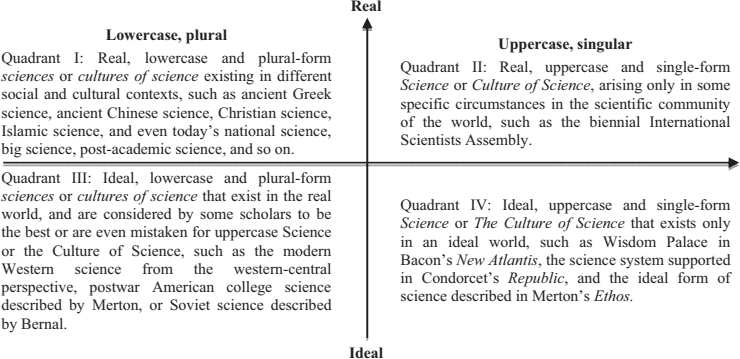
A four-quadrant description of the culture of science.
The modern culture of science operates against the background of global culture, and its dissemination carries the value system of its background culture and may arouse rejection or unease in receiving cultures. However, the overall journey of the culture of science in Western culture (the Christianization and later de-religionization of the classical Greek scientific and rational culture) tells us that the culture of science always pursues its own intrinsic value: it points to and serves the whole human being, whose true connotation is the spirit and value of internationalism. Therefore, we cannot deny the significance of the ‘ideal’ image of Science or the Culture of Science even when we note that sciences or cultures of science in different sociocultural contexts are always closely related to or even restricted by specific local cultures and values. Just as shown in Merton's studies on the sociology of science, the values and norms (the ethos) of science will be internalized in the inner worlds of scientists along with the institutionalization of science, and guide and regulate their scientific activities and behaviour. To put it simply, if the concept of this ideal form is excised from scientific culture, lowercase cultures of science associated with particular local cultures can no longer be assembled together as holistic objects of our study. Moreover, the more we apply the long historical perspective to observations of the history of science or culture of science, the more we can see that the light of the ideal Culture of Science lies within all forms of the lowercase cultures of science.
Postmodern researchers on the culture of science require people to focus on sciences and cultures of science in the real world, reject all forms of positive ontological thinking and deny the existence of intrinsic consistency between the various lowercase cultures of science. However, that will result only in the disintegration of the whole discourse on the culture of science, remove the possibility of analysing different cases in history or reality based on a precise conceptual framework, and reduce the academic value and practical significance of the results of our research. The communication of the culture of science may thus become the dissemination of ‘anti-scientific’ culture, manifesting either as an unrestrained cry or a vain groan that supposedly ‘defends’ the free will of humans or as an ethical sermon that makes ‘political correctness’ supreme and ignores the history and the reality, and eventually leads to a contradiction between belief in science on one side and belief in freedom and democracy on the other, and an even more violent conflict between scientific culture and humanist culture.
The renaissance of culture does not mean the restoration of ancient traditions. The Western Renaissance did not lead Western society back to ancient Greek culture. The essence of renaissance lies in the use of all cultural resources to create a new culture, and that is also applicable to the rejuvenation of Chinese culture.
In that sense, this paper holds that the culture of science is the growing point and new direction of contemporary Chinese culture. In contemporary China, rather than developing a new Confucianism, the most urgent task is to construct and promote the culture of science in order to promote the development of science, technology, innovation and national rationality. This will allow the broader culture to break away from money-worship and bureaucratism and stay on the road of reform and opening up in the development of society and culture. It is also a long-term plan for a real renaissance of Chinese culture, a wide awakening of the sense of national rationality, and the related values reconstruction project. When Chinese culture goes to the world, we need to respect the independent value systems of different civilizations and value islands, and to bring about communication and understanding between different civilizations using the culture of science as a bridge.
Studies of the culture of science continue to demonstrate a highly discrete pattern in contemporary China; all kinds of sub-academic approaches coexist, and the academic interactions among them are still very inadequate. In China today, studies of the culture of science face many academic issues and many topics need to be explored, such as the history of the Chinese culture of science since the middle of the 19th century, the history of Western or global cultures of science, the critique of the postmodern culture of science criticism, the re-examination on Snow's thesis, the development of the culture of science in the global cultural integration picture, the construction and communication strategies of the contemporary Chinese culture of science, and, above all, the transplanting, rebuilding and cultivating of a great tradition of science.
Today, for the first time, Chinese intellectuals have walked out from under the weight of hundreds of years of humiliating history. They are pondering the future development of Chinese and world culture with quiet, disinterested minds, and planning the future rejuvenation of Chinese culture. The subjects for thinkers of our generation will become how to understand history and reality, how to break through the stereotypes of local culture and stand on the summit of world culture, how to reassess local and worldwide cultural resources, how to cultivate a first-class tradition of science, how to understand the cultural creativity and shaping power of the culture of science, and how to conceive and develop a new culture that is rich in openness, creativity and vitality.
Footnotes
1
Since the establishment of the People's Republic of China, the terms ‘science and culture’ () or ‘science and culture development’ () have often been used in government documents, newspapers and magazines. However, most of those usages should be understood as ‘science and culture’ (), which is different from Snow's ‘the scientific culture’ or the ‘culture of science’ in this paper.
2
The book Pride and Prejudice on Science written by Chen Hengliu and Liu Bing is a translated work of two lectures made by CP Snow: Science and Government in 1961, and The two cultures and a second look in 1963.
3
Of course, thinkers such as Lu Xun and Zhu Kezhen realized that the origins and development of science should be explored from the aspect of the history of science, but they did not have enough time to conduct such studies.
4
In Chinese, this sentence is as follows: , , , , ,
Author biography
Jiangyang Yuan received a PhD degree from Peking University. He had been a researcher at the Institute for the History of Natural Sciences, Chinese Academy of Sciences from 1998 to 2015, and now is a professor of history at the University of Chinese Academy of Sciences. He went to Oxford University and Imperial College London for a scholarly exchange in 2001. His research interests include the history of Western science; the historiography of science; the philosophy of science; science and culture, and the sociology of science.