




Abstract
Purpose
In this study, we explored how pre-service teachers from two universities (one in Spain, the other in Germany) in different cultural contexts noticed students’ thinking based on a cartoon-based vignette depicting a teaching–learning situation about fraction operations (Enzo's vignette).
Design/Approach/Methods
A total of 37 pre-service primary school teachers (PTs) from a Spanish University and 56 pre-service teachers from a German University participated in the study. We analyzed how PTs interpreted the situation and the subsequent instruction decision-making they proposed.
Findings
The results showed similarities and differences between the PTs of both universities in terms of which aspects of students’ mathematical understanding they interpreted and their decisions.
Originality/Value
The analysis provides insights into the extent to which cultural framing differences (within Europe in this case) can determine noticing similarities or differences.
Keywords
Introduction
The number of studies on teacher noticing has grown in the last decade (e.g., Dindyal et al., 2021; Wei et al., 2023; Weyers et al., 2024). Noticing implies the skills of attending, interpreting, and responding to classroom events. Therefore, noticing students’ mathematical thinking implies attending to students’ ideas in the classroom and interpreting them to make decisions centered on students’ thinking. It has been demonstrated that the competence of noticing students’ mathematical thinking plays a crucial role in teaching. It must therefore be developed in teacher education programs because the skill is linked to focusing on student learning (Jacobs & Spangler, 2017).
Earlier research in different contexts has shown that teacher noticing is trainable (e.g., Dindyal et al., 2021; Fernández et al., 2018; Friesen & Kuntze, 2021; Krupa et al., 2017; van Es & Sherin, 2002). However, as stated by Dindyal et al. (2021), the “consideration of context is critical because teaching and learning is located in a complex cultural and political ecosystem” (p. 11). In this Special Issue related to noticing, the collaboration of mathematics teacher educators across different contexts to study teacher noticing was included in the agenda for future research in teacher education and professional development. Furthermore, in a recent literature review, Weyers et al. (2024) highlight intercultural perspectives as a new direction of research.
Representations of practice (also called vignettes) have been used to conduct research on teacher noticing (Buchbinder & Kuntze, 2018). In such representations of practice, a common approach is to depict an occurrence that does not meet the expectations of “good” understanding or “good” teaching. That is, the vignettes often include a critical incident (e.g., Rotem & Ayalon, 2022; Stockero et al., 2020) or a breach of a norm (e.g., Dreher et al., 2021). The teacher's reaction to such critical incidents is an indicator of noticing expertise. However, previous research has revealed that “it is not clear whether such research can be cross-culturally valid, since such norms may be culture-specific” (Dreher et al., 2021, p. 4), and has demonstrated that cultural norms frame and influence mathematics teacher noticing (e.g., Yang et al., 2019).
Yang et al. (2019) performed an international comparative study on in-service mathematics teachers’ professional noticing in China and Germany. They explored in-service teachers’ perception, interpretation, and decision-making competencies using videos. The results of this study revealed that German and Chinese teachers performed differently on noticing aspects. Therefore, the findings of this study provided empirical evidence that various cultural and societal factors, such as varying teacher education traditions or entrenched mathematics curriculum practices influence teacher noticing. In Dreher et al. (2021), researchers from Germany and Chinese Taiwan in mathematics education developed parallel text vignettes which integrated, from their perspective, a breach of a norm. They then investigated whether researchers from both cultures recognized a norm breach integrated into a text vignette. According to the results, most researchers from both cultures indicated that the teacher in the classroom situation should have attended to students’ thinking. However, they gave different reasons, revealing that expert norms regarding the response to students’ mathematical thinking could differ, and suggesting that cultural context factors influenced noticing and noticing research (Goodwin, 1994; Kaiser & Blomeke, 2013).
Consequently, these studies emphasize the importance of the cultural framing of mathematics teacher noticing. A complex interplay of multiple factors can contribute to the cultural framing of teacher noticing, such as: components of school culture(s), socially shared expectations of teacher and learner roles, institutional and curricular aspects, shared foci in a teacher group, etc. Nevertheless, relatively little is known about how samples of mathematics teacher noticing can vary across cultural framing. To explore possible noticing differences, the studies above focused on teachers from different continents. However, less distant samples may also present disparities and should be examined in order to identify differences and commonalities in mathematics teacher noticing across various cultural frames.
Considering the need for further intercultural noticing research, we examined potential cultural framing phenomena in pre-service teacher noticing based on samples from two universities within different educational systems (Spain and Germany). Specifically, we explored how pre-service teachers from two universities (Alicante and Ludwigsburg) that are culturally different (in terms of country, culture, and university settings) noticed students’ thinking using a cartoon-based vignette depicting a teaching–learning situation about fraction operations. Next, in the theoretical framework section, we conceptualize the noticing teaching–learning situations and the use of vignettes to assess noticing.
Theoretical framework
Noticing and mathematics teaching–learning situations
As highlighted in recent literature reviews (Dindyal et al., 2021; König et al., 2022), a range of noticing conceptualizations have emerged. For this explorative inter-cultural study, we adopted a cognitive-psychological teacher noticing perspective (e.g., König et al., 2022), which defines noticing as what teachers identify, interpret, and decide according to mental processes. Consequently, noticing implies knowledge-based reasoning, which consists of teachers interpreting a teaching–learning situation and deciding how to continue with the instruction. Despite a strong worldwide consensus regarding mathematical content, both knowledge-based reasoning about aspects in a classroom situation and the considerations about possible teacher reactions can be expected to be culturally framed and interdependent in culture-specific ways.
All over the world, mathematics teachers must face specific demands to support their students’ learning in mathematics teaching–learning situations and when deciding how to continue with the instruction. When interpreting and deciding, they use their professional knowledge, both their mathematical and pedagogical content knowledge (Brown et al., 2020; Di Martino et al., 2019; Thomas et al., 2017). Teacher professional knowledge varies on an individual basis and interdependencies can be expected to exist with a teacher's cultural environment—despite common, cross-cultural demands in mathematical learning.
Professional knowledge can play a supporting role when interpreting a situation and making a decision. When teaching fraction operations (the topic of this study), teachers not only need fraction and fraction operation knowledge but also must have the necessary knowledge to identify students’ different procedures, the most common related errors, and the possible origin of these errors. In fraction subtracting, a common error (observed in our study) is to separate the subtracting of numerators and denominators, and this may be due to the application of natural number properties to rational numbers (González-Forte et al., 2023).
Deciding about the next teaching steps to take can be facilitated in a number of ways: having advanced knowledge of potentially suitable strategies or alternative representations and ways of introducing the concept, knowledge about how students’ mathematical understanding develops over time, about the use of resources, about how to manage a classroom (e.g., questions to ask students), or about variables to design tasks (the role of numbers, modes of representations, etc.). In the subtracting of fractions, such knowledge encompasses how different representations can be used to introduce/solve the operation or how activities can be sequenced with respect to the numbers used.
To explore and assess pre-service teacher noticing, a growing body of research has shown the potential of vignettes (Buchbinder & Kuntze, 2018; Grossman, 2018) as a research instrument. Indeed, vignettes can help to bridge the gap between theoretical knowledge and the specific requirements of classroom situations. In other words, vignettes provide specific classroom scenarios allowing to elicit or assess teacher noticing (Danielson et al., 2018; Dreher et al., 2021; Herbst & Kosko, 2014; Ivars et al., 2020; Samková, 2018).
Exploring teacher noticing using vignettes
Multiple processes co-occur within a classroom, some of which may not be readily observable or audible. In this context, a vignette can be shown to be a valuable tool in mathematics teacher education (e.g., Buchbinder & Kuntze, 2018; Grossman, 2018; Herbst & Kosko, 2014), as it gives access to (a possibly purposefully reduced amount of) context information, which may elicit noticing. Buchbinder and Kuntze (2018) define a vignette, such as a classroom scenario, as an illustration of certain aspects of the situation (e.g., a cartoon depicting a conversation between students or a transcript of a dialogue between a teacher and different students as they solve a problem) that captures some—but not all—characteristics of the classroom episode it depicts.
Vignettes come in different formats—such as videos, cartoons, or text—and each format has its advantages and challenges (Friesen & Kuntze, 2018). Video vignettes can capture a large amount of information of a classroom situation but creating them requires effort and careful consideration of data protection issues, potentially limiting their use. In contrast, cartoons or text vignettes contain less information but offer more flexibility and are easier to create. Cartoons may require dealing with graphical elements, which can be challenging compared to text vignettes. However, their reduced complexity may support learners’ access and reduce cognitive load.
As mentioned in the introduction section, a common approach in vignettes is to show a scenario in which expectations of “good” understanding or “good” teaching are not met. However, teacher interpretations of the situation and teacher decisions can be influenced by the teacher's own, specific individual knowledge (including the teacher's views and beliefs) as well as by cultural aspects (e.g., university settings, different pre-service teacher education cultures).
Consequently, teacher noticing may differ according to both individual factors and cultural framing. As outlined above, empirical evidence needs to be collected on how, and to what extent, teacher noticing can be expected to vary based on cultural factors such as differences in pre-service mathematics teacher education courses, even within Europe.
Cultural framing in mathematics teacher education courses and its potential impact on pre-service teacher noticing
Pre-service teacher noticing can be expected to be influenced by a complex network of cultural framing aspects. They include, for instance: school culture and role characteristics in the classroom; representations of learning situations in the media (e.g., cinema); socially shared values/goals; official guidelines, national standards, textbooks (nationally shared or regional); teacher education courses (in mathematics education but also beyond, and such courses can vary widely in terms of perspectives or topics); school internship experiences, etc. Therefore, the influence of cultural framing cannot be attributed to single cultural factor(s).
On the other hand, a strong cross-cultural consensus can be expected regarding the science of mathematics, cross-culturally shared norms, as well as cross-culturally shared mechanisms in learning mathematics. Because noticing supports the students’ mathematical learning, it is highly relevant to examine the extent to which teacher noticing can vary.
Therefore, it is of interest not only to compare samples from various distant continents but also to examine groups of teachers in European countries presenting distinct “course cultures” (e.g., Ludwigsburg and Alicante)—that is, courses oriented toward different theoretical perspectives and goals in teacher education.
Research questions
The study objective was first to identify how two groups of pre-service teachers (one from the University of Alicante and the other from the University of Ludwigsburg) interpreted and reacted to a teaching–learning situation. Second, we explored similarities and differences between groups.
A cartoon-based vignette was used. It showed a teaching–learning situation in which Enzo1 tries to solve a problem that involves fraction subtraction. Pre-service teachers had to interpret the student's thinking and reflect on a possible reaction.
The specific research questions of the study were as follows:
Pre-service teacher noticing: What aspects of Enzo's mathematical thinking are interpreted by the PTs? What teacher reactions are suggested by the PTs? Exploration of the potential influence of cultural framing: What are the differences, if any, between the Spanish and German University PT groups?
Method
Participants and context
A total of 37 pre-service primary school teachers (PTs) from the University of Alicante and 56 PTs from Ludwigsburg University of Education participated in the study. For easier readability, we hereinafter refer to these PTs as “Spanish” and “German” PTs.
The Spanish PTs (S-PTs) were enrolled in a compulsory mathematics subject (60 hr) which was part of their third year (out of four) of the Primary School Teacher Degree. This subject aims to develop different professional competencies for teaching mathematics. These PTs had already studied two 60-hr compulsory subjects related to mathematical content knowledge: one linked to number sense and the other to geometric sense. This subject is divided into different learning environments and includes a range of various professional tasks and theoretical documents (Fernández et al., 2018). The professional tasks involve a vignette (e.g., different students’ solving an activity that shows varying degrees of understanding, and a student–teacher dialogue) in different formats (videos, written or cartoon) and guide questions to focus pre-service teachers’ attention on the specific competence to be developed: interpreting students’ understanding, planning a sequence of activities, deciding how to continue with the instruction, etc. The theoretical document contains information about the teaching and learning of the specific mathematical topic shown in the vignette drawn from mathematics education research.
The German PTs (G-PTs) were participants in a one-semester seminar on representations (e.g., Dreher & Kuntze, 2012). In this seminar, PTs worked on analyzing cases of classroom situations focusing on how mathematical objects can be represented (see also Kuntze & Krummenauer, 2023). The PTs were asked to answer the questions related to the classroom situation vignette presented below without any specific framing or instructions regarding the analysis criteria. It could be assumed, however, that the focus of the seminar and the common work conducted earlier in the seminar influenced their answers. In this way, the scope of the seminar could be understood to have contributed to a specific cultural framing of this PT group, adding elements of a “seminar culture” to other cultural framing elements, which could be regarded as linked, for instance, to country-specific school culture, or culturally shared teacher role expectations.
Instrument: Design of the vignette
PTs from both universities solved the same vignette-based task. The vignette shows a teaching–learning situation related to subtraction with fractions. This content was selected because it has been demonstrated over the years that fraction operation is complex for teachers’ and students’ learning (Copur-Gencturk, 2021; González-Forte et al., 2023). Furthermore, fraction operations are relevant in the context of pre-service teacher education programs both internationally and specifically in Spain and Germany.
The vignette consists of a teaching–learning situation (Figure 1) in which Lara (a primary school teacher) proposes the following problem to her students: “To celebrate the end of the pandemic, Emma organized a pyjama party with her friends. They ordered pizzas for dinner, and 2⅜ of the pizza was left in the fridge. The next day, Emma's parents ate 1¼ of the remaining pizza. How much pizza is left in the fridge now?”. Students work in groups for a few minutes. During this time, Lara and Xavi (a pre-service teacher completing his internship in Lara's classroom) walk around all the groups. Later in the vignette, the problem resolution is discussed with the whole group and Lara asks Enzo's group to share their solution on the blackboard. Enzo's resolution is 2
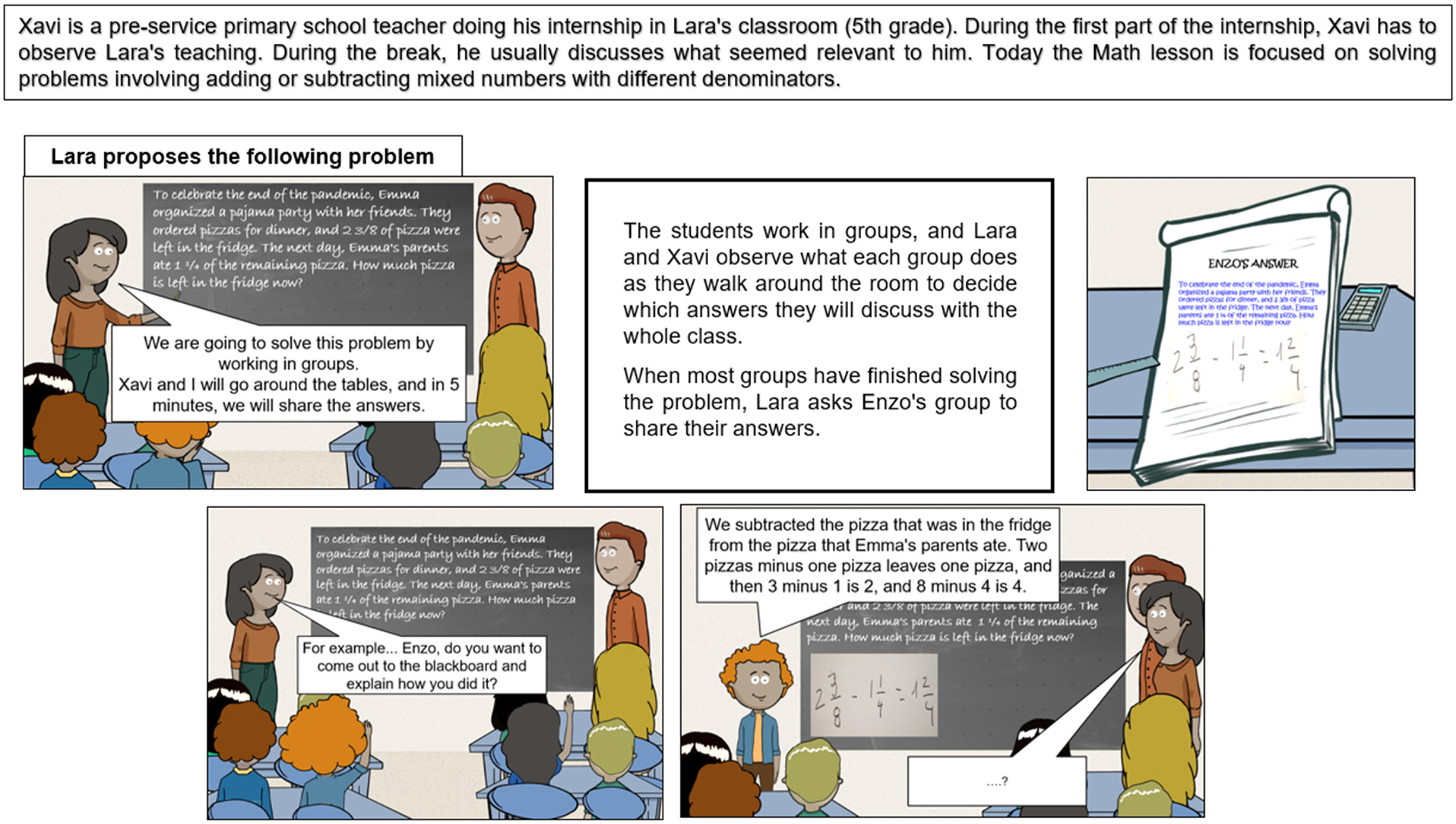
Enzo's vignette depicting a teaching–learning situation related to fraction operations.
The problem involves improper fractions represented by mixed numbers and the subtraction operation (2
PTs had to answer the following questions regarding the interpretation of students’ understanding and teaching decisions on how to proceed:
Question 1. Identify characteristics of the understanding of Enzo's group, justifying your answer based on fragments of their answer and indicating the implicit mathematical elements. Question 2. Based on the answer of Enzo's group, what would you do next if you were the teacher?
This cartoon vignette was designed using the DIVER CREATE digital tool developed in the CoReflect@maths Erasmus+ project (www.coreflect.eu). The vignette was initially designed in English and later translated into Spanish and German (one of the researchers is fluent in all three languages, and the others are fluent in English and their mother tongue). PTs from both countries were given 2 hr to solve the vignette individually. The PTs’ written answers to the two questions constitute the data of the present study. To ensure consistency in codification criteria across different languages, the data was translated into English before the analysis.
Analysis
We first anonymized the PTs’ answers, identifying the Spanish PTs as S-PTXX (where XX was a number between 01 and 37) and the German PTs as G-PTXX (where XX was a number between 01 and 56). The PTs’ answers to the two questions were subsequently analyzed. We identified categories (inductive analysis; Strauss & Corbin, 1990) based on how PTs interpreted the situation, and how they decided to continue with the instruction. These categories were refined and discussed until reaching a 100% agreement.
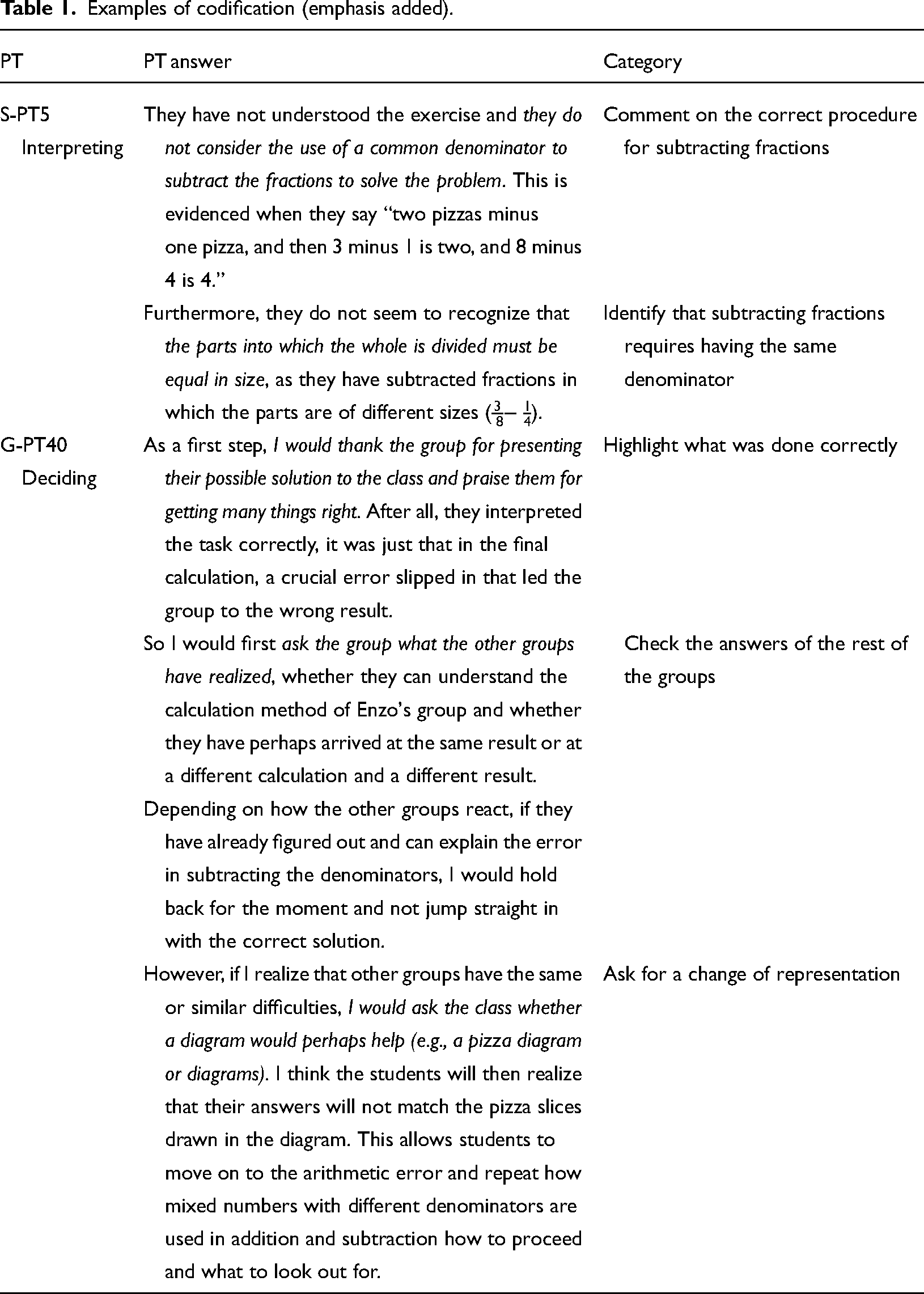
The results section presents the categories that emerged from analyzing the characteristics of the interpretation of the Enzo group's understanding and suggested decisions (reactions). A PT's answer could be classified into more than one category (Table 1).
Examples of codification (emphasis added).
Results
We first present the categories of the PTs’ answers when they interpreted Enzo's group answer. Second, we display the categories that emerged from the PTs’ suggestions on how to proceed. Due to space constraints, we show only one PT answer example (regardless of the country) as an instance of each category in both sections. Finally, we focus on the differences and similarities between PT answers in both countries.
Interpreting the understanding characteristics of Enzo's group
PTs identified different understanding characteristics of Enzo's group. One of these characteristics was highlighting what Enzo's group had performed correctly (25 PTS). They interpreted that Enzo's group had identified a correct operation to solve the problem related to the subtraction of fractions. They underlined that Enzo's group had mathematized correctly since they had translated the word problem into a mathematical language to solve it. For instance, G-PT18 wrote: Enzo has correctly translated the word problem, representing “eating a pizza” as a subtraction: “We have subtracted from the pizza what the parents ate.”
Twenty-four PTs also highlighted the incorrect use of fraction subtracting rules. They identified the incorrect procedural mathematical knowledge regarding the subtraction of fractions applied by Enzo's group. For example: Enzo's group subtracts the pizza left, that is, they subtract 1
Fifty-five PTs interpreted that Enzo's group did not consider that subtracting fractions required obtaining the same denominator. These PTs identified that the whole should be divided into the same number of pieces to subtract or to add with fractions, underlying that “The parts must be equal to be joined or separated.” S-PT10 wrote: To compare fractions, the unit must be divided into the same number of parts. Enzo's difficulty is that he subtracts eighths and fourths (
What he should do is to divide both by the same number of units, i.e., you should obtain the same denominator. In this case, you can easily see it since instead of using 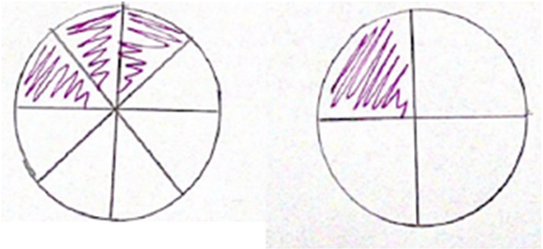
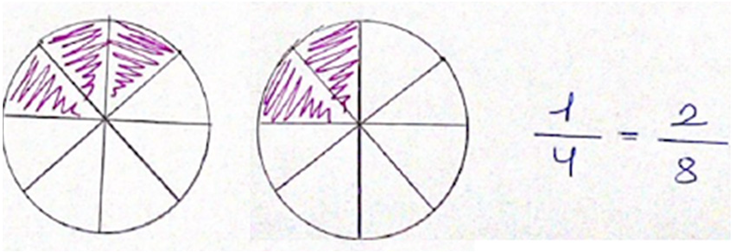
In PT10's last answer, the PT commented on the correct method to subtract fractions (obtaining equivalent fractions).
Furthermore, 19 PTs also interpreted that Enzo's group saw the numerator and denominator as independent and non-related numbers. Therefore, Enzo's group did not see fractions as numbers. For example: When solving the subtraction task, it becomes quickly apparent that children lack a basic understanding of fractions. This is because the numbers in the fraction, the numerator and denominator, are seen independently of each other and are not perceived as belonging together, as part of a whole […]. The numbers in the fraction are seen as two natural numbers separated by a line. This means the group has no idea what a fraction really is (G-PT4). Enzo's group thinks all components of mixed numbers should be subtracted as in the case of integer numbers (number - number, denominator - denominator, numerator - numerator).
Deciding what to do next
Regarding the decisions to take next proposed by the PTs, three main groups were identified: decisions based on promoting the conceptual understanding of Enzo's group, decisions based on classroom management, and other decisions.
Decisions based on promoting the conceptual understanding of Enzo's group. These decisions were based on promoting the understanding of Enzo's group: asking for a change of representation, asking to decompose the fractions into unitary fractions, and asking more questions to help him to recognize the incorrect method used.
Eighty-two PTs specified that they would ask the students to represent the problem data graphically (representing the area model) or use manipulatives (e.g., fraction circles) to help them understand that the parts of the whole need to be the same size to be able to join or remove/separate them. Therefore, they would ask for a change of representation. For instance: I would first propose representing the problem, which improves understanding because it is more visual. That is, represent the total number of pizzas and remove the ones eaten by the parents. This strategy involves using representations, whereby students acting on fractional quantities use representations, such as drawings showing units of the same size, to understand the need for common denominators (S-PT25).
[…] I would suggest that they decompose the fractions so that they realize that a fraction is formed from a unit fraction (
Seven PTs noted that they would ask more questions to help him recognize the incorrect method used. These PTs commented that they would ask critical questions to focus children's attention on the incorrect method applied. If I were the teacher, I would try to create a cognitive conflict between the current perception of Enzo's group and the actual facts. For example, critical questions can be used for this. Such a question could draw the children's attention to the fact that this calculation method would not work if [I would] ask the class whether they have come to the same conclusion or whether they have come to something different or proceeded differently. The aim is to check whether the other classmates have understood the topic or whether they have also detected problems. Depending on this, the problem has to be recognized and worked on with the individual group or with the whole class […] (G-PT14). Furthermore, it would complement one student's way of thinking by considering how another student thinks so that all students can reflect on their peers’ mistakes and successes (S-PT28).
Other decisions. Within this subcategory, decisions either focused on the characteristics of the activity—modify the numbers involved in the activity to make it easier—or were not associated with promoting Enzo's conceptual understanding: highlight what Enzo's group did correctly and repeat the rules of fraction operations.
Considering the activity characteristics, four PTs specified that they would provide Enzo's group with an easier activity using fractions with the same denominators. Therefore, these PTs proposed to modify the numbers involved in the activity to make it easier. For example: As a teacher, I would first ask the group to complete an activity in which the denominators are equal in order to check whether they understand a less complex exercise (S-PT36). […] I would thank the group for presenting their possible solution to the class and praise them for getting many things right. After all, they interpreted the task correctly; it was only the final calculation that slipped into a crucial error that led the group to the wrong result (G-PT40). […] I would then send Enzo back to his seat and tell the class that I am still not completely satisfied with the task's outcome. I would ask the class why I disagree with the result and then repeat the rules for subtracting fractions one by one with the class (G-PT36).
Similarities and differences between the samples from the two countries
How Spanish and German PTs interpreted the teaching and learning situation. Table 2 shows the percentage of each category that emerged when S-PT and G-PT interpreted the teaching–learning situation (the sum of the percentages exceeds 100% since a PT answer can be classified into more than one category). Generally, it is worth noting that the majority of PTs from both groups (except four Spanish PTs who gave non-sense answers) identified the understanding characteristics of Enzo's group. The answers of German PTs, however, were distributed into more categories, so they presented a larger variety of interpretations of the Enzo group's answers.
Interpretations made by the Spanish (S-PT) and German (G-PT) pre-service teachers.
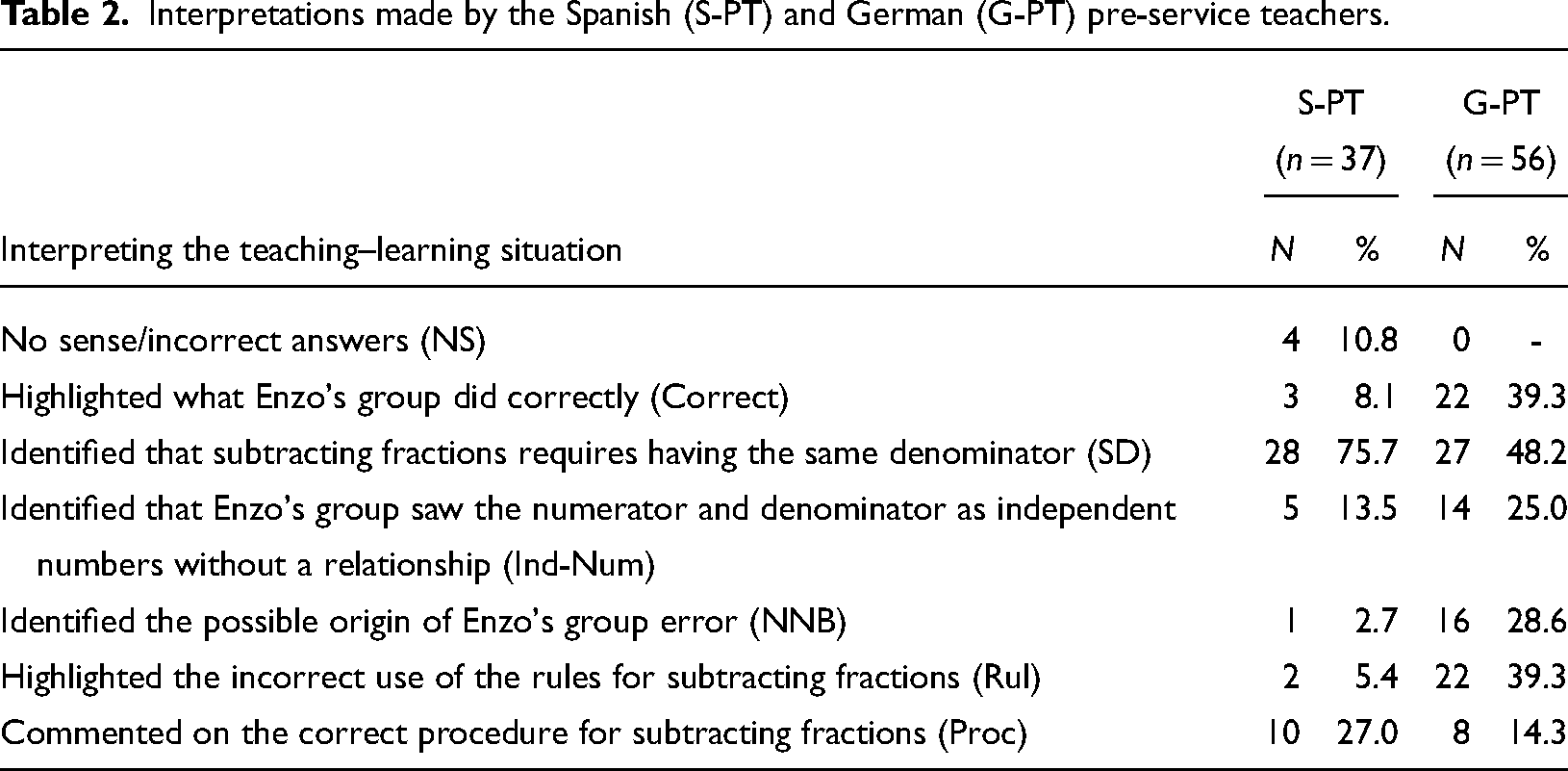
More S-PTs than G-PTs focused on the conceptual idea that the whole should be divided into the same number of pieces to subtract or to add with fractions (SD, 75.7% S-PTs and 48.2% G-PTs, this difference being significant, χ²(1, N = 93)= 6.953, p < .05). Furthermore, more S-PTs than G-PTs underlined the correct procedure to subtract fractions (Proc, 27.0% SPTs and 14.3% G-PTs, however, this difference was not significant).
On the other hand, more G-PTs than S-PTs: (i) highlighted what Enzo's group did correctly (Correct, 8.1% S-PTs and 39.3% G-PTs, this difference being significant, χ²(1, N = 93)= 11.018, p < .001), (ii) focused on the incorrect use of the rules for subtracting fractions (Rul, 5.4% S-PTs and 39.3% G-PTs, this difference being significant, χ²(1, N = 93)= 13.357, p < .001), and, (iii) identified the possible origin of Enzo's group error (NNB, 2.7% S-PTs and 28.6% G-PTs, this difference being significant, χ²(1, N = 93)= 9.981, p < .05).
Decisions provided by Spanish and German PTs. Table 3 shows the percentages of each category in both countries (S-PT and G-PT) regarding the suggested teaching decisions on how to respond to the situation. As in the previous subsection, the added percentages could reach above 100% since a PT answer could be coded in several categories.
Decisions made by the Spanish (S-PT) and German (G-PT) PTs.
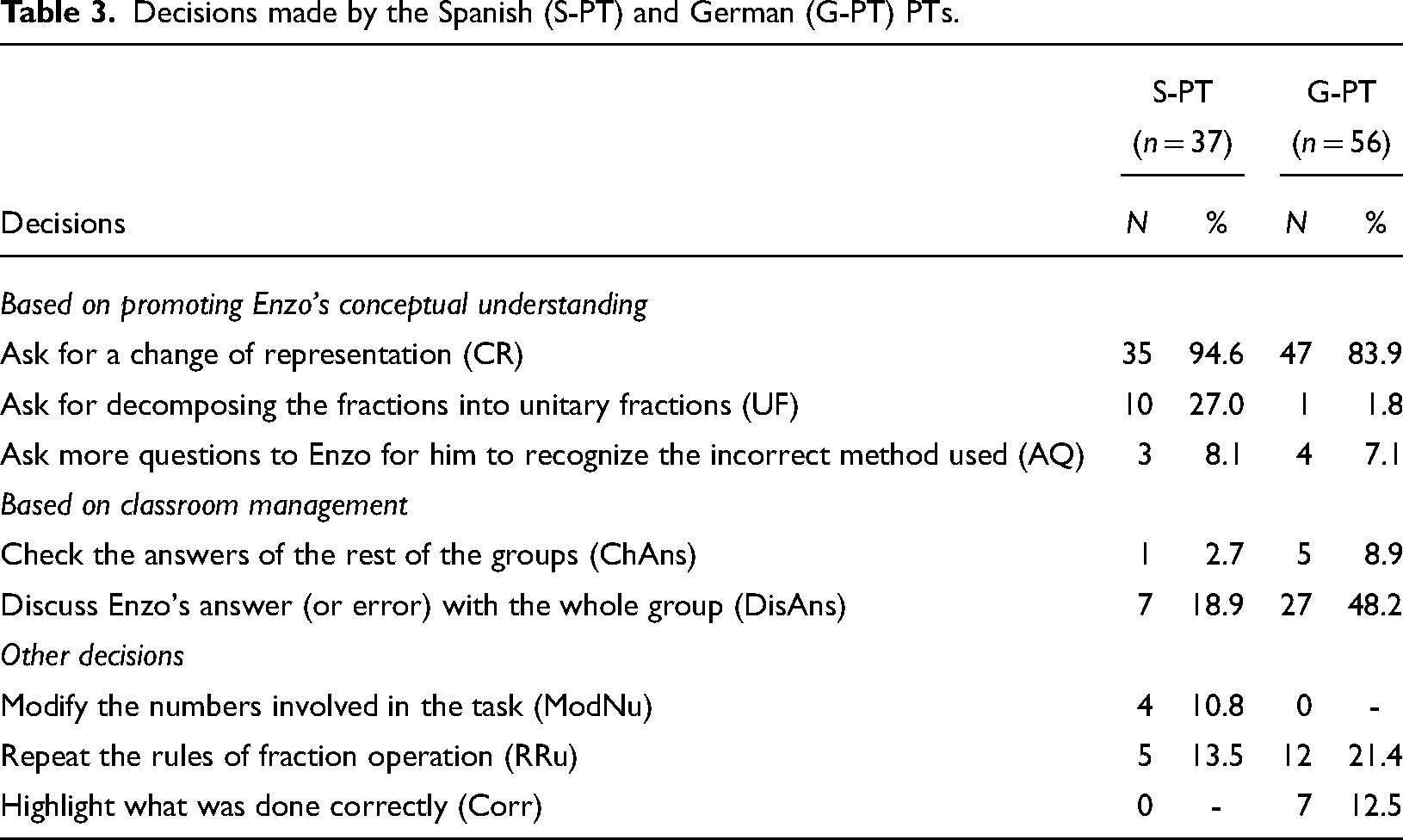
A large group of PTs from both countries focused on a change of representation (CR, 94.6% in S-PT and 83.9% in G-PT, the differences between countries were not significant). A number of differences between PT groups were also identified: S-PTs focused more on modifying the task numbers to make it easier (ModNu, 10.8% S-PTs and 0.0% G-PTs, this difference being significant, χ²(1, N = 93)= 6.326, p < .5) and on working on the unitary fraction iteration (UF, 27.0% S-PTs and 1.8% G-PTs, this difference being significant, χ²(1, N = 93)= 13.611, p < .001). G-PTs focused more on highlighting what Enzo's group performed correctly (Corr, 0.0% S-PTs and 12.5% G-PTs, this difference being significant, χ²(1, N = 93)= 5.001, p < .05) and on discussing Enzo's answer (or error) with the whole group (DisAns, 18.9% S-PTs and 48.2% G-PTs, this difference being significant, χ²(1, N = 93)= 8.244, p < .05).
Discussion and conclusions
The aim of this study was, on the one hand, to identify the aspects related to Enzo's mathematical thinking that were interpreted by the S-PTs and G-PT as well as the teacher responses they suggested (first research question). On the other, the objective was to explore similarities and differences between the PT groups from the universities in Spain and Germany (second research question).
Interesting conclusions could be drawn and they are discussed next. However, it is important to first acknowledge some study limitations, which prompt a cautious interpretation of the results. The study did not delve into the PTs’ individual characteristics, and different professional knowledge may have influenced their answers. Further, our results cannot be generalized to other universities in Germany or Spain, since, as mentioned earlier, teacher education programs differ, and so do course cultures. Moreover, the findings cannot be generalized to other Western countries. Finally, the findings presented in this paper are based on only one vignette and might be specific, e.g., to a particular mathematical topic.
Regarding the first research question—the aspects that PTs interpreted about Enzo's understanding, our results showed that PTs focused on different ideas. Most PTs (55 out of 93) interpreted that Enzo did not consider that the whole should be divided into the same number of pieces to subtract or to add with fractions, so they identified a lack of conceptual understanding of the fraction subtraction in Enzo's group. Other PTs also underlined that Enzo's group regarded fractions as two independent and unrelated numbers, highlighting the lack of conceptual understanding of the fraction concept. Others even explained the possible origin of the error in Enzo's group, explaining that Enzo's group may have applied the properties of natural numbers to fractions. Another idea recognized by the PTs was that Enzo's group had modeled the situation correctly, identifying the correct operation to solve the problem (a subtraction). Finally, some PTs focused on the incorrect procedure used to solve the fraction subtraction and/or the correct procedure to solve the subtraction. These PTs focused on the procedural knowledge of Enzo's group about fraction operations. Therefore, the majority of PTs had and used the professional knowledge needed to interpret Enzo's common error, since they gave reasons to explain conceptually and procedurally the error, and even, some of them explained its possible origin.
Furthermore, we identified three main categories corresponding to the PTs’ suggested reactions: decisions based on promoting the conceptual understanding of Enzo's group, decisions based on classroom management, and other decisions. Most PTs (82 out of 93) stated they would ask for a change in representation, showing how they used their knowledge about how to introduce/solve operations with fractions to promote conceptual understanding by connecting different modes of representation. A total of 11 PTs stressed that they would decide to ask to decompose fractions into unitary fractions to promote Enzo's conceptual understanding of the fraction
The second most frequent decision (34 PTs) focused on discussing Enzo's answer with the rest of the group. This classroom management practice implies connecting students to their peers’ ideas, generating a space for the students to understand the mathematical thinking of others. Also related to knowledge of classroom management was the fact that some PTs stated they would check the understanding of the rest of the groups. Regarding the other decisions, 17 PTs said they would repeat the rules of fraction operations, a decision oriented toward procedural knowledge. Four PTs would pose a task modifying the quantities involved to make the task easier, which is related to knowledge of how the activities can be sequenced. Finally, seven PTs would highlight what was correctly done since Enzo mathematized the situation adequately. These PTs showed knowledge related to alternative representations and ways of conceptually introducing the concept, knowledge related to how to manage a classroom, and about variables to design tasks. Our results underline the crucial role of professional knowledge in interpreting students’ answers to mathematical activities and in decision-making, as observed in previous studies (e.g., Brown et al., 2020; Di Martino et al., 2019; Thomas et al., 2017).
Regarding our second research question, the results also revealed similarities and differences in the interpretations and decisions advanced by the different PT groups. Generally, most PTs from both groups identified the characteristics of Enzo's group understanding. However German PTs gave a larger variety of interpretations. Most Spanish PTs focused on the conceptual idea that the whole should be divided into the same number of pieces (same denominator) to subtract or to add with fractions. They highlighted that Enzo's group saw the numerator and denominator as independent numbers with no relationship between them, and also underlined the correct procedure to subtract fractions. German PTs also focused more on the conceptual idea that the whole should be divided into the same number of pieces to subtract or add with fractions. However, some also focused on the incorrect procedure for subtracting fractions used by Enzo's group, what Enzo's group had performed correctly, and the probable origin of the error. An interesting group of German PTs also interpreted what Enzo's group performed correctly. This result aligns with the findings of Dreher et al. (2021) with experts from Chinese Taiwan and Germany. Whereas experts from Chinese Taiwan assumed that the students’ answers indicated a misunderstanding or inappropriate strategy to be corrected, the German experts assumed that the students’ answers showed a mathematical ability or strategy that should be valued.
Considering the PTs’ reactions, we identified commonalities between both groups. Most PTs in both groups (Spanish and German) proposed a change of representation. This result is in line with those obtained by Yang et al. (2019) with German in-service teachers (that differed from Chinese in-service teachers). Nevertheless, differences were also found. Some Spanish PTs also focused on modifying the task numbers to make it easier and on working on the unitary fraction (UF) iteration. The German PTs focused more on highlighting what Enzo's group did correctly, on checking the answers of the rest of the groups to determine whether they should review the content, and on discussing Enzo's answer with the whole group. As in the study of Yang et al. (2019), German PTs focused more on classroom management. However, Spanish PTs focused more on aspects of the tasks (e.g., variables of the tasks).
The differences found in the way of interpreting and deciding can be (partly) related to the different foci of the teacher education program and seminar contexts of the universities. The subjects in the University of Alicante's teacher training program consistently focus on developing noticing competence through vignettes. PTs from Alicante usually analyze teaching–learning situations using theoretical information related to the students’ understanding of the mathematical concept. This information is commonly presented in the material accompanying the vignette-based learning opportunities. This may explain why Spanish PTs centered on Enzo's conceptual and procedural understanding of the fraction concept and the subtraction of fractions. They suggested teaching decisions aimed at helping Enzo understand the concept (change of representation, focus on unitary fraction iteration to construct other fractions, or changing the quantities to make the activity easier). Some German PTs may have used criteria from the local seminar context (focus: dealing with representations of mathematical objects) and focused, for example, on changing the representations. However, the seminar context can hardly explain the comparatively higher frequency of PT's answers in which they suggested giving positive feedback to Enzo as far as the correct parts of his solution were concerned.
Although Spanish and German PTs could be expected to present different contexts regarding course culture, our results showed that both groups of PTs interpreted and reacted to the teaching and learning situation of the cartoon vignette on fraction subtraction by using their mathematical and pedagogical content knowledge. Therefore, vignette-based learning addressed relevant aspects of the classroom situation across different contexts, as reported in previous research on mathematics education (e.g., Buchbinder & Kuntze, 2018). The vignette thus appears to be a potential tool to assess and develop noticing in teacher education programs (Buchbinder & Kuntze, 2018; Grossman, 2018; Herbst & Kosko, 2014).
To summarize, our results have provided evidence of the interpretations and decision-making that Spanish and German PTs made when noticing a teaching–learning situation on fraction operations through a vignette. These interpretations and decisions were mediated by the PTs’ knowledge highlighting that noticing is a knowledge-based reasoning competence. Moreover, our results have shown similarities and slight differences within the groups of PTs (Spanish and German) from different cultural contexts when noticing the same teaching–learning situation. This result seems to emphasize the role of the vignette as a tool to assess and develop noticing, regardless of the cultural context.
Footnotes
Contributorship
All authors contributed equally to writing this paper, including designing the instrument, collecting data, analyzing results, and discussing them.
Declaration of conflicting interests
The authors declared no potential conflicts of interest with respect to the research, authorship, and/or publication of this article.
Ethical statement
Spanish data: The authors received written informed consent from the participants and the Ethical Committee (UA-2021-10-08_2).
German data: In German universities, researchers are bound to internal rules related to good scientific practice in the framework of their contract, among others, which cover the duties and criteria of the ethical consent committee. The data for this study has hence been gathered in accordance with scientific and ethical standards, including the cross-check within the international team of researchers.
Funding
The authors disclosed receipt of the following financial support for the research, authorship, and/or publication of this article: This research was supported, in part, by the project PID2023-149624NB-I00 from Ministerio de Ciencia e Innovación, Spain, and in part, by the project CIAICO/2021/279 funded by Generalitat Valenciana (Conselleria d’Educació, Cultura i Sport, Spain). The vignette design and data gathering phase of this study was carried out in close relation with the work in the project coReflect@maths (2019-1-DE01-KA203-004947), co-funded by the Erasmus+ Programme of the European Union. The European Commission's support for the production of this publication does not constitute an endorsement of the contents, which reflect the views only of the authors, and the Commission cannot be held responsible for any use which may be made of the information contained therein.
