




Abstract
Purpose
This study aims to investigate the noticing ability of Chinese in-service mathematics teachers (ISTs) when observing exemplary mathematics lessons online using two different noticing frameworks.
Design/Approach/Methods
The noticing of 24 ISTs was examined based on three dimensions: agent, topic, and stance. The data were collected qualitatively through guided questions during the video observation activity, and their noticing levels were analyzed using existing frameworks.
Findings
Utilizing the Focused Framework, Chinese ISTs exhibited a greater breadth and depth of noticing, in relation to both students’ mathematical thinking and teaching pedagogies. Their noticing abilities surpassed those utilizing an Open Framework, with enhanced sensitivity in adapting their teaching strategies to better address students’ mathematical reasoning. The study also revealed limitations in the current practices of classroom observation and teacher reflections.
Originality/Value
This study provides valuable insights into the noticing abilities of Chinese in-service teachers and the effectiveness of various noticing frameworks in enhancing their skills. It highlights the importance of further research on teacher noticing within Eastern contexts. The findings have significant implications for teachers’ professional development, advocating for the integration of noticing frameworks into teacher education programs to improve teachers’ abilities to discern critical elements of students’ mathematical thinking and pedagogical practices.
Introduction
Teachers’ noticing, a knowledge and expertise dependent on attention, refers to the skills that teachers use to attend to the cognitive and affective aspects of students’ activities, guiding the effectiveness of their instructions in response to classroom events (Ainley & Luntley, 2007). Noticing skills emphasize what and how teachers notice, relating to students’ learning and experiences (van Es & Sherin, 2021). Through the process of noticing, teachers closely attend to what students say and do and adjust instruction based on their needs, which in turn enhances teaching expertise (Jacobs et al., 2010; Rodgers, 2002) and benefits students’ learning outcomes.
While there is increasing focus on teachers’ noticing, literature primarily examines pre-service teachers’ (PSTs’) noticing (Amador & Weiland, 2015; Lee, 2019; Star & Strickland, 2008; Superfine et al., 2017; van Es & Sherin, 2002). In contrast, less attention was given to experienced in-service mathematics teachers (ISTs) as they are expected to have higher levels of professional noticing due to extensive teaching experience. However, studies showed that ISTs’ noticing is insufficient, with limited analysis and reflection on supporting students’ mathematical understanding (Beattie et al., 2017). The research gap motivated our study to focus on in-service mathematics teachers in primary schools. Most noticing studies are conducted in the Western contexts (Amador et al., 2021; van Es & Sherin, 2006), with few cross-cultural comparisons involving China (Ding et al., 2022; Miller & Zhou, 2007; Yang et al., 2021). This prompted our investigation into the noticing abilities of Chinese teachers.
Frameworks such as the Learning to Notice Framework (van Es & Sherin, 2002) primarily serve Western contexts. Only recently have scholars explored the Three-point Framework which originated in China and used by Chinese ISTs for lesson study (Lee & Choy, 2017; Yang & Ricks, 2012). The Learning to Notice Framework (hereinafter Open Framework), is a liberal and open approach commonly used in Western contexts to guide teachers’ observations and interpretations of student needs. On the other hand, the Three-point Framework is a more structural approach that encourages teachers to understand students’ learning difficulties and think about how to address them with different teaching strategies. Both frameworks have their own strengths and limitations, making direct transplantation into the Chinese context inappropriate. Hence, we compared the Open Framework (adapted from the Learning to Notice Framework) and the Focused Framework (which combines the designs of the Open Framework, Three-point Framework, and an additional Starting Point question) to examine their impacts on Chinese mathematics teachers’ noticing. We will elaborate the frameworks in coming sections in detail.
Based on the identified research gaps, this study aimed to answer the following questions: (1) Among the available Focused Framework and Open Framework, which Framework do participating in-service teachers choose for video classroom observation? (2) What do ISTs notice during the study, and how would they adjust their teaching strategies based on their observations? (3) What is the influence of these two frameworks on teacher noticing?
Literature review
Theoretical frameworks for mathematics teachers noticing—Learning to notice framework
The concept of mathematics teachers’ noticing has been conceptualized in different ways, which could be summarized into four major perspectives, namely expertise-related perspective, socio-cultural perspective, discipline-specific perspective, and cognitive-psychological perspective (König et al., 2022). The development of these theoretical perspectives could be traced back as early as the 1980s (Berlinder, 1988) and 1990s (Goodwin, 1994).
Berlinder (1988) initiated the expertise-related perspective. It suggested that teaching experience did not necessarily equate to expertise (Caspari-Sadeghi & König, 2018), noticing skills could be learnt systematically and developed gradually (Jacobs et al., 2010) through sequential training programs (Santagata et al., 2021). In the socio-cultural perspective, Goodwin (1994) advocated that the cultural norms and communities of practice would allow teachers to involve in a socialization process where they could gradually learn to adopt a professional lens to make sense of their work of teaching. In recent decades, Mason (2002) developed the discipline-specific perspective in the context of mathematics education. It emphasizes the ability to notice an opportunity to act appropriately. Rather than reacting habitually, this approach focuses on teachers’ internal processes to systematically reflect and recognize the typical situations to be prepared for the moments of noticing and response flexibly (König et al., 2022). van Es and Sherin’s (2002) seminal work gave birth to the cognitive-psychological perspective. It suggested noticing as a set of cognitive processes that takes place in teachers’ minds—from perceiving to interpreting and making sense of salient incidents in a classroom (König et al., 2022). They developed the Learning to Notice Framework (van Es & Sherin, 2002, p. 2006, 2008) and extended the definitions of noticing to involve teachers’ teaching strategies and students’ thinking processes, as well as the interactions between them. Jacobs et al. (2010) went a step further and added the idea of “deciding how to respond.” It entails a decision-making process that can be conceptualized as anticipating a response to students’ activities or proposing alternative instructional strategies (Kaiser et al., 2015).
Considering the following reasons, the cognitive-psychological perspective is the most relevant to our present study: (1) Cognitive-psychological perspective aligns with our intention to examine the cognitive processes of in-service mathematics teachers in the Chinese context, including their noticing of salient events in the classroom, interpreting, anticipating, and making decisions based on students’ responses and understandings. The socialization process suggested by the socio-cultural perspective is not our focus. (2) This study aims at comparing the two noticing frameworks, rather than comparing novice-expert teachers as in the expertise-related perspective. (3) Instead of aiming for a multitude of responses proposed by the discipline-specific perspective, the present study sets eyes on the steps that precede the responses—what they notice, how they interpret, and appropriate alternative responses— which do not require much.
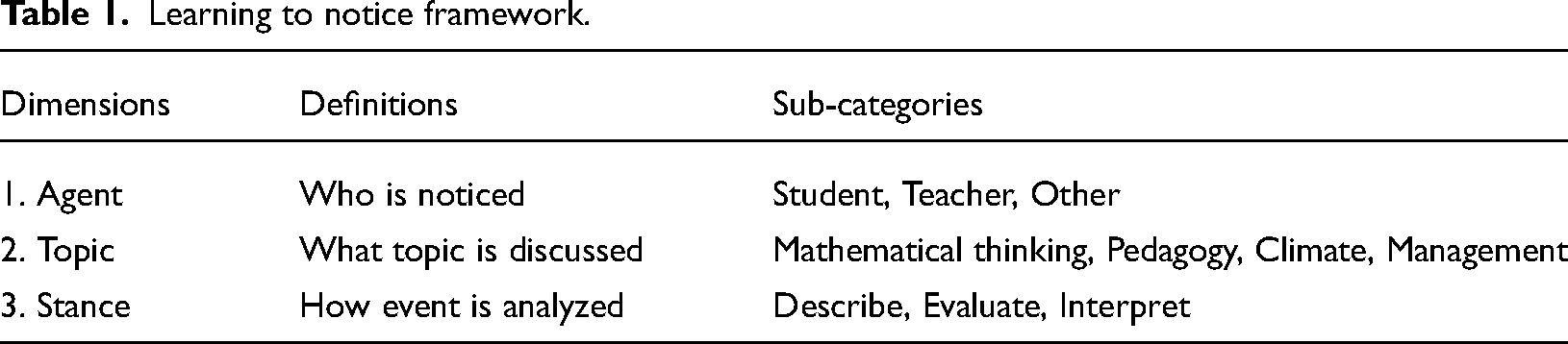
Following the cognitive-psychological perspective, we grounded our study on the Learning to Notice Framework developed by van Es and Sherin (2002). The framework pivots around two dimensions: what teachers notice and how teachers analyze what they notice. What teachers notice includes (1) whom they notice (i.e., the Agent), such as the class as a whole, students as a group, particular students, and the teacher; and (2) the Topic, such as students’ mathematical thinking, teachers’ pedagogy, and classroom environment. How teachers analyze what they notice (i.e., the Stance) refers to their analysis level, from descriptive, evaluative to interpretive. In sum, the Learning to Notice Framework could be summarized as the Agent, the Topic, and the Stance. Table 1 visualizes the framework definitions.
Learning to notice framework.
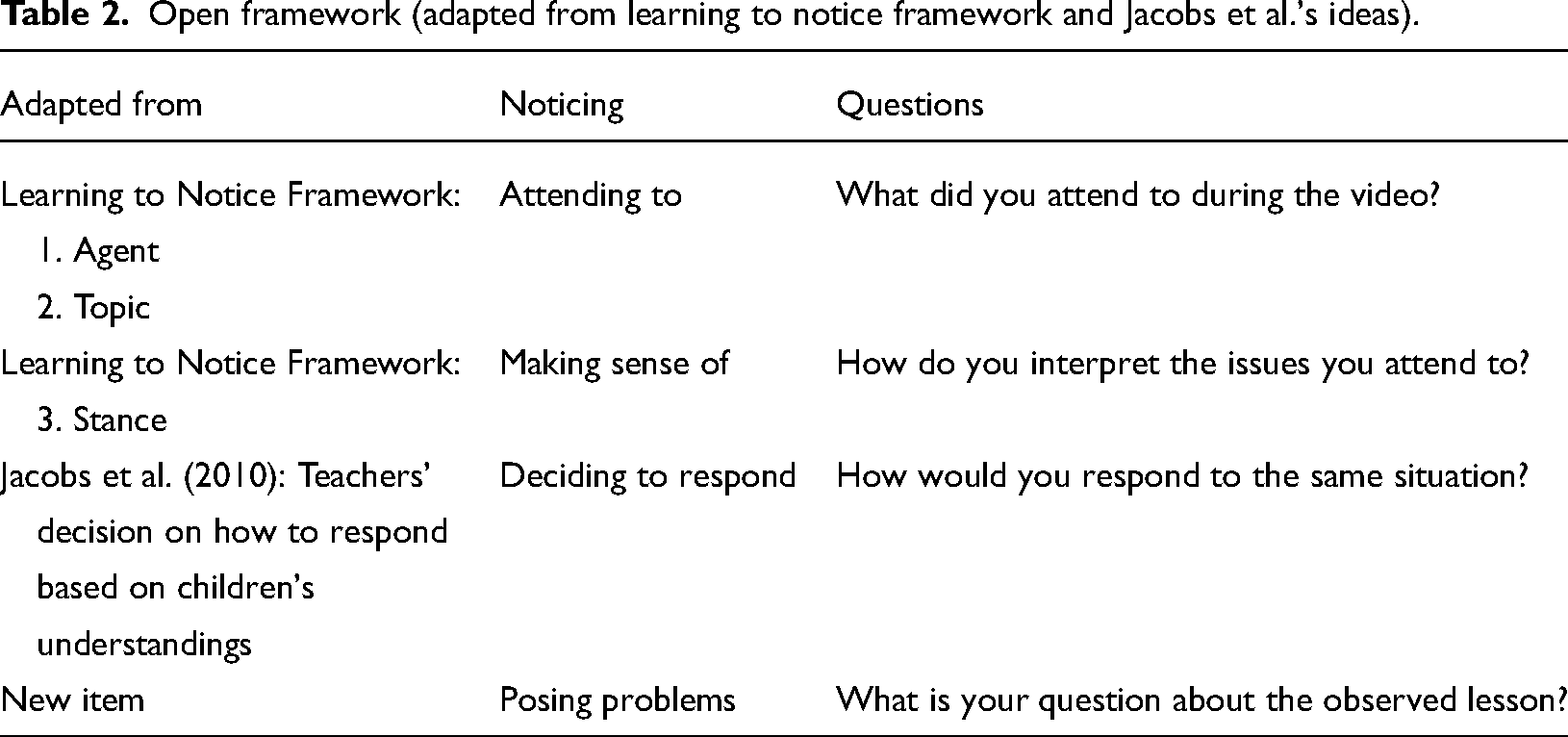
Besides, we borrowed Jacobs et al.'s (2010) ideas for examining teachers’ response decisions based on children's understandings. Deciding how to respond describes the extent to which the teacher could use his or her mathematical thinking knowledge to determine how to react to the student (Amador et al., 2017). For instance, when teachers notice the typical ways students think about a particular mathematics problem or the common misconceptions they may employ, teachers can adapt their instructional practices accordingly. Teachers may break down the concept, spare more time on explaining the concept step-by-step, proactively invite a class discussion on the misconceptions to elicit students’ thinking, or build students’ thinking with reference to their previous knowledge. Consequently, noticing could help teachers better position themselves and impact students’ achievement. Hence, we slightly modified the existing Learning to Notice Framework into Open Framework for testing in this study. The “Deciding to respond” question was intended to investigate how teachers responded based on their interpretations of certain classroom activities.
To explore teachers’ additional ideas, reflective questions and the focus about the noticed lessons, we added one “Posing problems” question “What is your question about the observed lesson?” in the Open Framework (see Table 2). Since all questions in the Open Framework were open-ended, teachers might limit their answers to the specific classroom events they attended. The “Posing problems” intended to encourage teachers to go beyond observation and reflect on the matters they find relevant, including but not limited to instructional context and pedagogical areas.
Open framework (adapted from learning to notice framework and Jacobs et al.'s ideas).
Theoretical frameworks for mathematics teachers noticing—Three-point framework
The Three-point Framework was originally the handling procedures of critical teaching events practiced by Chinese ISTs. Later, the Chinese teachers gradually apply the framework to lesson studies (Lee & Choy, 2017; Yang & Ricks, 2012). Contemporary instructional research borrowed the concept for pre-service teachers training. The Three-Point Framework involves the Key Point, the Difficult Point, and the Critical Point.
The Key Point refers to the main mathematical concept that the lesson aims to teach. This is sometimes referred to as the “Big idea” (Askew, 2013). The second factor is the Difficult Point, which refers to the challenges or obstacles that students may encounter while learning about the Key Point. These challenges may include persistent errors or common misconceptions associated with the concept being taught (Yang & Ricks, 2012). Based on an understanding of both the Key Point and the Difficult Point, teachers then plan their lesson design, which leads to the Critical Point. Yang and Ricks (2012) describe the Critical Point as the heart of the lesson, where teachers employ teaching strategies to help students overcome learning challenges and approach the Key Point more effectively.
In recent years, several studies have examined teachers’ noticing using the Three-point Framework in different Western contexts, such as the United States (Lee, 2021) and Singapore (Lee & Choy, 2017). However, to better understand students’ learning difficulties, the Key Point and the Difficult Point are not enough. Teachers need to know students’ existing knowledge level and cognitive thinking patterns, and further foresee their learning development, so as to connect their existing knowledge with the new ones (Yu, 2016). Since understanding students’ learning foundations is the basis of lesson planning and instructional design, the existing Three-point Framework is inadequate to guide teachers to reflect the starting point of the students. Thus, we proposed inserting the Starting Point before the original three points.
Though the Three-point Framework allows a more specific observation, it does not provide sufficient guidance for reflection. Unlike the Learning to Notice Framework which emphasizes the interactions between students’ thinking processes and teachers’ teaching strategies, Three-point Framework is more about reporting the observation for each Point, ignoring teachers as agents who have the power and ability to decide their responses to meet students’ needs. Therefore, we proposed the Focused Framework that combines the designs of Open Framework (excluding the Posing problems question), Three-point Framework and the additional Starting Point (see Table 3).
Focused framework (adapted from open framework and three-point framework).
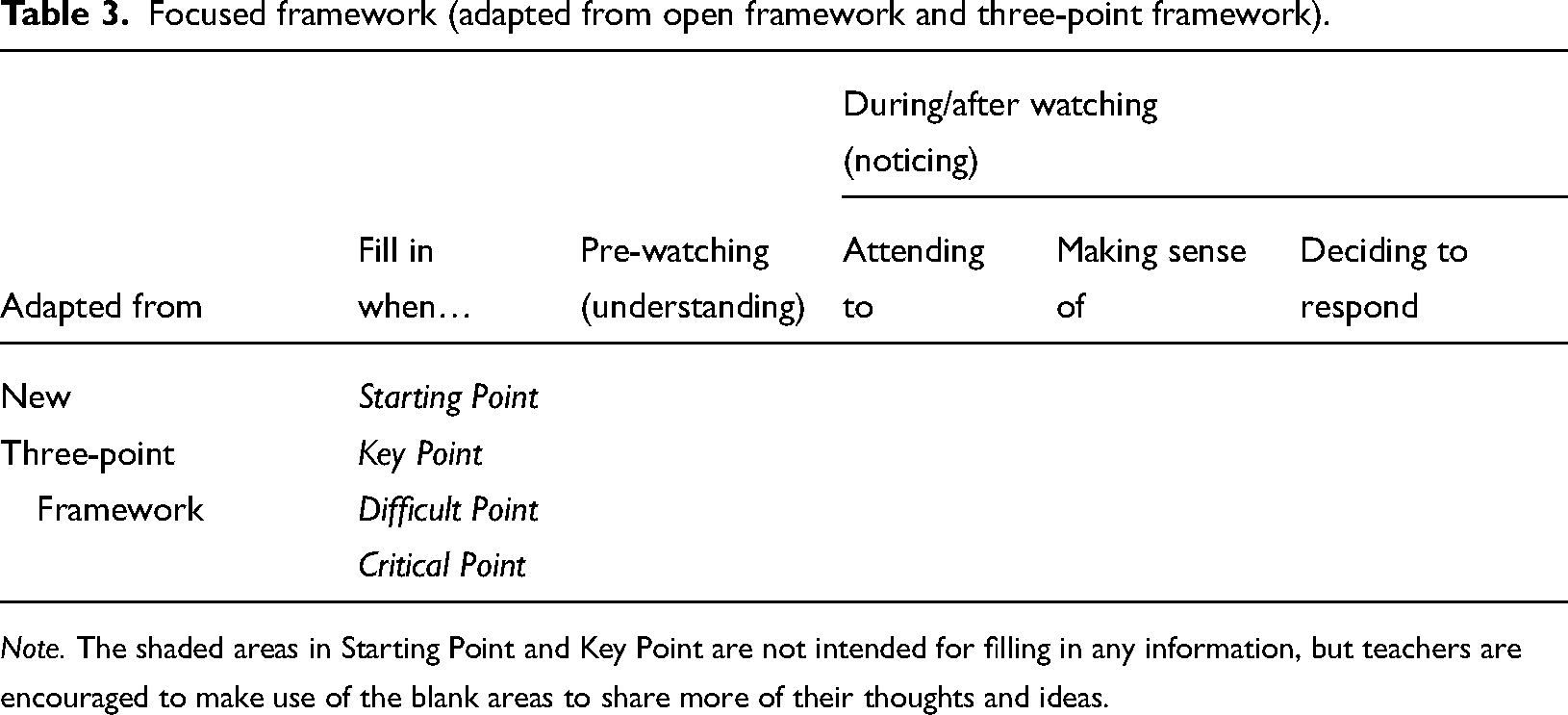
Note. The shaded areas in Starting Point and Key Point are not intended for filling in any information, but teachers are encouraged to make use of the blank areas to share more of their thoughts and ideas.
Theoretical frameworks for mathematics teachers noticing—Noticing levels
van Es (2011) provided a four-level noticing framework, from baseline, mixed, focused to extended noticing, to illustrate teachers’ growth in learning to notice (Wessels, 2018). In general, the higher the noticing level, the greater the teachers’ ability to attend to students’ mathematical thinking and its relationship to teaching strategies, beyond the class environment and teacher pedagogy. Teachers with higher noticing level are more likely to highlight the noteworthy events through interpretive comments and alternative pedagogical solutions and see the connections to teaching and learning principles. Details of the definitions of each level would be discussed in Section “Four-level framework for teachers noticing” and Table 5.
Cultural impact on teachers’ noticing
Given that teaching is culture-dependent, teacher noticing in different cultures will probably have different characteristics. It has been found that teachers’ noticing involved not only cognitive processes, but also the cultural ways of thinking and acting, with power relationships and culture embedded (Louie, 2018). Miller and Zhou (2007) reported that, when presented with the same mathematics lesson episodes, U.S. teachers tended to notice general pedagogy, while Chinese teachers focused more on mathematics issues. Dreher et al. (2021) further argued that cultural norms also play a role in professional noticing. They analyzed the responses of mathematics education researchers to student thinking in German and Chinese Taiwan and found that, when provided with the same teaching vignette, most experts in Chinese Taiwan addressed the correctness of the students’ answers, while the majority of their German counterparts focused on the students’ mathematical processes.
As teaching and learning is a sociocultural activity (McNamara & Conteh, 2008), there is a need to illustrate the adaptability of noticing frameworks in other classroom cultures.
Video-based research for teacher development
Video has been used for decades in teacher learning, and it appears to show promise in supporting teachers in learning to notice (Amador, 2017; Star & Strickland, 2008; van Es & Sherin, 2006). Teaching videos (real teaching or hypothetical situations) can capture more details of interaction during the lesson and provide more opportunities for teachers to watch from multiple perspectives and reflect repeatedly (Borko et al., 2008). By pausing and rewinding, teachers can have more chances to focus on the events they care about, and to find supporting evidence for their claims. Also, videos provide a medium where teachers can critically analyze teaching practice in ways that are safely distanced from their own teaching experiences (Superfine et al., 2017). Playing video clips was identified as a typical process for eliciting and developing teacher noticing (van Es, 2011).
Traditionally, Chinese teachers rely on classroom observation to hone their teaching and noticing skills. In this study, we intended to use the whole lesson video to simulate their real classroom observation, project the clearest classroom situation and background information to the teachers, and let them immerse in normal observation practices. Thus, this study could reveal what in-service teachers typically and naturally notice and why.
Methodology
Participants’ profile
Twenty-four in-service primary school mathematics teachers in Chinese mainland were invited to take part in this exploratory study in May 2021. Twenty-three of them were female, akin to the phenomenon in primary school mathematics education in China. Seventeen of them were with teaching experience of more than 15 years and seven of them with less than 15 years. Four were postgraduates, and the rest held bachelor's degrees. Research methods and procedures for this study were conducted in accordance with human subjects’ guidelines and approved by the second author's Human Research Ethics Committee (HREC) for research involving human subjects. Written signed informed consent forms were obtained from the participants of the study.
Materials
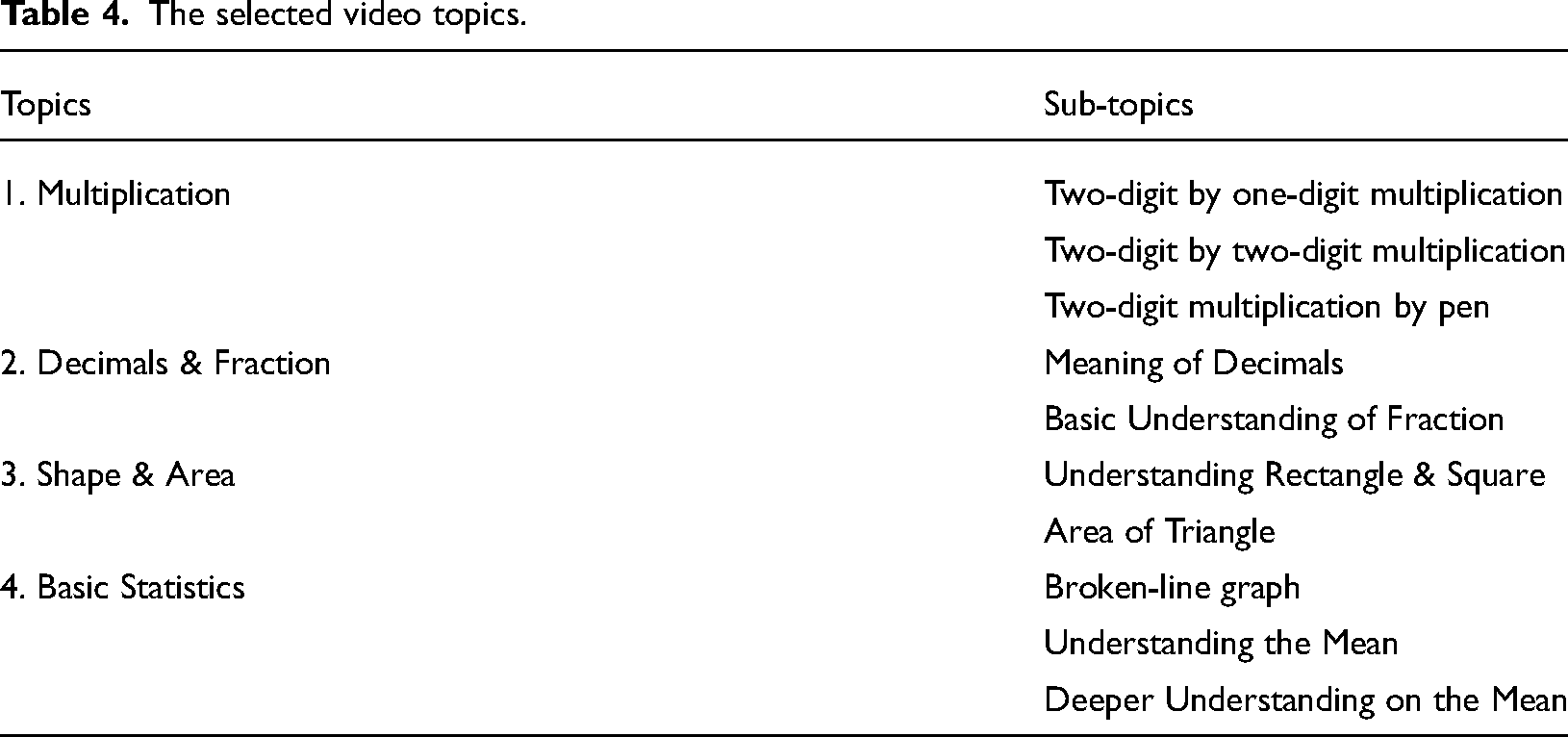
The training videos were produced by the Mathematics Teaching in Primary School Professional Committee in Chinese mainland. Chinese Education Association allowed free access to these videos online since March 2021 due to the pressing professional development needs of primary mathematics teachers amidst the pandemic. Each video recorded an exemplary lesson taught by experienced expert teachers in primary schools in Chinese mainland and lasted for around 40 min. Due to the high volatility of teaching and learning environment at that time, the present study rode on the urgent training needs of the teachers during the pandemic and did not restrict their topic selection of the training videos. The selected mathematics topics included Multiplication, Decimals & Fraction, Shape & Area, and Basic Statistics. Table 4 specifies the sub-topics viewed by the participating teachers.
The selected video topics.
Tasks of the participants
The teachers were shown two different worksheets without any instructions—one for Focused Framework, and the other for Open Framework. They were free to choose between Focused Framework and Open Framework. One of the research objectives was to understand the tendency of teachers in choosing the Frameworks.
After selecting their preferred Framework, the participating teachers were informed the following instructions and had to send back their worksheets within 2 weeks via email:
For the Focused Framework:
Before watching the video, in the “Pre-watching” column, please identify the Key Point of the lesson (i.e., the main mathematical concept that the lesson aimed to teach), and then predict or think about the Starting Point of the students (i.e., their learning foundations), their Difficult Point (i.e., learning difficulty), and teachers’ Critical Point (i.e., response to students’ learning difficulty). When you watch the video, please jot down in the “Attending to” column the Starting Point, Key Point, Difficult Point, and Critical Point revealed in the video; and in the “Making sense of” column your interpretations on why the students find difficulty and why teachers respond in that way in the Difficult Point and Critical Point respectively. When you finish watching the video, please go to the “Deciding to respond” column to write down your thoughts on students’ learning difficulty and your corresponding teaching strategies in the Difficult Point and Critical Point respectively. Whenever needed, please feel free to make use of the blank area in Starting Point and Key Point to share with us more of your thoughts and ideas. For the Open Framework:
Please write down what you have noticed from the video in the “Attending to” column, your interpretations in the “Making sense of” column, and your thoughts on your teaching strategies in the “Deciding to respond” column. If you have any questions or ideas after watching the video, please share with us in the “Posing problems” column.
Coding schemes
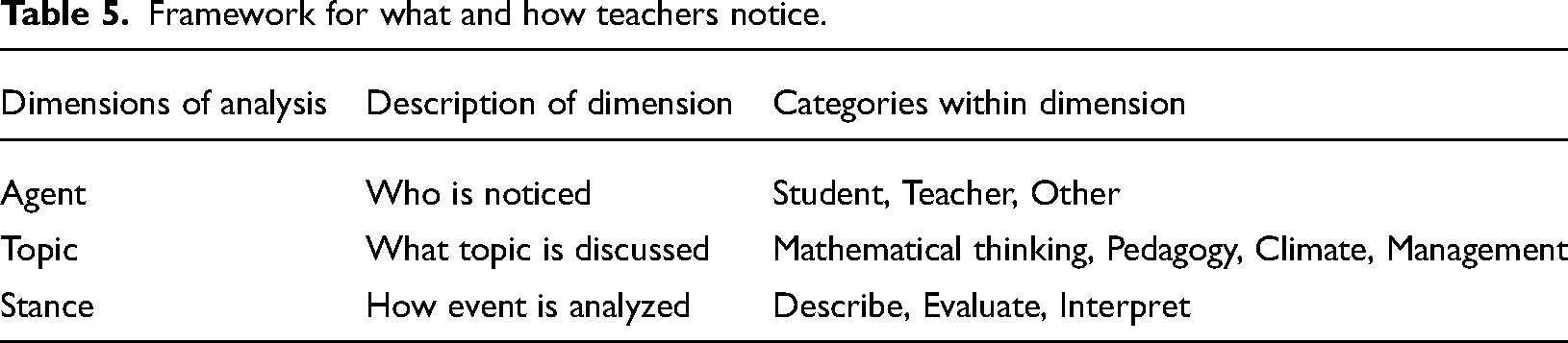
Framework for analyzing what and how teachers notice. To analyze the ISTs’ noticing, we focused on two key aspects of noticing: What the teachers chose to attend to in the video and how they interpreted those events. According to van Es and Sherin’s (2006) framework, what teachers attend to was examined through two dimensions, the Agent and the Topic that they identified. “Agent” refers to whom they noticed in the video clip, the Student, the Teacher, or Other. “Other” may refer to the curriculum designers or school administrators. “Topic” refers to what the teachers noticed, which are categorized into three components: Mathematical Thinking, Pedagogy, Climate, and Management. According to van Es and Sherin (2006), these contents can be interpreted as follows: Mathematical Thinking refers to mathematical ideas and understandings shown by teachers or students. Pedagogy refers to techniques and strategies for teaching the subject matter. Climate refers to the social environment of the classroom (e.g., “The teacher treated all the students fairly” or “It seemed like the students really liked that activity”), and Management refers to statements about the mechanics of the classroom (e.g., “The teacher did a nice job handling that disruption”). (p. 127)
To investigate how the teachers interpreted the events they attended to, we adopted Stance as an analysis dimension. Stance was used to consider the ways the teachers analyzed the noticing content, consisting of three categories: Describe, Evaluate, and Interpret. “Describe” refers to statements that recounted the events that unfolded in the clip. “Evaluate” refers to judgmental statements, in which the teachers commented on what was good or bad or could or should have been done differently. “Interpret” refers to statements in which the teachers made inferences about what they noticed, with supportive evidence from the video clips (van Es & Sherin, 2006). Table 5 recapped these analytic dimensions.
Framework for what and how teachers notice.
Four-level framework for teachers noticing. Besides analyzing what and how the ISTs noticed in the video clips, we also adopted the developmental trajectory framework to assess their noticing levels (van Es, 2011). There are four levels of noticing. From the lowest to the highest, these are Baseline, Mixed, Focused, and Extended. We showed each level and its characteristics in Table 6 (van Es, 2011). This table showed that, from Level 1 to Level 4, teachers’ noticing becomes more and more focused on the meaningful events that affect students’ learning processes, while the core of noticing shifts from teacher pedagogy to students’ mathematical thinking.
Four-level framework for teachers’ noticing.
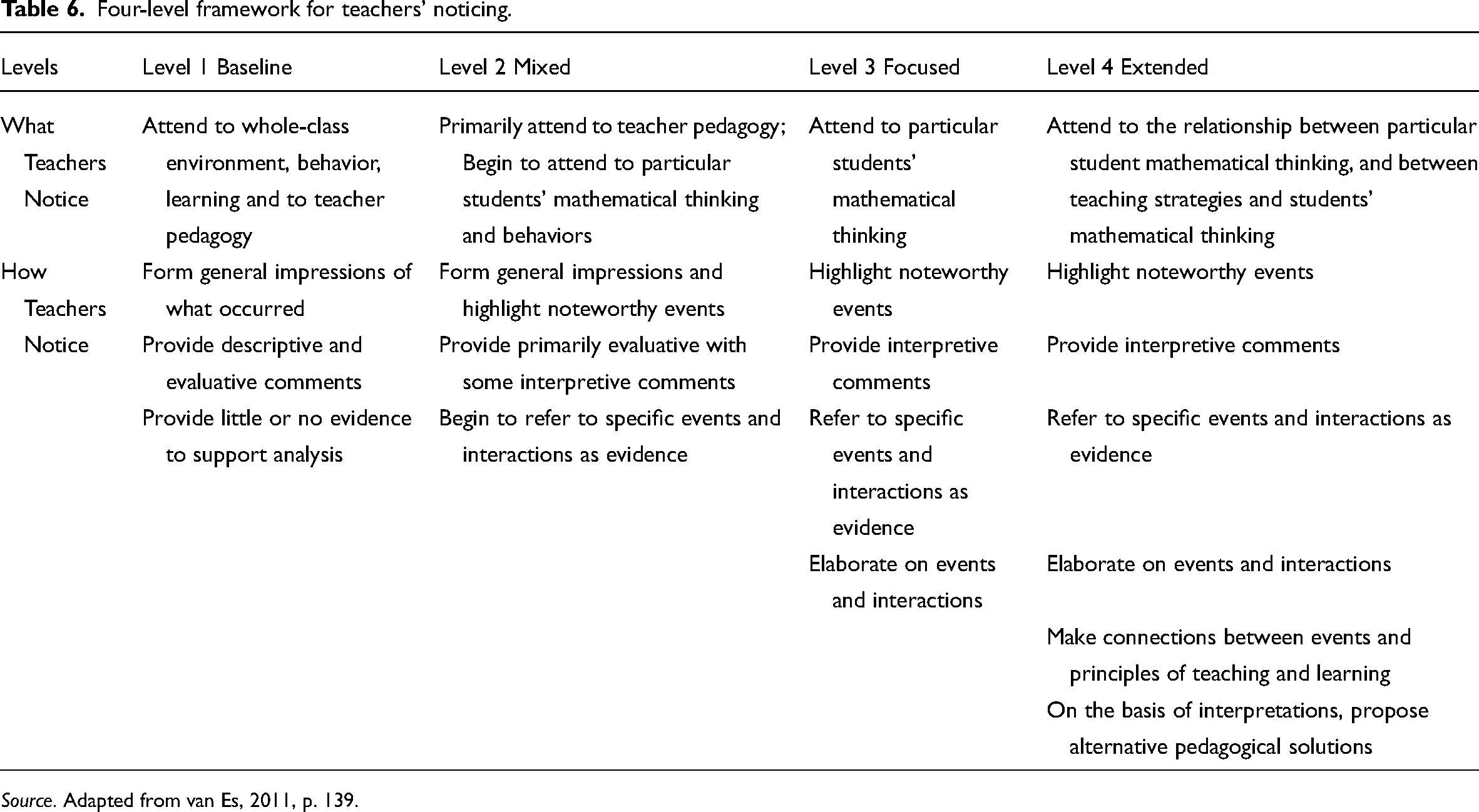
Source. Adapted from van Es, 2011, p. 139.
Data analysis
First, we reviewed each worksheet returned by each teacher holistically to understand teacher's focus and thinking logic. Then, we proceeded to coding the data. After coding, two researchers compared the coding results and invited another mathematics education expert to discuss the differences in coding. Based on the discussion, deeper analysis on the teachers’ interpretation on “Mathematical Thinking” and “Pedagogy” was needed to facilitate meaningful analysis at a later stage.
For instance, a teacher using Focused Framework (IST-Focused-5) viewed the training video on “Understanding Rectangle & Square” and observed that “when students fold the paper (i.e., paper folding exercise), they can explore (the properties of square and rectangle) on their own.” She also reflected that “we often see squares and rectangles in our daily life,” and suggested “dividing students into groups, and different groups folding the paper of different sizes.” Based on the above illustration, the Mathematical Thinking attributes “Exploring” and “Generalization,” and the Pedagogical attributes “Hands-on activities” and “Real-life examples & application” were checked. When performing the coding, both keywords and meaning of the sentences were considered.
Overall, the inter-rater reliability was 87%. Any differences between the two coders were discussed until an agreement was reached.
Results
In this section, we detailed the comparison between Open Framework and Focused Framework by examining what the surveyed teachers notice, how they interpreted different clues in the videos, their noticing level on students’ learning difficulty, and their reflection on ways to address students’ learning difficulty. The questionnaire collected mainly qualitative data for exploratory purpose, which was based on the spontaneous sharing of the surveyed teachers. Even so, quantifying the number of mentions could better reveal the magnitude and connectivity of various mentions.
What they noticed—The agent
Out of 24 responses received, 17 selected Open Framework—the format they were more familiar with, and seven selected Focused Framework. Of the seven teachers who adopted the Focused Framework, four of them (57.1%) focused on students, and three (42.9%) paid attention to both students and teachers.
Of the 17 teachers who used the Open Framework, 12 of them (70.6%) paid attention to teachers only, two (11.8%) focused on students, and three (17.6%) on both.
The Focused Framework requiring the teachers to consider students’ starting point and the difficult point seemed to be able to draw their focus more on students.
What they noticed—The Topic. The sub-categories of Topic covered Mathematical Thinking, Pedagogy, Climate, and Management.
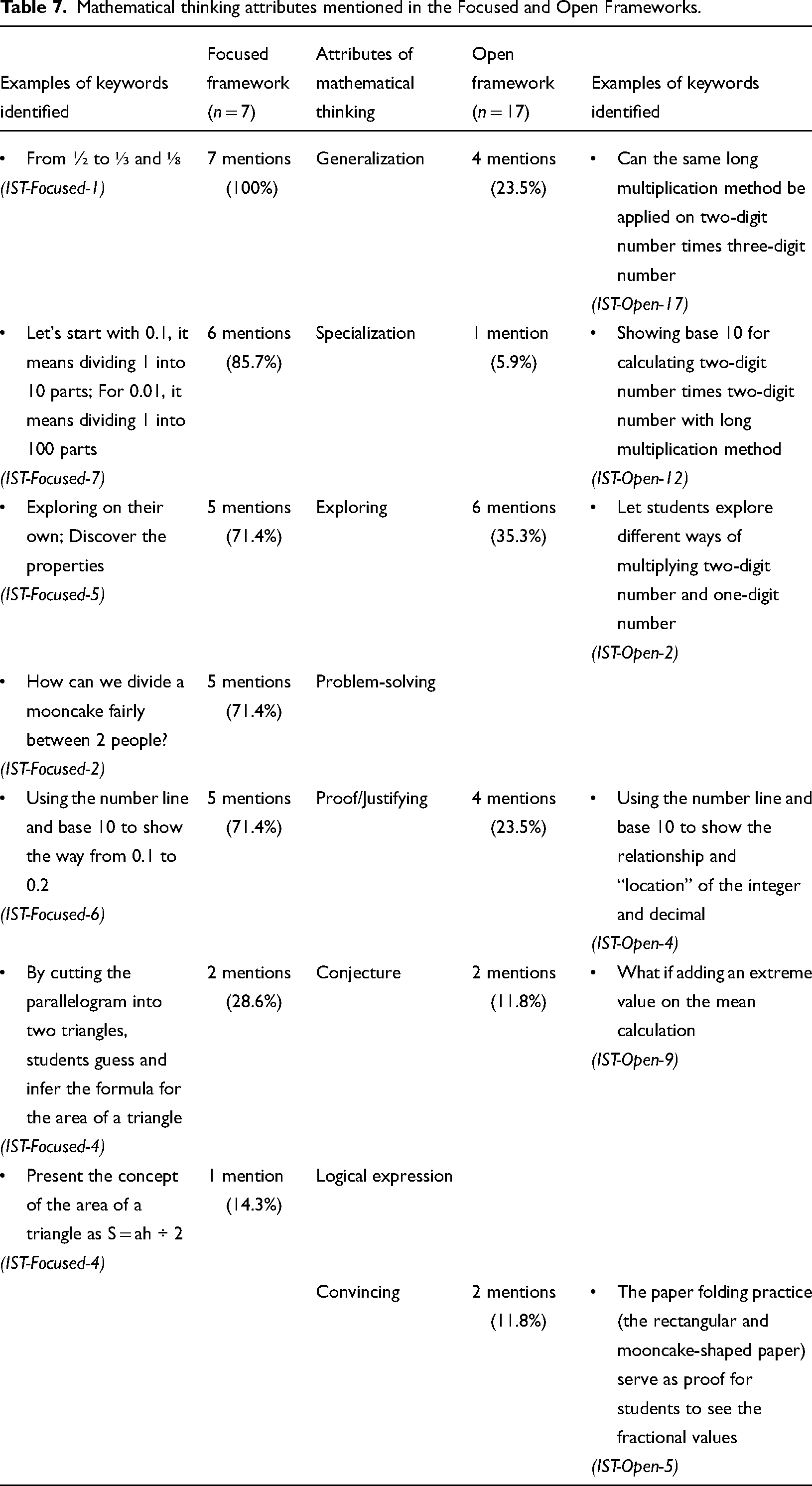
Regarding Mathematical Thinking, all seven teachers using the Focused Framework mentioned three to six attributes of Mathematical Thinking, including Generalization, Specialization, Exploring, Problem-solving, Proof/Justifying, Conjecture, and Logical expression. Other than noticing students learning specific mathematics topics and solving particular problems (i.e., Specification, 85.7%) in the videos, the teachers surveyed noticed and reflected on how to guide students to think about generalizing the knowledge they had learned (i.e., Generalization, 100%). “After getting to know what ½ means in fractions, students can try color the grid and learn ⅓, ¼ and so on” (IST-Focused-2). The teachers were aware of the moment students exploring the mathematical problems independently and group discussion in the videos (i.e., Exploring, 71.4%). They noticed that mathematics learning served the purpose of solving real-life problems (i.e., Problem-solving, 71.4%); “Matching with real-life scenario, like sharing an apple between two people, slicing the cake, students could learn the concept of equal sharing better” (IST-Focused-3). They also paid attention to the moment in the video that guided students to demonstrate their logical thinking (i.e., Proof/Justifying, 71.4%); “Using the number line and base 10, students could count from 0.1 all way to 0.2, 0.3 …” (IST-Focused-6). A few noticed how students were guided to deduce the relationship between two related concepts and formula (i.e., Conjecture, 28.6%; Logical expression, 14.3%); “By cutting the parallelogram into two triangles, students can make a guess and infer the formula for the area of a triangle; they can learn how to present their idea as S = ah ÷ 2” (IST-Focused-4).
Of the 17 teachers using the Open Framework, only eight of them (47.1%) could spontaneously mention Mathematical Thinking, mostly one to three attributes, including Exploring, Generalization, Proof/Justifying, Conjecture, Convincing, and Specialization. Exploring (35.3%) gained the most mentions relatively, as some teachers surveyed put their focus on in-class activity design, from freedom to work out solutions independently, group discussions to hands-on activities like folding paper. Generalization received some mentions (23.5%), as some teachers focused on how to deepen students’ knowledge and mastery of a specific topic: “Can students generalize their knowledge on mean to other events, such as the average number of bottles we have, pens and others?” (IST-Open-9). Proof/Justifying recorded some mentions as well (23.5%), since some teachers paid attention to the role of teaching tools that helped visualizing the mathematical concepts: “Using the number line and base 10 to show the relationship and ‘location’ of the integer and decimal” (IST-Open-4). A few were aware of Conjecture and Convincing (11.8% each), for example, “Students can guess whether the rectangular and mooncake-shaped folded in half mean the same thing. The practice can serve as proof for them to see fractional values. ½ means different things in different contexts” (IST-Open-5). Only one noticed Specialization (5.88%), eyeing on the moment of deepening students’ understanding on the topic of two-digit number times two-digit number with the long multiplication method.
In short, the Focused Framework inviting the teachers to consider students’ difficult point and teachers’ corresponding critical point could help draw their focus more on Mathematical Thinking from various dimensions. Table 7 summarizes the number of mentions of the Mathematical Thinking attributes with examples of corresponding keywords.
Mathematical thinking attributes mentioned in the Focused and Open Frameworks.
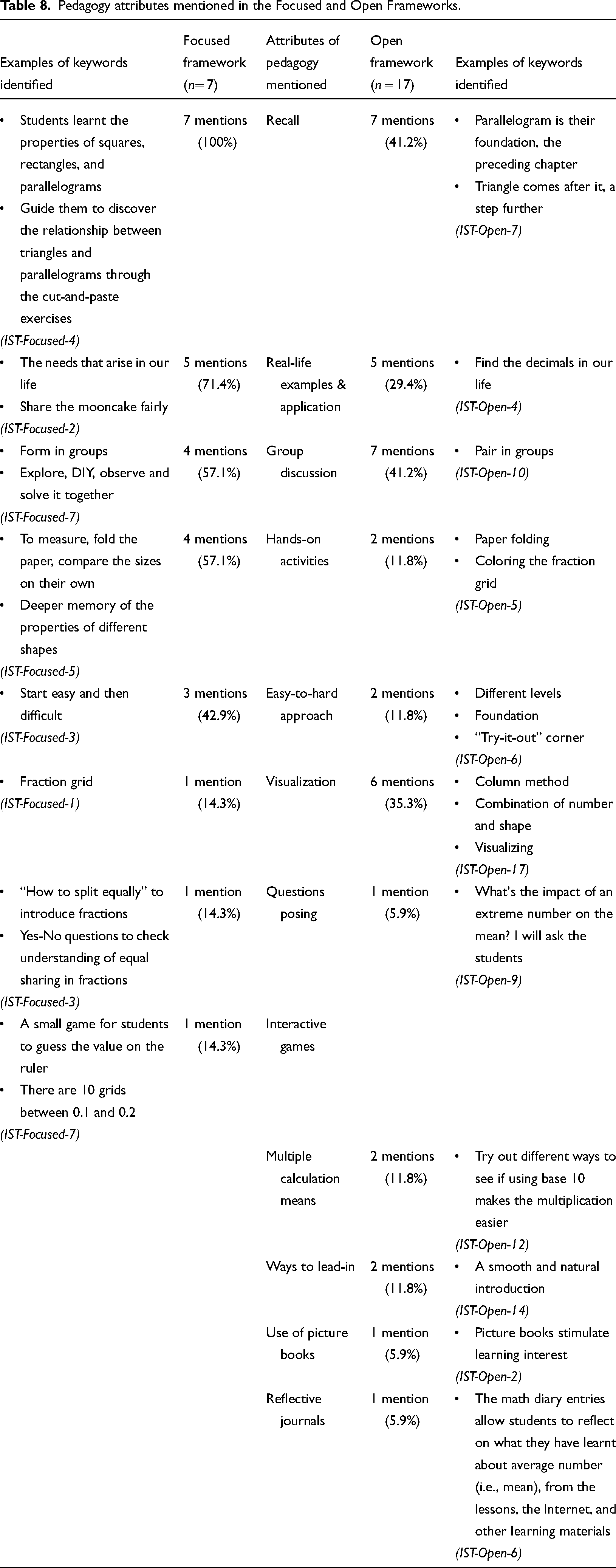
Regarding Pedagogy, of the seven teachers who used the Focused Framework, they could notice three to five pedagogical attributes. Since the Framework prompted them to think about the Starting Point of the students, all did consider connecting the new mathematics topics (e.g., area of triangles) to students’ previous learning experience (e.g., area of squares, rectangles, and parallelograms) (i.e., Recall, 100%). When the topic was completely new (e.g., fractions), they would relate it to students’ life experience (e.g., sharing the cake fairly among two or more children) (i.e., Real-life examples & application, 71.4%). Considering students’ mathematical thinking ability and ways to ease their understanding, the teachers surveyed paid attention to the teaching content design demonstrated in the videos, such as Easy-to-hard approach (42.9%)—“Start easy and then difficult, so that students can grasp the meaning of denominator” (IST-Focused-3), Questions posing (14.3%), and Visualization (14.3%)—“The fraction grid can visualize the equal sharing concept” (IST-Focused-1). They also noticed different ways of engaging students in the learning, such as Group discussion (57.1%), Hands-on activities (57.1%), and Interactive games (14.3%).
Among the 17 teachers who used Open Framework, they could only notice one to three pedagogical attributes. Recall (41.2%) and Real-life examples & application (29.4%) received more mentions, despite the shrunken magnitude than in Focused Framework. “Fractions is new to students, we have to identify their ‘zone of proximal development,’ like ‘bisecting the cake’ and ‘folding the paper into squares’” (IST-Open-5). For the teaching content design, the teachers paid more attention to Visualization (35.3%)—“The column method shows the combination of number and shape, visualizing the two-digit number times two-digit number” (IST-Open-17). A few were aware of the Ways to lead-in (11.8%), Easy-to-hard approach (11.8%)—“It is a step-by-step design that students start with understanding what average number (i.e., mean) is, then what factors influence the value, and finally collecting data to experience the process and its application in our life” (IST-Open-14), and Questions posing (5.9%). They also noticed Multiple calculation means (11.8%), and Reflective journals (5.9%) as means of encouraging students to think independently and reflect on their learning. To engage students in the lessons, they were aware of Group discussion (41.2%), Hands-on activities (11.8%), and Use of picture books (5.9%).
In short, the Focused Framework invited the teachers to consider students’ Starting Point and could remind them to pay more attention to connecting new topics to students’ previous learning or life experiences. The teachers were more aware of the easy-to-hard approach to teaching, which helped them to notice the various qualities in progressive education, such as group discussion and hands-on activities. As a result, teachers were more aware of how to bridge their teaching to developing students’ mathematical thinking and problem-solving abilities. Table 8 summarizes the number of mentions of the Pedagogy attributes with examples of corresponding keywords.
Pedagogy attributes mentioned in the Focused and Open Frameworks.
Regarding Climate, two of the 7 teachers (28.6%) who used the Focused Framework noticed students’ engagement level in the lesson—“Give students some time to think independently first, so that everybody can have something to share in their groups … Everyone participates … Engaging everyone” (IST-Focused-6). Of the 17 teachers who used the Open Framework, five of them (29.4%) were aware of the social environment of the classroom. They noticed the “open” (IST-Open-2) and “free” (IST-Open-11) environment that enabled “thought sharing” (IST-Open-16) and “interaction” (IST-Open-17), making the learning more “fun” (IST-Open-8). In short, the teachers surveyed demonstrated similar noticing level on Climate, regardless of Frameworks.
Regarding Management, no matter what Frameworks the participating teachers used, none paid attention to mechanics of the classroom.
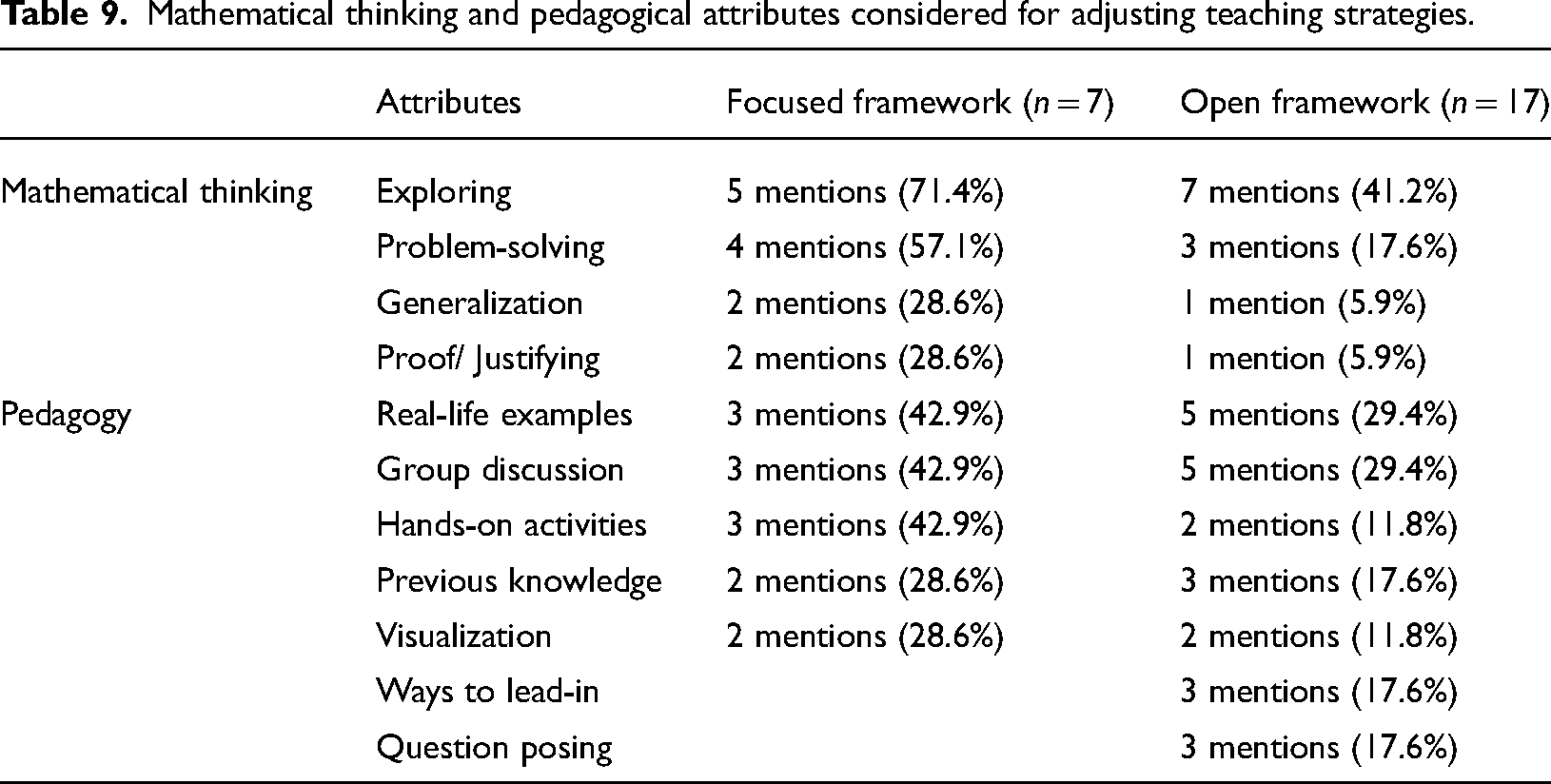
How they adjust their teaching strategies. Regarding how would teachers adjust their teaching strategies based on their observations, those using Focused Framework were inspired to connect the mathematics topics to students’ previous knowledge (e.g., revision on square before introducing rectangle), to real-life examples (e.g., cutting the cake fairly into half and sharing candies to understand the equal split principle in half fraction), and to other related mathematics topics and chapters through generalization (e.g., from half fraction to other fraction and its division meaning). Besides, teachers adopting the Focused Framework emphasized more exploring and justifying the mathematics concepts and solving the problems through different pedagogical means, including group discussion (e.g., discussion among students themselves to compare the similarities and differences of rectangle and square), visualization and hands-on activities (e.g., reading centimeters and millimeters on their rulers to explore the meaning of decimals).
Among those adopting the Open Framework, most put focus on the pedagogical part and were inspired to try different means, primarily using real-life examples (e.g., encouraging students to collect some daily life examples on the application of decimals before class) and group discussion (e.g., each team to prepare some acute triangles, right triangles and obtuse triangles to facilitate their discussion on triangles and parallelogram in class). Depending on the mathematics topics, some teachers would like to attempt visualizing the shape and mathematical meaning (e.g., triangle and fraction), while some preferred introducing hands-on activities for students to do mathematical experiment (e.g., cutting the parallelogram into triangles). Besides, teachers using the Open Framework concerned more about how to introduce the topic to students; they considered bridging to students’ previous knowledge, adjusting their ways to lead-in (e.g., asking students to estimate the answers for two-digit times two-digit first) and posing questions (e.g., the impact of extreme values to the mean). Comparatively, teachers using the Open Framework provided fewer mentions related to students’ mathematical thinking in their teaching strategies. Relatively, more teachers were inspired to provide larger space for students to explore the mathematics concepts and solve the problems on their own (e.g., exploring different calculation methods for two-digit times two-digit). Only a very few considered generalization of knowledge (e.g., from two-digit times two-digit to three-digit times two-digit) and guiding students to prove or justify the mathematics concepts (e.g., relationship between parallelogram and triangle) in their teaching strategies.
Table 9 visualizes the above findings in the number of mentions.
Mathematical thinking and pedagogical attributes considered for adjusting teaching strategies.
How they interpret—The stance and their noticing level
Stance refers to the three levels of interpretation ability, namely Describe, Evaluate, and Interpret. Among the seven teachers who used the Focused Framework, five of them (71.4%) belonged to the Interpret level (i.e., providing inferences with supportive evidence), and two (28.6%) belonged to Evaluate level (i.e., providing judgmental statements). For instance, a surveyed teacher noticed “a few geometric shapes with different shades” in the video and could infer the teaching intention—“Only based on equal sharing can the shades become meaningful fractions. This is the Key Concept (or Difficult Point) that students should master” (IST-Focused-1). The two being classified as Evaluate level could judge and notice the teaching strategies (e.g., easy-to-difficult approach) but did not provide detailed explanations on the inferences and supporting evidence from the videos.
When we extended the analysis to their noticing level, particularly their ability to notice students’ learning difficulty in mathematical thinking and the relationship with their teaching strategies, it was found that six of them (85.7%) belonged to Level 4 (Extended) and one belonged to Level 3 (Focused). Prompted by the Focused Framework, they were able to specify students’ Difficult Point in respect to the topics. For example, they considered that whether students could grasp the idea of equal sharing in fractions (IST-Focused-1/2/3), relate the triangle and parallelogram area formulas (IST-Focused-4), and understand decimals as a measurement unit (IST-Focused-6/7). In response to these challenges, as illustrated in the Critical Point of the Focused Framework, they decided to go with the demonstration of a fair and unfair cut on a cake, the cut-and-paste practices, and an enlarged ruler (i.e., teaching tool). The exceptional one who could interpret the teaching strategies shown in the video but did not detail its relationship with students’ learning difficulty in mathematical thinking and did not propose a pedagogical solution to her suspected students’ learning difficulty (i.e., confused about the hands-on exercises) was classified as Level 3.
Among the 17 teachers who used the Open Framework, seven of them (41.2%) belonged to the Interpret level, five (29.4%) belonged to Evaluate level, and five (29.4%) belonged to Describe level (i.e., recounting the events). When we extended the analysis to their noticing level, the seven teachers at Interpret level were scored low—three at Level 1 (Baseline), three at Level 2 (Mixed), and only one at Level 4 (Extended). The main reason was that they only focused on pedagogy, but neglected the consideration of students’ mathematical thinking, reflection on teaching strategies, and the connection between the two. Among the five teachers at Evaluate level, three of them were at Level 1, and two were at Level 3 and Level 4 respectively. Among the five teachers at Describe level, four of them were at Level 1, and one was at Level 2. The results showed that there was no definite correlation between Stance and Noticing level, and the ability to specify students’ learning difficulty.
Discussion
The effectiveness of teaching strategies depends largely on the alignment with understanding students’ learning difficulties. To understand students’ difficulties, teachers need to make sense of classroom events and notice their specific learning challenges. Developing this ability to notice would enable teachers to become reflective practitioners and continuously improve the quality of their teaching. In Chinese mainland, the training provided to teachers mainly consists of classroom observation and video studies. However, doubts remain as to whether these methods could effectively develop the noticing skills of in-service teachers. In this study, exemplary mathematics lesson videos were used to simulate real classroom observations and explore the differences in the perceptions of participating in-service teachers using the Focused Framework and Open Framework. The following discussion highlights why the Focused Framework outperforms the Open Framework in enhancing teachers’ noticing skills and their focus on students’ learning difficulties in mathematical thinking.
Our exploratory study revealed that the Focused Framework could help teachers prioritize students’ needs, delve deeper into students’ mathematical thinking from a broader perspective, and design appropriate pedagogical approaches that connect students’ Starting Points with new topics. Conversely, teachers using the Open Framework tended to focus more on the teacher and pedagogy, emphasizing strategies for delivering teaching content clearly and in a well-structured manner, but frequently failed to reflect on students’ mathematical thinking and learning difficulties. Indeed, our study suggested a consistent finding with the literature. In-service teachers were found inclined to focus more on their own activities than their students’ activities (Gaudin & Chaliès, 2015; van Es & Sherin, 2008). Like their pre-service counterparts, they were unable to identify relevant classroom events without training (Gaudin & Chaliès, 2015). Under existing training practices in Chinese mainland, a typical classroom observation or video training recording of a 40-min lesson inevitably shows various things happening in the large classroom. Some of this information is simply extraneous cognitive load, or simply “noises,” without aiding the training goal of improving teachers’ noticing (Sweller et al., 2011). As learners, teachers in training have to process instructional information in their working memory. The extraneous cognitive load imposed is entirely due to the instructional procedures used and under many circumstances unnecessary. These noises are not the information that the teachers expect to acquire to achieve the learning goals but are quite overwhelming and distracting. Therefore, adopting the Open Framework that allows attention and thoughts to flow freely could make it difficult for teachers to focus on students’ thinking.
The contrasting outcomes between the two Frameworks were also driven by the explicit prompts of the Focused Framework. Since the Focused Framework prompted the participating teachers to consider their students’ Starting Points before watching the videos, it also clarified their observation goals and framed their thinking to concentrate on students’ Difficult Points during the video-watching process. This activation of selective attention could filter out noise and irrelevant clues. Consequently, teachers using the Focused Framework demonstrated better noticing skills, particularly in identifying and elaborating on the relationships between students’ Difficult Points and teachers’ corresponding Critical Points. Given the videos lasting for a whole lesson, the Focused Framework could act as a problem-based learning (i.e., one type of theoretical frameworks used by studies on video viewing in teacher education and professional development) that guided teachers with questions on how to interpret and reflect (Gaudin & Chaliès, 2015), directing their attention to the most relevant classroom events with a more specific and interpretative analysis. According to the systematic literature review by Gaudin and Chaliès (2015) on video viewing in teacher education and professional development, effective video viewing should be guided and scaffolded. In our study, the Focused Framework could serve as the scaffold, which is expected to encourage teachers to “articulate and explore the conceptual frameworks they use to make everyday decision about instruction, and develop change-directed thinking (that) they will more likely to enact in practice” (Gaudin & Chaliès, 2015, p. 56).
In our present study, the socio-cultural context of education in Chinese mainland could help explain why the Open Framework that is effective in Western culture could not fit in. Similar to other East Asian countries, education in China places a strong emphasis on clear lesson objectives and structured lesson planning and design (Yang et al., 2019). In the Open Framework that allowed free observation, participating teachers naturally focused on what concerned them most, leading to results that revealed a teacher-led perspective (i.e., Agent). The teacher-centered approach in Chinese education is influenced by three fundamental factors: teachers’ authority, exam-oriented education, and training practices. In Confucian culture, a good student is expected to be obedient, respectful of teachers’ authority, and follow instructions. Chinese teachers often take well-behaved students and a well-managed classroom environment for granted (Yang et al., 2019). This may explain why the participating teachers in this study, regardless of the frameworks they used, did not pay much attention to classroom management. Instead, they focused on designing teaching content and lesson planning, aiming to effectively communicate well-prepared scripts in a smooth teaching flow.
Moreover, due to the tight class schedules and exam-oriented education, a well-organized teaching process, from imparting mathematical concepts to practicing exam skills, becomes more important than anything else, including understanding students’ learning difficulties and their need for mathematical thinking development. One may argue that China has placed more emphasis on student-led topics such as mathematical modeling, group work, and discussion since the introduction of the most recent mathematics curriculum in 2000 (Yang et al., 2021). However, these topics are relatively new and often seen as pedagogical strategies. Chinese teachers prioritizing effective teaching strategies and model answers over students’ mathematical thinking development can be seen as a natural response to this entrenched social phenomenon.
Finally, the teacher-centered perspective can also be attributed to training practices. Traditionally, the in-service teachers in China are accustomed to paying attention to experienced teachers and learning from their demonstrations through classroom observation and training videos. This explains why the student-centered perspective was largely absent under the Open Framework, and participating teachers scored poorly in noticing students’ difficulties across various mathematics topics and adapting teaching strategies to meet students’ learning needs.
The above three socio-cultural factors in education of China illustrated why the Open Framework proposed in Western context was unable to drive Chinese teachers to focus on students’ learning difficulties and reflect on their teaching strategies in daily classroom observation or video training. Developing a framework suitable for teachers in China is therefore required. In our present study, the proposed Focused Framework could be an available option for training the noticing ability of in-service mathematics teachers in Chinese mainland.
Conclusion and limitations
Currently, mathematics pedagogy courses at teacher training programs provide limited practical training, and the practicum allows free observation. The Open Framework, which simulated this free observation in our study, revealed the limitations and ineffectiveness of existing classroom observation, peer review, and teacher reflections. To address this issue, we proposed the Focused Framework that provided specific guidance regarding students’ Starting Point, Key Point, Difficult Point, and teachers’ Critical Point. The framework was found effective in framing teachers’ observation and guiding them toward becoming more student-led, sensitive to students’ needs and able to adjust their teaching strategies to address students’ mathematical thinking. As a result, the in-service teachers are expected to become more effective practitioners with their enhanced noticing skills. Since video viewing would be a continuum in teachers’ education and professional development programs that supports their entire teaching career, the Focused Framework to video training could be an effective tool to sustainably enhance teachers’ noticing skills.
Data for this study was collected in early 2021 during the pandemic, which presented challenges to the quota sampling design, such as teachers’ years of experience and designated video topics. Future research could consider these factors to quantitatively assess the effectiveness of the Focused Framework with a larger sample size. Additionally, future studies should include the Three-point Framework for a three-way comparison to further validate the effectiveness of the Focused Framework. Furthermore, to better demonstrate the validity and generalizability of the Focused Framework, future comparative studies should consider other contexts beyond China. Lastly, the design of this study's questionnaire demanded that participated teachers possess advanced expressive abilities to articulate their responses with accurate words and examples. Coupled with the 40-min video, the study tested participants’ patience and concentration. Future research could suggest improvements to the instructions, video content, and video length to address these challenges effectively.
Footnotes
Contributorship
Kexin Chen was responsible for conducting the data analysis and writing the first draft manuscript. Qiaoping Zhang conceived the idea, designed the study, collected the data, revised the paper, and responded to reviewers’ comments. Mi Yeon Lee was responsible for proofreading, revising, and finalizing the paper and responding to reviewers’ comments. Yang Cao was responsible for the data analysis and coding process.
Declaration of conflicting interests
The authors declared no potential conflicts of interest with respect to the research, authorship, and/or publication of this article.
Ethical statement
Research methods and procedures for this study were conducted in accordance with human subjects guidelines and approved by the second author's Human Research Ethics Committee for research involving human subjects (Ref. no. 2021-2022-0069).
Funding
The authors disclosed receipt of the following financial support for the research, authorship, and/or publication of this article: This research project was supported by the Seed Fund of the Education University of Hong Kong, Hong Kong SAR (Project No. R4248: RG43/21-22R) and partially supported by Departmental Research Grant (Project No. 04786). The work was also partially supported by the Guangdong Province General Universities Young Innovative Talents Category Project (Ref. 2023WQNCX076).
