



Abstract
Purpose
The growing literature on private supplementary tutoring, widely known as shadow education, addresses multiple dimensions and roles. However, many studies inadequately capture the diversity and implications of different forms of tutoring. This paper examines these matters in Myanmar, highlighting complexities and ambiguities in descriptors and in the nature of provision.
Design/Approach/Methods
Using a mixed-methods design, this study was conducted in Mandalay Region and Chin State. The data were obtained from interviews with 110 Grade 11 students, 34 high school teachers, 30 parents, 29 private tutoring providers, and two private school owners.
Findings
The article categorizes tutoring forms based on their styles and orientations, particularly lecture-type teaching and homework supervision by guides, class sizes, durations of fee-charging (e.g., annually), the number of subjects taught per tutor, and tutoring locations. The study brings the topic out of the shadows for clearer analysis of the phenomenon and thus for assessment of its implications.
Originality/Value
The study makes a methodological contribution to the wider picture by demonstrating the need for greater clarity and precision in the national and international comparative literatures. It also underscores shortcomings of predetermined categories in questionnaires and the value of qualitative interviews.
Introduction
A substantial literature has developed on private supplementary tutoring, including in this journal (e.g., Christensen & Zhang, 2021; Liao & Huang, 2018). The phenomenon is widely called “shadow education” because much of its content mimics that in schooling—as the content changes in the schools, so it changes in the shadows (Entrich, 2021; Zhang & Bray, 2020). The metaphor has ambiguities (Bray et al., 2015a; Malik, 2017), but also has appeal and pertinence both in the mimicry and insofar as shadows are usually indistinct.
The shadow education literature mainly focuses on tutoring in academic subjects that are also taught in schools, but for which instruction is delivered outside school hours and in exchange for a fee (e.g., Bray, 1999; Zhang, 2021). Suppliers of tutoring include teachers desiring extra incomes, university students and other informal providers, and entrepreneurs operating commercial enterprises (Bray, 2022; Duong & Silova, 2021). Tutoring has many forms, and varies in scale and intensity according to both demand and supply by different individuals and groups. It also varies in the times of day, week, and season. The diversity and indistinctness of shadowy features creates difficulties for analysis.
The goal of this paper is to show that from a conceptual and methodological standpoint, the diversities and complexities of shadow education should be recognized more fully than has been the norm in much of the international literature. The paper presents insights from fieldwork in Myanmar, showing the importance of interviews to permit adjustment of categories that might otherwise have been set by pre-determined questionnaires based on international literature. The analysis shows the value of developing conceptual frameworks rooted in both insiders’ and outsiders’ approaches (Crossley et al., 2016)—in this case for solid theorization of shadow education in specific contexts. Extending the metaphor, such scrutiny can take the theme out of the shadows for clearer understanding.
The paper begins by outlining some features of shadow education as portrayed in the international literature, together with some methodological weaknesses in existing studies. The paper then turns to specifics in Myanmar, beginning with the context before moving to the diversity of shadow education forms as shown by the present research. Although Myanmar is only one country, focus on patterns in Myanmar highlights definitional issues that likely have counterparts elsewhere and that raise fundamental questions for the broad field of shadow education research.
Objectives and design of shadow education research
Although shadow education research agendas have diverse objectives depending on the contexts and interests of the researchers, some core themes can be discerned (Hajar & Karakus, 2022; Luo & Chan, 2022; Zhang & Bray, 2020). One theme concerns social inequalities (Entrich, 2021; Matsuoka, 2018; Zwier et al., 2021). Families in higher socio-economic groups can afford more and better tutoring than their peers in lower socio-economic groups, and insofar as shadow education strengthens performance in education systems, investments in the early stages of children's lives have long-lasting implications for future careers and well-being.
Another common theme concerns the efficiency of education systems (Bray, 2009; Dang & Rogers, 2008). Some forms of shadow education help improve efficiency by assisting slow learners to keep up with their peers, and others provide tailored support to stretch high achievers further. Among the 74 publications appearing between 2000 and 2020 and reviewed by Luo and Chan (2022, p. 8), 41 focused on students’ academic performance. Similarly, Hajar and Karakus (2022, p. 349) stated that academic performance was the most visible topic alongside social inequality in shadow education research. Shadow education does not always have positive effects, and a key question is whether tutoring raises the academic achievement of children efficiently as promised (e.g., He et al., 2021; Ömeroğulları et al., 2020). Some tutoring may conflict with schooling if, for example, children learn material in advance and are bored in school (Guill & Bos, 2014; Zhang, 2019). Also, teachers who provide supplementary tutoring may be distracted from their primary duties (Duong & Silova, 2021). The provision of tutoring by currently serving teachers may raise ethical issues, especially when teachers tutor their existing students and deliberately cut content during regular classes in order to promote demand for private lessons (Ille & Peacey, 2019).
Beyond such concerns, the foci of research on shadow education may match almost all those of regular schooling. For example, they include administration, curriculum, pedagogy, tracking, personal generic skills, learning strategies, psychological well-being, and classroom dynamics (see, e.g., Luo & Chan, 2022). Hence, shadow education research is diverse and multifaceted.
Whatever the focus, it seems axiomatic that studies should always commence with clear identification of the phenomenon being examined. In practice, however, identifications are often indistinct. One illustration is Kuan’s (2011) study of mathematics achievement of Grade 9 students in Chinese Taiwan. Kuan sought through propensity score matching to identify the roles of tutoring among students receiving and not receiving such support. Treatment of tutoring as a single entity, coded yes/no, thus ignored even the differences between one-to-one, small-group, and large-class instruction. Similar remarks apply to the studies by Byun (2014) of shadow education in Korea, by Cole (2017) in Sri Lanka, by Hawrot (2022) in Germany, and by Ren et al. (2023) in Chinese mainland.
Elsewhere in the literature, shortcomings include blurring of concepts in the questionnaires for the Trends in International Mathematics and Science Study (TIMSS) and the Programme for International Student Assessment (PISA) (Bray & Kobakhidze, 2014). Problems have included whether or not the tutoring required fee payments, and terms such as “cram school” have been used loosely. This problem has also been evident at the national level. In Japan, for instance, Carley (2019) described Japanese juku as cram schools without recognizing the wide range of institutional types that serve different needs in different ways (see Yamato & Zhang, 2017). A similar problem arose regarding buxiban in Chinese Taiwan presented by Liu (2012).
More usefully, other studies have stronger recognition of diversity. Again concerning Japan, for example, Roesgaard (2006, pp. 33–34) categorized juku into four main groups based on the learning atmosphere, course focus, relationship with schooling, types of students, teaching materials, class size, entrance system, and advertising methods. With a broader focus, Kim and Jung (2019, p. 145) presented five forms of shadow education classified by class size, major provider, distinctive features of instruction, levels of individualization, and fees (in the Korean context). However, arguably Kim and Jung could have identified many more categories in an article that aspired to offer a worldwide analysis. More comprehensively, Zhang and Bray (2020) distinguished between providers (individuals, institutions), forms (online, dual-tutor, offline), and seasons (during semester, public holidays, and vacations), with various further sub-categories and sub-sub-categories. Yet as will be shown in this paper, even those classifications in the literature cannot capture all the local nuances in Myanmar—or, by implication, in many other countries/regions. The paper thus helps to refine concepts and definitions for both national and international analysis.
The paper also reflects on the processes of refining concepts, which may to a considerable extent reflect the identities of the observers as well as the objects being observed (Nisbet et al., 2001). The authors resonate with Neuman (2014, pp. 62–63), who remarked that concepts are combinations of word(s), definition(s), and assumption(s). Neuman explained, for example, that the concept of height includes the letters and etymology of the word itself, the vertical-measurement definition, and the tall/high or short/low assumption. Thus, a person with a height of 5 feet, 8 inches (specific indicator) might be tall (assumption) in one country but average elsewhere. Neuman stressed that clarification of definitions and assumptions of terms and concepts underlies solid explanation and theorization of social practices and processes in each context.
Along this line, common criteria for categorizing tutoring according to class size have different assumptions in the literature. For example, Cole's analysis in Sri Lanka (2017, p. 144) classified individual classes as having 1–10 students, small classes as having 11–25 students, medium classes as having 26–40 students, and mass classes as having 41 or more students. Most mass classes, she added (p. 144), had 51–75 students, but some had 150, 200, or 300 students—and this was just primary Grade 5. In the United Arab Emirates (UAE), by contrast, Rocha and Hamed (2018, p. 28) described a tutorial class with just six or more students as a large class.
With such matters in mind, Neuman (2014, p. 68) observed that cross-cultural categories commonly downplay the contextual and historical significance of phenomena but that local categories lack adequate articulation for broader theorization. Neuman then recommended use of multiple terms in specific fields with identification of the limits of each concept. The present paper begins by following this advice, and then shows the value of integrating international and national categories of tutoring provision.
Myanmar contexts
Myanmar is a diverse country, with an estimated population of 54 million as of 2020 (World Bank, 2021). Administratively, the country is divided into seven Regions, seven States, one Union Territory, four self-administered zones, and one self-administered division. It has 135 officially-defined ethnic groups, among which Burmans dominate. A quarter of the population has been estimated to live below a US$1.9 daily Purchasing Power Parity (PPP) poverty line (Central Statistical Organization [CSO], UNDP & World Bank, 2020, p. 130).
At the time of this study, the educational structure consisted of grades 1–5 in primary school, grades 6–9 in middle school, and grades 10–11 in high school. Scores in the Grade 11 high-stakes matriculation examination were the main criterion for higher education admission, and only one-third of students passed that examination (CSO, 2017, p. 159). Hence, the demand for private tutoring was especially high in Grade 11. Private schooling alongside public schooling was prohibited between 1964 and 2011, but private tutoring in the shadows was widespread throughout the period. The 1984 Private Academic Training Law (Socialist Republic of Burma, 1984) sought to dampen the sector, but was only partially successful. 1 In Yangon, the largest city, a 1990 study found that 90.6% of high-school-student interviewees were receiving some sort of private tutoring (Gibson, 1992, p. 10).
Alongside the temporal perspective are geographic and cultural ones. The present study was conducted in both rural and urban parts of Upper Myanmar, in contrast to previous studies in Lower Myanmar and mostly urban contexts (Bray et al., 2020; Gibson, 1992). Within Upper Myanmar, Mandalay Region was selected as the most developed area, and Chin State was chosen as the least developed area. Mandalay Region is largely flat and densely populated, while Chin State is mountainous and thinly populated. According to the 2014 census, the population of Mandalay Region was 6,166,000 and of Chin State was 479,000 (Ministry of Immigration and Population of Myanmar, 2015). The population of Chin State was therefore comparable just to one District in Mandalay Region.
Also relevant to this study were overall levels of educational performance. Unpublished official data provided to the authors indicated that 851,524 students across the country took the matriculation examination in 2019, among whom 119,210 (14.0%) were in Mandalay Region and 10,771 (1.3%) were in Chin State. Mandalay Region had the highest and Chin State had the lowest matriculation examination pass rates in Upper Myanmar for five consecutive years (2014–2018).
Methodology
This article is developed mainly from the qualitative component of a larger mixed-methods study in Upper Myanmar. The principal instruments were questionnaires and outlines for semi-structured interviews. These instruments were based on those for the Yangon study (Bray et al., 2020), which themselves had predecessors developed in China, Iran, Jamaica, Malaysia, and elsewhere (Bray et al., 2015b). Adaptation of the instruments to the contexts of Upper Myanmar was facilitated by a pilot study in Sagaing Region. Yet even with all these predecessors and tailoring considerations, the questionnaires (in particular)—which had been developed from international categories—had limitations for identifying details in local categories. For instance, the questionnaire for students asked about the number of peers in their tutoring centers, but did not ask whether their tutoring was lecture-oriented for curriculum content, supervision-oriented (which emphasizes overseeing students’ homework), or both. The insights presented in this paper primarily come from the interviews, especially those held with students and tutors, which had flexibility and could thus be adjusted as the research proceeded.
For sampling, the chief criterion was maximum variation in economics, geography, culture, and private tutoring. Within the Mandalay Region, urban Mandalay District was selected as having the highest pass rate, and rural Myingyan District was selected as having one of the lowest pass rates. Within each district, two or three townships were chosen based on the same maximum-variation criteria. Within Chin State, the research focused on one northern township that often had high matriculation pass rates, one central township that had the highest urban population, and one southern township that often had low examination pass rates. Within each selected township, at least one urban and one rural school were selected.
The interviewees comprised 110 Grade 11 students, 34 high-school teachers, 30 parents, 29 private-tutoring providers, and two private-school owners. 2 Among the criteria for selecting student interviewees was attendance at different tutorial centers. For teachers, at least two per school were selected, and parent interviewees were solicited through the students and school principals. Tutor interviewees were sought based on addresses published on posters around the school compounds. Approval to conduct the study was obtained from the University of Hong Kong (HKU), the Myanmar Ministry of Education, and the Mandalay Region and Chin State Education Offices. Most interviews were recorded with the written or oral consent of the interviewees, and a passive written consent form was distributed to student-participants at least one day prior to the study.
The first author of this paper is fluent in the Burmese and Chin languages. Two parents in Chin State who spoke dialects that he did not understand were interviewed with the help of voluntary interpreters, but their responses were excluded from the analysis due to the risk of unreliability. The other interview responses were transcribed into the Burmese and Chin languages. The transcripts for each data group (i.e., students, parents, teachers, and tutors) were then analyzed using Google Sheets. The first column of a sheet indicated each interviewee's identity, and every new concept was put in the first row. Related responses from the interviewees on similar concepts were placed in the column of each aligned first row, and new concepts were placed to new columns. Responses in the same column or related columns were then extracted for a new sheet with the respondent's identity column, and then analyzed for developing themes. After examining each data group, themes and concepts from the whole dataset were assembled to view the overall picture.
Following Neuman's guidance, the study first deployed common tutoring terms as used in Myanmar. The way to categorize tutoring in the locations studied was discerned as a combination of tutoring orientation (lecture-style classes, supervision, or both), the arrangement of tutors in different tutoring orientation sessions, class sizes, durations for which fees were charged, the number of subjects taught by the tutors, and tutoring locations. However, the classification also recognized blurred boundaries in some categories. The information gathered was cross-checked for consistency across the questionnaire and interview sources, and triangulated with official documents, informal conversations with stakeholders, and advertisements of tutoring providers.
The personal backgrounds of the researchers were also pertinent. The first author of this article is a Myanmar national of Chin ethnicity, while the second author is a United Kingdom national but acquainted with Myanmar for four decades and with extensive professional experience in the country. 3 These identities provided complementarities along the lines of what Crossley et al. (2016) have called insider–outsider research. For instance, tutoring typologies emerging from the data and taken for granted by the first author are challenged by the second author to clarify the meanings and associated connotations. Nevertheless, the researchers still needed self-questioning and exploration of their own assumptions about the objects of study.
Categories of private tutoring
The common term for private tutoring in Myanmar is kyushin (ကျူရှင်), derived from the English word “tuition.” Based on the authors’ experience and pilot study, the categories in the survey were one-to-one, wiin (ဝိုင်း which means “small grouping”), yoeyoe (ရိုးရိုး which refers to simple/common large-class tutoring), and asaung (အဆောင်)/bawder (ဘော်ဒါ) or bawdersaung (ဘော်ဒါဆောင်) (which means “hostel/boarding”). The survey responses indicated that in Mandalay District, the one-to-one receiving rate was 8.4%, for wiin it was 40.0%, for yoeyoe it was 40.0%, and for asaung it was 11.6%. In Myingyan District, the proportion was 0.5% for one-to-one, 6.1% for wiin, 18.4% for yoeyoe, and 75.0% for asaung. In Chin State, the rate was 2.5% for one-to-one, 18.5% for wiin, 3.1% for yoeyoe, and 75.9% for asaung. The variations by district showed geographic and cultural variations, albeit with limitations from the constraints of the instrument.
Further local terms including section (ဆက်ရှင်/တစ်ဘာသာချင်းသင်), day special (နေ့အထူး), extra class (အချိန်ပို), night study (ညကျောင်း), teaching wiin (စာသင်ဝိုင်း), studying wiin (စာကျက်ဝိုင်း), and guide (ဂိုက်) emerged from the interviews. During the process the first author, as a Myanmar national and insider, benefited from the questioning by the second author based on his external perspectives about what the categories actually meant and to whom. The process contributed to much conceptual refinement, though overall the terms could be placed in two main groups as lecture-oriented or supervision-oriented tutoring. Most tutoring occurred in one of these groups or in a combination. The categories existed in all seasons, and most students received tutoring even during the long vacations between academic years. For students who could not afford or did not want to receive tutoring at the beginning of the year, some providers offered intensive courses near the time of the final examinations.
Lecture-oriented tutoring
In this category, the tutor-centered instruction emphasizes curriculum content rather than supervision of students’ homework. The observed sub-categories of such lecture-oriented tutoring were sections, wiin, and kyushin.
Sections
In sections, each tutor offers a specific subject, and students travel from one location to another if they desire tutoring in more than one subject. A retired teacher pointed out that the system is longstanding. He had sat the matriculation examination in 1977 in Mandalay District, and recalled bicycling from one tutoring location to another. He added that the sizes of sections depended on the popularity of the tutors. During the present research, an example of section tutoring for Grade 11 physics was identified in Mandalay District. Sections commonly specialize in particular grades as well as specific subjects. However, since travel from one location to another could be costly for the students in time and perhaps money, one tutor in Mandalay District remarked that sections were now “almost disappearing.” Thus, in the contemporary era multi-subject tutoring has become the dominant form. Section providers often charge students per session or per month.
Wiin
In the typical wiin provision, students and parents organize tutoring groups (wiin means “grouping”) and invite teachers/tutors to provide instruction. One tutor in Myingyan District again provided a historical perspective. With six friends, in 1998 she had organized wiin by hiring teacher-tutors for instruction in her house. Another interviewee indicated that the practice had already been prevalent in 1982: Wiin means, for example, a 10-student, 15-student, or 8-student group, like that … organized by [students] with strong financial backgrounds. In wiin, parents select their favorite tutors based on their financial strength. The main thing is that … [wiin is] organized by the clients.
The wiin arrangement also has a connotation of privileged status as a grouping of students with a similar exclusive social background, unlike other forms of tutoring that are more open to all social classes. Wiin remains especially popular among students who desire and can afford more individual attention than they receive at school. Unlike section tutoring, students receive instruction in more than one subject, and indeed commonly in all subjects, at a single location. Students share the yearly cost equally, and students do not usually receive participate in more than one wiin.
Full-class kyushin
Alongside sections and wiin is large-class tutoring in more than one subject at a single location. This model is simply called kyushin, but potential for confusion arises because kyushin is also a collective noun for all forms of private tutoring.
According to one interviewee, this large-class provision of all subjects was already common in 1974. Another interviewee, recalling the tides of political history, remarked that “kyushin [provided by teachers] was especially prevalent after the 1988 public uprising.” 4 Political forces following that event caused frequent closure of schools, and one interviewee reported having had to rely on tutoring during the 1990s for support to sit the matriculation examination. Interviewees in Mandalay District indicated that due to declining expenditure in public schooling and low teachers’ salaries in the 1990s, full-class kyushin had expanded significantly. Among factors was an official policy to encourage fee-paying extra classes in schools as a way to improve educational provision at no additional cost to the government. Subsequent reforms abandoned this arrangement and prohibited teachers from providing private tutoring, but the extra-class policy created a lasting shift of norms in both urban and rural areas. Many respondents thus associated kyushin with large-class tutoring of all subjects, provided mainly by teachers and organized by the teachers/tutors in schools or in private properties. Kyushin is generally charged by subject per month, but since it is tutoring in one place where tutors come one after another and most students receive all subjects, the fees look like a monthly charge.
Supervision-oriented tutoring
In this category, tutors known as guides form a main component for stand-alone support, though further components may be found in mixed provision.
Guides
Tutoring in the guide system does not normally include lecture-style instruction with a chalkboard. Instead, guides supervise students’ homework and related studies—waiting while the students read and memorize texts, listening to their text repetition, and checking their exercises. Guides therefore do not need to be proficient in each subject. As explained by one tutor: They need to make sure students complete their daily homework. Students can ask them questions, and if the guides can’t explain lessons then they inform the teaching tutors (or school teachers) to explain that specific content again.
Guide tutoring commonly takes place in the evenings, and some people call it “night study.” Based on the number of subjects per tutor and intensity, guide tutoring can be sub-divided into:
- home guide, in which a tutor supervises one or a small number of students for all subjects, generally at a tutee's home; - special home guide, in which each tutor supervises specific subjects (one or more, but rarely all subjects per tutor) in a student's home, and - studying wiin or night study, in which tutors supervise many students, perhaps from different grades, for all subjects in tutorial centers, tutors’ homes, or schools.
In general, guide tutoring is charged monthly for all subjects, but payments to special home guides may vary.
Mixed provisions
Some tutorial centers, individual tutors and teachers provide both lecture-oriented and supervision-oriented tutoring. These provisions, based on the common terms used by the local people, can be grouped into “extra class and night study” in public schools, “day [kyushin/teaching] and night study” in tutorial centers, “teaching wiin and studying wiin” commonly at the tutors’ homes, and asaung (boarding) centers.
Extra classes and night studying in public schools
In order to boost the matriculation examination pass rates, education officers in the past often forced and partially financed schools to organize extra classes and night study. This work was commonly carried out via Parent–Teacher Associations. Some schools collected fees directly from students, but others sought funds in other ways. The revenue was used for operational costs such as teachers’ monthly tutoring fees, fuel for generators, and gifts at the year end. However, such provisions in urban public schools had almost disappeared, since students’ (and parents’) dependence on public schools for the examination preparation was low, especially in Grade 11, and instead the students received tutoring outside the schools. Moreover, students (and parents) chose to receive tutoring from the long holidays preceding Grade 11 (i.e., April and May) as an extended preparation for the examination. In public schools, the extra class and night study usually only started a few months into the academic year (e.g., August or September).
Unlike the urban counterparts, however, students in the rural and remote areas had to rely on schools for such extra classes since they lacked access to private tutorial centers and other providers. In this study, the four rural schools in Chin State still offered extra classes and night study. Two of the schools allowed students to receive either one arrangement (extra class or night study) or both, and students could pay fees for just the support that they received. The other two schools did not have separate arrangements, so students received both extra classes and night study. One of the schools also arranged for students to sleep on the premises because they had early morning guide tutoring.
In the survey responses, many students who attended such provisions stated that they had fee-paid lecture-oriented tutoring and guides. Such responses could easily mislead interpretations based on the predetermined categories in the questionnaire. Even though the questionnaire at the beginning provided a definition of what the researchers meant by “private tutoring,” students seemed to have challenges to grasp it. A major reason was that many teachers (51.1%, according to the survey responses) were also their tutors, sometimes working independently but in other cases arranged by the school. Also, some of the privately-organized tutoring was held on school premises rather than outside.
Day [kyushin/teaching] and night studying
Some tutorial centers offer both lecture classes and night study but with separate fees that are charged monthly. A student in Mandalay District illustrated: I receive only the kyushin [lecture-oriented tutoring]. We go there after school, and if the tutors request we also go on weekends. We receive teaching from 4:30 pm to 6:30 pm. They have a night guide [ညဂိုက်] from 7:30 pm to 10:30 pm, but I don’t receive that one.
In such centers, individual tutors commonly both teach classes and supervise night study. Among the interviewees, a tutor in Mandalay District and his wife offered both lecture classes and night study in their home. In another example, a student in Mandalay District received classes in a philanthropic tutorial center and separately took part in night study in a fee-paying center.
Teaching wiin and studying wiin
Some centers/tutors provide both classes and night study without separate fees for each session. In this arrangement, the teaching tutors can also be guides. Commonly, the owners are the main teaching tutors and might teach more than one subject. Some centers hire guides to assist the studying wiin (night study or guide system) and/or to teach classes. For instance, a student explained that: The owner and her husband teach two subjects each. We follow the Burmese Reader subject from school, and the guide teaches economics.
Unlike the pattern that encompasses the two systems with separate fees, students in teaching wiin and studying wiin commonly sleep at the centers (or tutors’ homes) because they have early morning studies. Students in this system often pay yearly.
Asaung/bawder or bawdersaung
Asaung (အဆောင်) means “hostel,” and bawder (ဘော်ဒါ) is a derivation of the English-language word “boarder.” Asaung tutorial centers offer both lecture-style classes and night study in an arrangement that is a more structured stage of the “day [kyushin/teaching] and night study” or “teaching wiin and studying wiin.” Some asaung providers allow students to receive kyushin classes separately, and call it “day special (နေ့အထူး)” or “semi-boarding,” and a few survey respondents in Mandalay District indicated that they received “semi-boarding.”
Unlike other arrangements, most asaung centers as reported by the interviewees have different tutors for teaching classes and night study. Concerning other aspects of management, over half of those interviewed who took part in asaung reported that their centers allowed students to manage food by themselves, that is, to order from restaurants, eat in their own or relatives’ homes, or have food brought to the centers by family members. Some centers preferred to keep students on campus to reduce emotional and social distractions. For instance, one tutor stated that: I allow only three students who live around this corner to go back for meals. It is very upsetting to let students go outside frequently. If they go out, they do not come back on time or skip classes. I also do not allow parents to bring food. They do not come on time; some come early, and some are late, and management is difficult.
Most asaung centers have specific schedules for bathing, sleeping, studying, and meal times. In that way, they have almost complete control over students.
Based on intensity and other concerns, the number of tutors per subject may vary. For instance, an asaung owner in Kale Town said that she arranged for two to three tutors per subject because she wanted to finish teaching the entire curriculum as soon as possible and then to provide revision classes. Learning ahead of school and completing the curriculum as soon as possible, so that students can have more revision classes (time to practice repeatedly and to take many mock examinations), was critical in the academic tutoring industry. Tutors charged students as a yearly package which could be paid in about three installments.
Demand for asaung tutoring also has a geographic factor. Only 12.0% of the students surveyed in (urban) Mandalay District said they were in asaung, in contrast to 75.9% in Myingyan District and 76.6% in Chin State. The availability of transportation and streetlights reduced the demand for asaung in urban Mandalay District because students could safely return home even after 10:00 pm. In contrast, students in the rural Myingyan District and in Chin State were more likely to attend asaung tutorial centers.
Revisiting typologies
The above classification shows how categories of tutoring provision differed significantly from frameworks in the international literature (e.g., Kim & Jung, 2019; Zhang & Bray, 2020), despite commonalities. This section first summarizes the picture discerned in Myanmar, and then relates to broader typologies, underlying assumptions, and their implications.
Table 1 summarizes the categories of private tutoring as revealed in the research, classifying them according to the criteria listed above. The first component in the classification is the orientation, that is, whether the tutoring is lecture-oriented, supervision-oriented, or both. Tutees mainly had tutor-centered lecture classes with teaching tutors or supervision sessions with guide tutors.
The diversity of private tutoring categories in Myanmar.
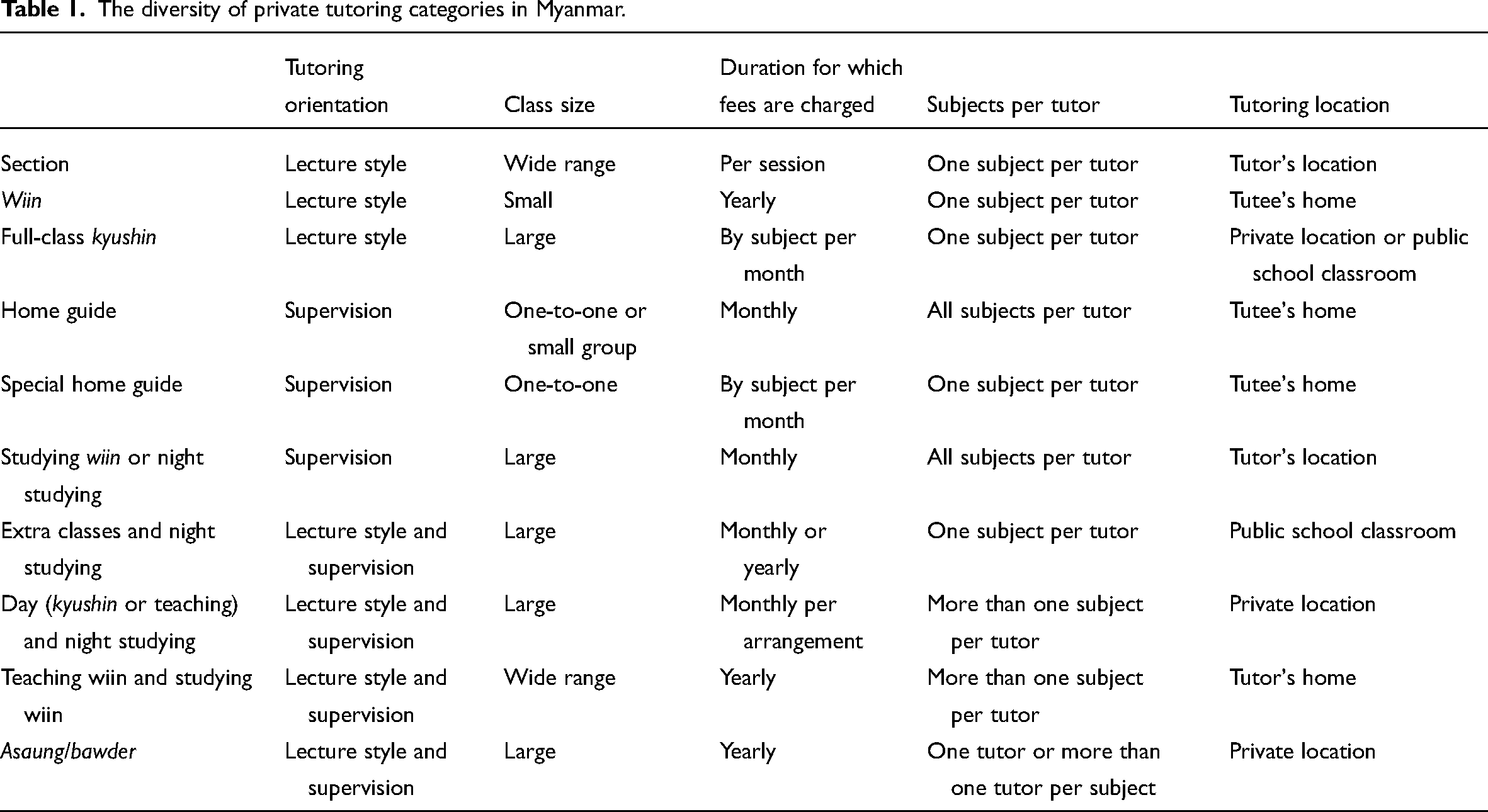
Common foci of research include the implications of tutoring for students’ academic performance, teachers’ behavior, and related dimensions of schooling (e.g., Ille & Peacey, 2019; Kobakhidze, 2014; Ömeroğulları et al., 2020). Teachers’ favoritism of tutored students in the classroom could be possible in any form of tutoring, albeit with different dynamics according to whether the teachers are also the tutors. However, supervision-oriented tutoring may have less negative impact on schooling for three reasons. First, students in supervision-oriented tutoring do not receive extra (or ahead of) teaching of the curriculum. Second, since they mostly focus on homework, they still need to pay attention to new content in school. Students who only receive supervision-oriented tutoring are therefore less likely to disturb school teaching and to be absent from school. Third, in lecture-oriented tutoring, students can experience a heavy workload due to hours of lecture classes plus independent homework. This burden is less evident in mere supervision-oriented tutoring.
The next component in the classification is class size, although the criteria underlying this term may be vague. For example, the concept of wiin is related to a small group even though wiin can sometimes have over 20 students. The class size shapes the style of tutoring that is possible. In large classes, tutors are constrained from tailoring style and content to meet the needs of individuals, though tutors of small groups do not always take advantage of this possibility.
Linking to assumptions in the literature about class size (e.g., Cole, 2017; Rocha & Hamed, 2018), a rural student in Myingyan District stated that “the school also teaches well but has many students [in a class]” as his rationale for receiving tutoring. Yet when asked about the number of students at his tutoring center, he replied “20” while his school class had only 19 students. Furthermore, even in the same class-size category, the tutoring implications, rationales of choices, and fees could vary based on the tutoring orientation. For instance, in the “large group” category, the nature and implications of a typical full-class kyushin (lecture-style tutoring) and a studying wiin or night study (supervision-style tutoring) could be significantly different.
Durations of fee-charging are the next component. Organizers of sections usually charged per session and by subject, but could also levy monthly charges. Special-home-guide and kyushin classes usually had monthly charges per subject. Charges in other categories were per arrangement (lecture, supervision, or both), monthly or yearly. Increasing numbers of providers charged students yearly, as packages with pre-installments, so that they could reduce the likelihood of students leaving in the middle of the year. Because students in tutoring that is charged per session and per month have more flexibility to drop the tutoring if they find that it does not meet their needs, tutors in these categories may be more client-oriented. In the questionnaire survey, students in both lecture-style and supervision style tutoring centers could not easily respond to the question about their tutoring hours. Students in asaung had particular difficulty because they were in the tutoring centers (hostels) when not at school.
In some countries tutorial centers are prohibited from charging fees for long durations (Zhang, 2021, p. 25), but no such government regulation exists in Myanmar. The conceptual point here is that the duration for which a fee is paid may affect the nature of the tutoring. When students who are being charged per session come and go, the horizons are very limited for the tutors to build up sequences of learning; but at the other end of the scale, payments for entire years may permit tutors to take their clients for granted and devote less effort than they otherwise would. Moreover, increasing numbers of providers did not allow students to learn and pay per subject. This required students to subscribe for multiple subjects although they might only have needed tutoring in only one or two. Further, such package-based tutoring tended to reduce the attention that students devoted to homework from schools. Thus, the various ways of charging fees could have multiple ramifications.
Another variation was in the number of subjects per tutor. In some instances, one tutor handled all subjects; another arrangement was one-subject-per-tutor; and some students had more than one tutor per subject. These arrangements had implications not only for the fees but also for the perceived quality of teaching. In supervision-oriented tutoring, for example, a special-home-guide in which one tutor supervised a single subject was usually considered more effective than a general-home-guide, even though both were normally one-to-one. Likewise, within the same category of full-class kyushin centers, at least one interviewee felt that a center that organized more than one subject per tutor would be low in quality.
The final component is tutoring location, which contributes to variations in fees, choices, and impressions about the quality of teaching. In general, tutoring in the tutee's or organizer's home/place was considered more individualized and client-centered, of higher status, and better in quality than tutoring elsewhere, and justifiably more expensive. Tutoring in public schools was generally considered less expensive but low in quality, large in class size, and low in status. Especially in urban areas and in Grade 11, academic tutoring in public schools was in low demand due to the impressions of higher quality and better targeted teaching in private tutorial centers. Nevertheless, school-based tutoring in the rural areas had legitimacy from its institutional setting and the lack of alternatives.
Far beyond the simple yes/no classification of private tutoring, this article shows possible variations even within the same categories of these detailed classifications. This study therefore stresses the need for careful scrutiny of private tutoring variations and for cautious interpretation of the implications of these variations both in Myanmar and more widely.
Discussion and conclusions
The commentary shows that analyses that present tutoring on a yes/no basis, and other generalizations such as those by Carley (2019) about Japanese juku, are likely to miss crucial variations. Further, even the relatively nuanced categorization presented by Zhang and Bray (2020) cannot capture all the variations in Myanmar.
At the same time, one component of Zhang and Bray's categorization is strikingly absent from the forms of tutoring reported here, namely online (and dual-tutor) provision. This may reflect first the economic circumstances of Upper Myanmar and second the period of data collection in 2018–2019. Myanmar is a low-income country with limited infrastructure, and broadband access is particularly weak outside the main cities. Perhaps it is surprising that no students mentioned online tutoring in urban Mandalay District, since higher-income families are more common there and electricity and broadband access are both available and relatively reliable; but it is possible that entrepreneurs had not yet identified Mandalay District as a promising marketplace for such tutoring. The matter of data-collection timing concerns the pandemic, which hit Myanmar like the rest of the world in 2020. Schools were closed for lengthy durations, and face-to-face tutoring was also officially prohibited. It seems likely that in these circumstances online tutoring would have developed to reduce the gap. Further, even if broadband access remains patchy, mobile phones are now ubiquitous in Myanmar. Entrepreneurs in Kenya for example are using mobile phones for tutoring, 5 and scope would seem to exist for similar enterprise in Myanmar.
Returning to the forms of tutoring presented in Table 1, even with the care demonstrated by this paper various ongoing ambiguities need recognition. First, many interviewees used the term “kyushin” for all forms, even if usually the term is reserved for lecture-based tutoring in large classes. Similarly, “extra class” was generally used to describe lecture-based tutoring outside schools, but was also used for low-fee provision inside schools. Again, asaung institutions provided both lecture and supervision forms of tutoring, and students wanting only the lecture components offered in the daytime chose “day special” which was similar to kyushin. On another tack, some respondents used kyushin to refer only to a private lecture class with school teachers. For instance, one interviewee in Myingyan District said: [It is] like this, not a kind of kyushin. … [It is a] bawder … not provided by schoolteachers but by outside persons.
In her conception, kyushin was tutoring provided by school teachers, and her child's tutoring was not kyushin because it was not provided by school teachers.
To complement the above example in which the concepts used by interviewees needed to be probed, another case reflected retention of old labels despite changing forms. One interviewee called her tutorial center “teaching wiin and learning wiin,” though it would have been more accurately described as asaung/bawder. At the outset, her tutorial center had indeed offered teaching wiin and learning wiin, at that time having no specific division of lecture and guide sessions, three tutors covering all six subjects, and no specific arrangement for food and accommodation even though a few students stayed overnight for various reasons. Later, her center evolved into an asaung, with division of lecture and guide sessions, three tutors per subject, and arrangements for food and accommodation. Had the researchers taken her description at face value without probing, the tutorial center would have been inappropriately classified.
In turn, this remark underlines that private tutoring is an evolving phenomenon. As Brehm (2017) remarked about shadow education in a different setting, a concept at one point in history might not have the same pertinence at another point. Thus, this study met only one tutorial service operating as a section, even though sections were common in previous eras. The scarcity of sections in the contemporary era reflected the evolutions from one-subject tutoring (section) to multi-subject tutoring (wiin), and to asaung with coordinated lecture time, supervision time, dining time, sports time, and leisure time. Factors in such evolution included increasing general acceptability of shadow education as a whole and of different models within it. Sections were more common when teachers independently provided tutoring, but as tutoring became more industrialized and commercialized, such forms became less common. Tutorial centers offering multiple subjects in single locations not only saved students from travelling to multiple locations but also made better use of facilities, and by grouping subjects the tutorial centers also increased the amounts of tutoring that students received.
The research has also noted geographic variations that even surpass cultural variations. Thus, the tutoring patterns according to the survey responses in Myingyan District were closer to those of Chin State than to those in the similar cultural context of Mandalay District. For example, the availability of electricity, street lights, and transportation in Mandalay District reduced the need for students to stay overnight in tutorial centers. On the other side, the extra classes and night study at public schools were observed only in (rural) Chin State. Villages in Chin State did not have strong external suppliers of private tutoring, so students needed to rely on their schools for such supplementary services.
These variations highlight the dangers of researchers making assumptions about common understanding of terms. Questionnaires are especially vulnerable to this problem because, returning to the observations of Neuman (2014, p. 68), they reflect assumptions made by researchers at the time of design, and are not open to the sorts of reinterpretation permitted by exploratory questioning through interviews. The patterns presented here only emerged as the research proceeded, despite the long research track records of the authors and despite prior piloting of the questionnaires in an Upper Myanmar context.
The observations also stress the need for considerable care with terminology for policy development. Thus, Myanmar's Private Academic Training Law (Socialist Republic of Burma, 1984) defined such training as “Private individual and/or group profit-oriented teaching of subjects taught in public universities, colleges, academies, schools, and training; and/or subjects to be tested in public examinations.” While the intent to clamp down on tutorial institutions was widely understood, in practice the associated vocabulary was vague. As such, people who organize guide tutoring could easily state that their work does not include “teaching” content but only “supervision” of students’ homework. The extra classes and night studying in public schools are also difficult to define categorically as “private academic training” since teachers offering school-based private tutoring could describe it as legitimate extra or remedial work. In recent years, State/Region education offices have asked teachers to sign on paper that they will not provide kyushin (ကျူရှင်). However, teachers have still provided tutoring with different names both within and outside the school compounds. In some cases this has been obvious contravention, but in other cases they could claim ambiguity because it was provision as guides, wiin, etc. rather than kyushin.
Thus, in summary this paper has shown considerable complexity even within two regions of a single country. International research demands even greater care in phrasing of questions to allow for variations in the phenomenon being considered. These matters need to be taken out of the shadows for improved understanding and analysis. This particular study has benefited from what may be called insider–outsider collaboration. Such partnerships are not universally available, but all can benefit from experience recorded in journal articles such as this one.
Footnotes
Contributorship
Peter Kamtungtuang Suante shouldered responsibility for the acquisition of data, its analysis, and the composition of the manuscript. He played the main role in the sections on Myanmar contexts, methodology, and categories of private tutoring. Mark Bray contributed to the theoretical interpretation of the findings by aligning them with existing literature, and verifying the analysis. His significant input was evident in the sections on objectives and design of shadow education research, revisiting typologies, and discussion and conclusion.
Declaration of conflicting interests
The authors declared no potential conflicts of interest with respect to the research, authorship, and/or publication of this article.
Ethical statement
The authors received participants’ active and passive written consent to use information that the participants provided to the authors for research purposes. Reference Number from HKU's Human Research Ethics Committee was EA1808004.
Funding
The authors disclosed receipt of the following financial support for the research, authorship, and/or publication of this article: The research for this article received financial support from the UNESCO Chair in Comparative Education at the University of Hong Kong.
