




Abstract
Purpose:
This article examines responses from the tutoring sector to Chinese national and local government regulations on private supplementary tutoring. It adds to the literature on policy enactment, showing the importance of context and noting the diversity of tutoring providers compared with schools.
Design/Approach/Methods:
The article draws on semi-structured and informal interviews with 11 tutors, 15 managers of tutoring enterprises, 5 members and managers of professional organizations, 5 government officials, 5 school managers, 5 teachers, and 20 parents. Data from interviewees were triangulated with observations, news reports, blogs written by tutoring analysts, and ad hoc research by industrial observers.
Findings:
Policy enactment in the tutoring sector is even more complex than that for schooling. Standardized policies do not necessarily achieve the aspired goals.
Originality/Value:
The article adds to the literature not only in China but also internationally. It highlights the importance of distinguishing between aspirations and realities in this domain. It also proposes conceptual considerations for regulating tutoring, given its diverse and fluid nature.
Introduction
In February 2018, China’s national government released a document entitled Notice Issued by the General Offices of Four Ministries including Ministry of Education on a Special Campaign to Rectify Out-of-School Training Institutions in Order to Reduce Extracurricular Study Burden on Primary and Secondary Students (henceforth described as Document 1). It was jointly issued by four bodies: the Ministry of Education (MOE), the Ministry of Civil Affairs (MCA), the Ministry of Human Resources and Social Security (MHRSS), and the State Administration for Industry and Commerce (SAIC). The joint action by the four bodies was itself a noteworthy feature, showing coordination for a multifaceted domain. A month later, the MOE issued a notice to accelerate regulation of tutoring enterprises (MOE, 2018c), following which all provinces, municipalities, and autonomous regions devised their own guidelines. In August 2018, based on evaluation of Document 1’s enactment, at the central level the General Office of the State Council (GOSC) issued a more powerful and detailed document entitled Opinions by the General Office of the State Council on Regulating the Development of Private Tutoring Institutions (GOSC, 2018, henceforth described as Document 2). This reflected the Chinese national government’s determination to regulate tutoring as a priority issue.
The national government agenda developed in the context of responses to public concern about the heavy burden on students. A related factor was government recognition, after several decades of ignoring the phenomenon, that far-reaching systems of shadow education operated in parallel to public schooling. The authorities observed that their efforts to reduce study loads were to some extent being subverted by the shadow education sector, and further that the shadow sector had significant implications for social inequalities. The major concerns of educational authorities were informed, among other sources, by a study in Shanghai (Zhang & Bray, 2017). Not only were policies to shorten official school hours commonly subverted by extra hours of tutoring but also the school curriculum was accelerated by students learning in advance and/or beyond the syllabus in the supplementary sector. Among the most problematic dimensions was tutoring established by or in collaboration with elite schools that served as an admission mechanism and fueled competition between schools and students. Tutoring also had problematic features when regular school teachers became involved, in part because those teachers were tempted to reduce attention to their mainstream duties and could exert inappropriate pressures on their existing students to receive tutoring (see e.g., Zhang & Bray, 2015).
The national and subnational regulations promulgated in 2018 have been instructively catalogued by Liu (2018), who included a table that classified the contents of these regulations. All of them had clauses on safety, licensing, progress, and organization of competitions and contests. Almost all also had clauses on content, target students, course offerings, class schedules, and involvement in school admissions. A few had additional clauses on qualifications of tutors, fees, and advertising.
The present article takes analysis further by considering industry responses to these regulations. A substantial international literature points out that policies rarely translate into practice in straightforward ways (see e.g., Honig, 2006; Levin, 2010). Because this article has been prepared within a year of the promulgation of the policies, it cannot assess the long-run effects. It is also constrained by availability of data in situations where governments may not wish to admit to limits in their effectiveness, and companies and self-employed tutors may not wish to expose ways in which they circumvent or ignore polices. Nevertheless, drawing on interviews supplemented by observation and media reports, the article maps patterns during the initial months of the policy enactment and provides a basis for further research. The article draws on research in other countries to provide signals on what might be expected in China, and it highlights ways in which analysis of patterns in China may contribute to the wider literature. Among the instructive features is diversity in responses in different parts of China despite the uniformity of the national directives.
Policy enactment in education
A substantial literature addresses themes of policy enactment across a multitude of sectors. Those concerned with education include Taylor, Rizvi, Lingard, and Henry (1997), Fullan (2003), Honig (2006), Lingard and Ozga (2009), and Ball, Maguire, and Braun (2012). However, few authors have addressed the themes in the domain of private tutoring. Policy authors commonly recognize that enactment does not lead to simple answers about what is implementable and successful. Instead, enactment deals with what works in different conditions and settings, and how. Contexts include wider power structures and social conditions beyond school boundaries.
Policy embraces both text and processes and demands attention to formulations, modifications, and practices (Ball, 2006; Lingard & Ozga, 2009). Policy text is not always applicable to every set of circumstances and can send different messages to different actors based on their interpretations. As noted by Ball (1994), policies “do not normally tell you what to do,” and instead they “create circumstances in which the range of options available in deciding what to do are narrowed or changed, or particular goals or outcomes are set” (p. 19). Schools, teachers, and administrators are not merely passive subjects who implement policies or get implemented upon. Rather, they operate in changing and creative processes of actively (re)interpreting and translating policies “through reading, writing and talking of text into action and the abstractions of policy ideas into contextualized practices” (Braun, Maguire, & Ball, 2010, p. 549). Policy enactment then refers to the “diverse and complex ways in which sets of education policies are ‘made sense of’, mediated and struggled over, and sometimes ignored” (Ball et al., 2012, p. 3). It is shaped by interplays between structure and agency and by multilevel dynamics.
The above paragraphs, and indeed the whole of this article, are mainly concerned with government policies. However, the principles can apply to policies by any organization and/or individual. Thus, companies in the tutoring industry have both written and unwritten policies on ways to manage and expand their operations, and even individuals who provide tutoring on a part-time basis have policies on the types and quantities of work that they undertake. For the present article, the important parts concern the intersections of government and company/individual policies and practices. The governments of some countries play a minimal role in the tutoring sector, largely leaving it to manage itself in a laissez faire way (Bray, 2009, 2011; Bray & Kwo, 2014). This used to be the case in Mainland China but evolved by stages during the initial decades of the present century and adjusted sharply with the 2018 announcement of the national regulations and their subnational counterparts.
The nature of private supplementary tutoring
Much of the existing literature on policy enactment focuses on schools, which may be very different from tutorial institutions. It is important to understand the nature of tutoring and of its providers before embarking on discussion of how regulations on tutoring are enacted in China.
Figure 1 highlights the diversity in types of tutoring providers. Students and in-service teachers, professional tutors, and other tutoring providers may be self-employed and/or work part-time for tutoring companies. Tutoring enterprises vary greatly in size. The smallest could be run by just one tutor with or without assistance from a few other personnel, while the largest operate with franchises or branches across the globe.
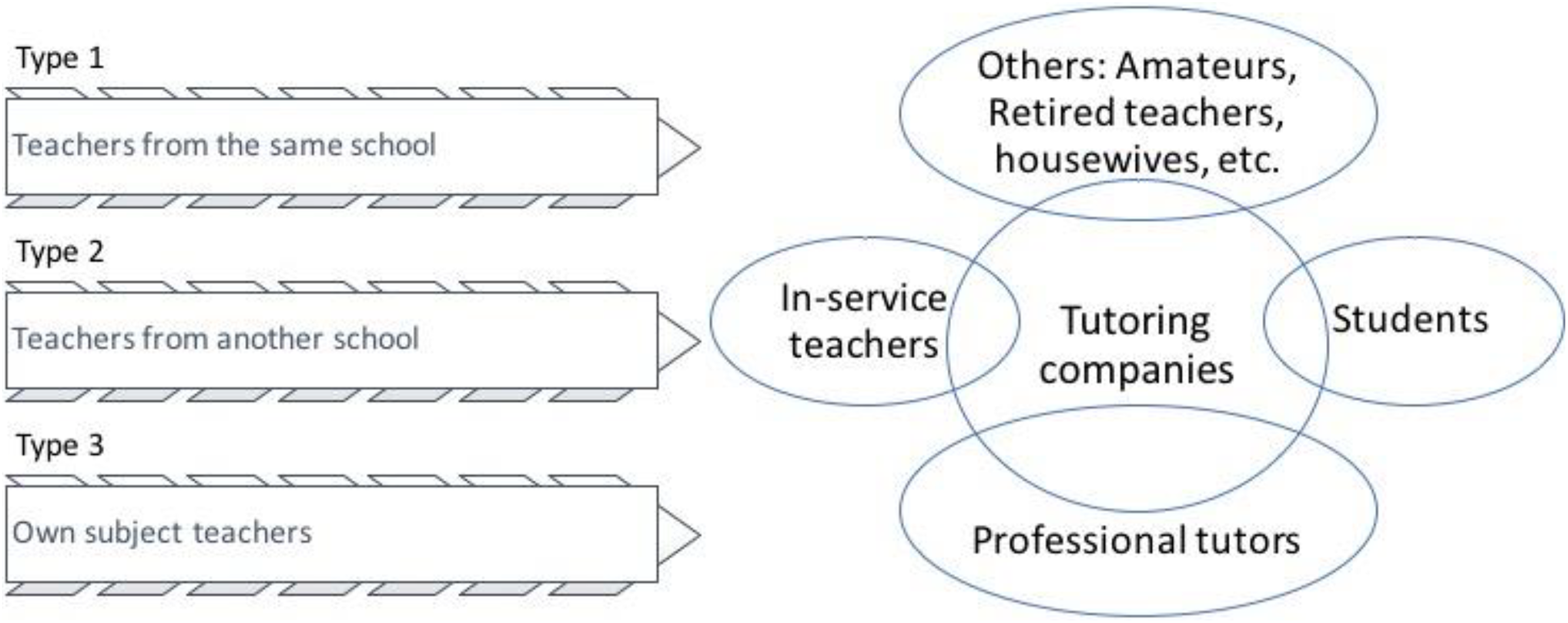
Providers of private supplementary tutoring.
Further diversity is evident in modes of tutoring, which can be delivered one-to-one, in small groups, in classes, or in large lecture theatres. It can take place at home, in classrooms, in public libraries, and in coffee shops; and tutoring via the Internet is increasingly common. Self-employed tutors, one-person businesses, and online tutoring are difficult to trace and regulate, and serve huge populations. In China, one report (MobData Research Institute, 2018) has grouped industry operators into three categories: (1) nationwide companies operating with branches in first- and second-tier cities on the way to reaching third-tier cities, (2) region-wide companies operating across one province or municipality, with branches mainly in first-, second- and third-tier cities, and (3) smaller enterprises which range from one-person workshops to medium-sized companies. Category 1 accounts for less than 5% of market share, while Category 3 accounts for the majority. Countless small centers in cities at all levels of development (mainly in tiers 1–4 cities) had the largest market share (MobData Research Institute, 2018, p. 23). Whereas school teachers have to cover full syllabuses and pay attention to children’s moral development, tutors may cover only parts of syllabuses and restrict attention to academic development.
The motives for seeking tutoring may also vary. Some tutoring is elitist and provides a positional good for some parents. Another important social function may be externalized parenting. Modernization has created busy parents who both have to work full time. Some parents place their children under tutors’ supervision to reduce bad social influences such as gambling and computer games. Tutoring also serves psychological needs: under the pressures from examination and peer influence, tutoring provides emotional comfort to ease family anxieties. Economically, parents may view tutoring as less costly than other avenues for educational choice such as purchasing housing in school zones or sending children abroad.
As such, policy enactment in tutoring is much more diverse and complex compared with schooling, and government regulations may generate a variety of responses from the industry. Moreover, compared to school policy which has developed over years and has been modified based on intra- and international experiences and lessons, tutoring regulations tend to be vague, unstable, and incomplete. Policy enactment in tutoring embeds more gaps and traps and lacks coherence in the processes of interpretation and translation.
Methodology
This article reports preliminary qualitative findings from an ongoing mixed-methods study that explores the enactment of regulations on tutoring in China during the period since February 2018. The author focused on ways in which tutoring providers have interpreted the regulations and adjusted (or not adjusted) their practices. Data in this article are mainly from the perspective of companies but are supplemented by data from schools, parents, and government officials. Semi-structured and informal interviews (Bernard & Gery, 2010; Spradley, 1979) were conducted with 11 tutors, 15 managers of tutoring enterprises, 5 members and managers of professional organizations, 5 government officials, 5 school managers, 5 teachers, and 20 parents. The sample of tutors and managers was selected purposefully (Creswell, 2012, p. 208) from diverse categories and comprised: three self-employed tutors; two tutors (counted as managers) running one-person businesses (workshops); three small tutoring centers: three tutors, one owner, and two managers; two medium-sized enterprises: two tutors and three managers; three large companies: two tutors, three managers from two nationwide companies, and two managers from one region-wide company; and two online tutoring companies: a tutor and two managers.
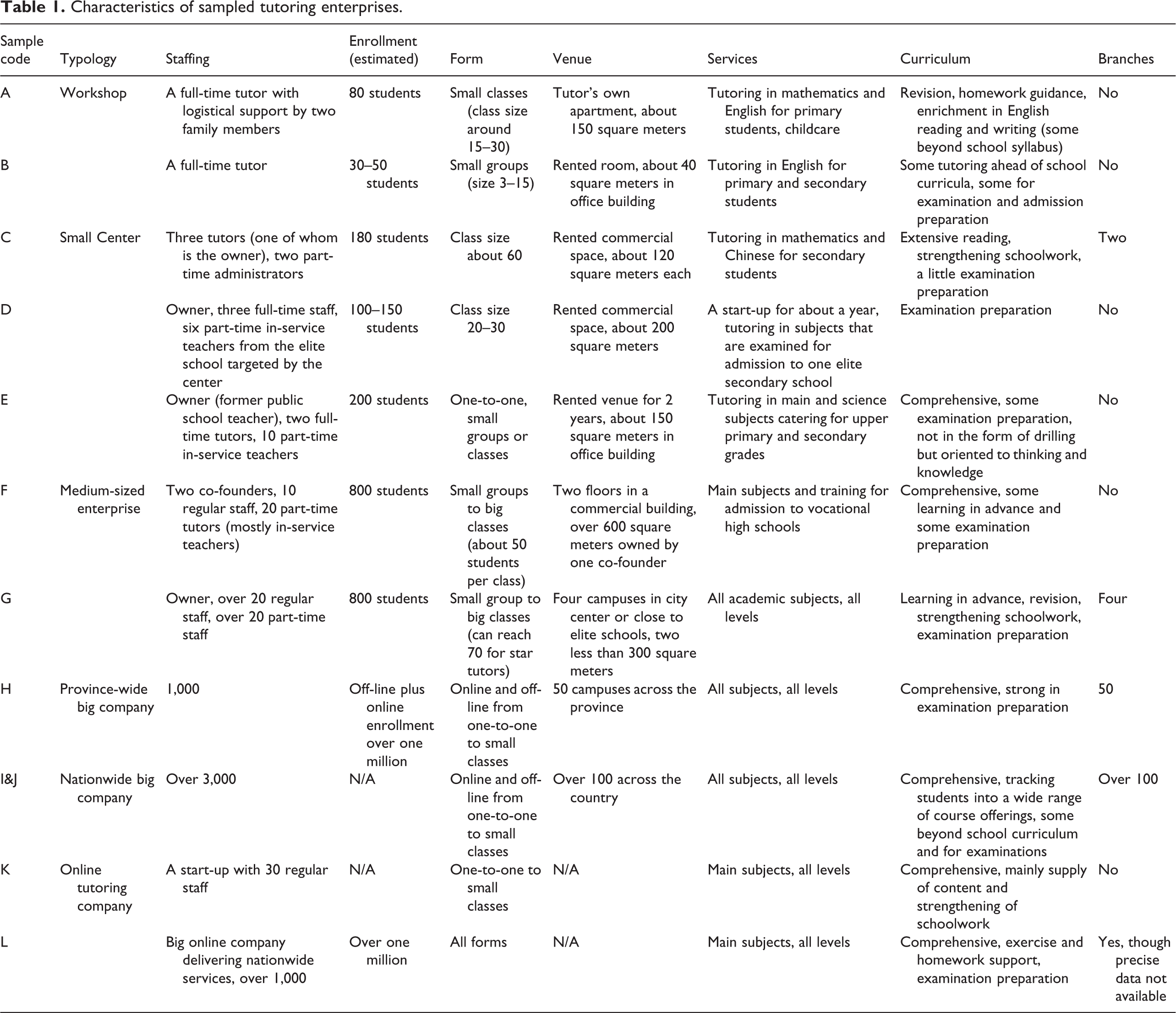
For each tutoring enterprise, interviews were first conducted with managers and then with tutors with the goal of confirming and elaborating on data. In the region-wide company, two managers were interviewed for data triangulation since tutors were not available at the time. Table 1 shows characteristics of the sampled enterprises according to information provided by the interviewees. Information on the large companies is obfuscated to protect the identities of those companies. Some information is incomplete due to interviewees’ unwillingness and/or inability to provide data. The sample is not representative and generalizable to all tutoring providers in each category, but information nevertheless points to significant patterns. 1
Characteristics of sampled tutoring enterprises.
Concerning other dimensions of the sample, the bodies from which interviews were secured included an official professional association (recognized by the national government), a commercial professional association (not recognized by the government), and an enterprise that provided training for over 300 owners of medium-sized and small tutoring enterprises. Government officials included personnel in charge of devising and/or enforcing local regulations in first-, second- and third-tier cities. Three teachers and school managers were selected from schools in a first-tier city, and two were from a second-tier city. All teachers interviewed were to some extent involved in the tutoring market. Among the parents interviewed, 17 were from three first-tier cities and three were from a second-tier city.
In addition, the author visited and observed tutoring centers in two first-tier cities and one second-tier city. She conducted short and informal interviews with a dozen tutors and managers on site. The author also collected triangulation information from news reports, blogs written by tutoring analysts, and ad hoc research by industrial observers.
The topic of the study was sensitive, and data collection encountered challenges since much information provided by the interviewees contained strategies to ignore, mediate, and resist regulations. The author therefore had to reassure all parties on confidentiality so that the data would not make interviewees vulnerable to sanctions or damage their reputations. At the same time, the data capture the dynamics of policy enactment in a meaningful way. The author recognizes the contextual variation among tutoring providers, but general patterns can be identified across categories of self-employed tutors, small tutoring enterprises, medium-sized enterprises, large enterprises, and online tutoring companies. The author has selected four dimensions of the regulations for which the existing data were sufficient to draw findings: venues, staffing (including qualifications and employment), curriculum/content, and class schedules.
Uniform policies, diverse responses
The national document and the subnational documents released in line with the national document treated all tutoring enterprises uniformly. However, the nature of policy realization varied because of diverse contexts and the nature of tutoring enterprises. This section reviews spatial and temporal variations, and industrial responses.
Spatial and temporal variations
To facilitate understanding, this section starts with analysis of the regulations based on findings from the present study. The first observation is about spatial variations. Although 2018 was a major watershed in national policy, some local authorities had already devised regulations for tutoring. Many large companies, especially ones listed in the stock market, followed regulations strictly in first-tier cities such as Beijing and Shanghai, and particularly in “education” districts with concentrations of tutoring institutions that attracted greater government attention. However, many other companies and self-employed tutors ignored the regulations—and in any case the regulations had many ambiguities.
According to interviews with local government officials, when Document 1 was released some provinces and municipalities including Shanghai, Sichuan, and Beijing already had local policies and experience in enacting those policies. These governments were among the first to respond both in text and practice. Others were uncertain on directions, and in particular were fearful of inaccurately enacting the national document and failing in the performance indicators. These bodies waited cautiously for the national government to release more information, reached out to contacts who knew the processes of policy formulation, and waited for other subnational governments to release their policies so that they would have a reference and not be the first to “make mistakes.” Thus the national policies were not immediately translated into text and action by all local governments. When in due course the national government released more documents and some tardy governments were named in what was interpreted as an open critique, all local governments realized that the initiative was serious and escalated the campaign. Variations were also evident in the processes of examining tutoring enterprises and introducing corrective measures for noncompliance (e.g., MOE, 2018a).
A second dimension concerns evolving and sometimes contradictory policies. Newly formulated regulations are commonly unstable and incomplete. Regulations following Document 1 elaborated on some aspects, tightened on some aspects, and contradicted in a few aspects. For instance, Document 2 added to Document 1 that tutors in academic subjects should hold teaching qualifications for the subjects in which they tutored. Other additions included prohibition of homework assigned by tutors and restrictions on payment of fees for periods exceeding 3 months.
Documents 1 and 2 were both strong on “rectifying” tutoring beyond and in advance of school syllabuses and focused particularly on examination-oriented tutoring. They required tutoring enterprises to submit information to local education authorities for scrutiny and filing on teaching content, course offerings, class schedules, and tutee enrollment. Document 1 was unclear on requirements about class schedules, which caused confusion to some local governments and tutoring providers. Document 2 specified a curfew at 8:30 p.m. and stipulated that tutoring should not be provided during school hours. It added that the boundaries of the tutoring curriculum should not go beyond national standards for schooling, and that lessons should be at the same pace as those in schools of the same county/district. However, education authorities still reported challenges to regulate the content “due to the lack of standards” and difficulties in monitoring. Partly in response, a further MOE document (2018b) stipulated that titles of tutoring programs should be accurate, concise, and standardized, containing information on the grade and subject such as “Mathematics Tutoring class for Primary 3.” This applied to information that tutoring enterprises should submit for scrutiny and filing and make open to the public.
Despite continuities and additions, there were inconsistencies between Document 2 and the draft amendment of Regulations for the Implementation of Non-State (Minban) Education Promotion Law of the People’s Republic of China released by the MOE (2018d) 2 weeks earlier. Interpretations of this earlier document tended to agree that enterprises providing training in nonacademic subjects could operate without the Practice License of Tutoring Institution, and instead register as legal persons (corporations). However, according to Document 2, all enterprises providing both tutoring (i.e., in the definition of this article, in academic subjects) and training in nonacademic subjects were required to obtain both business and educational licenses. Similarly, the MOE document did not seem to require company branches to obtain separate licenses, but Document 2 stipulated that licenses should be acquired by the branches located in counties or districts other than those of the headquarters. The interviewees indicated that these inconsistencies caused considerable confusion. Companies with branches, such as G, H, I, and J, were caught in a panic for branches to meet the requirements in order not to be shut down. However, they were obvious targets for the local governments to examine and enforce corrective measures and all of them lost some branches as a result.
As such, on the one hand evolving policies facilitated interpretations of the policy orientations and concretized some measures for translating the regulations into practice. On the other hand, the fluidity created challenges to amend company policies and adjust tutoring practices. Challenges were especially great for enterprises lacking the sensitivity and capacity to keep up with the changing regulations and/or already suffering considerable loss from compliance with Document 1. Two cases were reported of tutoring enterprises that had met the requirements of Document 1 but were then refused educational licenses following the release of Document 2 despite huge cost and effort.
The third dimension is a fundamental principle for all regulations that determines a tutoring enterprise’s legal status (GOSC, 2018; MOE, MCA, MHRSS, & SAIC, 2018). That is, a tutoring provider is qualified to provide services only after having registered and obtained both an educational license and a business license. Tutoring providers are required to register and obtain the Certificate of Registration as a Tutoring Institution (henceforth referred to as the Certificate) with educational authorities at the county level. The registration criteria should reflect all dimensions stipulated in Document 1 and thereafter Document 2, but in practice local governments were stricter in some dimensions and looser in others. Local governments are responsible for assessment and approval of license applications. They are also in charge of inspection and monitoring before and after the Certificate is issued.
Other issues concern sequencing. The fact that application for the business license should be conducted after the Certificate is obtained caused challenges in enactment. Historically for most regions, tutoring institutions were only required to obtain a business license to engage in tutoring activities. Several cities also required an education license in addition, but the regulation was largely ignored. According to the interviewees, prior to the campaign most tutoring providers were unregistered and operating without any licenses. Among those with licenses, the majority only held business licenses. The regulation that a business license should only be issued on the condition that the applicants held the Certificate made most tutoring institutions illegal. If local governments strictly enforce such an order, they would contradict their earlier decisions to issue business licenses to tutoring institutions (another example of conflicting policies) and send a signal that tutoring enterprises which had complied with regulations became illegal. This has led to efforts to negotiate by many professional associations and enterprises which had complied with the regulations and still tried to do so. Such negotiations failed in some regions but won some flexibility in others. Some interviewees reported that adjustments were made by a few local governments to allow time for enterprises with business licenses to apply for the Certificate before they were ordered to suspend or stop tutoring services. Yet, actual time won by enterprises varied depending on the power relations. Some enterprises with closer relationships with the authorities were able to win more time than others, since they had been alerted before the local policies were released and were given more time to adjust company practices after the release.
Industrial responses
This subsection discusses how various types of tutoring providers enacted selected aspects of the four dimensions mentioned above: venues, staffing, class schedules, and content. Findings presented are from the tutoring providers’ perspective, supplemented by data collected from the local government officials, schools, and parents.
Various categories of providers were affected differently enacting the regulations, yielding a variety of contextualized responses. For example, large and some medium-sized tutoring companies were easily identifiable targets and were more active respondents. They had to “hand themselves in” for inspection and adjust company policies and practices for survival. As noted by managers in H and J, when they had completed the procedure and gained more legitimacy, they felt more secure and sustainable for the long run. By contrast, most self-employed tutors and small enterprises (workshops in particular) tended to be passive or ignorant. The self-employed tutors interviewed who delivered one-to-one home tutoring or online tutoring did not consider the regulations relevant to them, and two were even unfamiliar with the policy. Small enterprises were reported to have slipped through the cracks, gone underground or changed their identities by merging into bigger companies that had both licenses and had passed inspections.
Further, online tutoring providers considered themselves off the radar since they interpreted Document 1 to be regulations for off-line tutoring companies and felt that online tutoring could not easily be traced and monitored. However, as the campaign escalated and more tutoring enterprises were affected, some online companies started to worry. K and L described their change of attitude, especially after Document 2 was released with the statement that online tutoring should also be regulated. K started working out strategies to shift its main business area and disguise itself as a technology company. L consulted local authorities and received advice to adjust its information on staffing, course titles, and other aspects disclosed on the main page and online platform according to Document 2 until specific regulations on online tutoring were released in due course.
Hardware: Venues
Among the various dimensions, fire safety and sizes of venues were most forcefully enacted, partly because safety was priority and also because this was the easiest dimension with clear standards. The guideline for classroom accommodation was “above three square meters per tutee for all tutees receiving tutoring at the same premises at the same time” (GOSC, 2018). In the regions where the sampled tutoring providers were located, providers were required additionally to have premises that were commercial properties with no less than 300 square meters, and to meet the regulations on fire safety. Sampled small enterprises (workshops and small centers) viewed the size of 300 square meters as an exclusion, which was echoed by a government official interviewed. The official remarked: It was an effective measure to restrain proliferation of tutoring enterprises, which honestly we do not have the capacity to regulate. The marketplace is vast and has a lot of clutter…Some places have even stopped issuing Certificates to bring the situation under control.
Failing to meet the standards, A and B decided to hide from the government by seeking partnership from their clients. A felt fortunate to own the apartment which the company used for tutoring in a residential property that was unlikely to attract government attention. The owner remarked: The apartment is hidden in a high-class property. No tutoring centers are open publicly. I heard that in some residential areas many small tutoring centers were concentrated in one or two buildings near the gate. They were inspected and required to close.
Some parents in the same city as A also reported that some small tutoring centers and workshops which were located densely in a residential building had been targeted by a task force. As a result, some enterprises had remained in the same property but became more hidden, while others moved to more invisible venues. Some parents had moved together with their tutors. According to the parents and tutors, such centers and workshops succeeded in covering their traces largely due to the parents’ trust in their services.
Evidently, inspections could not cover all centers in such a setting. The author visited some hidden small centers in residential buildings in two first-tier cities and one second-tier city. Some centers in the first-tier cities had “escaped the inspections” but worried about the future. Others appeared calm and relaxed but guarded against queries. One center was proud of its small and invisible nature. The manager perceived that the regulations were “for big companies” and claimed that his enterprise was different and contributing to schooling.
C and D had invested a lot in their existing venues. Tutors in C recognized that the conditions were so poor for their tutees that the two venues they rented were not qualified for tutoring. The owner was a school teacher, so more careful about implications of “being caught.” C had consulted many people including policy makers and local government officials to seek a “creative solution.” He rented two classrooms from a facility owned by a large company. The company had been praised by the local government in the list of enterprises complying with the regulations. It had reconstructed a commercial building in accordance with the requirements on venues, making it one of their branches while in effect renting most classrooms to small tutoring centers and workshops.
Similar cases were reported in another second-tier city. A real estate company reconstructed its commercial property according to the regulations and let to small tutoring companies and self-employed tutors. By contrast, the owner D was dispirited by the policy change: I started the business because government encourages fresh graduates in start-ups. But now I do not have enough money to live up to the fierce policy…It is not only about venue requirements, but also content. This is what we are good at, and this is what students need.
Contexts were also important. Compared to C and D, E was in an educational district of a first-tier city where the government was particularly fierce and had formed a special task force for surprise inspections. E had invested a lot in the premises. When the tutoring building where E was located was inspected, E did not meet the fire safety requirements because it was on a higher floor than required. E was forced to shut down, and the tutoring services were suspended. However, part of the tutoring continued in homes and temporary premises with similar content.
Sampled medium-sized companies, F and G were well-known in the neighborhood and located close to elite schools. They both held business licenses already when the national document was released, and both had close links with local governments. “Companies of our size more or less have connections in the district government,” said the owner of F who had been alerted in January 2018 and prepared accordingly. When the local policies were released, F smoothly got the Certificate following further adjustment after a strict check on fire safety. F and G were given 2 weeks for the adjustment so that tutoring services were not suspended. However, they were forced to shift business orientations due to challenges caused by the staffing requirements, which will be elaborated later. By contrast, G did not take immediate action to prepare for the Certificate despite advice from a local government informant: The local authorities had had this and that regulation before, but we never took it seriously. Nor did the government. And then when they made this decision, they did not give me any time to prepare. They just came in a group, checked here and there, and told us to close.
Compared to small and medium-sized companies, large companies received much more attention from the government but also had greater capacity to handle the policy shift. Given the large number of branches in a variety of locations, I and J set up a special team to research national and local policies in order to help their branches to apply for the Certificate and survive the surprise and regular inspections. H, I, and J all had to close more campuses in some locations than in others. Much depended on variations in local policy enactment, and on their ability to interpret and adjust to local regulations. H reported that costs from off-line regulations were recovered by growing online business. The managers interviewed in the three large companies indicated that frequent surprise inspections distracted them from tutoring practices. They were able to keep up with the policy directions and show evidence of compliance, but they also expressed insecurity and confusion about the policy shift. They also reported increasing cases of tutors and managers of small companies joining their companies.
The nature of venues was perhaps the most important criterion for determining if a provider could obtain the Certificate. The overall patterns were that self-employed tutors remained unregulated, and small workshops went underground. Companies also became more careful in advertising and gave more attention to the quality of services in order to keep clients. Small companies merged or kept ongoing operations amidst uncertainty. Medium-sized companies hung on with losses. Large companies also experienced considerable losses, but felt that the regulations were good for their long-run legitimacy and standardization.
Software: Content, staffing, and class schedules
Compared to the hardware, government officials indicated that it was much more challenging and “almost impossible” to enforce regulations on software such as curriculum and staffing. Because curriculum had multiple meanings and was arguably subjective, they decided either consciously or unconsciously to avoid too much workload in this regard. The main approach was to focus on what was “workable” and “presentable in paperwork,” such as examining and filing information on staff qualifications, courses, and content submitted by tutoring enterprises. These measures were supplemented by regular and surprise inspections of the large companies that they considered most problematic, and by surprise checks on smaller companies. Complaint mechanisms and (in some cities) student surveys were established to collect information on tutoring providers and to protect consumer rights. As such, local authorities mainly depended on three approaches for policy realization: scrutiny and filing of information submitted by the enterprises, complaints, and inspections in forms of open and secret investigations. Self-employed tutors and small enterprises largely escaped the net. However, these strategies made tutoring enterprises, particularly large ones, more careful in their undertakings.
Governments also had checklists of items according to priorities. Before Document 2 was released, the “must-checks” in terms of content included contests and competitions, classes as part of school admission mechanisms, and learning in advance. Long vacations were reported to be periods of fiercest prohibition on intensive tutoring courses in academic subjects with encouragement of nonacademic activities. The must-check for staffing was in-service teachers’ engagement in tutoring. Class schedules were reported to be largely neglected except for surprise inspections during school hours. Following release of Document 2, the 8:30 p.m. curfew and teacher certificates appeared on the lists; and following the further MOE document (2018b), formats of course/program titles were added.
The three additions were interpreted by the local governments as clearer indicators to follow. In contrast to the hardware, local governments allowed more flexibility in software. For example, I and J reported that they were given permission to organize tutors to sit examinations for teacher certificates rather than being required to terminate the contracts of uncertificated tutors.
Tutoring providers also developed their own checklists and strategies according to their conditions and interpretations of the government checklists. As noted above, constraints on venues had given an excuse for most self-employed tutors and small enterprises to remain in the shadow. Regulations on software were also largely ignored by these providers, but partial adjustment was reported in content. Small centers reported reducing or cutting tutoring for competitions partly due to the fear of being reported to the authorities. Perhaps more importantly, as a result of government oversight of contests, competitions for which they had provided tutoring were declared illegal and/or ceased to matter in school choices.
D’s circumstances deserve further comment because its tutoring was arguably problematic. Company personnel collaborated with in-service teachers in admission to give unfair advantages to their tutees. Parents revealed that D had strong connections with the elite school that its tutoring targeted. The company advertised that tutors were in-service teachers who designed admission examinations. They changed their written materials into “normal” versions such as “training in thinking and writing,” while in spoken form cautiously promoted the internal information from test writers.
Similarly, for the three aspects documented in this subsection, tutoring enterprises commonly had an official version, that is, a text that they publicized and submitted to the local authorities, and a working version which reflected reality. Their checklists distinguished between must-cut, retention with a mask (modifying the title as required), and minor adjustment to circumvent the regulations without change in practice.
Turning specifically to the medium-sized and large companies sampled, these enterprises submitted (to authorities) and publicized the information following the required format albeit with additional elaborations in promotional materials. Regarding content, because tutoring for competitions was considered too obvious to retain, sampled companies with such services cut intensive training for contests and converted related courses into other tutoring for higher level skills. Interviews with tutoring practitioners, parents, and government officials indicated that tutoring for competitions had significantly decreased, partly because such tutoring was a priority on the government checklists and also because tutoring companies were disqualified from hosting competitions and thus lost the information monopoly. For similar reasons, tutoring programs in collaboration with schools (that served as admission selection mechanisms) were reported to have disappeared in I and J.
Other aspects of content were regarded by most interviewees as “impossible” to regulate. Interviewees noted difficulty to draw a line of scope and pace, and challenges in monitoring teaching and learning in and beyond classrooms. School teachers agreed that government intervention could not even monitor the delivery of official school classes, not to mention the delivery of tutoring. However, variations were found among companies. Large companies were much more cautious because they were the “must-check” on the government lists. Despite that, some governments were looser than others, and I and J indicated that their branches were more strictly and frequently inspected compared to the “local companies.” During the surprise inspections, inspectors would interview tutees and parents to compare course delivery with the official versions in the submitted documents and publicity literature. H had long-standing strong links with local governments and brought in taxes and showed willingness to collaborate. H was inspected but had been alerted in advance and was well prepared.
Visits and observations showed distrust between tutoring providers and governments. Officials indicated that secret investigation was a response to the “tricks” of tutoring enterprises. Yet tutoring practitioners had their own perspectives. One medium-sized company reported that its campus had been secretly investigated by inspectors pretending to be parents. The manager complained: “They determine the rules. They demonize us. But the way they trick us shows no transparency and respect. They are no better than us.” To summarize, major changes in content for medium-sized and large companies were cuts in training and organization of competitions, standardized format of publicity literature especially program titles, and cuts in admission partnerships with schools.
Staffing was another dimension that inspectors checked carefully, especially focusing on in-service teachers’ engagement. In the first-tier cities, local regulations in addition to national guidelines required full and accurate disclosures (on site and on the website) of (academic) tutors’ names, photos, course offerings, and certificates. Evidence from other East Asian countries shows when tutoring is more institutionalized, the market depends less on in-service teachers (Zhang & Yamato, 2018). I and J had their own professional tutors, while H had previously had some in-service teachers but could manage without them. In general, large companies found it easier to comply because they had their own professional tutors.
In contrast, F had heavily relied on in-service teachers, on which it had built its reputation. In some ways the company felt subject to the power of these teachers. “We pay a lot to them, but they are not disciplined and do not follow our rules,” the manager remarked. The regulation did not prevent these teachers from providing tutoring, but did change where and for whom they worked. Data from in-service teachers and school managers showed that many teachers suspended work for the companies and instead went underground for tutoring in their own homes or in places organized by parents. Some school managers made teachers sign agreements to promise not to engage in tutoring and submitted these agreements to the local education authorities. However, in practice the schools were reluctant to “police” their staff. As one headmaster remarked: “I need to ensure that they teach in my school with no negative perceptions that the system does not treat them well.” This remark pointed to a bigger issue of what might be another root cause, namely the declining social status and welfare of school teachers. F was considering closing the center and turning to some other education business. G was struggling in restricting its teaching team and sending professional tutors to obtain teacher certificates. The manager was uncertain of the future but tried to hang on because he had already made much investment.
Class schedules were viewed as one of the easiest regulations with which to comply. Sampled medium-sized and large companies claimed that anyway they were originally providing tutoring outside school hours. They added that the curfew did not work because students could learn online or with a private tutor or in small groups (with small enterprises) after 8:30 p.m.
At the same time, online tutoring companies also made adjustments. For instance, L was planning to downscale one-to-one online tutoring, in part because anyone could register as an online tutor including in-service teachers. The company planned to use its own professional tutors only for large classes. Regarding content, the delivery of classes did not seem to change much but the website was significantly simplified. The website used to advertise all sorts of courses named after intensive preparation for examinations with flashy photos of tutoring stars. It gave parents the impression that these were the short cuts needed to improve their children’s performance within weeks. The revised website presented simple titles of fewer than 20 courses named according to the title format of off-line tutoring (e.g., 2018 Winter Program for Developing Mathematics Thinking), and all photos of tutors were temporarily removed. However, detailed information about the content could still be secured through the chat groups that L set up for parents, advertisements built in online classes, and free promotion seminars. These unofficial channels were difficult to trace.
Self-regulation through professional bodies
Professional bodies played very important roles in interpreting the policies for tutoring enterprises. This process also increased the legitimacy of the professional bodies. However, the bodies varied in nature and had different takes on self-regulation. Official not-for-profit professional associations that were recognized both by the government and the industry served as a buffer and mediator for both sides. Interacting with the local and national governments, they actively represented the industry (bringing voices from largest to smallest enterprises) to dialogue with the government in policy formulation. On the one hand, they provided timely feedback to government on dilemmas and challenges to help amendment in policy text; and on the other hand, they helped enterprises to interpret the regulations and advised on applications for the Certificate and on adjustment of company policy and practices. They also led enterprises to sign agreements on self-regulation.
Another type of body that claimed a professional identity brought together a significant number of small and medium-sized enterprises. These were for-profit bodies and thus more commercial. They publicly supported government regulation but provided coping strategies for the enterprises to circumvent regulations. They also offered tips to minimize costs and losses. These bodies shared lessons on turning challenges from the regulations into opportunities to upgrade tutoring services and extend the market. By doing so, they expanded their memberships and increased sales of their consulting services. These bodies were not recognized by the government as official associations.
Conclusion
Document 2 was the first national policy by the State Council in China’s history about regulating private tutoring. It has important implications for healthy and sustainable development not only of supplementary education but also of formal schooling. The national government required efficient responses and timely feedback from local governments despite regional variations, which in turn provided lessons and experiences for refining national and local policies.
The 2018 measures moved China from being behind many other countries (Bray & Kwo, 2014) to the forefront. Yet as already known in the domains of schooling and other spheres, a gap commonly exists between formulation and realization of policies. The Chinese case may interest analysts elsewhere first because it was dramatic and far-reaching, and second because China is large and has significant internal variations. Further, since tutoring differs from schooling in its less-structured and diverse nature, instructive variations are evident in the responses of tutoring providers of different sizes and types.
The present article has focused on responses from the tutoring providers. The article could not document all aspects of the regulations and was constrained by a purposeful sample that would not be applicable to all regions. Nevertheless it has generated insights, on which a conceptual framework can be built to understand policy enactment in the diverse and fluid circumstances of tutoring. Figure 2 portrays the dynamics of responses by different types of tutoring providers, which are shaped by government interventions and market forces at the macro level. Generally, responses to the regulations involved considerable cost. The policy slowed down the growth of large tutoring enterprises and challenged the survival and legitimacy of medium-sized and small ones. It forced some enterprises out of the shadows but pushed others even more deeply into the shadows.
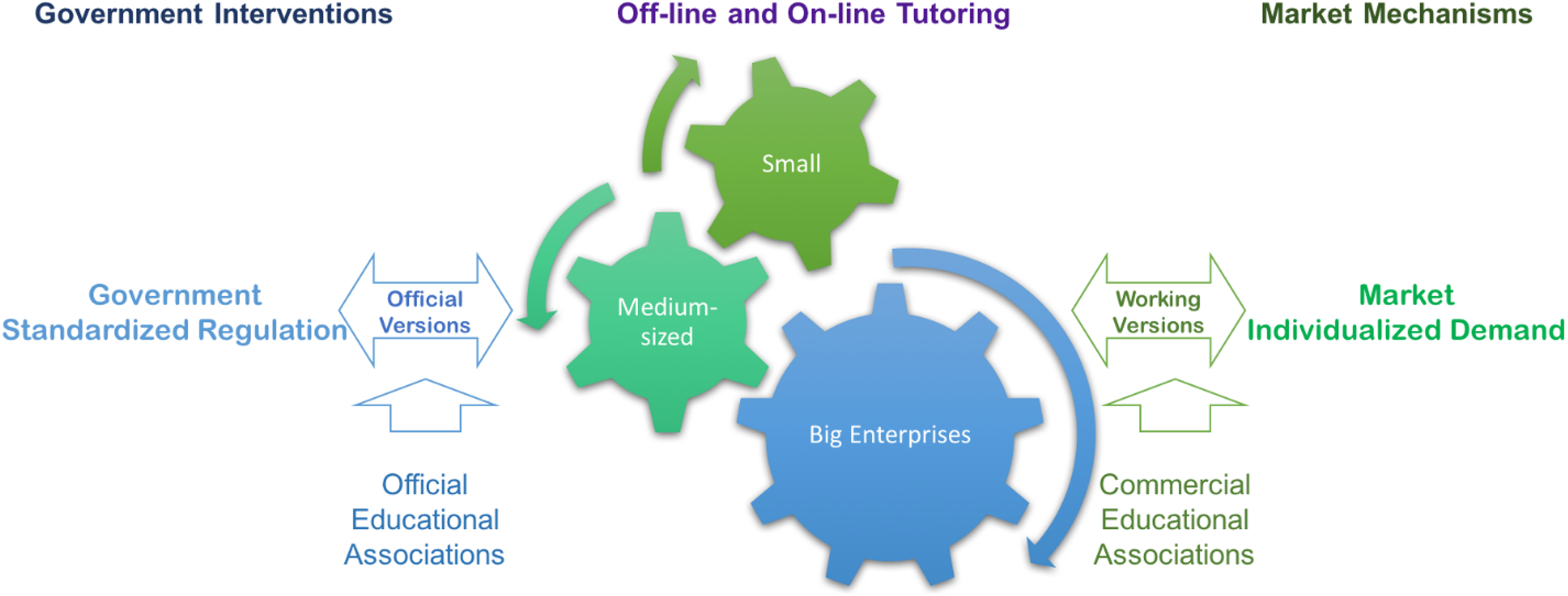
Conceptualizing industrial responses to tutoring regulations.
The study has also indicated greater policy realization in hardware than in software. For each aspect regulated, tutoring providers invented official versions to demonstrate compliance while their working versions reflected partial adjustment or resistance. On the hardware, the official versions by the enterprises that were granted licenses was mostly in line with their working versions. On the software, gaps were found between the official and the working versions. The government also had its official discourse that did not necessarily reflect reality. For example, some official claims implied that self-employed tutors and small enterprises had been eliminated even though in practice many had escaped the net. The official versions indicated that government interventions worked in some respects for some enterprises albeit with great variations, and that tutoring practitioners were paying increased attention to safety, quality, and standards. Yet, government interventions were subverted or mediated by market dynamics where individual preferences did not fit the official requirements. The working versions were possible partly because some families demanded (rationally or irrationally) for what was prohibited by the government and partnered with tutoring providers. In the policy processes, official professional associations operated as buffers and mediators to facilitate the official versions of enactments, while commercial unions advised their members on the working versions to maintain the status quo.
Implications for further steps of regulation might include the need for balance between standardization and diversity. A starting point might be setting of differentiated requirements for different categories of tutoring providers. Japanese experience has shown that qualified small enterprises and self-employed tutors can be valuable members of the education ecosystem through catering for individualized needs, and that eliminating these providers might raise dangers of monopoly and market concentration (Dierkes, 2010; Zhang, 2018). International evidence may show that tutoring has many negative dimensions that ought to be confronted and regulated (Bray, 2009; Bray & Kwo, 2014), but its diversity and flexibility can be utilized for education innovations and school/social support (Zhang & Bray, 2018; Zhang & Yamato, 2018).
Further, the patterns presented above had many problematic and controversial dimensions. Policy enactment in the shadow education sector encountered many challenges and dilemmas and revealed distrust as an obstacle for policy realization. Inspections were one of the outcomes from such distrust. Providers usually felt vulnerable to the government, but the government felt tricked by providers. Building trust could start with strengthening public services and mobilizing market mechanisms. For example, government top-down inspection could be gradually replaced by consumers’ feedback and evaluation. Complicated and lengthy licensing procedures could be improved through online application, and on-call support would help tutoring providers to interpret documents and deal with confusions. Local professional associations could also play a significant role in such services.
The authorities might also turn “enemies” into partners by learning from the industrial responses, since some innovative coping strategies from industrial players might be turned into opportunities for effective governance. The author has found in her Japanese research that many self-employed tutors are managed by legal companies specialized in “home tutoring” and permitted by the Japanese government. These companies commonly sign contracts with both tutors and tutees, collect feedback for quality assurance, receive payments for the tutors, and pay taxes. This model shows a way to mobilize market forces and regulate even the most challenging providers. The arrangement brings the sector out of the shadows and ensures protection of both consumers and providers at little cost to the government.
Looking more closely to its own context, the Chinese government might learn from related business models. Large companies that provide qualified venues to small centers might involve risks of market concentration, but noneducation enterprises that lease appropriate venues and take responsibility for clients of the centers that rent their spaces might be encouraged on conditions. Better still, underutilized public facilities and social institutions could be utilized for such purposes. Such arrangements could also help steer tutors toward social and lifelong education, broadening and changing the nature of the sector.
Repeating the importance of regulating tutoring, measures leading to the professionalization of tutoring are a key solution to in-service teachers’ engagement in tutoring. In Japan and elsewhere, the roles of teachers in provision of supplementary tutoring have decreased to the point of almost total disappearance as tutoring enterprises have developed toward specialization and professionalization. Teachers’ incentives to tutor have decreased as teacher welfare has improved, and in some societies fierce sanctions have been enforced on teacher involvement in tutoring (Zhang & Yamato, 2018).
Levin’s (2010) analysis of education reforms observed that policies have often been motivated more by beliefs than by evidence of impact, and that reform efforts would usually be strengthened if underpinned by reliable research. The evolving processes of the policies noted in this article echo Levin’s observation. However, much more is needed from the research community. More detailed and insightful data can contribute not only to understanding of patterns but also to finding appropriate ways forward. Further empirical research is needed to collect representative data on tutoring providers and on policy enactment in the wide range of regional and institutional contexts.
Footnotes
Declaration of conflicting interests
The author(s) declared no potential conflicts of interest with respect to the research, authorship, and/or publication of this article.
Funding
The author(s) disclosed receipt of the following financial support for the research, authorship, and/or publication of this article: Research of this work was supported by General Research Fund (GRF) of the Hong Kong Research Grants Council (RGC) (project number 17902815). Publication of this work was supported by Shanghai Municipal Education Commission through the Grant “Regulating Private Tutoring to Its Diversity.”