




Abstract
Purpose
This study aims to distinguish the particular mathematics discourse and the teaching discourse in two countries, and explore how the differences in mathematics and teaching discourses influence what is noticed.
Design/Approach/Methods
The study employs a cross-cultural case study methodology, using a mathematically rich video vignette from a Japanese classroom. Video-prompted focus-group interviews were conducted with preservice teachers (PSTs) from both countries.
Findings
Indian PSTs, familiar with geometrical reasoning, notice more detailed mathematical discourses, whereas Swedish PSTs, less familiar with geometry discourse, notice broader teaching strategies. In addition, the PSTs notice unfamiliar teaching strategies and how they support mathematics learning. Both groups identify and reflect on the unfamiliar teaching practices and classroom culture observed in the Japanese video.
Originality/Value
This study contributes to the research on noticing in teacher education (TE). The novelty is how the familiarity of mathematics discourse facilitates noticing details in students’ mathematical reasoning, and how an unfamiliar teaching discourse is an important learning opportunity.
Introduction
Teachers’ noticing is deeply influenced by the cultural context in which it occurs (Adiredja & Louie, 2020; Goodwin, 1994). Review studies indicate that research on noticing originated primarily in the United States and Europe, focusing on cognitive–physiological perspectives (König et al., 2022; Wei et al., 2023; Weyers et al., 2023). Louie (2018) argued that this geographical and theoretical concentration has shaped the field in such a way that it overlooks the broader social and cultural dimensions of noticing. An emerging body of comparative studies has highlighted these overlooked dimensions, stressing the importance of understanding how noticing is influenced by social and cultural contexts (Choy & Dindyal, 2021; Damrau et al., 2022; Ding & Dominguez, 2016; Lee & Choy, 2017), contributing to our understanding of how noticing is deeply embedded within its sociocultural context.
Over the past two decades, mathematics education research has increasingly emphasized teacher noticing, commonly described as the ability to identify significant classroom events, interpret them, and make informed decisions so that it supports adaptive and student-centered teaching (König et al., 2022; Mason, 2021). Review studies (Amador & Weston, 2024; Wei et al., 2023; Weyers et al., 2023) show how research on noticing relies on one of two frameworks: Professional Noticing of Children's Mathematical Thinking (Jacobs et al., 2010) or Learning to Notice (van Es, 2010). Both assume a hierarchy, where students’ “mathematical thinking” is a high level of noticing and noticing classroom events at a lower level. However, this way of conceptualizing noticing overlooks that what teachers consider meaningful to notice is culturally constructed (Dreher et al., 2021; Ivars et al., 2020). The limited geographical spread in research on noticing calls for theoretical perspectives that capture cultural differences in the mathematics classroom.
Addressing this gap, we take a discourse perspective, and researching preservice teachers (PSTs) in India (Southeast Asia) and Sweden (Nordic Country) we explore discourse as a means of capturing cultural aspects of noticing. Aligning with Fairclough (2010), we understand discourse as the rules for communication and use of language constituted in a particular community or culture. According to Fairclough, discourse is the accessible materialization of the ideology of a particular social practice. Hence, noticing discourse is a shift from the cognitive perspective in the sense that the communication that is noticed is no longer regarded as a reflection of thinking; rather, it is regulated by the cultural ideologies of that particular mathematics classroom. For mathematics discourse, in particular, it is characterized by its unique mathematical language (Sfard, 2008). Discourse in the mathematics classroom also relates to cultural ideologies about both mathematics and mathematics teaching.
A discursive perspective on noticing allows us to examine how familiar or unfamiliar events in mathematics classrooms are noticed by teachers. New and unfamiliar situations often present a variety of learning opportunities (Güneş et al., 2024) because they initiate reflection and re-examination of one's understanding. Ding and Dominguez (2016) found how Chinese PSTs’ familiarity with the experience informs what they notice. Fairclough (2010) argued that the familiarity of taken-for-granted social practices can obscure underlying ideologies. Conversely, unfamiliar activities provoke reflections on the social and cultural ideologies that shape them. We use mathematics discourse to analyze how mathematics knowledge is culturally constructed. By examining mathematics teaching discourse, we describe how knowledge about mathematics teaching actions and events is constructed in language. We claim such awareness of how knowledge is constructed in discourse enables a nuanced understanding of noticing across different cultures.
We argue that mathematics discourse and teaching discourse cannot be assumed to be equally familiar in different contexts and that encountering the unfamiliar provokes new reflections on mathematics teaching. We ask:
What teaching discourses do Indian and Swedish PSTs participate in? What mathematics discourses do Indian and Swedish PSTs participate in? What familiar and unfamiliar mathematics discourses do PSTs from India and Sweden notice in an unfamiliar video vignette? What familiar and unfamiliar mathematics teaching discourses do PSTs from India and Sweden notice?
Literature review
Research on noticing in teacher education (TE) is growing, with the agreement that PSTs need explicit opportunities to learn noticing during their mathematics teacher education (MTE; Amador, 2017; Dindyal et al., 2021; Fernández & Choy, 2019). PSTs in traditional classrooms often notice classroom management rather than mathematics (Wei et al., 2023). However, what is considered traditional, and important to notice, may be culturally different. There is a growing body of work emerging from Australia (Jazby, 2023), South Africa (Biccard, 2020), Turkey (Birgin & Eryilmaz, 2022), Indonesia (Widjaja & Dolk, 2015), Norway (Karlsen & Helgevold, 2019), and other countries/regions. Despite this progress, research on teacher noticing is found to be concentrated in the United States, Germany, and Spain (Wei et al., 2023), and there is still a lack of studies exploring noticing in diverse geographical contexts.
Comparative studies also play a significant role in understanding the cultural dimensions of teacher noticing. Such studies emphasize the need to expand the geographic spread of noticing. Comparing teachers in China and Germany, Yang et al. (2019) reported that although German teachers observe classroom behavior, Chinese teachers notice aspects related to mathematics instruction. This comparison between China and Germany is a recurring theme in the literature, emphasizing the need to explore cultural influences on teacher noticing. To enhance teachers’ noticing skills, Choy and their South Asian colleagues engaged with teachers in professional development courses (Dindyal et al., 2021; Fernández & Choy, 2019). The comparisons between countries/regions distinguish differences in noticing the mathematical content, students’ participation, pedagogy, and the teachers’ courses of action. Similarly, Ding and Dominguez (2016) focused on Chinese PSTs’ noticing, finding that PSTs’ prior experiences and familiarity inform what they notice.
Research comparing noticing between Eastern and Western countries (Dreher et al., 2021) found how cultural norms influence what teachers notice in different contexts. Cunningham (2019) conducted a study to understand noticing between PSTs from Mexico and the United States, finding that cross-cultural teaching programs promote their culturally responsive noticing because the unfamiliar cultural context helps PSTs to widen their teaching expertise. A case study of three teachers from Australia, China, and Germany by Damrau et al. (2022) reported that there were some familiarities between these three teachers despite their being from different cultural backgrounds. However, what teachers noticed was highly influenced by what they were familiar with. The value of comparative studies is that they add to perspectives on what notice can be. Nonetheless, very few cross-cultural studies focus on noticing between South East Asia and Nordic countries/regions.
In Sweden, Sjöblom et al. (2023) researched noticing as a tool to capture how teachers shifted their awareness toward their students’ group discussions. Besides Sjöblom and colleagues, little research beyond our own (Raval & Österling, 2023) originates in India or Sweden. In India and Sweden, TE is organized by institutions in higher education and regulated by policy at a national level. Comparing what constitutes teacher competency according to practicum assessment rubrics, Rusznyak and Österling (2024) reported how Swedish TE emphasizes professional judgment, whereas Indian TE emphasizes teachers’ knowledge base. Noticing is not systematically integrated into TE policy in either of the two countries and research on noticing is scarce in both countries. In Sweden, local TE institutions have some degree of freedom to design programs (Christiansen et al., 2021). India has similar regulations; in addition, it also has private institutions providing TE. Due to challenges such as inadequate support, multiple roles, limited planning time, lack of teaching aids, unclear objectives, and gender inequality, TE suffers from insufficient resourcing and democratic participation (Batra, 2023).
Discourses, described by Adiredja and Louie (2020) as cultural and societal narratives, may also subtly shape what PSTs notice, even when they aim to counter such formal views on what noticing means. Analyzing discourse enables us to describe the established practices—the Indian teacher-centered instruction and promotion of conceptual understanding (Sarangapani & Pappu, 2021) and the Swedish teacher-led review followed by students’ individual desk work (Tengberg et al., 2022)—as familiar teaching discourses. The growing emphasis on interactive learning (Shaikh et al., 2023) differs from the culturally situated teaching practices in both countries. In this study, we set out to explore whether such teaching discourses are familiar or unfamiliar to PSTs in India and Sweden, and how they relate to what PSTs notice.
Methods
The cross-cultural approach in this study was informed by the claim of Stigler and Perry (1988) that familiar teaching practices remain unquestioned without encountering the unfamiliar of the contrasting culture. We elaborate on a discursive perspective on the familiar or unfamiliar in mathematics teaching, where the taken-for-granted in one's own culture can be analyzed as familiar discourse. We propose mathematics discourse as a theorization of how knowledge is culturally constructed in mathematics language, and mathematics teaching discourse as how knowledge is constructed in language about mathematics teaching actions and events.
Data collection
We selected a mathematically rich video vignette and prepared focus-group-interview prompts (1 in Figure 1). We chose a Japanese classroom video because Japanese mathematics teaching is characterized by ample time allotted for learners to compare and discuss different strategies for solving tasks (Stigler & Hiebert, 1999). The criterion for choosing the video was that it contained a situation rich in mathematics discourse, with an open-ended task and classroom interactions, and that it was equally unfamiliar for both groups. We selected a lesson with an open-ended geometry task, with the content corresponding to the curriculum in both India and Sweden (National Curriculum Framework [NCF], 2005; Skolverket, 2022).
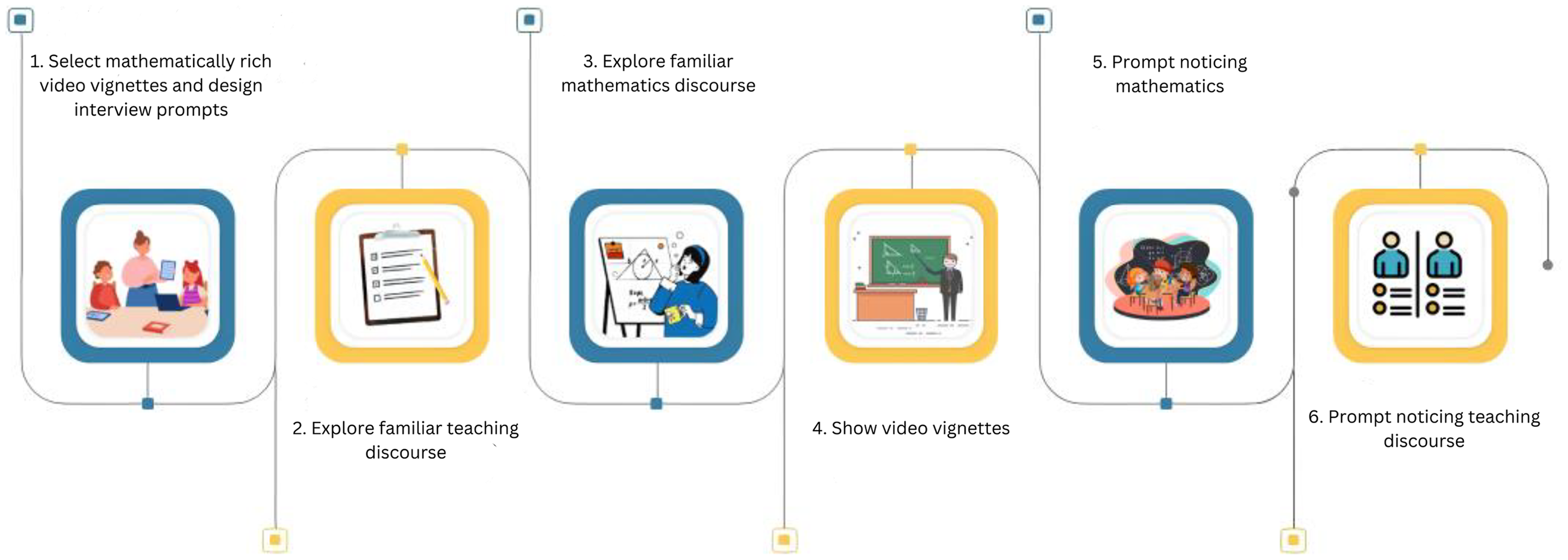
An overview of the study design.
The researcher was given consent by PSTs and the teacher education college to conduct the study. The selection criteria for participants included their being in the final stages of their MTE for secondary level (ages 13–19), having completed college with mathematics as one of their subjects, and having completed their pedagogy of mathematics course in their TE program, and feeling comfortable being interviewed in English. Based on these criteria, PSTs from two programs in both countries were informed, and seven volunteered. The interviews took place in their respective countries. Amira, Benny, and Charles are pseudonyms for the Swedish PSTs; Deena, Elias, Farouqi, and Gulu for the Indian PSTs.
The video-prompted focus-group interviews were inspired by the video-prompted discussions used by Borko et al. (2017) and incorporated a focus on both mathematics and classroom discourse (Yang et al., 2019). The interviews had five parts (2–6 in Figure 1), which were conducted in English, and were transcribed verbatim.
Teaching discourse (2 in Figure 1) was explored by asking PSTs to list what they considered to be the most, second most, and third most important aspects when observing a mathematics classroom, as a way of researching PSTs’ familiar discourse on mathematics teaching.
The familiar mathematics discourse (3 in Figure 1) was explored by asking PSTs to solve the open-ended geometry problem (Figure 2) from the video vignette in as many ways as they could. We asked questions about the reasoning behind their solving and the geometrical properties or constructions they used while solving the task.

The task of finding the value of an angle is used in the Japanese video vignette. Source. http://www.timssvideo.com/jp1-finding-the-value-of-an-angle.
The PSTs were shown the selected vignettes (4 in Figure 1). The parts shown were: the introduction, where the task is given; students’ working on the task; teachers’ discussions with individual student groups; and the whole-class discussion of students’ solutions on the board. The prompted semi-structured interviews were conducted between the shown vignettes.
To prompt discussions on noticing mathematics discourse (5 in Figure 1), we asked what PSTs noticed about students’ mathematics discourse. To prompt noticing of teaching discourse (6 in Figure 1), we asked about the teacher's role, posing follow-up questions based on PSTs’ responses.
Data analysis
In our study, two discourses were analyzed—mathematical discourse and teaching discourse. We found the Perception, Interpretation, and Decision (PID) model—developed during the TEDS-FU study by Blömeke et al. (2015)—more suitable because it does not follow the hierarchical structure of noticing with levels developed by van Es (2010) in her framework for noticing. We prefer this framework because it is relevant for distinguishing mathematics-related noticing (M_PID) from pedagogy-related noticing (P_PID). Coding was done by the first author, and then reviewed by and discussed with the second and third authors.
By analyzing the familiar teaching discourse, we categorized the lists with what is important to notice. The categories were inspired by Yang et al. (2019), using the division between M_PID and P_PID. We first deductively developed codes for the teaching discourse, assuming that P_PID relates to a discourse on teaching. We developed three categories: Classroom Interaction (CI), Teaching Actions (TA), and Classroom Culture (CC)—see Table 1.
Coding scheme for teaching discourse.
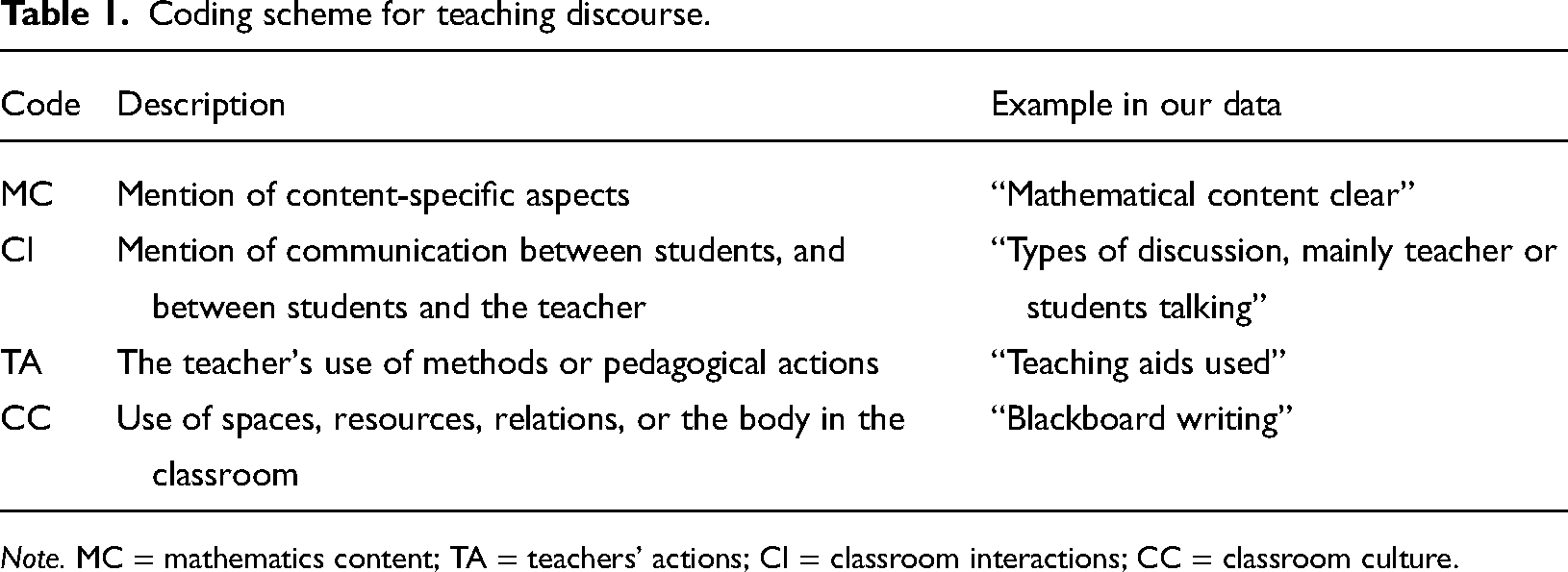
Note. MC = mathematics content; TA = teachers’ actions; CI = classroom interactions; CC = classroom culture.
To analyze the familiar mathematics discourse, we applied precedent-search-spaces (PSS) (Raval & Österling, 2023) to the solutions. The assumption behind the PSS is that to solve a task in a new situation, the person solving the task will draw on procedures previously encountered (Nachlieli & Tabach, 2022). In our analysis of PSTs’ solutions to the tasks (3 in Figure 1), we assume that the PSTs will use familiar procedures from their PSS when solving a geometry task. Informed by previous research, we developed a map of possible procedures in the PSS (Raval & Österling, 2023). We included characteristics of geometrical discourse such as direct recognition, recall, substantiation, or construction, as suggested by Wang (2016). Solving open-ended tasks requires creativity and alternative strategies (Leikin & Sriraman, 2022), as well as comparing, reasoning, conjecturing, or verifying (Ng, 2019). We took advantage of the flexibility of the open-ended task to invite PSTs to use, and to notice, both familiar and unfamiliar geometry discourses.
Where we use noticing mathematics discourse (NMC), we refer to what PSTs say or write about the students’ responses to the mathematics problem in the Japanese classroom video, in correspondence to the MC code used above. Noticing teaching refers to what PSTs say or write about the teachers’ actions in the vignette. This gave us the codes Noticing Classroom Culture (NCC), Noticing Teaching Actions (NTA), and Noticing Classroom Interactions (NCI)—see Table 2.
Coding scheme for noticing.
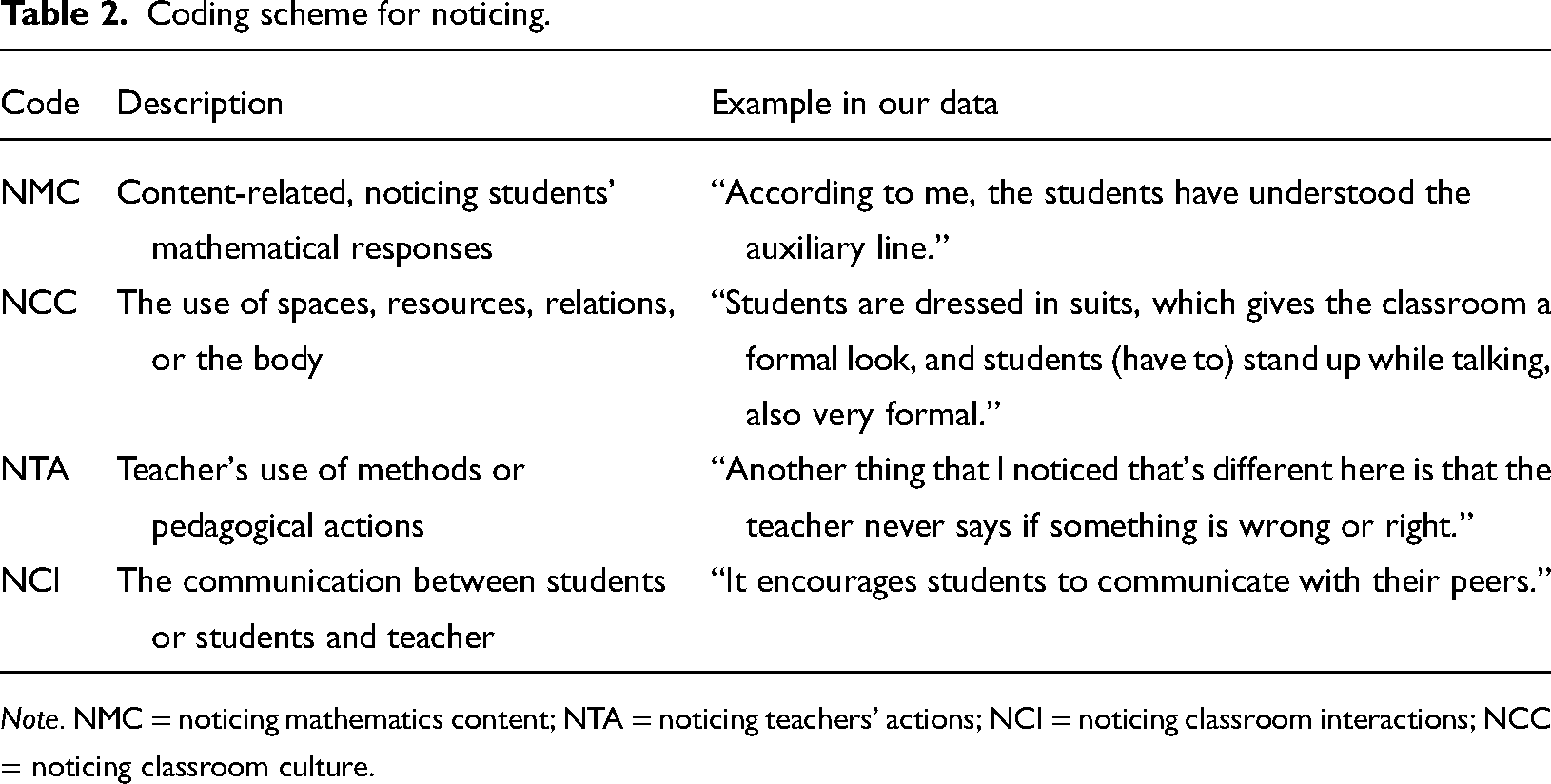
Note. NMC = noticing mathematics content; NTA = noticing teachers’ actions; NCI = noticing classroom interactions; NCC = noticing classroom culture.
We also distinguished between the familiar and the unfamiliar, where comments on what was unusual, surprising, or different were considered as noticing the unfamiliar, while noticing similar aspects, as was part of the mathematics or teaching discourse, was considered as noticing the familiar.
Results
The familiar discourse
The responses to the question, “What are the most important things to pay attention to in the classroom?” were the basis for describing the familiar mathematics and classroom discourses. The diagrams below provide an overview of PSTs’ familiar mathematics discourse and classroom discourse (Figure 3), and we expand on this overview by describing in detail what these categories contain.
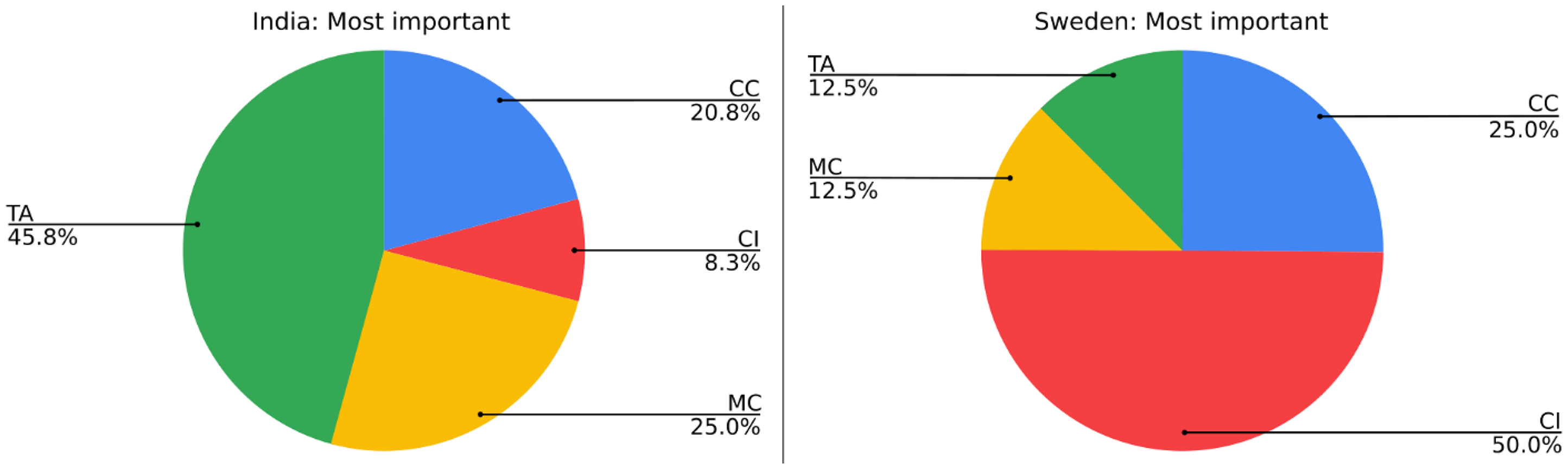
What PSTs think are most important when observing a classroom.
The diagrams display what the two groups consider the most important to observe in a mathematics classroom (Figure 3). Both attribute similar emphasis to CC. For the other categories, TA dominates the discourse of the Indian PSTs, whereas CI dominates the Swedish discourse. Furthermore, there is slightly more mention of the mathematics content among the Indian PSTs.
Classroom culture (CC) covers a range of classroom events such as time management, organization of groups, or individual work. Figure 3 illustrates how both groups find aspects of CC to be somewhat equally important when observing a classroom. Students suggested the teacher's voice and body language to be an important aspect to observe. The Indian group all mentioned “classroom management,” whereas the Swedish group wrote “classroom environment,” “handling conflicts,” or “configurations by which the students are situated,” which may relate to aspects of classroom management.
Teaching actions (TA) cover the teacher's use of methods or pedagogical actions in the classroom. The overview (Figure 3) shows how the Indian group attributes high importance to TA, with teaching techniques such as “teaching aids used,” “probing questions,” or “activity-based learning.” The Swedish group suggested a few TAs, and their examples focused either on “paying attention to learners’ mathematical work,” or the teacher's presentation such as the “introduction and outroduction” of content, and also the teacher's dedication. There is a difference in quantity between the two groups, but there are big individual differences in what the different PSTs said when talking about teaching actions.
Classroom interactions (CI) include both the interactions between students, and between students and teachers. In some sense, this is a sub-category of TA, but as shown in Figure 3, we found this to be an important emphasis of the Swedish PSTs, contrasting with the Indian group. The Swedish PSTs’ examples focus on whether learners are engaged in discussion, as in “engages students vs. monologue” or “in what form the information is communication between the students and the teacher.” Although the pattern shows a strong emphasis on classroom interactions in the Swedish group, two of the Indian PSTs mentioned student participation or talking skills, so again there is also an individual difference.
Mathematics content (MC) includes content-related aspects. Instead of CI, the Indian PSTs place more emphasis on MC. The Indian group mentions the teacher's “content knowledge,” “minor mistakes or wrong answers given by students,” or “assignment based on content.” The Swedish group's suggestions relate to how mathematics is perceived by learners, as in “Is the mathematical content clear/understandable?” For both groups, the descriptions of mathematics were not very specific. For a better understanding of the familiar mathematics discourse, we include the solutions where PSTs explain how they solved the geometry task.
In the first part, where PSTs solved the problem, most of the Indian PSTs used auxiliary lines in their solutions. Elias's solution shares several aspects that were typical for the mathematical discourse in the Indian group and serves as an example. The task was to “Find the value of angle x,” see Figure 4.
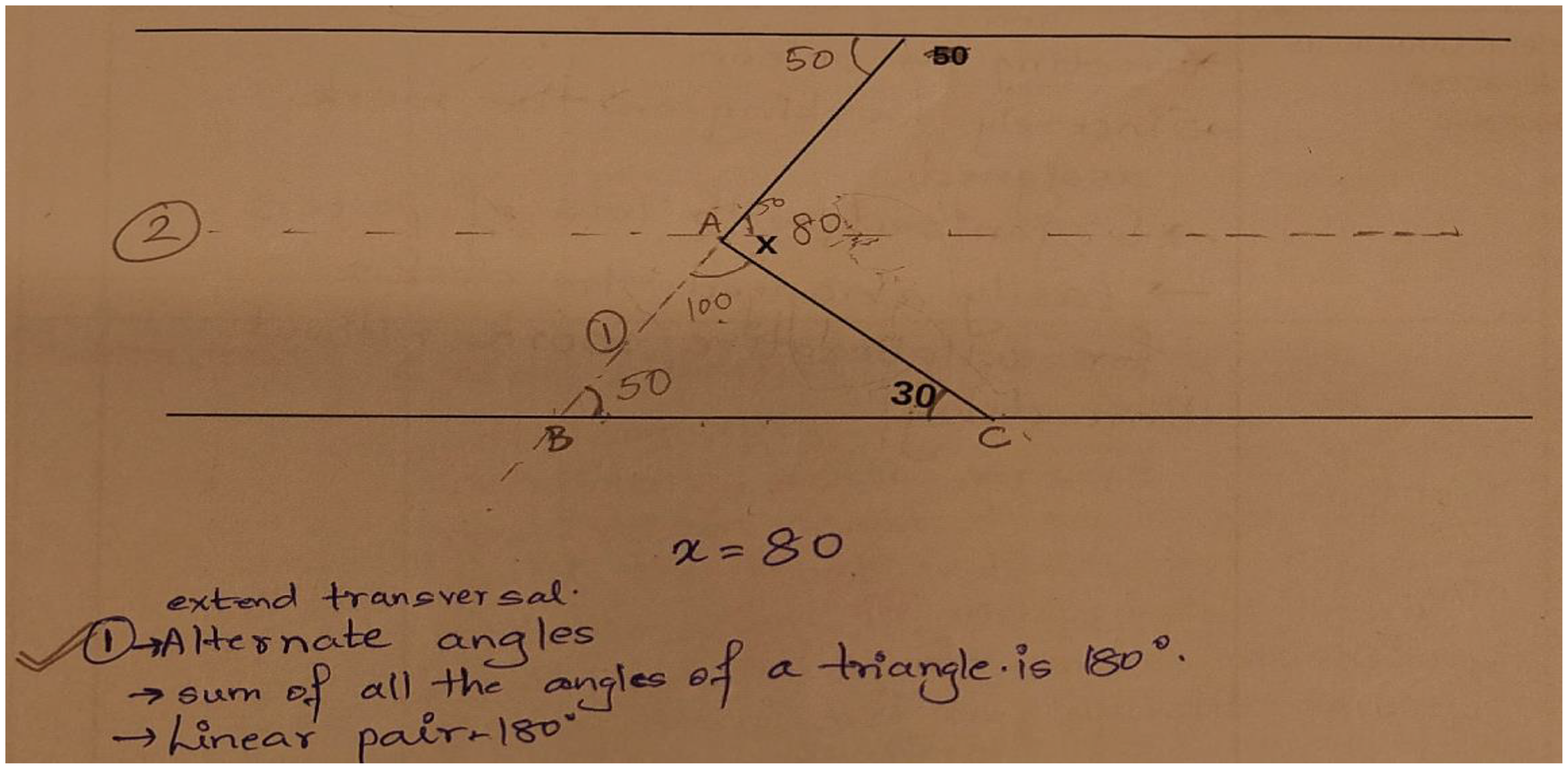
Elias's solution.
Elias uses two auxiliary lines, and explains the properties that were employed: Elias: So, my first one I explained with this transversal. Here we have a 50. So, in the definition of alternate angles, this interior angle also becomes 50. Then I took this triangle. So, the sum of all the three angles of the triangle is 180. So, 50 I got just now, and 30 is already there, so the remaining becomes 100. And this is a linear pair. So, the total has to be 180 degrees. I already have this 100. So, the remaining now becomes 80.
The Swedish participants, by contrast, took different approaches to solving the task. Here, we present Benny's full solution before we compare it with Amaira's and Charles's solutions. In contrast to the Indian PSTs, Benny solved the tasks by creating a set of linear equations and using the properties of alternate interior angles to find the value of angle x (Figure 5).
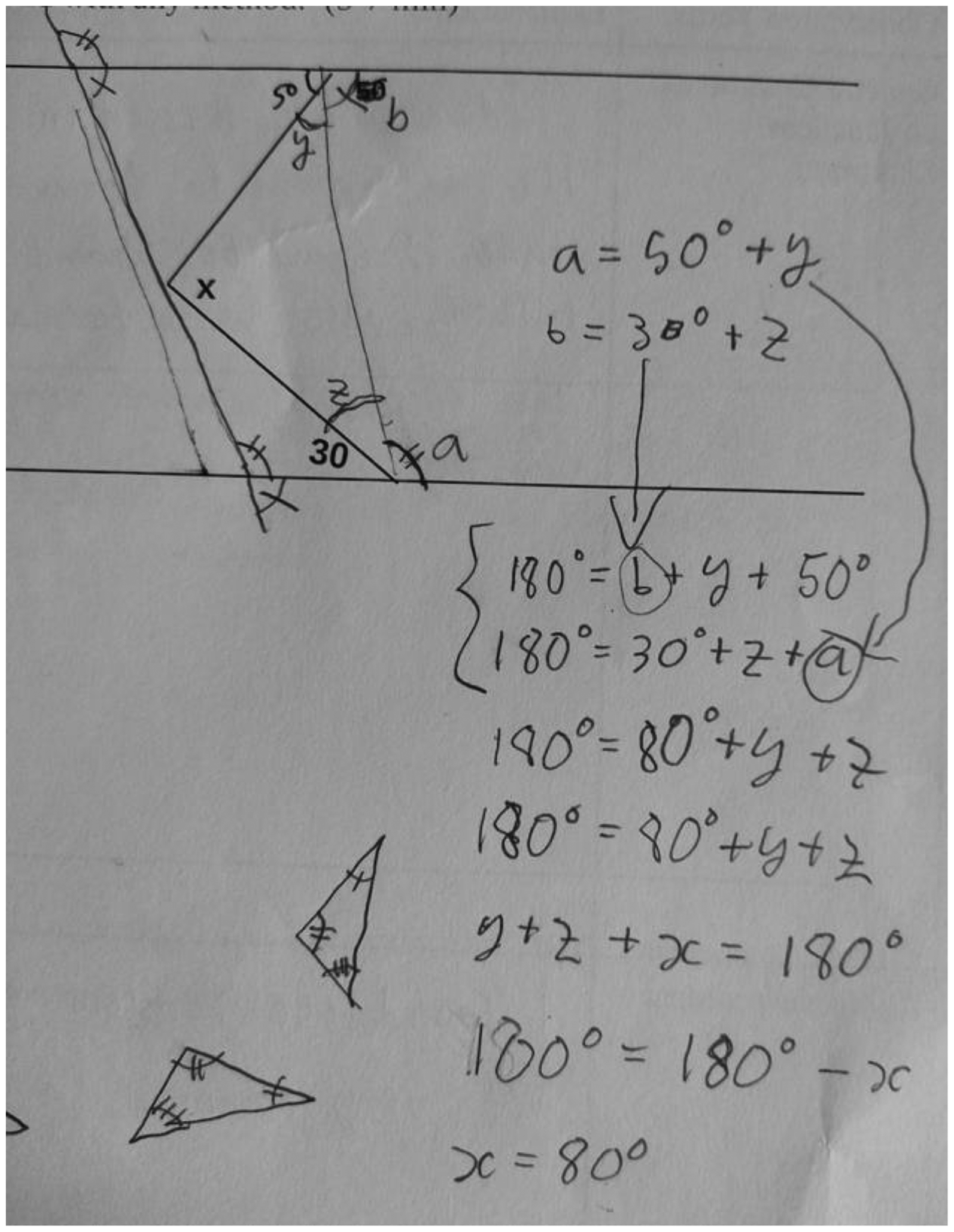
Benny's solution.
Benny used the auxiliary lines and alternate angles. He introduced variables, a, b, y, and z, for the unknown angles, and used these for formulating a system of linear equations to find x. In his explanation, it becomes evident that although Swedish PSTs are proficient in everyday English, English is not their language of instruction in mathematics, and as a consequence, their mathematics language is not as precise and formal in English. Benny: I’m trying to find out if there are any similar angles. I drew this line and this line that I thought. So, this would be one side of this triangle. And then I tried to see if there are … I don’t know if it's the right word but, like, congruent triangles. If there are any angles that are similar.
Regarding the mathematics discourse, there are some differences between Indian and Swedish PSTs. The Indian PSTs were familiar with geometrical reasoning and the use of formal mathematics language. The Swedish PSTs were less familiar with geometrical reasoning, where only Amaira found a geometrical solution. They also used less formal mathematics words, at least when they used English to explain their solutions.
Noticing the unfamiliar
When discussing the Japanese classroom vignette, PSTs from both countries claimed they had never encountered a similar mathematics lesson during their schooling or teacher training. The Japanese way of asking students to create problems, and as a group selecting, as a group the most difficult problem to share, was novel to all the PSTs. When discussing how the Japanese students were asked to create their own problems, Farouqi explained, “We have never even created a problem, nor solved a problem in the classroom.” Amaira explained, “I have never experienced that,” referring to her own experiences from school, but, “I think we did it at university.” Thus, what is noticed during the interaction with the Japanese classroom allows us to discern what is perceived as different. The Japanese lesson was unfamiliar from mathematics, as well as teaching and cultural perspective. Figure 6 displays the distribution of the noticing categories for the Swedish and Indian participants, respectively.
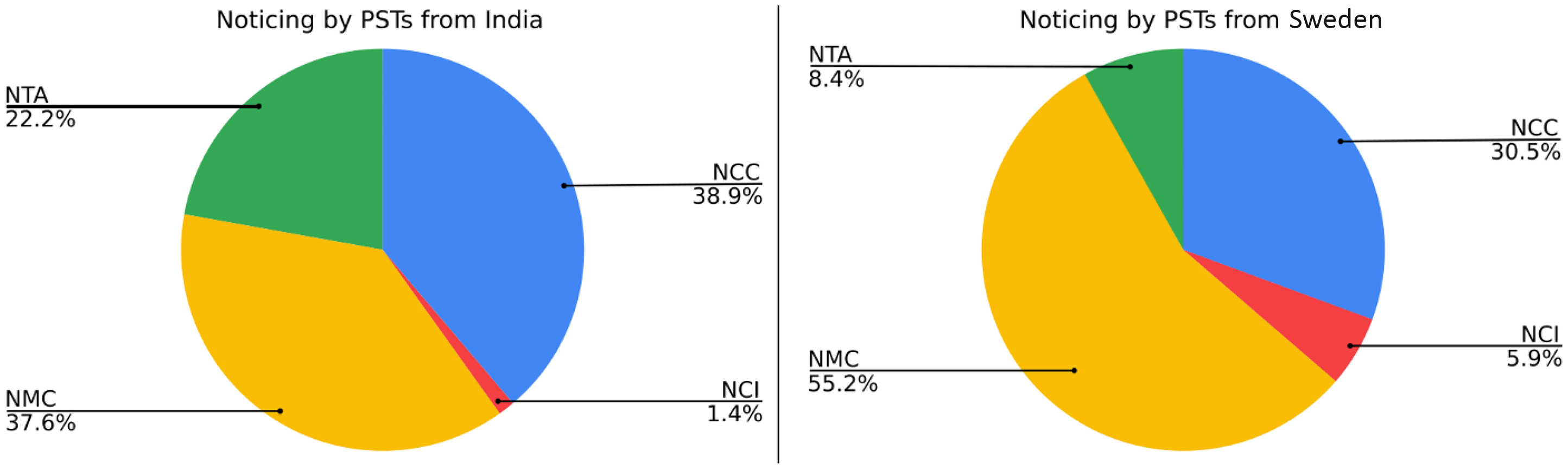
What PSTs notice from the Japanese video vignette.
Our intention with the video vignette was to enable us to analyze what mathematics discourse the PSTs noticed. Our initial idea relates to the assumptions in the literature that teachers need knowledge of, or need to be familiar with, what they need to notice. What we found is the opposite—the PSTs tended to notice what was unfamiliar. Where the Indian PSTs put the most emphasis on TA when asked what was most important (see Figure 3), they emphasized NMC and NCC when watching the video. The Swedish PSTs emphasized CI when asked what was important (see Figure 3), whereas they placed most emphasis on NMC and less on NCC when watching the video. In the following, we will analyze what is accessible for PSTs to notice in an unfamiliar classroom and whether they notice mainly what they already know, or what is perceived as unfamiliar.
Noticing mathematical discourse
After watching the vignette, Benny said, “It seemed very efficient. It wasn’t like my solution which required several equations before. So, they were very quick in finding ways to find a solution that I didn’t know.” Benny appreciated the efficiency of the geometrical reasoning. He noticed that one of the solutions used only alternate angles. Later, when he tried to solve the problems created by students, he used geometrical reasoning. When asked what the focus had been in Swedish school mathematics, Benny described how geometry problems were not emphasized as much as algebra tasks. Although all concepts required for solving the task are part of the Swedish geometry curriculum, the kind of problems the Japanese students proposed, or the solutions presented, were unfamiliar. However, Swedish PSTs quickly picked up this way of reasoning and were able to solve the second task using geometrical reasoning.
Elias noticed that “They tried the same way as I have” while watching Arai's (Japanese students’ group) solution in the vignette. Arai's method resembled Elias's solution—creating an auxiliary line by extending the given line. Instead of forming a triangle, they constructed a quadrilateral and calculated the sum of angles. Elias shared what she noticed from the Japanese students’ solutions: Elias: They were so confident with their better concept clarity. They are better at exploring. They were asked to create a problem. So, they can use whatever they have learned of angles and there are various things like interior angles and alternate angles. Everything they are putting into use to come up with the answer. And it is not like here that bas kar diya and ho gaya [“just do it and it's done,” our translation]; they are engaging in explaining in detail in every phase, also. I would not say it is one concept only, in and around everything they are discussing that particular concept and working on all aspects in detail.
In summary, the use of formal words, geometrical procedures, and routines are very similar between the Indian group and the Japanese students. Hence, the familiarity with the mathematics discourse enabled Elias to notice detailed relationships between students’ mathematics discourse and the task. In comparison, the Swedish PSTs had little to say about the mathematical details in students’ solutions, except that they were impressed by their efficiency, and, in Benny's case, learned from it. The unfamiliarity with the geometrical reasoning became an obstacle for Swedish PSTs’ noticing the mathematical details in Japanese students’ solutions, and the reason that NMC is such a significant category is mainly due to how PSTs followed the Japanese students’ reasoning, before noticing their learning. At least for mathematics discourse, we can conclude that familiarity with the mathematics discourse facilitates noticing.
Noticing classroom culture
Mathematics discourse and the discourse for what constitutes good mathematics teaching is culturally colored. Here, we discern what PSTs noticed about classroom culture, teaching actions, and classroom interactions.
PSTs noticed aspects of the classroom culture (NCC) which they found to be different in relation to their own. Both Indian and Swedish mathematics instruction is characterized as teacher-led explanations followed by student practice, although with variations in time allocation for instruction and practice. Charles explained, “In Sweden, out of 40 min, 20 min are given to teachers in explaining and then 20 min to students trying out tasks and the teacher helping them to solve them. If exercises are not completed, it is homework.” By contrast, Indian classrooms allocate 20 out of 35 min to teacher explanations; the remainder is dedicated to managing the class, necessitating the completion of exercise problems as homework assignments (Batra, 2023). Both Indian and Swedish PSTs noticed that the Japanese teacher allocated more time for students’ work, and noted how this differed from what they were familiar with.
The Indian PSTs had many comments on the resourcing of the Japanese classroom. Gulu noticed how the classroom infrastructure allowed the teacher to move around helping individuals. Elias noticed how the classroom was organized, with many posters on the walls. These comments on the resourcing reflect other differences from Indian schools. The Indian PTSs also noticed how the Japanese students used their mother tongue, whereas, in India, mathematics instruction is mostly given in English. While Swedish PSTs did not notice the language and resourcing, they did notice the size of the Japanese class. In Sweden, mathematics instruction is conducted in Swedish, class sizes are generally small enough for the teacher to be able to move around, and resources such as posters, whiteboards, or projectors were probably taken for granted. These aspects were not mentioned by the PSTs. The comparison shows that the Indian PSTs noticed what was unfamiliar to them.
The two focus groups had different perspectives on the relationship between the Japanese teacher and the students. Amaira and Benny noticed how the transition from individual work to groups was smooth and silent. Similarly, the two Indian PSTs commented on how the transition worked smoothly. They remarked how a similar transition would cause “chaos” in the Indian context, and noted how the Japanese classroom culture supports learning. Shifting focus from individuals to groups, Deena said, “This helped in understanding the best outcome of a problem and the best problem they can create which might be helpful in practical life.” The Indian group noticed the discipline but also the ease in the classroom, and how, “Teamwork is given focus” (Gulu). Elias noticed how the relationship between the teacher and students was cooperative and friendly, and how this was different from their experiences in the Indian classroom.
Amaira also noticed the relationship between the teacher and students and reflected on how this differed from their Swedish experience. Amaira: Another thing that I noticed that's different here is that the teacher never says if something is wrong or right. Which is, I think, like in Sweden; you want to come to some sort of consensus. Like, okay, so this is the answer.
Different from NMC, CC was noticed from the perspective of differences between the Japanese and PSTs’ own context. Both groups noticed the instance where the teacher asked students to create their own problem, the smooth transition from individual to groupwork, the supportive relationship between teacher and students, and how the teacher avoided giving the answer. By contrast, only Indian PSTs noticed the resourcing and language in the classroom and commented on how this differed from India.
Noticing teachers’ actions
As described above, both groups expressed how the task and setting of the lesson were unfamiliar, as well as how the teacher engaged students as creative participants in the lesson. Both focus groups noticed more or less the same instances in the Japanese lesson. The Indian PSTs noticed how the teacher asked students to present solutions on the board, encouraged students to be creative, and let students think critically about the problem. They noticed that the teacher was very “patient” and gave hints, checking the work of every student. Deena described the Japanese teacher as “very patient,” giving examples of how they gave mathematical hints to individual students (e.g., where to draw lines and how to find angles). In the interview, the Indian PSTs acknowledged how this requires a lot from the teacher in terms of preparation and content knowledge. Indian PSTs also noticed how the teacher organized the groupwork—asking the group to agree on the toughest problem, listing students’ problems on the board, and grouping problems in relation to their difficulty level. Hence, they noticed the teacher's actions on a very detailed level. Although the Indian PSTs appreciated how the Japanese teacher encouraged participation, they also commented on how this was different from their own experiences, in particular, because most of their practicum teaching took place during the pandemic lockdown, when teaching moved online.
The Swedish focus group made fewer comments related to the teacher's actions than the Indian group. Also, they did not agree with each other, and a discussion arose between Amaira and Charles. Charles claimed that students “really want to know if this is correct or not”; if not, they will not feel rewarded. Amaira objected. In their opinion, the reward was rather when the teacher wrote and named the solution from each group as a more inclusive practice than listening to the correct answer from a single student. Swedish PSTs expressed an expectation that the teacher take responsibility for providing a summary. The disagreement is about whether and when the correct answer is part of this. The debate between Amaira and Charles illustrated that it was possible to put critical questions to the teaching in the video, but also that participants from the same culture do not necessarily interpret what they notice in the same way. It is interesting that both groups noticed and appreciated the learner's participation in this lesson. We now move deeper into the analysis of the classroom interactions they noticed.
Noticing classroom interactions
PSTs noticed few classroom interactions (see Figure 6) in relation to what they claimed to be important to observe (Figure 3). The difference was particularly striking with the Swedish PSTs. Although this is a minor category, we have some findings.
Among the Indian PSTs, Elias noticed the interaction between students in the focus-group discussions: “They could try it out individually first and then work in groups, giving them a platform to explore, make mistakes, rectify them, and come up with various solutions.” Deena noticed how the teacher was a good listener and gave good guidance in the between-desk instructions. According to Deena, this interaction allowed students to “open up and express their ideas and ways of solving.” Hence, the Indian PSTs discussed the relationship between interactions and the possibilities for students’ explorative participation in mathematics. They also expressed how such interactions were rare in Indian schools. Although the Swedish PSTs emphasized that it was important to observe classroom interactions, this is not what they noticed. Again, it seems the Indian PSTs noticed classroom interactions because they were unfamiliar with the Japanese practices, whereas Swedish PSTs did not mention the classroom interactions, possibly because these practices were familiar.
Discussion
This study highlights cultural aspects of noticing in mathematics education in two different cultural contexts, comparing noticing between PSTs from India and Sweden. Our study substantiates the assertion by Adiredja and Louie (2020) that mathematics discourse is context-dependent, and significantly affects what and how PSTs notice. When we set out to look for alignment between the familiar discourses and what PSTs noticed, we found the opposite: the PSTs noticed the unfamiliar teaching discourse.
From the Japanese video vignette, both PST groups were able to notice details of how the teacher worked as a facilitator. However, the teaching discourse noticed by Indian PSTs focused on classroom culture, and the Swedish PSTs emphasized classroom interactions and the teacher's actions. Both Batra (2023) and Sarangapani and Pappu (2021) agreed that opportunities for PSTs to engage in student discussions are rare in Indian classrooms. In contrast, Sjöblom et al. (2023) found that group discussion is common practice in Swedish classrooms, but PSTs struggle to master it. Hence, the unfamiliar teaching discourses present in the Japanese classroom were noticed by both PST groups. However, what Indian and Swedish PSTs consider unfamiliar depends on what is familiar in their own context. We claim that PSTs tend to notice unfamiliar teaching discourses.
Regarding the mathematics discourse, the Indian PSTs were familiar with geometrical reasoning in open-ended tasks—the established mathematics discourse in their educational background. Hence, the Indian PSTs shared a familiar geometry discourse with the Japanese, focusing on geometrical properties and reasoning. By contrast, the Swedish PSTs struggled with the use of geometrical properties in open-ended tasks. Because they were unfamiliar with the geometry discourse, they resorted to alternative problem-solving strategies, such as algebra. This divergence resonates with earlier research (Dreher et al., 2021; Ivars et al., 2020), who noted that what is perceived as “mathematical thinking” varies across cultures. Thus, we claim that a familiarity with the mathematics discourse facilitates noticing.
Based on our findings, we claim that mathematical thinking often considered a higher level of noticing (Amador & Weston, 2024; Jacobs et al., 2010; van Es, 2010), overlooks the importance of noticing teaching discourse. Güneş et al. (2024) found that unfamiliar teaching situations present a variety of learning opportunities. We argue that noticing unfamiliar teaching discourses unlocks new reflections on mathematics teaching.
Limitations
The language of the interviews was English, and the differences we saw related to mathematics discourse can only to some extent be understood in relation to English being the language of instruction for participating PSTs in India, not Sweden. The use of formal language in mathematics is an established focus in Indian classrooms (Sarangapani & Pappu, 2021). Research on noticing is emerging in Sweden and India, and, therefore, it is difficult to judge the representativeness of our cases without further research.
Implications
As Amador (2017) advocated, providing PSTs with opportunities for video analysis, reflective writing, and collaborative discussions can enhance PSTs’ noticing skills. We suggest that TE programs also consider including examples, such as videos, from unfamiliar classroom settings. The contrast between such unfamiliar examples and the familiar creates the opportunity to reflect on familiar, taken-for-granted practices (Stigler & Perry, 1988).
Conclusions
Our findings show how noticing mathematics is facilitated by a familiarity with the mathematics discourse. However, the familiar mathematics discourse was not necessarily similar across our two groups. The Indian PSTs used strategies and a mathematics discourse similar to those in the Japanese classroom—construing auxiliary lines, using formal language, and engaging in geometrical reasoning when solving a task. The Swedish PSTs were less familiar with the geometry discourse and they struggled when required to use geometrical constructs, formal language, and reasoning. The Swedish PSTs followed, and learned from, the geometrical discourse of the Japanese classroom, whereas the Indian PSTs’ familiarity with the mathematics discourse enabled them to be more precise and nuanced in their noticing of the Japanese students’ discourse. The PSTs themselves acknowledged the importance of understanding the problem and the related mathematics for being able to follow the reasoning and mathematics discourse of students in the classroom.
The opposite seemed to be true for noticing teaching. When noticing classroom culture, teachers’ actions, or classroom interactions, the focus was on what was unfamiliar in the Japanese classroom, and not on what they claimed was important to notice. When watching the vignette, PSTs reacted to what was different and unfamiliar from the teaching they had experienced in schools and in TE. This unlocking of unfamiliar teaching discourse turned into a learning opportunity.
Footnotes
Acknowledgments
We extend our gratitude to the preservice teachers (PSTs) who generously participated in this research and their teacher education institutes for their support in conducting the research.
Contributorship
Harita Pankajkumar Raval was responsible for the design of the study, data collection, transcription, development of analysis, coding, coding validation, and writing, reviewing, and editing of the manuscript. Lisa Österling contributed by validating the study design, development of analysis, coding validation, and writing, reviewing, and editing of the manuscript. Eva Norén contributed by validating design of the study, development of analysis, coding validation, writing, reviewing, and editing of the manuscript.
Declaration of conflicting interests
The authors declared no potential conflicts of interest with respect to the research, authorship, and/or publication of this article.
Ethical statement
This study is part of a PhD project which has been approved by the Swedish Ethical Review Authority (Dnr 2023-02684-01). We followed the ethical procedures in both countries, India and Sweden. The researcher was given consent by the teacher education institutes and by the preservice teachers to conduct the study.
Funding
The authors disclosed receipt of the following financial support for the research, authorship, and/or publication of this article: This study falls within the research school REMATH, funded by the Swedish Research Council, grant number 2021-00534.
