




Abstract
Purpose
This study explores the current status of differentiated instruction (DI) in Chinese mainland primary and secondary schools.
Design/Approach/Methods
This study comprises a systematic review of the Chinese literature. Forty-five articles, published between 2000 and 2022, were reviewed and the results are presented as a thematic overview.
Findings
Chinese characteristics have contributed to the distinctive development of Chinese DI. Chinese researchers have defined DI as both a teaching concept and a practice. Chinese scholars have suggested strategies for teachers to use, including flexible grouping, tiered instruction, and multiple forms of evaluation, along with the use of non-graded classes and artificial intelligence. This study identifies barriers to teachers’ adoption of DI including large class size and China's examination-oriented culture. However, Confucian belief was effectively a forerunner of DI.
Originality/Value
This study offers insights and practical suggestions for those seeking to promote DI in Chinese mainland; for example, class sizes should be reduced, and teachers should receive relevant professional training. This study identifies a pressing need for empirical research of DI implementation in schools in Chinese mainland.
Keywords
Introduction
Classrooms worldwide are increasingly diverse. Consequently, teachers must adapt their instruction for heterogeneous groups, and how to achieve this has become an important topic for discussion and research. Differentiated instruction (DI) was originally presented as a practical way to meet the learning needs of particularly talented students, but over years—and particularly at the start of the twenty-first century—this concept has evolved, and DI is now seen as both a teaching philosophy and a whole-classroom practice that lets teachers meet the diverse needs of all students in their classrooms (Tomlinson, 2014). Tomlinson, a pioneer of modern DI, has defined DI as both a teaching philosophy and a classroom practice that requires teachers to engage proactively—particularly through positive planning and adjustment of teaching content, process, and student products—to cater for students’ learning differences optimally (Tomlinson et al., 2003). Evidence suggests that DI can enhance students’ academic outcomes, self-concepts, and learning interests (e.g., Maulana et al., 2020; Pozas et al., 2021). However, most relevant studies have been conducted in Western contexts (e.g., Letzel et al., 2022), prompting calls for more DI research in diverse settings and non-Western countries, such as China (e.g., Yuen et al., 2022). However, DI research conducted in Chinese societies has tended to focus on Hong Kong SAR and Chinese Taiwan (e.g., Hung & Chao, 2021; Wan, 2017), rather than Chinese mainland. Since these societies have different educational systems and cultures, such studies cannot always be generalized (Malinen et al., 2012; Wei & Ou, 2019). The current study aims to fill this gap in the literature by exploring DI in primary and secondary schools in Chinese mainland.
Chinese mainland schools have experienced significant change in recent decades, including curriculum reform and rapid urbanization (e.g., Cheng, 2005; Wu & Wei, 2015). Today, Chinese classrooms are diverse in terms of students’ academic, economic, emotional, and behavioral backgrounds, which has led policymakers and teachers to move away from a traditional approach and toward DI. Notably, DI is not entirely new to Chinese teachers: The Confucian pedagogical ideal counsels teachers to tailor their teaching according to students’ abilities (Deng & Harris, 2008). However, China's education system differs sharply from its Western equivalents. China has a highly examination-oriented culture and large class sizes (Wan, 2017).
Reviews of DI have tended to evaluate and summarize empirical evidence from English-language studies conducted in Western societies (e.g., Deunk et al., 2018; Smale-Jacobse et al., 2019); very few have synthesized evidence of DI from the Chinese literature via systematic review or meta-analysis. Therefore, the main objective of this study is to explore the current status of Chinese DI as reflected in the Chinese literature, through the design and application of a systematic review study. The three research questions for that study are:
What are the distinctive cultural and educational contexts that influence the development of DI in Chinese schools? How is DI defined by Chinese researchers? Which DI approaches are the most appropriate for Chinese teachers to use?
Methods
To the best of our knowledge, this is the first systematic literature review in English that evaluates and analyzes the evidence from contemporary Chinese research (i.e., published 1995–2022).
Search method
In the initial step, articles with “DI” (In Chinese: 差异化教学/差异教学) and “teaching students in accordance with their aptitudes” (In Chinese: 因材施教) in the title and/or keywords were identified through a search of two Chinese databases (CNKI and Wanfang Data) which are portals to the major social science databases. The second term was used because a Chinese idiom that translates as “teaching students in accordance with their aptitudes” expresses an idea similar to DI and many researchers have used this term as a synonym for DI in their Chinese-language articles.
Although the databases contained multiple articles on DI, only full texts published in prominent Chinese journals were selected. The Preferred Reporting Items for Systematic Reviews and Meta-Analyses (PRISMA) flow chart in Figure 1 shows the review procedure (Moher et al., 2009). This systematic search of CNKI and Wanfang Data yielded 651 items. After excluding duplicates, a set of 121 valid papers was identified as complying with the inclusion criteria, which stipulated that studies must have been conducted in Chinese primary and/or secondary school classrooms. These 121 articles were read, and 76 were excluded at this stage because they either (1) did not focus on the role of students or teachers during implementation of DI; and/or (2) were conceptual or empirical studies that did not refer to contexts, definitions, or approaches involving DI. Consequently, the final dataset for this study comprised 45 papers, of which 31 were from the perspectives of both primary and secondary schools, while 14 reflected either primary or secondary schools.
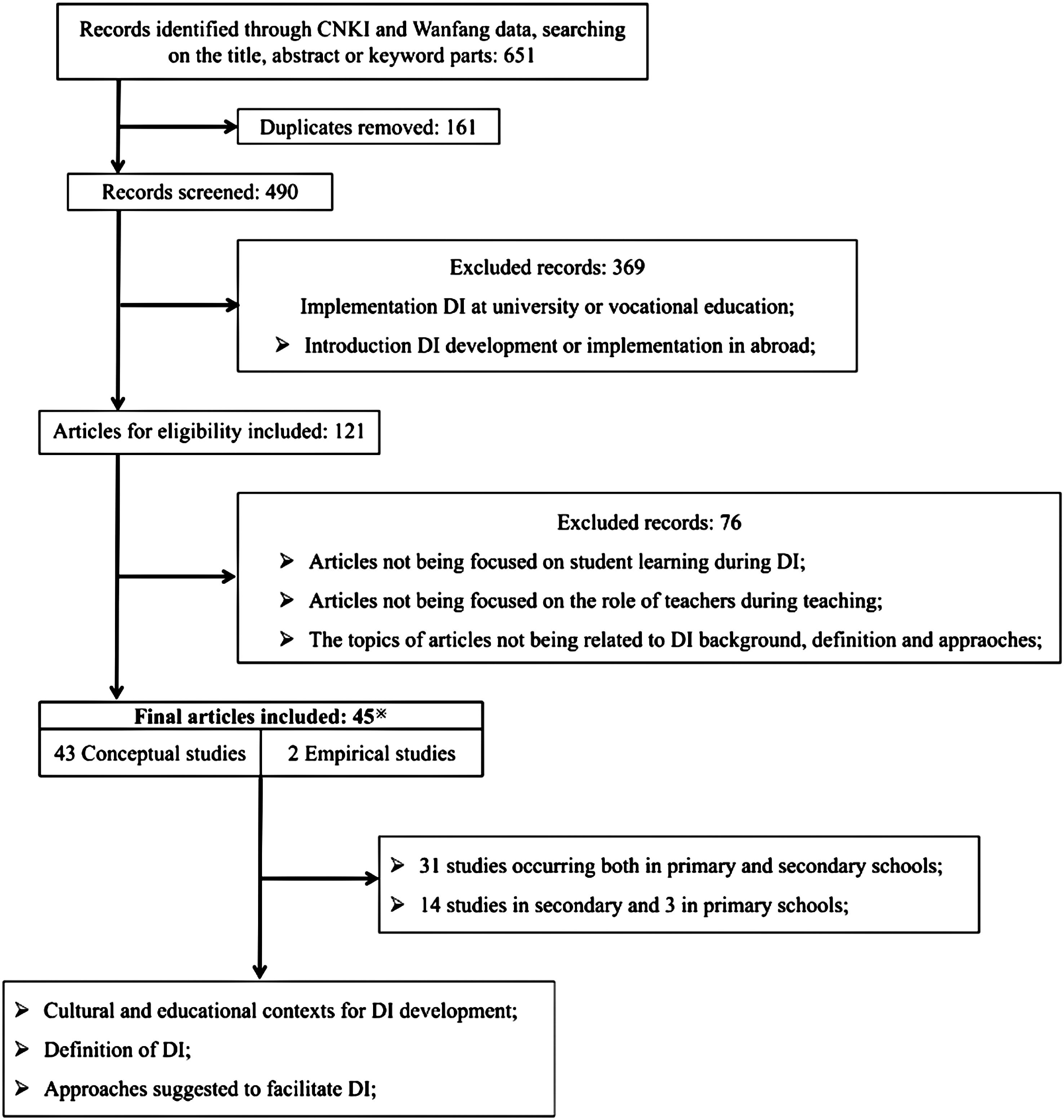
PRISMA flow chart of the systematic search.
Research sample
The current review is of 45 papers, published in 20 Chinese-language journals between 1995 and 2022. Of these, five were published between 1995 and 2005, 22 were published between 2006 and 2016, and 18 between 2017 and 2022. Just two of the 45 papers were empirical studies; this reflects Chinese researchers’ preference for writing conceptual papers.
As Table 1 shows, the articles explored diverse themes that sometimes overlapped. Their content generated three core themes for the current study. Eighteen described cultural and educational contexts for developing DI in Chinese schools; 18 gave definitions of DI; and 39 described approaches that might facilitate DI practice.
Thematic overview.
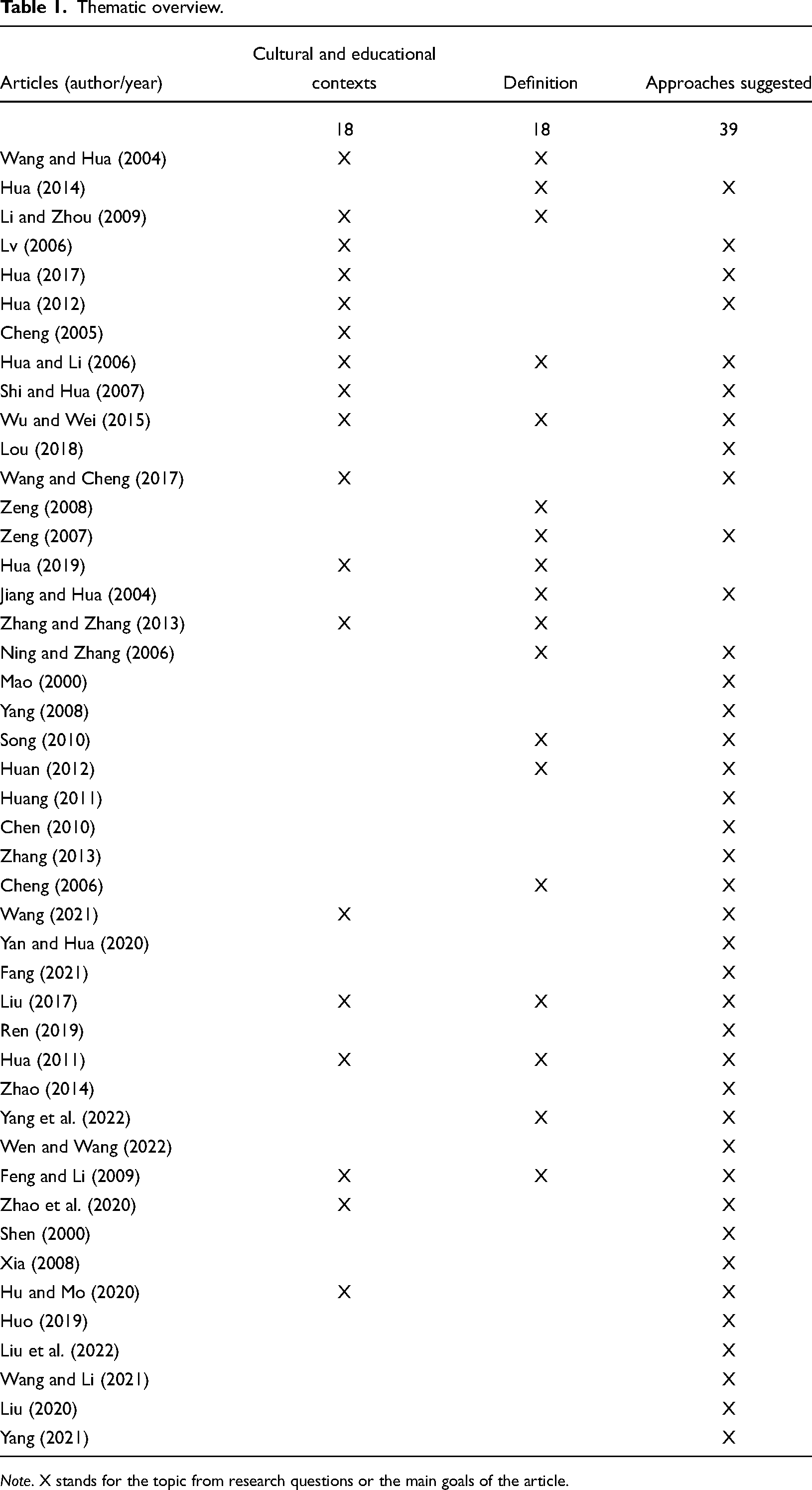
Note. X stands for the topic from research questions or the main goals of the article.
Results
Chinese cultural and educational contexts
As the twenty-first century began, Chinese educational reform prioritized inclusion. Teachers were advised to adopt forms of instruction that met all of their students’ diverse learning needs (Lv, 2006; Wang & Hua, 2004). Other countries had similar experiences, but China's conditions—including its cultural and educational contexts—are highly distinctive.
China has seen multiple educational ideals in its long history, including those of Confucius, who stated that students should be given equal learning opportunities, and that both female and male students were teachable (Hua, 2019; Zhang & Zhang, 2013). Confucius asked teachers to align their teaching with students’ own characteristics, ignoring distinctions of social class—which sounds remarkably contemporary (Jiang & Hua, 2004; Zhang & Zhang, 2013). Thus, the educational concepts drawn from China's Confucian heritage emphasize the importance of equal learning opportunities and of adapting to students’ differences, which perhaps laid the foundations for subsequent development of Chinese DI (Hua, 2019). Nonetheless, China's educational culture is now examination-oriented, and teachers in Chinese mainland schools are pressured to guide their students to exam success (e.g., Berry, 2011). Studies indicate that teachers in Chinese mainland schools, at both primary and secondary levels, face challenges when trying to implement DI (Hua, 2011; Liu, 2017). China has a single assessment system for students, which may generate conflict between preparation for high-stakes tests and teachers’ attitudes to DI. Consequently, DI is not universally popular with Chinese schools, teachers, and/or parents (Wan, 2020).
Furthermore, social equity affects the implementation of DI in Chinese primary and secondary schools (Shi & Hua, 2007; Yang et al., 2022). With growing urbanization, rural students have increasingly migrated into city schools (Wu & Wei, 2015). Generally, an increase in class size increases the diversity of students and learning needs (Hua, 2011), which may create complexities in classroom management (Hua & Li, 2006; Huang, 2011). Large class size is noted as a barrier to DI in the Chinese literature (e.g., Jiang & Hua, 2004; Liu, 2017). However, national commitment to social equity urges policymakers and school leaders to adapt their instruction, using approaches like DI to provide effective education for all (e.g., Hua, 2012, 2017; Lou, 2018). Meanwhile, teachers are reported to lack skill in identifying the differences between students, designing differentiated activities, and controlling the pace of teaching in large classes (e.g., Huang, 2011; Song, 2010; Zeng, 2007). Thus, the ideal of well-implemented DI conflicts with the practical problems of large classes.
Chinese law and policies also influence the application of DI (e.g., Hua, 2011; Li & Zhou, 2009; Wang, 2021). From the 1980s, China's revised Constitution and the Compulsory Education Law sought to support, and raise the educational attainment of, citizens with disabilities (Hua, 2017; Wu & Wei, 2015). Ground-breaking Chinese government policy stipulated that students with special educational needs should learn alongside their peers without disabilities in mainstream classrooms, and the government published a series of proposals, such as Trial Measures for Implementing Learning in Regular Classrooms for Children and Adolescents With Disabilities, the Ninth National Implementation Plan of Compulsory Education for Children With Disabilities, and the 2014—2016 Promotion Plan of Special Education, to expedite implementation of this. Teachers were encouraged to adopt inclusive approaches, to promote students’ success and maximize their learning potential (Hua & Li, 2006).
Further education reforms occurred in 2000 and 2022, the objective being to cater for all students’ needs. These reforms created educational environments favorable to DI (Cheng, 2005; Wang & Cheng, 2017). Teachers were told to abandon their traditional “one size fits all” approach and use DI in response to student diversity. Furthermore, these reforms explicitly noted the need to support teachers to adopt DI. Therefore, most current Chinese teachers support student-centered teaching and wish to implement DI according to students’ learning differences and characteristics.
DI as a teaching concept and practice
The popular definition of DI in Chinese literature came from Hua, who introduced the term “DI” to China around 2000 (e.g., Liu, 2017; Ning & Zhang, 2006). Hua (2001) argued that DI was derived from both Confucian principles and the work of Tomlinson, and that it matched the requirements of Chinese educational reform, which called for better education and equity of access. Hua saw DI as both a teaching concept and a practice; the basic premise of DI was that teachers should recognize every student as unique, and should adapt their teaching to respect and leverage students’ diverse learning characteristics (Feng & Li, 2009; Zhang, 2013). Thus, student diversity was effectively identified as a teaching resource in larger classes (e.g., Hua, 2011; Liu, 2017; Shi & Hua, 2007). Chinese teachers have adopted DI via teaching content, activities, and assessment techniques, seeking to take advantage of student diversity and help students to achieve their potential (e.g., Jiang & Hua, 2004; Zhao, 2014).
According to Hua's (2001) definition of DI, which reflects mainstream Chinese thought, teachers should (1) adjust the curriculum and teaching content appropriately during DI implementation, according to their students’ learning positions; (2) deploy various teaching approaches and activities, designed in light of students’ learning differences; (3) provide appropriate feedback and follow-on activity according to students’ learning outcomes; and (4) create inclusive, DI-focused classrooms within typical Chinese conditions, including large classes.
Many Chinese researchers have argued that DI comes from traditional Confucian belief, passed down for millennia, and that this informs Chinese teachers’ understanding of DI (e.g., Hua, 2019; Zeng, 2008). Others argue that theoretical research on DI undertaken in the early twenty-first century supports aspects of the Chinese model (e.g., Zeng, 2007). For example, Chinese scholars have stated that the accepted Chinese definition of DI is supported by Gardner's theory concerning students’ intelligence, and Vygotsky's work on the zone of proximal development, whereby teachers should understand, and prepare their instruction in light of, students’ starting points (e.g., Ren, 2019; Zeng, 2007).
Hua, a representative expert of Chinese DI, claimed that in addition to the Confucian concept, the typical definition of Chinese DI is influenced by Tomlinson, a Western scholar (Hua, 2001). There are many similarities between Chinese definitions and Tomlinson's views on DI, but national conditions and the underpinning Confucian concepts are distinctive characteristics of Chinese DI. In this regard, it is important to distinguish the main differences between Confucian pedagogical rubric, and the DI of Hua and Tomlinson.
All three counsel teachers to tailor their instruction based on students’ characteristics, and to maximize their learning potentials (Huan, 2012; Yang, 2008). However, the Confucian concept and the DI-related views of Hua and Tomlinson differ in terms of purpose. Confucius regarded moral education as a key learning object, in keeping with the demands of his time. Thus, the Confucian concept seeks to cultivate an ethical person of good character. In contrast, Hua and Tomlinson assert that the aim of DI is to let students master knowledge in order to achieve learning goals. These modern views perhaps promote a more holistic development of the individual student.
Another difference lies in the number of students involved. Hua (2001) foresaw DI's use in large classes, based on prevailing Chinese conditions; Tomlinson (1990) studied DI in Western classes of around 25 students. In contrast, since there were no formal classrooms in that ancient period, Confucius referred to the teaching of students in small groups (Zhang & Zhang, 2013). Thus, Confucian teaching was almost individualized instruction (Hua, 2014; Zhang & Zhang, 2013). Another difference is manifested in the ways that teachers design and organize their teaching. Although all three experts gave instructions, only Hua and Tomlinson advised teachers to use diverse teaching strategies; Confucius did not mention this (Zhang & Zhang, 2013).
Diverse approaches for DI implementation
Almost every article reviewed in this study referred to respecting students’ differences (Hua, 2012; Shen, 2000). Chinese researchers have advised teachers to use various strategies during DI implementation, in the context of assessing students’ differences and seeking to maximize their learning attainments (Xia, 2008; Yang et al., 2022). Such approaches include flexible grouping, tiered and individualized instruction and/or diverse forms of assessment (e.g., Chen, 2010; Xia, 2008). For instance, some Chinese children live with their grandparents because their parents have moved for work. These students may lack sufficient parental attention and some grandparents simply cannot help them with their learning (Hua & Li, 2006). Thus, teachers may deploy strategies that meet specific needs generated by students’ living conditions, such as private coaching (e.g., Mao, 2000; Song, 2010).
Flexible grouping, or cooperative learning, is the DI approach most often recommended by Chinese scholars. Some have argued that cooperative learning can improve students’ academic performance and promote their communication skills and cognitive development (e.g., Cheng, 2006; Huan, 2012). The most popular method suggested is to group learners according to their interests and abilities (e.g., Mao, 2000; Yang et al., 2022), but other methods mentioned in the literature include grouping by gender, readiness, learning profiles or character (e.g., Huan, 2012; Shi & Hua, 2007). Zhao (2014), Huan (2012), and Ning and Zhang (2006) counseled teachers to group students randomly.
Tiered and individualized instruction are both popular with Chinese scholars. Tiered instruction has been used in mixed-ability classrooms, by grouping students based on ability (e.g., Fang, 2021; Liu et al., 2022). Students working at different levels may be given different teaching content, requirements, assignments, and/or assessments (e.g., Hu & Mo, 2020; Zhao, 2014). Mao (2000) warned teachers to practice tiered instruction correctly, since students may feel frustrated if allocated to a group with inappropriately low academic performance. Many researchers have proposed individualized instruction to supplement DI, for example, extra tutoring for advanced pupils and those needing extra help (e.g., Hua, 2011; Hua & Li, 2006). Individualized instruction has also been suggested for students with disabilities who are integrated within regular classrooms but would benefit from additional attention (Hua, 2014).
Chinese studies have also highlighted the need to provide students with appropriate teaching content, objectives, and activities according to their current learning positions and needs. Shi and Hua (2007) and Hua (2011) underlined the importance of providing extra learning material and challenging learning objectives. Ning and Zhang (2006) and Ren (2019) found optional learning resources and the use of technology could help teachers to create differentiated classrooms. Studies indicate that appropriate learning objectives can exert a positive effect on students’ zone of proximal development, allowing them to progress via greater challenge (Wang, 2021; Zhao, 2014), and that additional learning material can promote educational equity (Huang, 2011; Shi & Hua, 2007).
Additionally, Chinese scholars have advised teachers to use multiple evaluation measures in the course of DI (e.g., Chen, 2010; Jiang & Hua, 2004). This helps teachers to assess current learning statuses accurately and make appropriate plans for future instruction (e.g., Ning & Zhang, 2006; Yang, 2008). In learning preparation phases, a baseline assessment gives insights into students’ current learning positions and characteristics, e.g., readiness, interests, and learning styles (e.g., Jiang & Hua, 2004; Yan & Hua, 2020). The literature indicates that teachers should make ongoing assessments, based on each student's classroom performance (e.g., Chen, 2010; Huang, 2011). Chinese scholars also suggest that, following learning sessions and in addition to traditional forms of summative assessment—which generally assess learning product rather than learning or any aspect of the individual—peer assessment should be encouraged, since students may benefit from interacting with classmates for mutual help (Jiang & Hua, 2004; Shi & Hua, 2007). Non-graded instruction, in which students with similar interests and abilities sit together, is also suggested (Hu & Mo, 2020; Zhao et al., 2020).
The use of modern technologies and associated tools can help teachers create differentiated classrooms. They can use multi-media and other technologies to gamify learning, show and record videos, and create interesting assessment activities that facilitate students’ progress (Liu, 2020; Wen & Wang, 2022). Huo (2019) referred to intelligent tools that track students’ learning and thus help teachers to identify the particular difficulties those students encounter. However, Wang and Li (2021) advised teachers to be wary of relying too heavily on artificial intelligence products, since most of these are still in the early stages of development.
Finally, teachers are encouraged to apply a selection of the teaching approaches mentioned above (Yang, 2021).
Discussion
This is the first study to investigate the current state of DI in Chinese mainland primary and secondary schools through the systematic synthesis of evidence—in this case, 45 articles, all published in Chinese journals between 1995 and 2022. The current study extends prior works, which lack literature reviews that capture and summarize Chinese studies. It also contributes information about DI with Chinese characteristics to the literature, and provides a window through which international researchers can observe and understand Chinese DI. This study has identified three themes arising from analysis of the Chinese literature, namely, distinctive cultural and educational contexts, DI defined as a teaching concept and approach, and diverse DI approaches for meeting students’ learning needs. These concepts both resemble and diverge from ideas found in the English-language literature on DI. The following sections will consider the commonalities and differences between the Chinese and English literature.
Firstly, the findings of this study indicate that China's distinctive cultural and educational contexts have shaped and influenced DI; the distinctive character of Chinese DI has developed in Chinese conditions. More specifically, China's experience of rapid urbanization and its policy of fully inclusive classrooms greatly increased the diversity of student learning needs in regular classrooms, which drew political attention and response (Deng & Harris, 2008; Wu & Wei, 2015). This is unlike DI in Western countries, which is used, at least partially, to address diversity arising from national integration; such differences are reflected in language and culture. Furthermore, Chinese education has an examination-oriented culture and uses score-based teaching evaluation (Wan, 2020). Consequently, Chinese teachers have traditionally followed a “one size fits all” approach, prioritizing public examinations, so many Chinese primary and secondary teachers prioritize exam success over DI implementation. However, teachers must in any case make adjustments during their work, to meet the needs of students who are particularly talented or have fallen far behind, even where teachers have only designed a single set of teaching content. Differences among students are inevitable and teachers deal with them daily. The fundamental objective of DI implementation, in all countries, is to meet students’ various learning needs. Recent Chinese curriculum reform uses the term “DI” and highlights its importance as an approach likely to bridge student differences and meet diverse learning needs (Ministry of Education of the People's Republic of China, 2022). This amounts to formal instruction for researchers to study DI, and pushes Chinese classroom practice closer to the DI ideal.
Thus, Chinese primary and secondary teachers experience conflict around the implementation of differentiated teaching, largely because, while Confucian belief established a foundation for DI and China's curriculum reform has highlighted its value, the dominance of exam-based evaluations makes it difficult for teachers and schools to abandon their traditional approach.
This study also found that Chinese researchers view class size as a barrier to DI, corroborating the findings of English-language studies such as Shareefa (2023) and Suprayogi et al. (2017). However, the challenges of class size may be more acute in Chinese mainland, given other aspects of the national context. Chinese educational statistics (Ministry of Education of the People's Republic of China, 2018) document two forms of large class in Chinese primary and secondary schools. There are 86,000 classes (2.4% of the total) that are “super large classes” with more than 66 students. “Large classes,” of more than 56 students, comprise 368,000 classes or 10.1% of all classes. Chinese researchers and teachers state that implementing DI in such massive classes is highly demanding, which echoes the international literature (de Jager, 2017; Dixon et al., 2014). A large number of students generates wider diversity and more numerous learning needs than the norm, making class management harder (Shareefa et al., 2019). This can, arguably, occur to the extent that teachers simply cannot implement DI (Bjork, 2005). It may be argued that education authorities should reduce class sizes; alternatively, teachers could be given professional training to improve their skills and competence in DI implementation.
This study found that Chinese researchers have defined DI as both a teaching philosophy and a classroom practice, echoing the international literature (Tomlinson, 2014). Both the Chinese and the English-language literature acknowledge that classes and students are inherently diverse, and that teachers can differentiate their instruction according to differences among learners (Hua, 2001; Tomlinson, 1995). For instance, teachers can helpfully consider students’ diverse family backgrounds and tailor their instruction accordingly (Hua & Li, 2006). This correlates with previous studies, whereby young people tend to find educational progress easier if their parents are supportive (Fan et al., 2012; Karbach et al., 2013).
Moreover, this study has reported theoretical support for Chinese definitions of DI definition in Vygotsky's (1980) work on the zone of proximal development and Gardner's (2021) theory of multiple intelligence. This confirms the work of Subban (2006), where the rationale for DI is given as the zone of proximal development and multiple intelligence. Subban (2006) suggests three concepts that are fundamental to students’ progress and must be accounted for when differentiating instruction: a safe learning environment, moderated challenges, and significant interactions with students.
This study has also found that definitions of DI in Chinese contexts draw upon the work of Western scholars (i.e., Tomlinson), which have been blended with China's national conditions, including urbanization and large class size. Definition of DI in Chinese contexts has also been influenced by Confucian ideals, which advise that students should be taught according to their own characteristics (Jiang & Hua, 2004; Zhang & Zhang, 2013). Moreover, DI in ancient Chinese education sought to cultivate an ethical person of good character (Shen, 2000). In contrast, Western countries initially promoted DI as a way to meet the learning needs of gifted students; such DI evolved into a philosophy and classroom practice suitable to meet the diverse needs of all (Tomlinson et al., 2003). For example, it is currently used to students’ cultural and linguistic differences in multicultural societies (Belfi et al., 2012).
This study identified various strategies suggested by Chinese scholars to facilitate DI; this resembles Tomlinson (2014), who encourages teachers to use a collection of measures in their DI implementation. Flexible grouping is a key characteristic of DI in the Chinese research; Chinese teachers have grouped students flexibly based on their capabilities, interests, readiness, and learning profiles. Switching between homogeneous and heterogeneous grouping has been suggested by Chinese researchers. Flexible grouping has also been reported as an important and effective DI practice in the international literature (Belfi et al., 2012; Terwel, 2005). Whitburn (2001) confirmed the positive effect of different flexible grouping forms on students’ academic performance.
Furthermore, Chinese researchers have proposed that the selection of appropriate teaching contents, strategies, activities, and assignments can help to create differentiated classrooms. This echoes Tomlinson et al.'s (2003) observation that teachers should differentiate content, process, and product according to students’ readiness, interests, and learning profiles. Teachers must alter the content of their teaching, through addition and/or deletion, to better achieve their teaching objectives in accordance with students’ learning needs, and to provide students at different levels with the various standards and assessment methods that will be most effective, given their learning status (Gijbels et al., 2005; Hattie, 2009). For example, teachers can design games and provide videos that engage students, or construct lessons that connect students’ learning with their living environments (Gheyssens et al., 2022). In this regard, the importance of technical support addressed in Chinese articles echoes the international literature, where technology is one means of helping teachers differentiate their instructions during classroom practice (Murphy, 2019).
Suggestions for future research
This study has shown that the characteristics of DI in Chinese mainland have been discussed in detail in a very few articles (n = 45), and even there, primarily on a theoretical level—just two articles in this study's sample are empirical studies which have investigated teachers’ design and view of DI. Therefore, conclusions about the current practice of DI in Chinese primary and secondary schools cannot be drawn from this review.
Since Chinese research lacks empirical studies of how teachers understand and implement DI, a necessary—and overdue—next step would be to empirically and scientifically examine Chinese teachers’ understanding and implementation of DI. Such studies should focus on exploring Chinese teachers’ differentiated teaching practices, using the most recent theoretical frameworks. For example, Chinese teachers’ DI perceptions and classroom behaviors might be measured via self-report survey (Bi et al., 2023). During the process of measurement, each scale of the instrument adopted should be assessed in terms of its fitness for use with Chinese mainland teachers. Subsequently, the extent to which teachers’ personal perceptions of DI influence their practice could be explored. If findings indicate that a scale is fit for this context, future comparative studies between Chinese mainland and Western countries will be supported. Similarly, if analyses show that Chinese teachers’ perceptions of DI perceptions affect their performances significantly, but not the reverse—which would confirm the English-language research—this would help future Chinese scholars to conduct relevant research with that scale. There is an urgent need for Chinese researchers to (1) conduct empirical studies that identify teachers’ actual perceptions and performances of DI, (2) capture teachers’ experiences of DI by drawing upon the instruments validated by English-speaking experts and their literature, and (3) examine the impact of variables influencing Chinese teachers’ DI practice.
Limitations of this study
This study reviewed 45 articles that explicitly focused on the status of DI in Chinese mainland primary and secondary schools. Other articles about Chinese DI were excluded, for example, those not published in highly reputable Chinese journals, and those where the study aims did not concern the role of teachers and students during DI, or where the DI was studied in preschools, vocational schools, and/or universities. Furthermore, this review excluded articles published after 2022. Although review of all 45 articles has revealed details of the background, definition, and approaches to DI in China, many articles lacked empirical evidence, and largely reflected the authors’ subjective opinions. Another limitation lies in the form of this study, which is a systematic literature review. Results have been synthesized into topics, and alternative approaches, such as a meta-analysis review, may have generated more interesting results. The authors recommend that quantitative or qualitative studies are carried out in the future, to accurately depict the situation in Chinese primary and secondary schools and fill a gap in the literature.
Conclusions
This study aimed to establish the status of DI in Chinese primary and secondary schools. In doing so, it has identified cultural and educational contexts that influence and promote DI in Chinese mainland, and clarified differences and similarities among the definitions of DI arising from Confucius, Hua, and Tomlinson. This review has also reported the suggestions made by Chinese scholars regarding the various approaches that teachers might implement to fully embrace DI to overcome the barriers of class size and China's examination-oriented culture. Since only two of the articles reviewed were empirical studies, the results of this study are discussed at a theoretical level, and it is not possible to draw firm conclusions about the practical implementation of DI in Chinese mainland primary and secondary schools. Based on this review, the authors suggest it is time for Chinese scholars to shift their research from theoretical discourses to empirical investigations; this will capture teachers’ actual experiences and identify (and provide evidence of) any problems they encounter during DI implementation. This in turn will promote further research of concepts and theories related to DI, thereby moving all interested parties forward, toward stronger theory development and an increasingly robust theoretical basis.
Footnotes
Contributorship
Meijie Bi is responsible for selecting the articles from Chinese literature, analyzing data, writing the full paper, and responding to reviewers’ comments. Katrien Struyven and Chang Zhu contributed to discussing research questions, theorizing, confirming the data results, and revising the draft. Both of them also conducted a second confirmation of language expressions and literature citations.
Declaration of conflicting interests
The authors declared no potential conflicts of interest with respect to the research, authorship, and/or publication of this article.
Funding
The authors received no financial support for the research, authorship, and/or publication of this article.
