




Abstract
Purpose:
This article aims to (1) systematically examine the development of career guidance practices in Hong Kong over the past 40 years, (2) discuss developmental attention to the career-related self-concept of diverse learners, and (3) propose a multidimensional model of self-concept by integrating the career-related domains with recent advances in self-concept research pertaining to students’ in-school and post-school outcomes.
Design/Approach/Methods:
This article charts the developmental trend of career guidance and counseling (CGC) over more than 40 years in Hong Kong. The article also examines key findings relating to self-concept research made in the fields of education and career counseling in the past 50 years.
Findings:
For 50 years, Hong Kong has progressively recognized the importance of CGC. The government’s continued determination to refine its policies and practices in this domain was succinctly highlighted in the Chief Executive’s 2018 policy address. However, many challenges pertaining the professional competence of career guidance teachers and the ability of school administrators to manage the paradigm shift from informal to formal career guidance and counseling practices (CGCPs) remain. Meanwhile, the effects of these CGCPs on students’ gains of career-related abilities and interests directly and indirectly remain under-researched.
Originality/Value:
This article integrates research into the developmental trend of career guidance practices in secondary schools and the study of academic self-concept. The article builds upon previous self-concept research by proposing an extended self-concept model that includes the career-related domain, setting a theoretical model for further research to explore. Finally, the article demonstrates the importance of tailoring career guidance activities in secondary education to reflect the diverse career-related self-concepts held by today’s students with diverse abilities.
Keywords
Introduction
While the relationship between positive academic self-concept and in-school success has been well-documented, considerably little effort has been allocated to investigate how students develop career-related self-concepts. Additionally, the interplay among academic self-concept, academic achievement, career-related self-concept, and post-school success has largely been ignored (Sin & Yang, 2018) but deserves in-depth exploration (Lee et al., 2018). To address these gaps, it is necessary to systematically review the developmental trend of career guidance practices in schools. Such a review provides an ecological background that highlights (1) the importance of a student’s career-related self-concept and (2) the process by which school-based career guidance practices can assist each student in understanding and using his/her career-related self-concept. This article synthesizes both policy and practice developments in career guidance and research within the field of self-concept to propose an extended multidimensional model of self-concept for future research with the goal of improving students’ in-school and post-school outcomes.
Hong Kong’s education system is well-known for its examination-oriented culture (Berry, 2011; Kwok, 2004) in which performance on high-stakes examinations can play a determinant role in the course of career development (Kennedy, 2002; Watkins & Biggs, 1996). This, to a large extent, means that other educational activities (such as career exploration [CE]) are often deemed irrelevant by schools, parents, and students themselves (Holman, 2014). As a result, career guidance practices in Hong Kong secondary schools have historically been underdeveloped. The following sections delineate three important stages in the development of career guidance in Hong Kong from the 1970s to the present, focusing on (1) the career guidance practices in each stage and (2) the extent to which such practices addressed students’ academic and career-related self-concepts.
The compound term career guidance and counseling (abbreviated as “CGC”) is used throughout this article. The term mirrors the fact that contemporary career services provided in schools should (1) supply information to students about their career options and choices (career guidance), (2) advise students on their study options (academic advising), and (3) support students as they plan their career paths based on their vocational interests, personalities, values, and academic orientations (career counseling) (Wong & Yuen, 2019). Career guidance and counseling practices (hereafter, “CGCPs”) in secondary schools, therefore, should not be confused with academic advising activities (e.g., helping students to calculate university admission scores) (Wong, 2018).
Literature review
CGC development from the 1970s to the 1990s
The Hong Kong SAR government conducted numerous CGC policy consultations and survey studies during the 1970s. In a public opinion survey conducted in 1974 (see Home Affairs Department, 1974), the Home Affairs Department reported that Hong Kong residents had identified career counseling as an important issue to be considered and addressed in any future educational reforms. Despite a negative view held by the majority of Hong Kong residents toward technical and vocational education (it was generally regarded as having much lower status than university study), it was agreed that the provision of vocational education was a more effective way to prepare students for employment. They could learn the skills required for workers in the industrial development of Hong Kong (Home Affairs Department, 1974). Despite public awareness of the importance of integrating career guidance in schools, a survey study conducted by the Educator’s Social Action Council (1977) found that only 8 out of 56 secondary schools in Hong Kong offered career counseling services. In this period, the quality of CGC in secondary schools was also questionable. A research report conducted by the Kwun Tong Vocational Training Centre, authorized by the Director of Education and the Command Education Officer British Forces (Williams, 1973), revealed that (1) CGC services were carried out mostly by untrained teaching staff with little or no knowledge of career theories or the psychology of counseling, (2) as compared to academic-oriented subjects, CGC services had low priorities in the surveyed schools, and (3) there were no clear rationale or performance assessment rubrics used for promoting a teacher to the position of career master/mistress. Some teachers, according to this survey, reflected that they were “forced into the position” or even randomly assigned to take up related duties.
In the early 1980s, the government introduced a series of initiatives to help address these concerns. First, five additional teachers were provided to each school in the period between 1982 and 1986. One teacher was specifically assigned to provide student counseling services, including career guidance (Education Commission, 1990; Education Department, 2001). A second policy was the development of aptitude testing for career guidance purposes, so that students of different abilities can be identified (Education Commission, 1984). The expansion was coordinated by the Education Commission (now referred to as the Education Bureau) in collaboration with the Vocational Training Council (Education Commission, 1986). In 1986, Education Department of Hong Kong published a book titled Guidance Work in Secondary Schools: A Suggested Guide for Principals and Teachers. To date, this guide remains the most relevant policy governing the provision of counseling services across kindergarten, primary, and secondary sectors in Hong Kong (Hue, 2017). However, career guidance is not a major focus of the guide. The guide has also been criticized for placing too much emphasis on managing student behavior problems. Considerably less attention is devoted to professional training and resources provided for guidance teachers (Hue, 2017).
Despite the foregoing criticisms, the guide and the first report issued by Education Commission in 1984 (also called Report No. 1) served as two key policy documents. Both reflected a new approach to career guidance: the consideration and use of psychological testing for career-related purposes. The 1970s–1990s also saw early efforts by local policymakers to acknowledge the important place CGC has in quality education. In this period, the concept of aptitude was introduced as a career-related psychological construct for school CGCPs. The government’s (1978) White Paper titled: The Development of Senior Secondary and Tertiary Education (Hong Kong SAR Government, 1978) recognized that one of the goals of quality education is to develop students’ knowledge of the career opportunities available to them. This suggests that information dissemination and vocational skills development remained the dominant mode of CGCPs. The role of student self-concept and interests in academic subjects and career guidance practices had not yet been articulated in policy papers or curriculum documents.
CGC development from the 1990s to the 2000s
In this period, career guidance practices in Hong Kong took a major step forward with the adoption of a “Whole-School Approach” (WSA). WSA was initially proposed in Report No. 4, issued by the Education Commission in 1990. The stated motivation behind WSA was to help students learn more effectively, overcome their emotional and behavioral problems, and make maximum use of teachers’ expertise by working collaboratively. Although the provision of career guidance service was briefly mentioned, it was not a major topic in the report. The report simply stated that the guidance curriculum should help learners become capable of meeting different challenges, setting personal goals, and solving problems at various stages in life. This paved the way for the later publication of policy guidelines on how career guidance could be specifically delivered in schools. Therefore, the guidance curriculum was required to include activities that promote self-awareness, self-understanding, learning how to make career choices, and planning for the future (Education Commission, 1990). The Education Department in Hong Kong also released a series of guidelines and resources for schools to assist in the implementation of WSA (Education Department, 1993, 1995). The Career and Guidance Services Section of the Education Department published a detailed guide titled Guidance Work in Secondary Schools to further explain how guidance work should be delivered under the WSA framework (Career and Guidance Services Section, 2001).
The policy guide on Guidance Work in Secondary Schools changed the trajectory of CGC in Hong Kong. The guide was the first policy document to elaborate in a systemic way the principles and objectives underlying a school CGC program. It also delineated the roles, qualities, and expectations of different members of the careers team and how their work should be supported by school administrators. The guide placed a clear emphasis on the importance of helping students to develop a positive academic self-concept and facilitating their career goal-setting. To this end, the guide identified two major objectives of a quality school guidance program: facilitating students to grow with “self-esteem” and “assist[ing] students to understand their interest, abilities, needs and priorities” (Career and Guidance Services Section, 2001). However, the guide provided little elaboration on how CGCPs at the school level could use these psychological constructs to support students’ career development.
To support the goal of facilitating student CE, the Hong Kong SAR government established a Task Force on Continuing Development and Employment-Related Training for Youth in 2004. Its purpose was to promote a closer partnership between the commercial sector and the education sector and to enhance professional support and training in career planning (CP) and guidance for youth (Legislative Council, 2008). To this end, a new Business-School Partnership Programme by the Education Bureau in 2005. The Hong Kong SAR government initiated a 3-month consultation process in 2006 to gather feedback from stakeholders as to how this new curriculum objective could be realized. The consultation process led to the introduction of an “Applied Learning” component in the secondary school curriculum that stresses the development of students’ authentic occupational skills (Education & Manpower Bureau, 2006). In 2009, the Education Bureau of Hong Kong launched a new curriculum titled “New Senior Secondary Curriculum.” A primary goal of the new academic structure is to help “students to understand their career aspirations and develop positive attitudes towards work.” Career education is to be carried out by secondary school teachers under the umbrella heading “Other Learning Experiences” which is to include “Career-Related Experiences.” The new academic structure also makes it possible for students to gain work-related skills by enrolling in an elective subject under “Applied Learning” courses. In conjunction with the above policy initiatives, the Education Bureau began to introduce large-scale professional training programs for teachers to enhance the quality of career services at the classroom level.
This period marked a shift from a vocational-placement-oriented form of CGCPs to a more developmental approach. Policies in this period also began to reflect a more advanced approach to psychological counseling, incorporating concepts such as academic self-concept and career-goal setting.
CGC development from 2014 to the present
The current period has been marked by consolidation in which not only the government but also various other stakeholders have made a concerted effort to promote the theme of career development. This period has seen the formal integration of career guidance and education into the curriculum (Education Bureau, 2014a) and the expansion and modernization of the career services offered to students.
In 2014, the Chief Executive in his policy address announced a landmark decision to release a Career and Life Planning Grant (CLPG) to all public-sector schools and direct subsidy schools with a senior secondary level. The primary aim of the grant was to affect a paradigm shift in the role of career guidance teachers, transforming them from “information disseminators” to “mentors” who can guide students on their journey to self-understanding and empower them to reach their full potential (Education Bureau, 2014a; Yuen et al., 2014). It is not in the best interest of students if the school relies only on external career guidance services (Education Bureau School Development Division, 2014). To realize the ideal of deploying school teachers to act as the major source of support in the provision of careers services, it requires school principals to allow teachers to attend professional development courses to enhance their knowledge in CGC. The Education Bureau aims to have at least two teachers from each school who have completed structured training programs in CGC (Education Bureau, 2014b). Schools can also opt to use the recurring cash grant provided by the Education Bureau under the CLPG for regular teaching posts to ensure a stable supply of manpower to implement school-based career and life planning education initiatives (Education Bureau, 2019).
Compared with the previous two stages (spanning the 1970s to the 2000s), career guidance in Hong Kong now has a relatively clear focus and is supported by formal policies. The Guide on Life Planning Education and Career Guidance for Secondary Schools (Education Bureau, 2014b) was released in conjunction with the announcement of CLPG to aid the implementation of new school-based career counseling and guidance initiatives. The guide clearly explains the various roles to be played by career guidance teachers. These teachers are charged with the task of empowering students to make informed career choices in accordance with their interests, abilities, and orientations (Education Bureau, 2014b). The guide, however, focuses mainly on the need to provide quality academic advising to students (i.e., helping with academic subject selection) so that they can work in their desired occupation in the future (Education Bureau, 2014b, p. 27). It is unclear how positive self-concepts in both academic and career-related domains can be achieved under the recommended approaches. The Education Bureau commissioned the Hong Kong Association of Careers Masters and Guidance Masters in 2010 to design a number of CGC classroom materials and training courses to enhance the skill set of career guidance teachers (The Hong Kong Association of Careers Masters and Guidance Masters, 2010). These resources adopted John Holland’s theory of vocational personalities as the predominant CGC model on the basis that it is a well-established theory (Wong, 2018). As a result, other career-related psychological constructs (e.g., the multidimensional self-concept construct) that are not covered by Holland’s theory are less understood by the teaching community.
In summary, over the past 40 years, Hong Kong has progressively recognized the importance of CGC. The government’s continued determination to refine its policies and practices in this domain was succinctly highlighted in the Chief Executive’s 2018 policy address (The Hong Kong Special Administrative Region of the People’s Republic of China, 2018).
Challenges in catering for the needs of special educational need students
Despite the overall improvements in career guidance counselling, many challenges remain. There are ongoing concerns regarding the professional competence of career guidance teachers and of the ability of school administrators to manage the paradigm shift from informal to formal CGCPs. Meanwhile, others have raised concerns as to whether current career guidance practices are able to cater for the career development needs of students with special educational needs (SEN) (Lam & Hui, 2010; Leung, 2002; The Hong Kong Federation of Youth Groups, 2019; Wong, 2017, 2018; Yuen et al., 2014). In a recent official report by the Hong Kong Audit Commission (2018), the number of SEN students was reported to have increased to 21,030 in 2016/2017 from 14,580 in 2012/2013 (an increase of 44%). In 2016/2017, students with SEN represented roughly 8% of the total student population (compared to 4.2% in 2012/2013; for details, please see Table 1). The Hong Kong Education Bureau currently recognizes nine types of SEN: specific learning difficulties, intellectual disability, autism spectrum disorders, attention-deficit hyperactivity disorder, physical disability, visual impairment, hearing impairment, speech disorder, and (beginning in 2018/2019) mental illness. Table 2 shows the number of SEN students in Hong Kong since 2009/2010 by category.
Number of SEN students by year (from 2012 to 2017).
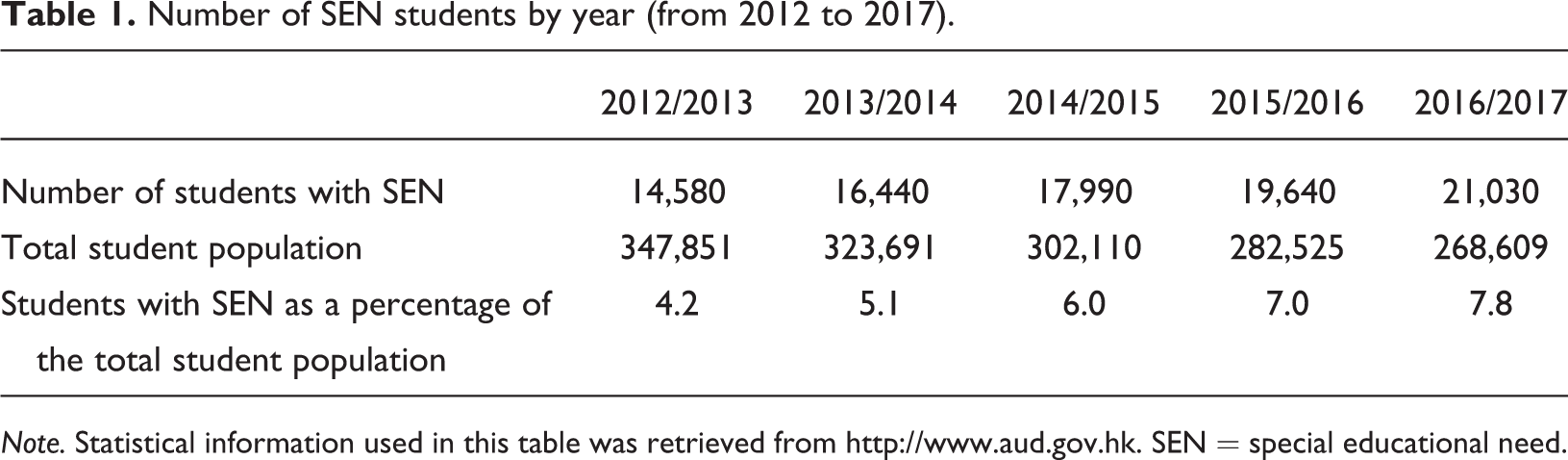
Note. Statistical information used in this table was retrieved from http://www.aud.gov.hk. SEN = special educational need.
SEN types in Hong Kong from 2019/2010 to 2018/2019.
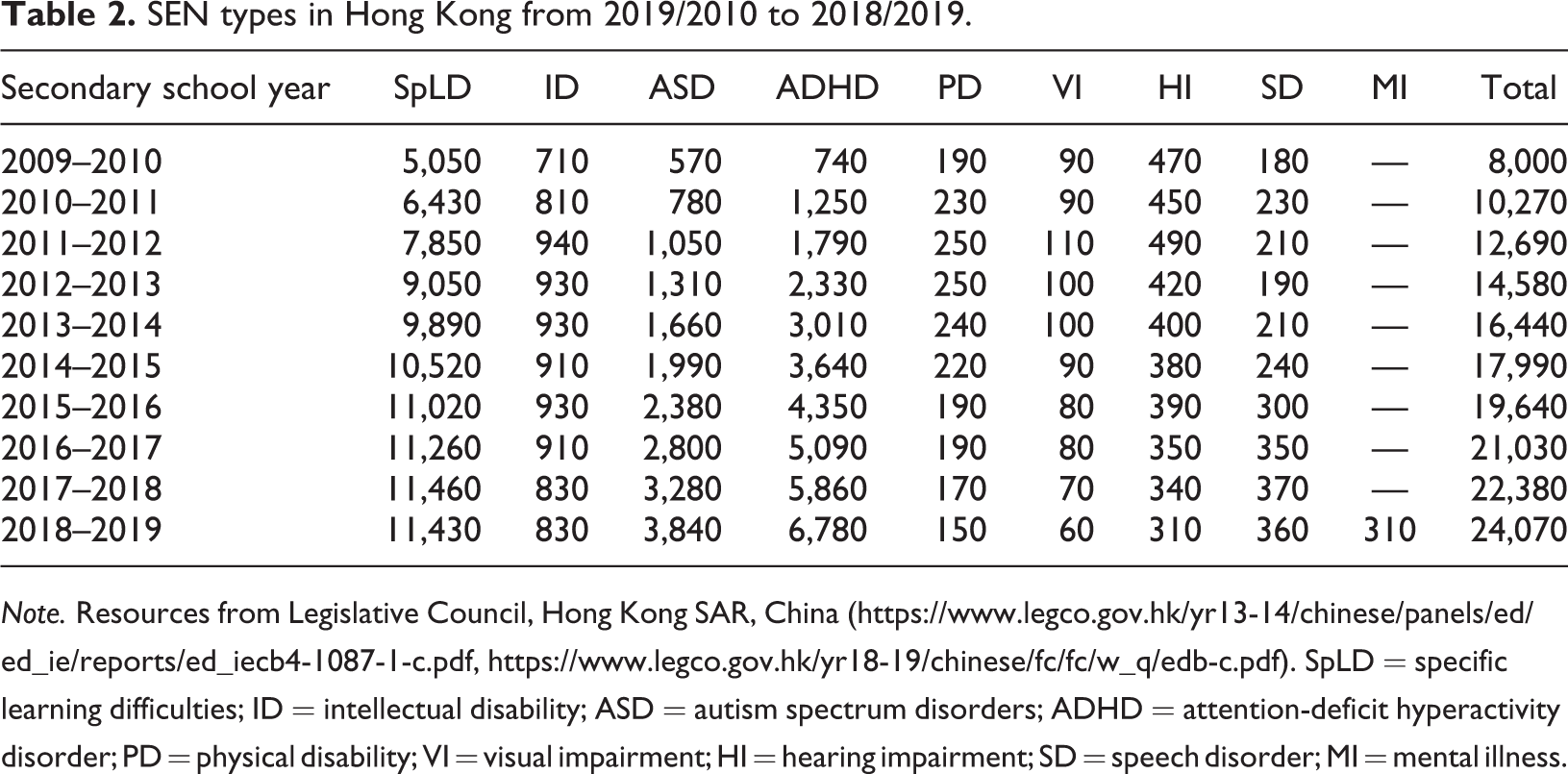
Note. Resources from Legislative Council, Hong Kong SAR, China (https://www.legco.gov.hk/yr13-14/chinese/panels/ed/ed_ie/reports/ed_iecb4-1087-1-c.pdf, https://www.legco.gov.hk/yr18-19/chinese/fc/fc/w_q/edb-c.pdf). SpLD = specific learning difficulties; ID = intellectual disability; ASD = autism spectrum disorders; ADHD = attention-deficit hyperactivity disorder; PD = physical disability; VI = visual impairment; HI = hearing impairment; SD = speech disorder; MI = mental illness.
The increasing number of students with SEN reflects an overall increase in diversity among secondary students in mainstream education in Hong Kong. Despite recent improvements in the career guidance practices provided by secondary schools, little has been done to test how the practices suit the needs of diverse groups of students (Yang et al., 2019; Yang et al., in press). Even research on the academic self-concept of SEN students remains sparse (Yang et al., 2014). As a result, it is not currently possible to systematically review empirical studies on academic self-concept in this population. Instead, this article focuses on self-concept research concerning students without SEN in Hong Kong.
At a fundamental level, students build their careers based on their school achievements and self-understanding of their abilities and interests in academic subjects. With good self-understanding, they are able to link their abilities and interests to the specific requirements of different occupations (Hagiwara et al., 2019; Super, 1994). The following sections elaborate on why academic self-concept matters and why career-related self-concept should not only be considered in self-concept theory but also in informing career guidance practices.
The role of academic self-concept in student achievement
Each student has a unique self-understanding of his/her abilities and interests in academic subjects as well as in social, emotional, physical, and other domains. Collectively, this self-understanding is conceptualized as the multidimensional construct of self-concept (Marsh, 1990b, 1990c; Shavelson et al., 1976). Numerous studies have identified a positive relationship between domain-specific academic self-concept and the corresponding domain of academic achievement (e.g., verbal self-concept and verbal achievement, see Marsh, 2007 for a review). Additionally, a growing body of research has also found a reciprocally causal relationship between self-concept in academic domains and academic achievement in corresponding domains by using longitudinal (as compared to cross-sectional) designs (for review, see Marsh & Craven, 2006; see also Arens et al., 2016; Marsh et al., 2018 for updated research).
Marsh and Yeung’s (1997) 3-year’s longitudinal study found a reciprocal causal relationship between high school students’ academic self-concept and academic achievement. This relationship appeared to be subject-specific (e.g., high mathematics self-concept led to high mathematics achievement, and vice versa). In another longitudinal study in Germany, Marsh and Köller (2004) found consistent evidence that supported the generalizability of the reciprocal effects in a large sample of secondary school students (n = 4,047) from both East and West Germany. Marsh, Hau et al. (2002) found significant effects of students’ prior academic self-concept on subsequent academic achievement in the corresponding domain using a large sample of Chinese students (n = 7,802) from over 50 high schools. This predictive pattern was also found in the single-domain context for the effect of prior academic achievement on subsequent academic self-concept. This cross-cultural evidence supports the generalizability of reciprocal causal relationships between academic self-concept and academic achievement. Extending to younger students, Guay et al.’s (2003) study used a multicohort, multi-occasion design to show the reciprocal causal relationship was identifiable in Canadian elementary students.
A number of recent studies have used new methods to demonstrate stronger empirical evidence to support the reciprocal causal relationships between academic self-concept and academic achievement (e.g., Arens et al., 2017; Marsh et al., 2018; Seaton et al., 2015; Seaton et al., 2014). The consistently identified, reciprocally reinforcing effects between academic self-concept and academic achievement have important implications in the development of self-concept enhancement interventions and skill-development programs to improve student learning outcomes (Marsh & Martin, 2011; Yang, 2012; Yang & Watkins, 2013).
Self-concept research in career development
While there have been numerous theoretical and empirical advances in self-concept research in academic development, researchers in the field of career guidance have done little work with the multidimensional features of self-concept (Marsh, 1990a, 1990b, 1990c; Shavelson et al., 1976). As a leading research in the field of career counselling, Super and his studies on this theme might be contemporaneous with the classic work on the construct of self-concept published by Shavelson et al. (1976). In 1963, Super and his associates had started to develop the self-concept theory in vocational development (Super et al., 1963). Super posited a construct called “vocational self-concept” in applying self-concept theory to this field. In a broad sense, vocational self-concept was defined as “the constellation of self attributes considered by the individual to be vocationally relevant, whether or not they have been translated into a vocational preference” (Super et al., 1963, p. 20). It is important to note the words “career” and “vocational” were used as synonyms (see his monographic chapter on self-concepts in vocational development, Super et al., 1963, pp. 1–16; see also Super, 1994). Despite Super’s contribution, given the definitional breadth and nondefinitional specificity in his conceptualization of vocational self-concept at the initial stage (e.g., Super et al., 1963), Betz (1994) commented initial attempts to develop instruments for assessing this construct appeared “unwieldy.”
In an attempt to refine their theoretical framework to integrate a developmental perspective of self-concept in career development, Super and his colleagues in their later publications (Super, 1990; Super et al., 1981) specified the multidimensionality of individuals’ self-perceptions of career development (instead of a broadly defined vocational self-concept). The multidimensional and developmental self-concept of career development in Super’s later work was implicitly regarded as a theoretical framework of self-concept research in career counseling. Correspondingly, Super and his colleague developed the Career Development Inventory (CDI with 120 items, see Super et al., 1981 for its manual). The CDI consists of multiple subscales to assess five dimensions of self-perceptions: CP, CE, career decision-making, world-of-work information (WW), and knowledge of preferred occupational group. Recently, scholars have developed short forms based on the CDI to assess these dimensions of self-concepts in career development (e.g., Cardoso et al., 2016; Hirschi et al., 2015; Negru-Subtirica & Pop, 2016). These shortened forms are more feasible in both cross-sectional and longitudinal studies. In addition, the multifaceted features of career-related self-concept that have been considered in the CDI serve as an important rationale for supporting the current extension of the multidimensional model of self-concept in education (Marsh, 1990a; 2007) to include the multifaceted career-related domain.
In summary, the multidimensional model of self-concept originally developed by Shavelson et al. (1976) has been widely tested in education by using SDQs developed according to Shavelson et al.’s (1976) model (see Marsh & Seaton, 2013 for an updated review). However, the model has not yet been integrated with the multifaceted career-related self-concept developed in career counseling (Savickas, 2013; Super, 1994; Super et al., 1996) to assess students’ self-understanding beyond academic domains. Enlightened by recent advances in theory, measurement, and practices of self-concept research in education and career counselling (Marsh, 2007; Marsh & Martin, 2011; Savickas, 2013; Super, 1994), a notable contribution of this review was its proposal and presentation of an extended model of self-concept (see Figure 1). In this extended model, general self-concept has academic, nonacademic, and career-related domains. In line with previous research, academic self-concept can be further divided into the self-concepts of school subject areas (e.g., English self-concept, mathematics self-concept, science self-concept, etc.). Nonacademic self-concept refers to the self-concepts of social, emotional, and physical domains. For social self-concept, students may form self-concepts of peer and teacher relationships. For emotional self-concept, students may form this domain based on their particular emotional states experienced in daily life. For physical self-concept, it mainly refers to students’ self-concepts of psychological appearance and abilities. The extended domain in this model is career-related self-concept, which is also multidimensional. Students may form their self-concepts of career-related abilities and interests based on career guidance practices provided by schools and their career development needs. The model was developed by integrating previous research (Marsh & Shavelson, 1985; Shavelson et al., 1976; Yang, 2017) with key findings of our comprehensive review of career guidance practices in Hong Kong to facilitate follow-up studies on multidimensional academic self-concept and multifaceted career-related self-concept. With these unique values that unify the two research lines, this extended self-concept model can help researchers and practitioners develop a new research agenda to assess diverse students’ career-related self-concepts, which can be cultivated by career guidance practices in secondary schools beyond the academic domains.
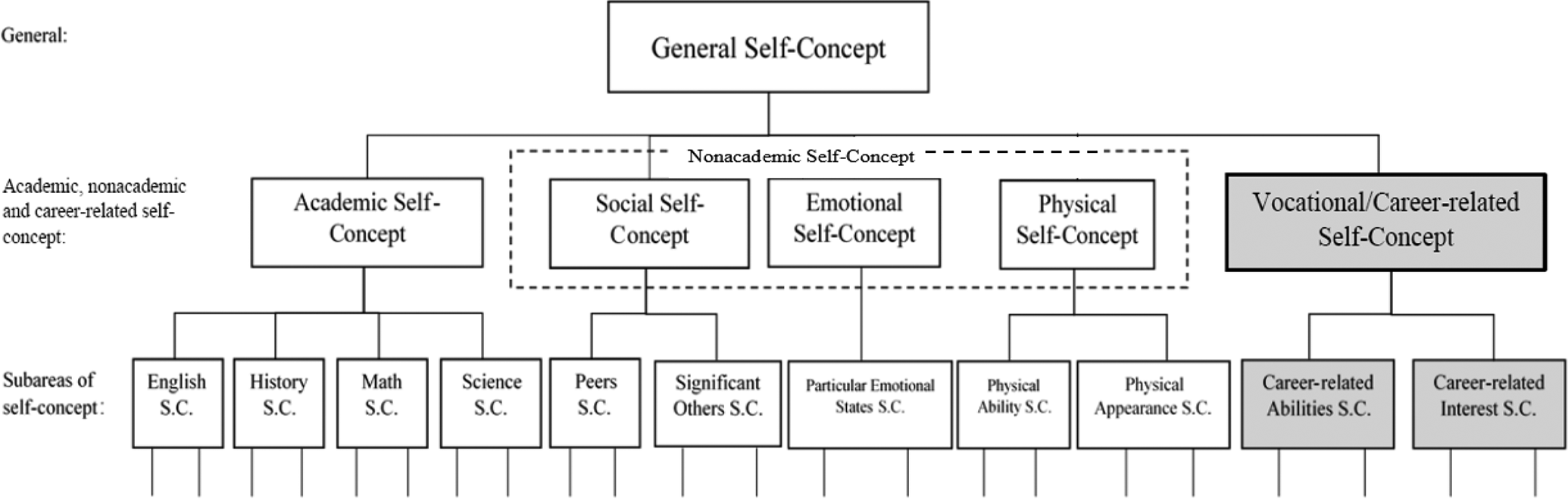
The extended self-concept model including the career-related domain.
Discussion
Due to some effects of the colonial rules of Britain on Hong Kong schooling, secondary school teachers are normally assigned two roles: One is the teaching of academic subjects (e.g., English, Mathematics) and the other is performing certain “non-teaching duties” by serving as members of different functional committees. Among these functional committees, a teacher may provide “career guidance” and “counseling” to support students in their CE and planning activities. Despite policymaking, professional training to teachers, and school-based implementations in these years, surprisingly, we found little has been done to understand the effectiveness of CGCPs in promoting students’ career-related self-concept. Academic self-concept has been widely tested and documented as an influential factor in student academic achievement; students build their careers on their academic achievement and career goals. More work needs to be done to test students’ career-related self-concept based on the hierarchical and multidimensional model of self-concept that links academic and career-related self-concepts in a holistic model. The newly extended model (Figure 1) by extending the self-concept theory can be used by researchers and practitioners to test the interplays between academic and career-related domains of self-concept that can potentially influence students’ in-school and post-school outcomes of building their careers in adaptive and sustainable ways. Sustainable ways here refer to the reciprocal reinforcing relationships among academic self-concept, career-related self-concept, and achievement (e.g., academic/career-related self-concept → academic/career-related achievement; academic/career-related achievement → positive academic/career-related self-concept).
There are several key themes to be explored by researchers and practitioners in the future. The first theme is to assess the internal structure of the extended self-concept model based on instruments with sound psychometric properties (Marsh, 1990a, 2007). In doing so, researchers and practitioners would develop a deeper understanding of the intracorrelations of these domains and intercorrelations between these domains and corresponding outcomes (e.g., academic self-concept and academic achievement, career-related self-concept, and career outcomes). The second theme is to test the reciprocal relationships between career-related self-concept and career outcomes by extending current reciprocal causal relationships research with a focus on academic self-concept and academic achievement. The third theme is to test antecedents that may influence the relationships among self-concept in academic and career-related domains and corresponding outcomes in academic and career-related domains.
Aside from cross-sectional studies to test the relationships among academic, career-related self-concept, and other variables, longitudinal studies are a promising means for testing the interplay and development trends of the two domains of self-concept. Additionally, comparative studies using academically disadvantaged groups of students (e.g., Bear et al., 2002; Preckel et al., 2017; Yang & Watkins, 2013; Yang et al., 2016) are also needed to improve our understanding of group invariance of the internal structure of the extended model (Figure 1). Future research aiming to test the correlation between in-school and post-school outcomes of students with diverse abilities should take full consideration of theoretical and empirical advances in (1) self-concept research in education (e.g., Marsh & Seaton, 2013; Marsh et al., 2020; Marsh et al., 2018; Susperreguy et al., 2018); (2) self-concept research in the field of career development (e.g., Patton & McMahon, 2014; Pisarik & Currie, 2015; Savickas, 2013; Super, 1980, 1994), (3) instruments firmly developed based on self-concept theories in the two fields and with sound psychometric properties (e.g., Marsh, 2007; Marsh, Ellis et al., 2002; Savickas & Hartung, 1996; Yang, 2018), and (4) integrative perspectives to link academic and career-related self-concepts in examining students’ in-school achievement and post-school transition outcomes (Sin & Yang, 2018; Yang, 2017). Based on the extended self-concept model and stronger longitudinal and/or experimental designs to include the domain of career-related self-concept, the research agenda of future studies will have breakthrough knowledge to enrich the extended multidimensional self-concept and provide new evidence on the reciprocally causal effects between career-related self-concept and career-related outcomes of students with diverse abilities. Comparatively speaking, a large body of research has focused on examining the reciprocal relationships between academic self-concepts and matching domains of academic achievement (e.g., math self-concept and math achievement, English self-concept and English achievement, see Arens et al., 2017; March & Martin, 2011; Marsh & Yeung, 1997; Preckel et al., 2017; Lee & Kung, 2018). Considerably little has been done to explore the links between academic self-concept and career-related self-concept formed by students based on their understanding of their academic abilities and interests. Given students’ individual differences, some may be more capable at the verbal domain than the mathematical domain and vice versa. However, how their academic self-concept contributes to their formation of career-related self-concept that helps them link in-school success to post-school transition plans (e.g., to continue further education or to find jobs) remains a notable research gap to fill. In school settings, career guidance practices have been taken to support students’ CP. Yet, without taking full consideration of the interplay between the two domains of self-concept (academic and career-related), the effectiveness of CGCPs cannot be adequately examined. The abovementioned research directions and future efforts will help not only evaluate the effectiveness of school-based CGCPs to inform policy and practice changes/improvements but also develop tailor-made self-concept enhancement programs that can be used to train teachers to promote diverse students’ self-concepts with pre-diagnosed problems. These enhancement programs may matter much more for the group of students with SEN. Other important research outcomes from future work based on our review and the extended model will definitely enrich theories and practices in two research fields (academic and career development). Interestingly, the strength of this review might be regarded as its limitation if international contexts are considered, given the focus of this review was mainly CGCPs in Hong Kong. Fortunately, the extended self-concept model was proposed based on international research work and with an international scope that can be applied at local, regional, and international levels among students with diverse abilities.
Footnotes
Declaration of conflicting interests
The author(s) declared no potential conflicts of interest with respect to the research, authorship, and/or publication of this article.
Funding
The author(s) disclosed receipt of the following financial support for the research, authorship, and/or publication of this article: This review paper was partially supported by Early Career Scheme funded by University Grant Council, Hong Kong SAR to Dr. Lan Yang, The Education University of Hong Kong (Project number: 28611618).