




Abstract
Purpose:
Catering for learner diversity is a key issue in the recent educational reforms in Hong Kong. The present study addresses this issue through an investigation of the relationships between students’ learning styles and approaches to learning in Hong Kong secondary schools.
Design/Approach/Methods:
A total of 6,054 junior secondary students in Hong Kong responded to a questionnaire consisting of two instruments. A series of confirmatory factor analysis, two-way analysis of variance, and structural equation modeling analysis were conducted.
Findings:
The results identified three types of learning style among the students which are characterized by a cognitive orientation, a social orientation, and a methodological orientation. Some significant gender- and achievement-level differences were revealed. Compared with the socially oriented learning style, the cognitively and methodologically oriented learning styles were more extensively and strongly related to students’ approaches to learning, even though these students showed a greater preference for the socially oriented learning style.
Originality/Value:
It is unwise to blindly cater for students’ learning styles in classroom teaching and curriculum design. Teachers should adopt a comprehensive and balanced approach toward the design of curriculum and teaching which not only highlights the congruence between students’ learning styles and teacher’s pedagogy but also integrates the constructive frictions between them into classroom teaching.
The emphasis on catering for learner diversity in Hong Kong
Learner diversity is a recurrent issue in education attracting the attention of both researchers and practitioners (Rosenfeld & Rosenfeld, 2008; Tatto, 1996; Tomlinson, 1999). The importance of catering for learner diversity is almost universally recognized (Ruys et al., 2013). To make classroom teaching effective, teachers have to abandon the illusion that there exists some “one-size-fits-all” approach to teaching. Instead, they need to be responsive to the individual differences among students in terms of ability, readiness, interests, and so on, and appropriately address these diversities by adjusting their teaching content, instructional strategies, and assessment schemes (Tomlinson, 1999; Wan, 2017).
During the past decade, catering for learner diversity is one of the key areas in the educational reforms in Hong Kong. In 2008, inclusive education and the whole-school approach were promoted in Hong Kong schools in order to integrate students with special educational needs into mainstream schools (Education Bureau, 2014). In 2009, the “3+3+4” new academic structure was introduced to Hong Kong, implying that all students have the opportunity to complete a 6-year secondary education (Curriculum Development Council, 2009). The implementation of these reforms dramatically increased the individual differences in classrooms and schools, especially the secondary schools in Hong Kong. Facing the challenge of greater learner diversity in classrooms, teachers are expected to embrace learner diversity when planning and delivering lessons. According to the newly published Secondary Education Curriculum Guide (Curriculum Development Council, 2017), Hong Kong teachers “should plan lessons flexibly to suit the needs of their students. They should make decisions about instruction based on the understanding of their students’ interests, progress, prior learning experiences and learning styles” (Chapter 5, p. 14). It is also recommended that teachers use a variety of strategies to accommodate learner diversity, such as collaborative learning, flexible grouping, and developing learning communities among students (Curriculum Development Council, 2009, 2017).
Learning styles and approaches to learning are frequently identified as the individual differences that have significant effects on the process and outcomes of student learning (Cassidy, 2004; Price, 2004; Rayner & Riding, 1997; Wang et al., 2006). To ensure the effectiveness of classroom teaching, it has been advocated that teachers and educators should match teaching with students’ learning styles (Anderson, 1995; Ford & Chen, 2001), because a teaching–learning match can better accommodate learner diversity, while a mismatch between teaching and learning styles often causes failure, frustration, and demotivation (Reid, 1987). However, a few studies have reported that the student–teacher style match is not always beneficial to student achievements (Peacock, 2001; Zhang, 2006). Therefore, whether the teaching–learning match works for facilitating student learning is still an unsolved problem.
According to Boström and Lassen (2006), students’ awareness of learning style influences their choices of relevant learning strategies, which further influence the outcomes of student learning. Therefore, this study attempts to address the issue of catering for learner diversity from the perspectives of students’ learning styles and approaches to learning in the context of Hong Kong secondary schools.
Literature
Learning style: Meaning and measurement
In the past two decades, learning style has attracted much research attention. Research on learning style is both extensive and, to some degree, diversified. Although dozens of different models and frameworks have been identified, there is no dominant theory in the field of learning style (Cassidy, 2004; Sadler-Smith, 1997). Some researchers’ suggestions partially reflect the complexity of this field. For example, in Curry’s (1987) four-layer onion model, the inner layer is “cognitive personality style” which is viewed as a fairly fixed personality trait; the second layer is “information processing style,” describing the individual’s intellectual approach to the processing of information; the third layer is “social interaction,” which relates to the individual’s preference for social interaction in learning; and the outermost layer is “instructional preference,” which is the least stable one, referring to the individual’s preferred choice of learning environment. Rayner and Riding (1997) also suggested three approaches to learning style research: personality-centered, cognition-centered, and learning-centered. The first approach emphasizes the fundamental role of personality in forming and sustaining the individual’s learning style; the second approach focuses on the identification of styles based on individual difference in cognitive and perceptual functioning; and the last approach mainly concerns the impact of style on learning and teaching. Since the purpose of the present study is to reveal the role of learning style in student learning, we follow the third approach and define learning style as consistent individual difference in learners’ preferred ways of organizing, processing, and retaining information through their interaction with the learning environment (Park, 1997; Towler & Dipboye, 2003). Compared with learning style, learning strategies usually describe the ways or means students adopt in learning (Cassidy, 2004). In addition, “learning styles might be more automatic than learning strategies which are optional” (Hartley, 1998, p. 149).
For the measurement of learning style, many instruments have been suggested by researchers (e.g., Cassidy, 2004; Rayner & Riding, 1997; Sadler-Smith, 1997). Among them, Kolb’s (1985) Learning Style Inventory (LSI) is one of the most prominent measures currently in use. In Kolb’s (1985) experiential learning theory, learning is considered as a four-stage process that can be described along two bipolar dimensions: thinking versus feeling and doing versus watching. Accordingly, LSI measures four learning styles: the accommodator who prefers a combination of active experimentation and concrete experience, the diverger who prefers a combination of concrete experience and reflective observation, the assimilator who prefers a combination of reflective observation and abstract conceptualization, and the converger who prefers a combination of abstract conceptualization and active experimentation. However, LSI has often been criticized for its problematic reliability and validity (e.g., Henson & Hwang, 2002; Loo, 1999). Towler and Dipboye (2003) pointed out three primary weaknesses of LSI. First, LSI is an instrument based only on theoretical contexts and ignores important facets of learning style difference that occur in actual situations. Second, LSI, similar to other measures, does not solve the problem of redundancy between learning style orientation and personality. Third, the forced-ranking scoring used by LSI is also problematic because it contains no information on the relative differences among individuals on the four scales and creates artifactual negative correlations among measured attributes (Henson & Hwang, 2002). To circumvent these problems, Towler and Dipboye (2003) suggested a new instrument, that is, the Learning Style Orientation Inventory (LSOI) which assesses five learning style orientations, namely discovery, group, experiential, structured, and observational, by directly asking individuals’ preferences in learning situations. Using undergraduate students as samples, their study shows that LSOI has good internal consistency reliability and construct, convergent, and discriminant validity. However, as the most recently developed instrument in the field of learning style research, LSOI has not been extensively used in empirical studies.
The role of learning style in classroom teaching
Learning style is suggested as an important aspect of individual difference which influences the effectiveness of classroom teaching. The congruence between teaching methods and students’ learning styles will help students learn more easily and more effectively (Sayer & Studd, 2006). In Dunn and DeBello’s (1999) study, when students were taught with learning-style responsive instructional approaches, their standardized achievement-attitude test scores improved significantly. Any attempts to integrate learning style into teaching or educational programs can be helpful for the process of learning and teaching, and even “simply being aware that there can be different ways to approach teaching and learning can make a difference” (Cassidy, 2004, p. 420; Yerxa, 2003).
The significant relationship between learning style and learner’s performance has been supported by many studies. For example, Furnham et al. (1999) found that some learning styles (e.g., reflector, pragmatist) were statistically significant predictors of rated work performance. Cassidy and Eachus (2000) found that academic achievement was positively correlated with a strategic learning approach and negatively associated with an apathetic approach. Busato et al. (2000) reported that the undirected learning style appeared to be a consistent negative predictor of students’ academic success. Even in web-based learning environments, learning style was found to be a significant factor affecting student achievement (Wang et al., 2006).
Previous studies have documented that gender and academic achievement levels tend to differentiate among individuals’ learning styles. For example, girls have been found to have higher levels of self-motivation, persistence, and responsibility than boys, while boys have stronger tactile and kinesthetic perceptual modalities than do girls (Honigsfeld & Dunn, 2003). Female students more often use memorizing and rehearsing strategies and are more likely to depend on the teacher and the school to organize their learning processes. Male students are more ambivalent as to why they are studying and show a greater preference than females for the abstract conceptualization mode of learning (Severiens & Dam, 1997). As for the achievement-level differences, Park (1997) found that high-achieving students tend to prefer a visual learning style, while middle- and low-achieving students show a greater preference for group learning than high achievers. In Burns et al.’s (1998) study, high achievers express more preference for “an informal design, accepted sound, low mobility and bright light in the learning environment, and perceive themselves to be more persistent than their classmates” (p. 279). Although these aforementioned studies investigate the learning styles of primary or secondary students, most of the research on learning styles has been small-scale studies targeting university or adult students rather than younger students (e.g., Busato et al., 2000; Cassidy & Eachus, 2000; Loo, 1999; Sayer & Studd, 2006; Towler & Dipboye, 2003; Wang et al., 2006).
Students’ approaches to learning and their relations to learning styles
Students’ approaches to learning describe the way students go about their learning in classroom or school settings. They provide a conceptual framework to capture the variations in the nature of students’ learning processes. Biggs (1989) interpreted students’ approaches to learning from the perspective of cognitive system theory. In his conceptualization, approach to learning consists of two dimensions, namely a congruent motive and a corresponding study strategy. The former explains why the student wants to approach a specific learning task, and the latter presents how the student approaches the learning task.
Biggs (1989, 1992) differentiated three approaches to learning, namely surface, deep, and achieving. The surface approach is characterized by students’ intention to invest minimal time and effort consistent with appearing to meet requirements (the motive dimension) through memorization and reproduction of the material being studied (the strategy dimension). The deep approach is based on interest in the subject matter of the task and is characterized by the student’s intention to seek meaning and understanding of the material being studied (the motive dimension) through elaborating and transforming the material (the strategy dimension). The achieving approach is based on the ego-enhancement that comes out of visibly achieving through high grades (the motive dimension), and students tend to use some learning skills such as organizing their time cost-effectively and planning ahead. Although Kember et al.’s (2004) validation work suggested that the surface and achieving should be combined, many researchers pointed out that East Asian learners, influenced by the examination culture and Confucian traditions, are prone to applying the achieving approach in their learning. For example, Biggs (1991) found that compared with Australian secondary school students, Hong Kong students have a higher score on both achieving motive and strategy. Kember (2000) revealed that there are higher levels of achieving motive among Asian college students (mainly Hong Kong students in his study), although it frequently has a collective rather than an individual nature.
Quite a number of studies have examined and supported the significant relationships between students’ approaches to learning and their academic performance, intellectual ability, thinking styles, learning environments, and so on, but most of these studies have targeted university students (e.g., Baeten et al., 2010; Choy et al., 2012; Kember, 2000). In school settings, the approaches to learning adopted by students are also suggested as powerful determinants of students’ success and failure in school (Yin et al., 2009). For instance, Cano (2005) found that Spanish students’ deep-approach scores declined significantly throughout secondary education and that their epistemological beliefs influenced their academic achievement directly and also indirectly via their learning approaches. A few studies explored the associations between students’ approaches to learning and both personal (e.g., level of self-esteem) and environmental (e.g., classroom or school environments) factors (Chan & Watkins, 1994; Watkins & Hattie, 1990). Nonetheless, in general, there is a noticeable shortage of research into secondary school students’ approaches to learning and their relations to learning styles, particularly in a non-Western context such as Hong Kong.
As Entwistle and Peterson (2004) pointed out, “learning styles are relatively consistent preferences for adopting learning processes, irrespective of the task or problem presented” (p. 537). Learning styles usually reflect individuals’ preferred mental learning models which are widely applicable to various learning processes for different learning tasks. According to Vermunt’s (1998) model of the regulation of constructive learning processes, both mental learning models and orientations may lead to individuals’ regulation strategies (i.e., motivation and metacognitive strategies) and information-processing strategies (i.e., learning strategies). Therefore, a few studies, mainly from the field of higher education, have examined the relationships between students’ learning styles and approaches to learning. For example, Fritz et al. (2004) found that college students’ surface apathetic approach positively correlated with their self-concept internal motivation, but negatively correlated with self-concept external motivation. Moreover, there was also a negative correlation between college students’ strategic approach and self-concept internal motivation. In a comparison study between excellent and average first-year university students, López et al. (2013) found that excellent students took a deeper approach than average students and that they preferred reflective and theoretical learning styles, while average students adopted a more surface approach and preferred active and pragmatic learning styles. They further pointed out that greater academic achievement was related to the reflective and theoretical learning styles and the deep approach to learning and that poorer academic achievement was related to an active learning style and the surface approach to learning. However, little is known about the relationships between secondary school students’ learning styles and their approaches to learning, thus highlighting the need for the present study.
The present study attempts to echo the call for more research examining the rapprochement between laboratory-based investigations of students’ learning styles and classroom-based research carried out from the perspective of students’ approaches to learning (Richardson, 2011). In short, this study aims to fill in the gaps in the literature by exploring the relationships between junior secondary students’ learning styles and approaches to learning in Hong Kong. Three specific questions will be addressed in this study: (a) What are the characteristics of the learning styles and approaches adopted by Hong Kong junior secondary students? (b) Is there any gender- or achievement-level differences in these learning styles and approaches? and (c) What are the relationships between various learning styles and students’ approaches to learning?
Method
Participants
This study used the method of convenience sampling to collect data. A total of 20 schools with different student enrollment backgrounds (i.e., high, medium, and low performance) were invited to participate in an online questionnaire survey. An invitation letter was first sent to the principals of these schools, stating the purposes and procedure of the online questionnaire survey. With the permission of the principal, the link and the instructions for completing the online questionnaire were sent to a school member in charge of the questionnaire survey. This online questionnaire survey lasted around 25 minutes. No monetary incentive was provided for the participants. Before collecting the data, all materials and procedures were checked and approved by the research ethics committee of the Chinese University of Hong Kong.
A total of 6,054 Hong Kong junior secondary students aged from 12 to 17 from 13 schools participated in the study. There were 2,006 Grade 7 students (33.1%), 2,154 Grade 8 students (35.6%), and 1,894 Grade 9 students (31.3%) in the sample. By gender, 3,550 students (58.7%) were male and 2,499 (41.3%) were female, with the gender of 5 students (0.1%) not recorded. In terms of academic achievement level, 1,271 students (21.0%) were high-performing students from Band 1 schools, 2,452 (40.5%) were students with middle performance level from Band 2 schools, and 2,331 (38.5%) were low-performing students from Band 3 schools.
Instruments
Two instruments were used in the study, namely the LSOI and the Learning Process Questionnaire (LPQ) because they are among the most frequently used scales for assessing students’ learning styles and approaches to learning in the literature (Asikainen & Gijbels, 2017; Cassidy, 2004). The Chinese versions of the two instruments were used in the data collection of this study. All items were scored on a 5-point Likert-type scale from 1 (not at all true of me) to 5 (very true of me).
Learning Style Orientation Inventory
The 54-item LSOI developed by Towler and Dipboye (2003) was used to measure students’ five types of learning style, namely discovery (14 items), group (7 items), experiential (13 items), structured (11 items), and observational (9 items). Because the original scale is in English, the translation and back translation procedure suggested by Brislin (1980) was followed to obtain the Chinese version of LSOI.
Learning Process Questionnaire
The 36-item Chinese version of LPQ suggested by Biggs (1992) was used to assess students’ three approaches to learning: surface approach, deep approach, and achieving approach. Each approach comprises a motive and a strategy factor. Each factor contains 6 items. This instrument has been used and validated in a few studies on secondary students’ motivation and learning strategies in Hong Kong (e.g., Fok & Watkins, 2007; Sachs et al., 2003). Hence, the Chinese version of LPQ was already available before data collection.
Data analysis
A missing value analysis was first conducted using SPSS 22 to examine patterns in the missing responses. The result showed that no variable had 5% or more missing values. Therefore, the expectation–maximization algorithm was used to calculate and replace the missing data.
Confirmatory factor analysis (CFA) was used to examine the construct validity of the measures using LISREL 8.70, and Cronbach’s α coefficients were used to examine the internal consistency of the subscales. Then, descriptive statistics (M, SD, and r) were calculated, and a series of t or F tests were conducted to compare the differences of means between the various groups. Because it can simultaneously analyze the complex relations among multiple latent variables and control for measurement error, structural equation modeling (SEM) using LISREL 8.70 was finally used to examine the relationships between students’ learning styles and approaches to learning.
A number of indices were used to indicate the robustness of fit in the CFA and SEM analyses. In addition to the χ2 statistic, the goodness-of-fit indices used in the study included the root mean square error of approximation (RMSEA), the comparative fit index (CFI), and the non-normed fit index (NNFI). According to the SEM literature, data fit is excellent when NNFI and CFI are greater than .95 and is acceptable when NNFI and CFI are no less than .90; for RMSEA, an excellent data fit requires it to be less than .06, and an acceptable fit requires it to be under .08 (Schreiber et al., 2006).
Results
Construct validity of LSOI and LPQ
Because the original LSOI targets university students rather than school students, CFA using LISREL8.70 was used to examine the construct validity of LSOI.
Results show that the factor loading of all 10 reverse-coded items in the original questionnaire is very low (i.e., lower than .20). This is consistent with the findings of previous studies that students in Hong Kong usually have difficulty answering reverse-coded items (e.g., Lee et al., 2010; Rao & Sachs, 1999; Yin et al., 2009). Apart from these 10 reverse-coded items, the factor loadings of the other 8 items are lower than .30, suggesting that they are not good indicators of the corresponding factor for junior secondary students. The reasons for the low factor loadings may be that these items tend to be difficult for junior secondary students to understand (e.g., “I enjoy studying subjects that deal with abstract ideas” and “I enjoy classes when the instructor deviates from the text”) or they are less applicable to the context of secondary education (e.g., “I prefer the instructor to provide handouts or use slides covering each part of the lecture” and “I enjoy jumping into a task when learning”). As a result, these 18 items with low factor loading were removed from LSOI.
After deleting the 18 items, the CFA results of the revised five-factor LSOI suggest a good fit to the data (χ2 = 12,796.30, df = 584, p = .00, RMSEA = .061, CFI = .96, NNFI = .96). However, it was found that the correlations among the three learning styles are extremely high. Specifically, the correlation between discovery and experiential styles was .86, that between discovery and observational styles was .76, and the correlation between experiential and observational styles was .90 (see italics in Table 1). These results indicate that the junior secondary students may have difficulty in distinguishing these three styles conceptually. Therefore, they have been combined into a new factor named the combination of discovery, experiential, and observational orientations (DEO) in the following analyses. The CFA analysis shows that this three-factor LSOI also had a good data fit (χ2 = 15,010.17, df = 591, p = .00, RMSEA = .066, CFI = .95, NNFI = .95).
Inter-subscale correlations and CFA results of the revised 36-item LSOI.
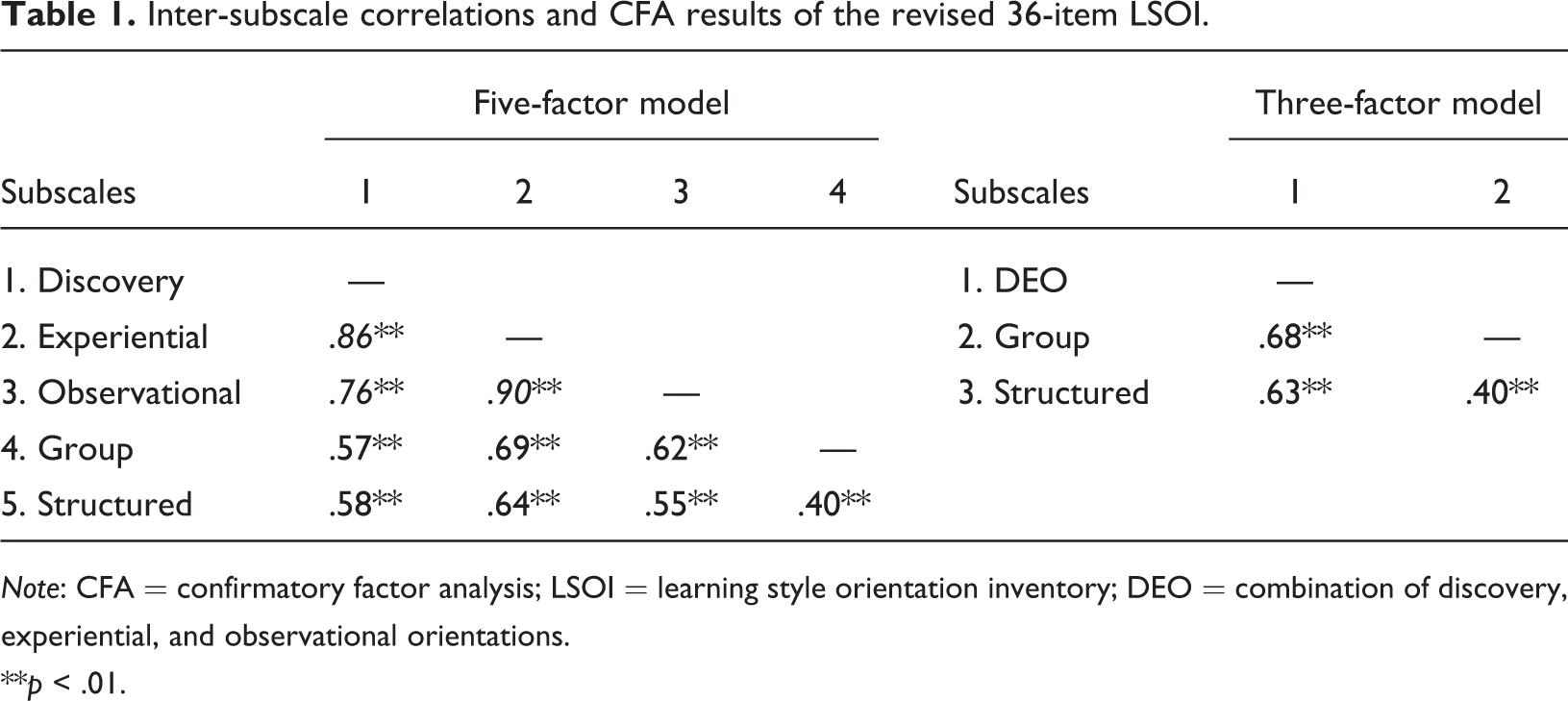
Note: CFA = confirmatory factor analysis; LSOI = learning style orientation inventory; DEO = combination of discovery, experiential, and observational orientations.
**p < .01.
Moreover, CFA results of the LPQ indicate a good fit to the data in general (χ2 = 18,390.38, df = 579, p = .00, RMSEA = .074, CFI = .95, NNFI = .94), and the factor loadings of all 36 items are no less than .40. Table 2 presents a summary of the finalized instruments used in the following analyses.
Summary of the instruments used in the present study.
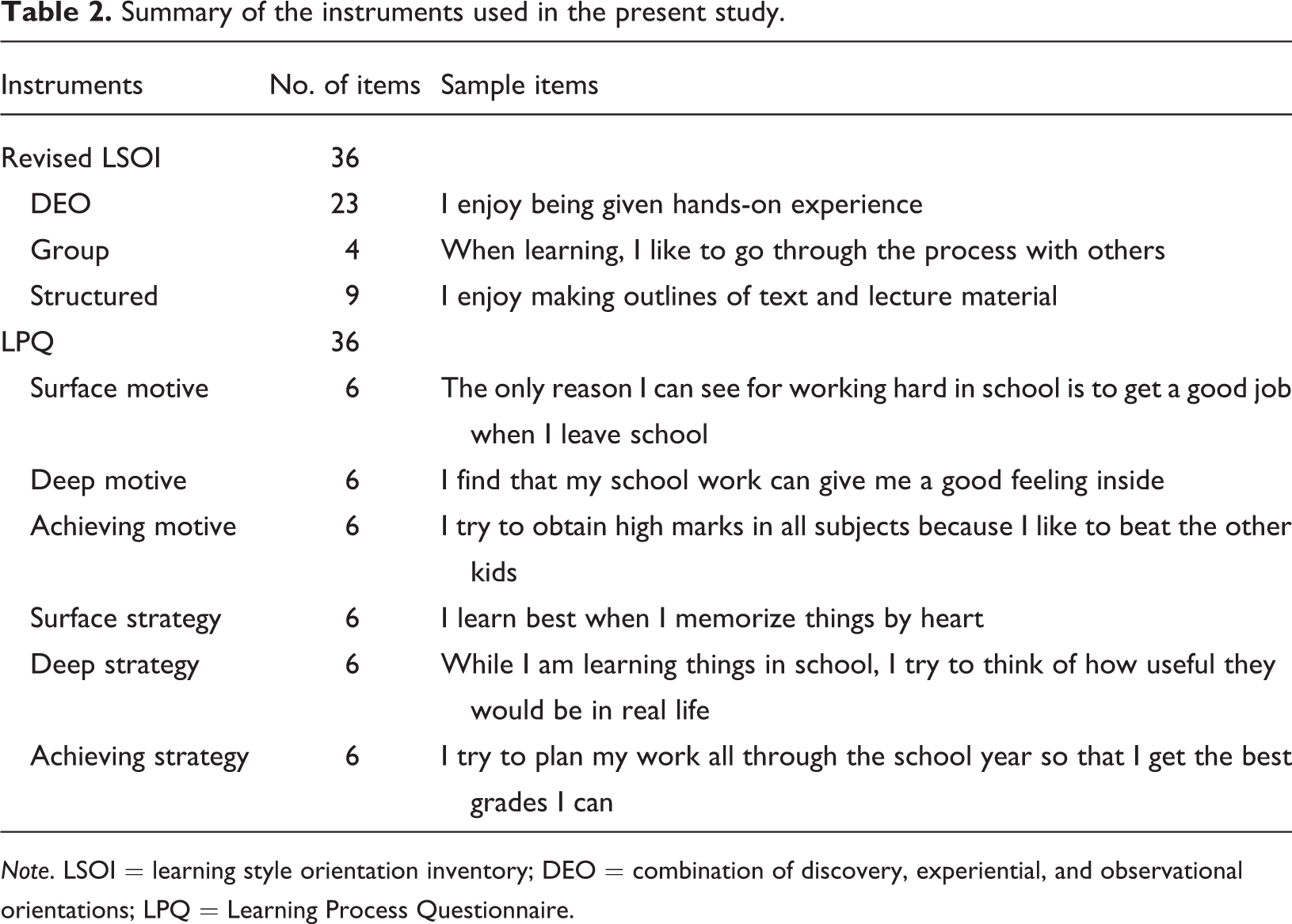
Note. LSOI = learning style orientation inventory; DEO = combination of discovery, experiential, and observational orientations; LPQ = Learning Process Questionnaire.
Descriptive statistics and reliability analysis
The descriptive statistics for the nine subscales are shown in Table 3. Among the three learning style orientations, group orientation is assessed most positively by students (M = 3.73, SD = .77), and structured orientation is the one with the lowest score (M = 3.13, SD = .66). Among the three types of motivation, achieving motive is scored the lowest (M = 3.08, SD = .82) while deep motive has the highest score (M = 3.43, SD = .71). As for the three types of learning strategies, deep strategy is the most popular (M = 3.30, SD = .73) while surface strategy receives the lowest score (M = 2.89, SD = .70).
Descriptive statistics, factor loadings, and reliability analysis for each subscale.
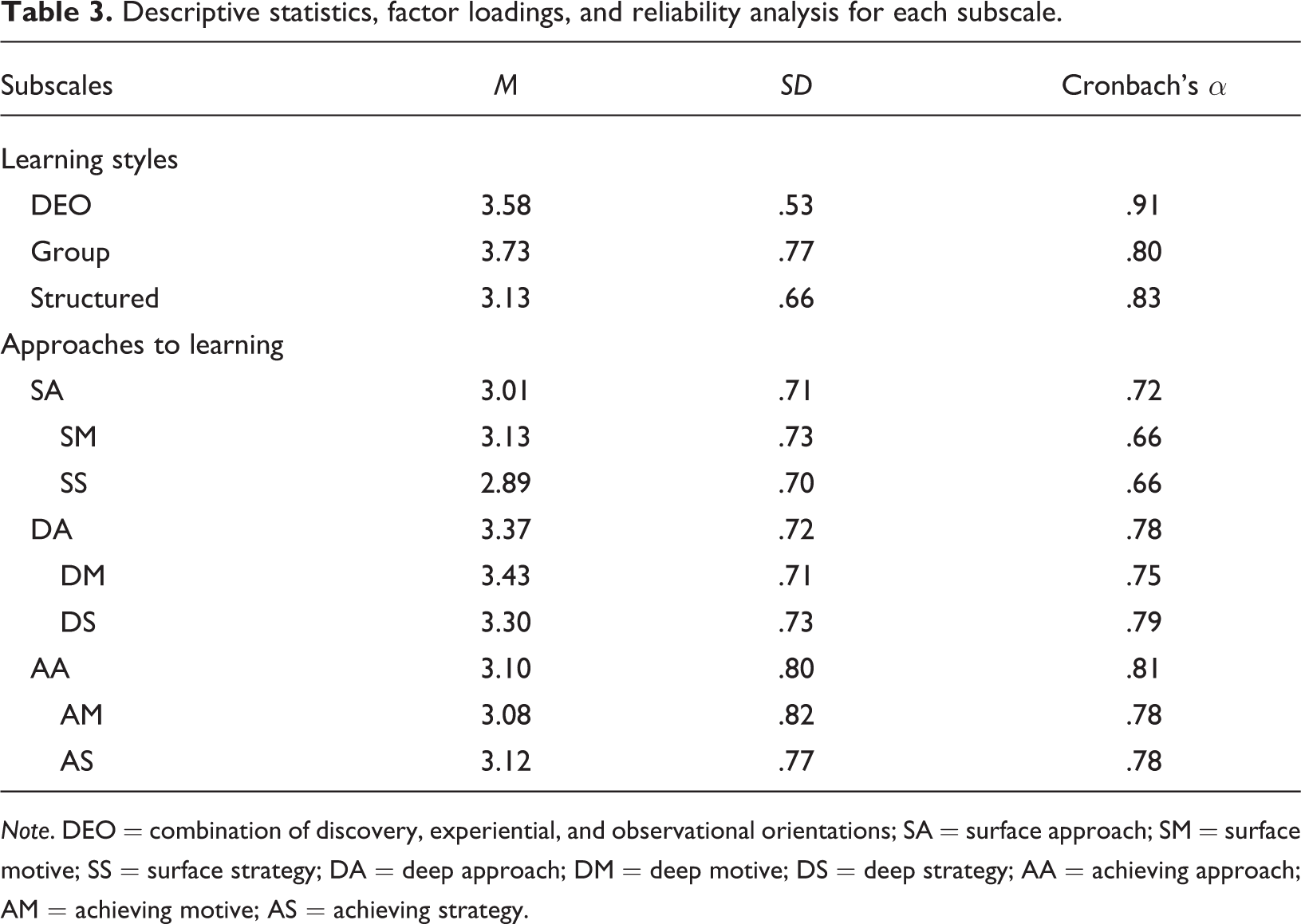
Note. DEO = combination of discovery, experiential, and observational orientations; SA = surface approach; SM = surface motive; SS = surface strategy; DA = deep approach; DM = deep motive; DS = deep strategy; AA = achieving approach; AM = achieving motive; AS = achieving strategy.
Table 3 also shows that the internal consistency reliability of each subscale is acceptable. Except for surface motive and strategy, the Cronbach’s α coefficients of all subscales are more than .70, indicating that the subscales had high internal consistency.
Gender and achievement-level differences
Table 4 presents the analyses of the gender and achievement-level differences on the nine subscales. The results of two-way analysis of variance indicate that a significant main effect was found on all factors, and there was also a significant interaction effect on two factors: surface strategy (F = 6.91, p < .01) and achievement strategy (F = 3.27, p < .05).
Gender and achievement-level differences.
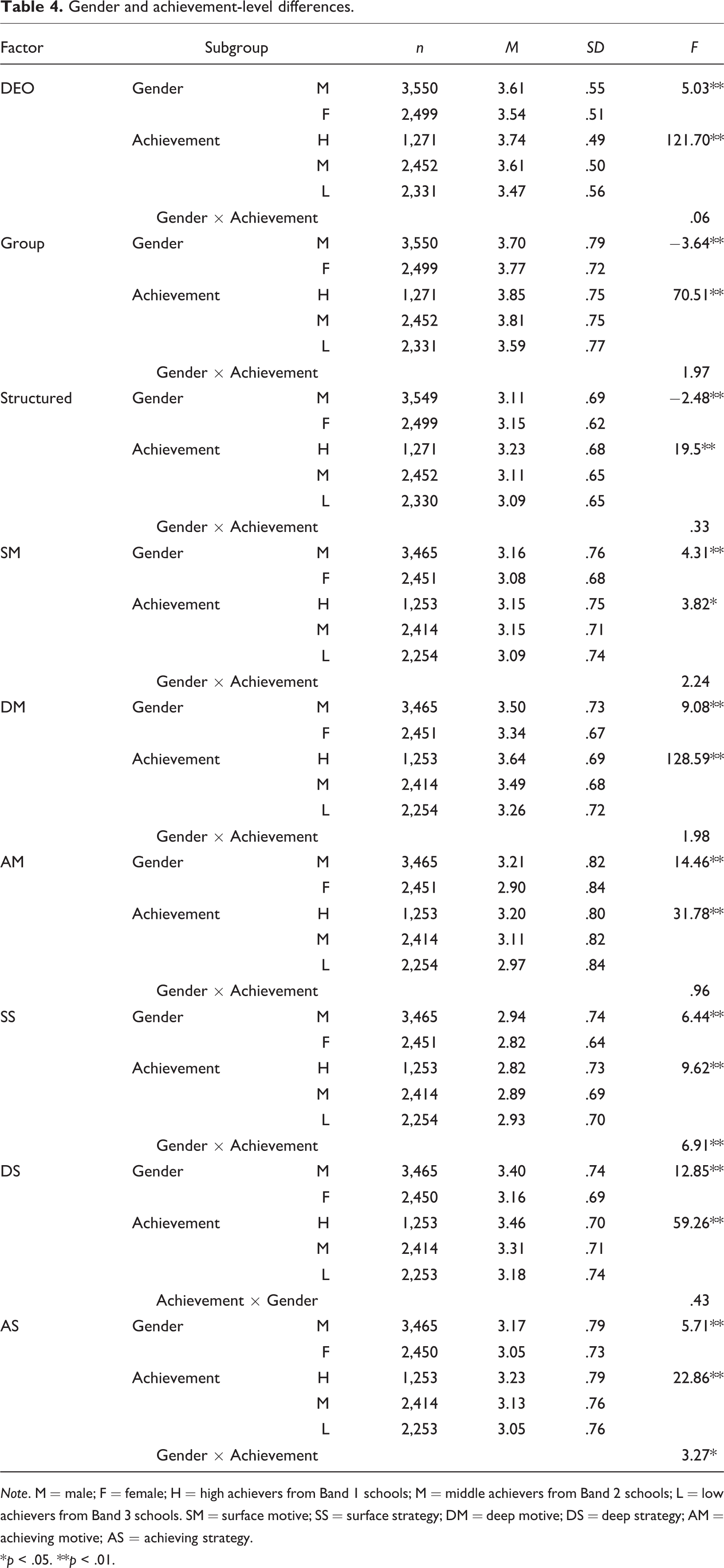
Note. M = male; F = female; H = high achievers from Band 1 schools; M = middle achievers from Band 2 schools; L = low achievers from Band 3 schools. SM = surface motive; SS = surface strategy; DM = deep motive; DS = deep strategy; AM = achieving motive; AS = achieving strategy.
*p < .05. **p < .01.
For gender differences, girls scored significantly higher than boys on two learning style orientations, namely group and structured. Boys were found to have higher scores on all other seven factors. As for the achievement-level differences, students’ scores on four subscales, namely DEO, deep motive, achieving motive, and deep strategy, were found to be the highest for high achievers (i.e., students in Band 1 schools), significantly declining through the middle achievers (i.e., students in Band 2 schools) to the low achievers (i.e., students in Band 3 schools). High- and middle-achieving students showed a greater preference for group style, and high achievers scored significantly higher than their counterparts in Band 2 and 3 schools on structured style. Moreover, middle achievers were more likely to display surface motivation than low achievers; however, no significant difference in surface motivation was found between high- and middle-achieving students.
Further, ad hoc examinations were conducted on the two factors with significant interaction effect, that is, surface strategy and achieving strategy. The results show that for girls, there was no significant difference among high-, middle- and low-achieving students on the two factors. However, boys in Band 1 schools were less likely to use surface strategies than their counterparts in Band 2 and 3 schools, but scored highest on the subscale of achieving strategy. This declined significantly for boys in Band 2 and more so in Band 3 schools.
SEM analysis
Due to the strength of analyzing the complex relationships among multiple latent variables simultaneously, SEM analysis using LISREL 8.70 was conducted to explore the associations between the learning style orientations and students’ approaches to learning. In the model, the three learning styles were used as the independent variables to predict various types of motivation and learning strategy (see Figure 1). The SEM results show that this model has an excellent data fit (χ2 = 41,080.35, df = 2,449, p = .00, RMSEA = .053, CFI = .96, NNFI = .96).
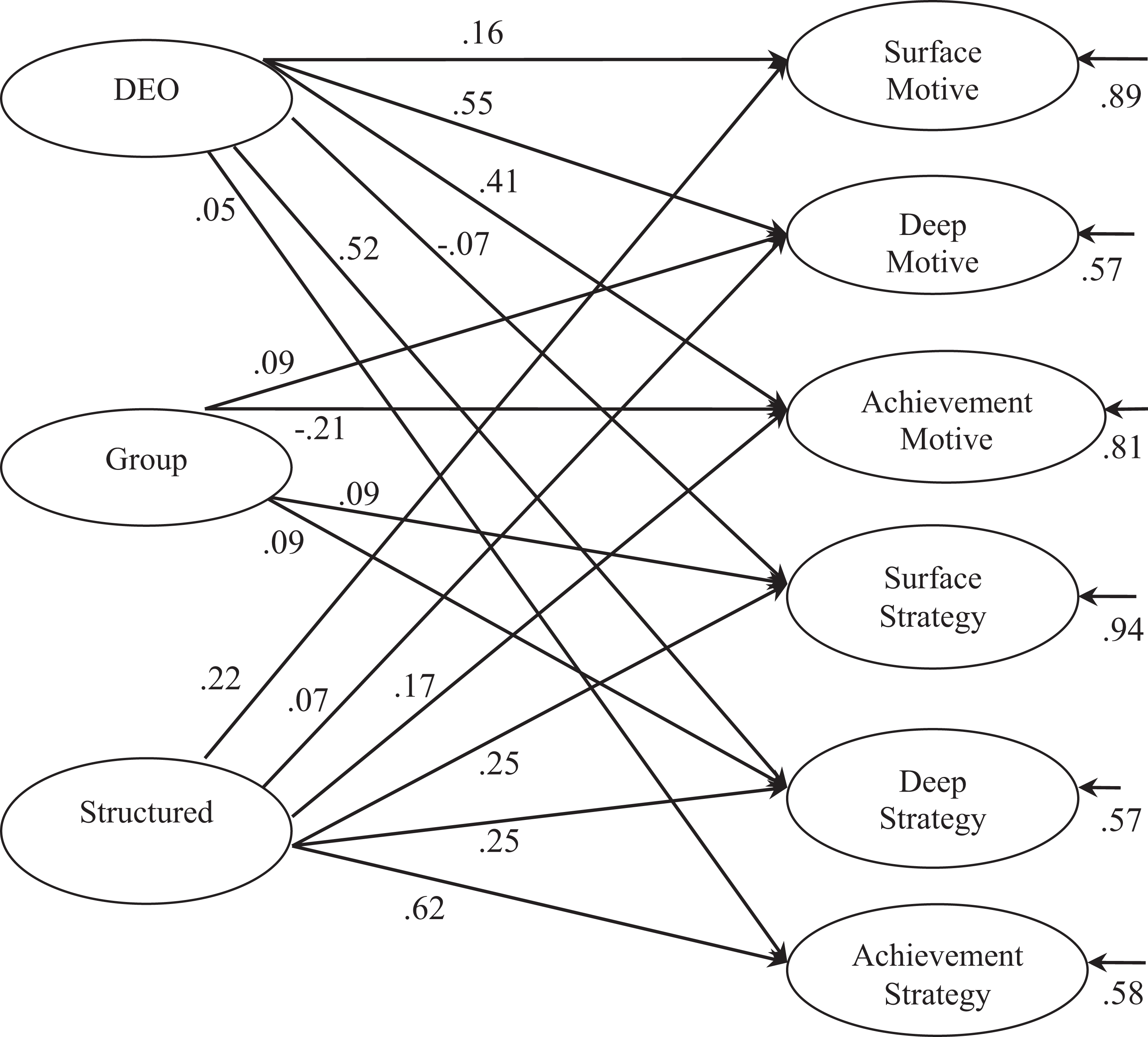
The effects of learning styles on students’ approaches to learning (showing significant paths only). Note. χ2 = 41,080.35, p = .00, df = 2,449, RMSEA = .053, NNFI = .96, CFI = .96. RMSEA = root mean square error of approximation; CFI = comparative fit index; NNFI = non-normed fit index.
In general, the SEM results indicate that: (1) The DEO style had significant effects on all factors of motivation and learning strategies. Among the six paths, moderate and positive relationships were found between DEO and deep motive, achieving motive and deep strategy, but the other three paths were weak, with regression coefficients of less than .30. Notably, DEO had a significant negative effect on students’ surface motive (β = −.07, p < .05). (2) The group style had no significant influence on surface motive or achieving strategy, and its effects on the other four factors, though significant, were generally weak. Meanwhile, it is notable that the group style had a significant negative effect on students’ achieving motive (β = −.21, p < .01). (3) The structured style had significant and positive effects on all six factors of motivation and learning strategies. Notably, the structured style moderately improved students’ use of achieving strategy (β = .62, p < .01), but its effects on the other motivation and learning strategies were weak in general.
Discussion
The combination of discovery, experiential, and observational orientations
The CFA results of the revised 36-item LSOI revealed that extremely high correlations exist between the learning style orientations of discovery and experiential, and between experiential and observational. The orientation of discovery was also found to be highly correlated with the observational style. Based on these findings, the three orientations were combined to form a new composite factor, DEO. After combining them, the CFA results showed that the three-factor model has a good fit to the data. The three learning style orientations in the finalized model are moderately correlated, suggesting an acceptable conceptual independence for each of them.
In addition to the support from the CFA results, two reasons may account for this combination. First, the target population for the original LSOI is university students or adults. Junior secondary school students are less developmentally mature and thus less capable than adults of differentiating the complicated constructs conceptually. Second, in comparison with the other two learning styles, that is, group and structured, these three orientations (i.e., discovery, experiential, and observational) all require more cognitive engagement from students, so they may be more difficult to distinguish conceptually. In fact, similar combinations happened to the validation of other instruments in previous studies. For example, when Pintrich and De Groot (1990) developed the Motivated Strategies for Learning Questionnaire (MSLQ) for junior secondary students, four factors related to cognitive learning strategies in the MSLQ for college students were combined to form one factor of “strategy use.” In Rao and Sachs’ (1999) adaptation of the Chinese version of MSLQ, they combined the two learning strategy components, namely strategy use and self-regulation, into one common factor of “strategy use.” These studies lend support to the combination in the present study. After the combination, distinctive characteristics can be identified in each of the three learning style orientations. Specifically, the group orientation is a socially oriented learning style. The structured orientation implies a methodologically oriented learning style because it mainly concerns the methods and procedures of learning. The DEO reflects a cognitively oriented learning style in that they collectively denote students’ preference for information processing during learning.
The characteristics of students’ learning styles and approaches to learning
The results of the present study indicated that junior secondary students in Hong Kong scored the highest on group orientation, slightly lower on the DEO, and the lowest on the structured orientation. These results suggest that they prefer group discussion and cooperation in learning most but pay less attention to learning methods such as scheduling, making plans, or taking notes. For approaches to learning, they scored higher on deep motive and deep learning strategy, indicating that they prefer a deep approach to learning most. In general, these students are internally motivated toward learning and are more likely to use the strategies facilitating their understanding in the learning process. The lowest score for surface approach indicated that they hold relatively unfavorable views on external motivation and the use of strategies for memorization in learning.
The comparison of gender and achievement-level differences revealed some interesting findings. Girls showed a greater preference for the group and structured style than boys, but boys scored significantly higher on the DEO style than girls, partly echoing Severiens and Dam’s (1997) suggestion that males favor the abstract conceptualization mode of learning more than females. Moreover, boys were found to have significantly higher scores on all six factors of motivation and learning strategies.
Looking at achievement-level differences, high-achieving students were consistently found to have the highest scores on all three learning styles, which is significantly different from the other two groups, and middle-level achievers have higher scores than low achievers on both DEO and group styles. Low achievers were found to be less favorably disposed to all three learning styles than the other groups. As for the six factors of motivation and learning strategies, significant differences on deep motive and deep strategies were also found among high-, middle-, and low-achieving students with a declining tendency. These results suggest that the higher the achievement level of the students is, the more likely they are to adopt a deep approach to learning. In addition, middle- and low-achieving boys, that is, those in Band 2 and Band 3 schools, are more likely to use surface strategies such as rote learning and memorization than their counterparts in Band 1 schools.
Match or mismatch? Implications for addressing learner diversity in classrooms
The relationships between various learning style orientations and approaches to learning are the focus of this study. The SEM results showed that in general, DEO and structured orientations influence students’ motivation and learning strategies more extensively and strongly than group orientation does. Specifically, the DEO orientation, which is the cognitively oriented learning style, can moderately improve students’ deep motivation, achieving motivation and deep learning strategy, and slightly reduce the incidence of using surface learning strategies. The structured orientation, the methodologically oriented learning style, can moderately facilitate students’ use of achieving strategy, with the highest regression coefficient among all significant paths. Moreover, the structured orientation significantly improves the other factors of motivation and learning strategies. In contrast, although students participating in this study scored the highest on group orientation, the socially oriented learning style, it only had some weak, though positive, effects on their deep motive, surface strategy and deep strategy, and significantly decreased their achieving motivation toward learning.
These results bring clear messages about how to cater for learner diversity in classrooms. As Boström and Lassen (2006) suggested, teaching based on individual learning styles is an effective way to facilitate students’ motivation. Awareness of students’ learning styles is helpful for teachers in respecting students’ learning preferences, and thus the instructional design and student performance in learning might be improved accordingly (Cassidy, 2004; Wang et al., 2006). The findings of the present study have some implications for the design and delivery of classroom teaching in Hong Kong. Research on learning style repeatedly emphasizes the importance of matching the teaching methods or curriculum design with students’ learning styles (e.g., Boström & Lassen, 2006; Ford & Chen, 2001; Sayer & Studd, 2006). Considering students’ positive score on DEO style and its desirable impact on approaches to learning, it is advisable for teachers to design more activities which encourage students to adopt cognitively engaged behaviors in learning and teaching, such as divergent thinking, authentic demonstration, hands-on experience, and relating theory to practical examples.
Adjusting teachers’ pedagogies to match students’ learning styles fosters the effectiveness of classroom teaching. However, effective teaching requires teachers to go beyond matching. As Corno (2008) pointed out, “adaptive teachers aim to keep the most number of students within that center to capitalize on skills across the class, challenge students to share experiences, and develop aptitude” (p. 161). The results of the present study also remind us to constantly consider the significance of intentional mismatching in classroom teaching (Peacock, 2001; Randi & Corno, 2005). Concrete evidence shows that although group orientation is the subscale with the highest score, it only has marginal or even negative effects on students’ approaches to learning. However, the structured orientation, the style with the lowest score among the three orientations, has some substantial effects on students’ approaches to learning. These results indicate that it is unwise to blindly cater for students’ learning styles in classroom teaching and curriculum design. Although group discussion or teamwork may make learning easier or happier for Hong Kong junior secondary students, teachers are encouraged to give more guidance about various learning methods to their students, instead of exclusively depending on collaborative learning and group activities in teaching.
As suggested by some researchers, intentional mismatching is helpful for students to recognize the weakness in their learning approaches and to identify long-term development activities which will assist them in becoming more effective learners (Peacock, 2001; Randi & Corno, 2005). Furthermore, it can produce the constructive frictions between teaching and learning which provide opportunities for students to increase their learning and thinking skills (Vermunt & Verloop, 1999). The rationale behind intentional mismatching is that “negotiating the demands of schooling is a life skill that students ought to acquire; by adapting their learning to whatever conditions of instruction they receive, students ultimately become skillful and productive learners, capable of independence” (Randi & Corno, 2005, p. 48). In brief, rather than suggesting that teachers seek the single “right” way to study or the “best” way to teach, we maintain that teachers and curriculum designers should adopt a comprehensive and balanced approach toward the design of curricula and teaching. This approach not only highlights the congruence between students’ learning styles and teachers’ pedagogy but also integrates the constructive frictions between them into classroom teaching.
Limitations and directions for future work
As an exploratory study on students’ learning styles in Hong Kong secondary schools, this study has three limitations in terms of its design and data analysis, providing some cues for future research. First, although the sample size was big and different student enrollment backgrounds were considered, the use of the convenience sampling method cannot ensure the representativeness of the sample, which limits the generalizability of the findings. Researchers should adopt more rigorous sampling methods, such as stratified random sampling, in future work.
Second, due to the nature of cross-sectional data, it is impossible to claim the existence of causal relationships between students’ learning styles and their approaches to learning. Future studies should use a longitudinal research design, which is helpful in clarifying the directionality of the regression paths.
Third, all data analyses were conducted at the individual level. However, considering the nested nature of data in school settings, it is suggested that future studies address the possible variances of students’ learning styles and approaches from the classroom or school level.
Despite these limitations, this study calls for more research on students’ learning styles and approaches for a better understanding of learner diversity. In this respect, there are many research issues for researchers to study in future work. For example, there has been little exploration into primary school students’ learning styles. What are the characteristics of their learning styles? Are there any differences between primary and secondary school students’ learning styles? This study only examines the effects of learning styles on students’ approaches to learning. To understand the role of learning style in school settings more thoroughly, future research should address the relationships between students’ learning styles and other attributes, such as their self-efficacy, academic emotions, and learning achievements.
Conclusion
The present study addresses the issue of catering for learner diversity through the lens of learning styles and approaches to learning. By investigating junior secondary students’ learning styles and approaches to learning in Hong Kong, we categorized three types of learning style reported by the students. These three learning styles were characterized by a cognitive orientation, a social orientation, and a methodological orientation. Moreover, this study revealed some significant relationships between students’ learning styles and their approaches to learning. Compared with the group-oriented learning style for which these students showed more preference, the cognition- and methodology-oriented learning styles were more extensively and strongly related to students’ approaches to learning. The results imply that it is unwise to blindly make teachers’ pedagogy and curriculum design consistent with students’ learning styles. A comprehensive and balanced approach to the design of curricula and teaching is more advisable for teachers.
Footnotes
Declaration of conflicting interests
The author(s) declared no potential conflicts of interest with respect to the research, authorship, and/or publication of this article.
Funding
The author(s) received no financial support for the research, authorship, and/or publication of this article.