




Abstract
Purpose
This conceptual paper aims to interrogate the current epistemological and cross-cultural approaches used to conceptualize climate change (CC) education, to critically point out ineffective approaches and false assumptions, and to propose practical suggestions that may support the development of a defensible and well-argued CC curriculum.
Design/Approach/Methods
Building on the author's earlier work in developing a systematic literature review and using a range of literary sources, the study examines CC epistemologically as a body of knowledge using various lenses. It further interrogates the suitability of Education for Sustainable Development (ESD) to act as a framework for CC education.
Findings
The findings suggest that CC as a body of knowledge, lacks a shared conceptualization and shared terminology. An in-depth interrogation of the ESD framework reveals that it is a problem-based agenda, unfit as a framework for hosting CC curriculum. A range of hindrances were found to be associated with this agenda, including its transient, ephemeral nature, tensions between ESD and the content-based curriculum and between ESD and CC science basis. Additionally, ESD's overall poor theorizing is noted.
Originality/Value
The study makes a set of recommendations, which includes dissociating CC education from ESD, considering implementation of CC as a curricular topic in its own right, and using commonly agreed CC terminology.
Introduction
Education policymakers today are facing the unprecedented challenge of having the responsibility to teach students about the imminent and unavoidable climate change (CC) catastrophe, while at the same time bearing the responsibility for students’ wellbeing and flourishing. To the best of knowledge, never in education history has such a challenge been put at the feet of curriculum developers. The philosopher Bruno Latour, when addressing the immense challenges involved in transitioning humanity into living in CC, “a land so different from nature” (Latour, 2021, p. 18), posited: “Adapting? Adjusting? Coping? All sorts of words that mean how to live in the ruins” (p. 20). In his further contemplations about this old, yet new hostile land that we are now entering, Latour ponders: “Look at what is necessary for landing one robot on a Mars mission: imagine what it will require to land eight billion people on Earth!” (p. 20). Inspired by Latour's provocation, this article is motivated by the need to examine what it would take for education policymakers to develop CC curricula that may support students to live and thrive in an era of CC—an era of uncertainties, frequent disasters, and social–cultural–economic–environmental instabilities, where tipping points are crossed—leading to the unknown.
The process of developing a CC curriculum invites us to consider not only the nature of CC knowledge but also its application in culturally appropriate ways, where Indigenous ways of knowing the climate are appropriately represented. It raises moral questions regarding the ways we present CC to students in various cultural settings and what it is that we are asking them to learn and perform. The coming together of curriculum, the CC body of knowledge, and the local cultural context into one framework requires complex integration of diverse evidence-based theories and cultural practices, all working together to create an effective CC curriculum, reflecting qualities of scholarship, debate, and research. In supporting these efforts, the present conceptual paper aims to interrogate current epistemological approaches for conceptualizing CC education, to critically point out ineffective approaches and false assumptions and to make practical suggestions that may be helpful in supporting the development of defensible and well-argued CC curriculum. The critical analysis presented in this paper builds upon an earlier project of conducting a systematic literature review, commissioned by the Israel Ministry of Education for the purpose of developing a CC curriculum (Eilam, 2023). The findings of the project form the literary foundations for the present conceptual paper.
This paper is organized in five parts. The first part begins by discussing the epistemological question: What is CC as a body of knowledge? This interrogation is required for explaining the role of the vague and undefined conceptualization of CC education in forming a hindrance to curriculum development. This question is examined through various lenses. Further examination addresses CC education conceptualization within the framework of Education for Sustainable Development (ESD). This interrogation is required due to the central leading role that ESD takes in relation to CC education, particularly under the leadership of UNESCO (United Nations Educational Scientific and Cultural Organization [UNESCO], 2021a, 2021b). This interrogation includes a chronological description of the ESD agenda and its conceptual development, and a critique of the suitability of the ESD agenda to act as a host for CC curriculum. The discussion continues to focus on tensions related to the practical implementation of CC education. These are tensions between ESD and: (i) the content-based curriculum, and (ii) the scientific consensus concerning CC. This is followed by presenting an additional epistemological hindrance to CC curriculum development. Finally, taken together, the inherent epistemological vagueness of CC education, and the additional hindrances posed by framing CC education within ESD, lead to concluding this conceptual paper by proposing a set of recommendations for CC curriculum development, drawn from the analysis.
CC epistemology: What is CC as a body of knowledge?
Climate change—What is it? Is it a discipline? Is it a field of knowledge within a discipline? Perhaps it is a concept, an idea, a theme, a capacity, an event, a crisis, a process, or an aspiration. This fundamental epistemological question seems critically under-researched. Furthermore, it is yet unclear how CC is understood through various cultural lenses, and the ways by which changes in the natural environment are conceptualized through local communities’ lived experiences. Rousell and Cutter-Mackenzie-Knowles (2020) note a landscape saturated with CC-related issues, delivered through the various media outlets. A review of the literature reveals multiplicity of terms expressing multiplicity of conceptualizations, mostly used uncritically and seamlessly, presenting a “nascent and under-theorized area of inquiry” (Rousell & Cutter-Mackenzie-Knowles, 2020, p. 192). Nevertheless, answering the epistemological question of: What is CC knowledge? is highly important in guiding curriculum development. If we don’t understand the nature of the knowledge, scope, sources, and structure of the knowledge that we are teaching, how would we know the appropriate ways for including it in the curriculum, determining learning outcomes and assessment measures? In what follows, the answers given to this question are critically discussed.
Characterizing CC knowledge as multidisciplinary
Most publications addressing CC education seem to agree on one thing, which is that CC is multi-, inter-, cross-, trans-disciplinary (hereafter referred to from here after as multidisciplinary) (e.g., Azeiteiro et al., 2018; Bieler et al., 2017; Busch et al., 2019; Mulvik et al., 2022; UNESCO, 2021a, 2021b). While the epistemological descriptor multidisciplinary conveys the idea that the knowledge is derived from multiple sources, it is not helpful in addressing the epistemological question of what this knowledge is. Furthermore, this epistemological descriptor forms a hindrance to effective CC curriculum development in two ways. First, by giving a false impression that we have characterized the body of knowledge, where in effect, we have not. Secondly, by providing a conceptual springboard for the misinformed conclusion, assuming that if CC is multidisciplinary, then it follows that CC needs to be taught in multiple subjects.
Concerning the first hindrance, characterizing knowledge of any sort, be it a concept, an idea or a discipline as multidisciplinary is epistemologically lacking. This is because most knowledge created by humans may be characterized as multidisciplinary, and the disciplines themselves are essentially multidisciplinary (Hammarfelt, 2019). Hammarfelt (2019) presents an extensive description of the transient and evolving nature of disciplines and their formations, beginning at the earlier Greek tradition, where areas of learning were grouped into productive, practical, and theoretical; later to be reshaped in ancient Rome as the seven liberal arts. Disciplines are further situated in socio-cultural local context reflecting temporal organization of information, where “disciplines refer to a specific organization of knowledge production which can be situated historically” (Hammarfelt, 2019, p. 10). Furthermore, “fields may over time evolve into new ‘disciplines’. This development is for example visible in the field of Gender studies” (Hammarfelt, 2019, p. 12). The same can be said for most disciplines. They are all multidisciplinary in essence. Biology evolved from Zoology and Botany (Goodson, 1987). Ecology evolved from Biology, Chemistry, Physics, and Earth Sciences (Odum, 1977). More recently, Engineering Education evolved in the 1990s from Engineering and Education (Sorby et al., 2014). Geography involved Sociology, Climatology, Urban Planning, Geology, and other sources of disciplinary knowledge. Psychology involves Science and Sociology (Hammarfelt, 2019), and so on.
This multidisciplinary nature of knowledge and its constituent concepts may be further exemplified in relation to the concept of photosynthesis. At its narrowest, it involves Physics (light energy), Chemistry (light energy transformed into chemical energy), and Biology (the transformation takes place in proteins). At its broader interpretation, photosynthesis is a critical aspect of Ecology with its contribution to biomass and bioproductivity. Photosynthesis is also involved in biogeochemical cycles, impacting the climate; it impacts atmospheric patterns as expressed in the seasonal variations of carbon dioxide in the Keeling Curve (Keeling et al., 1976). Greenery forms an essential aspect of urban landscaping, architectural biodesign, and more.
Consequently, referring to multidisciplinarity as the sole descriptor of a body of knowledge is not helpful for advancing curriculum development. Furthermore, characterizing CC as multidisciplinary is insufficient because it still leaves us with the question of: What are the disciplines that make up the multi-disciplinary knowledge? Obviously, if there are no disciplines, there is no multidisciplinarity. In Gardner's words: “If no single discipline is being applied, then clearly interdisciplinary thinking cannot be at work” (Gardner, 2007, p. 55).
The second hindrance is of particular concern. Here, it is assumed that if CC is multidisciplinary, it follows that CC ought to be taught in multiple subjects. This misleading conclusion seems to typify the approaches to CC education inclusion in the curriculum (UNESCO, 2021a). Unlike many other multidisciplinary curricular subjects such as History, Civics, Geography, and Science, CC education stands out in having the unfortunate fate of being fragmented and dispersed across the curriculum in what is known as the cross-curriculum approach. Multi-curriculum surveys attest to the dominance of this approach. For example, a UNESCO (2021a) publication titled “Getting Every School Climate-Ready: How Countries Are Integrating Climate Change Issues in Education” states in Recommendation 3 that “climate change education should be integrated across all levels and disciplines of learning” (UNESCO, 2021a, p. 12). In line with this view, in 2020, the State of New Jersey, USA, pioneered the adoption of a CC curriculum, clearly proclaiming its cross-curriculum approach to CC inclusion, stating that “with the adoption of the 2020 New Jersey Student Learning Standards (NJSLS), New Jersey became the first state in the nation to include climate change across content areas” (New Jersey Department of Education, 2020). Finally, in a cross-country comparison of five countries’ curricula, Dawson et al. (2022) have also highlighted the dominance of the cross-curriculum approach for CC curricular inclusion.
The fragmentation and dispersal of CC education across the curriculum poses a range of hindrances for effective teaching and learning, including challenges to curriculum design and implementation, resources development, teaching and teacher knowledge, and learning (Eilam, 2022). For a curriculum to be effective in achieving its educational goals, the structure of the curriculum must be intimately connected to the structure of knowledge and its acquisition. Knowledge acquisition “involves a change in long-term memory along with mechanisms for retrieving ideas from long-term memory. If nothing has altered in long-term memory, nothing has been learned” (Commission on School Reform, 2020, p. 10). For knowledge to be processed effectively it needs to be systematically structured and organized (Sweller et al., 2019). In other words, there is “overwhelming research on learning showing the importance of organizational structures for helping students progress to become experts” (California State Board of Education Policy on the Teaching of Natural Sciences, 2018). According to Hammarfelt's (2019) typology of knowledge organization, organizational structures may constitute a discipline, a field, a domain, or a topic. The dispersal of CC content across the curriculum violates this very basic principle of knowledge acquisition.
Thus far no form of knowledge organization has been found to be more effective than disciplines in offering structured and organized knowledge (Blake, 2014; Young, 2014). In a publication by Policy Exchange, a leading UK think tank, Blake (2014) claims that “a coherent curriculum programme is rooted in the knowledge and discipline of the relevant academic subjects, where explicit reference is made to the research evidence in these areas” (p. 5). Here, too, it can be seen that the cross-curriculum approach violates this basic curricular principle.
Further hindrances relate to the status of CC education within the curriculum. The issue of curriculum hierarchy has received much research attention since the 1980s (e.g., Connell, 1985; Goodson, 1992), with critical theorists emphasizing aspects related to power structures and prejudice (e.g., Apple, 1993). Bleazby (2015) emphasized the level of knowledge-certainty as a determinant factor of curricular status, where five characteristics were identified as typical of high-status subjects, including: (i) “strong disciplinary boundaries and internal cohesiveness”; (ii) “established subject matter,” which is less contentious; (iii) “high degree of abstractness,” “reliance on theory or symbols”; (iv) “emphasis of cognition”; and (v) “emphasis on written text and literacy” (Bleazby, 2015, p. 674). In the present context, curricular hierarchy literature is drawn upon to point out that national curricula often allocate high-status to foundational subjects, particularly those considered core subjects, and low status is relegated to the “cross curricular themes,” which are “unbounded and non-classified” (Ross, 2000, p. 111). Thus, the lack of CC subject-boundaries is often a clear indication of low status in the disciplinary hierarchy. This can be exemplified in the Australian curriculum, in which sustainability appears as a cross-curriculum priority, next to Aboriginal and Torres Strait Islander Histories and Cultures, and Asia and Australia's Engagement with Asia (Australian Curriculum Assessment and Reporting Authority [ACARA], n.d.). The low status delegated to this cross-curricular priorities can be demonstrated by the lack of achievement benchmarks and standardized tests for assessing outcomes (Bleazby, 2015). Common to all three is their strong underlying cross-cultural epistemic practices.
From an implementation perspective, the evidence suggests that while the cross-curriculum approach is highly advocated (e.g., European Commission, 2022b; Mulvik et al., 2022; UNESCO, 2021a, 2021b), contrary to the prominent expectation, the approach is not successful in contributing “to raising youth concern for climate change across contexts” (Kessler, 2021, p. 3). Very few countries implement this approach in their curricula, and when they do, it scarcely filters down into actual implementation (European Commission, 2022b; UNESCO, 2021a). For example, Rousell and Cutter-Mackenzie-Knowles (2020) found in a systematic literature review that CC was primarily associated with STEM education. These findings were confirmed empirically in a comparative analysis of the middle-years curricula of six jurisdictions (Dawson et al., 2022). When addressing the discrepancy between cross-curriculum advocacy and its poor implementation success, the literature commonly tends to lay the blame on the curricula, schools, and teachers for not trying hard enough (UNESCO, 2021a, 2021b). However, this lack of success is grounded in educational theories and may be inferred from theories of learning (Sandoval, 2016), teacher knowledge (Carlone & Johnson, 2007), and curriculum theory (Young, 2013).
Overall, it appears that the epistemological descriptor of CC as being multidisciplinary is not helpful in advancing the development of CC curriculum. Alternatively, the next section explores a suggestion to characterize the CC body of knowledge as a discipline in its own right.
Characterizing CC knowledge as a discipline
In previous work, I have made a case as to why CC should be conceptualized as a discipline (Eilam, 2022). As a discipline, it can be broadly described as dealing with interactions between multiple human and non-human systems that directly and indirectly involve changes in climatic patterns. These include, for example, the study of economic practices, social systems, cross-cultural knowledge, technological revolutions, and the multiple pathways and feedback loops by which these systems influence and are influenced by changes in climatic patterns. This broad description of the discipline aligns with the original CC definition by the United Nations Framework Convention on Climate Change (UNFCCC), proposed as early as 1992. Article 1 of the UNFCCC defines CC as: “‘Climate change’ means a change of climate which is attributed directly or indirectly to human activity that alters the composition of the global atmosphere and which is in addition to natural climate variability observed over comparable time periods” (United Nations Framework Convention on Climate Change [UNFCCC], 1992, p. 7).
Over the past 100 years, CC research has been evolving, producing increasingly sophisticated and robust evidence, methodologies, and conceptual understanding of the complex CC systems and feedback loops (Le Treut et al., 2007). CC evolved to present characteristics of a discipline, where “disciplines are characterized by the ways in which the knowledge is produced, applied, valued and evaluated, as well as rules and concepts related to governing epistemological principles” (Duschl & Grandy, 2013; Eilam, 2022, p. 9; Young, 2013, 2014). Accordingly, CC demonstrates a wide range of characteristics typical to disciplines. To name a few, these include “specialised knowledge in both structure and purpose” (Young, 2013, p. 9); “concepts within a discipline are linked to each other and to their underpinning theories” (Young, 2013, p. 9); and disciplines form “communities of specialist discourse, supporting the development of professional identities” (Harland et al., 2006, p. 9). Furthermore, in referring to the seminal work by Joseph Schwab (1967) in the field of Curriculum Theory, CC demonstrates all three structural aspects of disciplines, including: (i) internal organization in relation to the contents and their relationships; (ii) a substantive structure, relating to the essential concepts and principles that guide the research; and (iii) a syntactic structure, relating to the canon of evidence, and ways of establishing proof. Disciplinary knowledge is never fixed and “always fallible and open to challenge” (Young, 2013, p. 107). This is clearly the case with CC, where the discipline's boundaries and contents have been expanding over the past 100 years, particularly since the early studies by Guy Callendar, who in 1938 showed that the steady rise in temperature over a century is associated with the rise in carbon dioxide (Le Treut et al., 2007).
Viewed from a CC curriculum development perspective, there may be benefits in conceptualizing CC as a discipline. This may assist in overcoming the hindrances associated with the multidisciplinary conceptualization and the cross-curriculum implementation approach. This is because unlike the unspecified and disorganized knowledge delivered through the cross-curriculum approach, knowledge organized and bounded by disciplines is more suitable for teaching and learning through curricular frameworks (Grossman & Stodolsky, 1995; Young, 2013, 2014). However, such arguments are rarely heard. Instead, a range of other epistemologies are proposed, as discussed in what follows.
Diverse conceptualizations of CC education across the literature
When it comes to conceptualizing CC education, epistemological vagueness and inconsistencies permeate most of the reviewed literature. Here, I present some examples of the diverse conceptualizations of CC, as they commonly appear in education literature, with an emphasis on CC education. It is important to note that these exemplars are not meant to be exhaustive, but rather aim to convey the breadth of conceptualizations. They present both CC conceptualizations and CC education conceptualizations in an integrative way.
CC as a form of colonialism
For Indigenous cultures across the world, CC is conceptualized as a form of colonization, where “colonially-induced environmental changes altered the ecological conditions that supported Indigenous peoples’ cultures, health, economies, and political self-determination” (Whyte, 2017, p. 154). Colonially-driven environmental changes threaten the very fabric of life in which various Indigenous peoples are weaved into. Indigenous cultures such as the Inuit, and Métis peoples in Canada, and Aboriginal and Torres Strait Islanders in Australia, perceive themselves in unity with their local ecosystems, thus CC has a direct colonial territorial and cultural displacement effect on them (National Collaborating Centre for Indigenous Health [NCCIH], 2022).
CC forms part of science literacy
According to the U.S. Global Change Research Program (2009), CC is purely a field within science, stating that “people who are climate science literate know that climate science can inform our decisions that improve quality of life” (U.S. Global Change Research Program [GCRP], 2009, p. 4). Furthermore, the report makes no distinction between climatology (the discipline that studies the climate) and CC. These two seem to be addressed interchangeably. Additionally, there is no distinction between naturally caused changes in the climate in past geological eras, and the current human-caused CC, stating that “they have a basic understanding of the climate system, including the natural and human-caused factors that affect it” (p. 4). The lack of differentiation between the naturally-caused and human-caused changes in the climate may lead to erroneous conceptions. While the report views CC as a field of science it acknowledges that to be fully climate literate there is a need for input from the social sciences related to economic and social considerations.
CC as a geographical process
School Geography as a framework for addressing CC was emphasized in Waldron et al. (2019). Furthermore, Geography teachers in Israel also claimed that Geography could be a suitable framework for CC as the subject addresses the Earth's physical environment with climate and weather included, and human societies and their interactions, all of which are aspects of CC (Naugauker, 2022).
CC as an environmental issue
Cross-national comparisons of CC curricula reveal that various curricula tend to frame CC as a sub-theme or an issue of the environment included in environmental literacy (Blum et al., 2013; Dawson et al., 2022). Similarly, Ángel and Cartea (2020) refer to CC education as an area of Environmental Education (EE), defining it as follows: “Climate Change Education (CCE) is a specific area of Environmental Education aiming at designing and developing educational responses based on informed decisions intended to be effective in the context of the climate crisis” (p. 109).
CC is an energy systems issue
Jorgenson et al. (2019) argue that CC needs to be framed as an energy issue and suggest that this framing be used to promote environmental action. In their view, the transition from a fossil fuel-based economy to a renewable energy-based economy requires education for collective action concerning energy systems.
CC are capacities within ESD
In UNESCO (2015), CC education is conceptualized as capacities within ESD, primarily covering aspects of adaptation and mitigation. This is stated as follows: “Building climate change awareness and building capacities for adaptation and mitigation are critical dimensions of ESD” (UNESCO, 2015, p. 2).
CC is a topic or theme of ESD
The various UNESCO documents frequently address CC as a topic or a theme of ESD as exemplified in the following statement: “UNESCO promotes climate change education through ESD … Climate change is a critical thematic focus across all five Priority Action Areas of the Global Action Programme (GAP) on ESD” (UNESCO, 2015, p. 2).
Some authors, while conceptualizing CC as a topic of environment education (EE) or ESD, emphasize that as a topic it needs to appear on its own right within the broader scope of sustainability. For example, Pearson (2021) addresses this duality by stating that while CC is “enmeshed with environmental education and education for sustainability, it is a field of inquiry in its own right” (p. 33). I note here the term “enmeshed,” as a vague epistemological descriptor of CC.
ESD as a means to achieve the SDGs, including SDG13, climate action
The UNESCO (2020) roadmap calls for including education in every sustainable development goal (SDG) and emphasizes ESD in SDG13 as follows: “ESD should be prominently placed in all policies that address climate change (SDG13)” (UNESCO, 2020, p. 26). This conceptualization flips the roles. Where previously CC education was included in ESD, now ESD served the Climate Action Goal (SDG13). Additionally, while previously the education system was expected to serve the ESD agenda, here the ESD agenda is expected to serve the SDG's agenda (United Nations General Assembly, 2018).
CC may best be addressed in civic education
According to Kessler (2021), civic education has better tools than other fields to increase civic participation on CC issues among students. This is due to CC being closely associated with shaping future policies and forms of governance.
In summary, when it comes to conceptualizing CC education, there is a wide range of conceptualizations. While these may be seen as helpful in casting a wide net, they may also cause epistemological vagueness and terminological inconsistency. These, in turn, form hindrances for CC curriculum development. The following section elaborates on the terminological inconsistency.
Terms associated with CC
Conceptually, CC education has been associated with multiple terms. 1 The review of the literature revealed 21 different terms representing fields of education that claim to address CC. While the various terms may represent different focal points, areas of divergence and consensus, I am not familiar with any other curriculum subject or topic, where there is no agreed term signifying the body of knowledge under consideration. While some would argue that the various terms are reflective of debates within the field, the multiplicity of terms suggests that the disagreements concern the mere existence of the field, in other words: What is the field about? This is because debates are commonly conducted within disciplines, typically characterizing disciplines that have reached a level of maturity (Harland et al., 2006). However, when debates lead to the establishment of new fields bearing new names, it more likely suggests a neologistic exercise of naming rather than any meaningful epistemological debate related to the nature of knowledge at hand. This practice of naming and renaming differs significantly from the ways knowledge is commonly treated in disciplines, where not only the disciplines have commonly agreed upon terms, but also the sub-fields within disciplines are designated with common names. Overall, the lack of terminological consistency is an indication of the lack of epistemological clarity. This, in turn, may be acting as a hindrance for developing in-depth epistemic discourse and a thematical organization of the CC body of knowledge.
In addition to the terminological and conceptual inconsistencies and ambiguities, some of the studies expose what seems to be an empty debate about which term is capable of including more of the world's problems or emphasizing problems insufficiently addressed under other terms. For example, Mulvik et al. (2022) claim that “the majority of Member States have moved away from the term Environmental Education toward Education for Sustainable Development and have thus widened their thematic focus to also factor in social and economic issues” (p. 113). This form of argument is typical in this debate, where each term pushes aside the former term, claiming that it is not inclusive enough, while no real conversation is taking place regarding what this knowledge actually means from an epistemological educational perspective.
The lack of terminological consistency is reflected in education policy documents. Examination of national education policies reveals that 72% of policy documents continue to use the term EE, whereas ESD appears in only 26% of national policy documents (UNESCO, 2019a). In the debate between EE and ESD, Aikens and McKenzie (2021) report that in countries with a strong EE tradition, such as the U.S., the UK, and Canada, the term EE continues to be used as the preferred descriptor. However, in Canada, different terms were found to be used in different provinces, including EE, ESD, and Indigenous Education.
When it comes to CC itself, there is similarly no consistency. Some national policy documents and scholarly research use the terms Climate Education or Climate Literacy (Bieler et al., 2017; U.S. Global Change Research Program, 2009). This is surprising, as the study of climate is carried out within the framework of the discipline of Climatology. Using the term Climate Education would suggest that this field is purely focused on studying the climate, whereas CC includes concepts and processes beyond Climatology.
Blum et al. (2013) claimed that the diversity of conceptualizations and terms used by different organizations at different locations fueled, across the UK and other countries, tensions and debates concerning the very nature of education and its goals. The following section elaborates on the problems with CC education conceptualization when CC education is addressed within the framework of ESD.
Conceptualizing CC education in the context of sustainability education
As mentioned above, CC is commonly conceptualized as a topic of sustainability education (Waldron et al., 2019). In this section I aim to make the case that the subsuming of CC under sustainability education causes epistemological chaos that in turn limits effective CC curriculum development. To explain and justify this claim I first critically analyze UNESCO's conceptualization of ESD by tracking the development of the ESD agenda along a chronological timeline. This is followed by discussing the limitations of ESD as a framework for developing CC curriculum.
Epistemological ambiguity: A chronicle of ESD agenda
The epistemological ambiguity of CC, to some extent, may be explained by CC's close association with various educational initiatives promoted by international organizations such as UNESCO. These include the Decade of Education for Sustainable Development (DESD) (UNESCO, 2005), the Global Action Programme (GAP) on ESD, and the SDGs (UNESCO, 2020).
Common to these initiatives and others specified below are their epistemological ambiguity, inconsistencies, and even contradictions in relation to what ESD and CC knowledge are. This lack forms a major obstruction to curriculum development. This is because the backbone of school education is the curriculum, and for knowledge to fit into curricular structures it needs to meet some basic coherency and organizational criteria. This is not the case in UNESCO's conceptualization of ESD. In what follows, I focus particularly on the role of UNESCO's publications in muddling CC knowledge and obstructing its effective inclusion in the curriculum.
Since the 1970s, the United Nations with its various organizations became involved in promoting EE. The framework for what is known today as ESD was laid out as early as in 1977 in the first Intergovernmental Conference on Environmental Education in Tbilisi, Georgia. The goals of EE were:
to foster clear awareness of, and concern about, economic, social, political, and ecological interdependence in urban and rural areas; to provide every person with opportunities to acquire the knowledge, values, attitudes, commitment, and skills needed to protect and improve the environment; and to create new patterns of behavior of individuals, groups, and society as a whole toward the environment (UNESCO, 1978).
The conceptual foundations laid out by the Tbilisi Declaration have essentially remained the same to this day. The main differences between EE and ESD are epistemic. While EE developed as a content-based field, ESD developed as a problem-based field. This difference has far-reaching implications for CC curriculum development, as explained further in this article.
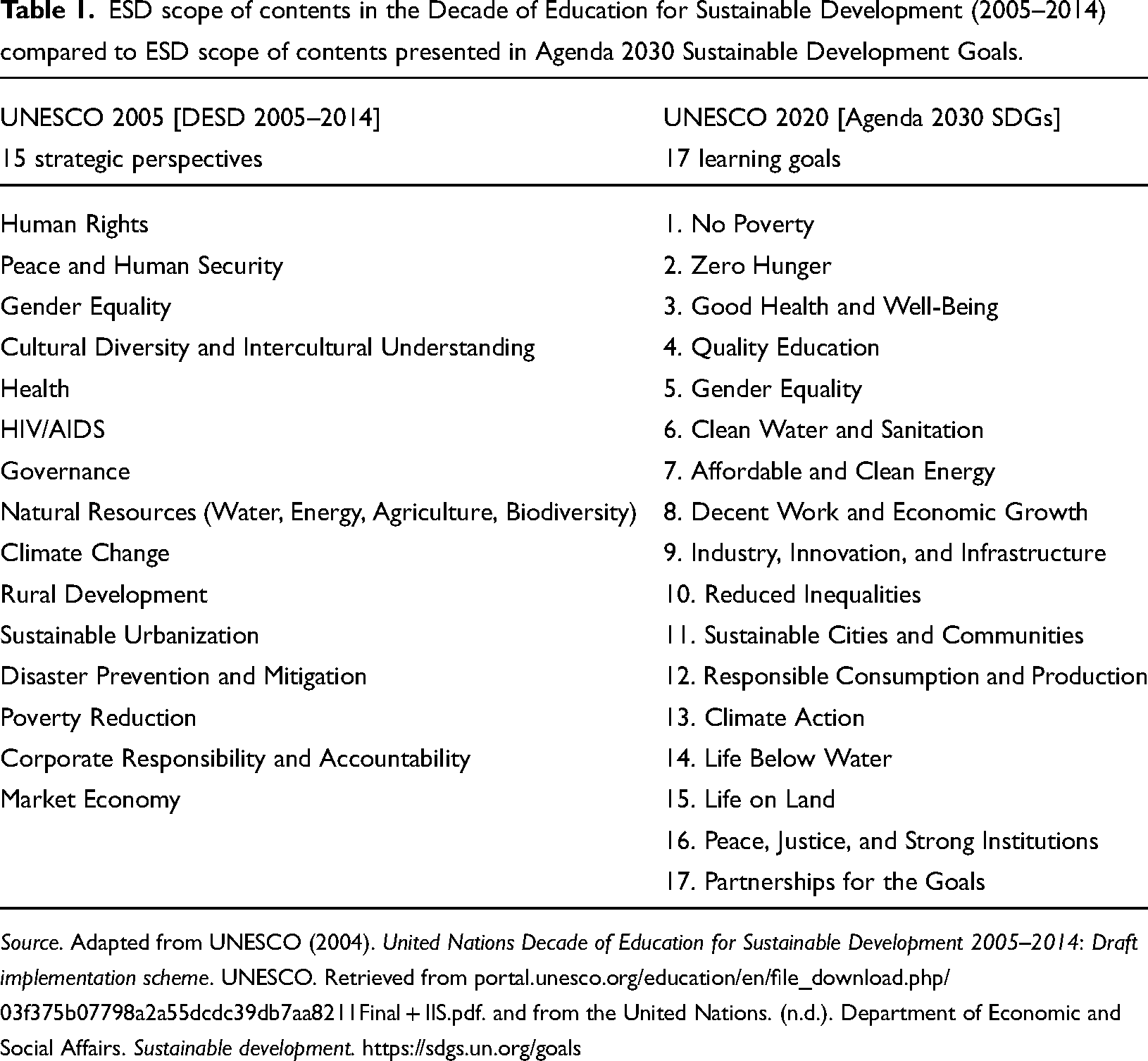
In 2002, at the World Summit on Sustainable Development in Johannesburg, South Africa, the title “Environmental Education” was officially replaced by ESD, and UN General Assembly Resolution 57/254 designated 2005–2014 as the United Nations DESD, with UNESCO as the lead agency (UNESCO, 2005). Since then, UNESCO has been leading the ESD agenda (UNESCO, 2020). The DESD strategy identified 15 strategic perspectives that formed the scope of contents addressed by ESD (see the list of strategies in Table 1).
ESD scope of contents in the Decade of Education for Sustainable Development (2005–2014) compared to ESD scope of contents presented in Agenda 2030 Sustainable Development Goals.
Source. Adapted from UNESCO (2004). United Nations Decade of Education for Sustainable Development 2005–2014: Draft implementation scheme. UNESCO. Retrieved from portal.unesco.org/education/en/file_download.php/03f375b07798a2a55dcdc39db7aa8211Final + IIS.pdf. and from the United Nations. (n.d.). Department of Economic and Social Affairs. Sustainable development. https://sdgs.un.org/goals
An examination of the 15 perspectives reveals that most of them do not represent any organized body of knowledge. Epistemologically, they may, at best, be characterized as a set of world challenges or problems relevant to the time of their conceptualization in the early 2000s. Consequently, UNESCO's conceptualization of the DESD was described by Kwauk (2020) “as turning a robust field of environmental education into a 21st century simulacrum of education for sustainable development (ESD) detached from reality—or more precisely, untethered to the planet” (p. 7).
Later, in 2012, at the Rio + 20 conference on Sustainable Development, UNESCO introduced an addition to the DESD perspectives, focusing attention on the role of education in addressing sustainable consumption and production, presented as follows: “Sustainable consumption and production: Sustainable Lifestyles and Education Programme of the 10-Year Framework of Programmes on Sustainable Consumption and Production 2012–2021” (UNESCO, 2020, p. 6).
Later, in 2014, UNESCO launched the GAP on ESD (2015–2019), aiming to follow up on the DESD that was coming to closure (UNESCO, 2014). From an epistemological perspective, ESD appears in the roadmap primarily as an agenda aiming to utilize education for the purpose of societal transformation, as an end goal. Priority Action Area 4 describes the means as “Empowering and mobilizing youth” (UNESCO, 2014, p. 15). This reorientation agenda is further strengthened in the 2020 UNESCO Roadmap (UNESCO, 2020), where the document clearly states that “education needs to transform itself” (p. 9) and that the aim is “to review the purposes and values that underpin education and reorient all levels of education and learning to contribute to sustainable development” (p. 12). The document further calls for the surveillance of education systems and to “ensure that education institutions are monitored and assessed for progress on how well they develop learners’ capacities as change agents” (UNESCO, 2020, p. 26).
Some educators may be alarmed by this apparent attempt to hijack the education systems for achieving a prescribed agenda, as most educators would think of schools as places where children are supported to grow to their full potential, whatever that may be, and not as training facilities for prescribed purposes. Using Gert Biesta's words: “… what they [the students] will do when it matters, that is, when they encounter something in their lives that addresses them and calls for them … is something we can never know in advance, which also means that it is fundamentally beyond our control” (Biesta, 2022, p. vii). Furthermore, Biesta (2022) suggests that “… instead of asking what the schools should ‘do’ for society—which seems to have become the most prominent way in which the task of the school is nowadays being conceived—I ask what society should ‘do’ for the school so that the school can be a school” (p. 9).
The roadmap further elaborates on its agenda as follows: ESD is transformative education … This, ultimately, requires a reorientation of education systems and structures as well as a reframing of teaching and learning. ESD concerns the core of teaching and learning and cannot be considered an add-on to existing educational practices. (UNESCO, 2020, p. 33)
This quote further suggests that, epistemologically, ESD is an agenda, not an organized body of knowledge. Schools and education systems are called on to re-route their purposes and educational operation modes to serve this agenda. As such, it is questionable as to whether it is morally right to allow any agenda to govern the curriculum.
In 2015, with the adoption of the 17 SDGs and Agenda 2030 for global transformation, ESD conceptualization shifted once again. This time, it was to be included in Target 4.7 of SDG4 Quality Education, Target 12.8 of SDG 12 Responsible Consumption and Production, and Target 13.3 of SDG 13 Climate Action. In 2017, the UN General Assembly Resolution 72/222 broadened ESD's role once again to be “an integral element of the SDG on quality education and a key enabler of all other sustainable development goals” (UN General Assembly, 2018, p. 3), thus forming a new list of ESD issues. Table 1 presents the shift in ESD issues when transitioning from the DESD strategic framework to the SDG framework. An examination of the two lists of contents reveals that except for Gender Equality, all the other titles have changed. Even CC has now changed to Climate Action.
Taken together, the analysis reveals that, epistemologically, ESD may best be characterized as an agenda for addressing the world's main challenges. This entails a perpetual conceptual inconsistency. This is because problems and challenges are always transient. Like the problems and challenges that individuals encounter throughout life, the world's problems are also continuously changing over time. It follows that attempts to organize curricula around problems rather than around structured knowledge, will meet insurmountable challenges in relation to all aspects of curriculum design, as elaborated further below.
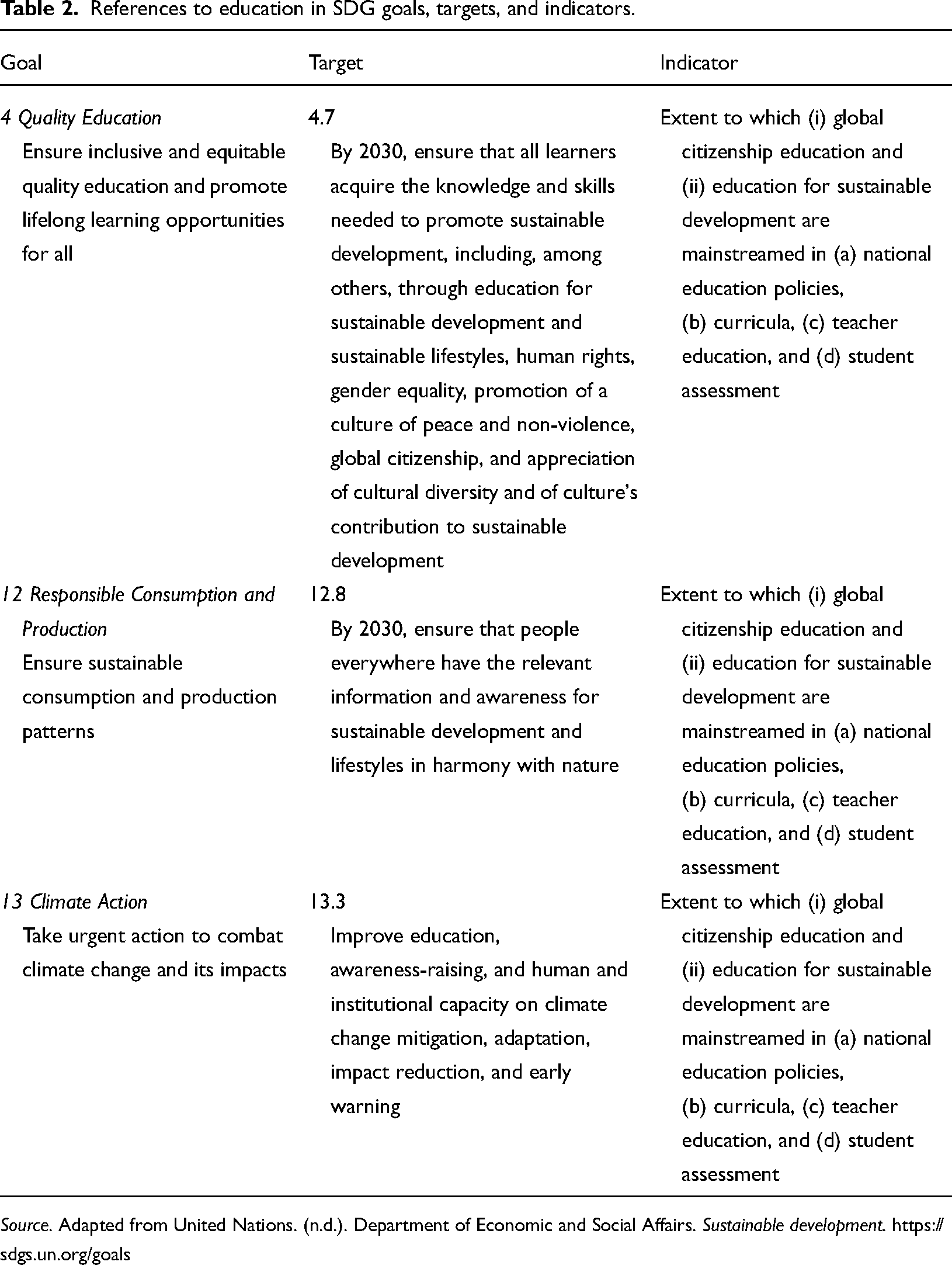
Examining the role of education within the SDGs themselves reveals further epistemological incoherency and ambiguity, which, in turn, pose barriers to CC curriculum development and implementation. Table 2 demonstrates the ambiguity in relation to SDGs 4, 12, and 13, their targets, and goals. These three SDGs include indicators specifically addressing ESD.
References to education in SDG goals, targets, and indicators.
Source. Adapted from United Nations. (n.d.). Department of Economic and Social Affairs. Sustainable development. https://sdgs.un.org/goals
Examination of Table 2 reveals that the indicators of three different targets in three different SDGs are the same. This basically means that there is no way to distinguish which of the three targets was achieved, when implementing these indicators for evaluating the achievement of the three SDGs. From a curricular perspective, assessment that is incapable of identifying what knowledge has been acquired is unfit for that purpose. Further in-depth examination of the targets and indicators reveals more inconsistencies and ambiguities. For example, Target 4.7 states that “all learners acquire the knowledge and skills needed to promote sustainable development, … through education for sustainable development and sustainable lifestyles, human rights, gender equality, …” (UN, n.d.). Here, in SDG4, ESD is conceptualized as a means for acquiring a set of attributes alongside other means, such as sustainable lifestyles, human rights, etc., unlike ESD conceptualization in the DESD strategic framework (UNESCO, 2005), where ESD was conceived to include human rights, gender equality, and the like. Similarly, the associated indicator differentiates between two separate vehicles for achieving the goal. These are ESD and citizenship education. This conceptualization is inconsistent with UNESCO's earlier conceptualizations of ESD, where ESD was all inclusive. Finally, there are misalignments within the SDGs themselves, as the indicators appear conceptually disconnected from the targets they aim to measure. For example, while Target 13.3 discusses, among other things, the raising of institutional capacity on CC mitigation, adaptation, impact reduction, and early warning, the indicator measures only the extent of educational dissemination by measuring its presence in national education policies, curricula, teacher education, and student assessment. It is unclear how this indicator could possibly provide useful information on early warning signs or raise institutional capacities by using the aforementioned data collection.
Even more surprising is that while ESD was announced as an enabler for all SDGs and appears in three indicators, an examination of the “Progress Towards the Sustainable Development Goals,” developed by the United Nations Economic and Social Council (United Nations Economic and Social Council, 2022), reveals no mention of ESD. It appears that no data were collected on ESD in relation to monitoring the progress of SDGs. These issues associated with the ESD agenda have been criticized on several fronts, as discussed in the following section.
Criticizing the suitability of the education for sustainable development agenda to act as a host for the climate change curriculum
ESD and its associated terms received various criticism over the years. UNESCO acknowledged the criticism that “ESD has received for its ‘vagueness’, which stems in part from its broad and inclusive perspective and the ever-changing nature of sustainability issues” (UNESCO, 2020, p. 57). Further criticism was summarized in Eilam (2022, p. 6) as follows: González-Gaudiano (2005) describes ESD perspectives as “[an] elusive thematic group of issues” (p. 243), made up of various fields of knowledge, each having its own identity and autonomy as a field. ESD provides an empty space of congregation for the various fields, and in turn becomes an “empty signifier” (p. 245). When co-opting these various autonomous fields into this makeshift shared space, they become deformed and obscured. The connections between these fields may go either way—positive or negative—or have no connection at all. For example, it can easily be seen how market economy may pull in an opposite direction to corporate responsibility; or HIV/AIDS may be unrelated to both market economy and corporate responsibility. Furthermore, there are no rules and regulations that govern the ways in which the empty space is filled, and therefore it can mean different things to different people, with meanings always being transitory and subject to permanent questioning (p. 246).
While CC knowledge is expanding and being continuously revised, in a typical disciplinary characteristic, the basic concepts that constitute this body of knowledge present relative stability over time. No such stability can be attributed to the various ESD challenges. Not even at the basic level of terminological stability. Consequently, Kwauk (2020) questions ESD epistemology altogether, stating that “it is still unclear whether ESD is meant to be an orienting principle, an actual subject, or an umbrella term encompassing environmental education, climate change education, and other permutations of ecologically-oriented disciplines” (p. 11). Eilam (2022) notes that “if sustainability is no more than neologism, it seems self-evident that the notion of sustainability education is an unsuitable platform for hosting CC education. It does not provide a framework for coherent, comprehensive, knowledgeable and effective CC teaching and learning” (p. 6).
In moving beyond the epistemological issues associated with ESD, it has also received criticism related to its axiology. It was suggested that the ESD agenda creates dangerous opportunities for corporates and interested actors in the neo-liberal market to justify continuous economic growth by reinterpreting and molding the sustainable development approach to support their interests and undermine efforts to seriously address CC (Hove, 2004 in Stein et al., 2022; Waldron et al., 2019). Furthermore, ESD discourse fails to provide a voice to critical decolonizing approaches for addressing CC (Whyte, 2017). ESD was criticized for (a) directly cultivating the neo-liberal stance in relation to the economy (Stein et al., 2022) and (b) for its instrumental and anthropocentric approach to nature, where the dominant ESD view conceives nature as a “resource” (Kopnina, 2012). A poignant critique by Selby and Kagawa (2010) summarizes this line of critique, stating that ESD has taken a neo-liberal marketplace worldview that “tacitly embraces economic growth and an instrumentalist and managerial view of nature that goes hand in glove with an emphasis on the technical and the tangible rather than the axiological and intangible” (p. 37). Selby sums up the problem by stating that ESD “has become part of the problem rather than part of the solution” (Selby, 2010, p. 36).
Tensions related to CC education implementation
Tension between the ESD agenda and the content-based curriculum
Most curricula worldwide present some degree of content-basis organization. This form of organization requires that teaching be organized around knowledge. This was clearly the case when EE was introduced into curricula during the 1970s and the 1990s. In many curricula Environmental Science or Environmental Studies were introduced as content-based subjects. However, ESD is not a knowledge-based agenda, but rather a problems-based agenda. As such, there is an inherent tension, making ESD difficult to fit into existing curricula (Blum et al., 2013). This tension is exacerbated by the fact that ESD calls for reorienting the curriculum (UNESCO, 2017). In essence, the ESD agenda delegitimizes the existing curricula.
This inherent tension between content-based curriculum and ESD application was noted in a number of recent studies. For example, a report by the European Commission (2022b) explains the low uptake of ESD by the education systems in the European Union, highlighting this tension as follows: “Given the interconnected nature of learning for sustainability, the structuring of curricula around single subjects appears to be a barrier to further embedding environmental sustainability” (European Commission, 2022b, p. 18). While the report perceived the curriculum framework as the barrier, here I suggest the opposite—that the barrier is the ESD agenda rather than the curriculum framework. Blum et al. (2013), in their comparative survey of the Denmark, Singapore, Canada, and UK policy uptake of ESD and CC, also noted this inherent tension between the curricular framework and the inclusion of ESD.
Different countries take different approaches to resolving these tensions. Some countries resolve the tension by including ESD as an almost separate entity aside from their subject-based curriculum, where ESD, with its CC content, is not examined, has no benchmarks, and does not present typical curriculum characteristics. In Denmark, pressures from NGOs and stakeholders led the government to develop a national strategy for ESD in 2009. However, Blum et al. (2013) note the hesitation by the Ministry of Education to engage in ESD, due to the epistemological problems that ESD poses. They describe this hesitation as “grounded in the priorities of the Ministry, which at the time focused on moving ‘back to basics’ in core subject areas and were therefore somewhat in contrast to ESD's interdisciplinary approach” (Blum et al., 2013, p. 212). In many countries, 30 years after its appearance on the world stage, ESD is still mostly implemented by NGOs, focusing mainly on awareness raising rather than on any specific content learning (Blum et al., 2013; UNESCO, 2020).
Empirical examination of CC education implementation within the ESD framework provides additional support to these claims. Repeated surveys reveal limited implementation. For example, a large-scale study by UNESCO and the UNFCCC analyzed a total of 368 countries’ submissions to the UNFCCC, representing data obtained from 194 parties to the Paris Agreement (2015). The aim was to examine how CC education is addressed in these countries’ submissions. The findings revealed that CC education (defined as formal education) was mentioned only in 17% of National Communications submissions and in 11% of Nationally Determined Contributions’ submissions (UNESCO, 2019a). The limited attention to CC education was confirmed in another survey by UNESCO (2021a) examining 129 curriculum documents obtained from 100 countries. The findings revealed that 47% of national curricula had no reference to CC whatsoever. The rest of the curricula mentioned CC in a shallow way. Finally, a third UNESCO (UNESCO, 2021a) curricula survey, which more specifically examined CC in the context of ESD, found that the term “CC” was mentioned at least once in only 47% of the 100 national curricula, leaving more than half of the curricula and policy documents with no mention of CC at all. The broad scope of empirical findings suggests their applicability and generalizability across cultures.
Tensions between ESD and the scientific consensus
Various scholars have noted the peculiar dichotomy that exists between CC conceptualization within the ESD framework and its conceptualization by scientists from a disciplinary perspective. The peak international body representing the well-organized and conceptualized CC knowledge is, undoubtedly, the IPCC (Intergovernmental Panel on Climate Change [IPCC], n.d.). The IPCC has developed numerous CC reports over the years. These reports are mostly based on sound methodologies, which lay out the scope of contents and key CC concepts in what can be understood to represent a disciplinary framework for CC. While it seems appropriate to turn to these reports as reliable resources for informing CC curriculum development, Kranz et al. (2022) noted that the IPCC reports are rarely addressed in the context of school CC education. In their review of 75 CC education interventions at schools, they found a worrying gap between CC research discourse and its representation in schools. They noted that it is striking that very few interventions introduce students to … official political documents or the IPCC reports. This is surprising as these documents describe the scientific and political consensus on mitigation actions and are thus a relatively solid knowledge base for educational intervention. (Kranz et al., 2022, p. 4194)
Contrary to this, within the ESD framework, Mochizuki and Bryan (2015), in presenting UNESCO's Climate Change Education for Sustainable Development (CCESD) programme, define mitigation as follows: Climate Change Mitigation is defined by the United Nations as a human intervention to reduce the sources of greenhouse gas emissions primarily linked to human actions of production and consumption (UNESCO/UNEP, 2011). Mitigation efforts include a range of interventions to stabilize and reduce greenhouse gas concentrations such as: investing in renewable, non-polluting energies and designing greener technologies, conserving energy, promoting changed consumption patterns and lifestyles, and re-orienting economies, social structures, value systems and ideologies that have resulted in the emission of excessive greenhouse gases. (p. 7)
Overall, it appears that CC association with ESD forms a major obstacle for effective CC curriculum development (Blum et al., 2013). Selby and Kagawa (2010) clearly and unapologetically call policy developers to steer away from conceptualizing CC as a topic of ESD, suggesting that “recent calls for the integration of climate change education (CCE) within mainstream education for sustainable development should be resisted” (p. 37). The broad evidence presented thus far suggests that CC curriculum is more likely to fulfill its purposes effectively when organized around knowledge, not when organized around agendas and periodic challenges, as is the case with the ESD and SDG agendas.
ESD conceptualization of learning dimensions as a hindrance
ESD literature often distinguishes among three types of learning: cognitive learning, socio-emotional learning, and behavioral learning (sometimes referred to as action-oriented learning) (UNESCO, 2021a, 2021b).
UNESCO (2017) refers to these types as domains and defines them as follows: The cognitive domain “comprises knowledge and thinking skills necessary to better understand the SDG and the challenges in achieving it” (p. 11). The socio-emotional domain “includes social skills that enable learners to collaborate, negotiate and communicate to promote the SDGs as well as self-reflection skills, values, attitudes and motivations that enable learners to develop themselves” (p. 11). The behavioral domain “describes action competencies” (p. 11).
UNESCO (2017) went a step further by specifying the specific capacities in each domain, as they apply to each SDG. For example, in SDG1, No Poverty, the socio-emotional objectives state that “the learner is able to collaborate with others to empower individuals and communities to affect change in the distribution of power and resources in the community and beyond” (UNESCO, 2017, p. 12), and “the learner is able to reflect critically on their own role in maintaining global structures of inequality” (UNESCO, 2017, p. 12). Here, UNESCO is suggesting that students who are socio-emotionally competent should be able to demonstrate their capacity to mobilize change in the power and resource distribution in society. This and other similar capacities are clearly unrealistic and seem detached from education theory. Additionally, it is expected that students demonstrate a capacity to reflect on their own negative impact in maintaining the existing structures, in an educational approach that seems to cultivate notions of behavioral repentance. This approach, aiming to cultivate a set of prescribed emotions, was criticized as “practically and ethically questionable” (Verlie, 2019, p. 752) where “emotions should be acknowledged, honoured and interrogated, not promoted or manipulated” (Verlie, 2019, p. 752).
UNESCO (2019b) proposed a new set of definitions as follows: The cognitive aspect involves the ability to “acquire knowledge, understanding and critical thinking about global, regional, national and local issues, the interconnectedness and interdependency of different countries and populations, as well as social, economic and environmental aspects of sustainable development” (p. 7). The socio-emotional aspect involves the ability to “have a sense of belonging to a common humanity, sharing values and responsibilities, empathy, solidarity and respect for differences and diversity, as well as feel and assume a sense of responsibility for the future” (p. 7). The behavioral aspect involves the ability to “act effectively and responsibly at local, national and global levels for a more peaceful and sustainable world” (p. 7).
The ESD literature suggests emphasizing the socio-emotional and behavioral learning, as these cause changes in individual behavior. In turn, individual behavioral change is conceived as causally related to bringing about sustainability. Furthermore, according to UNESCO (2017), “ESD can produce specific cognitive, socio-emotional and behavioural learning outcomes that enable individuals to deal with the particular challenges of each SDG, thus facilitating its achievement” (UNESCO, 2017, p. 8). UNESCO (2019b), cautions that the three types of learning need to be balanced, stating that less balanced ESD … approaches–such as a disproportionate focus on cognitive learning … may foster learners who will be less likely to alter their everyday actions and actively contribute to living in and building a more inclusive, just, peaceful and sustainable society. (p. 7)
This discourse suffers from a range of conceptual inadequacies. Among them is the unsubstantiated assumption that individual behavioral change can bring about sustainability and that individuals have the power to mobilize change as individuals (Powdthavee, 2020). Another concerning assumption is that the role of education is to bring about sustainability, rather than to educate children, as an end-goal.
Keeping these points aside, the focus here is on the distinction made among cognitive, social-emotional, and behavioral learning. This distinction is neither discussed nor theoretically substantiated in the ESD literature. No explanation is offered on how the three types of learning differ pedagogically, how they differ in relation to their respective learning outcomes, and how they can be measured. Examining the education literature further increases concerns regarding the validity and the meaning of these terms.
From a cognitive psychology perspective, these terms are at odds with theories. Current research suggests that there are no distinguishable brain processes that differentiate between cognitive and emotional epistemic processes. Various definitions of the term cognition include emotional aspects built into the definitions and form part of cognition. For example, Greene and Yu (2016) proposed to define cognition as “a process involving dispositions, beliefs, and skills regarding how individuals determine what they actually know, versus what they believe, doubt, or distrust” (p. 46). Expressions such as doubt or distrust inevitably involve emotional aptitudes. This intertwining of cognition and emotions is further demonstrated in Muis et al.'s (2021) definition, describing emotions as “interrelated psychological processes that include affective (e.g., feeling nervous), cognitive (e.g., ruminating thoughts), motivational (e.g., a desire to escape), expressive (e.g., displaying a frown), and physiological (e.g., increased heart rate) components” (p. 4). Lisa Feldman Barrett (2017), in her Theory of Constructed Emotions, takes this notion further and eliminates altogether the distinction between cognition and emotions. For her, emotions are simply concepts. These concepts are dependent on a combination of physical properties, the flexibility of the brain to respond to its environment, and “the culture and environment in which emotional responses evolve and operate” (Barrett, 2017, p. xii). Over the past decade, the growing understanding regarding the role of the body in learning and cognition further highlights the intertwined behavioral aspects of learning. Foglia and Wilson (2013) emphasized the role of embodied cognition, suggesting that “mounting empirical evidence shows that bodily states and modality-specific systems for perception and action underlie information processing, and that embodiment contributes to various aspects and effects of mental phenomena” (p. 319).
Taken together, it appears that the distinction made among cognitive, socio-emotional, and behavioral learning represents a positivist reductionist understanding of learning that does not have credence in evidence-based research. These terms seem to hang loosely when the typological distinction is unable to provide evidence as to how these so-called categories of learning can be taught separately, learned separately, and assessed separately as constructs that represent a meaningful understanding of the educational process. Thus, the three different terms are used in a misleading manner to describe the same process—learning.
Conclusions and recommendations
The present conceptual paper put forward the aim to contribute to conceptualizing and developing CC curricula by examining CC education epistemology. In particular, the analysis focused on hindrances associated with conceptualizing CC education within the framework of sustainability education. In-depth literary analysis was conducted revealing the following insights and leading to a set of recommendations.
Overall, the analysis revealed that CC education is under-investigated. There is no shared conceptualization and even no shared terminology. Concerning the conceptualization of CC education in the framework of ESD, a range of hindrances were revealed. From an epistemological perspective this study proposes to define ESD as an “agenda for solving the world's major challenges as they are understood at any given time.” This agenda is unfit as a framework for CC curriculum development. This is because curricula may function well when organized around concepts and knowledge, not around agendas made of transient challenges. While the ESD agenda, at best, may be an add-on to the curriculum, it cannot dominate or substitute the curriculum, as it proclaims to do. ESD knowledge is ephemeral, anecdotal, with no rules and concepts of organization. Contrarily, CC has evolved over the past 100 years as an organized body of knowledge with rules for determining claims of truth, and well-defined concepts and principles that govern the knowledge production.
The analysis further reveals a concerning finding by which ESD delegitimizes school education as social institutions supporting children to grow to their full, unknown potential, where “powerful knowledge” (Young, 2013, p. 108) acquisition has inherent value on its own through its ability to support students in becoming thriving adults. Contrarily, the ESD agenda puts forward the aim to utilize education for the purpose of societal transformation, in what seems to be an attempt to hijack the education systems for achieving its prescribed agenda as an ulterior end goal. ESD further calls to surveil education systems to ensure that students are trained properly to serve their purpose as “change agents” (UNESCO, 2020, p. 26). By this, ESD appears to be undercutting the purpose and meaning of schooling and, at the same time, presenting students as misbehaving and requiring redemption through behavioral transformation. No viable alternative for schooling is presented under this agenda, and it lacks further substantiation through empirical evidence or theoretical frameworks.
Further hindrances to CC curriculum development were revealed in the association between characterizing CC as multidisciplinary and the ineffective cross-curriculum approach for CC implementation. The fragmentation and dispersal of CC across multiple subjects is ineffective for a range of reasons, including the fact that it does not allow for systematic and organized construction of CC knowledge. However, the cross-curriculum approach continues to be the most advocated approach for implementing CC education, regardless of empirical evidence suggesting that this approach is not working as well as expected (UNESCO, 2021a). Furthermore, no evidence-based theoretical frameworks have been presented thus far to suggest why this approach can and should work. Finally, conceptualizing CC within the ESD framework was found to be at odds with the science basis of CC, due to ESD being overlayed by unsubstantiated agenda-informed claims. Similarly, ESD is also at odds with curricular structures and purposes.
Based on these findings, a set of recommendations may be suggested for advancing CC curriculum development. The first is to dissociate CC education from ESD and develop an independent CC curriculum. Such a curriculum needs to be locally sensitive and adaptable to local cultural knowledge and adaptation needs. Secondly, it is recommended to consider implementing CC as a subject or topic in its own right, rather than apply the cross-curriculum approach. Thirdly, it is advisable to use one agreed-on term consistently. The IPCC uses the term climate change as the agreed term. It seems appropriate to identify the field by this name. Finally, further research is required in identifying the key themes, concepts, and skills constituting CC literacy, across the range of economic, social, political-governance, and scientific and technological aspects. These seem to be critically missing in the literature. When key concepts are identified, they would mostly relate to the scientific aspects of CC (Schreiner et al., 2005). Perhaps a good place to start is to model the development of CC literacy framework on the work that has been done by the American National Research Council in developing the science literacy framework (National Research Council [NRC], 2012), where science literacy consists of Science and Engineering Practices, Disciplinary Core Ideas, and Crosscutting Concepts (NGSS, 2013). Similarly, we could perhaps think of CC practices, core ideas, and cross-cutting concepts, which present the scope and organization of the various socio–economic–scientific and other aspects of CC.
To conclude, the growing intensity and frequency of CC-related disasters, worldwide, calls upon educational policymakers to address the urgent need of developing CC curricula, effective in preparing students to live in an era of CC. The present study aspires to facilitate this process by inviting curriculum developers to consider critical epistemological aspects related to CC education implementation.
Footnotes
Declaration of conflicting interests
The author declared no potential conflicts of interest with respect to the research, authorship, and/or publication of this article.
Funding
The author received no financial support for the research, authorship, and/or publication of this article.
