




Abstract
Highlights
Pakistan's worst flooding occurred in 2022 and highlighted the critical link between educational and environmental sustainability. The 2022 floods took a heavy toll on the lives of 27,148 children. Educational sustainability suffered, affecting 33 million students at all levels. This study employed qualitative methods to examine the scenario post the 2022 flood in Pakistan, focusing on educational, psychological, and physical vulnerabilities. Information was drawn from newspaper reports, NGO documents, and data from the disaster management department. The research identified significant challenges faced by school-age children and proposed solutions. Setting up temporary schools, wetland restoration, urban planning reforms, and inter-agency coordination are vital. Moreover, training teachers and involving children in environmental education and awareness campaigns are recommended. Beyond infrastructure improvements, the study underscores the importance of incorporating climate change, disaster management, and natural catastrophe risks into the curriculum and teaching methods to prepare the youth for future environmental challenges.
Introduction
Educational sustainability depends on natural sustainability, which is significant in the Anthropocene epoch (APE). Human survival and progress, especially in future generations, are directly related to environmental balance. The Pakistan Floods Response Plan Report of August 30, 2022 (National Disaster Management Authority [NDMA], 2022a) shows that flood catastrophes have affected 33 million people in Pakistan. Approximately 6.4 million people need help, at an estimated cost of US$ 160.3 million; however, only 5.2 million people are targeted for assistance (National Disaster Management Authority, 2022a, p. 2). A critical analysis of fact-based research before and after the 2022 floods in Pakistan can help policymakers, educators, and individuals understand the effects of Anthropocene actions on their children's future.
The primary responsibility of individuals is to acknowledge the need to protect the planet (Haq et al., 2020). In the ecological migration caused by catastrophic events, children and women are often the first to be affected by climate change (Imran et al., 2021). This study undertook a qualitative data analysis of relevant articles, blogs, books, journals, reports by international research institutions, reviews, and Internet sources (Imran & Almusharraf, 2023a). Theoretical perspectives on the APE are reviewed, as well as the resulting flood catastrophes and their expected consequences for children's access to quality school in Pakistan.
This study evaluates policies for educating and preparing instructors and children to adapt to climate change and its effects. The study aims to illustrate the effects of the APE on environmental change, which have resulted in hazards in Pakistan, including dry spells and the 2022 floods. According to the World Bank Group Climate Change Knowledge Portal ([CCKP], 2022), Pakistan is included in its list of the 10 most climate-affected countries and states that the country is at the highest level of disaster risk—the country faces weather, Anthropocene, geophysical, and hydrological threats (CCKP, 2022).
The frequency of hydrometeorological disasters, including rising temperatures, drought, heavy rainfall, floods, and storms, increases daily. The APE is causing the melting of the Himalayas and up to 50% of the Karakoram glaciers as a result of high temperatures, which has led to flooding and affects water resources. Pakistan generally experiences drought before the extreme rainy season, especially in the Balochistan region. Increasing greenhouse gases are damaging weather patterns, resulting in food shortages, infrastructure damage, health issues, and poor water hygiene. Pakistan must work to increase its storage capacity by 22 billion cubic meters (bcm) by 2025 to avoid extreme floods.
According to the National Centers for Environmental Information (2022a), the global temperature in August 2022 was 0.76 °C higher than the average from 1880 to 2022. This rise in temperature has caused natural instability that impacts 66 million children worldwide (Curtis et al., 2000; Satici, 2016). The impact of environmental change is expected to increase the vulnerability of affected children in terms of the availability of food, housing, education, and health facilities (Bunyavanich et al., 2003; Shah et al., 2019, 2021; Shah, Gong, Ali, Jamshed, et al., 2020). Experts agree that floods cause loss of learning hours and qualified staff. They also cause waterborne infections, high truancy, and low inclusion, which can result in low academic achievement (Imran & Almusharraf, 2023b).
In the article “Pakistan's Floods are Deepening its Learning Crisis,” Saavedra and Sherburne-Benz (2022) report on the conditions in Government High School Ahmadani in Pakistan's DG Khan district. The 2022 floods significantly damaged the school, which has been serving students since 1916. The principal explained that the absence of electricity and drinking water and the damaged buildings have made it impossible to continue educational activities. According to the Pakistan Education Sector Working Group (EiE) report, more than 18,590 schools in the country were damaged or destroyed by the 2022 floods: 15,842 in Sindh; 544 in Balochistan; 1,180 in Punjab; and 1,024 in Khyber Pakhtunkhwa (KPK) (World Bank Group, 2022).
It is estimated that 18592 schools have collapsed in Pakistan due to flooding. Following the 2022 floods, schools and families were shifted to emergency shelters in Balochistan (World Bank Group, 2022). In Sindh, 39% of all primary and secondary schools were completely demolished (Chang et al., 2013). Whether an increase in learning poverty occurs will depend on how rapid and effective policy responses are. Earlier crises in Pakistan—such as the 2005 earthquake—have already had severe and long-lasting impacts on educational sustainability (Andrabi et al., 2021). These crises significantly curtailed educational sustainability throughout the country for several years and, according to Save the Children International, more than 670,000 children in Pakistan have been affected (Arijo, 2022).
In the 2022 floods, approximately 400 children died and 550 were injured due to incidents of buildings collapsing. Over 3,800 adults were killed, injured, or washed away in floodwaters (Arijo, 2022). As 50% of glaciers melt, water flow will also be reduced by 40% by the end of the century (Rees & Collins, 2004). The 2022 floods led to a large drop in enrollment and learning levels, especially among children of low-income families, even despite the existence of distance learning programs (Saavedra & Sherburne-Benz, 2022). The education sector can be protected through the integrated planning of school resilience to provide a safe environment for children. In the public and private education sectors, cooperation between disaster supervisors, educational staff, students, and parents can help formulate an inclusive disaster education plan (Shah, Gong, Ali, Sun, et al., 2020).
Parents have pulled their children out of school due to weakness resulting from food shortages and other life necessities. Children's access to quality teaching has also been compromised. This study aims to reveal ways to limit catastrophes related to the APE that educate young minds about climate change, disaster management, and the possible risks of natural catastrophes. Scholarly journalists, a wide range of media, and nature and climate activists should initiate awareness campaigns about the APE, specifically, its effect on people and, from a more extensive viewpoint, the world.
Literature review
The losses to Pakistan's education sector after the 2010 floods were estimated at US$ 311.3 million (Saavedra & Sherburne-Benz, 2022). The 2022 floods left practically 70% of Pakistan's land mass submerged, took many lives, and decimated the country's fragile schooling system. According to a World Bank Group (2022) assessment, Pakistan requires coordinated efforts, resources, the smart sequencing of negotiations, reforms, and extensive financial assistance to achieve educational sustainability. The current crises require considerably more financial resources than the 2005 earthquake, 2010 floods, and COVID-19 pandemic as the devastation to the education sector is more than twice as extensive. The construction cost has also increased due to problems accessing affected districts and the high inflation rate in the country. 1
Climate change affected the world significantly in 2022. Flooding is the most frequently reported natural disaster, affecting 140 million people globally (Qureshi, 2011, p. 110). Sydney received 250 mm of daily rainfall in July 2022 (National Centers for Environmental Information, 2022a). Nigeria has also experienced unprecedented flooding in various states, including Anambra, Enugu, Rivers, Taraba, Kogi, Benue, Katsina, Niger, Kano, and Nasarawa, which has affected its environment (Echendu, 2022). Moreover, Bangladesh is underwater due to heavy rains, and South Asia and the North Indian Ocean now have dry variant climate patterns. After a dry pattern, an extremely wet summer monsoon was experienced in Pakistan (National Centers for Environmental Information, 2022b). Europe is facing increasingly dry summers, with drought conditions drying up rivers, and Scotland has had six dry winters without snow. Meanwhile, due to the dry season, the United States has restricted certain communities from excessively using water (World Bank Group, 2022).
Climate change and the outbreak of diseases have damaged properties and endangered the lives of humans and animals. Urgent global attention is required to rescue humanity from the effects of the APE and to limit the world's temperature from rising as a result of fossil fuel burning and the emission of greenhouse gases (e.g., CO2, N2O, SO2). This study examines the causes of flooding and its impacts on Pakistan's educational sustainability. It also outlines recommendations for revised strategies to address the challenges posed by flooding to the education sector.
As the cause of climate change and flooding crises in Pakistan, community awareness of the APE is required to mitigate the impacts of flooding and achieve educational sustainability in the country. Cultural activities, media, and educational blogs can be used to educate communities and institutions on the impacts of the APE, such as flooding. This study highlights the need for revised policies and syllabi to educate students about the effects of the APE and their role in helping improve society. The education sector needs innovative tools to educate communities and institutions in Pakistan on adaptation strategies for educational sustainability.
In 2022, average rainfall in Pakistan had increased 2.9 times more the 30-years’ national average till 27 August, which caused massive flooding and landslides, affecting infrastructure, property, and human life (Saavedra & Sherburne-Benz, 2022). Rainfall in Balochistan was 5.1 times the 30-year national average, while in Sindh, it was 5.7 times the 30-year average. Flash flooding hits Balochistan, Sindh, KPK, and south Punjab. The NDMA (2022a) noted that Balochistan province is not usually affected by the monsoon, citing that these flash floods were clearly due to climate change. Extreme rainfall, snow melting, ice breaking, land sliding, and dam breaks are the major causes of flooding in Pakistan (Qureshi, 2011).
According to the Global Climate Risk Index 2021 and Climate Watch (2022), Pakistan is the country most affected by climate change, despite only being responsible for 1% of global carbon emissions. After the 2010 floods, 72 areas across Pakistan were identified by specialists as at risk of being hit by disasters, a prediction that was verified during the 2022 floods. UNICEF report (2023) highlighted that approximately 33 million people across Pakistan were affected. The lives of 421,000 refugees living in affected districts are also at risk. According to the NDMA, 1,033 people died; 1,527 people were injured; and 6.4 million people required assistance; and these numbers are likely to increase if no planning for future disasters is undertaken. Over 287,000 houses were completely demolished, and over 662,000 were partially damaged (NDMA, 2022b).
A critical source of livelihood for families in Pakistan is 719,000 livestock, of which 69% in Balochistan and 28% in Punjab died in the floods. The floods also damaged approximately 2 million acres of crops and orchards. The delivery of aid to affected people was impeded due to internet outages and the destruction of 3,500 km of roads and 149 bridges. The humanitarian situation also continued to deteriorate as a result of more than two months of storms and flooding. International solidarity is crucial to successfully address the climate effects of the APE, and the Secretary-General of the United Nations (UN), António Guterres, has appealed for massive support and immediate actions to minimize these effects (NDMA, 2022b).
The literacy rate in Pakistan is 58%, much lower than the 88% target set in the UN's 2015 Millennium Development Goals (MDGs). Pakistan's government, which signed the MDGs, promised progress in sectors such as education, the environment, and health, and a reduction in poverty and starvation. Nonetheless, sustainable development in all life sectors is impossible without educating the nation. Immediate efforts are required to ensure a better future and international image for Pakistan by reforming the education sector, environmental policies, and economic growth. To achieve this, Pakistan needs intelligent and well-trained people (Arijo, 2022).
According to Mirza (2003), UNESCO's (2000) world education initiative, Education for All, acknowledges the need for support to meet the challenges posed by natural hazards to countries affected by changing climate patterns. Wisner (2006) reported that approximately 875 million children live in high seismic risk zones (approximately 32 million of whom have recently moved to such areas). International forums are initiating efforts, such as environmental curriculum development, teacher training, and child participation in a rights-based approach; using media as a knowledge transfer tool; child-centered risk communication; and child participation in policy spaces through youth parliament forums (Mirza, 2003).
The Pakistani government and the World Bank are freeing up existing and new funding to rebuild the country's infrastructure and achieve better climate resilience. Kenya is undertaking this task by accelerating strategies to extensively support teacher training programs (Saavedra & Sherburne-Benz, 2022). Such programs aim to improve teachers’ instruction and raise societal awareness of the fact that progress in every sector of a country depends on natural sustainability, which can be achieved by balancing their relationship with climate. This study suggests that the public authority should focus on disaster training, transportation infrastructure, and strict building development regulations.
A secure way of life should be achieved through instruction and media awareness campaigns (Daha, 2021). Amending procedures will guarantee the security of children and the school system. Instructional management is reliant on countries’ needs and commitment to progress. During the war in Ukraine, the country's Schooling Clergyman, Serhiy Shkarlet, ordered educational institutions to start their scholastic year (September 1, 2022) after evaluating the educational infrastructure (Arijo, 2022).
The enormous amount of 216 billion rupees is required to rebuild 18,000 schools in Pakistan (Malik, 2021). STEM Pakistan arranged a virtual conference, Defending Education Against Climate Change, to discuss climate catastrophes and their effects on the country's educational system. The aim was to encourage society to speed up the relief works as schools that were destroyed in 2005 were only completed in 2021. Solutions can be extracted from the previous catastrophes that Pakistan has experienced in the last two decades (Siddiqi, 2022).
Public sector education should be a priority for federal and provincial governments, as much of the general public enroll their children in public learning centers (Arijo, 2022). The situation deteriorated as many districts remained underwater following the 2022 floods. Worsening weather patterns are responsible for the climate catastrophe in Pakistan, which is the country most vulnerable to floods, despite only contributing 1% of the total global emission of greenhouse gases (World Bank Group, 2022). The Pakistan country director of Save the Children (2022) explained that the scale of the damage would prevent children from returning to school. Gondal also noted that children were suffering from the trauma and shock of what had happened or would happen around them, as well as the pain of losing their loved ones, houses, and schools (Save the Children, 2022).
Technology is a key tool for educating and training children to help them face the destruction caused by disasters for their families. The Changing Climate Coalition emphasizes that children have an important role in reducing the risk of flood damage as they can provide their peers and relatives with practical and creative ideas (Tanner et al., 2009). It is difficult for students to attend schools in underwater areas where food, shelter, and transportation are unavailable (World Bank Group, 2022). Education is a fundamental factor in the sustainable development of a nation and must be considered while planning and making operational decisions, especially at the primary and secondary school levels (Anderson, 1985; Imran & Almusharraf, 2023c).
Floods in Pakistan
Although they present a serious threat to life and property, floods can be managed by reducing their environmental, social, cultural, and economic impacts. The different aspects of flood risks and their prevention in a changing climate across various geographical locations must be part of the planning process. Globally, flooding is affected by environmental, ecological, hydrological, and geomorphic factors and can occur in urban, agricultural, rangeland, forest, coastal, and desert areas. Climate change is hampering the natural sustainability of South Asian monsoon patterns and is increasing by 8%–24% according to Intergovernmental Panel on Climate Change (IPCC) reports (Rasul et al., 2008). The UN Office for the Coordination of Humanitarian Affairs (OCHA) predicted that Pakistan would experience severe monsoon circumstances in 2022 and that the monthly average rainfall would increase by 67% (NDMA, 2022b).
The Anthropocene Epoch
The new age was initially called “anthropozoic” in 1870 by Italian geologist Antonio Stoppani. Chemist Paul J. Crutzen and biologist Eugene Stormer proposed the name “Anthropocene epoch” in 2000. The word “Anthropocene” derives from the Greek words “anthropoid” and “cene,” which both mean “new.” The APE refers to the geologic period during which human activities have had a significant impact on the climate of planet Earth and are currently causing ecosystems to respond. In his article “The Anthropocene,” Crutzen (2006) stated that as human power increases and humans have a greater influence over their surroundings, including fellow humans, nonhumans, and nonliving things, it must be in the right direction.
According to Ehlers and Krafft (2006), the APE highlighted many human accomplishments within individual and collective activities to advance civilizations and cultures that have impacted the natural ecosystem. According to Crutzen (2006), the APE is a geological epoch produced as a result of deforestation, the burning of fossil fuels, converting agricultural land into industrial land, and the concentration of greenhouse gases toward the end of the 18th century. These processes have changed the Earth, land-dwelling organisms, and marine life. In the future, it will be impossible for humanity to gauge the rate of change necessary to meet temporary consumer demands.
The incapacity of the current infrastructure to handle the unusual volume of water exacerbates flash floods and rain-induced landslides. Like many others, the Indus River is frequently at high flood warning levels or bursting its banks. Major dam reservoirs are also rapidly filling or overflowing, posing a significant risk to individuals nearby and downstream (Qureshi, 2011). Through awareness efforts, decision making based on reliable data can become more appealing and efficient. Lobbying power in the APE may be able to move in the right direction by educating the public about the need to protect the environment. Visconti (2014) noted that the scientific community holds that the incapacity of current infrastructure to handle the unusual volume of water exacerbates flash floods and rain-induced landslides.
As all forms of media in today's society function as powerful opinion-makers and behavior-shapers, they can use their work to bring social and environmental ethics to the public's attention. Environmental balance is thrown off by how humans behave and how their behavior affects the ecosystem. The future of the next generation, which is dependent on the harmony of the environment and the sustainability of nature, is being threatened by the human behavior of denial, masked by political, social, and economic concerns. Pakistan requires that much more effort be invested in mitigating the effects of climate change to respond flexibly to the shocks of climate change (World Bank Group, 2022).
Impacts of the APE on natural sustainability in Pakistan
The APE and flooding in Pakistan
The extreme flooding in Pakistan is a result of the global APE. The disastrous natural catastrophe in 2022 was exacerbated by human negligence as hotels and houses were built in river passages, there was a poor drainage system, no planning had been undertaken after the 2010 floods, and there had been no investment in environmental education and awareness (Qureshi, 2011; World Bank Group, 2022).
Losses in Pakistan as a result of the 2022 floods.
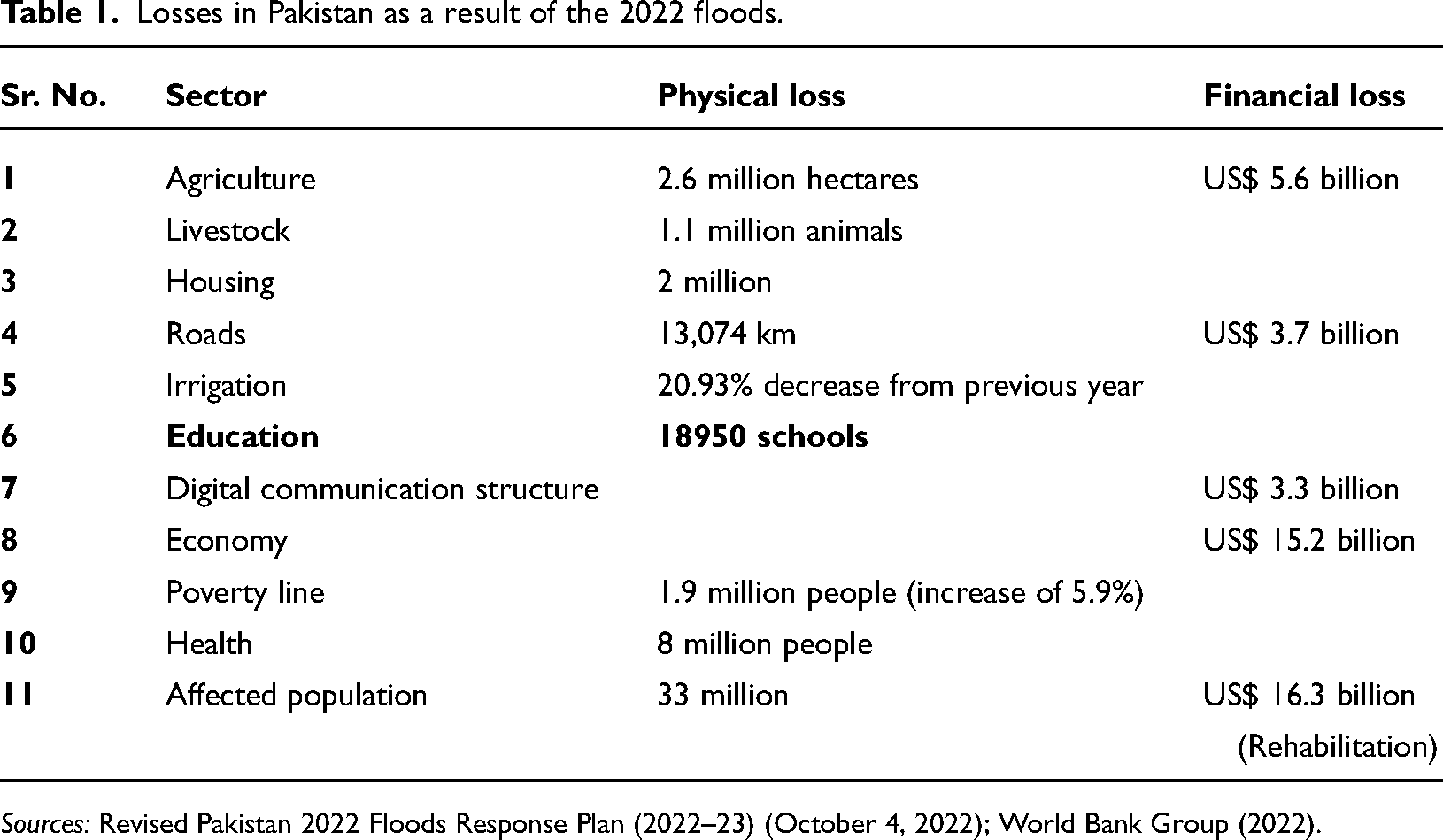
Sources: Revised Pakistan 2022 Floods Response Plan (2022–23) (October 4, 2022); World Bank Group (2022).
Educational sustainability
The foreign minister of Pakistan, Bilawal Bhutto, has voiced his concern about children, who are the most vulnerable community and represent a third of those who died in the 2022 floods (Wisner, 2006). According to provincial Education Departments, the floods damaged 18950 schools, and the remaining 7,652 schools, which were used as shelters, require cleaning and renovation. The floods affected learning activities and the resumption of the ongoing academic year. An estimated US$ 10.2 million is required to provide teaching and learning materials and infrastructure for the 255,000 children affected. The Pakistan Floods Response Plan (September 2022–February 2023) estimates that the floods interrupted the education of 3.5 million children. It was uncertain if the Sindh region would achieve its target of the new enrollment of 672,000 school-age children in Asia by 2022.
The Education Sector Working Group (ESWG) is working to help guarantee the continuity of the school year in a protected learning climate. Organizations such as Education Cannot Wait (ECW) have promised to support with funds on a priority basis. The Global Education Cluster and ESWG are helping to develop and update information products and the data analysis of field research in the affected areas. Natural catastrophes due to the APE devalue many children's lives, needs, health, and education. Meanwhile, governments and societies neglect children and risk their future growth (Bunyavanich et al., 2003).
UNICEF and the ESWG state that more efforts are urgently required in the wake of the devastation the 2022 floods caused to the education sector (NDMA, 2022c). Children comprise a larger ratio of the disaster-impacted population and are often the main survivors of catastrophes (Black et al., 2013; Ebi & Paulson, 2007; Grantham-McGregor et al., 2007; Walker et al., 2007). Children must be able to continue in a secure learning environment, both during displacement and when they have returned home. Pakistan's worst floods must be an international wake-up call and highlight that school systems urgently need to be made more climate resilient (Saavedra & Sherburne-Benz, 2022).
School closures during the COVID-19 pandemic interrupted children's learning progress and restricted their access to the educational environment. The floods in 2022 once again disrupted the educational system, especially in areas where a third of children (girls and boys) are out of school. In impacted villages, 61 schools (26 in KPK and 35 in Balochistan) were affected, hindering the learning process of 27,148 (58.7% girls) children (NDMA, 2022a). Temporary learning centers (TLCs) can lessen the impact of the disruption of education services. Pakistan's education sector urgently requires millions of rupees for technical teaching and learning materials like books, learning material, notebooks, blackboards, tables, and furniture. A safe and protected environment will help children feel a sense of normalcy. Despite the overwhelming need, the ECW has only committed US$ 5 million to support the country's educational system, while the estimated figure required for an immediate emergency response to the damage is US$ 10.2 million (NDMA, 2022a).
The intensity and frequency of floods have several consequences that affect children. In affected districts, community infrastructure was completely demolished by up to 12 feet of water. According to OCHA, Turkish news agency Anadolu reports that the floods increased the despair of 800,000 people in camps in districts in KPK. Farmers in Sindh also suffered as over 1.2 million hectares of agricultural land and 1.5 million residential areas were underwater (NDMA, 2022b). Consequently, they lost their ready-to-cut crops and could not plow the land for the next season. The excessive water destroyed the agriculture sector, and funds are needed for the rehabilitation process.
The destruction caused by the floods intensified Pakistan's learning emergency. Due to learning hardship as a result of the COVID-19 pandemic, 0.75% of Pakistani children lack the ability to read and compose basic text by age 10. Children are also experiencing hardship outside of school (Saavedra & Sherburne-Benz, 2022). An examination of archived information about the damage caused by floods revealed that learning hardship was 4% higher than during the COVID-19 pandemic, increasing from 75% to 79% as a result of the disrupted school framework. According to World Bank, the financial loss due to lack of education before the COVID-19 pandemic cost Pakistan US$ 67 billion. However, volume of loss in Pakistan's gross income is expected to increase by approximately US$ 155 billion due to the COVID-19 and floods in 2022 effects on education (World Bank Group, 2022).
The Annual Status of Education Report (ASER) 2021–2022 highlighted weaknesses in Pakistan's school system, particularly in science, innovation, arithmetic, language learning, and teaching instructions. The country's efforts to increase new enrolment and reduce school dropouts are not at the expected level (Arijo, 2022). According to Bharwani (2022), Pakistan has the second highest number of school dropouts, with 22.8 million children aged 5–16 dropping out (44% of the child population). Segregation, unequal societal positions, monetary disparities, and geographic variables are striking. A total of 58% and 78% of young women in Sindh and Balochistan, respectively, are not in school, although Article 25-A of the constitution guarantees free education for all children between the ages of 5 and 16 (Bharwani, 2022).
Already poor households in Pakistan devastated by the floods cannot take advantage of the elite and expensive private education sector. The 2022 floods increased the number of people below the multidimensional poverty measure from 8.4 to 9.1 million (World Bank Group, 2022). Many out-of-school children work daily from an early age to help their families financially. Poverty has forced them to be kiln workers, waiters, domestic workers, mechanics, and welders. The incidence of physical and sexual child abuse is increasing, along with long working hours and low wages. Public sector schools lack funds and teacher training, and children may prefer to be out of school due to teachers’ harsh attitudes. The children of rich and powerful individuals do not attend public sector education institutions. Children in schools without board walls sit under trees and fan themselves with notebooks in hot summers (Arijo, 2022).
Gender and climate change specialist Afia Salam has expressed concern in Siddiqi (2022) report about the girls in rural Sindh, southern Punjab, and Balochistan, who rarely get opportunities to complete education, unlike boys. TLCs in the city of Pishin accommodate 3,600 children, including 1,100 girls. One TLC in Lasbela accommodates 100 children, including 40 girls, with educational facilities. Sindh and Punjab also accommodate 35,000 children in educational facilities in TLCs. Girls in affected areas are more vulnerable to the effects of displacement. Without shelter or protection, they may be forced into early marriage or child labor and abuse (Siddiqi, 2022). However, few responding partners in the ESWG are providing significant funds and facilities to rehabilitate flood-affected regions.
Even before the 2022 floods, Pakistan's education sector was in need of reforms and an updated syllabus. The infrastructure, especially in rural areas, requires considerable attention to improve children's enthusiasm for school. The Trends in International Mathematics and Science Study (TIMSS & PIRLS International Study Center at Boston College, 2019) rated Pakistan second to last out of 64 countries in terms of science and mathematics outcomes. In southern Punjab, only 51% of schoolchildren aged 3–5 years have age-appropriate skills (Chaudhary & Timsina, 2017). Additionally, only 11% of teachers in 900 schools demonstrate quality teaching skills. This ratio falls to only 1% of teachers in 199 schools in flood-hit areas (Saavedra & Sherburne-Benz, 2022).
Pakistan's government should train young scientists and students. In particular, agriculture-based institutions should offer scholarships for students to receive higher education abroad. The United Kingdom issued 8,117 visas to Pakistani students in the first half of 2022, and Pakistan's Higher Education Commission (HEC) has conveyed to the British Council its intent to increase the number of scholarships available for quality education (British Council, 2022). The NDMA October 4 plan for 2022–2023 highlights the importance of providing financial and technical support for climate change science (Rahman & Shaw, 2015). The HEC deferred the fees for flood-affected students at public and private institutes for two months. Veterinary universities are also helping in the livestock sector (Ahmed, 2022).
Climate change disasters distress people and restricts them from accessing food, clean water, sanitation, and physical and social security. The Anadolu Agency reports that the 2022 floods affected 1,460 health facilities. School attendance is impossible in the absence of sufficient basic necessities. The NDMA (2022a) also reported that 1,391 people had died as a result of the floods since June 14, 2022. United Nations Satellite Centre maps show that at least 75,000 square km of land strips were underwater in Pakistan. In a speech during his visit to Pakistan, UN Secretary-General António Guterres noted that he had never seen such a huge humanitarian disaster caused by a climate catastrophe (Asia News International, 2022).
Recommendations
A rapid, massive relief operation can lessen the devastating impacts on the health sector and the economy. Temporary shelters, cash transfers, and health assistance should be the priorities, managed through proper planning and result-oriented efforts. Children should be provided with emergency schooling in shelters to maintain educational sustainability.
Many families in several districts of flood-hit areas across Pakistan have not received aid. Substantial, large-scale financing is required from the international community as Pakistan is paying the price for the CO2 emissions resulting from economic priorities in other countries.
As the main sources of information for children, governments, the educational system, and parents should educate and equip children with knowledge of flood science, including engineering and technology, natural science, and the sociological implications.
Families should be encouraged to ensure their children continue their education and return to school after normalcy resumes by supporting them with housing and fund transfers during school closures.
Improved and accelerated learning strategies have been empirically shown to increase human capital for generations. Learning outcomes can be achieved by providing extensive support for teacher training programs that can improve teaching efficiency and societal awareness. Progress in every sector of Pakistan requires natural sustainability, achieved by balancing society's relationship with climate.
Time is required for cross-departmental coordination that can ensure access by solving issues such as swamped roads, damaged infrastructure, and medical facilities. Pakistan requires structural measures as its reservoir capacity is 9%, far below the world average of 40%. The current storage capacity is 7.3 bcm in Mangla, 1.07 bcm in Chashma, and 14.4 bcm in Tarbela, which will be reduced by 57% by 2025 (Qureshi, 2011, p. 113). Consequently, Pakistan should also take nonstructural measures, including weather forecasting, flood warnings, mapping, relief plans, installing modern tools, and marking cultivated land zones.
Children need psychological treatment and emotional support to overcome their educational, economic, and social traumas.
The sharp increase in absenteeism is due to migration and viral diseases. The full support of the international community is required for rehabilitation. Pakistan has experienced many crises, and it is now time to learn from the past for the future of millions of children worldwide.
The international community should help establish emergency schools and provide lifesaving supplies such as food, shelter, and health facilities. Educational activities can enrich children's lives, bring them stability, and help them face chaotic situations.
Public sector education must be a priority for federal and provincial governments as much of the general public enroll their children in public learning centers.
The federal and provincial governments should ensure international standards within the existing educational system. Educational sustainability plans should also be implemented nationwide to achieve the enrollment of the quarter of Pakistani children that have never been in schools. Balochistan requires more attention because it has the lowest enrollment rate in Pakistan. In comparison, the region of Gilgit Baltistan has a 99% literacy rate (Bharwani, 2022).
Pakistan's government should train young scientists and students. In particular, agriculture-based institutions should offer scholarships for higher education abroad. Climate education should urgently be introduced into the primary-level curriculum as a long-term strategy to minimize the effects of the APE.
Technology is a key educational and training tool for preparing children to help their families survive natural catastrophes.
Under the guidance of the UN, the international community should examine global flooding ratios across various climates and diverse landscapes.
The UN should assist and educate the most at-risk countries about the environmental, ecological, hydrological, and geomorphic factors that contribute to flooding. Data about floods in urban, agricultural, rangeland, forest, coastal, and desert areas should be updated, analyzed, and shared with different countries to allow them to take precautionary measures. Governments must annually revise policies related to flood control structures, preparedness, and response methods.
Conclusion
This study, through a detailed analysis of both the qualitative and qualitative data, concludes that Government of Pakistan should work on the future plans by gaining support from the UN MDGs for 2030 agenda and young people in the country to overcome various challenges including awareness about climate change, learning goals and disaster management skills. It is critical to upgrade skills, technology, and common workforce to meet the global challenges at the national and international levels, failing which Pakistani youth's progress will lag far behind the rest of the world due to individual ignorance and natural disasters. The devastation caused by floods exacerbates the difficulties of an unsafe school system by increasing learning hardship. The assistance of institutions and departments from varying backgrounds and global regions will guarantee an effective school system and children's eventual fate.
This study observed that school-age children and their educational activities were more susceptible to the 2022 floods in Pakistan than any other group or activity. They faced psychological, physical, and educational vulnerabilities. Temporary schools, the immediate restoration of wetlands, restructuring urban development, and the coordination of departments are vital to attain natural and educational sustainability. Teacher training and children's involvement in environmental education and awareness campaigns are also necessary. Our findings suggest that in addition to improving the buildings of educational institutions and other infrastructure, the curriculum and school teaching approaches must educate young minds about climate change, disaster management, and the possible risks of natural catastrophes.
Moreover, dewatering, cleaning, and disinfecting schools and TLCs, and distributing education equipment in flood-affected areas are necessary for educational activities to continue. Children, adolescents, and teachers require assistance to adapt to psychosocial stress after floods. Teacher training on psychosocial support, teaching in an emergency, and environmental education, as well as the mobilization of school management committees, are urgently needed in the current context of educational sustainability.
The tragic flooding in Pakistan in 2022 can be a turning point in world history. The basic targets are climate resilience and the mobilization of domestic revenue to develop climate-resistant infrastructure and support the most vulnerable populations. The international community must reconsider its Anthropocene behavior to provide a safe, healthy, and education-friendly environment for the sustainable development of future generations. The developed countries, which produce the largest ratio of greenhouse gas emissions, must compensate affected countries. Green energy and eco-friendly policies, such as the 10 Billion Tree Tsunami initiative launched by the Pakistan government in 2018, are currently needed. The 2017 National Education Policy should be implemented, and environmentalists must have opportunities to become aware of and work toward educational sustainability to achieve the UN's 2023 agenda for sustainable development. As a fundamental part of the sustainable development goals, children must be included in sustainable environmental and educational policy campaigns to allow them to enjoy a healthy future and progress.
Footnotes
Acknowledgment
The authors would like to thank the Prince Sultan University for financial and technical support.
Contributorship
All the authors contributed equally to the preparation of the manuscript titled “Educational Sustainability: An Anthropocenic Study in the Wake of the 2022 Floods in Pakistan.”
Declaration of conflicting interests
The authors declared no potential conflicts of interest with respect to the research, authorship, and/or publication of this article.
Ethical statement
No human beings or animals were involved in this research; therefore, no ethical concerns are applicable to this manuscript. The authors did not use any data for which prior consent is needed. All authors agreed to publish the article.
Funding
The authors are thankful to Prince Sultan University for financial support of this publication.
