




Abstract
Purpose:
The article investigates how to make a broader understanding of sustainability relevant for early childhood education (ECE) guided by the four dimensions suggested by United Nations Educational, Scientific and Cultural Organization: ecological, economic and social/cultural sustainability, and good governance.
Design/Approach/Methods:
Previous research on ECE on sustainability is discussed in relation to the four dimensions and to Biesta’s concepts of socialization, qualification, and subjectification.
Findings:
The investigation finds that all four dimensions are necessary in ECE for sustainability, and it suggests how the dimensions can be understood, how they may overlap, and how they can be contradictive.
Originality/Value:
The article depicts how children’s opportunities to engage and to disturb established ways of thinking can be facilitated through all dimensions.
Introduction
Early childhood education (ECE) is a rapidly growing field of both political and economic interest for early interventions to meet contemporary challenges (Biesta, 2014; United Nations [UN], 2015). These interventions are often presented as methods for mending individual or group-related deprivations, such as class differences, immigrants’ limited knowledge of the local language, and behavioral or learning problems detected at an early age. This approach could be useful if we knew the answers to the problems we address. When facing concerns over the impacts of how we live our lives and how we manage natural resources, including the possibly negative ramifications of what might be seen as progress today, we realize that we do not have all the answers with regard to what these contemporary challenges are and how to handle them. Moreover, topics such as war, poverty, and climate change clash with an understanding of the optimal childhood spent in joy and harmony while being protected from dangers. Thereby, two contradictions are depicted: first, educating children without fully knowing what they need; and second, tackling real-life problems without curbing a happy childhood. These contradictions might explain why it has taken longer to address sustainability in ECE than in other parts of education (Ärlemalm-Hagsér & Davis, 2014; Davis & Elliot, 2014). The situation is beginning to change, however, and there are strong voices arguing for the importance of education for sustainability, even for young children (Davis, 2009; Sageidet, 2014; Pramling Samuelsson, 2011). We aim to position ourselves among these strong voices and contribute by outlining a theoretical approach to sustainable education in ECE that emphasizes the contradictions and overlaps among several dimensions.
The complexity of sustainability has often been dissected into three dimensions: ecological, economic, and social/cultural. References to these three dimensions in ECE are dominant (Boldermo & Ødegaard, 2019; Eizenberg & Jabareen, 2017; Hedefalk et al., 2015; Pramling Samuelsson, 2011; Siraj-Blatchford, 2016; Somerville & Williams, 2015), and the main emphasis has been on the environmental or ecological dimension (Davis & Elliot, 2014). Achieving sustainability through these three has proven difficult, and a fourth dimension, called “good governance,” has been suggested (Sachs, 2013; United Nations Educational, Scientific and Cultural Organization [UNESCO], 2017), although the social/cultural dimension often seems to overlap good governance, pointing to children as citizens (Hägglund & Johansson, 2014). Despite UNESCO’s emphasis on these four dimensions, there are only some studies (e.g. Phillips, 2014) referring to all four dimensions in ECE settings.
The Nordic tradition has a long and strong tradition of children’s democratic involvement, which we consider as one of the key elements of good governance. Given the limited amount of research that includes good governance in sustainable education, we argue for the inclusion of the fourth dimension. We argue that all four dimensions are needed to bring sustainability in line with young children’s everyday lives in ECE and aim to go beyond the overall emphasis on environmental and outdoor education, by structuring the question as follows: How is sustainability, as it relates to the dimensions of ecology, economy, society/culture, and good governance, relevant in early childhood education?
We start by outlining earlier research with regard to how sustainability is approached in ECE. We then review our understanding of the four dimensions of sustainability, followed by how these dimensions can be apparent in ECE, in line with Biesta’s (2011a) outlines of educational cultures. These four dimensions pave the way for a variety of content in ECE. In addition, by involving the dimension of good governance, reflections regarding how to facilitate children’s involvement in educational practices and cultures become of interest. From the differences, overlaps, and contradictions among the four dimensions, we conclude that the multidimensional and contradictory challenges of educating for sustainability in ECE call for an overlap of all four dimensions of sustainability, including good governance. Good governance builds upon an educational culture that facilitates children’s opportunities to disturb the established ways of thinking, which could pave the way for new practices when striving for achieving sustainability.
From one dimension to several dimensions of sustainability in education
As early as at the UN’s conference on environmental problems in 1972, education was presented as a part of the solution—and it still is seen as such (UN, 2015; UNESCO, 2017; UN’s Sustainable Development Goal 4, 2019). The question of how to facilitate or understand sustainability comes up frequently. Following the historical line of how to meet the challenges of educating for sustainability in ECE, the ecological dimension is evident. The ecological dimension includes aspects from nature conservation education and environmental education. Several researchers claim to have found a close relation between this emphasis on nature-based activities and environmental awareness (Beery, 2013; Chawla, 2006; Green et al., 2016). However, this linear and single-based causality between spending time in nature and connectedness with it is also contested (Dickinson, 2013) and calls for educational awareness of how to facilitate learning as more than reproduction. In addition, the need to reduce poverty and distribute resources more evenly becomes evident in achieving sustainability.
Three dimensions representing ecology, economy, and social/cultural aspects follow from the Brundtland Report (1987), in which sustainable development is outlined as “development that meets the needs of the present without compromising the ability of future generations to meet their own needs” (Brundtland, 1987, s. 29). In the report, reducing poverty and distributing resources more evenly are central in defining both present and future needs, together with acknowledging the importance of people living rewarding lives, which are dependent on human relationships and cultural belonging. Framing the concept of sustainable development in a manner similar to Brundtland enlarges the concept of future development from environmentalism to include human and economic perspectives. Sustainability thus concerns more than environmental issues, envisioned in three dimensions of sustainability: ecological, economic, and social/cultural.
There has been interesting research conducted when approaching these three dimensions in ECE (Siraj-Blatchford et al., 2016). Education for economic sustainability stands out as the least developed of the three dimensions (Siraj-Blatchford & Pramling Samuelsson, 2016, pp. 8–9). In the Nordic ECE context, the economic dimension of sustainability is rarely approached. Economic differences seem to be neglected due to the widely accepted and egalitarian social democratic welfare model (Sadownik, 2017). In our rapidly changing society, the economic social democratic welfare model is also challenged and changing, and the economy facilitates both children’s everyday life and sustainability. Following these arguments, we state that economic sustainability is also relevant in ECE.
Achieving sustainability through emphasizing ecological, economic, and social/cultural dimensions has proven difficult, and a fourth dimension—good governance—was included in the UN’s Sustainable Development Goals (Sachs, 2013; UN, 2012). The UN organ for education for sustainability, UNESCO (2017), based their work on these four dimensions and included good governance, emphasizing democracy, politics, policy, and decision-making. Therefore, sustainability is understood as the linkages and interdependencies of the social, political, environmental, and economic dimensions of human capabilities. The dimensions of sustainability can be illustrated in a Venn diagram, as shown in Figure 1. We see the necessity within each dimension but are convinced that optimal sustainability can be achieved only when actions for improving sustainability relate to all four dimensions. This is represented by the overlapping dark circle in the middle of Figure 1.
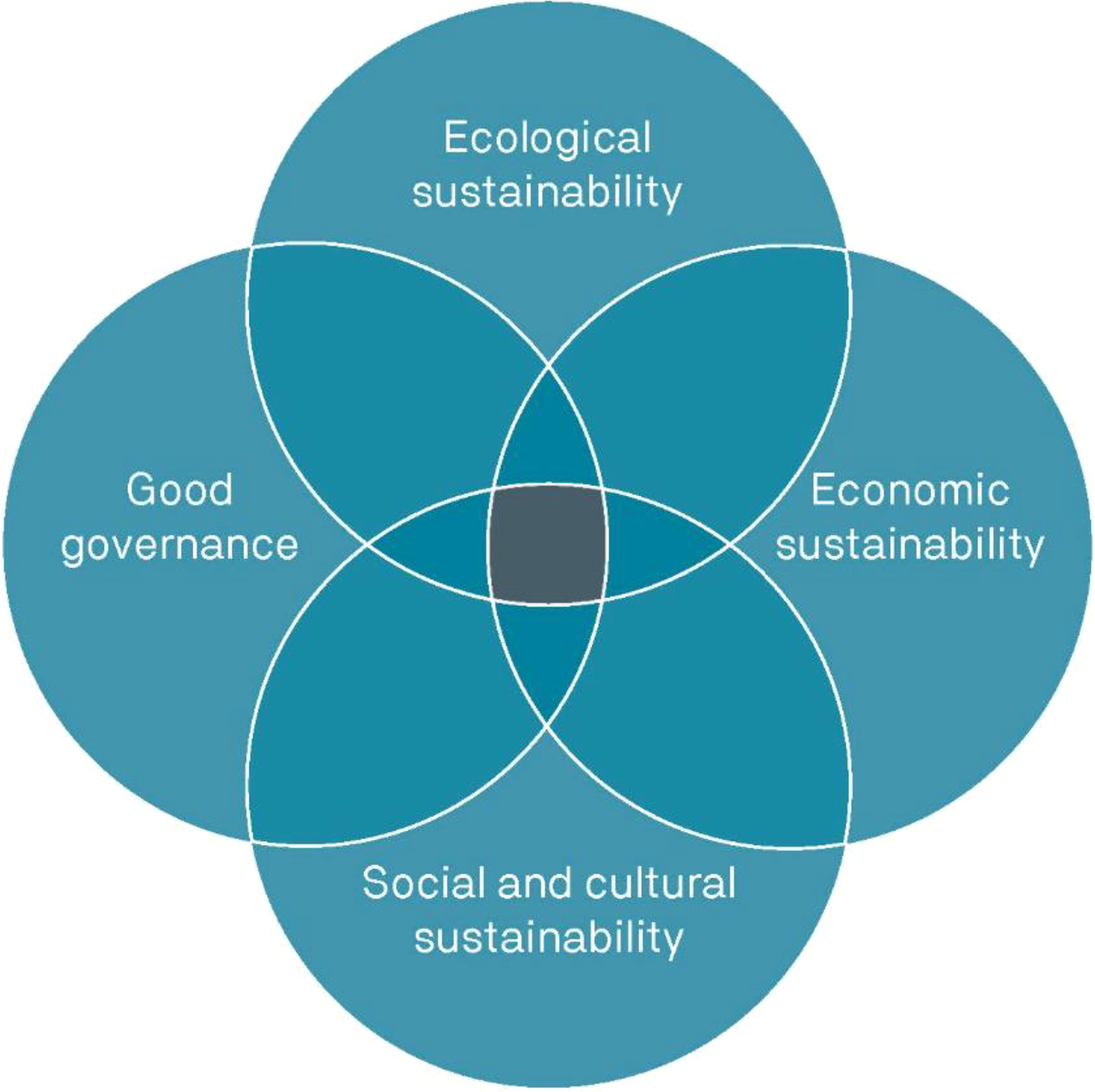
The four dimensions of sustainability.
This holistic view forms the base for our discussion of how sustainability as it relates to dimensions of ecology, economy, society/culture, and good governance is relevant in ECE. This does not imply that education for sustainability needs to address all four dimensions at the same time. Rather, education may focus on one or two, but it must not be in irreconcilable conflict with other dimensions of sustainable development. The following example from an ECE practice in Norway, presented by Holmvik (2019), illustrates the four dimensions: Like many other ECE institutions in Norway, the kindergarten called “The Blue Orange” wanted to stop using disposable shoe covers that parents wore when entering the building. The teachers’ primary aim was to prevent consumption and plastic waste. The kindergarten changed their routines and, rather than throwing away the used shoe covers at the end of the day, they started displaying them. After a while, some parents started to take off their shoes instead of using the shoe covers. The children picked up on this and described their parents’ actions. From the children’s descriptions of how their parents left their shoes on the doorstep instead of using the shoe covers, the teachers were able to change their way of implementing the concept of “no use of shoe covers.” Instead of removing the shoe covers or telling the parents not to use them, the children made the parents take off their shoes.
Approaching four dimensions of sustainability in ECE
In the introduction, we point to two contradictions when approaching sustainability in ECE: one is the problem of education for an unknown future, and the other is the contemporary and not so pleasant challenges of unsustainability that we must face. Such contradictions can be said to be an always present issue in education, in line with the well-known “paradox of education” (Løvlie, 2007a), in which education is seen as a preparation for the future but grows out of the past. It seems as though this paradox appears more relevant than ever when approaching education for sustainability (Wals & Corcoran, 2012). Approaching all four dimensions, as well as considering ways to increase the overlapping area in the middle, represents the opposite of approaching linear and single-based causality as is done in some early intervention programs that focus on fixing one “thing” to solve the problem, for example, the contemporary urbanized child’s disconnectedness to nature.
Despite emphasizing the overlapping area, we start by outlining our understanding of each dimension, and how they can be apparent, overlapping, and contradicting in ECE, building on research that describes how ECE approaches sustainability. The first dimension we present is good governance, operationalized in line with Biesta’s (2011a) outlines of educational cultures as room for qualification, socialization, and subjectification. The way research describes how ECE approaches sustainability, within all four dimensions, is seen in the light of our understanding of Biesta’s concepts.
Good governance
How to approach contradictions and conflicts is a recurring theme in sustainable education, often connected to the political dimension of sustainability, or what is often referred to as good governance. Håkansson et al. (2019) have carried out a research synthesis of how the political dimension can or should be staged in education for sustainable development (ESD) teaching and learning content. Their main result is synthesized in three approaches: a socially critical approach (SCA), a social learning approach (SLA), and a radical democratic approach (RDA). In all three approaches, conflicts are taken for granted, but whereas SCA and SLA tend to downplay conflicts with an aim to produce political sameness, RDA differs by claiming that consensus should not be the aim (Håkansson et al., 2019, p. 7). RDA often takes departure from Mouffe (2005) and the notion that democratic society has to create space for conflicts to meet contesting demands, make place for struggling hegemonic structures, and make room for different interpretations of sustainability in education. The emphasis on conflicts—instead of downplaying them—is in line with emphasizing the paradox of education and contradictions when all four dimensions of sustainability are at stake. Therefore, as several education researchers do (Lundegård & Wickman, 2012; Öhman & Öhman, 2013; Tofteland, 2018; Van Poeck, & Vandenabeele, 2012), we take on RDA when it comes to the political dimensions of sustainability. The political dimension, which corresponds to Mouffe’s (2005) concept of “police,” is understood as the system that is supposed to distribute power and make room for diversity, subjectivity, and multiple perspectives, conceptualized as good governance in Figure 1. In ECE, the “police” is organized through rules, structures, choice of content, plan for the day or the activities, and so on.
We take departure from Biesta, who looks to Mouffe. Biesta (2011b) claims—like the RDA approach—that consensus-oriented learning obliterates social differences for the sake of maintaining group unity, which excludes dissent. Biesta (2011b), with reference to Mouffe, also claims that society might miss the youngest or marginal stakeholders’ contributions when criteria for participation, such as verbal language, must be learned before these group experiences and views are taken into account. Conflicts are seen as important for challenging what’s taken for granted and for possibilities to find new solutions to contemporary problems. Thus, education appears as a risk: When not fully knowing the answers or providing room for more than we can plan for, we lose control, even though we are in charge of the education of the young generation. Instead of trying to avoid these problems, we embrace them, leaning on Biesta (2014), who emphasizes “the beautiful risk of education.”
We understand ECE as an educational culture, that is, a culture that aims to forward specific interests and values (Biesta, 2011a). In our case, the specific interest and values are sustainability, solidarity, and equity for coming generations. Values are not only a crucial concept in this approach but the turning point when planning and performing educational practices. Multidimensionality, diversity, and subjectivity, wherein multiple actors are met in temporal and spatial contexts, are required to promote sustainability, solidarity, and equity. Educational cultures are rapidly changing, as are culture and nature that education is a part of. Educational practices have to relate to changes and consider which changes to embrace, which to facilitate, and which to fight. To cope with these always present changes and how to meet them, Biesta (2011b) suggests that the values we aim to promote are the turning point for how to facilitate and meet changes. He differs between quantitative changes and qualitative changes. Quantitative changes are when a person acquires skills to be a part of the already existing culture, and thereby the number of persons who are a part of the educational culture increase. Qualitative changes are when the educational culture makes room for new ways of thinking and participation that help reach the values we pursue. By giving room to new ways of governing toward sustainability, the system changes, rather than the individual teacher or child. Such changes require agents of change and may easily involve conflicts, as emphasized in the RDA.
To conceptualize such changes, Biesta (2011a) outlines that educational cultures should emphasize socialization, qualification, and subjectification. Qualification is similar to the traditional understanding of learning, whereby learners gain established knowledge, techniques, skills, and dispositions. Traditionally, qualification has been the main aim of education, but often socialization is also seen as an important aspect in education. In ECE, socialization, which is understood as learning how to participate and behave in an established culture through dialogue among different people and activities, has a long tradition. Most educators approach these two as the central aspects in education. Biesta argues that a third aspect is needed, conceptualized as subjectification. This is about human freedom and the opportunities to come forward as an outsider of the established educational culture. Thus, subjectification appears as the opposite of socialization; it is about coming forward with something new—something that is seen as “not how we do it here,” something that challenges our common ways of facilitating thought and action. To obtain new solutions, education must embrace the “strange point of view” of newcomers to contribute toward qualitative changes. To obtain new insight, we need educational cultures that create and evolve in accordance with a range of varying participants who are living together in their contexts, in a “world of plurality and difference” (Biesta, 2006, p. 9). New insight needs agents of change who can disturb the existing educational culture and thereby facilitate qualitative changes and new solutions to sustainability.
When presenting research on sustainable education in ECE within each dimension, we look for overlaps and contradictions, quantitative and qualitative changes, socialization, qualification, and subjectification.
Ecological sustainability
Approaches to environmental education can be summarized as the development from education about the environment in the 1970s, through education in nature (1980s), and education for the environment (1990s) to a participatory focus in education for sustainability at the beginning of the millennium (Tilbury et al., 2005). Building on environmental education, education for ecological sustainability in ECE has been, and still is, worked with through all these aspects.
There is a focus on education in nature in large parts of the world, perhaps particularly strong in Scandinavia (Wagner & Einarsdottir, 2006), and it spreads through western cultures with approaches such as the forest schools (Elliott & Krusekopf, 2018). In Scandinavia, the focus is often on play in nature (Hammer, 2012, Hammer & He, 2016; Heggen, 2015, 2016; Sageidet, 2014). There seems to be an understanding that such play in nature provides opportunities for children to connect with nature in ways that will stay with them and affect their relationship with nature and nature conservation later in life (Carson, 1956; Chawla, 2006; Green et al., 2016). Studying children’s perception of nature, Hallås and Heggen (2018) interviewed children who regularly take part in pedagogical activities in nature, either as relatively free play in early childhood or in more structured approaches in first grade at school. In groups, the children were asked open questions, such as: Can you tell us about the nature here? In the answers, the children described the value of nature in itself, a more ecocentric view on nature than what is implied both in earlier research (Kahn, 2002) and in the concept of sustainability (Brundtland, 1987).
Education in nature includes learning about nature, reflecting the qualification aspect in accordance with Biesta’s terms. There are, however, cultural differences regarding learning about nature in ECE. Hammer and He (2016) showed in their comparative study that while ECE teachers in China provide opportunities for children to experience and learn science in structured activities, such as experiments, Norwegian ECE teachers argue for learning through free play in nature with a focus on the innocent childhood and outdoor life (“friluftsliv”). A poster in an international ECE institution in Norway asked in its headline: “How may children learn anything when they are outside all day?” Several notices about a variety of learning opportunities in nature, for example, in social and scientific learning, followed. This shows how cultural differences—such as emphasizing different learning contexts and methods for achieving sustainability—become evident when cultures meet and an overlap between ecological and social/cultural sustainability is depicted.
Teacher-led experiences, such as those described from China (Hammer & He, 2019), seem to form a contradiction to the Nordic approach to play. Despite the contradiction, it is hardly contested that there is a range of learning opportunities in both teacher-led activities and in free play. Considering Biesta’s concepts, both approaches can serve as qualification and socialization. In addition, both in structural learning activities and in play, children might come forward with something new or unexpected that could challenge our settled ways of thinking and serve for qualitative changes to meet unsustainability. A challenge is to handle the beautiful risk of education and to give room for emerging conflicts as outlined in the RDA and for children’s subjectivity as described by Biesta.
Outdoor learning in nature in early childhood in Norway is often expected to be curiosity-driven and based on children’s interests (Heggen & Lynngård, in press). While research shows that play in nature may affect children’s relationship with nature, the possible learning outcomes of these situations are debated (Ejbye-Ernst, 2011; Lynngård, 2015). As such, the dimension of qualification might be left out. However, there is a contemporary trend involving nature as a co-learner, for example, in eco-cultural conversations (Dickinson, 2016) or through the influence of place: learning in the world rather than about the world (Sverdrup & Myrstad, 2019). With an emphasis on the value of childhood and play in nature, it might be postulated that such situations imply a higher degree of autonomy for the children, suggesting a larger contribution from the children, which we frame within the dimension of good governance.
Arguing to view children as eco-citizens, Heggen et al. (2019) suggest implementing pedagogical activities around farming, gathering of wild food, or children’s literature. Letting children grow their own food may provide insights into complex ecological systems. Composting organic waste and using the soil to grow new vegetables may lead to an insight into where food comes from as well as provide an emerging understanding of the carbon cycle. Heggen et al. (2019) argue that through emancipatory methods in farming activities, children may see an increased value in the vegetables (economic sustainability); the joint work for a common good implies cooperative traits necessary in social sustainability; and they are gaining ecological competence. If we view farming as economically beneficial, we trace an overlap among the ecological, social/cultural, and economic dimensions. By following the children’s curiosity and reflections in such activities, Krempig and Utsi (2017) have shown that children can contribute to the joint learning of both adults and children, framing such approaches within the political dimension. Viewing gardening approaches as valuable nature experiences in early childhood implies that these may occur in urban gardening in differing cultural contexts (Sageidet et al., 2018). Thus, we can trace an overlap among the ecological and social/cultural dimensions. Considering Biesta’s concepts, the gardening activities in nature often emerge as qualification and socialization for future citizens, although traces of subjectification are facilitated by the way the activities are performed and organized that make room for qualitative changes and more equity among teachers’ and children’s contributions. Therefore, these activities could be seen to represent the overlapping area in Figure 1.
Social and cultural sustainability
Social and cultural sustainability points to a development that ensures safety, social rights, and good living conditions—equal rights for all. These concern class, gender, ethnicity, religion, and culture. Social sustainability has also been defined as “a life-promoting state within communities, and a process within communities that can achieve this condition” (McKenzie, 2004, p. 12). In the context of ECE, one might see social/cultural sustainability when creating surroundings that include and stimulate positive interactions, such as trying to promote a sense of community and a feeling of belonging to the community where we live. In short, it is feeling safe and attached to the local area. This holds common references within the group of children, but works as well for contact across groups and generations (Horrigmo, 2014; Løvlie, 2007b; Mannion & Adey, 2011).
ECEs most often aim to contribute to children’s interest in civil society and to facilitate attitudes that can strengthen their social capital and create confidence in themselves as participants in community life and build trust in the communities they are part of (Horrigmo, 2014). Another task is social equalization: the kindergarten should help to level out social differences. Social capital can be viewed as a starting point for participation in civil society (or community life or voluntary participation—or whatever we call these kinds of ties between actors in a local community). Putnam (2001, 2007) refers to social networks and the standards of mutual dependence and trust. Social capital in our sense may be about knowing the place where we are, and what qualities and resources exist in the local environment around the ECE institution. Granovetter (1977) points out the cohesive power of “weak ties,” meaning that it is not only close relations that develop our trust in our surroundings. Social capital exists in relationships and it is both an individual advantage and a collective benefit. According to Biesta, the aim of increasing social capital seems to be similar to solidarity, equity, and sustainability through socialization.
ECE teachers can facilitate different social relationships among parents through joint activities, by inviting them into the kindergarten, and by giving them more access to the staff’s taken-for-granted knowledge about the kindergarten and what is going on there. It might help to strengthen the social capital of newly arrived families in the form of social affiliation, membership, relations, and networks. This can be linked to the concept of community trust (Glanville & Paxton, 2007). This kind of local place-based trust is closely connected to problem-solving in the local community. In ECE institutions, locally based everyday problems that are relevant to young children arise. Problem-solving often emerges from contradictions or conflicts and can therefore be close to the RDA and might serve as ways to facilitate qualitative changes in ECE cultures.
The above ways to educate, involving social and cultural sustainability form a contrast to solidarity campaigns that are common in many ECE practices. The common focus on the need for the “rich” children to be kind and give to “the poor and needy children” in other areas of the world imposes a feeling of “us” and “the others” (Børhaug & Bakken, 2009; Tabulawa, 2003). Tabulawa (2003) also poses a critique to the compound of international aid agencies, learner-centered pedagogy, and political democratization. He argues that learner-centered pedagogy is a political artifact, an ideology, a worldview about how society should be organized. Because it is inherently ideological, justification of the pedagogy on educational grounds is questionable, he claims. The basic premise is that learner-centered pedagogy given by aid agencies is used to promote democracy, an approach to democracy that forms a necessary condition for the development of a free-market economy. The hidden agenda, Tabulawa argues, is to alter the “modes of thought” and practices of those in the periphery states so that they look at reality in the same way(s) as those in the core states. It thus promotes westernization in the form of individualist and capitalistic ideology, he states. Considering Biesta’s concepts, these campaigns are embedded in education and can be understood as qualification and socialization by learning how to participate in the ideological, capitalistic society at the same time as establishing distinguishable borders between the ones that are a part of the system and the outsiders—“us” and “the others.” Here, there is limited room for subjectification or new ways of thinking.
Further, local- and cultural-based problems—and thereby relevant for children—are often left out of these campaigns. Fernando (2001) problematizes how the UN Convention on the Rights of the Child (CRC) and work for children’s rights are not very sensitive to social and cultural diversity. Fernando (2001) claims that isolating children’s rights issues from issues of class, race, and gender has become a convenient means of avoiding direct engagement with the political and economic realities of the emerging global economy—and thereby putting the economic dimension at stake. He refers to how discussions on the study of power relations in the current children’s rights discourse are structured in binary terms, such as the powerful versus the powerless. According to Fernando (2001), this way of homogenizing and systemizing the experiences of children in different contexts, in turn, leads to the legitimization of Eurocentric/universalistic policy interventions. Nongovernmental aid organizations (NGOs) are dependent on private donors as well as structures and policies—and their work partly provides ideological legitimacy for the state to reduce subsidies for welfare and social services, such as health and education. NGO activities do not compensate for the loss of provisions for children due to the dismantling of the welfare state. “This raises the issue as to whether the ‘NGOization’ of children’s rights is in fact providing legitimacy for the neoliberal ideology of the state that underpins the reduction of state welfare provisions for children” (Fernando, 2001, p. 14). In addition, children might lose their jobs due to the closure of sweatshops and simply end up worse off, because there is a difference between advocating for an awareness of and improving the rights of children—striving to create an alternative social and economic order in which such violations would not exist. A contradiction between an understanding of good governance as an individual fulfillment of legal rights, social/cultural sustainability, and economic sustainability emerges. Even if Article 32 in the CRC states that children have the right to be protected from child labor, it does not necessarily benefit these children to be “exempt” from work. Many children have neither work income, welfare benefits, nor access to nature as a provider for food, and thus have few alternative ways of coping. The cultural part of education that Biesta emphasizes is not evident, and therefore these aid campaigns seem closer to qualification, socialization, and colonization than to qualitative changes. Despite the good intentions, they do not facilitate more equity. Referring to Figure 1, there seems to be irreconcilable conflicts among the four dimensions in the overlapping area.
Economic sustainability
Our understanding of ECE for economic sustainability consists of three topics that partly overlap: economy, consumption, and value, which will naturally vary from one country to another, and within a country, depending on the economic situation of the children’s families and society. While ECE in poor areas might concentrate on developing capacities for children and their families to fight poverty, the focus might be on reducing consumption in wealthy areas.
An understanding of economy, in terms of money and its value, has been considered part of education for economic sustainability, wherein play with make-believe money is common (Folque & Oliveira, 2016; Kultti et al., 2016; Mogharreban & Green, 2016). In some of these cases, children were invited to make decisions regarding what to buy, or they sold goods or food, which they or their families had produced. In addition, a focus on restricting water, electricity, and paper consumption was presented as education for economic and ecological sustainability (Siraj-Blatchford et al., 2016). The educational aims in these cases were to learn about monetary value and that choices need to be made when access to money is limited. By allowing children to be involved in actual purchasing, but also in play and games that involve mimicking purchasing, children learn and experience the value of money, and that money is not an endless resource, and that choices need to be made. The children become familiar with purchasing and may be introduced to capitalism through discussions on why there are poor and rich countries, or poor and rich people. In Biesta’s terms, the children become acquainted with established practice—a form of qualification—but such activities can also be seen as socialization, depending on whether the practice is seen as established and which practice is in mind.
Another topic linked to economics is to bring children’s attention to the uneven distribution of wealth (Santone, 2013), which is a topic inside the overlap between the social/cultural dimension and the economic dimension in Figure 1. A project with children aged 6 and 7 in Australia showed that even young children may adopt society’s stereotypes and prejudices about the poor (Hammond et al., 2015). Yet, facilitating productive discussions with the children revealed they were capable of theorizing about poverty and social justice, reasoning and reflecting on solutions to a complex and, for them, a novel problem. Their way of facilitating productive discussions points to the dimension of good governance that makes room for subjectification, as Biesta terms it, since the children made unexpected reasoning and solutions.
Some kindergartens in wealthy countries or wealthy neighborhoods support children or kindergartens in poor countries. The idea is to socialize children into solidarity with poor children. In principle, this is considered a good thing, but concerns about how poor people and children are presented, for instance, as pitiful and lacking skills, have been raised (Børhaug & Bakken, 2009). On the contrary, Wood (2013) suggests that bringing attention to lives lived generations ago or lives lived with much less in the way of resources can give hope to people, showing them that happy lives are indeed possible without the immense wealth that too many people are used to. This means that people who are poor but who enjoy healthy and rewarding lives can be a resource in achieving change and an adjustment to a sustainable future. Solidarity and learning ways of living with fewer resources overlaps well with the dimension of social/cultural sustainability and ecological sustainability. In order to become an agent of change and disturb our understanding of how our society should be, children can be exposed to ideas that show that things may work differently, such as seeing that other ways of living can be rewarding and bring hope, and that there are many activities that are fun and leave no ecological footprint. Presenting such ideas can make room for even more ideas for qualitative changes, in line with Biesta’s notion of subjectification.
Closely linked to the topic of economics is that of consumption, our second topic in education for economic sustainability. Consumption is a threat to ecological sustainability, because of contamination issues and the overexploitation of natural resources. In addition, it identifies an equity problem, which overlaps with social sustainability. In ECE for economic sustainability, we suggest that consumption be addressed as described above: exploring what a rewarding life might be in the past or in places with fewer resources, and where consumption is significantly lower. Another approach is to make children reflect on the difference between what they need and what they want to be happy and healthy (Santone, 2013). Other ways of addressing consumption are through saving, sharing, reusing, and recycling, and through repairing broken things, whereby children can, for instance, learn to differentiate in recycling and see that waste can go back into production (Siraj-Blatchford et al., 2016). We argue that children can also be involved in reflecting on the amount of waste produced and what is disposed in the kindergarten, at home, and in their hometown, associating this with issues of consumption. Excessive packaging and low-quality products are two examples of what can be explored. Children can be introduced to alternatives to consumption, such as repairing, reusing, and sharing goods (Kultti et al., 2016). We place these examples in the overlapping area between the economic and the ecological dimensions in Figure 1.
Value is the third key topic in our understanding of ECE for economic sustainability: to cherish or value things, craftsmanship, and activities may imply a low or even no ecological footprint. Craftsmanship has been suggested as one way to counteract a throwaway mentality, by letting children experience how much effort it takes to create a product (Siraj-Blatchford et al., 2016). For instance, a kindergarten let the children craft their own sheath knives to focus on utility value rather than economic value (Heggen, 2016), which indicates an overlap between the economic and the social/cultural dimensions. The social/cultural dimension is represented by the heritage of culturally developed craftsmanship. Children have also been motivated to collect “treasures,” such as beautiful rocks and nice sticks found during walks (Heggen, 2016). In Norway, where water is available and abundant, children love playing with water, which has been associated with ECE for economic sustainability, and represents activities that touch upon all four dimensions for sustainability (Grindheim et al., in press).
The topic of the economy includes an early understanding of the economy and monetary value, representing the economic dimension. Equally important is the aspect of equity in terms of standard of living and fairness, both locally and globally, which represents good governance. Consumption focuses first of all on education on how to reduce consumption through sharing, reusing, repairing, and recycling, but also on activities that encourage respect for produced objects and the need to take care of these objects and thereby the social/cultural dimension is evident. The third topic, value, is about emphasizing the utility value rather than the economic value, and it promotes activities that make children happy without making a significant ecological footprint, and thereby the ecological dimension is depicted. We can see that these activities represent the overlapping area in Figure 1.
Summing up overlaps and contradictions
There seems to be consensus that education can contribute to sustainability. We also depict an agreement that distribution of natural and cultural resources is vitally important for engagement for sustainability. In addition, the economy and belonging in a culture and a society emerges as important for engagement with sustainability. Approaching earlier research about sustainability from these four dimensions depicts a variety of relevant activities, such as playing in nature, learning about nature, gardening, composting, and facilitating positive relations and social networks among children and ECE, among parents and ECE, and among places and humans to establish locally based trust, solidarity campaigns, play with make-believe money, bringing attention to lives lived generations ago with fewer resources, learning craftsmanship, saving, sharing, reusing, and recycling. From this, we suggest that finding activities to educate for sustainability that is of relevance for children is possible and can meet the demand of overlapping the ecological, social/cultural, and economic dimensions. A challenge arises in that the variety of activities can both reproduce problems and make room for new solutions, depending on how they are governed in the locally based everyday life in ECE institutions. It is also of interest that overlaps are easy to spot, but contradictions mostly emerge from the research within the social/cultural dimension—perhaps because conflicts are underplayed. Emphasizing the need for change, we suggest also taking good local governance from an RDA perspective and Biesta’s concepts into the discussion of how to promote qualitative changes.
How are all four dimensions relevant?
When facing the challenges where sustainable activities that involve ecology, economy, and social science can both reproduce problems and make room for new solutions, the question of how to educate toward increased sustainability is at stake (Sterling, 2010; Wals, 2012). Several researchers argue for didactical practices that move from transmissive toward transformative learning (Percy-Smith & Burns, 2013; Sterling, 2010) and an emancipatory approach. They argue that it is insufficient to simply treat ESD as another body of knowledge for young people to learn; instead, there needs to be a more transformative approach to learning about sustainability that develops in young people a culture and consciousness for critical learning and action, as active agents of change for increased sustainability. Thus, we are touching the dimension of good governance in Figure 1.
Despite the emancipatory approach, most strategies seem, as Håkansson et al. (2019) state, to underplay conflicts and seek consensus, and thereby the aspect of subjectification is underplayed. In seeking to make sense of conflicts as opportunities for students to act as agents of change, the authors are concerned with how young people can be involved through more than just articulating a view. Percy-Smith and Burns (2013) discuss the importance of spaces for initiative and action, and a culture of seeing and supporting young people as active and competent citizens are necessary conditions for young people to participate as agents of change (Davis & Elliot, 2014). In Biesta’s terms, we may call this demand for agents of change as a demand for room for subjectification.
Despite some progress, the goal of transformative learning and emancipatory practice has been difficult to achieve in practice. In part, this appears to be the result of an emphasis on knowledge acquisition for the future rather than learning what is usable and useful in the here-and-now. A review of research finds that although the aim is to improve children’s opportunities to act as agents of change (Wals, 2012), the practices are often on teaching the children facts about the environment (Hedefalk et al., 2015). Learning facts would be a reasonable basis if knowledge changes attitudes and leads to actions; there is, however, little evidence for this causality (Kollmuss & Agyeman, 2002). This can be explained from the problem of identifying purpose or direction in transformative and emancipatory perspectives.
Sterling (2010) draws on mutually dependent aspects from instrumental and intrinsic perspectives, as well as from resilience and social learning theory. He underlines inter- and transdisciplinarity, an emphasis on real-life problems, and the fluid boundaries between institution and community. This seems to be similar to what Wals (2012) denotes as postnormal environmental education, which is inspired by the philosophy of postnormal science. The overall idea of postnormal science is that environmental problems are often associated with complexity, uncertainty, and contradicting views, so that a best solution does not necessarily exist. This implies that policy-making should draw on both experts and a democratic approach involving citizens (Funtowicz & Ravetz, 1993). While postnormal science deals with the interface between science and decision-making, Hauge and Barwell (2017) argue that education can prepare students for playing the citizen role in postnormal science. They emphasize that working with societal issues with high stakes and contradictory views is essential for this aim, whereby students are allowed to disagree. In addition, they call for multidisciplinary approaches in education, although their point of departure was mathematics education. Similarly, Wals (2012) calls for a postnormal environmental education that facilitates transdisciplinary and democratic thinking on environmental problems, whereby children learn to cope with disagreements respectfully. He concludes that sustainable development requires learning that leads to “a ‘new’ kind of thinking, alternative values, and co-created, creative solutions, co-owned by more reflexive citizens in a more reflexive and resilient society” (pp. 637–638). This seems to be similar to Biesta’s arguments for making room for subjectification in ECE education. Our understanding of ECE for sustainability, wherein the dimension of good governance is central for teaching and learning issues of sustainability, is thereby in line with a postnormal environmental education and with RDA, which both emphasize the role of conflicts and that disagreements should be allowed.
The perspective of a postnormal environmental education is related to science education and not frequently referred to when approaching sustainability in ECE. On the other hand, there is educational research approaching young children’s resistance as ways of performing their citizenship as agents in their own and in other people’s lives (Grindheim, 2014; James, 2011). These similarities illustrate a demand across disciplines for education and education research related to children as agents of change, and they also suggest a need for developing transdisciplinary perspectives in education for sustainability. These demands call for several dimensions that include many disciplines to cover the ecological, economic, and social/cultural dimensions. In addition, multiple stakeholders, including young children, emerge as relevant contributors for how to meet the contemporary challenges of sustainability. The demand to meet the contemporary challenges of sustainability requires educational cultures that emphasize more than qualification and socialization. Agents of change as subjectification are to be facilitated and welcomed.
Closing remarks
Taking departure from Biesta, we explore the challenges of sustainability and education for sustainability. The traced challenges point to passing on cultural tools and knowledge to the next generation (qualification) at the same time as facing an unknown future and contemporary problems. Education within all dimensions points to the need to emphasize local belonging and global challenges, teachers and children as agents of change (subjectification), and eco-centeredness. Interdisciplinary curricula and pedagogical practices emerge as important. Looking into research framed by the dimensions in Figure 1, both ways of governing activities and the content of activities point to possibilities of incorporating new ways to solve problems.
We conclude that the multidimensional and contradictory challenges of education for sustainability in ECE call for an overlap of all four dimensions of sustainability. This implies pedagogical practices emphasizing real-life problems that illustrate the ecological, economic, and social/culture dimensions as well as the dimension of good governance. To meet the paradox of education, good governance calls for didactical practices that make room for unexpected contributions from children who are not yet socialized into established ways of solving contemporary sustainable challenges. Contradictions and conflicts are to be welcomed and dealt with instead of being underplayed. We welcome research that elaborates and discusses such practices, meeting both the challenge to educate for an unknown future and to face everyday problems that are also considered global challenges, such as inequity, lack of solidarity, and unsustainability, at the same time as not curbing hope and a cheerful childhood.
Sustainability issues are often associated with risk because there are no quick fixes to solve problems, which can cause unease and a feeling of hopelessness. We recognize that careful consideration is necessary, showing that small steps matter, to ensure hope for the future by making room for children to be agents of change in relevant activities in their everyday life without handing over the failures from earlier generations. Taking departure from RDA as good governance, our main contributions are that conflicts among children as well as among children and teachers are to be welcomed to meet the challenges of sustainability. We identify the overlapping area in the middle of Figure 1 when real-life activities relate to nature, society/culture, economy, and good governance. Ways of facilitating these real-life activities become highly relevant in making room for agents of change through subjectification. This brings hope that the overlapping portions of the circles can be widened.
Footnotes
Declaration of conflicting interests
The author(s) declared no potential conflicts of interest with respect to the research, authorship, and/or publication of this article.
Funding
The author(s) received no financial support for the research, authorship, and/or publication of this article.