



Abstract
Purpose
This study has two objectives. The first is to describe the conceptual diversification embedded in reported documentation of teacher educators regarding the conception/phenomenon of good question-asking. Second, based on systematically observed and qualitatively analyzed diversifications, this study aims to portray the conceptual sophistication of participants’ experience-based awareness of good question-asking by constructing a hierarchical illustration.
Design/Approach/Methods
A total of 56 participants were selected based on a maximum variation strategy to capture more diversified conceptions of good question-asking. Qualitative data were collected through one-on-one phenomenographic interviews. Inductive data analysis was conducted in three phases: open coding (extracting ways of experiencing), axial coding (collapsing categories of descriptions), and diagrammatizing (establishing an outcome space).
Findings
Seven conceptual meaning clusters were gathered around four hierarchically sophisticated themes: monological (level-1 sophistication, “lowest”) (diagnostic tool), declarative (level-2 sophistication) (cognitive-emotional, pre-organizer), dialogical (level-3 sophistication) (structural qualities, typological qualities, multivocality, negotiation, internalization), and metacognitive (level-4 sophistication, “highest”) (pedagogical content knowledge of question-asking and teachers’ meta-noticing regarding question-asking).
Originality/Value
Participants’ conceptions of good question-asking showed monological and dialogical dimensions in addition to transitional (declarative) and metacognitive comprehensions. Educational recommendations are offered, especially for developing teacher educators’ question-asking noticing.
Question-asking in the classroom is a central part of educational dialogue. Regarding systematic reviews and the general pace of studies on educational dialogue, it can be claimed that the question-asking phenomenon is chiefly informed by research conducted in science or mathematics classrooms (Göçer & Kurt, 2022). For instance, most of the relevant citations received by science educators were related to question-asking in the classroom (e.g., Chin, 2006, 2007) based on state-of-the-art bibliometric analysis (e.g., Göçer & Kurt, 2022). As expected, a vast number of research studies concerning academically productive classroom question-asking have been published in highly prestigious science education journals such as Journal of Research in Science Teaching, International Journal of Science Education, Science Education, or Studies in Science Education (Göçer & Kurt, 2022).
This phenomenon can be explained by the claim that science and mathematics lessons in elementary or secondary school may include more discussable contents through which teachers may provide enlarged dialogical spaces, where alternative or competing viewpoints (e.g., Soysal, 2023b) are considered and tested mainly through question-asking. In the current study's context, the critical point was not exploring why the question-asking phenomenon in primary, elementary, and secondary science and mathematics—or in other areas—was well explored and understood. Rather, the present study chose to examine why teacher educators’ instructional practices that may be triggered and maintained through question-asking were uncharted territory. Recent studies have established an evidence-based linkage between teacher educators’ good question-asking practices as initiators of academically productive educational dialogue and prospective teachers’ conceptual and academic gains (e.g., Douglas et al., 2023; Soysal, 2023a; Soysal & Soysal, 2023). However, these studies have not investigated the complexity of teacher educators’ mental models with regard to conducting educational dialoguing through classroom question-asking. It is widely accepted that higher education teachers’ cognitive schemes, as well as their conceptual understanding of classroom teaching, can indicate their in-class teaching strategies (e.g., question-asking) (Goodwin & Kosnik, 2013). Therefore, delving into the diversity and complexity embedded in teacher educators’ experience-based conceptions about question-asking could move the field forward because documenting and clarifying a given phenomenon that requires explanation is the first step in theory building (Borsboom et al., 2021). The current study attempted to address this gap by taking a phenomenographic stance based on the justifications (stated further ahead).
Justification for the study
One reason for the above-mentioned problem is that teacher educators’ pedagogical awareness of teaching via question-asking has remained mostly unexplored (e.g., Soysal, 2023a; Soysal & Soysal, 2023). Previously, regarding teaching in higher education, Murray and Kosnik (2011) and Murray (2005) stressed that teacher educators’ teaching roles had received inadequate research attention or that they were not well understood as a professional community; they thus presented a mystery of higher education or a missing paradigm of (teaching) higher education (Darling-Hammond, 2006).
More importantly, the present study centralizes that there are concrete distances between “teaching science or mathematics” or “other content areas” to children and “teaching how to teach, for instance, science and mathematics to children” staying at different developmental stages or displaying individual differences. In teacher-preparation lessons, teacher educators share a specific phenomenon with prospective teachers: teaching “how to teach.” In this context, Goodwin and Kosnik (2013) stressed that teacher educators’ transition from being K-12 (kindergarten to secondary school) teachers to teacher educators is considered “taken-for-granted” even though there are pretty considerable differences in these teaching zones (Vanassche & Kelchtermans, 2016). In other words, for instance, question-asking in the classroom does not convey the same meaning for “K-12” and “higher education” lessons from the lenses of question-askers as that for “teachers” and “teacher educators.” It must be noted that being skilled in question-asking at elementary or secondary school levels does not automatically translate into being generative at higher education levels (Zeichner, 2005). As anticipated, the latter context, which involves practicing question-asking in educational dialogues for teaching “how to teach” contents and skills to teacher candidates, would be more sophisticated and demanding and involves complex social and institutional interactions (Bullock & Christou, 2009) compared to question-asking in educational dialogues enacted in, for instance, elementary school lessons. Therefore, researching teacher educators’ experience-based conceptions of good question-asking for academically productive classroom dialoguing and philosophizing ideas (or good question-asking) would be a pragmatic approach to shed light on an under-researched and emerging area of inquiry.
Recent studies have confirmed the aforementioned qualitative nuances in teaching via question-asking at different educational levels. For instance, Douglas et al. (2023) listed some barriers that can hinder academically productive classroom dialogue via question-asking in higher education settings. The challenges in academic discourse via question-asking, summarized by Douglas et al. (2023), confirmed that question-asking in pre-higher education and higher education shows fundamental qualitative nuances. Douglas et al. (2023) listed barriers such as active student participation in the dialoguing of ideas. They found that this problem could be attributable to student comfort and etiquette issues. This implies that teacher educators’ question-asking strategies must create an ethos of mutual respect in the classroom and that alternative ideas must be considered seriously by avoiding sarcastic Socratic question-asking. Douglas et al. (2023) also indicated that students might lack the motivation to actively respond to teacher educators’ challenging or cognitively demanding questions. Moreover, educational logistics, including compatible equipment, should be prioritized in online courses in order to facilitate good question-asking in higher education because educational dialoguing via question-asking requires genuine social interactions and verbal exchanges, which online course platforms may hinder. Douglas et al. (2023) also reported that academically productive educational dialoguing via question-asking could be hindered by overloaded higher education curricula and accountability issues (e.g., differences in pacing and course progress). All these hurdles show that the nature and structures of good or academically productive question-asking incorporate different qualities compared to other educational levels.
Therefore, this study offers a pedagogical conceptual perspective of good question-asking from the perspective of teacher educators. The pedagogical-conceptual perspective implies that the current study demonstrates the diversity and complexity of experience-based pedagogically oriented conceptions of teacher educators with regard to good question-asking. While teaching “how to teach” classes, teacher educators may enact diverse instructional strategies (e.g., direct lecturing, triadic dialoguing, demonstration, discussion, guided inquiry, cooperative teaching, role-playing, project-based teaching, and argument-based or argument-driven inquiry) (Cornelius-White & Harbaugh, 2009) to build candidate teachers’ initial pedagogical content knowledge (PCK), thus enabling them to be better instructional designers. Previous research has shown that these instructional strategies are mainly surrounded by teacher questions (e.g., Menayni & Merabti, 2020). In other words, classroom question-asking, where “how to teach” concepts and practices are discussed and exemplified, is a building block of the implemented teaching strategy. Metaphorically speaking, if the relevant teaching strategy is a building, each question surrounding it is one of its analytical bricks. Thus, teacher-led question-asking cannot be viewed as a mere teaching strategy. Instead, it is a comprehensive enactment by educators to actualize the teaching activity, and it can be handled by a version of the teaching strategy described above.
The present study explored the complexity of teacher educators’ pedagogical recommendations regarding good classroom question-asking (explained further in this paper) from a phenomenographic perspective. It should be noted that, in the present study, teacher educators’ conceptual recommendations were captured for prospective teachers. Therefore, one specific question should be asked herein. To what extent or at which complexity level do teacher educators possess an explicit (or conscious) pedagogically oriented conceptual awareness regarding good question-asking strategies that prospective teachers must employ in their future classrooms? (Chan et al., 2021; Soysal & Soysal, 2023). Some teacher educators may have the opportunity to observe, analyze, and interpret their own or one another's in-class question-asking activities and make sense of question-based dialoguing in classroom conversations (van Es & Sherin, 2021). However, other teacher educators may employ intuitive reasoning and primarily experiential propositions for conducting good classroom question-asking (Boissin et al., 2021). Teacher educators’ experience-based conceptions of question-asking regulate their conceptual recommendations for academically productive classroom dialogues, which are governed mainly by their question-asking capacity and capability. In this context, the current phenomenographic study aimed to diagrammatize the hierarchical complexity of teacher educators’ good question-asking conceptions for instructional aims, which prospective teachers could operate in their future classrooms. Therefore, the present study could advance the field as it is worthwhile to unpack teacher educators’ varying degrees of conceptual awareness regarding a unifying instructional phenomenon—that is, question-asking—which can be operated at every single moment of a lesson.
High-quality question-asking involves multifaceted and complex pedagogical adjustments and conceptualizations (van Es & Sherin, 2021). In classroom conversations, verbal or nonverbal exchanges may not develop by following specific sequences (Hattie, 2012). A significant portion of classroom question-asking develops and continues spontaneously. Therefore, educators’ decisions regarding question-asking strategies may change constantly (even for seconds) and can be restructured. Therefore, there are critical micro-moments for asking questions, and these moments should be felt, worked on, and conceptualized by teacher educators in order to produce better question-asking (van Es & Sherin, 2021). However, this process requires considerable intellectual effort. In the context of question-asking, pedagogic awareness development is associated with what teacher educators notice when viewing conversations in their classrooms or another educator's classroom and how much they can conceptualize them instructionally (Stahnke et al., 2016). A teacher educator who looks at conversations in the classroom from an outsider's perspective may be bombarded with pedagogical sensory data. Studies have shown that analyzing classroom conversations or making sense of visual classroom data is a dizzying activity (Sherin, 2017). Therefore, teacher educators should be able to select, analyze, and conceptualize critical and non-important incidents related to question-asking in detail. However, it is still unknown which themes of classroom question-asking are embedded in teacher educators’ cognition and externalized as their conceptions of good question-asking. Previous phenomenographic perspective-based higher education studies dealt with university educators’ conceptions of teaching and learning (e.g., Bruggeman et al., 2022; Samuelowicz & Bain, 2001). Therefore, an understanding of teacher educators’ good question-asking conceptions is uncharted territory. Consequently, it is imperative to explore teacher educators’ conceptual externalizations for good question-asking.
Conceptual framework
Numerous studies have dealt with the instrumentality of question-asking in the classroom for fostering students’ cognitive contributions to topics under discussion. Three leading points have emerged in reviews of state-of-the-art literature on good question-asking. These three categories are the structural qualities of teacher questions, discursive functions of teacher questions, and teacher-led cognitive demands embedded in teacher questions.
Structural qualities of in-class question-asking
The structure of a given question plays a crucial role in determining its quality. Questions can be broadly categorized as open- or closed-ended (Kayima & Jakobsen, 2020). Open-ended questions are useful for eliciting diverse and detailed student responses. These questions lead to more profound discussions and enhance conceptual understanding (Boyd, 2015). In contrast, closed-ended questions have predetermined answers known to the teacher and often fail to stimulate deep thinking or conceptual growth. Overuse of closed-ended questions in the classroom can reduce cognitive effort and hinder students’ genuine intellectual development. Consequently, teachers must employ open-ended questions to encourage critical thinking and foster meaningful learning experiences in their students (Boyd & Markarian, 2015).
Compared to closed-ended questions, open-ended questions are generally more favorable for encouraging students’ cognitive contributions (Smart & Marshall, 2013). However, another crucial factor that significantly influences question-asking quality is the contingency of teachers’ questions (Molinari et al., 2013). Contingency refers to how teachers proceed with questioning after receiving the students’ answers. They can either follow a predetermined sequence of questions or adapt their subsequent questions based on the response content (Boyd & Rubin, 2006). The teacher's contingency approach determines whether the lesson aligns with students’ unexpected or alternative responses or remains bound to the teacher's predetermined agenda.
By utilizing contingent questions, whether open- or closed-ended, teachers can guide lessons according to students’ developed mental schemas regarding the discussed topic. This approach significantly enhances students’ academic outcomes by allowing them to clarify, discuss, and negotiate alternative, invalid, incomplete, or competing propositions (Littleton & Mercer, 2013). This is one of the fundamental principles of intentional conceptual change. Consequently, teacher questions should be reclassified into four categories: open-ended non-contingent, open-ended contingent, closed-ended non-contingent, and closed-ended contingent. Previous research suggests that, compared to open-ended non-contingent questions, closed-ended contingent questions can more effectively scaffold student engagement in academically productive classroom discourse (Boyd & Rubin, 2006).
Discursive functions of teacher questions
The structural qualities of classroom question-asking indicate the goodness of teachers’ asked questions. However, the discursive typologies of the questions asked in the classroom may present a profound picture of good question-asking. Teachers can employ question-asking techniques for specific teaching goals (e.g., seeking clarification, prompting students to reframe their responses, or probing deeper into their understanding) (Bansal, 2018). Monitoring questions can allow teachers to engage students in actively following ongoing classroom discourse and help students understand why the teacher may emphasize a particular idea (Tang, 2017). Discrepant questions encourage higher-order thinking by challenging students to consider alternative perspectives and engage in alternative ways of thinking and discussion (Osborne, 2019). Legitimating questions facilitate critical thinking by encouraging students to actively listen, analyze, and critique alternative or competing propositions (Hennessy et al., 2021). Finally, evidencing questions guide students in substantiating their claims with comprehensive and relevant data, thus discouraging the presentation of unsupported assertions (Jadallah et al., 2011). Note that these different question functions should be thoughtfully and flexibly integrated within a lesson to facilitate intellectually productive discussions. Research suggests that contextually relevant combinations of these functions are vital for fostering higher-order reasoning and intellectual growth among students (Soysal & Yilmaz-Tuzun, 2023). Therefore, teachers should carefully select and employ question function typologies that align with their classroom teaching goals and learning objectives.
Presumable cognitive demands embedded in teacher questions
The concept of good question-asking can also be understood in terms of the cognitive requirements necessary for classroom questioning. These cognitive demands refer to the varying mental processing levels teachers can elicit from students through their questions (Hallman-Thrasher & Spangler, 2020). For instance, a science teacher educator might ask prospective teachers to define “heat” and “temperature.” This question places a low cognitive demand on students, as they can recall the text-based definitions of these concepts. Conversely, let us suppose that the educator asks a question about the relationship between heat and temperature in the context of phenomena such as evaporation or boiling. In this case, prospective teachers are compelled to engage in deeper reasoning by considering the molecular-level kinetic actions that occur during the boiling or evaporation of a liquid. In other words, in response to this question, prospective teachers must contemplate both the micro and macro aspects of substances to explain the phenomena being addressed.
Furthermore, educators may investigate how elementary or middle school science students can enhance their understanding of heat, temperature, and connections through teaching activities designed by prospective teachers. In this case, the pedagogical question-asking raises the expected cognitive demand placed on the prospective teachers. In addition to comprehending substances’ micro and macro interactions, they must also explore strategies for constructing PCK to effectively teach abstract concepts such as heat and temperature as well as their relationships while incorporating real-world phenomena such as evaporation and boiling.
It is often suggested that teacher educators should structure their lessons using highly cognitively demanding questions. However, previous research has indicated that bombarding students with frequent and highly demanding questions can lead to cognitive overload. This creates an unfavorable environment for discussion, where students’ cognitive activity and productivity may decrease. To address this issue, teacher educators have proposed the cognitive ladder concept, which aims to balance the cognitive demands of the questions asked throughout a lesson by considering students’ mental capacities.
Chin (2006, 2007) and Soysal (2020) have suggested a strategy in which teachers can begin the lesson by asking less cognitively demanding questions in the lesson's initial minutes. As classroom discussions progress and become more involved, teachers can introduce highly cognitively demanding questions based on the assumption that students will be mentally prepared for in-depth exploration. To conduct effective question-asking, teacher educators must be aware of their questions’ varying cognitive demands, which may fluctuate throughout the lesson. They should aim to maintain a certain rhythm of classroom discourse by asking both higher and lower cognitively demanding questions in a contextually relevant and appropriately timed manner.
The phenomenographic perspective of the present study
Adopting a phenomenographic perspective could be informative in understanding teacher educators’ conceptions of (or recommendations for) good question-asking with regard to their complexities. This phenomenographic stance characterizes experience, conception, and conceptual variation (Åkerlind, 2012). First, the present study has attempted to explore how teacher educators experience question-asking in their classrooms. Second, teacher educators’ question-asking experiences are embedded in their conceptions of question-asking. Third, there might be a gradual deepening of teacher educators’ externalized conceptions of question-asking (the degree of the inclusivity of awareness). Fourth, it is accepted herein that the phenomenon under consideration—question-asking—which appeared to the teacher educators is not experienced and conceptualized in its whole or given (absolute) form (Marton & Booth, 1997). As the phenomenographic perspective suggests, a phenomenon is experienced and conceptualized partially or incompletely (Åkerlind, 2012).
For instance, each participating teacher educator may experience a different aspect or layer of good question-asking. This produces conceptual variations in terms of conceptualizing a given phenomenon. Conceptual variation primarily concerns humans’ partial understanding of a given phenomenon. This phenomenon comprises two aspects. The structural aspect of a phenomenon is its fragmented part, which is perceived by an individual's mind (Åkerlind, 2012). Another aspect is the reference aspect (Åkerlind, 2012), which is the universal perception of a given phenomenon. The universal aspect covers all structural aspects (Stolz, 2020). In this case, as Marton et al. (1993) argue, an individual's mind cannot approach the universal limits of any given phenomenon. Experiencing and conceptualizing are not individualistic actions that can cause potential uniformity but, rather, collective actions, thus implying a potential for creating conceptual variation. To link human experience, concept, and conceptual variation, the breadth of teacher educators’ awareness of classroom question-asking governs the differentiation or discernment of the question-asking phenomenon.
This phenomenographic research incorporated two purposes:
describing teacher educators’ conceptions of good question-asking offering a hierarchical illustration of the externalized conceptions of good question-asking
The current study does not aim to capture teacher educators’ sophistication regarding “generic conceptions” that have been externalized for generic teaching strategies (e.g., project-based or problem-based teaching enacted in university classes). Here, a particular layer of instructional flow (e.g., question-asking) is described from the perspective of teacher educators. Teacher educators’ question-asking actions are inherently visible in their talk-based attempts to teach lessons on “how to teach.” Thus, it would not be feasible to grasp the sophistication of teacher educators’ question-asking conceptions by proposing simplified pedagogically oriented cognitive-conceptual categories: teacher-centered versus student-centered. These two categories and some broadening additions have been used intensively in previous studies to explore university educators’ conceptions of teaching, learning, and teaching methods (e.g., Bruggeman et al., 2022; Samuelowicz & Bain, 2001). Furthermore, previous scholars added intermediate or transitional categories to hierarchically describe the phenomenon of teaching or instruction at the higher education level; for instance, organizing the learning environment (Martin & Ramsden, 1992), helping students develop concepts (Prosser et al., 1994), or student–teacher interaction (Kember, 1997). Consequently, to understand the complexity of teacher educators’ question-asking conceptions, the present study developed a more nuanced, talk-based phenomenographic thinking scheme (e.g., monological, declarative, dialogical, and metacognitive), which is presented below.
Methods
Participants
The study participants were 56 teacher educators selected through a maximum variation strategy (men = 17, 30.4%; women = 39, 69.6%). This strategy was utilized in order to grasp the diversifying conceptions of good question-asking. The diversification principle (Stake, 2006; Yin, 2017) was met by considering different participant characteristics, as summarized below. The study participants were employed at different universities and university-based teacher education programs across various cities in Turkey. Most participants were affiliated with elementary or secondary science education programs (n = 16; 28.6%) in addition to different subject education fields including mathematics education (n = 8; 14.3%), Turkish language teaching (n = 8; 14.3%), social sciences education (n = 5; 8.9%), English language teaching (n = 4; 7.1%), early childhood education (n = 2; 3.6%), classroom teaching (n = 10; 17.9%), and literature and art teaching (n = 3; 5.4%). The participants held at least one teacher education doctoral degree in the fields mentioned above and were employed as instructors/lecturers (n = 25; 44.6%), assistant professors (n = 21; 37.5%), associate professors (n = 8; 14.3%), or full professors (n = 2; 3.6%). The participants were enrolled in foundation-supported (n = 28; 50%) or state-based universities (n = 28; 50%) and had diverse levels of teaching experience in the higher education field: 1–5 years (n = 2; 3.6%), 6–10 years (n = 23; 41.1%), 11–15 years (n = 13; 23.2%), 16–20 years (n = 16; 28.6%), and more than 20 years (n = 2; 3.6%). Participating teacher educators reported different levels of research productivity, including research articles published in highly reputable educational journals that were evaluated per year (n 1 publications per year = 25, 44.6%; n 2 publications per year = 23, 44.1%; n 3 publications per year = 8, 14.3%). Participants stated that they were not involved in a professional development program to foster their generic teaching capacities at any higher education level or in good question-asking in any university-based classrooms.
Data collection
Qualitative data were gathered through one-to-one interviews that were prepared and conducted in a phenomenographic manner. Before the data-gathering process, all participants signed a consent form that informed them about the present study's generic purpose and the confidentiality of the data corpus. In the phenomenographic interviews conducted in the present study, a “what else” or “say more” approach was strictly followed (Åkerlind, 2012). The in-depth interviews aimed to capture every statement of the participants regarding pedagogical recommendations for the phenomenon of good in-class question-asking. The interview protocol (see Appendix) was structured using conversation openers, a phenomenographic interviewing method. Before the primary data-gathering process, the conversation openers used in the present study were contextualized as initiators to grasp the verbal documentation of participating educators. Teacher educators were requested to suppose that they were invited as keynote speakers or presenters in an international conference on good question-asking, which was aimed at teachers, prospective teachers, and educational policymakers. For instance, the questions and sub-questions in the interview protocol were directed specifically: “Dear Dr. Milena, how should your students, as future teachers, understand the meaning of good and intellectually productive classroom question-asking? Can you elaborate upon your pedagogical recommendations by providing experience-based in-class instances for your students as prospective teachers?”
As observed explicitly, the conversation openers provided an informal interviewing context where the participants could flexibly externalize their verbal documentation without feeling pressure from the data collectors’ gestures, mimicries, or intonations. Guiding the participants to act as keynote speakers or presenters was instrumental, as this was a familiar situation or task for them. During the interviews, the researchers, as experts in classroom question-asking, tried to bracket their conceptions, theories, or interpretations of question-asking. In other words, the researchers in the present study hypothesized that the participants’ recommendations for good question-asking differed from their conceptions. The bracketing was intended to be open-minded, and the interviewing harmony permitted the participants to externalize fruitful or novel reflections that might not have been on the researchers’ agenda. The general purpose of the interviews conducted in the current study was to exhaust the teacher educators’ in-class good question-asking suggestions until the saturation of novel verbal documentation occurred. All interviews were conducted using the Microsoft Teams© exchange platform. The interviews lasted at least 51 min.
Data analysis
First, verbatim transcriptions were completed, and the accuracy of the relevant data was checked. The data analysis process included three steps and related sub-steps.
Extracting ways of experiencing
This initial step was conducted to discern the conceptually different statements of the participants regarding good question-asking. This was maintained as an open coding process where each particular verbal expression of the participants was coded. Each verbatim transcription was first evaluated individually, and the collective sums of the experience-based meanings of good question-asking were then pooled. In this step of the analysis, three sub-steps of phenomenographic analysis were followed (Sjöström & Dahlgren, 2002).
Collapsing categories of descriptions
This analysis step was conducted using axial coding, where participants’ internally similar expressions (ways of experiencing) were gathered around broader meaning clusters. In other words, conceptually identical ways of experiencing were pooled under homogeneous meaning clusters (conceptions or categories of descriptions). The collapse of consistent meaning clusters is an iterative process. This implies that a meaning cluster was constantly tested against the whole dataset (other conceptions) and then adjusted, retested, and readjusted. Therefore, there was a decreasing rate of change within a meaning cluster, and eventually, the extracted clusters were stabilized.
As pictured in Figure 1, vertical and horizontal constant comparisons or checks were completed for saturation. As seen in Figure 1, in the vertical (within) dimension, the analytical statements conveying the same meaning cluster of participant-1 were constantly compared with each other to determine whether they were included in the same conceptual cluster. This was an intraparticipant (within-subject) checking mechanism. Meaning clusters were also compared and contrasted between the participants. As shown in Figure 1, in the horizontal (between) dimension, one extracted meaning cluster of participant-1 was compared with the other participants’ meaning clusters. This was an interparticipant checking mechanism.
Diagrammatizing the outcome space
After finalizing the collapsing meaning clusters based on the participants’ diverse ways of experiencing the good question-asking phenomenon, an outcome space representing a logical and hierarchical schematic structure (Åkerlind, 2012, p. 116) was constructed. As shown in Figure 2, the outcome space was built by considering two principles: the linearity and hierarchy between the meaning clusters extracted from the participants’ experience-based statements regarding different aspects of good question-asking. Linearity implies a similar sequence or equality in the conceptual and logical complexity or inclusivity between the meaning clusters. For instance, as shown in Figure 2, meaning cluster-b and meaning cluster-c are located at the same level in terms of conceptual complexity.
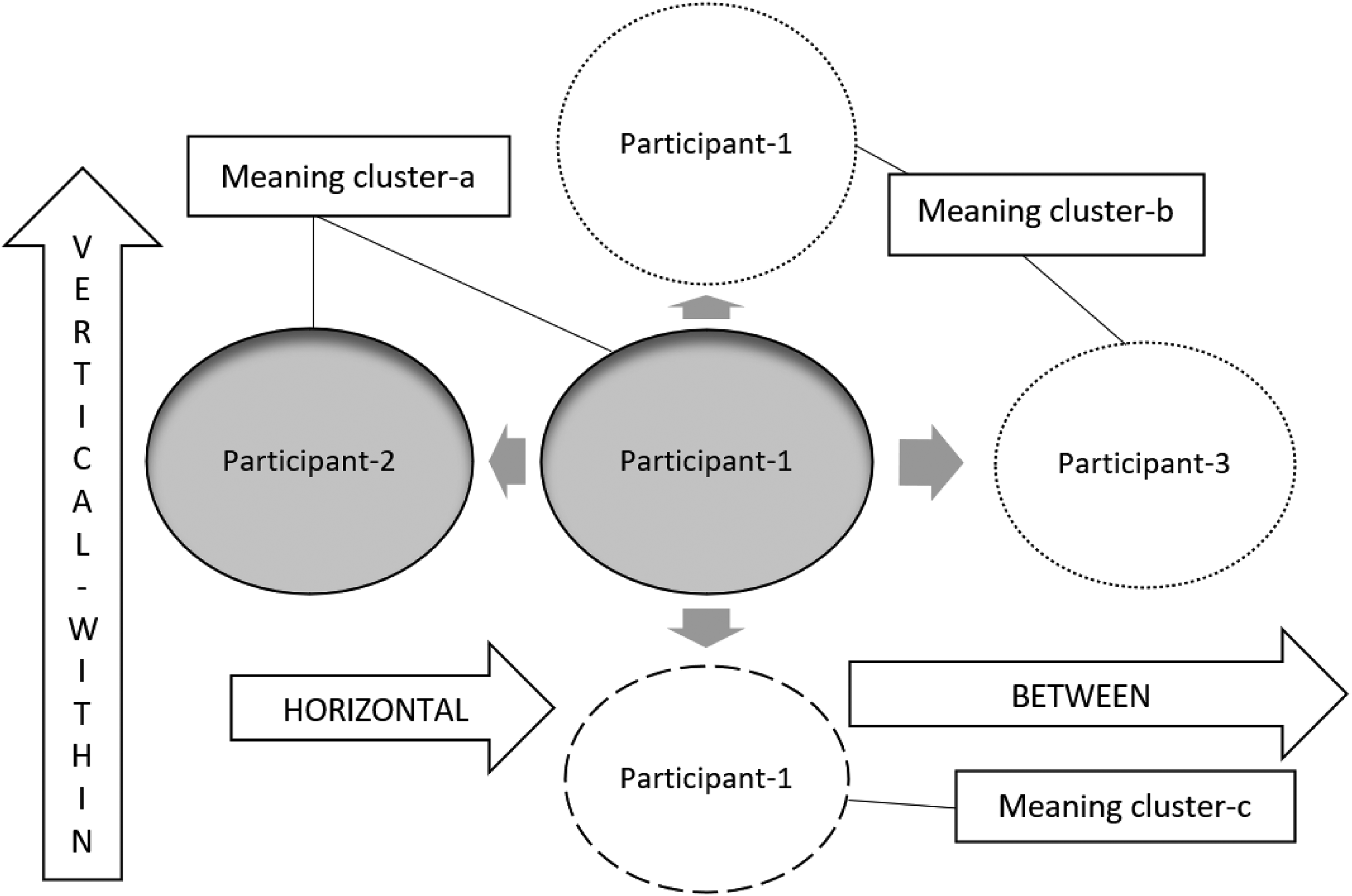
Rationale for structuring the meaning clusters.
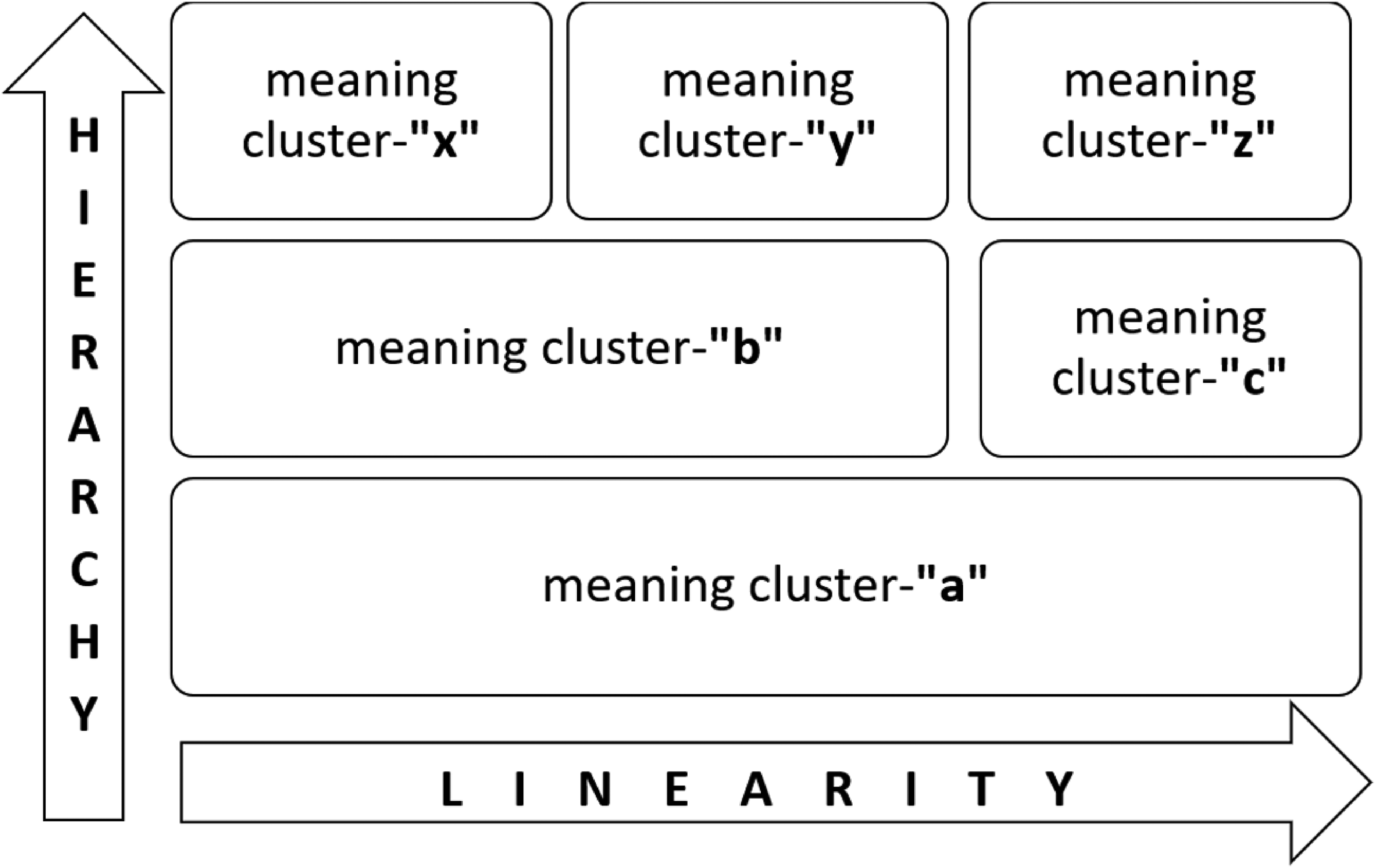
Principles considered for diagrammatizing the outcome space.
Moreover, these conceptions are more sophisticated than the meaning cluster-a with regard to the conceptual complexity of participants’ expressions. This shows a hierarchy that implies an incremental breadth of awareness between the participants’ pedagogical recommendations for good question-asking. The linearity and hierarchy between meaning clusters are based on a logical background that must explain why one meaning cluster is conceptually accepted as being more sophisticated than the other(s).
In phenomenographic research, two aspects of participants’ conceptions of the researched phenomenon are significant. The first aspect is the structural dimension. The second aspect is the universal dimension (Åkerlind, 2012). In this study, participants’ statements were continuously compared with one another to understand their relative complexity levels. The phenomenographic logic (Åkerlind, 2012) followed here is that an individual's conceptual complexity level within a closed system can only be known and determined by checking other conceptions’ conceptual complexity. As phenomenographic research acknowledges that all human conceptions are partial (Åkerlind, 2012), in the current study, the participants’ conceptions of good question-asking were compared with the complexities of good question-asking concepts derived from existing relevant literature representing the universal or reference dimensions. Consequently, the outcome space offered here as the collective intellect of the participants can be viewed as a logical (data-driven) and criterion-based (theory-laden) conceptual order.
To establish a credible outcome space, our colleagues, as external auditors, were assigned as the persons playing the devil's advocate role for scrutinizing the current study's process and outcomes. Three external auditors assessed precision and determined whether our findings, interpretations, and conclusions were well-founded in the data. Soysal and Saruhan (2023) systematically reviewed these phenomenographic studies. They concluded that communicative validity is one of the most instrumental strategies for checking the internal consistency of the general meaning of the conceptual categories abstracted from participants’ discourses through dialoguing (p. 288). This strategy was mainly used to structure the outcome space by inviting three scholars unrelated to the research process, who acted to ensure the credibility, trustworthiness, and rigor of the present study.
Findings
Participants’ expressions were used for extracting seven categories of descriptions or meaning clusters regarding good question-asking. These conceptual clusters of good question-asking were gathered around the four higher-order dimensions represented in Figure 3: monological, declarative, dialogical, and metacognitive, which are operationally defined and exemplified in the participants’ verbal documentation below. These four dimensions were centrally related to each other. In phenomenographic research or thinking, all generated conceptual clusters for any phenomenon are attached to each other because each is produced for the same experienced concept (Åkerlind, 2012; Soysal & Saruhan, 2023), which makes the conceptual meaning clusters and higher-order dimensions extracted in the current study associated, related, or joint in nature. On another note, the qualitative distinctions between the participants’ conceptions regarding good question-asking stemmed from the diversity of their experiences, which could show a shrinking inclusivity or potential for conceptual variety regarding the same phenomenon. Their understanding of the same, related, or associated, phenomena should be understood in order to estimate or portray the potential for uniformity and conceptual variation in participants’ conceptions.
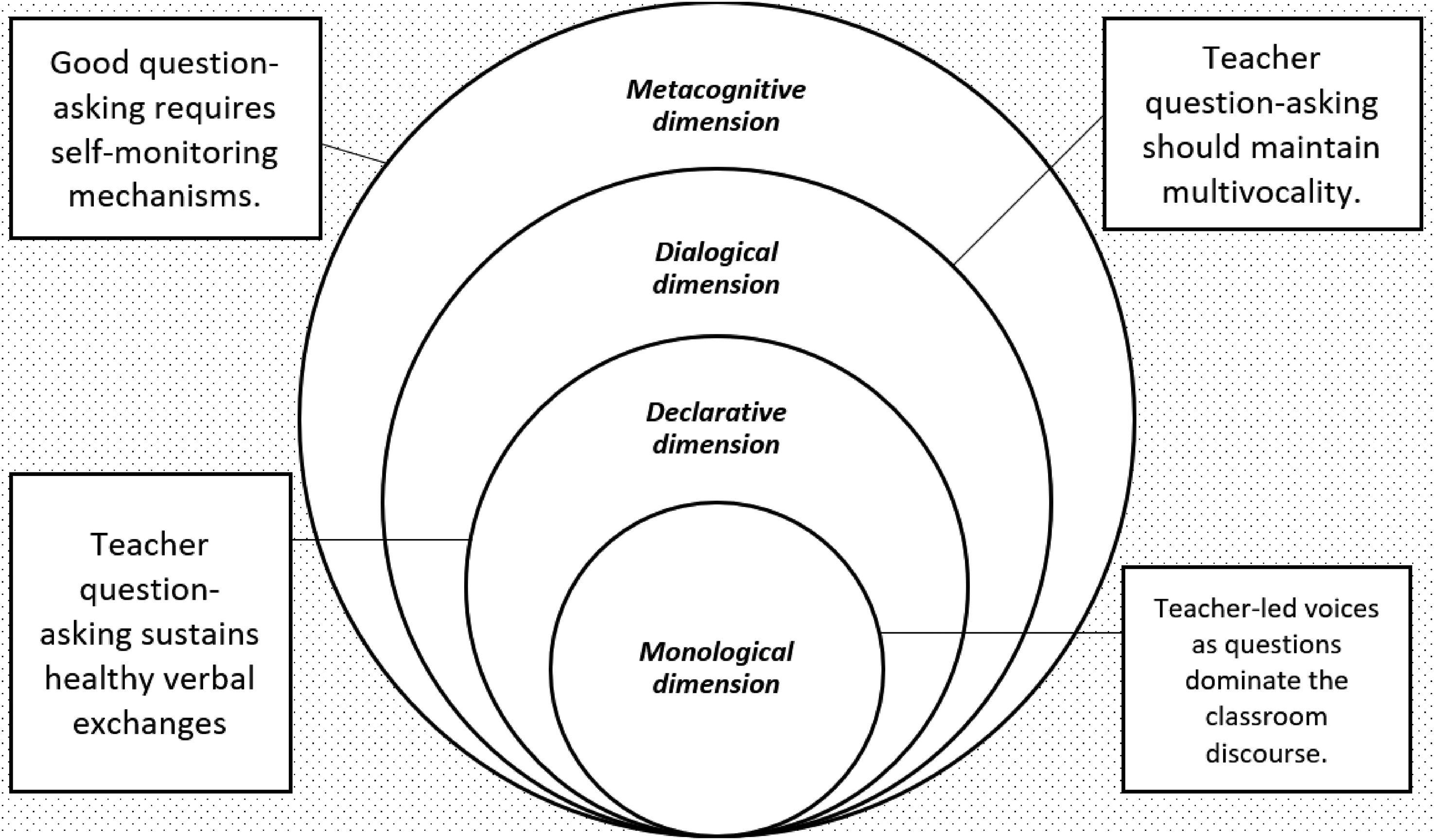
Focused dimensions in hierarchically sequenced meaning clusters.
Monological dimension
This level of experience-based understanding of question-asking refers to the fact that teacher educators pose questions, and prospective teachers are expected to provide short and concise answers. Monological question-asking entails a one-way communicative approach where the teacher assumes the role of the primary knowledge provider, and the students’ role is to just listen and respond to the questions posed. Let us suppose that a teacher educator experiences monological question-asking as a way to ask good questions. In this case, the purpose is to assess students’ understanding of a topic in order to reinforce key concepts that the teacher educator wants to transmit. A monological experience of monological question-asking in a higher education classroom implies a teacher-centric perspective through which teacher educators wield control over the questions and the direction of the discussion. The questions were typically closed-ended—requiring clear right or wrong answers—instead of encouraging open-ended discussions.
In the monological dimension, in-class question-asking limited students’ participation and interaction. The inclusivity of classroom actors was, therefore, restricted in this version of the experience of question-asking, as the teacher educator took on an authoritative role. Simultaneously, the students primarily acted as passive recipients of knowledge. Therefore, the monological dimension presents a limited understanding of in-class question-asking because it focuses on memorizing and regurgitating information rather than promoting a more profound understanding. Furthermore, monological question-asking may discourage shy or introverted students from actively participating in classroom discussions. One meaning cluster was found within this dimension, as described and exemplified below.
Meaning cluster-1: diagnostic tool (monological)
Under this meaning cluster, teacher educators perceived good question-asking as a tool for diagnostic purposes. Some participants (n = 9) (e.g., Table 1, Wendy) asserted that teachers should use questions for diagnostic purposes (e.g., revealing a conceptual deficit in students’ understanding of the topic under consideration).
Recommendation-1: Teachers should use questions for diagnostic purposes.
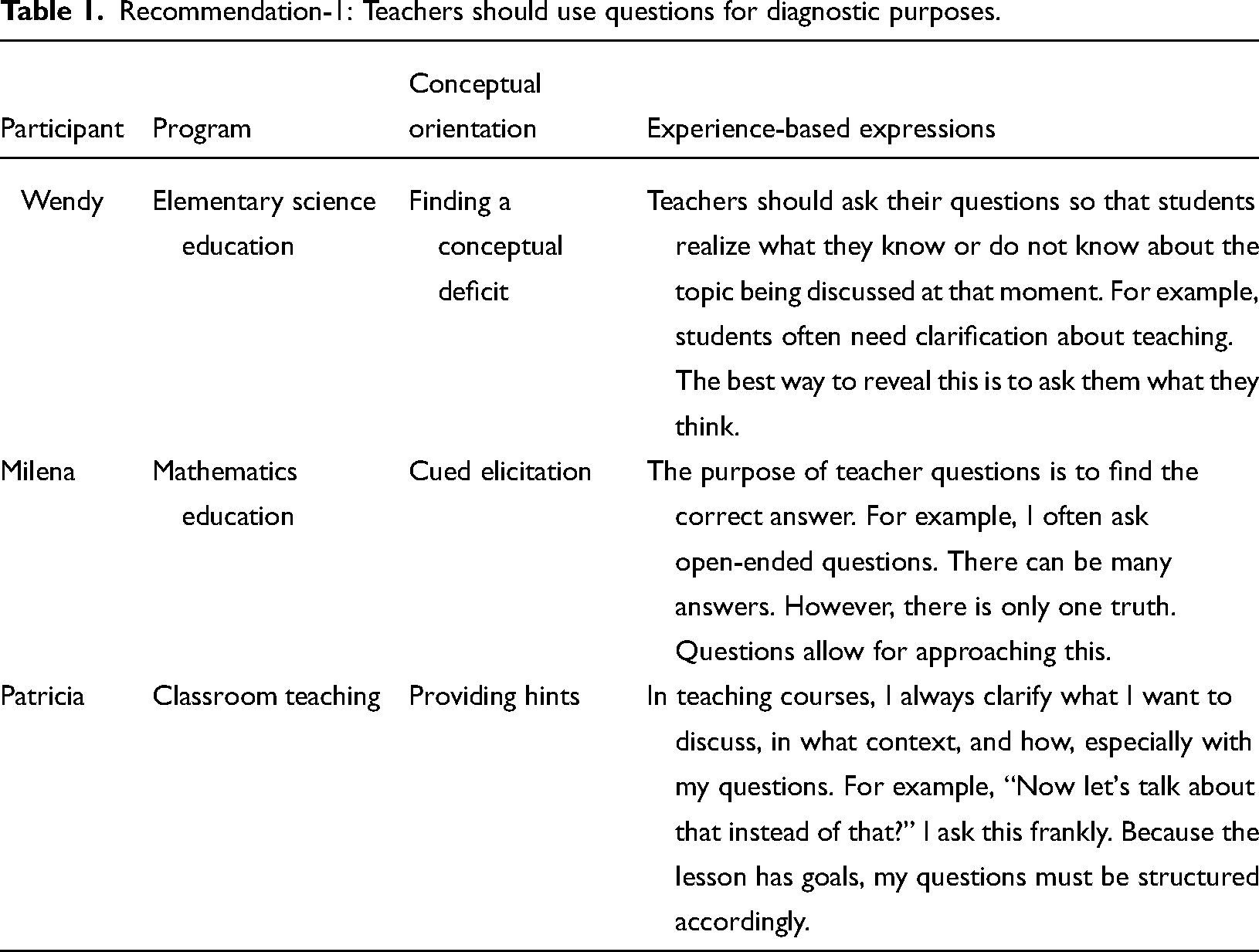
Nine participants proposed that good question-asking can make students’ erroneous ideas public in nature. These participants also believed that teachers should ask questions to press students to respond more neatly with a more relevant reply. This implies that, based on the participants’ expressions, good question-asking can be used for cued elicitation (e.g., Table 1, Milena). This way of experiencing means that students’ ideas should be elaborated through question-asking; however, the questions asked in classroom discourse should also guide students to have a closer understanding of the teacher educator. For instance, Milena directly stated that “the purpose of teacher questions is to find the correct answer,” implying that first, students’ existing mental models or cognitive schemes regarding a “how to teach” topic under discussion should be captured or diagnosed by teacher educators, who may then look for the intended response, which is mostly prescriptively embedded in the teacher's rigid instructional agenda. In Milena's statements, diagnostic question-asking implies selecting one answer over others by eliminating irrelevant ones from the relevant ones (“…But there is only one truth.”).
Furthermore, some (n = 11) teacher educators have mentioned that, in addition to hinting at question-asking or question-asking for cued elicitation, teachers must use particular gestures, mimicries, and intonations when posing their questions in order to provide hints for students regarding their responses’ credibility or on-the-fly or contextual (ir)relevancy (e.g., Table 1, Patricia). Thus, Patricia suggested that the questions she asks should align with the prestructured or prescriptive goals and objectives of the lesson. Overall, teacher educators experienced good question-asking while enacting questions as feedback for informing students about their ideas’ credibility, importance, and contextual relevance in discussing “how to teach” concepts and practices.
Declarative dimension
A teacher educator operating in the declarative dimension is accepted as holding more profound experiences regarding in-class question-asking than a teacher educator who is mostly experiencing monological classroom question-asking. Once teacher educators experience declarative question-asking, they maintain a questioning technique that requires students to provide detailed explanations, opinions, or analyses rather than simple one-word answers. The primary purpose of declarative question-asking is to encourage students to express their thoughts and ideas more elaborately. Declarative question-asking can go beyond factual recall and may require students to engage in interpretation, often connecting classroom content to real-world scenarios, thus encouraging students to apply their learning in practical contexts. This helps students to understand the relevance of the subject matter and develop a deeper appreciation for its significance in their lives. Declarative question-asking promotes a more interactive and student-centered classroom environment. It encourages active participation, collaborative discussions, and the sharing of different viewpoints among students. This can lead to a deeper understanding of the subject through peer-to-peer learning. Declarative question-asking can enhance student engagement and motivation, as it requires active participation and allows students to express their ideas and opinions.
Meaning cluster-2: cognitive-emotional-motivational pre-organizer (declarative)
In this meaning cluster, many participants presented several ways of experiencing good question-asking. Regarding this meaning cluster, the participants stated that teacher questions should be used as cognitive-emotional pre-organizers. This implies that, in addition to diagnostic aims, classroom questions facilitate students’ cognitive, emotional, and motivational readiness to engage in verbal interactions. Within this meaning cluster, the teacher educators proposed that question-asking should stimulate student interest and curiosity for the topics under consideration (e.g., Table 2, Barbara). As added by some participants (n = 6), arousing students’ interest and curiosity via question-asking is attainable if teachers ask their questions by attributing them directly to students’ everyday experiences.
Recommendation-2: Teachers should use their questions as cognitive-emotional-motivational pre-organizers.
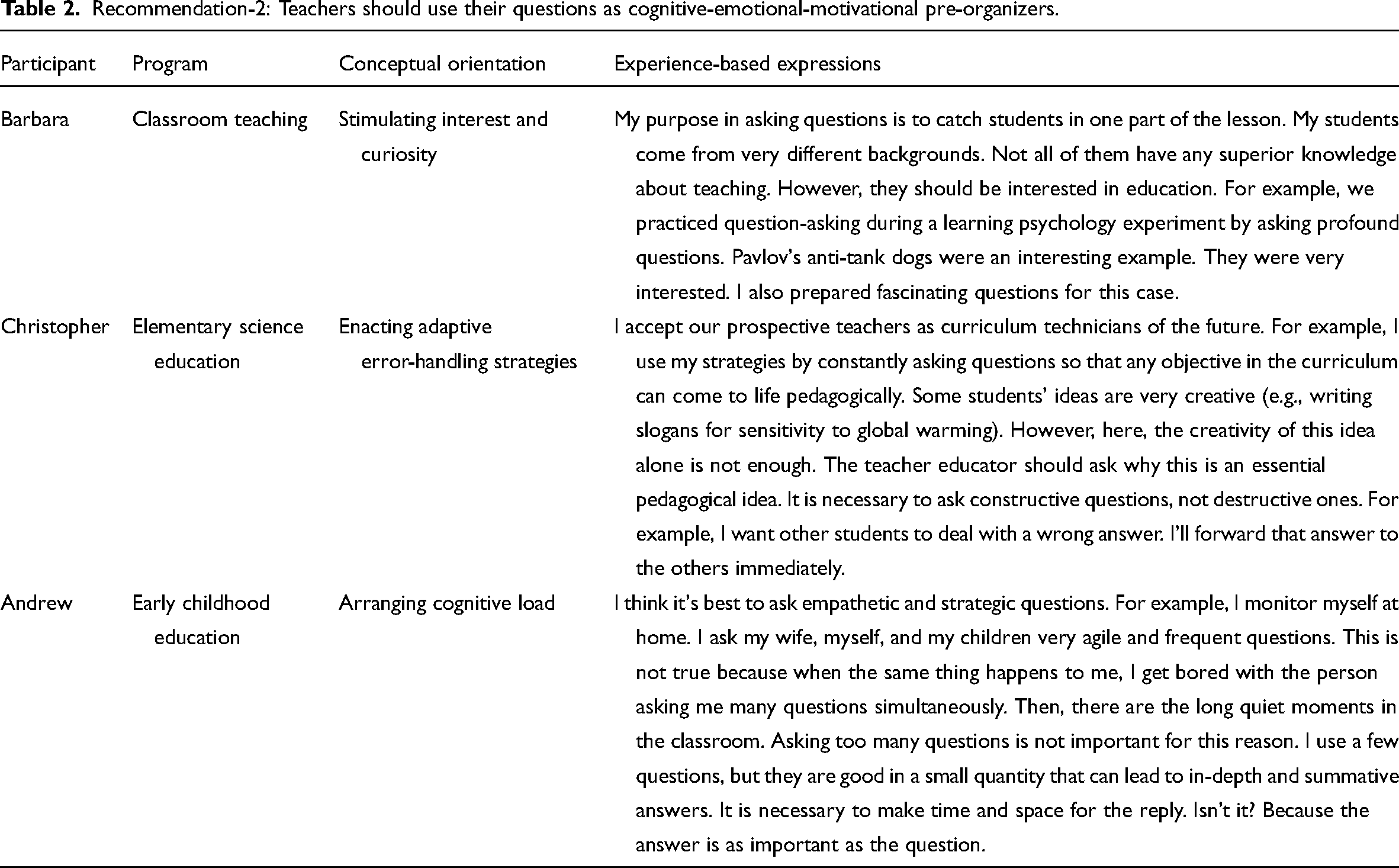
Some teacher educators (n = 9) claimed that there is a concrete linkage between good question-asking and promoting students’ creativity in terms of coming up with alternative ideas to address a challenging situation. Furthermore, teacher educators have advocated that teachers should be careful not to break students’ self-confidence if they receive irrelevant responses based on their questions (e.g., Table 2, Christopher). In other words, through this way of experiencing, some participants (n = 11) attributed it (good question-asking) to adaptive error-handling strategies instead of maladaptive ones in the presence of an irrelevant response.
Some teacher educators (n = 13) recommended specific question-asking sequences in the classroom to constantly rearrange the cognitive load on the students’ side for a more cognitively comfortable lesson (e.g., Table 2, Andrew). For instance, they claim that teachers should ask questions in the classroom in a specific sequence: preparation, probing, critiquing, and wrap-up. In this context, even though the teacher educators did not imply the possible relationship between cognitive load theory and the mental demands embedded in teacher questions, they suggested that teachers should ask simple questions; furthermore, when progressing the discussion via a question-answer format, they should ask higher-order questions. This sequence—asking questions from simple to sophisticated ones—was associated with another term directly expressed by a few teacher educators: wait time. They asserted that teachers should not expect to receive a rapid answer or should wait for a while after asking a question to permit students to think about the question they asked.
Dialogical dimension
The experience-based and conceptual complexity of participants’ externalizations is anticipated to increase in the dialogical dimension compared to the monological and declarative dimensions. To enhance student engagement and foster a more inclusive learning environment (including teacher educators and prospective teachers), teacher educators may experience question-asking in a dialogical fashion, which encourages open-ended discussions, active student participation, and peer-to-peer interactions. Once teacher educators experience dialogical question-asking, they encourage open-ended inquiries and foster a two-way exchange of ideas, perspectives, and knowledge. In this dimension, participants are expected to understand the question-asking phenomenon, which encourages students to think critically, articulate their thoughts, listen to others, and engage in respectful dialogue, even in competing theories. In other words, when teacher educators experience a version of dialogical question-asking, they typically ask open-ended questions, that is, there are multiple possible answers and interpretations. Dialogical question-asking is more intellectually demanding, as it encourages students to explore different perspectives, consider alternative solutions, and engage with higher-order thinking skills such as analysis, evaluation, and synthesis. Joint thinking or interthinking is at the center of dialogical question-asking. Prospective teachers are encouraged to share their ideas and contribute to discussions by acting as cocreators of knowledge rather than passive recipients. In other words, dialogical question-asking values and incorporates diverse perspectives and experiences. This creates a supportive and inclusive classroom environment where students feel safe expressing their thoughts and learning from each other's backgrounds and viewpoints. Teacher educators’ question-asking in a dialogic fashion is expected to empower students to take ownership of their learning processes. To justify, dialogical in-class question-asking allows students to learn from each other, challenge ideas, and build upon shared knowledge. Like the monological dimension, dialogical question-asking can be executed to assess students’ understanding regarding the topic under consideration; however, dialogical question-asking allows teacher educators to assess prospective teachers’ understanding and thinking processes by observing and participating in the dialogue, as educators can evaluate students’ ability to articulate ideas, engage in critical thinking, and build upon their prior knowledge. Three meaning clusters were extracted within this dimension, as described below.
Meaning cluster-3: structural qualities (dialogical)
For the first time, under meaning cluster-3, some participants (n = 14) externalized ideas about the linkage between the typologies of the questions and good question-asking. Teacher educators believed that teachers should avoid asking too many close-ended questions to ensure good question-asking. They asserted that filling lessons with too many close-ended questions turns them into a classroom game in which some good question-askers and respondents are glad because no challenging ideas are delivered through close-ended questions (e.g., Table 3, Lisa). Accordingly, some teacher educators (n = 17) expressed that teachers should ask ample, timely, relevant, and contextually appropriate open-ended questions to present alternative ideas in the classroom.
Recommendation-3: Teachers should enact open-ended and contingent questions to create a discursive classroom setting in which alternative viewpoints are valued.
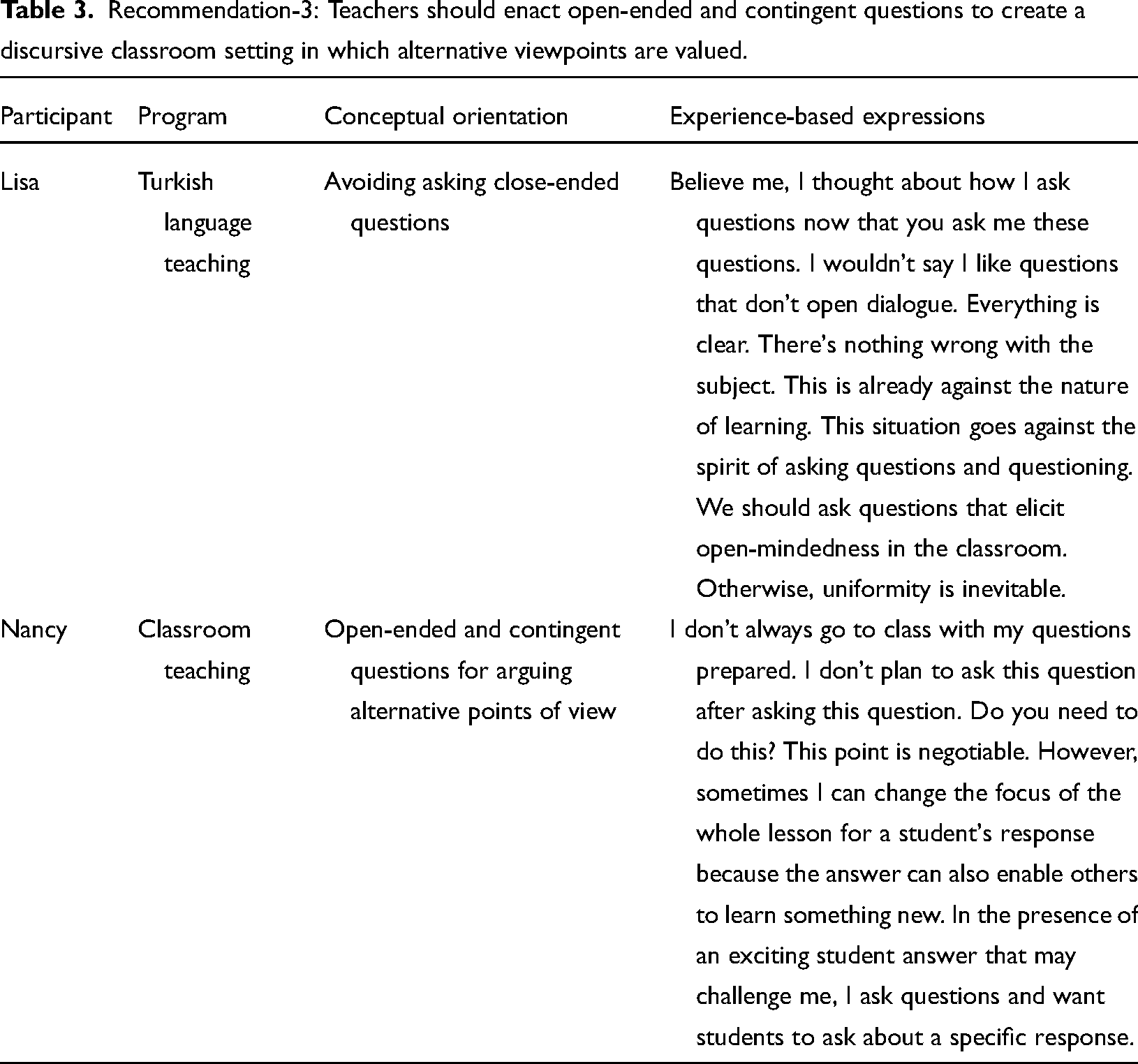
They highlighted the existence of alternative viewpoints in the classroom discourse through open-ended question-asking. Some participants (n = 21) added that teachers must listen to students’ responses carefully and ask appropriate and continuous contingent questions. They believed that grasping students’ alternative or even competing meaning positions is possible (e.g., Table 3, Nancy) when their questions and the student responses are dialoguing for philosophizing ideas about teaching.
Meaning cluster-4: typological qualities (dialogical)
In this meaning cluster, the participants emphasized the need to operate elaborate question-asking. They suggested that teachers should use eliciting questions in every sub-topic lesson episode (e.g., Table 4, Jessica). Some participants (n = 11) made explicit attributions to the discursive typologies of question-asking in the classroom (e.g., clarification and embodying or exemplifying questions) (e.g., Table 4, David).
Recommendation-4: Teachers should use questions to press students to attain elaborate thinking and intellectual-metacognitive productive engagement.
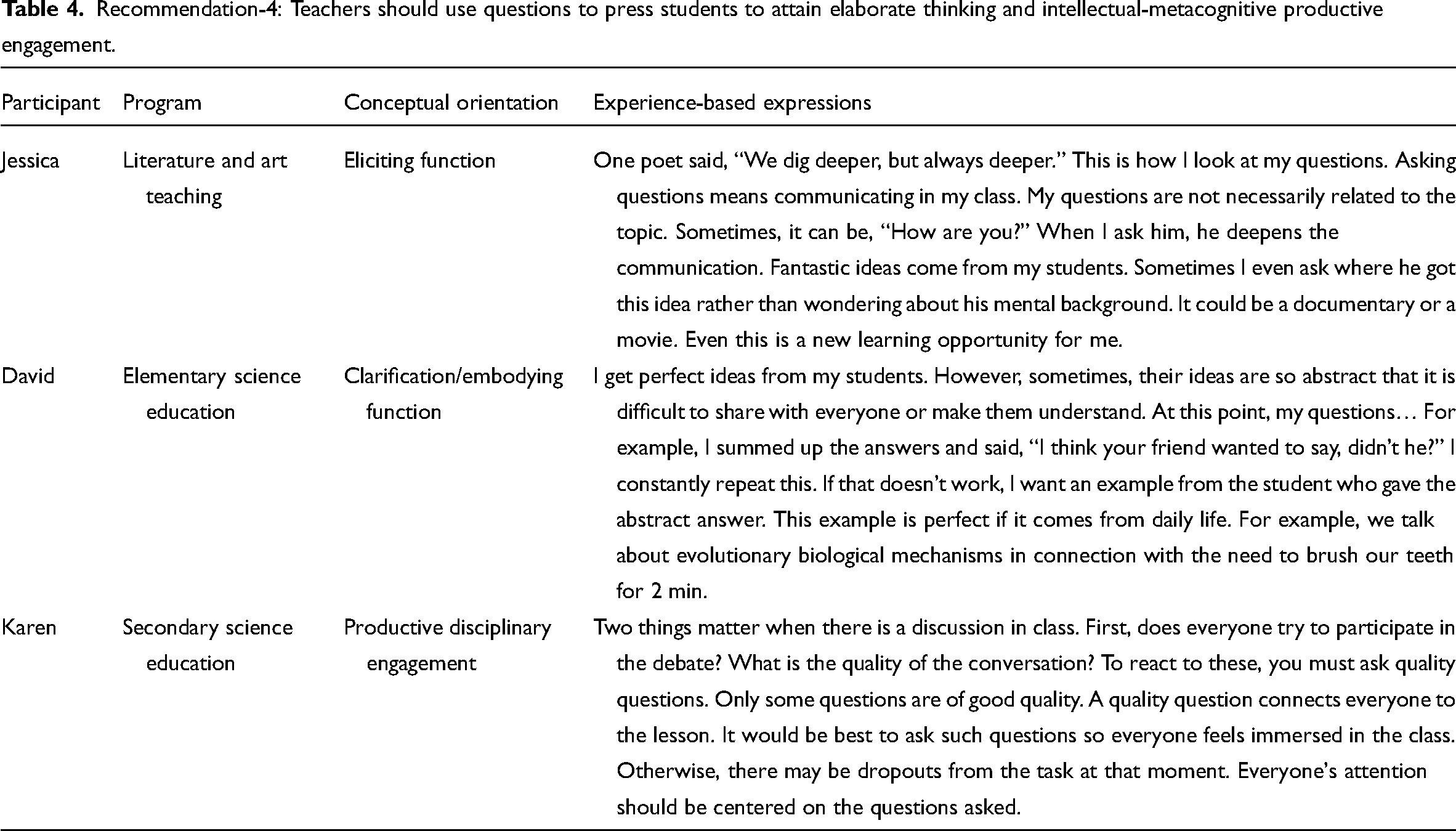
Moreover, some participants (n = 23) expressed a specific question-asking discursive typology (e.g., deeper-thinking questions). They explicitly mentioned that teachers should press students to practice deeper thinking instead of looking for a prescriptive response through the questions asked in the classroom (e.g., Table 4, Karen). Furthermore, teacher educators stated that deeper thinking-oriented question-asking is considerably related to metatalk questions, through which students may monitor the progression of classroom talk. In this sense, some teacher educators (n = 11) directly indicated that once they use their question-asking to ensure that all students are aware of where the discussion point is and where it is going, students’ thinking about the topics under consideration becomes profound.
Meaning cluster-5: multivocality, negotiation, internalization (dialogical)
Within this meaning cluster, participants suggested that teachers should view questions as a way of seeking alternatives or competing student voices. They recommended that teachers should view question-asking not only as a means to test students’ knowledge but also as a way to encourage diverse conceptual, epistemological, or ontological perspectives among students. As some participants (n = 14) expressed, instead of simply seeking correct answers through a series of question-asking activities, teachers should foster an environment in which students feel comfortable and empowered to express their thoughts and ideas, even if they differ from those of the teacher or most of the class (e.g., Table 5, Brian). Under this meaning cluster, some participants (n = 19) indicated that, by valuing alternative or competing student voices through question-asking, teachers could help their students develop the ability to engage in thoughtful negotiations of ideas.
Recommendation-5: Teachers should ask questions to create dialogical spaces in which students negotiate ideas within the intermental and intramental planes of classroom conversations.
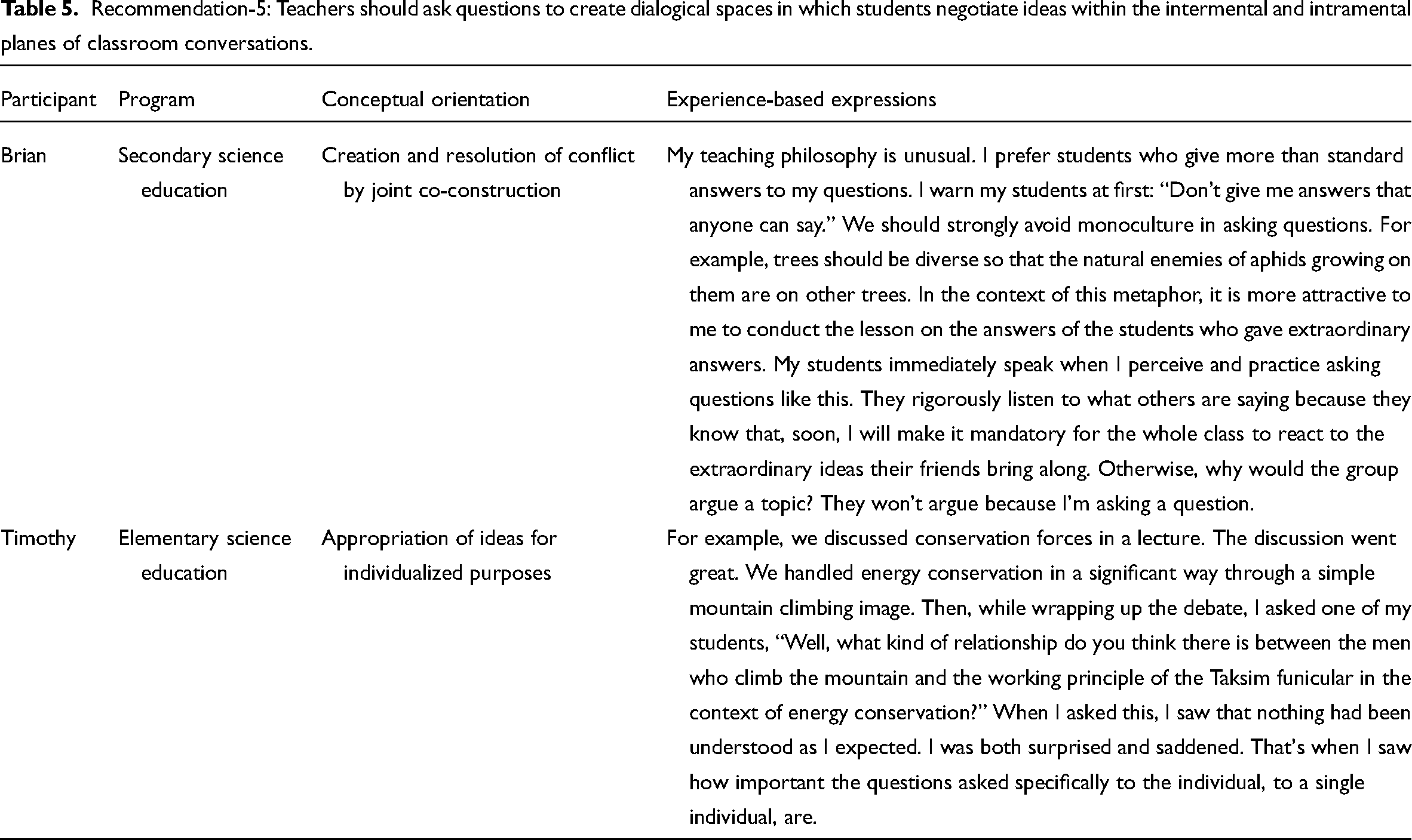
Furthermore, under this meaning cluster, some participants (n = 29) emphasized that teachers should ask questions to link one response to another, which could boost student–student interactions. This experience-based statement suggests that teachers should ask questions to encourage students to build on each other's responses (e.g., Table 5, Brian). The participants indicated that, instead of simply asking a question and waiting for a single student to answer it, the teacher should ask questions that invite multiple students to participate in the conversation and engage with each other's ideas.
Teacher educators also added that asking questions that link one student's response to that of another could help create a more collaborative and interactive classroom environment in which students feel encouraged to participate and contribute their unique perspectives. Some participants (n = 9) interpreted that teachers should ask questions to all students and then ask specific questions to specific members to ensure internalization (e.g., Table 5, Timothy). This implies that teachers should first ask all students questions to ensure meaningful learning for everyone and then follow up with specific questions for individual students. They claimed that this process was necessary for the individualized internalization of ideas. Combining question-asking and internalization can help students develop a sense of ownership over their learning. Consequently, by following up with specific questions for individual students, teachers can provide targeted scaffolding and ensure that everyone receives the opportunity to succeed.
Metacognitive dimension
The participants externalized their most sophisticated conceptions regarding good question-asking in this dimension. It is important to note that this level of abstraction goes beyond question-asking to encourage students’ metatalk in the classroom. Teachers can pose questions by encouraging students to reflect on their thinking processes, consider the reasoning behind their responses, and evaluate the validity of their arguments. This enhances students’ self-awareness and their ability to monitor and regulate their learning.
Metacognitive question-asking in the classroom is a questioning technique that encourages students to think about their thinking and reflect on their learning processes. It involves asking questions that prompt students to consider their strategies, monitor their understanding, and evaluate their learning. Metacognitive questioning promotes self-awareness, self-regulation, and the development of students’ metacognitive skills. In the current study context, the metacognitive dimension refers to the participants’ meta-understanding regarding the need for good question-asking. This dimension includes the abovementioned dimensions because, under this conception, the participants did not have to discuss the monological, declarative, or dialogical aspects of good question-asking. Furthermore, participants with this conception looked for pedagogical ways of initiating and sustaining good question-asking in the classroom by checking, monitoring, and meaning-making with regard to their question-asking strategies. In other words, this dimension mainly concerns participants’ self-reflection and awareness regarding different aspects of good question-asking. This meta-thinking requires participants to reflect on their learning experiences, understand their strengths and weaknesses, and recognize their thinking patterns for good question-asking. By engaging in self-reflection, the participants became more aware of their question-asking strategies, which allowed them to make more informed decisions and adjustments. Thus, participants with metacognitive conceptions of good question-asking not only ponder about in-class questioning strategies but also reflect upon how they can foster them by using specific strategies such as monitoring and evaluation. Under this dimension, two meaning clusters were extracted from the participants’ experience-based expressions.
Meaning cluster-6: pedagogical content knowledge of question-asking (metacognitive)
In this meaning cluster, some participants (n = 19) made explicit attributions to PCK in the context of good question-asking. They claimed that good question-asking is closely related to possessing structured and sophisticated subject matter knowledge about the topic under consideration. This experience-based statement of the participants suggests that in order to ask effective and sophisticated questions, teachers must have a deep understanding of the material, including its underlying concepts, key ideas, and potential areas of confusion (e.g., Table 6, Kathleen). Some participants (n = 11) believed that teachers could ask their students relevant, thought-provoking, and challenging questions by grasping the subject solidly. This implies that, by structuring in-class questions clearly and logically, teachers can help their students make connections between different concepts and ideas.
Recommendation-6: To enact good question-asking, teachers should be metacognitively aware of the depth of their pedagogical content knowledge.
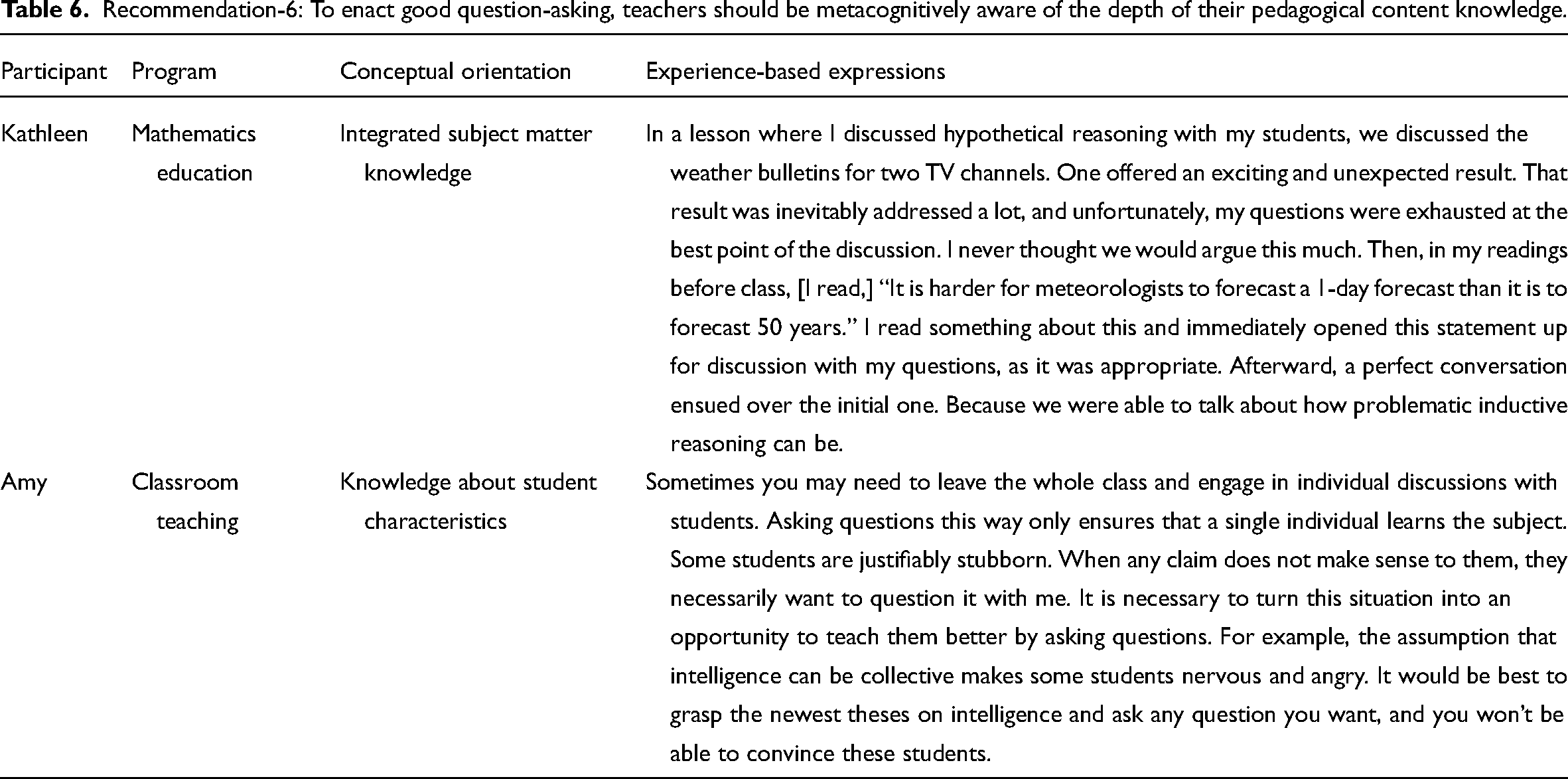
In addition to holding a structured and sophisticated subject matter knowledge base for asking good questions in the classroom, some teacher educators (n = 12) suggested that teachers should have in-depth information about student characteristics (e.g., know the students’ preparedness for a topic that the teacher is introducing). They expressed that, by understanding their students’ prior knowledge and readiness, teachers could tailor their questions to meet their students’ needs and help them engage with the material appropriately. For example, as one participant directly expressed (e.g., Table 6, Amy), if a teacher knows that a particular student is struggling with a specific concept, they can ask questions designed to help that student understand the material better. Overall, some participants (n = 17) seemed to have experienced good question-asking in such a way that, by having information about their students’ backgrounds, interests, and learning styles, teachers could ask their students more relevant and engaging questions. This helps students feel more connected to the material and understand the subject better.
Meaning cluster-7: teacher meta-noticing on question-asking (metacognitive)
In this meaning cluster, some participants (n = 13) stated that asking good questions in the classroom mostly concerned having research awareness. As mentioned in the meaning clusters located above, teacher educators expressed some points regarding good question-asking in the classroom. They claimed that asking good questions requires a deep understanding of the subject matter being taught, an awareness of the needs and interests of the students, and the ability to craft engaging and challenging questions. While these expressions were considered to support good classroom question-asking among the participants, as meaning cluster-7 implies, they are not the only factors involved.
As scholarly researchers, some teacher educators (n = 11) asserted that a version of research awareness on the good question-asking phenomenon could help them keep up with the latest educational practices and pedagogical techniques of question-asking in the classroom. Other educators (n = 9) suggested that research awareness regarding question-asking may include understanding how different types of questions can promote learning, scaffolding questions to support student learning, and using questioning to encourage critical thinking and problem-solving. Some teacher educators (n = 13) claimed that teachers could better tailor their questioning strategies to aid students’ learning and engagement by understanding different question typologies and types and how they relate to students’ academic outcomes. For example, some participants (n = 7) explicitly mentioned that teachers familiar with Bloom's Taxonomy (e.g., Table 7, Scott) could use its framework to structure their questions to promote higher-order thinking skills. These participants also suggested that teachers could use questioning techniques such as wait time and follow-up questions to encourage deeper engagement with the material and promote critical thinking.
Recommendation-7: Teachers should have research and metacognitive awareness of what-aspects and how-aspects of good question-asking operate in the classroom.
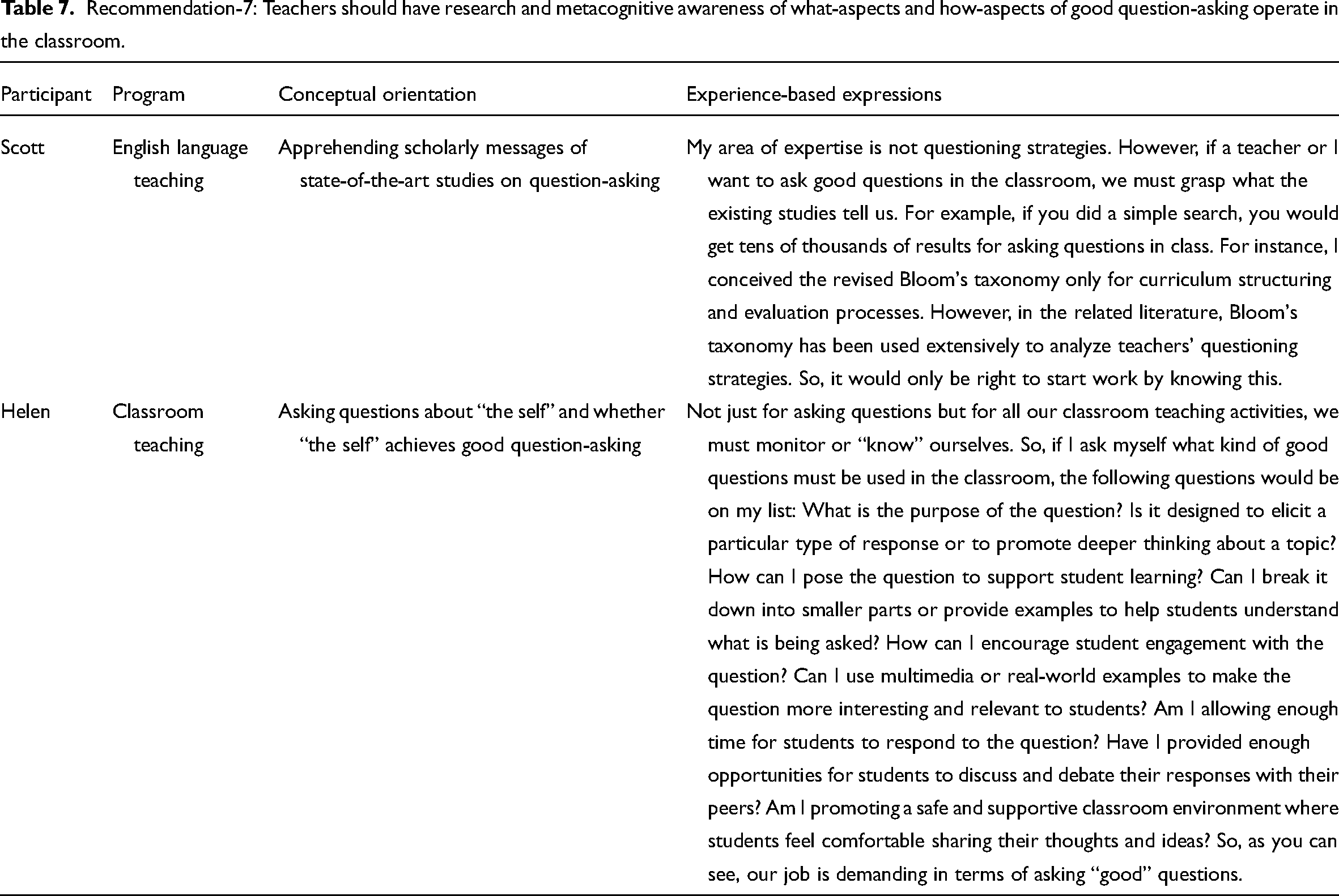
At this point, the participants mentioned a specific point, that is, simply being aware of research on the parameters of the good question-asking phenomenon was not enough. Teacher educators advocated that teachers should also apply this knowledge in the classroom context, adapting their questioning strategies to meet the needs of their students and the subject matter they are teaching. Overall, they expressed that better question-asking in the classroom requires self-questioning about good questions and good question-asking (e.g., Table 7, Helen). Some teacher educators (n = 7) explicitly perceived teachers as being reflective practitioners, stating that by reflecting on their questioning practices and considering how they could be improved, teachers could become more effective in guiding student learning and promoting critical thinking. They believed that, by engaging in self-questioning about their questioning practices, teachers could become more aware of their strengths and weaknesses and work to improve their questioning strategies to better support student learning and engagement.
Discussion
The participating teacher educators generated diverse ideas in verbalizing their pedagogically oriented recommendations for good question-asking in the classroom. As shown in Figure 3 and Table 8 (the outcome space), the participants’ conceptions of good question-asking incorporated monological and dialogical dimensions in addition to transitional (declarative) and metacognitive experience-based understanding.
Outcome space.
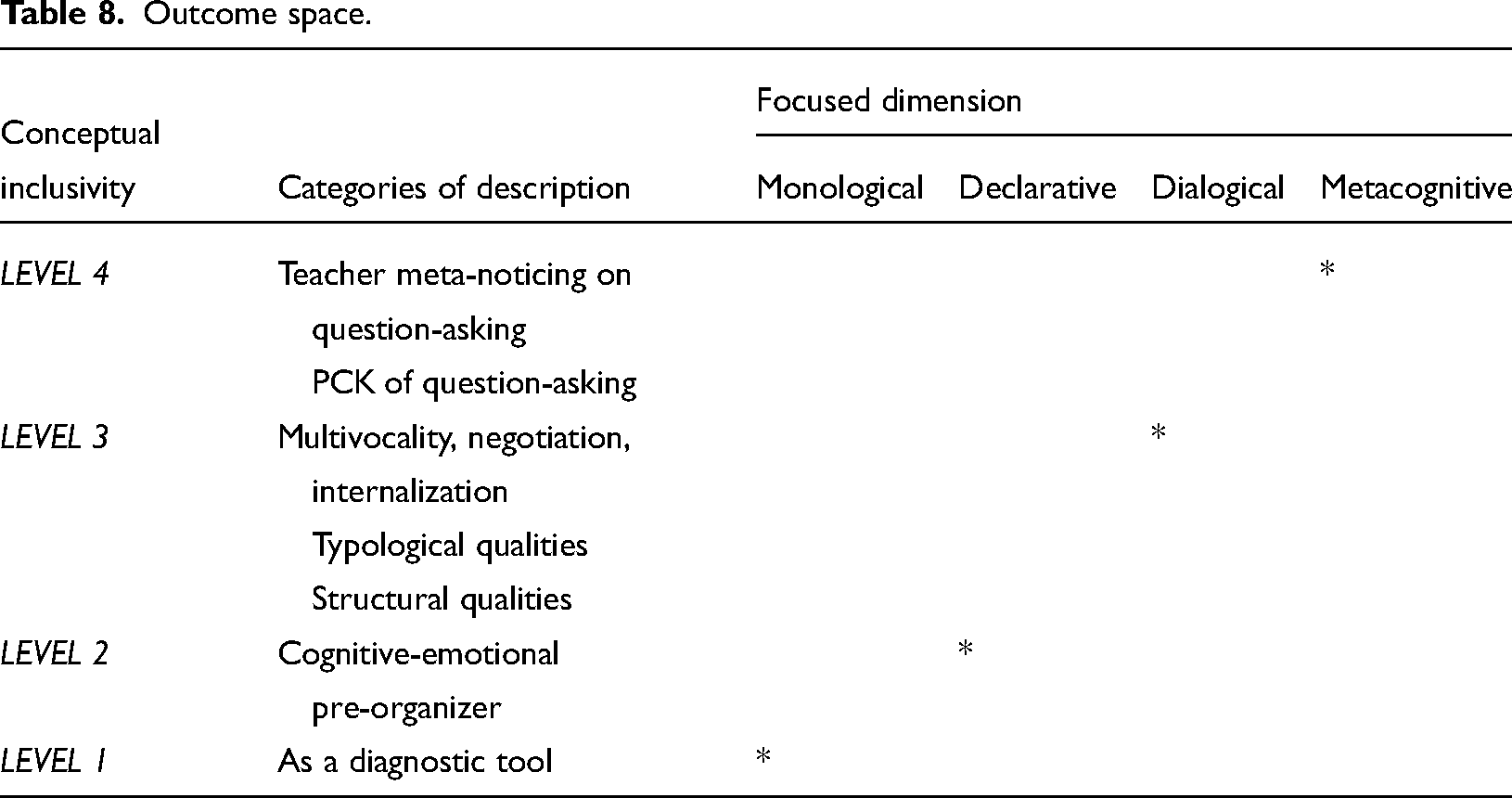
One of the most critical questions was whether the participants gained their conceptions of good question-asking deliberately or randomly. The greater diversity in the meaning clusters extracted herein may confirm that the participating teacher educators’ conceptions of good question-asking were constructed randomly. The variety in the observed conceptions of good question-asking encompassed the monological, declarative, dialogical, and metacognitive dimensions (Table 8). Therefore, it is questionable whether participants documented their expressions based on intentionally planned experiences or random trials of question-asking in the classroom. This point is debatable, as the conceptual sophistication of meaning clusters has increased from the monological to the metacognitive dimension (Figure 3, Table 8). Thus, asserting that less sophisticated recommendations for good question-asking might emerge during random teaching moments is credible. However, more sophisticated meaning clusters regarding good question-asking require the development and constant monitoring of a version of conscious awareness regarding one's question-asking strategies. These processes imply intentionality in developing conceptions of good question-asking. In this context, Ping et al. (2018) suggested that the work of teacher educators does not yet constitute a well-developed profession. Previous research has shown that becoming a teacher educator does not involve a formal route or a scaffolding induction program (e.g., Reichenberg et al., 2015). Preparing teacher educators in school- or faculty-based contexts is inadequate to address the challenges a teacher educator must handle, such as constructing a novel professional identity (Goodwin & Kosnik, 2013) or being aware of holding monologic conceptions regarding good question-asking in the classroom. Swennen et al. (2009) stated that, due to the lack of formal training routes for teacher educators, they might engage in individualistic or group-based experiential trials of becoming good teacher educators by primarily using intuitive reasoning for their profession's pedagogic dimensions, including operating and developing sophisticated ways of conducting good question-asking in the classroom.
The current study does not underestimate the importance of less sophisticated conceptions regarding good question-asking (e.g., the monological dimension). Academically productive question-asking strictly requires monological, declarative, and dialogical interactions in the classroom. Previous studies conducted in secondary school (Soysal & Yilmaz-Tuzun, 2023; Scott et al., 2006) or higher education (Soysal, 2023a; Soysal & Soysal, 2023) have shown that monological and dialogical question-asking must be implemented to boost academically productive talks. This point is defined as tension (Scott et al., 2006) in question-asking, which implies that teacher educators first use their questions for dialogical purposes to open opportunities for capturing alternative and competing viewpoints that may be considerably different from teacher educators’ instructional agendas or higher education curricula's intended contents and tasks. After collecting and pooling alternative and competing viewpoints, the teacher educator's task is to sustain an internally persuasive dialoguing of ideas to invite prospective teachers to adapt novel thinking and talking or explanation systems regarding how to teach concepts. This is called teaching as persuasion (Alexander et al., 2002), and it strictly requires monological question-asking in order to get somewhere in the discussions on how to teach. This implies that teacher educators may prefer asking questions from a dialogical zone for monological purposes in order to conduct effective question-asking. The declarative dimension can be seen as a bridge (Presmeg, 2016) between the monological and dialogical scales of the same instructional spectrum. This means that, for understanding, clarifying, and elaborating prospective teachers’ background meaning positions on how to teach concepts, in dialogical discussion episodes, teacher educators highlight the meanings of class members, which seem more attainable through declarative question-asking. After saturating different meaning positions and categorizing them according to contextual relevancy, teacher educators may force students to select one explanation system over others. As expected, this requires more monologically oriented question-asking strategies, as exemplified herein. The current study goes beyond the above-mentioned question-asking tension by adding another deeper experience-based conceptual zone of question-asking, such as the metacognitive dimension.
The conceptually higher dimensions proposed for good question-asking were the PCK of question-asking and teacher meta-noticing regarding question-asking (Table 8). The PCK of the question-asking meaning cluster implies that teacher educators should have integrated and more profound subject matter knowledge in addition to their students’ structural and emergent needs in asking the next question in the classroom. In this manner, Ping et al. (2018) and Loughran (2014) asserted that a fundamental part of teacher education pedagogy encompasses an integrated knowledge of prospective teachers’ concerns, needs, identities, beliefs, and practices regarding how to teach. Thus, for developing sophisticated conceptions of good question-asking, in the present study, the teacher educators may have used explicit attributions to the PCK of question-asking, especially in the sense of holding an awareness regarding, for instance, students’ preparedness (see Amy's expressions in Table 6).
Under the meaning cluster of the PCK of question-asking, it was explicitly observed that the teacher educators made direct associations between operating good question-asking and holding sophisticated and integrated subject matter knowledge (see Kathleen's expressions in Table 6). In this context, Superfine and Li (2014) indicated that, for teaching prospective teachers how to teach mathematics, a teacher educator must possess two fundamental knowledge typologies: content knowledge and PCK. The present study shows that while asking good questions in higher education classrooms where “how to teach” concepts are taught regarding different subjects, teacher educators might experience and believe that possessing good content knowledge is a way of enacting good question-asking (see Kathleen's expressions in Table 6).
In their seminal systematic review, Ping et al. (2018, p. 97) identified several categories for teacher educators’ professional learning content, which incorporate specific subcategories such as research (valuing research knowledge and skills to strengthen teacher educators’ practices or contributing to their professional knowledge) and reflection (teacher educators’ self-reflection regarding their practices and their awareness to make reflections), which are considerably related to the meaning cluster-7 (teacher meta-noticing on question-asking). As seen in the statements of Scott (research awareness for good question-asking in the classroom) and Helen (self-awareness or self-monitoring for good question-asking in the classroom) (Table 7), in the current study, teacher educators proposed that in order to enact good question-asking in the classroom, one has to hold a version of research awareness and act as a reflective practitioner. Kosnik et al. (2015) reported that teacher educators must conduct scholarly research and closely examine research outcomes to become good teachers.
Based on a systematic review of current studies on the educational journeys of teacher educators, Ping et al. (2018) reported that reflective practices for teaching “how to teach” contain two dimensions. First, teacher educators should reflect on their in-class teaching and “how to teach” techniques. In the present study, this aspect was evident in the expressions of the teacher educators, as they declared that they had to push themselves to think and act as reflective practitioners in order to develop good question-asking (see Helen's expressions in Table 7). The second dimension concerns what aspects and how aspects of teacher educators support prospective teachers in engaging in reflective practices for learning to teach. This point was missing in the recommendations of the teacher educators with regard to reflecting upon good question-asking.
In the present study, teacher educators accepted the value and instrumentality of teachers’ meta-noticing regarding good question-asking. However, they did not make any direct attributions to explain how this self-questioning about good questions and good question-asking (see Helen's expressions in Table 7) should be enacted. For instance, Selkrig and Keamy (2015) argued that if teacher educators engage in collective or co-constructive processes with their colleagues by operating social negotiations for meanings of, for instance, asking good questions in the classroom while teaching how to teach, they may improve their teaching practices concerning their students’ achievements. Furthermore, because a missing point in the highest complex conception proposed by teacher educators emerged as part of meaning cluster-7, Harfitt and Tavares (2004) indicated that teacher educators are not only responsible for questioning their question-asking actions through self-reflective processes. More importantly, teacher educators must guide prospective teachers to intentionally engage in reflective processes to improve their question-asking actions while learning to teach lessons.
Final comments, concluding remarks, and recommendations
The present study confirms that teacher educators may still hold monologically oriented conceptions of question-asking, as these expressions have been embedded in their pedagogical recommendations, as exemplified above. As discussed earlier in this section, this does not mean that monological question-asking is unnecessary or less important when discussing how to teach concepts in higher education classrooms. Based on the experience-based conceptions of the participants, the current study infers that if a teacher educator holds only monological conceptions regarding good question-asking apart from others, this may be counterproductive in fostering the conceptual comprehensions of prospective teachers regarding how to teach content by executing question-asking strategies. In other words, a combined or joint understanding of question-asking overlapping with the more (sophisticated) conceptual dimensions described herein implies a more elaborate question-asking system for participants’ beliefs. It is well known that systems of teacher educators’ beliefs, such as experience-based conceptions, regulate their in-class question-asking strategies. Therefore, this study concludes that the participant teacher educators might experience pedagogical instantiations falling under monological, declarative, dialogical, and metacognitive dimensions during their instruction. However, how they experienced question-asking in the classroom must be interrogated: In an isolated manner [monological dimension] or combined manner? [(monological dimension) + (declarative dimension) + (dialogical dimension) + (metacognitive dimension)].
There could be several reasons why some teacher educators still had monological or narrower conceptions regarding good question-asking in the classroom. One reason could be that they were taught using a traditional lecture-based model that prioritized the teacher as the source of knowledge and epistemic authority (McPherson, 2020). Therefore, they may not have been exposed to alternative teaching methods that emphasized declarative, dialogical, or metacognitive conceptions of good question-asking for teaching prospective teachers who are learning to teach (Goodwin & Kosnik, 2013). Another reason could be that teacher educators may feel more comfortable with monologically oriented questions in their classrooms, as these might allow them to maintain control over the classroom and learning process. Moreover, teacher educators might be unaware of research that has shown the benefits of dialogical question-asking in learning, including the importance of discovery learning through questioning in higher education (Akyeampong, 2017).
The outcome space generated in the current study implies that teacher educators may face several barriers when trying to ask good questions in the classroom. First, teacher educators may not receive sufficient training in effective questioning techniques, which could make it difficult for them to develop and ask good questions in the classroom. Second, teacher educators may feel that they do not have enough time to ask good questions, especially if they are pressured to cover a large amount of content quickly. This current study was conducted in Turkey, where prospective teachers were viewed as apprentices by teacher educators. Third, there may be power issues between teacher educators and prospective teachers in lessons involving teaching “how to teach” concepts and practices. This implies that teacher educators may feel uncomfortable asking questions that could potentially be challenged by prospective teachers, and this could limit their willingness to engage in dialogue by asking good questions.
Asking good questions is an intellectual ability and virtue (Baehr, 2013) in higher education. Scholars have argued that educating individuals to be good question-askers is the ultimate goal of higher education systems (Watson, 2018). Thus, it is imperative to question teacher educators’ conceptual recommendations about good question-asking, which can be an effective way to teach prospective teachers who are learning to teach. Teacher educators can be trained to have a higher and deeper understanding of good question-asking through various methods, including professional development workshops, mentoring, classroom observations, collaboration, reading and research, and model teaching (Montenegro, 2020). It should be noted that even though the teacher educators showed a more remarkable and profound conceptual understanding of good question-asking—especially from meaning cluster-3 to meaning cluster-7—they did not conceptually question the particular point of how a teacher educator experiences and develops good question-asking in sharpening their teaching.
The answer is related to the phenomenon of self-investigation or self-study. Self-exploration or self-study is associated with introspection and mainly includes reflective practices (Izadinia, 2014). Teacher educators can problematize, monitor, analyze, and interpret their questioning conceptions and accompanying practices through pedagogical and methodological scaffolding in self-studies. Teacher educators can become reflective practitioners when they research and analyze their, for instance, monological conceptions of good question-asking as problematics. When teacher educators reflect on their in-class questioning practices, they make their question-asking experiences and actions meaningful. They can monitor their pedagogical development (Phuong et al., 2018) by consciously asking good questions based on data. The outcome space, meaning clusters, and thinking tools proposed and developed in the current study can be springboards for proliferating teacher educators’ prior mental schemes as their experience-based conceptions of good question-asking.
Footnotes
Contributorship
Yilmaz Soysal contributed to all parts and sub-parts of the main body, including data collection, analysis, interpretation, and communication of the findings. Somayyeh Soysal contributed to managing the data corpus and operating some fundamental and foundational question-asking and academically productive talk theories to make sense of the systematic observations. Yilmaz Soysal and Somayyeh Soysal cooperated mostly in analyzing data and producing theory-laden interpretations to generate tentative but internally persuasive qualitatively oriented outcomes. Language editing was finally checked, and clarity issues were removed by Yilmaz Soysal.
Declaration of conflicting interests
The authors declared no potential conflicts of interest with respect to the research, authorship, and/or publication of this article.
Ethical statement
The present study and informed consent were approved by the Ethics Committee of the University (IRB number 2022/28). The informed consent was obtained from all the participants.
Funding
The authors received no financial support for the research, authorship, and/or publication of this article.

Appendix
Please imagine you are invited as a keynote speaker at an international conference on good question-asking, including teachers, prospective teachers, educational policymakers, etc. The participants will be asking you some questions about good question-asking and expecting to receive responses regarding pedagogical/instructional recommendations about good question-asking.
Based on your teaching experiences, could you please interpret what is good question-asking in the classroom that may foster academically productive classroom talks? Then, could you please elaborate on your responses by providing concrete pedagogical suggestions? Which features of the questions you ask in classroom talks are vital? Could you please elaborate on your responses by providing concrete pedagogical suggestions? Who asks questions in your classroom? You or students? Or collectively? Could you please describe discursive happenings (conditions) in your classroom in the sense of (good) question-asking? Then, please deepen your ideas by giving in-class talk-based examples and instrumental pedagogical suggestions. Do you use open-ended and close-ended questions in your classroom? What will be your pedagogical recommendations for using open-ended and close-ended questions in your classroom? Do you have ideas about good question-asking and your student's academic outcomes based on your question-asking actions? Please illustrate your ideas by giving in-class talk-based examples and instrumental pedagogical suggestions. Imagine receiving a wrong response from a student based on your question. What will be your initial reaction to the incorrect answer? Please illustrate your ideas by giving in-class talk-based examples and instrumental pedagogical suggestions. Imagine a student providing a good, informative, and exact response to your question. What will be your following action based on this considerably relevant response? Please illustrate your ideas by giving in-class talk-based examples and instrumental pedagogical suggestions. Imagine receiving a contextually irrelevant but significant response from a student based on your question. What will be your following action based on this timely or contextually inappropriate but logical and significant response? Please illustrate your ideas by giving in-class talk-based examples and instrumental pedagogical suggestions. What will be your expectations from the program if you are invited to a professional development program to foster your in-class good question-asking capabilities? Could you please illustrate your ideas by summarizing the general features of a program purposed to support teachers in improving their question-asking? Do you engage in formal/informal conversations with your departmental colleagues where parameters or characteristics of good question-asking are negotiated? Could you please summarize some key points regarding good question-asking obtained from the discussions on in-class good question-asking?