



Abstract
Purpose
This study explores prospective classroom teacher (PCT) question types and their role in initiating productive student-led talk.
Design/Approach/Methods
This study is a naturalistic inquiry focusing on the structure, nature, and productivity of PCT questions using data collected from 24 fourth-grade (exit-level) PCTs. Video-based data were analyzed via systematic observation.
Findings
This study identified nine types of teacher questions. Of these, six types—namely, communicating, monitoring-framing, critiquing, legitimating, evidencing, and modeling—were explicitly related to productive classroom talk indicators. While the remaining three question types—observe-compare-predict, concluding and naming, and maintaining—contributed to the variation in PCT questions, they were not directly linked to the indicators of talk productivity. Moreover, the critiquing, legitimating, and modeling questions expected to foster talk productivity were seldom asked, with classroom discourse dominated by communicating questions.
Originality/Value
The literature has yet to observe and systematically analyze the productivity of PCTs’ in-class questions. In addressing this gap, this study presents a wide-ranging and qualitatively oriented coding catalogue to identify several aspects of academically productive classroom discourse that can be triggered and maintained by PCTs’ questioning behaviors.
Keywords
Introduction
A teacher can take up to half of an hour-long lesson asking questions (Cotton, 1988), even asking 300–400 questions throughout a school day. As an instructional toolkit, teacher questions are employed for a variety of purposes (Chin & Osborne, 2008). Indeed, teacher questions are instrumental for scaffolding students’ higher-order thinking (Chin, 2006, 2007) and are considered an important determinant of quality talk (Soysal, 2021). Teacher questions can inhibit or foster students’ intellectual productivity because they incorporate different levels of cognitive demand (Kayima & Jakobsen, 2020; Soysal, 2020). This study explores the types of questions asked by prospective classroom teachers (PCTs) and their potential value for facilitating students’ talk productivity.
Literature review
According to Shaughnessy and Boerst (2018), although in-service teacher training is typically maintained across teachers’ careers, prospective teachers should be trained to foster higher-order student learning. Accordingly, academically productive classroom talk (APCT) is a central component of teacher preparation programs (van der Veen et al., 2015). In teacher preparation programs, APCT instruction covers high-leverage practices that should be implemented by prospective teachers (Shaughnessy & Boerst, 2018). In this regard, Grossman et al. (2009) proposed pedagogies of enactment, whereby prospective teachers engage in high-quality pedagogical preparation to approximate their instructional scene staging and prepare themselves for the on-the-fly (unexpected) and structural (expected) qualities of lessons. Grossman et al. (2009) emphasized the need to cultivate prospective teachers’ abilities to deal with unexpected events in classroom discourse in terms of micro-discursive transitions (Mameli & Molinari, 2013) and use these to foster students’ talk-based intellectual productivity (Kazemi et al., 2016). As such, the content of teacher education involves the enactment of the best instructional scene staging practices to increase students’ cognitive activity.
There is a broad consensus that prospective teachers should have the knowledge and skills necessary to materialize APCT or students’ productive disciplinary engagement (Engle & Conant, 2002). For instance, Cohen et al. (2003) argue that novice teachers should maintain active verbal interactions with students by problematizing (Engle & Conant, 2002) curricular content. Shaughnessy and Boerst (2018) advocate that, in the context of practice-based teacher preparation, the teaching practices of prospective teachers should focus on eliciting student thinking. On this basis, Shaughnessy and Boerst (2018) demonstrated how prospective teachers use questions to elicit student thinking, thus contributing to the content of teacher preparation. This study adds to the current understanding of teacher preparation by generating a data-based catalogue to observe prospective teachers’ questions systematically. More importantly, this study qualitatively elucidates the different aspects of novice teachers’ questions for scaffolding student talk and other aspects of in-class questioning. This study also proposes a validated thinking tool to check whether the in-class questions of participatory novice teachers (PNTs) effectively trigger APCT.
In doing so, this study addresses a significant gap in the literature. Certainly, to foster the pedagogic cognition of prospective teachers, teacher educators have developed various training strategies, including microteaching (Özcan & Gerçek, 2019), video clubs (Charalambous et al., 2018), and Japanese lesson study (Groth et al., 2020). Such professional teacher preparation strategies center on a specific concept: teacher noticing (e.g., Sherin, 2007, 2017). Earlier research noted the need for prospective teachers to recognize, make sense of, and respond to student ideas on the fly in order to promote student learning (Sherin et al., 2011). When observing a lesson, prospective teachers are bombarded with numerous, overlapping events—that is, pedagogically oriented sensory data—that may or may not be valuable for ensuring students’ meaningful learning (Chan et al., 2021). Therefore, prospective teachers need to selectively observe, analyze, interpret, and meaningfully react to instructional events in a visually complex and potentially confusing classroom atmosphere. This study questions the content of teacher noticing, that is, which aspects of noticed events should be prioritized or eliminated by prospective teachers. As such, this study investigates how prospective teachers should see, analyze, and comment on qualitatively different aspects of APCT—hitherto uncharted territory in the literature. While teacher educators’ deliberations on teacher noticing have contributed to the pedagogical knowledge of novice teachers, few attempts have been made to enrich teacher noticing with respect to APCT.
This study does not feature instructional typology or context/content of a teaching activity that can be examined to foster novice teachers’ noticing. Rather, this study identifies the indicators of APCT by evaluating the typology of novice teacher questions. Examining specific moments of teaching activity is important for teachers noticing research. However, every in-class activity is surrounded by teacher talk in the form of teacher questions. Therefore, possessing data-based knowledge about varying aspects of novice teachers’ awareness of APCT by examining the questions of PCTs contributes to our current understanding of professional noticing. Indeed, teacher educators have primarily investigated the question-based noticing of prospective teachers in science (e.g., Chan et al., 2021) and mathematics (e.g., Choy & Dindyal, 2021) education, overlooking how PCT questions reflect their professional awareness of APCT.
Recent studies have tended to focus on in-service teachers’ questioning techniques (e.g., Chin, 2006, 2007; Oliveira, 2010; Soysal, 2020). Although some studies have sought to systematically observe the types of questions employed by PCTs (Ahtee et al., 2011; Hähkiöniemi, 2017; Sun & van Es, 2015), they have been relatively narrow in scope. For instance, Hähkiöniemi (2017) only examined probing questions. Accordingly, there may be several other question types linking APCT with the question typology. This study addresses this methodological limitation.
Preservice teachers may leave university without an elaborated understanding of productive in-class questioning (Zhang & Patrick, 2012). PCT encounters with in-class productive questioning are largely unintentional in university-based teaching. Prospective teachers must have the opportunity to deliberately monitor their questions (Zhang & Patrick, 2012) and be guided in noticing strategies for asking academically productive questions (Sun & van Es, 2015). Therefore, investigating the questions PCTs employ in the lessons conducted during the practicum course is imperative. In order to advance PCTs’ understanding of the types and potential value of in-class questions to trigger APCT, both PCTs and teacher educators need to be aware of the types of strategic questions being employed.
Theoretical framework and research questions
The purpose of this study is twofold. First, this study identifies a typology of PCT questions. Second, this study evaluates the potential instrumentality of this typology for triggering APCT.
Typology
The literature has identified a variety of question types strategically used in classroom settings. Science teachers use questions to frame student’s minds, actively selecting some ideas and ignoring others (Mortimer & Scott, 2003). A revoicing question is a linguistic scaffold for students with weaker verbal capability (Chapin et al., 2003; Soysal, 2020; Soysal & Yilmaz-Tuzun, 2021). Teachers pass the responsibility of learning back to students using reflective toss or toss-back questions (Pimentel & McNeill, 2013). Teachers encourage students to take responsibility and develop criteria for legitimating an idea using reflective toss questions (Christodoulou & Osborne, 2014), motivating students to engage in collaborative thinking. Scholars have also noted the use of discrepant questions, with teachers typically employing such questions when dissatisfied with a respondent's existing mental scheme. Once a student encounters a discrepant question, they can modify their existing ideas (Rea-Ramirez et al., 2009). Teachers can also use a discrepant question to force students to revise their existing understanding in the presence of an alternative or contradictory explanation. Discrepant questions intended to throw students off balance can cognitively force them to recognize their weak thought processes.
This study develops a fine-grained coding catalogue to identify the types of questions employed by PCTs hitherto overlooked in the literature.
Potential productivity
This study's theoretical framework is informed by several systematic reviews of APCT (e.g., Khong et al., 2019; Mercer et al., 2019; Soysal, 2019). This study developed five theory-laden criteria to predict the effects of PCT questions on students’ cognitive productivity (Figure 1).
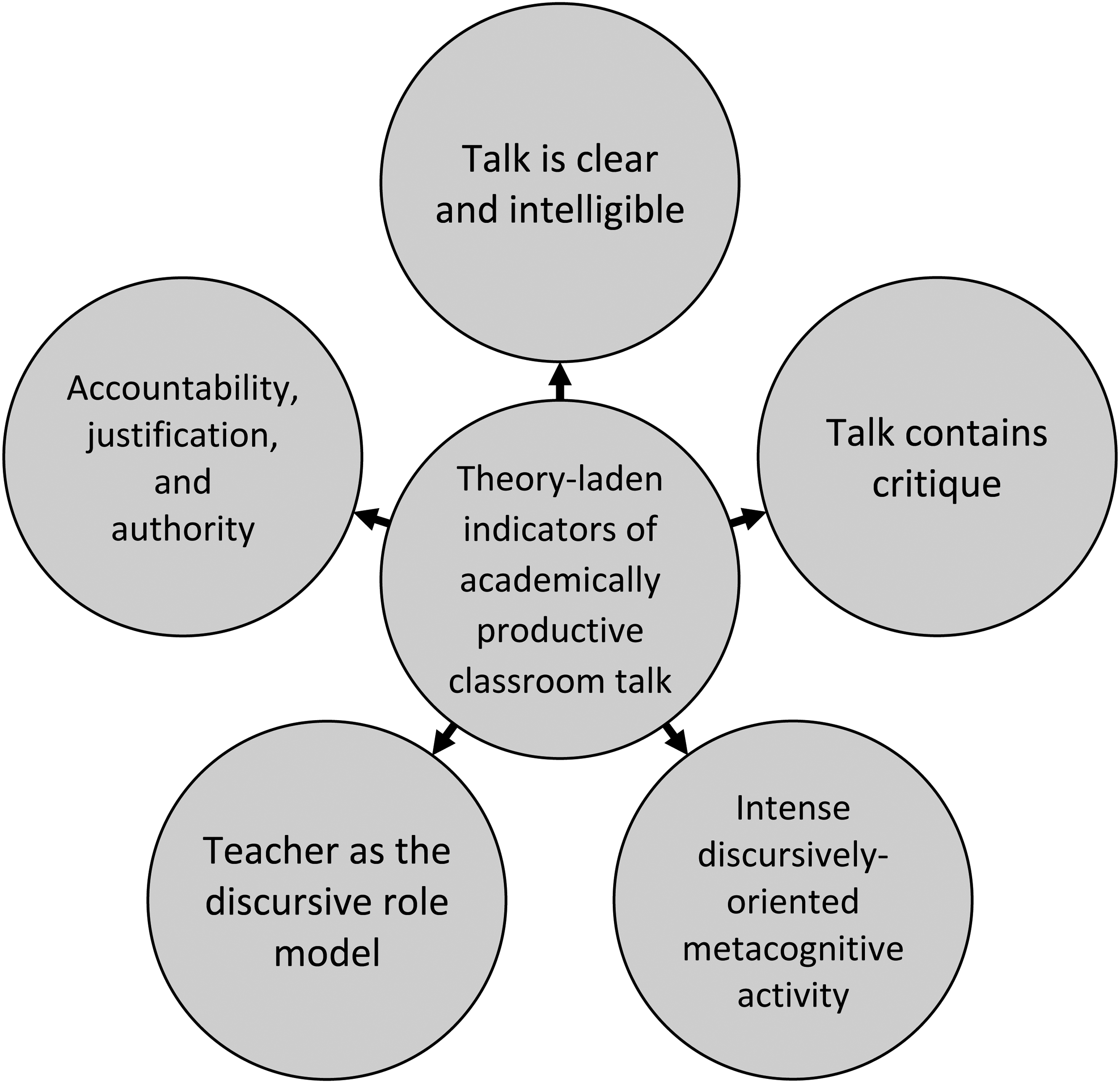
A theory-laden pentagon model for characterizing academically productive classroom talk (APCT).
As the pentagon model shows, PCTs should ensure the clarity and intelligibility of student utterances (Reznitskaya et al., 2009). Proper and timely teacher questions serve to sustain precise communication, thereby enhancing students’ intellectual productivity (Alexander, 2006, 2008). APCT is also indicated by the continuous comparison of alternative ideas. PCT questions should ensure a discursive harmony in which critical but constructive verbal exchanges are sustained (Reznitskaya & Gregory, 2013). In this respect, PCTs should use their questions to create situations of cognitive conflict. PCT questions should serve to externalize students’ conceptual, epistemological, and/or ontological conflicts (Littleton & Mercer, 2013). Accountable talk should be the norm of classroom discourse, with PCT questions guiding students to be accountable to the learning community and toward understanding the accepted standards of logic and theoretical frameworks of a specific field of inquiry (Michaels et al., 2008). PCT questions should also ensure that students take the claims and logic systems of others seriously. PCTs should use questions to force students to provide evidence for their baseless claims (Conner et al., 2014a, 2014b). PCTs should use their questions to share their epistemic authority, with students able to review the opinions of their classmates. In this regard, PCTs should also employ questions to create an inclusive space in which students can philosophize, and in which they can mutually construct and reconstruct one another (Alexander, 2006, 2008).
None of the aforementioned indicators of APCT is possible without metacognitive prompts. Students need to use PCT questions to monitor their own conceptual and procedural thinking. Accordingly, PCTs should ask questions that guide students to check, control, regulate, and evaluate their thinking (Tang, 2021). They can do this by constantly responding to the question: “What is happening in this specific moment of classroom talks?” (Mercer, 2008). PCTs should act as discursive role models for APCT by enacting good thinking styles (Conner et al., 2014a, 2014b). For instance, PCTs should exhibit evidence-based reasoning in order to demonstrate how a person might present their idea in a more persuasive and internally consistent manner (Reznitskaya et al., 2009). PCTs should model how an individual generates a justified argument, rebuts a less plausible point of view, or defends an assertion by protecting it from counter-arguments (Simon et al., 2006).
Research questions
Based on the foregoing, this study addresses the following two research questions:
Which types of questions do PCTs use to initiate, maintain, and finalize the lessons? What are the relational patterns between the observed types of PCT questions and the five criteria of APCT?
Methodology
Research approach
This study was conducted as a naturalistic inquiry focusing on the typology of PCT questions and their potential instrumentality for sustaining APCT. This study examines PCT questions in a particular context, namely, their first experience conducting in-class lessons. This study employs a case study approach because it involves “intensive descriptions and analyses of a single unit or bounded system such as an individual, program, or group” (Merriam, 1998, p. 19). More specifically, this study sought to observe the participating PCTs’ questioning behavior in the natural classroom setting without any external intervention.
Participants and research context
Participants comprised 24 senior students; specifically, 20 females (80%) and 4 males (20%). Participants were enrolled in a classroom teacher program at a foundation-supported university located in the Marmara Region of northwest Turkey. At the time of this study, the participant PCTs were putting their theoretically oriented pedagogic cognition into practice. Before the practicum, the PCTs completed theoretical courses incorporating core components of a standard-based teacher education program. During the practicum period, faculty members pedagogically guided the PCTs. The practicum provides PCTs with a practical opportunity to apply and refine what they have learned from the standard program. Through their practicum, a PCT experiences the realities of an authentic classroom setting. This period also provides pedagogical moments in which PCTs can address any gaps between the theory and practice of in-class teaching. The practicum provides experiential and novel occasions for PCTs (Kosnik & Beck, 2009). Accordingly, to address its research questions, this study collected verbal data from the lessons conducted by participating PCTs during their practicums.
Teaching planning task
The PCTs completed a teaching planning task (TPT; see Appendix A). The TPT prompted the PCTs to work through multifaceted aspects of lesson planning. By completing the TPT, PCTs developed structured lines of pedagogical reasoning regarding what they anticipated would happen when they presented specific subject matter knowledge as per their plan. Based on the work of Soysal and Radmard (2018), the TPT's prompts comprised three categories: the prior-to-teaching session (items 2, 3, and 9), after-teaching session (items 1, 4, 5, and 8), and a combination of both sessions (items 6 and 7). After completing the TNT, the PCTs carried out the lessons on the following curricular content:
Life Knowledge Lesson: Life in school, life in nature, and so on (third grade). Mathematics Lesson: Natural numbers; mathematical data collection and interpretation; addition, subtraction, multiplication, and division; geometric objects and shapes; weighing and measuring time, liquids, area, and so on (third and fourth grades). Primary Science Lesson: The planets, five senses, force and motion, substances, light and sound as energy, living things, and electric vehicles (third and fourth grades). Social Knowledge Lesson: The individual and society; culture and heritage; people, places, and environments; science, technology, and society; production, distribution, and consumption; active citizenship (fourth grade).
Data collection
This study's primary data are video data of the lessons. Each PCT conducted four lessons, resulting in 96 video recordings. The first two implementations were considered warm-up activities and the PCTs were supported by guide teachers or teacher educators, who provided in-the-moment pedagogical feedback to the PCTs. Moreover, the teacher educators sometimes interfered with the talks and maintained the student dialogues in order to model proper questioning practice for the PCTs. Consequently, pedagogical scaffolding was maximized during the first two lessons. Although the PCTs experienced several aspects of managing question-asking during classroom teaching, the first two lessons were dedicated to providing feedback to the PCTs so that they could observe and understand their teaching behavior using pedagogical scaffolding. In the last two implementations, the PCTs handled the teaching process independently. Therefore, this study excluded the first two lessons from data analysis, with the final data sample comprising 48 (1,821 min) video recordings.
Data were collected via two cameras in the classrooms. Audiovisual quality was ensured to differentiate the simultaneous talk initiations. Prior to conducting this study, the school board was informed of the purposes of and approved this research. The students’ parents were also informed that the classes would be recorded and provided written consent. The PCTs and guide teachers also completed consent forms.
Data analysis
Using a systematic observation approach (Mercer, 2010), data were analyzed by coding and quantifying the verbal data transcriptions. The patterns between the observed question types and their instrumentality in triggering APCT were then interpreted. Data analysis comprised three stages: (1) coding, in which the discursive function (typology) of an observed question was identified; (2) quantifying, in which the frequency of a question type was determined; and (3) associating, in which the patterns between the observed question types and their presumable contribution to APCT were identified.
As shown in in Table 1, this study developed a theory-laden and data-driven coding catalogue, the Teacher Questioning Coding Catalogue (TQCC), comprising 9 higher-order categories and 34 subcategories. The complex structure of the TQCC enabled the identification of PCT question types. After refining the PCT questions, a code was assigned to each utterance in order to clarify the discursive function of the question. Once the observed question types were saturated, the final form of the TQCC was generated. Two external researchers supported the two principal researchers in assigning the codes from the TQCC. Three coders worked together to analyze 22 videos, while the principal investigators analyzed the remaining videos (n = 26). Cohen's kappa reliability coefficient was checked twice, producing scores of 0.71 and 0.83, respectively.
Types, sub-types, descriptions, and examples of prospective classromm teacher (PCT) questions.

The researchers were debriefed by two external researchers with expertise in preservice teacher training. In addition to rigorous external checking of the assigned codes, the external debriefers continuously reviewed the researchers’ coding mentality, playing the role of devil's advocate. In doing so, they drew attention to issues like overinterpreting the challenging questions. Based on their recommendations, the TQCC was understood as a context-sensitive tool. Consequently, the researchers had to reconsider the context of a displayed question to make a more objectified decision on the typology.
The assigned codes were consistently compared in two ways: intra-implementation (internal) and inter-implementation (external). In this respect, a matrix was designed to compare, for instance, the probing questions (Table 1) asked within the same lessons to determine whether there was internal consistency. Accordingly, the probing questions were constantly compared with other questions coded as probing and observed during other lessons to ensure external consistency. Occurrences of the higher-order categories were subsequently quantified.
Data-based estimations of the instrumentality of PCTs’ questions for triggering and fostering APCT were generated in the third step of analysis using a theory-based APCT indicator list. As shown in Table 2, PCT question types were linked with appropriate APCT descriptors, with such associations used to predict the instrumentality of the observed questions for initiating APCT. Associations were discerned based on answering the following two questions:
To what extent did the PCTs use their questions to maintain an aspect of APCT? Were the PCTs’ questions dispersed homogeneously across the lessons to scaffold APCT?
Indicators and descriptors of productive classroom talk (PCT) and possible question types supporting talk productivity.
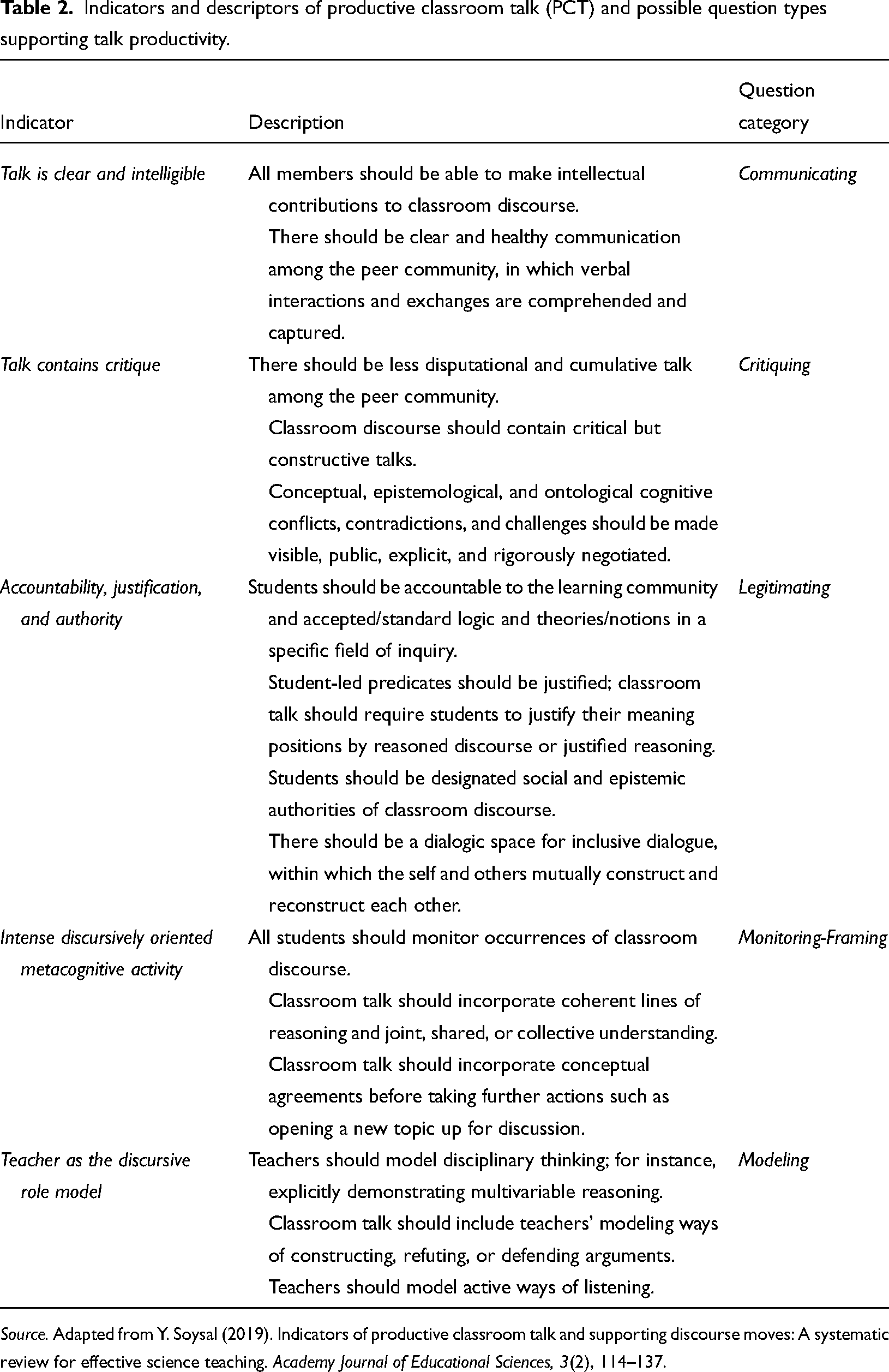
Source. Adapted from Y. Soysal (2019). Indicators of productive classroom talk and supporting discourse moves: A systematic review for effective science teaching. Academy Journal of Educational Sciences, 3(2), 114–137.
Results
Data analysis revealed nine types of PCT questions. Of these, six types—namely, communicating, monitoring-framing, critiquing, legitimating, evidencing, and modeling—appeared to foster APCT. While the remaining three question types—observe-compare-predict, concluding and naming, and maintaining—contributed to the variation of the typology, they were not explicitly linked to APCT indicators. Figure 2 shows the frequency with which each question type was asked.
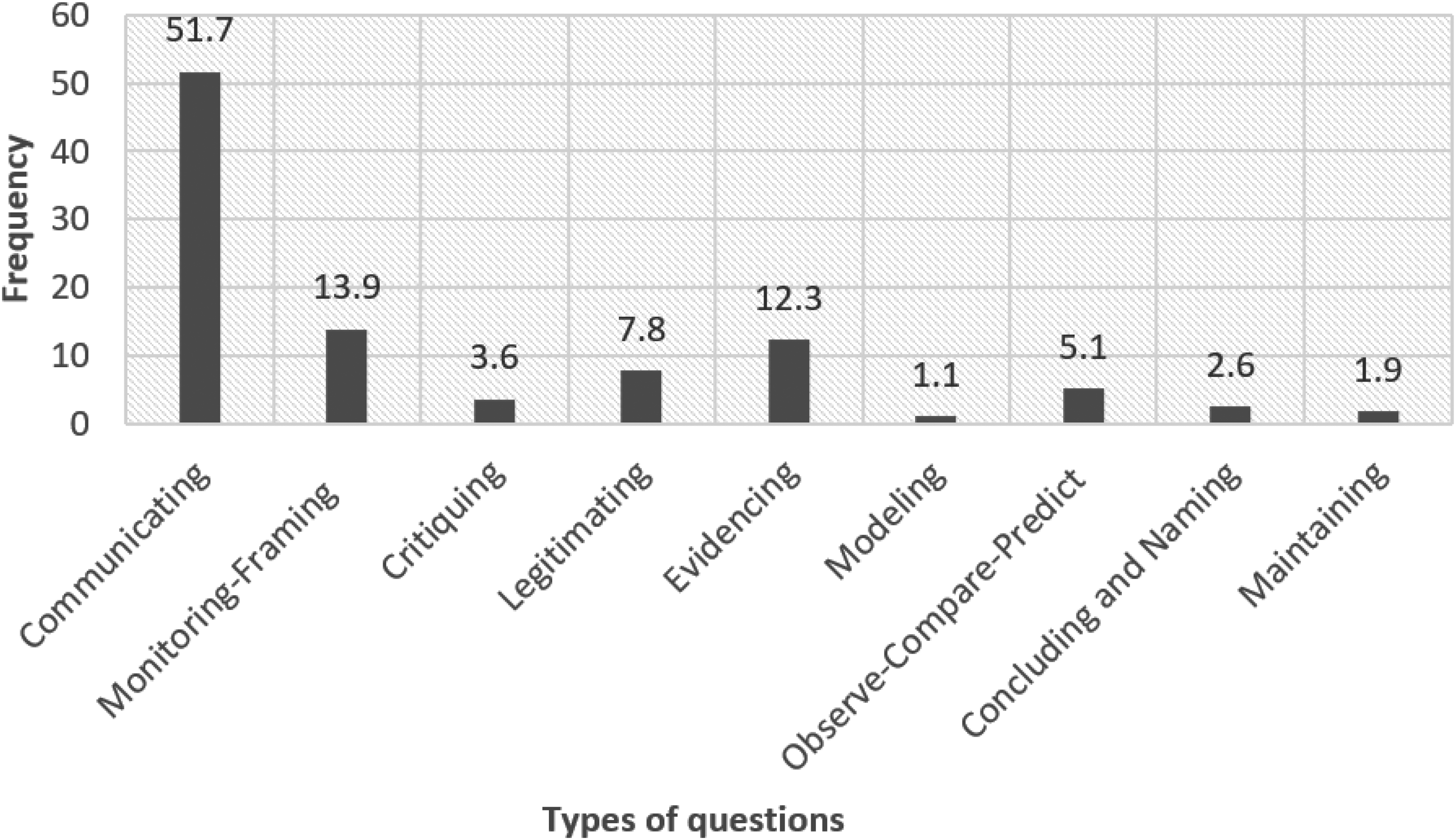
The proportion of prspective clasroom teacher (PCT) question types (%) asked in the selected classes.
Communicating questions
PCTs used communicating questions (Table 1) to clarify, reformulate, elaborate on, or embody the students’ utterances. These questions helped students comprehend what their classmates were trying to articulate. Table 3 shows a sub-topical talk episode from a lesson about professions. In the episode, the students discussed having a profession. In line 28, the PCT elaborated on a previous utterance requesting more information about the student's underlying meaning (line 27: “Because we have to work.”). In line 32, the teacher candidate was asked to clarify an ambiguous utterance (line 31), which had a subjective meaning (“… time passes”).
Example analysis of prospective classroom teacher (PCT) questions during the class on “professions.”

Communicating questions reflect many APCT indicators (Figure 1), and were used more frequently than other question types (Figure 2; 51.7%). The PCTs prompted students to make an intellectual contribution to the classroom talks, requiring the exchange of ideas. When the students understood their peers’ conceptual intentions through the communicating questions, they were able to comment on these ideas, which is a more sophisticated indicator of APCT.
Monitoring-framing questions
PCTs used monitoring-framing questions to maintain an on-the-fly synchronization between themselves and their students during the lessons. The PCTs held a relatively prescriptive teaching agenda, which meant that the students had to follow what was said at a specific moment of the lesson. The PCTs guided student engagement with metacognitive activity by asking monitoring-framing questions, which required selection, elimination, focusing, and monitoring (Table 1). In line 84 of the episode presented in Table 3, the PCT put forward a student response as it was relevant to expanding the classroom talk. Here, the focusing question drew the students’ attention to a specific point, thereby generating rich ideas. Answering monitoring-framing questions required students to recognize which responses the PCT had selected, eliminated, or focused on. For example, in line 86, the PCT guided Student-1 to determine whether Student-9's idea (line 83) and her response (line 85) conveyed the same meaning (i.e., one needs both effort and talent to perform a profession effectively).
As shown in Figure 2, PCTs frequently employed monitoring-framing questions (13.9%), which were associated with APCT indicators like sustaining intense metacognitive activity. The monitoring-framing questions required students to pay close attention to what was happening at a specific time of the lesson. As a metacognitive activity, the PCTs delivered metamessages to the students so as to differentiate a contextually valuable idea from an inappropriate one. Monitoring-framing questions were also associated with the students maintaining constant cognitive engagement as they had to make sense of the classroom occurrences or mentally engage in order to address such questions.
Critiquing questions
Critiquing questions were used to guide the students to recognize that a phenomenon can be better understood or explained via recourse to an alternative viewpoint. In this respect, the PCTs acted as external auditors by understanding, analyzing, and commenting on the students’ incomplete or untenable ideas. In doing so, the PCTs were able to concretize the students’ conceptual, ontological, or epistemological conflicts, thereby facilitating the development of more plausible ideas. Such questions required students to pay attention to alternative or contradictory ideas. For example, in line 92 (Table 3), the PCT proposed an alternative proposition to Student-1, while Student-4 argued that some professions cannot be attained through effort alone (lines 79, 80, 85, 87, 89, and 91); for instance, being a football player requires innate talent.
However, as shown in Figure 2, despite being a fundamental indicator of APCT, the PCTs rarely employed critiquing questions (3.6%). Indeed, the PCTs seemed to avoid problematizing the students’ assertions and seldom employed a discrepant question by playing the role of devil's advocate or drawing attention to the students’ cognitive conflicts. The PCTs maintained the lessons by ensuring an early intellectual consensus where the students’ ideas were simply gathered and accepted without constructive criticisms.
Legitimating questions
PCTs used legitimating questions to encourage the students to critique their classmates’ ideas (Table 1), using such questions to prompt students to determine whether an opinion was credible or not. Once the PCT asked a legitimating question, the students contributed to the classroom talk by deliberating on a classmate's less plausible idea. For example, in line 30 (Table 3), the PCT invited the students to evaluate an idea of one of their peers (line 29). Meanwhile, in line 36, the PCT contextualized Student-7's response by referring to the diversification of professions, inviting Student-7 to evaluate the presented case. Lines 50 and 90 also present examples of legitimating questions.
Although legitimating questions encouraged accountability, justification, and authority sharing, PCTs seldom employed them (7.8%). Instead of inviting students to comment, the PCTs decided on the acceptability of a student’s response. The students may have had more opportunities to examine and legitimate their peers’ ideas if the PCTs had used legitimating questions. Indeed, although the PCTs made some use of legitimating questions, the lessons provided little space for this question type. As a result of few legitimating questions, the students rarely built on their classmates’ ideas by expanding or revising them, a practice that typically characterizes APCT.
Evidencing questions
The PCTs encouraged students to present observational data, examples, instances, or individual experiences to support their claims. For example, in line 42 (Table 3), the PCT requested that Student-1 provide an example to confirm their argument (line 41: “… not everyone can be a football player”). Through evidencing questions, the PCTs prompted students to link their claim with the data, and explain why the proposed cases, observational data, examples, instances, or individual experiences supported their argument. The PCTs motivated students to provide evidence by focusing on the value of their reasoning and the need for it to be trustworthy in idea sharing. As shoen in Figure 2, the PCTs employed evidencing questions more frequently than several other question types (12.3%). The PCTs may have used evidencing questions to encourage accountable talk, which is an indicator of APCT. Such questions are also necessary in the case of students making numerous baseless claims.
Modeling questions
The PCTs used modeling questions to demonstrate active listening, multivariable reasoning, or represent ideas. In doing so, the PCTs demonstrated the value of active listening for ensuring reciprocal verbal interactions among the students (e.g., “I think if I listen to everything you say carefully, I can answer you better, right?”). In line 84 (Table 3), the PCT posed a question to check whether every student had understood Student-9's idea (line 83). She then drew the students’ attention to a specific utterance (line 83: “Actually it is both …”) by emphasizing the response (line 84). As noted, the PCTs also used modeling questions to demonstrate multivariable thinking. For example, in line 88, the PCT noted other factors explaining how people choose a profession, adding the “want to do a job” (line 88) to Student-9's list.
However, PCTs almost never employed modeling questions (1.1%). This indicates that there was less space for APCT, particularly insofar as modeling questions tend to facilitate student engagement with sophisticated cognitive operations (e.g., complex idea sharing by multivariable reasoning). The demonstration of active listening, multivariable thinking, or clear idea presentation by a teacher often leads to students mimicking such behaviors. PCTs could have used modeling questions to demonstrate the process of effective idea exchange or valuing the ideas of others. Other uses of modeling questions include promoting core indicators of APCT like inter-thinking, whereby students listen to one another carefully. However, because PCTs seldom employ such questions, the aforementioned indicators of APCT may have been absent.
Observe-compare-predict questions
The PCTs used questions to encourage students to make observations, comparisons, and predictions (Table 1). By addressing observe-compare-predict questions, the students engaged in hypothetical thinking. In line 44 (Table 3), the PCT asked Student-1 to explain the connection between running fast, working hard, and being a football player. The PCTs used such questions to guide the students to compare ideas, cases, arguments, and instances. For example, in line 78, the PCT asked the students to compare the different conditions behind being educated as a football player. However, only 5.1% (Figure 2) of the analyzed questions were from this category and were not directly related to the indicators of APCT.
Concluding and naming questions
The PCTs prompted students to draw conclusions and encouraged them to summarize their thoughts using concluding and naming questions (e.g., “How might we [label] this situation? Ethical or unethical?”) at the end of the lesson. For example, in line 95 (Table 3), after receiving various responses from the students about how one should act in a profession, the PCT requested a summative statement from the students. However, only 2.6% of the PCTs’ questions fell under this category and intended to prompt concluding remarks. Concluding and naming questions were not directly associated with APCT indicators.
Maintaining questions
PCTs used maintaining questions to cultivate and sustain an intellectually flexible classroom atmosphere in which students felt comfortable articulating their ideas. PCTs used maintaining questions to ensure an ethos of mutual respect by encouraging students to take their classmates’ ideas seriously (Table 1). For instance, the PCTs encouraged students to feel comfortable admitting a change in opinion about the difference between having and performing a job. Essentially, maintaining questions were used to organize the classroom talk (e.g., Table 3, line 97, “He is talking to you … Can you turn to your friends and talk to them?”). The PCTs also bolstered students’ concentration by ensuring silence in the lessons (e.g., “Isn't it plausible that we need to listen to her quietly if we want to comprehend what she is trying to say?”). This type of question was not evaluated as an explicit sign of APCT and was rarely asked by PCTs (1.9%).
Discussion
Typology of PCT questions
This study proposes a validated coding catalogue to capture the analytical aspects of PCT question types. In this study, participant PCTs asked a diverse range of question types, indicating a general desire to sustain multivocality during lessons. In this respect, PCT questions facilitated dialectical verbal interactions among the students (Lee, 2020). Dialectical verbal exchanges incorporate dialogical and monological teacher talk (Mortimer & Scott, 2003). In the proposed catalogue, the communicating category includes dialogically oriented interactions. Therefore, by asking questions in the communication category, the PCTs did not affirm student responses or dismiss their invalid or contextually irrelevant ideas. The PCTs used communicating questions to explicitly articulate the implicit or underlying meanings of student responses. In contrast, dialogical interactions involve welcoming, valuing, and interrogating alternative/contradictory perspectives (Sepulveda et al., 2020). As the multivocality of classroom discourse requires, the PCTs had to consider curricular content favoring the social languages of school science (Soysal & Yilmaz-Tuzun, 2021) to introduce alternative ways of thinking to the students. Therefore, the PCTs needed monologic question types, such as critiquing, legitimating, and evidencing.
Critiquing and legitimating an alternative explanation demands rhetorical verbal exchanges. Dialectical verbal exchanges in lessons require a cycle of affirming and negating ideas (Hasson & Glucksberg, 2006). As such, the PCTs appeared to engage in a zigzag or back-and-forth questioning process in order to stimulate harmonious dialogical and monological verbal exchanges, with the cognitive contributions of the students resulting in the construction of concepts. As such, the PCTs needed to diversify their questions in order to maintain the rhythm of authoritative and dialogic interactions (Scott et al., 2006). In other words, the PCTs tended to engage with the students’ everyday social languages (i.e., dialogical talk), which tend to be conceptually, epistemologically, and/or ontologically different from the social language of school science social languages (i.e., monological talk), resulting in dialectical classroom discourse.
The PCTs employed the observe-compare-predict and concluding and naming questions to encourage students to utilize inquiry or scientific process skills. Indeed, using these two types of questions, the PCTs directed students to apply scientific inquiry skills, including observation, measurement, classification, inference, and communication (Padilla, 1990). Higher-order reasoning involves sophisticated skills, such as the operational definition of a concept, hypothesis development, data interpretation, and experimenting and model construction (Padilla, 1990). PCTs encouraged students to engage with such skills by asking question types from the communicating, critiquing, legitimating, and evidencing categories. In this study, the observed classes covered a variety of topics, including mathematical data collection and interpretation, school life, the solar system, the five senses, force and motion, substances, the individual and society, as well as culture and heritage. Comprehending these topics requires students to engage with the basic and integrated skills of scientific thinking (Padilla, 2010). Accordingly, the PCTs diversified their question types to encourage students to apply basic and integrated scientific thinking skills.
The PCTs may also have diversified their questions for organizational purposes, such as constructive classroom management. For instance, questions under the modeling (e.g., modeling active listening) and maintaining (e.g., fostering mutual respect for the articulation of ideas or invoking silence to foster concentrated thinking) categories can be used to manage classroom talk. Using questions from the aforementioned categories, the PCTs were able to manage both expected (structural) and unexpected (emergent) situations in the classroom talk (Candela, 2005). Indeed, the multifaceted and overlapping nature of classroom talk required the PCTs to diversify their questions in this way (Soysal & Radmard, 2018). As such, the PCTs used questions to manage the deviations in the conceptual flow of the lesson arising from classroom discourse (e.g., communicating, critiquing, legitimating, and evidencing). They also used maintaining and modeling questions to manage adaptive and maladaptive student behaviors.
PCT question strategies for student-led intellectual productivity
The PCTs asked hundreds of questions over the course of the observed lessons. On average, more than 90% of the observed questions were intended to apply or trigger an indicator of APCT ([(Mcommunicating = 51.7%) + (Mmonitoring−framing = 13.9%) + (Mcritiquing = 3.6%) + (Mlegitimating = 7.8%) + (Mevidencing = 12.3%) + (Mmodeling = 1.1%)] = 90.4%). However, the dispersion of the question types appeared heterogeneous because one of every two questions observed in the lessons was from the communicating category. Questions from the critiquing (3.6%), legitimating (7.8%), and modeling (1.1%) categories were particularly rare.
Questions from the communicating category were dominant across the board, particularly insofar as the PCTs had to deal with ambiguous student responses that inhibited APCT. In this respect, the PCTs had to clarify what was said at a specific moment in the lesson in order to prompt engagement with other question types and foster APCT. For instance, before challenging the students’ ideas to create an argumentative classroom discourse, the PCTs had to clarify and elaborate on the students’ responses (Soysal, 2021). However, the PCTs’ reliance on communicating questions resulted in procedural discourse or cumulative talk (Cui & Teo, 2021). Such reliance also resulted in the low interanimation of ideas and the tendency to pool student responses (Mortimer & Scott, 2003). Consequently, there was less dialogic space for students to comment on one another's ideas, that is, conceptual discourse requiring the negotiation of competing arguments. In this study, communicating questions were used to promote APCT. Although previous research similarly concluded that probing questions play a key role in fostering APCT (e.g., Hähkiöniemi, 2017; Sahin, 2008, 2013, 2015; Shaughnessy & Boerst, 2018), the results of this study demonstrate the need for other question types to ensure APCT.
The PCTs appeared to use monitoring-framing questions more frequently than other question types. Indeed, there were many overlapping events during the lessons in which the PCTs were forced to make in-the-moment pedagogic reinitiations to encourage the students to engage in the classroom discourse. Monitoring-framing questions are metatalk questions (Tang, 2017), whereby the PCTs encouraged students to be aware of what was happening in a specific moment of the classroom talk. As students can be inattentive and easily distracted, the PCTs posed metatalk questions in order to regain student focus on the lesson and ensure that they engage in the conversation. In doing so, PCTs were able to create mind synchronization (Mercer, 2008). Although the PCTs wanted to discuss specific content within a particular sub-topical episode of the lesson, the students were not always mentally aligned with the PCTs during verbal interactions. Therefore, the frequency of metatalk questions may reflect the PCTs’ attempts to create synchronous talking, thinking, and knowing (Barnes, 1992), a fundamental indicator of APCT.
Evidencing questions were also popular. Evidence construction and intellectual productivity are reciprocally related (Manz & Renga, 2017). For evidence construction, students are required to gather, select, and use data as evidence to support their claims (Manz, 2016). Previous studies indicate that students can experience difficulties presenting evidence for or justifying their claims. Students may not know what actually constitutes evidence or how evidence is generated (Sandoval, 2003). As such, although students may propose evidence to support a claim, it may be invalid or inapplicable to the claim itself (Sandoval & Millwood, 2005). Moreover, students may be unable to differentiate between theory and evidence, or rely on personal ideas or assumptions rather than processing the data at hand (Hogan & Maglienti, 2001). Students may also fall into the trap of cherry-picking evidence, proposing relevant evidence to support a claim while ignoring other evidence. Such issues likely explain the prominent use of evidencing questions during the observed classes, particularly insofar as PCTs had to address students’ baseless, invalid, or incomplete claims and prompt them to reevaluate or justify their arguments (see, e.g., Table 3).
Meanwhile, the observed classes provided little to no space for critiquing questions, despite critique and construction constituting the fundamental elements of higher-order thinking, decision-making, and meaningful learning (Ford, 2008, 2012). As the PCTs were new to the classroom setting or unfamiliar with students, they may have felt that students would not respond to discrepant questions in a positive manner. In other words, the PCTs may have felt uncomfortable critiquing the students’ ideas, feeling that it might disrupt the class or student-teacher relationship. Moreover, a counter-argument or rebuttal by the PCT may have risked the students feeling embarrassed or feeling that they had lost face by being proved wrong (Tulis et al., 2018). Injecting critiques and counterclaims requires building certain classroom norms and ground rules (Tulis et al., 2018), which the participating PCTs may not have known how to do. In light of the aforementioned social requirements or barriers, the PCTs may have avoided asking many critiquing questions, despite the value of such questions in creating a more argumentative discourse setting, which is a major indicator of APCT.
PCTs also asked few legitimating questions. In this respect, the PCTs tended not to share their epistemic authority, making them the primary evaluators of the students’ ideas. This may be counterproductive to the fostering of APCT (Ong et al., 2020). In this study, the PCTs appear to have used legitimating questions to regulate the flow of the talks or organize the classroom discourse. In this study, the PCTs maintained close-ended patterns of interaction in the absence of the legitimating questions. As shown in Table 3, the verbal exchanges usually followed a teacher-student-teacher-student pattern, indicating that the PCTs preferred a teacher-controlled lesson flow (Weiland et al., 2014). The students had fewer opportunities to actively comment on their peers’ claims. This indicates that the PCTs were concerned with controlling the dialogue, although they asked several follow-up questions to encourage the talk. Such follow-up questions, which included a small number of legitimating questions, prevented the PCTs from getting stuck in the initiate-response-evaluate-(IRE) based triadic (Louca et al., 2012).
Educational implications
This study should be seen as a call for teacher educators to consider whether PCTs engage in teacher noticing (Sherin et al., 2011) in terms of their question types and the potential instrumentality of such questions for fostering APCT. In the context of this study, teacher noticing means that PCTs should be aware of the knowledge base and practical value of orchestrating conversations using specific questions in order to foster APCT. PCTs should understand that they have to examine and make sense of their instructional practices and the role of teacher questions in this regard. The outcomes of this study may be used as a methodological toolkit to aid and encourage PCTs to recognize their in-class questioning style and how this influences APCT.
The best way to ensure teacher noticing is to systematically train PCTs to analyze their question typology and the potential impact thereof on cultivating APCT. To do this, PCTs should pay attention to what is prominent and noteworthy in pedagogically oriented verbal data. The PCTs must be understood as co-researchers collaborating with teacher educators to identify and comprehend academically productive question-asking tactics. Lesson study and microteaching may encourage PCTs to evaluate their lessons. Teacher educators should provide a reflective space for PCTs to discuss and practice questions for APCT, thereby ensuring that PCTs become versatile questioners (Celik & Guzel, 2016). However, despite recognizing the vital role of specific question types in fostering APCT, teacher educators may avoid sharing such wisdom with PCTs (Sahin, 2013, 2015; Zhang & Patrick, 2012). Therefore, teacher educators can use the thinking tools proposed by this study to foster PCTs’ pedagogic cognition in sustaining APCT via strategic and planned question-asking.
Limitations of the study
This study has some limitations. Notably, in the different lessons planned and implemented by the PCTs, a topic-sensitive or topic-specific patterning could be observed regarding the question typology. In other words, it is possible that the content of the lessons regulated the typology. Based on the nature of the content covered in the lessons, the typology and frequency or distribution of the observed typology across the lessons changed. In some lessons, there were visible similarities between the everyday social languages of the students and those of the PCTs, who favored school science social languages. However, there were qualitative differences between the two social languages or the thinking and talking systems in some lessons. Therefore, the aforementioned linguistic similarities or communalities may have forced the PCTs to continuously rearrange the typology to better maintain the lesson. However, it must be kept in mind that most of the exemplified question types were observed because they were a requirement of the practicum. Consequently, the argument of this study regarding the question types and their associations with APCT is specific to the study context. This argument is supported by the fact that there was no interference in the lessons requiring PCTs to change their question types or questioning strategies, with the only requirement being that they display their pedagogic performance through intense question-asking.
Footnotes
Contributorship
Yilmaz Soysal contributed to all parts and sub-parts of the main body, including data collection, analysis, interpretation, and communication of the findings. Somayyeh Soysal contributed to managing the data corpus and operating some fundamental and foundational question-asking and academically productive talk theories to make sense of the systematic observations. Yilmaz Soysal and Somayyeh Soysal cooperated mostly in analyzing data and producing theory-laden interpretations to generative tentative but internally persuasive qualitatively oriented outcomes. Language editing was finally checked, and clarity issues were removed by Yilmaz Soysal.
Declaration of conflicting interests
The authors declared no potential conflicts of interest with respect to the research, authorship, and/or publication of this article.
Ethical statement
The present study and informed consent were approved by the Ethics Committee of Istanbul Aydin University (IRB number 2021/13). The informed consent was obtained from all the participants. The study participants did not give written consent for their data to be shared publicly, so supporting data is unavailable due to the sensitive nature of the research.
Funding
The authors received no financial support for the research, authorship, and/or publication of this article.