




Abstract
Purpose
In this article, we explore how student authorship may be enhanced among learners in mathematics classrooms in a Hong Kong primary school through rich dialogue discourse.
Design/Approach/Methods
Using qualitative methods, that is, coding and discourse analysis, we examine the relationship between student authorship and personal latitude through a case study of two Grade 4 mathematics lessons taught by two primary mathematics teachers, respectively.
Findings
We discuss the study's findings in relation to how teachers can engage themselves and their students in dialogic discourse to offer student choices and opportunities and generate original voices.
Originality/Value
Personal latitude was found when the students were given the choice to use their original voices. The learners assumed the role of author; consequently, authorship was enhanced in ensuing rich dialogic discourse.
Introduction
In the past two decades, studies have investigated how authority structures can be shaped in school learning contexts to develop learners’ sense of ownership and, in turn, enhance subject learning (Baxter Magolda, 2001; Cobb et al., 1992; Depaepe et al., 2012; Lerman, 1994; Milik & Boylan, 2013; Povey, 1997; Povey et al., 1999; Wagner, 2007; Walter & Gerson, 2007). For instance, Wagner and Herbel-Eisenmann (2014) have identified four kinds of authority structures that were present in mathematics classrooms: personal authority, discourse as authority, discursive inevitability, and personal latitude. Of interest to this study is the structure of personal latitude, which “recognize[s] that classroom participants could make decisions, and thus had authority” (p. 873). This is opposed to power residing in the traditional authoritative figures—teachers. These authors found that the discourse pattern that usually facilitates the development of personal latitude is associated with the presence of questions that open dialogue. Another key feature is the acknowledgment that people are making decisions. Amit and Fried (2005) have recognized a web of authority in the classroom context, demonstrating how authority is not only manifested in teachers but also in administrators, textbooks, textbook writers, parents, peers, and so on. Likewise, Ni et al. (2014) investigated the relationship between instructional task designs and teacher–student discourse, finding that instructional task designs impact classroom authority structure and the effectiveness of students’ mathematics learning.
These studies reveal the importance of considering how learners can be empowered through gaining voice, agency, and authority in the learning process. While Wagner and Herbel-Eisenmann (2014) have suggested how language practice and authority are related, Amit and Fried (2005) have highlighted the importance of exploring how learners conceive of the notion of authority because such an observation can produce reflective and fruitful collaborative work among students. Ni et al.'s (2014) study has revealed that designing high-cognitive-demand tasks affects the nature of classroom discourse, such as the kinds of questions raised in classrooms. However, they have concluded that it is “highly unlikely that a complete transformation of classroom practice to teacher–student shared authority would follow changes in instructional tasks alone” (p. 38).
Inspired by previous studies conducted in this area, the present work used a case study to explore alternative means for enhancing authorship among students. Specifically, the students were engaged in mathematics classrooms in a Hong Kong primary school via rich dialogic discourse. This article poses the following research question: How can student authorship be enhanced in rich dialogic mathematics classroom discourse in a Hong Kong primary school; in particular, how is student authorship related to broadening personal latitude in mathematics classrooms?
Research background
The authority structure
In this section, we define and explain how authority is understood in mathematics classroom context using Herbel-Eisenmann and Wagner's (2010) conceptual frame of authority structure. In their study, data collected were some frequently occurring set of words referred to as “lexical bundles” (p. 44). In particular, the researchers identified those “stance bundles,” which they have cited from Biber et al. (2004), as lexical bundles that communicate “personal feelings, attitudes, value judgments, or assessments” (p. 966). Their study then revealed how the stance bundles relate to teacher authority and how they position teachers, students, and the discipline of mathematics in different ways. In their study, they identified four authority structures: personal authority, discourse as authority, discursive inevitability, and personal latitude. The four kinds of authority structures are defined as follows: When students were assumed to be obligated in the interactions, authority seemed to lie with the teacher (which we denote as ‘Personal Authority’) or with the discipline of mathematics (which we denote as ‘Demands of the Discipline as Authority’). Another form of obligation seemed more subtle and appeared to draw on some presence external to students, suggesting inevitability to an upcoming action (which we call ‘More Subtle Discursive Authority’). When choice was encoded in the stance bundles, we indicate how ‘Personal Latitude’ was expressed in the language choices, hence suggesting an opening up of viewpoints. (Herbel-Eisenmann & Wagner, 2010, p. 46)
Of interest to the present case study is how students’ personal latitude, the fourth kind of authority structure that Herbel-Eisenmann and Wagner (2010) identified, may be broadened through rich dialogic discourse in a mathematics classroom. In Herbel-Eisenmann and Wagner's study (2010), stance bundles that encode an underlying message of alternatives are considered to offer potential to open up discourse and that indicates personal latitude. Personal latitude refers to an individual's scope of freedom of action or thought. Herbel-Eisenmann and Wagner (2010) have explained that personal latitude is broadened when choices are encoded in the classroom context. This is made evident when certain stance bundles are identified, encoding underlying messages of alternatives for students. In their study, examples were found to illustrate how personal latitude has been enhanced. One example was when the teacher authorized student agency by asking them, “Do you want to …” and another instance was when the teacher gave students a choice by asking them, “Which one do you want to do?” When these stance bundles offer students a choice, this “opens up the discourse” (Herbel-Eisenmann & Wagner, 2010, p. 57). Other examples of stance bundles were “What do we do …,” “Do we need to …,” and “Do you want to …” In a similar vein, Wagner and Herbel-Eisenmann (2014) have highlighted the importance of letting learners make decisions in the sense of making up and changing their minds in classroom learning situations.
In relation to authority, this study explores how allowing students to take on the role of authors may support them to make decisions, which in turn may lead to more student authority for having the right to do something in a particular context. According to Povey et al. (1999), when authority belongs to the learners, they understand meaning as negotiated, but when authority belongs to the experts (teachers), they take meaning as a given.
Author and authorship
Within classroom interactions, participants may assume the role of authors, the etymology of which shares the same root with “authorship” and “authority.” It is worthwhile to delve into the notions of author and authorship to unpack its connection with personal latitude as a form of authority in mathematics classrooms. According to Povey (1997), author refers to someone who brings things into being and who is the originator of any action or state of things. It entails the learner being able to produce something original that is not a recitation of what others have said. In the context of mathematics learning, learners who assume the role of author can tell their own stories about mathematics (Povey et al., 1999) and can use their personal voice both to produce and to critique meanings (Cobb et al., 1992). Lerman (1994) and Povey et al. (1999) have argued that the authority of an author lies in the ability to create potentially emancipatory discourse when a learner's understanding is different from others so as to open up different modes of discourse, like talk, discussion, refutations, suggestion, compromises, etc. Baxter Magolda (2001) even more concisely identified the key feature an author demonstrates—making up one's own mind.
In particular, in a mathematics classroom, the role of an author can be understood as how the author's voice is heard both audibly and subtly. This is different from how an author is perceived in a language classroom—here, an “author” is generally believed to be someone who writes something (e.g., a story or an essay). In relation to authority, Rossman and Rallis (1998) have observed that “voice is especially important because authorship gives power” (p. 199). It is also crucial to explain how voice is heard in a discourse. According to Wagner (2007), voice can be defined as “the level of input a person has in a discourse” (p. 37). In this sense, discourse can embrace various modes of presentation, such as written (notes, assignments, tests, exams), spoken (teacher-initiated dialogues, student–student interactions, group discussions, student presentations, student responses), and/or physical responses (nodding, frowning). Povey et al. (1999) have defined an author as a “learner [who] uses his or her mathematical voice to enquire, interrogate and reflect upon what is being learned and how” (p. 43). The “voice to enquire” means to seek information and to learn about something, the “voice to interrogate” means to ask questions about something, the “voice to reflect upon what is being learnt and how” means to make reflections based on the new knowledge that has been learned.
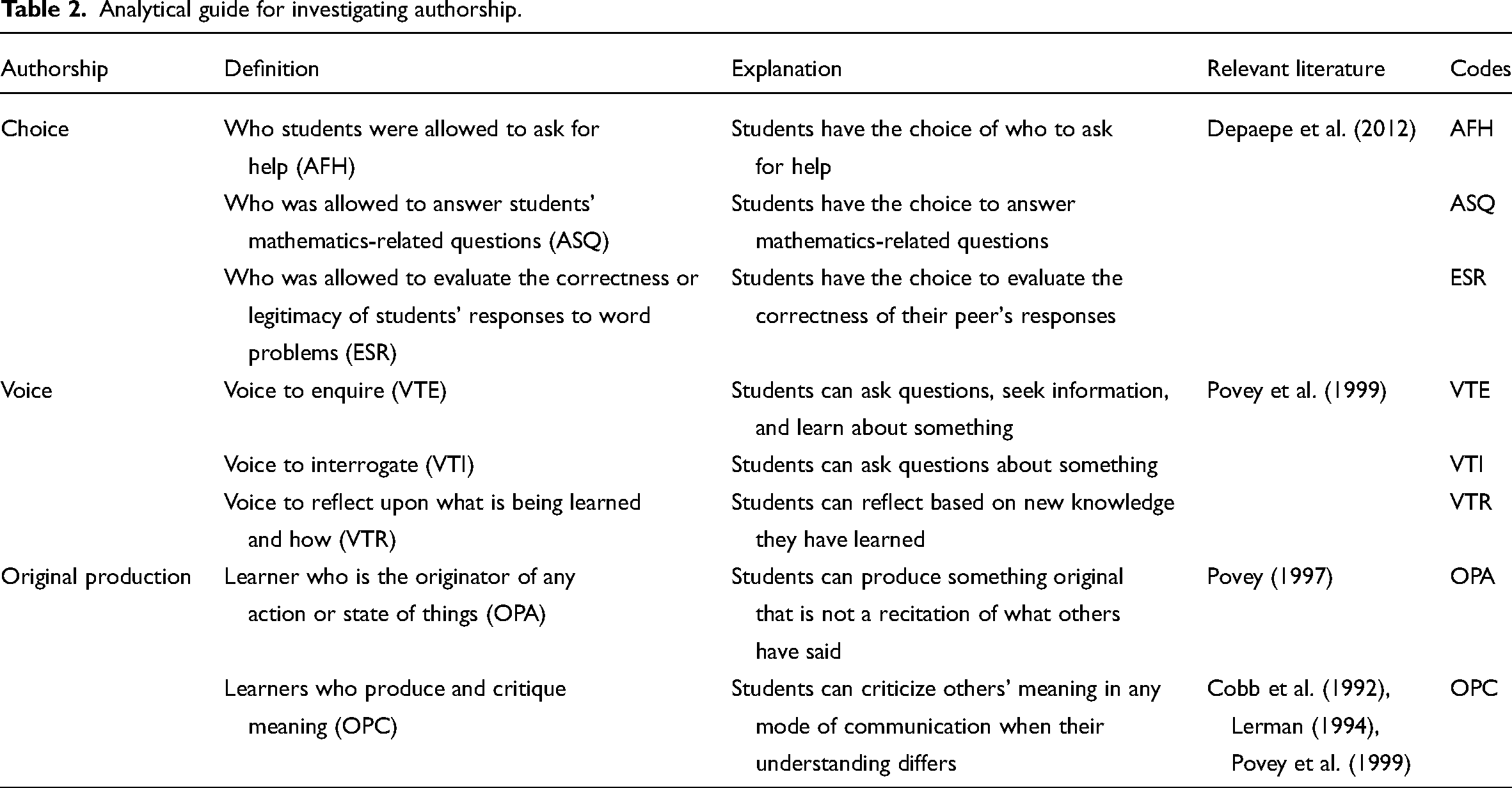
In contrast, “authority” refers to a learner having the right to do something in a particular context; authorship is the state of being an author. Baxter Magolda (2001) has identified what an author does as making up one's mind; thus, learners who have attained authorship can exercise a range of choices. This facilitates “deep progress” in mathematics classrooms, as Watson and de Geest (2005) discuss. “Deep progress” refers to how students can learn more mathematics, improve how they learn mathematics, and develop a sense of efficacy about themselves as mathematics students. Depaepe et al. (2012) have developed a coding scheme focusing on three aspects of the teacher–student interactions; it reflects whether or not the teacher shared mathematical authority with their students. The three aspects include offering students the choices of (1) who the students were allowed to ask for help (AFH), (2) who was allowed to answer the students’ mathematics-related questions (ASQ), and (3) who was allowed to evaluate the correctness or legitimacy of the students’ responses to word problems (ESR).
In this study, these codes were adapted by exemplifying students’ choices to analyze the level of authority distributed among teachers and students through classroom discourse. In addition, we drew on the features of an author (being the originator of any action or state of things and being able to produce and to critique meaning) as well as Povey et al.'s (1999) definition of “voice” (voice to enquire, voice to interrogate, and voice to reflect) to generate an analytical framework.
Dialogic discourse
In mathematics classrooms, as in other classrooms, interactions between the teacher, the student(s), and the whole class are evident. These interactions give rise to patterns of saying, acting, and doing in the classroom environment, each of which has implications for who gets to talk and whose voices are authorized (Otten et al., 2019). Discourse refers to how “the teacher and the students are mutually constituted through the course of interactions” (Walshaw & Anthony, 2008, p. 521). Dialogic discourse, in particular, is concerned with how “teachers need to be aware of the educational functions of talk and how it can best be used to guide and support children's learning” (Mercer & Howe, 2012, p. 14). Nystrand et al. (2003) distinguished monological discourse from dialogic discourse: …[in] an ideal dialogic learning environment, especially in open discussion as opposed to tightly cast recitation, teachers treat students as potential sources of knowledge and opinion, and in so doing complicate expert–novice hierarchies. (Nystrand et al., 2003, p. 140)
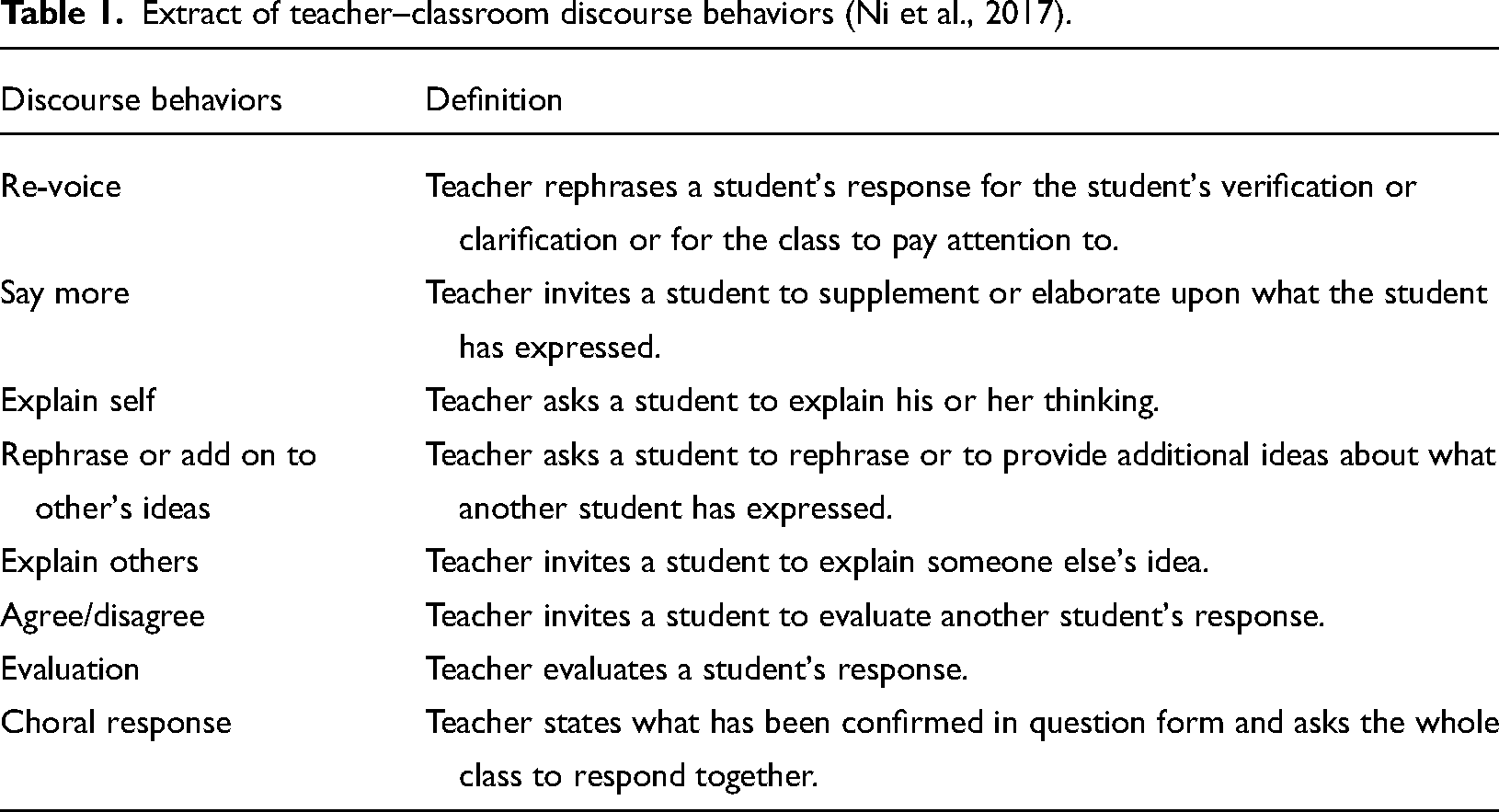
According to Ni et al. (2017) and Ng et al. (2020), implementing dialogic discourse can enhance students’ experiences in explaining, justifying, co-operating, and, most importantly, gaining a sense of ownership over the study of mathematics. In their study, they state that dialogic discourse can be enriched with a set of teacher–classroom discourse behaviors (Table 1), namely, re-voice, say more, explain self, rephrase or add on to other's ideas, explain others, agree/disagree, evaluate, and choral response. Some of these discourse behaviors require students’ explanation, elaboration, evaluation, and production of additional ideas, illustrating how the teacher and students interact to establish authorship in the classroom. As evidenced by Jacknick (2011), two important characteristics of teachers’ dialogic discourse behaviors are initiating interactions and delivering follow-up moves. Consequently, learners’ contributions are valued, which can be fruitful in getting students to reason mathematically using their peers’ ideas (Resnick et al., 2010).
Extract of teacher–classroom discourse behaviors (Ni et al., 2017).
Methodology
Research design and context
This study used an exploratory case study of two classrooms with rich dialogic discourse in Hong Kong. An important advantage of the case study method is that it allows authors to draw new insights into a phenomenon (Cohen et al., 2007; Denzin & Lincoln, 2000). This study draws insights into authorship features as well as how authorship can be enhanced in rich dialogic mathematics classroom discourse.
We conducted a case study at a public primary school in Hong Kong. Under the influence of Confucianism and sharing similarities with other East Asian mathematics classrooms (Leung, 2001), the local Hong Kong school culture features whole-class instruction and teacher-led activities, with students sitting in rows that face the teacher. Leung (1995, 2001) found that group work was rarely conducted, and mathematics teachers appeared to rush through the content. The teachers gave high priority to memorizing mathematical facts, and students mainly learned by rote (Leung, 2001). Compensating for large class sizes and striving for efficiency, instruction focused on procedures featuring minimal student involvement, reflecting how teachers’ pedagogical expertise was second to gaining content knowledge (Lui & Leung, 2013).
This study is embedded within a larger research project: a 3-year quasi-experiment investigating the efficacy of a teacher intervention program aiming to engage students with dialogic discourse for rich learning opportunities in mathematics classrooms. The intervention's goal was to equip teachers with the conceptual and practical tools (Grossman et al., 1999) necessary to engage students in dialogical discourse in mathematics classrooms (Ni et al., 2017). The specific aims of the intervention program included (1) assisting teachers to identify the attributes of classroom discourse and their relationship to student learning, (2) assisting teachers to understand and apply previously identified conceptual tools in order to explore the principles and core practices of engaging students in disciplined and dialogic discourse, (3) applying analytical tools of classroom discourse to assess one's own teaching, (4) enabling teachers to identify the challenges they face in their daily teaching in orchestrating classroom discourse that supports and expands students’ thinking and learning, and (5) assisting teachers to master and refine a repertoire of discourse strategies. The intervention, totaling 28.5 h, was carried out in the form of workshops with video-based activities, reflection activities, and group discussion. A total of 128 lessons were videotaped—each of the 32 participating teachers conducted two pre-intervention lessons and two post-intervention lessons. All the participants provided written informed consent to participate in the study.
Case study participants
In the present case study, the participants were two teachers, Amy and Brenda (pseudonyms), who taught Grade 4 (ages 9–10) mathematics classes at the same school. Of the 32 classrooms participating in the research project, the average class size was 28 students per class. Both Amy and Brenda had 32 students in their classes; they had 10 and 2 years of teaching experience, respectively. Notably, Amy was the vice panel chair of the mathematics department. This case study has captured several excerpts from these two lessons, which focused on the topic “Comparing fractions with different denominators.” As the medium of instruction of these lessons was Cantonese, the researchers translated the classroom transcriptions into English. They also cross-checked any discrepancies that arose in the translated transcripts to ensure accuracy and reliability (Cohen et al., 2007; Denzin & Lincoln, 2000).
There were several reasons why Amy and Brenda were selected for this present case study. First, during the 18 h of intervention workshops, the research team identified them as the most responsive and active participants of all the teacher participants who had been recruited into the program. Second, the lesson excerpts captured from these two teachers focused on the same topic “Comparing fractions with different denominators”—which was new to students of this level and considered to be important for the students’ further studies. Having been taught by both teachers, the chosen topic was believed to facilitate analysis of the students’ subject learning. Third, among all the teacher participants involved in this 3-year quasi-experiment, the lessons that Amy and Brenda delivered had yielded the highest increase in student utterances (an increase in the total number of words uttered by students of 571 and 1,743, respectively, outnumbering the average increase of 363 words from other teacher participants) when comparing the teachers’ pre-intervention and postintervention lessons. As this study aims to understand learners’ production of voice, quantitatively measuring the number of words the students uttered served as an objective indicator of their level of participation in the classroom discourse. As such, they demonstrated a representative case of rich dialogic discourse.
The analytical framework
As informed by the literature review, an analytical framework (Table 2) was generated and followed to analyze Amy and Brenda's lesson excerpts by considering three aspects of authorship: choice, voice, and original production. As with Depaepe et al. (2012), this study used the method of coding, along with the analytical framework, to analyze the chosen representative excerpts to better understand the mechanisms of authoring and its connections with broadening personal latitude in mathematics classrooms.
Analytical guide for investigating authorship.
Results
This section reports the current study's findings in response to the research question that was posed. The excerpts below were chosen because they were representative of the two lessons the case study participants—Amy and Brenda—delivered. Prior to these lessons, in Grade 3, the students had learned how to compare fractions whose denominators were the same, or whose numerators were the same. They had also learned equivalent fractions in the lessons prior to the videotaped lessons. In both analyzed lessons on “Comparing fractions with different denominators,” the teachers started revising the Grade 3 skills with the students, comparing fractions with the same denominators or with the same numerators before assigning the new tasks captured in the following excerpts. Amy conducted her lesson with a great deal of whole-class, teacher–student interaction, whereas Brenda conducted her lesson with a great deal of group discussion and group presentation.
Amy's lesson
In Amy's lesson, the students sat individually facing the blackboard. The first excerpt below shows a teacher-led discussion conducted in the middle of a mathematics lesson. In the beginning of the lesson, Amy revised some pre-requisite knowledge, followed by having students work individually (2.5 min) and then in groups of 2–3 (1 min), the task of which was to answer Question 4: Compare
Excerpt 1
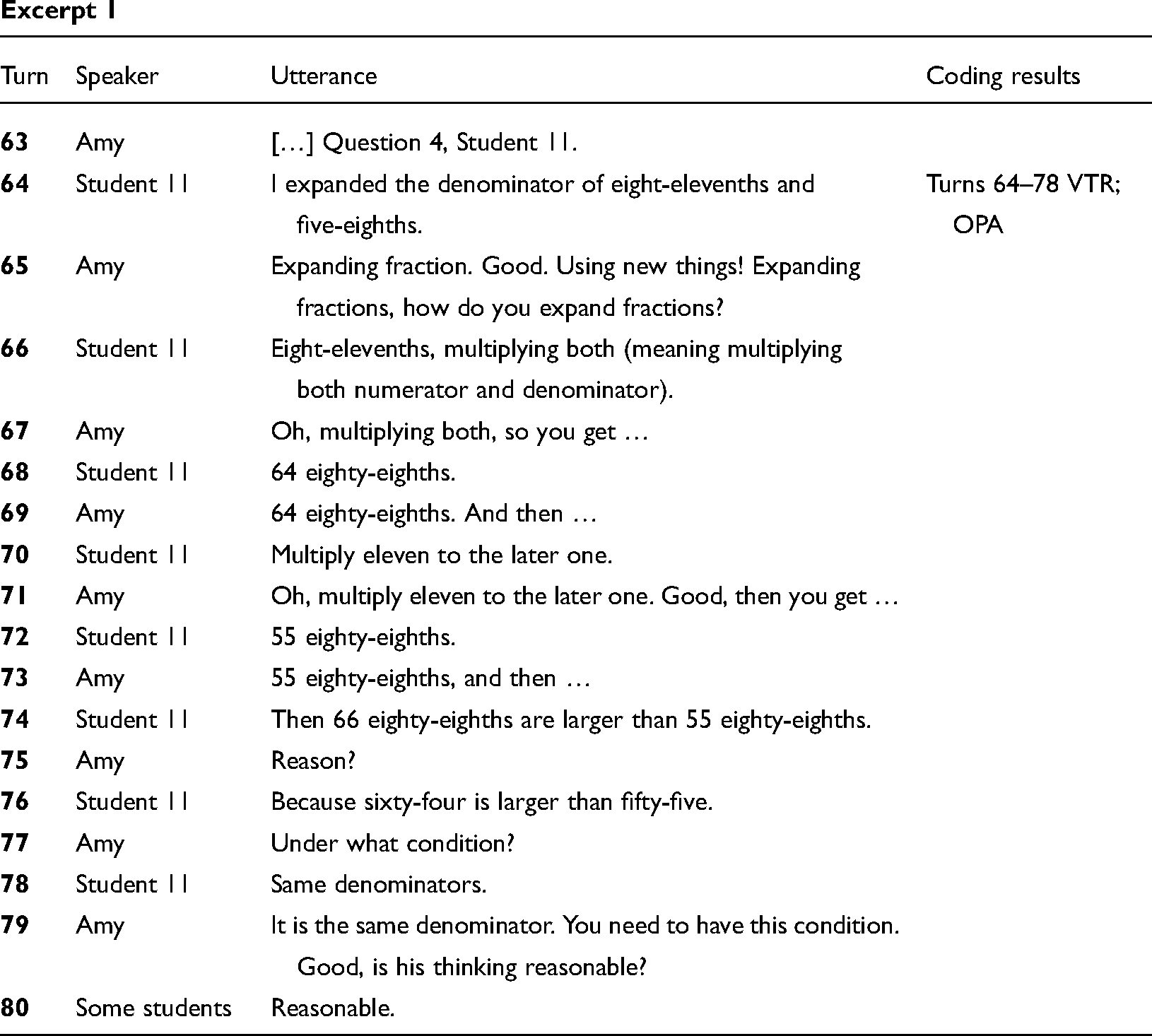
Excerpt 1 demonstrates how Amy conducted a teacher-led discussion after giving the students time to think on their own and work with their peers. In this excerpt, patterns of teacher–student interactions were prevalent, as the turns were taken by the teacher and the student in a tidy alternating manner. The content of such exchanges focused on how to compare fractions by the method of expanding fractions, which, as Amy suggested, was new to Grade 4 students (Turn 65). In Turn 66, Student 11 managed to produce his voice to reflect upon his ideas. He maintained his voice by describing how the fractions could be expanded, such as “multiply 11 to the second one [fraction
As can be seen in the excerpt, Student 11 demonstrated how he originated a mathematical idea. In his production of meaning, he demonstrated the application of “expansion of fractions” to “comparing fractions.” In Amy's utterance, “Good. Using new things!” (Turn 65), it was evident that Student 11 was going to express something new that Amy had not yet introduced to the class. This was done with Amy's guidance via prompting Student 11 to communicate his ideas throughout the exchange. Importantly, this interaction facilitated Student 11 to produce meaning within a 1:04 time span (Turns 63–80). Another facilitating factor that might have helped Student 11 to produce something original may have been the group work time that Amy allowed before she introduced the new topic to the whole class. It is likely that Student 11 did not recite this idea from the teacher but through the student–student discussions. This excerpt, however, did not provide evidence of students being given choices (i.e., AFH, ASQ, and ESR) (Depaepe et al., 2012). The highly controlled teacher-led discussion might have caused this.
As mentioned, Amy's questions and prompts might have facilitated Student 11's production of meaning. Specifically, Amy employed discourse moves that opened dialogue and enabled students to re-voice, say more, and explain self (Ni et al., 2017): “Expanding fractions, how do you expand fractions?” (Turn 65), “so you get …” (Turn 67), “and then …” (Turn 69 and 73), “then you get …” (Turn 71), “Reason?” (Turn 75), and “Under what condition?” (Turn 77). These dialogic discourse behaviors could give students the freedom to express their thoughts, coinciding with establishing personal latitude in allowing students to make decisions (Wagner & Herbel-Eisenmann, 2014).
Excerpt 2 is also from Amy's lesson. The task in the discourse was the same as in Excerpt 1—comparing
Excerpt 2
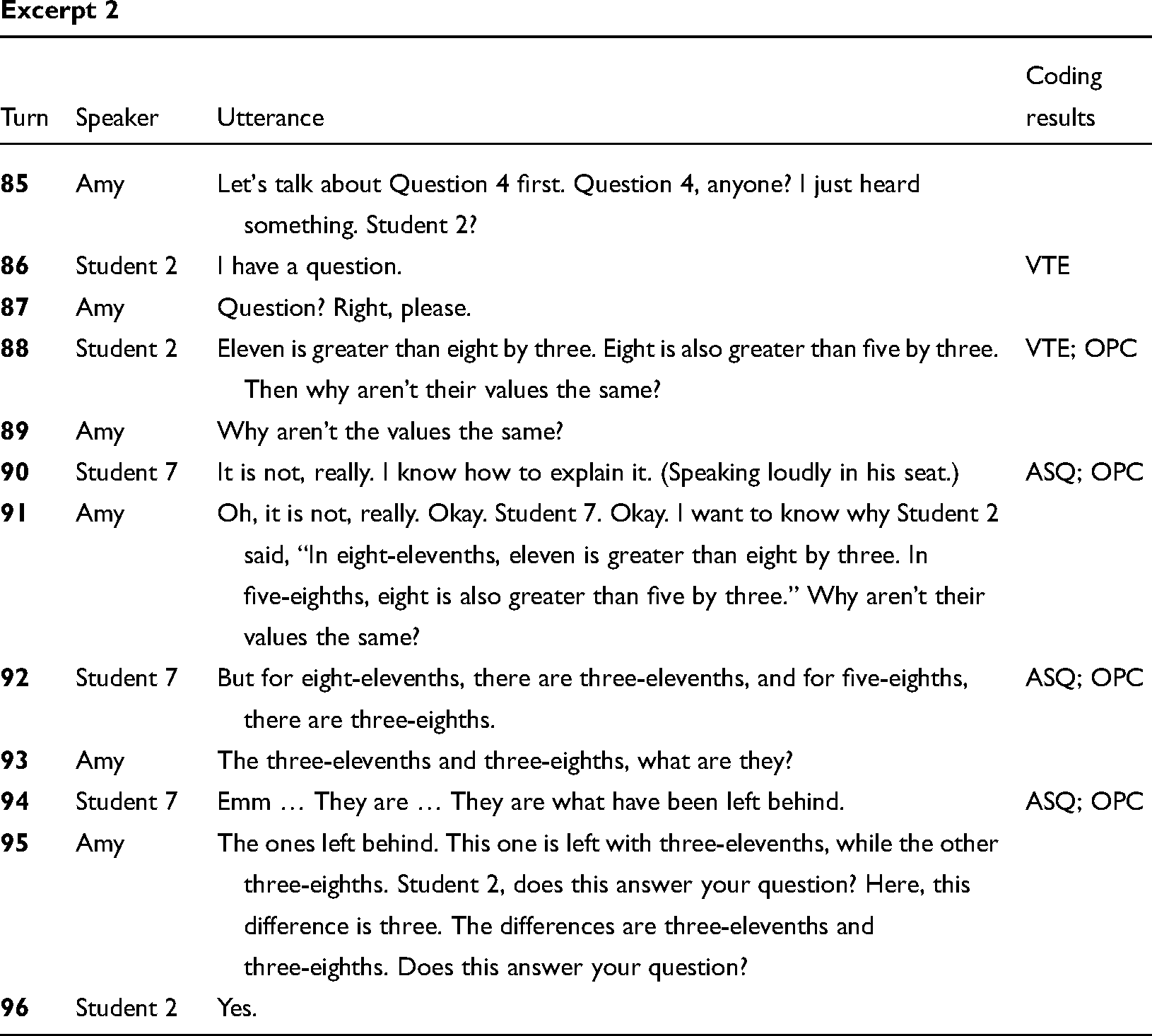
Excerpt 2 provides evidence of student choice. In Turn 88, Student 2 realized that he had a different thought from the one that Student 11 explained in Excerpt 1, subsequently raising a question about it. In response, Amy re-voiced the question but did not answer the question, and in so doing, she invited the floor to respond (Turn 89). This is an example of ASQ (Depaepe et al., 2012): introducing freedom to choose who was allowed to answer students’ mathematics-related question. While Student 7 volunteered to respond in Turn 90, he had neither been nominated by the teacher nor invited by his peers. He made a decision and he chose to respond. However, there was a lack of evidence of AFH, as Student 2 did not choose who he could ask for help.
In what follows, a productive dialogue is highlighted between the teacher and Student 7 showing Student 7's understanding of the difference between a denominator and a numerator—an understanding which was different from that of Student 2's. This happened when students came up with different understandings. In Turn 92, Student 7 explained, “But for eight-elevenths, there are three-elevenths, and for five-eighths, there are three-eighths.” According to Student 7, the respective fractions were how much is left over when “eight-elevenths” and “five-eighths” are taken from a whole (Turn 94). Knowing that three-elevenths was smaller than three-eighths, Student 7 was explaining that taking a smaller portion from the same whole would leave a larger portion. Thus, Student 7 compared the fractions in a mathematically sound and correct way: eight-elevenths was larger than five-eighths. This explanation was an original idea that Student 7 produced, albeit an indirect one. That is, Student 7 demonstrated how he compared fractions by making relevant connections to his previously learned concept, “Comparing fractions with the same numerators.” These utterances demonstrated an emancipatory discourse based on learners’ different understandings (Povey et al., 1999).
In another vein, student voice was very evident in Excerpt 2. In Turns 86 and 88, Student 2 raised and elaborated upon his question: “Eleven is greater than eight by three. Eight is also greater than five by three. Then why aren’t their values the same?” Clearly, Student 2 was producing a voice to enquire by attending to the difference of the denominator and numerator in both fractions. From this, it was observed that Student 2 had a misconception: “since both fractions had three parts left, the fractions have the same value.” However, Student 2 seemed to have corrected this misconception by his response in Turn 96. This change of thinking could be grounded on Student 2's voice to enquire, which was answered by Student 7's inference that eight-elevenths was larger than five-eighths, as the leftover fractions of the whole were three-elevenths and three-eighths, respectively.
The use of open questions in invited dialogue was again observed in Excerpt 2. For example, Amy asked, “Question?” (Turn 87), “Why aren’t the values the same?” (Turn 89), and “I want to know why Student 2 said…Why aren’t their values the same?” (Turn 91). Amy adapted Ni et al.'s (2017) dialogic discourse behavior exactly—“re-voice” and “explain others”—to invite students to elaborate upon another student's ideas. In Turn 95, Amy further adapted the discourse moves re-voice and agree/disagree. She re-voiced Student 7's response to the whole class and invited Student 2 to check whether he agreed with Student 7's explanation. Not only did the above discourse behaviors invite individual student's participation, but they also invited the co-construction of mathematical meanings. Such open dialogues exemplify a key feature of Wagner and Herbel-Eisenmann's (2014) characterization of personal latitude, that is, offering students a choice to open up a discourse.
Brenda's lesson
The study now turns to the representative excerpt captured in Brenda's lesson. In general, the task design was similar to Amy's where students were invited to compare fractions. What is more distinctive in Brenda's instructional task design (Ni et al., 2014) was how she planned her lesson that facilitated group work, which nurtured peer interactions. Students in Brenda's lessons were divided into eight groups of four to five students, with each group of students seated in a cluster of desks that were facing one another. During group discussion time, Brenda would circulate around the classroom to interact with students. In the beginning of the lesson, Brenda distributed some paper cutouts of two sectors (Figure 1), some markers, and an A3-sized erasable board to each group. She asked the students to compare the fractions

The paper cutouts Brenda used in her lesson.
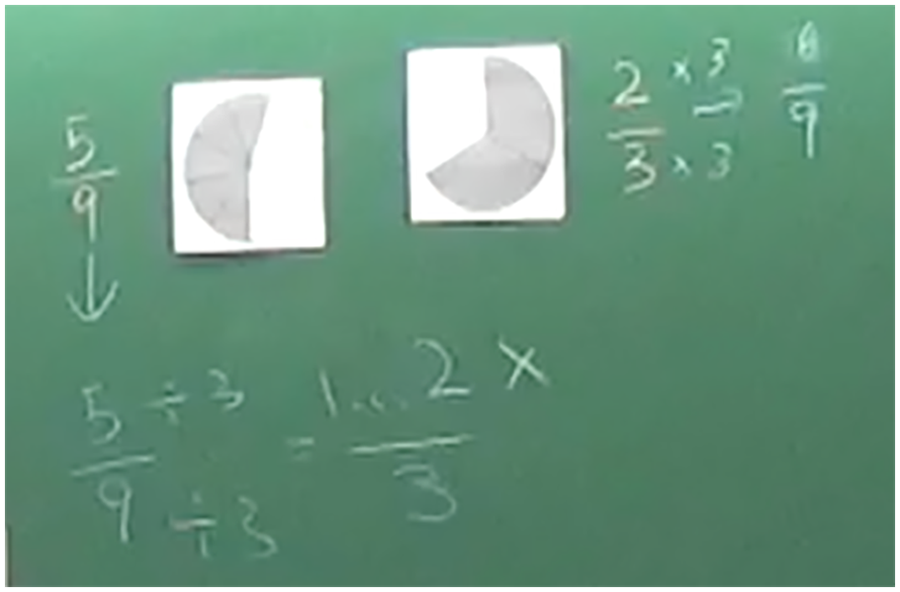
Brenda's representation on the blackboard (Turn 154).
The following excerpt captures the third group's presentation, who volunteered to present and chose to come up to the front of the classroom to share their solutions. They presented methods that were different from the previous two groups.
Excerpt 3
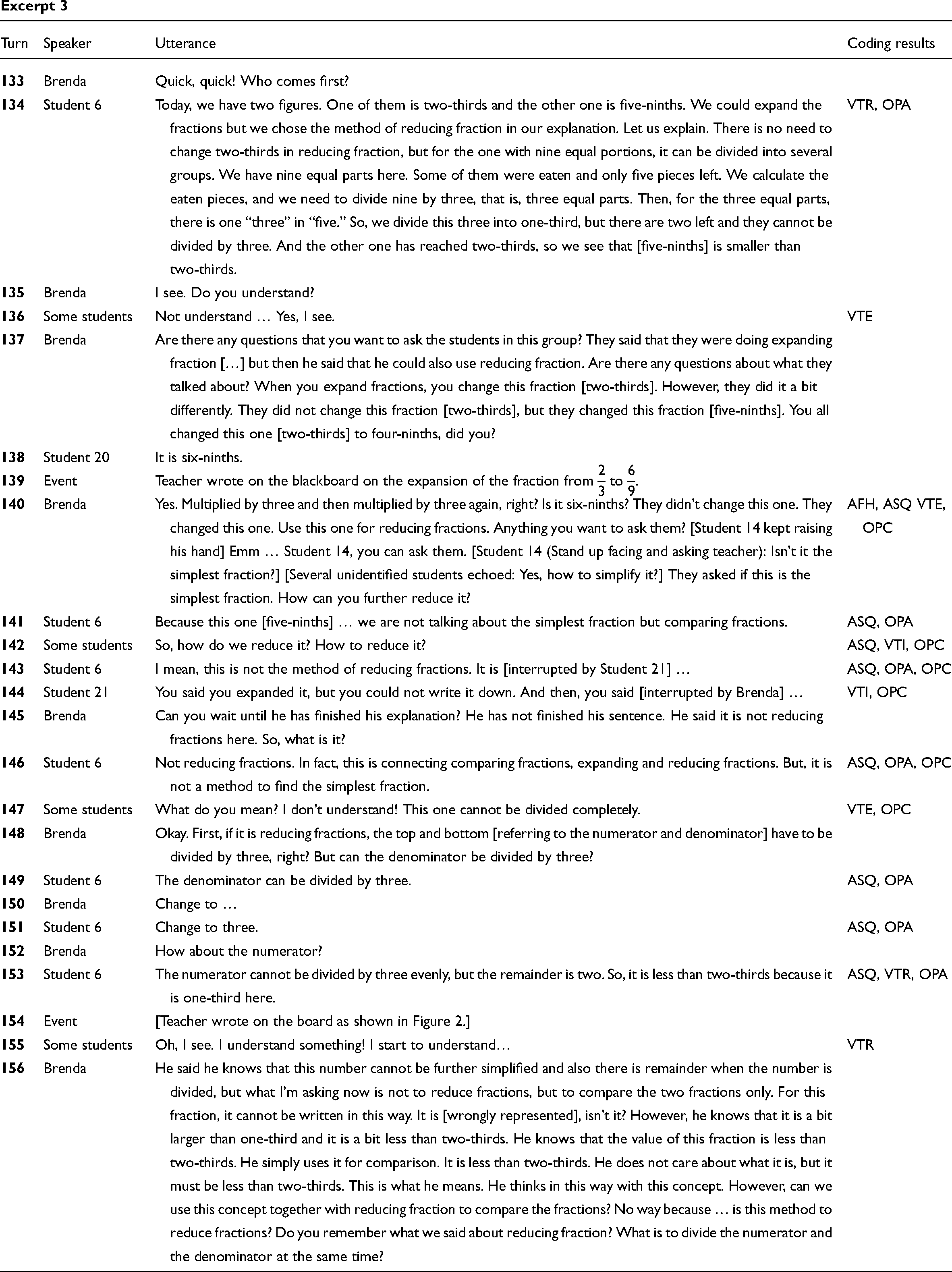
Excerpt 3 consists of a rich dialogue among several students featuring student choice and the broadening of the students’ personal latitude. In particular, Student 14 asked, “Isn’t it the simplest fraction?” (Turn 140). Although Brenda told Student 14 that he could ask the presenting group questions, Student 14 directed the question to Brenda through his gaze. This is an example of AFH since Student 14 had a choice of whom he could ask for help, either the presenting group or the teacher. Student 14 may have made this choice because he perceived Brenda as being the authoritative figure who was more likely to tell him the answer. Besides AFH, there were many instances of ASQ (choice to answer mathematics-related questions). For example, Student 6 chose to answer the floor's questions regarding the assigned task (Turns 141, 143, 146, 149, 151, and 153). Importantly, by letting Student 6 and his peer presenters answer the questions raised by the floor, Brenda demonstrated how the mode of student–student interactions could grant students choices and let them take on the role of decision maker. Consequently, the dialogic discourse pattern became student-led, characterized by Student 6 and his groupmates standing at the front of the classroom. Finally, ESR (choice to evaluate) was exemplified in Turns 140 and 142, when Student 14 judged whether Student 6 and his group members’ fraction could further be reduced, as well as when some unidentified students raised the same concern, asking, “So, how do we reduce it?” These quotes illustrate how the students were given the choice to evaluate the correctness or legitimacy of one another's responses.
Following the analytical framework proposed in this study, the voice produced and heard in this excerpt was further examined. In terms of voice to enquire, it was observed that the question that Student 14 raised—“Isn’t it the simplest fraction?”—through raising his hand to ask for his turn to speak was a case of Student 14's request to voice his enquiries (Turn 140). Numerous unidentified students raised their questions, such as uttering, “Not understand” in Turn 136 and “What do you mean?” in Turn 147, respectively. As Povey et al.'s voice to interrogate (1999) suggested, students interrogated the presenters through follow-up questions based on what Student 6 had explained (Turn 142). As demonstrated in Turn 144, Student 21 did not manage to follow or agree with what seemed to be a contradiction between reducing and expanding fractions (Turn 134). Rightfully, Student 21 seemed to be wondering why Student 6 kept talking about reducing the fraction
When analyzing original production, episodes in Excerpt 3 demonstrated that Student 6 was an originator of the ideas produced in the presentation. Such originality was realized when Student 6 answered his peers’ enquiries into his method (Turns 146–153). Notably, his method was so original that it was different from any of the methods mentioned in their textbooks (another authority) for comparing fractions. Namely, he chose to divide the numerator by three, which resulted in a noninteger numerator (Turn 153). Although conventional, Student 6 used this noninteger numerator in a so-called reduced fraction to compare it with the numerator of the other fraction. While Student 6's presentation showed evidence of his production of something original, an emancipatory discourse was established by sharing and critiquing each other's thoughts on reducing fractions. For example, two students demonstrated the originality to critique meaning when they criticized Student 6 for not reducing the fraction (Turns 140 and 144). Throughout this time, Brenda allowed the students to conduct an open discussion in which the floor and any individual student could ask questions, refute, and freely explain.
Excerpt 3's analysis is concluded by focusing on the discourse moves Brenda employed and the authority structures that were construed. Specifically, Brenda used the discourse move “explain self” to invite the students to express their thoughts. Further, she invited a unique style of questioning: “Anything you want to ask them?” (Turn 140). In so doing, Brenda invited questions from the whole class and redirected the questions to the presenting students, followed by pressing them to “Say more.” The students did “say more” after this turn, leading to a series of student–student turns in the following utterances. Thus, it is evident that Brenda successfully created an environment in which the students could freely express their thoughts, query their peers, and ask questions. This is what Wagner and Herbel-Eisenmann (2014) described in terms of students as decision makers in the classroom with a choice to voice their thoughts, which is an essential feature of personal latitude.
Excerpt 3 illustrated that dialogic discourse in the form of student–student interactions could greatly facilitate students’ broadening of personal latitude by giving them choices and the opportunity to produce original voice. It is evident that learners have been making decisions throughout, such as Student 6 being selected as the representative to present in front of the class, which method to present in explaining the comparison of fractions, which question from the floor to answer, etc.
Based on the observation done by the researchers, it is believed that high-cognitive-demand task design affects the nature of classroom discourse (Ni et al., 2014) in a positive way. For instance, in this excerpt, though students got distracted by whether or not they had to reduce fractions, this actually inspired them to explore how they can compare fractions (without necessarily always reducing the fractions). The task designed by teachers concerned, in addition to the teacher moves within the dialogue, was thus found to be crucial in enhancing personal latitude among learners.
Discussion
This case study was conducted in two mathematics classrooms in Hong Kong, the context of which has been influenced by the ideology of Confucianism to a certain extent as mentioned in the Methodology section. In Confucian classrooms, features such as long teacher talk, “getting the body of knowledge across from the teacher to the student,” and memorization are commonly evident. This study has drawn implications about how Hong Kong mathematics teachers can enhance student authorship and broaden personal latitude in such local context. For instance, the implementation of group activities and more student-led discussion has demonstrated the shift toward focusing more on “the process of doing mathematics rather than learning the mathematics content itself” (Leung, 2001, p. 38). According to Leung (2001), “this is consistent with a constructivist view of knowledge, where learning is perceived as a process of active construction by the learner rather than the learner being a passive recipient of knowledge” (p. 38). With students taking a more active role, insights can then be drawn regarding how learners can gain more control of their learning.
This case study also aimed to uncover the features of authorship a classroom possesses: (1) the learners have the freedom to choose (e.g., AFH, ASQ, and ESR), (2) the learners’ voice is produced and heard (e.g., voice to enquire, voice to interrogate, and voice to reflect upon what is being learned and how), and (3) the learners’ production of ideas is original (e.g., originating any action or state of things, producing, and critiquing meaning). The study further investigated their connections with the personal latitude authority structure present in mathematics classrooms. The results of this study suggest that a rich dialogic classroom is strongly connected to learners assuming the role of author. Methodologically, the analytical framework in this case study was useful to unpack the complexity of authorship in a mathematics classroom. In response to the research question posed, this study suggests that authorship may broaden students’ personal latitude, which refers to widening the scope of an individual's freedom of action or thought. This echoes what Herbel-Eisenmann and Wagner (2010) proposed when personal latitude is enhanced in the presence of an open dialogic discourse.
Furthermore, the data revealed that when students were given choices as to whom they were allowed to ask for help, they did not necessarily seek help from their peers, but from their teachers. This could be because they perceived teachers as an authority, and thus a more reliable figure to query. With regard to who was allowed to answer students’ mathematics-related questions (ASQ) and to evaluate the correctness of their peers’ responses (ESR), the study found that the students felt quite comfortable responding in a student-led discussion. In contrast to Depaepe et al. (2012), these findings suggest that students perceived a combination of teacher authority and distributed authority in the case study classrooms.
Besides choices, the analytical framework highlighted the importance of letting students produce their voice when they assume the role of authors. The study followed Povey et al.'s (1999) definition of voice: voice to enquire, voice to interrogate, and voice to reflect upon what is being learned and how. These voices are regarded as students practicing their freedom of action and thought—their personal latitude was enhanced in the process. As shown in the data analysis, the students asked their peers and teachers questions in both teacher-led discussion (Excerpt 2) and student-led discussion (Excerpt 3). The voice to interrogate was also evident in the video excerpts. Yet it is apparent that only when a gap in understanding arose did learners see the need to interrogate in order to seek clarifications (Excerpt 3). In terms of voicing to reflect upon what was being learned, some students explained the new knowledge learned, whereas others briefly acknowledged what they understood. Not much was captured regarding students reflecting on how they had learned something. Based on the analysis on the different kinds of voices the students produced thus far, these voices have proven effective in opening up and further engaging participants in dialogue, especially with the help of the teacher's dialogic discourse moves (e.g., say more, explain self, explain others, re-voice, and agree/disagree). Thus, it is inferred that letting students produce their voice can greatly broaden their personal latitude. This aligns with Herbel-Eisenmann and Wagner's (2010) illustration of how teachers’ dialogic discourse moves indicate personal latitude when learners are offered alternatives in doing mathematics.
Original production is the other feature this study identified in the attainment of authorship. This entails that learners themselves can make decisions and come up with the production on their own, or as the excerpts showed, via collective effort by working with their peers. Brenda's lesson (Excerpt 3) showed that decision making was evident in many occasions, such as which method of comparing fractions to present to the class, who should represent the group to present, how the presentation is going to be done, whose questions from the floor to answer, etc. The students’ explanations of how the fractions were to be compared were also a case in point. The study also found the excerpts where students conducted an emancipatory discourse with different insightful thoughts. This was when the students demonstrated the originality to critique meaning. These findings support Herbel-Eisenmann and Wagner's (2010) definition of personal latitude, which entails the realization of student agency when students are in a position to claim authority. It implies the importance of inviting learners to be the originator of an action or produce meaning in the learning process (Cobb et al., 1992; Povey et al., 1999).
The data collected in this study also support the positive relationship that instructional task designs have to teacher–student discourse. Design of more open and interactive tasks in mathematic classrooms is found to be constructive in enriching teacher–student discourse. As Ni et al.'s (2014) study has found that it is “highly unlikely that a complete transformation of classroom practice to teacher–student shared authority would follow changes in instructional tasks alone” (p. 38), instructional task design and teachers’ moves within the dialogue are both found to be crucial in enhancing student authorship and broadening personal latitude in the mathematics classrooms.
In terms of study limitations, the study was not able to capture many of the student–student interactions during individual group discussions. More insightful findings could be drawn if a similar study is undertaken involving student interviews and more extensive student work in the data collection process along with an enrichment in the analytical framework. This could also serve as data validation to confirm the results of the present findings.
Conclusion
This study calls attention to the conduct of dialogic discourse to enhance authorship among learners through broadening learners’ personal latitude. The research explored the rich dialogic discourse captured in lessons delivered by teachers Amy and Brenda. As shown in this case study, employing rich dialogic discourse in mathematics classrooms in a Hong Kong primary school indeed facilitates learners to assume the role of author, which entails broadening their personal latitude through making choices and producing their original voices. Thus, pedagogical implications can be drawn regarding how teachers can employ rich dialogic discourse to broaden personal latitude in the classroom context. That is, we suggest the benefit of employing discourse behaviors such as “say more, explain self, explain others, re-voice, and agree/disagree” to open dialogues and enhance student authorship. This was evident by adopting a novel analytic framework that addresses student authorship in three dimensions. In addition, the study provides insights into other facilitating factors for nurturing a classroom atmosphere where open dialogue can be enabled: group work (and a physical setting favoring group work), wait time, representational tools, and open-ended questioning. Future research may examine how patterns of teachers’ discourse moves facilitate other authority structures, including how certain patterns may disrupt the development of personal latitude.
Footnotes
Contributorship
Wing Kin Cheng was responsible for writing the abstract and the main body of this article. He also finalized the article and responded to the reviewers’ suggestion. He covered areas including the presentation and analysis of data, and drawing implications based on the evidence-based analysis. Oi-Lam Ng contributed by enriching the theoretical support of the research design and reviewing the critical analysis of the classroom dialogues. She responded thoroughly to the relevant educational research done on the dialogic discourse in the classroom context. Yujing Ni has been the pioneer researcher in the area of mathematics classroom discourse. She was the leader of Research Grant Council of Hong Kong (RGC Reference No. 14620515), from which the data of this study was drawn.
Declaration of conflicting interests
The authors declared no potential conflicts of interest with respect to the research, authorship, and/or publication of this article.
Ethical statement
Ethical approval for this study was obtained from the Survey and Behavioral Research Committee, the Chinese University of Hong Kong. The informed consent was obtained from all the participants.
Funding
The authors disclosed receipt of the following financial support for the research, authorship, and/or publication of this article: This work was supported by the Research Grants Council, University Grants Committee (grant number GRF Ref No. 14620515).
