



Abstract
Purpose
This study explores the relationships between the cognitive demands of the questions asked by a teacher educator (TE) and prospective teachers’ (PT) capacity for critical thinking (CT).
Design/Approach/Methods
Participants comprised a TE and 32 PTs. The cognitive demands of the TE's questions and PTs’ CT were analyzed using a systematic observation approach.
Findings
Results indicate that there are tangible connections between the increasing mental demand of TE questions and PTs’ higher-order cognitive processing. The PTs achieved higher-order CT when the TE asked more cognitively demanding questions. For instance, when the TE's questions were pitched at the cognitive demand levels—namely, the analyze, evaluate, and/or create levels—the PT answers were longer and reflected higher CT, such as inductive reasoning, suggesting new ways of thinking, or legitimating the arguments of others. Accordingly, results suggest that intentionally subjecting PTs to sustained higher cognitive demands via questions may help them reach their optimal CT capacity.
Originality/Value
Although proposed teaching strategies have been invaluable in proposing content-specific interventions for fostering the CT of university students, how lecturers should use their questions to conduct such interventions has been overlooked. This study addresses this gap.
Introduction
Critical thinking (CT) involves the “active, persistent and careful consideration of a belief or supposed form of knowledge in the light of the grounds that support it” (Dewey, 1910, p. 6). A critical thinker utilizes cognitive and dispositional strategies—such as analyzing, understanding, inferencing, inductive and deductive reasoning, and legitimating the validity and reliability of data source—to enhance the probability of a desirable outcome (Halpern, 1999). According to Ennis (1993), CT is a “reasonable reflective thinking focused on deciding what to believe or do” (p. 180).
Numerous researchers, policymakers, and educators have recognized the key role of CT in the context of postsecondary education (e.g., Arum & Roksa, 2011; Hammer & Green, 2011; Moore, 2011, 2013). Indeed, CT has been described as an essential component of high-quality postsecondary education. According to Chan (2016), teaching CT in the context of higher education is fundamental to students becoming self-sufficient, independent, and well-rounded thinkers. However, developing critical thinkers within mass higher education systems is hardly a simple process. Higher education systems tend to emphasize the cumulative teaching of subject matter knowledge (SMK) instead of creating and implementing courses dedicated to teaching CT. Nonetheless, it is dangerous for students to complete university-level education without cultivating core CT abilities (Harland, 2020).
Developing the CT skills of university students under a serious information bombardment is invaluable insofar as it facilitates their ability to distinguish between relevant and irrelevant information. El Soufi and See (2019) note that while the importance of CT skills is recognized in higher education, how CT should be taught in higher education remains an issue. It is generally accepted that developing the CT skills of higher education students is not a spontaneous process or something that can be quickly addressed in the final year of a university program. Moreover, the CT capability of an educator displays in their instruction is recognized as one of the most important factors in determining the CT level of higher education students (Moore, 2011, 2013). As CT is an ability primarily displayed in and cultivated through an individual's questions and questioning behavior, it is necessary to examine how the question-asking actions of university tutors can be used to foster CT in a specific learner group, such as prospective teachers (PTs). Accordingly, this study develops an in-depth analysis of classroom talks in which the teacher educator (TE) and PTs discussed learning, teaching, and knowledge phenomena. More specifically, this study examines the TE's questions during the lessons to estimate how they regulated the CT capacity of the PTs.
Theoretical framework
This study employs several specific terms to explore the relationship between the TE's questions and the CT pathways of the PTs. First, teacher questions can be considered in terms of three dimensions: structure, typology, and cognitive demand. Structure refers to how the questions asked by a TE in the lessons can be close-ended, open-ended, or contingent. Typology refers to how the TE uses their questions to evaluate, summarize, legitimize or criticize student responses. Accordingly, typology is mainly related to the discursive function of a question asked during a lesson.
This study primarily focuses on the third dimension of a TE's questions: cognitive demand. Previous studies have found interconnections between cognitive demand, academic rigor, and CT phenomena. Culver et al. (2019) found that academic rigor in the context of higher education courses defined the cognitive processing capacity anticipated from students. Academic rigor refers to the cognitive demand created by a TE's question, with such a demand likely to prompt a version of the CT process. Here, cognitive demand is a type of mental demand and reflects the degree of the complexity of cognitive processing applied in the context of problem-solving.
As the cognitive demand of a mental task, such as a problem, is related to the complexity of the task, it can be used to design and evaluate teaching and learning, as well as assess the effectiveness of that teaching and learning. For instance, while discussing teaching, learning, and knowledge concepts, a TE may ask PTs to clarify and expand upon their ideas or opinions (e.g., “What do you mean by that?” and “Could you elaborate on your idea?”), which may create moderately lower-level cognitive demands. To respond to the aforementioned cognitive demand, PTs must clarify, paraphrase, and represent their ideas or opinions so that they are more intelligible or comprehensive. Meanwhile, PTs face higher cognitive demand when a TE asks them to criticize the credibility of a proposed claim regarding teaching (e.g., “Do you want to comment on this fascinating perspective favoring the effectiveness of a true combination of direct instruction modes of teaching strategies with reform-based ones for more meaningful student learning?”). In this case, the PTs are required to make judgments based on particular criteria, logic, and standards. In other words, the aforementioned line of questioning tends to create a degree of cognitive demand, with PTs required to discern inconsistencies or fallacies within an utterance or determine whether the utterance has internal consistency. All PTs are expected to exhibit such CT skills.
Previous studies show that academic rigor is related to designing and implementing a cognitively challenging lesson. Here, the term “cognitively challenging” is related to the cognitive demand phenomenon. A cognitively demanding teaching process “stretches students to previously unrealized levels of student effort, understanding and accomplishment” (Kuh et al., 2011, p. 178). An academically rigorous or cognitively demanding teaching process comprises both lower-order (e.g., interpretation, inference, prediction, and explanation) and higher-order (analysis, evaluation, critiquing, and suggestion) cognitive pathways of students that can be illustrated by the Bloomian taxonomy (Culver et al., 2019). As Campbell and Dortch (2018) have argued, course designs should challenge students to make deep connections with the topics under consideration and to think in increasingly sophisticated ways. Focusing on another aspect of academic rigor, Bowman and Culver (2018) argue that university-based teaching should be cognitively challenging or demanding, such that students are forced to think and externalize their thinking in more sophisticated ways that centralize different perspectives and interpretations. Cognitively demanding teaching incorporates integrative and reflective processes. Instead of rote learning by teaching-by-telling, cognitively demanding teaching employs in-class, teacher-led questions requiring students to exhibit a higher-order understanding of course content (Draeger et al., 2013; Nelson-Laird et al., 2014).
However, academic rigor or the planning and implementation of academically demanding courses are not priorities of contemporary college programs (Arum & Roksa, 2011). According to Bok (2013), in the absence of sustained academic rigor, beneficiaries of higher education cannot be expected to exhibit intellectual habits like CT in the economic, social, and political domains. In their systematic review, Mayhew et al. (2016) identified a close link between student outcomes and academic rigor in university-based lessons. Systematically observing the instructional practices of university educators has proven instrumental in examining intellectual rigor (Mayhew et al., 2016). Recent studies show that the instructional practices of TEs largely occur through in-class talks using a question format (e.g., Soysal & Radmard, 2020). Therefore, the systematic analysis of the questions asked by TEs during classes can elucidate how academically demanding talk processes are triggered and maintained in scaffolding the CT pathways of PTs.
Based on the foregoing, this study hypothesizes that the varying degrees of cognitive demand embedded in a TE's questions shape the CT capacity of PTs. Simply put, when a TE's questions demand more cognitive effort, the PTs are encouraged to display higher-order reasoning. Accordingly, diversifying the cognitive demands of a TE's questions will provide linguistic scaffolds for PTs to engage in the CT process, including interrogating assumptions, analyzing the arguments of others, evaluating the credibility of given information, processing available data, criticizing ideas, and constructing justified claims.
Literature review
Several scholars have explored CT development in higher education. According to Ikuenobe (2001), higher education students must possess informal thinking or everyday logic capacities to think critically. However, simply possessing and using disciplinary thinking norms is not enough to actualize a complete CT process. Ikuenobe’s (2001) theoretical framework proposed that CT is more visible when a thinker can meaningfully and effectively transfer a set of skills to various contexts in order to overcome different problems. In short, Ikuenobe (2001) advanced a pragmatic combination of domain-specific and domain-general CT skills to deal with problems when teaching CT in the context of higher education. Meanwhile, Gent et al. (1999) investigated how some elements of teaching and learning influence the proliferation of CT skills among university students enrolled in computer science. Lecturers were assigned as social role models who enacted core aspects of CT and guided the students to engage in tutorial discussions and deliver effective oral presentations within a collaborative teaching environment. Criticizing the simple generic versus discipline-specific accounts of CT, Gent et al. (1999) argued that teaching CT required relatively sophisticated interconnections among students’ learning strategies, the teaching tactics of lecturers, and, in particular, the assessment of CT based on the course content and purposes. However, Gent et al.’s (1999) study did not refine teacher–student verbal exchanges in detail to present evidence of how pedagogic collaboration serves to scaffold the CT capacity of computer science students. Seeking to define the core aspects of the instructional settings in which CT is triggered and sustained, Browne and Freeman (2000) proposed that CT classrooms incorporate frequent questions regarding a topic under discussion. They also suggested that CT classrooms include discussions on contradictory or alternative perspectives to ensure developmental tension. However, Browne and Freeman (2000) did not provide clear dialogue-based examples of how the aforementioned initiators of CT should be embedded in classrooms.
Scaffolding university participants’ CT capacity is hardly simple. The outcomes of studies examining the relationship between course-based actions—such as questions about the behavior of instructors—and students’ CT capacity are complicated and mixed. For instance, Smith (1983) found no significant relationship between the CT capacity of liberal arts college students and the types of questions educators employed. In contrast, evaluating the influence of course-based assignments and questions asked in exams on the CT capacity of higher education students, Renaud and Murray (2008) found that higher-order questions served to increase the students’ CT, even within the restricted time interval of a single semester of teaching. However, in their study, Nelson-Laird et al. (2014) observed that students did not exhibit sophisticated CT skills despite higher course-based expectations.
The relationship between academic rigor and enhancing students’ CT capacity is similarly complicated. Several longitudinal studies have found that academically demanding lessons were instrumental in encouraging university students’ enjoyment of literacy-related activities and positive attitudes toward literacy. However, these benefits notwithstanding, this approach was ineffective in forcing students to think critically (e.g., Cruce et al., 2006; Loes et al., 2012). Similarly, Seifert et al. (2014) found that although senior students’ self-motivated learning capabilities were enhanced through academically demanding course design and implementation, such courses did not impact their capacity to think critically. Cross-sectional studies reached similar conclusions (e.g., Jessup-Anger, 2012). As such, more systematic investigations of the relationship between instructional scene staging and students’ CT pathways are necessary, particularly with respect to clarifying how and to what extent educators’ talk-based actions are regulative for promoting students’ CT.
Walker and Finney (1999) contended that developing good research skills may bolster the CT capabilities of master's students. In their research program, they observed that encouraging self-awareness through reflection-in-action and reflection-on-action played a significant role in improving students’ CT capacity during the research process. Self-awareness largely involved students identifying their skills and developing a general awareness of how they learn. Accordingly, Walker and Finney (1999) advanced self-awareness through reflection as an ideal and generic skill irrespective of which definition of CT (i.e., domain-general vs. domain-specific) is emphasized. Ghanizadeh (2017) explored Iranian university students’ reflective and CT capacities and their association with self-monitoring mechanisms. In doing so, Ghanizadeh (2017) found that CT was more sophisticated when students displayed more profound self-monitoring activities. Based on students’ self-reflection, self-correction, and self-monitoring activities, Ghanizadeh (2017) argued that sustained metacognitive activity can ensure CT in the context of higher education. This finding is supported by Facione’s (1990) comprehensive Delphi study, which identified self-regulation as a core indicator of complicated CT processes. Swanwick et al. (2014) also found clear and evident connections between CT and reflection as a metacognitive activity in the context of deaf education. However, scholars have yet to explore how, in a talk-based manner, university teachers can maintain metacognitive moments using questions, which can be pitched at different levels of cognitive demand, to create reflective spaces in which university students can cultivate CT.
Existing studies have typically developed, conducted, and evaluated an interventional program to improve the CT of university students. For instance, through their teaching intervention for CT, Hashemi and Ghanizadeh (2012) found that when university students engaged in critical discourse analysis supported by elaborated presentations, they could identify implicit assumptions and proposed fewer biased interpretations, indicating CT. Similarly, Luk and Lin (2015) found that critical text examinations as a teaching intervention for CT resulted in an increase in university students’ justified arguments, a core element of CT. Meanwhile, Wale and Bishaw (2020) demonstrated that inquiry-based argumentative essay writing instruction, a specific interventional technique, can cultivate students’ CT capacity. Wale and Bishaw’s (2020) intervention program included specific tasks intended to improve students’ CT. First, the students selected their writing topics. Data collection, analysis, interpretation, and reporting were then conducted with the students, who had to address real-life problems. The students were directed to use ample and appropriate evidence to justify their arguments in their essays. In this rigorous interventional study, external audits played the role of devil's advocate, criticizing the conceptual flow of students’ written drafts. Wale and Bishaw (2020) concluded that all of the aforementioned interventional processes improved the participants’ CT skills and dispositions.
However, although the aforementioned interventional studies have been invaluable in clarifying content-specific pedagogic interventions for fostering CT among university students, research has yet to elucidate how lecturers should analytically conduct such interventional approaches. It is undeniable that educational researchers and educators have developed diverse and relatively effective instructional approaches to teach CT (Abrami et al., 2015; Abrami et al., 2008; Pascarella et al., 2011). However, further consideration of the interventional approaches mentioned above reveals that they are not pedagogically illuminating, particularly insofar as they lack a methodologically sound thinking tool elucidating how and why an in-class activity encourages or discourages sophisticated CT. Therefore, design-based interventions dedicated to teaching CT are vital. Of course, all in-class interventions by university teachers are inherently surrounded and governed by their talk actions, which determine the ability of an interventional design to enhance university students’ CT capacity. Indeed, as Yuan et al. (2022) argue, effective CT interventions should incorporate the discussion, negotiation, and philosophizing of ideas. Accordingly, as this study holds, in addition to the design and/or content of the activity, classroom talk should be added to the CT teaching agenda. Doing so will aid the development of a more verifiable way of enhancing CT among university students, that is, an intervention in which the instructional/interventional variable can be verified through systematic observation.
Teaching CT in the university context should welcome the debate over domain-specificity versus domain-generality. On the one hand, the proponents of the domain-generality perspective have suggested that CT can be taught within any conceptual context and transferred from one context to another. On the other hand, the domain-specificity thesis advocates that CT skills are content-sensitive and that specific SMK requires particular CT skills, which may not be transferrable across different subjects. The differentiation mentioned above improves various methods of teaching CT: namely, generalist, immersion, and infusion (Abrami et al., 2015). The generalist approach to teaching CT accepts that it constitutes SMK that should be taught within a separate course (Abrami et al., 2008). In contrast, advocates of the immersion approach believe that meaningful instruction in every subject domain inherently comprises the development of CT skills. Therefore, in the immersion approach, embedded elements of CT are experienced by any student enrolled in a well-structured university-based course. Significantly, the immersion approach does not explicitly emphasize the teaching of general CT skills during instruction. While the infusion approach accepts the basic tenet of the immersion approach, it adds that the CT skills embedded in SMK should be refined, clarified, and elaborated by participants as a separate aspect of the instruction. In other words, the infusion approach places explicit emphasis on the CT skills used within a specific domain of SMK, thereby involving explanations of why and how a particular CT skill is applicable to a specific field of instruction (Abrami et al., 2015; Abrami et al., 2008).
James et al. (2010) approached developing CT skills in a domain-specific manner and proposed an approach to pedagogical scene staging to enhance the CT capacity of law students. More specifically, they conceptualized CT as “critical legal thinking” based on the argument that a clear and contextualized definition of CT is the first step in developing a law course in which students are encouraged to think critically when assessing and discussing legal conditions. As the proposed course components infer, James et al. (2010) favored domain-specific teaching of CT. Similarly, seeking to develop CT in the context of criminology, Howes (2017) instructed law course participants to complete written reflections on how their thinking about crime and criminal justice had developed over the unit. Howes (2017) concluded that the CT capacity of students can be enhanced when they are given the chance to internalize or make individual appropriations of criminology concepts. More importantly, the students’ CT capacity appeared to improve when in-class discussions welcomed nuanced and CT about crime and justice.
In this study, the TE tried to develop sophisticated arguments of a how-to-teach phenomenon with the PTs by employing academically rigorous and cognitively demanding or challenging questions. In doing so, this study adopts an immersion approach and investigates the relationship between the TE's questioning techniques and the CT of PTs within an instructional context. Accordingly, this study contends that sophisticated and rigorous negotiations of the how-to-teach phenomenon primarily regulated by the TE's questions can trigger the CT capacity of PTs.
Methods
Participants
Participants comprised a TE and 32 PTs who attended a teaching methods course in the classroom teaching department of a foundation-supported university located in the Marmara Region in northwest Turkey in the 2018–2019 academic year. In terms of gender, the TE was male while the PTs consisted of 6 males (18.75%) and 26 females (81.25%). Participant ages ranged from 20 to 23 years (M = 21.9 years; SD = 0.8). Participating PTs had different sociocultural and economic backgrounds, with some studying on scholarships or reduced tuition fees. All PTs were in the third year and had completed various pedagogically oriented courses (e.g., introduction to educational sciences and educational psychology), excluding practicum and school experience.
The TE possessed 7 years of university-level teaching experience, with primary specializations in the professional development of in-service teachers, teachers’ pedagogical–epistemological belief systems, and teaching in higher education. The TE was selected for this study for several reasons. In the preliminary video-based observations of the in-class implementations, more student voices were permitted to analyze the complex relationships between cognition (i.e., PTs’ CT pathways) and the classroom discourse, the latter of which was initiated and materialized by the TE's questions. The patterns of interaction enabled the construction of a researchable verbal data corpus in the TE's classroom. In the context of classroom discourse analysis, the patterns of interaction can occur in two ways: teacher–student and student–student. This study sought to analyze both teacher- and student-led discourse requiring open- and close-ended patterns of interaction. More specifically, open-ended patterns of interaction incorporate triadic dialogues (initiate-response-evaluate) completed by a teacher-led follow-up question (initiate-response-follow-up questioning). Accordingly, the TE's numerous and relevant follow-up questions provided a more analyzable data set. In the in-class examinations, open- and close-ended questions allowed for the observation of both high and low cognitively demanding questions.
In addition to the aforementioned methodological concerns, the TE was selected in view of the desire to investigate the connections between his question-based utterances and the CT actions of the PTs. In this respect, the TE was eager to monitor and evaluate his in-class teaching practices per the goals of this study. Participating in this study provided the TE the opportunity to problematize his teaching praxis. Based on the researchers’ informal observations, the TE was genuinely motivated to engage in this study once informed about its aim to identify patterns between TE questions and the CT capacities of the PTs.
Data collection procedures
The TE's in-class questioning was monitored by video recording the classes as the primary data source. The TE completed eight in-class implementations (1,049 min in total). Four of the implementations were selected for systematic analysis. Selected cases (557 min) had more teacher–student and student–student verbal exchanges, allowing for the in-depth examination of classroom talk. The PTs were informed about the purposes of the video recording and completed consent forms agreeing to participate in this study.
Selection of the concepts negotiated in the implementations
The following pedagogical topics (or problematized cases) were specifically selected to design and conduct the in-class interventions. This study accepts that there may be conceptual, epistemological, and ontological differences and similarities between the PTs’ everyday expressions and the TE's use of more technical and formal language, which favored the jargon employed in the science community. In other words, the PTs may have held different personal or intuitive learning, teaching, and knowledge theories before starting their undergraduate education or throughout their undergraduate education. For instance, pre-university or university education may have led some PTs to believe that learning is a process that takes place through the transfer of knowledge. Indeed, the PTs were subjected to knowledge transmission modes of teaching throughout their university education and thus formed their personal pedagogical beliefs based on the lectures they had attended. Significantly, it is possible that the TE offered a different social language or explanation system regarding how learning and teaching occur, potentially excluding or providing an alternative to the daily social language of the PTs. Accordingly, the conceptual distance between the social languages of the TE and PTs could have led to alternative or exclusively mutual arguments regarding the learning and teaching phenomena. In such an event—or in the social negotiation of different explanation systems of learning and teaching or how-to-teach in the classroom—there will be more space for dialogic talk where the connections between the TE's questions and the CT capacity of the PTs will be more tangible. In general, the selected topics had the potential to trigger the negotiation of meanings of pedagogy. The topics were selected to conceptually, epistemologically, and ontologically challenge the PTs, forcing them to develop broader explanation systems regarding how learning and teaching occur in classroom settings.
As noted, this study analyzes the talks that occurred in the four implementations in which the TE and PTs had the greatest number of verbal exchanges: (1) knowledge–teaching–learning; (2) Lily and the dark room; (3) experience and learning; and (4) teaching profession. With respect to the first implementation, knowledge–teaching–learning, the PTs discussed learning, teaching, and the nature of knowledge acquisition. Specific cases were presented to the PTs to interrogate how they conceived the learning of specific subject matter, their understanding of how learning phenomena are associated with teaching processes, and their assumptions regarding the nature of knowledge. For instance, the PTs discussed whether knowledge is external or internal to the learner or both. Piagetian (individually oriented learning, development-driven learning) and Vygotskian (socially oriented learning, learning-driven development) ideas and education theories were also discussed. The second implementation centered on a problem referred to as “Lily and the darkroom,” in order to discuss the phenomenon of rote learning, that is, the memorization of facts. PTs also engaged in discussions regarding the instructional conditions permitting rote learning and meaningful learning. PTs were also prompted to consider the close link between thinking and talking by covering different instructional cases regarding the significance of rote learning in educational settings. In the third implementation, experience and learning, the peer community considered and negotiated the teaching and learning barriers that emerged in the classroom. The PTs were guided to discuss teacher-, learner-, and curriculum-oriented pedagogical barriers and how these might be contextually specific in different classroom settings. In the fourth implementation, teaching profession, the PTs externalized their arguments regarding teaching as a profession. This class largely focused on the pedagogical content knowledge (PCK) phenomenon. The PTs were prompted to negotiate how subject matter or pedagogical knowledge may create an amalgamation for the teaching profession or differentiate the profession from the amateur pedagogies people hold when teaching a subject to someone.
Teaching approach principles used by the TE
This study followed Engle and Conant’s (2002) principles for productive disciplinary engagement in each discussion on teaching, learning, and knowledge. Pedagogical cases were problematized by initially located brainstorming activities to encourage the PTs to take on philosophical problems. For instance, the second implementation presented a case to the group. In this case, Lily, a top-ranking student, responded to a teacher-led question of “Can we see in a completely dark room?” by insisting that is possible with some eye accommodation. Here, the central pedagogical problem or challenge for the PTs was whether Lily understood the vision phenomenon in the desired way via formal instruction or whether she was exhibiting unsound reasoning. In accordance with Engle and Conant (2002), the PTs discussed this and similar problems after being assigned specific intellectual roles, such as being the epistemic and social authority of classroom discourse. According to the third negotiation principle, every individual claim should be warranted. As Engle and Conant (2002) suggested, every learning community member should be accountable to others and to the disciplinary norms. In this respect, justified claims were more acceptable for both the TE and PTs.
Data analysis
Two aspects of classroom talk were analyzed: the cognitive demands of the TE's questioning and the CT processes of the PTs. This study employed a systematic observation approach (Mercer, 2010) to analyze the data. Systematic observation processes comprise two phases: first, coding all teacher- and student-led utterances separately; second, counting the coded articulations for collapsing higher-order categories regarding the two aspects of the classroom talk. The TE asked different types of questions, thereby diversifying cognitive correspondences. The PTs’ responses reflected different levels of the CT process. This study sought to identify the patterns of the relationships between the cognitive demand of the TE's questions and the CT of the PTs. Accordingly, a counting process was employed to proportion the relative occurrences of each aspect of the classroom talk in making the relationships concrete.
Two coding catalogues were adapted for systematic observation. Cognitive Demand Coding Catalogue's (CDCC) Revised Bloom Taxonomy (RBT, Anderson, et al. 2001) to analyze the assumed cognitive demands of the TE's questions. To our knowledge, the RBT can be used for planning, designing, and assessing the influences of teaching processes. Moreover, several researchers have advanced the RBT as an effective means of characterizing CT processes (e.g., DeWaelsche, 2015). Therefore, this study used the RBT as an evaluation tool to detect the cognitive demand of each question from remembering (e.g., recognizing, recalling), understanding (e.g., interpreting, exemplifying, inferring, comparing, and explaining), applying (e.g., executing, implementing), analyzing (e.g., differentiating, organizing), and evaluating (e.g., checking, critiquing) to creating (e.g., generating, planning, and producing) (Krathwohl, 2002). Table 1 presents the sample questions and their corresponding cognitive demand as identified by the RBT. Both authors coded the questions’ cognitive demands, finding an inter-coder agreement of 93%. However, considering issues in differentiating the questions at the level of analysis and evaluation, rigorous negotiations between the coders were conducted to remove any discrepancies.
Revised Bloomian taxonomy for analyzing cognitive demand.
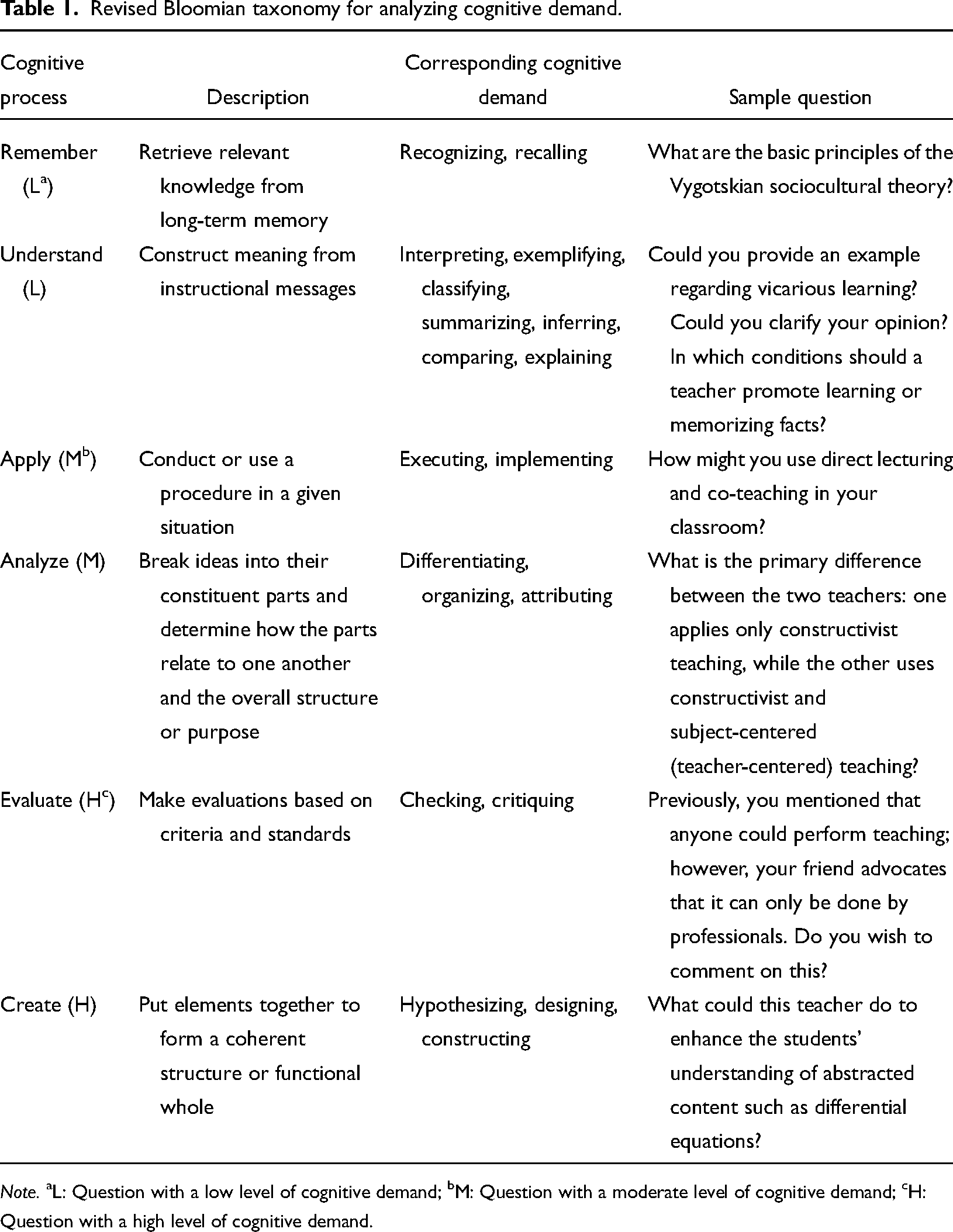
Note. aL: Question with a low level of cognitive demand; bM: Question with a moderate level of cognitive demand; cH: Question with a high level of cognitive demand.
The Cognitive Pathways Coding Catalog (CPCC) was used to identify the cognitive level of each student-led response in terms of CT. The CPCC is a combination of various assessment tools proposed by different scholars, including Facione's Delphi Report (1990), which presents categories of CT skills (e.g., interpretation, analysis, evaluation, inference, and explanation); Ennis’ (2011) Categories of CT skills (e.g., basic clarification, inference, and advanced clarification); and Grimberg and Hand’s (2009) categories of cognitive pathways (e.g., observation, comparison, analogy, clarification, and investigation design). As seen in Table 2, the CPCC incorporates 14 CT processes ranging from simply sharing relevant experiences to advising and recommending. These 14 CT processes were also divided into three categories or levels reflecting the sophistication of the cognitive operations—namely, perception (P), conception (C), and abstraction (A). In terms of perception, the PTs’ cognitive processes typically involved stating their intuitive or personal experiences about the given cases or comparing, juxtaposing, and contrasting ideas proposed by their classmates. The level of conception reflected more advanced signs of CT, with PTs able to use appropriate examples, provide basic clarifications, and exhibit causal thinking about the pedagogy. At the level of abstraction, more concrete and complex processes of the CT were observed in the utterances of the PTs, such as inductive and deductive reasoning or judging and criticizing. The inter-coder reliability was 79% for the initial evaluations of the cognitive operations. In this respect, there were some difficulties in analysis, including differentiating inferencing (low-level induction) from inductive reasoning or advanced clarification from basic clarification. In the presence of peer debriefing and external audits from other departmental colleagues, we attempted to resolve the inconsistencies by assigning codes for the cognitive processes. Accordingly, codes were assigned to each cognitive process of CT using a higher inter-coder agreement (89%) compared to the previous coding procedure.
Critical thinking (CT) pathways of the prospective teachers (PTs).
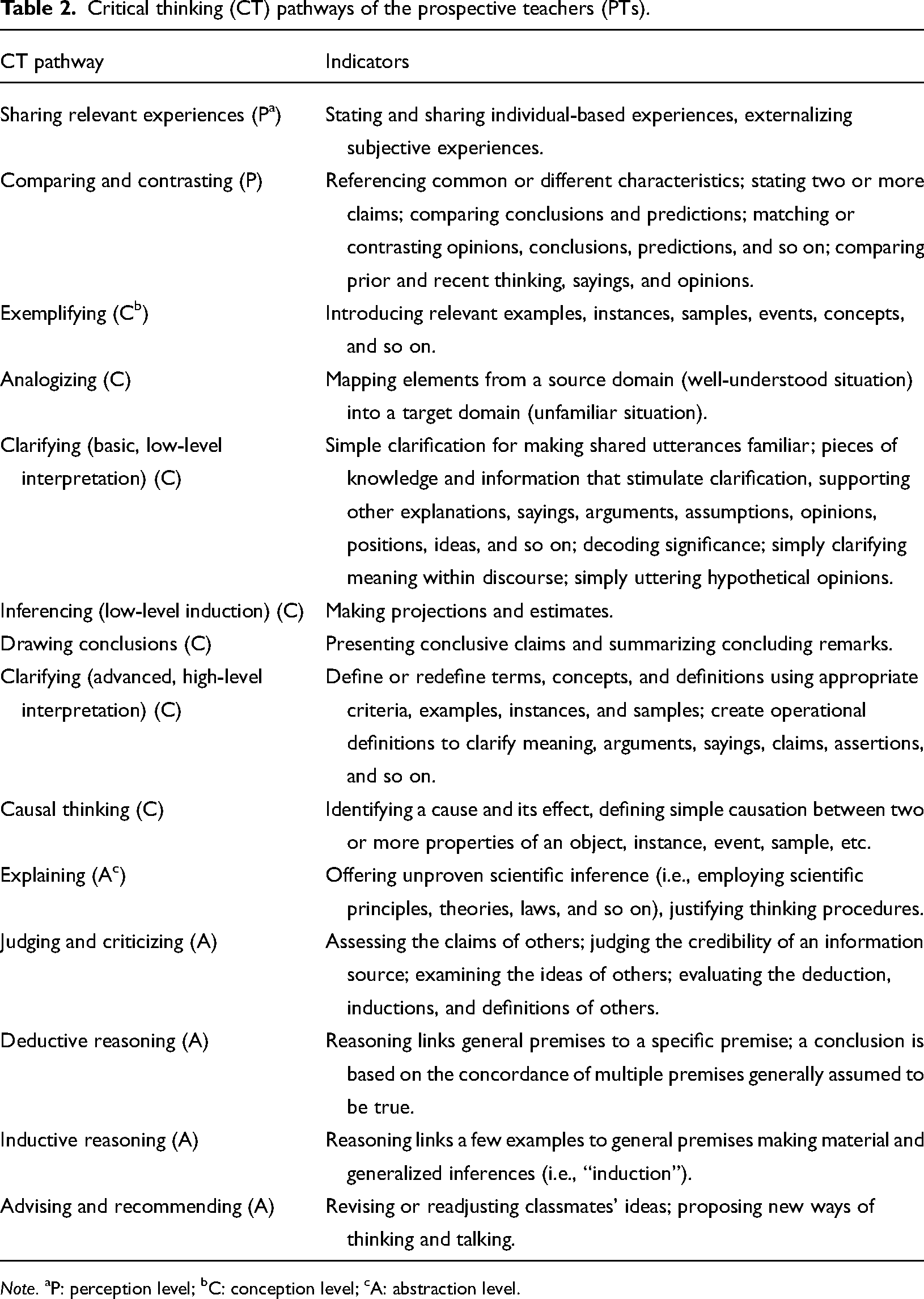
Note. aP: perception level; bC: conception level; cA: abstraction level.
Statistical values of observational data are expressed as percentages and SD as z-scores. Z-scores were calculated for each variable (e.g., the mental demands of the TE's questions and the PTs’ CT capacity) by taking observed values, subtracting the mean of all observations, and dividing the result by the SD of all observations. A z-score is necessary to interpret trend lines between two or more means obtained from observational data (Tabachnick et al., 2007). Numeric distributions calculated for implementation quality level, talk move typology, and CT level were converted into z-scores as a new distribution with a mean of 0 and a SD of 1.
Findings
Figure 1 illustrates the patterning between the cognitive demands of the TE's questions and PTs’ CT pathways (i.e., the CT activity or capacity that the PTs performed or exhibited). This section uses both percentages and z-scores for statistical inferences (Figure 1) to interpret the connections between the discourse (i.e., the cognitive demands of the TE's questions) and cognition (i.e., the CT pathways of the PTs).
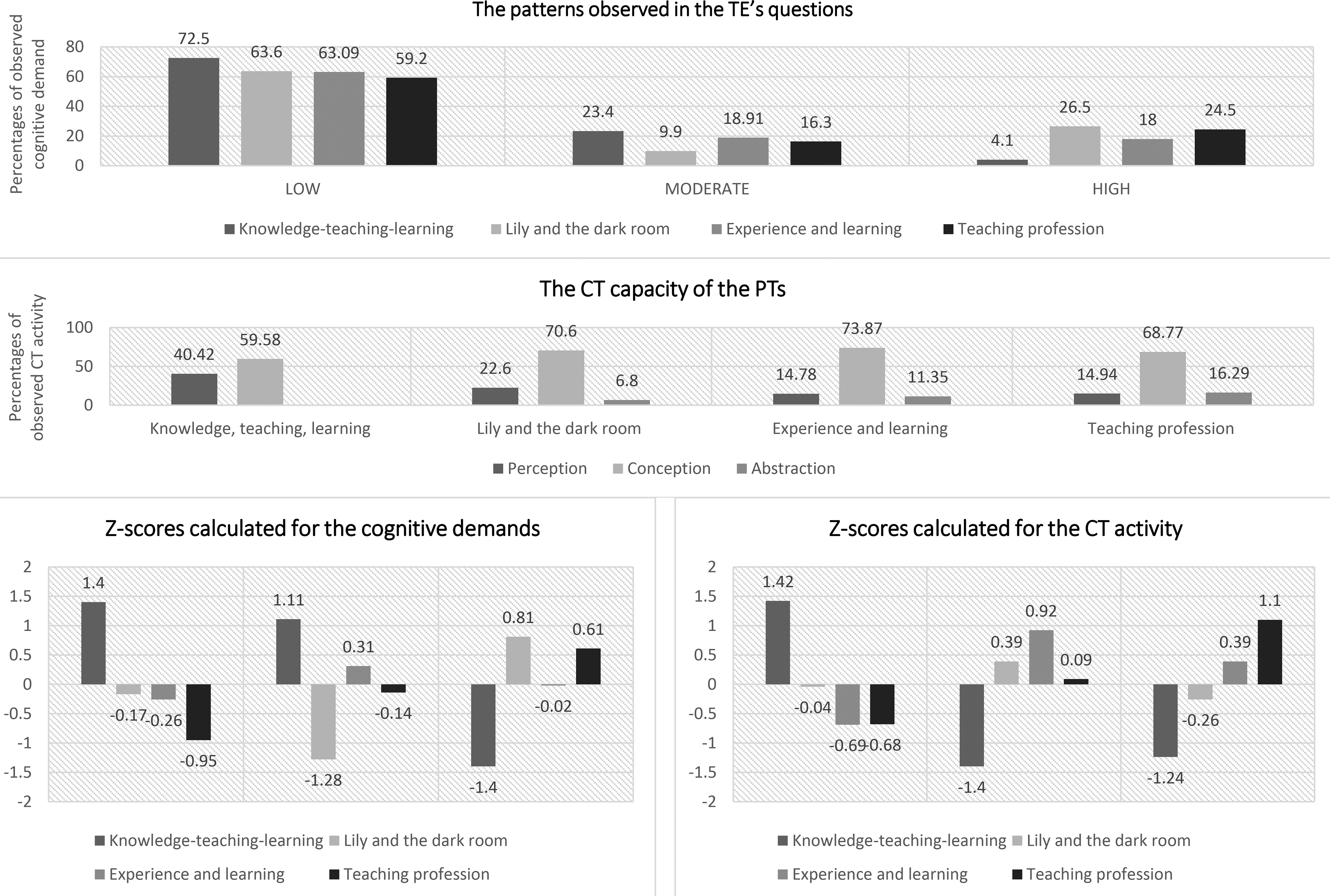
The relationships between the cognitive demand of the teacher educator (TE)'s questions and the cognitive pathways of the prospective teachers (PTs).
As seen in Figure 1, in the knowledge–teaching–learning implementation, the PTs’ responses were primarily pitched at the perception level, reflecting lower CT activity (40.42%; z-score: +1.40; more than 1 SD above the mean calculated for the perception zone). As this result indicates, observed CT activity was lowest in the knowledge–teaching–learning implementation (M = 59.58; z-score: −1.4; more than 1 SD below the mean calculated for the conception zone). Indeed, in the knowledge–teaching–learning implementation (M = 0; z-score: −1.24; more than 1 SD below the mean calculated for the abstraction zone), the PTs appeared incapable of applying sophisticated CT skills such as constructing explanations, critiquing arguments, inductive or deductive reasoning, or creating new ways of thinking and talking about a pedagogical problem. Accordingly, in the knowledge–teaching–learning implementation, the PTs engaged in less academically productive talks and only enacted lower-level CT actions such as sharing relevant experiences, comparing and contrasting, providing examples, making clarifications and inferences, and causal thinking.
In terms of CT activity, more academically productive talk was observed in the Lily and darkroom implementation than in the knowledge–teaching–learning implementation. As the decreasing percentages and negative z-scores in Figure 1 show, PTs’ responses remained at the perception level in the Lily and dark room (M = 22.6%; z-score: −0.05), experience and learning (M = 14.78%; z-score: −0.70), and teaching profession (M = 14.94%; z-score: −0.95; nearly 1 SD below the mean calculated for the perception zone) implementations. Nonetheless, of the four implementations, the PTs exhibited significantly more CT on the conception level during the experience and learning implementation (M = 73.87%; z-score: +0.92; nearly 1 SD above the mean calculated for the conception zone), while CT at the abstraction level was highest in the teaching profession implementation (M = 16.29; z-score: +1.10; more than 1 SD above the mean calculated for the abstraction zone). Therefore, the PTs reached the highest CT levels in the last two implementations—experience and learning and teaching profession—and exhibited sophisticated thinking (e.g., inductive reasoning).
Accordingly, the CT activity and sophistication observed in the four implementations can be summarized as follows:
The knowledge–teaching–learning implementation: lower-level CT activity. The Lily and darkroom implementation: moderate-level CT activity. The experience and learning: higher-level CT activity. The teaching profession: higher-level CT activity.
This study hypothesized that the different patterns of CT activity exhibited by PTs can be regulated and shaped by the cognitive demands embedded in the TE's questions. In this respect, in the knowledge–teaching–learning implementation (M = 72.5%; z-score: +1.4; more than 1 SD above the mean calculated for the low cognitively demanding questions), the TE typically asked questions requiring low cognitive processing (i.e., remember, understand) from the students compared to the other implementations. During the teaching profession implementation (M = 59.2%; z-score: −0.96; nearly 1 SD below the mean calculated for the low cognitively demanding questions) in particular, the TE tried to avoid asking questions with low cognitive demand compared to the knowledge–teaching–learning implementation.
Compared to other implementations, the TE focused on questions with a moderate level of cognitive demand (i.e., apply, analyze) in the knowledge–teaching–learning implementation (M = 23.4%; z-score: +1.11; more than 1 SD above the mean calculated for the moderate cognitively demanding questions). For instance, there was a more significant difference between the knowledge–teaching–earning implementation and Lily and the dark room implementation (M = 9.9; z-score: −1.28; more than 1 SD below the mean calculated for the moderate cognitively demanding questions) in terms of asking questions with a moderate degree of cognitive demand. However, the Lily and the dark room implementation seemed to be more academically productive in terms of prompting the PTs to engage in higher-level CT activity. This discrepancy is likely due to the knowledge–teaching–learning implementation comprising significantly more questions with a low degree of cognitive demand (i.e., remembering, understanding), with the intensity of such questions potentially overshadowing the influence of the more cognitively demanding questions on fostering the CT activity of the PTs. Certainly, in the Lily and dark room implementation, the TE asked more questions pitched at high levels of cognitive demand, such as evaluate or create (M = 26.5%; z-score: +0.81; nearly 1 SD above the mean calculated for the high cognitively demanding questions), with PTs required to engage in higher-order thinking and reasoning to respond to the deeper cognitive demands of the TE. Moreover, given the abundance of questions with a low level of cognitive demand in the knowledge–teaching–learning implementation, the PTs may have felt more comfortable responding to the TE's overly simple questions.
As seen in Table 3, during the initial phase of the knowledge–teaching–learning implementation, the TE discussed the relationships between teaching and learning phenomena. As the TE sought to capture the initial understandings of the PTs, he preferred posing fewer demanding questions requiring that students remember (e.g., turns of talk: 5, 7, 9, and 11) or understand (e.g., turns of talk: 15 and 17). The TE did not pose questions intended to elicit the PTs’ externalizations during this implementation. Rather, the dialogue followed a simplified and shallow question-and-answer format, confirming cumulative talk. As the dialogue shows, there was no room for the PTs to analyze, criticize, and evaluate the claims of others, that is, more cognitively demanding skills. Although the TE employed more demanding questions at particular times during the classroom talks on the knowledge–teaching–learning implementation, the majority of questions were not cognitively demanding. As Table 3 notes, per his prescriptive teaching agenda, the TE welcomed the responses and frequently posed “…what else?” questions in striving to elicit credible responses.
Excerpt from the knowledge–teaching–learning implementation showing intense usage of questions with lower cognitive demand.
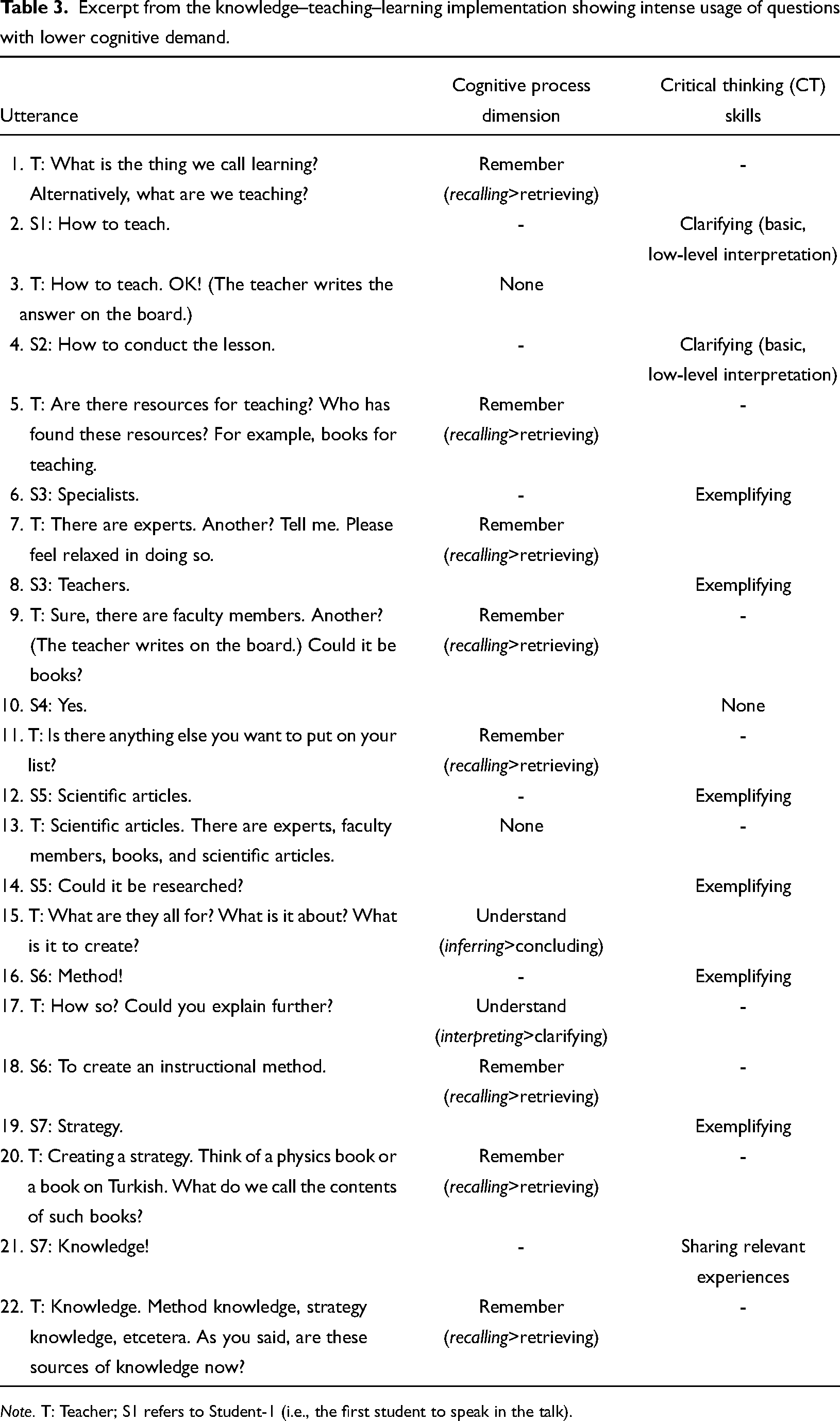
Note. T: Teacher; S1 refers to Student-1 (i.e., the first student to speak in the talk).
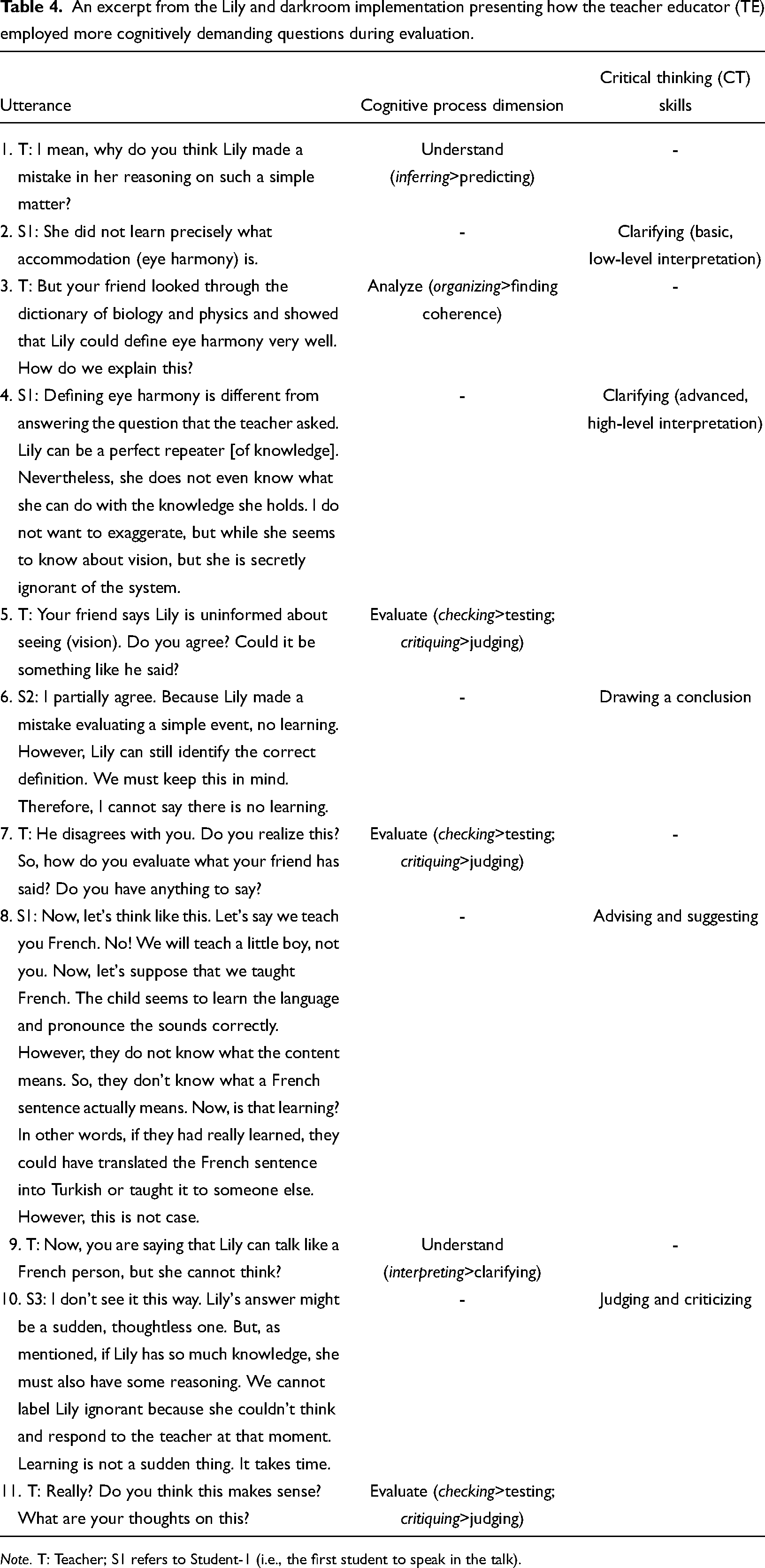
The PTs negotiated the primary difference between rote learning and meaningful learning in the Lily and dark room implementation. In the dialogue (Table 4), the TE asked questions with a high level of cognitive demand, particularly at the level of evaluation (e.g., turns of talk: 5 and 7). When asking questions at this level, either explicitly or implicitly, the TE asked PTs to detect the inconsistencies or fallacies in the ideas of others (e.g., Turn 5: “Do you agree? Could it be something like he said?”). This was more cognitively demanding for the PTs as they had to analyze, criticize, judge, evaluate, and eventually legitimatize their claims. The TE used evaluation-level questions to encourage the PTs to identify conceptual conflicts (e.g., Turn-7: “He disagrees with you … Do you realize? So, how do you evaluate what your friend said? Do you have anything to say?”).
The PTs had to compare different, alternative, and/or contradictory ideas by critically reconsidering them to resolve the contradictions. Based on the evaluation demand of the TE, in Turn-8, Student-1 offered a new way of thinking and talking about teaching phenomena. Meanwhile, as seen in Turn-10, Student-3 did not abandon her initial idea and attempted to review the internal consistency of Student-1's response by making a different point about Lily's acquisition process. As the TE's questions appeared to require more cognitive effort from the PTs, they appeared to engage in higher-order CT processes (abstraction zone) in the Lily and darkroom implementation compared to the knowledge–teaching–learning implementation.
An excerpt from the Lily and darkroom implementation presenting how the teacher educator (TE) employed more cognitively demanding questions during evaluation.
Note. T: Teacher; S1 refers to Student-1 (i.e., the first student to speak in the talk).
Although more cognitively demanding questions were posed in the Lily and darkroom compared to the experience and learning and teaching profession implementations, the last two implementations showed more signs of sophisticated CT activity among the PTs (Figure 1). This indicates that the combined operation of questions with a moderate and high level of cognitive demand can boost CT. More specifically, in the Lily and the dark room implementation, there was a more heterogeneous dispersion of the questions at the moderate and high cognitive demand levels. However, in the experience and learning and teaching profession implementations, the TE asked questions with varying levels of cognitive demand, requiring students to understand, apply, analyze, evaluate, and create. In the Lily and darkroom implementation, the questions had either low or high levels of cognitive demand (Figure 1). In contrast, questions transitioned from a low to high level of cognitive demand in the experience and learning and teaching profession implementations. This suggests that a more varied or pragmatic/combined use of questions with a low, moderate, and high level of cognitive demand may better predict the CT activity of PTs. Correspondingly, a heterogeneous pattern of cognitive demands was observed in the TE's questions during the knowledge–teaching–learning implementation, indicating that a combination of questions with low and moderate levels of cognitive demand (Figure 1) may actually hinder the ability of PTs to engage in more sophisticated forms of CT.
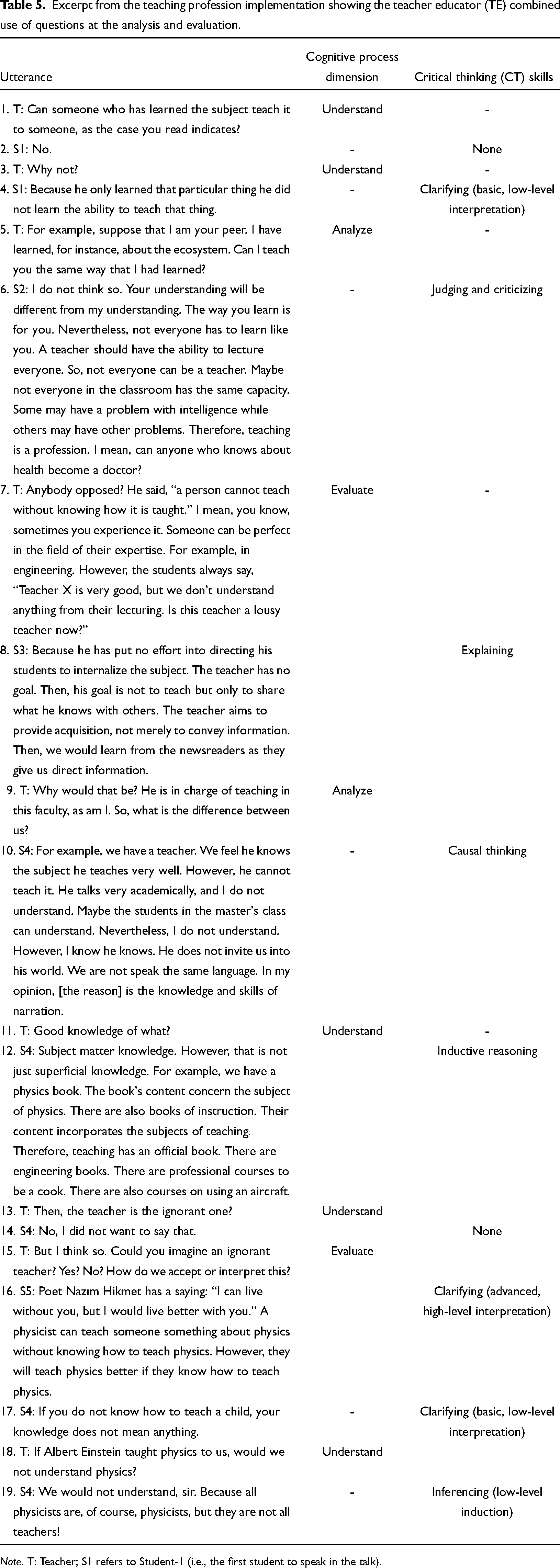
During the teaching profession implementation, the PTs discussed theoretical arguments regarding the teaching phenomenon, namely the importance of SMK and PCK in designing and conducting effective teaching. Table 5 presents an exchange in which the TE attempted to elicit the PTs’ arguments regarding why both SMK and PCK are needed to teach effectively. As seen in Table 5, the TE tried to play devil's advocate by inserting sub-cases requiring rigorous evaluation. For instance, in Turn-5, the TE pressed the PTs to evaluate whether a layperson could competently teach a particular subject to a student group. The TE encouraged the PTs to distinguish between professional and amateur teaching using case-based questioning. The PTs had to discern between relevant and irrelevant arguments concerning SMK and PCK. Accordingly, in Turn-6, Student-2 engaged in rigorous critical analysis by explaining why PCK is a fundamental requirement for teaching, noting the need to keep individual differences in mind while designing and implementing instruction. Student-2 also exhibited analogical reasoning (“I mean, can anyone knowledgeable about health become a doctor?”) to reinforce the idea that teaching should be recognized as a profession. The TE then presented another sub-case. In Turn-7 and Turn-9, the TE interrogated the possible differences and similarities between the SMK and PCK. In Turn-8, Student-3 emphasized that a teacher differs from a newsreader in sharing their knowledge in the classroom. In Turn-10, Student-4 explained why they had not understood the lecture content, noting that the lecturer used peculiar jargon or social language during the instruction that failed to hold student's interest in the discussion of SMK. Elsewhere, discussion during the teaching profession implementation (e.g., turns of talk: 9 and 15) reflected how a pragmatic combination of questions with moderate and high cognitive demand served to bolster the PTs’ CT (e.g., Turn-12; inductive reasoning).
Excerpt from the teaching profession implementation showing the teacher educator (TE) combined use of questions at the analysis and evaluation.
Note. T: Teacher; S1 refers to Student-1 (i.e., the first student to speak in the talk).
Discussion
The findings of this study confirm the links between the cognitive demands of the TE's questions and the CT capacity of PTs. When the TE increased the cognitive demand of his questions, the PTs engaged in higher-order CT processes. Notably, when the questions required PTs to engage in analytical, evaluative, and/or creative thought processes, they articulated extended utterances pitched at higher cognitive levels (e.g., inductive reasoning, suggesting new ways of thinking, or legitimating the arguments of others). These findings suggest that intentionally requiring PTs to consistently engage with and answer cognitively demanding questions will result in their exhibiting high levels of CT activity.
Recent studies support the findings of this study. For example, Lun et al. (2010) and Tan (2020) suggested that the CT phenomenon cannot be understood as an innate capacity of individuals. CT capacity does not develop through an immediate encounter with everyday cases or communications but a mediated relationship with them. This indicates that learners must face intensive cognitive demands in an instructional setting in order to develop and deploy CT skills. It is largely accepted that CT can be learned and taught. This tenet guides educational researchers in designing instruction intended to foster students’ CT capacity. Instructional designs for enhancing CT incorporate problem-based teaching, scenario-based teaching (Gilboy & Kane, 2004), hands-on teaching (Coker, 2009), the case study method (Phillips & Mackintosh, 2011), teaching through the social negotiations of meanings (Yang et al., 2008), teaching through dialoguing (Parkinson & Ekachai, 2002), authentic instruction (Sungur & Tekkaya, 2006), and mentoring (Solon, 2001). However, scholars have yet to address the question of what actually happens in the classroom pedagogically in terms of CT process by analyzing verbal exchanges through a close investigation of classroom talk. This study's fine-grained talk analysis demonstrates the beneficial impact of more cognitively demanding questions on the development of PTs’ CT activity. This study contributes to the literature insofar as it shows that TE questions deliberately calibrated to a high level of mental demand may facilitate the use and development of higher-order CT in PTs. In other words, the results of this study show that students’ critical evaluation and discussion do not necessarily occur spontaneously; rather, the TE is required to force PTs to engage with specific cognitive processes (e.g., explaining, judging, criticizing, inductive reasoning, advising, recommending), which were made more accessible via cognitively demanding questions.
According to Kuhn (1999), experiencing CT requires “judgements that can be evaluated and compared according to criteria of argument and evidence” (p. 23). Kuhn (1999) also emphasized the need for a critical thinker to assess a given idea. Recent studies (e.g., Espey, 2018; Wilson, 2016) indicate that a CT capacity is primarily related to specific cognitive skills, including the judgment of faulty or alternative claims and arguments, hasty generalizations, and ambiguous concepts. As such, engaging in sophisticated CT involves construction, critiquing, and evaluating ideas. In this context, this study elucidates how the mental demands of the TE's questions regulated the instructional conditions of PTs, thereby centering the construction, critique, and evaluation of ideas. For instance, in the teaching profession implementation, the TE instructed the PTs to critique the ideas he presented (e.g., Table 5: talk turns 5, 7, 9, and 15), prompting them to attempt to discern faulty or alternative arguments.
It should be noted that critiquing the presented ideas requires cognitively demanding questions. As Perkins (1995) argued, a critical thinker must use reflective and experiential intelligence. Similarly, Espey (2018) and Wilson (2016) have asserted that sophisticated CT in the context of higher education requires self-reflexive and self-regulated actions. In terms of this study, these actions indicate that the PTs had to make concrete attributions to their mental model revision processes. As illustrated by the in-class dialogues, particularly those presented in Tables 4 and 5, the TE's cognitively demanding questions—that is, those requiring PTs to engage in analysis, evaluation, or creativity—appear to have guided the students to consider and evaluate arguments of both the TE and their peers (e.g., Table 4: talk turns 5, 7, and 11). This is one of the most tangible indicators of higher-order psychological processing concerning CT activity. The PTs were assigned as co-evaluators, co-evaluators, or co-critics through the questions at the analysis or evaluation levels, which proved instrumental in leading them to decide what constitutes an adequate answer. The PTs determined the quality and validity criteria of the provided responses. The PTs experienced high cognitive load when answering the TE's evaluation-level questions, namely, “How do we know?” and “Why do we believe?” The PTs’ negotiation and decision of the correct answer are indicative of sophisticated CT activity.
This study problematized how a specific university-based instructional environment with varying mental demands created by the TE's questions shapes the PTs’ CT activity while discussing pedagogic phenomena. In other words, this study sought to illuminate how a series of question-based practices conducted by the TE creates dialogical spaces for educating and cultivating critical thinkers. Paul and Elder (2019) identified several essential indicators of a well-cultivated critical thinker. First, critical thinkers must use effective communicative tactics to formulate their ideas clearly or propose abstractions to comprehend their conceptual intentions. As seen in Figure 1, in this study, the TE mainly used questions with a low level of cognitive demand across the four implementations. The TE encouraged the PTs to share their ideas with the whole class, particularly via questions pitched at the level of understanding, thereby motivating students to engage in CT skills of interpretation, illustration, classification, and summation (e.g., Table 3, Turn-17). These relatively undemanding questions appeared necessary insofar as the PTs needed to elaborate on their presumptions and initial ideas before engaging in sophisticated CT activity.
In this study, PTs required more mental demand in order to cultivate CT. In this respect, Paul and Elder (2019) suggested that a critical thinker should be able to problematize the content under discussion. However, problematizing content is not a spontaneous process; rather, intentionality is required in instructional scene staging. In this study, the PTs were able to problematize the content when the TE increased the cognitive demand of his questions. For instance, Turn-5 and Turn-7 in Table 5 shows how the TE tried to guide the PTs in problematizing the content. In this example, Student-2 initiated her explanation by saying, “I do not think so” (Turn-6). Here, Student-2 took an intellectual position and presented a counterargument based on the TE's questions. As such, the results of this study show that the pragmatic use of questions with a low and high level of cognitive demand may serve to foster the CT capacity of PTs.
According to Paul and Elder (2019), it is crucial that a critical thinker is able to formulate well-reasoned conclusions and solutions and test them against relevant criteria and standards, think open-mindedly within alternative systems of thought, and be able to recognize and assess their assumptions and the implications and practical consequences of their arguments when necessary (p. 9). This study systematically observed that the aforementioned standards of a critical thinker were possible through the TE's cognitively demanding questions (i.e., three levels of analyze, evaluate, and create). For example, by asking questions at the analyze level, the TE required PTs to distinguish between relevant and irrelevant ideas (e.g., Table 4, Turn-3; Table 5, Turn-5 and Turn-9). Similarly, to answer questions at the evaluate level, PTs had to identify the conceptual, epistemological, or ontological inconsistencies or fallacies in the ideas presented by the TE or their peers. In other words, in order to answer questions with a high level of cognitive demand, such as those at the evaluate level, the PTs were required to determine whether an intellectual process (e.g., argumentation, discussion, and negotiation) or product (e.g., idea, argument, conclusion, and assumption) had internal consistency or identify and explain the incongruity between the product and external criteria to determine whether the product had external consistency. The TE's questions, particularly those pitched at the evaluate level, prompted the PTs to make evidence-based critiques of the presented ideas, possibly by presenting counterarguments, thereby indicating sophisticated CT. For instance, in Turn-5 and Turn-7 of Table 4, the TE required the PTs to consider and analyze alternative views. In response, Student-1 (Turn-8) and Student-3 (Turn-10) presented elaborate arguments reflecting the highest levels of CT (e.g., advising and suggesting or judging and criticizing; Table 2). Therefore, there appears to be a close relationship between the TE's more cognitively demanding questions and the CT capacity of the PTs.
Browne and Keeley (2007) proposed a more realistic list of thought-evoking questions for promoting CT, one that supports the findings of this study. In this respect, Browne and Keeley (2007) identified the following strategies to encourage CT: suggesting (e.g., “What are other alternatives?”), reasoning and elaborating (e.g., “What do you mean by…?”), evaluating (e.g., “What are some of the reasons to disagree with…?”), and concluding (e.g., “What conclusions can we draw?”). In a similar vein, Golding (2011) composed a list of educator-based questions regularly asked during lectures to promote CT. Golding’s (2011) list comprised the following types of questions: “why?” questions, which ask students to provide justifications; “what do you mean?” questions, which prompt students to clarify the background context or basis of their claims; and “what is the difference between…?” questions, which require students to make comparisons. However, while valuable, these studies do not illustrate how the proposed questions should be asked by a TE in the discussions of pedagogy to foster the CT activity of PTs.
This study proposes a link between questioning activity, mental demand, and CT activity. In this respect, Hallman-Thrasher and Spangler (2020) explored the complex connections between teacher-led purposeful questioning, increasing the cognitive demand of an instructional task, and higher-order student-led reasoning. They concluded that teacher questions should serve the following four discursive functions: (1) eliciting thinking, (2) generating ideas, (3) clarifying explanations, and (4) justifying claims. The teachers used these functions to maintain the cognitive demand of an instructional task and promote the students’ CT capacity. In this study, these four talk-based discursive functions (Hallman-Thrasher & Spangler, 2020) were prompted by the TE asking questions with varying levels of cognitive demand. As this study observed, functions (1) and (3), eliciting thinking and clarifying explanations, can be attained via the TE asking questions with low and moderate levels of cognitive demand, that is, questions on the level of understanding and analysis. Meanwhile, functions (2) and (4), generating ideas and justifying claims, are more challenging, and are thus more likely to occur via the TE asking questions at a higher level of cognitive demand, namely, those pitched at the evaluate or create levels. However, Estrella et al. (2020) noted the need to maintain harmony or balance to increase or decrease the cognitive demand of instruction. In other words, a heterogeneous dispersion of mental demand across the lesson period is not conducive to promoting displays of CT by learners. As such, the findings of this study need further investigation and clarification in order to verify the proposed connection between the cognitive demand of questions and the CT capacity of those to whom these questions are posed.
Various scholars have advocated the need for teachers to constantly refine the mental requirements of their instructional scene staging to ensure balanced or pragmatic teaching and foster students’ conceptual learning and higher-order reasoning (e.g., Humphrey et al., 2020). In other words, teachers should use particular instructional tactics via their questions to maintain or change the cognitive demands they make on students. In this regard, Smith and Stein (1998) proposed three instructional strategies to maintain a high level of cognitive demand. First, students should monitor their own thought processes and/or those of others. Second, students should be encouraged to display justified thinking and construct operational definitions of a concept under consideration. Third, teachers should guide students to draw and articulate concluding statements. According to Smith and Stein (1998), these strategies can effectively boost the level of mental demand, and are more visible in the presence of teacher questions, comments, and feedback formulated on the basis of student responses. This study contributes to the aforementioned arguments insofar as it suggests the potential of a combination of questions with a low, moderate, and high cognitive demand to scaffold learners to reach the peak of their CT capacity. For instance, to evoke justified thinking or the operational definition of a pedagogic concept, the TE, consciously or unconsciously, asked a combination of questions with a low and high cognitive demand. For instance, Turn-1 to Turn-4 in Table 5 reflects that the TE's questions ranged from a low to moderate range of cognitive demand, to which Student-1 responded with a basic interpretation (Turn-2) and an advanced clarification (Turn-4). In this study, cognitively demanding questions seemed to motivate the PTs to monitor both their own thought processes and those of others. In the teaching profession and experience and learning implementations, once the TE asked questions at the evaluate level, the PTs were able to verify the thinking of others as a metatalk activity that might augment CT capacity. Indeed, as Turn-7 and Turn-15 in Table 5 show, the PTs were explicitly invited to review and comment on their peers’ thinking about pedagogy, evidencing higher mental demands.
Significantly, it should be noted that in the teaching profession and experience and learning implementations, the TE followed a more homogenous questioning style by incorporating questions with a low, moderate, and high level of cognitively demanding questions across the class discussion of ideas about teaching and learning (Figure 1). However, in the Lily and darkroom and knowledge–teaching–learning implementations, the TE's questions appeared to be dispersed in a more heterogeneous fashion (Figure 1). As various scholars have argued (e.g., Humphrey et al., 2020; Smith & Stein, 1998; Whittington and Tekkumru-Kisa, 2020), the homogeneous distribution of the mental demands of questions across an instructional scene staging is more effective in eliciting the CT capacity of PTs.
Conclusions and recommendations
As many higher education systems agree, teachers are change agents and an essential dimension of education reform, particularly TEs who train these change agents and ensure the continuity of their professional development (Goodwin & Kosnik, 2013). Certainly, Darling-Hammond (2006) demonstrated this argument by providing data demonstrating that TEs are a community, albeit one that has yet to be researched as a professional community. This situation is known as the mystery of higher education and constitutes a serious pedagogical obstacle to the education of TEs (Darling-Hammond, 2006). This prompts the question of why we, as TEs, dare not investigate ourselves. Indeed, neither a curriculum specifically created to cultivate TEs nor a set of instructional strategies have been defined scientifically. Moreover, there is a common misconception that the linear path from preschool to postdoctoral education can guarantee the development of TEs. The phenomenon of specializing in teacher education and being a quality TE is often taken for granted, with many assuming that it is merely a matter of passing certain education levels (Goodwin & Kosnik, 2013).
This study sought to address this problem by qualitatively prototyping how TEs use their questions during pedagogy lessons to trigger PTs’ CT activity. However, as TEs, we recognize that it is counterproductive to present the findings of this study to the TE community to challenge their question-based pedagogic actions in fostering the CT capacity of their students. As Chan et al. (2021) emphasize, high-quality teaching is a multidimensional and complicated enterprise. Indeed, during classroom talks, TEs are bombarded with countless incidents that need to be controlled in order to maintain a high-quality lesson where students are guided to engage in CT processes. Based on the literature on teacher noticing, this study recommends that TEs selectively attend, interpret, and respond to noticed events in the visually complex and potentially confusing world of the classroom (Chan et al., 2021). Accordingly, this study accepts two premises of the teacher noticing: first, like members of other professions, TEs can develop unique ways of comprehending appropriate points in their profession; second, effective TEs should be able to refine featured social interactions and verbal exchanges within the visually complex setting of the classroom. However, those responsible for educating TEs can expand their instruction by considering the findings of this study in professional development programs.
We further propose a specific methodological approach to training and cultivating the versatility of candidate or in-service TEs with respect to their using cognitively demanding questions to foster the CT capacity of PTs. We believe that TEs should be treated as co-researchers who can analyze the mental demand of their questions and the dispersion thereof. In other words, TEs must be recognized as classroom discourse analysts who can evaluate the influence of their talks on the pedagogic cognition of PTs. However, being a classroom discourse analyst is hardly automatic; rather, specific methodological orientations need to be adopted. One of the most effective ways of training a TE as a classroom discourse analyst is to conduct consistently stimulated recall sessions within a self-study approach. By scaffolding a more knowledgeable/capable other, a TE can gain core skills, including the ability to gather, analyze, interpret, and evaluate their question-asking behavior and PTs’ CT activity. After attaining the fundamental knowledge and skills necessary to link classroom discourse (i.e., mental demands of questions) to cognition (i.e., CT activity/capacity), the supporter TE may gradually withdraw from the system, allowing the supported TE to transform into a self-reflective practitioner. Based on a cascade model and the reflection-in-action and reflection-on-action cycles, faculty or university members may develop a critical and data-based approach to improve their question-asking pedagogy for cultivating teachers with a high capacity for critical thought.
Limitations
This study has some limitations that may inform the conceptual and methodological streaming of future studies. First, this study identified a TE who tended to ask ample and appropriate questions in the classroom, and thus limited the number of TEs to a single individual. Future research should conduct a similar analysis with more than one TE for comparative outcomes. Limiting the number of TEs prohibited a collective case study approach, in which diversification would have provided more generalizable outcomes regarding the relationship between the cognitive demand of TE questions and the CT capacity of the PTs. Second, this study focused on only four topic-specific activities in analyzing the connections between the mental demand of question levels and CT capacity of the PTs. A longitudinal study of this nature would likely produce a greater number of valuable insights. Third, although the four topic-specific activities provided a sound instructional setting to capture more classroom talks between the TE and PTs, findings should be interpreted cautiously because the observed connections between the mental demand of the TE's questions and the CT capacity of the PTs may have been influenced by the different conceptual themes discussed in the lessons. In other words, this study's decision to employ content-sensitive analysis may have impacted the generalizability of the results. Fourth, a significant limitation concerns our inability to discern whether the TE actively regulated the cognitive demand of his questions or whether this process was done unconsciously. In this respect, was an incremental tendency from the first to the last implementation in terms of mental demand despite there being no experimental intervention. Therefore, the results of this study should be understood as a call for the further design and conduct of experimental research of this nature to provide more empirical data and verify the largely qualitative findings of this study.
Footnotes
Contributorship
Yilmaz Soysal contributed to all parts and subparts of the main body, including data collection, analysis, interpretation, and communication of the findings. Somayyeh Soysal contributed to managing the data corpus and operating some fundamental and foundational critical thinking and adult education theories to make sense of the systematic observations. Yilmaz Soysal and Somayyeh Soysal cooperated mostly in analyzing data and producing theory-laden interpretations to generative tentative but internally persuasive qualitatively oriented outcomes. Language editing was finally checked, and clarity issues were removed by the efforts of Yilmaz Soysal.
Declaration of conflicting interests
The authors declared no potential conflicts of interest with respect to the research, authorship, and/or publication of this article.
Ethical statement
The present study and informed consent were approved by the Ethics Committee of Istanbul Aydin University in Istanbul, Turkey. Informed consent was obtained from all the participants.
Funding
The authors received no financial support for the research, authorship, and/or publication of this article.