




Abstract
Purpose
The current study aimed to identify the distances between a science teacher's intuitive reasoning and researchers’ systematic analysis of various aspects of science classroom discourse. An expert science teacher, given the pseudonym Jake, engaged in self-reflective processes regarding different aspects of classroom discussions to assess the variations and similarities between the teacher's intuitive estimations and the researchers’ data-based reasoning.
Design/Approach/Methods
Data collection involved in-depth interviews and video recording. Six aspects of science classroom discourse were considered to elucidate the distances: structure, interactional pattern, verbal sequence, typology, cognitive demand, and communicative approaches.
Findings
The quantitative distances between Jake's estimations and systematic observations of the six aspects of science classroom discourse varied across different aspects of the observed science lesson. While no consistent pattern was observed in the distances, there were increasing and decreasing gaps between the different aspects of science classroom discourse.
Originality/Value
Considering the contemporary arguments on human cognition and the professional development of science teachers, potential reasons for the differences were explored. Educational recommendations were provided, particularly regarding supporting science teachers’ journey toward becoming reflective inquirers or researcher-teachers.
Keywords
Introduction
The primary aim of this study is to differentiate between the concepts of “sensory perception” and “meaning making” in regard to observing, comprehending, and assessing pedagogical-discursive occurrences in the science classroom. It is widely acknowledged that sensory perception and the subsequent act of deriving meaning from these perceptions play a significant role in shaping an individual's cognitive framework, particularly in pedagogical matters. Both aspects are valuable and complementary when applying human cognition to a particular issue or understanding explicit observations, such as those found in classroom discussions. As Vygotsky (1987) suggested, individuals possess both spontaneous (sensory perception) and formal (meaning making) forms of reasoning when explaining social or natural phenomena. Spontaneous reasoning evolves through everyday experiences and communication, developing independently of any specific effort to master them (Leach & Scott, 2002, 2003; Vygotsky, 1987). Alternatively, formal reasoning does not begin with an immediate encounter with objects but, rather, through a mediated and intentional engagement with the subject matter (Vygotsky, 1987).
For example, in a science classroom, students may hold ideas that do not align with the scientific community's understanding of the world, such as “A tree feeds on the earth” or “I’ve consumed my energy today.” These examples are not formally relevant (i.e., devoid of meaning making) but align with individuals’ everyday sensory perceptions. Students holding such ideas may not feel discomfort as they observe plants flourishing when water and nutrients are added to the soil or as they become fatigued after physical activity. Experts in plant physiology would describe the cultivation process using specific scientific terminology, considering photosynthesis through chemical equations. Similarly, experts in biological energy systems would explain the feeling of tiredness through energy transformations such as aerobic respiration and the production of adenosine triphosphate (Soysal, 2020b; Soysal & Yilmaz-Tuzun, 2021). However, the idea that “A tree feeds on the earth” is not entirely erroneous; it fits within the conceptual framework of students, who understand that plants require water and minerals from the soil. Nevertheless, this understanding is incomplete and should be extended with a more comprehensive conceptual framework, transitioning from a sensory perception-based mental state to one constructed through meaning making (Mortimer, 1995). The crucial point here is not these alternative conceptual frameworks’ absolute correctness or incorrectness but their descriptiveness and applicability within specific contexts (Mortimer & El-Hani, 2014). Scientists develop various systems of thinking and communication, including alternative conceptual frameworks for a given concept. These frameworks do not contradict each other but, rather, complement and expand understanding (El-Hani et al., 2013).
The arguments and examples presented above also apply to observing, comprehending, and assessing the intricate nature and structure of classroom discourse events regarding their pedagogical significance. Science teachers, for example, may approach their verbal initiations with common-sense reasoning, relying on sensory perceptions or intuitive thinking to a certain extent to grasp the dynamics of science classroom discourse. I do not dismiss science teachers’ common-sense reasoning in this study as entirely incorrect or as misconceptions about science classroom discourse events. Instead, I acknowledge their common-sense reasoning as an incomplete understanding, representing an alternative (or spontaneous, common-sense) form of reasoning.
Consequently, in this study, I endeavor to compare the comprehension of an experienced science teacher and experts regarding science classroom discourse events. The objective is to determine the specific aspects or parameters of science classroom discourse where the teacher's common-sense or intuitive reasoning is applicable in precisely defining the classroom discourse events. In other words, this study introduces a unique methodological framework, which is detailed in subsequent sections, to re-evaluate the points of overlap and differentiation between the teacher's and classroom discourse experts’ analyses, evaluations, and understandings. Overall, this study posits that science teachers’ reasoning regarding classroom discourse events is more intuitively oriented, while professional researchers are expected to employ deliberative thinking when analyzing such occurrences. The hypothesis, which suggests the existence of overlapping and distinctive viewpoints, explanations, propositions, and arguments regarding the intricate classroom discourse events, is rigorously examined in this study.
Based on the above-stated arguments, the current study was structured around two concepts. Human cognition involves two systems for cognitive processing: the intuitive system and the deliberative system (Kahneman, 2011). People may often rely on intuition-based heuristics when making decisions about events in science classrooms (Boissin et al., 2021), influenced by their experiences within the lay culture. Intuitive reasoning is rapid and mentally efficient (Evans & Stanovich, 2013). Conversely, deliberative cognitive processing is slower and requires deeper intellectual demands due to post hoc verbal externalization (Morewedge & Kahneman, 2010; Wyss et al., 2021). Intuitive reasoning may overshadow alternative thinking, as individuals may fail to consider other perspectives and explanations for a phenomenon. The deliberative system serves as a facilitating mechanism that addresses and represents the contents derived from intuition-based heuristics (Kahneman, 2011).
It is essential to acknowledge that there may be similarities between intuitive and deliberative reasoning. However, intuitive reasoning can sometimes lead to incomplete comprehension (Boissin et al., 2021). For example, in a science classroom, an intuitive observer may perceive a highly intellectually productive environment in which the teacher asks questions, students respond, and discussions flow smoothly. However, a systematic and critical investigation may reveal that the teacher predominantly asks close-ended questions, does not structure questions based on student answers, and uses coercive tactics to elicit responses. In addition, the observer may find that the classroom lacks genuine dialogue and consists of one-sided lectures. Thus, significant differences can arise between the conclusions and recommendations of intuitive and deliberative observers regarding effective science teaching.
This study explores the nuances, if any, among these different types of pedagogically oriented cognitive processing by examining various aspects of science classroom discourse in middle school classrooms. An expert science teacher participated in a carefully designed self-reflective process, assessing different aspects of classroom discussions to investigate the potential differences and similarities between their intuitive estimations and researchers’ data-based reasoning. The study also quantitatively measures the distances between the teacher's intuitive reasoning and researchers’ systematic analysis of the various aspects of science classroom discourse. This study is significant as it presents a thinking tool for estimating the gaps between intuitive and systematic pedagogical perspectives. By engaging in an inquiry discourse with researchers, the aim of the study is to systematically explore agreements and disagreements in the specifications of science classroom discourse, differentiating between deliberative and intuitive pedagogical reasoning—a practice often overlooked in teacher education (Wyss et al., 2021).
By allowing science teachers to collect, analyze, and interpret data on science classroom talk, this study positions them to make informed decisions regarding the intellectual productivity of classroom discourse (van Es & Sherin, 2010). In this sense, science teachers can be considered reflective inquirers who employ deliberative reasoning (Eshchar-Netz & Vedder-Weiss, 2021). However, a gap exists in understanding the differences between science teachers and professional researchers in evaluating science classroom discourse (Wyss et al., 2021). Thus, developing a rigorous thinking tool, as justified in this study, to highlight the disparities between perception and sense-making in the various aspects of science classroom discourse will advance the field.
Research question
The current study is conceptualized around prominent aspects of classroom discourse, which are detailed below. The research question addressed in this study is given below:
What were the similarities and differences between the teachers’ predictions and systematic observations regarding the below-listed science classroom discourse aspects?
Structure of questions asked in the lessons Occurrences of patterns of interaction in the lessons Discursive functions of the questions asked in the lessons Cognitive demands presumably embedded in the questions asked in the lessons Communicative approaches that emerged in the sub-topical episodes in the lessons
As previously mentioned, this study goes beyond comparing and contrasting a science teacher's pedagogical perspective and a group of classroom discourse experts regarding the aspects of classroom discourse outlined earlier. Rather, the primary objective here is to gain a profound understanding and clarify the aspects of classroom discourse where intuitive reasoning proves effective and serves as a comprehensive tool for explanation and exploration. Conversely, it aims to identify those dimensions of classroom discourse events in which both observers (teachers and experts) necessitate a more nuanced, deliberate approach and heightened observational insight to elucidate the precise dynamics unfolding during specific moments of social interactions and verbal exchanges between teachers and students within the classroom setting.
It is worth noting that selecting these specific aspects or indicators of classroom discourse was a deliberate choice. To provide some context, previous studies in science classroom discourse have generally employed two distinct methodological approaches: the process-product paradigm and the interpretive approach. The first approach, the process-product paradigm, seeks to comprehend classroom discourse events by breaking them into discrete, observable teacher-led conversational initiations (Kayima & Jakobsen, 2020). This perspective offers a somewhat predetermined and prescriptive understanding of communicative events within the classroom, often emphasizing analytical communication acts (Hennessy et al., 2020). Within this framework, classroom actions give rise to analytically discernible, systematically observable, and context-independent indicators. These indicators encompass elements such as the structure of questions, the discursive functions of questions, and the cognitive demands associated with questions (which are central to the present study and will be elaborated on in subsequent sections). However, it is worth noting that the process-product paradigm has limitations in fully capturing how classroom discourse unfolds within the science classroom.
The interpretive approach argues that in order to attain a comprehensive understanding of classroom discourse, it is essential to consider the interplay between spoken language and the role of the social context in interpreting that language (Kayima & Jakobsen, 2020). This perspective places the context in which teacher-led conversational initiations take place at the forefront. Within this framework, the meaning of classroom discourse is context-dependent, with these contexts being shaped and revised by the individuals engaged in the dialogue. Science teacher educators contend that the observed patterns of interaction and communicative strategies (which are central to the present study and will be detailed further in subsequent sections) in science lessons can serve as context-dependent indicators characterizing the situational dynamics of classroom discourse (e.g., Kayima & Jakobsen, 2020; Soysal, 2020b; Soysal & Yilmaz-Tuzun, 2021). The current study rigorously observes and analyzes the previously listed parameters to encompass both methodological approaches outlined above.
Theoretical framework
This section clarifies two frameworks central to the current study. First, feature aspects of science classroom discourse are synthesized. Second, the differences between intuitive and deliberative thinking are discussed. Classroom discourse defines the verbal and non-verbal social interactions and verbal exchanges between all classroom members. Talk-based interactions characterize classroom discourse in which teachers and students ask questions and answer each other. Therefore, patterns of interaction may vary in the classroom discourse. During classroom discourse, verbal exchanges facilitate the co-construction of knowledge claims by the intellectual contributions of different classroom members. Below, fundamental aspects for exploring profound layers of classroom discourse are summarized.
Featuring aspects of science classroom discourse
This study explores the differences and similarities between intuitive thinking (decision-making, reasoning) and deliberative reasoning in science classroom discourse from different aspects. Essential features of science classroom discourse are first synthesized below.
Interactional patterns
The nature of talk in science classrooms is complex. First, interactional patterns are salient features of science classroom discourse (Mercer & Dawes, 2014). Patterns of interaction are characterized by triadic dialogue (Initiate-Response-Evaluate, IRE), in which the teacher triggers the conversation with a question, after which students respond. After receiving responses, the teacher decides whether they are acceptable based on canonical or curricular science knowledge. According to Khong et al. (2019), a conventional triadic framework called the IRE is commonly used to analyze discourse in science classrooms. In this framework, teachers are authorities on knowledge by virtue of presenting themselves as the primary knowers.
Science teachers may reformulate IRE-based verbal exchanges into IRF-based interactions where F demonstrates a follow-up action that can be feedback or a follow-up question that is contingent on the contents of students’ responses (Louca et al., 2012). When IRF-based verbal interaction chains are pervasive, more dialogic space can be allocated for student-led talk. Chin (2006, 2007) suggests that students’ intellectual contributions can be enhanced by utilizing follow-up contingent questions that prompt them to initiate discussions. These discussions should encourage student interactions, leading to a collaborative thought process known as interthinking. This collective and joint thinking enables dialogic argument construction, ultimately aiding in resolving task-based problems.
These two triadic exchange patterns are matched with different verbal sequence patterns. With the discursive preference for follow-up questions, science teachers may guide students to probe their and their classmates’ ideas. In such instances, an increase in student–student interactions can be observed within the science classroom. When teachers ask follow-up questions based on a student's response, other students can actively listen, respond to, critique, and validate their classmates’ alternative explanations, propositions, and claims. Mercer (2019) highlights the significance of this dynamic, which encourages a robust exchange of ideas among students. This is defined as the joint co-construction of knowledge in the science classroom.
Structure of science teacher questions
Science teachers employ open-ended and close-ended follow-up questions as distinct inquiries in science classrooms. Prior studies have indicated that open-ended questions offer advantages in promoting students’ science learning. These types of questions enable students to provide competing or alternative responses, encouraging active engagement and dialogue among them (McNeill & Pimentel, 2010; van Booven, 2015). Furthermore, as open-ended questions are used for probing students’ utterances, their speaking time can be enhanced by five or more seconds (Lefstein et al., 2015), requiring more cognitive activity on the part of students and improving their acquisition of science concepts (Kayima & Mkimbili, 2021).
Close-ended questions, in contrast, are often seen as less effective in encouraging students to delve deeply into their explanations and provide meaningful justifications for their ideas. These questions are typically asked to elicit a known answer, often aligning with the science teacher's predetermined agenda or following a confirmatory or cumulative conversation style reminiscent of Socratic questioning (Oliveira, 2010). However, some previous research has suggested that the open- or close-endedness of science teachers’ questions may not be adequately explanatory in boosting students’ cognitive and metacognitive activity compared to their contingency (Alexander, 2018; Boyd & Rubin, 2006; Molinari et al., 2013). This implies that the effectiveness of science teachers’ questioning in stimulating students’ conceptual thinking depends on their capability to ask contingent questions grounded in conceptual, epistemological, or ontological themes implicitly embedded in students’ responses. Thus, science teacher questions should be re-categorized as close-ended non-contingent, close-ended contingent, open-ended non-contingent, and open-ended contingent. Science teachers may ask many open-ended questions that may not be contingent upon the contents of students’ responses. When there is a lack of contingency, the level of student-led intellectual activity tends to be lower. Alternatively, close-ended contingent questions have shown to be more effective in prompting students to engage in novel thinking and discourse, leading to deliberative conceptual change. This outcome may not be achievable through science teachers’ open-ended, non-contingent questions alone (Molinari et al., 2013).
Talk moves of science teachers
Most of the talk moves of science teachers are displayed in the form of questions. Science teacher educators proposed fruitful coding catalogs to identify the discursive functions of science teachers’ talk moves. In addition, some scholars proposed models to characterize the typology of the discursive function of science teacher questions. Soysal and Soysal (2022) proposed the pentagon model to describe academically productive classroom talk, emphasizing teacher questions’ role in scaffolding student learning. The pentagon model suggests that science teachers should use specific communication questions to facilitate effective classroom discussions. These questioning techniques include clarifying, revoicing, reformulating, and eliciting questions (Pimentel & McNeill, 2013). The purpose of using communicative questions is to encourage students to clarify, probe, and reformulate the semantic and conceptual content of their ideas. These questions aim to foster more profound and meaningful verbal exchanges among students. In addition, science teachers should press students to provide evidence for their claims (Christodoulou & Osborne, 2014). In the science classroom, students cannot engage in warranted reasoning without sufficient and relevant evidence if they are not explicitly and intentionally prompted to provide evidence, especially for their baseless, invalid, or incomplete propositions.
It is strongly suggested that a considerable amount of science teacher questions should be allocated for metatalk (talk for metacognitive purposes) or monitoring questions (Tang, 2021). Metatalk questions guide students to continuously check what happens within a particular time interval of classroom talks. Metatalk questions guide students in managing their cognitive involvement and aligning their thinking with the teacher's cognitive process, which is essential for advanced thinking and learning. Some metatalk questions are well described by previous research: focusing, selecting-eliminating, on-moment monitoring, prospective monitoring, retrospective monitoring, and asking about mind change (Tang, 2017, 2021).
One of the most prominent aspects of science classroom talk is whether it allows for interthinking (Mercer, 2019; Mercer et al., 2004). This implies that science teacher questions should guide students to listen to and comment on their classmates’ ideas. This goes beyond simply elaborating on each other's assertions regarding a scientific topic. It also involves collective or collaborative thinking, in which individuals engage in discussions, evaluations, judgments, and validation of alternative or competing ideas within an argumentative discourse. This is achieved by presenting counterarguments to challenge contextually or logically flawed ideas, fostering a harmonious exchange of perspectives (Reznitskaya & Gregory, 2013). In pursuit of this communicative objective, science teachers can employ their questions to foster student engagement in evaluating, judging, critiquing, and, when appropriate, legitimizing the ideas put forth, all within a framework of mutual respect. In a science classroom characterized by interthinking, science teachers can effectively utilize their questions to leverage the collective processes of sharing and constructing ideas. They achieve this by explicitly encouraging students to evaluate their peers’ ideas, a proposition by the teacher, or a case presented in a science textbook.
In an argumentative discourse classroom, science teachers’ challenging or discrepant questions are instrumental in guiding students to think and talk about diversifying science phenomena in novel ways. In science classroom discussions, challenge questions are utilized to adopt the role of devil's advocate. Their purpose is to stimulate internally persuasive dialogues and prompt students to recognize that their current mental frameworks developed for the scientific topic being discussed may not be sufficiently explanatory or exploratory to make progress in the conversation. This helps instill in students the notion that further examination and exploration are necessary (Rea-Ramirez et al., 2009). Consequently, to facilitate a more productive classroom dialogue, students can be actively involved in the process of conceptual change. This process enables them to adopt and internalize novel perspectives on science concepts by posing challenging questions in a timely manner (Soysal, 2023).
Cognitive demands in science talks
Science teachers may create and maintain different cognitive demands on students’ side, especially by asking questions (Chin, 2006). Previous studies showed that certain kinds of science teacher questions might create lower or higher cognitive processing demands for students (Kayima & Jakobsen, 2020; Soysal, 2020a. With their questions, science teachers invite their students to retrieve a piece of information from long-term memory (Soysal, 2020a). By asking higher-level questions, science teachers may force students to use higher-order reasoning, such as hypothesizing, explaining, arguing, and evaluating. Previous research intended a tangible linkage between the cognitive demand levels of science teachers’ questions and the complexity of students (Kayima & Jakobsen, 2020; Kayima & Mkimbili, 2021; Soysal, 2020a). This suggests that students’ cognitive productivity can increase when they engage in an intellectually challenging science lesson. This can be achieved through the science teacher's use of higher-order questions that align with the analyzing, evaluating, or creating levels of the revised Bloomian taxonomy.
Nonetheless, it has been suggested that cognitive demand during a science lesson should be consistently harmoniously maintained or balanced. Science teachers are advised to follow this approach by appropriately utilizing question-asking techniques (Chin, 2006). This makes systematically analyzing the cognitive demand throughout a science lesson more possible. Previous studies have shown that teachers should first ask lower-order questions to balance the cognitive demand in science talks (Chin, 2006). Once students discuss and conceptualize fundamental points in the lesson, it is more appropriate to ask higher-order questions. The process of gradually progressing from lower-cognitive-demand questions to higher-demand questions is called the cognitive ladder or cognitive scaffolding. Its purpose is to alleviate cognitive overload in students (Chin, 2006).
Communicative approaches in science talks
Mortimer and Scott (2003) proposed an analytical framework for analyzing the existence of monologic and dialogic verbal exchanges between teachers and students. According to Mortimer and Scott (2003) as well as other scholars (Bae et al., 2021; Kim & Wilkinson, 2019), the consideration, argumentation, and negotiation of alternative or conflicting viewpoints should be openly demonstrated in the intermental plane of classroom discourse, as this is recognized as dialogic. Mortimer and Scott (2003) and other researchers suggested that the presence of verbal interactions between the science teacher and students alone is insufficient to determine whether classroom discourse can be considered dialogic. In addition to verbal exchanges, social-intellectual negotiations of alternative or rebutting explanation systems should be argued in the science classroom discourse. Based on this re-formulation of dialogism in the science classroom, Mortimer and Scott (2003) proposed four classes of communicative approach: non-interactive monologic, interactive monologic, non-interactive dialogic, and interactive dialogic.
Science teacher educators have widely employed the typology of communicative approaches to examine sub-topical episodes systematically. This analysis aims to determine whether a single point of view dominates a science lesson or if alternative, competing, and rebutting assertions are acknowledged and mutually illuminated to reach an intellectual consensus. By addressing discrepancies between competing theories, the science classroom aims to foster a shared understanding. It is worth mentioning that while dialogic classes within communicative approaches appear to be productive in terms of cognitive activity in science classrooms, it is vital to establish a rhythm of classroom discourse in which all classes of communicative approaches are harmoniously integrated and balanced. Prior research has indicated that effective science classroom discourse necessitates a combination of open-ended, dialogic sub-topical and monologic, subject-centered episodes. Science teachers must guide their students through a discursive journey that highlights the students’ pre-existing mental framework (dialogical orientation) and subsequently reconsiders canonical science knowledge (monological orientation). This approach facilitates the resolution of dilemmas arising from different sense-making systems, allowing for the identification of similarities and discrepancies among alternative or competing explanatory styles (Soysal, 2020b; Soysal & Yilmaz-Tuzun, 2021).
Intuitive and deliberative thinking regarding science classroom discourse
Teachers should engage in pedagogical decision-making, which is crucial for higher-order student learning, yet little is known about it (Vanlommel et al., 2017). Despite the fact that the impact of data-based reasoning on the quality of instruction has been confirmed (König et al., 2022), teachers may easily engage in decision-making by relying on their experiential intuition. A prominent explanation for teachers’ inclination to rely on intuition rather than data-based thinking is their tendency to perceive their role primarily as lecturers or knowledge providers in the classroom rather than as data analysts or researcher-teachers (Wright, 2015). Furthermore, teachers may also view themselves as knowledge consumers rather than knowledge producers due to the demands of their teaching responsibilities, which often leave them with limited opportunities to reflect on and articulate the underlying reasoning behind their instructional practices (Loughran, 2019, p. 523).
Teacher decision-making includes dual processing. On the one hand, teachers may use their intuition immediately to address a situation occurring in a classroom (Evans, 2008). Using intuitive heuristics is a rapid and less time-consuming response but provides a temporary solution. On the other hand, teachers may gather, analyze, and interpret classroom data, leading to reactions to issues occurring in the classroom (Epstein, 2010). However, this is slow and time-consuming. Although data-based or deliberative decision-making requires more significant cognitive effort on the part of teachers, it ultimately leads to more reliable and valid conclusions when addressing classroom-level issues or situations.
Intuitive decision-making in pedagogical situations may hinder alternative and better solutions (Lefstein et al., 2020). Conversely, intuitive decision-making is characterized by limited generalizations derived from restricted premises primarily based on individualized experiences or subjective feelings of knowing (Epstein, 2010; Vanlommel et al., 2017). In addition, belief-related and knowledge-based individual mental schemes are highly decisive in forming a teacher's intuition regarding classroom data. As a generic human cognition feature, when people think and decide intuitively, they often ignore data supporting their claims or overlook data showing counterarguments (Epstein, 2010).
In intuitive decision-making, teachers rely on data as evidence, primarily based on their observations and findings, which can lead to simplistic or naïve generalizations. Clarifying the distinction between data and evidence is crucial to comprehend teacher decision-making. Data can be personal and collected without conscious attention (Vanlommel et al., 2017). Collecting data on classroom talk may not provide a comprehensive understanding of what occurs during a specific time-lapse of verbal exchanges in science classrooms; classroom discourse data does not speak and is blind (Cavagnetto & Hand, 2012).
During the process of filtering data, such as when a teacher serves as a coder, evaluator, or interpreter, an individual utilizes their cognitive resources (Todorova et al., 2017). This cognitive filtering process is theory-laden, drawing upon generalized abstract principles of teaching, learning, cognitive development, or classroom discourse theories. The purpose is to distinguish important points embedded in the data from irrelevant aspects (Meschede et al., 2017) and make sense of their observations (Barnhart & van Es, 2015). This cognitive filtering and sense-making process contributes to deliberative pedagogical reasoning. Therefore, data plus reasoning (Cavagnetto & Hand, 2012) elicits evidence construction regarding, for example, an aspect of classroom discourse. In other words, science teachers should transform classroom discourse data into classroom discourse evidence to engage in deliberative/systematic instructional decision-making. Thus, teachers’ decision-making should incorporate a pedagogically oriented evidence-construction process that is not achievable through intuitive reasoning. In this context, science teachers’ pedagogical decision-making must be theory-laden. They must actively engage in selective attention, focusing on relevant aspects of classroom discourse data. Subsequently, they should employ knowledge-based reasoning, drawing upon their theoretical knowledge and expertise (Sherin, 2017), to process the selectively attended parts of the data from classroom discourse incidents. This process is referred to as pedagogically oriented evidence construction. The present study aims to facilitate teachers’ role as knowledge-based interpreters of science classroom discourse events by emphasizing the differences and distances between intuitive perception and deliberative reasoning. By highlighting these nuances, the goal is to promote a deeper understanding and awareness among teachers, encouraging them to engage in more deliberate and informed decision-making processes.
Methodology
Research design, the participant, and procedures
The study was designed as a single case study focusing on intensive and bounded research concerning a science teacher's perceptions of classroom discourse incidents in his science lessons. According to Stake (1995), a single case study is tailored to uncover deep connections to an individual's fundamental understandings and intentions within a specific context, offering an illustrative and exploratory approach. In this study, I comprehensively examined the entirety of the teacher's science classroom discourse within its naturalistic context.
The participant, whom I will refer to as Jake (a pseudonym), brought a wealth of experience with 17 years of teaching middle school science. Although Jake had participated in over five in-service teacher training programs, none had specifically addressed science classroom discourse and its parameters, which I explored in this study. Jake held master's and doctoral degrees in elementary science education, with a research focus on science teachers’ pedagogical content knowledge related to teaching science through argument-driven inquiry. Consequently, I expected Jake to possess a deeper understanding of learner-centered classrooms.
Jake served as a head teacher in a state school in Turkey's cosmopolitan Marmara region. His school was relatively large, housing over 11 science teachers and accommodating 1600 students in a crowded six-story building. Colleagues considered Jake a successful teacher and even a supervisor. He was known for experimenting with innovative teaching strategies in his classroom and was open to external research collaboration. Jake's educational philosophy viewed classrooms as research sites, aligning well with the researcher's research objectives.
In this study, the school principal acted as the gatekeeper. He identified himself as an educational leader committed to overseeing his teachers’ professional growth. He believed that studies like the present one could enhance the pedagogical capacity of other teachers by inspiring their active participation in well-designed programs. This cooperative environment facilitated the collection of authentic data.
I employed two data types to assess the discrepancies between the teacher's assumptions about various aspects of discourse in his science classroom and the inferences drawn from systematic observations. These data types involved theory-based and data-driven coding and quantifying procedures, as Mercer (2019) outlined. Before data collection, Jake signed a consent form outlining the study's general purposes and the confidentiality of the data.
Data regarding Jake's perceptions of science classroom discourse parameters were collected through a carefully designed interview, as detailed in the Appendix. The interview covered six sections, each focusing on a different aspect of science classroom discourse, including structure, interactional pattern, verbal sequence, typology, cognitive demand, and communicative approaches. Jake responded based on his collective experiences from previous science lessons, providing a comprehensive overview of his perspectives on science classroom discourse.
Jake underwent an introductory non-interventional program to ensure that he fully understood the interview questions and concepts. For 12 weeks and approximately six sessions, totaling 26 h, Jake received detailed and practical information on the study's intentions and meanings. This extensive training was crucial to ensure that Jake's responses were well-informed.
Jake was presented with the interview items during the interview, and each item's description was explained in detail. Jake confirmed his understanding of the questions and their intentions before quantitatively rating himself on each item. For example, for the structure aspect, Jake was asked to rate his use of close-ended questions in his lessons. He decided whether he asked close-ended questions slightly, moderately, or frequently and provided a percentage estimate to specify the frequency. He was also asked to provide evidence-based reasoning for his ratings.
The interview, conducted via voice recording, spanned two days and lasted 223 min. This timeframe was chosen to prevent cognitive overload and to allow Jake the necessary time and space to provide thoughtful responses. Jake comfortably expressed himself during the interview, and a democratic, civic-social process was followed with no intervention or inducement.
Once ethical considerations were addressed, two cameras were installed in Jake's classroom to record 11 videos of his 7th-grade science lessons. Jake used his projective ratings from the interview to select a video that he felt best represented his science classroom discussions. This chosen video was then subjected to systematic analysis to evaluate six aspects of science classroom discourse, as previously mentioned. By comparing and contrasting Jake's perceptions with the researchers’ objective observations, I aimed to comprehensively understand the alignment or disparities between them.
Lesson process
The analyzed lesson was conducted in the Force and Motion unit. The generic flow and qualities of the lesson are summarized analytically below.
Topic Introduction
Jake and his students discussed energy transformations and energy conservation.
Key concepts
The concepts in the lesson were the conservation of energy and loss of kinetic energy by friction, air, and water resistance.
Main objective
The lesson's main objective was to guide the students in understanding the concept of energy conservation by converting kinetic and potential energy types.
Initial discussion
Therefore, the students were engaged in discussions where they attempted to explain the effect of friction force on kinetic energy with examples.
Alternative perspectives
Jake encouraged the students to adopt alternative positions to illustrate the impact of the frictional force on kinetic energy, frictional surfaces, air resistance, and water resistance.
Group discussions—Air and water resistance
The effect of air or water resistance on the design of different vehicles was negotiated in detail in the whole-group discussions.
Design proposals
Design proposals aimed at reducing vehicle water and air resistance were generated through drawing activities.
Active engagement and refinement
The students actively engaged in group discussions to negotiate and refine their designs, seeking ways to improve and enhance the proposed solutions.
Comprehensive discussion
Four lesson hours, equivalent to 161 min, were specifically allocated to the comprehensive discussion of the final design features for vehicles intended to move swiftly in water or through the air.
Data analysis
After recording the video, the visual and audio quality was checked. Every suitable verbal exchange was transcribed verbatim. If needed, the transcription noted bodily externalizations such as gestures, intonations, and mimicry. As summarized in Figure 1, several features of Jake's and his students’ science classroom discourse were analyzed.
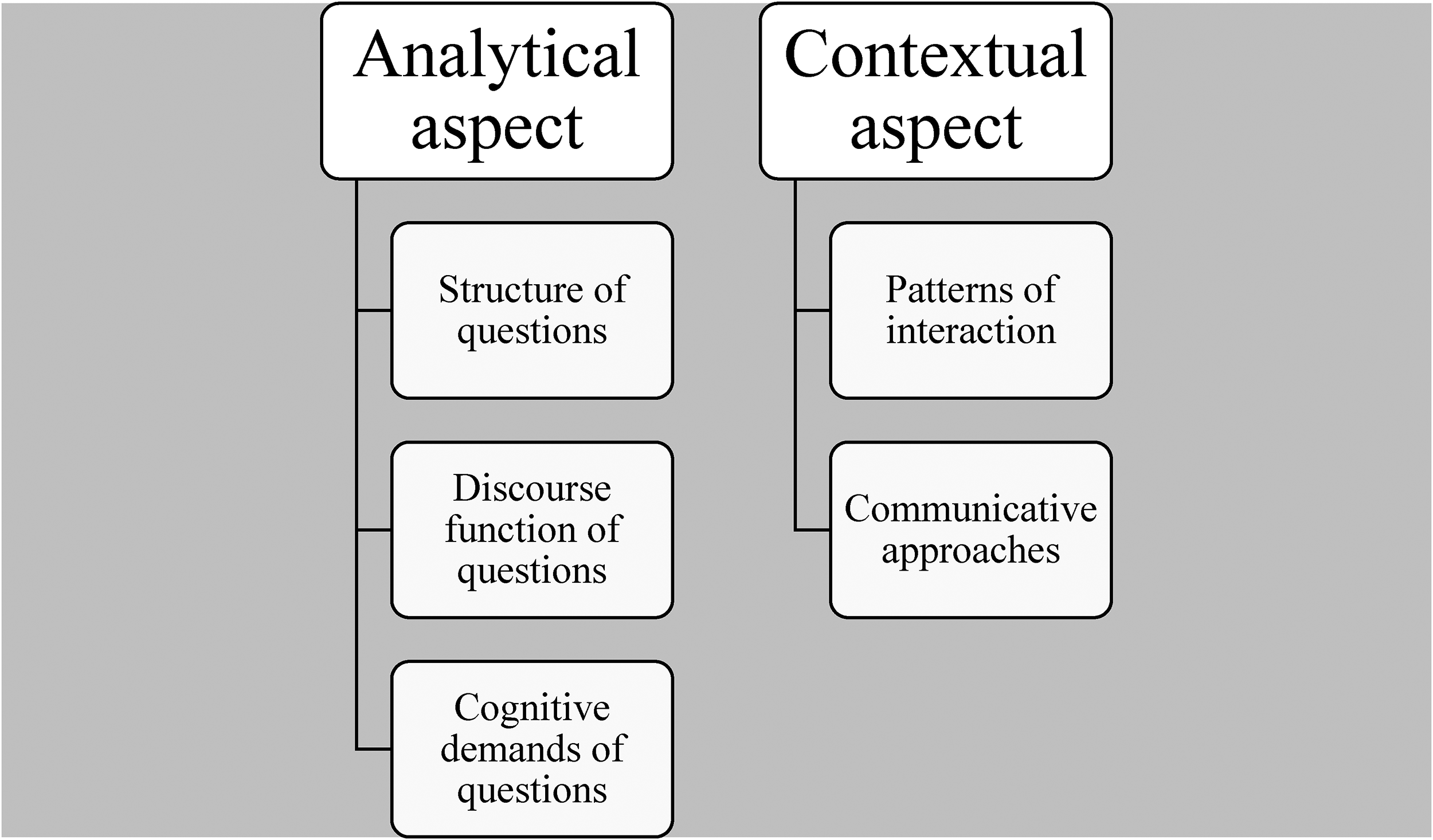
Two higher-order aspects and sub-components of data analysis.
Analytical aspects
Analysis of the structure of the questions
In this analysis step, Jake's questions were coded as close-ended or open-ended. At this analysis level, the examination unit consists of questions primarily presented in the form of sentences and phrases. The context in which Jake asked a question was closely considered to determine the question's structure. In addition, the length of the student's responses to Jake's questions was another criterion to define a question as close-ended or open-ended. Three researchers coded the structure of the questions. The kappa statistic as an indicator of percent agreement was calculated based on the following formula (McHugh, 2012): [(nagreed codes)/(nagreed codes + ndisagreed codes) × 100]. For this analysis step, kappa values were checked two times (first = 0.81; second = 0.89).
Analysis of the typology of the questions
In this analysis step, the discursive functions of Jake's questions were coded. The coding procedure was both theory-laden and data-driven. Theory-ladenness implies that in the current study, previous studies (e.g., Kayima & Jakobsen, 2020; Soysal & Soysal, 2022) dealing with science teachers’ questions discourse functions were closely considered and synthesized to establish an initial coding catalog. For example, in a recent study, Soysal and Soysal (2022) proposed eleven discursive functions of elementary and middle school science teachers’ questions: clarifying, probing, embodying, evidencing, observing, comparing, predicting, engaging, focusing, joint thinking, and challenging. These discursive functions were considered an initial instrument to assign analytical codes for each of Jake's questions. If Jake tended to enact an alternative question-asking function that might not be previously described by the related literature, novel codes were assigned.
Two classroom discourse analysts analyzed the discursive functions of Jake's questions. Some discordant code assignments were observed for particular functions. For example, it was initially compelling to distinguish probing questions from clarifying ones. In addition, engaging or focusing questions caused some inconsistency during the coding. Moreover, there were some inconsistencies in distinguishing the challenging questions from others. By engaging in ongoing discussions and seeking external audits, the coders successfully resolved any discrepancies in coding. The coders attempted to persuade one another to enhance the reliability of the function type analysis for the questions. Inter-coder reliability was checked three times due to lower consistency (kappa values: first = 0.69; second = 0.68; third: 0.79).
Analysis of the cognitive demand of the questions
During this step, the researchers identified the cognitive demand potentially embedded in Jake's questions. For cognitive demand analysis, the revised Bloom taxonomy (RBT; Anderson & Krathwohl, 2001), which has been widely used in previous research (Kayima & Jakobsen, 2020; Soysal, 2020a, 2020b; Soysal & Soysal, 2022) to analyze the cognitive demand of science teachers’ questions, was applied. Six hierarchical levels in the RBT were considered to systematically estimate the presumable cognitive demand of Jake's questions:
Remembering: Recalling information from memory
Understanding: Constructing meaning from instructional messages
Applying: Carrying out or using a procedure in a given situation
Analyzing: Breaking material into constituent parts and determining their relationships
Evaluating: Making judgments based on criteria and standards
Creating: Putting elements together to form a coherent or functional whole
Jake's questions were carefully examined within their specific context to determine the cognitive demand expected from the students during various classroom discussions. At this analysis level, the examination unit consists of questions primarily delivered in the form of sentences and phrases. Two experts used the RBT to identify the cognitive demand of Jake's questions. The coders encountered fewer instances of internal inconsistency when assigning codes to questions that conveyed potentially lower cognitive demand, such as remembering or understanding. However, a notable discrepancy arose between the coders when labeling Jake's questions that required higher cognitive demand, such as analyzing, evaluating, and creating labels. The questions posed to analyze and evaluate levels were particularly compelling for the researchers. Internal consistency was checked three times (kappa values: first = 0.51; second = 0.78; third: 0.84).
Contextual aspects
Analysis of the interactional pattern
This step identified Jake's discursive preferences in initiating and maintaining triadic dialogues. At this analysis level, the examination unit comprises turns at talk or individual lines of conversation, which are considered separate units of analysis. As clarified, a triadic dialogue consists of three verbal endings: follow-up evaluation, follow-up explanation, and follow-up feedback or a follow-up question. Jake's preferences regarding the interactional pattern were coded by considering IRE (initiate-response-evaluate), IREx (initiate-response-follow-up explanations by presenting logical expositions to students), and IRF (follow-up feedback or follow-up question) triadics. Three researchers identified Jake's verbal ending preference with higher internal consistency (kappa values: first = 0.96; second = 0.96).
Analysis of the verbal sequence
At this level of analysis, the unit of examination comprises turns at talk, with each conversation line considered a separate unit of analysis. This step determined the sequence of verbal exchanges: teacher–student or student–student. First, the frequency of the “T–S” sequences was observed within the lesson flow. A “T–S” sequence represents a teacher–student exchange. A “T–S–T” sequence represents a teacher–student–teacher exchange. In contrast, a “T–S–S” sequence signifies a teacher–student–student exchange in which two or more students respond to the teacher's initial statement or interact with each other. Analyzing and quantifying these sequences from the entire transcript helped determine the extent to which the classroom conversation was between Jake and the students or among the students under Jake's instructional guidance. Two researchers coded the sequences (kappa values: first = 0.99; second = 1.00).
Analysis of the communicative approaches
Mortimer and Scott (2003) proposed four classes of communicative approaches, which can be observed in science classroom discourse. The communicative approaches are classified in terms of multivocality and interaction, as reflected below:
Non-interactive monologic: No sequence of verbal interactions takes place between the teacher and students. Instead, the teacher highlights a single form of explanation.
Interactive monologic: There are verbal interactions between the teacher and students, but the teacher emphasizes a single form of explanation.
Non-interactive dialogic: No verbal interaction sequence occurs between the teacher and students. Instead, the teacher highlights more than one explanation of the topic and presents it for the students’ evaluation.
Interactive dialogic: There is a series of verbal interactions between the teacher and students. Finally, the teacher highlights more than one explanation of the topic and presents it for the students’ evaluation.
Before the communicative approach analysis, which requires a holistic perspective within a verbatim transcription, the unit of analysis was determined as sub-topical episodes. Within the context of a larger lesson transcription, an episode referred to a specific section in which Jake and the students focused on a particular aspect of the lesson's overall idea or core concepts. Within the verbatim transcription, 617 analyzable turns at talk were determined. Next, the nuclear and bound initiations were determined, and the entire transcription was branched to compose sub-topical episodes (n = 24), which were homogenous. Finally, two experts coded all sub-topical episodes to identify their orientations regarding one of the communicative approaches. The coders noted that in specific sub-topical episodes, there could be multiple orientations toward communicative approaches (such as considering alternative explanations and attempting to favor one of them). To address this issue, a resolution was reached by selecting the dominant orientation over others. For this analysis stage, the intercoder reliability was acceptable (kappa values: first = 0.78; second = 0.83).
Findings
In the systematically observed lesson, within 617 turns at talk, Jake produced 401 (64.99%) utterances compared to the students’ 216 utterances (35.01%). Moreover, within 401 utterances, Jake asked 292 questions (Table 1). An example analysis of different aspects of science classroom discourse is displayed in Table 2.
Descriptive distances between Jake's estimations and systematic observations regarding different aspects of science classroom discourse observed in Jake's lesson.
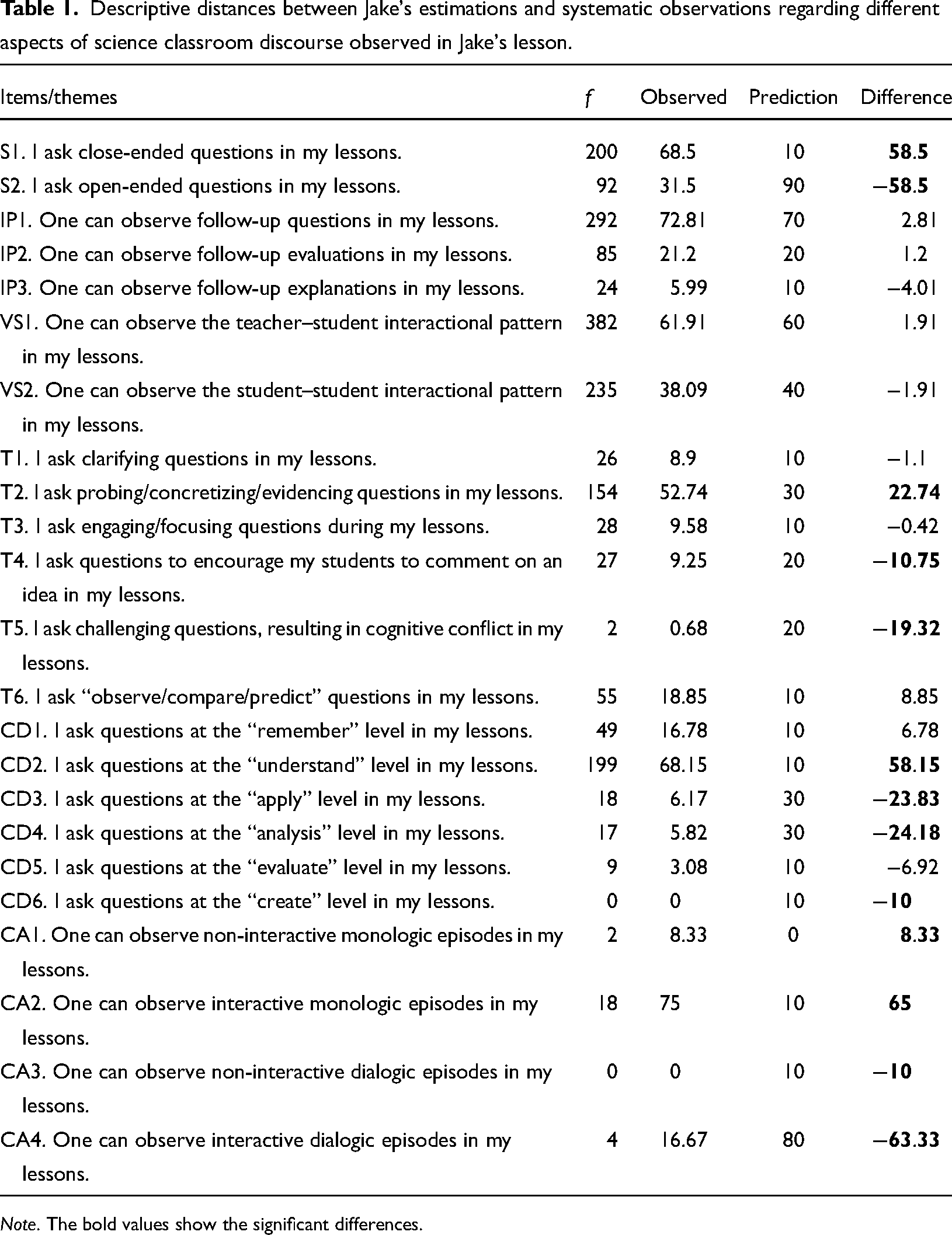
Note. The bold values show the significant differences.
An example dialogue between Jake and his students on the resistance and friction force.
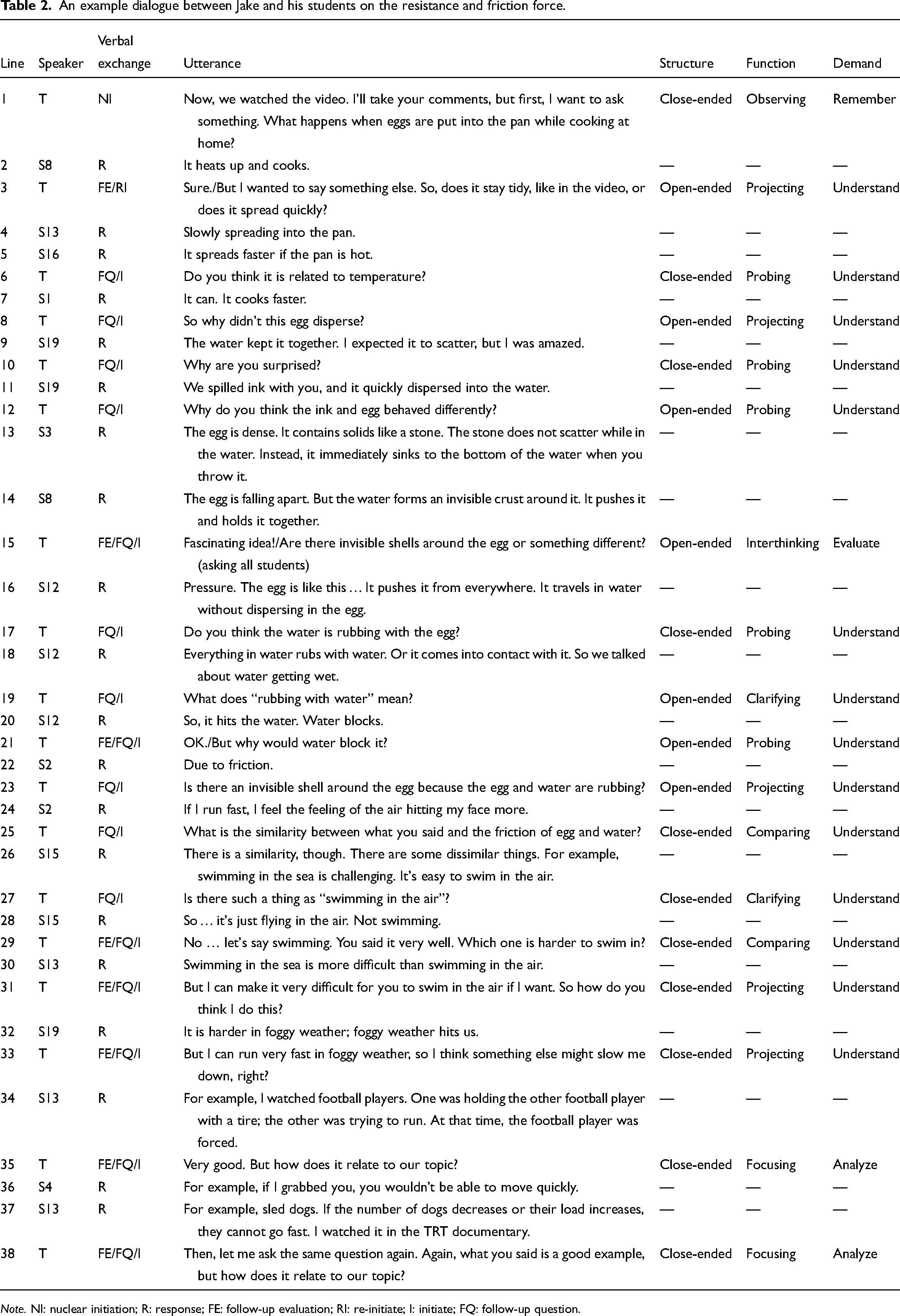
Note. NI: nuclear initiation; R: response; FE: follow-up evaluation; RI: re-initiate; I: initiate; FQ: follow-up question.
Comparisons of the structure of teacher questions
Jake predicted that he posed the open-ended question (e.g., Table 2, lines 3 and 15) at the 90% level compared to the close-ended ones (10% level; e.g., Table 2, lines 6 and 10). However, systematic observations (Table 1) showed that Jake had a dissonant perception regarding the structure of the questions he asked in the science lessons. For example, 200 (68.5%) out of 292 questions Jake asked were close-ended (Table 1).
Comparisons of the patterns of interaction
Among Jake's 401 utterances, in addition to 292 questions, he used follow-up evaluations and explanations (Table 1) by presenting logical expositions to the students (represented as “FE” in Table 2). Jake claimed that in his science lessons, follow-up or contingent questions (70%) (represented as “FQ” in Table 2) dominated the follow-up explanations (10%) and follow-up evaluations (20%). He estimated that he attempted to keep his neutral position when a student provided an invalid, wrong, or incomplete response and asked an additional question to elaborate the conversation. As observed and compared systematically (Table 1), he proposed a compatible estimation of the interactional patterns in his science lessons. There were fewer quantitative differences (Table 1) between his estimations and systematic observations.
Comparisons of the verbal sequences
Jake anticipated that teacher–student sequences (60%; e.g., Table 2, lines 6–11) were generally more common than student–student sequences (40%; e.g., Table 2, lines 12–14) in his lessons. In Jake's classroom, as systematically observed, there were both teacher–student (“T–S” = 191; 61.19%) and student–student (38.09%; “T–S–S” = 51; “T–S–S–S” = 14; “T–S–S–S–S” = 4; “T–S–S–S–S–S” = 1) verbal sequences. Thus, Jake understood the verbal sequence types observed in his science lessons (Table 1).
Comparisons of the question-asking typologies
Some question types had incongruities between Jake's estimations and systematic observations. First, regarding the clarifying questions (e.g., Table 2, line 19), there was nearly an exact match between the estimation (10%) and observation (8.9%; Table 1). However, although Jake asked more eliciting (e.g., Table 2, line 10), concretizing, and evidencing questions (52.74%), his estimations regarding the uses of these types of questions were lower (30%). Jake hypothesized that he posed fewer questions than systematic observations to encourage students to explore the underlying meanings of their statements or offer real-life, contextualized, and authentic examples to substantiate their unsupported claims. The difference between Jake's estimation (10%) and systematic observations (9.58%) regarding metatalk moves seemed to be insignificant (Table 1). This shows that Jake was conscious of his monitoring questions, such as engaging or focusing (e.g., Table 2, lines 35 and 38). Jake claimed that 20% of his questions encouraged interthinking (e.g., Table 2, line 15) and estimated that 20% were dedicated to encouraging the students to listen, consider, evaluate, and criticize their classmates’ ideas. However, there was moderate inconsistency between Jake's inference (20%) and systematic observations (9.25%) regarding interthinking questions. Moreover, a notable disparity emerged between Jake's estimation and the systematic observation regarding the frequency of challenge questions. Jake anticipated asking challenging questions at a rate of 20%, but the systematic observations revealed that he posed very few challenging questions (only 0.68%, as indicated in Table 1).
Comparisons of the presumable cognitive demand embedded in the teacher's questions
There was significant dissonance between the prediction and observation regarding presumable cognitive demand embedded in Jake's questions. Jake predicted that he asked his questions at specific cognitive demand levels such as apply (30%) and analysis (30%; Table 1). However, as systematic observations showed, Jake asked fewer questions aimed at the apply (6.17%) and analysis cognitive levels (5.82%; e.g., Table 2, lines 35 and 38). Moreover, Jake claimed that he asked fewer questions at the understand level (10%; most of the questions are exemplified in Table 2). However, it was observed that nearly 60% of the questions asked during Jake's science lessons remained at the understand level (58.15%; Table 1), showing a lack of conformity between the prediction and observation. Jake proposed that he generally asks create-level questions to a specific extent in his science lessons (10%). However, none of the questions Jake asked were at this level (Table 1). Furthermore, there were fewer differences between the prediction and observation regarding questions at the remember (e.g., Table 2, line 1) and evaluate (e.g., Table 2, line 15) levels.
Comparisons of the typologies of the communicative approaches
Table 1 shows four classes of communicative approaches observed in Jake's lesson. Significant differences existed between the prediction and observation regarding this aspect of science classroom discourse. First, Jake claimed that non-interactive monologic episodes are not observed in his lessons. Nevertheless, the systematic observations validated that approximately one out of every 10 sub-topical episodes consisted of monological lecturing or one-way knowledge transfer with no verbal exchanges (8.33%, as indicated in Table 1). Second, Jake assumed that in his science lessons, there were fewer interactive monologic episodes (10%; e.g., the example sub-conversation presented in Table 2). However, systematic observations revealed that in Jake's science lessons, most sub-topical episodes (three out of four) incorporated some variation of this communicative approach typology. Jake presumed that non-interactive dialogic episodes would take place in his science lessons at a 10% frequency. However, the observed sub-topical episodes showed that none fell into this category (as indicated in Table 1). Of greater significance, Jake's prediction that his science lessons primarily consisted of interactive dialogic episodes (80%) was inconsistent with the observations. The analysis revealed that only 16.67% of the observed sub-topical episodes were dedicated to this particular form of the communicative approach.
Summary and discussion
As seen in Figure 2, the quantitative distances between Jake's estimations and systematic observations on the six aspects of science classroom discourse are variable. While there is no discernible regular pattern in the observed distances, there are noticeable variations in the different aspects of science classroom discourse implemented in Jake's classroom. These variations exhibit both ascending and descending differences. Some presumable aspects of the differences are considered in light of state-of-the-art arguments on human cognition and (science) teacher professional development.
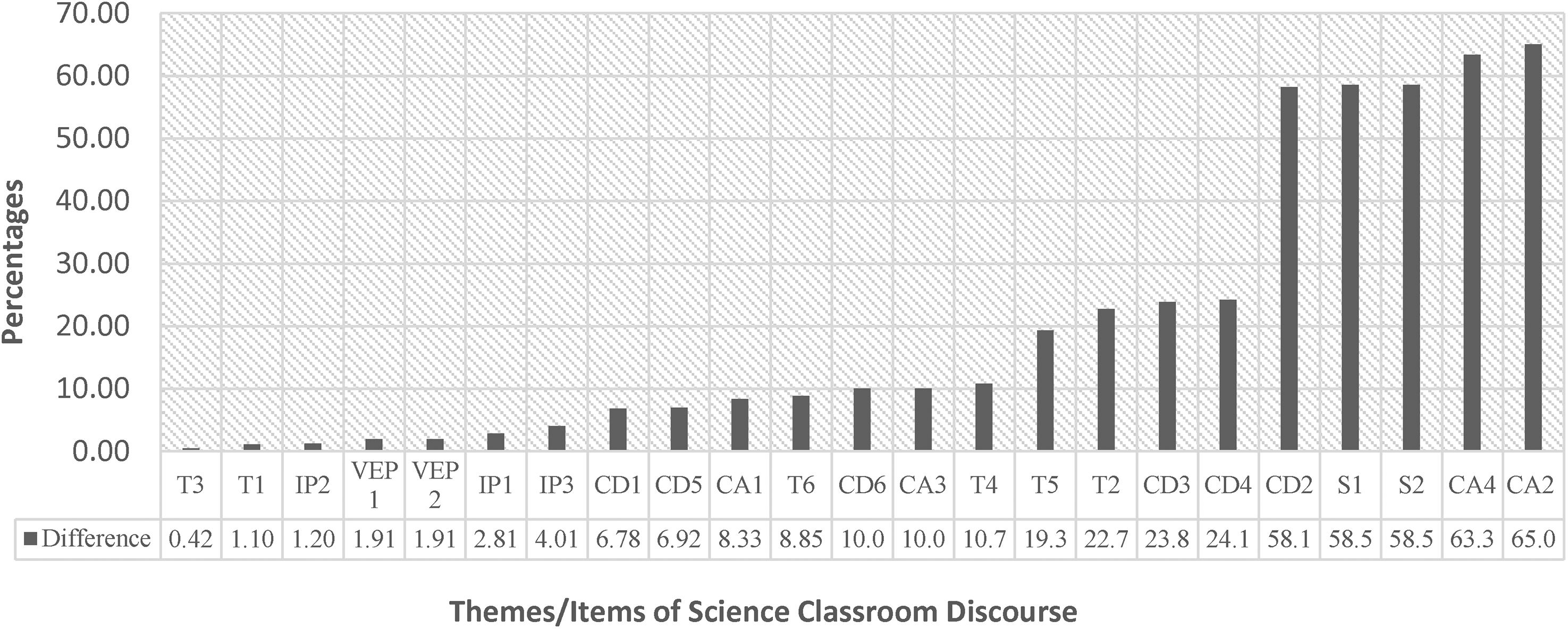
Comparative differences between the different themes of science classroom discourse regarding intuitive and deliberative reasoning.
Authentic reflection versus pseudo-reflection
Initially, interaction took place between Jake and the researcher group, focusing on the observation and comprehension of the events unfolding in the science classroom discourse. Jake then actively participated in reflective action by following a specific protocol outlined in the Appendix and the procedures detailed in the Methods section. However, in the context of the current study, deliberate reasoning required reflective inquiry processes (Roth et al., 2011), which differed from Jake's inferential thinking. The findings of the current study suggest that there could be a noticeable gap between reflection and inquiry (as discussed by Eshchar-Netz & Vedder-Weiss [2021]) in regard to an understanding of the different aspects of science classroom discourse, including what-aspects and how-aspects. Science teachers should be accepted as reflective practitioners in making decisions regarding their instructional strategies to foster students’ intellectual gains from an in-class science conversation (Chan et al., 2021). Nevertheless, the outcomes of this study serve as a reminder to re-evaluate the notion of reflective science teachers, as there were discernible differences between reflection and inquiry as well as disparities between Jake's estimations and the systematic observations (see Figure 2).
Dewey (1933) speculated that reflection could be regarded as a superior approach for reasoning regarding natural and social phenomena. However, this raises doubts in relation to the effectiveness of reflection in the absence of inquiry and suggests that reflection alone may not be sufficient or productive. Inquiry, encompassing activities such as data gathering, analysis, interpretation, and (self-)reporting, involves a context-based and deliberative examination of practice. It emphasizes the importance of rigorous reasoning, as highlighted by scholars such as DuFour and Eaker (2009) and Schön (1983). If Jake were to assume the role of a classroom discourse analyst, engaging in deliberate reasoning, it is conceivable that he could involve himself in reflective inquiry processes. This would entail critically analyzing his practices and actively avoiding inaccurate estimations regarding various aspects of the science classroom discourse he oversees. In this manner, it is highly recommended that reflective science teachers combine their reflection skills (mostly intuitive) with systematic inquiry capabilities (Lefstein et al., 2020) to develop their adaptive expertise. To achieve this combination, science teachers can be explicitly encouraged to analyze their talk strategies for the various aspects of classroom discourse, as demonstrated in the present study.
Instructional decision-making and experienced-based reservations
Psychological research on human cognition has shown that there may be a linkage between expertise and better decision-making in relation to practice (Harteis et al., 2012), such as governing science classroom discourse. This implies that better reasoners should be experts or have more profound experiential knowledge regarding practice. Jake, the participant in this study, possessed a remarkable 17-year tenure as a science teacher and had accumulated extensive expertise in overseeing classroom discussions during his countless teaching hours. However, it was found that there were substantial differences between some of Jake's estimations and the deductions obtained from classroom discourse analysis (Figure 2). The ability to make informed predictions about intricate classroom data necessitates purposeful cognitive processing, as intuitive and deliberate human thinking stems from distinct sources. The sources of Jake's intuitions were his individualized mental schemes based on his in-class experiences. It is reasonable to assume that Jake's understanding of the six dimensions of science classroom discourse data was contingent upon specific conditions emerging within the context and was thus potentially influenced by random factors. In the present study, Jake might engage in intuitive thinking by spontaneous pattern recognition (Harteis et al., 2008), represented in Table 1 (see the prediction column). However, as seen in Figure 2, there is no compatible pattern between Jake's estimation and the systematic observations.
Throughout his career, Jake amassed abundant declarative and procedural data, which was crucial in informing his instructional decision-making processes (Epstein, 2010). Nevertheless, this study has substantiated the concern that Jake's collection and analysis of sensory classroom discourse data during his daily in-class practices were conducted randomly. Jake heavily relied on probabilistic thinking and intuitive educational principles to evaluate the effectiveness of instructional strategies, which served as the primary foundation for his classroom approach. The current study implies that Jake had no opportunity to conduct a rigorous test and control the instrumentality of his pedagogic inferences due to the lack of deliberative reasoning in relation to the data at hand.
Underestimation and overestimation
The present study shows that for some aspects of science classroom discourse, Jake made instructional decisions that were underestimated (e.g., Figure 2, features: S1, T2, and CA1 or CA2) and overestimated (e.g., Figure 2, features: S2, T5, CD3 or CD4, and CA4). This suggests that Jake relied heavily on spontaneous pattern recognition as the central mechanism of intuitive knowledge in his pedagogic decision-making process. It served as his primary tool for comprehending and making sense of the questions posed in the protocol (Appendix). Two sub-components of intuitive reasoning can explain this: affect (Epstein, 2010) and bias (Hubbard et al., 2014). The present study showed that Jake had to use an affect heuristic to make sense of question incidents (Appendix) displayed in his classroom. Jake's affective heuristic can be defined as a feeling with no logical rationale (Epstein, 2010) or a logical rationale based only on experiential/personal data accumulated through years of in-class science teaching. Based on the findings, it is evident that Jake tended to overestimate the significance of certain talk-based occurrences in his lessons. These included asking open-ended, interthinking, challenging questions requiring cognitive engagement at the apply or analyze level. However, he often overlooked the importance of questions that remained at the understand cognitive-demand level or facilitated interactive dialogic sub-topical episodes, which are crucial for fostering sustained and interactive discussions. Table 1 compares the systematic classroom discourse analysis and Jake's self-reporting estimations regarding six aspects of science classroom talk. As exemplified above, for most aspects of the classroom discourse examined herein, Jake had favorable estimations for himself. However, Epstein (2010) indicated that the affective component of intuitive reasoning harnesses the power of the hedonic principle, as Jake's decisions had to feel good for him. Thus, Jake might overestimate some aspects of classroom discourse enacted in his lesson. Engaging Jake in systematic observations along with rigorous and reliable data analysis, as methodologically exemplified in this study, is crucial in mitigating these overestimated pedagogical projections.
Jake's overestimated and underestimated inferences regarding science classroom talk could be due to bias in his intuitive reasoning. It is well known that intuitive decisions are biased (Hubbard et al., 2014). It is possible that, during the data collection process of the present study, Jake retained nested beliefs regarding his talk strategies implemented in his science lessons. This preservation of nested beliefs could potentially introduce bias into his intuitive reasoning. Once Jake preserved his nested beliefs, he may have acted selectively in focusing on aspects of his classroom video. To explain this phenomenon, Vanlommel et al. (2017) suggested that teachers may rely on intuition more than alternative explanation systems extracted from data. Therefore, it can be inferred that Jake may have analyzed specific sub-parts of the video-based data while overlooking the holistic view of the data. This tendency could have arisen from his inclination to seek evidence that aligns with his preconceived notions of what is rational. However, this approach could potentially hinder Jake's ability to engage in hypothetical thinking about science classroom discourse data. It is important to note that intuitive thinking does not always align with truth conditions, which may have led Jake to make errors in his decision-making (Earl & Louis, 2013).
Teacher development and change for deliberative instructional reasoning
In the informal conversations, Jake stated that systemizing his estimations related to science classroom talk was enjoyable and informative. It should be noted that it was Jake's first engagement in this reflective process. This might also cause the fundamental distance exemplified in Table 1 and Figure 2. Loughran (2019) stressed that teachers are not encouraged to consider and discuss their teaching in a theory-laden manner. This suggests that teachers have limited opportunities to thoroughly examine and elucidate the intricacies of their in-class teaching methods, showcasing their knowledge, processes, and underlying rationales. The present study aimed to address this gap by employing a specific methodology to investigate and interrogate these aspects. Loughran (2019) argued that teachers are primarily occupied with the act of teaching itself, often neglecting the importance of systematically exploring and articulating their pedagogical reasoning regarding what they do and why they do it in particular ways. Loughran (2019) further emphasized that teacher knowledge, including knowledge of instructional practice, can only be cultivated through inquiry-based approaches such as teacher research. In this process, teachers are empowered to engage actively with professional educational experts/scientists, promoting close interaction and collaborative knowledge construction (DuFour & DuFour, 2010). Once the interaction between the teacher and the teacher educator is maintained in a fossilized and routinized manner, the teacher may transform themselves into a deliberate data analyst to unpack tacit classroom events.
In this manner, Loughran (2019) emphasized that teacher-led deliberative thinking cannot be considered an autonomous process as “teachers do not necessarily think of their teaching and the underlying influences on what they know and are able to do” (p. 526). As a result, science teachers construct their knowledge through the lens of their practice as the primary source of their intuitive reasoning. Therefore, there were significant differences summarized in Table 1 and Figure 2 because deliberate consideration of classroom talk incidents was not a routine practice for Jake. Instead, his fossilized practice was to carry out the teaching. To alter this fossilized routine, a new busyness of teaching had to be introduced to him to reduce the extracted differences regarding the six aspects of science classroom discourse exemplified herein. As a crucial point, it is essential to note that this study does not aim to undermine the value of Jake's valuable projections regarding his talk-based actions. However, it should also be acknowledged that in the demanding nature of daily in-class teaching, Jake might not have had the opportunity to develop well-refined and expertly nuanced utilization of deliberate reasoning, which could serve as a language (Appendix) for effective sharing (Mansfield, 2019). Teacher stories and experiential narratives are valuable reflection-on-action practices that can significantly enhance in-class teaching. However, it is essential to acknowledge that these practices are often rooted in a sense of personal knowing rather than being based on a systematic, deliberative, codified, and articulable knowledge base.
Conclusions
The current study offers a unique perspective by distinguishing between “sensory perception” (intuitive thinking) and “meaning making” (deliberative reasoning) in regard to noticing, analyzing, and evaluating classroom discourse events. It is important to note that this distinction does not imply a complete separation of sensory perception and meaning making, as previously discussed. Instead, this study argues for a gradual transition from sensory perception to meaning making, emphasizing their complementary roles in understanding classroom discourse events. This study provides evidence that an experienced science teacher's sensory perception when observing and assessing classroom discourse events can be valuable and informative. However, as classroom discourse often becomes more complex, involving numerous intricate parameters (refer to Figure 1), relying solely on sensory perception can offer limited insight. The study confirms that science classroom discourse is considerably complex and less predictable when viewed solely from an intuitive thinking perspective.
The study demonstrates that the inherent limitations of sensory perception in comprehending and interpreting classroom discourse events can be overcome through meaning making. This involves explicit data collection, thorough analysis, interpretation, and self-reporting. Consequently, the study implies that both thinking styles—intuitive and deliberative—are actively engaged in analyzing various aspects of classroom discourse events. However, the conclusion is that engaging in meaning-making alongside intuitive thinking can elevate a science teacher's pedagogical-discursive vision to a higher level.
Considering the above proposition, this study offers two valuable thinking tools for enhancing science teachers’ pedagogical vision and their ability to notice complex parameters within classroom discourse, as thoroughly examined here. First, it proposes establishing a well-defined theoretical framework to determine which aspects of classroom discourse merit consideration and study in collaboration with science teachers. These aspects are rigorously justified, discussed in the theoretical framework section, and summarized in Figure 1. They can serve as essential tools for science education researchers, particularly those focused on science teachers’ noticing during instruction. Second, as demonstrated in the Appendix, this study provides another thinking tool to improve the accessibility of theoretically justified classroom discourse parameters for research, rendering them visible and understandable. Science teachers and science education researchers can implement these two tools through collaborative dialogue and discussion on classroom discourse parameters.
With the aid of these thinking tools, the current study encourages a rational approach to exploring classroom discourse events more deeply, bridging various pedagogical perspectives, including those of science teachers and science education researchers. In conclusion, the study emphasizes the importance of initiating discussions on how science teachers can be trained as analysts of science classroom discourse (Ryan et al., 2017), thereby transforming their educational vision from primarily intuitive to a blend of deliberative, systematic, and intuitive thinking. Eshchar-Netz and Vedder-Weiss (2021) provided an example of how both veteran (experts) and novice (beginners) science teachers can interact within collaborative communities of practice to enhance inquiry skills. However, it is crucial to note that such studies are still in their early stages and should be further expanded using the tools developed and tested in the present study.
Limitations and future research
The current study has several limitations. First, only Jake's estimations regarding different aspects of science classroom discourse were considered and analyzed. Quantitative and qualitative nuances exist among different science teachers’ projections regarding classroom talk features observed in their lessons. Thus, future multi-case studies should be structured based on the methodological pathways presented herein. Furthermore, in future multiple-case studies, it will be possible to achieve expert–novice comparisons. This would enable rigorous testing to determine whether there is a strong correlation between having expertise, intuitive thinking, and deliberative reasoning when interpreting incidents in science classroom discourse.
Furthermore, the six aspects of classroom discourse discussed in this context may vary depending on the content or specific topic being addressed. Various patterns could emerge when different science topics are taught and used for the comparisons presented here. Similarly, if Jake were invited to evaluate multiple lessons, each focusing on different science topics, it would provide a more reliable and clearer indication of whether the observed differences result from Jake's overall estimations or the systematic analysis of the specific lessons he chose.
Furthermore, the classroom discourse data analysis involved two parties: Jake and the researcher group. In an alternative research design, the researcher could focus solely on Jake's reflections regarding the classroom discourse data. This design would necessitate a pre-post experimental or intervention-based process. To elaborate, initially, Jake's reflections on his classroom discourse actions would be examined to understand his predominantly intuitive comprehension and reasoning behind them. Subsequently, Jake would be made aware of his intuitive reasoning and encouraged to transition from an intuitive approach to a more formalized or intentional one through a carefully designed professional development program based on dialogue. However, implementing this program requires prior studies establishing essential methodological thinking tools explored and exemplified in the current study. These points are elaborated upon in the following paragraphs.
The central hypothesis of the present study posits that when engaged in specific adult learning environments that allow them to analyze science classroom discourse systematically and deliberately on a minute-by-minute basis, science teachers become more effective reflective practitioners and knowledge producers rather than mere consumers of knowledge. In this prototype-descriptive study, there are indications that there may be more significant distinctions between intuitive and deliberative reasoning in terms of making sense of science classroom discourse. It is vital to conduct experimental studies to explore the relationship between intuitive and deliberative thinking in relation to re-evaluating science teachers’ pedagogy on classroom discourse. These studies would aim to test whether a specifically designed and meticulously implemented intervention could prompt science teachers to assume the role of classroom discourse analysts. The goal would be for them to generate professional knowledge by systematically collecting, analyzing, and interpreting classroom data. This rigorous causal analysis would provide valuable insight into the effectiveness of such interventions and their potential impact on teachers’ pedagogical practices.
It is crucial to note that despite the positive and productive civic-social relationship between the researcher group and Jake, there remains a concern regarding the potential presence of an asymmetrical power dynamic that could have unfavorably influenced Jake's reasoning and the researchers’ interpretations. Thus, in future studies, symmetrical power relations should ensure more valid and reliable data from teachers, who should be considered and accepted as co-researchers.
Footnotes
Declaration of conflicting interests
The author declared no potential conflicts of interest with respect to the research, authorship, and/or publication of this article.
Ethical statement
The present study and informed consent were approved by the Ethics Committee of the University (IRB no: 2022/13). The informed consent was obtained from all the participants. The study participants did not give written consent for their data to be shared publicly, so supporting data is unavailable due to the sensitive nature of the research.
Funding
The author received no financial support for the research, authorship, and/or publication of this article.

Appendix. The structured interview protocol.