



Abstract
Purpose
This paper adds to the understandings of how face-to-face meetings contribute to the network governance and global mobility of United Nations (UN) policy programs on environmental and sustainability education (ESE).
Design/Approach/Methods
Data from interviews with 13 international ESE policy leaders were transcribed, coded, and analyzed for key themes related to the research purpose.
Findings
The findings indicate that meetings provide an arena for collaboration and influence on UN ESE policy programs, as well as facilitating the impact of the policy programs on UN member country policy. In addition, attending meetings enables the production of network relations that bind ESE policy communities together across distant locations. They are also a venue for the networking labor involved in forging new relationships and facilitating the social learning that supports global policy mobility.
Originality/Value
This pilot study enriches understanding of face-to-face meetings as a key vector of policy mobility and a significant factor in the overall network governance of UN organizations and their policy programs. We hope the study contributes to the fields of critical policy studies and ESE, as well as to informing policy actors on how important their participation in meetings can be for the network governance and mobility of UN policy programs.
Keywords
Introduction
In this paper, we explore the role of face-to-face meetings in the global network governance and mobility of United Nations (UN) policy programs with a focus on environmental and sustainability education (ESE). The emergence, evolution, and circulation of global ESE policy programs have occurred through a range of interconnected trajectories over the past 50 years. This development across time and space has largely been driven by a few UN international organizations (IOs), such as the United Nations Environment Program (UNEP); the United Nations Educational, Scientific, and Cultural Organization (UNESCO); and the United Nations Framework Convention on Climate Change (UNFCCC) Secretariat. The shaping and mobility of UN IO ESE policy programs involves member country governments, as well as a growing array of non-state actors. However, the specifics of how these diverse policy actors interact with each other to influence UN IO ESE policy programs, how that dynamic shifts over time, and the effects on the programs’ global mobility, have received little research attention. This paper addresses these questions by specifically exploring the role of face-to-face meetings in policy actor influence on UN ESE policy programs and their mobility, including in relation to the network governance of the respective UN IOs.
A broader education policy literature on network governance and the global mobility of policy has increasingly examined the roles of non-state actors in influencing policy reform, such as edu-businesses, philanthropies, think tanks, nonprofits, and social movements. Researchers have mapped the relationships and policy impacts of such actors using qualitative (or mixed) methods of network ethnography. These include, for example, examinations of the Indian Educational Reform Movement (Ball, 2016), low-cost private schooling in Kenya (Junemann et al., 2016), the Brazilian educational reform movement (Avelar et al., 2018), character education in the UK (Allen & Bull, 2018), Teach for Bangladesh (Adhikary & Lingard, 2018), education reform in the United States (Hogan, 2015) and in Portugal (Viseu & Carvalho, 2018), and health and physical education in Australia (Sperka & Enright, 2019). Some experts have questioned the overemphasis on description versus analysis in network governance studies and have called for greater attention to the processual specifics—the whos, whats, and wheres—of how networks contribute to policy processes (Hogan, 2016; Junemann et al., 2016).
One factor identified as deserving of further research is the role of face-to-face meetings in network processes (e.g., Avelar et al., 2018; Ball, 2016; Junemann et al., 2016; McCann, 2011). Several types of face-to-face events have been suggested to have an animating effect on policy networks, thus providing policies with the “energy to circulate” (Wood, 2016, p. 400), that is, to create favorable conditions for their increased global mobility. Meetings are thought to provide space and time for “policy intermediation and networking as the ‘connective tissue’ of the policymaking process” (Peck & Theodore, 2010, p. 171). However, aside from a few notable contributions mainly outside of education (Cook & Ward, 2012; Temenos, 2016; Ward, 2006; and in education, Avelar et al., 2018), the impact of meetings in policy networks, including UN IO networks, has not been the subject of much empirical research.
This paper seeks to add to the understandings of the functions of face-to-face meetings in the network governance and mobility of UN IO ESE policy programs, thus contributing to filling the current gap in the education policy research literature. By analyzing data from pilot study interviews, we discuss how meetings are key components of the network governance of UN IO ESE policy programs. Our findings suggest how meetings can provide an arena for collaboration and influence the policy programs, including their impacts on UN member countries’ policy. Moreover, attending meetings enables the production and reproduction of network relations that bind ESE policy communities together across distant locations. Much of the networking labor involved in forging new relationships and facilitating the social learning that makes policies mobile internationally also takes place at international meetings. These findings enrich our understanding of face-to-face meetings as a key vector of policy mobility and a significant factor in the overall network governance of UN IOs and their policy programs. We hope this not only contributes to ESE and related research fields but also helps policy actors appreciate how important their participation in face-to-face meetings can be to the governance and mobility of UN IO policy programs.
Background: Network governance, policy mobility, and the role of meetings
The paper is informed by policy network theory, including in relation to shifting modes of global governance and the policy activities of UN IOs. UN IOs generally have mandates allocated by national governments and are designed to put issues on the global agenda, gather and disseminate knowledge, and develop implementation and monitoring mechanisms (Barnett & Finnemore, 1999; Reinicke et al., 2000). In doing so, they not only create opportunities but also “exercise influence and impose constraints” on member states’ policies (Karns et al., 2015, p. 27). Much of the legitimacy of UN IOs is based on expectations of country consensus decision-making and shared global governance (Haunss, 2007; Speth & Haas, 2007). Such processes are intended to rely not on coercion but on deliberation, persuasion, and institutionalization as norms emerge, gain legitimacy, and become internationalized through global agreements (Finnemore & Sikkink, 1998). Where previously UN IOs were considered as international extensions of country-level decision-making, shifts over the past several decades have led to greater autonomy for IOs, allowing them, in some cases, to act as “centres of power and persuasion” in global policymaking processes (Barnett & Finnemore, 2004; Peck & Theodore, 2015, p. xxxi).
Non-state actors are also integral to the work of these intergovernmental bodies (Karns et al., 2015; Mundy et al., 2016). In their roles converting mandates into specific procedures and programs for member states, UN IO secretariats and staff select particular policy actors for assistance, with those actors, in turn, having an influence on the UN IO initiatives. These non-state policy actors can include nongovernmental organizations, businesses, philanthropic organizations, and academic advisors who provide funding, serve on decision-making committees, attend key meetings, host events, write reports, promote initiatives via social media, or undertake other functions in creating and mobilizing policy programs (Abbott et al., 2016; Ayre & Callway, 2013; Jörgens et al., 2016; Kolleck et al., 2017; Reinicke et al., 2000). They participate in networks that unite “the voluntary energy and legitimacy of the civil-society sector with the financial muscle and interest of businesses and the enforcement and rule-making power and coordination and capacity-building skills of states and international organizations” (Reinicke et al., 2000, p. 29). To understand UN IO policy program governance, it is therefore important to look at the broader networks of the IOs.
UN IO networks can thus be understood to operate through forms of “network governance,” including in relation to the development and evolution of their global policy programs (Rhodes, 2006). In contrast to the workings of government “carried out through the hierarchies or specifically within administrations and by bureaucratic methods,” network governance operates through the “‘informal authority’ of diverse and flexible networks” (Ball & Junemann, 2012, p. 3). The widely observed shift from government to governance over the past several decades has involved a movement from state-centric systems of governing toward a “heterarchical form that relies on networks of actors (institutions and individual agents) actively engaged in processes of policy-making” (Avelar et al., 2018, p. 56). In relation to global UN IO policy, there is a coexistence of elements of network governance and more traditional forms of global governance tied to the hierarchical and bureaucratic governing structures of UN IOs (Menashy & Manion, 2016). In other words, the state remains an active agent of UN IO policymaking. However, whereas previously non-state actors relied on the intermediary role of the state to access global policymaking, now “non-state actors have more spaces and opportunities to influence IOs without the necessary mediation of the state” (Verger et al., 2018, p. 16).
Facilitated by the UN IOs’ orchestration of global policy networks, non-state actors have an influence on both the development of global policy and its impact in national and regional settings (Abbott et al., 2016; Hickmann et al., 2021). Through digital interactions, travel, relationships, and so on, policy actors’ influences on global governance can be topological and instant. These impacts include the various mobile and influential policy actors and the sites, organizations, and meetings through which they interact in policy networks (Peck & Theodore, 2015). This encompasses sociomaterial aspects such as policy products (e.g., reports, proceedings, declarations, briefs), data and media, funding mechanisms, and events. Examining these relational dynamics can shed light on how policy programs are initiated and how they hold together or mutate over time and across contexts. Considering policy mobility also informs understanding of the roles of individual policy actors; their connections within and across networks and organizations; and the spaces, practices, and infrastructures through which they navigate these connections to influence the governance of education policy programs (e.g., Ball, 2016; McKenzie, Bieler et al., 2015; McKenzie, Lewis et al., 2021). These conditions of policy influence and mobility stand in contrast to prior circumstances of global policy development by countries through negotiation and consensus in intergovernmental processes at specific times and places. With these newer influences on global governance, IOs may seek to forge a “coherent logic and shared epistemic sensibility to a ‘bundle’ of policy ideas” (Ball, 2016, p. 553) across associated policy networks rather than building and disseminating policy models mainly with and to member states.
In this paper, we hone in on face-to-face meetings as key governance arenas and mobility vectors for UN IO ESE policy programs. Although network governance increasingly relies on remote and digital connectivity (e.g., in education Gulson & Sellar, 2019), these “connections also depend on the intermittent co-presence of those actors in specific places” (McCann, 2011, p. 112). The social relationships that bind spatially dispersed actors in policy networks are made, renewed, strengthened, or undone in face-to-face meetings. As McCann (2011) describes, face-to-face meetings, including those that take place in “meeting rooms, hallways, cafes, bars, and restaurants” associated with events are: where lessons are learned, where trust is developed, where reputations are made or unmade … (reputations of best cities, successful policies, and hot policy gurus), and where acquaintances, or “weak ties,” are made among co-present conferees, thus connecting what would otherwise be socially and spatially isolated policy communities. (p. 119)
Avelar et al. (2018) suggest how policy meetings “provide the platform and space” for policy actors to “enact network governance” (p. 70). Discussions and relationships built, presentations and “best practices” shared, and other means of networking at meetings can shape policy governance, internationally and regionally. Examining what happens in face-to-face meetings allows researchers to investigate “how global policy networks work and how individuals invest their labour to animate these networks” (Avelar et al., 2018, p. 56), thereby discerning the in-person labor and relationships involved in network governance and the global mobility of policies.
Notably, face-to-face interactions occur in both formal (presentations, panels, other elements of scheduled programs) and informal (cafes, hallways, restaurants, lobbies, etc.) settings. Both “are constituent elements in an atmosphere of comparison and learning where places and people can be brought into … ‘relational proximity’” (Cook & Ward, 2012, p. 142). The accompanying materials and digital infrastructures people share and interact through before, during, and after face-to-face meetings are also important. This includes comparison data, PowerPoint presentations highlighting particular policy approaches and successes, exhibit booths, flyers and business cards, tweets during sessions, online social networks, and virtual meetings, along with the bodily and affective sensibilities with which all these communications are imbued (McKenzie, 2017; Sellar, 2015). Through such infrastructures, face-to-face meetings provide “opportunities for policy-makers and practitioners to compare, evaluate, judge, learn, and to situate” their policy ideas and practices in ways that benefit from face-to-face interaction (Cook & Ward, 2012, p. 141) and feed into the network governance and mobility of global policy programs.
UN IO network governance and ESE policy program mobility
The role of face-to-face meetings in network governance and associated policy mobility has not yet been examined in studies on ESE. In general, there are relatively few studies on ESE policy, especially global-scale empirical research (see reviews, Aikens et al., 2016; Lysgaard et al., 2016; Rickinson & McKenzie, 2021). Existing research examining UN IO ESE policy tends to involve textual analysis and commentary, including critiques of particular programs (e.g., Huckle, 2009; Jickling & Wals, 2008; Lotz-Sisitka, 2009). The few empirical studies of the production and circulation of global ESE policy priorities mainly focus on the uptake of UN IO policy mandates in specific national or subnational contexts (e.g., Bengtsson & Östman, 2016; González-Gaudiano, 2007; Læssøe et al., 2013; McKenzie, 2012; Van Poeck et al., 2014). Some research examines the policy mobility of UN IO ESE programs (e.g., McKenzie, Bieler et al., 2015; McKenzie & Aikens, 2020), and other literature focuses on their governance in part through networks (e.g., Kolleck et al., 2017), but not specifically in relation to the impacts of face-to-face meetings in ESE policy processes.
This is a worthwhile topic for further investigation given the extent and influence of UN IO ESE policy programs, as they have developed, evolved, and had a substantial impact on education around the world over the past half-century. Since the early days of the environmental movement in the 1960s, ESE-related policy has become more common in the intergovernmental arena and has become increasingly mobile globally. Stemming from common origins with Environmental Education (EE) programs, which were dominant in the 1970s–1990s, the turn of the millennium saw a shift toward Education for Sustainable Development (ESD). The 2005–2014 UN Decade of Education for Sustainable Development (UNESCO, 2006) marked this change in mainstream global policy, leading subsequently to the Global Action Programme (GAP) on ESD (UNESCO, 2014), which has now transitioned into the ESD 2030 Framework (UNESCO, 2019). Other recent UN programs also indicate that education is considered a key leverage point in global efforts to foster sustainability, including in relation to all 17 of the UN Sustainable Development Goals (SDGs), and especially SDG Target 4.7 on ESD (UNESCO, 2017). National governments have also acknowledged the importance of education in addressing climate change in Article 6 of the original UNFCCC (UN, 1992) and in Article 12 of the more recent Paris Agreement (UN, 2015). The UNFCCC Secretariat has since launched Action for Climate Empowerment (ACE) as a re-branding of the education focus in both these prior UNFCCC member party agreements. This includes guidelines for countries to develop ACE national strategies (UNESCO/UNFCCC, 2016) and, more recently, guidelines for including ACE in country documents outlining their climate action targets or nationally determined contributions (McKenzie 2021; UNESCO/UNFCCC, 2020). These overlapping trajectories of UN IO ESE policy programs constitute the objects of study for this paper. We consider their growing governance and mobility through policy networks associated with the longstanding UN IO structures of intergovernmental decision-making and, in particular, the critical functions of face-to-face meetings in these processes.
Network ethnography pilot study
This study was conducted as pilot research for a larger network ethnography on the role of policy actors in UN IO climate change education policy programs (SSHRC, 2019–2023; see also McKenzie & Stahelin, 2022). It examines the policy mobility of ESE policy programs, including through global ESE networks associated with UN IOs. This includes attending to “the relationships, events, and exchanges that make up network activity and evolution” (Ball, 2016, p. 550), their impact on the relative global mobility of policies, and the role of meetings in these processes. Elsewhere, Ball and Junemann (2012) describe network ethnography as a “mapping of the form and content of policy relations in a particular field” (p. 13). As an anthropological version of social network analysis focusing on understanding the contexts, transactions, and meanings of networks, network ethnography often involves a combination of observation, documentary analysis, background internet searches, and in-depth interviews (Junemann et al., 2016). In this pilot study, we mainly relied on interviews, although we also attended a range of the key meetings discussed by the participants. We also performed background web searches to better understand the connections between actors, locations, meetings, and key policy documents referenced in the interviews.
Thirteen interviews of 60–90 min each were conducted with international ESE policy leaders, or “key network personnel” (Macdonald et al., 2020, p. 178), over six months in 2016–2017. The interviewees included two UN IO staff members in charge of organizational units overseeing ESE policy programs, six civil society leaders of NGOs with substantial national and global recognition in the field of ESE policy implementation, and five university-based academics. The interviews were undertaken at a Global Environmental Education Partnership (GEEP) meeting in Washington, DC, USA, and at a World Environmental Education Congress (WEEC) meeting in Vancouver, Canada; with two conducted by telephone. Participants’ countries of origin included New Zealand, India, Botswana, Ghana, the Netherlands, Denmark, England, Colombia, and the United States, although many had worked across countries or in international UN offices through their career trajectories.
The criteria for the selection of participants included our prior knowledge of their leadership roles in global ESE policy processes. In addition to aiming for geographic diversity, we sought individuals who had been intimately involved with ESE policy programs led by UN IOs in a variety of sectors and institutional settings. For example, we chose the UN IO staff members with the most experience and knowledge of UN IO ESE policy programs, regardless of seniority. From the civil society organizations, we interviewed the most senior members of the organizations who regularly attended international policy meetings and interacted directly with UN IO staff members or national governments in the governance of ESE policy programs. The five academics were chosen for their known impact as researchers and network actors in relation to global ESE policy programs—three are widely published senior scholars with a distinguished impact on the field of ESE, who have been formally engaged in collaborations with UN IO ESE programs, and two are distinguished ESE practitioners and leaders at the national and regional levels. The sample aims to both capture experience and expertise in this policy field while also representing the diversity of policy actors involved in the ESE policy network.
The pilot interview protocol tested various possible lines of inquiry, with a range of questions deductively developed based on the network governance and policy mobility literature. The questions covered the following areas: the trajectories of key international policy programs in ESE over the past decades and the factors that shaped and influenced these trajectories, such as particular policy actors, networks, and organizations; data infrastructures and social media; monitoring and evaluation program components; affect or “vibes or climates of emotion” associated with the policy programs; and successes, barriers, gaps, and hopes for the future. We asked about the role of personal and professional relationships in the constitution of policy networks; the roles of UN IO staff and secretariats in shaping policy programs and networks; the economic and local/national political calculus that informs actors’ engagement with ESE-related policy programs and networks; and discursive elements of policy processes, including perennially contested policy terminologies that inform actors’ actions and positions in policy networks.
We conducted a manual thematic analysis of the interview data and engaged in multiple rounds of readings and coding to ensure analytical rigor. An initial code list with agreed-upon descriptions or definitions was produced based on our existing knowledge of the field and on the conceptual framework and related literature. The first reading of interview transcripts employed both the initial code list and open-coding to allow for emergent concepts. Two subsequent rounds of reading/coding through transcripts were conducted to check for coding consistency across the data. In each round, the code list was revised and codes were grouped into thematic categories. As thematic categories emerged, we utilized Scrivener—a dual word processing/document management software—to collate and organize transcript segments by thematic categories. The role of meetings emerged as a key theme in the network governance and mobility of UN IO ESE policy programs and thus became the focus of the current paper.
Meetings and their impacts on the governance and mobility of UN IO policy programs
The interviewees focused on several key UN IOs—mainly UNESCO, UNEP, UNFCCC, and UN—when discussing ESE-related policy programs. In the case of UNESCO, the main unit involved in ESE policy program development and mobilization is the ESD Section. Mentioned to a lesser extent was UNEP and their EE work during the 1970–1990's, as well as more recently. The UNFCCC was also discussed for its growing focus on climate change education, training, and public awareness. The UN's SDGs, launched in 2015, were also frequently referred to as a relevant global policy agenda. The networks participating in the governance of these UN IOs were clearly overlapping yet also distinct in terms of some of the actors involved and their ways of operating. Many non-state actor types were discussed by interviewees, including policy “entrepreneurs” or “champions;” academics working as researchers, consultants, and practitioners (e.g., teacher trainers); networks of researchers (such as a biannual invitational international seminar on EE research); UNESCO Chairs housed in universities; and a range of NGOs and foundations at international, national, and subnational levels. The latter included the World Wildlife Fund (Global), the Centre for Environment Education in India, the North American Center for Environmental Information and Communication in Mexico, the Wangari Maathai Institute at the University of Nairobi, the King Mohammed the 6th Foundation in Morocco, and Television for the Environment (tve) in London, among others (see Figure 1).
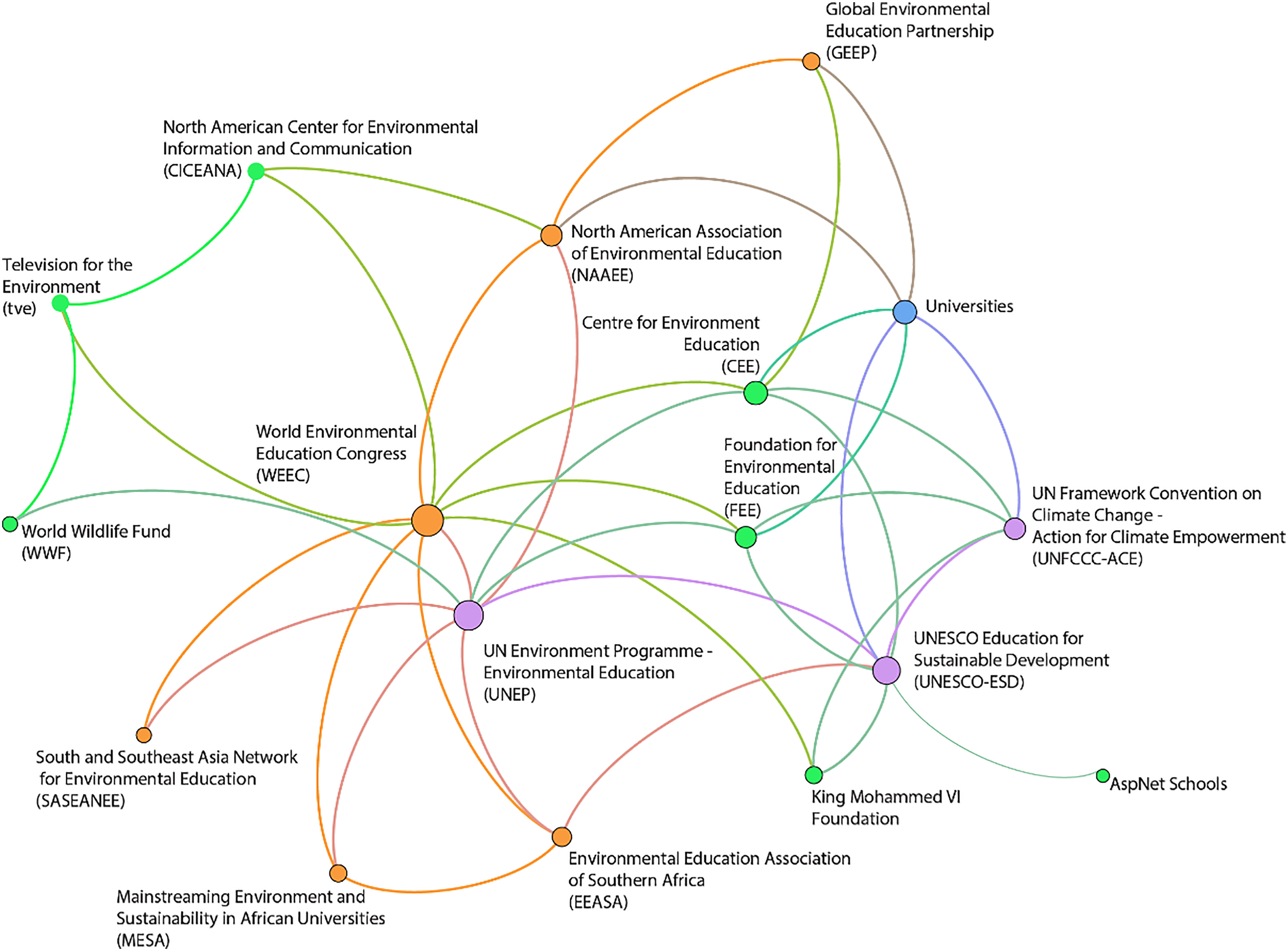
A partial mapping of key organizational actors influencing UN policy programs on education and environment (informed by pilot study data and full study data, McKenzie & Stahelin, 2022).
Although the influence of NGOs, individuals, and other non-state actors in the governance of education has grown, UN IOs remain intergovernmental bodies intended to enable member-party consensus and shared action on issues of global concern (Christiana, 2019; Karns et al., 2015). The UN IOs involved in ESE policy program development differ in the extent of member parties’ centrality in their activities. For example, the UNFCCC is still strongly oriented toward the work of formal member states or “Parties” in the Convention, with the Conference of the Parties and associated meetings primarily oriented around member countries’ climate change negotiations. That said, the education work of the UNFCCC has been largely at the margins of formal climate negotiations and has existed more in the domain of civil society and other stakeholder discussions and actions (e.g., through annual Dialogues on “Action for Climate Empowerment” [ACE] and associated initiatives in collaboration with civil society actors). UNESCO's ESD section operates primarily through various initiatives, collaborations, and meetings that are not focused on the participation or work of member countries only, but on a broader range of actors from civil society. Nonetheless, key donor countries were referenced in relationship to UNESCO's ESD work, in particular Japan, Sweden, and Germany.
Several face-to-face meeting types were identified by interviewees as important to the network governance and mobility of UN IO ESE policy programs. These varied primarily by the geographic scope of participation and by the type of hosting agency. The primary distinction was between global meetings hosted by the UN IOs and global or regional meetings not convened or hosted by UN IOs. Table 1 shows the key UN IO meetings mentioned during the interviews. In addition, relevant regional meetings mentioned included those organized by civil society organizations or networks, all of which were in some way associated with the ESE policy programs of UNESCO, UNFCCC, and/or UNEP. The bodies hosting these events included the Foundation for Environmental Education (FEE), GEEP, and WEEC, as well as more regionally oriented networks and organizations, such as the South and Southeast Asia Network for Environmental Education, the Secretariat of the Pacific Regional Environment Programme, Environmental Education Association of Southern Africa (EEASA), Mainstreaming Environment and Sustainability in African Universities Partnership Programme, and the North American Association of Environmental Education (see Figure 1). Some of these organizations or networks are discussed in the selected findings below.
Timeline of UN IO ESE meetings referenced by interviewees.
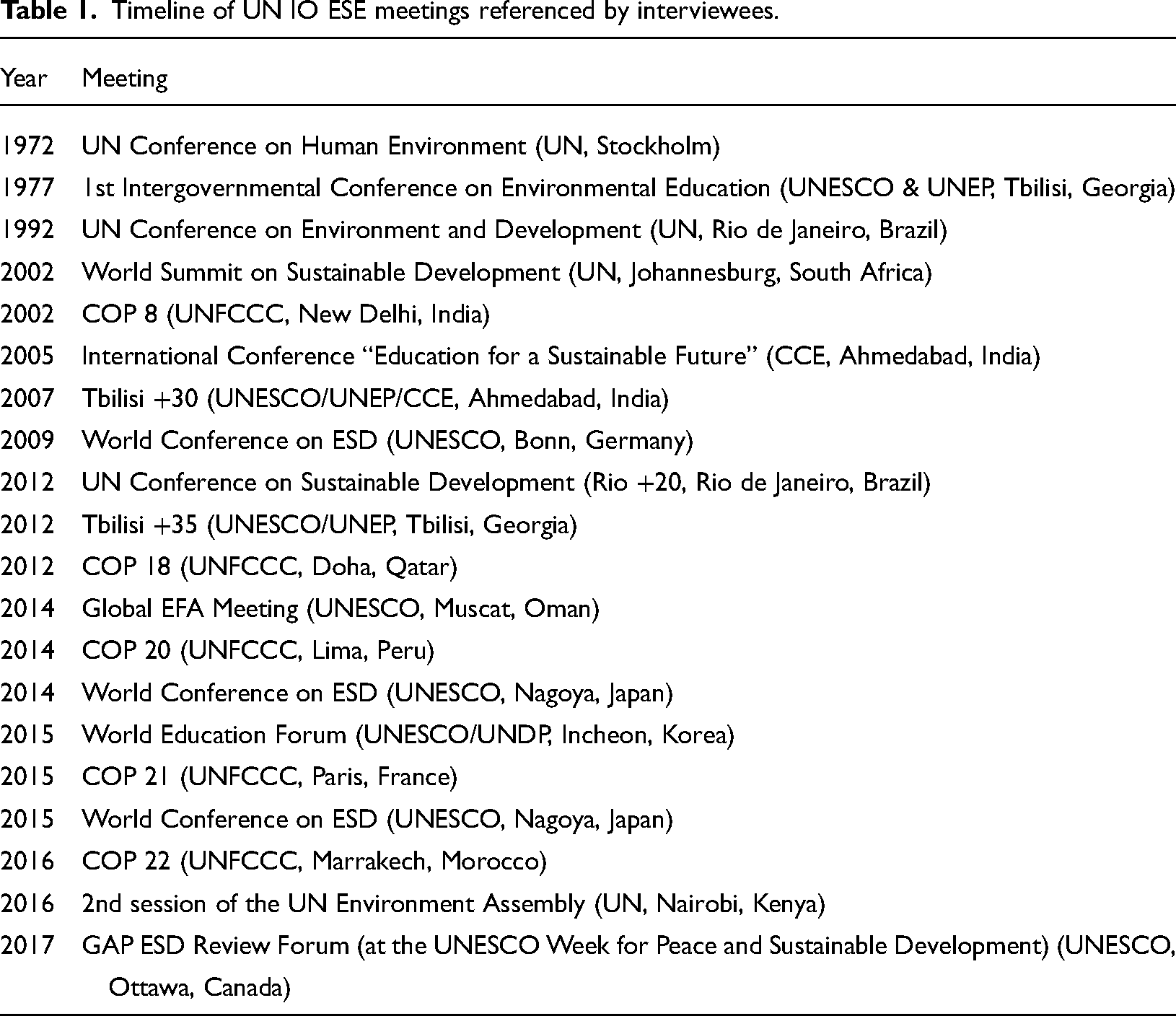
In the sections that follow, we discuss what interviewees said about the contributions of UN IO meetings in providing consensus-building platforms and enabling collaborative input in the development of UN IO ESE policy programs. This included the opportunity for policy actors to shape or guide the development of the UN IO policy programs, as well as to contribute to specific documents or declarations written at meetings that helped solidify, define, redefine, or promote the policy program frameworks. We also discuss the ways that meetings were found to contribute to the mobility of the UN IO ESE policy programs; for example, by providing a platform for “close enough” shared interests developed at meetings that give vitality to a UN policy program within a region, establish commitments that can leverage resources in network actors’ home countries, and offer feedback mechanisms to inform the UN's global policy initiatives with regional/local contexts and priorities. We then examine the enabling social practices of network governance, such as the importance of producing network relations as a central form of network labor.
UN IO meetings as platforms for consensus-building in policy programs
The interview data suggest that UN IOs use their mandate and influence to convene state and non-state policy actors at international meetings to help build consensus to facilitate the mobility of ESD across geographic or institutional contexts. The success of UN IOs and their policy programs as platforms supported and furthered by UN IO networks appears to rely in part on the extent to which UN IO policy program language is designed to be ambiguous and flexible so that it can be used and mobilized by various network members. Our study participants, in numerous cases, discussed the role of meetings in this process. One interviewee from the UK spoke of the importance of this capacity of UNESCO ESE policy programs: They always have lovely words which are hard to disagree with, but then you have to say, well, what do we actually mean in practice and so on. I think the sort of in-built ambiguity of UNESCO rhetoric is in some ways a strength. People are critical of their language because it's not sufficiently bold, it's not sufficiently explicit, or whatever. But what UNESCO does have is kudos and prestige and standing, and therefore, those involved in this field can use its leverage and mandate and legitimation for what they do, and I think that's, if nothing else, that's really important. And also, because of their international, their global scope, it provides an umbrella, such as this meeting this week, for international collaboration between different groups in different parts of the world.
The “umbrella” metaphor is a key descriptor in this quote, illustrating the global scope of an organization able to use its status, moral authority, and convening power (Karns et al., 2015) through international meetings to foster collaboration between network actors and legitimize their work. In doing so, the UN IO shapes and consolidates the formation of policy networks. What is referred to here as “rhetoric” and “language” was also referred to by others as tensions in “discourse” or “terminology.” Echoing comments from other interviewees, this individual alludes not only to the tensions that network actors have to navigate but also to the mobility enabled by the elasticity in the framings used in the policy programs (McCann, 2011; McKenzie, Bieler et al., 2015). The “in-built ambiguity” supports the IO programs’ ability to function as “umbrellas” or platforms to further their ESE policy focus globally in what might otherwise be dispersed efforts across private, philanthropic, and other civil society sectors. The policy platform is flexible and thus “fixes” policy in ambiguous ways, rendering it more mobile (McKenzie, Bieler et al., 2015).
To get buy-in from stakeholders, UN IOs convene international meetings where policy programs can be examined, questioned, and negotiated as policy actors from and beyond the member states re-contextualize them according to their needs and own agendas. The comments of an interviewee from Denmark who has led a prominent global EE organization since its inception illustrate this point. He described the challenges his organization faced when there was a shift to the now dominant UN IO policy focus on ESD, which, at least initially, appeared to relegate the previously dominant work on EE to a lesser status. This had major implications for the decades of work he and his organization had put into advancing EE nationally, regionally, and globally through building their own extensive network of intergovernmental, nongovernmental, corporate, and philanthropic partners pursuing an EE agenda. After describing the tensions and challenges that his organization faced when UNESCO shifted the globally dominant policy orientation toward ESD, he explained why his organization nonetheless continued participating in the policy program's international activities, including the meetings: You have to realize that when you have international bodies, institutions like UNESCO, you might like what they do or you might not like everything that they are doing. But they are the international institution and you have to show pragmatism. I can’t keep on being angry. You have a reason for being angry and you explain that reason. And immediately you have to reply. Out of that comes the possibility to talk together. And when UNESCO have made its Global Action Programme [on ESD] and the United Nations family is behind, we have to use it. And we have of course to bring all what we can do into the Global Action Programme
1
… but if the frames need to be a little bit extended or enlarged, then we have to work for it. But use the platform.
With the ESE policy landscape comprising numerous policy networks and heterogeneous actors, a key responsibility of UN IOs is to provide a degree of cohesion and stability to the “constitution of moral and epistemic communities” across ESE policy networks (Avelar et al., 2018, p. 56). In this way, UN IOs can “provide an environment for consensus building and therefore limit the emergence of implementation resistance” (Ball, 2016, p. 6). This is part of the governance work of face-to-face meetings and related policy program (im)mobility.
Writing policy program documents at meetings
A key practice of UN IO network governance is enabling both state and non-state actors to come together in meetings to produce policy documents. Although the production of these materials takes place remotely, face-to-face meetings are key opportunities for initiating, negotiating, or finalizing document contributions. The published documents that emerge as meeting outcomes serve as reference points for subsequent policy work. Several interviewees spoke of the importance of face-to-face meetings in enabling them to participate in the development of documents that shape or advance UN IO ESE policy programs (see Table 2 for a list of UN IO documents referenced in the interviews). These included contributions to reports produced in advance and presented, deliberated, and agreed upon at meetings. In other cases, statements or declarations marked the culmination of face-to-face events, providing a summation of discussions or decisions at the event and acting as a future reference point for subsequent proceedings.
List of UN IO documents referenced by interviewees and associated UN IO meetings.
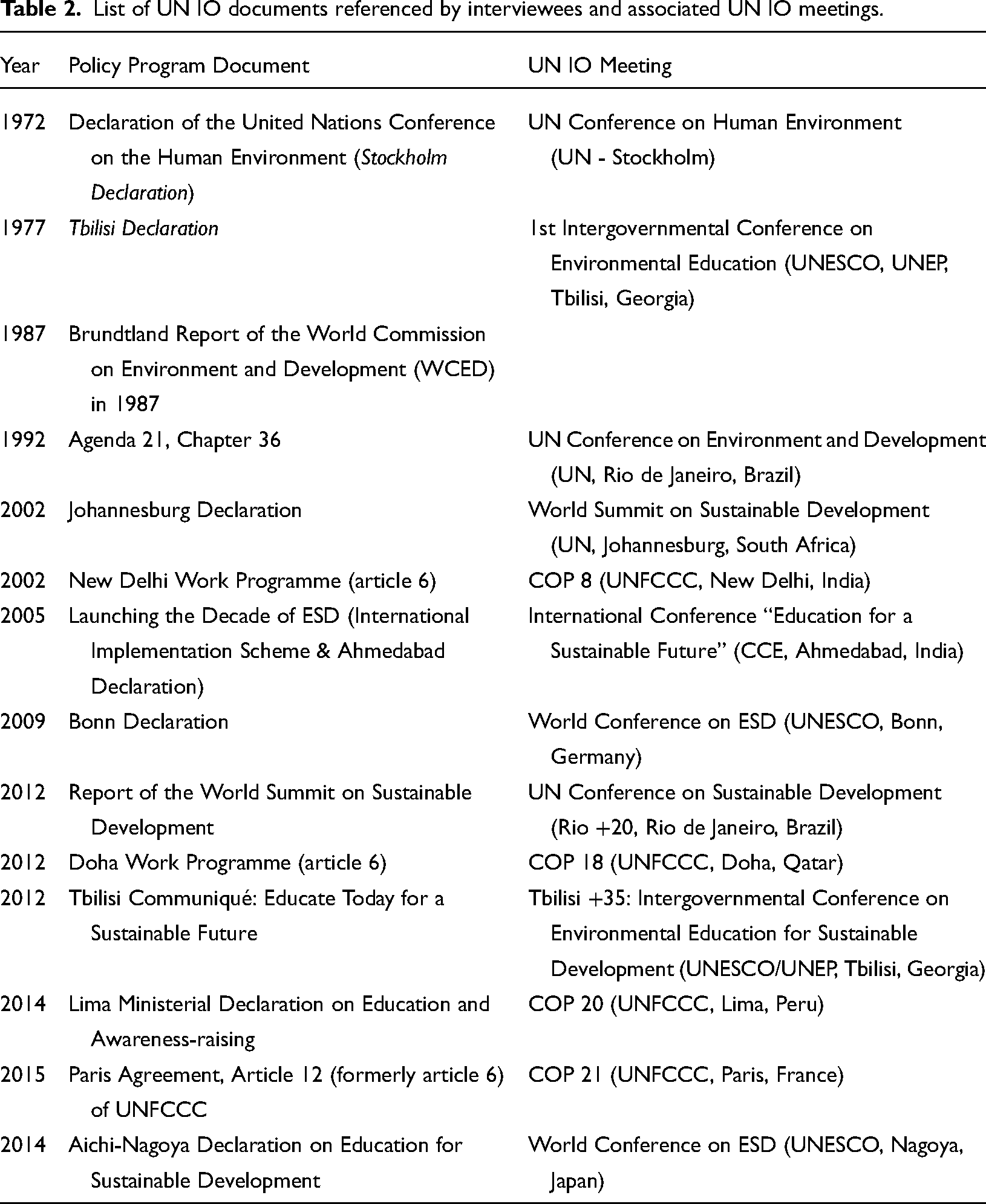
An interviewee from Australia shared his view on the importance of meetings in bringing together “core” network members to create key policy program documents: So these forums are more than social. And having a statement, a declaration or a statement of something. I remember working on the ‘communiqué’ it was called, from Tbilisi + 35 [meeting]. And I was part of that core group. And it was three or four o’clock in the morning, and we were struggling to get this communiqué and get it right, and I was putting in perspectives in there. I was able to influence; I can see my fingerprints … The education ministers from the Commonwealth, I can say, “Hey, you’re a signatory to this. What are you doing? Be accountable. You’ve signed on.” I could just sign and disappear, and it becomes a piece of paper that goes through the recycling machine. But that's where you can use those sorts of things to influence change. And if you can be part of that construct of it, you can then use it. And I have done so in certain areas.
Meetings and the regional mobility of UN IO policy programs
Meetings with national and/or regional orientations were often referred to as propelling UN IO policy program mobility at local and regional levels. Such meetings were hosted by organizations and government agencies involved in national or regional ESE policy program networks and helped to mobilize and vitalize a policy program agenda across regions of the world. These meetings provided a normative reference against which member states could gauge the adequacy of their engagement with emerging ESE policy innovations (Finnemore & Sikkink, 1998). And they were also venues where regional/national policy actors could allow locally contextualized policy program input to feed back into shaping the ongoing development of global UN IO policy programs. An academic from Botswana, who is a former president and a current active member of the EEASA and on the advisory board of the GEEP, discussed the importance of the annual regional conferences that EEASA has been holding since the association's founding in 1982
2
. [These have] quite a bit of influence, because we always reflect on these regional as well as, I would say, international kind of discourses that are going around. We know the agreements. We know, we always try to measure how much impact—how much are we doing and so forth.
These gatherings were often hosted by prominent academic institutions, such as the University of Namibia, the University of Botswana, the University of Swaziland, and the Treverton Colleges and Rhodes University in South Africa. Local conference organizing committees also supported the meetings. Various national-level organizations and communities of practice, such as the Gauteng EE Forum, Swaziland Environmental Agency, Namibian EE Network, and the Zambia Network for EE, voluntarily participated in helping organize the meetings. The events exposed the members of these associations to global UN IO policy programs and provided them with spaces of exchange and deliberation to contribute to global ESE agendas at local, national, and regional levels.
This same interviewee also articulated how EEASA's conferences have enabled the flow of feedback from national/regional contexts back to the UN IO by convening stakeholders and inviting regional UNESCO leadership to the meetings: Last year one of our guest speakers or keynote speakers was the UNESCO regional director. He came to Botswana. The year before last, we also have a regional representative who came at 2014 in Namibia. And then, fortunately, the Namibia and the Swaziland one [meeting] they were co-sponsored by UNESCO. Because they were interested in getting feedback from us. So we are working together, I would say. And you can just imagine your sponsor coming, and you don’t actually deliberate on their mandate.
These examples suggest how global ESE policy programs led by UN IOs that are “(global) elite formulations” are also “often reciprocally constituted through distant nodes and sites” (Peck & Theodore, 2010, p. 172). They also illustrate how UN IO ESE “‘networks have a history’, [and] that meetings ‘join-up’ networks” (Avelar et al., 2018, p. 68). Regional meetings are key spaces and moments in this process, both spatializing and temporalizing the network governance of policy programs. They also make policy regionally mobile, bring vitality to a UN policy program agenda within a region, as well as provide feedback mechanisms to UNESCO regional and main offices to inform the global policy initiatives with regional/local contexts and priorities.
Meetings and the labor and expansion of networks
In this section, we turn to the production and reproduction of network relations that have globally vitalized the mobility of ESE policy, and the role of meetings in that. Several interviews exemplified how policy mobility can be driven by specific individuals holding key positions in the web of social relations that animate policy networks. Their networking labor builds the social relations necessary for convening distant policy actors at meetings, which in turn expands the bandwidth and circuitry of existing UN IO policy program networks. This labor is often enabled by the access made possible by their own prior participation at policy meetings. The following example illustrates the importance of specific policy actors’ network relations to produce meetings and provide circuits for mobility from global to regional and national scales of policy activity. The former president of a large international environmental education organization explained how the membership of a Kenyan organization in their global network, as well as his professional relationship with the executive director of UNEP, became the basis of a major regional initiative launched through a workshop in Kenya: And we said, ‘Why shouldn’t UNEP and [our organization] make a workshop in Nairobi where we invite all African EE organizations?’ And we brought a lot of Western members of [our organization] to Nairobi and tried to make links between the African countries, the organizations there, and the Western European organizations. And then the Western European organizations had to go back to their Ministry of Foreign Affairs and say, ‘we have now contacts here and there.’ And before that, they should find out which country do we actually support with our money from the Ministry of Foreign Affairs. So I think that was one example where we, very directly in fact, used personal relations and commitments to create more environmental education in a completely new area in Africa.
This story highlights the entrepreneurial use of existing professional relationships within a policy network that enables the convening of these meetings, in turn nurturing the regional mobility of a policy. Also noteworthy in this process is the creation of new cross-sectoral network relations across national and global level civil society organizations, UN IOs, and member state governments. Junemann et al. (2016) refer to the agency and performance depicted in this anecdote as “network animation and network building or in other words the work of networking” (p. 535). This animation often rests on the agential role and convening capacity of specific well-connected individuals.
In another example that illustrates the importance of network connections to the mobility of policy programs, and the key function of international policy gatherings that catalyze them, the same individual recounted an occasion in 2013 during the Seventh WEEC held in Marrakech, where he was unexpectedly invited by Her Royal Highness Princess Lalla Hasnaa to a small private meeting with several key individuals in positions of leadership, including the directors of UNEP, UNESCO, and the WHO. He and Princess Hasnaa were already connected by virtue of her role as the Chair of the Mohammed VI Foundation for Environmental Protection, which was (and still is) a member of his organization. Among the individuals present at this meeting was the UNESCO director, Irina Bokova, which provided him with the opportunity to advocate for his organization. So that was the golden opportunity for me to say to Irina Bokova from UNESCO: ‘You owe me something. So when you have your final conference in Nagoya in Japan on ESD, I would like to see [our organization] play a major role there because we have actually created a lot of the activities that you demanded from UNESCO ten years ago.’
This interviewee's anecdote exemplifies the networking labor of a policy elite, which Baker et al. (2020) describe as “people in positions of relative power by virtue of their ability to access and harness resources (e.g., political authority, money, knowledge, social connections, etc.) to influence the policy process” (p. 132). The interviewee's experiences also exemplify the work of “policy entrepreneurs as key nodal actors, whose social capital and elite membership helps to lubricate network relations and facilitate policy influence” (Allen & Bull, 2018, p. 1). As a non-state policy elite, policy entrepreneur, and nodal actor, this policy actor was able to harness his influence and position to drive the mobility of UN IO ESE policy programs, both by orchestrating new international meetings using his relationships and by developing new relationships of influence by participating in meetings orchestrated by others.
If the individual agency of well-connected policy entrepreneurs is important to note in the development of UN IO policy programs, it is also important not to overlook how policy is made mobile by expanding the circuitry of network relations beyond a small number of individuals with a preexisting history. An academic and UNESCO report writer from the UK, for example, spoke about the advantages and disadvantages of working through existing, tight-knit friendships and professional relationships in ESE policy networking. He indicated that initially there was a functional benefit to having a small, core, and tight circle of policy advocates working across international borders to get a global policy program off the ground. However, later it needed to open up, be more inclusive (including across social, cultural, and geopolitical divides), and make way for the new generation; a change that is still underway in the field of ESE: I think the fact that this field has been quite small in terms of the number of actors for years is both good and bad. It's good in the sense that a lot of the main actors have known each other for years and trust each other, and therefore get things done quickly. But bad from the point of view that it's still a limited group, and I think some people come into it new, probably feel that it can be exclusive, and how do you break into it? Well, it seems like an all-boys club sometimes, I would think. It's also … tends to be male, white, English-speaking, and so on. But what I find encouraging from these kinds of meetings is … there's new people coming into the field all the time, and younger people, which is great … But I think it's been important in the early years that you had a lot of passionate people who worked closely together internationally to make the thing, to give the thing momentum. But now I think that role is less important because it's … to the younger generation and needs to balance north and south much better.
In these ways, meetings can be important for consolidating “strong ties,” as well as for the crucial expansion of “weak ties” in a policy program governance network. In discussing the diffusion of ESD through networks, Kolleck et al. (2011) comment that the “role of weak ties within networks should not be underestimated. As distinct from strong ties that do mostly consist of fast friendships and deep trust, weak ties are built on more distinct acquaintances … [and] can be very important dimensions in processes of establishing strong networks” (pp. 83–84). Thus, new network relations need to be built for policies to remain mobile in innovative ways.
Discussion
We have explored various roles that meetings play in the network governance and mobility of UN IO ESE policy programs. Our analysis has encompassed the functions of face-to-face policy meetings at a range of scales, from globally oriented international meetings hosted and convened by UN IOs to smaller regional meetings that bring together diverse policy actors to influence UN IO decision-making and policy program mobility. As we have shown, in global and regional meetings related to UN IO policy programs, agendas are set for ongoing work, commitments are made, and resources are called for; policy orientations are legitimized, modified, or contested and taken in new directions; policy guidance is provided; positions of individuals and organizations are affirmed, solidified, or shifted; policy documents are produced, negotiated, and circulated; new relationships are created, and existing relationships are affirmed and strengthened; and much learning, encouragement, exchange, and inspiration takes place.
The production and performance of meetings that help make policies mobile are often orchestrated by specific individuals who play key roles within and across UN IOs, governments, NGOs, policy networks, and policymaking sites. This orchestration, in turn, is made possible by social relations that animate policy networks, providing the connectivity through which networks endeavor to influence policy programs and their mobility. The facilitative role of UN IOs in their associated policy networks is noteworthy in this process. Convening international face-to-face meetings, they create spaces of convergence and exchange for policy actor engagement with policy discourse as a way of both fixing “meanings in the social world” of ESE policy networks and instigating movement through new ESE “norms, principles, and actors around the globe” (Barnett & Finnemore, 1999, p. 710). As such, they are “both ephemeral fixtures in the landscape of policy activism,” and “important nodes through which policy mobilization occurs” (Tenemos, 2016, p. 125). The role of face-to-face meetings in network governance is likely similar in other policy fields where UN IOs coordinate global policy programs with the intense participation of non-state actors.
Our focus on face-to-face meetings has highlighted policy networking as a social practice and form of governance labor that is not by any means novel historically but is especially central in network governance. Network labor as a social practice is not merely about reproducing existing social relations but also about producing new relationships and developing, connecting, and expanding networks to produce new connective tissue and expand connectivity across networks. This dynamic elicits both the production and reproduction of the social relationships that nurture, animate, and stimulate network connectivity through which policy is made mobile. This speaks to the idea that “first, networks are structures which constrain and facilitate agents; and second, the culture of a network acts as a constraint and/or opportunity on/for its members” (Marsh & Smith, 2000, p. 5). With this in mind, we see that established relationships can present both opportunities and barriers. Our respondents alluded to a variety of instances where efforts were made to create spaces for participation and exchange for new policy actors. Beyond an oversimplified notion of well-connected policy actors with the resources to influence policy agendas, the relationship-building imperative of network governance (as opposed to reliance on existing social relations) centers on new forms of labor at the heart of network governance that are worthy of continued investigation.
To conclude, research on global UN IO ESE policy programs can provide insight into what happens when global multilateral governance mechanisms, of which UN IOs are key entities, become permeated by the growing participation and moral authority of policy networks comprised of non-state actors (individuals and institutions). Bridging these concerns of critical education policy studies with the further study of ESE policy presents a field ripe for further research. Further investigation is needed, for example, to examine in more detail the role of philanthropies, think tanks, edu-businesses (Thompson et al., 2016), and other new non-state actors in the network governance of evolving ESE policy programs. This should include how and to what effect they organize, are invited to, or otherwise come together in policy meetings. Such research might also delve into the changing role of the state and the continuous rise of public–private partnerships in neoliberal modes of governance that contextualize ESE policy initiatives and innovation, including at the intergovernmental level.
Although this is a fertile area for further policy research, there are also practical implications. The importance of networking is not just a cliché pertaining to individual career advancement; rather, networking is an essential activity that drives policy program development and mobility and is a key ingredient in the success of policy programs. At a time when ESE has grown in prominence in the 2030 Agenda for Sustainable Development, including through the Berlin Declaration 4 that resulted from the World Conference on ESD held in May 2020 and following the COP 26 negotiations on Action for Climate Empowerment resulting in the eight-year Glasgow Work Programme 5 , this topic is more timely than ever. Whether virtual meetings can produce similar network connectivity and impacts is also a topic of merit for further research, but based on this pilot study, we are skeptical about the extent to which some of the functions of face-to-face meetings in network governance and mobility would also hold true in virtual formats.
Footnotes
Acknowledgments
The authors gratefully acknowledge the work of Alan D. Reid in co-developing the interview protocol and co-conducting the interviews for this pilot study. Johannes Schuster and Diego Santori provided support with the network diagram. Analysis and writing of this paper was supported through funding from the Social Sciences and Humanities Research Council of Canada (grant number 435-2019-0906).
Contributorship
Nicolas Stahelin was responsible for undertaking data coding and data analysis, writing the initial drafts of the paper, and responding to reviewers’ feedback. Marcia McKenzie was responsible for funding support, co-developing the interview protocol, co-conducting the interviews, guiding data analysis, contributing to writing the paper, and responding to reviewers’ feedback.
Declaration of conflicting interests
The authors declared no potential conflicts of interest with respect to the research, authorship, and/or publication of this article.
Ethical statement
Ethical approval was received from the University of Saskatchewan, and participants provided informed consent prior to the interviews.
Funding
The authors disclosed receipt of the following financial support for the research, authorship, and/or publication of this article: This work was supported by the Social Sciences and Humanities Research Council of Canada, (grant number 435-2019-0906).
