




Abstract
Highlights
Using a new concept of “a plate of food” (aPoF), a symbol of meaningful chemical reaction products, this article addresses the Grade 10 students’ chemistry anxiety in Indonesia. In line with the ecological citizenship and pro-environmental behavior perspectives, the aPoF is conceptualized based on environmental concerns such as food sustainability, food-critical consciousness, and the earth's carrying capacity. This means that the aPoF is beneficial to support Sustainable Development Goals #2 Zero Hunger, #4 Quality Education, and #12 Responsible Consumption and Production. Based on our results, we suggest that chemistry teachers can give more space for students to express their difficulties in learning chemistry. The space can be delivered by giving assignments focusing on the students’ feelings and experiences related to a certain chemistry topic.
Keywords
Introduction
Many environmental problems are, unfortunately, caused by individuals’ unsustainable ways of life (e.g., Hobson, 2004, 2013). Consequently, there is an ethical demand for individual citizens to incorporate ecological considerations and responsibilities in their day-to-day choices. Here, ecological citizenship (EC) plays a role in framing a reconceptualization of both human–nature and interpersonal relationships (e.g., Mason, 2009; Middlemiss, 2010). Theoretically, EC has been suggested as a driver of individual pro-environmental behaviors (PEB) (Kennedy, 2011; Wolf et al., 2009). Referring to PEB theory, individuals who have EC responsibility are more likely to behave in an environmentally friendly way in their daily lives compared with others (Jagers et al., 2013).
Compounded by the massive world population growth, a major concern has been raised regarding food sustainability and critical consciousness (Wistoft, 2020). The latter is defined as the ability to make critical food choices (Wistoft, 2020). In addition to the relationship between people's mindset (culture) and environmental sustainability (Komatsu et al., 2022), this concern is gaining more attention politically and didactically. As sustainability connects to the well-being and critical understanding of a society, students should not only learn how to eat right (e.g., combining correct nutrition) but also to relate to food and meals in a critical and reflective way (Komatsu et al., 2022; Wistoft, 2020).
This study used “a plate of food” (aPoF) as an educational tool. The concept is inspired by the author's personal experience when her Grade 10 biology teacher used aPoF to teach Latin names. Combined with her academic training as a college teacher, the educational experience enabled the first author to develop an innovative, reflective module, using aPoF as a chemistry learning medium for connecting students with environmental sustainability (Simanjuntak, 2015, 2017, 2020a, 2020b, 2020c). The aPoF is conceptualized as a symbol of a product with meaningful chemical reaction that can fulfill both physiological and psychological human needs.
In line with EC and PEB perspectives, aPoF is envisioned based on environmental concerns, such as food sustainability and the Earth's carrying capacity (Simanjuntak, 2015, 2017, 2020a, 2020b, 2020c). The concept can develop students’ PEB by increasing their climate change awareness (Lovett et al., 2017), reducing the usage of disposable plastic bags (O’Brien & Thondhlana, 2019), moralizing meat consumption (Bruckner & Kowasch, 2019), and promoting sustainable consumption (Hüttel, 2017). The aPoF refers to the interaction of chemical elements (e.g., photosynthesis, land cultivation, and food processing) involving three multi-dimensional roles of biotic and abiotic factors: (1) biodiversity—the dimensions of the natural environment, (2) cultivated land—the dimensions of the built environment, and (3) socio-culture in the community—the dimensions of the social environment (Simanjuntak, 2015, 2017, 2020c). As a medium of chemistry learning, aPoF will encourage students to ask many questions related to the center of moral philosophy, such as the extent of our responsibility to people in need, how to fulfill our self-determination, and the specific place of human morality (Telfer, 2012).
As food studies at schools have a multifunctional capacity to link with an array of sustainability issues, such as hunger, nutrition, and economics (Morgan, 2014), aPoF is not only beneficial to support Sustainable Development Goals (#2 Zero Hunger, #4 Quality Education, and #12 Responsible Consumption and Production) but also didactically reduce students’ chemistry anxiety. This anxiety has been suspected to be one of the largest barriers in learning chemistry (Firman, 2007).
In Indonesia, chemistry as an independent school subject is first encountered by Grade 10 students. As students of this age are in a crucial period of life wherein specific psychosocial and physical problems occur (World Health Organization, 2021), providing interventions to support them is an essential step for their positive developmental process (Larson & Tran, 2014). However, the subject mostly deals with abstract concepts, identical formulations, and chemical reactions that cannot be seen or touched (Firman, 2007). Consequently, chemistry teachers often need a specific approach to ensure their students achieve a good level of comprehension. Here, aPoF can be a meaningful learning medium to facilitate students’ experiences of eating activities (i.e., meal preparation and eating at home or outside and eating alone or with someone) and chemical ingredients in food (Simanjuntak, 2020a).
The aPoF can also develop high-ordered thinking skills (HOTS) concerning chemistry education (Aksela, 2005; Simanjuntak, 2020a). HOTS, such as the ability to ask questions, solve problems, develop an argument, draw comparisons, and identify hidden assumptions, can be identified during the learning process (Rahayu et al., 2020). Utilizing aPoF in this learning process can increase students’ interest in reading books and proactively seeking information that can enhance their knowledge, analytical and critical thinking, and helping them find their true interests and talents for fulfilling their duties in a sustainable society.
Utilizing EC and PEB theories, we conducted an empirical study to evaluate and analyze how aPoF, as a chemistry learning medium, helps Grade 10 students.
Methods
To meet our research objective, we utilized a qualitative case study method (Yin, 2009). Our context was food chemistry learning application as one of the chemistry learning approaches at Grade 10 (high schools) in Jakarta, the capital city of Indonesia. Students were instructed to complete a learning module based on the extant literature. Before, students get informed consent to be participated in completing the learning module. The module utilized six indicators (relationships, feelings, knowledge, desire, hope, and favorite food) in four syntaxes: (1) introduction, (2) life and relationships about food, (3) respect for reasonable food portions, and (4) closing: seven reflections before eating. The details are described in Table 1. All syntaxes consisted of open-ended questions.
“A plate of food” as a food chemistry learning module.
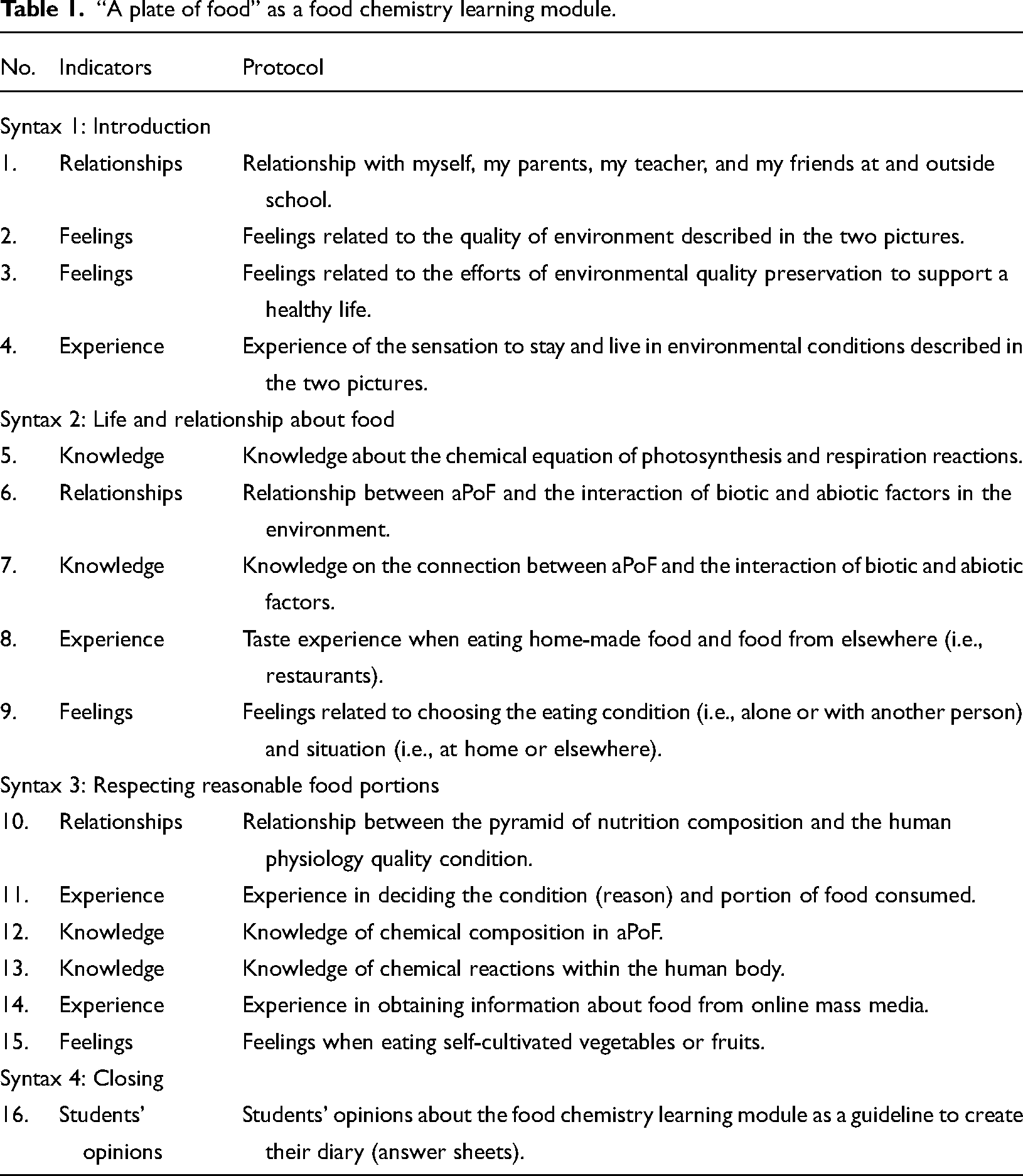
The initial learning module was pre-tested with a convenience sample of five Grade 10 students. The results of the pre-test revealed that the students still require instructions to write their answers and observations. Based on this pre-test, we added more detailed information in the module, for example, the food chemistry that aligns with the level of chemistry learning for Grade 10 students.
Following the purposive sampling method, potential participants were identified from 30 diverse high schools, ranging from national public to religious (i.e., Islamic) high schools. In total, 623 students participated in the study. We employed content analysis (Patton, 2002) to qualitatively analyze the students’ answers.
Results and discussion
As an entry point, Syntax 1 intended to visualize taste and food preferences when the students eat in two opposite environmental conditions (green urban forest versus slum residential along the river). In their answers, the students stated that the environmental quality impacts on the relationship and the taste of their plate of food. Moreover, they agreed to participate in activities related to environmental protection such as consuming local food and ensuring food ecological footprints. In line with Romero and Francis (2020), the students also agreed to be autonomously involved in food preparation at home. In the future, they can be expected to be actively involved in fulfilling their duties in a sustainable society (Dobson, 2007). The students were also able to define various actions to protect environmental quality by applying PEB, including supporting carbohydrate biodiversity preservation for achieving food security in Indonesia (Lamoureux, 2003; Soehadha, 2016).
In Syntax 2, specifically designed to reduce chemistry anxiety, the students confidently wrote the correct equation for photosynthesis and respiration reactions. They could also explain the reaction equalization and the important phases of molecules to define the correct equation. For example, they were able to describe the roles of the sun and chlorophyll in photosynthesis reactions to produce carbohydrates. In addition, students acknowledged the impact of biotic and abiotic factors on photosynthesis and respiration reactions. They were also able to mention the interaction between water (abiotic) and organisms under the soil (biotic) for delivering their plate of food. This suggests students’ awareness of the effects of the surrounding environment on their quality of life (Hüttel, 2017; Lovett et al., 2017). Most of the participants could not only identify the visible, seen components of their plate of food, but also describe invisible components, such as their associated feelings while eating. For instance, some students could describe their feelings when eating homemade food versus food bought from elsewhere. They stated that although they love their mother's homemade food, they prefer to eat out (i.e., restaurants). By following the aPoF recommendation, they confirmed that they would help in preparing meals at home using their favorite ingredients or eat their mother's homemade food out of respect.
Syntax 3 engaged the students to explore their feelings. For example, they were asked about the difference in taste between self-cultivated and market-bought vegetables/fruits. They emphasized that self-cultivated crops have a better taste (i.e., sweeter and fresher) owing to the use of organic fertilizer. Further exploration encouraged them to identify the effects of chemicals on the quality of crops or agricultural products (Simanjuntak, 2015). Syntax 3 aimed to facilitate the students’ feelings, desires, and hopes, and stimulate them to perform HOTS. The students’ HOTS were written in their diaries as a description of their relationships, knowledge, experiences, and feelings, including hope, joy, and desires (Rahayu et al., 2020; Simanjuntak, 2020a). Thus, it can be concluded that HOTS have been achieved as a learning outcome.
In Syntax 4, the students were asked to share their feelings, thoughts, and experiences during the module. Some implied that they had doubts about their answers as they found it was difficult to express their feelings related to personal questions. Nevertheless, the students agreed that the aPoF module led them to be more concerned about their well-being and the quality of the environment for accessing their food.
Based on our findings, we suggest that chemistry teachers can give students more space to express their difficulties in learning chemistry. Teachers can then address the students’ doubts during the learning process, both in the classroom and at home. The space can be delivered by giving assignments focusing on the students’ feelings and experiences related to a certain chemistry topic (Aksela, 2005; Simanjuntak, 2020a, 2020b, 2020c). This also supports their HOTS development.
Furthermore, aPoF can be the core aspect of problem- and project-based chemistry learning in the classroom to raise students’ environmental awareness (Mellor et al., 2018; Scanlon et al., 2020). Based on Chemical Thinking and eco-reflective decisions, students are the main subjects or agents in solving the current situation and establishing a sustainable future (Jagers et al., 2013; Matlin et al., 2015; Schummer, 2018). The environmental awareness achieved through aPoF can support the students in protecting the environment as a part of their human rights (Brown, 2000).
Based on science process skills and critical thinking, there are two basic types of environmental awareness that can be achieved by the aPoF as a chemistry learning medium: food ecological footprints and local food consumption (Simanjuntak, 2020a; Tanti et al., 2020). Both of these can be the foundation to protect the environment quality and support food security in Indonesia. Local food consumption can boost competition for Indonesian traditional food in the global market (Widiana et al., 2020).
Engaging Grade 10 students in EC by raising their environmental awareness is the next achievement of aPoF (Simanjuntak, 2020a). As described in the students’ diaries during their aPoF journey from Syntax 1 to 4, they were able to describe the ecological perspectives following their learning style. Their EC is also expected to develop a perception of sustainability.
Conclusion
The aPoF as a chemistry learning medium leads to learning achievements by reducing students’ chemistry anxiety, increasing their well-being, and connecting them with the surrounding environment. The learning achievements are also related to engaging Grade 10 adolescents as PEB agents by raising their environmental awareness. The PEBs are described and explained as the students’ sensitivities, disposition, and awareness about the chemistry in their plate of food, impacting on their feelings, emotion, and desires. Gradually, aPoF, as a chemistry learning module, can be the core of the students’ participation in developing their EC.
Thus, we conclude that aPoF can be a good medium to improve students’ chemistry learning comprehension in identifying the role of chemistry in their daily lives. The students’ unique and plural perceptions and expressions related to food consumption can be facilitated by the aPoF through their relationships, knowledge, feelings, and experiences between food and the environment. Nevertheless, the aPoF as a food chemistry learning module will still require development, for example, with regard to several learning evaluation models that can improve the students’ achievement and interest in learning chemistry.
Footnotes
Contributorship
Familia Novita Simanjuntak was responsible for designing the research, collecting data, analyzing the results, writing the early version of the manuscript, and responding to the reviewer's comments. Suyud Warno Utomo, Francisia Saveria Sika Ery Seda, Tri Edhi Budhi Soesilo, and Sumiyati supervised the research and provided suggestions during the process of manuscript writing.
Declaration of conflicting interests
The authors declared no potential conflicts of interest with respect to the research, authorship, and/or publication of this article.
Ethical statement
First, the researcher holds an official permit from the Jakarta Provincial Education Office to collect data from 30 senior high schools distributed across six regions, Thousand Islands District, Administration City of North Jakarta, Administration City of West Jakarta, Administration City of Central Jakarta, Administration City of South Jakarta, and Administration City of East Jakarta. Human participation was involved in this research to collect data through paper questionnaires, interviews, and focus group discussions. The researcher provided participants a clear explanation of the aims, overall purpose, methods, and implications of the research. They also explained the degree of benefit, risks, burden, or discomfort involved in participation as well as an estimate of the time and effort expected of participants, who is funding the research and for what purpose, who will benefit from the research, who will have access to any data that participants provide, and where research findings will be published. The researcher explained that participation is voluntary and that they can withdraw their consent at any time without any consequences. In addition, the researcher offered a firm commitment to protecting respondents’ anonymity and privacy (provided that this can genuinely be guaranteed) and to treating personal and sensitive information confidentially. Last, the researcher provided the name and contact details of the contact person who would answer any queries the participants may have.
Funding
The authors disclosed receipt of the following financial support for the research, authorship, and/or publication of this article: This work was supported by the Universitas Indonesia, Kementerian Pendidikan dan Kebudayaan (grant number NKB-0885/UN2.R3.1/HKP.05.00/2019, BU-201702200193).