




Abstract
Purpose
Drawing on a study of international schools in Shanghai, this study explores how external experiences and curricula are mobilized as policy tools to inspire local educational innovations and how these experiences are enacted differently by schools.
Design/Approach/Methods
Based on a review of policy documents and interviews with school principals, senior management stakeholders, and teachers, this study identifies and compares the typologies of international schools in policy design and practice. Then, by deploying the network ethnography method following three key nodes, this study offers some explanations for the gaps between policy design and enactments.
Findings
This study demonstrates the complex relations, interests, and struggles involved in constructing and shaping the meanings of international curricula within local education. The findings show the autonomy of policy networks and the difficulties of ‘steering’ them in a clear-cut way.
Originality/Value
This study is one of the earliest attempts, if not the first, to experiment with the method of network ethnography in the context of China. These findings offer a nuanced account of the complex relations and ad hocery involved in policy learning.
Keywords
Introduction: Globalization and education policy mobilities
Globalization, as an “everyday practice” (Harvey, 1989), has transformed the definitions, forms, modalities, effects, and orientations of education policy and policymaking in most societies. As Ball (2016) notes, local problems are diagnosed by global players; solutions and “best practices” from elsewhere are mobilized and mutated; and global forms of policy move across cultures and places.
Researchers refer to the process of seeking and accepting policy solutions from other systems using different terms such as “policy borrowing” (Phillips & Ochs, 2004), “policy transfer” (Dolowitz et al., 2000), “policy referencing” (You & Morris, 2016), and “policy mobilities” (Peck & Theodore, 2010). Studies have demonstrated different degrees and forms of reflexivity and receptivity among local governments in taking up external initiatives. For example, Tan and Chua (2015) described policy borrowing as a continuum ranging from passive transfer, whereby external models are imposed upon local governments, to actively seeking and adopting external policy “solutions.” You and Morris (2016) suggested the term “policy referencing” in their analysis of how the UK government depicted school autonomy in East Asia in a certain way to legitimize the local policy agenda. Critically engaging with policy borrowing and policy transfer studies, Peck and Theodore (2010) offered a new perspective on “policy mobilities.” They underlined the role of policy networks in defining local policy problems, seeking solutions, and mobilizing external practices. They also suggested that researchers should pay more attention to the translation, adaptation, and mutation of external policies/practice in local spaces in order to shed light on the path dependency of local policymaking. Drawing on the policy mobility perspective and a study of international schools in Shanghai, this study explores how external experiences and curricula are mobilized as policy tools in Shanghai to inspire local educational innovations and how schools enact external experiences in different ways.
In addressing the different ways in which policy is mobilized /mutates, our emphasis is on the role of policy networks. According to Rhodes (2007), policy networks refer to “sets of formal and informal institutional linkages between governmental and other actors structured around shared interests in public policymaking and implementation” (p. 2). By comparing typologies in policy texts and enactment practice, we demonstrate the complex relations, interests, and struggles involved in constructing and shaping the meanings of international curricula within local education. In addition, drawing on techniques from network ethnography (Ball, 2016; Ball et al., 2017), we foreground the autonomy of policy networks and the difficulties of “steering” them in a clear-cut way.
China's opening-up policies in education and the rise of international schools
Early in the Outline of China's Education Reform and Development (The State Council of the People's Republic of China, 1993), the Chinese central government encouraged Sino-foreign cooperation in education and demonstrated an enthusiastic attitude toward policy learning, explicitly stating that local schools should “boldly absorb and borrow every civilized achievement of human societies and be brave to undertake innovations and experiments.” After China's entry into the World Trade Organization, two important policy documents regarding Sino-foreign cooperation in education were published (the 2003 Regulations and the 2004 Measures), which specified the regulations for the launch, management, teaching, and evaluation of Sino-foreign schools and programs (Ministry of Education of the People's Republic of China [MOE], 2003). Higher education and vocational education were the priority areas for Sino-foreign cooperation until 2010 when the Outline of National Medium and Long-Term Plan for Education Reform and Development (2010–2020) (hereafter, the 2010 National Outline) directed to “promote quality education experimental sites” and “encourage senior secondary schools to experiment with diverse ways of teaching, managing, and developing featured courses” (The Central Committee of the Communist Party of China [CPC] and the State Council of the People's Republic of China, 2010).
However, even in the 2010 National Outline, the central policy document did not explicitly mention or encourage internationalization in basic education in China. Nevertheless, to implement the central government's call for experimenting with diverse ways of teaching and managing in senior schools and to support Shanghai's strategy to become a “modernized international metropolitan city,” Shanghai Municipal People's Government (SMPG) (2010) published the local Outline for Education Reform and Development (hereafter, the 2010 Shanghai Outline) to encourage “founding Sino-foreign schools in basic education” and “experimenting with international curricula classes and international student exchange programs at senior secondary schools” (Shanghai Municipal People's Government, 2010).
Against this background, the number of international schools in Shanghai has risen dramatically. On the one hand, this rapid development was motivated by encouraging policies, such as those named above. On the other hand, it was driven by a burgeoning market in private education aimed at local middle- and upper-class residents who aspired to send their children overseas to prestigious universities and escape the highly pressured local education and the fierce competition in the Gaokao 1 (Bunnell, 2022; Wright et al., 2022). According to a recent report published by the Center for China and Globalization (CCG)—a Chinese non-governmental think tank—there were 1,168 international schools in China as of September 30, 2019. Their market size exceeded 80 billion RMB, an increase of about 60% from the previous year (Center for China and Globalization, 2020). The growth rate of the number of international schools in China in 2019 was 13.62%, which was higher than the global average (Center for China and Globalization, 2020). According to NewSchool Insight (2021), a Beijing-based consultancy company specializing in K-12 international education, Shanghai has the largest number of accredited international schools by city, amounting to 132 schools (Beijing occupies the second place with 96 schools).
The rise and development of international schools in China have seen increasing diversity and heterogeneity in teaching, curricula, school management, and cooperation. Studies demonstrate different kinds of actors involved in the landscape, such as local prestigious state schools, real estate companies, private schools, and global edu-businesses, including “GEMS Education, Cognita, and Nord Anglia” (Kim & Mobrand, 2019, p. 313), indicating various forms of public and private partnerships. The literature also sheds light on different types of international schools, such as schools exclusively for expatriates and those for Chinese citizens (e.g., Bunnell, 2022). There are also different types of “international” curricula, such as Advanced Placement (AP) programs from the US, Advanced Levels (A-Levels) programs from the UK, Canadian provincial courses (Wu & Koh, 2022), and the International Baccalaureate Diploma Program (IBDP) developed by the International Baccalaureate Organization (IBO) (Bunnell, 2022). By adopting the method of following policy (Ball et al., 2017), this study aims to demonstrate the effects of partnerships between various actors in shaping the policy mobilities of international curricula in China.
Research methods: Understanding the disparities between policy design and practice
Our research is based on three steps of data collection and analysis. First, in order to understand the “policy trajectory” (Ball, 1994; see Jin (2022) for a detailed analysis) of experimenting with international curricula in Shanghai and the struggles involved in constructing the meaning of this initiative, we conducted a documentary analysis using available secondary resources on international curricula and schools. We performed searches on government websites, academic databases, and major media outlets (e.g., a major local media outlet, The Paper, and a nationally influential social media platform, Zhihu) using keywords such as “international curricula,” “international schools,” “Sino-foreign cooperation,” and “opening up policies in education.” Through a review of these resources, we show how international schools are divided and categorized by policies and academic literature and indicate how experiments with international curricula are imagined in policy design.
Second, the findings from the documentary analysis informed the next data collection step, which involved semi-structured interviews with school principals, senior management stakeholders, and teachers. This aimed to gain an understanding of various policy enactments in practice and concomitant forms of partnerships and exchanges of ideas and resources. The interviews were conducted between March 2021 and February 2022 with six school principals, two senior management stakeholders, and 20 teachers based in Shanghai. We chose to situate our study in Shanghai as it is one of the most developed cities in terms of the types of international schools. The school principals and teachers in the sample were from two international curriculum classes affiliated with state schools, eight local private international schools, and three franchised schools. One senior management stakeholder in the sample was the founder of an education consultancy company that specializes in China's international education, and the other was a senior administrator in a university that affiliates various types of international schools. The interviewees were recruited through the authors’ affiliated institutions and our personal networks (the second author is a teacher at a school franchised by a British private school and previously worked in a local private international school). As our study aimed to understand practitioners’ constructed meanings of international curricula as mobilized in local education, we only interviewed Chinese principals and teachers. The interviews were conducted face-to-face or over the phone in Chinese. Each interview lasted between 45 and 90 minutes and was transcribed verbatim and translated into English by the authors. Pseudonyms were used for the names of people and institutions in the interview transcripts. All research participants were informed of potential ethical risks and provided their consent. Thematic analysis (Braun & Clarke, 2013) was used to construct typologies in policy texts and practices.
To further understand the differences between the two typologies, we deployed network ethnography techniques (Ball et al., 2017) in our data analysis. Network ethnography is a method of understanding the processes and effects of policy networks by following people, things, stories, lives, and conflicts (e.g., Ball, 2016; Ball et al., 2017). Ball et al. (2017) deployed network ethnography in various studies and national contexts. For example, they demonstrated how philanthropists and social organizations in the US and the UK move across the public and private sectors, work together with local policy actors to scrutinize the effectiveness of public schools and systems, and introduce pro-market approaches and business models to drive educational reforms in Ghana and India. Other researchers have used network ethnography to follow different kinds of non-state actors, such as Edu-Tech companies (Williamson, 2019), foundations (Avelar & Ball, 2019), edu-businesses (e.g., Pearson in Hogan et al., 2016), and global chain organizations (e.g., Teach for All in Olmedo et al., 2013). Network ethnography can effectively explore the effects of reconfigured relations, boundaries, spaces, and modalities conjoined by globalization and policy mobilities. It can also motivate reimaginations of “what is near or connected and what is distant or disconnected” (Lingard et al., 2014, p. 713) in the shaping of policies and policymaking.
Our third data collection and analysis step was informed by the network ethnography method. Through documentary analysis and interview findings, we were able to identify three key nodes in the international school landscape in Shanghai (specifically, Professor Zhang, Principal Tang, and Professor Zhou, who were connected in a key policy space; see later sections for more discussion). We followed these three key nodes through extensive online searches, tracking their affiliations, biographies, career trajectories, and social networks. Our analysis highlighted an underlying core policy network (see Figure 1; constructed by Gephi) in fostering the initiative to experiment with international curricula in Shanghai. We argue that this policy network can offer some explanations for the gaps between policy design and enactments and help us understand how China's recent policies to “counter privatization” (Verger et al., 2017) can be negotiated. Given our difficulties in gaining direct access to the three key nodes 2 for interviews, we drew on publicly accessible materials (e.g., official websites, media reports, and resumes available online) to collect contextual information on them and construct the policy network; therefore, we did not anonymize these names in the map. However, to reiterate, the names in the interview transcripts were all anonymized.
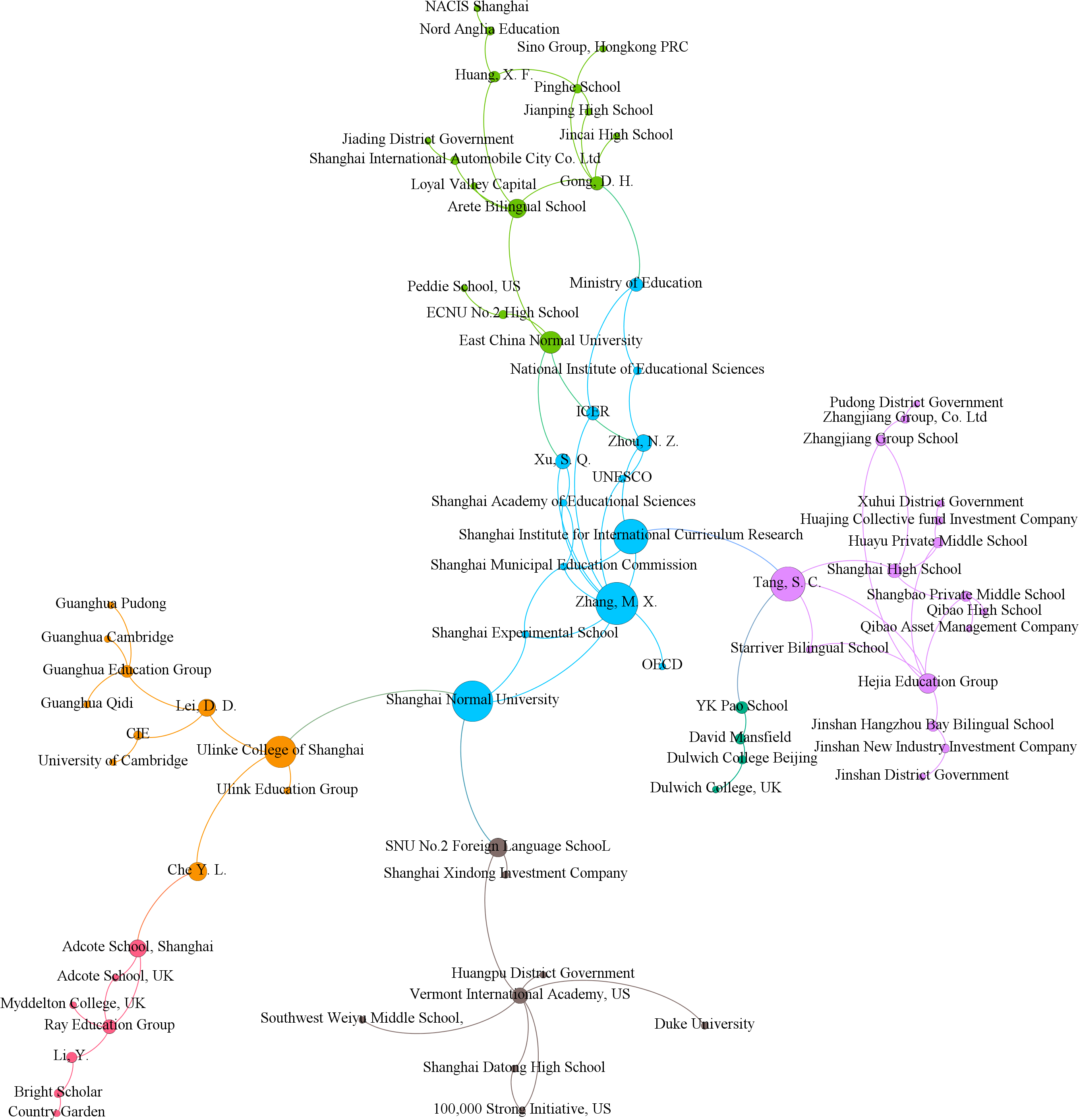
The core policy network in Shanghai's international school landscape.
This three-step research design allowed our policy network analysis to be based on deep contextualization and key insights from practitioners on the ground, which in turn, enabled us to identify and subsequently “follow” key nodes in the international school landscape in Shanghai. Nevertheless, due to our difficulties in contacting with these key nodes, we experimented with network ethnography that draws on publicly accessible data. This approach partially constrained our analysis and findings, which may reflect what Savage et al. (2021) noted as the problem of “elite privileges” (p. 312) in mobility research. We return to reflections on network ethnography in the conclusion.
Findings: Implicit hierarchies and the constraining effects of policy learning
The following discussion begins by outlining how Shanghai's policies categorize international schools and apply differentiated management. As will be seen later, the typologies in the policies almost align with those in the literature. The second section addresses the perceptions and categorizations of practitioners, featuring the various ways of enacting international curricula and the concomitant consequences of policy learning. The third section, drawing on a social network map centered on three key nodes, offers some explanations for the gaps between policy design and practices.
Typologies in texts: Clear-cut boundaries and segregated management
Figure 2 illustrates the typologies used in the policy documents. Traditional international schools and Chinese internationalized schools (CISs) constitute the two main categories. The first main category includes two sub-categories: schools founded by foreign institutions and international divisions affiliated with state schools. The second main category includes three sub-categories and variations: local private schools, international curriculum classes affiliated with state schools, and overseas franchised schools. Schools are subject to different policies and regulations according to the different categories and sub-categories to which they belong.
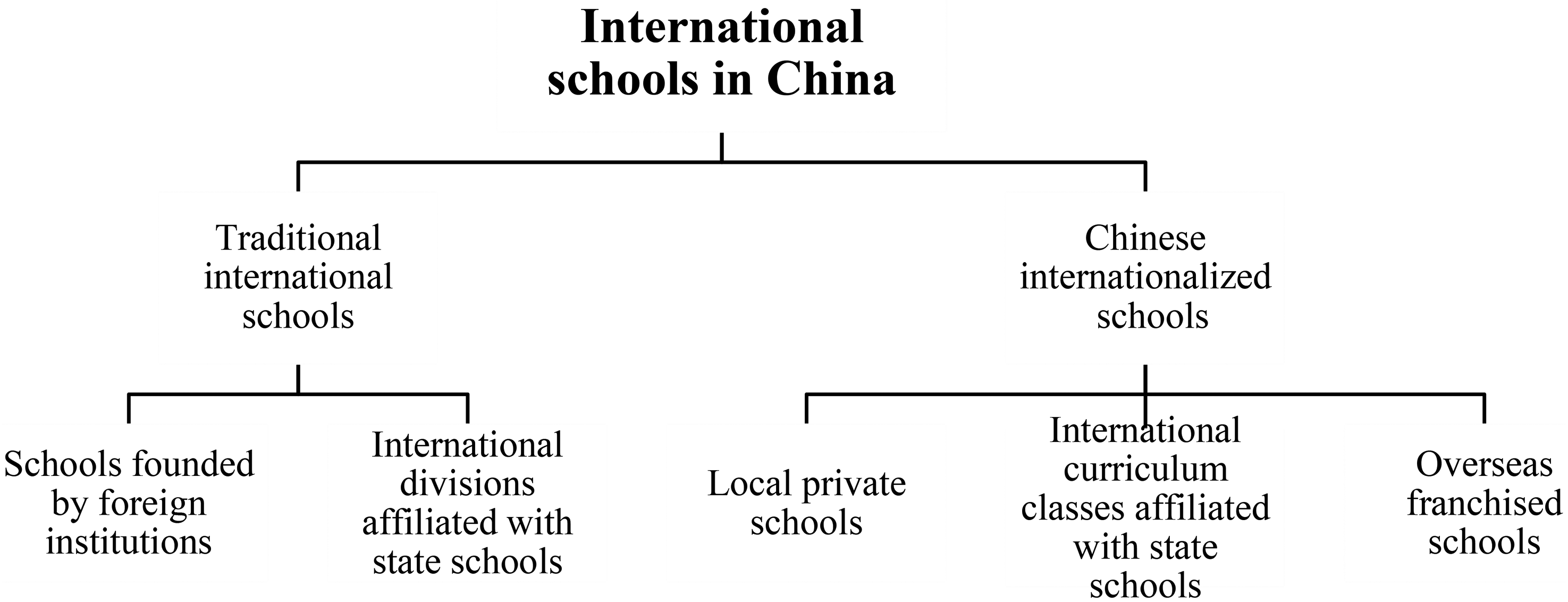
Typologies of international schools under China's policies.
The first main category of schools is subject to the central and provincial governments’ policies regarding schools for expatriates, such as the regulations in the Notice on Further Strengthening the Management of Schools for Children of Foreign Personnel in the City (Shanghai Municipal Education Commission, 2014). In fact, in early 1995, the Tentative Measures for the Administration and Establishment of Schools for Children of Foreign Personnel (State Education Commission of the People's Republic of China, 1995 3 ) showed a positive attitude toward foreign institutions and businesses establishing schools in China to offer education to children of foreign residents, such as ambassadors and employees of Chinese branches of overseas companies. Some international divisions affiliated with state schools, which exclusively recruit students with foreign or overseas Chinese passports (e.g., the Shanghai High School International Division established in 1993 4 ), are subject to the same policies.
The distinction between traditional international schools and CISs is also highlighted in some media and business reports. For example, the rankings of international schools in China, published by a subsidiary of the Hurun Report, 5 Hurun Education, are split into the Top 80 International Schools for Mainland Chinese Citizens and the Top 20 International Schools for Children of Foreign or Overseas Chinese Passport Holders. 6
The second main school category in Figure 2 is usually described as “Chinese Internationalized Schools” (Poole, 2019, 2020). These schools are divided into three sub-categories by policies: local private internationalized schools, international curriculum classes affiliated with state schools, and overseas franchised schools.
The number of local private internationalized schools increased with the support of policies in the 1990s to encourage non-state actors (including private enterprises, public institutions, and individual citizens) to participate in the provision of education and to satisfy the government's agenda of building new development zones (see Jin, 2022). As a kind of high-fee private school 7 that specializes in international education, the private schools in our study, which target local middle and upper classes, differ from the low- and medium-fee private schools in Schulte's (2017) study. For example, the World Foreign Language Primary School and Secondary School (hereafter, WFLs) were state schools founded in 1993 and 1996 by the Xuhui District government and civil society actors, respectively. 8 They became private schools in 2005 with the investment of the JuneYao Group, a Shanghai-based company that was founded in 1991 and provides services in air transport, finance, technology, and marketing. 9 The investment in WFLs, according to the JuneYao group's website, was made to “respond to the call by the SMEC and the Shanghai government for comprehensive reforms and modernization in education.” 10 Privatization was one of the measures taken to modernize education in China, and local businesses were encouraged and called upon to participate in education reforms, such as JuneYao's investment in WFLs. At almost the same time, some other prestigious private schools were founded in Shanghai, for example, the YK Pao School in 2007, which was launched by the offspring of Sir Yue-Kong Pao, a renowned businessman, politician, and philanthropist from Hong Kong SAR, China; 11 the Ulink College of Shanghai in 2005; and the Guanghua Education Group's first school, which was established in 2008.
Although private schools are considered to have a high degree of autonomy (Chan & Wang, 2009), they need to follow the rules and regulations based on Law on the Promotion of Minban 12 Education (hereafter, the Minban Law). This law was first published in 2002, an amended version was published in 2016, and new amendments were added in 2021 (see Jin, 2022). In Shanghai, private schools are supervised by a particular government organization, the Private Education Management Office (Zhang, 2017), and by the government's annual inspection and evaluation systems. 13
The secondary sub-category under the type of CISs category is international curriculum classes affiliated with state schools. They are usually referred to as “international curriculum classes” to distinguish them from “international divisions”, which fall into the first main category. International curriculum classes affiliated with state schools are an outcome of the 2010 Shanghai Outline, which we discuss in detail in the next section. These classes follow the same policy regulations as other state schools in terms of student admission procedures and tuition management. 14 For example, No. 2 High School of East China Normal University opened an international curriculum class in 2014 and works with an elite American private school, Peddie School, to integrate Chinese courses and curricula with American Advanced Placement courses. 15
A third sub-category under the second main category is overseas franchised private schools, whose parent schools are mainly from Britain (e.g., Dulwich College established Dehong School in 2017; Wellington College established Huili School in 2018). Their rise and development in Shanghai were supported by the 2003 Regulations and 2004 Measures regarding Sino-foreign cooperation in education. They usually provide a K-12 education system and emphasize the holistic education that they can offer to students (Wu & Koh, 2022). Combining the characteristics of Sino-foreign cooperation, private schools, and franchised schools, the third sub-category of school is subject to the 2003 Regulations, the 2004 Measures, the Minban Law, and British policies such as the Standards for British Schools Overseas 16 (Tan, 2021). Franchised schools in China must also be audited annually by their overseas parent schools.
The typologies of international schools under China's policies are in line with categorizations in some previous studies. For example, Kim and Mobrand (2019) classified international schools in China into four types (p. 319): (a) expatriate schools, (b) Sino-foreign cooperative schools, (c) private bilingual schools, and (d) international divisions affiliated with a state school. Based on a critical engagement with Western-centric typologies, Poole (2020) divided international schools into traditional international schools for foreign passport holders and “Chinese internationalized schools” aimed at local families; the latter combined national and international elements of curricula, teaching methods, and teacher recruitment.
The typologies constructed in policy documents and the literature are mainly based on the types of actors involved in school management and the student population they cater to. Although the typologies in texts demonstrate a certain degree of variation and diversity in Shanghai's international school landscape, they seem to suggest that these schools are a homogeneous group of high-fee, high-end schools that offer a similar kind of international education to global and local elite families. Although some authors have discussed different types of international curricula adopted in these schools (e.g., Wu & Koh, 2022), they have constructed typologies a priori, rather than responding to the beliefs of professionals in the landscape, which is an important factor for understanding the construction of policy networks (Rhodes, 2007). Based on interviews with practitioners, the following section presents a different understanding of international school types, evidencing ways to enact international curricula.
Typologies in practice: Blurred boundaries and hierarchies of value
Typologies constructed by practitioners indicate the varied meanings they have given to different types of schools and the features they perceive as an ideal way of enacting international curricula in the Chinese context. These accounts show complex relations, ad hocery, and heterogeneity in the international school landscape, demonstrating the challenges of managing international schools in a clear-cut way.
“21 Schools” versus “non-21 Schools”
A typology frequently mentioned by our research participants is the distinction between “21 Schools” and “non-21 Schools.” Responding to the call in the 2010 Shanghai Outline to build a modernized Shanghai by building modernized schools and introducing advanced external educational experiences, the SMEC published the Notice Regarding Trial Work to Develop International Curricula at Senior Secondary Schools (Shanghai Municipal Education Commission, 2013) (hereafter, the 2013 Notice) in 2013. The following year, it approved 21 schools, including 10 public, 10 private, and one Sino-foreign cooperative school (hereafter, 21 Schools). In addition to the reason for implementing the agenda set out in the 2010 Shanghai Outline, some authors (e.g., Xu, 2017) point to the government's intention to curtail the rapid commercialization in the international school landscape with the 2013 Notice. The 21 schools were granted official permits to experiment with international curricula through the 2013 Notice, distinguishing them from “others” that were regarded as self-enterprising schools or businesses. This distinction between and evaluation of “21 Schools” and “non-21 Schools” were echoed by some of our interviewees, particularly those from the 21 schools. For example, Principal Yu (from an international curriculum class affiliated with a state school) recounted the following: We are officially recognized by the SMEC and can issue official certificates of graduation. The others can only issue their own certificates rather than official ones issued by SMEC. Of course, they also need to get approved by SMEC, but they are different from us. They run schools and recruit students on their own and receive less monitoring [from the government]. They manage schools in a commercial way …. You see real estate companies run schools and private tutoring institutions run schools, too.
Ms. Xu, a senior manager at an education consultancy company, also illustrated the problems of commercialization in the landscape: Some senior secondary schools don’t have an official license to run international schools. They use a private tutoring license. The government is investigating these schools. It is problematic if they use a private tutoring license. Their environments and conditions of teaching may not satisfy the government's standards and requirements. After the investigation, I think the only way for these schools is to try to get an official full-time senior school license.
As illustrated by the above accounts, the 21 Schools Policy can be read as one of the measures the government took to curtail the commercialization of education in the international school landscape while also attempting to maintain a space for policy experiments with international curricula to achieve educational innovations. Nevertheless, the expansion and heterogeneity of international schools make it hard to restrict these experiments to a small circle, as explained by Ms. Xu: The division between “21 Schools” and “non-21 Schools” has intensified tensions between international schools in Shanghai. I think it becomes a kind of prejudice and a problem. Some schools like to say, “We are among the 21 schools, so we have advantages.” The rest of the schools feel that they are not being given any attention …. There are so many international schools in Shanghai, yet, the SMEC only selected these few as a circle.
The division between “21 Schools” and “non-21 Schools” seems to depict all of the latter as a homogeneous group of commercialized and unofficial schools; however, our interviewees stated that this was untrue. Indeed, the 21 Schools Policy may face adjustments. For example, Principal Wang (from a local private school), who participated in the annual audits of the 21 schools, highlighted the unstable state of this categorization and its potential for change: The division between “21 Schools” and “non-21 Schools” is just an administrative measure for regulating unlawful student recruitment behaviors. 21 Schools are those that the government recognizes as eligible to implement educational innovations; therefore, they are called the International Curriculum Experimental Schools. The government audits those schools annually …. So it is not that with the title, “21 Schools” naturally became superior. Every year some schools fail to pass [the evaluations], so they need to make adjustments …. The situation is also changing … “21 Schools” may be regrouped again.
From the different meanings our interviewees ascribed to this category, we can glimpse into the complexity and ad hocery involved in Shanghai's international school landscape and the difficulties of managing experiments with international curricula in a clear-cut way.
Chinese internationalized schools versus internationalized Chinese schools
CISs, as described by Poole (2020), are characterized by the integration of national and international orientations in teachers, curricula, pedagogy, and management. However, CISs are subject to strict government scrutiny. CISs at the compulsory education level (primary education and junior secondary education) are required to teach the national curriculum rather than international curricula. Senior secondary CISs can teach international curricula but must deliver four compulsory subjects: Chinese Literature, Geography, History, and Civic Education. Despite the requirement to adopt the national curriculum, CISs are encouraged to create innovative teaching practices by learning and integrating elements from international curricula. To this end, “integration” has been repeatedly emphasized in the school mottos of CISs. For example, the mission of one local private school in our study is to cultivate students to become “successful learners and qualified world citizens rooted in Chinese culture” (see other examples in Poole, 2020).
However, according to some of our interviewees, such “integration” is implemented only superficially in some CISs, rather than substantively. For example, Principal Du, from a British franchised school, recounted that international education in some schools takes on the superficial form of English-medium or bilingual teaching, sidelining pedagogical philosophy and goals: To me, many internationalized schools are simply “bilingual schools.” They think that as long as English teaching and learning are enhanced, or even when English is used to teach the local curriculum, the schools can be called international schools. They think it is how international education is being practiced. In fact, this is definitely not right. However, quite a lot of schools are doing this in the market. To be honest, I look down on them.
Ms. Song, a math teacher from a local private CIS, expressed a similar impression and evaluation of CISs in Shanghai: My previous working school was a bilingual school. As the textbooks used there were from overseas, it was considered an international school. But I don’t think it embraces an “international” philosophy, so I would not count it as an international school …. I think its philosophy is more utilitarian, that is, test scores override everything …. To me, the goals of international education should be to develop students’ potential rather than to focus on knowledge itself.
In addition to contentions over teaching and curricula, some interviewees questioned the enactments of “integration” in school management and culture. For example, Ms. Ge, a math teacher from a British franchised school, described: Bay School [a local private CIS] is more like a traditional state school than an internationalized school in terms of school management, though the students there are learning an international curriculum …. The hierarchy is very clear. Leaders are leaders, and staff is staff.
On the one hand, the above accounts reflect local contingencies and “moorings” (Savage et al., 2021) in shaping the reception and adaption of external experiences, which may constrain more open and equal educational dialogues with “others.” On the other hand, these descriptions highlight tension and a form of global inequality in defining cosmopolitanism and modernization: they seem to suggest that, in order to be “modern,” Chinese education should be changed and reformed according to “international” curricula and their underlying philosophy. However, some forms of so-called “international” curricula, for example, A-levels or AP programs, are, in fact, other countries’ national curricula—they are not “international” but are considered as such. This may also reflect the paradoxes and dilemmas of the initiative to learn from international curricula and the “West–China” binaries (You, 2020) embedded in it.
Indeed, after years of curriculum and education reforms, mainstream state education in Shanghai has increasingly become more innovative, holistic, and “progressive,” which further questions the essentialist claim of cosmopolitanism in international curricula. Principal Liang (from a local private CIS) described: We use a trans-discipline program in our kindergarten. You can’t say it comes from the West. Now, it is hard to say the origins of a kind of pedagogy, whether it's from the West or East. It may be better described as “progressive,” meaning it's not that “traditional” and is more closely related to updated research on curricula and teaching …. You can’t say there are no international elements in state schools. Many schools cultivate students’ international awareness, especially in big cities such as Shanghai. I got in touch with a very small state primary school in Minhang District. They cared about external relations, established partnerships with some other schools around the world, and sent students overseas to visit them. I think they are also cultivating Chinese citizens with a global outlook.
Inspired by Principal Liang's account, we coin the term “internationalized Chinese schools” here, in contrast to “Chinese internationalized schools,” to highlight the complexity in the notions of “Chinese” and “international” and foreground the struggles involved in the international school landscape shaping our imaginations of education modernization.
International schools versus exclusive schools
International schools for expatriates are often termed “exclusive international schools” (Young, 2018). The boundary between these schools and CISs seems to be very clear in policies and in the literature, given their varied student intakes. However, this section demonstrates the blurred boundary that exists between them in practice.
Some interviewees in our study illustrated the relations of traditional international schools to Chinese education. For example, Ms. Li, a science teacher from a British franchised school, described two higher education destinations for students from exclusive international schools. The first destination is high-ranking universities in China. For these students, the principal task of exclusive international schools is to prepare them for Gaokao. These students are referred to as “transnational migrants for Gaokao” (Quan & Xiong, 2007, p. 37) and are usually entitled to less demanding admission requirements than local students; therefore, it is easier for them to gain access to prestigious local universities. Some of these students were born and raised in China, and their foreign passports (usually from developing countries) are an outcome of their local parents’ strategies, efforts, and investments to produce entitlement through the advantages that come with being “transnational migrants for Gaokao” (Xia & Yu, 2011; Xiao & Wang, 2007). The places at these exclusive international schools are used by local upper and middle classes as a tool to reproduce their social advantages.
The second higher education destination for students from exclusive international schools, like most students from CISs, is universities overseas. In this sense, the teaching practices and objectives are not very different from those at CISs. In some exclusive international schools, whose student intakes are mainly from Chinese-speaking regions or countries, teaching is conducted bilingually, making these exclusive schools more similar to CISs.
A clear boundary between exclusive international schools and CISs has been drawn in policies and some academic studies. As their clientele is assumed to be comprised of globally mobile expatriates, exclusive international schools are often overlooked by local policies and are given more freedom and autonomy, for example, as mentioned earlier in this paper, in terms of the actors who can run these schools. Additionally, they are considered to cater to a small group of people with cosmopolitan outlooks and dispositions, who have the potential to contribute to global public goods. Therefore, these exclusive schools are often considered to be “authentic” (Hayden & Thompson, 2013) international schools. Yet, as shown in this section, exclusive international schools can be used by wealthy local families to reproduce their social advantages and, consequently, raise questions regarding the equality of access to local higher education. Furthermore, with a similar obsession with teaching for the Gaokao and admission examinations for overseas universities, it is difficult for these exclusive international schools to claim that they are more “international” or authentic than CISs.
The above discussion shows the importance of the 2010 Shanghai Outline in shaping the policy trajectory of experimenting with international curricula in Shanghai and constructing relations in practice. Based on the analysis of secondary data, we identified a key node (Professor Zhang), who participated in the draft of the 2010 Shanghai Outline, and two other nodes (Principal Tang and Professor Zhou) associated with him in founding a research institute that consults on the city government's management of international schools. The next section focuses on the policy network centered around these three key nodes.
An underlying policy network: Competitive government and economic rationalities
This section shows an underlying policy network that constructed international curricula as a source of Shanghai's policy learning. The policy network demonstrates the more complex relations and interests involved in the international school landscape in Shanghai and may help further understand the blurred boundaries that exist in practice.
As mentioned earlier, the purpose of taking international curricula as resources for policy learning can be seen clearly in the selection and distribution of the 21 schools. The 21 schools include 10 private schools, 10 public schools, and one Sino-foreign cooperative school. These schools adopt various international curricula, including foreign national curricula (i.e., AP, A-Levels, Canadian, German, Australian, and Japanese courses), the IBDP developed by the IBO, and a curriculum developed cooperatively by a Chinese university and ACT Education Solutions (see also Jin, 2022; Shanghai Municipal Education Commission, 2014). This is clearly a deliberate policy design intended to experiment with different types of international curricula in different settings. Our analysis shows that one of the three key nodes in our study, Professor Zhang, may have played an important role in shaping this policy design. According to his resume on the website of the institution to which he is affiliated, 17 Shanghai Normal University (SNU), Professor Zhang chaired the draft of the 2010 Shanghai Outline and held a senior government officer position at the SMEC in 2010. Professor Zhang also supervised a doctoral student, Dr. Xu, at the East China Normal University to conduct a study on international curricula in Shanghai in 2011 (Xu, 2017). Dr. Xu currently works at Shanghai Academy of Educational Sciences, a semi-official research institute and think tank affiliated with the SMEC. The relations that extend from the key node Professor Zhang and the potentially significant role they played in shaping the policy initiative to learn from international curricula reflect the structure of policy networks in Shanghai's international school landscape, in which the core policy network that relates to decision-making is deeply involved with the government.
Somewhat related to the above point is that the rise and expansion of international schools in Shanghai were not only driven by policies or the market targeting local middle- and upper-class families but were also fostered by the competition between district governments for talent and economic development opportunities. For example, as shown in Figure 1, the Hejia Education Group, led by Principal Tang, comprised three private middle schools that were respectively invested in by collectively owned real estate development companies related to three district governments—Minhang, Xuhui, and Pudong. The three schools adopt China's national curriculum, but they exchange teachers and share the management team (particularly the leader, Principal Tang) with two international schools in the Hejia Education Group. International schools in the policy network are linked with the city or district governments’ agendas to build Special Economic Zones (hereafter, SEZs), and their futures are contingent on these relations. For example, Arete Bilingual School was co-founded by the East China Normal University, Loyal Valley Capital, a local private equity firm managing assets of $1.6 billion, and an organization founded by the Shanghai government for planning and developing the Automobile City in the Jiading District, the Shanghai International Automobile City. 18 According to its introduction on the official website, the Concord Bilingual School was established in 2017 “with the guidance of the district education bureau” and “fully supported by the Huangpu District government.” 19 The school also explicitly states its aims “to cater to students’ various educational needs inside and outside of the district” and to “promote the district economic development by covering children's education of high-level talents at nearby Fortune Global 500 companies.” 20
Here, we should distinguish between the two types of international schools and the associated education privatization. One type of school, as illustrated above, is supported by the city government or district governments, serving the construction of SEZs, and is funded by collectively owned or state-owned investment companies. The other type of school is founded by individual entrepreneurs or private companies and is less related to the city or district governments’ economic agendas. As shown in Figure 1, the first type of school (e.g., Arete and Starriver) is more closely and directly related to the three key nodes in our study, while the second type is more distant (e.g., Ulink and Guanghua). Ulink Education opened its first school in Shanghai in 2005 in collaboration with SNU. In fact, Ulink was then named “SNU Cambridge International Centre” and has been “the best performing international program in Shanghai in the rates of admissions into overseas universities.” 21 As one of the earliest private international schools in Shanghai, Ulink trained and cultivated many international education leaders. For example, the president of another big private international education group in Shanghai—Guanghua Education Group—once worked at Ulink as a provost, 22 and the founding principal of the Shanghai Adcote School (a sister school of the Adcote School in the UK) also previously worked at Ulink. 23 Yet, despite its performance in student admission and its history in the market, it is more peripheral in Figure 1 and more distant from policymaking.
China's education policies in relation to international schools saw radical changes in the last decade, particularly in the last three years, demonstrating a movement toward “anti-privatization” (Verger et al., 2017, p. 799). Private actors involved in the Chinese education sector, particularly businesses, face increasingly strict regulations (Jin, 2022). For example, some provincial governments announced plans to limit the percentage of students enrolled in private schools to 5% of compulsory education students (see also Jin, 2022; Peng, 2021). However, based on our analysis above, we would argue that recent policy changes are less likely to influence schools closely related to district or city economic development than self-enterprising schools. However, if the chief responsibilities of schools are orientated toward political or economic rationalities, they may be constrained in their potential to experiment with innovative educational ideas and contribute to policy learning for the sake of education.
In addition to the dominant economic and political rationalities in shaping the structure of policy networks in Shanghai's international schools, we also noted the frequent movement of key nodes between the public and private sectors. For example, Principal Tang worked at a prestigious state school (Shanghai High School) for 20 years before he led the establishment of a private international school (Starriver Bilingual School) and the Hejia Education Group. Many teachers and most of the management team at Starriver came from Shanghai High School. Notably, Shanghai High School was the earliest school to open an international division (in 1993) catering to expatriates’ children and, therefore, gained many experiences and resources in international education. In this case, the example of Principal Tang's movement between Starriver and Shanghai High School provokes further questions about the exclusiveness of traditional international schools within China's education and education governance, as discussed in the last section and illustrates the complexity in the typologies of international schools in practice.
In addition to managing Shanghai High School and the Hejia private education group, Principal Tang also worked with Professor Zhang and the late Professor Zhou to establish an international curriculum research institute (SIICR) in which a former vice director of the SMEC was also a consultant. Both Professor Zhang and the late Professor Zhou worked closely with international organizations, such as the OECD and UNESCO. SIICR is a “new space” (Ball, 2016) created by key actors where ideas for educational reform are exchanged, relations are built, and boundaries are adjoined. International curricula are mobilized in and through nested relations between public and private, governmental and non-governmental, and local and global actors, and their mobilities also extend and enhance these relations. Such complex interrelationships and pipelines may partly explain why clear-cut boundaries and segregated management design in policy documents fail to take effect in practice. These embedded relations may also demonstrate the autonomy of policy networks and raise questions about whether policy networks can be effectively monitored or steered by the state (Rhodes, 2007).
However, it is worth noting that due to our lack of access to and interviews with key nodes, our discussions here are only tentative and based on relations as they appear on paper. Future studies could further explore the dynamics in the Shanghai international school landscape by shedding light on key actors’ perspectives and reflections on their experience and choices.
Concluding remarks: Experimenting with network ethnography in the context of China
Based on a case study of international schools in Shanghai and drawing on techniques from network ethnography, this paper demonstrates the complex processes, ad hocery, heterogeneity, and struggles involved in policy learning and offers some insights into why educational innovations are difficult to achieve.
As Ball (2016) illustrated, policy mobilities happen in and through “trans-national” and “intra-national” (p. 549) spaces, relations, negotiations, and partnerships between various actors. Traditional geographical imaginations, such as the boundaries between the local and global, public and private, governmental and non-governmental, and business and education, collapse or, at least, are inadequate for capturing the processes and effects of policy mobilities. By following the mobilities of international curricula in Shanghai and experimenting with network ethnography, our study demonstrates the ambivalences, tensions, and struggles in shaping the imaginations of what “good” education is and how it should be related to economic development. With and against such complex and reconfigured relations and modalities of governance, it may be hard for segregated measures and clear-cut ways of management to take effect. Future research and policies may need to use the lens of policy networks to understand what is going on in education and education reform, as well as what is going to be.
Our study is one of the earliest attempts, if not the first, to experiment with the network ethnography method in the context of China. Nevertheless, due to our constrained research resources and social contacts, we could only construct a policy network based on secondary data. In a sense, we conducted network analysis, rather than network ethnography. Although we tried to combine network analysis with interview data, our analysis and research findings have some limitations. For example, our discussions feature little on the dynamics and culture of the policy network; our analysis is unable to confirm a dominant discourse over multiple voices; and our data may have missed more insidious but important nodes by focusing on apparent ones. Our difficulties in experimenting with network ethnography may, in part, reflect “elite privileges” in mobilities studies and some other “researching up” studies (Savage et al., 2021, p. 312), which demand high-level resources, effort, and investments to follow and stay close to policy and policy elites. Future studies may consider how to make network ethnography more accessible to young researchers.
Footnotes
Contributorship
Jin Jin was responsible for designing the study, revising the manuscript according to reviewers’ feedback, and finalizing the paper. Jiaying Chen drafted the early version of the manuscript and contributed to data collection.
Declaration of conflicting interests
The authors declared no potential conflicts of interest with respect to the research, authorship, and/or publication of this article.
Ethical statement
Pseudonyms were used for the names of people and institutions in the interview transcripts. All research participants were informed of potential ethical risks and provided their consent to participate in the study.
Funding
The authors disclosed receipt of the following financial support for the research, authorship, and/or publication of this article: This work was supported by China's National Social Science Fund Education Youth Project entitled “Globalization and China's Education Governance Through the Lens of Policy Networks” (grant number CGA190250).
