



Abstract
Purpose
This article maps the rise of venture philanthropy in public education in Australia, exploring how policy networks mobilize high-level systemic reform and governance technologies. This is philanthrocapitalism, a fundamental shift for policy mobility and modes of redistribution.
Design/Approach/Methods
Drawing upon network ethnography, I focus on a node called Social Ventures Australia (SVA), an organization committed to revolutionizing venture philanthropy in Australian education reform. SVA, the brainchild of McKinsey & Company and multinational corporations, is a useful example to map how venture philanthropy leverages resources and, in the process, fundamentally changes the shape, functionality, and form of traditional government.
Findings
SVA has successfully advocated for several intermediaries, such as an evidence broker (Evidence for Learning), a national charity (Schools Plus), and a national education research institute (Australian Education Research Organisation). Overlapping philanthropy and state, the intermediaries stand as a critical assemblage and technology of governance.
Originality/Value
Venture philanthropy and the way in which these networks achieve high-level systemic reform is under-researched in Australia. It stands as a critical lever of policy reform in public education. This article will scrutinize and map the way these networks mobilize reform and function as an identifiable form of economic exchange.
Introduction
The rise of venture philanthropy in public education is well researched in countries such as the U.S. (Saltman, 2010; Scott, 2009; Scott & Jabbar, 2014; Tompkins-Stange, 2016), or the UK, Europe, and elsewhere (Ball, 2012; Ball & Olmedo, 2011; Ball et al., 2017; Olmedo, 2014), but, as a recent development in Australia, it is under-researched in terms of how venture philanthropy influences education policy (see Hogan & Williamson, 2022; Hogan et al., 2022; Rowe, 2021a, 2022a).
Venture philanthropy is partnering rather than giving, or in other words, building influence and affecting change—and often this “partnering” occurs in a context where charitable acts are desperately needed—such as public education. In Australia, public schools are largely funded by their respective state or territory government rather than the federal government, whereas the continually growing and expanding private sector is funded by the well-resourced federal government, and high parent fees (Forsey et al., 2017; Rowe, 2019). Public schools are increasingly underfunded, resulting in significant funding gaps, with public schools spending extraordinary amounts of their time on fundraising from the community, or simply, going without (Rowe & Perry, 2020a, 2020b; Thompson et al., 2019). This exacerbates an ever-growing divide between the rich and the poor, between parents with resources and those without. While public schools often struggle to resource the basic requirements of their school, such as heating or cooling, many private schools are building Olympic-sized swimming pools and million-dollar investment portfolios (Schneiders & Millar, 2021). The funding structures are based on inherently unfair and inequitable foundations, and it is in this context that venture philanthropy finds its opportunistic space.
In this article, I trace the emergence and influence of venture philanthropic organization, Social Ventures Australia (SVA), as an example of a pluralistic policy network. As I will set out, SVA is the peak venture philanthropic organization in Australia and an influential node in driving large-scale reform in public education. Yet, at the current point in time, there is a lack of academic research focusing on how SVA mobilizes policy—arguably a highly urgent area of critique.
SVA is the brainchild of global consultancy McKinsey & Company, in addition to foundations and banks.
1
SVA received pro bono consultancy from McKinsey & Company and the Bill & Melinda Gates Foundation among others. In developing its education reform agendas, SVA seeks to emulate the Gates Foundation's model of “evidence-based catalytic philanthropy” (SVA, 2013b; Traill, 2016a). The first CEO, a former merchant banker from Macquarie Bank, expands on the notion of venture philanthropy. A lot of the work and thinking behind SVA drew on overseas examples, particularly in the US, of emerging venture philanthropy organisations. “Venture philanthropy” describes the idea of bringing venture capital and private equity disciplines, funding and support to selected social entrepreneurs. (Traill, 2016a, pp. 71, 72)
In affecting reform, the venture philanthropic-backed networks highlight a modern governance state and era of capitalism, that is—philanthrocapitalism—fundamentally altering the shape and form of the traditional capitalist state and the means by which revenue (money, taxation, contracts, and appointments) is redistributed and how legislation is shaped and assembled. And, while these hyper-mobile policy networks clearly decenter the traditional government, the modern state continues to play an important role in propping up and facilitating venture philanthropic policy networks.
While this article attends to a nation-state perspective, it is important to indicate how venture philanthropy is positioned within a global context and how these networks are not limited to the nation-state.
The golden age of venture philanthropy: A global phenomenon
Green and Bishop (2006) famously declared “the birth of philanthrocapitalism” in the mid-2000s, in the same period of time that Bill Gates left Microsoft to pursue a full-time position at the Bill & Melinda Gates Foundation, a venture philanthropic organization. It should be noted that as the world's wealthiest commit to giving away their fortunes, so, too, inequality, as measured on a wide range of different metrics, is significantly growing, such as the gap between the richest and the poorest, or the number of people experiencing homelessness, stagnant wages, poverty, unemployment, or precarious employment (Joyce & Xu, 2019; OECD, 2011; Piketty, 2014).
Although foundations focus on initiatives outside of education (the Gates Foundation and their spending on health exceeds the budget of Canada and Germany, see McGoey, 2015), their interest in education is consistent and remarkable. Public education is regarded as an “untapped” source of revenue, such as the Merrill Lynch-Bank of America valuing the education sector at US$4.3 trillion (Verger et al., 2016, p. 5), Rupert Murdoch's commercial stakes in education (Bradshaw, 2011), or McKinsey & Company declaring it as a “$70 billion market” (Lebraud et al., 2012). This is a global “phenomenon,” as declared by Michael Barber, the former director of McKinsey & Company (2005–2011) and the chief education advisor at Pearson (2012–2017). And, while education reform used to be regarded as a solo endeavor by individual countries, “today it is a global phenomenon,” says Barber (Cave & Rowell, 2015, p. 230). This is a euphemism for global market.
The influence of these foundations in education reform is significant. For instance, the Gates Foundation gives generously to support Charter School Initiatives and makes up almost the entire budget of policy agendas committed to growing charter schools (Au & Ferrare, 2015; Au & Lubienski, 2017). Fontdevila et al. (2021) estimated that the Gates Foundation and its contribution to the pro Charter Schools campaign, “represented around 80 per cent of the campaign's total budget,” successfully enabling their desired outcome (p. 138). There is a critical reshaping away from the traditional government as the center point, captured effectively here by Reckhow (2013): After a hard-fought presidential election, the leading national figures in education did not gather in Washington, D.C., to hear an address from [the newly elected President] Obama. Instead, [educators], governors, the secretary of education, unions and leaders in the education non-profit world convened in Seattle, Washington, to hear Bill and Melinda Gates speak about the new education priorities of the Gates Foundation. (Reckhow, 2013, p. 1)
While venture philanthropic policy networks potentially provide an exciting new shape of postmodern governance, one that is more mobile and responsive, one that can foster relationships with a diverse number of nodes and depart from the “stale” or slow bureaucratic government, there are tensions in how nation-wide education policy is mobilized and the influence that a relatively small number can garner. These policy networks, as I will study in this article, are dominated by financiers, and the sector is unlikely to represent the wider population. Reckhow (2013) referred to these changemakers as “boardroom progressives.” As they are not accountable to the broader public and are not subjected to reporting to the public, or democratically voted into positions or roles of power, their capacity to mobilize high-level policy reform, and yet unaccountable to any kind of democratic transparency or input, is concerning.
The following section explores how venture philanthropy reforms education policy but, in doing so, effectively drives philanthrocapitalism and the role of the capitalist state.
Philanthrocapitalism and network governance
Venture philanthropy is distinct from earlier versions of philanthropy, described as “industrial” or “scientific” and giving for the sake of giving (Saltman, 2010). Venture philanthropy, or what many in the industry refer to as “philanthrocapitalism,” is investing rather than granting (Bishop & Green, 2008; Green & Bishop, 2006). Venture philanthropy is wanting something in return. This can be in the form of high-profile roles or high-value appointments to senior-level government committees; it could be an increase in won contracts and jobs for their corporation; or simply a form of tax minimization—in other words, venture philanthropy gives money in order to generate profit, a loyal customer base, or policy influence. It is results-oriented, entrepreneurial, savvy, and strategic (Scott, 2009). Philanthrocapitalists aim to revolutionize the nonprofit world by emulating the way business is done, believing that capitalism can be “naturally philanthropic,” driving innovation and system-level improvement in a way that benefits everyone (McGoey, 2015, p. 7). Philanthrocapitalism may signal postcapitalism, or a crisis of capitalism, as it seeks to bring together creative approaches to generating profit and “doing good” at the same time (Kinsley, 2010).
Philanthrocapitalism signals a radical shift away from bureaucratic government, established around traditional forms of redistribution, where the centered hierarchy, as a set of institutions that is sovereign and democratically accountable, determines monetary distribution via the extraction of revenue (taxation) from the polity (Dunleavy & O'Leary, 1987). Philanthrocapitalism fundamentally alters the way in which resources and money are redistributed among the population, in that traditional government redirects an increased amount of resources to intermediaries (such as consultancies, private organizations, and not-for-profits) via grants, high-value contracts, or appointments (Gunter et al., 2015). This is noted as one of the “most striking features” of philanthrocapitalism: In the past couple of decades [there] has been growing importance of professional advisers, intermediaries, and other service providers, and of a market-based system that seems designed to let them thrive. (Bishop & Green, 2008, p. 218)
This is particularly pronounced in Australia, with federal government expenditure on consultants dramatically increasing since 2013 (Browne, 2021). By population, “Australia's spending on consulting is greater than that of any other country, and about double that of comparable countries like Canada or Sweden” (Browne, 2021, p. 2). This is relevant for this study, with SVA receiving funding from the traditional government.
One particular shape and functionality of the state is traditionally seen in levels of power and the capacity to affect legislation and reform. But this traditional set of powers to affect legislation and reform is debated within policy network studies (Han & Ye, 2017; Shiroma, 2014). This is the question of “network governance” (Han & Ye, 2017), or “governance without government” and the hollowing out of the state (Rhodes, 1996). As vertical forms of authority and sovereignty become shape altered, the question becomes whether the hierarchy remains the central driver of policy reform and social change; this is contrasted to the second school of thought, which argues that the traditional government continues to perform a significant role, in providing funding, leverage, and institutional forms of authority for policy networks (Han & Ye, 2017; Shiroma, 2014). Ball (2009) described this positionality as “heterarchy,” an organizational form, “replete with overlap, multiplicity, mixed ascendancy and/or divergent-but-coexistent patterns of relation” (p. 689).
In this article, I position myself with the latter school of thought that policy networks as hybrid systems, marked out by multiplicity, complexity, and “heterarchy,” fundamentally modify governance technologies, altering the vertical lines, shape, and centering of hierarchical government. Indeed, the binary itself might not be useful, but it points to a problem within policy network studies. In his later work, Rhodes (2017) writes that the nation-state continues to “steer the actors” (p. 17); the state is a “facilitator, a broker” (Olmedo, 2016), or a “market-maker” (Ball, 2007). Networks are an addendum rather than a replacement, in similarity with Rhodes (1996): “to markets and hierarchies, we can now add networks” (Rhodes, 1996, p. 653). As the system shifts from capitalism to philanthrocapitalism, policy networks represent significant forms of power, working with markets and hierarchies.
Philanthrocapitalism represents more diverse shapes and interconnections between the shapes (Latour, 2002; Law, 1992). Understanding power as “a set of effects,” rather than predetermined or existing out there, policy networks change the orientation and structures of democratic forms of traditional government, but not always in entirely evident ways. They are characterized by heterogeneous intermediaries, such as foundations or “not-for-profits”; these intermediaries are governance technologies, characteristic of philanthrocapitalism, and are key for the reordering of economic exchange. This reordering should be regarded as an assemblage of a set of effects (Law, 1992) that alter the shape and contours of power—progressing high-level education reform and modes of distribution—thinking about “power as a (concealed or misrepresented) effect, rather than power as a set of causes” (Law, 1992, p. 387, italics in original). The following section discusses the methodology before turning to the analysis of SVA.
Methodology
This study was carried out in the context of a broader 3-year-long study on venture philanthropy in public education (Rowe, 2021a, 2022b), drawing upon network ethnography to examine how venture philanthropy mobilizes education reform in public education in Australia. The approach to network ethnography is influenced by Ball et al. (2017) in following people, following things, and following money. It is “not simply the mapping of networks” and identifying or describing connections, “but rather to move on to begin to understand ‘how’ policies move, and the labour of mobility, the work of networking” (Ball et al., 2017, pp. 5–6).
This article generates multiple sources of data, including comprehensive and highly purposeful internet searches, face-to-face interviews, and draws upon official databases (see Appendix 1). The method utilizes SVA as the hub and follows the hub to the “spokes” (intermediary organizations, people, money, things, and policy) (Hogan, 2016; Junemann et al., 2018; Scott & Jabbar, 2014). To follow people, I have paid attention to institutional affiliations, which tend not only to be widely promoted within online curriculum vitae, but also published in great depth in financial reports and impact statements. The article uses Gephi as a means to qualitatively and visually map the connections, ties, and links (Ball et al., 2017).
The formal databases drawn upon in this article include the Australian Charities and Not-for-profits Commission (ACNC) database, which provides free-of-charge financial reports and names of directors; purchased reports from the Australian Securities and Investment Commission (ASIC), in order to follow names, nodes, and company structures, including company constitutions. Impact reports and financial reports were collected for each main hub, including SVA and the subsidiaries and/or intermediaries, for every year they are available. The data drawn upon in the article have been included in detail in Appendix 1. The article draws on very few of the interviews generated in this study (six in total), only drawing on two interviews from high-level nodes from SVA and Schools Plus, as a means to complement the aforementioned data.
The analysis first provides a brief introduction to SVA, as an example of a policy network. Policy networks are typified and characterized by their patterns of reciprocity and repetitive institutional connections, as a form of economic exchange.
SVA: Network governance
Emerging in 2002, as an initiative of Robert McLean from McKinsey & Company, SVA “is the largest dedicated player in the Australian social impact investing market” with “$150 million funds under management” (SVA, 2021a, p. 8). As an organization, they have been highly successful in achieving what they set out to do initially and, that is, “revolutionizing” the venture philanthropic landscape in Australia (Traill, 2016a, 2016b). SVA's strategy, as stipulated in its financial statement, is to “engage with government and convene networks to influence policy and practice” (SVA, 2020, p. 8). They aim to influence the way systems operate, make investments in partner organizations to increase their impact, and to advocate and lobby for system-wide solutions, programs, and policies (SVA, 2021a, p. 3). They capture the notion of a boundary-spanner effectively, by bringing together “unlikely partners,” breaking through “red tape” and “seeing things differently” (Williams, 2002, p. 109).
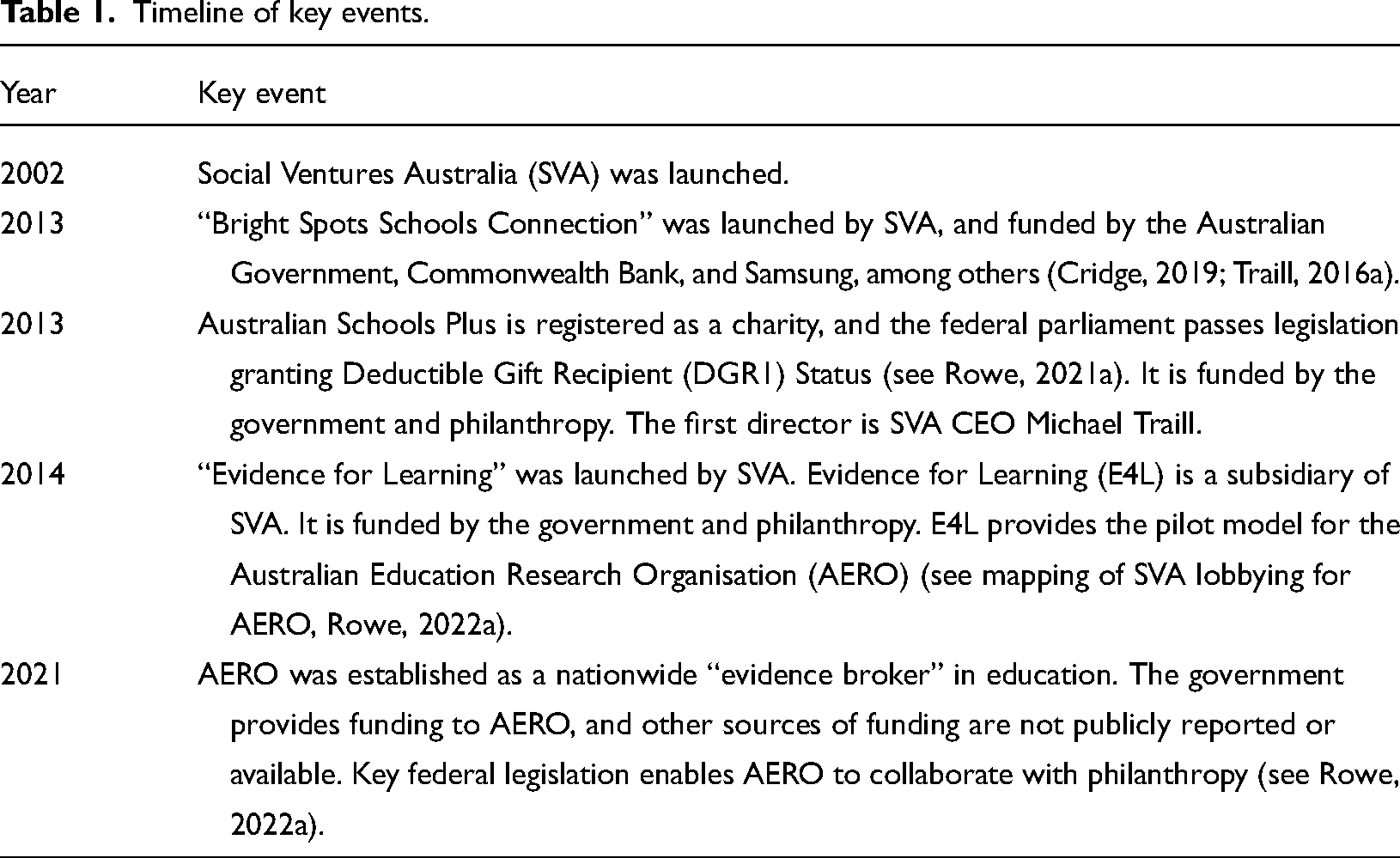
As a node, one that consists of people, things, objects, and policies, SVA represents reach and impact in each facet of public schooling. Arguably, SVA has carried its influence into every single high-level public education reform in Australia since its emergence in 2002. SVA has effectively installed (or advocated for) a number of governance technologies that are able to rearrange and reorder things, including legislation and money (Law, 1992). This includes the government-sponsored “Bright Spots Schools Connection,” a program that remodeled 50 low socioeconomic status public schools across three states (Cridge, 2019), successfully lobbied for a national charity named Australian Schools Plus, and established subsidiary Evidence for Learning (E4L) as a “pilot model” for Australian Education Research Organisation (AERO; see Rowe, 2022a; SVA 2018b).
Each of the SVA-driven nodes was introduced with government funding and/or government legislation (see Table 1).
Timeline of key events.
SVA is the central hub, connecting to each of its spokes—Schools Plus, Evidence for Learning and the Australian Education Research Organisation—and each of its spokes retains ties, connections, and mutuality with the hub. The connections can be identified by shared co-affiliations (Avelar & Ball, 2019), whether this is epistemological or ontological. The co-affiliations can exist categorically for individual nodes, as formal employment or as a donor, or can exist through institutional relationships and modes of exchange, such as the Gates Foundation providing guidance or learning models for SVA. The association is clearly slippery, hyper-mobile, and “messy”—keeping in mind that “network relations are opaque, consisting in good part of informal social exchanges, negotiations and compromises” (Ball, 2009, p. 688)—and exists on multiple levels, categories, and spaces, as individual nodes, institutions, and categorical arrangements are reordered and assembled into a shared network of epistemological and ontological commonality.
The following diagram shows SVA as a broad network, positioning SVA as the hub and connecting the hub to its donors, subsidiaries, and intermediaries 2 (Schools Plus, E4L, and AERO), highlighting shared co-affiliations, ties, and mutuality (see Figure 1).
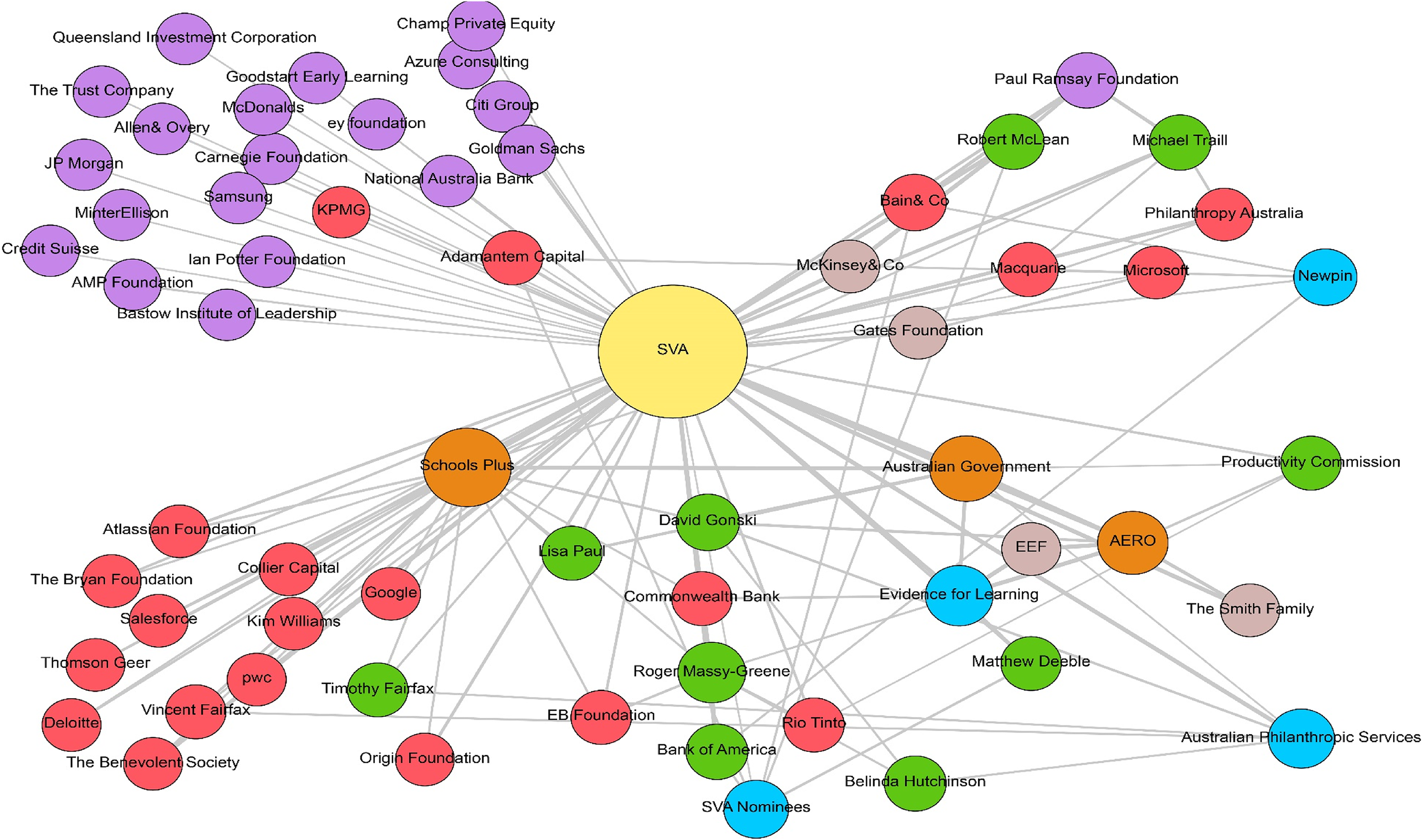
SVA and its expansive network of funders, partners, and donors.
Identifying this policy network commonality is important. It is at the center of philanthrocapitalism and how it functions as an identifiable form of economic exchange. As Avelar and Ball (2019) write, “it involves close attention to organisations and actors within the education policy field, both global and local (and their movement), as well as to the chains, paths and connections that join-up these actors” (p. 66). But, while it may be identifiable, this is not to suggest that it is clearly visible or evident, particularly in the public eye. For instance, the wider public would unlikely know who Michael Traill is, the former CEO of SVA—despite invited personal orations to the government (Traill, 2014), or government representatives attending SVA meetings as a common occurrence (SVA, 2021b), Traill's face-to-face meetings with the Prime Minister's Chief of Staff about the possibility of specific education policy SVA wishes to change (Traill, 2016a, p. 199), or the receipt of government grants that “shouldn’t be made public” (Traill, 2016a, p. 200). This was referencing a $15 million grant that SVA received, but Traill was advised that “the government support could not be made public during the bid process” (Traill, 2016a, p. 200). Traill has since been appointed to chair a senior federal government committee (Australian Government, 2021). It tends to suggest that it pays to be a philanthropist.
The following is a brief overview of specific reforms and intermediaries that SVA successfully lobbied for or established, with a focus on illuminating a shared policy network. It is beyond the scope of this article to examine each reform in depth (which I do elsewhere). I argue that philanthrocapitalism involves relational forms of organization that are clearly identifiable as a form of economic exchange (Powell, 1990). Even though there are efforts to distance themselves publicly from these intermediaries, the recurrency and repetitiveness of individual nodes, donors, and relations are evident throughout; this repetitiveness helps to identify policy network commonality, speaking to shared epistemology, and ontology within the network.
The heterarchical state in practice
The reforms that SVA achieves are the product of a complex interaction highlighting the “heterarchical state in practice” (Avelar & Ball, 2019, p. 65), conceptualizing heterarchy as “an organisational form somewhere between hierarchy and network that draws upon diverse horizontal and vertical links” (Ball & Junemann, 2012, p. 138). But this is not to suggest that it lacks shape, structure, or ranking—arguably, SVA is the interface of a venture philanthropic structure—and rather, describing this as heterarchical points to hypermobility, a mobile shape that is consistently reshaping itself, and while SVA appears to be the hub, sources of power are indeterminate. Clearly, power is not ascertained through clear lines or formal roles; and rather, it seems to be the result of relational co-affiliations.
Scrutinizing the shape of SVA highlights problematic tensions in how these organizations pull on simultaneous levers of state and philanthropy. SVA is registered as a public company and nonprofit charity but retains profitable consultancy services (SVA, 2020). It is exempt from income tax (see SVA, 2020), 3 and it receives sizeable donations from the government and philanthropy (SVA, 2013a, 2019b, 2020). SVA's most recent financial records indicate that they received over one million dollars from “government grants” (AUS$1,216,000) and gave away approximately 51% of this income through grants and donations (AUS$625,000) (see ACNC, 2021). This indicates that SVA receives more from the government than they bequeath through philanthropic gifts.
While there are multiple lines, I am endeavoring to emphasize specific lines of redistribution that should be made explicit. Traditional government directs money to venture philanthropic networks, rather than distributing money directly from government to public schools; schools are forced to compete for competitive grants and align themselves with the ethos and epistemologies of the grant applications. These networks are exempt from paying tax, on the proviso the organization bequeaths approximately half of the government revenue via competitive grants.
To counter an argument to this—intermediaries have always existed in the flowing of government funds to public schools (in Australia, a state department allocates funding to public schools), and the government continues to distribute funds directly to public schools—but in a rational sense, all funds are capped and finite; therefore, taking into account limited funding sources, it is fair to suggest that the redistribution of funds to tax-exempt venture philanthropic intermediaries indicates a changing flow of money from the government to public schools and a refashioning of the role of the state in funding public schools.
Network forms of economic organization and policy influence: Tracing the mobilization of Schools Plus, Evidence for Learning, and AERO
Philanthropy wants to invest in things that are going to change systems. For good. (Interview with high-level node from SVA, 2020. Italics represent emphasis)
SVA is registered as the ultimate holding company of four different subsidiaries, which can be used to indicate policy network commonality (ASIC, 2021; see Appendix 1). The fact that SVA has this highly complex corporate structure, and retains multiple subsidiaries, does not carry high public visibility. Tracing this network is important for how it illuminates network ties, repetitions, and connections; for instance, the following image focuses on the directors alone to highlight reach and flows of power. Indeed, this is only a partial glimpse at their network and omits the influential lists of donors, board members, and associates. Figure 2 maps out connections made via the directors of SVA (both past and present) and the SVA subsidiary company directors.
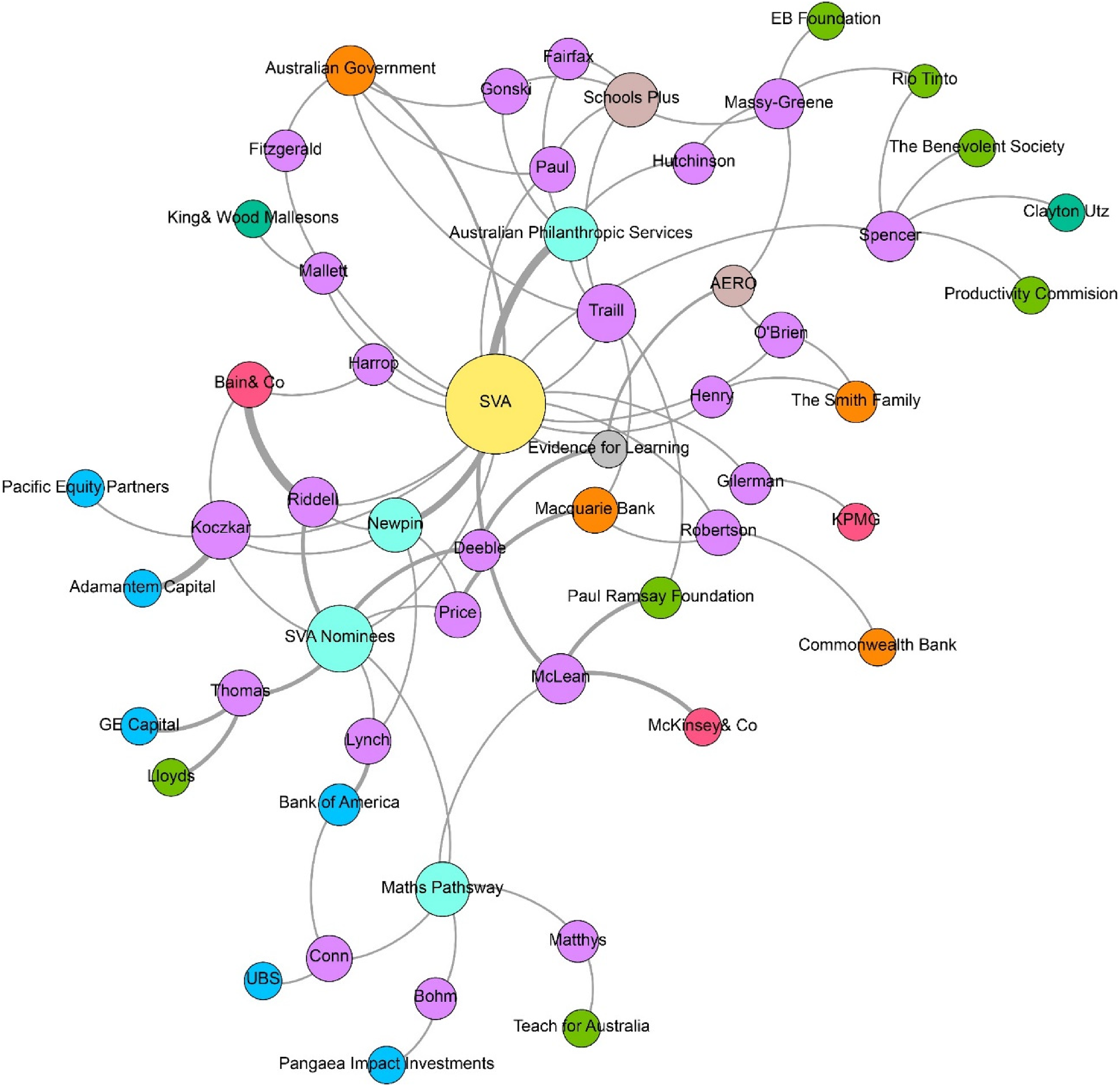
Following people, policy, and money.
This network commonality is important because it indicates how power, influence, and policy are mobilized. It is a network characterized by repetitive relational patterns, but so, too, it is a knowledge network transferring shared values and involves economic exchange. Individual nodes move within the venture philanthropic network, seemingly at ease—moving from corporate, to traditional government roles, and to charity—and the links between SVA and their nodes are highlighted by the commonalities. It is typical for SVA directors (or directors of SVA subsidiaries) to represent high-tier global financial or consultancy services, in addition to high-level government roles (sometimes both). For instance, David Gonski is the co-director of a subsidiary of SVA, named Australian Philanthropic Services (APS). 4 APS is a registered charity, which generates income via a consultancy arm and receives large grants from the government (ACNC, 2021). A corporate lawyer, Gonski, was appointed to high-level roles on federal government education reviews (Australian Government, 2011, 2018)—both of which made major recommendations for the establishment of Schools Plus and AERO.
This raises an important point that is evident throughout the network—that SVA is very much entangled with traditional government—and many directors or donors to SVA are/were employed in formal roles for the traditional government (e.g., Lisa Paul is the former secretary of the Commonwealth Department of Education and Training and former Commonwealth Government chief executive. Richard Spencer is the former Commissioner of the Australian Government Productivity Commission).
The connecting lines and ties between nodes are ongoing and expansive, indicating complex assemblages that result in strategic exchanges. When Gonski's authored government report recommended Schools Plus (Australian Government, 2011), it rapidly mobilized, and by 2013, Schools Plus was registered as Australia's first national charity that would enable corporations to give to public schools for a tax deduction (Rowe, 2021a). In aiming to act “as a bridge between the corporate and the school environment” (interview, July 9, 2020), Schools Plus received government funding of 5 million dollars, and federal legislation promptly “moved” to grant nation-wide deductible gift recipient (DGR1) status to the national charity (Tax and Superannuation Laws Amendment [2014 Measures No. 5] Bill 2014), a significant precedent for state-aided tax subsidization.
The close network alliance between SVA and Schools Plus is seemingly evident, with recurrent individual nodes and sharing of resources. The inaugural registered address of Schools Plus was SVA (from 2013 to 2016, see ASIC records 2021). The former CEO of SVA (Michael Traill) became the first CEO of Schools Plus (2013–2018); or, Lisa Paul, a former director of SVA and donor to SVA is a current director of Schools Plus. 5
A senior-level node from Schools Plus stated in an earlier interview in 2020: And I don’t know whether you know this, but Michael Traill who used to run Social Ventures, was the driving force behind setting us up. So he was my first chairman when I started because—Social Ventures needed …[pause]… they were sort of saying well, there's no …. [pause]… they couldn’t do the work themselves. So they were looking for an entity where people could donate through to schools … We are, yes, very close. (Interview, July 9, 2020. Italics indicate emphasis)
Relational reciprocity is common and would suggest a close network alliance (Avelar & Ball, 2019). There are many examples of the co-affiliations, too many to list in this article—former Foxtel executive Kim Williams is a prior donor to SVA, and now he sits on the board of Schools Plus; Gonski maintains relationality and positionality with Schools Plus, as chair of “Pioneers in Philanthropy” (Schools Plus, 2022).
Evidence for Learning (E4L) was established in 2014 as a subsidiary of SVA (Deeble & Vaughan, 2018). The director of E4L is corporate lawyer Matthew Deeble, who also serves as co-director of two subsidiary SVA companies (see Figure 2). A founding partner (and funder) of E4L is the UK Education Endowment Foundation (EEF), a foundation that was established while Michael Barber was head of McKinsey & Company, who are of course linked to SVA. The founding CEO of the Education Endowment Foundation (Sir Kevan Collins) would later sit as a board member on the Australian Education Research Organisation's “Expert Board.”
Using Evidence for Learning as a “pilot,” SVA lobbied for the Australian Education Research Organisation (AERO) (SVA, 2011, 2016). In 2021, AERO was established as a nationwide “evidence broker” in education, funded by the Commonwealth and State Governments. 6 The ties between AERO and SVA are recurrent throughout their network. For instance, a former director of SVA is now the current chair of AERO's executive board (O’Brien, ASIC, 2021); or, Roger Massy-Greene, a donor to SVA, and a visible part of the Schools Plus network as a “Pioneer in Philanthropy,” is also on the “Expert Board” of AERO. Massy-Greene is the director of Eureka Benevolent Foundation (see Figure 1), which funds Schools Plus and SVA. He is married to Hutchinson, a co-director of Australian Philanthropic Services. But it is not disclosed to the public whether AERO currently receives funds from philanthropic sources. The current CEO stated on a podcast, “we’re being set up in such a way that we can attract philanthropic funding” (Donovan speaking to Ashman, 2021).
The federal government has recently established legislation that formally enables AERO to “collaborate with … philanthropic organisations” (Australian Government, 2016 see Item 8, section 5)—setting another historical precedent for the institutional embedding of philanthropic organizations in education research (Rowe, 2022b). It is questionable whether the use of funds to be potentially directed to venture philanthropic organizations would be better directed to public schools.
Concluding discussion: Changing shapes of the state
This article has drawn on network ethnography, utilizing interviews, websites, financial statements, and corporate watchdog company records, in order to qualitatively map the influence of venture philanthropic policy networks in education reform. Focusing on SVA, the article has illuminated how SVA has been highly influential in mobilizing significant national reform, focusing on the establishment of three different nodes—Schools Plus, Evidence for Learning, and the Australian Education Research Organisation (AERO)—and the accompanying federal legislation and sources of funding.
In similarity with existing research, this article shows that policy networks can be complex and at times opaque (Ball et al., 2017; Junemann et al., 2018), yet can be visibly represented through either informal or formal lines, such as via donations, employment roles, company holdings, and structures. But this is not to suggest that they hold any public transparency or lines of accountability to the voting public, and rather, the process of researching these networks has resulted in numerous contestations.
It is only when identifying and scrutinizing details of the policy network, by examining individual nodes and their institutional affiliations, that we begin to see consistent repetitions and complex assemblages, similar to a web spanning across and connecting to even more complex webs. This points to how the networks function as a form of economic exchange, reproduction, and redistribution. Policy networks are characterized by repetitive and reciprocal relational patterns.
The modern state means that traditional shapes governing distribution and policy mobility become nebulous and difficult to define. Corporate consultants and financiers are clearly invested in education reform, and it is highly questionable whether this is for altruistic motives—in simply wanting to give to charitable causes they find worthwhile—or whether they are seeking to lobby and advocate for reforms that benefit their organization. Indeed, the networks studied in this article are dominated by financiers and consultants, representing some of the largest multinational banks (including Bank of America), consultancies (Bain & Company and McKinsey & Company), and investment companies.
The highly dominant venture philanthropic policy network, as hybrid and pluralistic, is heterarchical, retaining lines that are both horizontal and vertical, but this is not to suggest it is open and democratic. Indeed, they are frequently presented to the public via subsidiary companies, complex structures, and unclear money trails. Corporate consultants invested in education reform fail to acknowledge vested business interests and state-subsidized tax shelters.
The commonality of the policy networks is concerning for democracy and accountability to the public. As these networks not only retain access, but also the direct capacity to mobilize national education policy that directly impacts public education, schools and teachers, and the means by which schools are funded, it is fair to question how transparent and accountable this is to the wider public. This is corporate philanthropy—private philanthropy—with channels of money benefiting tax-exempt private organizations and selectively filtered out via competitive grants to public schools, that schools are forced to apply for.
Footnotes
Acknowledgments
The author would like to thank the editors of this Special Issue, particularly Diego Santori, who provided helpful feedback to improve this article. The development of this article was supported by the Discovery Early Career Researcher Award (DECRA), titled “Venture Philanthropy in Public Education: Governance, Policy and Practice” (DE210100513). The author has sought advice from a corporate lawyer to assist with understanding complex company structures, who wished to remain anonymous. All errors made are my own. I would also like to thank academic mentors including Professor Bob Lingard for his time and intellectual generosity; Associate Professor Nicole Mockler, as the editor of the Australian Association for Research in Education blog (EduResearch Matters) and Jenna Price, for supporting aspects of this article as presented in this blog (Rowe, 2021b). Human Ethics was granted by Deakin University.
Declaration of Conflicting Interests
The author declared no potential conflicts of interest with respect to the research, authorship, and/or publication of this article.
Ethical statement
Human Ethics was granted by Deakin University (HAE-21-132 and HAE-20-074).
Funding
The author disclosed receipt of the following financial support for the research, authorship, and/or publication of this article: This work was supported by the Australian Research Council (grant number DE210100513).

Notes
Appendix 1. Further notes and data sources.
The analysis, as presented in this article, was undertaken in 2021, and therefore the networks, as presented in this article, reflect this time period. The networks are highly changeable and mobile, so details might change after this article is published. The roles, as presented in this article, are verifiable. The following lists data sources according to nodes: