




Abstract
Purpose:
This article examines how individual, school, and social factors shape the perceptions of students in Senior Secondary Three (SS3; in some schools called Form Six [F6]) toward English private tutoring in Macao.
Design/Approach/Methods:
This is a comparative study of two F6 classes of an English-medium secondary school and four SS3 classes of a Chinese-medium secondary school in Macao, with a total number of 145 students. Mixed-methods approach (questionnaires and interviews) is employed in the study.
Findings:
The respondents’ participation in English tutoring is not very intensive. They prefer to receive government-subsidized after-school tutoring taught by their schoolteachers more than fee-paying English tutoring taught by tutors outside. Low level of social competition and high tertiary enrollment rates contribute to this phenomenon. Students’ needs and beliefs in English learning play key roles in determining their receipt of English tutoring.
Originality/Value:
Teachers may need better understanding of their students’ needs so as to design suitable pedagogies. Schools can consider more fully the types of tutoring that they provide for different kinds of pupils. The government-subsidized after-school tutoring could be a plausible way to reduce educational inequality.
Introduction
Private tutoring, also known as shadow education, private supplementary tutoring, or simply tutoring, has become a worldwide educational phenomenon over the past decades. According to the introduction in the book Out of the Shadows (Aurini, Davies, & Dierkes, 2013), the total revenue of the supplementary education industry in just 17 countries (not including the East Asian societies) had already reached around 41.7 billion USD a year (p. xvii). It has become a lucrative multibillion-dollar business.
Various terms have been used in different places to describe private supplementary tutoring. In Mainland China and Taiwan China it is called buxi, in Hong Kong China it is commonly called tutoring, both of which mean 补习 in Chinese. In Macao China, in Portuguese (which is one of the official languages) it is named apoio pedagógico complementar, which is literally translated as complementary educational support in English. Chinese is Macao’s other official language and the official term is 私立补充教学辅助, which emphasizes the feature of “private” and “complementary.” While buxi is commonly used in other places, the Macao government defines tutoring as a means of assisting the mainstream education and provided by the private sector. In this article, shadow education in Macao is defined as “additional support in academic subjects, including academic-oriented tutoring such as preparation for the International English Language Testing System (IELTS), Test of English as a Foreign Language (TOEFL) and other entrance examinations, received in exchange for payment.” Besides private tutoring centers, schools in Macao can legitimately run fee-paying after-school tutoring classes. In this regard, such school-run tutorials also form part of the shadow. This operational definition embraces three essential attributes of supplementation, privateness, and academic subjects (Bray, 1999).
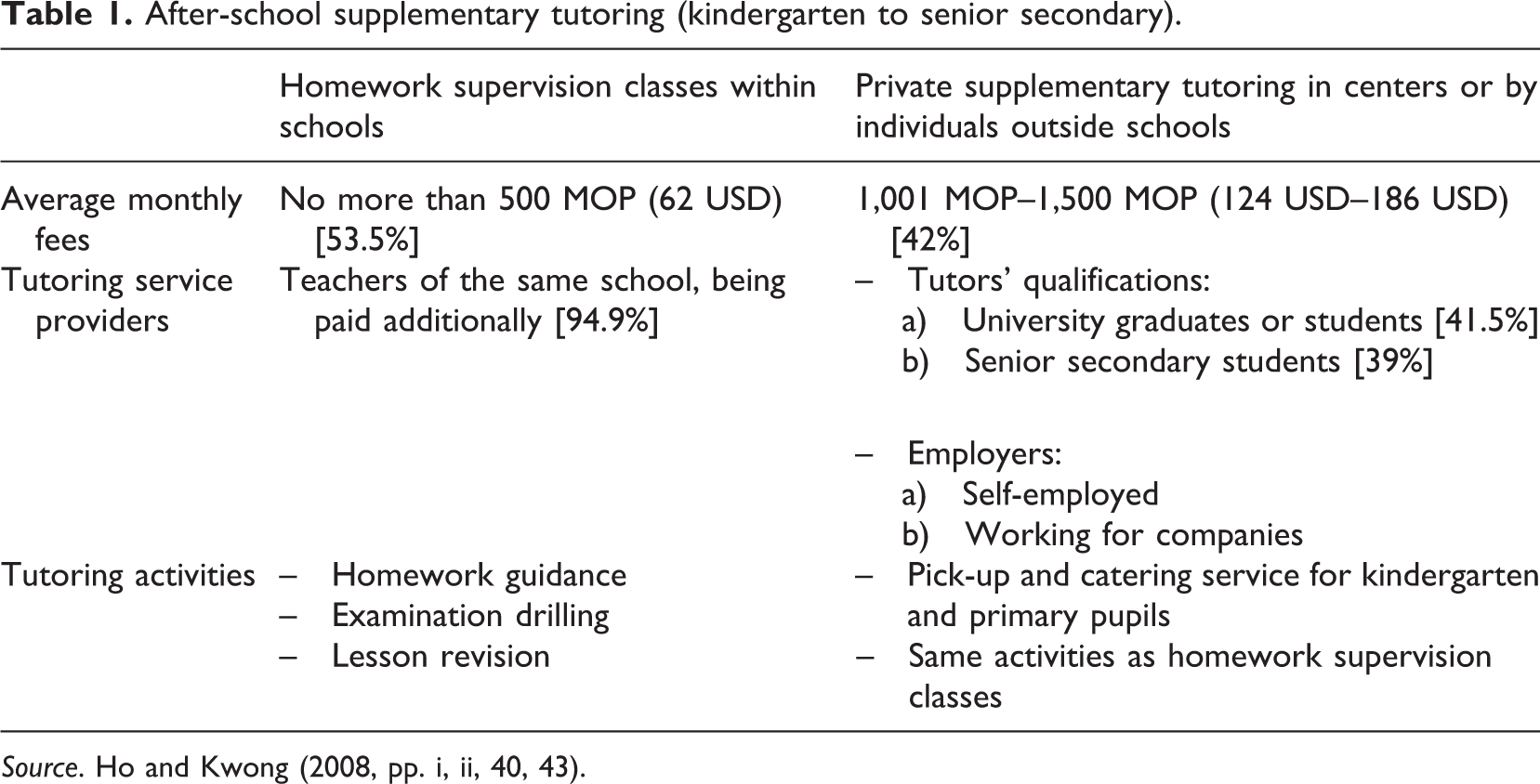
Private tutoring has been widely investigated in different settings, but situation in Macao is under-researched. In 2008, a large-scale study conducted by the Chinese University of Hong Kong and reported by the Macau Education and Youth Affairs Bureau (Ho & Kwong, 2008) was the first in-depth study on shadow education in Macao. Of all primary and secondary students, around 40% were reported to participate in homework supervision classes within schools, and 20% received private supplementary tutoring in centers or by individuals outside schools (p. ii). Table 1 compares the two forms of after-school supplementary tutoring across the entire non-tertiary educational stage.
After-school supplementary tutoring (kindergarten to senior secondary).
Source. Ho and Kwong (2008, pp. i, ii, 40, 43).
In both kinds of tutoring, primary pupils were the major tutoring receivers. The findings suggested that English and Mathematics were the most popular tutored subjects, but there was no further information on how students viewed tutoring.
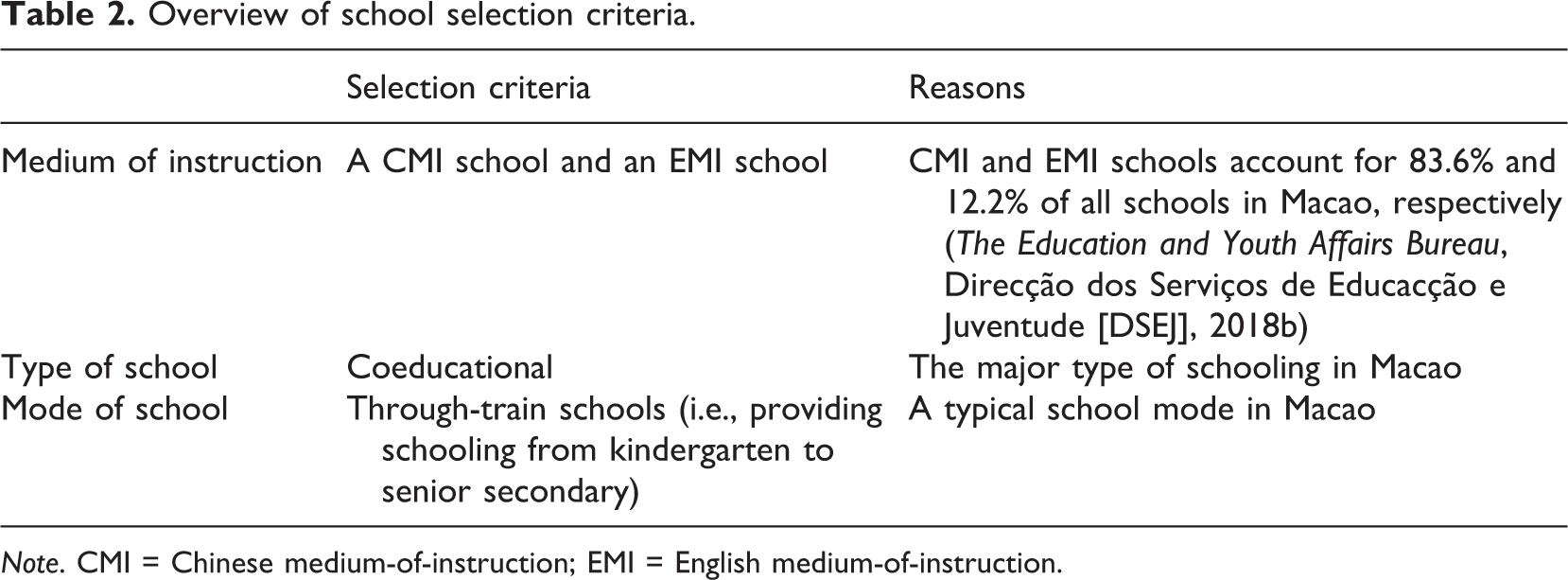
As a former English tutor and current English teacher, in this article I focus on how students of the final year of non-tertiary educational stage, namely Senior Secondary Three (SS3) or Form Six (F6), perceive English private tutoring (EPT) because their English learning experience is the longest compared to other students of the same stage. Exploring their personal needs and perceptions on EPT would thus provide valuable insights into teaching and learning English. Table 2 presents the selection criteria for two schools which became detailed case studies for analysis and comparison.
Overview of school selection criteria.
Note. CMI = Chinese medium-of-instruction; EMI = English medium-of-instruction.
I selected a Chinese medium-of-instruction (CMI) school where I was working at the time of this study, but in which I was not and had not been the teacher of the sampled students. With the help of a friend, I was able to access a parallel English medium-of-instruction (EMI) school.
The CMI school offered after-school private tutoring classes for students of all forms. These classes were taught by the teachers of the same school, who might or might not have been their subject teachers, with additional pay. At the time of conducting this study, the school was providing fee-free after-school tutorials (where teachers were paid by the school at a flat rate) for all SS3 students because the past year’s entrance examination results to the University of Macau, which was the most popular local university, were not satisfactory. In particular, English was ranked slightly below the average of all participating schools.
The EMI school had adopted English as its main medium of instruction since Form One. The school boasted its students’ academic performance in different public examinations. Taking the result of the same entrance examination as an example, this school was ranked first among all participating schools. In addition to this entrance examination, its students also performed above par in other subjects.
The research questions for the study were: What mode of EPT do SS3 or F6 students in the two sampled schools receive, how much and from whom? Why do students say they need (or do not need) EPT? To what extent do the students perceive EPT to be effective in enhancing their English learning?
Context
Macao has a population of approximately 653,000 (Statistics and Census Service, Direcção dos Serviços de Estatística e Censos [DSEC], 2017) and has the world’s highest population density at 21,081/km2 among the jurisdictions covered by the World Population Review (2018). The economy has long been dominated by the gambling industry, and after the opening of this industry to competing companies in 2002, increasing numbers of English-speaking casinos were established. Projections suggested that in 2020, Macao would replace Qatar with the highest per capita GDP of 143,116 USD (Fraser, 2018). Li and Choi (2014) noted that the nature of employment in casinos contributed to the rise of private supplementary tutoring centers. They pointed out that “the monthly rotating shift system in the gambling and hotel industry has created an added burden preventing parents from personally supervising their children” (p. 509). This observation echoed the report by Ho and Kwong (2008), indicating that lower form students whose parents work shifts need in-school or out-of-school tutoring services (p. iv).
Macao’s colonial history under Portuguese administration lasted from 1557 to 1999. During this period, the government chiefly operated laissez-faire market principles in the education sector (Tang & Bray, 2000). Due to lack of common assessment standards, each school had its own standard to assess the students, and many schools required students to repeat grades when they did not reach the required benchmarks. Even in the postcolonial period, over 40% of Macao students reported that they had repeated a grade at least once in primary, lower secondary, or upper secondary school (The Organisation for Economic Co-operation and Development, 2010). Ho and Kwong (2008) concluded that examination pressure was one of the main reasons for intensifying tutoring (p. 65). The government has set out guidelines for reducing the grade repetition rate and urged schools to diversify forms of assessment (DSEJ, 2017a).
On the other hand, although some students are admitted to universities without taking the entrance examination by so-called “principal recommendation scheme,” other students still need to sit their examinations such as Joint Admission Examination for Macao’s Four Higher Education Institutions (JAEM), which was first implemented in 2017. Some tutoring vendors even use appalling slogans such as “life-or-death test” and “once failed, all lost” to attract more students to sign up for classes ( Macao Daily News, 2016, p. A1).
Owing to economic growth, studying abroad is becoming a popular alternative. The infographics of Macao Higher Education data collected by Tertiary Education Services Office (Gabinete de Apoio ao Ensino Superior [GAES]) indicate that the number of secondary graduates studying at overseas universities which require English language examinations such as IELTS or TOEFL has been rising steadily (GAES, 2018).
In Macao, English is taught as a compulsory subject across the entire non-tertiary educational stage. Bray and Koo (2004) observed that in Macao, English is not the colonial language, unlike in Hong Kong, but is generally used as an international language. The entry of foreign casinos has boosted the demand for this language. A government language education policy report (DSEJ, 2008) emphasizes: To develop Macao into an international city and to ensure the sustainable development of its economy and society, it is necessary to popularize English among residents and nurture foreign language professionals. (p. 3)
In sum, tutoring centers which prepare tutees for taking International English proficiency tests or entrance examinations have opened one after another (Exmoo, 2013, p. 11) so as to address the needs of these students.
Literature review
Shadow education and EPT
In many countries, shadow education maintains and exacerbates educational inequalities. Bray (2011) observed that “it is self-evident that families with higher incomes can afford both greater quantities and better qualities of tutoring than can families with lower incomes” (p. 57). Studies in different contexts (e.g., Vietnam, Bangladesh, Mainland China, Korea) show that high-income households have higher demand for tutoring than middle-income and low-income ones (Dang, 2014; Hamid, Sussex, & Khan, 2009; Kwok, 2010; Lee, 2013). Xue and Fang (2018) observed the developmental patterns and trends of supplementary tutoring in compulsory education in China, noting that “students with higher socioeconomic status, higher school quality, and better academic performance have a higher tutoring participation rate and also spend more on tutoring” (p. 36).
Thanks to the exponential growth of gambling tax revenue, the government has more budget for education (among other services). Some Macao schools offer fee-free after-school remedial classes, using the budget from the DSEJ’s Education Development Fund. The purpose of this scheme is to help students who have difficulty in studies to receive immediate academic assistance at nominal charges or sometimes free of charge, as evidenced by the statistics that 26.6% of homework supervision classes within schools are free (Ho & Kwong, 2008, p. 43). Teachers who teach these classes are paid. This scheme could be seen as a proactive approach to combating educational inequalities.
The existing literature is inconclusive as to the effect of private tutoring on student achievement because of complex interplay of multiple factors (Bray, 2014). Zhang (2013) explained that “data constraint and technical problems such as endogeneity” increase the difficulty in identifying such causal effect (p. 2). Moreover, the effectiveness of tutoring may vary due to students with different academic levels and different purposes (Zhan, Bray, Wang, Lykins, & Kwo, 2013, p. 497). With the specific focus on EPT, empirical studies show that students who receive EPT feel ambivalent about this issue. Yung (2014) found that Hong Kong Year One undergraduate students who had received EPT thought that it improved their exam-taking techniques rather than “overall English proficiency for genuine communication” (p. 723). Hamid, Khan, and Monjurul (2017) argued that while Bangladeshi students do not regard EPT as essential, their high participation rate could be a sign of “declining faith in school English teaching” (p. 865).
Ho and Kwong (2008) suggested that reading skills, which are one of the fundamental skills in English language learning, are developed through a good reading habit instead of private tutoring (p. iii). While the findings remind us of the importance of reading, more research could be done on how students perceive the effect of private tutoring on different subjects.
Multilevel analysis of factors affecting students’ perceptions of EPT
Figure 1 illustrates how the factors of individuals, families, schools, and society influence a student’s perceptions of EPT. Students have their personal reasons for receiving private tutoring. Inspired by the studies of Chan and Bray (2014), which employed Maslow’s hierarchy of needs to analyze the reasons behind Hong Kong students receiving the private tutoring of Liberal Studies, this article will examine the personal needs of Macao students on EPT.
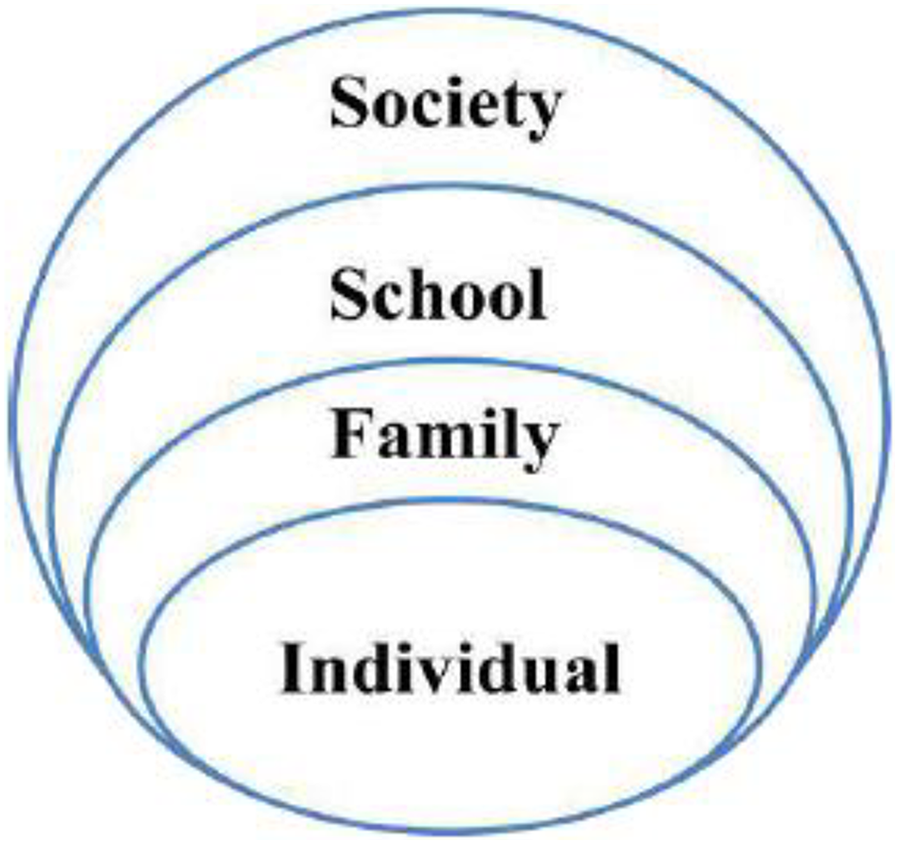
Four-level factors shaping students’ perceptions of EPT. EPT = English private tutoring.
Various studies show that family and school have a place in affecting students’ participation in tutoring. Zhang (2014) observed that Chinese students’ demand for private tutoring can be “readily influenced by their parents and teachers” due to cultural tradition (p. 441). Bray and Kwok (2003) found that Hong Kong students who are less motivated are pushed to receive tutoring by their peers, families, teachers, or others (p. 617). In Macao, parents’ perceived needs of their children receiving tutoring are greater than the children’s perceived needs of their receipt of tutoring (Ho & Kwong, 2008). As such, some students receive private tutoring against their will, which may affect the tutoring effectiveness.
While the poor quality of education is a major reason for aggravating shadow education in some settings (Hamid et al., 2009; Ille, 2015), not all learners are dissatisfied with their school teaching. Yung (2014) noted that learners in his study “understood and accepted the realities faced by mainstream teachers” (p. 723).
From the macro perspectives, demand for shadow education is affected by the nature of socioeconomic and educational structures, cultural values, and government polices (Zhang, 2014, p. 437). As noted above, although in-grade retention rates at the non-tertiary educational stage were high in Macao, the enrollment rates of tertiary education are also high. Further, its unemployment rate has long stood at below 2% since 2012 (DSEC, 2017, p. 66). Therefore, unlike other East Asian regions which are highly competitive, the dominant culture of Macao is rather complacent. With high enrollment rates of high school education in cities and counties, Zhang (2013) regarded shadow education in urban China as a means to “compete for high quality education” (p. 3). Taking economic and educational realities into consideration, it is worth exploring the ecology of shadow education in Macao.
Data, models, and methods
Purposive sampling was adopted in this study since I could select the units which were considered the most representative on the basis of my judgment (Babbie, 2014, p. 187). Following sequential explanatory design, the study consisted of two parts—questionnaires and interviews (see Figure 2).
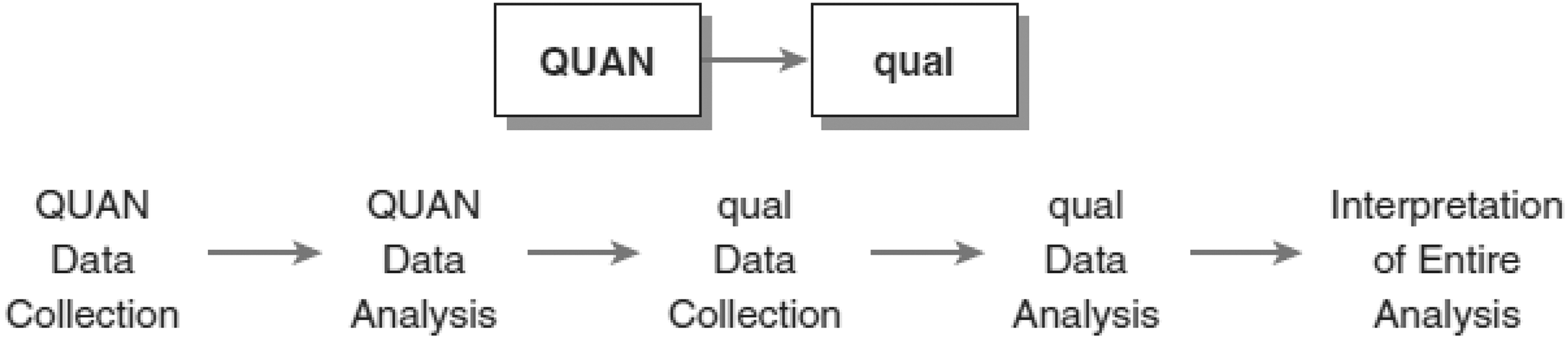
Flowchart of sequential explanatory design. Source. Creswell, Clark, Gutmann, and Hanson (2003, p. 180).
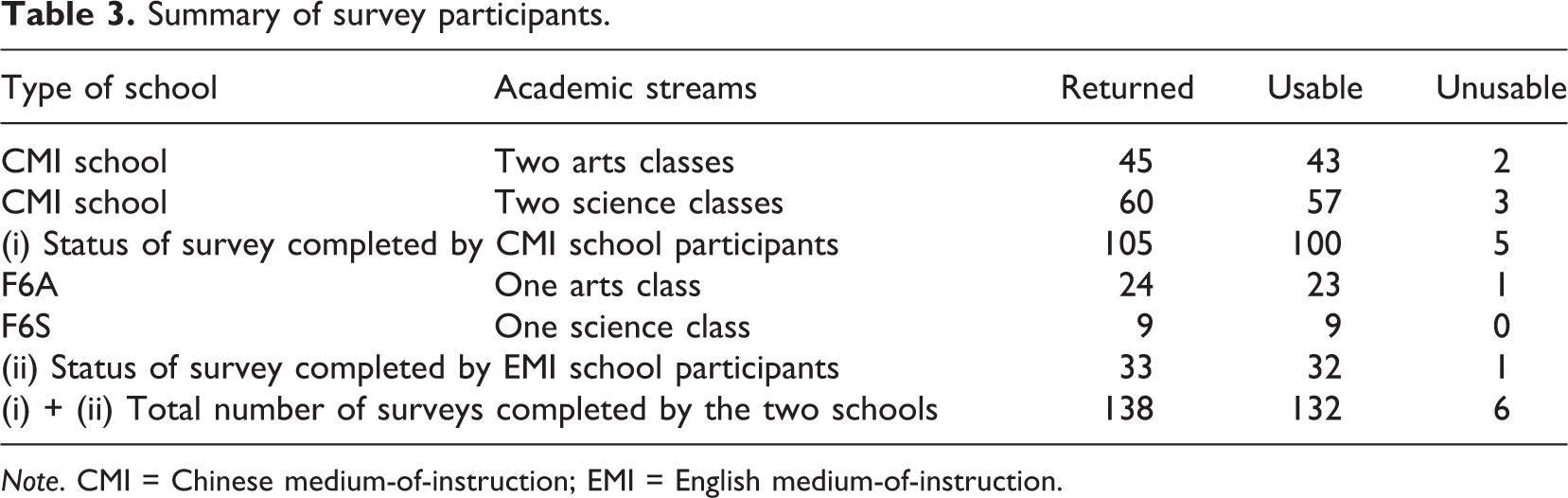
Before conducting the study, I had invited my former students who were studying at university to try out both questionnaires and interviews. Based on their comments and feedback, I revised the instruments. A total of 138 students from the two schools filled out the questionnaires in Phase 1. Of all the respondents, six gave contradictory answers which were unable to be analyzed. Since they did not leave any contact information, I was unable to follow them up so their data were treated as unusable. Table 3 presents details of survey participants.
Summary of survey participants.
Note. CMI = Chinese medium-of-instruction; EMI = English medium-of-instruction.
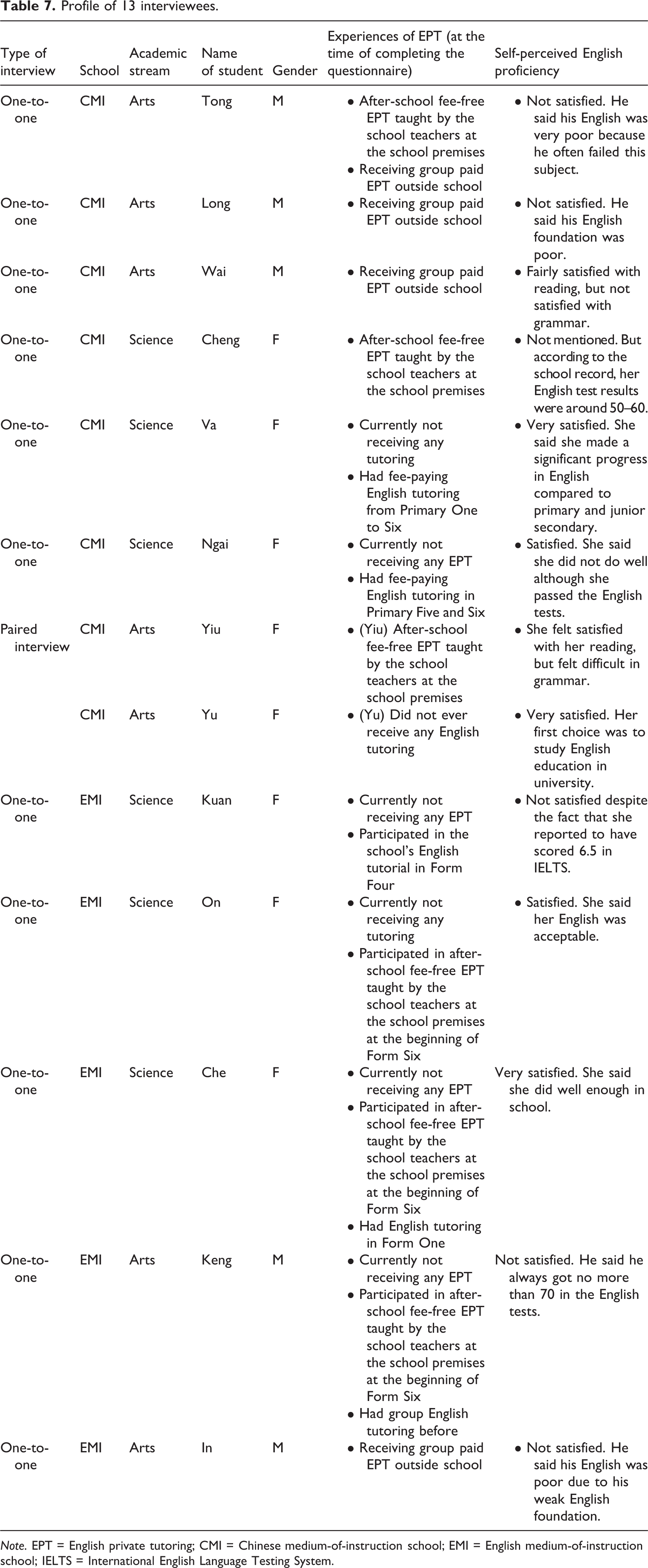
In Phase 2, purposeful sampling of participants was performed based on the quantitative results. Among the respondents, 13 students were selected on the basis of their academic stream, their experiences of receiving EPT at the time of completing the questionnaire, and their self-perceived English proficiency. In selecting the potential interviewees, I tried taking all possible factors into consideration. The semi-structured interviews were conducted on one-to-one basis, with the exception of a paired interview upon the interviewees’ request (refer to Table 7 for more detail), followed by another round of qualitative data analysis. Palinkas et al. (2015) commented that purposive sampling is largely based on the researcher’s choice and may result in bias, but selected individuals provided rich information on the subject based on their knowledge, experience, and willingness to participate.
The nature of the research questions determined that mixed-methods ought to be used in this study. To answer my first two questions, the use of questionnaires was identified as a powerful quantitative approach because it helps to reach a larger number of people and hence collects data economically (Verma & Mallick, 1999). Closed questions were used for respondents to choose. For the third question, I decided that it would be more appropriate to conduct interviews. Johnson and Onwuegbuzie (2004) noted that using qualitative research can “describe, in rich detail, phenomena as they are situated and embedded in local contexts” (p. 20).
Figure 3 is best used to illustrate the different levels of comparison. Applied to this study, Bray and Thomas’ cube (1995) is interpreted as follows: The locational levels are Level 5 (schools), Level 6 (classrooms), and Level 7 (individuals). The subjects of nonlocational groups are of the same category—SS3/F6 students. The aspects of education and of society for comparison are tutoring culture, learning English with schoolteachers and with tutors.
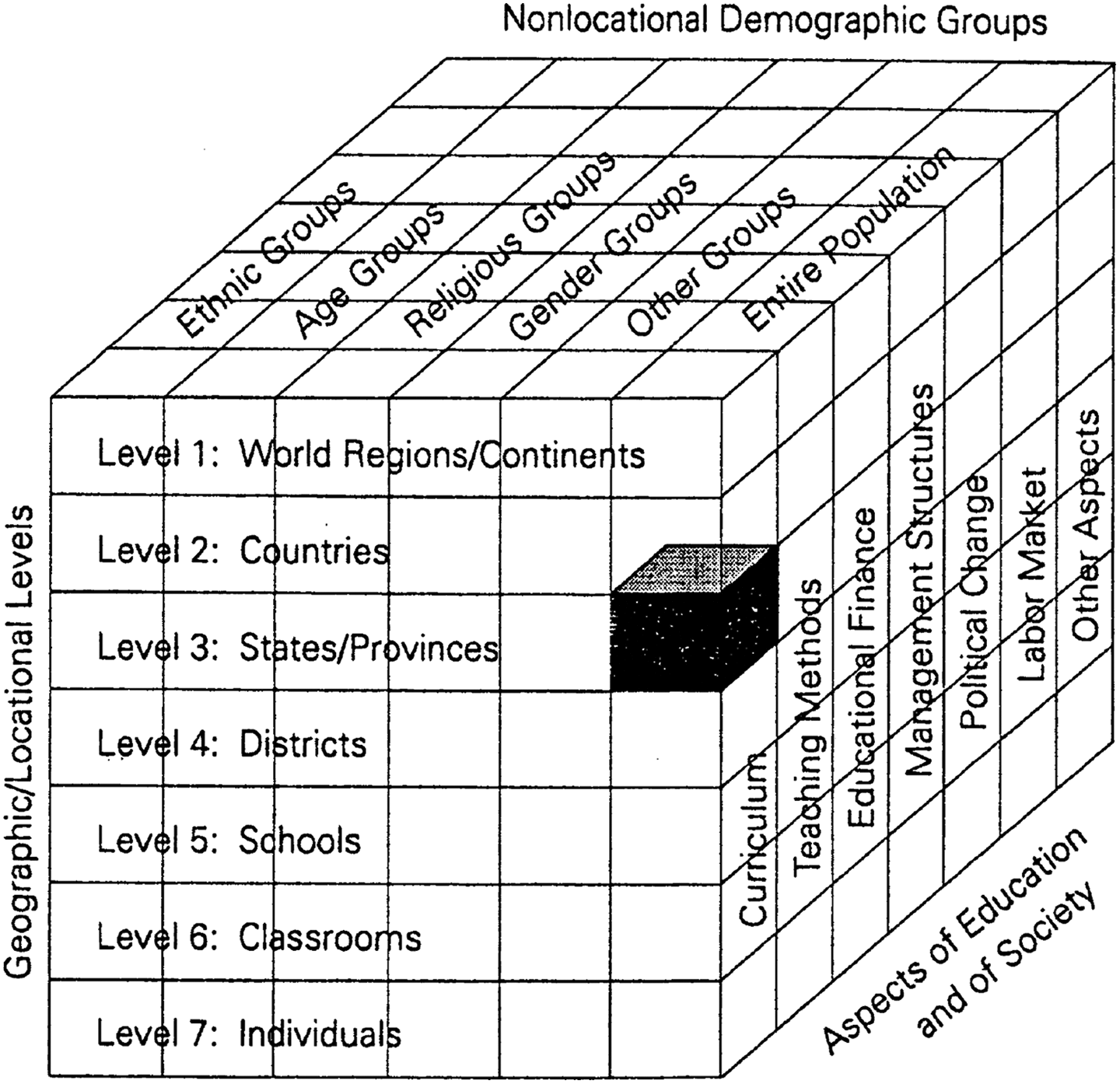
A framework for comparative education analyses. Source. Bray and Thomas (1995, p. 475).
Analysis and discussion of quantitative data
Among all the respondents, 98% of them said that they would continue university studies after graduation. Further, 57% of them stated that they would need to use English as the main medium of instruction in their target academic majors.
According to the survey results, 19 out of 132 students were receiving paid EPT. Among the 19 EPT students, one-to-one was the most popular type of private tutoring.
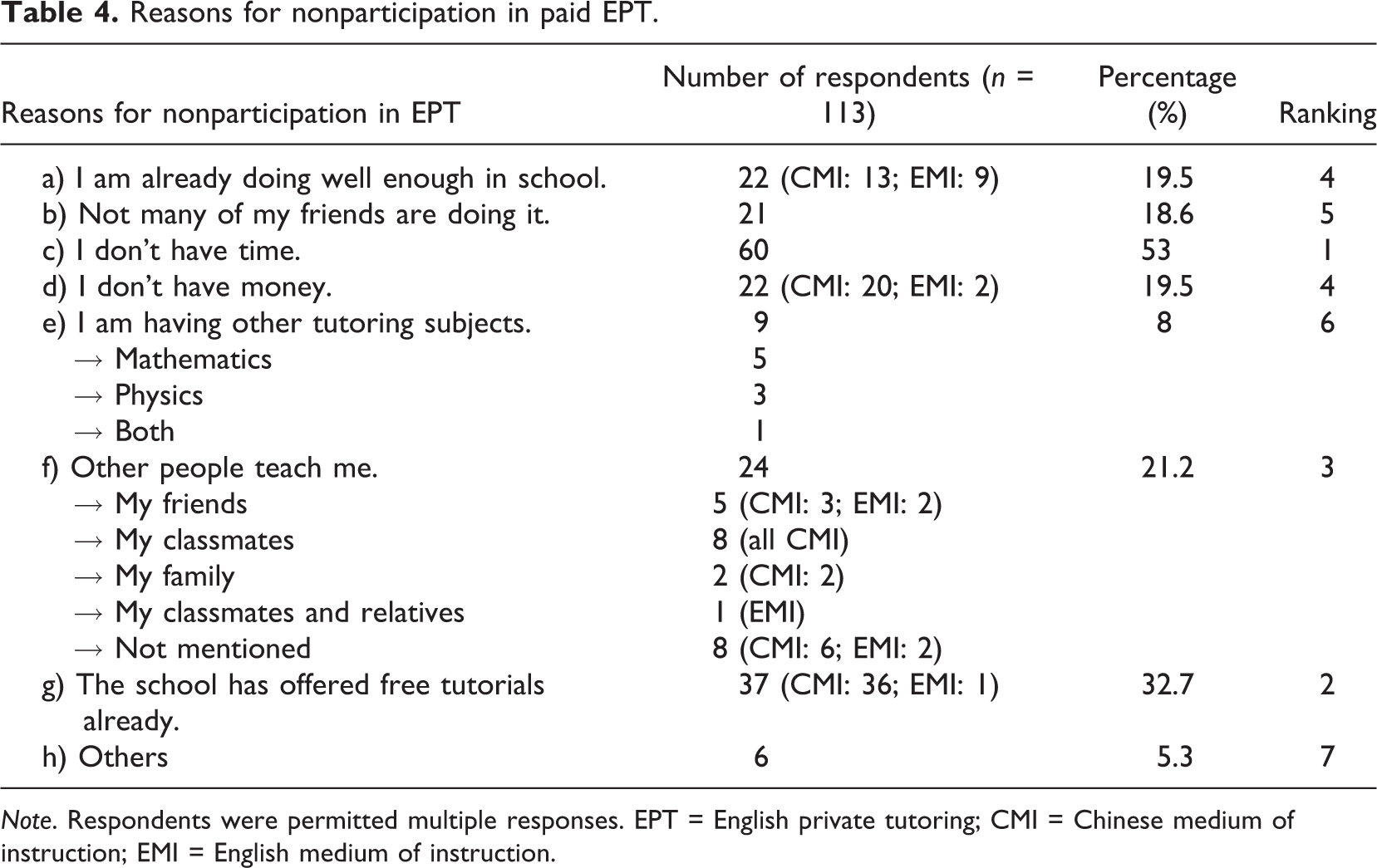
Table 4 presents the reasons given by the students, who were the majority, about why they did not participate in EPT. Of all 113 students not receiving paid EPT, 53% said they were busy after school. It is worth noting that only 8% reported that they had other tutoring subjects, showing that private tutoring in other subjects was not the main reason for not having paid EPT. At the same time, it was a notable practice to offer fee-free after-school tutorials in the CMI school. Almost 40% of the CMI students said this was the reason for not taking fee-paying EPT. Perhaps this could explain why the students said they were busy. To some extent, the school arrangement for after-school classes reduced the demand for paid EPT.
Reasons for nonparticipation in paid EPT.
Note. Respondents were permitted multiple responses. EPT = English private tutoring; CMI = Chinese medium of instruction; EMI = English medium of instruction.
The finding also shows that the respondents preferred to ask their classmates and friends before they decided on having English tutoring. This finding was similar to that of Ho and Kwong (2008) on the reasons why senior secondary school students did not receive tutoring (p. 52). In fact, it is common to see groups of students discussing their schoolwork at McDonald’s fast-food restaurant, especially during the examination period.
The finding suggests that the EMI students (31.0%) felt more confident in their academic performance than their counterparts (15.5%). In contrast to I am doing well enough, some students wrote I do not care about the English results. In this case, they would not take EPT on their own initiative even if they did not do well in English. After all, they did not think they had such a need.
Besides the above responses, the extent to which nonparticipation in EPT caused by financial problems is another worthy comparison between CMI and EMI students. On this account, fee-free after-school tutorials would help the students who could not afford paid tutoring.
In terms of the overall time spent on fee-paying EPT, 26.3% of the EPT tutees spent 4 hr per week. But when there were English tests, midterm or final examination, they would spend more time on EPT.
The finding also indicates that the intensity of EPT was low. Except for one respondent spending 11 hr on EPT per week, the other tutees did not receive English tutoring very frequently. It could be inferred that their participation in fee-paying EPT did not occupy much of their free time after school.
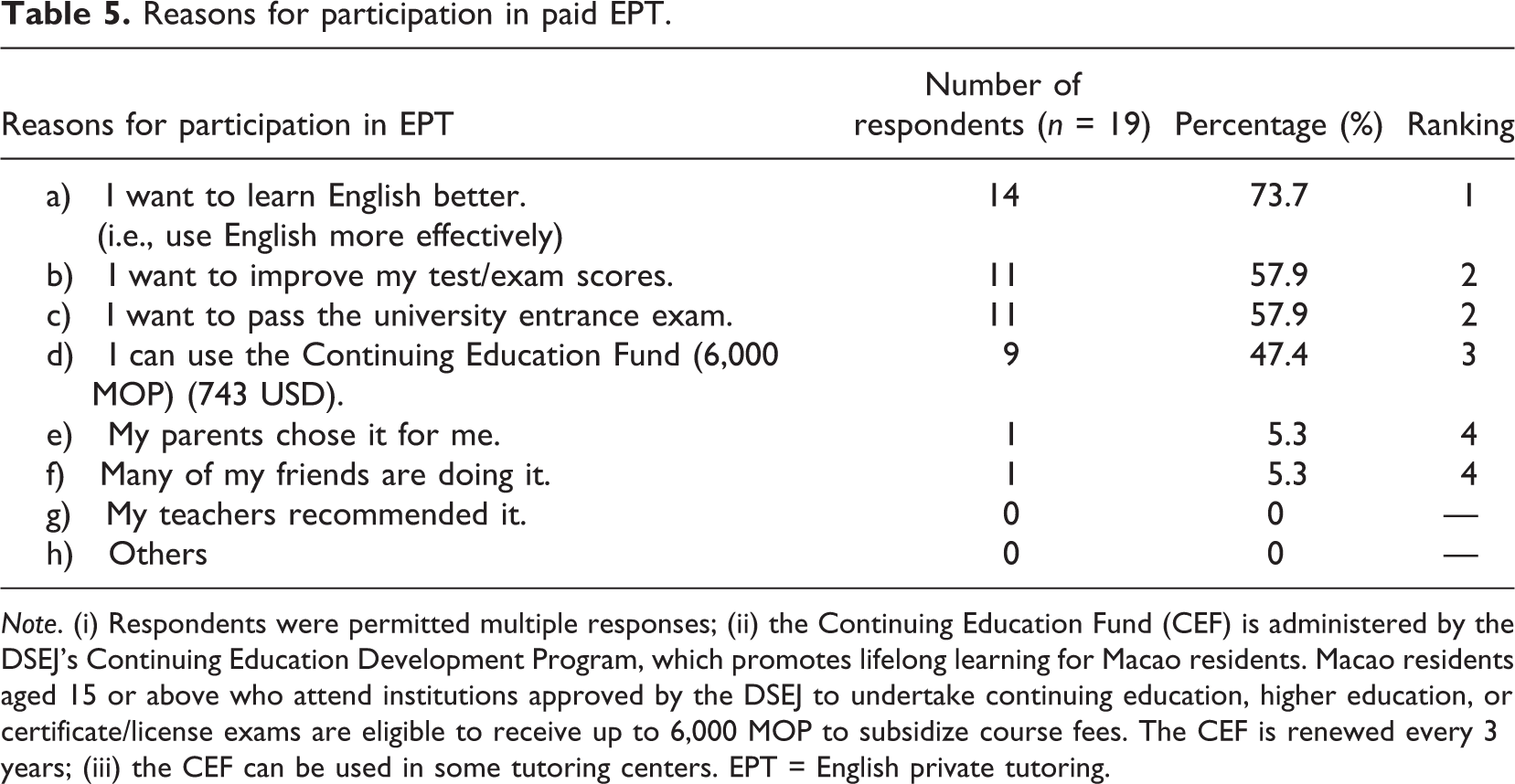
Table 5 states the reasons provided why the respondents received fee-paying EPT. While Macao students still need to face the entrance examination, their primary reason for having fee-paying English tutoring was to improve their English proficiency. This finding is very different from Hong Kong, where improving examination scores has been reported as the main reason for Grade Twelve students to receive tutoring (Kwo & Bray, 2014; Yung, 2014). Few of them reported that they took part in EPT because of pressure from their parents, teachers, or friends. At the graduating level, their personal needs rather than any other reasons drove them to receive EPT. They could make their decisions more independently than the lower form students when it comes to whether or not they will receive tutoring.
Reasons for participation in paid EPT.
Note. (i) Respondents were permitted multiple responses; (ii) the Continuing Education Fund (CEF) is administered by the DSEJ’s Continuing Education Development Program, which promotes lifelong learning for Macao residents. Macao residents aged 15 or above who attend institutions approved by the DSEJ to undertake continuing education, higher education, or certificate/license exams are eligible to receive up to 6,000 MOP to subsidize course fees. The CEF is renewed every 3 years; (iii) the CEF can be used in some tutoring centers. EPT = English private tutoring.
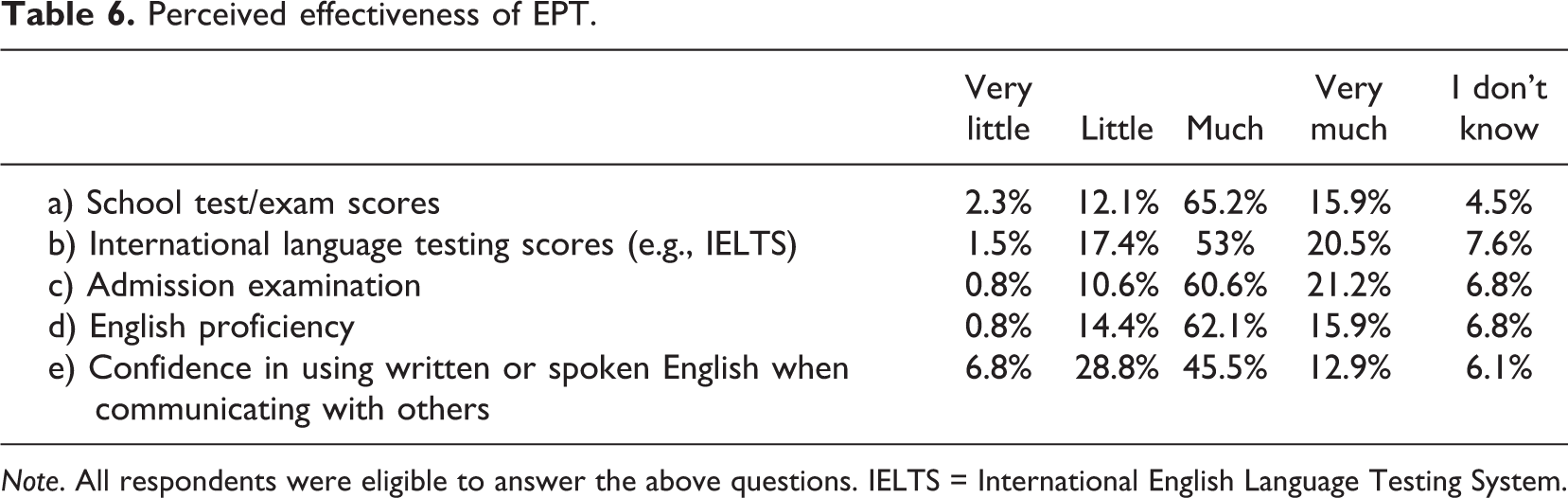
Turning to students’ perceived effectiveness of EPT, Table 6 shows that most respondents generally considered paid EPT positive and helpful. Even for students who were not receiving English tutoring, or had not participated in such before, their perceived effectiveness of EPT was still high. This might be encouraging news for people who provide tutoring services.
Perceived effectiveness of EPT.
Note. All respondents were eligible to answer the above questions. IELTS = International English Language Testing System.
Comparing the schoolteachers and tutors from the perspectives of actual EPT recipients, nearly 60% of students said they had more interaction with their tutors, which was likely because of more participation in the tutorial due to the smaller class size. It is worth noting that almost 80% of students disagreed that their tutors would give them better examination tips, which was very different from the scenario of Hong Kong, where students described their tutors as giving them better tips (Chan & Bray, 2014; Kwo & Bray, 2014). Perhaps it is because of the high enrollment rates of university education and moderate level of competition in Macao. Therefore, the aim of English tutoring could be less examination-oriented and more proficiency-focused. This interpretation also fits the dominant motive for the respondents who received EPT in this study (see Table 5).
In spite of the differences, there was similarity between this study and findings in Hong Kong. Students of both places who received tutoring described their schoolteachers as “more concerned with wide-ranging knowledge and personal growth” (Kwo & Bray, 2014, p. 408). It is undeniable that schoolteachers take on more roles than tutors. They not only prepare pupils to pass the examinations; more importantly, they cultivate them to be persons of integrity.
Analysis and discussion of qualitative data
Table 7 presents the profile of 13 interviewees who met at least one of the following criteria (one-to-one paid EPT, group paid EPT, after-school paid EPT at school, no paid EPT).
Profile of 13 interviewees.
Note. EPT = English private tutoring; CMI = Chinese medium-of-instruction school; EMI = English medium-of-instruction school; IELTS = International English Language Testing System.
As indicated above, Tong and Cheng participated in fee-free after-school English tutorials once a week. The tutorial was taught by their English teacher and organized on a class basis. Cheng provided more details: After-school tutorials run from five to six every weekday. For Mathematics, it is compulsory and therefore arranged three times a week. Other subjects, including English, are treated as electives. The English tutoring class meets once a week. We can choose whether or not to take the electives.
Based on the interviews with CMI respondents, the features of the fee-free English tutorial provided by the CMI school are summarized as follows: • Revision. • Supplementing the regular lessons with more focus on the difficult points. • Teaching more slowly. • Drilling past papers.
The students felt that the school tutorials were useful because through the tutorials, they would understand topics that they did not understand in regular lessons. Yiu made a comparison between a regular lesson and a tutoring class: In order to cover the syllabus, my English teacher could not help but had to teach very fast in the lesson. But when it comes to after-school tutorials, she explains things in more detail. When we have questions, she will coach us individually, which I think is impossible to do in a regular lesson due to time constraints.
From the accounts of students, it can be inferred that teachers of this study regarded such tutorials as remediation of their regular lessons. Since the school did not charge students any fees and the number of students was not a determinant of their pay, it was unnecessary for teachers to “refrain from teaching some of the curriculum during school in order to generate more demand for their fee-generating tutoring classes” (Bray & Lykins, 2012, p. 43) like in other contexts.
Instead of focusing on general tests and examinations, an IELTS tutorial was provided for the candidates of the EMI school. All candidates were required to attend the tutorial unless they had some specific reason not to do so. As the name suggests, the tutorial was designed for IELTS. The class met twice a week, each time lasting for 2–3 hr. Likewise, it was taught by their schoolteachers, who might not be their same English teacher. In terms of the class size, it was much bigger than the regular class. While there were around 20–30 students in a regular class, there were at least 40 students in the IELTS tutorial. The tutorial was divided into four skills, each of which was taught one after another. The teacher gave the class some mock tests to do first, and then checked the answers together. The teacher introduced some test-taking techniques. To some extent, this kind of school tutorial solely focuses on skills and so is similar to the IELTS class provided in the tutoring marketplace.
The feedback of the EMI participants varied when they were asked about their opinions on such tutorial. On and Keng thought that the tutorial was generally useful in that they had a better understanding of IELTS, and learned more relevant skills. Nevertheless, Che, who was said to have done well at school, held different views on the effectiveness of such tutoring class. Many of my classmates said it was not useful. It was a mere past paper drilling class. As you know, each learner has different mistakes. Even making the same mistake, each learner might be trapped in different mistaking areas. The main problem of such tutorial is that the teacher explains the mistakes superficially. I would rather work on my own.
In order to find out about the tutoring providers of Macao, the respondents were asked to describe the backgrounds and qualifications of their English tutors. From the interviews with the respondents who were having or had received EPT, it was found that Macao students could choose where to receive tutoring but they could not choose the tutors. The center assigns tutors to them. Because the information on the tutors was not revealed, the respondents did not know their qualifications. Some tutors might occasionally introduce themselves during the lesson. The following accounts given by In and Long might shed light on the providers of EPT in Macao.
In’s account:
I chose that tutoring center because my friend had studied there before. He recommended it to me and gave me his textbook so that I did not need to buy a new copy…In the self-introduction, when I mentioned that I was from (the name of the EMI school), my tutor replied that he had also gone to the same school.
Long’s account:
Interviewer: Do you know your tutor’s qualifications? Long: I forget whether my tutor graduated from university or not. I guess she is probably studying her year three or four. Interviewer: How long has she been tutoring? Long: She has been a tutor since senior high school. Now she studies English in university. As far as I know, many university tutors are like that: their degree is related to English, and they teach others English as well. Interviewer: Why did you choose her? Long: My friend introduced the tutoring center to me. In fact, many tutoring centers in Macao like to hire university students to be tutors.
Regarding the intensity of EPT, the time spent on the after-school tutorials was much more than paid EPT. Che recounted: At the beginning, I eagerly anticipated the tutorial, but as time went by, I did not want to attend it any more. The tutorial ran till half past six. It was really a long tiring day. I could not concentrate on the tutorial at all. I prefer to review IELTS myself when I am better focused.
In parallel with the findings of the questionnaire, the interviews show that receipt or nonreceipt of EPT is largely determined by wants, hopes, or perceived needs. Che: I wanted to know how to pronounce a word when I see it. This would be helpful to my dictation and speaking. Tong: I have chosen to attend both after-school tutorials and group paid EPT because I think that my English needs improvement. My English was not good. Keng: To me, it is a summer class to increase my English proficiency. Wai: Since my target university requires IELTS, I have to take the test and hope to have a better score. In: I want to study in Taiwan China. It is said that as long as a student achieves IELTS overall band score 5.5, he or she need not study English at university. I know that my English is not good. That is why I signed up for the course (the group paid EPT) in order to achieve this score.
On the other hand, learners who have interest in English may or may not receive English tutoring. Kuan did not receive any paid EPT although she felt interested in English. She said that she liked English, but when asked why she did not spend the Continuing Education Fund on English tutoring, she explained, “I do not think I need it. That is why I did not bother to search for this kind of course where I can use the subsidy.” Responding to the reason for participation in EPT, Keng said, “Because I am interested in English, I signed up for group paid English tutoring. If I did not like English, I would probably not have received additional tutoring.” To sum up, learners’ decisions on whether or not to have English tutoring seemed mainly to depend on their needs, and there was little direct correlation between their enthusiasm for English and for English tutoring.
Based on the high perceived effectiveness of EPT in the survey, the respondents were asked to describe their perceptions of EPT in the interview. The extent to which EPT was useful largely depended on whether learners had chosen the right tutoring class. Tong, for example, signed up for the tutoring class which aimed at improving English skills. He reported that his writing skills were improved after attending the tutoring class in that he had learnt how to write. Nevertheless, Wai set his heart on registering for the IELTS course, but was persuaded by staff working at the tutoring center to take another course. He was not satisfied with the course because it did not meet his needs.
Another example is Long, who compared his past and present experiences of receiving EPT: When I was small, my parents arranged for me to have EPT. At that time, I did not have a strong will to improve my English, and I was not serious in tutoring. However, after stopping EPT for two years (between Junior Secondary Three and Senior Secondary One), I found that I could not improve English myself. Moreover, I wanted to have better school grades and pass the university entrance exam. This time I told my parents that I needed EPT.
Besides needs, the students’ beliefs in the way of English learning may also affect their perceived effectiveness of EPT. In the interviews, the respondents who had or did not have EPT exemplified how they learnt English more effectively. Long, the English tutee, and Yu, who did not receive any EPT, both agreed that only by continuous acquisition would their English improve. While Long thought that English tutoring could sharpen his language skills, Yu believed that she could learn English better by herself. She explained: I think as long as I pay attention in class, watch English movies, and listen to English songs on YouTube, I can improve English by myself. I do not think I need to receive tutoring.
As manifested in the survey results, time was the main reason for the respondents’ nonparticipation in EPT. SS3/F6 students did need a lot of time for homework or revision after school. Ngai pointed out that they had many past papers to do. The CMI respondents also noted that late dismissal was the main cause for nonparticipation in EPT. Both Va and Ngai mentioned that they were often asked to stay after school for various reasons, such as after-school tutorials or activities. Time was also a problem for English tutees. They complained that late dismissal affected their participation in English tutoring. Although Long had group English tutoring at the tutoring center, he would pay his tutor to offer additional tutoring at weekends outside the tutoring center. His explanation may help readers to understand how some Macao tutoring centers are operated: Long: My tutoring center closes at 8 p.m. When I arrive there, it is almost 6 p.m. On top of that, my tutoring center does not open at weekends. If I have a test on Monday, there is not enough time to have revision at the tutoring center on Friday. That is why besides regular tutoring, I pay for my tutor directly to offer me extra lessons at weekends at any convenient places such as at McDonald’s. Interviewer: Does the boss of the tutoring center know that? Long: Well, I don’t think so. He is not in the center most of the time.
The survey findings show that over half of the students who received EPT agreed their tutors were more inspiring in teaching. In order to understand what they meant by inspiring, the respondents were asked to describe a sample regular lesson and a sample tutoring lesson in the interview. Wai recalled that the regular lesson was like a lecture. He took notes while listening to his teacher. Sometimes they were told to make sentences and did classwork in a group of four. In the tutoring class, the tutor introduced a topic through activities such as role-play. Although he thought the latter was more inspiring, he preferred the lecturing style. “Because I am used to this style,” he explained, “that is, teachers teach and students take notes. I do not like to learn English through activities. I do not think I can learn English in this way.” Long said the regular lesson was interactive: his teacher would either pick them or have them fast answered to get bonus marks. He praised his schoolteacher for explaining the subject matter clearly. But due to his shyness, he would not ask the teacher if he had any question. Further, in order to meet the school syllabus, the teacher sometimes taught very fast, and had no room for him to “digest” the content. His tutor, on the other hand, would teach him in accordance with his needs and learning progress. When asked who facilitated his learning, he thought it was his English tutor, who fostered a self-paced learning environment.
As stated previously, schoolteachers are irreplaceable. Long appreciated that his schoolteacher would share her life experience with them after class. “The tutor would just focus on imparting the knowledge that is relevant to the course.” “Each has their own merit,” he added, “as far as care is concerned, schoolteachers can never be replaced by the tutor outside.”
Conclusion
Expanding the diagram of perceptions, Figure 4 summarizes the factors affecting SS3/F6 students’ perceptions of EPT and the interplay between individuals, school, and society based on the findings of this study.
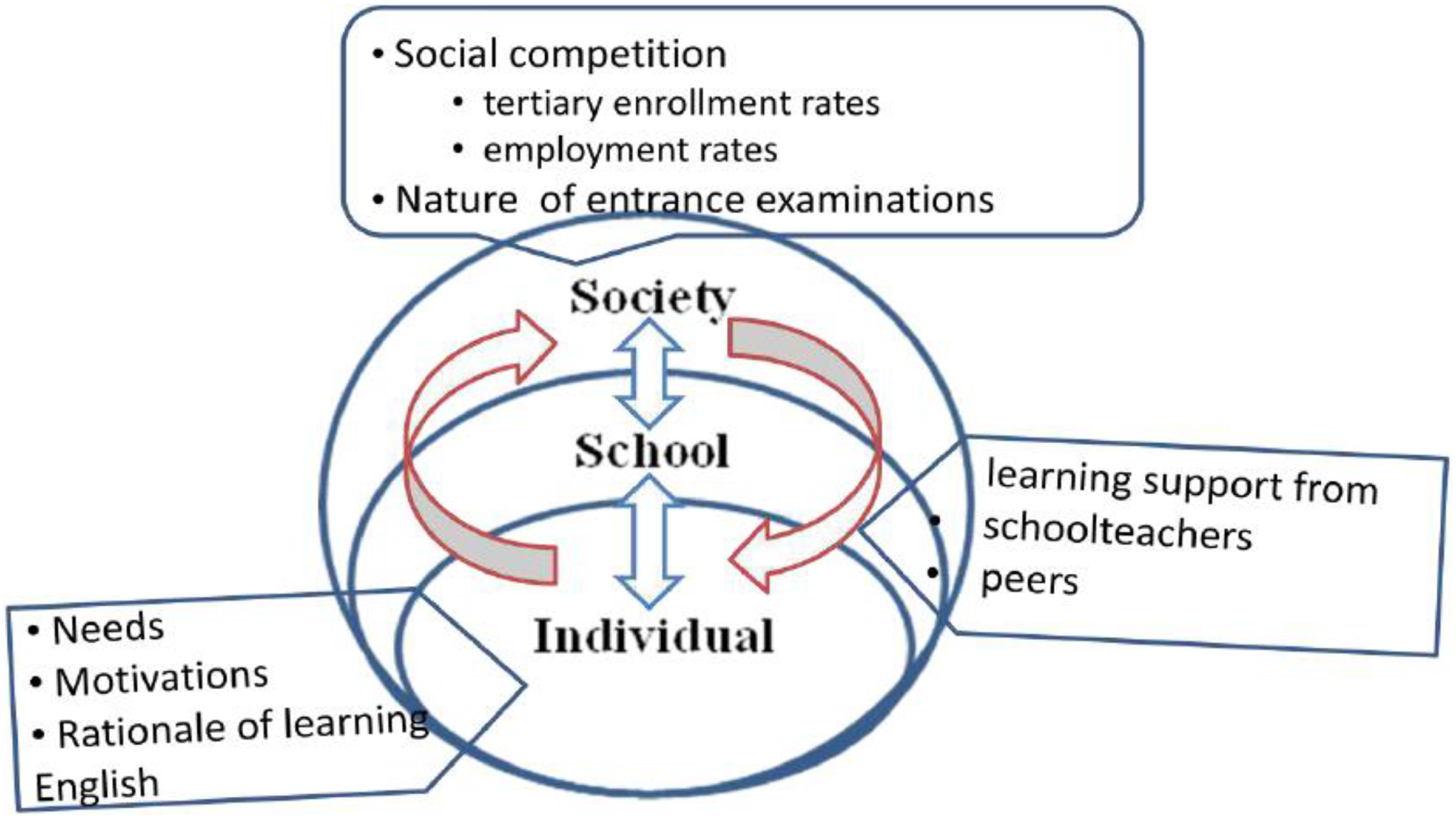
Factors affecting SS3/F6 students’ perceptions of EPT. EPT = English private tutoring; SS3 = Senior Secondary Three; F6 = Form Six.
Three levels are interrelated. External-level factors shape individuals’ views of EPT. At the same time, individual factors will bring about the possible effect on tutoring provided by schools, if any, and by society. According to the findings of this study, fee-paying EPT in Macao is not perceived as a necessity: only a minority of students receives it. Two dimensions shape such perception. The first one is the low level of competition, as evidenced by mass higher education, numerous job opportunities, and absence of high-stakes assessment. The second one is fee-free after-school supplementary classes funded by the government where teachers are paid separately. All these dimensions make EPT less perceived as an essential aid to learning. Compared to the original diagram, family factors have been removed in this study since the interviewees reported that their parents were open-minded about their studies and choice of university.
On the other hand, the students’ perceptions of EPT are influenced by the extent of their needs. In the interviews, independent learners (Yu, On, Va) found both fee-charging or fee-free EPT time-wasting or ineffective in terms of improving their English scores or proficiency. Va described the after-school tutoring class as “a mere revision class for the students who could not keep up with the lesson.” In addition, learners who were satisfied with their English learning (e.g., I am doing well enough) or indifferent to English (e.g., I do not care about the English results) do not look for either type of English tutoring irrespective of their actual performance in English. In other places (e.g., Hong Kong China, Greece, Turkey), it is often the case that more able students demand greater tutoring than their average or weak counterparts (Bray, 2011; Kassotakis & Verdis, 2013; Kwok, 2010; Tansel, 2013). But in terms of the findings of the interviews, no evidence shows that high achievers in English receive fee-paying EPT to maintain their competitive edge. To some extent, this echoes the point that the level of competition in Macao is not intense.
In contrast, tutees who received English tutoring, particularly the fee-paying type (Tong, Wai, Long), are often those who had strong needs of cognition or self-actualization. They find other means of improving English unable to satisfy their needs. Therefore, they perceived that it was necessary to take English tutoring lessons. Nevertheless, their perceptions of EPT might change after receiving it. Tong and Long regarded tutoring helpful to their English learning because they could learn more effectively in tutoring than in class as their teachers rush to cover the whole syllabus, whereas Wai thought that tutoring was not worthwhile due to being arranged for the wrong class.
Facing the growing phenomenon of shadow education, every educator should consider a question: Why do students feel that they need to go to tutoring classes in addition to schooling? According to the findings of the study, the interviewees who received EPT appreciate that they do not feel any rush in the tutoring lessons. Their tutors teach them in accordance with their learning abilities. Nevertheless, in the eyes of students, tutors cannot replace teachers by virtue of the fact that the latter are more than a knowledge transmitter. They also offer pastoral care to their students. While maintaining this uniqueness, teachers should diversify their pedagogies to facilitate students with different learning abilities. This belief is also advocated by the DSEJ catering to learner diversity, as it outlines in the requirements of Basic Academic Attainments in Junior and Senior Secondary English for EMI (2017b, 2017d) and Non-EMI (2017c, 2018a) schools. Besides, drawing on Long’s comparison between his sample tutoring lesson and regular lesson, the study suggests that schoolteachers should be more student-centered, in a way that pauses are given from time to time during the lesson to let students reflect upon what they have learnt.
Schools should be aware of providing what sorts of tutoring for what kinds of students. The findings suggest that tutoring classes held by the two schools are mainly for remedial or test-preparing purposes. Therefore, this type of tutoring is not suitable for high achievers or independent learners. They should be excluded from staying after school to receive this kind of tutoring. With more available resources, schools can offer enrichment classes to help such students realize their potential.
Time is another issue concerning after-school supplementary classes. The interviewees of both schools reported that they were too exhausted to learn in the tutorials after a long day of studying. Schools should be slightly flexible on the tutoring arrangement. For example, when students have more than one test the following day, the English tutoring class should be canceled so that they will have enough time for revision. Alternatively, Saturday mornings can be used for tutoring, as many schools do not have lessons.
Subsidizing schools to run after-school supplementary classes is a way to reduce educational inequality, as this can help those students who cannot afford expensive private tutoring receive academic assistance with much lower fees or even free of charge. In fact, the grant given to schools is taken from the tax revenue. Following this line of thought, fee-free tutoring could be seen as a variation of fee-paying tutoring.
Finally, only 138 SS3/F6 students completed the questionnaire and 13 participated in the interviews. This sample size is not sufficient to generalize the findings to all SS3/F6 students in Macao. Despite my effort to maintain a similar number of participants from the two schools, the EMI participants are evidently much lower than the CMI due to its number of students per se. That said, the results of this study may be of value to other places which do not have high-stakes school-leaving examinations, whose governments endeavor to reduce educational inequality, or whose regulations of education are moving away from laissez-faire to more interventionist.
Footnotes
Acknowledgements
The author expresses her deepest appreciation to Professors Mark Bray and Wei Zhang, who convincingly challenged and enriched her ideas in preparing this manuscript. The author is also grateful to the anonymous reviewers and students in the schools researched.
Declaration of conflicting interests
The author(s) declared no potential conflicts of interest with respect to the research, authorship, and/or publication of this article.
Funding
The author(s) received no financial support for the research, authorship, and/or publication of this article.