



Abstract
Purpose
Private supplementary tutoring—widely known as shadow education because of the ways in which it mimics regular schooling—is increasingly visible across the globe. The Middle East is no exception, though the phenomenon has received relatively little attention in the English-language literature. This article maps some key features of shadow education, identifying ways in which contextual forces have shaped it.
Design/Approach/Methods
The article focuses on patterns across and within the six members of the Gulf Cooperation Council (GCC), namely Bahrain, Kuwait, Oman, Qatar, Saudi Arabia, and the United Arab Emirates. It draws on literature in both Arabic and English and shows the value of multiple units of comparison.
Findings
Private tutoring has a long history as a significant phenomenon in some GCC countries, but in others developed more recently. Some governments have had active policies to dampen the phenomenon, but with little success. Factors in the complex dynamics include social, economic and cultural forces.
Originality/Value
The article assembles literature from around the region, noting both commonalities and diversities among GCC members. It contributes to the global literature by providing the regional mapping from this specific part of the world and by showing comparisons with other world regions.
At the outset of the 20th century, Sir Michael Sadler (1900, p. 309), widely viewed as a key historical figure in the field of comparative education (Phillips, 2020), stressed the importance of context for understanding the nature of education. In an oft-quoted phrase, he wrote (p. 310) that: In studying foreign systems of Education we should not forget that the things outside the schools matter even more than the things inside the schools, and govern and interpret the things inside.
In the same vein, a century later Crossley and Jarvis (2001, p. 405) stressed in the journal Comparative Education “the significance of context, at all levels and in many forms,” and particularly the tensions between the global and the local. Both works also highlighted the importance of historical analysis. “A national system of Education,” wrote Sadler (1900, p. 310), “is a living thing, the outcome of forgotten struggles and difficulties and ‘of battles long ago,’” and in echo, Crossley and Jarvis (2001, p. 406) stressed “the importance of a sense of history in understanding our various worlds.”
The present paper, taking these cues, recognizes the importance of historical, social, political, and other dimensions of context in shaping educational provision. Furthermore, building on Crossley and Jarvis (2001), the paper stresses recognition not only of the global and the local but also of many intermediate levels. One framework for multilevel analysis is the Bray and Thomas cube (Figure 1), which lists geographic levels from world regions/continents down to individuals. The paper employs the cube while in addition taking a related cue from Sadler’s (1900, p. 309) admonition that: if we propose to study foreign systems of education, we must not keep our eyes on the brick and mortar institutions, nor on the teachers and pupils only, but we must also go outside into the streets and into the homes of the people, and try to find out what is the intangible, impalpable, spiritual force which … is in reality upholding the school system.
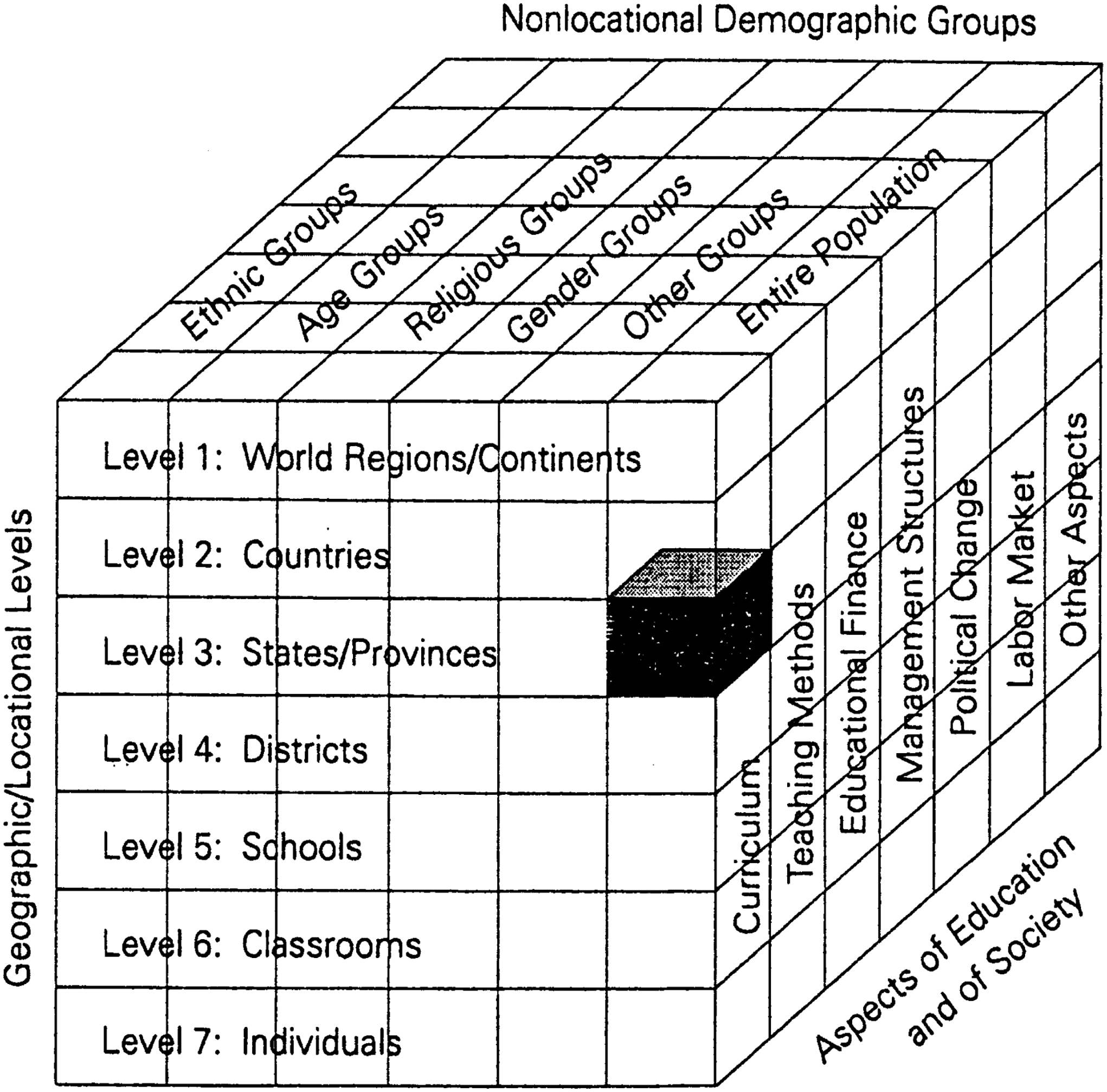
The Bray & Thomas cube for comparative education analyses. Source. Bray and Thomas (1995, p. 475).
The starting point for geographic focus, as also indicated in the title, is the Gulf Cooperation Council (GCC) and its six members, namely Bahrain, Kuwait, Oman, Qatar, Saudi Arabia, and the United Arab Emirates (UAE). These six countries have much in common, but also considerable diversity between and within them. At the same time, the paper contrasts features of these countries as a group with features of other groups of countries around the world. In the process, the paper makes methodological as well as substantive points about its specific focus.
This specific focus, as again evident from the title, is private tutoring—that is, supplementary forms of education provided beyond mainstream schooling for either enrichment or remedial support to students. Such tutoring is widely known in the literature as shadow education, on the grounds that much of its content mimics that of the mainstream: As the curriculum changes in the mainstream, so it changes in the shadow (Aurini et al., 2013; Bray, 1999).
To set the framework, the paper first outlines some dimensions of private tutoring as analyzed here. It then turns to the GCC and its members, to provide more information on political, economic, and social contexts. These remarks set the stage for portraits of private tutoring in the GCC countries and for identification of shaping forces. The final section pulls threads together in conclusion, again stressing the complexity of the contexts and the value of multilevel and multidimensional units for comparison.
The nature and drivers of private tutoring
In line with much existing literature (see, e.g., Zhang & Bray, 2020), this paper chiefly concerns tutoring that:
supplements in the sense of addressing subjects already covered in schooling; is private in the sense of provision in exchange for a fee; focuses on academic subjects such as languages, mathematics, and sciences, excluding musical, artistic, or sporting skills, which are learned primarily for pleasure and/or for more rounded personal development; and is delivered at the levels of primary and secondary schooling.
A case can be made for expanded analysis beyond each of these boundaries, but delimitation is needed to permit adequate focus. The tutoring may be delivered one-to-one, in small groups, or in large classes. Online tutoring has also become increasingly evident, boosted by the pandemic that hit in 2020.
Three main groups of shadow education providers may be discerned around the world. First are full-time teachers in both public and private schools who offer supplementary tutoring to earn extra incomes. Second are enterprises established for the purpose, and third are informal self-employed suppliers including university students and retirees. In many settings, supply creates demand: Families invest in tutoring when it is available, perhaps further motivated by perception that most peers are investing in it and fear of being left behind (see, e.g., Dierkes, 2013).
Elaborating on motivations, social competition is a key driver of demand for private tutoring across all cultures and income levels. Intensified by the forces of globalization, families increasingly feel that schooling does not suffice in the efforts to achieve social mobility or to retain existing status in the middle and upper classes. At the same time, shadow education has become a norm in many societies, leading to self-fulfilling dynamics in which teachers assume that their students are receiving tutoring and then are less diligent than they would otherwise be. Such matters are linked to the quality of schooling. Some families invest in shadow education to compensate for perceived inadequacies of schooling, while others recognize that the schooling is good but still want more. This factor helps to explain why shadow education is prevalent in poorly resourced education systems, such as those of Bangladesh and Ethiopia (Mahmud, 2021; Melese & Abebe, 2017), but also in well-resourced societies such as England and Korea (Holloway & Kirby, 2020; Kim, 2016). In addition, some parents seek private tutoring to keep their children gainfully occupied outside schooling hours and to “outsource” the stresses of supervising homework (Oller & Glasman, 2013).
Governments are typically either ambivalent about shadow education or actively opposed to it. They recognize that private tutoring maintains and exacerbates social inequalities because prosperous families can afford greater quantities and better qualities of shadow education compared with lower income families. Governments also perceive a negative backwash on schooling when teachers reduce their efforts on the assumption that students can and will secure external supplements. The most problematic situations occur when teachers providing supplementary tutoring to their own students deliberately cut parts of regular lessons in order to promote the private classes (Jayachandran, 2014). Even if not admitted, however, governments may find some aspects of private tutoring advantageous. Tutoring promotes learning that can expand human capital, and it provides employment for tutors.
These remarks may be linked to literature on privatization. While much privatization of education has been an active government policy with the goal of improving efficiency and client responsiveness (Ball & Youdell, 2008), shadow education is mostly an example of what Verger et al. (2016, p. 7) called “privatization by default” that occurs despite rather than because of government policies. Regulations have been slow to catch up with the phenomenon, but have become more evident in many countries (Bray & Kwo, 2014; Zhang, 2021). The wording and operationalization of regulations commonly reflect complex relationships between national and subnational governments, teachers, families, and other stakeholders.
The GCC and its member states
As explained by the GCC Secretariat General (2022), the GCC was formed in 1981 as “a cooperative framework … to effect coordination, integration and inter-connection among the Member States.” The underpinnings, the Secretariat General added, included “deep religious and cultural ties … and strong kin relations,” enhanced by geographical proximity and common interests. Like counterpart bodies such as the European Union (EU) and the Association of Southeast Asian Nations (ASEAN), the GCC has experienced multiple tensions in operationalizing its architects’ vision (see, e.g., Adam, 2018; Miniaoui, 2020), but it has held together as a significant geopolitical body. Article 4 of the Charter (GCC, 1981) envisaged formulating similar regulations across member states in economics, commerce, culture, and education. In education, however, the GCC has been a forum for sharing perspectives rather than for formulating similar regulations—and, as might be expected, the sharing has focused on schooling rather than shadow education. Thus, the main regulatory bodies for education lie at the national level in most countries and at the emirate levels in the UAE.
This remark about emirates leads to a further observation about constitutional arrangements. All six GCC members are monarchies, including three constitutional monarchies (Qatar, Kuwait and Bahrain), two absolute monarchies (Saudi Arabia and Oman), and one federal monarchy (UAE, which has seven emirates each constituted as an absolute monarchy). These constitutional arrangements have strong bearing on policymaking arrangements. They were part of the underpinning for creation of the GCC, which included “common qualities and similar systems founded on the creed of Islam, faith in a common destiny and sharing one goal” (GCC Secretariat General, 2022). This goal reflects a sense of commonality as Arab countries but difference from others in the Middle East and North Africa (MENA).
Turning to demographics, Saudi Arabia has by far the largest area, 2,756 times the size of Bahrain (Table 1). By corollary, Saudi Arabia has very low population density compared with Bahrain. Also concerning population are very high proportions of non-nationals. This matter has considerable pertinence to education, including shadow education, because many of these non-nationals desire provision related to the education systems of their home countries.
Features of GCC countries.
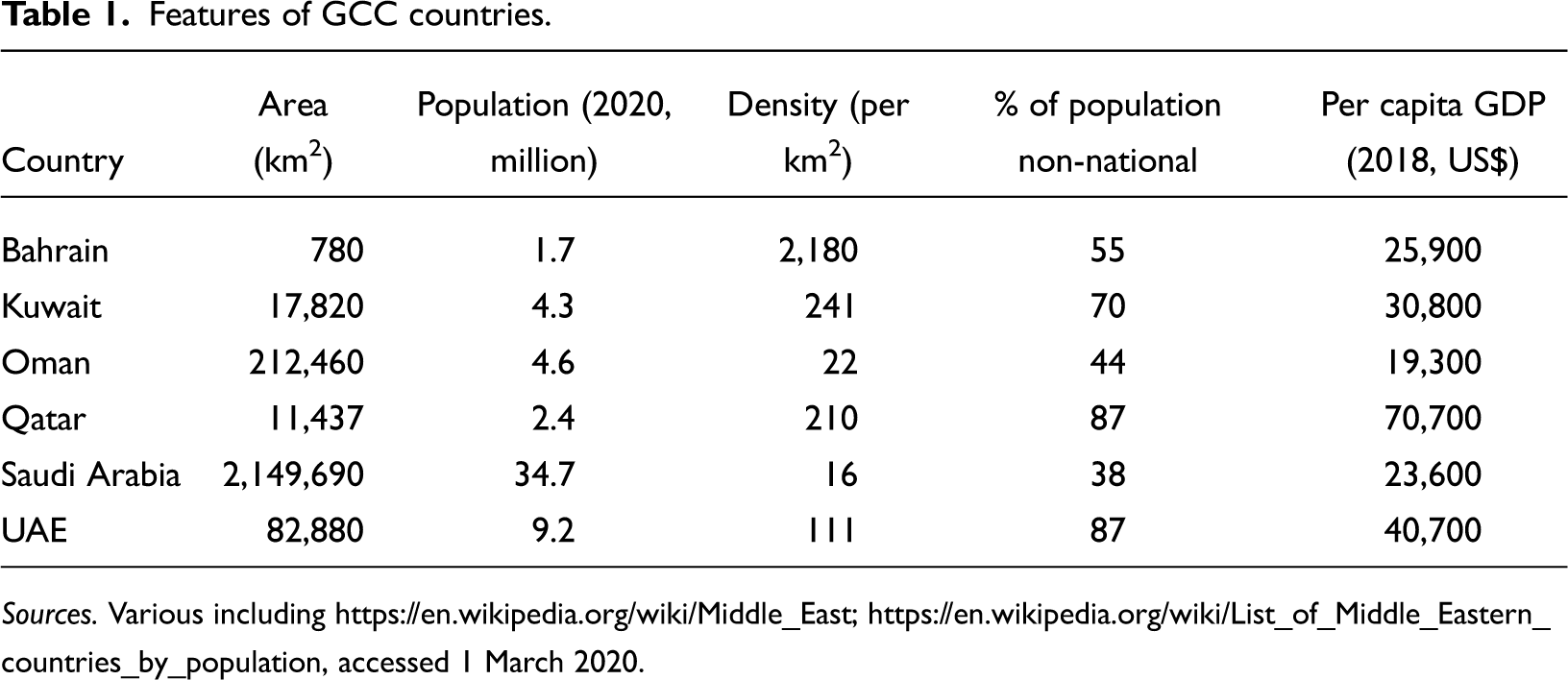
Sources. Various including https://en.wikipedia.org/wiki/Middle_East; https://en.wikipedia.org/wiki/List_of_Middle_Eastern_countries_by_population, accessed 1 March 2020.
Perhaps even more important to this paper are economic features. As explained by Allam and Karolak (2020, p. 2): From being initially the backwaters of the world system to becoming the oil providers to the world, in the twenty-first century, the countries of the Arabian Gulf entered a new era. … Thanks to vast oil resources, the Gulf Cooperation Council (GCC) region has evolved from sleepy outposts to world-recognized centers of banking, tourism, trade, shopping, and more recently innovation and culture.
Turning to education, the majority of countries have young systems (Kirdar, 2017). In Qatar, for example, before the start of modern schooling in the 1950s the only form of education was traditional provision by one teacher to groups of girls or boys, and mainly focused on memorization of the Quran with basic Arabic orthography and simple arithmetic (Al-Maadheed, 2017, p. 180). In 1952 Qatar had just one elementary school (for boys); yet, by 1980 it had 141 schools (71 for boys and 70 for girls). Kuwait had a longer history of schooling in the accepted contemporary mode, with the first institution having been established in 1911 (Al Sharekh, 2017, p. 138), but provision remained very limited prior to independence in 1961. Oman similarly prior to 1970 had “no comprehensive educational system” (Al Ghanboosi, 2017, p. 157), and in that year had only 16 schools. However, the numbers expanded dramatically to 207 schools in 1975, 588 in 1985, and 953 in 1995. Comparable patterns were evident elsewhere in what are now the GCC countries, stimulated by resources from oil and the visions of their respective governments. Yet while oil provided financial resources, personnel to operate the schools had to be recruited from elsewhere. Egypt was a major source, supplemented by neighbors including Lebanon, Jordan, Syria, and Palestine (Ridge et al., 2017). The teachers and administrators brought with them their accustomed approaches, including those concerning private tutoring.
The scale and nature of shadow education in GCC countries
Commencing analysis with historical patterns, private tutoring was an issue in Kuwait even in the 1960s. According to Al-Sowelan (2013, p. 14), a 1961 circular to schools from the Majlis Al-Maaref [Council of Knowledge], which preceded formation of the Ministry of Education in 1962, prohibited individual tutoring “because of its harmful effect on students.” It was followed by a pair of circulars (Ministry of Education of Kuwait, 1962, 1964) that prohibited teachers from providing private tutoring unless they had explicit permission from the Ministry. A report by Jamal (1965) in Saudi Arabia indicated that private tutoring had similarly emerged in that country as a significant issue. In other countries, the issue only became prominent in subsequent decades, but by the 1990s, it was clearly an agenda item in Bahrain, the UAE, and Qatar (Albuhi & Alsadah, 1994; Bouklah & Al-Khayal, 1997; Hasan, 1996).
Table 2 presents data from the Trends in International Mathematics and Science Survey (TIMSS) managed by the International Association for the Evaluation of Educational Achievement (IEA) for 2015 and 2019. The data refer to Grade 8, and are only for mathematics and science. Further, since the question did not include focus on fees, they could include fee-free tutoring. 1 Nevertheless, the data are especially useful because they were collected with rigorous sampling and common method across all the countries shown. As might be expected, tutoring enrollment rates were greater in mathematics than in science. In 2015 for mathematics they ranged from 57.9% in Kuwait to 38.6% in the UAE, and for science they ranged from 48.2% in Bahrain to 31.5% in the UAE. Since Grade 8 was not a significant transition point in these countries, it may be assumed that rates were higher in subsequent grades and particularly the last grade of secondary schooling at the end of which students sat the high-stakes examinations for university entry. The dominant motive indicated by the students was to excel in class rather than to keep up. In most (but not all) countries, reported enrollment rates dropped slightly between 2015 and 2019, but remained high.
Grade 8 enrollment rates and motives in supplementary tutoring, TIMSS, 2015 and 2019 (%).
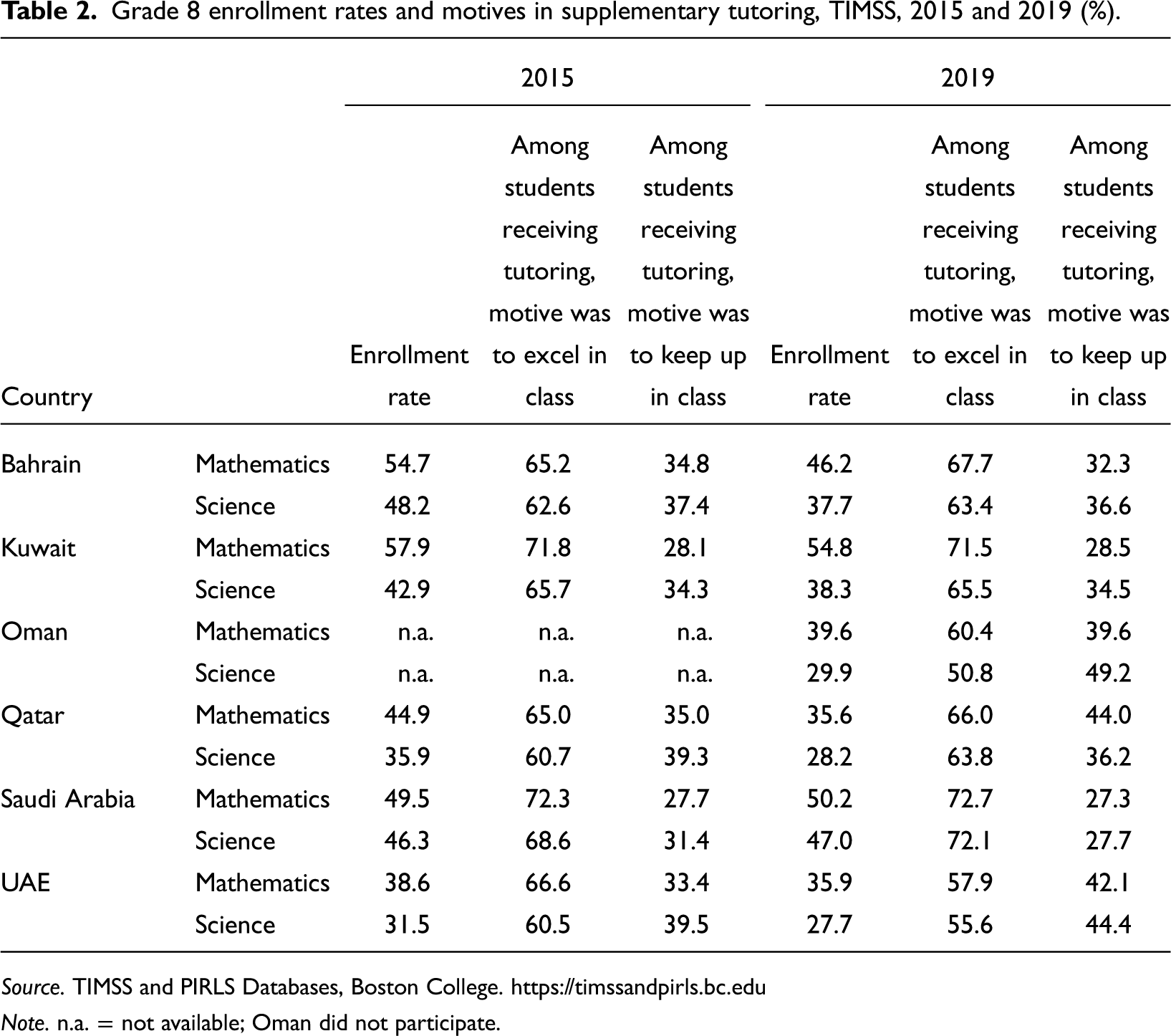
Source. TIMSS and PIRLS Databases, Boston College. https://timssandpirls.bc.edu
Note. n.a. = not available; Oman did not participate.
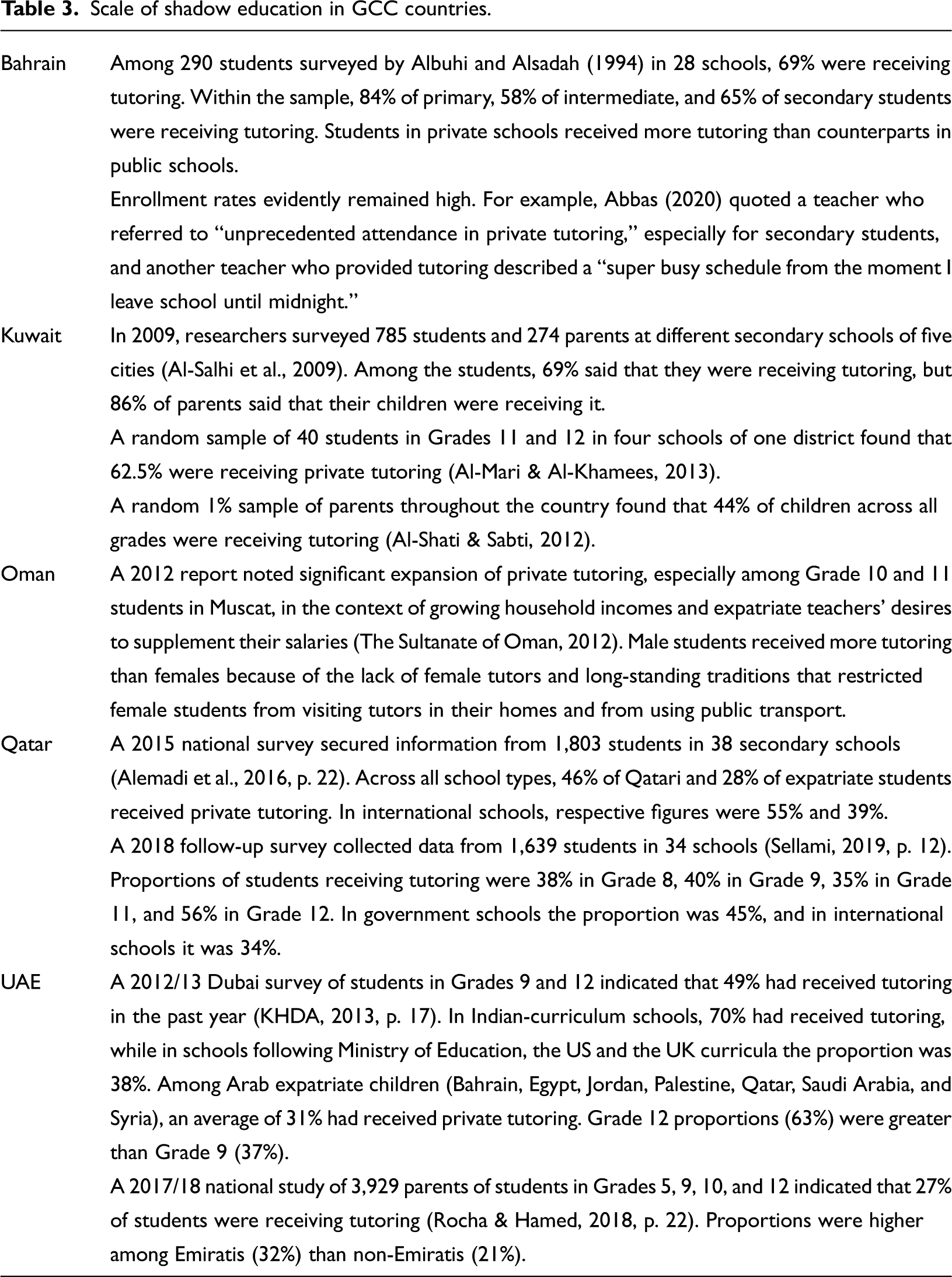
Supplementing the TIMSS data, Table 3 summarizes various national and subnational studies. They were conducted with diverse approaches, in some cases without strong methodological rigor, but are nevertheless useful. Overall, the studies and related commentaries indicate that tutoring has been and remains:
especially common in senior-secondary schooling as students face terminal examinations, but also evident in primary and junior secondary schooling; commonly received by students in both private and public schools; especially demanded in mathematics and languages (particularly English, and also, to some extent, Arabic), and in physics and chemistry for students in science streams; and more widespread in urban than rural areas.
Scale of shadow education in GCC countries.
Concerning providers of private tutoring, data collected by Rocha and Hamed (2018, p. 27) through a national sample across the UAE are worth noting. Nearly half were tutored by teachers from other schools, 13% by their own teachers, 12% by other teachers in their own schools, and 29% by “persons who were not teachers.” This last category may have included personnel in tutorial centers as well as university students and other informal workers. Concerning tutorial centers, several international companies including Kumon, Kip McGrath, Oxford Learning, and Sylvan Learning were active in GCC countries—attracted by the lucrative market and strikingly absent from other countries in the Middle East.
Multilevel and multidimensional analyses of shadow education
As indicated at the outset, understanding of the nature of shadow education and its driving forces may be enhanced by multilevel analysis of the sort presented in Figure 1, and by consideration of further units for comparison including socio-economic groups and wider cultural groups. These units for comparison are here employed in turn.
Comparisons across world regions/continents
For this paper, a starting point for cross-regional comparisons is between the GCC countries as a group and the rest of MENA. Within MENA, Egypt is among countries with the longest histories of shadow education on an extensive scale, reflected in a set of regulations (Ministry of Education of Egypt, 1947) that prohibited teachers from providing private lessons without permission. These regulations were not effective, and successive governments battled with little success (see, e.g., Abd-al-Aaty, 1994; Hartmann, 2013; Hua, 1996; Sieverding et al., 2019). The engrained nature of shadow education across North Africa and also in the lower income countries of the Middle East shaped patterns in the GCC countries, especially because many expatriate teachers in the GCC countries were from the broad MENA region and brought their cultures with them.
Looking further afield, MENA's long history of tutoring deserves underlining because much literature places East Asia than the Arab states at the forefront, asserting the influence of Confucian culture (see, e.g., Kim & Jung, 2022; Zeng, 1999). Certainly, concerning Japan, Sato (2012) wrote about “100 years of juku and 50 years of juku associations”; yet, in Korea, the history of the phenomenon as a significant issue dates only from the 1950s (Seth, 2002, p. 143), i.e., a little later than Egypt albeit a little earlier than the GCC countries. In Chinese Taiwan, according to Zeng (1999, p. 156), academic buxiban, which he describes as “cram schools,” came to the fore in the 1960s with government (attempted) regulation dating only from 1985. Further, in Chinese mainland, shadow education only emerged significantly in the 1990s, with regulations commencing their evolution in 1995 (Zhang & Bray, 2021).
Turning to South Asia, Majumdar (2018, pp. 274–275) highlighted tutoring advertisements in a leading Indian newspaper at the turn of the 20th century, but many decades elapsed before tutoring became a focus for government action. More significant as a milestone of government attention was focus in 1943 in neighboring Ceylon (present-day Sri Lanka) (Government of Ceylon, 1943). As such, in at least this part of South Asia historical patterns paralleled those in Egypt and predated those in the GCC countries. They also had parallels in the subsequent ineffectiveness of government policies to rein in the phenomenon (see, e.g., Joshi, 2021; Majumdar, 2018).
An alternative reference point might be Europe. In Greece, Kassotakis and Verdis (2013, p. 94) highlighted political forces from the 1920s that increased competition in education and therefore demand for tutoring, and also increased the supply of tutors because many schoolteachers lost their jobs for ideological reasons and sought alternative occupations. However, the early development of Greek patterns was largely an exception, though to some extent accompanied by Cyprus which had close cultural and political ties (Lamprianou & Lamprianou, 2013). In Eastern Europe, shadow education emerged when teachers’ salaries collapsed in conjunction with the 1990s transitions from Communism; in Western Europe, the phenomenon advanced in the 2000s with increased acceptability of marketization; and in Northern Europe, the phenomenon dates mainly from the 2010s (Bray, 2021b; Christensen & Zhang, 2021). Thus, with the main exceptions of Greece and Cyprus, the European emergence was again substantially later than in the GCC countries.
Similar remarks also apply to the other world regions. In Sub-Saharan Africa, Mauritius was a forerunner evidenced by a 1941 government report (quoted in Ministry of Education and Science of Mauritius, 1994, p. 2) that paralleled the 1943 Ceylon report. Elsewhere in Sub-Saharan Africa, the phenomenon only emerged in a significant scale after the turn of the 21st century, and even then was more prominent in Anglophone and Lusophone than in Francophone countries (Bray, 2021a). Similar remarks about timescale may be made about North and South America (see, e.g., Aurini et al., 2013; Galvão, 2020). Thus, in summary while the GCC countries were not the first to experience significant shadow education, the emergence was earlier than in many other regions.
Countries as units for comparison
Although the above section was titled “Comparisons Across World Regions/Continents,” considerable mention was made of countries despite broader descriptors of Arab states, Confucian culture, post-Communist transitions, Anglophone countries, etc. This was partly for convenience to identify specific parts of regions, but also because countries are indeed important units for comparison—especially in education sectors dominated by national education systems and regulations set by Ministries of Education.
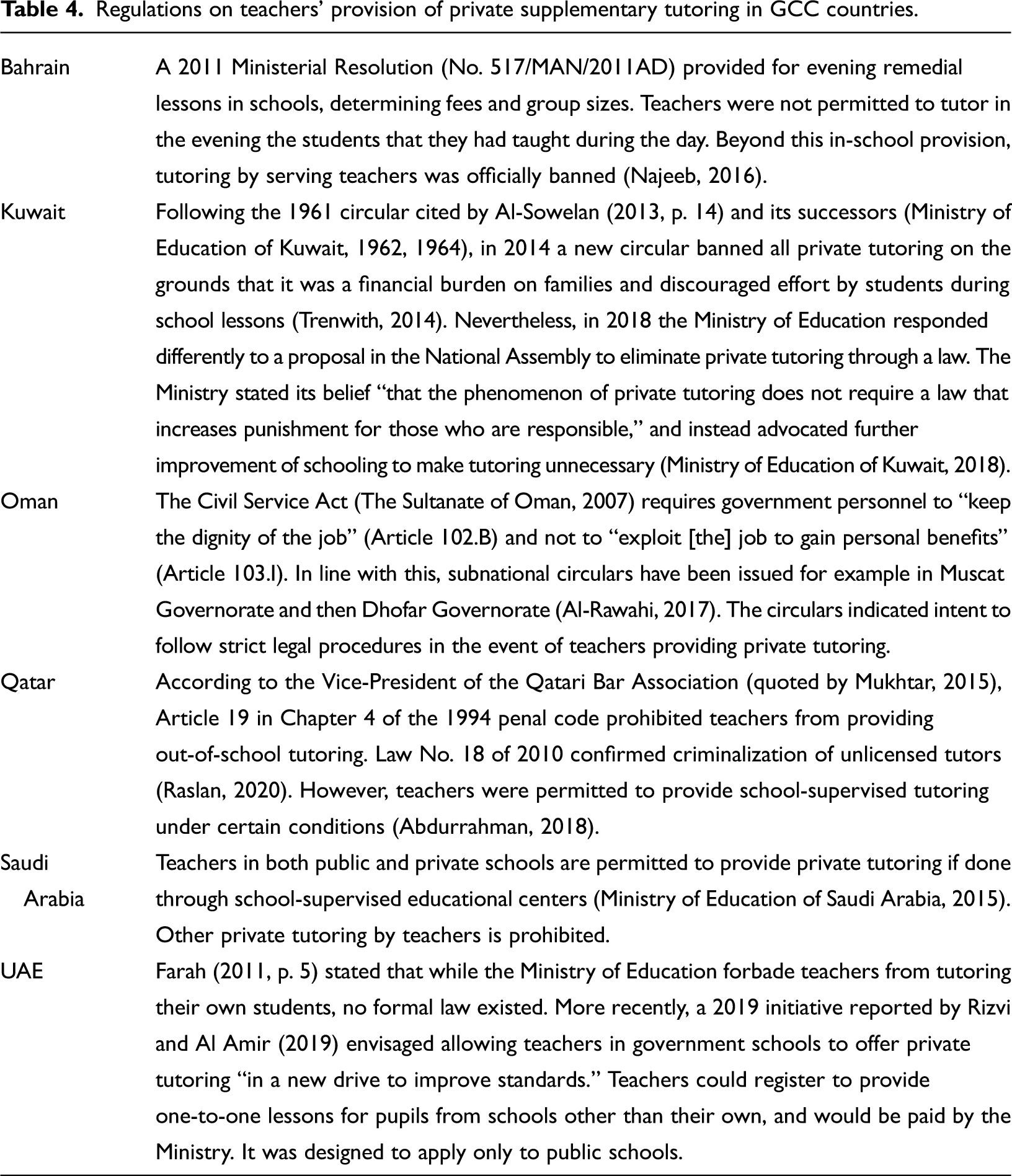
Elaborating, Table 4 presents regulations concerning teachers and private tutoring in the GCC countries. Many governments prohibited serving teachers from providing private tutoring, but with variations for example in the regulations of Bahrain, Qatar and Saudi Arabia that did permit forms of school-supervised remedial private lessons. The UAE government did not have a specific policy of prohibition outside schools, but did devise a scheme for teachers in public schools to provide Ministry-supervised tutoring. The Kuwait authorities, after decades of fierce but ineffective regulations, decided in 2018 to reduce confrontation and instead to focus on school improvement to make tutoring unnecessary. This diversity shows the pertinence of policy comparisons at the country level, and further insights can be obtained from evaluation of factors determining the (in)effectiveness of the policies.
Regulations on teachers’ provision of private supplementary tutoring in GCC countries.
A further regulatory dimension concerns tutorial companies. In all countries, standard business regulations may be assumed to apply concerning accounting, contracts, taxation, etc., alongside building regulations about fire escapes, electrical wiring, and toilets. In contrast to other parts of the world (Zhang, 2021), however, few GCC countries have specific regulations for tutorial centers. The most prominent exception is Qatar, the government of which issued a pair of documents (Government of Qatar, 2015; Ministry of Education and Higher Education of Qatar, 2017) with detailed specifications on licensing tutorial centers, the qualifications of tutors, and display of prices. Subsequent measures included a system to evaluate, classify, and if necessary suspend all accredited centers (Al-Sharq, 2019), and then requirements on maximum prices, group size, and provision for both genders (Raslan, 2020). These requirements considerably reduced the number of tutorial centers, and thus showed how regulations at the country level could impact on the scale and nature of provision.
Comparisons across subnational levels of government
Table 4 mentioned that in Oman, the Muscat Governorate had in 2017 chosen to issue its own policies under the umbrella of national ones and was followed by Dhofar Governorate. In this regard, Al-Rawahi (2021) surveyed 200 teachers in different schools in Oman to explore the scale of private tutoring and the participants’ awareness of the Omani legal prohibition of serving teachers providing such tutoring. Al-Rawahi (2021, p. 218) found that 67% of participants provided tutoring, mainly to supplement their school salaries. Almost all participants believed that there was no official prohibition, and rather that it was only a Ministry of Education recommendation (Al-Rawahi, 2021, p. 217).
More striking examples of subnational policies are at the emirate level in the UAE. Sharjah, for example, at one stage devised a model for government-supervised after-school study centers to provide an alternative to the private marketplace (Ahmed, 2012), though in practice the marketplace remained vigorous. In parallel, Dubai’s Knowledge and Human Development Authority (KHDA) engaged in a detailed study of the nature of tutoring provision (KHDA, 2013), and for several years suspended issue of new licenses. One impact of Dubai's relatively tight management of tutorial centers was that many families sent their children across the border to Sharjah on a daily basis for after-school tutoring.
Comparing shadow education at institutional levels
Even more striking than differences between subnational levels of government are differences between schools, as again illustrated by Dubai. Among the UAE emirates, Dubai has the largest proportion of non-nationals—reaching 91% of the total population (De Bel-Air, 2018). Public schools supervised by the UAE Ministry of Education chiefly cater for Emiratis, though some children from other Arab countries also attend. The private sector, supervised by the Dubai KHDA, serves expatriates and Emirati families who choose not to attend public schools.
In 2021, Dubai’s private schools served 89% of the total school-going population and offered 17 different curricula (KHDA, 2021). Some schools followed the Ministry of Education curriculum, while others followed curricula taken or adapted (sometimes with hybrids) from Australia, India, Iran, France, Germany, Japan, Pakistan, Philippines, Russia, the United Kingdom (UK), and the United States (US). These schools were not necessarily populated exclusively by nationals of those countries, and the UK and the US schools in particular attracted multiple nationalities. To some extent, the scale and nature of private tutoring reflected traditions in the students’ home countries, with Indian, Pakistani, and Egyptian students being among the groups with the highest rates of private tutoring. In addition, uptake of shadow education reflected the curriculum. Thus, the principal of a UK-curriculum school mainly serving Indian and Pakistani families reported that very few students received supplementary tutoring because the assessment system mainly depended on student profiles rather than on examination scores in which a single percentage point could have far-reaching implications for each student’s future. The principal added that the Indian syllabus was much wider than the UK one, and therefore required much more cramming of information.
Patterns also reflected the schools’ business models. Some schools charged high fees and provided tutoring at no extra charge as part of the package, while others charged low fees and expected students in need to secure extra tutoring either via the schools or externally (Bray & Ventura, 2022). This observation raises an issue of classification: in both cases families were charged fees for the tutoring, but packages in which the school provided support might not have been called shadow education in the same way as separately funded support.
Further diversity was evident even among comparable schools according to the policies of institutional administrations. Thus, the principals and management teams might oppose tutoring on the grounds that it interfered with school operations, might welcome tutoring because it raised the students’ performance levels, or might have a laissez faire attitude with no specific policies. Indeed school-by-school analysis showed two cases in which even different sections of schools had different policies (Bray & Ventura, 2022). In one school, the primary-section head organized private tutoring on the premises, while the secondary-section head rejected such a practice. Another school displayed a reverse pattern: the secondary-section head had an approval system for teachers to provide fee-charging supplementary lessons, though normally outside the premises, while the primary-section head rejected the practice.
Comparing socio-economic, cultural, and gendered groups
International literature (e.g., Entrich, 2021; Jansen et al., 2021) shows that shadow education is more likely to be demanded by the middle classes than by the lowest and highest classes. The lowest classes cannot generally afford the fees and may not have ambitions to invest in shadow education, and the highest classes have alternative ways to secure their children’s futures by sending their children to outstanding schools at the outset and by supplementing with foreign travel and other forms of cultural capital.
While more research is needed, to some extent these global patterns match those in the GCC countries but with variations. In general, the nationals of the GCC countries are protected in their earnings and lifestyles, and are cushioned in a way that non-nationals are not. This is part of the “autocratic bargain” in which populations have been willing to acquiesce to long-standing political structures in return for economic and social rewards (Abdel-Moneim, 2016, pp. 52–54). Among expatriate workers, those at the top end are commonly looked after by their employing companies and related structures. At the bottom end, however, low-income expatriate workers employed for construction, maintenance, etc., commonly leave their families in their home countries rather than bringing them to the Gulf, and thus do not appear in the host-country schools. Thus, review across the social classes might not even show the children of the lowest classes.
These observations also overlap with cultural groups. In Dubai, the survey of students in Grades 9 and 12 (KHDA, 2013) had shown that in Indian-curriculum schools (populated almost exclusively by Indian students) 70% of students were receiving private tutoring. In schools following the Ministry of Education, the UK and the US curricula, among Arab students from non-UAE countries an average of 38% were receiving private tutoring. These matters also affected the subjects demanded. Across all schools, mathematics and sciences were in high demand. Among the Emirati and other Arab students in the US-curriculum schools, English was also much demanded. By corollary, few Emirati and other Arab students sought tutoring for Arabic, presumably feeling that they had adequate competence. Non-Arab students in the other schools mostly stuck to their own languages or to English and thus felt less need to learn Arabic, but interviewees in one Indian-curriculum school indicated that some families did desire Arabic competence that could not be offered adequately by the school.
The question then remains about cultures of tutoring among Westerners and others. Although recent years have shown growing shadow-education enrollment rates in such countries as Australia, the UK, and the US (Buchmann et al. 2010; Davis, 2013; Sutton Trust, 2019), rates have not (yet) reached the levels of South Asia and the Middle East. While numerical data would be desirable for confirmation, impressions across the GCC countries suggested that the tutoring enrollment rates for Westerners are relatively modest even if probably growing in line with trends in the home countries.
A further cultural element had a gender dimension. The UAE survey undertaken by Rocha and Hamed (2018, p. 23) found that among Emiratis, males received private tutoring more often than females. Rocha and Hamed suggested that the pattern might be linked to parental awareness of the poor performance of males in national and international assessments. More judgmental was the view of a school principal in Dubai that boys needed more tutoring because “they are more spoiled, less committed to learn, and want to have fun,” while girls were expected by cultural norms to be more domesticated (Bray & Ventura, 2022, p. 6). Allied to this matter was the gender of available tutors. In the Arab community, men were more likely to offer tutoring, not only because of financial incentives but also because of acceptable cultural norms. Women were more likely to have family obligations that precluded supplementary roles, and for cultural reasons could less easily visit students’ homes to provide tutoring (see also, e.g., The Sultanate of Oman, 2012). Such factors were less inhibiting for other cultural groups, and no statistical differences between male and female receipt of tutoring were found by Rocha and Hamed (2018, p. 23) among expatriates in their sample.
Conclusions
This paper commenced with Sadler's (1900, p. 309) oft-quoted phrase that “the things outside the schools matter even more than the things inside the schools.” This insight applies in the GCC countries as much as other parts of the world, and alongside schools it applies equally to tutorial centers and other venues of private tutoring. Sadler added (p. 309) that the things outside the schools “govern and interpret the things inside.” This further clause assists understanding of relationships between schooling and private tutoring, since each shapes the other. Private tutoring has a backwash on schooling, and thus is neither neutral nor unidirectional in its shadowing qualities.
For a paper specifically focused on the GCC countries, some summary observations can indicate how patterns resemble or differ from those elsewhere. First, insofar as schooling has become a global phenomenon, so has shadow education, and insofar as the shadow, indeed, mimics the globalized features of schooling, its features in the GCC countries resemble those across the world. However, the GCC countries also have distinctive features, in part reflecting historical forces.
Here again it is useful to recall both Sadler (1900) and Crossley and Jarvis (2001). Sadler wrote (p. 310) about “forgotten struggles and difficulties and ‘of battles long ago,’” while Crossley and Jarvis (p. 406) stressed “the importance of history in understanding our various worlds.” This paper has highlighted the late development of schooling in the GCC countries compared with other world regions, but then the very rapid changes facilitated by availability of wealth from oil. Construction of the school systems required import of teachers and administrators, with Egypt as the largest Arabic-speaking country in the region being a major source. Ridge et al. (2017, p. 46) cited a newspaper editorial applauding the UAE’s educational pioneers who in the 1960s and 1970s “had the herculean task of building an entire educational network from nothing.” However, the editorial added, “by importing teachers en masse from Egypt, they rebuilt the problems of the Egyptian state system here.” The prevalence of shadow education, particularly that provided as a side activity by serving teachers, was among the problems imported. Teachers were also recruited by the GCC countries from other Arabic-speaking countries of the region, but schooling in those countries had also to some extent been shaped by patterns in Egypt, and in Egypt itself, shadow education remains an intractable issue (Moreno Olmedilla, 2022; Sieverding et al., 2019).
Alongside the Arabic-speaking teachers are counterparts from other world regions. The GCC countries are distinctive in having very high proportions of expatriate residents—reaching 87% in the UAE. The non-Arab expatriates also bring their cultures with them, and commonly send their children to schools following the curricula of their home countries. These curricula are also in many cases supported by shadow education, particularly in schools serving South Asian families, which helps to explain the high rates of shadow education in these subpopulations in contrast to patterns for Europeans and North Americans, for example. Such factors are part of what Sadler (1900, p. 309) had called “the intangible, impalpable, spiritual force which … is in reality upholding the school system,” and what Crossley and Jarvis (2001, p. 405) had described as “the significance of differing world views, forms of knowledge [and] frames of reference.”
The paper then moved to multilevel analysis to highlight patterns and forces. First were comparisons across world regions and continents to show that while the emergence of shadow education as a significant phenomenon demanding government attention was later in the GCC countries than in parts of East and South Asia and in such specific countries as Egypt and Mauritius, it was earlier than in most of the Americas, Europe, and Sub-Saharan Africa. This fact again underlines the imported traditions in the GCC countries despite the overall youth of their education systems. Next were remarks about patterns at the country level, which in turn show the pertinence of national-government policies. Most such policies have sought to dampen shadow education, though they have had limited success—again in echo of patterns elsewhere (Zhang, 2021). At the subnational level, variations may be found for example according to governorate policies in Oman and emirate policies in the UAE, and even more striking may be variations at the school level. These factors are in turn “governed and interpreted” by cross-cutting dimensions of socio-economic status, culture, and gender, and all is best understood by taking a historical perspective to show continuities and changes over time.
Many further dimensions could and should be explored beyond the length possible in this paper. Referring again to the top of the cube (Figure 1), they would include age-groups and religious groups; concerning the right-hand side of the cube, they would include dimensions of curricula, teaching methods, finance, management structures, political changes, and links to labor markets. Such factors again would relate on the one hand to the schooling and on the other hand to shadow education, showing differences, complementarities, and interactions between the two sides. The GCC countries, both individually and as a group, have many complex features that provide an instructive context for comparative analysis. Further research can explore these domains not only to deepen understanding of patterns and forces in this part of the Middle East but also to contribute to wider understanding through comparison with other world regions.
Footnotes
Authors’ note
This paper draws on a broader work (Bray & Hajar, 2023) that focuses not only on the six GCC countries but also on the six other Arab countries in the Middle East. The authors appreciate the permission from the publisher to utilize the material in that book.
Contributorship
The authors worked together on this paper. Mark Bray took the lead in drafting. Anas Hajar played a significant role not only in conceptualizing but also in identifying Arabic-language sources.
Declaration of conflicting interests
The authors declared no potential conflicts of interest with respect to the research, authorship, and/or publication of this article.
Funding
The authors disclosed receipt of the following financial support for the research, authorship, and/or publication of this article: This work was supported by the Chinese Ministry of Education Project for the Key Research Institute of Humanities and Social Sciences at Universities, entitled “Cross-Boundary Curriculum Partnerships Between Schooling and Shadow Education” (Project number: 22JJD880028).