



Abstract
Purpose
This study explores the achievements and process of a group of Chinese primary school teachers learning from a research-based school–university collaborative project.
Design/Approach/Methods
We used qualitative methods to construct our research design, collecting data through participatory observations of weekly meetings, teacher interviews, and participants’ reflective journals. Both thematic analysis and discursive analysis were employed as strategies to scrutinize the data.
Findings
We categorize teachers’ learning into five achievements: outcome, processual, democratic, catalytic, and dialogic achievement. A further examination highlights seven successive learning actions composing an implicit mechanism to facilitate these achievements: questioning, analyzing, modeling, examining, implementing, reflecting, and consolidating.
Originality/Value
Through this longitudinal study, we more comprehensively record details about teachers’ learning as they conduct their own research. Although school–university heterogeneous collaboration has potential conflicts, teachers can improve their problem-solving and knowledge creation and sharing abilities, promoting a sense of professional accomplishment. These findings also suggest the need to reconsider the authentic process of teacher research, a task equally significant for international educators.
Keywords
Introduction
Teacher research has recently gained popularity as a crucial factor in the professional learning and development of teachers worldwide (Cheng & Li, 2020; Dunn et al., 2019; Lambirth & Cabral, 2017). The growing interest in “teachers as researchers” (Stenhouse, 1981) emerges from the demand for teaching competencies necessitated by educational reforms requiring changes in both teachers’ practices and ways of thinking. A common approach to teacher research is school–university partnerships (Tsui & Law, 2007), wherein teachers, who are not researchers as such, function in that capacity through the facilitation of university experts serving as teacher educators.
Existing research suggests that teacher–university researcher collaboration significantly contributes to teachers’ professional development (Baumfield & Butterworth, 2007; Burton & Barlett, 2005; Tsui & Law, 2007). Thus, teachers and researchers exchange experiences, promoting meaningful mutual learning during such collaborations (Dresner & Worley, 2006). Recently, van Schaik et al. (2018) revealed that the school–university partnership is an emerging strategy enabling teachers to apply academic knowledge. However, few studies have fully and deeply explored how teachers learn in such settings by conducting research themselves instead of passively acquiring knowledge from others’ research. Moreover, according to Mitchell et al. (2010), there remain uncertainties about teachers’ learning processes and achievements in school-based research processes. Thus, a research gap exists regarding the authentic process of teachers’ learning by doing research. Moreover, evidence from Chinese local schools and teachers has not been meaningfully presented internationally. Hence, this study aims to address this lapse by analyzing a Chinese case to clarify the authentic teacher learning-through-research process alongside achievements and conflicts.
This study adopts the concepts of “learning achievements” and “learning actions” to examine what and how teachers learn in a school–university collaborative project where schoolteachers learn to conduct research. “Learning achievement” stems from Meijer et al. (2013) and is defined as the quality of teacher research carried out in schools, ultimately relating to changes in teachers’ professional development. “Learning action,” taken from Engeström’s (1987/2015) activity theory, posits a processual mechanism of human learning. Synthesizing several learning theories, Emgeström proposed a cycle of seven learning actions: questioning, analyzing, modeling, examining, implementing, reflecting, and consolidating. In our study, “learning achievement” refers to “what” teachers learn by researching, while “learning actions” is “how” teachers learn in the evolutionary process. Thereby, we conducted a longitudinal investigation in a Chinese primary school to obtain in-depth answers to two research questions:
What learning achievements do teachers gain by conducting research? What learning actions do teachers demonstrate when conducting research?
Through these questions, our study is significant in promulgating the authentic learning of Chinese teachers conducting research. Achievements alongside conflicts are consolidated by teachers’ reflections, which supply a dialectical view of teacher learning by researching. Additionally, our empirical survey of the evolutions of each learning action during the 11-month collaboration sheds light on Chinese teachers’ learning styles, perhaps serving as further implications for reshaping in-service teacher education and school–university partnerships.
Literature review
This study is informed by three interconnected strands of literature: teacher learning, teacher research, and school–university partnerships. Here, teacher research is an effective strategy for teacher learning, and school–university partnerships construct foundations for teacher learning by researching.
Teacher learning
Teachers’ professional development can significantly improve school quality, increase teacher effectiveness, and facilitate student learning (Opfer & Pedder, 2011). However, most existing research has yielded unsatisfactory results owing to insufficient model development (Webster-Wright, 2009). Teacher learning is an attempt to transform the top-down model of teacher development to a bottom-up model (Eraut, 1994; Meirink et al., 2007; Putnam & Borko, 1997). Learning as a knowledge co-construction process is situated in specific school settings (van Schaik et al., 2019); thus, we should explore how teachers’ skills can be enhanced within authentic contexts (Grimmett, 2014).
Previous studies on teacher learning have covered several critical topics. Notably, teacher learning is hard to define because learning is context-, people-, and activity-dependent (Opfer & Pedder, 2011). Kennedy’s (2019) recent review examines how professional development programs facilitate teacher learning, arguing that most focus on specific procedures, content knowledge, or strategies and insights. Paying attention to teacher selves, Korthagen (2017) proposes that teacher reflection on three dimensions (cognitive, affective, and motivational) is important in promoting teachers’ meaningful learning. Regarding teacher learning approaches, Korthagen (2017) weighs a teacher-personal-centered approach against a theory-to-practice and school-based workplace learning approach. Similarly, Cameron et al. (2013) provide invaluable insight into what might constitute a holistic and teacher-centered approach to understanding teacher learning.
More broadly, Opfer and Pedder (2011) conceptualize teacher learning as a complex system rather than an event. Education researchers have pursued questions about what makes one teacher better than another and how we can provide guidance to help teachers improve. However, most efforts have been naive as teaching is more complicated than previously thought. Historically, researchers have assumed that teacher behavior and learning sources could be visibly identified; however, many unconscious sources are also important (Korthagen, 2017). As Hoekstra (2007) claims, “it is remarkable that research on teacher learning is mostly concerned with teachers’ change in cognition, as if behavioural change automatically follows from a change in cognition” (p. 116).
Aligning with Opfer and Pedder (2011), we define teacher learning as a complex system where teachers undertake learning actions that change their research knowledge and daily work actions. Opfer and Pedder (2011) suggest the need for continued large- and small-scale empirical research combining both qualitative and quantitative enquiry: “To develop the conceptual and empirical basis necessary to test an explanatory theory of the complex systems of teacher learning, our focus should be on developing and continuously refining methods and methodologies aimed at identifying the edges of generalizability and variation that characterize the patterns of processes and interaction of these systems” (p. 396). This study contributes by revealing the complex process of teacher learning in schools and evaluating teachers’ learning achievements in the context of their learning to conduct research.
Teacher research
“Academising teaching” (Meijer et al., 2013, p. 40), leading teachers to conduct research, is a vehicle for professionalizing in-service teacher education. As Meijer et al. (2013) argue, “teachers should ask questions more frequently, which would result in an inquiry-based attitude and a more academically inclined interpretation of teacher-hood” (p. 40). Cochran-Smith and Lytle (1993, 2009) contribute a critical approach to analyzing teacher learning and collaborative practices in teacher education.
Previous studies have shown that learning to conduct research is significant for teachers’ individual development and increased professionalism (Cochran-Smith & Lytle, 2009; Toom et al., 2010). Having research expertise will give them confidence in reading research articles and in acquiring high-level skills such as data analysis, writing, collaboration, and critical thinking (Healey & Jenkins, 2009; Hunter et al., 2007), contributing to the analysis of their own development and learning processes (Medwell & Wray, 2014). Therefore, doing research plays a role in teachers’ personal development, professional competence, and research competence (Aspfors & Elund, 2017). As Cochran-Smith and Lytle (1993) proclaim, teacher research is a way of knowing, arguing that school-based teacher-researchers are knowers and primary sources for generating knowledge about teaching and learning. Simultaneously, it has been claimed that teachers’ involvement in research is beneficial for schools and school communities, promoting a research culture (Gu & Wang, 2006; Harrison, 2013) that perhaps leads to evidence-based teaching practice. Further, research has also suggested that researching is a characteristic of high-quality teachers (Earl & Timperley, 2008), where they shift from mere technician roles to critical and professional ones (Postholm, 2009).
In the Chinese context, establishing research-based teachers is a policy-oriented discourse in schooling that has profoundly influenced teachers’ perceptions of their teaching (The Central Committee of the Communist Party of China and the State Council, 2018; Wei, 2020). Teacher research is regarded as a boundary-crossing activity between schools and universities (Chen, 2020) and requires a learning community constructed by schools/districts for sustainable communication (Gu & Wang, 2006). Our previous research in Chinese primary schools shows that teachers learning to conduct school-based research need certain interventions from knowledgeable others (Wei, 2019).
Teacher research has helped teachers hone their research-based knowledge by granting them and university experts opportunities to exchange more diverse ideas and experiences (Burton & Barlett, 2005; Dresner & Worley, 2006). Such interactions, however, are rarely achieved without dispute, and disruptions to teachers’ daily work are seldom viewed as teacher learning opportunities (Engeström, 1991). Despite the benefits of research in teacher education, the actual relationship between academic research and teachers’ professional practice is not straightforward (Yancovic-Allen, 2018). Thus, this raises the novel question of what the specific features are of successful teacher learning about how to conduct research in collaborative settings with university experts.
School–university partnerships
Numerous studies analyzing teacher learning acknowledge the significance of school-university partnerships (Cheng & Li, 2020; Dunn et al., 2019; Wang & Wong, 2019). School–university partnerships as research networks commonly draw on principles of practitioner research, reflective practice, and collaborative enquiry as sources of professional learning, knowledge-building, and school improvement (McLaughlin et al., 2008). The aim is to combine the expertise of university and school staff to address concrete, local, and professional challenges often accompanied by university accreditation for involved teachers. Both school and university staff can derive significant benefits from participating in such partnerships. Yet, as Baumfield and Butterworth (2007) remark in a review of school–university research partnerships, the parties involved do not always receive mutual and equitable benefits. It is a learning process for all involved.
For most teachers, the nonlinear development of professional competence, theory, and experience converges over time in day-to-day school practice (Lunenberg & Korthagen, 2009). A central aspect of teacher learning considers the shifting ways in which different knowledge worlds are experienced. Until recently, a comprehensive understanding of the conditions for teachers’ learning at schools has been hindered by extensive research about competing individual, social, and contextual perspectives on how teachers learn in their workplace. There are sensory, motivational, emotional, cognitive, and social aspects of the processes affecting people’s thinking and behavior. These derive from contextual and personal factors elicited in varied and unpredictable ways in particular situations (Korthagen, 2010; Meirink et al., 2007). Teachers may change from viewing academic study as a distant, irrelevant, and difficult university process to a fully integrated aspect of collective professional activity in schools. This is an empirical question relevant to our own study and school-university partnerships generally.
Yet, there are also challenges in establishing mutually beneficial school–university partnerships. Often, the research questions posed by academics do not match the needs of the target communities. Additionally, the lengthy process of conducting rigorous research may not align with community partners’ timelines for incorporating findings into decision-making processes (Nelson et al., 2015). Our recently published study in China investigated the common modes of school–university partnerships and discussed the challenges they face (Wei & Huang, 2022). However, the Chinese experience of school–university partnerships has not been visible to international scholars, and how Chinese teachers learn has not been studied empirically by local researchers. Our article aims to fill this gap.
Conceptual framework
To ascertain the “what” and “how” of teacher learning in school–university collaborative research projects, this study combines two theoretical concepts—“learning achievements” and “learning actions”—corresponding to the lines of inquiry within the two research questions.
Learning achievements in teacher research
Meijer et al. (2013) identified five criteria to evaluate teacher learning achievements. A learning achievement criterion was first established by Anderson and Herr (1999) and has since become an effective indicator of teacher-conducted research quality (James & Worrall, 2000; Newton & Burgess, 2008). The achievement has been used to assess teacher research effectiveness and determine teacher learning outcomes. It evaluates the quality of teacher research carried out in teachers’ schools, relating to their further professional development as a result.
We identify five types of learning achievements in teacher research. Outcome achievement ascertains whether the research solves the posed problems and whether it results in certain achievements for teachers and schools. Processual achievement reflects whether problems are reframed and facilitate teachers’ continued learning. Democratic achievement considers multiple perspectives by incorporating various agents in the research topic. Catalytic achievement demonstrates how the research leads to a knowing-and-action transformation in teachers’ future work. Finally, dialogic achievement focuses on critical dialogues with peers about the research to ensure its quality (Anderson & Herr, 1999). These five subachievements are used to analyze teachers’ learning through research, interviews, and reflection journals.
Learning actions in teacher research
Our definition of learning actions is based on Leont’ev's (1978) theoretical distinctions among activity, action, and operation. Activity is the object-oriented unit of analysis that defines what people do and why. Activity is realized through actions (a goal-oriented unit through which an activity can be fulfilled; Leont’ev, 1981, pp. 62–63). Actions are mostly automatic and are performed through operations that depend on existing conditions. Thus, action is a critical mediator in learning activities.
Engeström (1987/2015) defines a learning activity as a series of learning actions. Questioning aims to criticize or reject accepted practices. Analyzing explores the current situation through historical and empirical scrutiny. Modeling presents a new idea that offers a solution to the current situation. Then, examining the model by testing its potential and limitations is done followed by implementing the model by means of practical application and enhancement. The last two actions are reflecting on the process of learning and consolidating the outcomes into a new cycle of practice (Engeström & Sannino, 2010).
In the teacher research context, teachers propose a research focus by questioning the reality of schooling. Then, teachers use methods to collect evidence for analyzing these problems. In practice-oriented research, teacher-researchers often design strategies by modeling new ideas and then examining them. Finally, by implementing their thinking, teachers could reflect on their research process and consolidate their learning achievements. We observed these seven learning actions in participants’ dialogues during weekly meetings on learning to conduct research.
Methods
Settings
Since the early 2000s, the Chinese government has worked to enhance education quality, acknowledging the importance of improving teaching standards. In 2018, the Central Committee of the Communist Party and the State Council co-promoted a nationwide policy to strengthen the development of continuous teacher learning, identifying teacher research as a crucial element in this endeavor (The Central Committee of the Communist Party of China and the State Council, 2018).
Schools in China often seek professional support from university experts, who are perceived as knowledgeable, in small-scale school–university partnership projects. Here, university experts commonly function as boundary brokers (Wang & Wong, 2019), promoting teacher learning and development.
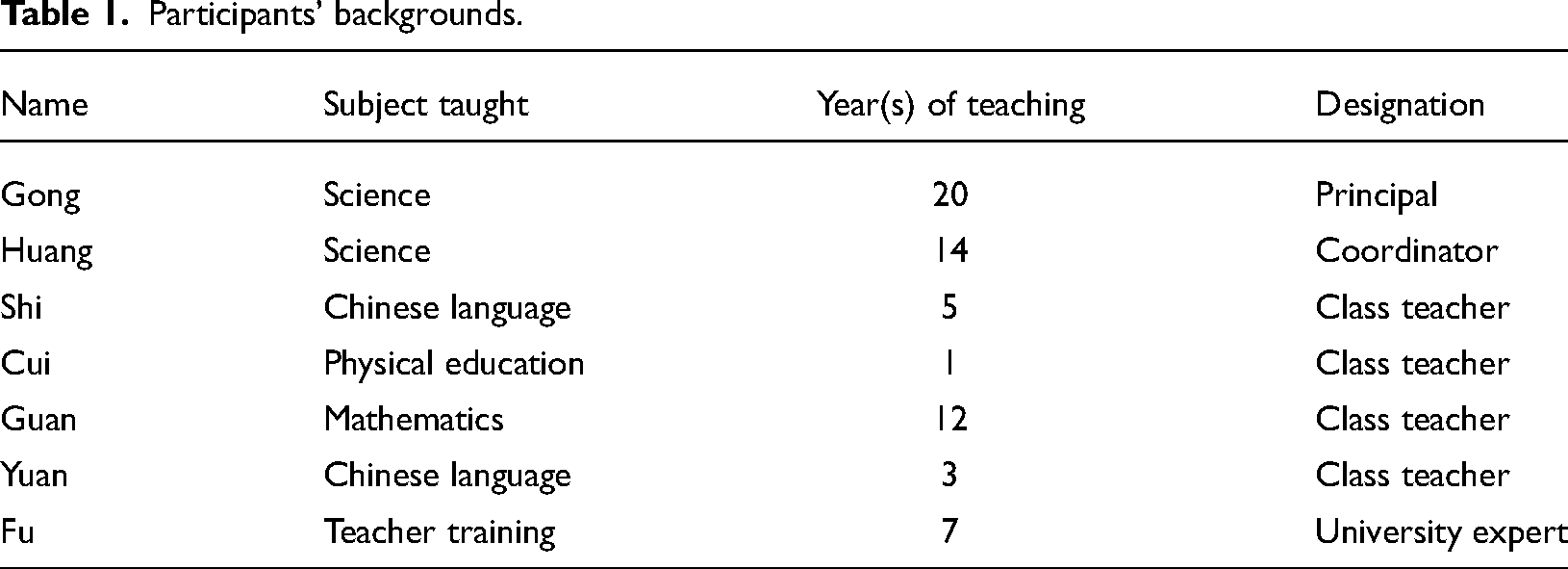
For this study, we formed a teacher research team from September 2018 to August 2019 for a university–school collaborative project conducted at Yang-Ming Primary School, a public school in the west district of Beijing city. The project was launched by the school principal, Ms. Gong, to develop a more academic and self-reflective working style among the teachers. Dr. Fu, a university researcher, was invited to participate in the project and guide the team of teachers in conducting research. The research team comprised four schoolteachers, an administrator, a principal, and a university expert (see Table 1). All participants have been informed through consent forms. Their identities have been kept anonymous to protect their privacy.
Participants’ backgrounds.
The authors participated as third-party observers of the teacher team affiliated with a broader project—“Teacher learning in authentic workplaces”—to examine complex teacher learning mechanisms. The collaborative project, lasting 11 months, involved five collaborative work sessions (see Figure 1). The first focused on identifying a pertinent research question for the school. The second provided guidance to teachers in collecting data through interviews. The third analyzed the collected data. The fourth involved documenting self-reflections in journals, and the final summarized and evaluated the learning process and achievements.

Timeline of the teacher research at Yang-Ming Primary School.
Data collection
We adopted a qualitative approach to data collection. The main sources were participatory observations, interviews (including focus groups), and reflective journals. Weekly team meetings were recorded using a video camera. Furthermore, after-meeting focus group interviews were conducted for 30–40 min to understand the changes that individual teachers’ working habits underwent during the process. The questions posed during these sessions included: “What did you learn from the recent meeting? How are you feeling now? Do you think you have experienced any changes in your work since the previous meeting?” The interviews were conducted soon after the observations to optimize recall and elicit cognitive processes concurrent with the observed activity. In-depth interviews were conducted with each participant mid-project and at the end of the project. All data were collected in native Chinese and consisted of 20 video-recorded meetings, 40 interviews, 5 focus group records, and 14 reflective journals.
Data analysis
A thematic analysis (Braun & Clarke, 2006) and discursive analysis on speaking turns (Haapasaari et al., 2016) were conducted to analyze the data, serving as a foundation for addressing the two research questions.
For the first question, learning achievement in teacher research was adopted as a criterion to categorize the participating teachers’ observed and reported achievements using a thematic index (see Table 2). The analysis of teachers’ learning achievements used verbatim transcriptions of interviews based on key studies and theories, rendering it both inductive and deductive.
Conceptual index for data analysis.
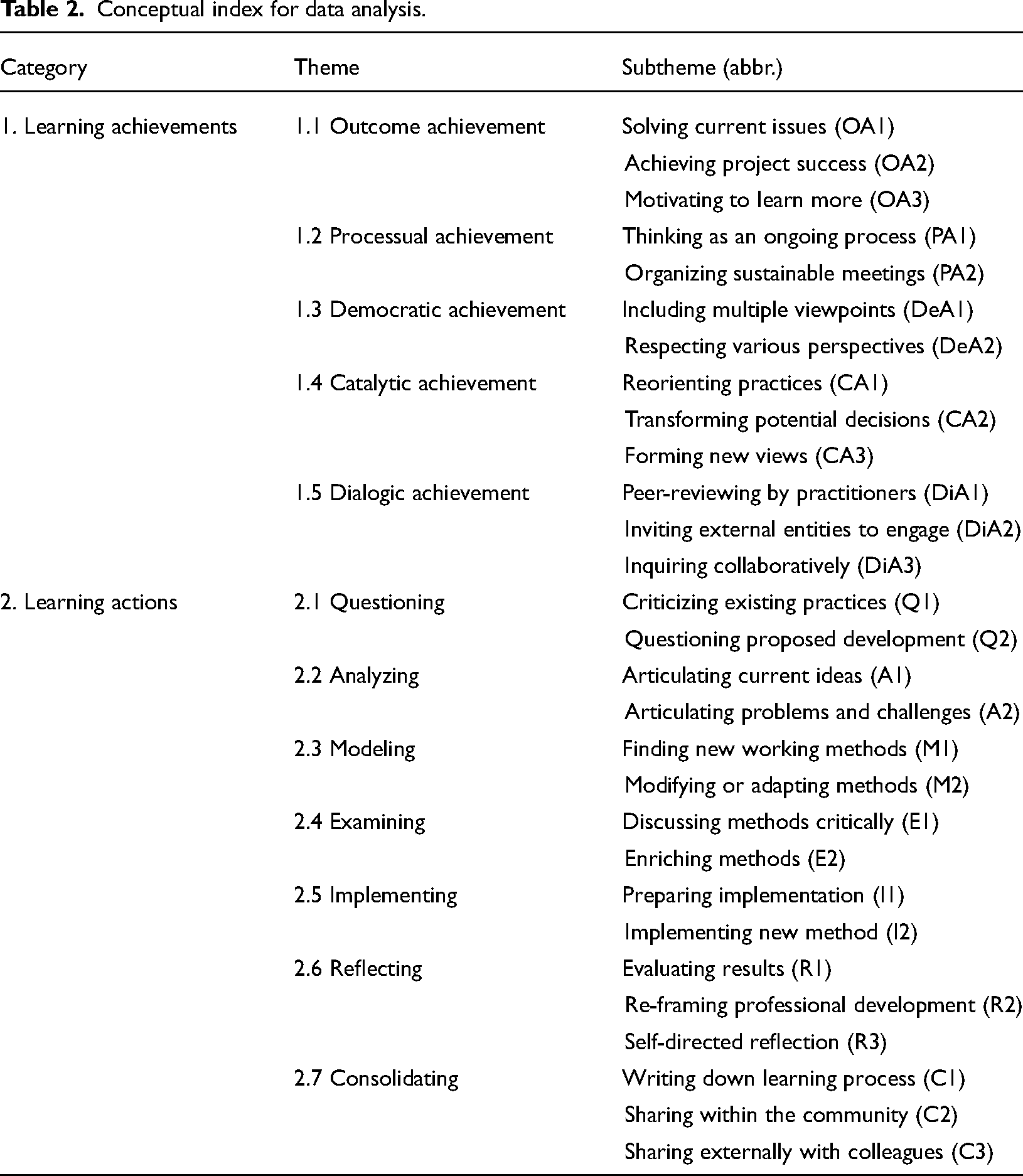
To answer the second question, discursive expressions of the seven learning actions were identified during the meeting dialogue analysis. Speaking turn was used as a unit to analyze the frequencies of learning actions during the five learning sessions. The turns were numbered and coded according to keywords in the index (see Table 2) to obtain a comprehensive overview of the emergence and evolution of teacher learning in all aspects of the process of learning to conduct research.
Findings
The findings are presented from the viewpoints of teacher learning achievements and learning actions as per the research questions. We answered RQ1 using transcripts from individual interviews and teacher focus groups and by categorizing the data into the aforementioned learning achievements. We addressed RQ2 by conducting a discursive analysis of the weekly meetings and identifying learning actions and their change trajectories throughout the process of learning to conduct research. Abbreviations for all subthemes were inserted to help interpret the data.
Teacher learning achievements
The school-based collaborative research team’s learning achievements were mainly determined from the after-meeting focus groups and individual interviews. The observed and reported achievements were categorized and presented along with the viewpoints of the participants in the learning community. These achievements result from the research process. All participants, including Principal Gong, Dr. Fu, and the school teachers, shared their achievements from the research process.
Outcome achievement
Teacher research to solve authentic workplace problems constitutes the outcome achievement of teacher learning (Anderson & Herr, 1999). The research team at Yang-Ming Primary School sought to learn how to conduct research by investigating the professional development challenges of in-service teachers. Principal Gong stated: The original intention of forming this [teacher] team was to cultivate teachers into more reflective practitioners, considering the national policy demands for teacher training. We need to try to change the traditional model of professional development. (OA1)
Here, outcome achievement is synonymous with the successful outcome of the university–school project, an improvement in the teacher professional development model. All participants reportedly explored self-directed professional development after the 11-month period of learning to conduct research (OA2). During the final session, novice teacher Yuan pointed out the contrast between her current attitude and previous passive working style: Since the beginning of this project, a university expert has been invited to answer our questions and gave us much guidance. I am now aware of the importance of applying theory to practice, so I always remind myself that I shouldn’t slack at my job. (OA3)
Yuan's new awareness of educational theories is an outcome of teachers’ learning from research. Through this project, research theories are recognized as instruments that are more effective in solving practical problems.
Processual achievement
In addition to solving existing issues, teacher research should be considered an ongoing process toward reframing problems. The school-based research at Yang-Ming Primary School was marked by formal weekly meetings. Huang, the project coordinator, remarked, “Since September 2014, we have held a meeting every Tuesday afternoon. Even though we are exhausted from teaching all day, we gather promptly at 4 o’clock and put in additional hours without any bonus.”
The teachers initially resisted the additional work; Teacher Cui, for example, did not accept the school's initial demands. However, teacher learning is a process of reflecting and reexamining latent presumptions regarding one's daily work (Korthagen, 2017). On the effect of processual achievement, Cui wrote in his reflective journal: The initial pressure [of doing research] was transformed into motivation. The process of learning to conduct research is actually one of studying ourselves. It is a way to find our own weakness, analyze reasons, propose resolutions, and discover new but more essential issues. (PA1)
Over the 11-month period, the team of teachers formally met 32 times for a total of 120 h (PA2) to broaden their awareness of teacher development issues, design interview outlines, conduct interviews, and analyze the obtained data. The processual achievement of teacher research was thus informed by the learning process and changing views regarding professional learning.
Democratic achievement
The teacher research team worked collaboratively to consider various perspectives and interests during the learning process. Two representatives of authoritative discourse, Principal Gong and Dr. Fu, publicly expressed their newly formed identities in the community of learning. Gong stated, “in terms of doing research, I am a novice as well. Critical reflection is key in research and needs an atmosphere of equality in this group” (DeA1).
During the data analysis session, the team encountered a double bind (Bateson, 1972), where neither the schoolteachers nor the expert knew how to proceed. Fortunately, Dr. Fu adapted his leadership style to the situation by communicating on an equal footing, admitting his own weaknesses as follows: It [the difficulties of data analysis] is not your [the teachers’] problem. It is a challenge for me. The way I speak [is not fully comprehensible] … I struggle to present abstract or academic concepts colloquially. Sometimes you nodded your heads, but I know that I didn’t capture your minds. So, I need to improve … we need to try to work together when difficulties arise. (DeA2)
Democratic achievement requires the inclusion of multiple perspectives. In this study, all participants were a part of the insider research community, ensuring the sustainability of teacher learning.
Catalytic achievement
The teachers were open to reorienting their views and practitioner roles. Guan, an experienced mathematics teacher, transformed his view on collegiality through the process of learning to conduct research: While interviewing my colleagues, I realized … they have so many experiences, strategies, and ideas about teaching. Some have great ambition and lofty goals; some know highly effective methods of teaching and management. Every teacher uses his or her own personal way in rethinking pedagogy. (CA1, CA3)
Observations and reflections such as these enabled teachers to discover how to construct a more relevant teacher professional model by drawing on individuals’ practical knowledge and facilitating a reciprocal learning system. In an in-depth interview, Principal Gong highlighted the transformative potential of learning to conduct research: As a principal, I am glad to dedicate my time to the research team. This is a critical activity for both the participants and the school administration. We have established the habit of meeting at 4 p.m. on Tuesdays. We have gradually accepted it, and I don’t want to disrupt this practice, even though I have had to reschedule my personal or other official affairs … [because] doing research is definitely an important part of our teaching career. (CA2)
According to Anderson and Herr (1999), the most effective practitioner research projects are those where the practitioners report a cyclical change in their and others’ understandings. All participants in this study deepened their understanding of the current situation and were motivated to transform it, even reaffirming their support for it.
Dialogic achievement
The quality of research is monitored through peer reviews, a common practice adopted among practitioner research communities to promote the dialogic achievement of teacher learning. In the summary and evaluation group session, Teacher Shi said: I was not a talkative man. Even though I interact with my colleagues, the communication is usually restricted to trivial things in life rather than professional development. However, I would now like to share my experiences and lessons from this project not only with you [group members] but also with the rest of our colleagues in our school. (DiA1, DiA2)
Some scholars insist that collaborative inquiry should shape practitioner research to promote dialogic achievement (Carr & Kemmis, 1986). It has also been suggested that practitioner researchers in dialogue with one another (Martin, 1987) can provide an alternative approach to reflection. Huang's reflection is in line with these viewpoints: “The weekly meeting is the most important scenario for our learning to conduct research. The increasingly inclusive dialogues during the meetings empower us as a collaborative community of inquiry” (DiA3). Emphasis on the dialogic nature of practitioner inquiry renders teacher research a good fit with teacher community intuitions. Thus, dialogic achievement is an imperative dimension of teacher learning through conducting research.
Teacher learning actions
The second research question concerns the types and longitudinal evolution of teacher learning actions in learning to research in a school–university partnership setting.
Types and subtypes of learning actions
This study draws on Engeström's framework (1987/2015), identifying seven learning actions in the data obtained from the interactive meetings (see Table 2). More specifically, questioning and analyzing the researched situation, modeling a new solution, examining the model, implementing the model, reflecting on the process, and consolidating the professional learning achievements were labeled using NVivo 12.0. The relatively complete set of learning actions recurred over almost a year.
Further, as per Engeström et al. (2013), 16 subtypes of learning actions were observed through careful, line-by-line readings of the meeting dialogues. One of the richest varieties of subtypes was found in the action of reflecting on the execution of teacher research. Initially, Dr. Fu, as the interventionist, reminded the schoolteachers to cultivate reflection as a habit. By reframing the demands of teacher professional development (R2), the teachers developed self-directed compatibility (R3) to evaluate their learning outcomes (R1). Dr. Fu's emphasis on the role of reflection is illustrated in the following excerpt:
Cui, this is an important issue you have raised. However, our current goal is to research and gather data. The strategy to overcome the problem should be discussed in another context. At this moment, we should analyze the “why” behind the issue. This … I … We should conduct a systematic inquiry into the conditions contributing to the emergence of this issue. I just … You have to step back, make inquiries, and think systematically. Only by systematically investigating the problem will we be able to gain a deeper understanding.
Teacher learning actions of examining and implementing new practices at work by researching were regularly discussed during the follow-up sessions held in September 2018. The following is an excerpt of teachers discussing the importance of performing research critically (E1) and situating the research method in a practical context (E2) in both the preparation for data analyses (I1) and the categorization of interview data (I2).
How could we draw abstract concepts from these three pages of record? You don’t seem to have an open mind. We should find the experiential modes behind the data and relate it to your research questions. Could you help us categorize? The outline of your interview is [a guide]. There are few common elements among the three interviewees. It’s not definite. My data is. I don’t think so. I find a lot of insights in your data.
The data do not show much evidence of consolidating as a learning action. However, the teachers at Yang-Ming Primary School were aware of the importance of writing reflective journals (C1) as a means of improving their thinking habits within (C2) and outside (C3) the learning community.
We talked about teacher self-learning such as reading books. Apart from this, Guan’s proposal mentions teacher reflection. In terms of the school’s demands, writing reflections in journals is one aspect of everyday teaching activities. But I hope we as teachers can write reflections that are motivated by the desire to improve ourselves, not out of the obligation to hand them to the school administrators. I am a homeroom teacher, so my reflections focus on daily teaching and class management. I prefer to note my thoughts on a little memo in an informal fashion. I write 1–2 points per day and re-read them several days later. This is better known as the ‘days and months multiplying’ approach. Shi, what about you? I write my reflections when I encounter problems, make mistakes, or obtain advice from experienced teachers.
Teacher learning actions include criticizing existing practices (Q1), questioning proposed development (Q2), articulating needs or ideas (A1), and addressing problems or challenges (A2). These actions aided the participants in identifying a new approach to research work (M1) and modifying or adapting the method (M2) to reconstruct their professional development approaches.
Longitudinal evolution of learning actions
This section outlines the rate at which the various learning actions occurred during the sessions. Drawing on Engeström (2011) and Haapasaari et al. (2016) for methodological guidance, we used speaking turns as a unit of analysis. These were coded based on the 16 subtypes of learning actions to capture their emergence and evolution throughout the sessions. Teachers’ team meetings in which work-related problems and conflicts are discussed are potential venues for learning actions. NVivo 12.0 was used to code the dialogues in the meetings. There were 2,738 occurrences of learning actions in the transcribed discourse. Table 3 shows the longitudinal evolutionary trajectory of learning actions throughout the five collaborative sessions.
Distribution of learning actions.
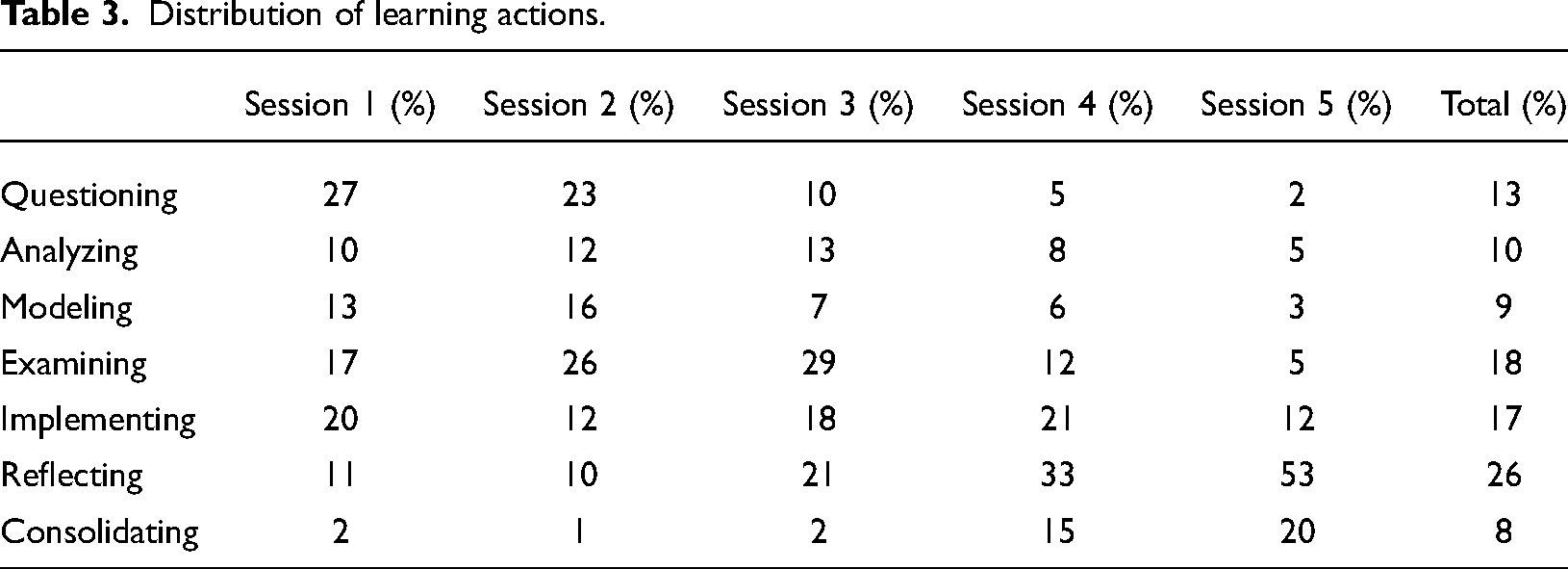
The most frequently observed learning action in the data is reflecting, evidencing the project's success in transforming teachers’ ways of working. The high rate of reflection highlighted issues that needed to be addressed by explicating new possibilities in the activity. The second most frequent types of learning action are examining and implementing, demonstrating teachers’ gradual acceptance of new ways of working by researching. By collecting and analyzing data, the teachers understood the significance of research in improving their working styles, indicating that they considered the weekly meetings an opportunity to develop work activities by implementing research in their daily practice. Further, consolidating their learning outcomes by writing journals and intending to share their experiences with the community support the sustainable development of new practices and highlight the potential for a continued university–school partnership. The learning actions of questioning and analyzing indicate that teacher learning is not automatic. The university expert was both disruptive and developmental in the context of teachers’ learning to conduct research. Interventions such as school–university partnerships aim to be deliberate and systematic. To a certain extent, they should also intervene in teachers’ daily practices and push them to reexamine their business-as-usual processes. In this study, this is achieved using a researcher-led professional development model consolidated and generalized for a broader range of teachers.
Discussion and implications
This research integrates the concepts of learning achievements and learning actions to examine how Chinese primary schoolteachers learn to conduct research. Five types of learning achievements and seven learning actions were examined and proved to support teachers’ professional development. Although this study is limited to China, its findings can contribute to the teacher professionalism discourse globally regarding the authentic process of teacher learning in long-term interactions. Here, a key outcome of the exploration at Yang-Ming Primary School could serve as a model for teacher development through research.
Regarding teacher research, research-based teacher education is critical for sustainable teacher development (Aspfors & Elund, 2017; Toom et al., 2010), and involvement in research is conducive to improving schools by promoting a research culture (Harrison, 2013). Our findings align with those of Bronkhorst et al. (2013) that conducting research improves the effectiveness of teachers’ professional development and serves as an intervention in their routine practices. We show that resources gained by learning to conduct research increase teachers’ achievements in problem-solving and knowledge creation and sharing, promoting a sense of professional accomplishment.
In the context of school–university partnerships, teachers learning to conduct research typically require university support. According to Baumfield and Butterworth (2007), the parties involved do not always derive benefits from the collaboration due to implicit conflicts in boundary-crossing activities. However, this study indicates that heterogeneous collaboration holds potential for positive change, although it may interfere with teachers’ daily work (Engeström, 1991). The democratic dialogue between Dr. Fu and the teachers suggests that an effective school–university research partnership draws on the principles of practitioner research, reflective practice, and collaborative enquiry as sources of professional learning, as confirmed by McLaughlin et al. (2008).
However, this study reveals that teacher learning calls for active processes that are highly successful when they involve a degree of conflict or disturbance. During such processes, various learning actions serve as mediators, transferring teachers’ knowledge from unknown to known and transforming teachers’ mindsets from a culture of doing to one of thinking. This confirms earlier research findings (e.g., Harrison, 2013). Teachers can engage in discursive knowledge building and culture reframing to master key research approaches, ways of thinking, communicating, and writing about experiences.
Nevertheless, teacher educators should rethink teacher research, expanding rigid definitions of research where objectivity and securing data are central (Vanderlinde & van Braak, 2010). Teacher education objectives should include learning to engage in practitioner inquiry and create local knowledge within communities (Cochran-Smith & Lytle, 1999). When teacher research is framed as a learning process, teachers’ professional performances can demonstrate how they make decisions, interact with colleagues, and create practical knowledge in authentic contexts. Thus, teacher learning could be theorized as a dialogical, democratic, and transformative process for professional development.
By answering the “what” and the “how” of teacher learning by researching, our study sheds light on the authentic learning of Chinese teachers conducting research. Here, learning achievements alongside conflicts are consolidated by teachers’ reflections, which supply a dialectical view of teacher learning by researching. Teacher learning is not smooth; rather, it involves conflicts in school–university partnerships. However, a dialogue between teachers and researchers leads to progress in teachers’ learning. Additionally, our empirical records of the evolutionary trend of teachers’ learning actions during the 11-month process provide evidence for understanding Chinese teachers’ learning styles, perhaps imparting further suggestions for reshaping in-service teacher education. For example, teacher training programs should focus on teachers’ critical thinking and reflections instead of only teaching skills as per international scholars’ research (e.g., Postholm, 2009; Toom et al., 2010).
Overall, this study's key contribution is identifying teacher learning achievements and actions through longitudinal empirical analysis. However, it has certain limitations, paving the way for future research. First, such research could adopt a more open-ended design to identify novel achievements and actions of teacher learning by going beyond Western theories. Second, the relationship between learning actions and achievements should be studied, including ways to increase teacher learning achievements and actions critical to this process. Thereby, school–university partnerships could be redesigned according to effective learning actions for better teacher development.
Footnotes
Contributorship
Ge Wei wrote the abstract and the bulk of the text (theorizing and analyzing the data and discussing the results with prior theories), finalized the paper, and responded to reviewers’ comments. Chi-yang Chung contributed by identifying, analyzing, and responding thoroughly to our case study based on relevant Chinese and English literature and proofread the paper.
Declaration of conflicting interests
The authors declared no potential conflicts of interest with respect to the research, authorship, and/or publication of this article.
Ethical statement
Ethical approval for this study was granted by the Ethical Board of Capital Normal University. Informed consent was obtained from all participants.
Funding
The authors disclosed receipt of the following financial support for the research, authorship, and/or publication of this article: This work was supported by the Funding of Landmark Academic Achievement at Faculty of Education, Capital Normal University, Beijing Municipal Commission of Education (grant number SM201910028014).