



Abstract
Purpose
Based on a systematic review of policy documents in China related to teacher training over the past four decades, this paper identifies and analyzes the main policy shifts and strategies in terms of teacher training in China.
Design/Approach/Methods
Using quantitative trend analysis, high-frequency word analysis, and content analysis, this study presents the policy changes in and reform of China's national teacher training system and elucidates the reasons for such changes.
Findings
Chinese teacher training and practice reforms resonate with the paradigm shifts of international teacher training and development, particularly those based on real-world scenarios. However, innovations have also been made in response to the problems of Chinese in-service teacher training and development, such as the lack of time for teachers and the separation between learning and practice. Such innovations reflect the government's efforts to narrow the gaps between theory, policy, and practice by improving China's macro policy design.
Originality/Value
This study contributes to the longitudinal study of policy shifts in teacher training in China.
Introduction
A well-designed teacher training system plays a key role in the construction of high-quality and innovative teacher teams, while the national policies for teacher training can reflect a country's basic understanding of and requirements for teacher education in a certain historical period (Zhu & Hu, 2009). In China, primary and secondary school teacher training policies have gone through three development stages, namely, the period of exploration and tortuous development (1949–1976), the period of recovery and sustainable development (1977–2009), and the period of consolidation and innovation (2010–present). All three stages have provided a strong boost to China's social development and education (Qu & Gong, 2019). A review of the evolution of China's primary and secondary school teacher training policies reveals that the policy concept has tended to be more human-oriented, the policy objectives more precise, and the policy content greatly enriched. Meanwhile, because of constant revision and improvement, national policies for teacher training have responded to specific issues of the time and are consistently oriented toward problem-solving (Qu & Cui, 2014).
In this article, we regard lifelong learning as the only way for primary and secondary school teachers to adapt to education reform and development and ensure their own professional development. In this respect, we consider teacher professional development as a process of self-improvement and continuous learning, one in which teachers need to rely on external support to achieve professional advancement and leapfrog development. In China, teacher training and development issues have received increasing attention since the 1980s. The State Council has issued a series of policy documents on teacher training and its promotion, with such moves serving to clarify the goals and requirements of teacher training, implement institutional design, and provide multiple forms of support to continuously improve the quality of teachers’ professional development. Alongside the deepening of comprehensive education reform and the vigorous promotion of teacher training in the new era, the Chinese government has prioritized and valued teacher training and development.
As Guskey (2002) has pointed out, “High-quality professional development is a central component in nearly every modern proposal for improving education” (p. 381). In China, the government spotlights the cultivation of high-quality professional and innovative teachers at the national policy level. In particular, a high-quality teacher team is considered a primary resource for educational development and a key component of China's prosperity and national development. This orientation has been further reinforced by a recent policy document, Opinions on Comprehensively Deepening the Reform of the Teaching Staff Construction in the New Era, in which the Chinese government highlights the fundamental role of teachers in education and states their intent to improve the overall quality of teachers across all levels of education (Central Committee of the Communist Party of China [CCCPC], 2018). Through a policy analysis of 32 government policy documents related to teacher training in China since the 1980s, this study traces development trends in the promotion of teacher training in primary and secondary schools and discusses the intrinsic value of primary and secondary school teacher training policies.
International trends in teacher training
Different countries have adopted various national policies and approaches to developing teacher training. For instance, in France, national policy for teacher training is committed to improving a teacher education model by combining the professional training of teachers with diversified training methods, thus providing teachers with varied and all-round training (Ries, 2016). With the advancement and evolution of the teacher training policy, French policy has shifted from “universal” to “difference”. The United Kingdom's teacher training policy emphasizes the importance of school-based training (White et al., 2015), with UK policy characterized by a focus on solving practical problems in the development of schools and teachers. More specifically, in-service teacher training in the UK seeks to address the actual needs of schools and teachers through school-based training for teachers based on work scenarios. Accordingly, the in-service teacher training policy is premised on the model of first constructing a learning community and then improving the professional ability of teachers. Meanwhile, in the United States, teacher training policies reflect the characteristics of diversity, with initial and continuing teacher education increasingly making use of remote and blended modes of education (Perry et al., 2021). The goal of teacher training is to promote teachers’ professional development and improve teaching effectiveness. The US teacher training model reflects autonomy and selectivity. In this respect, teachers choose and combine different training forms according to training intentions, optimize the practical requirements of teacher training services, and meet their diversified needs (Guskey, 2002).
Drawing on the successful experiences of such countries while taking their own situation into account, China's teacher training has become more scientific, professional, and institutionalized. For instance, in terms of the value concept, teacher training policy in China is more concerned with legal aspects and the professional development of primary and secondary school teachers. In terms of training content, the policy orientation shows that teacher training accounts for both teaching methods and education compensation for academic qualifications. With respect to value, the concept of teachers’ rights has been established and implemented in Chinese policy. Finally, in terms of training methods, information communication technology has been integrated into teacher training to develop teachers’ informatization capacity (Zhang & Zhang, 2017). These characteristics indicate a development trend focusing on professional, systematic, and high-quality teacher training in the new era.
Methods
This study adopted quantitative trend analysis, high-frequency word analysis, and content analysis to examine the policy promotion strategy and logical evolution process of primary and secondary school teacher training in China. Using “teacher training policy” as a keyword, we searched the official websites of the MOE and the State Council for policy documents published since 1980, retrieving a total of 32 documents.
First, the quantitative trend analysis method is employed to study the development of teacher training policies. We divided the total study period, 1980–2019, into five-year units to examine the development of China's primary and secondary school teacher training policy. As Figure 1 shows, since 1996, the number of policy documents on teacher training issued by the State Council has increased significantly. From 2011 to 2019, the total number of policy documents on teacher training doubled compared with the previous 30 years, indicating the increasing support of the Central Committee of the Communist Party of China (CCCPC) and State Council for the continuous improvement of the quality of teacher teams in the new era.
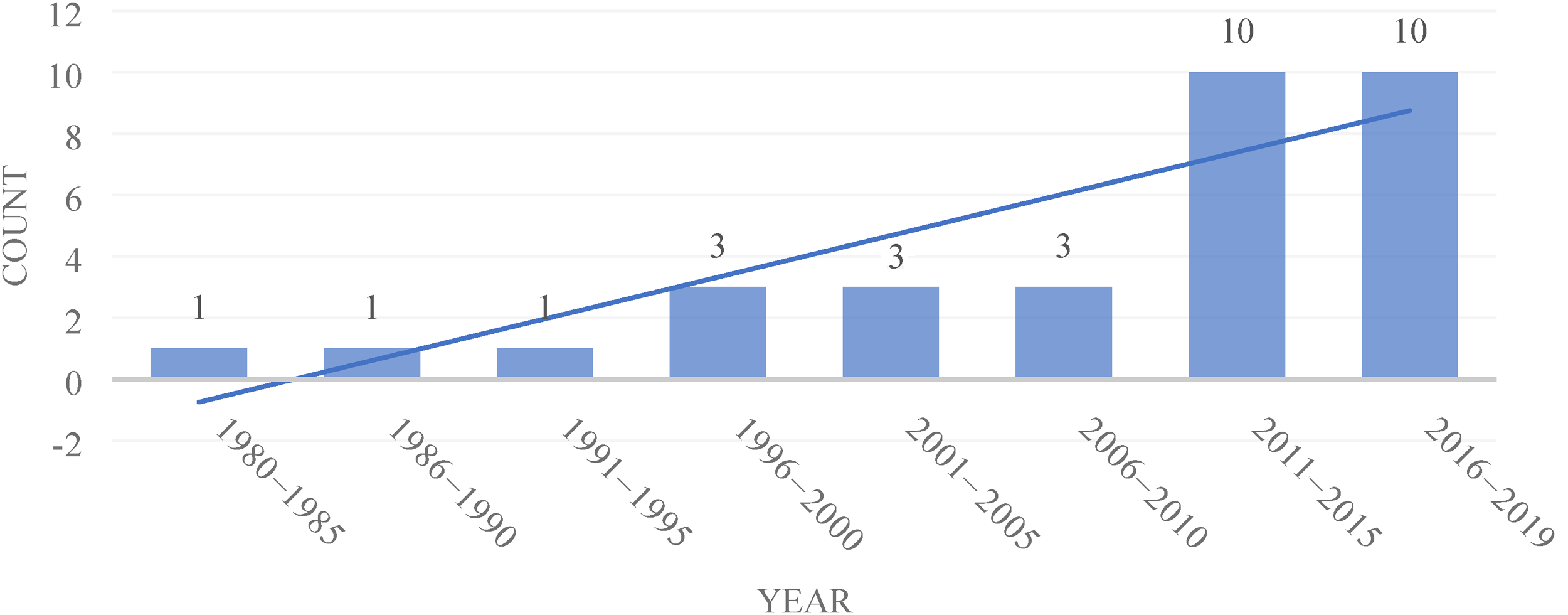
Quantity distribution of teacher training policies over the past 40 years.
We then used the content analysis method to classify the content of teacher policies according to chronological order, specific content, relevant keywords, and so on. Based on the three dimensions of goals, conditions, and paths in the policy documents, we constructed an analytical framework comprising five key elements: value, goal, object, content, and method. By extracting high-frequency keywords and tracing the evolution, context, and logical characteristics of the policies, we analyzed the policy promotion strategy and developmental direction behind the system design of teacher training policies in China.
Key findings
High-frequency keywords and initial interpretations
Using the Chinese word frequency analysis software ROST-CM6, a widely used tool in the field of content analysis, we conducted a word frequency analysis of the collected teacher training policy documents and sorted keywords by frequency. Table 1 presents the high-frequency keywords. The statistical results show that, in addition to the core themes of teacher training such as “teacher,” “training,” and “teacher training,” high-frequency words include “backbone teacher,” “quality,” “rural primary and secondary schools,” “resources,” “information technology,” and “practice.” Our analysis also revealed that different high-frequency keywords appeared in education and training policy documents in each historical period. This reflects the changing rationale and approaches of the government with respect to promoting teacher training in China.
High-frequency keywords for national teacher training, 1980–2019.
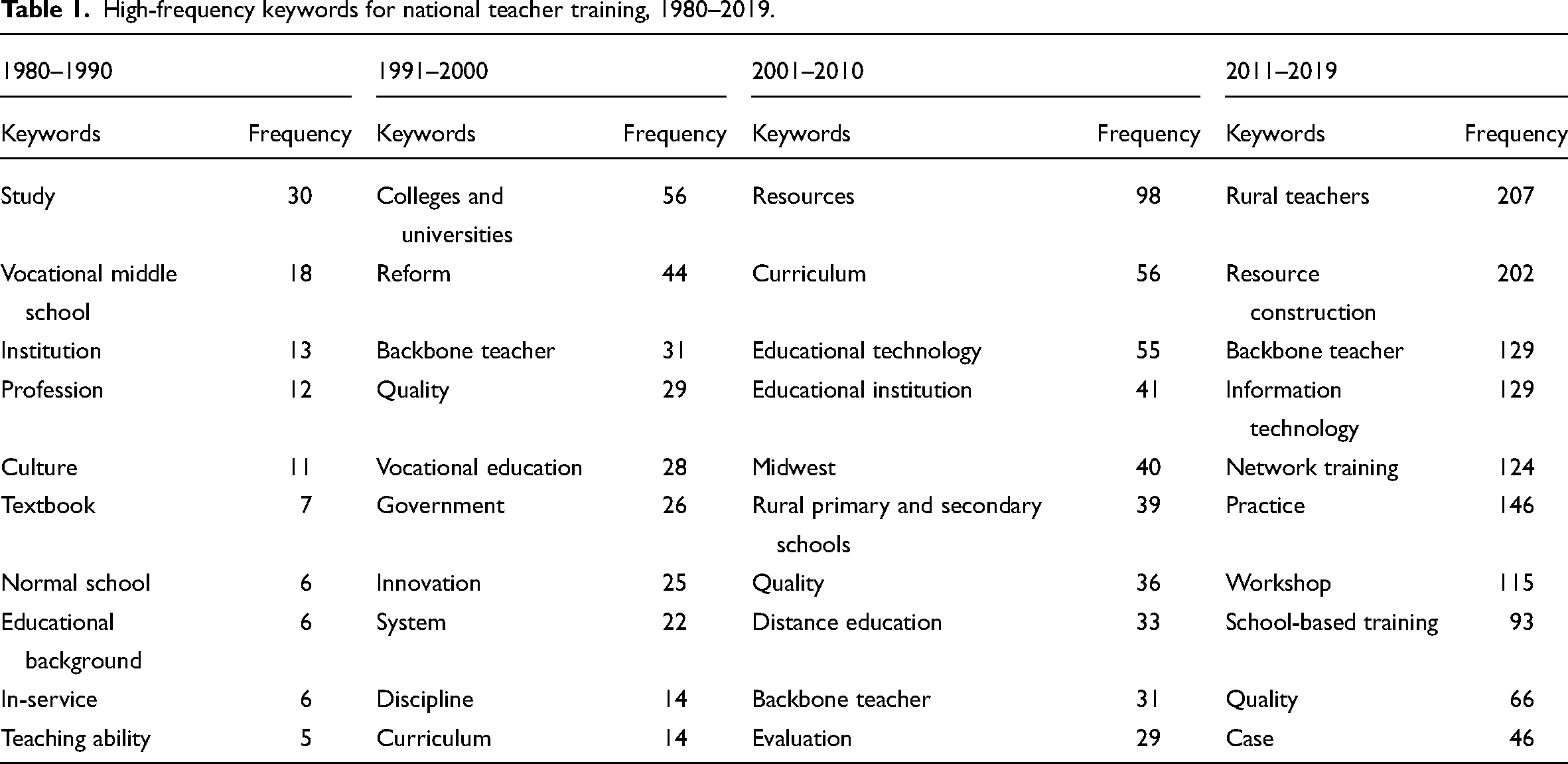
As Table 1 shows, from 1980 to 1990, the high-frequency keywords in teacher training policy documents included “profession,” “culture,” “textbook,” and “education background.” At this stage, the policy sought to solve the problem of the insufficient quantity and quality of teachers, particularly with respect to their low educational level. Accordingly, more formal and systematic teacher training was necessary to improve teachers’ cultural level.
From 1991 to 2000, high-frequency keywords included “backbone teacher,” “quality,” “vocational education,” “system,” and “discipline,” indicating that the State Council attached great importance to the cultivation of backbone teachers, the training of teachers in short-term and weak disciplines, the improvement of teacher quality, and the institutional improvement of teacher training.
During the 2001–2010 period, high-frequency keywords included “resources,” “curriculum,” “Midwest,” and “rural primary and secondary schools.” In addition to being more abundant compared to earlier periods, keywords focused on the development of teachers’ educational technology capabilities in the information age and strengthening the training of teachers in Midwest China and rural primary and secondary schools. Meanwhile, “backbone teacher” remained a high-frequency keyword. As the high-frequency words indicate, during this period, policy orientation focused on improving the quality of rural teachers and increasing teacher training in the economically underdeveloped regions of central and western China to promote educational equity.
From 2011 to 2019, high-frequency subject keywords became more diversified, with “rural teachers” and “information technology” emerging as the most important keywords. This reflects the government's greater attention to educational equity, emphasis on resources for teacher training, the request for more diversified methods for teacher training via information technology, and the orientation toward synthesizing network training with school-based training and facilitating the innovation of teacher's workshops to optimize the model of teacher training. The word “practicality” was also highlighted, revealing the emphasis on improving training effectiveness and strengthening the link between learning and application given the policy context.
Findings from content analysis
The findings from our content analysis of a total of 32 documents centered on the evolution of policies and systems and putting “policy into practice.”
The evolution of policies and systems
By tracing the development of primary and secondary school teacher training policy and system, our study observed significant shifts in terms of value orientation, content, types of trainees, and the model of teacher training in China.
The establishment of the “five-year cycle” teacher training system signified a value orientation shift in teacher training from an emphasis on rights to a focus on obligation and responsibility, offering the value-oriented basis for the teacher training system design. In addition to providing a policy basis and legal guarantee for teachers’ lifelong learning and normalizing the training of all staff, the cycle has laid the foundation for the continuity and integrity of teacher training in China (Hu, 2019). Moreover, guided by such an orientation change, teachers’ learning behavior shifted from self-regulated learning to demonstrative guidance to the integration of support, supervision, and management (Shan, 2013).
More specifically, in 1990, the State Education Commission issued Minutes of the National Symposium on the Continuing Education of Primary and Secondary School Teachers, a document requesting that teachers’ continuing education focus on sizheng and teaching ability. In September 1999, the MOE promulgated Regulations on the Continuing Education of Primary and Secondary School Teachers, which clearly stated that continuing education should focus on improving teachers’ ability and level to implement quality-oriented education. The content of continuing education includes sizheng education, teacher ethics training, and professional knowledge, which encompasses modern educational theory and practice, educational and scientific research, education and teaching skill training, modern educational technology, and modern science and humanities knowledge.
Policies have also been issued to ensure that teacher training keeps pace with the new curriculum reform. Under the new round of basic education curriculum reform, Outline of Basic Education Curriculum Reform (Trial), issued by the MOE in 2001, requires all primary and secondary school teachers to engage in training on new ideas, courses, and technologies as well as teachers’ ethics. The policy orientation toward comprehensively improving teachers’ ethics and professional abilities has since reached broad consensus in Chinese society. In 2011, the MOE's Opinions on Strengthening the Training of Primary and Secondary School Teachers proposed: In the new era, the training of primary and secondary school teachers should take the training of high-quality and professional teachers as the strategic goal, take the improvement of teachers’ moral quality and professional level as the core, take the improvement of training quality as the mainline, carry out all staff training, and comprehensively improve the quality of teachers.
The Action Plan for Teacher Education Promotion (2018–2022) further clarified specific action measures. Notably, it aimed to offer solid support to teaching staff and talents for developing higher quality and more equitable education by enhancing teachers’ comprehensive qualities, professional levels, and innovation capabilities (Central People's Government of the People's Republic of China, 2018). To achieve competency-based training, the policy guides the development of thematic training and progressive courses, while stressing the importance of the construction of high-quality training resources and development of practical courses.
To implement the Twenty-First Century Education Promotion Action Plan (MOE, 1998), in March 2000, the MOE issued Continuing Education Project for Primary and Secondary School Teachers (1999–2002), which planned to train ten million primary and secondary school teachers, particularly those from rural regions, ethnic minorities, and weak areas. This move created a new situation for teachers’ continuing education. In September 2004, the MOE issued Training Plan for Primary and Secondary School Teachers in 2003–2007, launching the training of one million backbone teachers, with a specific focus on rural teachers. The plan resulted in the training of ten million primary and secondary school teachers, focusing on new concepts, courses, technologies, and teacher ethics education. At the same time, the State Council of China implemented a training support plan for primary and secondary school teachers in western rural areas.
In 2010, the MOE and Ministry of Finance jointly issued Notice on the Implementation of the National Training Plan for Primary and Secondary School Teachers and decided to implement a National Training Plan focusing on the “demonstration training project for primary and secondary school teachers” and the “central and western rural backbone teacher training project.” In 2011, the MOE issued Opinions on Strengthening the Training of Primary and Secondary School Teachers, which links teacher training with the promotion of quality-oriented education and educational equality. It also emphasizes the improvement of training quality, with particular attention to rural teachers and providing training for all primary and secondary school teachers. In June 2015, the State Council released the Rural Teacher Support Plan (2015–2020). Accordingly, from 2015, the National Training Plan focused on the training of rural teachers in the central and western regions.
In 2018, the State Council issued Opinions on Comprehensively Deepening the Reform of the Teaching Staff Construction in the New Era, which highlighted the establishment of a teacher training system, the development of full staff training, and the promotion of teachers’ lifelong learning and professional development. This policy-oriented reform serves as the backbone of the whole system and provides all teachers with professional learning opportunities and support. At the same time, the policy clearly states that the training of all teachers should follow the requirements of fundamental education reform and the rules of teacher growth and focus on pre-job training for new teachers, on-the-job teacher training, and the training of backbone teachers. The document also asserts that policy guidance should adhere to the principle of classified training when carrying out all staff training to ensure its pertinence and effectiveness.
A 2011 MOE policy document entitled Opinions on Strengthening the Training of Primary and Secondary School Teachers proposed the implementation of “training on demand,” “providing high-quality training services,” “encouraging teachers to choose their schools,” “providing personalized and diversified selection opportunities for teachers,” and “establishing and improving the school-based training system.” In terms of training methods, the policy attaches great importance to improving the effectiveness of training, emphasizes the link between learning and application, and proposes using case, research, participation, situation, and other training methods. The document also notes that each region should strengthen the training link to the real classroom according to the characteristics of teacher learning. To ensure the effectiveness of training, practical problems should be solved through on-site diagnosis and case-based teaching, teaching behavior improved through on-the-job training and situational experience, and education experience enhanced through action research and reflection practice. Each region should actively do the following: (1) promote the construction of teachers’ network training communities, as well as the blended learning of teachers’ virtual learning and teaching practice; (2) conduct the online collaborative training of teachers from different regions to promote peer communication; (3) cultivate a backbone team for online training, build a learning community for teachers, and realize normalized teacher training; (4) promote the integration of network and school-based training to enrich the theme of the training; (5) promote the combination of teaching and research by training through collective lesson preparation, lesson observation, and lesson evaluation; and (6) fully develop the fundamental role of school-based training.
In January 2018, the State Council issued Opinions on Comprehensively Deepening the Reform of the Teaching Team Construction in the New Era, which proposed: (1) Changing the training method, promoting the integration of information technology and teacher training, and implementing a hybrid type training; (2) promoting self-selection, implementing credit management, establishing a training credit bank, and building a bridge between teacher training and academic education.
In short, the policy orientation has shifted to promoting the innovation of training models, the normalization and individualization of teacher training, and the lifelong learning of teachers. It also highlights school- and teacher-based teacher training and emphasizes the combination of learning and use.
“Policy into practice”: Practical implications for teacher training
Amid the above-mentioned policy guidance and support, teacher training has undergone unprecedented development at both the national and local levels. In this respect, the MOE and Ministry of Finance have launched a National Training Plan to allocate special funds, established multiple types of projects, and implemented a support guarantee system to provide full support and guarantees for teachers’ learning. With the development of training, teacher requirements in terms of the content, form, and effectiveness of training are constantly improving. Given the outstanding problems in teacher training—such as its unidirectionality and the overgeneralization of the training content and single model—it is necessary to constantly study the actual situation, real needs, and development direction of teacher learning so that national policy and financial support can be transformed into effective training that helps teachers solve real problems. Teacher training serves as a support system for teachers' professional development, and its acceptance by teachers and schools hinges on whether it aligns with the principles of professional growth, meets the practical needs of teachers, and assists in problem-solving.
Local education administrative authorities need to systematically coordinate teacher training and develop an overall plan to guide the professional development of local school teachers. Various types of teacher training projects have been offered to teachers in different professional development phases in an organized way. Teachers have also been encouraged to self-diagnose their problems. More specifically, they have been motivated to evaluate and self-monitor their development paths and participate in learning communities to share and reflect on their practices over time. This training system provides teachers with the source and motivation for growth, helping them to continue improving their abilities while promoting spiral progress and sustainable development. Essentially, the ten-year National Training Plan has illuminated the value of teacher training and developed curriculum standards to systematically support teachers’ lifelong learning and development.
In the current information age, teachers’ perceptions of how technology supports and changes learning influence their acceptance of students’ diverse learning methods as well as their understanding and anticipation of future world developments. Therefore, teacher training should integrate technology-supported approaches to facilitate the provision of diversified learning methods and hybrid learning.
Moreover, teachers are reflective practitioners and their learning should be rooted in classroom practice. Teacher training is embedded in educational practice and educational life. As such, teacher training should fully consider how to build a stereoscopic platform for teachers; gather multiple spaces; effectively connect teachers’ practice, learning, and life; and promote the diversification of learning methods, particularly in terms of integrating “learning, thinking, inquiring, and acting.” Teachers’ personal space, school space, and learning community space should be effectively connected to promote the organic integration of teachers’ action-reflection, peer assistance, and professional guidance. In this respect, teachers’ action, reflection, and practice should be linked with peer dialogue and sharing to effectively promote their individual and social learning.
… enhance the pertinence of training and ensure the training on demand. The training of primary and secondary school teachers should aim at meeting the individualized needs of teachers’ professional development and leading teachers’ professional growth. The teacher training project aims to implement an investigation and analysis system for teacher training needs and establish a new mechanism to determine training objects with primary and secondary schools jointly.
Therefore, teacher training institutions and education administrative departments should take different levels of need—including policy requirements, school development needs, and teachers’ personal and professional development needs—into account in terms of the training content for teachers. Through the provision of guidance, support, and services, the teacher training process can effectively help teachers solve problems in teaching practice and overcome confusion and bottlenecks, as well as support their professional growth.
Meanwhile, teacher learning is practical and problem-oriented. Teachers hope to solve real problems in practice through learning. Practice and research have proven that teacher training is more effective when it is closer to a teacher's own practices (Fullan, 1991). Likewise, teacher training is more effective when it is rooted in a learner's experience and is more reflective of the learner's practice (Shulman & Shulman, 2004). Therefore, teacher training should be problem-oriented and carry out training focusing on internal practical problems. Teacher training should promote teacher development by enhancing their professional learning and problem-solving abilities, enabling them to act rationally in the face of complex practical situations. Teacher training should also promote teachers’ cooperation to solve problems and improve their ability to diagnose and solve problems. Through cooperation, exchange, and dialogue, teachers can develop more nuanced understandings of problems and work to identify solutions and strategies. It is even more important to link theory with practice through training, particularly insofar as theoretical construction and rational reflection promote the rationalization of teachers’ problem-solving process. This will help teachers move from routine problem-solving to connective problem-solving and, ultimately, to creative problem-solving.
Teachers themselves have rich practical experience. Teacher training should prompt teachers to consciously pay attention to their own experience, reflect on their practical experience, and form an overall understanding through connection and systematic thinking. At the same time, teachers should be encouraged to express and externalize their implicit experiences. Through the sharing and exchange of experiences, they can realize the connection, reference, application, and transfer of both their own experiences and those of others and engage in further practical reflection. Teachers’ practical knowledge is fostered through the nuanced and diversified understanding and meaning construction of practical experience. Teachers should also be encouraged to focus on self-experience and how it relates to the experiences of others and realize relevance thinking and meaning construction. Teachers integrate learning and practice through the process of promoting dialogue between theory and practice. In the process of continuous reflection, the spiraling rise and development of “practice, cognition, practice, cognition” is realized, further promoting the improvement of teachers’ experience and the continuous generation of practical wisdom. The key to teacher training is enhancing teachers’ practical experience, promoting their transformation and generation of practical knowledge, helping them generate practical wisdom, and improving their ability to carry out the practical actions of education and teaching. This is the essential process of teacher training for the future.
Conclusion
At present, primary and secondary school teachers’ learning and development reflect a trend toward large-scale training as well as normalization and standardization. However, at the practical level, teacher training faces numerous problems. For example, in the context of large-scale training, how can we account for differences in teachers’ personalities? How can we transcend individual growth and design teacher learning with the development of schools and regions as the performance goal? These problems require further research.
In this respect, we argue that teacher training should move from the provision of training services for all teaching staff to the promotion of individual teacher growth; coordinated development of schools and regions; and construction of a new paradigm of high-end, accurate, and flexible teacher professional growth services. At the macro level, the construction of a standardized evaluation and support system will facilitate the construction of a collaborative development model integrating professional guidance, diagnostic evaluation, and development services, thereby enhancing the professionalization of teacher training. At the meso and micro levels, regional systematic and professional teacher training should be facilitated in view of local conditions, including the professional construction of teacher training institutions and training teams. In particular, standards, evaluation, and support systems should be established to meet the personalized needs of different professional development objectives, and provide systematic solutions and professional services for teacher learning and the regional professionalization of teacher training.
Moreover, the transformation and improvement of the paradigm of teachers’ professional development should be promoted using key technologies—such as artificial intelligence, big data, and teacher learning analysis—thereby facilitating the formation of a new pattern of personality, quality, and accuracy. Data-driven teaching and research innovation is expected to facilitate high-quality resource sharing, a precise data service, professional team assistance, and micro-certification evaluation. It is also necessary to study integration and innovation in terms of the collaboration between schools and the development of the teacher community. Such research could contribute to the analysis of teachers’ learning behavior, evaluation of practical knowledge generation, and system construction. Through the dynamic analysis of teachers’ learning and professional growth based on big data, innovative initiatives can be implemented for the personalized diagnosis of teacher learning and the development of adaptive and intelligent collaborative services. As a support system for teachers’ professional development, teacher training is only welcomed by teachers and schools when it aligns with their professional development, practical needs, and problem-solving requirements. Over time, the policy and system for teacher training in China have been improved over time. However, the issues discussed in this paper need to be examined through more grounded empirical studies to offer practical suggestions and implications for both policymaking and teacher training.
Footnotes
Acknowledgments
The authors gratefully acknowledge the support of Dr. Jie Zheng and Dr. Xiaolei Zhang at East China Normal University for their insightful suggestions during the writing process.
Contributorship
Baomin Li contributed to the conception and design, draft and revision of the manuscript. Fenglei Yang contributed to the conception and revision of the manuscript. Qian Wang contributed to the data collection and analysis of the manuscript.
Declaration of conflicting interests
The authors declared no potential conflicts of interest with respect to the research, authorship, and/or publication of this article.
Funding
The authors disclosed receipt of the following financial support for the research, authorship, and/or publication of this article: This research was supported by Science and Technology Commission of Shanghai Municipality (grant number 20ZR1416400) and the 2021 Key Project of the National Social Science Fund of China (in the field of education): “Theoretical and Practical Research on the Reconstruction of Future Schools' Organizational Forms and Institutions” (grant number VFA210006).