



Abstract
Purpose
This paper attempts to review and conceptualize how different scholars approach research on teacher identity through the lens of three human interests defined by Jürgen Habermas.
Design/Approach/Methods
This literature review, guided by Habermas's three human interests, illustrates the characteristics of three different approaches to the inquiry into teacher identity.
Findings
This paper summarizes three approaches to researching teacher identity and their characteristics, namely the technical approach, the practical approach, and the critical approach. The implications for future research and teacher development are also discussed.
Originality/Value
By incorporating Habermas's three human interests into teacher identity inquiries, this article offers a theoretical narrative review of the approaches to investigating teacher identity. Strengths and weaknesses of each approach as well as the possibility of a combined application of different approaches provide an original discussion of teacher identity research.
Keywords
Introduction
Teacher identity has been recognized by many scholars as a central discourse in research on teaching and learning (Alsup, 2006; Beauchamp & Thomas, 2009; Beijaard et al., 2004). Advocated by Olsen (2016), teacher identity is a key for successful teaching as it can engage teachers in effective professional learning. It is undeniable that how teachers perceive themselves and what others expect of the teaching profession have a great influence on teachers’ teaching experience and professional development. However, the attention given to the issue of teacher identity differs in terms of how the researcher interprets teacher identity and the purpose of the inquiry. Deriving from these differences, disparate flows of inquiries of teacher identity become visible. As illustrated in an overview by Beauchamp and Thomas (2009), teacher identity has been widely explored in relation to teacher education, teacher agency, and the narrative aspect of identity. Regarding identity and teacher education, Hammerness et al. (2005) argue that teacher identity is a central channel of teacher education in ensuring teachers’ comment and “adherence to professional norms” (p. 383). For identity and teacher agency, Beauchamp and Thomas (2009) suggest that the sense of agency is a sense of empowerment to practice ideas that could result from teachers’ recognition of their identities. For the narrative aspect of teacher identity, Søreide (2006) argues that teacher identity is narratively constructed and consequently multiple and unique. Apart from the obvious different choices of topics and understandings toward teacher identity, possible conflicts exist among these disparate flows. The overemphasis on professional norms and requirements may create difficulties for teachers in attaining a sense of empowerment and agency (Priestley et al., 2015) whereas the dominance of the narrative and personal aspect of teacher identity could lead to obstacles in promoting professionalization among teachers (Lopes, 2009).
What is missing in the literature is a discussion of what the differences are in researchers’ intentions, interests, and understandings regarding teacher identity and how these differences amount to disparate, and sometimes conflicting, flows of inquiries into teacher identity. This discussion is under-explored in the sense that few relevant reviews have tried to address it in a comprehensive and explicit manner. That is to say, there is a gap in the literature of exploring teacher identity comprehensively with a specific emphasis on researchers’ intentions, interests, and understandings regarding teacher identity. Previous reviews tended to restrict their scope of investigation in their choice of context and inquiry type, e.g., van Lankveld et al. (2017) focused on empirical inquiries in the context of university, while Jupp et al. (2016) focused on qualitative and narrative studies of white teacher identity. Of the few reviews with broader contexts, Hanna et al. (2019) only examined quantitative measurements of the domains of teacher identity, whereas Beauchamp and Thomas (2009) constructed their review around salient topics instead of the inquiry intentions, interests, and researchers’ understanding regarding teacher identity.
Considering the extensiveness and complexity of existing inquiries into teacher identity, a comprehensive exploration examining the fundamental components of the inquiries (i.e., researchers’ intentions, interests, and understanding toward teacher identity) will be rather beneficial in refining familiar issues and broadening our visions with fresh perspectives. The significance of this exploration, then, is to offer an explicit and unique review of how researchers perceive teacher identity, their inquiry intentions, and their interests. Although this type of exploration has its own merits, attempting to understand the issue of teacher identity may also be a great challenge. The extensiveness and complexity of existing inquiries into teacher identity is double-edged, as it offers potential for as well as impediments to comprehensive exploration. Without the navigation of a solid and comprehensive theoretical framework, this mission could have been impractical. Many researchers have been successful in pursuing a single perspective (e.g., Jupp et al., 2016; van Lankveld et al., 2017) on teacher identity, but few have or tried to face the challenge of understanding teacher identity comprehensively through multiple perspectives. This theoretical narrative review, with the aid of the three human interests defined by Habermas (1971) and earlier studies, is able to bring various approaches to teacher identity research together and consider them in an organized way. To guide the exploration, the following questions have been generated: (1) Through the lens of Habermas's three human interests, what are the differences in researchers’ understandings of teacher identity and identity formation? (2) Through the lens of Habermas's three human interests, what are the differences in researchers’ inquiry intentions and interests?
With an emphasis on applying Habermas's theory to teacher identity research, this review is by its nature a theoretical narrative review that examines “how theory shapes research” (Onwuegbuzie & Frels, 2016, p. 24). More specifically, theoretical narrative reviews embody theories by making sense of the research through a specific theoretical lens. Unlike systematic literature reviews, “narrative reviews do not provide any information about how the search for literature was conducted, how many studies were selected, [or] what criteria were used to decide which studies to include” (Onwuegbuzie & Frels, 2016, p. 24). Instead, the reviewers are responsible for determining the appropriateness of the studies being reviewed. Comparatively, narrative review aims at obtaining an interpretive understanding of the research issue based on a non-exhaustive literature search, whereas systematic reviews attempt to gain some aggregative or translative knowledge of the research issue through an exhaustive literature search (Onwuegbuzie & Frels, 2016). In our study, by conducting a theoretical narrative review, the attempt to understand teacher identity through a specific perspective, Habermas's human interests in this case, can be fulfilled.
Concerning teacher identity
Contributing to the challenge in understanding teacher identity, there is a predicament in providing a consistent definition of teacher identity. As Beauchamp and Thomas (2009) pointed out, one could face a major difficulty in defining the understandings of teacher identity and how it influences teachers’ work. The source of this difficulty, in Beauchamp and Thomas’ (2009) opinion, comes from the breadth of teacher identity, as “a variety of issues surface in any attempt to reach a definition” (p. 176). Under the various branches of these issues, this difficulty also runs deep, as teacher identity not only encompasses a wide range of issues, but also at the same time contains controversies within each branch. Some of the most debated issues include whether teacher identity should be perceived as a consistent system or an aggregation where conflicts may exist; whether teacher identity is mainly constructed through individual teachers’ self-identification process (Varghese et al., 2005) or interactions between teachers and the social environment (Gray & Morton, 2018); what forces have the greatest influence on the construction of teacher identity (Chen & Mensah, 2018; Morrison, 2013); and so forth.
Despite the presence of disagreements, a few common grounds are still visible in the literature. First, many researchers have indicated that teacher identity is not a static concept, nor should it be (Akkerman & Meijer, 2011; Beijaard et al., 2004; Mitchell & Weber, 1999; Zembylas, 2003). Mitchell and Weber (1999) perceived the identity of teachers as involving a continuous process of reinventing the teacher selves. Likewise, Zembylas (2003) depicted teacher identity as “constantly becoming in a context embedded in power relations, ideology, and culture” (p. 213). Teacher identity therefore can be considered as a dynamic development of teachers that would transform over time; yet, how this dynamic process is actually carried out and what may influence it are still under debate. Second, it has been argued that teacher identity is more than a mere professional self that teachers keep separate from their personal selves (Alsup, 2006; Day & Leitch, 2001; Nias, 1989; Palmer, 1997). Nias (1989) observed that the development of teacher identity requires an investment of their personal selves, which may lead to teachers’ vulnerability. Moreover, as Day and Leitch (2001) found, a teacher's personal biography (e.g., beliefs and purposes) is closely related to their professional self. In this sense, teacher identity may not be limited only to what it is to be a teacher, but also includes “who I am” as a person. Consequently, the interaction between a teacher's personal self and professional self could be in some cases unavoidable. Lastly, teacher identity concerns not only teachers’ self-knowledge but also others’ opinions of them as teachers (Beauchamp & Thomas, 2011; Clarke, 2009; Danielewicz, 2001; Sfard & Prusak, 2005). Danielewicz (2001) considered the identity formation process of teachers as one in which “individuals define themselves and are viewed by others as teachers” (p. 3). Similarly, Beauchamp and Thomas (2011) recognized that teacher identity comprises both an “active construction” of identity by teachers themselves and an external identity that others attach to teachers as a group. This dual nature of teacher identity could complicate the situation even more when the internal identity is intertwined with the external identity.
These complexities surrounding teacher identity would not pose any problem if one merely intended to follow a certain perspective with a specific anchor within the topic. However, if one attempts to comprehensively understand the issue of teacher identity, the breadth and the depth of teacher identity would present a great challenge to both researchers and readers in seeking to understand this issue. Fortunately, ways to facilitate an understanding of teacher identity are still possible. One only needs to transform from viewing this issue inside-out to organizing it outside-in. In this way, the attempt could be realized through simulating the functioning of an anchor with a lens from the outside. In this respect, Habermas's (1972) three human interests serve as such a comprehensive and useful lens for understanding teacher identity.
Habermas's three human interests, education, and teachers
Proposed by Habermas in 1972, the idea of viewing educational inquiries in terms of basic human interests is an influential conceptual formulation as well as a powerful analytic tool for researchers (Ewert, 1991). In the field of adult education, Habermas's idea has inspired and laid the foundation for the development of transformative learning theory. From Habermas's differentiation of technical, practical, and critical interest, Mezirow (2003) proposed a way of understanding learning phenomena as instrumental learning, communicative learning, and emancipatory learning, which he recognized as a “key proposition of transformative learning theory” (p. 59). Through transformative learning theory and inherently Habermas's idea, Mezirow has constructed a powerful and popular theoretical foundation for adult education that is unique and rare, as Mezirow has not borrowed theories from other disciplines (e.g., psychology) but “spoke directly to educators of adults about a learning phenomenon” (Hoggan, 2016, p. 58). Apart from adult education, Habermas's idea is also frequently applied in the field of educational policy to examine policies and professional standards. Romanowski (2014) adopted Habermas's three basic human interests as a theoretical framework to examine Qatar's National Professional Standards for School Leaders (QNPSSL), and by doing so, he questioned the appropriateness of imposing professional standards based in Western culture on Eastern societies. Similarly, Knowles (2012) used the Habermasian theory to examine educational policies that specifically targeted native Americans and argued for a critical pedagogy that supports their emancipation. In a critical way, the idea of human interests has encouraged researchers to seek democracy and equality in educational policies and practices (Murphy & Fleming, 2010). For educational research and researchers, Habermas's idea has been recognized as informative and inspirational. Long (2017) applied it to promote a fresh way (i.e., objective, subjective, and normative) of understanding the validity issue in mixed-method research in education, whereas Garland (2014) used it in developing his own framework of educational researcher development programs. The influence of Habermas's human interests on education goes far beyond the above examples. This article is but one of the many applications of Habermas's conceptions which, to the best of our knowledge, is the first attempt to apply them to inquiries into teacher identity.
One of the central reasons why Habermas's human interests hold such great potential for enlightenment in education and for this particular topic is related to the comprehensiveness of these conceptions. In nature, the three human interests represent the essential ways in which human beings perceive realities, what realities human beings choose to emphasize, and why realities exist as they do. In other words, the idea itself is a common system for understanding what, how, and why our knowledge and interests regarding our world are constituted. In an introduction to various articles combining Habermas's idea and education, Englund (2006) pointed out that what Habermas actually developed is “a kind of social philosophy that may be seen as a general theory of education” (p. 500). Therefore, Habermas's three human interests offer a desirable theoretical framework through which the breadth and depth of teacher identity can be comprehensively investigated.
Technical interest
The first interest, technical interest, is mainly related to people's need to control and/or predict the world, and the underlying assumption is that the world is regarded as an object that can be manipulated, intervened in, and controlled (Baynes, 2016). The knowledge generated through this interest is technical knowledge that exists as information (e.g., facts and natural laws). What technical interest actually reflects is the “imperative of survival” (p. 175) for us humans as a species, which relies on the effective control of the world (Cooper, 2010). Most disciplines in the natural sciences, or empirical-analytic sciences, correspond to technical interest (Field, 2019). Though this interest is typically represented by natural science, the technical orientation is not limited to it. A technical orientation could still be evident in the domain of education. A specific case could be the issue of accountability. Aiming to control the effectiveness of education, schools, teachers, and students are then held responsible for results. Researchers (Rothstein et al., 2008) who emphasize accountability in education tend to be interested in assessments, standards, and ways of ensuring education quality, as they see the educational results as something that could be effectively controlled.
Practical interest
The second interest, practical interest, is derived from people's need to communicate with each other, as we exist not merely as individuals but also as social groups (Cooper, 2010). The pursuit of practical interest facilitates our understandings of the social world and the meanings behind social events, conventions, and situations. What is implied here is that human activities have meanings, and that these meanings are worth understanding and can be understood. A variety of social sciences, or the interpretive-hermeneutic sciences in Habermas's terms (Rehg, 2017), fall under this division of interpretation and comprehension, such as archaeology, linguistics, and sociology. Unlike the laws of physics, which are universal and falsifiable, the social meanings that people construct together and that individuals attach to their experiences could be disparate and unique for different societies and individuals. Take the case of education in Finland, for example, which is considered one of the top-performing countries in education owing to a unique and productive system (Ahonen, 2021). Its success is meaningful and informative but cannot be replicated in other countries in the same manner. What practical interests can provide then is neither control nor critical reflection but contextual understandings for different situations.
Critical/emancipatory interest
In contrast, what the critical or emancipatory interest offers is the critical reflection on individuals themselves and social issues. The root of this interest is in people's right and responsibility for autonomy and liberty, which lead to efforts for “understanding injustice, power relations, and the beliefs and values that constrain us” (Field, 2019, p. 256). Consequently, the foci of emancipatory interest reveal the unjust constraints over people and promote ways to restore fairness and righteousness to people's experiences. The constraints could be imposed by others or by individuals themselves, in the sense that in some cases, when individuals are so deeply drenched in unjust normalities, they could become blind to and indulge in the violation of their own freedom. Therefore, one's capability to “act rationally and to be self-determining and self-reflective” (p. 354) is crucial for attaining individual freedom (Ewert, 1991). However, being in the place of the oppressed, it is not always easy for individuals to see and liberate themselves on their own. Researchers with emancipatory interests perceive that it is their responsibility and opportunity to uncover the unjust and distorted situations that people encounter. Racial equality in education is one of the situations that interest critical-educational researchers. For instance, Gillborn (2005) examined the educational policy in England critically and discovered inequality among races, based on which he criticized the obvious white supremacy in the policies. Critical knowledge is thus constructed through Gillborn's critical reflection on the fairness of current policies.
The supplement among three human interests
Even though the three basic human interests presented here seem on the surface level to differentiate knowledge and inquiries, and although the three human interests look quite different, there is a supplementary effect among them when researchers use them to illuminate the same issue. The technical interest's focus on manipulation, control, and effectiveness in the physical world may lead to a reductionist understanding of things and the meanings behind them due to its inability to fully account for the subjective world (Baynes, 2016). This corner could be brightened through an examination from the perspective of practical interest, as it cares for the subjective meanings in the social world and emphasizes understanding rather than control. Yet, practical interest may also be limited in the sense that the overemphasis on subjective interpretation of the reality could hinder the awareness of critical thinking or the necessary initiatives to take actions against distorted realities (Elliott, 2005). The emancipatory interest can highlight the power relations overlooked by practical interest or the injustices imposed by technical interest. However, emancipatory interest's search for liberation and reflection may not be feasible without adequate reference to and exploration of technical and practical knowledge, as critical discourses are unavoidably addressed to or provoked by existing and previously existing realities in society (Horkheimer, 1972).
Based on the assumption that all three human interests are worthwhile, it is the position of this article to argue that by considering teacher identity comprehensively from the perspectives of technical, practical, and critical interest, inquiries into teacher identity can be further extended. Due to the distinctive choices made by researchers on how to understand teacher identity, what to focus on and what intents to follow can be considered as a certain form of indication of their stances. The core elements to be examined include the foci and the (implicit and/or explicit) purposes of the inquiries. Through this analysis, the depth and breadth of the complexity attached to teacher identity can be acknowledged.
Three approaches to inquiries into teacher identity
The three approaches to teacher identity research would be proposed and could be regarded as an effort to organize inquiries concerning teacher identity in a meaningful and beneficial way. By examining teacher identity inquiries through the lens of the three human interests, seven aspects have been singled out to demonstrate the distinctions between different approaches. Among these aspects, one (i.e., the philosophical basis of the inquiry) is directly derived from Habermas's theory, while the rest are a result of applying Habermas's theory on teacher identity research that considers both the characteristics of three human interests and the characteristics of teacher identity inquiries. The features of the three approaches are briefly demonstrated in Table 1. Detailed illustration will follow later as the discussions of each paradigm unfold. Moreover, summaries of typical studies following different approaches will be provided for reference. As this is a theoretical narrative review, these typical studies are chosen through a non-exhaustive search of the literature and critical evaluation of their appropriateness in presenting a clear image of each approach.
Three approaches to teacher identity research.
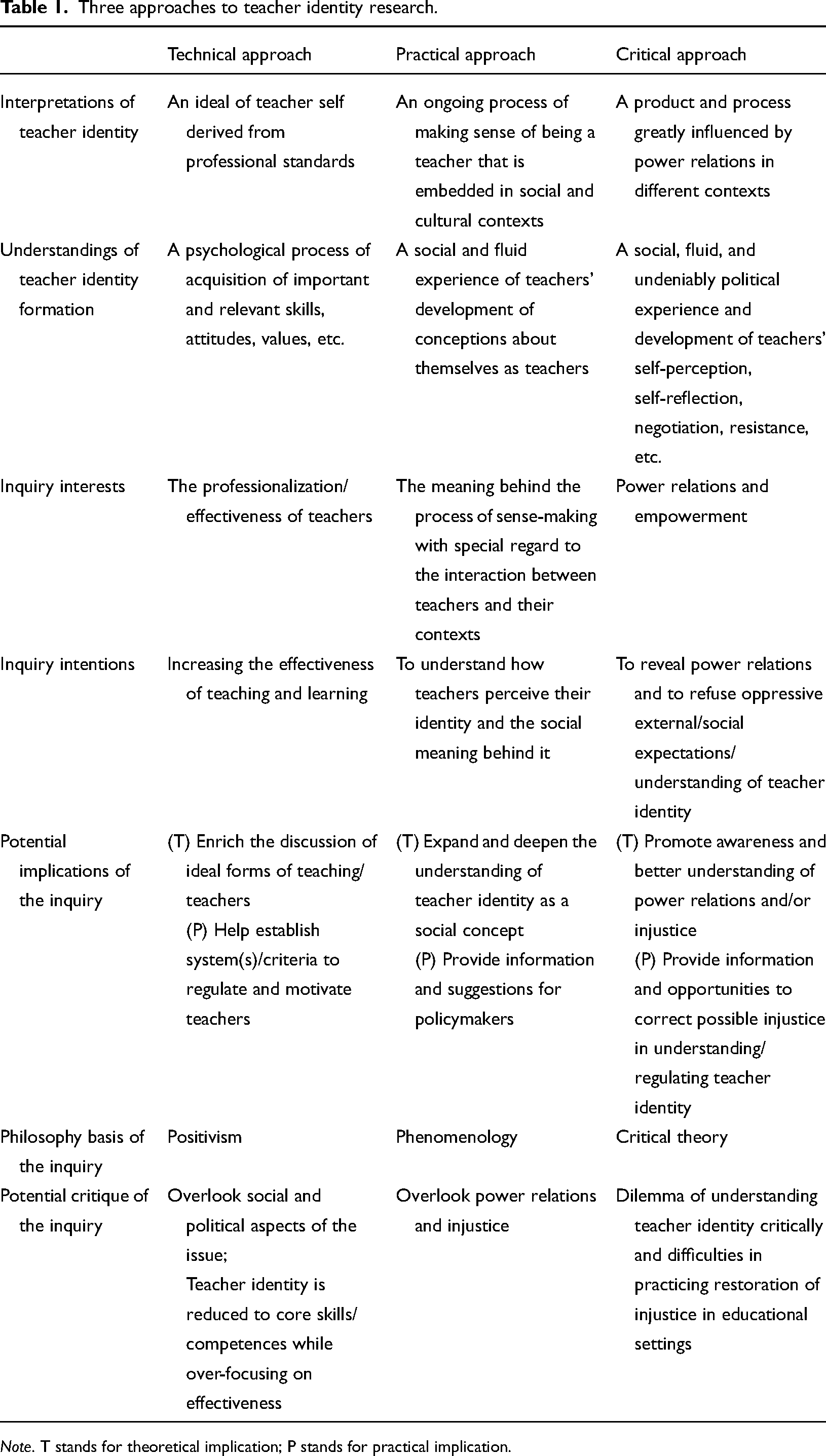
Note. T stands for theoretical implication; P stands for practical implication.
Technical approach to inquiries into teacher identity
The technical approach to teacher identity is concerned primarily with the need to control and predict teaching and learning outcomes for the survival of teachers in their professions. The philosophical basis of the technical approach, as Ewert (1991) identified, is positivism, as this approach emphasizes objectivity and external reality. Researchers following this approach are interested in what a good or effective teacher should be, how to educate preservice teachers, and what criteria should be used to evaluate the effectiveness of teaching and teachers. The underlying intentions of these inquiries, explicit or implicit, are related to increasing the effectiveness of teaching and learning or determining the criterion of effective control of teaching and learning. Teacher identity, then, is interpreted as one or a set of ideal images and characteristics of teachers that stem from outward expectations of how teachers should be. As a consequence, the development of teacher identity is considered as a process of acquisition of these core competences vital for maintaining the effectiveness of teaching and learning. Table 2 shows three typical inquiries following the technical approach to teacher identity.
A summary of typical technical inquiries into teacher identity.
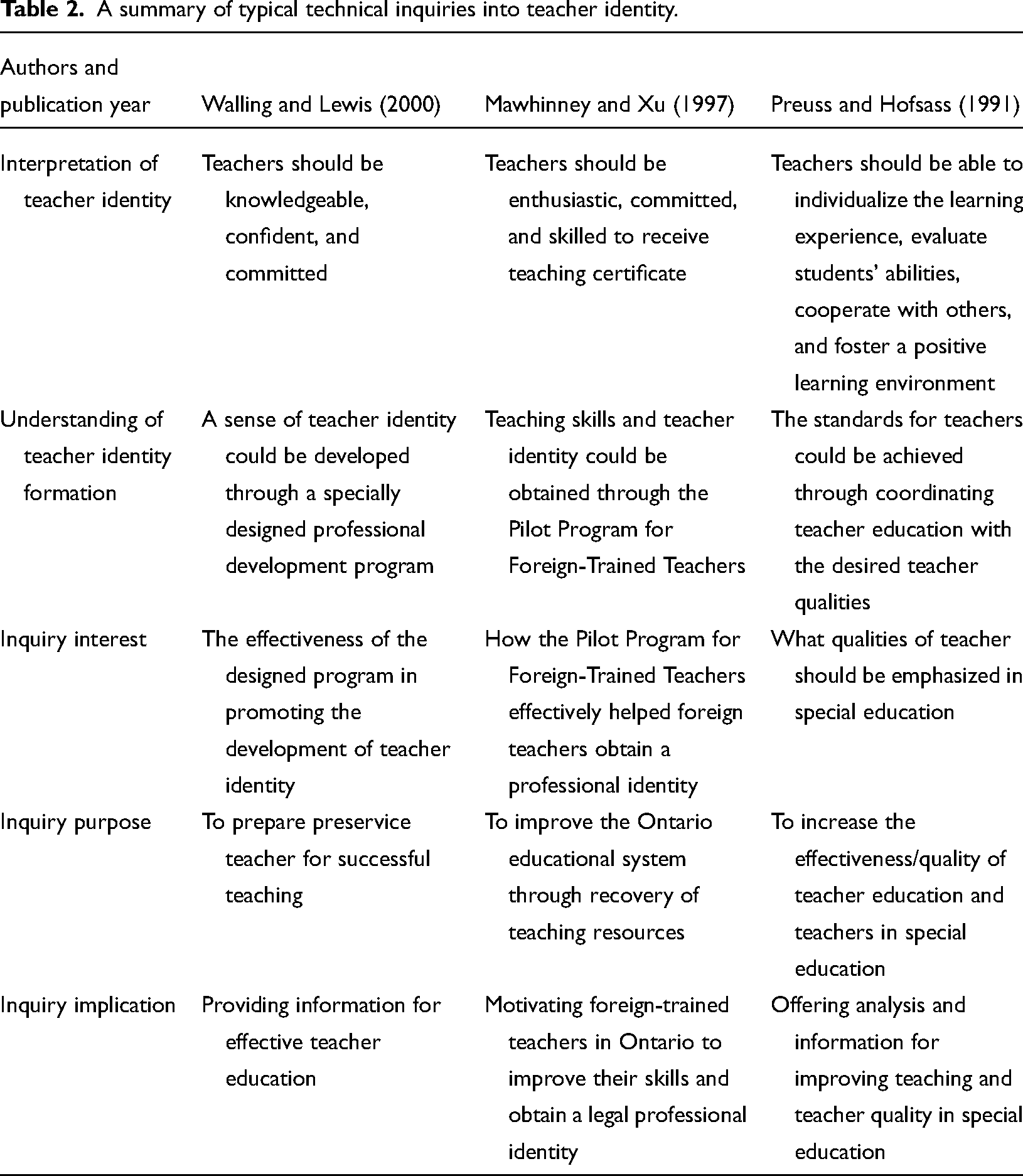
An example following this approach comes from the pursuit of the “professionalization” of teachers. It is recognized that teachers’ success in constructing a sense of professional identity is crucial for teaching and teacher development (Sachs, 2001; Whitty, 2000). Thus, many efforts have been given to exploring what the professional identity of teachers should be and how teachers could effectively obtain their professional identity. As Walling and Lewis (2000) understood, a professional teacher should be knowledgeable in his/her subject, confident in practice, and committed to the profession. Based on their understandings of teacher's professional identity, a Professional Development Program has been designed and implemented at the University of Texas. As a result, they found that in comparison to traditional program, their professional development program is more effective in promoting the construction of preservice teachers’ professional identity (Walling & Lewis, 2000). Beyond the direct interest in examining the effectiveness of the program, the underlying intention of Walling and Lewis's inquiry is to offer their propositions on how to improve teaching quality through programs that promote the construction of professional identity. In this sense, teachers' professional identity is interpreted as something that could be and should be effectively controlled.
Similarly, in the Pilot Program for Foreign-Trained Teachers developed by the Faculty of Education at the University of Ottawa, teacher identity is also understood as something controllable (Mawhinney & Xu, 1997). This program was designed to help foreign teachers to reconstruct their professional identity in relation to the requirements set out by the Ministry of Ontario Education and Training (MOET) (Mawhinney & Xu, 1997). Teacher identity, therefore, is interpreted as the predetermined requirements of MOET. As Mawhinney and Xu (1997) illustrated, teachers’ enthusiasm, commitment, and teaching skills were specially valued in this program, which was evident in the participant teachers at the end of the program. The technical orientation in this inquiry could be more intense, as the researchers indicated that the obtaining of teacher identity is more about receiving legal teaching certification from the Ministry of Education than achieving the desired quality of being a teacher. This technician position is understandable, given that the primary purpose of this program is to help Ontario's educational system make use of available resources.
Apart from the inquiries of educational program, the technical approach to teacher identity could also be found in researchers’ synthesis on professional standards. Preuss and Hofsass (1991) explicitly proposed a set of professional identities as the desired professional standards in special education. These professional identities include: “Agent who individualises the learning process” (p. 113), “Agent of diagnostic knowledge,” “Agent of professional cooperation,” and “Agent of professional coordination” (Preuss & Hofsass, 1991, p. 114). The teacher identity, then, consists of these ideal images constructed by the researchers. In proposing these professional identities/standards among special education teachers, what Preuss and Hofsass (1991) intended to accomplish is to facilitate effective teaching and teacher education.
In addition to researchers’ explicit synthesis of teacher identities as professional standards, the concept of teacher identity also exists implicitly in different countries’ official professional standards. The National Board for Professional Teaching Standards (NBPTS) and the Interstate New Teacher Assessment and Support Consortium (INTASC) in the United States stipulated that a qualified professional teacher should be (1) effective in teaching both bright and less bright students, (2) capable in their teaching subjects and teaching methods, and (3) knowledgeable of students’ learning mechanisms and ways to help students when they are experiencing difficulties (Darling-Hammond, 2000). The Chartered Teacher Project in Scotland described the ideal teacher as an “expert” who can constantly improve his or her practice, collaborate with others, and positively influence the “wider educational community” (O’Brien & Hunt, 2005, p. 454). What these professional standards demonstrate is more than a control over hiring requirements or guide lines but an ought-to-be self of all teachers. The message being sent included an official account of what an effective teacher is or what counts as an effective teacher. Consequently, teacher identity is conceptualized as a model teacher with particular characteristics, and the process of identity formation is merely the acquisition of the ideal skills and features that are central to the effectiveness of teaching and learning.
This type of thinking is not geographically limited, as a considerable number of countries have proposed their own understandings of ideal teaching and teachers. Researchers from different regions have participated in the discussion of ideal images of teachers through analysis, recognition, and encouragement (Buchberger et al., 2000; Horn, 2016; Ingvarson, 1998; Mayer et al., 2005; Pupala et al., 2016). What this type of thinking can offer is the enrichment of our understandings of what effective teaching is, as well as practical suggestions for how to motivate and regulate teachers.
Practical approach of inquiries into teacher identity
Scholars following the line of practical approaches believe that teacher identity is not a fixed image (nor a set of predetermined characteristics), but that it is constantly shifting through the interactions between teachers and their environments. Melville and Bartley (2013) have argued against a “single, consistent, teacher identity” (p. 175), stating that teacher identity is constructed in an ongoing process of teaching, experiences, and emotion adjustment. Likewise, Sfard and Prusak (2005) also support that identity is multifaceted and constructed through communication between individuals and their community. In this sense, teacher identity is not only constantly changing over time but may also take multiple forms in the same period of time. Accordingly, the process of identity formation in the eyes of practical thinkers is much more complicated, social, and individualized than the acquisition of core skills or features. For them, teacher identity formation is the social and fluid experiences of teachers’ development of conceptions about themselves as teachers. Table 3 lists three typical studies following the practical approach to teacher identity.
A summary of typical practical inquiries into teacher identity.
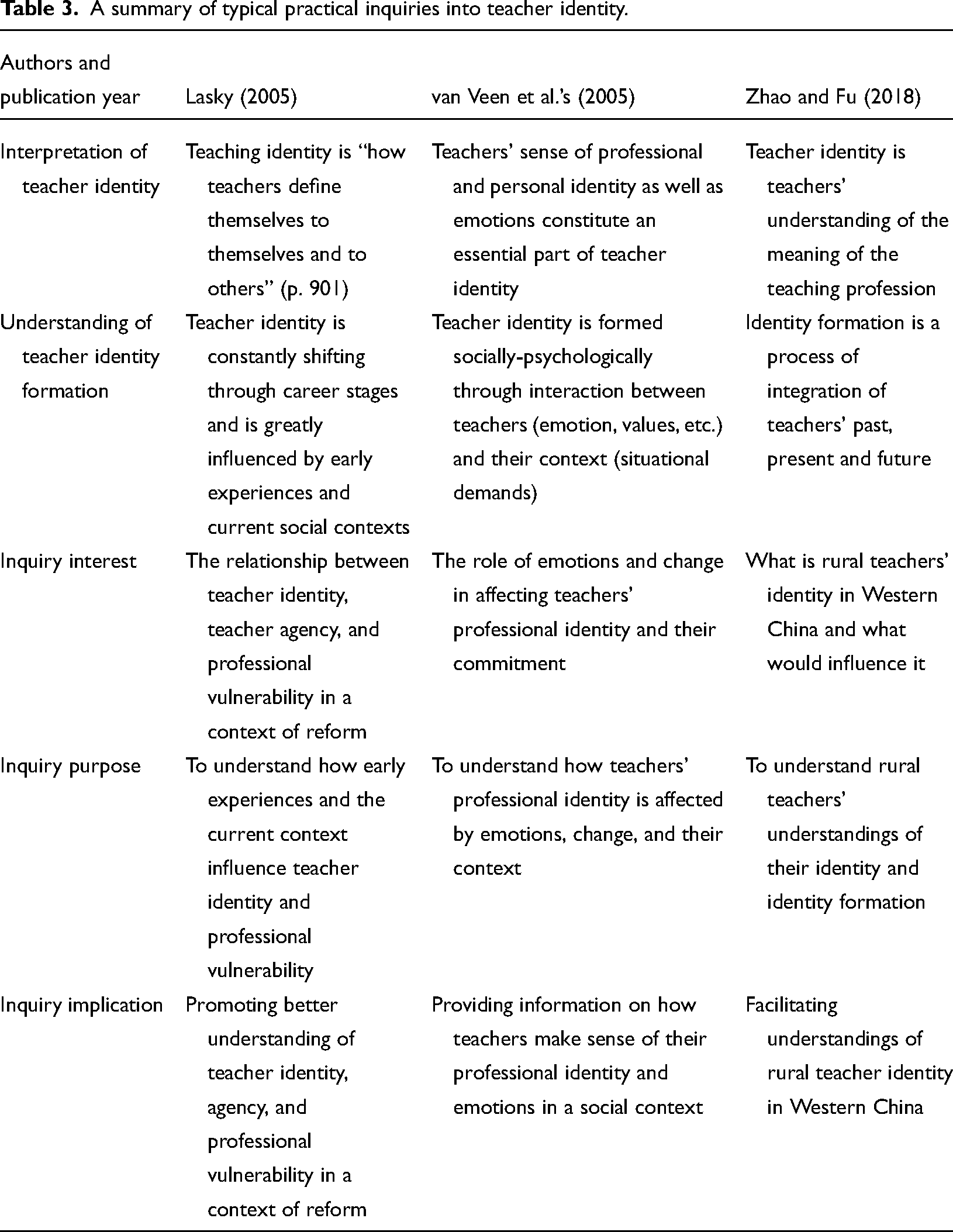
However, if the practical approach assumes that teacher identity is multiple, diverse, and fluid in nature, would it be pointless to investigate it, since the conclusion cannot be generalized to a large population, nor can it directly increase the effectiveness of schooling? An abundance of scholars would think otherwise. For Lasky (2005), the main purpose of conducting research on teacher identity is to understand how teachers’ identity would influence and be influenced by social (i.e., education reform) and individual factors (i.e., agency, professional vulnerability). She found that teachers’ early training experiences and interpretations of the larger environment were all related to the development of their professional identities. The sense-making process of teachers in social and cultural contexts is meaningful and worthwhile for Lasky, as understanding the issue itself is the end.
Similar incentives are visible in van Veen et al.’s (2005) research, as they illustrated its purpose as using a “cognitive social–psychological theoretical framework … to understand how teachers’ identity can be affected in a context of reforms” (p. 917). Understanding once again is treated as an adequate purpose of the inquiry. Teacher identity is perceived by van Veen et al. (2005) as multi-dimensional and subject to social influence. The focus of their study is to understand teachers’ personal, moral, and social concerns in the context of reform.
As context is considered crucial for practically considering teacher identity, inquiries conducted in Eastern culture are also indispensable for our understandings toward teacher identity. Chinese culture, as one of the most classic Eastern cultures, exerts unique influences on teacher identity inquiries. Zhao and Fu (2018) interpreted teacher identity as teachers’ understandings of the meaning of the profession of teaching which is “a fundamental psychological need of teachers” (p. 92). Teacher identity, in this case, has been given a higher value for individual teachers and the profession, as it was perceived as more than a mere construct but rather as something spiritually and psychologically meaningful. This conception could be relevant to a Confucian perspective on teaching and teachers where teaching is a noble cause and teachers are respected for their profession. As for the research intention, Zhao and Fu (2018) demonstrated a similar interest in understanding and interpreting teachers account of their identities, but specifically in rural teacher identity.
Although van Veen et al. (2005), Lasky (2005), and Zhao and Fu (2018) were all interested in how teachers made sense of their own identity in broad terms, their specific foci were not identical. Lasky (2005) made a priority of understanding how teacher identity would influence and be influenced by the social and individual factors. van Veen et al.’s (2005) use of a cognitive social–psychological theoretical lens led them to focus on three aspects of teacher identity, namely personal, moral, and social, whereas Zhao and Fu (2018) concentrated on rural teacher identity.
Although sharing similar interpretations of teacher identity and purposes, researchers who favor the practical approach have rather diverse interests. Common themes include teacher identity and emotions (Hodgen & Askew, 2007; Lee & Yin, 2011; Pappa & Hökkä, 2021; Song, 2016), agency (Beauchamp & Thomas, 2011; Buchanan, 2015; Lasky, 2005), and the development of teacher identity (Alsup, 2006; Clarke et al., 2016; Mitchell & Weber, 1999; Yang et al., 2021). This diversity of specific interests derives from the subjective orientation of practical interest regarding individual interpretation and social meanings. As teacher identity is perceived practically as an ongoing process that can differ among individual teachers and different cultures, researchers can have their own understandings of teacher identity.
The practical approach to teacher identity research falls into the realm of interpretive-hermeneutic science, and the common philosophical basis of this research approach is phenomenology, with its focus on explaining and understanding realities (Ewert, 1991). The practical approach is capable of expanding and deepening our understanding of teacher identity as a social and cultural construct while providing valuable information for educational practitioners.
Critical approach of inquiries into teacher identity
From a critical perspective, teacher identity is perceived as a product and process greatly influenced by power relations. Scholars following the critical approach acknowledge that the identity formation process would be impacted by a variety of personal and contextual factors, but what they highlight is the role of power relations in the presence or absence of certain identities and factors. As Nias (1989, p. 44) pointed out, “routine and taken-for-granted ways of behaving within any school” actually reflect power relations, and new teachers might have to defend their sense of self against dominance. Zembylas (2003, p. 214) also argued that “the construction of teacher identity is at bottom affective, and is dependent upon power and agency.”
Apart from the difference in emphasis, what really sets apart the critical approach from the practical approach is the inquiry purposes. Facilitating understandings among people is an objective of the practical approach, but the critical approach encourages scholars to go a step further to critically evaluate the understandings so that power relations and oppressive “identities” can be revealed and refuted. Consequently, researchers following the critical approach tend to be interested in the political side of the issue and in the empowerment of teachers. Naturally, their works hold great potential in promoting awareness and better understanding of power relations, which could provide information and opportunities to tackle injustice in the current ways of understanding teacher identity and regulating teachers. The philosophical basis for this approach is critical theory, as one of the most distinctive characteristics of critical theory is its aim to explain and transform the injustice in our societies (Joldersma & Crick, 2010). Table 4 lists three typical studies following the critical approach to teacher identity.
Summary of typical critical inquiries into teacher identity.
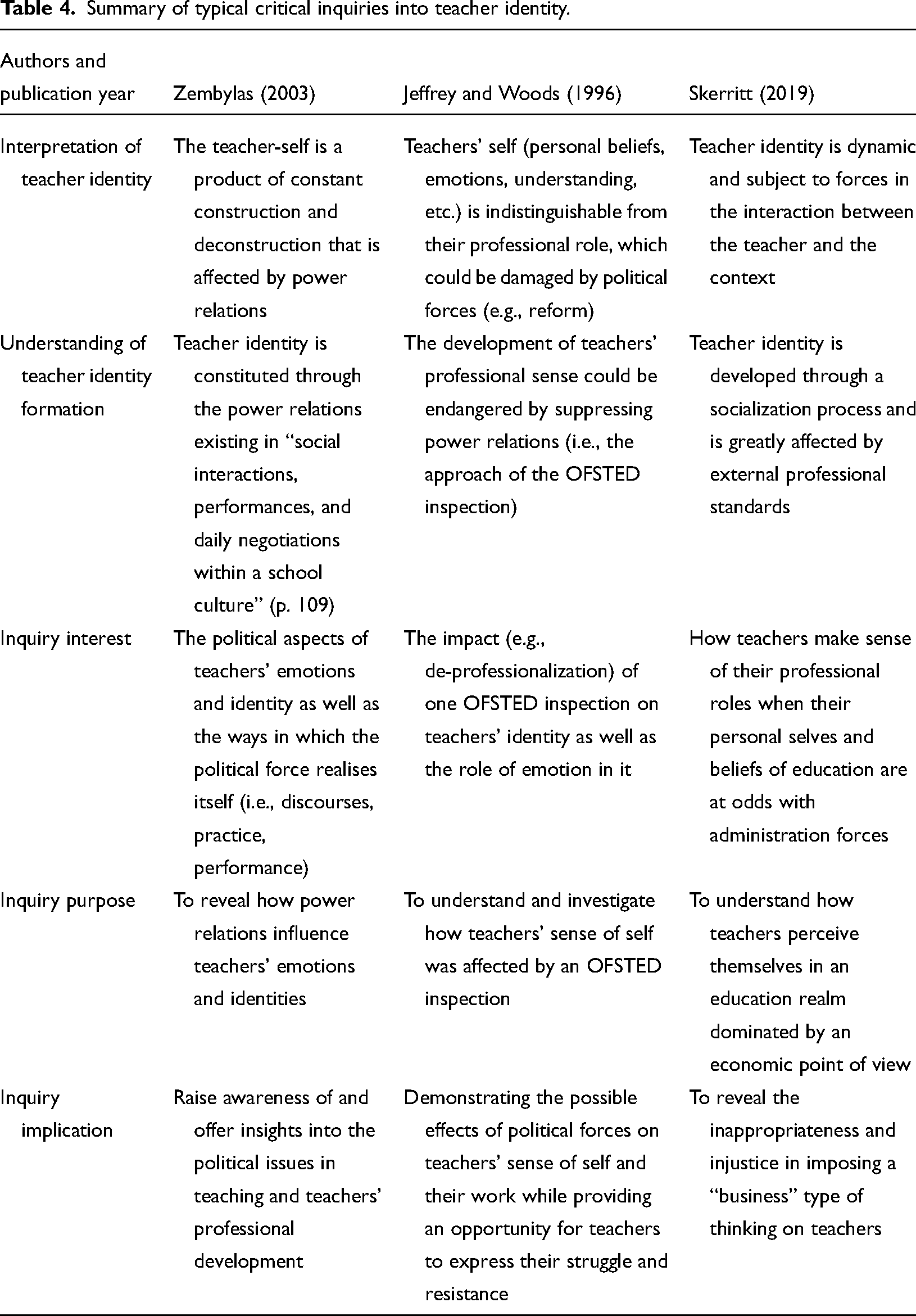
Jeffrey and Woods (1996) conducted research on emotions and the de-professionalization of teachers during an OFSTED (i.e., Office for Standards in Education) inspection in the United Kingdom. Based on the results, they warned against the danger of damaging “teachers’ sense of professionalism” (Jeffrey & Woods, 1996, p. 341). According to them, OFSTED's vision of teaching and teachers would reduce teaching to technical competences, and teachers to technicians (Jeffrey & Woods, 1996). However, teacher identity is more than a list of ideal skills and features that could be acquired and maintained through examinations and inspections. It is obvious that their concerns go beyond interpreting teacher identity. They have engaged in critical thinking on whether or not teacher identity should be this way. What these authors are trying to do is draw attention to injustices within the official ways of understanding and managing teachers.
Skerritt (2019) also made a strong case against what he considered injustice—the business-like professional culture in Irish schools. He argued that the instrumental view of effective teaching as accountability could have negative effects on teacher identity, as teachers’ personal beliefs and values are an important and irreducible part of their professional identity (Skerritt, 2019). Although teacher identity is practically dynamic, social, and political, critical examination is still necessary and crucial for teachers’ positive development. Skerritt (2019) further suggested that what teachers really need is to be “more intrinsically motivated” rather than compelled by external regulations (p. 164). By proposing an alternative solution to what he considered injustice, Skerritt (2019) demonstrated that the critical approach includes not only a revelation of injustice but also suggestions and ideas of alternatives.
Discussion: From competing to supplementing
Every approach to teacher identity research has its strengths as well as its blind spots. The technical approach offers information on what effective teachers should be, but may be insufficient for understanding how teachers understand themselves as teachers. Sachs (2003) questioned the establishment of a uniform standard for teachers and asked scholars to pay attention to the potential effect of imposing it on teachers individually and collectively. As one of the possible effects, the “de-professionalization” of teachers can lead to a loss of autonomy among teachers (Frostenson, 2015). The outcome-based standards and management could damage teachers’ professional identity (Skerritt, 2019).
These critiques of the technical approach actually reflect an inherent complication of technical interest. Due to the positivist basis, technical interest presumes that the issues in question can be effectively controlled through objectively unveiling the “reality.” This presumption is appropriate for the natural sciences, yet “social reality” is hardly purely objective. In the case of teacher identity, different countries have each offered their own depictions of ideal teachers. Even though these ideals are meant to be uniform in their individual jurisdiction, differences between them are still observable across regions. What do these differences mean? Why do these differences exist if there is a unified truth about teacher identity? What and who are responsible for these differences? The answers to these questions lead us to the other two approaches to teacher identity.
The practical approach can provide subjective understandings of teacher identity, but it lacks critical thinking about the status quo. Zembylas (2005) argued that the overemphasis on understanding how teacher identity is developed subjectively in a social context may lead to the neglect of the power relations hiding inside these identities. Instead of asking what an effective teacher should be or how teachers make sense of their identities, Zembylas (2005) suggested that we ask how the present identities of teachers came to be, or whether the current ways of understanding and researching teacher identities are fair. What mere understanding lacks is critical reflections on the fairness of social realities. Be it however practical and meaningful a reality, its existence nonetheless cannot simply justify its fairness.
The critical approach is unique in its focus on revealing injustice and empowering individual teachers. For this reason, some scholars (e.g., Butler, 1999; Foucault, 1982; Zembylas, 2003) even deem the critical approach of teacher identity as more informative than other approaches. Zembylas (2003) argued that a post-structuralist perspective of identity formation can make a distinctive contribution by giving priority to the “socio-political context that confounds the meanings and interpretations of knowledge and identity” (p. 222). It is worth noting that the post-structuralist perspective, although frequently associated with the critical perspective, is not equal to the critical approach in Habermas's (1972) terms. The post-structuralist perspective as illustrated by Zembylas (2003) is a way of connecting the technical and practical perspectives, as it supports “an integrated notion of identity rather than a dichotomy” (p. 223). However, the critical approach based on Habermas's (1972) idea has made no such combination. With that being said, the similarities between the post-structuralist perspective and the critical approach are still evident in their understandings of teacher identity and their inquiry interests.
Despite the focus of the critical approach on revealing unfairness and supporting empowerment, the restoration and justification of fairness can be empirically difficult. A chain of dilemmas stands in the way. The beginning dilemma is about reaching a consensus on fairness or unfairness. As individuals’ understandings of teacher identity are subject to social and political influence, their understandings of fairness are also socially bound. Therefore, individuals may hold different opinions on fairness as social contexts and personal factors differ. The question then is whose perception should have the power to decide what fairness or unfairness is. If each individual teacher should be empowered to decide what is right for him or her, how would teachers as a group function properly? If a balance should be maintained between individual identities and collective identities, where would the boundary be? These questions and dilemmas are a reflection of the complicated or even conflicted nature of teacher identity. Therefore, as Akkerman and Meijer (2011) argued, teacher identity is both unitary and multiple, consistent and conflicted, individual and collective.
On the issue of teacher identity, the three approaches exist simultaneously in academia and in practice. Instead of seeing them as opposing forces, it may be beneficial and feasible for scholars to see these research approaches as supplementary to each other.
The technical approach has been criticized for its overemphasis on effectiveness and its singular ideal view of teacher identity (Sachs, 2003; Skerritt, 2019), but the fundamental problem is not effectiveness nor the ideal view of teacher identity per se. The dispute is about overemphasis, as the effectiveness of teachers and the formulation of ideal teaching are still an inseparable part of teacher identity. What might improve the technical approach would be using and seeing the ideals of teachers and teaching in a different way. Instead of viewing the ideals as standards that should be applied to teachers generally, these expectations can be viewed as an “ideal ego” that is concerned with individual teachers’ own fantasies of good teachers (Clarke et al., 2016). The official account of an ideal teacher can then actually function as an inspiration and guidance for teachers to find their own ideal form of self and invest themselves in reaching it. In addition, from a fresh perspective, changing the ways in which ideal teacher identity is used by the official department is vital as well. In contrast to imposing these ideals on teachers in the form of inspections and qualifications, if these ideals could be presented as suggestions for implementation, teachers may find them much less oppressive and more humanistic (Jeffrey & Woods, 1996). However, what this change in use requires is a change in thinking about ideal teacher identity on the part of official departments.
As for the practical approach, in dealing with the critiques of the dominant purpose of understanding, it can be seen as an information source for the other two approaches. The understandings of how teacher identity is constructed in social and political contexts and how teachers make sense of their professional identities can inform us of how teacher identity may influence and be influenced by various forces and factors (e.g., Hodgen & Askew, 2007; Lasky, 2005). This practical knowledge, then, can be considered and utilized with a technical intention to promote desirable professional development in teaching and learning. Individual teachers themselves can also benefit from their self-knowledge by adjusting and developing themselves to be more effective. A typical example is teachers’ self-motivation and positive development related to their reflections on what an effective teacher should be, what kind of teacher they are now, and what kind of teacher they want to be. In addition to considering and utilizing practical knowledge with a technical intention, this information can also be examined critically, as only from understandings of how things actually are (i.e., the status quo, whether fair or not), can reflections and critiques be made. It is from the pictures depicted by the practical approach to teacher identity that arguments about whether the current situation is fair or not and how to restore the distorted reality derive.
Lastly, the critical approach could be considered as a further purpose for technical and practical approaches. After fulfilling the pursuit of effectiveness or understanding, an extra question can be asked: Is this way of effectiveness or understanding how it should be? Based on the answers to this question, respective actions and investigation can be made with considerations of social justice. In this way, a critical pursuit of teacher identity can be possibly constructed and realized through the technical and practical approaches. Although it is difficult to coordinate relevant parties (e.g., teachers, schools, administrators) and achieve a consensus, the critical approach offers an opportunity to collectively investigate and negotiate the possible fairness or unfairness within teacher identity.
In short, this theoretical narrative review has discussed the possibilities of supplementation among the three distinctive approaches to teacher identity. What can be inferred from these possibilities is the impracticality of justifying paradigm purity (Ryan, 1988). The technical, practical, and critical approaches to teacher identity research do not exist as a trichotomy. Instead, it is possible for them to inform one another and contribute to the same cause. It would be likely that researchers hold multiple interests regarding teacher identity. The mixture of approaches should not be considered negatively as a disruption of paradigm purity, but as creative understandings and efforts to accommodate different interests and purposes.
Practical implications
Apart from the theoretical implications, this study also holds a few practical implications for teacher education and educational policies. For teacher education, it is vital to provide preservice teachers opportunities to interact with the educational environment, as genuine teaching experiences are necessary for them to develop their teacher identity as individuals, and in a teaching community. Moreover, teachers (both pre- and in-service) should be allowed and encouraged to express and critically reflect on their understandings of teacher identity, and teacher education programs should construct a secure and positive space for them to do so. It is important for teacher educators to recognize their own conceptions of teacher identity and their influences on teachers. Imposing authoritative values on teachers could be unwise and ineffective. Instead, teaching ideals should be utilized as an inspiration and motivation for teachers to improve their teaching practices and themselves as teachers.
For educational policymaking, it is imperative to reflect on the dominance of technical perspective in education. Policymakers should maintain a relatively balanced orientation in regulating teachers. Policies should not merely be based on ideal images of teaching and teacher but also include teachers’ own understandings and needs. Furthermore, the critical perspective of teacher identity could also be quite helpful to policymakers, for it allows them to critically reflect on the policies they have made or intend to make. From this reflection, the educational policies then can be developed and/or adjusted to better serve the need of the countries, teachers, and students.
Concluding thoughts
The three approaches to teacher identity research are associated with Habermas's (1972) three human interests, namely, technical, practical, and critical interests. Technically, teacher identity is understood as a set of standards of ideal teachers. Practically, teacher identity indicates how teachers make sense of being a teacher in their social, cultural, and political contexts. Critically, the power relations embedded within teacher identity are the central issue that should be emphasized, revealed, and corrected. Researchers with a technical interest tend to value the effectiveness of teachers and believe that effectiveness can be enhanced by advocating an ideal image of teachers. Researchers with a practical interest emphasize understanding individual teachers’ own sense-making process within a specific context. Researchers with a critical interest are most concerned with how teacher identity is shaped by power relations, refutes possible injustices, and empowers teachers as a whole. Even though each approach is informative in its own terms, each is limited in certain ways. It is not wise to claim the superiority of one approach over the others. Rather, a combination of different approaches in the research on teacher identity may be more beneficial for academia.
Footnotes
Contributorship
Rensijing Liu was responsible for conducting the literature search, analyzing the literature, and writing the bulk of the main body. Hongbiao Yin contributed to theorizing the framework, analyzing the literature, responding to the reviewers’ comments, and finalizing the manuscript.
Declaration of conflicting interests
The authors declared no potential conflicts of interest with respect to the research, authorship, and/or publication of this article.
Funding
The authors received no financial support for the research, authorship, and/or publication of this article.
