



Abstract
Purpose
This study aims to search for fitting lenses to view and interpret teacher learning in a Japanese secondary school teacher staffroom and capture the reconstituting of researcher subjectivities in this process.
Design/Approach/Methods
A narrative approach chronically documents the findings and use of the lenses in analyzing the staffroom daily interactions and traces the journey of transformation in our researcher subjectivities.
Findings
The telling of a Japanese staffroom (shokuinshitsu) as a thrice-told tale under the three lenses—cultural-historic activity theory, contextualism, and intimacy orientation—each uncovers a unique interpretation of the learning going on in the daily life of the Japanese staffroom. While complementary, Western-lenses are found to be unable to explain the nature of the everyday practices in the staffroom formed under the worldviews and ethics of East Asia. Our critical examination of the major academic encounters involved in the past two decades illuminates the complex dynamism behind our research perspectives, awakens us to the dominance of Western-centralism in our researcher subjectivities, transforms our worldviews, and returns us to our cultural roots to build alternative frames of reference as East Asia as Method.
Originality/Value
This study not only uniquely demonstrates what decentered, alternative, and diversified frames of reference would look like in studying East Asian practices but also what it would take for scholars to move toward East Asia as Method. Additionally, going beyond the three lenses, it contributes to our understanding of how space (staffroom as an entity) mediates forming of the character of those who are dwellers of the shokuinshitsu.
Keywords
Background
The notion of staffrooms as sites of teacher learning in schools of three cultures—China, Japan, and Korea—emerged as a reaction to course work and research experience during the first author's doctoral studies at Michigan State University over two decades ago. Course readings and class discussions, mostly concerning works by U.S. scholars, highlighted a recurring theme of teacher isolation and autonomy (e.g., Huberman, 1995; Little, 1990; Lortie, 1975), which was both shocking and intriguing to a Chinese person growing up in a familiar school culture of teachers working together. Together with a few doctoral students who were from or worked in Korea and Japan, we used our summer breaks to travel back to our individual countries to observe, video-record, and interview individual teachers in one school staffroom in Shanghai, Japan, and Korea, respectively. We conceptualized staffrooms in terms of space, time, and artifacts/tools, supporting informal learning for teachers while they fulfill their roles and responsibilities. We presented our findings at both AERA and CIES (Fang et al., 2003). Our own individual doctoral research activities kept us from continuing with the staffroom research, and we parted ways after the completion of our doctoral studies. Since then, however, framing our questions using Western lenses and drawing upon Western research (mainly U.S.-based research) to make sense of and promote East Asian educational practices has been our taken-for-granted scholarly path.
Nearly two decades later, we returned to our staffroom research with a recent ethnographic observation at a junior secondary school in Central Japan, which was conducted by the second author, Lingfeng, in early October 2019 as part of her university-school partnership program. From 2020–2022, we joined the “slow scholarship” (Shahjahan, 2015) experiment group led by Professor Keita Takayama and Professor Yoonmi Lee in making this Special Issue. We studied and exchanged East Asian educational practices by reading Chen's (2010) Asia as Method. Our discussions on Chen's 3Ds—decolonialization, de-cold war, and deimperialization made us aware of the predominance of Western-centric framing in our research and our unquestioning stance of its universal value in framing educational research as well as the possible unintended consequences that this stance could have had on our understanding of East Asian education practices! In response to Chen's call, we seek a “possible way of shifting points of reference and breaking away from the East-West binary structure” (pp. 215–216) in order to form “multiple frames of reference in our subjectivity and worldview so that our anxiety over the West can be diluted, and productive critical work can move forward” (p. 223).
In this paper, we choose to focus on the Japanese case alone based on the recent fieldwork. The first part of our paper focuses on our search for and use of appropriate lens/lenses in interpreting lives/learning in the Japanese staffroom (shokuinshitsu) which is eventually told as a tale from three different theoretical or conceptual lenses: our long-held social cultural and cultural-historic activity theory (CHAT) cultivated by our doctoral training and two recently found ones—contextualism, a lens based on “emics” that studies Japanese culture from perspectives “inherent to Japan” (Hamaguchi et al., 1985, p. 219) and Kasulis’ (2002) intimacy orientation regarding the worldviews of East Asian and ways of knowing and being. A vignette of a typical staffroom day in the life of Mdm. M, the school's Research Head, proceeds how each of the three lenses views and interprets her life and learning in the accompaniment of her colleagues and students. The second part focuses on how the process of finding the lenses and deriving the interpretations made us reconsider and challenge our own researcher subjectivities, ontology, and even worldviews as well as the emerging transformations that have moved us toward East Asia as Method, which we will discuss in the final section of the paper.
Located at the center of the ground floor of the three-story junior secondary school building in Central Japan, the shokuinshitsu, a large (approximately 20 × 25 m) rectangular staffroom, serves 750 students. Leading from the sliding door at the bottom left into the shokuinshitsu (see Figure 1 floor map below), about 50 sturdy metal teachers’ desks are adjoined in rows and clusters according to homeroom grade level and subject area between two long walls of windows and shelves on both sides. The desks—so arranged that teachers in each of the three main clusters (7th, 8th, and 9th grade groups) face each other—are covered with piles of books, papers, pens, calendars, coffee mugs, teacups, and laptop computers. Near the front wall to the left, a row of administrators’ desks sits perpendicular to the rest, with desktop computers to the right and a copy machine to the left. The side door of the Principal's (P's) Office next door is near the end of the right side of the Vice Principal's (VP's) desk; it leads into the staffroom and always remains open.
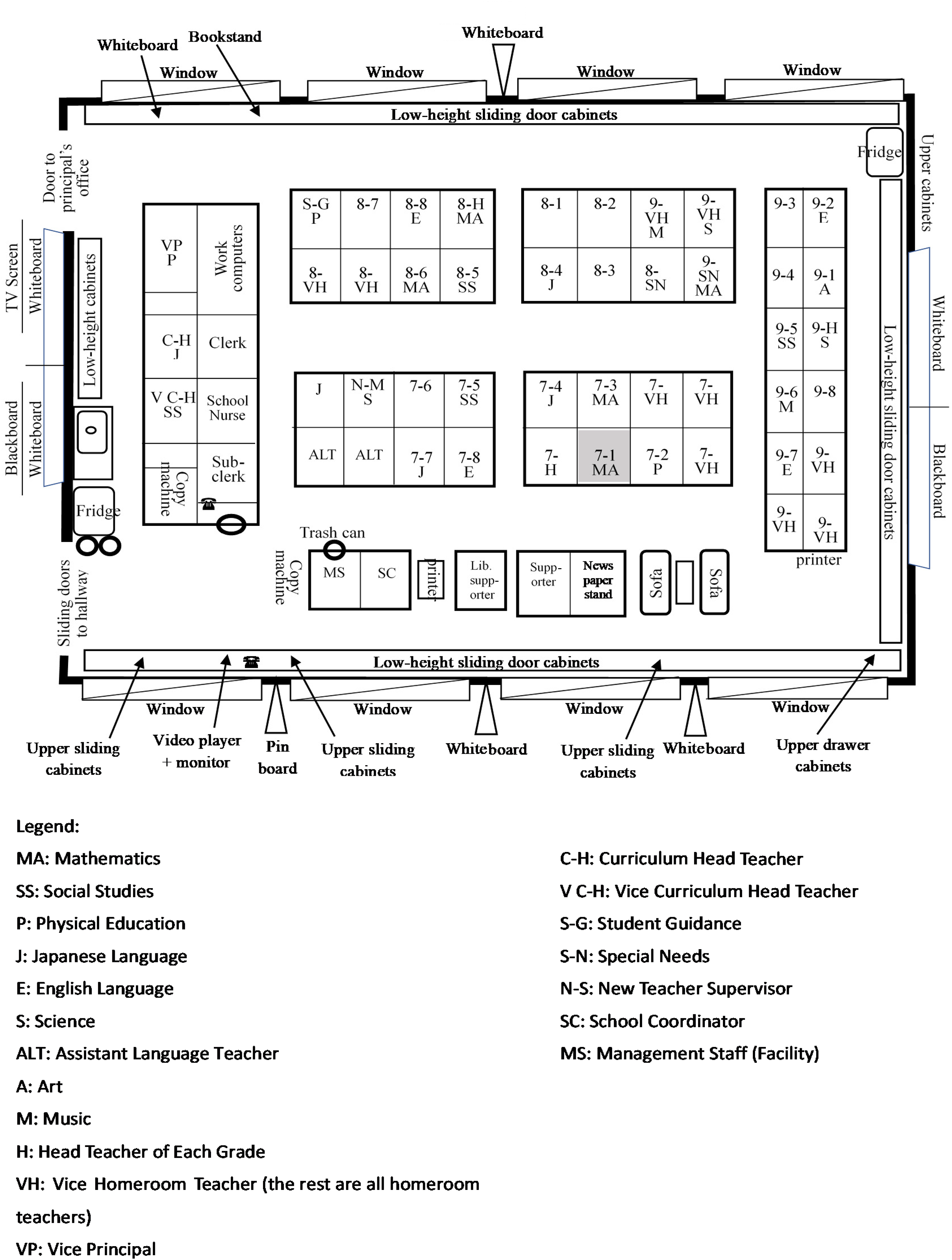
Shokuinshitsu floor map.
Large whiteboards with a monthly calendar, featuring handwritten announcements about school events and schedule changes, are placed on the front wall behind the row of administrators’ desks. The rest of the walls in the shokuinshitsu are lined with message boards (for posting the two-day schedule and attendance—by gender, grade, and homeroom), file drawers, and shelves. In fact, it seems as if every available surface (even the space under the desks) serves as storage space for something—small baskets of textbooks, reference books, a tripod, forms, tote bags, and so on—giving the room a crowded feeling. A big refrigerator, a sink, and a hot water set for brewing coffee or tea are placed against the front wall by the sliding door (the other refrigerator is placed at the right corner of the back wall).
On the morning of October 9th, 2019, Mdm. M, a math teacher of Grade 7 (her desk is shaded in grey in the above-provided floor map) and the current Research Head of the school, arrives at the school (her 7th school for three years across her 25 years of teaching) at 6:50 AM. After making herself a cup of hot coffee, she works on her files in the folder named “To-do List”. By 7:30 AM, when all the teachers arrive, the staffroom gets extremely crowded; many are standing and chatting, some are followed by students, and others are engaged in making some quick checks on lessons. When the school chime sounds a short tune at 8:10 AM, the last of the students scurry out of the shokuinshitsu, closing the sliding door behind them. The P enters through the door from his adjoining office to attend a brief morning staff meeting for general orientation and school announcements, which is followed by a sharing between grade-level heads and teacher volunteers. Mdm. M reminds everyone about the staff research meeting that is taking place after the day's final period; it concerns preparing for the Board of Education (BOE) visit two weeks later. She then takes her seat to join her grade-level meeting, which is one of the daily 5-minute meetings held concurrently after the morning staff meeting and chaired by grade-level heads to consolidate information and actions related to individual grade levels. At 8:20 AM, Mdm. M and other homeroom teachers go to their classrooms to brief the students and orient the day. They return to the staffrooms 15 minutes later around 8:35 AM. “Talks happen naturally when people gather,” shares Mdm. M, as she watches teachers standing while talking, “and we know others and their thoughts from random talks.” “You overhear talks like what happened in the social studies classes (or any ongoing group meetings),” she continued, “you then know how and what's going on.”
At 8:45, Mdm. M and most teachers leave quickly to teach the 1st period, and the staffroom suddenly becomes very quiet. Teachers with nonteaching periods are checking students’ workbooks, marking worksheets, or working on laptops while writing report cards, since it is close to the end of the semester. The VP is busy talking to new teachers who consult him and responds to their individual queries casually with laughter. The P also comes to talk to certain teachers. The 10-min breaks in between classes are rushed. Since each teacher teaches the same subject to three different grades, they need to return to the staffroom to change textbooks and materials. After a sip of coffee or a brief chat with a colleague while standing, they then head out 3 minutes before the next class.
After four morning lessons, homeroom teachers, including Mdm. M, stay with their students for lunch in their homerooms and return to the staffroom at around 1:45 PM after supervising the post-lunch cleaning hour. Before heading to their two afternoon classes, teachers quickly check with colleagues about their unit progress while standing. This is a busy time for the P and VP, who need to talk to certain teachers. “There are a lot of talks that have to be completed after classes,” they share. Talk and laughter are also heard within the Administration section.
At 4:35 PM, the school research meeting begins. The P starts by talking about the national curriculum reform and the need for deep learning, which requires changes in the usual ways of teaching. The VP follows by reiterating information about the BOE supervisors’ visit, stressing that reform is necessary for students’ future because, by 2030, AI will take over all jobs, so students need to be more creative than AI, which cannot read human beings’ emotions. Half an hour into the meeting, at 5:07 PM, when Mdm. M is chairing as research head, she shifts to subject-based reform on deep learning. She asks her two nominated teachers to talk about the research lessons they have planned for the BOE visit the following week: one social science teacher, who talks about his planned lesson on “Organ donation,” and one moral education teacher, who discusses “Apologies mean sincerity? What is important when you have to make a decision?” By 6:30 PM, the meeting ends, and all teachers are reminded to leave work, since every Wednesday is a Public Day for No Extra Work in the school in accordance with the prefecture's movement to keep teachers from overworking.
The above vignette is crafted based on data collected on a whole day in the life of Mdm. M within the nexus of the school's central staffroom including pictures of all the surface areas of the staffroom walls and desks, observation of the dynamic interactions between and among staff members, videos of major staff meetings, and interviews with teachers in the staffroom. The purpose of our paper, however, is not to report on daily lives in a Japanese staffroom but as stated earlier is to search for and use appropriate lens/lenses in interpreting lives/learning in the Japanese staffroom and offer a critical examination of the cultivation of our Western-centric researcher subjectivities as well as the changes resulting from the entire process.
Shokuinshitsu as a tale told from three different theoretical lenses
A shokuinshitsu tale first told through tool/resource-mediated activity systems driven by contradictions for boundary crossing
On January 14th, 2022, at the invitation of Professor Keita Takayama, we presented our shokuinshitsu study at a Kyoto University Webinar. We viewed the shokuinshitsu as a tool-mediated activity system based on our familiar social cultural framework and CHAT perspectives: The subjects or agents—the staffroom dwellers—are in dynamic interaction with the object (the real world lying outside of the subject), which is represented as the problem-solving space for teaching and education mediated by use of tools and artifacts (calendars, forms, schedules, and books that cover the walls and desks) and constant discourses, both formal (meetings) and informal (quick talks in between lessons). The subject–object interaction via tool mediation was viewed from the perspectives of contradictions which drive the activity system forward (Engestrom, 1999). According to Cole and Engestrom (1993), in activity systems, “equilibrium is an exception, tensions, disturbances and local innovations are the rule and the engine of change” (p. 8). The shokuinshitsu, however, is uniquely characterized by numerous seemingly competing contradictions which harmoniously coexist. For instance, what appears to outsiders is a crowded, messy, and physical surrounding which to insiders are orderly placed tools and resources made handy and easily accessible for use. Housed under the same roof, public functionalities mix with private life space of individual teachers’ desks (such as coffee mugs, snacks, and family pictures); the administrators and the teaching staff work together in close proximity and their daily casual interactions narrow the distance and the hierarchies they inhabit. The intensity of the hustle and bustle of the work pace is relaxed by the hearty laughter from quick collegial conversations for seeking and exchanging information. The noisy ambience is juxtaposed with focused private engagement and quiet emotional undercurrents (as expressed by Mdm. M and other teachers interviewed). It is here that overhearing can be natural, informative, and relaxing. The divide between different grade levels and subjects is bridged by tatemochi (one subject teacher teaching all grade levels); the divide between the curricular and extracurricular is bridged by involving teachers in jointly sharing club activities, lesson studies, and community outreach; the divide between the school and community is bridged, for example, by students volunteering in regular community events (e.g., the VP asked teachers to send volunteers to help in the community festival at the morning staff meeting).
The above conflicting yet harmonious organizational patterns seem to be achieved by the system's built-in features mediated by space, tools, resources and their use, which produces interpenetrating sub-systems of activities within the general activity system of the shokuinshitsu. For instance, analysis of the artifacts covering the walls and desks indicated that 60% were timetables/schedules and teacher duty lists or signups, while the remaining 40% provided information related to work in and outside of the school. Analysis of photos capturing teachers working at their desks, which were triangulated with interviews and observation notes, revealed a high frequency of tools and artifacts mediating teachers’ work and high correlation between the activities in the schedules and those that teachers were engaged in. They support teachers in dealing with the boundaries of roles and responsibilities, allowing for the blurring of such boundaries and the resolving of contradictions. They are arranged in ways to serve its central role as “a school's hub” (Rohlen, 1983, p. 152) with its practical and pragmatic orientation revolving everything around work practice hectically yet rhythmically. This, perhaps, explains why the bureaucratic structures of the Japanese staffrooms have been rather stable and resistant to change across history (Rohlen, 1983; Sato, 1991; Shimahara & Sakai, 1995). Newcomers’ peripheral participation is limited when novices move quickly to central participation with no restrictions of access to the tools, resources, and discourses of old timers (Lave & Wenger, 1991). Standing while talking and overhearing, a common landscape in the staffroom, can thus be viewed as teachers’ “third space” for building shared understandings of practice, forming new meanings with emotion, and identity-making which goes beyond the evident limits of both worlds (such as between current practice and reform demand) (Gutiérrez, 2008). Yet such “third space” is effortless and happens everywhere and every workday in the staffroom. For Mdm. M, her “overhearing” becomes her “third space,” through which she gathers the information necessary for performing her role as the school's research head while planning for the BOE visit and addresses problems confronting different subject areas in the new deep learning reform.
A shokuinshitsu tale twice told from Hamaguchi et al.'s contextualism—A relation-centric cultural psychological view of the Japanese organizational life
In June 2022, one and a half year after our Kyoto University Webinar, we shared our work-in-progress with our “slow scholarship” experiment team in one regular Zoom workshop session. This time, informed by Hamaguchi et al. (1985), we interpreted the findings from their notion of contextualism, a relation-centric view of organization life in Japan which was intended as “an insider's perspective” or “emics inherent to Japan” (pp. 291–305). Contextualism, based on Hamaguchi et al., can be encapsulated in five kanji (Chinese) characters: 1. “Ningen (人間)” refers to people in a society but foregrounds “in-betweenness” (間), a central idea “in the experience structure of us Japanese” (p. 301); 2. aidagara (間柄) refers to the social context made up of relations, which is the base of motivation for the Japanese “to get along well with others” not “for one's own gains” but because it is “intrinsically valuable, and hence goals to be pursued,” and “a commitment to better the seken or the world” (p. 317). Captured metaphorically, “each Japanese can be stabilized only when he forms a social molecule (aidagara) with other Japanese,” which renders the Japanese organizations “extremely stable” (p. 315); 3. hitogara (人柄) refers to personal traits that are only demonstrated in “the constant social culture space,” which forms the “locus of all the interactions of a person within society” (p. 303); 4. jen (jenism) or ren (仁), the core Confucian virtues, can be used as “an analytical concept” to “operationalize” how the actor achieves hitogara (人柄) by maintaining “a dynamic equilibrium” in the form of “good psycho-social homeostasis” (pp. 303–305); and 5. jibun (自分), referring to one's own self (or one's own share), is always viewed as being “beyond oneself,” which is distributed across “a certain co-variant relationship” with others and “changing in mutual accord with the other” vis-à-vis “the changes in the overall situation” (p. 302). Therefore, knowing one's bun/share well and being able to cooperate and compromise with others is an invariable expectation. When operating under the above-mentioned set of principles, the actors, the smallest elements of a system, exhibit properties of the local whole (holon)—self within others (p. 320).
Viewing the shokuinshitsu from the angle of contextualism, those who dwell in this workspace are contextuals, who are naturally inclined to seek out and work in close relations in the best ways they can to serve students’ needs and school goals. Grade-, subject-, and club-level groups are the “molecules” of natural work arrangements that support the optimal performance of roles and responsibilities. In the staffroom, therefore, individuals cooperate spontaneously by controlling their behavior so that the whole system is properly ordered. Hence, the shokuinshitsu appears to run as a holonic decentralized control mechanism, self-governing and flat. With the lens of contextualism, the school motto set in three square wood frames with two kanji characters in each frame hung on the back wall of the shokuinshitsu is illuminated: 诚実 (honesty), 節度 (moderation), and 実践 (action) which actually embodies the virtues of jen (仁) too—that is, to be a person of honesty, modesty, and virtuous deeds. The role of the motto aligns with beliefs, behaviors, and heart and mind of the entire staffroom colleagues. This, as discussed later, demonstrates that East Asians share a Confucian cultural heritage and that the Chinese characters, albeit with contextually layered adaptations of meanings in the kanji form, provide a shared means to building mutual communication and negotiating common understanding. Although loss of meaning in translation often occurs as a barrier, Confucian thinking is found to be able to mediate a shared understanding in East Asian educational scholars’ work.
Mdm. M, a mathematics teacher with 27 years of teaching across seven schools, her jibun (自分)—herself, her life space, and her own share of the expertise—can only grow together with the growth of other colleagues in all the seven schools in which she has worked, integrating the diverse and rich contextual goodness from each of them to make up her own. As research head, Mdm. M's jibun (自分) is distributed “beyond” herself, serving the needs of the whole staff in her current school preparing them for the upcoming BOE visit, a situation that demands her to know her bun (share) well by paying particular attention to social studies teachers whom she has chosen to offer research lesson observation during the BOE visit. As Mdm. M shared, the staffroom is a place to know other colleagues through small talk, know their confusion, and share worries and where conscious or unconscious overhearing always seems useful source of information, and where she relaxes, eats her snacks, and brings her favorite things. Her functional relationships (roles) practiced over many years and in many schools as well as her current graduate studies at the local university seem to have rendered her in-between relational space flexible and resilient. Therefore, the notion of “boundary” or “boundary crossing” viewed from activity theory no longer seem to fit in interpreting the life of the shokuinshitsu inhabited by contextuals. The notion of “third space,” viewed from the perspective of activity theory or personality psychology as a space outside two competing worlds (one's own and that of others)—achievable only by taking advantage of one's own strengths as a resource (Kraus, 2013)—would not make much sense when it comes to the case of shokuinshitsu colleagues.
A Shokuinshitsu tale thrice told from Kasulis’ intimacy orientation—Breaking binary opposition and duality to achieve a unity of viewing
In the last few months of this slow scholarship journey, a new window opened when reading Kasulis (2002) shed light on remaining questions such as, why do the relational actors (e.g., the staff members) in their actor systems (e.g., in the shokuinshitsu) under Hamaguchi et al.'s contextualism do what they do everyday and how do tools and artifacts mediate actions and activities as part of what they do under CHAT? Indeed, by going into the most fundamental aspects—the worldviews and ethics—that form the “foundations of knowing and valuing” (p. 149), we have come to appreciate shokuinshitsu as a space designed for fostering, preserving, and supporting the intimacy of the staff members (and administrators) and the organization of teachers’ work.
Kasulis (2002) compares worldviews and ethics between East Asia (particularly Japan) and the West: The former foregrounds intimacy orientation, and the latter foregrounds integrity orientation. The intimacy-integrity metaphor captures how the people in each orientation understand the world and the self and also construct value and knowledge differently (p. 13). To people who are encultured in integrity orientation in the West, knowledge is considered usually objective since it is constructed in and from reality (object) by the knower (subject). It lies externally to the knower as something verifiable by any knower and thus cannot be colored by subjective emotions. Therefore, the knower and the reality correspond to each other to maintain the integrity of knowledge formation (p. 72). To people in East Asia, who are enculturated in intimacy orientation, the knower and the reality are regarded as being internally connected, and knowledge is formed in the overlaps between the knower and reality (p. 77). Hence, knowing is intimate; it is the identification (not correspondence) of the knower with others and reality by reacting with compassion. Therefore, “we learn, in part, about ourselves” and what we learn changes what we are, too, at least in part (p. 79). That is to say, for East Asians, knowing is not an external practice; it is habituated through daily repetitive praxis, enacted, lived, and felt through the body, so it is both embodied and psychological. When knowledge is achieved and transmitted through praxis, it is tacit, “not publicly observable,” “embodied through physical style,” and learned through “emphatic imagination” (p. 40) and “aesthetic sensitivity” (p. 41). This “ecological” view of knowing involves “the mutual transformation of both world and human beings” (p. 81), which is “reminiscent of the Chinese model of yin and yang” (p. 101). In ethical interactions between humans and the environment, intimacy orientation holds the morality of responsiveness (being there and caring for) in contrast to the morality of responsibility (safeguarding rights and justice) to uphold the integrity of the knower and the knowledge.
When viewing the shokuinshitsu based on intimacy orientation, our perspectives of what we have observed could shift drastically. We now see the shokuinshitsu space as being designed not to promote boundary crossing but to preserve and enhance the intimacy of the staff members. The physical structures—for instance, the seat arrangement, tools, artifacts, and resources—are designed for easy access to one another and for sharing information. The overlapping arrangement of grade, subject, and extracurricular groups, indeed, seem to blur the boundaries, but the rationale is to make knowledge and expertise easily available, tappable, used, learned, and mastered through daily praxis of formal and informal interactions, such as in daily meetings, casual conversations, and small talks exchanged while standing. School transfer creates other kinds of overlapping, so that teachers can adapt to different school contexts and cultures in many different school settings over their career to diversify their knowledge and adaptability. All of these arrangements, from the perspective of Kasulis, ought to be guided by the principle of being responsive to the needs of one another, of the school, and of the current new reform on “deep learning” so that students’ needs are best served.
Intimacy orientation does not view the shokuinshitsu simply as a neat system of tool-mediated activities where the subjects interact with the objects in performing roles and responsibilities through division of labor and abiding to norms. Instead, the shokuinshitsu comes alive with actions, words, and feelings that are embodied, visual, and somatic. We can almost see the moving of bodies with the rhythm of the staffroom, day in, day out with their dynamic exchanges and quick talk while standing close to one another. We can notice the expressions of concern when worries are shared (as your worries are mine), hear the sound of laughter at jokes, and smell the coffee beans in the casual and noisy ambience of the staffroom while those sitting at their desks seemingly unbothered concentrate on the work at hand. We can feel their pace when others complete the quick filling of forms, check attendance sheets, or refer to textbooks or laptops before heading to the next set of lessons. The use of tools and resources becomes a natural extension of the bodies through routinized and habituated praxis, which develops teachers’ tacit personal practical knowledge and expertise in teaching (Connelly et al., 1997) (as in the case of Mdm. M) through the praxis of intimate work life.
Being there for others, as in the morality of responsiveness, is embodied by compassion and empathic imagination, which further promotes intimate knowledge, learning of morality, use of tools, and aesthetic sensitivity which are usually taught or learned nondiscursively (Kasulis, 2002, p. 41). Embedded in intimacy orientation is the cultural philosophy of the school leaders in the shokuinshitsu, the P and VP, who serve with their responsiveness by being there to offer help—for example, by standing there and waiting to talk to teachers after teaching: “There are a lot of talks that have to be completed after classes,” they share. Being responsive to students, the core of the school's existence becomes highly visible and coherent when viewed from all the school meetings and the context of teachers’ formal and informal exchanges on the day of our observation when the school semester was approaching to an end. From the morning meeting in which teachers were requested to discipline late-coming students to the afternoon post-teaching staff research meeting that focused on reform for “deep learning,” students’ future needs was the common vision that the school was building. The atmosphere (the look, sound, taste, and feelings), the micromilieu in the staffroom, reflects the holonic whole of the entire country's education strategy for preparing schools for “deep learning” through research lessons. During the BOE visit days, the research lessons were open to all available teachers in the country's junior secondary schools. Experts from universities, districts, and the prefecture as well as the superintendent of the BOE are forthcoming with their comments and feedback, creating a vibrant system that was not just based on teachers’ own local knowledge and practice as some Western scholars would have us assume (e.g., Edsal, 2018).
On the one hand, we argue that the intimacy orientation allows us to view the above structures as creating overlaps that embody the visible dynamic interactions through which knowledge is built with invisible undercurrents of internal feelings and emotions that are often embedded. Constant sharing is managed through self-constraint for the benefit and greater good of others. Teachers in our interviews talked about the rich emotions they experienced in the staffroom, such as feeling sensitivity toward others, overhearing nearby conversations, sharing worries (related to roles/tasks), and achieving a sense of relaxation (e.g., enjoying a cup of coffee or drinking tea and eating snacks before and after teaching). On the other hand, however, as researchers we have been steadfast in holding on to integrity orientation in conducting research in—and interpreting data from—East Asian education settings, as guided by integrity principles. We are “the empiricists,” as Kasulis (2002) would call us, who categorize the artifacts/objects (timetables, forms, charts) on the walls and desks to analyze their properties and assign values to turn such analysis into publicly verifiable facts. In doing so, we run the risk of cutting off the internal relations between these artifacts and the staffroom dwellers with which these objects belong; yet it is they who inscribe meanings and emotions to lived experiences through use—practices that can be considered nonobjective and nonpublicly verifiable and therefore illegitimate from the integrity orientation.
Nonetheless, our understanding so far has still kept us wondering aloud whether such a highly coherent and fluid staffroom life is a double-edged sword. The 45 subject teachers (along with two clerks and one school nurse) serving 750 students in all areas including club activities (in Singapore, many of these are contracted to vendors) were highly efficient. Under the highly stable physical structure are seated with staff members who are being regularly transferred across schools in the prefecture and who work for long hours performing multiple roles which also renders the system highly efficient. At the time of writing, Mdm. M has joined her 8th school as a VP and the P has also been transferred to another school. In Japan, teachers’ heavy duties remain indeed as a matter of national concern since the nondiscursive knowing and learning regularly extend beyond the staffroom and school hours. “All of us participate in drinking parties after research days or other school events,” as Mdm. M shared. But this did not happen on the day of the research observation which was a Wednesday. All school staff was told to leave school at 6:30 PM sharp since every Wednesday is mandated by the prefecture as no-extra-work day in order to follow the national policy which aims to prevent teachers from overwork. We have yet to probe deeper into what lies beneath the dynamic, rhythmic, and hectic staffroom life to understand better teacher learning and being as a culture practice both individually and collectively starting from an insider perspective.
Cultivation, awakening, and transformation: Changes in researcher subjectivities along with each telling of the Japanese staffroom tale
As Chen (2010) suggests, to address matters at the level of identity and subjectivity is to “reopen the past for reflection in order to make moments of liberation possible in the future” (p. x). In fact, with each telling of the Japanese staffroom tale, our past, present, and future researcher subjectivities have been reopened in the form of cultivation, awakening, and transformation particularly from the perspective of the first author's life journey (Connelly & Clandinin, 1994).
Complex political dynamism behind cultivation of CHAT and social cultural theories as dominating lenses
Framing the shokuinshitsu as a tool- and artifact-mediated activity system is almost second nature to us, particularly because of the long-term cultivation of the first author's academic identity since her doctoral studies. By the late 1990s, American researchers increasingly headed to the East for best practices to help improve their own public school education system (Paine, 1990; Stevenson & Stigler, 1992) while we East Asians continued venturing to the West to seek advanced theories and systematic approaches to conduct educational research. East meeting West makes the immigrant an “amateur anthropologist” (Hoffman, 1989) in ways that allow us to notice things that could appear to be most common to native eyes, making new meanings through constant comparison and contrast. For our previously mentioned three-country teacher staffroom research (China, Japan, and Korea), when we presented our findings at both AERA and CIES (Fang et al., 2003), a common reaction from the audience was shock when they noticed school leaders working under the same roof with teachers in Japan and Korea—to them, this was a kind of eavesdropping which subjected teachers to constant surveillance (Rohlen, 1983), and thus the audience felt quite uncomfortable. Contrary to these reactions, the staffroom peer researchers, particularly based on their own experiences of working in the Japanese and Korean staffrooms, felt it was convenient to seek help from and check for information with the school leaders and administrators—which was anything but surveillance! It is at such meeting spaces between the East and the West that new insights were formed and novel meanings were made, our sensitivity to the differences sharpened, intellectual pursuit was cultivated, and important research foci were developed. Shulman, in his Foreword to Ma's famous book (Fang & Paine, 2008; Ma, 1999), Knowing and Teaching Elementary Mathematics: Teachers’ Understanding of Fundamental Mathematics in China and the United States, highly commended the contributions made by international students to education research in the United States.
An initial cultural shock of the first author was when she noticed that the mathematics teachers whom she observed for the first time in the secondary schools of East Lansing, Michigan checked students’ completion of homework without going through and marking the homework or providing feedback, a sharp contrast to their counterparts in Shanghai who spent huge amount of time doing so on a daily basis in their staffrooms. Her dissertation research therefore followed up the mathematics teachers in a secondary school in Shanghai studying their homework practices. In earnest search for fitting conceptual frameworks to guide the data analysis, she first viewed the practice in Marxist and Maoist social practice, then in Vygotsky's tool- and artifact-mediated activity which is complemented by Leontiev's community mediation by norms and distribution of labor, and finally arrived at the then popular CHAT framework pulled together by Engeström (1999). Eventually, CHAT serves as the organizing structure of the system of the four interrelated homework-related daily teacher staffroom activities in her dissertation: marking homework, talking about homework with colleagues sitting nearby, providing various forms of timely feedback to students and tutoring individual students. Indeed, the interpenetrating activity systems exist in Shanghai teachers’ homework practice as coherent work structures underlying teachers’ informal learning from their daily work (Fang, 2005, 2010; Fang & Gopinathan, 2009), similar to the informal learning embodied in the interpenetrating activity system of the shokuinshitsu that we updated 20 years later.
Nevertheless, the phenomenon that East Asia has been used by Western researchers as “a data mine” which Takayama (2019, p. 2) critically opined has not registered with her until she joined this current scholarly group. The reasons can be several. First, in her eyes, China's/Shanghai's education offers a lot to learn to the world since academic work and theory building belong to the world. For a long time in China, it has been taken for granted that the West or the United States leads the world in advancing knowledge building. Her dissertation research on teachers’ mathematics homework practices in Shanghai inspired her sense of patriotism and made her believe that school education in China would prepare young adolescents to be highly skilled workers and with good foundational knowledge for their continued learning on the job. Second, Vygotsky, a contemporary of Lenin, was influenced by Marxism, an ideology that she was brought up with. She thus viewed Vygotskian perspective coming from Continental philosophy, and unlike the dualism of Euro-American theories, it is capable of explaining use of tools and tool mediations in forming cultures (Vygotsky, 1978). Such is the case in curriculum theory where there is a contrast between German and continental didactics and North American curriculum studies (Westbury, 2000). This sense of diversity among the Western theories has not made her consciously place her research within the East–West dichotomy. Furthermore, her seamless transition to Singapore where it is common for teaching and research in higher education to rely chiefly on readings and theories from the West has reinforced the dominating role of Western-centric lenses in her research.
Despite all, as detailed later, she still found it shocking to realize quite recently the inability of Western-centric views to satisfactorily explain what lies beneath East Asian practices such as staffroom and homework practices. These Western-centric views have, however, become so ingrained in her researcher subjectivity that it is impossible to tear it apart without feeling a certain loss of researcher identity. Chen (2010), however, does not suggest replacing the West with the East in order to deimperialize and decolonize from the universal Western dominance in knowledge production. He posits, instead, making Asia an anchoring point or point of reference in order to move beyond our “fixations on the West” and in order to “multiply the objects of identification and construct alternative frames of references” (p. 2). In the light of Chen's pointers, it is both timely and important to explore and build East Asia as Method as alternative frames of reference from East Asian insider perspectives.
Awakening to and reconnecting with Confucian heritage cultures
While navigating the meandering writing of Hamaguchi et al. (1985), the first author was serendipitously reconnected to her own roots—Confucian heritage culture—while revisiting the meanings of jen (jenism) or ren (仁), the core of Confucianism which Hamaguchi et al. suggest using to operationalize the analysis of human traits, hitogara (人柄), as basis to understand the psychology of relationships. This is attributed to the Chinese characters Hamaguchi et al. put together as a framework to depict the inner workings of a Japanese organization such as the staffroom.
Growing up right after the “Cultural Revolution” when “Down with Confucius” was still a political slogan, she had little exposure to Confucius’ texts, so her knowledge about the meaning of ren or jen (仁) encompasses no more than kindness, benevolence, and compassion. After consulting the Internet, its fuller meaning emerges. According to Britannica (https://www.britannica.com/topic/ren), jen (ren 仁) means “embodying the virtue of humaneness requires that one become an ethically mature human being.” A person of extraordinary virtue, whose every thought and action bear out a moral concern for others around him. According to Lander Philosophy (philosophy.lander.edu/oriental/main.html#:∼:text=Jen%20), jenism (ren, 仁) is “the foundation of all human relationships” that encompasses truthfulness as reflected in the major elements that she paraphrased below based on what is given in the website: The first principle of Confucianism is to act according to jen: it is the ultimate guide to human action. It is dearer than life itself—the man of jen will sacrifice his life to preserve jen, and conversely it is what makes life worth living. There is the belief that jen can be obtained; indeed, there is the belief that one should seek to extend jen to others and seek the perfectibility of man. Hence, he rejects the way of human action where one satisfies likes and avoids dislikes.
Hayashi (2021), a scholar who cited Hamaguchi et al. (1985) to underscore the importance of considering the role of context under which children's learning happen, reflects on how she embodies Japaneseness in her research methodology. When she worked long and hard on her doctoral advisor's (Joseph Tobin) research team's video data, in one instance, something of significant value almost “jumped out” (p. 151) to her. She noticed something when revisiting a video that a Kyoto preschool director referred to as “gyarari (gallery)” in which a teacher was sorting out a fight between two four-year old boys (p. 151). Following this lead, she uncovered an indigenous preschool pedagogy that had escaped the eyes of her professor's research team because their focus had been squarely on the teacher and the fighting scene. They ignored in the same scene, the whole class was standing around watching the fight and learning a moral lesson on how to get along well with one another. Only by zooming wider to include the context of the children's learning through peripheral participation can this indigenous practice be captured and grasped sensibly to its fullest extent—an approach that Hayashi (2021) relates to contexualism which Hamaguchi et al. believe to be essential to “avoid fruitless dichotomous conflicts concerning the relation between individuals and society” (p. 301).
She refers to her 15-year pursuit and honing of this one research method, “cuing ethnography,” as “long-term perspective” or “long eye” in terms of “dou” (dao, 道) or the way (Hayashi, 2021, p. 154). Indeed, Confucius takes dao as the highest pursuit in scholarship since it is his first doctrine when he summarizes his own life pursuit in 12 characters: 志于道 (set your heart upon the way), 据于德 (act in accordance with virtue), 依于仁 (hold fast to goodness or jen/ren), and 游于艺 (explore widely in your cultivation of the arts). Working hard on academic engagements over many years, often referred to as sitting on a cold bench (坐冷板凳), is a practice normally followed by Confucian scholars historically and today. Practicing such self-discipline is a process not only leading to knowledge but also cultivation of virtues and improvement of one's self.
Transforming researcher subjectivity—Toward East Asia as Method
It is a luxury to share such “behind the scenes” work which occurs only in the process and as part and parcel of writing that often appears in the margins of pages as musings alongside with our reading and writing. Indeed, this is only made possible by our experiencing this “slow scholarship” experiment in making this Special Issue. What is essential is the coming together of a group of like-minded scholars who are passionate practitioners and researchers of East Asian education. As a group, we struggled together, and our shared sentiments in exposing and questioning our own academic subjectivities are interwoven and grow into a network of relationships. As mentioned earlier, behind our perseverance is the dao (道) or the way that guides East Asian academics in their painstaking endeavors in scholarship. Eventually, the team wondered aloud whether our journey itself is a sort of East Asia as Method. It dawned upon us that the numerous encounters and twists and turns that we shared on the journey were inseparably linked with East Asia as Method, both in how we approached the study and what it entails, as discussed hereafter. In writing this paper, our narrative approach allowed us to trace how we arrived at this point too. “(I)t is through the rewriting and retelling” of how we reopen and reconstitute our researcher subjectivities “that we begin to transform ourselves and see new possibilities” (Connelly & Clandinin, 1994, p. 152).
First, reopening our past for reflection enabled us to question our long-held Western-centric researcher subjectivities as a precondition for exploring and constructing alternative conceptualizations, and opening up “moments of liberation possible in the future” (Chen, 2010, p. x). As for the first author, this reopening has allowed her to reconsider her subjectivities when arriving in a new land of opportunities, the United States, with the freedom to explore how to study and understand East Asia. It is only until recently, however, that she has started wondering how the cultivation of her long-held lenses has become so entrenched that she has never questioned their legitimacy. She wonders why, both physically and intellectually, she is so close to East Asia in her study of its educational practices but still fails to see the issues from an insider East Asian perspective! On the one hand, with this thrice-told tale of a Japanese staffroom, she has been awakened to how she is confined by the dominance of her long-held frameworks. Despite their capacity to illuminate the general contextual structures of local social practices and certain parts of their inner workings, the Western lenses fall short in explaining their cultural underpinnings and social cultural psychologies beneath them. On the other hand, simply replacing this cultivation with completely new perspectives will not work either, as the West has become part of her East Asian identity. The search for an insider lens or lenses has to continue in order to break free from the habit of relying solely on universal Western-centric lenses to view East Asian practices. To navigate comparative education work with fluidity and an open mind, a “double vision” (Hoffman, 1989) needs to be developed to productively explore the hybridity of education practices (Paine & Fang, 2006) at the interfaces of cross-cultural boundaries (Takayama, 2022).
Second, as we move on, our journey to find an insider lens also resonates with that of a “wayfarer” (Takayama, 2022), who is consciously responsive to encounters involving different thinking perspectives by letting the data speak through exploring, imagining, and adjusting “our bearing” to new landscapes (p. 9). Following through the thread of jen (ren, 仁) foregrounded in Hamaguchi's contextualism and arriving at Kasulis’ intimacy orientation, we return to our root—Confucianism with worldviews and ethics of intimacy—the love of humanity and compassion for all, which is commonly shared by East Asians. It is a late homecoming, but it is never too late to re-embrace our cultural identity. Our new way of viewing has gradually integrated subject, object, and tool mediation as one unitary whole (wanwu yiti, 万物一体) based on Confucius’ ren (仁) or jenism, which sees “a synthesis that places human society and nature as cohorts of a cosmic family” (Li, 2022). In other words, a man of humanity is in unity with heaven and earth as well as with all creatures and living things. Subject, object, and tool mediation are thus an inseparable, embodied extension of body and mind as an organic transformative whole in the process of knowing and becoming. We no longer simply see the staffroom as a mechanism for social practice and activities systems but also as a recursive human praxis, in which personal practical knowledge about education and student learning are being formed and applied in caring for—and acting responsively to—each other's needs, both current and the future. We not only start to decenter Western frameworks but also decenter the domination of any theoretical framework in our research and teaching by situating them in the context of and fully considering the personal experiences and subjective theories of our research participants and students.
Third, our perspectives take East Asia as an anchor point. We are reminded by Tu (2000) that Confucian ethics “is not a simple representation of Classical Confucian or Neo-Confucian teaching. Rather, it is a new way of conceptualizing the form of life, the habits of the heart, or the social praxis of those societies that have been under the influence of Confucian education for centuries” (p. 215). Building East Asia as Method—both as ways of thinking and conducting research—provides a common ground under which we can examine the uniqueness of each East Asian country. When we study the social praxis that is indigenous to East Asia, such as teachers working together and the praxis of teacher staffrooms, we focus on each country's special cases as unique to itself. In doing so, we enrich our understanding of the generality of the praxis across East Asian countries. We go beyond decentering our research from Western domination in knowledge production by contributing a better understanding of diverse forms of teacher workplace learning praxis to the world. We can start identifying and putting together a spectrum of East Asia's shared indigenous educational praxis (such as staffroom praxis, homework, and lesson study among those that I have explored), many of which are also found in serious ethnographic studies of East Asian education, such as teacher induction in Shanghai and Japan (Paine et al., 2003) and new teacher socialization in Japan (Shimahara & Sakai, 1995), by studying them as indigenous praxis in and of themselves in East Asian contexts. To do so, Kasulis’ intimacy orientation offers a set of useful principles of knowledge generation and praxis (e.g., somatic and affective, identification, and responsiveness).
Fourth, one core element missing from all three perspectives (social cultural, contextualism, and intimacy orientation) is the importance of space in the forming of relationships, work styles, thinking, learning, and knowledge. Obviously, the shokuinshitsu space, cluttered and crowded as it is, does not seem to bother those working in it for some 15 hours a week. It is not that the Japanese government cannot afford to enlarge the space (e.g., the Singapore government rebuilt all schools more than 15 years ago to give teachers bigger space for staffrooms). We can relate the forming of such physical, institutional features of the shokuinshitsu to its historical, cultural, and local customs as part of fentu (风土) studies (fudo in Japanese, and in Chinese, meaning “wind and earth”), such as those following the ideas of Watsuji's (1961) 风土 (fudo). His classic study treats space as an intimate construct for national character and ethics. By regarding space within this context, we also build East Asia as Method by “fac(ing) them in their own mode of being and on their own home-ground” (Takayama, 2022, p. 9) instead of simply contributing to international comparative education.
Last, but not least, we must consider the East Asia moment. To quote Tu (2000) once more, “East Asian intellectuals have been devoted students of Western learning for more than a century” (p. 200) and even more so today. There is a relative lack of attention to promoting mutual understanding among East Asian countries under the widely assumed, shared Confucian heritage culture at a time when there is a greater need for de-cold war strategies and consideration of the economic dependency of East Asia (Sun, 2019). The “revitalization of the Confucian discourse” advocated by Tu (2000) 20 years ago still “may contribute to a much needed communal, critical self-consciousness among East Asian intellectuals” (Tu, 2000, p. 216). It is with good hope that we end the paper with a classical wisdom text from The Vegetable Roots Talks/Discourse (《菜根谭》, Caigentan or Saikontan in Japanese) by Yingming Hong of the Ming Dynasty which is an informal compilation of his thoughts containing 360 poem-like texts on the cultivation of personhood based on ideas from Confucianism, Daoism, and Buddhism as well as his self-reflection. It has impacted East Asian societies and combines not only time (temporality and eternity) and space and being as well as becoming but also changing sentiments in a philosophical sense. We associate it not only with our understanding of the lives and mentalities of the teachers in the Japanese staffroom that we study but also with our hope that East Asian scholars of education may promote mutual understanding and shared self-cultivation through the dao of simplicity, peacefulness, and compassion in our living and being. Length of time depends upon our ideas. Size of space hangs upon our sentiments. For one whose mind is free from care, A day will outlast the millennium. For one whose heart is large, A tiny room is as 三一三、广狭长短 由于心念 延促由于一念,宽窄系之寸心。 故机闲者,一日遥于千古, 意广者,斗室宽若两间。
Footnotes
Acknowledgments
The authors would like to thank Keita and Yoonmi, the guest editors of this Special Issue, and the colleagues in this slow scholarship experiment group, who are contributors to this Special Issue. We further wish to thank Yun, the liaison of ECNU, for insights, generous support, and encouragements. Our thanks also go especially to the staff members of the secondary school staffroom in Fukui City, Japan, for making this updated study possible. We appreciate Keita and Yoonmi for their extensive comments on the earlier drafts and Keita for recommending the core readings that constituted important intellectual encounters in our learning journey.
Contributorship
Yanping Fang was responsible for writing the Abstract, the bulk of the main body, finalizing the paper and responding to reviewers’ comments. She covered various aspects of the paper including adjustment of the theorizing and realignment of the analyzing of the staffroom observation data. Linfeng Wang was responsible for conducting the field study in consultation with the first author. She was heavily involved in analyzing the data and drafting the methodology in the initial round of writing. She co-presented with the first author the initial draft of the paper focusing on the first telling of the staffroom at the Kyoto University Webinar in January 2022. The two authors continue their collaboration in conducting and publishing on staffroom research in East Asia.
Declaration of conflicting interests
The authors declared no potential conflicts of interest with respect to the research, authorship, and/or publication of this article.
Ethical statement
This article does not involve human participants or animal subjects. Written informed observation consent was obtained from the school for their anonymized information to be published in this article.
Funding
The authors received no financial support for the research, authorship, and/or publication of this article.
