




Abstract
Purpose:
This study systematically reviews Korea’s shadow education policies during the COVID-19 pandemic and the implications for shadow education policy development in the future.
Design/Approach/Methods:
In terms of approach, this policy review analyzes selected documents using the analytical framework of shadow education policies. Selected documents comprise recently revised decrees, policies, and regulations issued by the Korean Ministry of Education, as well as policy notices issued by the Korea Association of Hagwon. Data are supplemented by triangulation with news media content.
Findings:
This study identifies tutoring policies at the legal level in response to the COVID-19 pandemic. Government debate regarding shadow education largely centers on the closing of tutoring organizations and ensuring that online tuition fees adhere to government regulation. In respect to the expansion of the government-led shadow education partnership, the government’s increasing role in education has served to restrict the shadow education market.
Originality/Value:
The Korean government has adjusted its shadow education policies in response to COVID-19, altering its legal and economic status. An examination of Korea’s recent shadow education policies suggests future trends in the revision and development of shadow education in the country.
Introduction
Shadow education in Korea, and the government regulation thereof, has attracted the attention of many countries (Bray & Lykins, 2012, p. 67). According to the Korean Statistical Information Service (KOSIS, 2020), approximately 74.5% of all K–12 students received shadow education in 2019. Moreover, Organisation for Economic Co-operation and Development (OECD) data on private spending on education in OECD countries reveal that Korea has the highest gross domestic product expenditure on shadow education in Asia (OECD, 2020).
Bray originally advanced the concept of private supplementary tutoring in a metaphorical way as shadow education (Bray, 1999; Bray & Kwo, 2014). In Korea, the phenomenon is called Sa Gyo Yuk—that is, private education. The Korean concept of shadow education refers to education that differs from the public education provided in schools. Some Korean scholars (Kim, 1999; Kwon, 2016) refer to private school education as public education and shadow education as equivalent to Sa Gyo Yuk (private education). The Hagwon Act (The Act on the Establishment and Operation of Private Teaching Institutes and Extracurricular Lessons, 2019) defines shadow education as “private education,” which includes imparting knowledge and teaching techniques and arts to students in primary, secondary, high schools, and students preparing for entrance or qualification-related examinations (Hagwon Act [2019] Article 2).
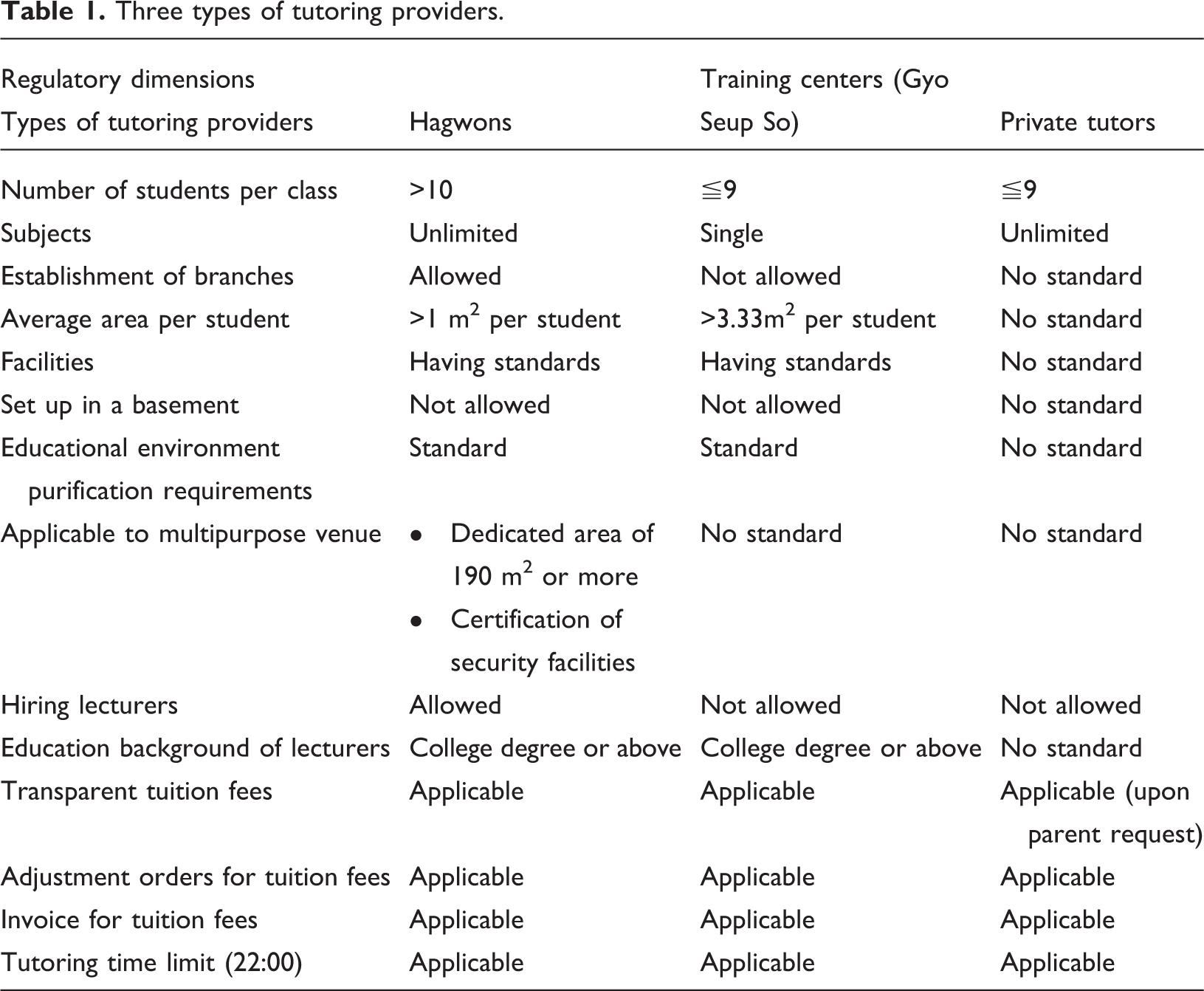
The Hagwon Act and its related enforcement decrees were developed and administered by the Ministry of Education, which is the main body responsible for providing general regulations for local education departments. Meanwhile, the specific and detailed provisions of shadow education are regulated by local governments. Local education departments, such as the Gyeongsangnam-do Changwon Office of Education (2020), have classified shadow education providers into three categories: hagwons, training centers (Gyo Seup So), and private tutors. Hagwons can tutor hundreds of students in unlimited subjects, training centers tutor a limited number of students in only one subject, while private tutors are typically college and graduate students who provide private tutelage as a part-time job. In 2020, Korea had 73,865 hagwons tutoring and training students in the school curriculum (KESS, 2020). As Table 1 shows, hagwons and training centers are regulated more strictly than private tutors. Before the COVID-19 pandemic, legal regulations primarily focused on the extensive off-line tutoring institutions. In this respect, Korea classifies tutoring institutions at the legal level and has explicit provisions regulating everything from the facilities, tutoring venue, environmental hygiene, and safety to tuition fees and tutors.
Three types of tutoring providers.
Since Korea’s founding, it had enacted many laws and regulations on shadow education, which can be regarded as regulatory or reactive policies. From a policy perspective and Chu’s (2016) definition of regulatory policy, tutoring policies tend to limit and control shadow education, and the issue of policy regarding tutoring venue, environmental hygiene, and so on is biased toward the regulatory policy. Regulating tuition fees and tutoring time (Kim, 2009) was also a matter of regulatory policy before the COVID-19 pandemic. Moreover, as Alsmadi (2016) has noted, the reactive policy is dynamic and can change or update the relevant policy. With the sudden outbreak of the COVID-19 pandemic, reactive policies were urgently implemented. As tutoring policies can address urgent matters and respond to public opinions in revising or expanding current policy, some tutoring policies are reactive policies.
Shadow education policies in response to the COVID-19 pandemic
In a theoretical study on shadow education policies, Zhang and Bray (2020, p. 332) propose a five-dimensional model for regulating shadow education: namely laws and regulations, self-regulation, educating consumers, personnel deployment, and partnerships. According to this theoretical framework, Korean policies during the COVID-19 pandemic are mainly reflected in four areas. First, in the hagwon revision laws and regulations regarding the closure of hagwons, which are intended to protect schools as the dominant providers of public education and maintain the subordinate position of shadow education (Zhang & Bray, 2020, p. 331). Second, in the self-regulation of the Korea Association of Hagwon (KAOH) in lobbying and promoting a series of policies. Third, in the transparency and control of tuition fees related to consumers. Fourth, in partnerships as embodied in the collaboration between the Korean government and shadow education market through a digital educational resource platform called Korea Educational Broadcasting System (EBS), which provides free digital tutoring courses and resources for students at the national level.
Amendment of Acts in response to COVID-19
Reactive policy concerning Korean shadow education is reflected in the immediacy of revising laws—a time-sensitive matter given the pandemic—and the non-mandatory closure of hagwons. In respect to the latter, the government does not have the legal right to close hagwons and can only recommend or advise that they should be closed.
The legal regulation of shadow education comprises three aspects: venue selection, reimbursement standard, and the rights of superintendents of education. Specific additions and amendments to the regulations are reflected in the Building Act and Hagwon Act. Venue standards were changed on January 23, 2020, when the Korean Enforcement Decrees of the Building Act (2020) limited where hagwons can be built. Originally, Korean law allowed for the building of hagwons in two categories of living facilities. The first category comprised living facilities that provide for daily living, such as convenience stores, clinics, table tennis courts, and residential areas. The second category was more comprehensive and included facilities adjacent to residential areas, such as concert halls, gaming halls, religious meeting houses, youth gaming centers, financial institutions, and photo studios. Following the amendment of the law, hagwons can only be built in the second type of living facilities (Enforcement Decrees of the Building Act [2020] Article 14). The amended Act also stipulates new requirements pertaining to area, population density, social management, and control in the selection of a hagwon venue. The amendment and promulgation of the Building Act occurred in the early phase of the COVID-19 pandemic in Korea. Indeed, the change of venue standards was requested before the government advised the hagwons to close. The amendment was thus a timely and active response.
On March 31, 2020, the Korean government added a specific “reimbursement standard” and “penalty standard” to the Enforcement Decree of the Hagwon Act. 1 Several new regulations were added in response to the new learning situation created by the COVID-19 pandemic. These regulations were developed to deal with instances of student isolation; the inability of hagwons, training centers (Gyo Seup So), and private tutors to open or operate normally; the specific reimbursement standard for students who chose not to attend class; and the corresponding penalty standards if students did not receive their tuition reimbursement in time.
Additionally, in order to enhance both state and hagwon pandemic prevention and control measures, the Hagwon Act was amended to supplement the power of the superintendents of education (Hagwon Act [2019] Article 16). 2 The Act lists the specific rights of superintendents as an independent regulator, reflecting the government’s determination to control the shadow education market by increasing its supervisory capacity. The amendment also grants superintendents of education the right to enter the shadow educational field at the legal level.
Regulatory policies in response to the COVID-19
Where the legal level concerns the legal parameters governing shadow education, the regulatory level comprises particular control or restriction policies and administrative orders. Like legalization, regulatory policies are part of the government’s efforts to maintain the affiliated position of shadow education.
As noted, the Korean government was unable to impose mandatory legal sanctions requiring hagwons to close during the COVID-19 pandemic. However, as a result of the pandemic, the scope of administrative interference extended to the whole of Korean society, and hagwons were required to obey regulatory requirements under the pandemic prevention system. In addition to the stipulations of the “social distance restriction” policy in the later period, the closure of hagwons depended on the determination and supervision of the population density. The social distance regulations and prohibition of assembling orders (KAOH, 2020a) affected the hagwons. Indeed, the government’s “social distance” rules affected the shadow education market, particularly insofar as hagwons that could not support online tutoring were concerned.
On August 22, 2020, the government raised the “national social distance” measures to the second phase. 3 Then, on August 31, 2020, the Korean government stipulated phase 2.5 in the capital and phase 2 outside the capital, and prohibited large gatherings. In this respect, large hagwons able to accommodate more than 300 people were prohibited from operating in the capital area, where the majority of large hagwons are located. However, other providers, like training centers and private tutors, were allowed to remain open (KAOH, 2020a), causing discontent among hagwons. The ban on large assemblies continued until October 11, 2020, when the city returned to “social distance phase 1.” The relaxation of social distancing measures meant that large hagwons could resume operations. According to data on the daily closure rate of Hagwons and training centers collected by the Daegu Metropolitan Office of Education (2020), only 2% of hagwons and training centers were closed in November 2020. Essentially, shadow education had returned to normal.
Self-regulation of shadow education in response to government policies
In addition to legalization, the Korean government issued many guidelines and recommendations regarding the non-mandatory actions of hagwons during the COVID-19 pandemic. However, the Ministry of Education could only inform these actions in the form of briefs rather than policies. It is because the government did not have the authority to interfere with the independence and self-management of shadow education, and the government could only supervise with the cooperation of hagwons and KAOH. The government’s actions included guidelines regarding the hagwons’ closure and reduction of tuition fees.
In terms of measures to close the hagwons, the Korean government provided supportive policies to ensure that hagwons could open and operate safely in accordance with the independence of the shadow education market. From February 2020, hagwons spontaneously closed in response to the KAOH’s (2020b) call. According to a Ministry of Education document, on February 23, 2020, the government recommended the closure of the hagwons (KAOH, 2020c). According to KAOH data, on February 28, 2020, 67% of hagwons closed in accordance with the government’s suggestion. However, as the government did not have the power to enforce the closure, the policy was issued as advice and was not enforceable. Although the relevant government departments could check the health standards of tutoring providers and close hagwons that did not conform to the pandemic measures, this authority was relatively limited.
As a result of the COVID-19 pandemic, most hagwons lost their income and faced significant financial difficulties. In this case, the KAOH, as a representative of hagwons, held four meetings with the Ministry of Education in seeking the government’s help. Subsequently, specific measures have been introduced to provide support for hagwons that have been closed for an extended period due to the pandemic. More specifically, as the government did not include hagwons in its SME support program, which was intended to provide “stable financial support” for impacted SMEs, KAOH invited the Ministry of Education to engage in a series of meetings. The fourth meeting resulted in the government deciding to issue a closure certificate (KAOH, 2020d). Accordingly, a successful application for a closure certificate will facilitate a hagwon’s application for funding, including operation stabilization funds, employment maintenance support, and banking products like ultra-low interest loans and cash deposits (Seoul Bukbu District Office of Education, 2020). As a compensatory policy, the government approves the behavior of cooperative hagwons that cater to its demands to close; in turn, the government protects the economic interests of these hagwons to some extent. Meanwhile, hagwons that insist on opening or staying open and ignore the government’s advice and KAOH’s requests are excluded from the compensatory policy. Indeed, as a closure certificate is necessary for support, the financial support policy encourages compliance with the government’s advised closure, with those who fail to comply punished indirectly.
As noted, this supportive policy was launched through four meetings, initially proposed by the KAOH and subsequently developed in consultation with the Ministry of Education. Under the National Ministry of Education’s policy guidelines, local governments began implementing their own support guidelines. On March 19, 2020, local educational offices—including those in Gyeonggi Province (Gyeonggi-do Hwaseong Osan Office of Education, 2020a), Seoul (Seoul Seongbuk Gangbuk District Office of Education, 2020), and Gangwon-do (Yonhap News, 2020a)—issued guidelines and procedures to facilitate the issuance of closure certificates to hagwons unable to open due to the impact of COVID-19. Some hagwons responded positively to the government’s call to close tutoring providers, reducing the risk of transmission.
Consumer protection
During the COVID-19 pandemic, the government’s proposal for adjusting tuition fees reflected consumers’ cost control. While not mandatory, the proposal sought to interfere with the rules of free-market operation, inciting debate among interest groups. With respect to the long-term concern of tuition fees (Bray, 2015; Byun, 2010; Koh & Lee, 2002), Korean shadow education policy during the pandemic continued to focus on adjusting tuition fees. On April 2, 2020, the Korean Ministry of Education issued a new policy guideline stipulating that tuition fees be at least 30% lower for online tutoring than in-person tutoring (Park, 2020). Local education offices—such as the Seoul Nambu District Office of Education (2020) and Gyeonggi-do Hwaseong Osan Office of Education (2020b)—issued guidelines for online tuition fees. These measures form part of the tuition advice and control guidelines for online education developed during the COVID-19 pandemic.
The issuing of this guideline saw several responses. First, some referred to the tuition fee brackets of 30%, 50%, and 70% as belonging to the “Captain’s call” (Park, 2020). Second, in respect to the Hagwon Law (2019), the government allowed for online tutoring, which is usually illegal, as a temporary regulation. Therefore, the stipulated price reduction does not have any legality. According to the Hagwon Law, if an off-line hagwon wants to provide online tutoring, it needs to be re-registered as an online hagwon. During the COVID-19 pandemic, the government temporarily simplified the complex procedures involved in this process and lowered the institutional threshold, allowing off-line hagwons to conduct online tutoring. For example, in February 2020, the government advised hagwons to close (The Korean Economic, 2020) and temporarily allowed online tutoring per reduced tuition fees. As financially motivated institutions, hagwons did not find this measure or the price cuts reasonable. Third, the demand and supply sides naturally hold different views regarding the change in tuition fee standards based on hagwons moving from off-line to online tuition (Daegu Education News, 2020). On the demand side, students believe that online hagwon tutoring is neither convenient nor useful, making it necessary to reduce the tuition fees given the perceived quality of tutoring. In contrast, the supply side feels that the spatial transfer of tutoring increases the hagwon lecturers’ workload, making the fee reduction unreasonable.
Although the government has suggested that hagwons reduce tuition fees, the government has hardly intervened in the matter due to the hagwons’ protests. Nevertheless, the tuition fees reduction policy during the COVID-19 pandemic differs from past attempts. Although reducing hagwon tuition fees is a difficult prospect, based on the price standard made public in 1981, the government can ask hagwons to adjust online tuition fees based on the percentage of open off-line tuition fees during the COVID-19 period. Consequently, the hagwons have had to set standard online tuition fees based on a fixed price. The open price and new price reduction proposals have become matters of public debate, promoting the adjustment of tuition fees.
Partnerships with shadow education
The Korean Education Delivery Commune (EBS) is a government-led and funded platform that, together with shadow education resources, supplements the demand for online shadow education. On February 23, 2020, the EBS platform launched the COVID-19 Response Group to provide home-based K–12 learning resources, including more than 28,000 online education courses (Yonhap News, 2020b). As a collection of television, radio, news, and e-learning resources, this government-led education platform has played a significant role in the transition from school to home learning, helped students develop autonomous learning skills, and disseminated COVID-19 prevention and control knowledge.
Prior to the pandemic, the EBS platform was established to provide extracurricular education. Following the introduction of distance learning in Korea, the government stipulated that “task-based classes, EBS videos, and other content prompts” be recognized as forms of distance teaching (MOE, 2020), making the EBS part of public school education. During the transition from school to home-based learning, the platform’s system was upgraded to increase its multiuser capacity, while the number of courses was expanded and course quality improved. Owing to the persistence of the pandemic, the EBS announced its intent to expand and further adapt the general curriculum on August 21, 2020 (Yonhap News, 2020c), improving the student utilization of the platform.
However, the EBS platform only met part of the tutoring demand. Some students and parents still wished to pursue real-time tutoring and learning, placing particular value on the real-time interaction between student and teacher and the timeliness of responses and feedback, and thus were willing to spend extra money on tutoring provided by hagwons. As such, the limitations of the EBS platform have been compounded by the real-time and time-sensitive advantages of hagwon teaching. Meanwhile, the situation has encouraged the development of hagwons, particularly those able to purchase the equipment necessary for online tutoring. Hagwons unable to teach online now face bankruptcy due to their lack of income. As a market partner, the EBS can cover part of the Korean shadow education market using video courses and quality curriculum content. However, the EBS has proven less capable in matters of student evaluation, the timeliness of feedback and updating of curriculum content, and student-teacher interaction, leading to students and their parents seeking the service of fee-based shadow education providers.
Discussion
The COVID-19 pandemic has had a profound impact on Korean government policies, including their revision or reenactment. The KAOH has played a role in the self-regulation of shadow education during the COVID-19 response period. However, conflicts between the government, KAOH, hagwons, and parents and students resulted in the fluctuating rate of hagwon closure. Based on a review of the laws, policies, and regulations concerning Korean shadow education, this study advances the following suggestions and expectations regarding new policies on tuition fees, online tutoring, and public educational tutoring support in Korea.
Influence on different stakeholders
From a legal policy perspective, the Korean government’s supervision of shadow education has been enhanced in the form of tutoring venues, reimbursement standards, and increased administrative supervision power. Although the government did not have the authority to close the hagwons in the early days of the COVID-19 pandemic, the government has since passed laws giving them the ability to do so. On September 13, 2020, the Congressional Education Commission submitted to Congress a partial amendment of the Hagwon Act to Congress and the Ministry of Education (Yonhap News, 2020d). The amendment proposes that if the infectious disease crisis alarm reaches a “serious” level, the head of the Ministry of Education and the superintendents of education can demand that hagwons and training centers should be closed and compensate the institutions for any resulting losses. If the law is approved, the government’s regulatory power will increase, as will its ability to solve other issues resulting from the uncontrolled state of shadow education.
From the perspective of industry independence, the KAOH has promoted a number of supportive policies, which have brought about some unexpected results. On March 19, 2020, local governments began implementing the supportive policy. However, the closure of the hagwons—which should have responded positively given the implementation of the supportive policy—did not occur as expected. For example, in Seoul, the closure rate of hagwons and training centers has decreased significantly. According to the Seoul Education Office’s daily briefing data, the closure rate was 42.1% on March 13, 2020 (Seoul Metropolitan Office of Education, 2020). However, from March 25, 2020, the closure rate declined from the previous range of 20%–30% to 10%–20%.
There are four explanations for this rapid decline. First, the most likely explanation is that the government’s support policy does not provide sufficient support to offset the hagwons’ losses. In addition to providing bank loans and products, the policy stipulates a direct payment of KRW 1 million to eligible hagwons (Green Economic Daily, 2020). However, hagwon tuition fees exceed KRW 1 million for the employment of a lecturer alone. This, together with the increase in fixed costs, such as labor and rental expenses, has resulted in many hagwons choosing to reopen after weighing their pros and cons.
Second, the government’s supportive policy does not meet all of the hagwons’ needs, leading to poor cooperation with the government’s call for closure. On March 25, 2020, the KAOH held a press conference expressing its disappointment with the government’s decision to impose administrative sanctions on hagwons and a penalty in the event of their having confirmed cases of COVID-19 (E-daily, 2020). According to the KAOH, the government “claims only the right to get a penalty and does not attach importance to the compensation proposal” (MBC News, 2020). In addition to bank products, the hagwons requested the government to grant employment maintenance assistance, 4 provide measures for emergency loans, and support at least 50% of lost income.
Third, differences in local governments’ specific supportive policies may have impacted the closure rate. Procedures and regulations that are not conducive to the majority of hagwons applying for funding in local areas will result in more hagwons choosing to reopen. According to the owner of a hagwon (KAOH, 2020e), the supportive policies in their living district of Dobong differed from that of another district, Dongdaemun. While the owner closed their hagwon from late February to early April, they had to close it for another 2 weeks in order to apply for relevant support. However, starting from March, Dongdaemun’s support policy allowed the owners who followed the rule to close their institutions within 6 weeks to apply.
Fourth, although the general public recognizes the seriousness of the pandemic, the anxiety of students and parents regarding their educational achievements necessitates the use of shadow education to improve their learning level (Korea Joong Ang Daily, 2020). Accordingly, many hagwons chose to reopen in order to meet demands for in-person tutoring and secure customers.
Suggestions for shadow education policies
From the consumer’s perspective, price reduction measures during the COVID-19 pandemic differ from previous overall price reduction requirements. Based on the change in the nature of the curriculum and in light of the financial burden of education expenditure and equity, hagwons have had to provide lower prices and more detailed price breakdowns. However, tuition fee regulations can involve a wide range of interest groups. On the supply side, hagwons can be divided into those offering online education and live interactive tutoring, those offering online but video-recorded tutoring, and those offering only online or off-line tutoring. On the demand side, some are willing to pay exorbitant amounts for the best extracurricular tutoring, others prefer paying less for good-quality tutoring, while the minority are satisfied with paying less for average or poorer quality tutoring. Therefore, in light of the various needs of both hagwons and students, the government needs to enact policies on tuition fees that consider the different scales of providers and consumer needs, particularly insofar as balancing the export of tutoring labor, tutoring quality, and tuition fees are concerned.
In respect to shadow education partnerships, the EBS—a product of cooperation between public and shadow education—has been given more room to develop during the pandemic, expanding from an extracurricular to a primary education platform. However, with the development of online tutoring, shadow education has become a competitor to the EBS and instigated issues regarding the pricing of distance or online learning and the new tutoring technology. Although there is a standard for the reimbursement of off-line tutoring, the Hagwon Act does not deal with online tutoring in any detail, including tutoring time, participation rate, tutoring class quality, and the online tutoring platform or technology. As such, the government cannot ensure the price reduction of online tutoring or supervise the operation of online hagwons. These policy loopholes need to be improved in the future.
This study also found that although the superintendents of education have the authority to control tutoring time, the flexibility of the online platform makes the supervision of tutoring time far more difficult and complicated compared to that of off-line tutoring providers. Some hagwons have taken advantage of the lack of online tutoring time regulation during the pandemic, providing online shadow education services during school hours (No Worry About Shadow Education, 2020). Accordingly, policymakers should pay attention to the venue, tuition fees, direct supervision, and other issues emerging in online education and consider the scope of surveillance and control, including tutoring time, tutoring quality, and tutoring class supervision.
As a result of the COVID-19 pandemic, the majority of hagwons are transitioning from off-line to online tutoring. As the Korean government has yet to develop laws and regulations for online teachers, this move has allowed hagwons to operate with relatively free reins. Unsurprisingly, the rapid growth of online tutoring demand is prompting more tutoring providers to change from traditional off-line tutoring to online or off-line optional tutoring, suggesting that a blend of online and off-line tutoring may become the norm. Based on this potential future development, the online or off-line unilateral registration model will shift toward the bilateral registration in terms of the tutoring providers’ registration process. With respect to the development of laws concerning hagwons, the new revision needs to focus on the management and control of online tutoring providers based on the current Hagwon Act, such as tuition fees, tutoring time, tutoring class quality, and online tutoring platform or technology. Finally, with regard to the government’s public education support, government-led e-learning currently has more financial support than tutoring providers. Accordingly, if the government can occupy high-quality tutoring resources, e-learning platforms such as EBS are expected to meet the extracurricular tutoring needs of more students and successfully supplement shadow education with public education.
Footnotes
Acknowledgements
The authors would like to thank Dr. Wei Zhang for her instruction and revision, and the two anonymous reviewers for their feedbacks on an earlier draft.
Contributorship
Huiyan Piao was responsible for writing the paper and responding to reviewers’ comments. Hyuna Hwang contributed by identifying and supplementing policies and data thoroughly based on relevant Korean literature and documents.
Declaration of conflicting interests
The author(s) declared no potential conflicts of interest with respect to the research, authorship, and/or publication of this article.
Funding
The author(s) received no financial support for the research, authorship, and/or publication of this article.