



Abstract
Purpose:
This study focuses on courses that prepare applicants for universities’ highly competitive entrance examinations in Finland. The analysis clarifies the market-making practices and the construction of this field.
Design/Approach/Methods:
To understand these processes, we use Çalişkan and Callon’s five framings for studying marketization as a heuristic framework. In our analysis, we combine different data sets, including data on course provision, thematic interviews, documents, and ethnographic notes.
Findings:
In this article, we argue that the preparatory course markets in Finland are an example of private tutoring which operates in the privacy of the university applicants’ exam preparation process, thus commercializing this process. The market making of this type of private tutoring is an assemblage of a variety of agents that interact in parallel with each other.
Originality/Value:
This study aims to contribute to the systemic understanding of the assemblage of private tutoring markets in an equality-focused Nordic country by providing new heuristic lenses from economic sociology through which to view private tutoring.
Introduction
The development of private tutoring markets shadowing public schooling is a widely identified phenomenon (Bray, 2011; Stevenson & Baker, 1992). Private tutoring, also known as shadow education, refers to “a set of educational activities that occur outside formal schooling and are designed to enhance the student’s formal school career” (Stevenson & Baker, 1992, p. 1639). The evolvement of shadow education in comprehensive and secondary schooling is often attached to certain characteristics of the education system, such as its competitive examination system, cultural features, and an increased emphasis on individualization (e.g., Lee et al., 2010). A major body of research focuses on academic subject tutoring alongside comprehensive and secondary schooling through one-on-one or group tutoring, either in the form of contact teaching and/or an online course (Bray et al., 2015). Aside from this mimicking of public schooling (Bray, 2013), other forms of private tutoring include preparing for a specific high-stakes exam using a separate body of content knowledge (Kosunen et al., 2015).
With this study, we aim to gain a systemic understanding of private tutoring markets. Previous studies have shown the parallel relations of public and private actors, identifying active measures from all actors that have shaped and reconfigured the field (Bray & Kobakhidze, 2015; Yamato & Zhang, 2017; Zhang & Bray, 2017). This study contributes to the field of the systemic analysis of private tutoring by drawing from economic sociology. To provide new analytical lenses, we approach private tutoring as a market that is constructed through market-making practices to emphasize the complex nature of private tutoring that involves a variety of actors and sites.
We study this phenomenon in the country context of Finland. Despite its widely acknowledged (and comparatively) equal education system, Finland is no exception to this trend of private tutoring nor a new field for such activities. In fact, the admission to higher education in Finland is very competitive, nurturing the private tutoring markets (see Kosunen & Haltia, 2018; Kosunen et al., 2015). As they have fairly broad autonomy regarding student admission, universities have traditionally selected their students based on entrance examinations. Because entrance is competitive, courses have emerged that provide support for preparing for these examinations.
This study provides new approach to analyzing private tutoring through understanding the public–private transformations and the field as a market to highlight the commercial aspects involved as well as the practices that reconfigure these relations. We approach private tutoring as a complex assemblage of market-making practices and perceive preparatory courses as singularities (Karpik, 2010) that represent products and services that are highly subjective and difficult to compare. The analysis follows Çalişkan and Callon’s (2010) pivotal work on market-making practices that identified five framings that contribute to the construction of markets. Through these theoretical lenses, we aim to analyze comprehensively the preparatory course markets.
This article begins with an introduction to the theoretical framing of this study and continues with the contextualization of the Finnish case. Then, we introduce the methodological triangulation employed in this study followed by the empirical analysis of the preparatory course markets in Finland. Last, we discuss our findings.
Admission to universities and private tutoring in the Finnish context
The Finnish education system is committed to the ideals of equality, reflecting the Nordic welfare state model (see Thomsen et al., 2013). Degree education is free of charge for everyone regardless of parental or other backgrounds, and degree students are entitled to study allowances and loans. 1 Eligibility for higher education is defined broadly, as all those with a secondary-level school certificate, either from an academic track (i.e., upper secondary school) or a vocational track, are able to apply to a higher education institution (see Haltia et al., in press). Because of Finland’s scattered population, geographical availability is another factor that has affected the development of the higher education system (Jalava, 2013).
Against this background, however, the Finnish admission system to higher education is among the OECD’s most competitive (OECD, 2019), resulting in a slow transition to higher education with many young people taking gap years prior to entering university (Isopahkala-Bouret, 2019). The bottleneck in the transition is at the juncture of secondary and higher education. The Finnish higher education system is composed of universities and universities of applied sciences, and in both sectors, entrance is competitive. In universities, the selection is usually based on the grades earned on the matriculation examination, which is the national test taken at the end of upper secondary school, and/or entrance examinations that are organised by universities either individually or in field-specific cooperation networks.
Similar to other competitive systems (e.g., Bray et al., 2015), competition as a mechanism nurtures the market and creates a niche for private tutoring. In the Finnish context, tutoring for universities’ entrance examinations has rather deep historical roots. The so-called numerus clausus (i.e., restricting the number of university admissions) was largely introduced in the 1960s, as the number of upper secondary school graduates grew rapidly. Although the higher education system has expanded through different reforms (Jalava, 2013), access to higher education has been competitive since the 1960s, especially in specific fields of study (see Kosunen & Haltia, 2018; Kosunen et al., 2015). Besides this historical background, the context of preparatory courses in Finland also differs from that of many other countries regarding the focus on preparing for university entrance examinations. Preparatory courses do not mimic public schooling but rather sell a specific exam preparation package. Hence, we refer to private tutoring in this context as preparatory courses (valmennuskurssit in Finnish) and define the process as the commercialization of exam preparation.
The programs with the highest numbers of applicants per study place are at universities, and the study fields with the most competitive entrance criteria are found in the university sector. Preparatory courses for the entrance examinations in these fields have become an established phenomenon. Preparatory course participation is the most common in the fields of medicine, law, and economics, where the majority of applicants have parents with higher education backgrounds (Ahola et al., 2017, 2018; Kosunen et al., 2020). An association has also been found between course participation and university admittance (Ahola et al., 2017, 2018).
Private tutoring has attracted policy attention over the past 20 years. For example, in 2002, the Finnish Higher Education Evaluation Council (Sajavaara et al., 2002) evaluated student admission to universities and noted that some applicants aim to guarantee their success by participating in preparatory courses, which promotes geographical and social inequality. Two years later, Ahola (2004) evaluated universities’ student admissions, identifying the role of preparatory courses in the transition to higher education. Moreover, in its Finnish country report, the OECD (2005) noted that student participation in preparatory courses has implications for the equal access to higher education.
Despite this attention, private tutoring has not been targeted as a distinct policy objective. During the last decade, however, preparatory courses have attracted more attention in the political arena and have been discussed in the context of student admission reform. The policy problem identified by the Ministry of Education and Culture (MEC) is the comparatively slow transition from secondary schools to higher education, and the aim of the reform was to address this issue. The main actions include reserving the majority of the admission slots for first-time university students and increasing the significance of the matriculation examination in admissions (Haltia et al., 2019). A quota for first-timers was put into practice in 2016, and the admission criteria changed in 2020, when the majority of students are accepted based solely on matriculation examination scores, while the number of students accepted via entrance examinations is reduced. The rationale behind the reform lies in streamlining the access to higher education and reducing the number of obstacles that applicants must overcome. One of the arguments for increasing the weight of matriculation examinations has been to reduce the need for private course providers. Thus, it can be assumed that the policy attention within student admission reform has resulted in changes in the operational environment of course providers.
The general attitude toward preparatory courses is somewhat disapproving. They are seen as creating inequality within a system that is aimed at reducing the effects of parental income or family wealth on gaining access to higher education (see Kosunen et al., 2020). Private tutoring can also be seen as a controversial market, as the access to higher education is perceived to be grounded in a meritocratic system and not in the purchasing power of the applicant, even though the tutoring itself does not provide any guarantee of success on entrance examinations.
Assembling and making markets
Previous systemic research on private tutoring has analyzed the parallel public and private transformations, observing that this shadow system reconfigures itself as the public schooling changes (e.g., Yamato & Zhang, 2017). Hence, policy framing and educational structures provide the context in which this industry operates (Bray, 2003, 2011; Lee et al., 2010; Zhang, 2019). Previously, from a systemic perspective, this interaction has been analyzed using different concepts, presenting it as an ecosystem (Bray & Kobakhidze, 2015) and as mixed zones (Zhang & Bray, 2017) used to metaphorically describe the phenomenon as the blending of running water. These different conceptualizations share the perception that the actors operate within a space where the actors take different positionalities and activities in relation to each other.
We approach the private tutoring field as a market and specifically focus on the practices that produce or prohibit these markets. By referring to a market, we aim to emphasize the commercial aspect of the activity as well as focus on the active practices that make markets. In this study, we conceptualize the construction of private tutoring within its “shadows.” Using the conceptualization from economic sociology (Çalişkan & Callon, 2010) that has also been employed in higher education studies (e.g., Komljenovic & Robertson, 2016; van Zanten & Legavre, 2014), we conceptualize our systemic approach to private tutoring as a market that is a complex assemblage of actors and sites (Çalişkan & Callon, 2010). To analyze how the market takes its shape and form, the analysis focuses on the processes of marketization. Çalişkan and Callon (2010) define the studying of marketization as “the entirety of efforts aimed at describing, analysing and making intelligible the shape, constitution and dynamics of a market socio-technical arrangement” (p. 3). Previously employed in Actor-Network theory (Latour, 2005), this approach includes nonhuman actors and materials (such as entrance examinations) not only to merely understand markets as social but also to pay attention to the role of the knowledge of markets (Çalişkan & Callon, 2010).
Çalişkan and Callon (2010) have conceptualized marketization as a process through five framings, which we refer to as market-making practices that illustrate the constantly evolving and productive nature of market making: pacifying goods, marketing agencies, market encounters, price setting, and market design and maintenance. These framings overlap, and they are even heuristically, to some extent, difficult to separate from each other in practice. However, these framings assist in understanding the various aspects of market-making practices.
The first framing, pacifying goods, refers to the process where a good or service is valued and packaged in a purchasable form. Essentially, it involves transforming a good or service from all the possible combinations of materials and ideas into a pacified format that directs prospective consumers to value the product to the extent that they purchase it. This framing often includes transforming property rights to the new owner of the good. In the case of private tutoring, the tutoring providers pacify the content and/or support provided to students for preparing, for example, for exams. Preparatory courses can be defined as a product (materials for exam preparation), a service (teaching), or often a combination of the two.
To understand what type of product and/or service a preparatory course actually is, we refer to Lucien Karpik’s (2010) theory of singularities and suggest that a preparatory course has the characteristics of a singularity. Singularities such as movies, lawyers, and doctors, are conceptualized as goods and services that can be characterized by three distinctive dimensions as “structured, uncertain, and incommensurable” (Karpik, 2010, p. 10, italics in original). The value of a singularity is defined in a structured relation to other goods, and they possess a multidimensional nature. In private tutoring, as discussed later, the service is multidimensional and structured purposefully.
Singularities obtain two sets of uncertainty: strategic and quality-related. In the case of strategic uncertainty, there is no confirmation that the good matches the expectations of the customer. Compared to products in neoclassical markets where the product is known prior to purchase, in singularity markets, the outcome of the product remains unknown and uncertain until a later point. According to Karpik (2010), the results of quality uncertainty are that (1) the exchange of products is actually the exchange of promises, (2) the uncertainty cannot be reduced to information asymmetry, (3) an increase in information is not sufficient to eliminate uncertainty, and (4) in free market conditions, it leads to “market failure.” In private tutoring, the quality of the product and/or service remains uncertain and can be even questioned in a situation when entrance to the desired institution is obtained: The applicant may have been able to gain entry into the institution even without participation in the preparatory course.
The consideration of preparatory courses as singularities is justifiable as their value is greatly subjective and uncertain (Karpik, 2010); hence, within these markets, Karpik (2010) argues that the providers need to employ trust devices to create the need for and trust in their products and services. Singularities are also characterized by their incommensurable nature, which denotes that the goods and products cannot be compared. In private tutoring, it is not possible to compare the value of the different courses and course providers (or not taking the course) as they involve highly subjective matter.
The second framing in Çalişkan and Callon’s (2010) model is marketing agencies. Within markets, several actors participate in defining and valuing the goods, and to acknowledge and analyze these in all their diversity, Çalişkan and Callon (2010) refer to this complex relation as an agencement or assemblage. These assemblages have a socio-technical nature that encompasses all actors, including human, nonhuman, material, and nonmaterial. In his famous work, Polanyi (1957) perceives markets as profoundly embedded in social structures. Markets have a social dimension, which cannot be reduced to market exchanges but rather that a market is an institution (Araujo, 2007; Çalişkan & Callon, 2010). Araujo (2007) has argued that a market is “an accomplishment that depends on the mobilization of varying bodies of expertise and calculative agencies” (p. 212). These practices are understood here as market-making practices that construct the preparatory course markets. This study considers the varying human actors participating in the market-making practices, including preparatory course providers, applicants (and their parents), universities, upper secondary schools, and policymakers. This study also extends the acknowledgement of actors to nonhumans such as university entrance examinations.
As a third framing in Çalişkan and Callon’s (2010) model, market encounters enable the provider of the good or service and the customer to encounter each other so that a market exchange can take place. These encounters are often not one but many, and they are products of deliberate marketing processes. For them to take place, encounter devices that are usually technical, such as websites, are employed. Encounters are situated in varying sites, including schools and media platforms. In the Finnish case, preparation for university entrance exams is separate from public schooling in that private tutoring does not target the school curriculum but rather steps into the applicants’ private sphere of exam preparation. Hence, we identify the process of privatization as the emergence of private commercial actors into the private space of exam preparation. We refer to this process as the commercialization of exam preparation.
When an applicant takes a preparatory course, commercial actors intrude into the private area. When referring to actors, “private” can encompass a person or a group of people or the nonpublic interests of commercial, for-profit actors. As a space, “private” can refer to privacy, meaning a space that is removed from others’ scrutiny (see also Carrasco & Gunter, 2019), or a nonpublic, often commercial, space. As the preparation for university entrance examinations takes place in the applicants’ private space, applicants vary in their levels of resources, from cognitive (e.g., help with preparing for the exam) to financial (e.g., possibility of participating in a preparatory course), embedded in students’ prior socialization within their families and other social circles (Olivier et al., 2018).
As the fourth framing of Çalişkan and Callon (2010), price setting in markets is perceived as an indicator of valuation and targeting differentiation in the market. According to Bray (2011), pricing in private tutoring is shaped by the type of tutoring and the providers’ reputation.
Finally, as the fifth framing, market design and maintenance encompass all the efforts and information attached to maintaining and developing the market structure. The market making of private tutoring is at the confluence of public schooling, targeting the interaction of the immediate actors involved. Markets operate within the policy framing, where the influence of the public policies may vary. In private tutoring, government-steered education policies are the focus, providing the framing for tutoring.
Previous research has found varying responses to shadow education, from laissez-faire to active policy intervention through regulation (OECD, 2014). Active policy responses aim at either reducing and limiting the market or broadening the access to the market. In the first approach, reducing the selectivity in the examination system (e.g., by increasing the intake of students into higher education) has merely shifted shadow education to an earlier phase in the system (i.e., to secondary education or even earlier). Some governments have also aimed at limiting activities through enacting regulations on the actual operations of shadow education organizations or their marketing procedures. The second approach broadens the access to private tutoring either by providing access for low-income students or by reducing costs through technological innovations (OECD, 2014). In this study, we argue that the market making is not an exchange merely between university applicants and providers, but rather, the private tutoring markets are made through the complex assemblage of various actors and sites.
Methodological approach
The research question guiding our discussion is the following: How are the private tutoring markets constructed in Finland, and what are the market-making practices through which the commercialization of exam preparation for admission to higher education emerges both in policy and praxis? In this study, the analysis of market making combined several data sets that were collected for the “Privatisation and access to higher education: A study on power relations, guidance devices and private capital in the transition to higher education (PAHE)” research project.
For the first data set, to determine the preparatory course provisions and how these markets are structured, we mapped the provision of private tutoring using the publicized course data gathered from Finnish private tutoring providers’ websites. The focus was on courses targeting the 2017 entrance examinations in four selected fields of study: law, economics, medicine, and education (analysed earlier in Jokila et al., 2019). The first three disciplines were selected because they are defined as status fields with competitive admission processes and these students largely come from upper-middle-class backgrounds (Kosunen et al., 2020; Nevala, 1999). Education encompasses a more heterogeneous student body, but as the teaching profession is highly valued in Finnish society, the entrance is competitive. All selected fields of study are among those with the broadest provision of preparatory courses. Information was gathered about the mode of teaching, geographical distribution, and fee structures of the courses. Thus, the course provision data reveal some of the characteristics of the course products and the expected customers.
For the second data set, we used interview data (analyzed earlier in Kosunen & Haltia, 2018) from five major private tutoring organisers to analyze how the course providers talk about private tutoring, the courses that they provide, and their own position and actions in the market. The interviews were conducted in 2015 and lasted about 1.0–1.5 hr each. The interviewees widely represented the central actors in preparatory course providers, altogether comprising a significant share of the preparatory course markets. We analyzed the interview data to determine how the course providers described their preparatory course as a product and the types of customers they serve. In addition, we aimed to understand how the course providers construct their markets.
For the third data set, we analyzed the ethnographic field notes from one general upper secondary school over a 6-month period, focusing on a student counselling class. The ethnographic fieldwork occurred weekly during the academic fall semester of 2019. Using the ethnographic data, we aimed to understand the interactions and marketing means (encounters) of preparatory course providers and prospective university applicants. Additionally, we visited one open day event at a Finnish university in autumn 2019, which showcased the educational opportunities of that university to the third-year upper secondary students. As the open day event provided the prospective students with information about study choices and admission criteria, in cases where interactions between the course providers and the universities took place, this was assumed to be the place.
For the fourth data set, we selected three key national-level policy documents (MEC, 2016; MoE, 2010; Prime Minister’s Office, 2016) to trace how policy framing and policy response have developed over time.
Further, as a fifth source of data, to analyze how private tutoring companies (if any) have endeavored to make private tutoring markets in the context of policy, we included the written statement of one public affairs agency (affiliated with preparatory course providers) (CRE8, 2017b) provided for ministerial policy preparation purposes as well as a report (CRE8, 2017c) by the same communication agent that was distributed to universities.
Finally, we included the meeting minutes from two board meetings of the University of Helsinki (2018, 2019), which provide information on the relationship between one university and preparatory course providers, to assess the university’s responses to the preparatory course providers.
As noted by Bray (2010), analyzing private tutoring is not straightforward, as there are difficulties in accessing information, and the field itself works in a complex interaction between people’s private spheres and the business sector. Consequently, we employed these data sets to build a comprehensive understanding of the private tutoring market and the process related to market making. We analyzed the documents and interview data using content analysis (Elo & Kyngäs, 2008) and the data on course provision using descriptive statistical methods.
Market making of preparatory course markets
We used Çalişkan and Callon’s (2010) research program for studying market making to understand how the preparatory course markets are created in Finland. To guide our analysis, we heuristically employed the five interconnected framings of market making introduced earlier.
Pacifying goods
The product and/or service that the preparatory course providers offer to prepare university applicants is a singularity (Karpik, 2010). There is no guarantee of the value of the course for gaining entry into university prior to taking the course nor can the value be evaluated later, as students may have reached their location of study without taking the course. Hence, by purchasing a preparatory course, access to a university is not exchanged for money, but rather, a promise is exchanged. Similarly, as with singularities in general, a preparatory course does not lead to something that can be later exchanged such as a degree.
Preparatory course providers pacify the preparation process or some aspects of it as preparatory courses or materials (Çalişkan & Callon, 2010). They normalize the preparation process into a purchasable standard format, but for some courses, they provide more personalized services. Course providers work with knowledge asymmetry in relation to exam preparation. Moreover, the applicants face quality uncertainty (Karpik, 2010), as the applicants do not know how beneficial the preparatory course will actually be for them.
The interviewed private tutoring providers referred to two sets of support that the courses provide: cognitive support, encompassing content preparation, and social support, including group support and help with social pressure as a result of course participation (Kosunen & Haltia, 2018). The course providers in our interviews referred to their services as support targeting those who were studying for the admissions examinations and needed support: Let’s agree that preparatory courses are absolutely not essential to gaining admittance to a particular university, but they support you along the way. For sure, there are different types of people. Some can read and cram on their own and are very independent throughout the whole process, but then there is the other half, who need that support by their side. We are here for them. (Course Provider 2)
The course providers stressed that they were not able to guarantee entrance to a university but only support with the preparation process. Targeted as a one-time purchase, the value of the preparatory course is measured only in acceptance to a university. As illustrated in the following interview excerpt, the value of the preparatory course is only realized when students also prepare for the exam themselves. The course product was constructed as a device for dealing with the uncertainty related to the application process: Well, of course they want to feel confident that they will get into their university of choice. But we don’t promise that will happen if you just buy and attend the course. You can’t get into a university just by doing that; you also have to do some of it yourself. But the preparatory course participants, the customers, they want that certainty that they will be accepted right away the first time they apply to the university. Or sometimes their parents will push them to take the course to get into a specific university. (Course Provider 1)
In this excerpt, we can see that the course provider employs uncertainty, which Cochoy (2007) referred to as a disposition. With dispositions like uncertainty or affirmation, private actors make their markets in more subtle ways than, for example, through pricing.
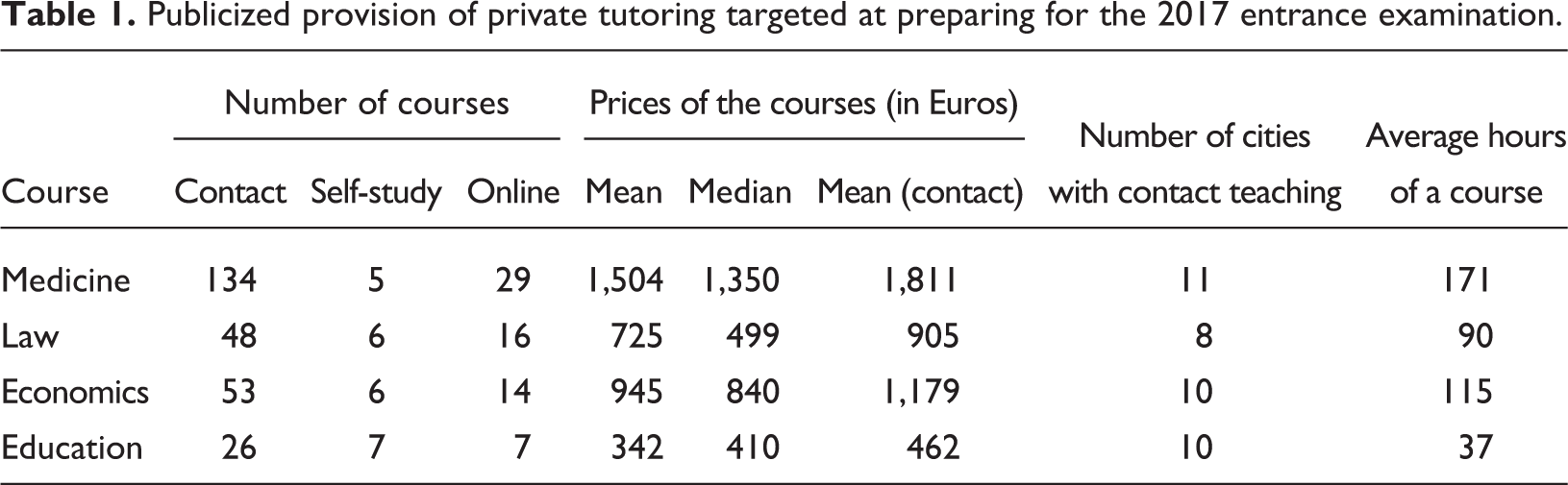
A snapshot of preparatory course provision from a provider’s website in 2017 provides an understanding of what types of courses are provided and who the expected customers are (see Jokila et al., 2019). We analyzed the preparatory course provision in selected competitive fields of study: medicine, law, economics, and education. In our data on preparatory course provision targeting the 2017 exams, we identified 350 courses in these four fields (Table 1) available through different modes of teaching, encompassing contact teaching, self-study, and online courses. The analysis of the course provision data gathered from the provider’s website revealed the characteristics of the preparatory courses as a product and/or service. The diversity of courses reflects the different applicant bodies that the courses aim to attract. Some courses require more attendance, which was also reflected in the pricing: The length of the contact teaching courses varied from 1.5 hr to over 500 hr, with the longest courses in medicine (mean 171 hr).
Because of the scattered population distribution in Finland, the market has adjusted to provide courses that do not have temporal and spatial frames. Self-study and online courses were available for all subject fields. The student body in contact teaching is expected to be located in large cities. The geographical concentration of the courses was higher in large (university) cities, with the highest concentration of courses in the capital city of Helsinki (104 courses and 17 private tutoring providers). Other larger cities with university campuses also had a high volume of courses: Turku (44 courses and 10 private tutoring providers), Tampere (34 courses and 8 private tutoring providers), and Oulu (25 courses and 7 private tutoring providers). Pricing also varied greatly (this is discussed in more detail in pricing framing).
Publicized provision of private tutoring targeted at preparing for the 2017 entrance examination.
In summary, the mode of teaching, field of study, geographical concentration, and length of the course all shaped the diversified customer bodies within a context where students have unequal possibilities (and restrictions) to participate.
Marketizing agencies
To understand the market-making processes, Çalişkan and Callon (2010) note that all actors involved in defining and valuing goods, whether human beings, material, or nonmaterial, need to be defined. These agents form a type of assemblage to “create differentiated agents and positions in the market” (Çalişkan & Callon, 2010, p. 9). In this section, our primary aim is to identify the main agents in these preparatory course markets.
The key actors in pacifying the preparatory courses into a purchasable format are the preparatory course providers, including private companies, non-degree awarding educational institutes, folk high schools, and student associations. In the Finnish context, while the major private providers comprise a significant market share, actors such as student associations (often with a lower fee structure) also provide courses. In our interviews with the major course providers, they identified themselves as operating in a market where competition is fierce. They referred to some established course providers as having a more stable market footing in the long run, while there was greater variation among the smaller companies in the short term:
Is there or do you see any specific roles for different firms then?
Let’s say that yeah, bigger and older preparatory course firms I guess have a kind of more established position already, and then there are a lot coming like kind of newcomers. That some of them succeed and some of them do not. Then, the fact that there are so many newcomers every year, new preparatory course firms, and also…older firms force you to always have to invent something new and nice.
Our latest update on the course providers in the preparatory course markets supports this by showing that some smaller companies, particularly those focused on a single subject field, have withdrawn from the market. Our data do not indicate the reasons for this, but one factor could be the upcoming admission reform stressing the matriculation examination instead of entrance exams.
Universities are also focal actors in the sense that they create the framework for a preparatory course market with their admissions policies (see Kosunen, 2018). Policymakers and the government can be identified as actors that steer student admission practices by legislation, financing, and other means. According to the Universities Act, “Universities decide the admissions criteria” (Universities Act 558/2009, Amendment 256/2015), but this takes place within the legislative frame of reserving some admissions slots for students without a previous higher education degree or previous admission to a university. Although steered by the government and the MEC, universities have been fairly autonomous in their student admissions and hence take part in defining and redefining the framework of universities’ student admissions.
Further, as universities use different means for student selection, the selection tools and criteria can also be identified as a specific actor in the market, formulating an assemblage among the other agents. Here, we focus specifically on entrance examinations, but the matriculation examination can also be identified as similar type of entity. Structural changes in the organization of the exams have significant repercussions for the preparation process and, as a result, private tutoring. Alongside the previously noted shift to stress the matriculation examination as a source of selection, the organization of entrance exams has not remained stable in the Finnish context. Entrance exams have field-specific variations, but the trend has been to shift from field- and institution-specific exams to national exams, enabling students to simultaneously apply to many universities that offer education within the same field. This has also made it easier for applicants to take preparatory courses, as the exams are nationally harmonized. Actors attached to the entrance examination also include the entrance examination book publishing industry as well as (on a minor scale) lawyers who submit complaints about the results of entrance examinations specifically for law applicants (Kosunen, 2018).
Finally, the most significant agent operating in the market is prospective customers (i.e., the applicants and potentially their parents). In the Finnish context, the admitted students who participated in private tutoring are more often from higher socioeconomic backgrounds and have their fees paid for by their parents, while their counterparts from lower socioeconomic backgrounds tend to work or borrow money to participate in a course (Kosunen et al., 2020). International studies have found that those students who participate in the courses are already in a good position in terms of gaining access to higher education (Pearce et al., 2018; Smyth, 2009).
As noted earlier, private tutoring takes place at the confluence of the public schooling system (Bray, 2003, 2011), and policy actors also participate (deliberately or not) in the making of private tutoring markets. As they are also providing the policy framing for the field, they are discussed in more detail in the last framing, market design and maintenance.
Market encounters
Market encounters refer to the situation in which the different agencies, particularly preparatory course providers and university applicants, meet (Çalişkan & Callon, 2010). By combining different data sets, we can observe that the encounters occur at different sites and are to some extent hidden under other activities. Çalişkan and Callon (2010) stress that this encounter can be deployed by nonhuman devices, such as websites. Preparatory course providers’ websites are a platform that provides publicized information on courses. Other platforms include social media, school visits, and many types of marketing materials. These different marketing channels are illustrated in the following excerpt from one of the course providers:
What kind of channels are you using in your marketing practices?
Many kinds. Like, traditional what are these, any kind. Newspaper ads, our own magazines that we send out to customers, school infos. We go to schools to give information about the admission process in general, about applying; it is not used to market the firm, and it is not even allowed like that. Then, we hold our own info sessions, text message marketing, email-marketing, Studia fair [national study fair], which is the biggest event annually. Then, there are partners who organise school tours. Like the normal marketing channels of the firms, they are used.
Our interviews with the preparatory course providers demonstrated that the providers do market in general upper secondary schools through brochures and information sharing events: Yeah, we are, well, at the capital city area especially, we are visiting almost every general upper secondary school in the autumn. Then, many from there become interested in us, and then, we organise separate info events where we talk about the process of applying and the entrance examinations and everything that is connected to that. (Course Provider 3)
This excerpt also makes a geographical differentiation by naming the capital city area as one of the focal marketing areas, reinforcing the geographical inequality regarding information and opportunities in a country like Finland with a scattered population where the markets operate with market logic.
Our ethnographic fieldwork from 2019 indicated that the private enterprises posted their advertisements on the dashboards of the public general upper secondary schools. Further, it was observed that upper secondary schools accepted these companies’ visits to their mandatory courses. In the following excerpt from the ethnographic fieldnotes from one of our high schools, the preparatory course provider was starting a lesson during a mandatory guidance counselling course for high school students in their final year:
So, I come from the company [name of big preparatory course company], and the topic of today is an information event for further studies after high school. We are going to be talking about the entrance examinations and matriculation examinations.
[The presenter is wearing a t-shirt with a company logo.]
How has the entrance examination reform impacted you, as there are not as many entrance examinations anymore?
Well, this is like sports or similar, as it is rather seldom that the training of a person changes. But that’s all for preparatory courses. If someone is interested in those, we can discuss them after the lesson. We are here to talk about the possibilities of applying.
The lesson primarily followed the company’s organization: Only disciplines for which the company provided preparatory courses were presented. Almost half of the students were absent from the lesson, but many of the ones present listened and asked general questions about the admission process, some of which their own guidance counsellor at the school had been unable to answer. The preparatory course provider gathered their contact information and promised to get back to them with answers to their questions, in a manner that was like “fishing” for prospective customers. Access to general upper secondary school classes and attached hidden marketing agendas reflect the operation logic of the marketing activities. The information was physically provided on the high school premises during a compulsory course within school hours. The task of filling out a form was given, which while officially voluntary, was framed in the same way as any mandatory task to be completed during a school lesson. The presenter gave the following instructions: If you want to order material or information about these fields, make a cross in that box, so we’ll send it to you. This, of course, does not cost anything and does not put you under any obligations. And put some feedback in the opinions part. I’ll gather these notes before you go. Right after the paper, you’ll get a pen. And the papers I’ll gather; the pens you can have.
It remained unclear how conscious the students were of the fact that this was a private enterprise describing the current system of higher education admission from the company’s perspective and that it was gathering their contact information. The students were also asked to indicate three disciplines in which they were interested. The company promised to send the students information about those disciplines (i.e., their own course catalogue on those disciplines). The encounter described above was interesting in that the customer was not the one approaching the seller, but rather, the enterprise was entering a legitimate public education forum and approaching potential customers, who had no other means of receiving this information as part of their studies in general upper secondary education. This process can be seen as the gathering of information for market maintenance. This acceptance of preparatory course providers to provide information on university admission might be explained by the competitive positions the students are in and the uncertainty related to the reform period; hence, guidance counsellors are perhaps more open for information from different sources.
Although universities are often perceived as the proponents of the entrance exams, they do not seem to be in favor of preparatory courses. While upper secondary schools have allowed companies to enter their grounds, universities have been more reluctant in accepting private tutoring providers’ actions. In terms of spatial access to university premises, our limited data from one open day event at a Finnish university as well as a Finnish university’s board meeting minutes indicate that these universities were disinclined to welcome preparatory course providers onto their premises and prohibited university staff from taking part in any of these companies’ activities: Preparatory courses cannot be organised within the university facilities, nor can the university website be used for preparatory course activities. These guidelines also apply to student associations. University personnel cannot work as a teacher or an organiser in preparatory courses. (University of Helsinki, 2019, p. 132)
The comparison of the field notes from upper secondary schools with the university’s event data and university document suggests that the acceptance of exam preparation market making only applied to public schools.
Pricing
Çalişkan and Callon (2010, p. 17, italics in original) approach pricing ethnographically, stating that prices are “estimated quantifications” and “at the heart of agents’ struggles to produce asymmetries in the distribution of value.” Thus, to understand market making, we must also analyze how pricing is constructed. Pricing is closely connected to the provision structures (see “Pacifying goods” section) of preparatory courses, so these two sections are to some extent artificially separated.
The pricing of the preparatory courses varies greatly. In general, the least expensive preparatory courses are within a price range that many of the applicants (and/or their parents if willing) can afford, and thus, participating in a preparatory course cannot be seen as a purchase made by only very few in Finland. According to our course data for the 2017 entrance exams, pricing varied based on the field of study, mode of teaching, and geographical location of the course. Contact teaching had the highest pricing. Students equipped with the temporal and financial resources could choose a course varying from 0 € to 6,590 €. Medicine was the subject with the highest pricing (mean = 1,504 €, median = 1,350 €) as well as the broadest provision of courses, while education had the lowest pricing (mean = 342 €, median = 410 €) and lowest provision. The average course price was 726 € (median = 499 €) for law and 945 € (median = 840 €) for economics.
Our previous findings showed that when the prices of the courses rose above 2,500 €, their titles started including terms such as “guarantee” and “VIP,” indicating larger amounts of certainty and special treatment than the less expensive courses (Kosunen, Haltia & Jokila, 2015). Hence, in these course introductions, personalization (Karpik, 2010) was employed as a means to market the course. These courses also included the promise that if the applicant was not admitted to a university, they could retake the same course the following year free of charge. In general, however, preparatory courses are developed as a one-time service, and the course providers do not need to develop a method to encourage the consumer to return to the course.
Interviews by the preparatory course providers revealed that the companies communicate the expected valuation of the courses through pricing. The more expensive the course is, the higher the perceived value of the course: Some of them choose the course that is the most expensive in the market, and they think it’s of the highest quality, and it’s the best. Just like in any other [purchase], it’s the question of whether you buy the most expensive purse or car or so on; it is the mental image that is being created with the price. (Preparatory Course Provider 1) And now during the past few years, with the competition over these students, the applicants, who have not attended courses earlier, for example, because the courses cost quite a lot of money, there have emerged courses targeted at them that are a bit cheaper. We’ve tried to also get those who applied [to university] previously with only their own knowledge and reading. Expanded, kind of. Tried to expand the potential user base. (Preparatory Course Provider 5)
Market design and maintenance
The final element of Çalişkan and Callon’s (2010) market-making research program is market design and maintenance, which refers to the market dynamics encompassing all the elements employed to maintain the market. These dynamics revolve around all sociotechnical agencements that shape markets, including all of the knowledge and skills of the agents. In the following, we analyze how, on the one hand, policymakers and, on the other, preparatory course providers make and contribute to the market making of private tutoring. In the “Market encounters” section, we already discussed the specific marketing practices, so in this section, we focus on analyzing the market-making practices as a broader notion, including those that enable and those that prevent preparatory courses from operating.
In our analysis of policy documents relevant to preparatory course markets, we found that preparatory courses are only discussed within higher education student admissions policies. From the government’s perspective, there has been interest in creating policies to reduce the markets for providers of private tutoring for entrance exam preparation within a broader admission reform. In a Ministry of Education’s policy memo in 2010, the problematization of private tutoring was identified as a source of social and geographical inequality. This document specifically discussed private tutoring markets with the goal of increasing the significance of matriculation examinations (MoE, 2010). Even though there was fear that private tutoring could shift to preparing for the matriculation examination (such courses have existed previously), there were no policy objectives to address this issue (MoE, 2010).
Stressing the political significance of private tutoring, Prime Minister Juha Sipilä’s cabinet (Prime Minister’s Office, 2015, p. 18) noted in its government program that the entrance examination policies of higher education institutions should be reformed. In its action plan for this goal, it was also stated that the ministry steers higher education institutions through financing devices to renounce entrance examinations requiring lengthy preparation, so that the need to take part in preparatory courses will be fundamentally reduced (Prime Minister’s Office, 2016, p. 38). The central action resulting from this political attention was changes to the admission criteria of higher education institutions. The policy aim was unequivocal: The weight of the entrance examinations should be radically reduced. This goal was put forward in the educational ministerial memo (MEC, 2016) to strengthen the position of the matriculation examination in student admissions. The document explicitly stated that “the entrance examination system has created the preparatory course markets, which all cannot afford” (MEC, 2016, p. 30). Further, it was noted that it is better for the students to pay for matriculation examination preparation through the public schooling system than to prepare for entrance exams, as the former allows students to apply to multiple institutions: Expenses during the general upper secondary school (for example, the time spent on preparing for general upper secondary studies and the matriculation examination) is a better option from the perspective of educational equality than the expenses after general upper secondary school. The entrance examination system can be expected to be unfair to those young people who have done well at the secondary level but whose parents cannot or will not support them during the entrance exam preparation or pay for their preparatory course. (MEC, 2016, p. 54, translation by author)
Identifying proactive market-making practices revealed that the market making of preparatory courses not only takes place between the prospective customers and the course providers, but the course providers also aim to reconfigure or improve their place in their markets through influencing public policymaking. Our data show that the course providers participate in the government’s policy process via a public affairs agency known as CRE8 by sharing their views on the government’s open discussions about student admission reform. This agency “had a mandate from communities and private enterprises organising preparatory courses to follow the reform” (CRE8, 2017a). This agency produced a report aimed at policymakers and distributed it widely among higher education institutions and other actors in the field. The report defended the existing admission system based on entrance examinations, stating that it was fair and provided opportunities for diverse applicants. Reforming admissions and giving more weight to the matriculation examination would lead to inequalities on many levels, for example, the differentiation of upper secondary schools and exclusion of some groups from higher education (CRE8, 2017a). CRE8 (2017b) also gave a statement on the abovementioned ministerial memo (MEC, 2016), in which it repeated these same arguments. In addition to this active influencing of policy, the course providers have also reacted to the situation by adapting their activities and identifying the possible need to shift to preparing students for taking the matriculation examination as their market maintenance strategy.
As is clear from the policy documents, the private tutoring markets are to some extent criticized in Finland, and there is an element of delicateness involved. This was also clear in the interviews with the course providers when they referred to equality:
I remember that on the phone you mentioned that not all parties really like this. Would you like to elaborate a bit on that?
Well I don’t know, what does it mean to like, but they think negatively for sure, the universities.
Why do you think they think negatively?
I think because it [the prep course] un-equalises.
In what way?
Not everyone has the money to take a preparatory course.
Yeah, that is the main-?
I think it is. Because it is chargeable, then it thereby un-equalises, as some people can’t afford it. As in Finland, it is thought that studying is free of charge; therefore, I think it comes from there.
Evidently, there is a need for course providers to respond to the criticism and justify their actions. The following excerpt from the public affairs agency’s report illustrates this: The companies and communities providing preparatory courses are already now offering the possibility to apply for scholarships or reduced course prices. The claim that the courses have an unequalising effect is disproven already because there are scholarships every year left unused. Annual scholarships amount to more than 250,000 €. (CRE8, 2017c, p. 8)
Conclusion
In many international comparisons and country reports, the Finnish education system is ranked high in measures of equality and is praised for its tuition-free education. However, as this study noted, for decades, commercial preparatory course providers have offered fee-based courses for university applicants. This study aimed to illustrate the market making of private tutoring using the specific case of preparatory courses targeted at preparing university applicants for the entrance exams in Finland’s highly competitive selection system (OECD, 2019). We refer to this process as the commercialization of exam preparation. In this process, the commercial actors enter the private sphere of university applicants through the preparation course. This separation of exam preparation outside the public schooling system differentiates this form of private tutoring from many others. To analyze the parallel activities involved in preparatory course markets in Finland, we applied Çalişkan and Callon’s (2010) research program developed to distinguish the framings in the market-making processes. This article contributes to the body of previous research (Bray & Kobakhidze, 2015; Zhang & Bray, 2017) by providing new heuristic lenses through which to view market making in private tutoring. With this study, we aimed to contribute to the field of private tutoring with a systemic analysis of agents while also noting the agency of nonhuman actors such as entrance examinations, and we discussed the complex parallel transformations of all actors and activities, extending the shadow from the confluence of public schooling system to the policy sphere.
Çalişkan and Callon’s (2010) research approach for scrutinizing private tutoring markets enabled us to distinguish and analyze the different market-making agencies and practices, both material and nonmaterial, and their assemblages. At the same time, all five framings are deeply connected to each other, making the distinction of the five framings somewhat artificial. A good example of the embedded relations of these framings is the case of marketing agencies and market maintenance. It seems rather unfeasible to differentiate agents from the practices, as they do not exist without each other.
The analysis revealed a complex assemblage of actors, including preparatory course providers, university applicants (and their parents), schools, universities, public affairs agencies, and policymakers, who all occupy different positionalities in relation to entrance examinations and the shadows that are cast around the examination system. In fact, the assemblages are centered on the mode to select university students, which, here, is the entrance examination. The means for a university to select students define the positionalities of the agents involved in defining and valuing preparatory courses. Here, we discussed how the preparatory course providers are responsive to the changing environment as evidenced by the modification of the course packages for the applicants and the preparedness of the course providers to transform the course provision to an earlier stage, the matriculation examination. The connectivity of the agents has enabled the preparatory course providers to exert influence even in the policymaking sphere.
These assemblages take place in the political sphere, schools, universities, and marketing, demonstrating the agencement of public and commercial agents even in situations where there is no actual contact. The public agents vary in their stance on private tutoring. While the ministerial sphere has not found the means to prevent private tutoring, universities are opposing any connection with these providers. Thus, schools seem to accept the presence of preparatory course providers with some limitations.
As the political debate and reform objectives aim to target preparatory courses within a wider policy reform, it remains to be seen how the course provision and attendance evolve in the near future.
Footnotes
Acknowledgements
We would like to thank the two anonymous reviewers and the guest editors for their constructive comments that helped us develop the paper.
Author’s Note
During the time our study was conducted, we have followed the ethical guidelines offered by the Finnish National Board on Research Integrity.
Contributorship
Suvi Jokila had the main responsibility of the idea and theorizing of the article, and contributed to the analyzing and writing of all parts of the article. In close cooperation, Nina Haltia contributed to the development of the article's idea, analysis, and writing. Sonja Kosunen was responsible of producing and analyzing ethnographic data and interviews, and contributed to the writing of these sections. All authors discussed and agreed on the theoretical and methodological choices together and worked as a group.
Declaration of conflicting interests
The author(s) declared no potential conflicts of interest with respect to the research, authorship, and/or publication of this article.
Funding
The author(s) disclosed receipt of the following financial support for the research, authorship, and/or publication of this article: This study is funded by KONE Foundation and is part of Privatisation and Access to Higher Education: A study on power relations, guidance devices and private capital in the transition to higher education (PAHE) -research project.

Correction (June 2023):
Article updated online; for further details please see the Author’s Note at the end of the article.