




Abstract
Purpose:
Building on a qualitative case study of parents and tutors previously involved with a large commercial tutoring company, this article investigates experiences of private tutoring in Denmark.
Design/Approach/Methods:
The case study centers around an affective analysis of eight interviews—three parents and five tutors—centering on why and how the interlocutors decided to hire services from or work for the tutoring company.
Findings:
The article illustrates how the parents’ and tutors’ experiences of private tutoring are colored by a series of affective patterns that set the tone for how the parents and tutors make sense of and feel about the phenomenon. Three patterns are drawn forth which together sustain the “mood” in which the parents and tutors encounter the tutoring phenomenon: teacher intimacy, institutional professionalism, and nonexclusivity.
Originality/Value:
The article provides an empirically grounded perspective on the stakes of commercializing education in spaces characterized by egalitarian ideals in education.
Keywords
Introduction: Between private tutoring and egalitarian education
For a growing number of students, the school day does not end with the ring of a bell. Over the course of the last two decades, the use of supplementary education services after school has been on the rise around the world, most commonly offered by companies specializing in subject-specific improvements, personal motivation, or exam preparation. The Scandinavian countries have not escaped this trend (Bray, 2021). Referring broadly to education services sold to families with children enrolled in the formal school system (Hallsén & Karlsson, 2018, p. 631), the increasing use of private tutoring has, in short time, upended the assumption that the formal provisions of education in Scandinavia generally “satisfy the expectations of families” (Bray, 2011, p. 7). Following a broader trend of marketizing matters historically satisfied by state-provision, these shifts beg the need to examine how the use of private education services unfolds in spaces characterized by strong, egalitarian commitments to education (Antikainen, 2006; Bray, 2011; Dovemark et al., 2018; Wiborg, 2013). 1 It is from this tension between private, commercial action, and egalitarian traditions of democratic education that the questions guiding this exploration emerge. How do parents respond to the possibility of buying help for their children in spaces characterized by promises of equal opportunity and access in education? What motivates the choice to work as a tutor in such spaces? And how, more generally, does the continued circulation of egalitarian ideals and images relating to educational encounters shape the experiences of moving them into a commercial sphere?
Building from a qualitative case study of a large Danish commercial provider of private tutoring, 2 this article sets out to broaden our understanding of these questions. The article departs from a series of interviews with parents and tutors who have either bought services from or provided tutoring for the company, referred to throughout using the pseudonym “TutorMe.” Leaning on the concept of mood (Ahmed, 2014a; Anderson, 2016), I examine how the interlocutors’ experiences with tutoring are colored by a set of historically and culturally formed affective patterns of education through which they encounter the phenomenon (Wetherell, 2012). Understood as a “fundamental manner” that “sets the tone for being as such” (Heidegger, 1995, p. 67), moods provide a useful analytical backdrop against which to explore how the seemingly private choices of the parents and tutors are corrected by such patterns, tuning people’s encounters with the phenomenon through an amalgam of cultural, social, economic, and personal practices (Butler, 1993). As I will elaborate below, this focus on the situated aspects of private tutoring can contribute to elucidating not only the experiences of the parents and tutors engaged in private and/or commercial forms of education. It can also highlight the complex ways in which these experiences are themselves colored by the cultural and historical patterns of educational relations in which they take place, sustaining a certain configuration of the “Danish welfare state” that makes some things feel more right than others. As I will elaborate below, this sense of context does not emerge as the result of a prefixed discourse or nation, but through the continuous circulation and re-continuation of affective patterns that color people’s experiences in a way that makes certain relations or ideas appear more valuable than others—sustaining, a particular mood in which educational encounters take place. Thinking through patterns and the moods they sustain, I suggest, provides an apt frame to draw forth and discuss this situatedness of seemingly private choices and actions, illustrating the complex ways in which certain ideas and practices can “stick” as they move into a commercial sphere (Ahmed, 2004; Williams, 1977). After briefly delineating the broader political shifts undergirding the emergence of a tutoring industry in Denmark, I will draw forth three such “sticky” patterns emerging through the coding process—teacher intimacy, institutional professionalism, and nonexclusivity—and discuss their effects on the “mood” in which the parents and tutors make sense of their experiences.
Taming the welfare state
The growing market for private tutoring in Denmark follows a general trend of commercial education services expanding within and beyond primary, secondary, and tertiary education. This development reflects a broader political ambition to diversify the traditional structures of teaching that have, historically, been characterized by a strong social democratic commitment to equal opportunities across socioeconomic backgrounds (Telhaug et al., 2006). While the Danish public education system has always allowed relatively high levels of school autonomy, the involvement of nonstate actors or companies in the educational process has been limited historically by this commitment, curbed by demands on the public school system to “exert justice toward each and every citizen independent of rank and social position” (Danish Youth Commission, 1949, p. 12). In the wake of WWII, these structural limitations became increasingly bound to a view of the public sector as a “tool of pursuing social equality through producing services itself, and thereby freeing citizens from market dependence” (Wiborg, 2013, p. 410), supported by policies aiming to restrict market and familial influences in the education process (Telhaug et al., 2006). A powerful teacher’s union, a highly regulated funding model, and social policies supporting affirmative action all form the structures and ideas that have come to shape the landscape of Danish educational provision in the period following these early ambitions. It is against this ideational and structural backdrop that recent efforts toward diversification have begun to surface (Prøitz & Aasen, 2017).
Beginning around the turn of the millennium, the ambitions to diversify public education provision have materialized in a range of legislative openings toward private involvement in education. These shifts mirror what has, within the social sciences, been portrayed as a general “retraction, during the last three decades, of the social democratic promise of the post-Second World War period” (Berlant, 2011, p. 3). Framed in opposition to the purported misconception that schools should liberate students from the socioeconomic limitations of their parents, the reforms introduced in this period have been characterized by a strong emphasis on parental choice and accountability, leaning increasingly on household agency and market actors to enhance the competitiveness and results of the formal school system (Danish Ministry of Education, 2014; Green, 1994). Part of these reforms include improved possibilities for parents to be involved in the education of their children, as well as an increased use of outsourcing to private operators as a way to open up educational provision for innovation (Cone & Brøgger, 2020; Epinion, 2017). To the extent that private tutoring “only exists because the mainstream education system exists” (Bray, 2013, p. 413)—in the sense that its contents and purposes tend to align with the dynamics of the formal education system—the increasing possibilities for parents to be monetarily involved in their children’s education is intimately connected to these openings. Figures 1 and 2 demonstrate the effects of these recent shifts.
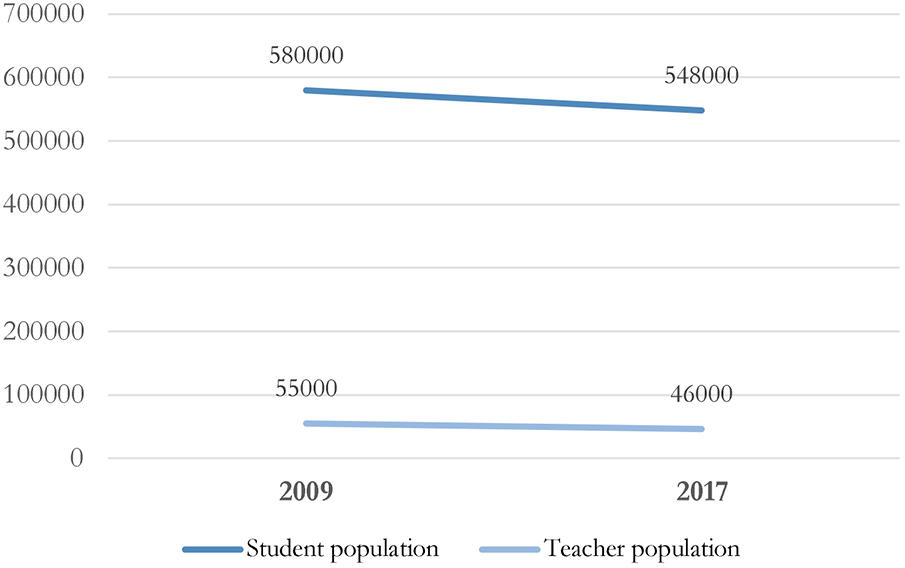
Student and teacher decline (%), Danish public schools.
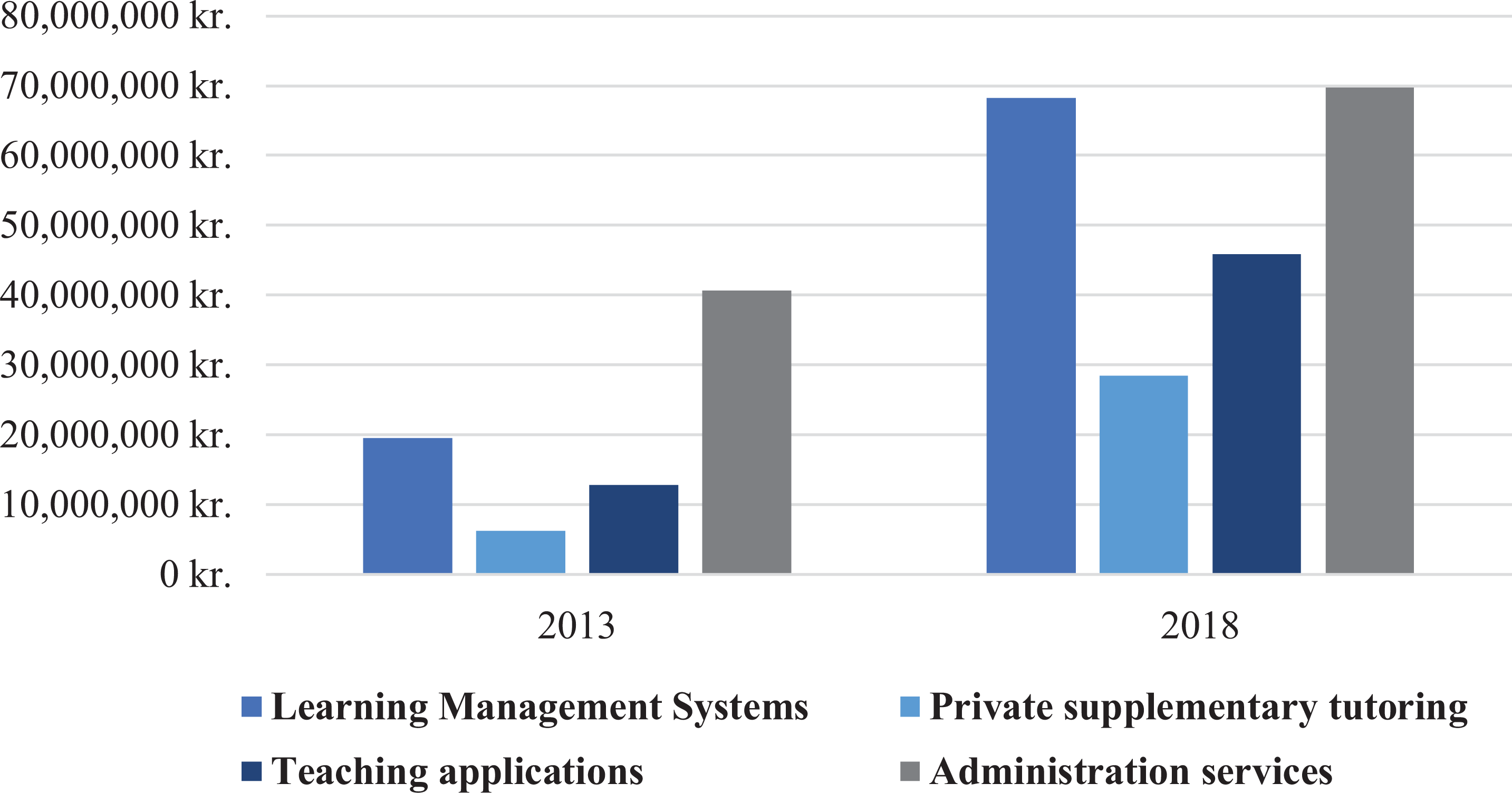
Yearly revenue, educational services, primary, and secondary education (DK).
Where Figure 1 illustrates the increased workload placed on schools over the course of the past decade, Figure 2 documents the growth in revenue for companies providing educational services within and outside public primary schools in 2013 and 2018. Reflecting the ambitions of diversification in the Danish education system, many of these latter services cater explicitly to tasks, functions, and content that were previously managed by institutional and/or district-level public employees. With drastic growth rates in the markets for Learning Management Systems, private supplementary tutoring, teaching applications, and school administration services, the figures provide an apt illustration of the emergence of a purported need to supplement the formal education process with private education services. To the extent that any market would have a hard time growing without increased demand, Figure 2 indicates that any understanding of this emerging need must be framed as part of more widespread shift in the provision of educational matters, such as the Danish Government’s 2013 reform designed to regulate teachers’ preparation time and limit their time for “softer,” nonmeasurable tasks (Danish Government, 2013).
Much more could be said about the recent efforts to infuse the Danish education system with choice, competition, and private innovation, galvanizing commercial activities both within and in the periphery of traditionally “satisfying” educational institutions (Bray, 2011). What matters here, however, is to simply provide a sense of the dominating political tendencies and reformatory ambitions undergirding the emergence of a market for private tutoring, anchored at once in deliberate efforts to promote parental involvement and structural changes in schools’ regulatory frameworks. In less than two decades, the outcomes of these tendencies have placed a big, looming question mark after the assumption that the public Danish education system satisfies the wants of ambitious parents and students. It is from this apparent insufficiency that a range of nation-wide, commercial tutoring companies such as TutorMe have recently begun to emerge.
In the following sections, I draw on the notion of mood to situate the parents’ and tutors’ experiences with private tutoring. As a phenomenon that cannot be disentangled from its historical and cultural situatedness, I set out to explore how the parents and tutors feel about their tutoring engagements are colored by the cultural and historical “manner” of relating to educational encounters in a space that is, notoriously, characterized by a strong emphasis on egalitarian values and practices. To discuss the relation between immediate experiences and this broader mood in which they take place, I will initially establish some of the central theoretical assumptions which underlie the study of mood and its potential implications for the notion of “context” within the field of comparative education. Following the overview, I set out to expound on some of the methodological considerations relating to the present study. Finally, I draw forth three affective patterns which, I suggest, sustain and contribute to solidify the mood in which the parents and tutors encounter private tutoring.
Studying moods and affective patterns
The present focus on moods extends the work of scholars who have grappled with the ongoing “coloring” of actions, meaning-making processes, narratives, performances, desires, and bodily postures in everyday situations (Wetherell, 2012). Situated within the field of affect study, the study of mood and its related concepts—atmosphere, texture, attunement, ambience—entails a complicated body of disagreeing perspectives (Ahmed, 2014b; Brennan, 2004; Clough, 2009; Massumi, 2010). If there is a common threat throughout the works of scholars who have engaged the notion, however, it lies perhaps in the general ambition to undo the “disrespect for what’s apprehensible in the ordinary” (Berlant, 2011, p. 68) that has characterized much critical social analysis in the last century. Rather than identify and pick apart the discursive structures or semiotic regimes operating over or under subjects, a chief tenet of this focus on the ordinary has been to ask how bodies in concrete situations are compelled to “feel” and do certain things rather than others, leaning toward certain objects or images which appear as vital if they are to sustain a meaningful life (Ahmed, 2004). Inherently relational, the study of moods can, in this sense, never be disentangled from the concrete, discursive-material patterns which energize attachments and make certain objects and signs stick together (Fischer, 2016; Hochschild, 2011).
As manifestations of cultural and social embeddedness, it is not always up to us to decide for ourselves what mood we are in or how we end up aligning with certain value attributions to objects rather than others (Butler, 1993). Returning to the musical image of mood suggested in the German Stimmung, a central focal point within the study of moods is exactly the way they often operate “below the level of shape or structure” (Sedgwick, 2003, p. 16), attuning our being in the world through subtle affective patterns that are not necessarily “known” consciously. There may be good and well-articulated reasons for me to use a certain word in a given situation or to click on an advertisement—but I would have a hard time explaining how my responses materialize exactly in this way and not another, or why so many of the people around me somehow feel the same way. Part of the reason for this difficulty arises from the tendency to look at feelings or thoughts as effects of our own constitution, or as direct consequences of external circumstances (Barrett, 2006; Burkitt, 1997). When I sense an urge to respond to something in a certain way, the seemingly internalized nature of my reaction does not suggest that it somehow preexists culture and sociality as an expression of some pre-personal determinancy (Massumi, 2002). Rather, it is exactly because my response has too much culture and sociality that it appears to be un-reflexive (Brennan, 2004; Illouz, 2007). This is why a crucial element in the study of moods, as Michel Foucault suggests, is to look behind “what we tend to feel is without history—in sentiments, love, conscience, instincts” (Foucault, 1977, p. 139). In line with the works of Jameson, Spinoza, and Williams, studying moods encourages us to ask how people end up feeling this and not that about certain things, expanding the linguistic orientations of discourse analysis to include affective patterns that operate below the radar of articulated meaning (Wetherell, 2013). Moods, in sum, set the tone for our very “openness for perceiving and dealing with what we encounter” (Boss, 1979, p. 110), mediating our immediate encounters through the body’s capacity to “retain impressions or traces” (Spinoza, 1959, III, Post. 2) beyond a singular event or action.
Looking through the lens of moods—and the affective patterns that sustain them in everyday social relations and encounters—carries important implications for the study of private tutoring as a phenomenon within comparative education. Following Sobe’s and Kowalczyk’s account of the tendency in comparative education research to treat context as a “matter of fact and invoked as a unity that is always already-there” (Sobe & Kowalczyk, 2018, p. 198), a central aspect of studying moods lies in its focus on the more situated nature of educational phenomena, shifting the analytical orientation toward the material-discursive patterns in everyday life that sustain and repeat certain actions rather than others. As Wetherell notes, these patterns are not only linguistic, but comprise a complex of “[s]omatic, neural, phenomenological, discursive, relational, cultural, economic, developmental, and historical patterns” (Wetherell, 2012, p. 14) which interweave with each other, forming a “structure of feeling” for those who share a more or less bounded space (Williams, 1977). Rather than analyze the characteristics of a discursive macro-construction and its relation to experiences on a micro-level, the study of moods, then, encourages us instead to linger in and shed light on the patterns that structure people’s feelings in a situated encounter (Berlant, 2011; Clough, 2009; Sedgwick, 2003). By resisting the temptation to always look behind the encounter, the point is therefore not to deny the existence of structures or discourses that impede or correct the movement of certain bodies over others. What matters is instead to locate how these corrections are lodged within the patterns repeated in the encounters themselves, opening up an agential space for being able to identify and possibly reject the seemingly “natural” forces of a mood which is, again, no stronger than the patterns of words and practices that are repeated in order to hold it together (Ahmed, 2014a; Deleuze & Guattari, 2013).
In this sense, focusing on people’s actions and statements in a mood provides different analytical possibilities than the assumption of them being in a context as a matter of fact, one whose unity cannot be dislodged so long as it controls the realm of possible articulations (Wetherell, 2013). Rather than unpack the hegemonic discourses that determine how a situation is bound to be felt, the point of looking at moods is to gain a deeper conception of what it means for an encounter to be situated and to broaden the analytical scope toward the complex affective patterns—words, images, structures, embodied memories of being in school—that sustain the mood (or tone) which frames the experience. As intimated above, this attention to patterns requires not only an eye to the historical and institutional structures that constitute the materiel premises for the encounters. It also suggests that we pay close attention to the more subtle, day-to-day circulation of objects and ideals which contribute to “tune” people’s possibilities for feeling and thinking about educational relations (Ahmed, 2014a; Butler, 1993). As we shall see below, the parents’ and tutors’ feelings about their encounters with private tutoring contain several instances of this kind of affective “tuning”—in this case closely bound to a series of patterns centering around ideas that, paradoxically, are closely tied to the very egalitarian welfare state out of whose insufficiencies the market for private tutoring has grown. While a comprehensive analysis of these patterns would require much more than interview data alone, it is these types of affective corrections that make up the central focus of studying moods as a subtle boundary for people’s experiences, continuously and contingently affecting us “despite our best intentions, despite even our own selves” (Ahmed, 2014a, p. 13). I will return to elaborate on the methodological implications of this focus below.
Steps toward an affective case study
The empirical material supporting the present analysis consists of five semi-structured interviews conducted with parents (3) and tutors (5) over the course of a 4-month data collection period between July and October 2019 (see Table 1). The interviews took place as part of a larger doctoral project examining the involvement of commercial services in Danish primary and upper primary level education. Along with a primary school and a corporate provider of teaching materials, TutorMe appears as one of three “sites” in this study. With the exception of two group interviews with former tutors, interviews were conducted individually in the research participants’ homes and, in one interlocutor’s case, their place of work. The parents to children who had received tutoring through TutorMe were contacted based on dialogues with school personnel previously interviewed during visits to two schools in Copenhagen, while the tutors volunteered to participate on the basis of a post in a Facebook group for university students, calling for students either currently or formerly employed by TutorMe. Both parents and students took part in the project on a voluntary basis and provided written or oral consent. All names have been given pseudonyms.
Empirical overview.
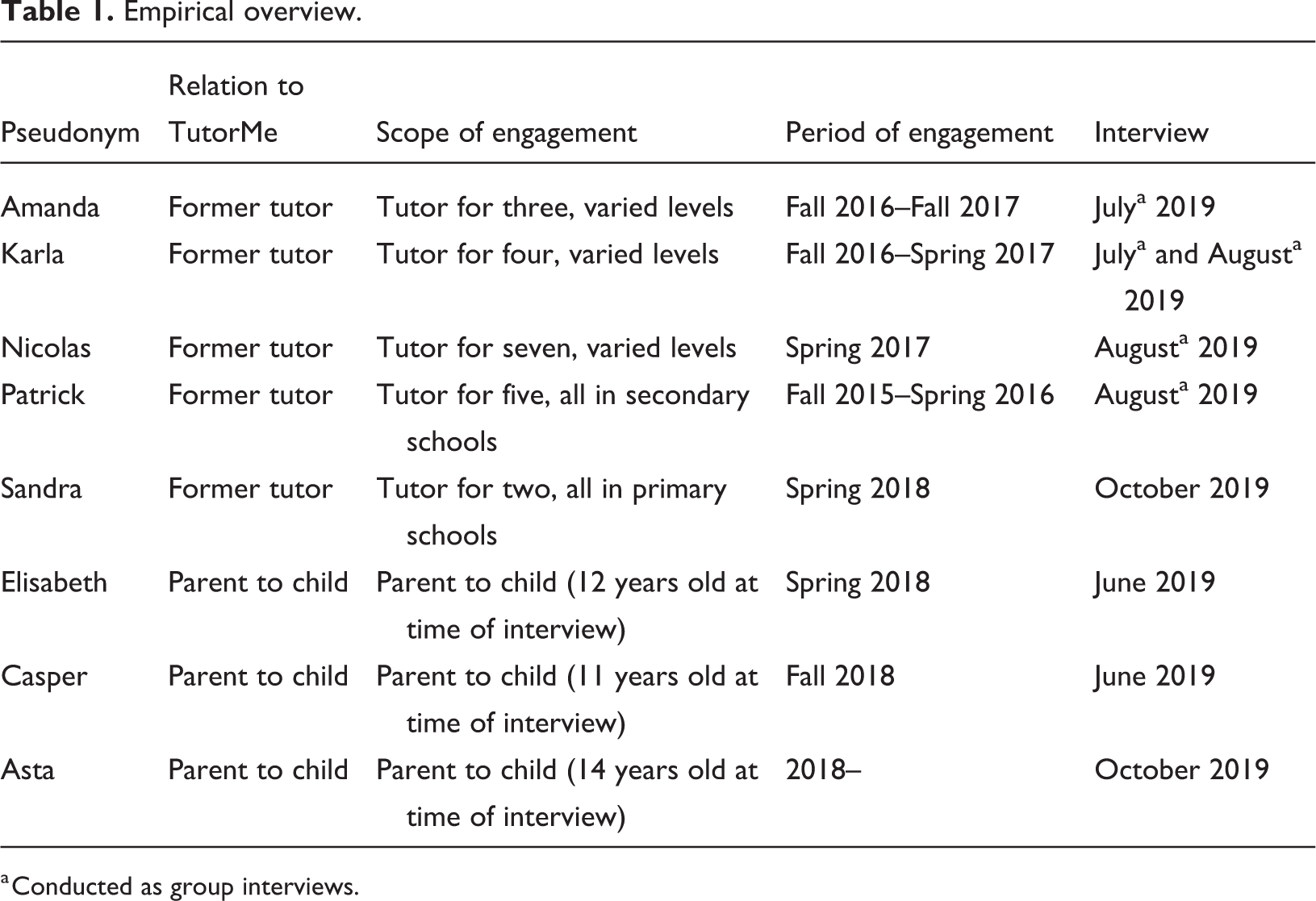
a Conducted as group interviews.
As suggested above, the parents and tutors interviewed share not only the experience of having either bought or taught private tutoring but also a common connection to TutorMe, one of the larger corporate providers of private tutoring in Denmark. By focusing on an “in-depth description and analysis of a bounded system” (Merriam & Tisdell, 2016, p. 37), the present case study is thus limited empirically to (1) a very particular geographical region around the Danish capital, Copenhagen, (2) a limited number of possible research participants (omitting, however, company representatives), and (3) a large-scale, commercial context of tutoring (disregarding both noncommercial and “neighborhood” tutoring in which the tutor does not serve a company). 3
As noted above, the empirical limitations suggested here do not necessarily preclude generalization. While the boundaries of the case should certainly caution against attempts to universalize the concrete experience or the practice of tutoring, the current focus on the ongoing production of a mood which “colors” the meeting with the private tutoring phenomenon does entice generalization, if only an analytical version of it (Yin, 2010). As a particular “problem-event that has animated some kind of judgment” (Berlant, 2007b, p. 663), the case provides an access point to decipher at least some of the patterns which undergird this judgment—not in the form of an ideological superstructure but as an opening toward naming the impressions or traces that attune one’s feelings in and about a given encounter (Burkitt, 1997). Looking across these impressions, it is thus neither the experience nor the phenomenon itself that opens up to generalization, but the affective patterns through which an apparent mood solidifies, correcting the individual’s response by setting the tone for their being (Ahmed, 2014a). It is an attention to the conditions of this affective solidification that makes up the point of generalization below, opening up toward studies that may wish to investigate phenomena such as tutoring from a situated, affective perspective.
“You know how it is”: Methodological challenges in situating encounters
As indicated above, coding and analyzing people’s statements in relation to the affective patterns that color their experiences presents an obvious methodological challenge. How do we open up the spoken words of the interlocutors to recognize the subtle patterns of feeling, speaking, and acting which undergird their descriptions? Leaning on scholars who have addressed variants of this question (Clough, 2009; Kofoed & Ringrose, 2012; Massumi, 2015; Staunæs, 2018), the very premise of analyzing at the level of moods and their corresponding patterns opposes the suggestion that individuals’ encounter with phenomena is conditioned by either the person’s past or by surrounding ideological structures. As a shared orientation that emerges in and through the very act of “being in relation to others” (Ahmed, 2014a, p. 15), what the attention to moods suggests is that while personal beliefs and existing discourses certainly matter, how we feel about a phenomenon in a given situation is, exactly, situated. This situated understanding of valuations in spoken statements has important methodological implications: A White male researcher organizing an interview concerning the use of private, commercial tutoring from a position at a publicly funded research institution will, most probably, energize a different attunement to the phenomenon than a dialogue occurring between a parent and a tutoring company representative.
In relation to the present analytical process, it is, for the same reason, not so much a matter of drawing forth preexisting personal narratives or discursive nodal points as it is about highlighting the moments in which the interviewees’ experiences appear to be intercepted, caught up in navigating between their own experiences and the impressions of being in a mood where not everything counts as good. To the extent that “embodied action (on a scale of intensity) tends to be bound up with talk at some point in a flow of activity” (Wetherell, 2013, p. 360), the spoken word provides an important—but not the only—point of access to this interception. A person can say a lot of things concerning, say, the importance of a child’s education; but to avoid appearing as an “affect alien” (Ahmed, 2010, p. 37), they can’t say anything. Just as bodies are drawn together by subtle habits, ways of relating, and culturally recognized symbols of value, so too are the articulations of people’s actions and practices bound to the situations in which words such as “child,” “teacher,” “education,” or “tutoring” are used. Returning to the question of generalization, the attention to people’s situatedness does, in this sense, not imply that the words used to describe people’s experiences are simply void of signification. It does, however, illustrate the contingency of cultural expressions and values, in the sense that the corrective nature of being in a mood is only as affective as the re-continuation of the patterns that makes it seem unquestionable and rigid in the first place (Clough, 2009). While the present analysis is limited to the discursive aspect of this ongoing process of affective correction, what matters is to highlight at least some of these general patterns that emerge across the interview situations as the interlocutors—situated in a dialogue with the interviewer—encounter the “pitch at which our existence, as a set of relationships to objects, ourselves and other people, is vibrating” (Boss, 1979, p. 110).
Translating these points into the present study, a three-step coding process was applied in the analysis of the interviews (Merriam & Tisdell, 2016). First, an open coding of the interviews was conducted to label any unit of data that may be relevant for the study. Second, these coded units of data were then categorized, focusing on drawing forth the images, stereotypes, and emotions applied or expressed by the interlocutors when discussing, for example, a “positive” educational relation. By categorizing the most common words, adjectives, and sentiments, the second round hereby sought to highlight what appeared to be the most relevant points of concern for the tutors and parents—generating a variety of meta-categories such as “the teacher role,” “motivation of students,” “the child’s relation to school,” “parental responsibility,” “public education,” and so on. The third round of coding, finally, focused on bringing together these general descriptions to identify common patterns in how, for example, the parents’ and tutors’ attribute value to the teacher’s role: “I mean I always liked this whole idea of the caring teacher”; “I think I grew up like most kids, attending a public school with kids from all social backgrounds”; “you know how it is to really feel acknowledged in a learning process.” In gathering and labelling the interlocutors’ attributions and feelings across the different interviews, a range of regularities emerged which appeared to circulate across their statements, presenting a series of historical, discursive, and bodily patterns which appeared to correct how they, each in their own way, tried to make sense of their encounters. Again, speaking of “correcting” here does not refer to a prefixed system of causality. Rather, it refers to the situated sense of something feeling this way and not that which emerged during the interviews: the subtle sense that not all teachers count as teachers, that not all types of motivation count as motivation. It is exactly the patterns that sustain this “mood” in which certain things become valuable that I wish to explore below, limited in this case to the three most prevalent patterns that appeared in the coding process: teacher intimacy, institutional professionalism, and nonexclusivity. Whether discussing the role of teachers or the importance of student motivation, these patterns appeared again and again as a kind of Archimedean point from which the parents and tutors perceived their encounters with tutoring, sustaining a “structure of feeling” that is referred to throughout this article with the concept of mood (Williams, 1977). After briefly summarizing the central organizational traits of TutorMe, the following section will elaborate each of these patterns as they emerged across the interview data.
Teacher intimacy, institutional professionalism, nonexclusivity: Experiences with private tutoring
As many other companies on the growing market for tutoring, TutorMe grew out of one person’s initiative to offer fee-based education services for children and parents. Initially, the services offered by the company centered around subject-specific supplements to the formal education system, in the form of training in specific areas (algebra, grammar, chemical elements) and exam preparation. TutorMe’s growth from a single-person endeavor to an industrial company was as swift as it was expansive in terms of the services offered by the many tutors who were gradually employed to work on behalf of the company. Since its launch, the company has grown to serve multiple subjects in school across the country and has established partnerships with various organizations. All tutors who work for the company are employed part-time, as most of them are students at higher education institutions and, in a few instances, secondary schools. As will be clear below, this unprofessional nature of the tutors working for TutorMe is important to bear in mind when reading the statements of the parents and tutors.
With these characteristics in mind, we can turn to explore the affective patterns identified in the process of coding the parents’ and tutors’ statements. As noted above, these patterns are closely bound to the difficulties of navigating one’s immediate wants and experiences within the impressions of an educational “tone” which, in most of the instances drawn forth below, does not appear to harmonize with the commercial premise of using a commercial tutoring service.
Teacher intimacy
Well I think a good teacher is someone who goes that extra mile for their students. But I know that’s a lot to expect. So when I first saw the ads [for TutorMe], it must have been sometime in 2017, that’s what I thought: Christian [Elisabeth’s son, 10 years old at the time] could use that kind of teacher who would actually have time to get to know him, he can be difficult to read. Not because I thought his teachers at school are bad teachers, they really aren’t. But I mean you know what it’s like out there, they don’t have time for anything, it’s just survival…So what were we going to do when we have a son who desperately needed a new pair of eyes to look at him, someone who could go that [extra] mile? Elisabeth, former customer, TutorMe
In the face of an increasingly strained public school system, the desire to establish or sustain a more intimate teacher–student relationship plays a central role in many of the interlocutors’ descriptions. In her projection of a “good teacher,” Elisabeth, who lives with a partner and three children in Southern Copenhagen, appears to reflect this want as she expresses frustration with the fact that no one seems able to “read” her son, Christian. Alluding to the promise of pedagogical intimacy suggested in most forms of one-on-one tutoring, her expectations going into the tutoring relation pivot around finding the “kind of teacher who would actually have time to get to know him”—and through this close relation move him forward in math. Pointing to the structural changes in the conditions for public school teachers previously noted in Figure 2, Elisabeth’s use of the “good teacher” seems inseparable from the cultural patterns of teacher relations within the Danish educational system, where teachers have, stereotypically, always gone that “extra mile” beyond mere subject training (Antikainen, 2006). By linking the “new set of eyes” with the expression used for the figure of the “good teacher” earlier in the statement, Elisabeth’s expectations upon seeing the TutorMe ads thus seem deeply colored by this sustenance of an educational impression (“that kind of teacher”). As she emphasizes, it’s not that “his teachers at school are bad teachers”; they simply “don’t have time for anything.” And in the light of her son’s “desperate” need for someone to take on this role, the TutorMe ads presented a feasible way for Elisabeth to project her patterned attributions of value to the good teacher—a kind of teacher relation which, as she explains, is “what anyone [in Denmark] would expect”—onto the body of the tutor. After a 6-month engagement with a tutor from TutorMe, however, she and her partner chose not to continue the engagement; they had been “happy” with the help he received in math but had also expected “more than was probably realistic of someone like him.” As we shall see below, Elisabeth is far from alone in sensing this kind of mismatch between immediate wants and the kind of relation that “anyone would expect.”
The circulation of an intimate and caring pattern of teacher–student relations is reflected across several of the tutors’ expectations as well. In the case of former tutor Sandra, who is currently studying to become a social worker, the positive attribution to the notion of intimate pedagogical relations is apparent in her descriptions of why she initially “fell for” TutorMe’s profile. Relating why she applied for a job with the company, she connects the company’s advertisements to the positively attributed object of the aforementioned “extra mile teacher,” anchored here in TutorMe’s use of images and the company’s self-descriptions. I think of one the reasons I became a tutor [with TutorMe] was this whole thing about…Well, helping kids out, making a difference. I guess being some kind of role model, like the good teacher you like brag about. The TutorMe people [employees] they were all about that like, in the job interview and just in general. So there’s this story and feeling of breaking negative social inheritance. It’s probably why I went into it, because I also feel that need to help kids out right? Sandra, former tutor, TutorMe
Another example of how a particular affective pattern of teacher intimacy affects the experience of tutoring can be found in the following statement from the former tutor Amanda, who worked for TutorMe for about a year and half. In the excerpt below, she is reflecting on an apparent clash between her own sense of importance in the tutoring relation and the parents’ academic ambitions. …like I had a girl who was very shy and quiet in class, but she was actually really good at both English and math. Um, so but I still feel like the parents wanted her to do better. But I feel I was a bit, I don’t know how do you say like, I felt it was more a confidence [problem]. Yeah, I thought it was more important for her to learn to relax and also just uh, be brave enough to say something in class. Everything didn’t need to be perfect, but that was kind of not what the parents wanted. They wanted her to get better in school and they wanted me to teach her things. But I felt like what she needed was more like a mentor. Like how can you relax more when you’re in school and um, become more confident. Amanda, former tutor, TutorMe
Institutional professionalism
As we have seen above, the projection of intimacy into the encounter with tutoring does not exist in a vacuum. Rather, it is colored by attributions to educational objects and ideals that “stick” and, conversely, shape the parents’ and tutors’ experiences of the encounter: the good teacher, the brave and relaxed student, the importance of breaking negative social inheritance. In the words of Ahmed (2010), these objects stick exactly “because they are already attributed as being good or bad, as being the cause of happiness or unhappiness” (p. 35). In the statements above, we saw how this stickiness materialized in a range of conflicted statements as Sandra and Amanda tried to align their experiences with an affective pattern of teacher–student intimacy that did not harmonize well with the corporate reality of private tutoring. In the following excerpt from Karla, a former TutorMe employee with a little more than a year’s experience tutoring four different students, we meet another form of this affective clash, anchored in an affective pattern that can be described as a kind of institutional professionalism.
But I also feel like very I felt very conflicted when I was working as a mentor because I don’t think I had one student where I feel like they actually needed my help. Like I think they would do just fine without me and my help. But with my help, maybe they got from a seven to a twelve or whatever. But like the girl in ninth grade, you don’t use those grades for anything. She would get into high school anyways. It feels like it was sort of a competition that was like constructed or something like because it wouldn’t have any real life consequences for her if she got a seven instead of a twelve, it didn’t really matter…I feel like it’s sort of a competition that has been made. But it’s really weird because you’re not competing for any spots in better schools or whatever. Karla, former tutor, TutorMe
Karla is far from alone in navigating a gap between a noncompetitive pattern of institutional practices and the actual experience of tutoring outside school. Another example of this pattern appears in the following excerpt from Patrick, who worked for TutorMe as a tutor in math between 2015 and 2016. Well, I mean, you can always discuss this like politically and whatnot. Uh, but I think that of these, I mean the ones I’ve had, they would benefit a lot if they talk to their math teacher in the school, like in high school…Uh, and they would benefit a lot because there, there’s someone who’s actually qualified and actually knows how to teach…Um, um, so, um, I’m not sure it’s, it can be helpful to many…Patrick, former tutor, TutorMe
It is not only from the perspective of former tutors that an affective clash emerges concerning the very premise of establishing educational relations with student tutors who, as Patrick suggests, “aren’t qualified” or employed in a formal institutional setting. In the following excerpt from an interview with Casper, a parent whose son received help in English from a TutorMe tutor for 6 months, a similar sense of disharmony appears to color his reflections. Here, however, it is grounded not in the professional training of the institutionally employed teacher, but rather the expected temporality of a positive educational encounter. I think one of the reasons was…after he [the child’s tutor for six months] said he had to quit. Because he was going to study abroad, as part of his bachelor because he was studying at the university. That was kind of unexpected. So now suddenly we had to find a new tutor, do the meetings and explain how this and this was best for our child to learn, I guess that’s where it stopped because we felt like it would just be too much. [Interviewer: In what way?] Just. Well just having to go through it all again, and I also thought it’s not ideal to change like that, I mean to have to learn how to work with and or I mean do math with a new person again. I mean sometimes it’s necessary to do so, but you can’t just build trust in someone in one month.…it’s the long-term relation that matters. Casper, former customer, TuturMe
Nonexclusivity
As we have seen above, the interlocutors’ experiences with private tutoring appear to be colored by the continued circulation of objects and signs that continue to accumulate affective value, producing an evident “social clash of different cultural expectations” (Burkitt, 2014, p. 136). Teacher intimacy and institutional professionalism, I have suggested, express two such patterns which contribute to uphold a mood that attunes the experiences of parents and tutors to a notion of “Danish education” while engaging with an activity that, on the face of it, does not necessarily have to have anything to do with the historical and cultural approaches to education that may or may not have existed when the tutors and parents grew up. Nonexclusivity, I will suggest here, appears as another such affective pattern in the interlocutors’ statements, intercepting the initial and immediate sense of benefit for one’s child or student that makes TutorMe appear a viable company to engage with.
In the following excerpt, Asta, whose son had been receiving tutoring in English for about a year and a half at the time of the interview, indicates a sense of this pattern as she relates the confrontation between her “private” encounter with the tutoring phenomenon and her impression of the Danish “public school.” I will say this, it [hiring a tutor for their child] wasn’t exactly something I went around bragging about…It’s Denmark, it’s equal opportunities for all right? I’ve always been a defender of the public school, Matt [their child, 14 years old at the time of the interview, 2019] attends a public school…but at the same time I’m not blind to the fact that he just isn’t getting the help he needs. It’s been awesome having a tutor for him, really…But for sure, it’s not something that I mean it’s not a thing I’m waving around to the other parents, because his friends could say, you know, he’s special or something like that. Asta, current customer, TutorMe
Asta is not alone in sensing that her actions are somehow out of tune with an egalitarian and nonexclusive pattern of educational relations sustained in the public sentiment, feeling disjointed from the expected forms of conduct and value attributions that “stick” to the objects, actions, and words applied in the interview situation (which, again, does not mean that everyone will necessarily “feel” and respond to this misattunement). As she relates her own sense of redundancy in the tutoring encounter, Karla’s reflection below indicates a similar struggle to align her actions with this pattern, energized in this case by a stereotypical notion of social justice and her awareness of the noncompetitive access criteria which structure many parts of the Danish education system. I think the area I worked in it was a lot of very wealthy families…. I personally don’t think I had any students who actually really needed my help. They would get average grades. Some of them would already get a ten [equivalent of a B], but wanted to go to a twelve [equivalent of an A]. Um. And I felt a bit weird about that because I don’t think like my parents’ care. If I got an average grade that was fine. But it was not good enough in this setting. That’s what I felt. Yeah, so that was the way I felt a bit conflicted. Karla, former tutor, TutorMe
Yeah, it is only rich people who can get the course. Yeah, it’s a problem. It is a problem; I think so the poor people in Denmark only get the public school and not an extra course. Amanda, former tutor, TutorMe
Um, like, first of all, I think it’s a shame that private tutoring is such a big sector, such a big business. And the fact that I can just make website in ten minutes post a link and get seven families to contact me within the first hour tells me that there are too many people in this situation where they can’t actually do that…I feel like it’s just it’s a symptom of a bad educational system as a whole, the larger the private industry. Um, so I would rather not have any students and that everyone could just follow [the ordinary school]. Nicolas, former tutor, TutorMe
Mirroring the reflections of the other tutors and parents, Nicolas’ attempt to grapple with this pattern of nonexclusivity illustrates well the paradoxical situation created by the subtle corrections of patterns which, together, form the sense of a “tone” that impresses on the parents’ and tutors’ feelings about their encounters. As I have attempted to illustrate above, however, this sense of being in a mood is never more rigid than the patterns that sustain it: There is always the possibility of trying to change the mood insofar as one is able to read, reject, or revamp the patterns of affect that make only certain types of teachers seem familiar and valuable. Rather than try to sustain the “tone” of an orchestra that no longer plays as it may have done before, the analysis above can hopefully entice more realist conversations about what private tutoring, as a situated phenomenon, can and cannot do.
Conclusion: Hitting the right tone
Based on a series of interviews conducted with parents and former tutors from a large, commercial tutoring company, this article has examined how the experiences of buying or providing private tutoring in Denmark are colored by the mood they are in. Understood as a “fundamental manner” that “sets the tone” for being (Heidegger, 1995, p. 67), I have sought to highlight how the interlocutors’ experiences with tutoring appear to be attuned to a particular educational manner emerging from their situatedness in the Danish education system, correcting how they are affected by and make sense of the phenomenon. To this end, three affective patterns were identified across the interviews—teacher intimacy, institutional professionalism, and nonexclusivity—whose continued circulation in the words, images, structures, and embodied memories of the interlocutors were found to contribute to upholding a general mood for educational relations that the interlocutors carried with them into the tutoring encounter. By focusing on how this sense of a fundamental manner is sustained through the day-to-day use of words, practices, and stereotypes applied by those who are impressed by it, the article has aimed to open up for an affectively oriented approach to the study of private tutoring, hopefully encouraging further explorations of the complex patterns and agencies through which the phenomenon emerges as this and not that in different settings.
Importantly, the patterns drawn forth across the statements do not imply a causal understanding of how private educational encounters are bound to feel. As indicated above, not everyone is equally dispositioned or willing to “attune” their responses and feelings with the general sense of good or bad that follows from being in a mood; many parents may even take a distinct pleasure in giving their child an exclusive advantage. What matters here is to challenge the idea that individual preferences and choices in the burgeoning markets for education are individual, in the sense of bounded bodies experiencing and acting on the world as rational customers. As a fundamental manner sustained through the continued circulation of affective patterns in the parents’ and tutors’ educational ideas and relations, the often frustrating attempts to make sense of a “private” choice while staying in tune with the mood permeating one’s actions illustrate that many times, the “tone” of our situatedness can end up overflowing our bodies, “despite our best intentions, despite even our own selves” (Ahmed, 2014a, p. 13). By opening up empirically the gap between these contingently sustained patterns and the actual experience of an encounter, I suggest that the findings drawn forth in this article illustrate not only the complex relationship between private tutoring encounters and the “mood” in which they unfold, but the very premise of commercializing relations that have their own affective history.
Footnotes
Declaration of conflicting interests
The author(s) declared no potential conflicts of interest with respect to the research, authorship, and/or publication of this article.
Funding
The author(s) received no financial support for the research, authorship, and/or publication of this article.
