




Abstract
Purpose:
This article focuses on rarely explored organizational practice of teaching research in China’s private tutoring industry. Taking a large private tutoring institution as an example, the article examines how private tutoring institutions understand and engage in educational explorations of standardization and informatization processes.
Design/Approach/Methods:
The article is based on a case study of one of the biggest tutoring companies in China. The study started with document analysis of the institutional history, supplemented by interviews with personnel who have worked in the institution since it was founded. Next, the researchers collected empirical data using mixed methods. Quantitative data were obtained from the user database owned by the institution. Qualitative data were collected directly by the researchers through interviews and participant observation. Both qualitative and quantitative data were analyzed from multiple perspectives.
Findings:
Teaching research in private tutoring institutions commonly differs from that in public schooling. In this particular case, it is technology-driven, student-tailored, and process-standardized. Utilized well, it can supplement the mainstream public education system and promote education innovation and equity throughout the country.
Originality/Value:
It is hoped that this article could give some insights into the possibility of the cooperation between formal schools and tutoring institutions in the areas of teaching research and other in-class and off-campus activities. The article can also draw public attention to the necessity and benefits of adopting technical methods in the teaching process.
Introduction
Private tutoring in China has expanded at great speed in the past two decades (Zhang & Bray, 2016). Its rapid expansion has counterparts elsewhere in the world and has growing influence on education and the wider society (Bray, 2009, 2011; Zhang & Bray, 2017). Some dimensions of tutoring can be problematic with backwash on schooling and parenting, while some can be useful supplements and contribute to teaching and learning (Bray & Lykins, 2012). Private tutoring industry in China is very complicated and diverse, and the development of the industry is not straightforward. This article is a case study of a tutoring institution in China. The case institution started its business in the early boom years of the tutoring industry. Today, it has become one of the largest tutoring companies in China. Although the case institution cannot represent the whole tutoring industry, its practice and explorations could be useful for understanding one type of tutoring institution in China.
The practice of the case tutoring institution is greatly shaped by the market. The development of teaching research (known as Jiaoyan, 教研) is a case in point. Teaching research is a widely known institutionalized practice in mainstream public schools in China, where the teachers regularly review their teaching methods, teaching materials, and curriculum structures in order to improve the whole teaching and learning process (An & Wang, 2016; Zhong, 2017). The emergence of teaching research in the case institution has been driven by its growing scale that requires standardization to ensure the quality of tutoring services. As one of the biggest tutoring companies, with online teaching platforms and off-line branches across China, the case institution faces challenges of developing unified teaching research systems to guarantee service quality for students’ personalized demands.
Questions arising might be as follows: How does the case institution tackle such problems with its teaching research development? What are the strengths and obstacles of its teaching research system? What lessons can be drawn from the case institution’s development to promote education innovation and equity in China? This article examines these questions adopting mixed methods. It entered the case institution and obtained access to data that are very difficult to collect by outsiders. The study not only secured firsthand data through interviews and participant observation. The researchers were also given access to a vast database in order to find quantitative evidence to triangulate with qualitative findings.
The article starts with a brief history of the case. It then analyzes the development of the case institution’s teaching research system in detail, with lessons drawn correspondingly. The article concludes with implications for education innovation and equity.
Explorations in teaching research
The case institution was founded in the early 2000s. It started as a traditional off-line class-based tutoring institution in a China’s megacity. After a decade of development, it claimed to shift to a data-driven education technology enterprise. To survive in China’s fiercely competitive tutoring market, the case institution needed to improve its services’ user experience and foster its popularity. Most importantly, it needed to have a stricter control over teaching quality across China. Controlling teaching quality is not easy for any educational enterprise in high-speed expansion. Many tutoring institutions try to attract students by advertising their better-known tutors. However, for mature, large educational enterprises, the priority is to stabilize the tutor teams’ teaching skills to ensure that every tutor has a satisfactory teaching level. It is believed by the case institution that only when a solid foundation has been established can it move on to cultivate outstanding tutors.
Facing the market conditions of the time and its own need for development, the case institution found out the importance of developing original teaching contents and standardizing its teaching quality. It navigated a mechanism of developing and using teaching research. With the development of the company and the advancement of its educational techniques, the case institution’s teaching research system underwent three stages of development which are summarized below. The three stages will be examined from the aspects of driving force, team formation, quality assurance, achievements, and challenges, respectively, in the following subsections.
Teaching research era 1.0: Standardization
In the early days, the case institution’s teaching syllabus and teaching materials were settled entirely by its tutors. This led to differences in progress among different classes. The progress variance plus the broad differences in tutors’ teaching styles complicated students’ schedules. At the same time, the supply of outstanding tutors was limited. As the scale of the institution grew, the user experience was unavoidably affected. How to promote the resources and the abilities of tutors and unify the teaching progress among different classes? How to guarantee the general teaching quality and improve user experience? These were serious challenges that the case institution faced in its initial expansion process.
In the fourth year since its founding, to meet the market demand for qualified tutors and unified teaching process, the case institution set up its first teaching research department (Jiaoyanbu, 教研部) based on its founders’ teaching experience and accumulated teaching resources. Eight members who had graduated from top universities in China and were popular among students were selected to form an internal teaching research team. Among the eight members, half were alumni of Peking University and Tsinghua University, seven majored in science and one in philosophy. This team aimed to promote standardized teaching research in the case institution by developing unified course syllabuses and designing specific teaching plans for tutors.
A specific mode of operation was designed to assure teaching quality in the standardization process. First, each member of the internal teaching research team oversaw one grade’s lecture notes and teaching reference materials which would then be reviewed by team leaders. Second, all tutors would make comments on the materials while preparing for teaching. Third, an external consultation team was set up to ensure the quality and direction of students’ lecture notes and tutors’ reference books. This consultation team consisted of researchers from the local authoritative education research institutions, key middle school teachers, and renowned scholars. The internal teaching research team and the external consultation team worked together to finalize drafts of teaching materials for publication. At the same time, teaching content choices were provided to meet students’ need in different classes and grades. Tutors were able to adjust teaching content and progress according to their class needs.
With the establishment of teaching research team, an internal cooperation mechanism became mature. The academic department (Xuekebu, 学科部) is responsible for gathering and summarizing the need of the market and users. The teaching department (Jiaoxuebu, 教学部) is responsible for managing and communicating with the whole group of tutors, while the teaching research department is responsible for the design of syllabuses and lecture notes.
The standardized teaching materials greatly lighten the burden of setting teaching goals and organizing teaching content for tutors. Tutors can pay more attention to teaching by preparing more interesting class activities and better grasping the content to be taught. Most of the teaching materials at this stage were in paper format, and the content focused on knowledge itself. The presentation of the teaching content was monotonous. Three years later, inspired by a tutor’s use of slides in the classroom, the case institution’s teaching research entered its second stage of development.
Teaching research era 2.0: Visualization and modularization
In the second stage of the case institution’s teaching research development, paper teaching materials were upgraded to digital courseware, and more technological teaching methods were added to the whole teaching process. In the meantime, its teaching research team faced new challenges. With more and more new branches set up across the country, the standardized teaching materials needed to be amended due to the differences of regional examinations, teaching systems, and textbooks.
To solve this problem, the headquarters and its branches divided their labors. The headquarters was responsible for providing modular and standard products such as courseware and other digital materials to the branches. It also provided practice exercises that matched its self-edited textbooks. The branches then organized their own curriculums based on these materials to better fit local education systems. The scale of teaching research teams at its branches was around one third to one half of that of its headquarters. In this way, the headquarters could concentrate on exploring curriculum standards, teaching materials, and teaching methods to provide appropriate courseware and better class designs of the teaching of specific knowledge. Meanwhile, its branches could focus on developing local learning and teaching goals and processes, adjusting class schedules and extracting appropriate content from its standardized materials to create local curriculum programs. In sum, the headquarters was responsible for setting up the foundational curriculums, while its branches focused on meeting the need of local tutoring markets.
At this stage, the case institution also began to develop its internal class instruction and teaching research systems. In 2011, the Intelligent Classroom System was established for class instruction, and later it was upgraded to Intelligent Teaching System. This system collected teaching resources used in the process of class instruction. Tutors could either choose to use the standard courseware provided by the teaching research team or customize the software according to their teaching progress and local needs. The system gave tutors room for adjustment while using standardized teaching content.
The collection of online teaching resources brought much convenience to the tutors. For instance, there are safety concerns in the transportation and use of instruments in high school science lab classes. Besides, the tutors’ experiment demonstration effects are often not satisfactory. The case institution uses technological methods to simulate the laboratory operating process and demonstrate experimental details by using high-definition videos (see Figure 1). In such ways, tutors can use visual images and videos to show experimental process which may not be easy to express verbally.
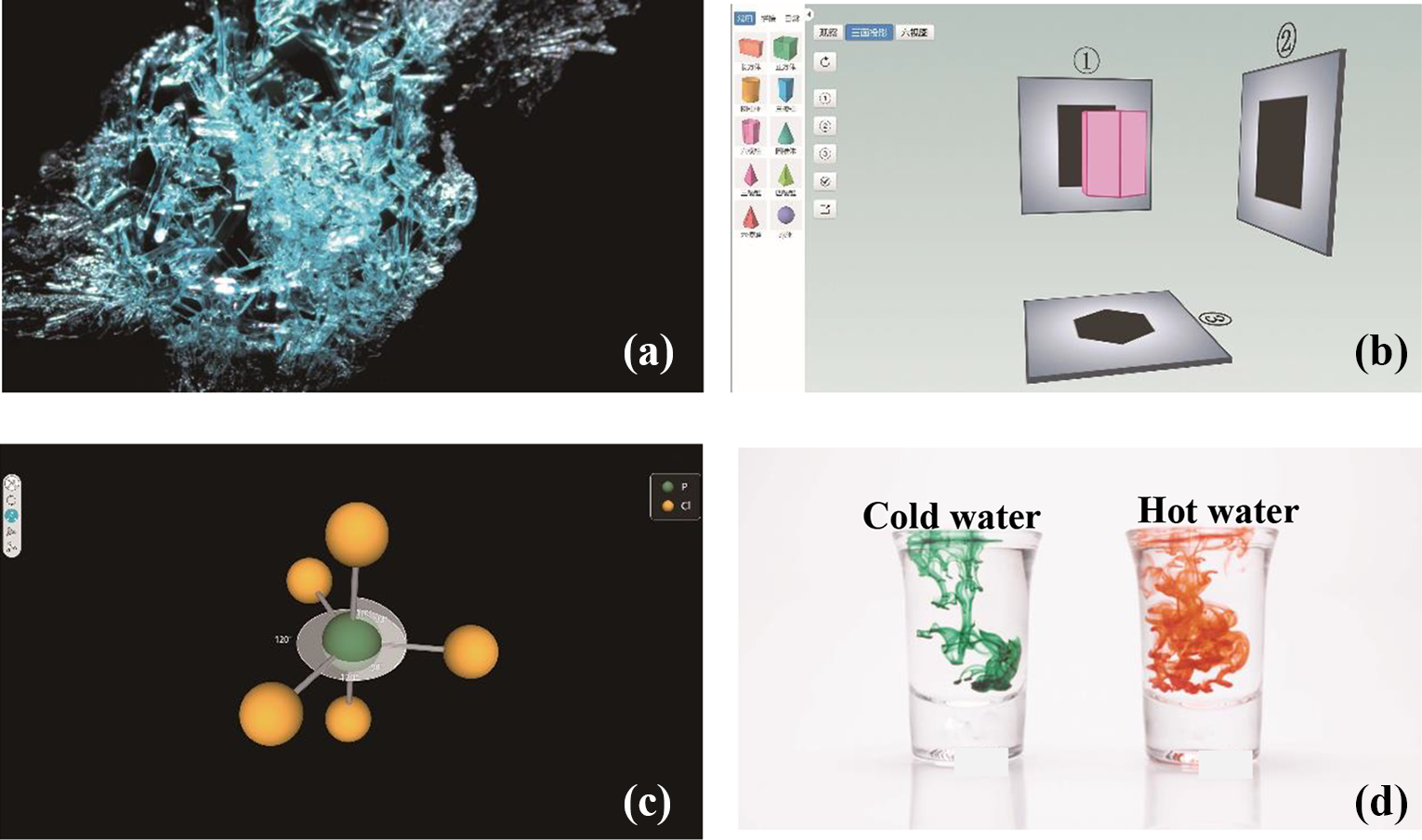
Sample source materials from the teaching research system: (a) copper sulfate pentahydrate; (b) Stereometry, three-plane projection drawing; (c) molecular structure; and (d) comparison of diffusion rates in hot and cold water.
The instructional system also possesses the function of data collection. The teaching research team can get timely feedback of the usage of courseware and other instructional resources from the system which may help them improve their class design. Figures 2 and 3 show the statistics for nationwide use of courseware for a course. The teaching research team could improve the teaching materials in a more accurate way by communicating with tutors and analyzing the total number of classes that use the courseware and the length of time when each courseware page is visited.
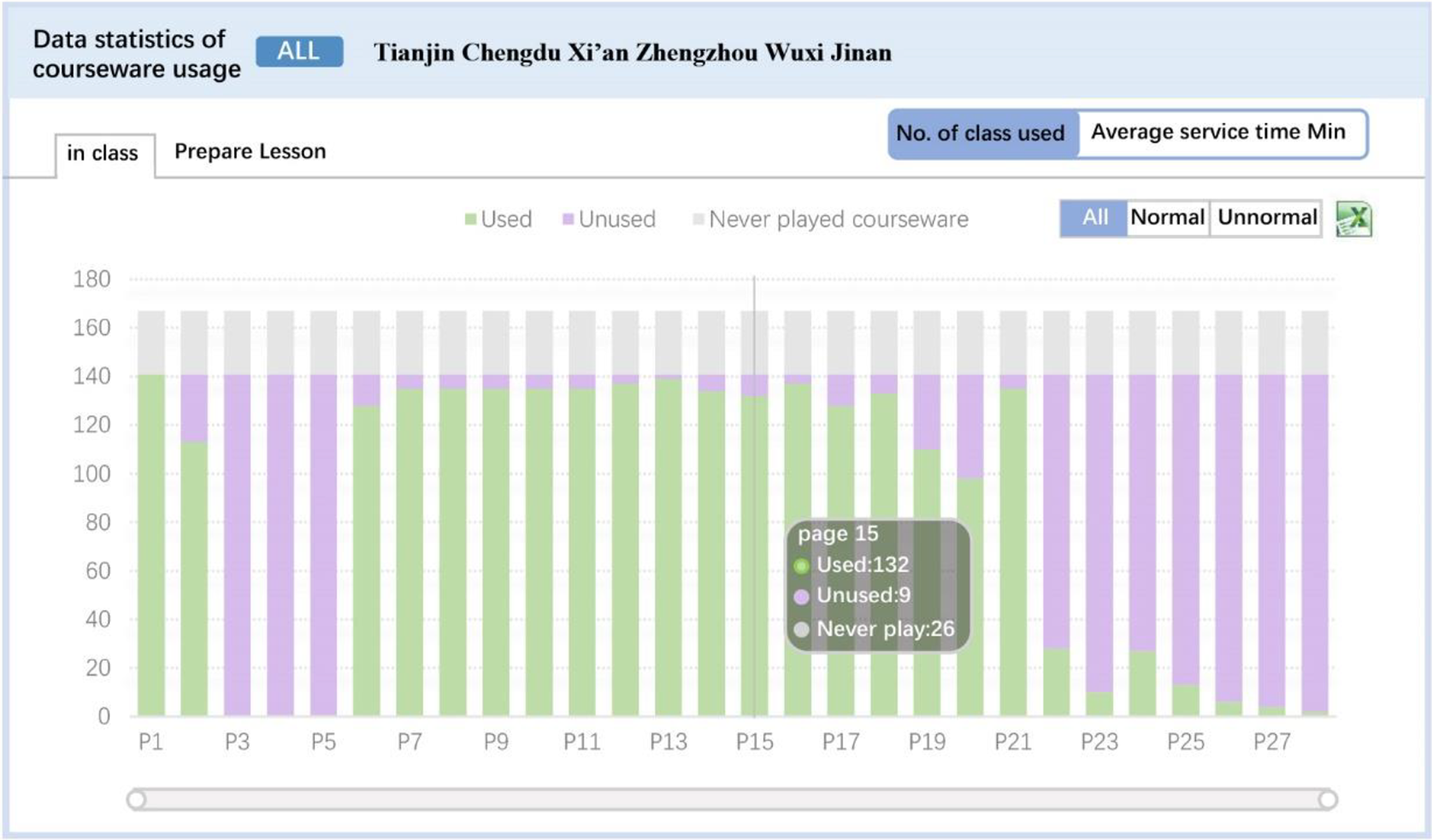
Sample courseware usage analysis of the number of classes using the software.
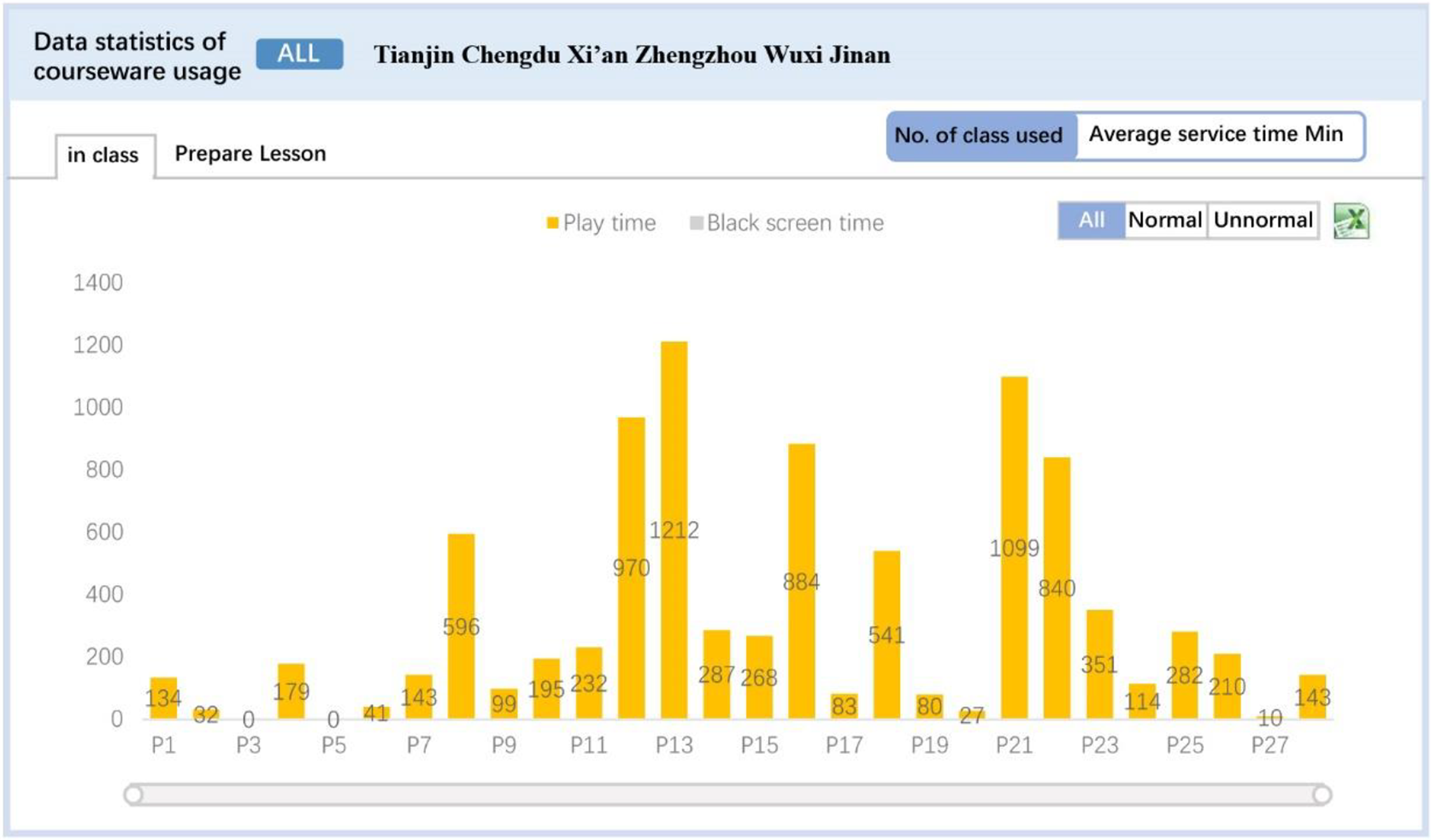
Sample courseware usage analysis of the duration of slide display.
The system helps make up for the lack of teaching experience of junior tutors. The case institution mainly employs fresh graduates from elite universities as tutors. They often have rich passion but lack teaching experiences. With the support of such standardized and systematized teaching materials and instructional tools, new tutors could better fulfil their teaching duties despite lack in experience.
The case institution went through a process of adaptation in which its teaching and instructional methods changed from paper formats to digital platforms. The tutors need to make effort to digest the content and logic behind standardized courseware. At the same time, the use of digital platforms also liberates them from organizing instructional content, writing on the blackboard, and other onerous tasks. Using electronic courseware can significantly lighten the burden of tutors and improve their teaching efficiency.
Teaching research era 3.0: Digitization
At the present stage, the case institution has designed more digitalized teaching materials and applied them to its classes. Meanwhile, its teaching research department performs more functions. Having gone through the previous two development stages and accumulated enough teaching resources, the headquarters’ teaching research team makes every effort to examine the national curriculum reform process, analyze mainstream textbooks, and timely adjust the modularized standard teaching materials provided for the branches. It also works hard to improve the integrity of the whole teaching research system.
The division of teaching research responsibilities has become more precise, and the teaching research team, technical team, visual design team, and the data analysis team are performing their own functions. The teaching research team focuses on curriculum content design, while the technical team keeps organizing and analyzing the exercise database (Tiku, 题库) and other types of teaching resources. The visual design team focuses on the creation and presentation of teaching resources, such as videos, animations, and 3-D modeling. The data analysis team assists teaching research team in analyzing feedback data. The ratio of the teams of teaching research, technical support and data analysis, and visual design is around 1:1:1. The scale of teaching research department at headquarters is about 50% of that of the whole country. Branches of the case institution which have internal teaching research teams are mainly set up in first- and second-tier cities, with an average scale of around 60 staff per city.
Today, the case institution has become one of the largest tutoring institutions in China. The company has developed its own system of controlling the quality of teaching research at the basic level. Taking the Chinese discipline as an example, when teaching research team members finish making courseware, they need to revise it under the guidance of team leaders and disciplinary specialists before uploading it to the instructional system. The team members then need to give a demo class using the instructional system in front of a group of frontline tutors and listen to their opinions and comments for amendments. Only after all frontline tutors have personally tried out the class, and their performance meet all the teaching standards, such as fluency, accurate expression, and teaching stance, can the teaching materials be applied to real classes. All the tutors need to provide feedback again after class on how they feel about the teaching materials and how effectively students can use such materials. The teaching research teams will further amend the materials based on such feedback.
In the process described above (also see Figure 4), the teaching materials have to go through several reviews before being finalized by the teaching research teams. The tutors have also gone through several rounds of practice and assessment. The teaching research teams constantly improve the materials based on frontline tutors’ and students’ feedback.

Workflow of the case institution’s teaching research system.
Conclusion
This article takes a case institution to examine how private tutoring institutions in China understand and respond to market changes in the area of teaching research and the possibility that their experience and discoveries might contribute to wider education ecosystem. Teaching research is important for both formal schooling and tutoring. The emergence and evolution of the case institution’s teaching research is driven by its growing scale, which requires standardization to ensure the quality of service as well as meeting individualized demand. With a clear division of labor among frontline tutors, teaching research teams, and technical support teams, it has gradually developed an internal teaching research system in constant search for balances between standards for quality control and diversity for individualized learning needs. Online tutoring platforms and different kinds of learning products have been developed to improve the tutoring effectiveness.
The case institution’s teaching research system is technology-driven. It has enabled cross-regional partnerships in teaching research, which on the one hand involves challenges in variations in local curricula but on the other hand enriches the research database and facilitates cross-sector teamwork. The use of real-time tutor and tutee feedback analysis as progressive assessments can be an effective strategy to improve teaching materials and other teaching research outcomes.
Meanwhile, school teachers’ expertise in subject matters and teaching research in schools is also valuable for tutoring companies to learn more about what is happening in formal schools, so that their services can better supplement school progress instead of causing a backwash. School teachers’ experience in grasping the trend of national curriculum development and their ability to analyze regional education systems are among the domains that private tutoring institutions lack. Zhang and Bray (2018) noted the importance of positive partnerships between schooling, tutoring, and other social actors where the strengths of educators of different nature could be mobilized to support each other. Such partnerships can also facilitate various education actors communicating for better education of the young. Tutoring companies could identify and extract from their daily practices insights that could be useful for formal schooling and even other forms of social education.
Another dimension might concern equity of education. Tutoring has been criticized for exacerbating social inequalities because access tutoring, unlike formal schooling, involves fees. Yet, despite the for-profit nature, certain dimensions of tutoring practices might provide tools and ideas for schooling toward more equitable education. The case tutoring institution’s efforts to provide their teaching research system and digital education products to primary and middle schools in less developed areas have produced some positive results. The experiences show the possibility of providing technological and pedagogical tools (which are products of collective research) to support frontier teachers in rural areas to reduce gaps.
Footnotes
Declaration of conflicting interests
The author(s) declared no potential conflicts of interest with respect to the research, authorship, and/or publication of this article.
Funding
The author(s) received no financial support for the research, authorship, and/or publication of this article.