




Abstract
Participatory action research (PAR) is an effective means of collaborating with older adults to support community change. Limited PAR literature exists in which older adults catalyse social change within neighbourhoods, particularly using virtual methods. In this paper, we discuss a virtual PAR process with older adults that occurred during the COVID-19 pandemic, and the results of inquiry into our application of PAR principles. We conducted PAR in a collective involving university researchers, older adult residents and community partners in an urban core neighbourhood in a mid-sized Canadian city and focused on enhancing daily life for older adults. The PAR project emerged through reflection on previous ethnographic findings regarding older adults’ daily life in neighbourhoods. Our PAR collective collaboratively identified a need among older adults for more accessible information about community resources. To support older adults’ participation and access to community information, the PAR collective created and distributed a free neighbourhood resource booklet, in print and digital formats, to promote equitable access. We evaluated the impact of the booklet through a survey and discussions with community partners. During our PAR process we found challenges and solutions related to using technology, engaging in discussion during virtual meetings, and making collaborative decisions. A combination of in-person, remote and online interactions seemed to facilitate relationship development amongst co-researchers and completion of the project. Future PAR projects would benefit from incorporating in-person, remote and online methods from the outset, as well as ways to support older adults in using and accessing technology. We further noted the value of a local resource booklet, in print and digital formats, in promoting neighbourhood information sharing.
Introduction
Participatory Action Research (PAR) is a valuable methodology for collaborative work with older adults as co-researchers and agents of change in their communities and neighbourhoods. In the context of barriers to in-person research, such as pandemics, environmental events, individuals’ health concerns and others, more research is needed regarding how to apply PAR using digital methods with diverse groups, including older adults. This paper aims to support and contribute to this growing area of literature through reflection on a virtual PAR project with older adult co-researchers. Insights gained from such reflection are a key feature of knowledge generated through PAR, which can be described as a cyclical process of co-creating knowledge, acting and reflecting, which leads to further knowledge co-creation and further action towards change (Minkler et al., 2010).
Literature on PAR with older adults highlights a number of limitations and challenges. In reviewing 40 PAR projects with older adults, Corrado et al., (2020) found that despite the potential for PAR to encourage co-research, co-learning and equitable collaboration to achieve change, older adults are seldom positioned as equal partners at all phases of a project. Building from the same review project as Corrado et al. (2020), Benjamin-Thomas et al., (2018) found that there is frequently a gap between the intention and the ability to enact key PAR principles such as equitable participation and social transformation. Buffel (2018) and James and Buffel (2023) found that co-research, that is, participatory approaches to research, with older adults continues to be limited despite increasing interest in how to support older adults as they age in place, addressing issues such as social exclusion, gentrification of neighbourhoods, lack of community spaces and inadequate public transit. Doyle and Timonen (2010), Buman et al., (2012) and Yankeelov et al., (2015) conducted PAR with older adults and noted the challenges inherent in recruiting, retaining and providing ongoing training to co-researchers, as well as maintaining co-researcher working relationships over time. Andonian and MacRae (2011) engaged in a PAR project using photovoice with older adults and noted technological barriers and inequities, finding that a peer mentor programme helped to mitigate difficulties. While each of these studies did not include virtual PAR methods, finding different ways to provide co-researchers with digital and technological skill building opportunities was a recurring theme.
Literature on applying virtual PAR with older adults is emerging and recent research has shown how researchers pivoted a project from in-person to online. La Rose et al. (2022) changed their initial design and some of their priorities when pandemic conditions required a shift to virtual methods. They found that despite the challenges of changing a project to a virtual format, familiar faces and an identifiable person as leader/host was preferable to un-hosted or asynchronous approaches. Salma and Giri (2021), whose methods included in-person as well as virtual, found that virtual collaboration during pandemic conditions revealed different priorities in terms of technology, which precipitated a shift in focus away from older adults’ comfort with technology and towards older adults in need of digital literacy training. Finally, Blusi et al. (2018) co-created social activities, which also incorporated a digital coaching system, specifically so that older adults could participate in social activities remotely without leaving their homes. Although this study was done prior to the COVID-19 pandemic, the focus on supporting older adults in their homes can be applied to pandemic conditions.
In this paper we aim to contribute to the literature regarding conducting PAR in virtual environments with older adults, a particularly important area given that older adults may experience exclusion from digital technologies (Kebede et al., 2022). We further aim to support future PAR work generally, whether in person, virtual or hybrid. This paper reports on a PAR study conducted in one urban core neighbourhood in a mid-sized Canadian city. Although the study began as an in-person PAR project, much of it was conducted online as a result of public health and individual measures employed to limit the spread of COVID-19. Furthermore, the focus of our PAR collective was on inclusive neighbourhoods and age-friendliness, topics that inevitably benefit from being in and moving about the neighbourhood, posing a challenge to enacting our PAR project online. Our objective in this paper is to present a description of our virtual PAR process with older adults, as well as the results of our inquiry into application of PAR principles. To do so we draw on our experiences creating, distributing and evaluating a neighbourhood information booklet, actions that arose through our PAR process.
Methodology and methods
This project is part of an ongoing PAR initiative, a research approach in which groups most affected by an issue collaborate with academic co-researchers and others to explore issues, share knowledge and implement solutions (Benjamin-Thomas et al., 2018). The larger initiative involved an ethnography conducted in collaboration with older adults and other community partners (Phase 1). The ethnography explored older adults’ community participation, social engagement and mobility, in two neighbourhoods in a mid-sized Canadian city (see McFarland et al., 2023; Stewart et al., 2022). Thirty-eight older adults participated in narrative interviews, activity-travel logging through GPS devices and diaries followed by an interview, and either go-along interviews or photo elicitation interviews. Phase 2 of this project was designed to utilize and build on Phase 1 study findings and apply PAR to collectively enhance neighbourhood life for older adults. This paper addresses our use of PAR in creating a resource booklet, one action of Phase 2. During this aspect of the project we engaged in the stages of the PAR cycle, including reflection, planning, action and observation (Benjamin-Thomas et al., 2018); we did this work primarily virtually, from November 2020 to December 2021. We held 13 meetings online via GotoMeeting, a tele- and video-conferencing platform, and hosted an outdoor event in October 2021 in compliance with COVID-19 guidelines and co-researcher comfort levels at that time. The PAR collective of co-researchers was initially composed of academic researchers and five older adult community members, and later was expanded with representatives of a local health centre and the city’s age-friendly network.
Throughout the project we aimed to apply PAR tenets. Benjamin-Thomas et al. (2018) developed a set of six principles and guiding questions that can be used to design and critically reflect on PAR projects. Their ideas can be synthesized into the following principles that explicitly state key actions that are essential within PAR:
Identify an issue through collaboration with people holding firsthand experiences of the issue, and determine how the issue is situated within sociopolitical, historical, cultural, gender and economic forces.
Locate the study as PAR using terminology and conceptualizations of PAR.
Apply a paradigmatic location, theory, methodology and methods that are consistent with the tenets of PAR.
Enact power sharing and equitable participation and collaboration of all co-researchers within all stages of the research process.
Take action towards personal and social transformation, that is, change that addresses injustices.
Engage in reflexivity, that is, an inquiry into how co-researchers’ own values and experiences influence the research and action processes, in order to consciously address the issues of power, justice, equity and cultural relevance.
We sought to enact these six principles of PAR.
In the present paper, we present a description of our PAR project process and its impacts, as well as the results of inquiry into our application of PAR methods. To facilitate reflexivity regarding our methods and our enactment of PAR principles, throughout the PAR project we kept records of meetings. In addition, some of the academic co-researchers kept reflective notes about the PAR process we were engaging in, and the research collective discussed the PAR process as a large group and in small groups, reflecting on how well we had enacted PAR principles. As well, we each reflected on, reviewed, and contributed to drafts of this paper as it was being developed. Authors of this paper include academic and older adult researchers, and all are referred to as ‘co-researchers’ throughout. Given that PAR is a long-term venture, this paper presents only part of our ongoing PAR process.
PAR process, impacts and reflections
The PAR process and our reflections on our work are discussed in the following sections, structured by the PAR stages of reflect, plan, act and observe.
Reflect
Building from Phase 1 of our study, the aim of Phase 2 was to begin a PAR process in one of the study neighbourhoods to enhance daily life for older adults in the area. Phase 2 started in March 2020 with an in-person community event that took place just prior to the implementation of provincial COVID-19 public policies which restricted public gatherings. The aim of the event was to share and discuss Phase 1 study findings and engage community members as a first step in creating a PAR collective. To prioritize the voices of older adults and set the groundwork for older adults to participate equitably in the proposed PAR collective, only older adults living in or around the chosen neighbourhood were invited (20 attended), along with academic researchers involved in Phase 1. The Phase 1 findings were grouped into the following categories: being out and about in the neighbourhood; shopping and access to goods and services; participating in leisure and recreation activities; socializing with others; and caring for the neighbourhood. The event involved viewing visual displays of study findings, reflecting on the findings, participating in small-group discussion, voting through sticker placement on the top priorities to address in the neighbourhood, and identifying possible next steps in creating age-friendly change in the neighbourhood. At the end of the event, the academic researchers proposed forming a PAR collective which would aim to create neighbourhood change. When proposing the PAR collective, academic researchers deliberately left the aims and processes open and flexible, so that those who joined could jointly determine the direction for the group, in line with the PAR principle of identifying issues through collaboration with the individuals that the issue most concerns (Benjamin-Thomas et al., 2018). Attendees were asked to indicate interest in being contacted to attend an initial meeting to form the PAR collective.
Shortly after the community event, the COVID-19 pandemic was declared and the province enacted ‘stay-at-home’ mandates, later followed by a series of measures to limit the spread of COVID-19, such as social distancing measures and limits on the size of public gatherings. As a result we paused our plans for the PAR project, after which we changed our original plans in recognition of the current context and started a virtual PAR process in November 2020. We invited Phase 1 participants, the older adult attendees of the March 2020 community event, and previous partners from community organizations to attend an online meeting to discuss topics and priorities that came out of the community event; invitations included postcards they could use to invite other older adults in the neighbourhood. As we began this virtual PAR process, we considered how to best include any older adult who wished to join, recognizing that many older adults may not have the supports and resources needed, including access to the internet and internet-enabled electronic devices, digital literacy skills and self-efficacy, and access to others who can teach those skills (Han and Nam, 2021; Hanninen et al., 2021; Hargittai et al., 2019; Wilson et al., 2023). To promote equitable engagement in the PAR process, our initial invitations provided options and information about how to join meetings online as well as phone support for any technology issues, and options to join meetings by phone, or to share comments through voicemail or written mail about neighbourhood priorities and how these might be addressed as a group.
Despite these efforts, and our perceived strong interest among attendees of the community event, only five older adult community members joined the meetings. Some joined online with little difficulty and others struggled with internet connectivity and computer devices as well as skill level; additional older adults who did not attend stated that having meetings online was a barrier for them, due to access, comfort and/or skill level related to technology. Four older adults requested the mail-in option, and three of these provided written ideas to inform the group’s work. In addition, due to budget constraints, we were not able to offer older adult co-researchers with compensation for their time, such as an honorarium for each meeting; offer of compensation may have promoted more older adults joining our collective. To recognize their contributions in some way, we provided co-researchers with coffee gift cards.
Despite the challenges faced and the smaller than expected number of older adults joining the online meetings, we found that the Phase 1 ethnography helped to create relationships that supported the creation of the PAR collective. The older adults who joined the virtual PAR collective were familiar with the study and had built positive relationships with the academic co-researcher who had conducted the Phase 1 data collection. On the basis of such relationships, these older adults, despite challenges, moved forward with virtual engagement.
A key topic in initial discussions of the PAR collective was information-sharing and knowledge of resources amongst local older adults. We discussed how at the March 2020 event, many attendees shared a lot of information about local events, activities and resources, and that many other attendees were not aware of these opportunities and resources, but would like to be. We also noted that in the Phase 1 interviews, participants mentioned opportunities in the neighbourhood that did not seem well-known and that some Phase 1 older adult participants were actively looking for information about their community, but with limited success. Through this reflection we collaboratively identified a need among neighbourhood older adults for more information about community resources. These initial discussions amongst the PAR collective reflected an early change, or transformation, that occurred as a result of the PAR process: the collective had a heightened awareness about inequities in access to neighbourhood information among local older adults. We decided to create, distribute and evaluate a resource booklet for older adults living in the area. In addition to our funding for the larger study (i.e. Phase 1 and Phase 2), we obtained funds from a local organization to support this work. Similar to Salma and Giri (2021), in keeping with PAR principles of co-developing priorities with those with firsthand experiences of an issue, we considered what would be feasible for us to do during a pandemic. The PAR collective determined that working on a resource booklet would be more feasible to complete during a time of social distancing than other potential projects, such as developing social activity programmes. Creating a print and digital booklet would not necessarily require in-person engagement and distribution could be done in ways that minimized risk of contracting COVID-19, thus fulfilling the collective’s goal for action without risking members’ health.
Plan
We created a booklet of neighbourhood resources that could support participation in the neighbourhood among older adults, in print and digital formats (https://engageresearch.ca/wp-content/uploads/2021/09/LIVING1.pdf). As we engaged in this work, the membership of the PAR collective changed, with members joining and leaving, often in line with the needs of the booklet project as well as each person’s access to technology and individual health concerns. The PAR collective discussed local organizations who may be good partners in our work and we decided to invite representatives of a local health centre and the city’s age-friendly initiative, as well as a city community developer; all expressed interest in supporting our work and began to attend meetings. Three older adults attended consistently (including LS, SL), and two additional older adults attended infrequently. When new people joined the collective, we sought to integrate them into the group through a warm welcome and introductions and ice-breakers at each meeting to allow them to get to know the members and vice-versa. We encouraged all forms and frequencies of engagement and did not require consistent participation to be part of the collective, aiming to support equitable participation through recognition of co-researchers’ life conditions and capacity to participate. We continued with online meetings throughout the project due to ongoing public health measures and for the protection of all.
Navigating videoconferencing technology and etiquette
We aimed to enact an equitable, participatory process, where all members could engage, however, technology proved challenging at times. Representatives of community organizations and two of the older adult co-researchers could navigate the videoconferences well with apparently good devices and internet. Other older adult co-researchers lacked up-to-date devices and software, with one older adult frequently joining by audio only and two others attending meetings infrequently due to difficulty hearing and being heard as well as dislike of online meetings generally. To overcome technological difficulties, we continued to provide support and encouragement related to technology issues, via phone and email. We had difficulty finding solutions for technology issues, and noted the limits of the digital literacy skills of the academic co-researchers to provide this support over the phone. We also continued to provide options for members to contribute comments and ideas by email and phone, a strategy that enabled a few participants to regularly engage with the project that they would otherwise not be able to do. The multiple options to engage with the PAR work was also beneficial to co-researchers who had no difficulty attending online meetings; for example, one co-researcher often provided written ideas and feedback, a practice he had also used in Phase 1 when participating in in-person meetings.
As we worked in an online environment, it became apparent that we were applying, learning and developing etiquette and conventions for working together. Unfamiliarity with digital meeting conventions, as well as difficulty in consistently implementing such conventions, may have contributed to some members’ experiences of discomfort with online meetings and hampered discussion and the PAR process. In one instance, some loud static led the lead academic researcher to mute a specific older adult co-researcher and briefly note to the group that she did so to avoid the noise. The co-researcher in question likely did not hear or fully understand comments about the strategy, because after the meeting she spoke on the phone with another academic co-researcher about feeling silenced. The situation illustrates competing needs when video-conferencing: to minimize unwanted noise during conversation, and to enable all participants to be able to speak when desired. In subsequent meetings, academic co-researchers provided more information about the strategy of muting participants to avoid static or echo and emphasized that speaking was still possible and welcomed, through unmuting oneself. In addition, technical issues such as lags in hearing audio sometimes resulted in inadvertent interruptions and cross-talk. Not being in a shared physical space seemed to mean a loss of many aspects of body language and cues that help with aspects of conversation such as turn-taking. One strategy that one co-researcher implemented occasionally and held potential for avoiding cross-talk was to state ‘end of thought’ at the end of their comments.
Navigating relationship-building as a foundation to PAR
A key part of PAR is establishing and maintaining positive, genuine relationships through working together as well as through more casual interactions. The virtual meetings seemed to act as a needed way to connect with others during a difficult time of distancing measures and isolation and to work on something meaningful. The group, however, was not as able to engage in more casual interactions, due to the virtual format of the meetings. In our experience, in-person meetings often involve unstructured social time before and after, about topics related to the work at hand as well as more personal, friendly conversations. For the online meetings we aimed to replicate a form of these interactions before meetings; however, such conversations were very much on ‘display’ to the whole group of attendees, likely leading to discomfort and less interaction.
A hybrid approach, when possible, seemed important in enabling relationship-building in our project. For example, a new academic co-researcher joined the project in August 2021 and began attending online meetings. They also met one research team member in person in September 2021, visited a variety of locations in the neighbourhood for booklet distribution, and attended the outdoor gathering we hosted in October 2021 to promote the release of our resource booklet. These in-person activities facilitated a greater understanding of the geography and atmosphere of the neighbourhood and created a deeper sense of connection to the community, to the project and to the other co-researchers. In addition, the fact that much of the collective’s work was done virtually also meant that when the same academic co-researcher had to relocate out of town, they could still continue to be involved in the project and stay connected with the research team.
Collective decision-making in PAR
The members of the PAR collective made decisions in several ways. In some instances, the decision felt like all were in agreement, such as deciding on the breadth of information to include in the booklet. Across a few meetings, we talked about needing to bound the booklet’s scope for it to be feasible for our group; avoiding replicating something already in existence, like the ‘yellow pages’ (a telephone number directory); and the fact that the Phase 1 older adult participants had shared much information about neighbourhood resources, possibly ‘insider’ information that would be useful to others. We ultimately decided to ground the booklet content in sharing older adult voices and drew information from the Phase 1 data collection, including text, photos and quotations. We did not include places or services that no longer existed and strove to note instances when certain services would be available only when COVID-19 restrictions lifted.
At other times, discussions involved diverging opinions, such as discussions about accessibility features in the booklet. We agreed broadly about features to promote general accessibility such as print and digital formats, plain language, a text-only/graphic-free digital version, large font and spaced-out layout to enhance readability. We diverged on the need for image descriptors in the booklet. Co-researchers with experience of the needs of people with vision loss were in favour of image descriptors, for the document to be fully compatible with digital screen readers as well as magnifiers that people with vision issues may use. Other co-researchers with specialized skills in print documents, and who prioritized clear layout and format of the document, seemed to be in favour of no image descriptors, thinking they would clutter the layout for not much value for most readers. Academic co-researchers engaged in reflexivity during such discussions, aiming to limit their positions of power in the collective, but also wanting to be a voice for people who were not in our collective, such as older adults with vision loss and/or other disabilities. In the end we reached a compromise, by creating a print version with no image descriptors and a digital version with image descriptors.
In addition, there were times when it seemed the community co-researchers backed off from a decision to allow the academic co-researchers to make a decision, implying or saying that the academic co-researchers should do what they thought was best. Part of this dynamic may have been related to perceived hierarchies, as well as our collective decision to base the booklet content on information from Phase 1 study participants. The community co-researchers were less familiar with these data and findings than the academic co-researchers as they had not read the interview transcripts. The experiences of the community co-researchers sometimes diverged from the experiences of the Phase 1 participants, sometimes creating tension among co-researchers, which the academic co-researchers attempted to resolve by revisiting our decision to use Phase 1 interview data and emphasizing the value of information from this larger and more diverse group of older adults. Given the complexity of PAR generally, and virtual PAR specifically, it is difficult to know whether these types of challenges could have been addressed differently in an in-person context.
Finally, in other discussions with diverging opinions, community co-researcher ideas were prioritized. For example, in discussions about problems with paratransit, some academic co-researchers felt a need to highlight issues with paratransit, as they were described by Phase 1 study participants, whereas older adults and community partner co-researchers felt that providing too much negative information about the service was not needed and was the wrong tone for an information booklet. In the end we decided to provide information about service limitations factually (e.g. that users must book ‘three days in advance of your trip’) rather than experientially based on Phase 1 quotations (e.g. ‘But you got to phone three days ahead, that’s what makes me mad’).
Seeking sustainability
As we created the booklet, we tried to plan for sustainability, a key part of PAR (Benjamin-Thomas et al., 2018), which was shaped by the unpredictable context and shifting measures of a global pandemic. A main area of concern that arose throughout all stages of the booklet project, was about booklet content soon being out of date, such as details about business hours and specific services. We explicitly stated in the booklet the date of compilation and that some information may become out of date; we also recognized that some information like phone numbers were unlikely to change and therefore readers could seek out more current information at a later date.
Furthermore, one of the PAR co-researchers had played a key role in writing, editing and distributing a neighbourhood newsletter in prior years, and spoke about the large amount of work involved, which would not be sustainable within our small PAR collective. We reached out to the local neighbourhood association as a potential collaborator but found that they had very limited capacity with minimal to no activity since the COVID-19 pandemic started. We decided to go forward with one iteration of our booklet, hoping that circumstances for potential collaborators might change over time, and accepting that uncertainty is part of the PAR process. We also aimed for this booklet to be a test of whether creating such a resource is feasible and useful and could be part of a larger strategy aimed at enhancing awareness of neighbourhood resources among older adults.
In addition, our online PAR process was more sustainable than an in-person process in many ways. Co-researchers were able to join meetings with no travel time or travel expenses, benefitting one co-researcher who moved out of province and those with mobility concerns such as difficulty getting around and lack of access to a vehicle. There were also no costs to rent space, which had typically cost approximately $40 per meeting in the past, off-setting costs of monthly videoconferencing. It is also likely that in-person meetings would have been cancelled throughout the year due to weather and scheduling conflicts. Online meetings proved convenient to attend. The virtual format also allowed academic and community co-researchers with health concerns and/or disabilities to continue to participate in discussions that might otherwise be risky to attend in-person during an ongoing pandemic. As COVID-19 measures shifted and were removed, managing personal risk became the burden of individuals, generally; holding online meetings mitigated some of the risk that at least some co-researchers were navigating. In addition, access amongst the co-researchers to a computer and internet facilitated communications about meeting times and sharing notes and other materials, and phone calls to some members without this access, to collect feedback about the agenda’s points, were relatively easy to conduct. Given that other public health and/or environmental crises are likely to occur, the lessons learned at the height of COVID-19 measures are applicable to future situations in which some populations are at far greater risk than others. Online meetings are, in other words, an important option going forward to increase accessibility and inclusion for a wide range of people who might otherwise be excluded.
Act
The PAR collective aimed to take action, through distributing the booklet we created, in a collaborative way that involved power sharing and participation by all. The lead academic researcher helped facilitate this process by asking PAR collective members to co-develop a distribution plan for the print and digital versions of the booklet. The group engaged in collaborative decision making about how and where to distribute the booklet in the community, and older adult co-researchers particularly provided the most useful ideas about locations. In fall 2021, we printed approximately 400 booklets and distributed to 30 Phase 1 study participants and 19 community partners, including local variety stores, food marts, pharmacies, entertainment venues, apartment buildings, recreation centres and libraries. Academic co-researchers also distributed digital copies in a variety of ways, such as through emails to 21 previous study participants, the listserv of the city’s age-friendly network, the website of the lead academic researcher and the homepage of a local organization that serves seniors. As social distancing measures had lessened by this time, and in keeping with a PAR tenet that part of equitable participation is co-researchers taking up roles that are of interest, academic and older adult co-researchers distributed the booklets to local organizations, and older adult co-researchers distributed copies to other interested older adults in their networks. We considered locations where older adults would likely go and were able to go given pandemic measures. Telephone and email follow up with each distribution location were used to gather information about distribution numbers and determine if more copies were needed or wanted. Based on these check-ins, likely all booklets were distributed, to local older adults and/or people who support older adults. We also created information posters and postcards about the booklet (drafted by some academic co-researchers and refined by all PAR collective members), with contact information to request a booklet copy, that we distributed at locations where printed copies were provided.
At a meeting in September 2021, we discussed the small number of older adults in our PAR collective and a desire to have more people attend online meetings. We decided to host an outdoor event with a few aims in mind and in a way that recognized a need to exert caution related to the spread of COVID-19 and keep the community safe. We aimed to launch the booklet and reconnect with current members of our PAR collective and invite others to join. Printed invitations were sent to previous study participants, email invitations were sent to older adults known to the academic co-researchers, and PAR collective older adults invited additional older adults. The event occurred in October 2021 and seven older adults, including three PAR co-researchers, as well as three academic co-researchers attended. Having an in-person event after months of virtual meetings helped people to connect socially in an informal setting and strengthened engagement in the PAR collective amongst all members. Those who attended were very appreciative of having a socially distanced in-person event, stating how good it was to connect in person.
Observe
We engaged in collaborative decision-making and decided to evaluate the booklet impact and process of booklet creation and distribution, in order to assess its impact and potential for creating change in the community, and the methods through which to do this. This evaluation involved several steps. We created a survey to evaluate the format, content and usefulness of the booklet in supporting older adults’ community participation. We also gained informal feedback through discussions with older adults and organizations that had helped with distribution, and we reflected as a collective on the process of creating, distributing and evaluating the booklet.
To ensure the survey was as accessible as possible, the booklets included an invitation to complete the survey, either online, over the phone or in print, and paper booklets were distributed with a survey and a stamped, mail-back envelope. The surveys were anonymous and submitting a survey served as consent to participate in the study. We noted that print copies of the evaluation form were being returned more consistently than the online survey, a possible indication of the importance of printed materials for some communities of older adults, and thus additional print copies of the booklet and evaluation forms were delivered to locations that indicated interest.
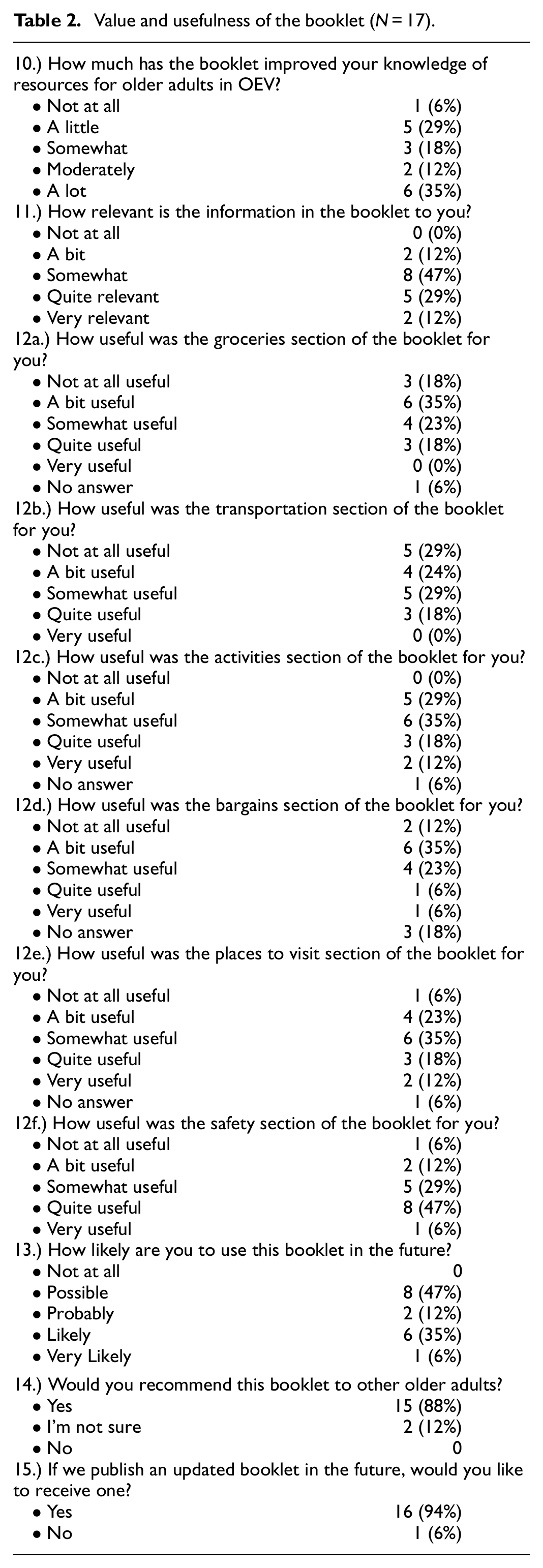
We aimed to enact change through our PAR work, in line with the PAR principle of taking action towards personal and social transformation (Benjamin-Thomas et al., 2018). The process of creating, distributing and evaluating the booklet seemed to create change in the wider community and within our PAR collective. Regarding change in the wider community, survey data and informal feedback we have collected about the booklet suggests it is a needed and useful resource (See Tables 1 and 2). We noted that survey respondents were positive about the format of the booklet, including that they liked the booklet’s ‘large print’, ‘colour points’, ‘organized and relevant headings’ and ‘photos of various locations’. In written feedback, respondents stated they appreciated that it was designed specifically ‘for [neighbourhood name] residents’, ‘based on interviews with older adults who live in the area’ and ‘value[s] [seniors’] input’. Further survey questions were aimed at determining impacts of our work. Respondents were divided about whether the booklet had improved their knowledge about resources in the neighbourhood for older adults; about one third of participants reported, ‘not at all’ or ‘a little’, and about half reported ‘moderately’ or ‘a lot’. Nearly half of the respondents found the information in the booklet to be ‘somewhat’ relevant to them and approximately 40% thought it was ‘quite relevant’ or ‘very relevant’. Respondents also thought some sections of the booklet were more useful than others; the safety section seemed the most useful. This coincides with the number 1 priority from the March 2020 event, which was ‘Being Out and About’, and echoes some Phase 1 findings, including safety issues such as navigating unpredictable crowds of people on sidewalks. See Table 2 for details. In addition, all the distribution locations were able to hand out booklets to older adults, despite the fact that distribution took place during the COVID-19 pandemic in fall 2021. The few online surveys that were completed suggests that uptake of paper copies was greater than uptake of the digital format. Overall, the evaluation information suggests that the booklet created increased awareness of community resources and community information amongst the survey respondents, potentially supporting community participation amongst older adults living in the neighbourhood.
Survey respondent characteristics (N = 17).
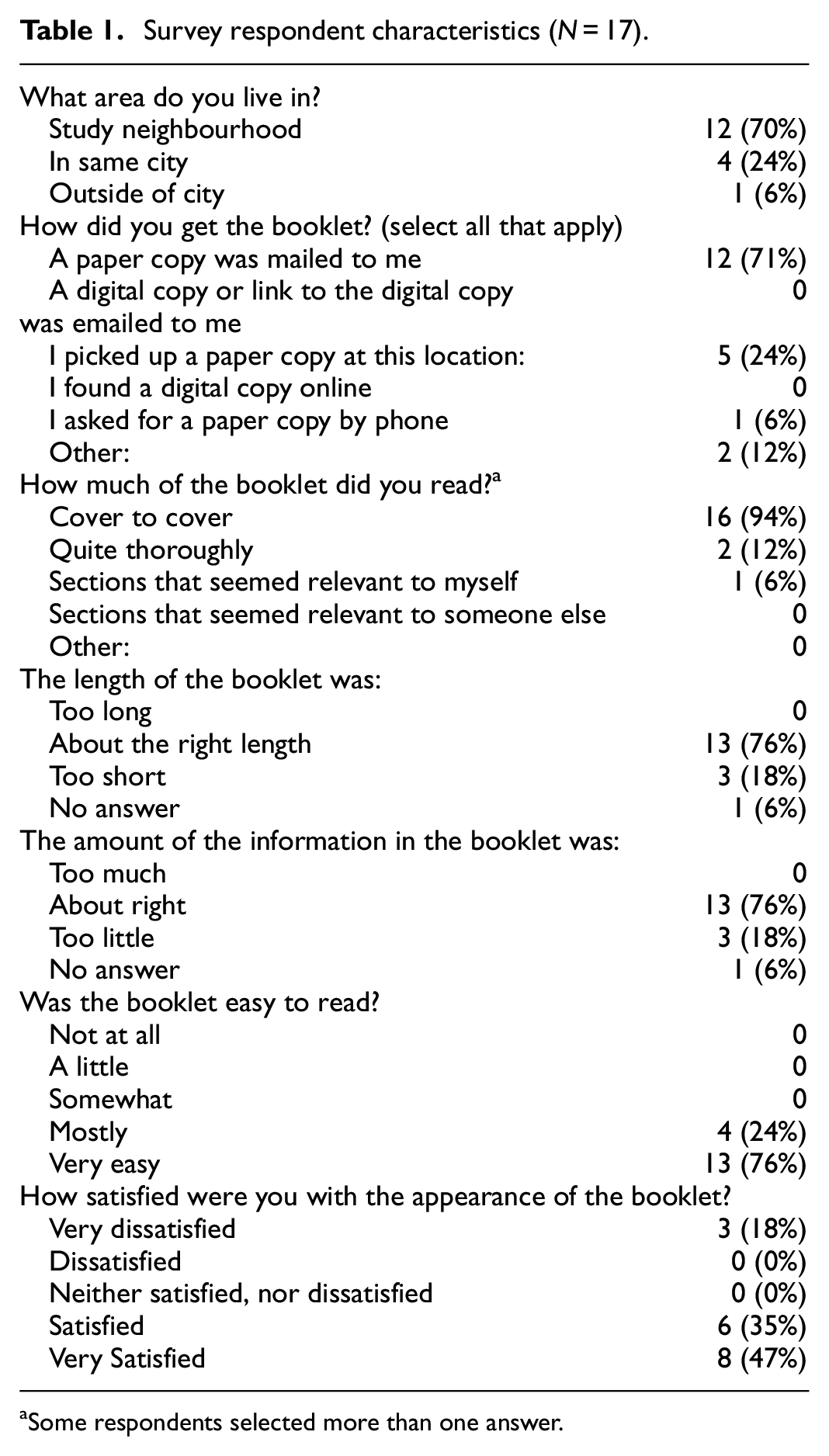
Some respondents selected more than one answer.
Value and usefulness of the booklet (N = 17).
Regarding change in our PAR collective, the process also helped to further build relationships within our collective, such as with staff from local organizations who began attending PAR collective meetings more frequently, and amongst the older adult members of the PAR collective. At this stage some members left the online PAR process, notably, an older woman who reported challenges with the online meetings but wanted to stay updated about the process and continued to offer feedback and input. Another member also preferred to receive updates rather than attend meetings, due to their own health issues. These departures felt like a loss of older adults’ voices in our process, which was partially mitigated by staying in touch with these co-researchers through email, providing the opportunity for co-researchers to come into and out of the project according to their comfort and interest. Supporting the engagement of PAR members in a variety of ways helped us collectively continue to work on additional projects, such as a community participation survey.
The booklet survey and examining the process of creating and distributing the booklet also provided new information to our PAR collective, that could be used in future projects, supporting the sustainability of our work. Specifically, we learned about local seniors’ community information needs, such as an interest in receiving future iterations of the booklet, which informed one of our next steps to further explore how information can be gathered and shared in a sustainable way. We noted that creating the booklet required a large amount of work, from developing content to formatting to revising. Conversely, distributing the booklets was a relatively easy process, with several people handing out booklets to different locations.
Discussion
In this paper we have reflected upon a virtual PAR process, conducted with a desire to protect community and academic co-researchers from exposure to COVID-19, as well as in compliance with health measures to reduce the spread of COVID-19. We found that our virtual PAR project, conducted with older adults and aimed at promoting older adults’ participation in their neighbourhoods, was feasible and generally effective, involving challenges and a need for creative methods. Other authors have shown how participatory research co-production with older people can help to support age-friendly communities (e.g. Buffel, 2018), and our work adds to this literature by conducting similar work through virtual methods. In line with PAR principles (Benjamin-Thomas et al., 2018), we were able to collaborate with older adults to determine issues and priorities, discuss how social, political, economic and other factors relate to the issue, make plans to address the issue and then take action. Our shift to virtual methods did not change our over-arching goal of enhancing neighbourhood life for older adults, however, our priority-setting was affected by contextual factors, particularly considerations of what would be possible in the context of a pandemic. Similarly, La Rose et al. (2022) found they needed to shift their PAR goals and priorities significantly, and move to an online process as a result of the pandemic and related public health measures.
Throughout the project we engaged in reflexivity, and while we aimed to engage in equitable participation, power sharing and collaboration (Benjamin-Thomas et al., 2018), we were continually aware of the fact that many older adults were not able to participate online, similar to the experiences of Salma and Giri (2021) in their PAR project. Those authors had difficulty engaging older immigrants with low digital literacy skills as well as those experiencing isolation. One useful strategy they used was to allow co-researchers to choose the social media platform they would use to connect, such as WhatsApp (Salma and Giri, 2021). Videoconferencing and teleconferencing were our main ways of collaborating, which also posed barriers to some co-researchers. Lack of affordable internet services and devices could be addressed by forming collaborations to support seeking donations and discounts (Rusnak, 2021). Training and support are critical, and communication and initial training by telephone has been reported as a needed option for many older adults (Rusnak, 2021). One option that was not possible in the current project due to pandemic guidelines and personal comfort levels was an in-person digital learning session, with masking and precautions (Salma and Giri, 2021), as well as providing devices, such as wifi-enabled tablets, and online digital literacy tutorials (La Rose et al., 2022). Assisting older adults to identify and gain support from ‘warm experts’ may also be useful; these are people whom the older adult is close to and can provide technological support (Hanninen et al., 2021).
Finally, one useful strategy that we implemented was providing alternative options to engage in the project, aside from videoconferencing, including individual phone calls outside of meetings and mail in options. Future projects could plan for multiple ways of engaging in PAR, such as hybrid options that incorporate in-person, remote and virtual activities, as well as planning for supports that may be needed for using technology. Reflecting on a large collaborative project with older adults, Vrkljan et al., (2021) similarly recommended that studies be designed with in-person and virtual options from the outset. This may require advocating to research funders to provide funds for activities such as training and electronic devices (Janes, 2016).
Related to equitable participation in PAR tasks and phases, as observed by others applying PAR (e.g. Doyle and Timonen, 2010; Hand et al., 2019), not all people engaging in PAR want to work intensely at all phases; rather, similar to our findings, a focus on translation of research into actions, as well as an emphasis on knowledge sharing rather than research task completion may prevail. In our case, the community co-researchers chose to be heavily involved in booklet creation and distribution (i.e. planning and action tasks) through advising, making recommendations, editing documents and handing out booklets, but not as involved in contributing to survey development (i.e. research). These choices demonstrated the importance of co-researchers being able to choose for themselves their degree and types of involvement, in line with the PAR principle of power-sharing and autonomy within power-sharing (Benjamin-Thomas et al., 2018).
Equitable participation is also related to motivations and compensations for engaging in PAR. Likely all co-researchers had a desire to contribute to the neighbourhood, and additional motivations included continuing a programme of research (for the academic, faculty member co-researchers) and obtaining pay (for the academic, trainee co-researchers). The community co-researchers did not receive any additional benefits, aside from the opportunity to contribute to their neighbourhood and gift cards as thank-you tokens. Given that some groups of older adults feel undervalued, overworked and invisible in their communities (Stewart et al., 2022), future PAR projects (as well as other forms of community participation and volunteerism) could benefit from greater considerations of compensation. Small tokens, snacks or meals may help sustain volunteer engagement (Buman et al., 2012). Seeking to compensate community co-researchers fairly for their contributions is important from an equity perspective; however, as Janes (2016) highlights, a critical tension in PAR is that for some community co-researchers experiencing social inequalities, no amount of honoraria or tokens may be adequate recognition (Janes, 2016).
We aimed to enact equitable participation as we navigated discussion and collaborative decision-making as a group. Overall, this process seemed relatively successful, despite the challenges of facilitating virtual meetings and the variety of forms of collaborative decision-making that we noted. Future PAR projects could involve paying attention to the different ways that decision making may occur and checking in with any co-researchers who appear to be retreating from decision-making, such as specifically asking if they would like to weigh in on the topic. Such questions may generate useful discussion and insight into the degree of ownership co-researchers have for the project, their perceived level of expertise about the topic and others. Furthermore, seeking input outside of meetings, such as opportunities to send in anonymous feedback prior to meetings, could promote engagement of those who may be reluctant raising concerns within a group meeting.
A key need in PAR and virtual PAR is relationship-building, and we accomplished this in a variety of ways, such as inviting people to be co-researchers who had a prior relationship with the overall project, hosting an in-person meeting and providing time for socially connecting in virtual meetings. In addition, to attract potential co-researchers who may be reluctant to participate in virtual PAR for a variety of reasons, community liaisons could be helpful; Salma and Giri (2021) found these staff members helpful in recruiting older adult immigrants to participate in their PAR project. Finally, multilingual staff members may be helpful, as La Rose et al. (2022) found them effective in working with Arabic-speaking older adult migrants. Such approaches could assist in attracting diverse older adults to PAR projects.
Throughout this project we saw that part of successful collaboration and relationship-building within PAR was positive experiences of the process amongst co-researchers. As also noted by Salma and Giri (2021), the pandemic produced many stressors for everyone involved in our PAR collective. All co-researchers were limited in where they could go, and in the early months were not able to be with people outside of their household, resulting in feelings of social isolation for many. The interactions and tasks involved in the PAR collective seemed to be a support for the co-researchers, as we valued having this work to engage in and coming together each month. While the virtual format carried limitations and challenges, the meetings promoted relationship-building and checking in on each other during a time when socializing was constrained. Relatedly, Salma and Giri (2021) reflected on data collection with older adult participants as ‘care work’, that promoted social connection during the pandemic. The academic co-researchers also benefitted from continuing the PAR virtually, related to meeting funder obligations through ensuring study progress and moving towards publications.
While our objective in this paper is to reflect on our PAR process, the project also suggests implications for information sharing among older adults. The PAR project showed that print-based information specific to a single community is a useful addition to other forms of digital and print information that large cities often provide. Neighbourhood-based, printed information booklets that support the sharing of information from older adults may be a good way to support older adults in participating in their communities. Despite this perceived need, creating and circulating such a booklet requires significant time and funds. Finding ways to collaborate with organizations like local age-friendly councils or community associations may help to share the work of creating such booklets.
Conclusion
In this paper we explored and provided reflections on a virtual PAR process with older adults living in a neighbourhood in a mid-sized Canadian city. We illustrated the ways in which we strove to enact PAR principles, challenges we faced and potential solutions. Our process was feasible and generally effective, involving collaborating to determine issues and priorities, discussing factors shaping issues, making plans and taking action. We found that distributing print-based information about neighbourhood resources through collaborations with community partners can be an effective way to support older adults’ engagement in their communities. Technology training and support are critical in virtual PAR projects, as well as access to affordable devices and internet. Providing non-internet-based options to engage when technology is a challenge is also important, such as individual phone calls, mail-in comments and in-person events. We saw that equitable participation in PAR is enacted when co-researchers can choose the aspects of the work they wish to be involved in, and such participation can be promoted through compensation such as honoraria, tokens and meals. Finally, the collaborative decision-making that is essential in PAR requires intentional actions, such as checking in with co-researchers. Future PAR projects could benefit from these insights, reflexively seeking to implement PAR principles.
Footnotes
Acknowledgements
We would like to thank all those who contributed to the PAR Collective and the people who participated in the booklet survey.
Declaration of conflicting interests
The author(s) declared no potential conflicts of interest with respect to the research, authorship, and/or publication of this article.
Funding
The author(s) disclosed receipt of the following financial support for the research, authorship, and/or publication of this article: This work was supported by grants from the Social Science and Humanities Research Council of Canada (grant number 435-2018-1440) and the South West Frail Senior Strategy.

Author biographies
While residing in one of the project neighbourhoods,