




Abstract
This paper offers best practice guidance on participatory action research (PAR) methods in modern slavery studies, through sharing the experiences of survivors of modern slavery as active project consultants. By using participatory approaches and engaging in an action learning set model, this paper aims to understand how to meaningfully engage survivors of modern slavery as co-researchers. Inclusion was at the heart of this research study, and thus, this paper was co-produced by survivors of modern slavery. Through their voices, and by engaging in reflexivity, we share the challenges of engaging in meaningful peer research methods, lessons learned as well as the benefits of adopting this approach to provide creative, engaging and empowering opportunities for participation in research and skill development. We share some examples of challenges and successes in our approach to understand what meaningful peer research methods look like, addressing conservative and more liberal views including academic expertise, safeguarding and empowerment. In concluding this paper, we provide some recommendations for best practice, recognising a continual need to reflect and adapt peer research approaches that suits the needs of the peer researchers as well as the subject to be studied. The overwhelming sentiment, is that social science research must look to engage in peer research methods, recognising the expertise of lived experience, and the potential for research to empower others while also creating meaningful change.
Keywords
Introduction
This paper offers best practice guidance on participatory action research (PAR) methods in the field of modern slavery, offering a methodological roadmap of our research study, with input from survivors of modern slavery as active project consultants. Consequently, this paper offers recommendations and lessons learned when carrying out PAR, given the dearth of knowledge in modern slavery studies (University of Birmingham, 2021; Yang and Dibb, 2020). High quality peer research methods involve peers in the research process from conception, with activities led, co-produced, and advised on by survivors (Fahlberg, 2023; Kennedy et al., 2022; Yang and Dibb, 2020). Yet by failing to address critical barriers to inclusion (Holland-Hart et al., 2019), research has neglected to capture voices that are not privileged or socially prominent (Beresford, 2013; Kalathil and Jones, 2016).
To fulfil our objectives, this paper is split into three main sections. First, is a literature review giving crucial background highlighting the issue of modern slavery and human trafficking within a UK context. Then, the paper explores the importance of peer research methods and the need for meaningful engagement of survivors in modern slavery research. After contextualising the lack of best practice guidance, this paper presents a methodological roadmap, alongside reflections and direct quotes from our peer researcher study, exploring the impact of peer research on them. Consequently, this paper highlights the importance of ensuring equitable engagement from peer researchers, such that their input is valued, while offering critical reflection on how our own attempt at PAR can be improved upon.
Literature: Modern slavery
Modern slavery and human trafficking (MSHT) is a UK political agenda-topping issue, motivated by global geopolitical changes that aggravated trans-population movement and the development of organised crime groups (Di Nicola et al., 2017). Human trafficking, the exploitation of humans for monetary gain or benefit (Keskin et al., 2021), is a complex crime, recognised in the Palermo Protocol, which identifies three elements – act, means and purpose (Directive 2011/36/EU). The ‘act’ includes the recruitment of victims; the ‘means’ are the ways offenders carry out the act of human trafficking, for example, through force, abuse of power or coercion; and the ‘purpose’ is the exploitation of victims. This can take many different forms, such as sexual exploitation, labour exploitation, criminal exploitation and domestic servitude.
In 2021, 16,938 potential victims of modern slavery were referred to the UK Home Office (2021). Of these referrals, 52% (n = 8854) were for potential victims who claimed exploitation as adults, 78% (n = 6874) of whom were male and 22% (n = 1978) were female. Albanian nationals (27% of all identified victims; n = 4613) overtook UK nationals (25%; n = 4185) as the most identified nationality in survivors of exploitation in 2022, with Eritrean nationals (7%; n = 1171) being the third most referred through the National Referral Mechanism (a framework for identifying and referring potential victims of modern slavery and ensuring they receive the appropriate support (Home Office, 2021)). For adult potential victims, labour exploitation was the most reported form of modern slavery (39%; n = 3433), with 9.5% (n = 845) of referrals for sexual exploitation. However, the true number of victims is likely to be much higher, owing to both a lack of awareness and understanding of trafficking and victims’ willingness or ability to report (Cockbain et al., 2020; Cockbain and Bowers, 2019).
Literature: Peer research
Meaningful inclusion of people with lived experience of modern slavery in research and policy development is a growing conversation (Asquith et al., 2022). Lushey (2017) defines peer research as a participatory research method in which people with lived experience of the issues being studied take part in directing and conducting the research. A ‘peer researcher’ is understood to be an individual from the community being studied, who utilises their lived experience and contextual understanding of their community to help generate information for research purposes (Edwards and Alexander, 2011). The wider literature exemplifies the importance of including a diverse range of voices, particularly those historically marginalised, in the design, development and administration of the research that affects them (Ferris et al., 2021; Lushey, 2017; UKRI, 2020). Peer research methods recognises the agency and competency of individuals being researched to actively participate as co-researchers. However, this is successful only insofar as the research process facilitates the equitable inclusion of peer researchers.
When designed effectively, the advantages of peer research methods are multiple, including empowerment and co-learning of research subjects (Hollis et al., 2022; Kennedy et al., 2022); establishing meaningful relationships with community groups; extension of research impact (Hollis et al., 2022); better quality data (Hollis et al., 2022; Kennedy et al., 2022); and, in the case of this research field, increase the effectiveness of programmes and policies addressing modern slavery (Asquith et al., 2022). Moreover, Fahlberg (2023) spoke about decolonising the research process, ensuring the inclusion of peer’s voices, allowing them to derive benefits and inform the study’s impact.
There is agreement across the anti-slavery sectors that more needs to be done to understand the needs of survivors of modern slavery through meaningful engagement in research (Lebovitch and Ferris, 2018; Van der Meulen, 2011). The body of research exploring MSHT is extensive, with a growing understanding of the ways the internet and adult service websites (ASWs) can harbour MSHT activity (OSCE, 2022). However, the inclusion of MSHT survivors’ voices as peer researchers is rarely present, despite research demonstrating its value for scientific research (University of Birmingham, 2021; Yang and Dibb, 2020). Traditionally, modern slavery research has involved targeting survivors of modern slavery (alongside practitioners, law enforcement and support services) as interview participants only, without actively consulting survivors on how their lived experience can shape ethical research practices that maximises impact (for example see: Bales et al., 2015; Caruana et al., 2021; Lightowlers et al., 2022; Ramiz et al., 2020). Given the lack of a protocol, most lessons learned are taken from previous reflections on other topics (for example see: Fahlberg, 2023; Peltier, 2018; Wallerstein et al., 2017), or learning from your own research practice. This means survivors are rarely engaged appropriately, or to the full extent in ways which acknowledge their expertise.
Scott (2001) criticised the primacy of academic voices over survivor reports, particularly when researching those who are societally oppressed and whose voices are typically unheard. Fahlberg (2023: 115) argues that Participatory Action Research (PAR) implores us to de-structure the ‘Westernized scaffolding of empirical research and reimagine the institutionalized and taken-for-granted practices in which we engage as producers of knowledge perceived as legitimate by mainstream society’. Thus, peer research methods must be innovative, creative, and flexible to incorporate the diverse needs of marginalised research populations.
Involvement of survivors as peer researchers challenges traditional ways of doing research, contributing to research outputs that are meaningful and contextually informed (Bissell et al., 2018; Brett et al., 2014; Jennings et al., 2018). Beyond the benefits to knowledge production, survivor involvement addresses researcher hierarchies and the disempowerment and silencing of survivors’ voices (Perôt et al., 2018; South Central and West Commissioning Support Unit, 2017). PAR focuses on decolonising the research process, acknowledging lived experiences and contributing to social impact while challenging the hegemonic power relations in academia that are deeply gendered, classed and racialised (Fahlberg, 2023; Grant et al., 2008). Meaningful engagement of survivors in peer research must allow for an equitable power dynamic, that allows for individuals’ voices to be implemented beyond just being heard (Kennedy et al., 2022). Perôt et al. (2018) argue that without such inclusion, the research process can retraumatise by replicating the exclusionary dynamics of abuse. Thus, high quality research co-conducted by survivors can be an empowering source of healing and self-development (Kennedy et al., 2022; Ramirez and Allison, 2018), while accurately representing survivors’ voices and experiences, contributing significant impact to the research field (Perôt et al., 2018).
Methods: Peer research methods
The core challenge this peer research study addressed is that Adult Services Websites (ASWs) are an extensive feature of the digital world that facilitate the advertising, negotiation and purchase of sexual services yet are also considered to be harbourers of sexual exploitation, modern slavery and human trafficking (MSHT) (Giommoni and Ikwu, 2021; Milivojevic et al., 2020; Sanders et al., 2018). While awareness of cases of internet facilitated MSHT has entered the public and policy domain, little is known about the role and responsibilities of ASWs. Funded by The Modern Slavery Policy and Evidence Centre this 1-year research project investigated what role ASWs can play in preventing MSHT in the UK. An expert advisory group, comprised of stakeholders in law enforcement, modern slavery NGOs and the National Crime Agency (NCA), provided input throughout to ensure the research, analysis, dissemination and impact pathways were relevant, robust, and feasible.
This mixed-methods study employed 30 semi-structured online interviews with law enforcement (across 23 forces in England and Wales), 13 interviews with practitioners and 5 with ASW operators and an online survey with sex buyers (142 responses) to generate a unique body of evidence that reaches beyond existing data or government consultation (Keighley and Sanders, 2023). This four-way approach gathered a 360-degree perspective of ASW activity to understand their role and working practices in modern slavery prevention. This research also aimed to increase the proactivity and responsibilities of ASWs to identify and prevent exploitation on their platforms.
The interviews and qualitative survey data was analysed using thematic analysis (Attride-Stirling, 2001). Thematic analysis was presented through key themes, which enabled an emotionally sensitive, insightful and rich exploration of the data’s patterns. Furthermore, the data was organised using a representational tool that is accessible and easy to interpret (Attride-Stirling, 2001).
After much reflection on best practice methods, this project implemented a participatory action research approach, led by the Principal Investigator and Co-Investigator who have 12 years’ combined experience with PAR. The academic researchers recognised their privilege as middle class, white women and were conscious of this and the power dynamic that could minimise the voices or role of the peer researchers. However, a power imbalance is inherent in academia (Lake and Wendland, 2018; Smith et al., 2010), so while every effort was made to minimise its effect, this was ultimately an academic research project based on established research questions with funding priorities that can never be completely equitable. This will be further explored in the discussion.
This project relied on Unseen for ethical modern slavery survivor involvement. We worked under Unseen’s Survivor Involvement Protocol to inform the project. Consequently, 10 peer researchers from eight different countries were hired, eight females and two males, ranging in age from mid-20s to 65+. We referred to these peer researchers as consultants (hereafter referred to as such) recognising that our research relies on the lived experience and thus ability of this group to give expert advice. As one consultant described it by asking the academic researchers the question ‘Have you ever had frostbite?’. When we answered ‘no’, they proceeded to explain: I would then ask you what you think it feels like. You would answer me using phrases such as ‘I think that, I’ve been told, I assume, I read that . . .’ but you would not know. It is the same with Modern Slavery. You cannot properly explain what you have not experienced. You need us. (P)
The consultants were selected by Unseen upon volunteer application, advertised through case workers, newsletters, and safe houses to ensure ‘experts by experience’ fed into the research and policy influence work that could affect them or their peers. We achieved an inclusive and diverse group of consultants, with differing life experiences and expertise. The consultants will remain anonymous within the authorship of this paper given they are at various stages of their survival journey. Therefore, we have not provided any further details regarding their identities to preserve this anonymity. However, their contributions were essential to the project and this output.
The consultants were paid for their contributions and reimbursed for any travel costs incurred. The group of researchers and consultants met on Microsoft Teams (due to geographic separation) or in person, and a translator was available for most sessions to aid with understanding and accessibility. The translators were arranged through Clearvoice Interpreting Services (with 17 years’ experience providing specialist language services) and were asked to join the meetings online, offering live translation (whereby speakers paused to allow for translation). Consultants noted that the translator broke up the flow of sessions, but they welcomed their presence to aid their peer’s understanding.
The consultants were involved through participation in the research advisory group, instrument design, implementation, analysis and research dissemination. It was mutually agreed that the academics would lead on the more demanding areas while the consultants played a no less important supportive role. However, the consultants fed directly into each stage of the research project, to be explored. A training and support needs analysis was completed at the beginning of the project to ascertain what skills people had, desired for personal and career development and to identify any additional requirements to enable participation (e.g. interpreting services, childcare costs, travel costs).
Given their relative inexperience with academic writing and research, we provided capacity building through an Action Learning Set (ALS) methodology. The training needs analysis and input from the consultants guided the focus of the ALS sessions, which included research skills, data analysis, translating research to impact, policy impact, writing for different audiences, creating resources and research dissemination. Throughout the research the consultants also worked weekly with Unseen on employability skills training including how to create a PowerPoint, CV writing, mock interviews, using emails and other practical skills. They were also given the opportunity to share their skills with the group, teaching each other about an area of competence or interest (such as finance or travelling), as well as to present at various research advisory panels. Finally, the consultant group had a meeting with the Home Office Modern Slavery Unit to talk about policy, research impact and what the UK Government is doing to protect survivors of modern slavery.
An Action Learning (AL) approach acknowledges the expertise of peers as active co-researchers (Zuber-Skerritt, 2018). Practicing this method meant considering and integrating the beliefs, experiences and skills of survivors of MSHT as co-researchers. Action learning means: asking questions; learning from and with one another; working collaboratively on solving complex research problems; sharing experiences, ideas, feelings; and critically reflecting on what works and what does not (Zuber-Skerritt, 2015).
A methodological roadmap
Peer research methods are not without their challenges, and this project encountered some important learning moments. Figure 1 outlines our methodological roadmap of the study, detailing the stages at which the consultants contributed to the project. Despite the growing encouragement for peer research methods (Ferris et al., 2021; UKRI, 2020), there is still a need for University and funding bureaucracy to recognise the expertise of those with lived experience and make appropriate accommodations. Most prominent to this research project was finding a balance between meeting the needs of the research funders, while also offering meaningful engagement for the consultants. Thus, communication of the research objectives was critical to this process.
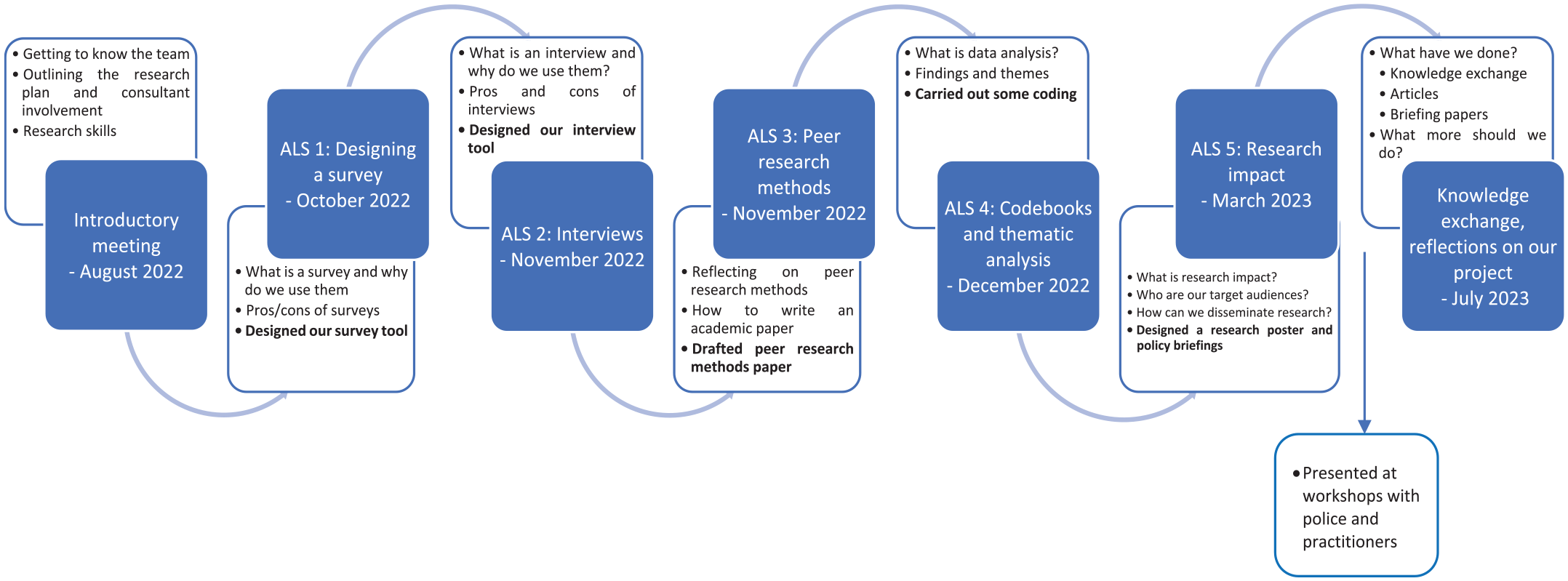
Methodological roadmap of our peer research methods study.
The consultants first engaged with the research at the design stage. Following the appropriate Action Learning Set sessions on designing interview and survey questions, the academics and consultants worked together to shape the interview tools for police and practitioners. Drawing on the consultants’ lived experience of police and practitioner working practices, they offered reflections regarding the challenges to offering support for survivors of modern slavery, thus shaping some critical questions. For example, the consultants were interested in understanding the work police carry out after taking a victim statement, therefore recommended questions that probed police confidence and experience dealing with MSHT reports, what they do once a referral is made, and how law enforcement support victim/survivors mental and physical well-being. The consultants recognised the nature of victimhood, and the need to shape interview questions to adequately probe on police provision of support beyond just gathering evidence, by recognising that trauma makes it harder for people to speak up and engage in criminal justice processes. Thus, the consultants shaped some interview themes, including recognising a need for wider social support and the fact that current methods for responding to MSHT puts the onus on the victim/survivor for proof of victimhood.
Consultants were then involved with carrying out some interviews with police and practitioners alongside the academic researchers. This was largely to offer the consultants experience with interviewing, with some consultants opting to just observe. However, others probed the interviewees on particular answers, holding them to account, again drawing on their experience going through the system and experiencing some of the challenges in responding to MSHT that this research wished to identify. Some of the interviewees commented on the usefulness of this experience, both to communicate their working practices to MSHT survivors, while also thinking critically about the ways their support systems can be improved, for example, through greater transparency with victim/survivors and ensuring a continuation of mental health support.
Upon completion of the data collection, the consultants were involved with the preliminary data analysis. Due to the complex nature of data analysis, it was agreed that the academic researchers would take the lead. Training on thematic analysis was first delivered to offer a basic understanding of how to develop a codebook and identify research themes from the findings. Then, several sessions were held to shape the police codebooks. The consultants’ lived experience proved useful as they understood the types of themes likely to arise, for example, barriers to policing and improving responses to MSHT. The codebooks were then finalised by the academics to ensure academic robustness. Arguably, this approach results in only partial participation in the analysis stage (Lushey and Munro, 2015). However, pragmatically, this was the correct decision, both due to the time limitations of the consultants, and the experience of academics on data analysis. However, many of the themes adopted were both identified and named by the peers, rather than imposed by academic researchers.
The consultants provided critical input during the impact and knowledge exchange stage of the research. First, they provided detailed guidance on which audiences our research ought to reach. For example, they identified case workers, safe houses, drug and alcohol welfare teams and ISVAs (Independent Sexual Violence Advisers), to name a few, as key stakeholders, given the critical role these organisations play in MSHT support. They also identified several stakeholders to target for MSHT education and prevention, arguing that with increased education comes increased identification and safeguarding of victim/survivors.
As part of our knowledge exchange activities, we hosted workshops with practitioners and law enforcement to share the research findings. The consultants chose a volunteer among their group to present at these workshops, sharing their experiences on the project, what they had learnt and any messages they wished to share. Thus, the consultants described being grateful for the opportunity to use their voices and encourage change, developing confidence and communication skills. Through sharing their life experiences, some also disclosed an increased trust in the police and criminal justice system to aid them and their peers. The consultants finished by addressing our responsibilities as research study members to share our knowledge and prevent modern slavery. The feedback from workshop attendees was extremely positive, with law enforcement and practitioners thanking the consultants for their bravery in speaking out and their input into the project.
Finally, the consultants helped design the research briefings and report, choosing key quotes to include and commenting on how the language ought to be shaped to maximise impact. A powerful example was changing the language of ‘preventing modern slavery’ to ‘eradicate modern slavery’, with consultants arguing that ‘prevention’ implied only stopping ASWs being used as a conduit for modern slavery, whereas ‘eradicate’ has the much more powerful aim of ending modern slavery entirely. Utilising their personal experience helped to instil the emotional connection of the research project, humanising victim/survivors and ensuring that any outputs were driven by those with lived experience.
Thus, it is through the expertise of the consultants that this research project benefited, providing more nuanced, emotionally evocative and context specific recommendations and outputs than if we did not use a PAR approach. The consultants played an active role in identifying critical interview questions, analysing, and understanding the context of the data and demonstrating their knowledge of key stakeholders that this research could influence. By empowering the consultants, not only does a PAR approach incorporate unique experience, knowledge, and creativity, but empowers commitment towards the social change the research desires (Wedemeyer-Strombel et al., 2019).
Recommendations for peer research methods
This section offers some reflections to improve meaningful engagement of those with lived experience in PAR. The ethos of peer research methods is to engage active participation from all team members. When working with a community excluded from participating in research, diversity and inclusion principles are central (Kearney et al., 2013). This requires flexibility beyond traditional research methods. For example, there were notable differences between consultants in terms of language barriers, educational attainment and experience and those who are migrants that have a direct impact on the knowledge, understanding and ability to participate on an individual level.
Thus, to achieve the aim of equitable partnership, time and resource must be spent ensuring everyone’s participation, including supporting on any apprehensions peer researchers may have. Some barriers that occurred through our project included adequate training in research skills, translator costs, childcare costs and covering travel costs when meeting in person. To this end, the University and Unseen ensured all expenses were covered including laptop costs and gift vouchers were provided as a thank you for the consultants’ time. We also ensured the consultants were supported emotionally and practically, including appropriate training to prepare them for work and for their recovery onto independence.
We also recommend, where applicable, building time into the research planning stage to ensure translators are available for full participation at all sessions. We sometimes struggled to book a translator for every session and did not have translators for every language (only Albanian). If relying on an external company give them time to find someone with the right knowledge skills for the work that needs translating. Furthermore, the translator did not have specialism in MSHT, and sometimes queried what modern slavery is in the meeting. However, the consultant who required a translator felt confident later in the programme to join without a translator. Thus, the consultants grew in confidence and spoke more freely, creating less structured sessions, where it would be challenging for a translator to effectively communicate all that is said. Translators can disrupt the flow of conversation. If required to have multiple translators, this would multiply the disruption. Thus, we recommend that any projects that requires the need of a translator(s) look for alternative means of translation such as having the translator present online with the consultant and translating discreetly in real time.
Most of our consultants were migrants; therefore, English is not their first language. Thus, they were navigating new terrain, a new country, and challenging academic concepts in an unfamiliar language. Consequently, ensuring the pace is matched to everyone’s understanding is important. When delivering any research skill sessions, make sure to use simple English over academic jargon and illustrations to support points. To help with this process Unseen are working on a dictionary of long versus short words and acronyms. Creating a similar resource for peer research projects can help save time and aid understanding of complex academic topics.
Additionally, every effort was made to make the sessions interactive and fun. This will encourage engagement and minimise/alleviate any nerves consultants may feel about engaging in academic research (Maguire, 2006). Therefore, we started each session with an ice breaker to encourage everyone to relax and get to know each other. Then, we split the sessions into digestible chunks, with a break in between for coffee/tea and cake if in person and comfort breaks if online. This also facilitated an opportunity to get to know each other as friends, further breaking down the hierarchical structures. The first half of each session was mainly skill and knowledge building, however this was always reflective and interactive, as knowledge was built in an exploratory and collaborative way. The second half of each session was about knowledge application, contributing directly to the research process. We found this method worked best to maximise engagement and understanding, as well as empowering the consultants to see how their input was shaping the research. For example, when designing a survey, we created some questions first based on our interests (e.g., love of animals, favourite food, favourite season) before applying the knowledge of question styles (single choice, multi choice etc.) to the subject matter.
Given the nature of the research topic, safeguarding was a priority. Unseen provided professional support, while the ALS sessions were tailored around safeguarding, trigger warnings, and the freedom for consultants to engage as much as they wanted. No consultants chose to withdraw, however when wider advisory group online meetings were held, the consultants often left their cameras off to preserve anonymity given the presence of law enforcement and on two occasions, ASW operators. An important part of the process was ensuring all consultants were empowered to participate, therefore together we worked to identify challenges to engagement, to ensure an inclusive environment was fostered. Thus, the consultants were asked about the challenges they faced, such that adjustments could be made over the remaining lifetime of the project. Overall, the main worries included language barriers and fear of judgement. To alleviate these concerns we utilised ice breakers, organised an in-person meeting between the whole team and personalised the meetings.
The time required to carry out research is intensive, and it was not possible to ask the consultants to work full-time. Therefore, while peer participation is important, and we worked to engage the consultants at every stage, much of the work had to be done by the academics alone. If unable to bring peer researchers onto the project on a full-time basis, embedding flexibility in meeting times and locations can maximise input. We had two meetings every week, one entirely online and the other blended (with the researchers and translator attending online) so there was flexibility if anyone was busy or did not feel up to meeting 1 day. The different meeting options meant people could access despite childcare or travel considerations. While online meetings allowed everyone to participate, we found it difficult to know whether people understood everything being discussed, and whether they enjoyed the sessions due to a lack of physical cues. These advantages and disadvantages to online engagement can be minimised through constant reflection, regular feedback and adapting subsequent sessions if required. A way to do this is to ask everyone to either verbally feedback or complete a short form after each session, asking questions about what was learned (to judge the success of the teaching style), any challenges faced and what the peers from future sessions. In this way, the structure of the sessions can be adapted as necessary to suit everyone’s needs and learning styles.
Finally, academic research around an emotionally sensitive topic can be mentally exhausting. Trigger warnings before each session and offering consultants the opportunity to leave and re-enter in their own time, letting people choose how much they want to contribute and having strong support systems in place will help alleviate this re-traumatisation. However, consultants shared that there is a high possibility for healing and feeling renewed as they reported learning more about their own situation, feeling less alone and finding out what research is being done to stop MSHT. When asking individuals with lived experience to participate in research it is important to ensure they do not feel used by the research process. Thus, it is crucial to sustain benefits for peer researchers post lifetime of the project (Kearney et al., 2013). Having past peer researchers talk to new peer researchers, or acting as peer mentors about the tools that help them cope and about the research process generally can be a great onboarding experience for upcoming peer researchers and a way to include and empower established peers in the future of research. The consultants shared that our experience working together gave them hope and patience with their own situations. Thus, we hope that peer research projects are as much about giving back to the peer researchers and changing lives as they are about giving rise to academic knowledge.
The impact of PAR on the consultants
Approximately halfway through the research project, the academic researchers met with the consultants to reflect on their experiences engaging with peer research. Important was a cascade of learning to the consultants, such that they had the confidence and skills to share their reflections on the research process. This final part of this paper shares some of these reflections, co-authored by the consultants, capturing their exact words and feelings (without use of translators), thus centring their voices to provide reflective best practice guidance on meaningful peer research methods. The use of direct and sometimes lengthy quotes is intentional – ensuring consultants’ voices are recognised, while being accessible for those unfamiliar with academic writing. To disrupt the hierarchy of academic versus non-academic, the quotes included are from the consultants, academics, and practitioners at Unseen (hereafter referred to as consultants for equity). Pseudonyms/initials are used as identifiers for the quotes.
Valuing everyone’s voices: Getting involved in peer research
The consultants were asked to share how they felt before meeting as a group to work on the research project. The intent was to capture everyone’s emotions regarding working on an academic research project to potentially alleviate any concerns future participants may feel in similar working environments. Unequivocally, consultants shared feelings of nervousness: Nervous as I don’t know what it’s about but [I was] excited for something new. (О) I was nervous about leading as I didn’t know what to expect, especially when I don’t know what it’s about. But I was excited to see what happens as well as looking back to see how far we’ve come. (S)
However, many of the consultants expressed excitement regarding learning new skills and spending time on an academic research project, When I came I didn’t have anything to do. This is my first course I joined, and I wanted to learn new things. This course has been helpful because I have learned about DBS, interviewing and more things. It is good to be informed and it is interesting. (M) Interesting where the consultants have sat in on the interviews. To look at the answers given, were they different than the interviews where they weren’t present? (AI)
Importantly, consultants shared feelings of being empowered to change their lives, and the lives of survivors of exploitation: I leapt for joy when I heard Unseen were employing me as they help me, and I help others as I always thought about what I could do. I can take the driver’s seat and let my own thoughts be heard. I am able to voice and convey my thoughts even when English is hard. I have been on the path of something I have always wished for and now I can see my dream come true. My dream is to learn, listen, be heard and learn from others. Thank you for allowing me to have a voice. (J) I think for me it is good that what I have experienced, having kept me in that bondage I am able to come here, give value and serve humanity, and actually it is a good platform because what you are contributing to is going to potentially make a big difference in the scope of the whole country, maybe even the world and you’ve been given an opportunity to serve. (B)
When considering engaging in a research project, the consultants recommend that peer researchers look at the impact and change that can potentially be made. Having lived experience of an issue can inspire active involvement because ‘after coming out of negative situations where you’ve been told negative things about yourself, you realise you have value and can give value’. They described the opportunity as once in a lifetime. Thus, being involved in peer research inspires survivors to embrace their identity, as well as learning applicable life and research skills.
The main motivations for engaging in this research project was both for personal growth and to help safeguard targeted communities. The consultants spoke about being encouraged to speak up, and about being happy about the decisions they made to participate 10 years down the line.
I was excited about UoL joining and I was able to understand what it is when I have my sessions with my therapist, and they use surveys – I know and can carry out an accurate measurement and get a better understanding of myself. (J) But the reason that I wanted to join was to get more experience in this because in the future, I definitely want to like, I know it sounds a bit mad, but open a safe house. But just for certain things, have certain backgrounds that are complex, and then find a way for it all to work on smoothly so that the person gets a correct move on the correct support. So I would like to push that into my future career. (C) And the second question I had was about how I was going to try and get into people’s lives in terms of like, helping them to be safe regarding modern slavery, and trafficking, especially back home. So, but definitely, I was able to do that. And totally, my mission, the reason why I decided to go into this project is because so personally, I’m going to be a counsellor for those who have been a victim of trafficking and modern slavery, because I have been actually been on a four years degree, so I’m actually studying as a counsellor at school. So because I wanted to impart that in to help people and to be positive in your life. And that was one reason why I pursued, taking part in the projects, because it was going to go a long way. For me, that’s really going to help me enlighten people about modern slavery and trafficking and make a change in your life. (Bl)
Thus, consultants shared how they took their trauma and turned it into something meaningful, helping their peers and others who are exploited. They spoke about protecting future communities and getting justice for people who have been unable to speak out about their exploitation. This requires peer researchers to think positively and have the courage to believe they can make a difference. Overall the consultants were motivated by this opportunity and the ways in which they hoped it would improve their life, the community and society.
Empowering survivors: The benefits of peer research
The consultants were asked how they had benefited from working on this project, but also how the delivery from an academic perspective was going. The consultants reported a rise in confidence and excitement, feeling empowered by the opportunities afforded by the project and wider consultancy programme. Consultants offered detailed examples of what they had learned, demonstrating their active engagement. This also helped to show academics which topics were highlights for the consultants and whether the working style was effective.
We have learned from each other too. So because every week, we have said we have our opinions, and everyone has their opinions. So for us, for me, in this situation, UK is great it is a new country. So it’s a new mentality, a new government. So because in every country there are problems. So the thing that they have to fix is the legal advice. So this is the first thing that they have to do because not everyone has information about modern slavery. If you ask someone what is the meaning of modern slavery, they don’t know it. Because they don’t understand the word. So this project, it was very helpful for everything. So I have learned every day . . . we have to take the risk to lead the others to learn. (A) This course was really helpful. We have learned so many things, again, like DBS, interviews and things that are mentioned about the modern slavery. It’s so true, like, the area I was living before, I don’t have no idea about modern slavery, what is modern slavery, or what is human trafficking? I don’t have no idea. But you know, the meeting we have, they give us the paper about modern slavery and the helpline, that was really helpful. And I think this paper is good, we should share this paper everywhere. (M)
Consultants identified wider benefits to peer research, beyond engaging in academic knowledge exchange, citing improvements in language skills, presentation skills and learning from each other’s opinions.
When I and friends didn’t understand English, I liked how they explain it as sometimes we use specific words we can’t understand and H managed to describe the word. And now my English is better. (O) It is interesting when we’ve been asked to explain words and I can’t explain them which shows how challenging English is. (AI)
Furthermore, the consultants spoke of the courage received from engaging in academic research and how it produced stability and goal setting for their futures. They spoke about taking this knowledge and helping their peers, particularly given the lack of general awareness around modern slavery. Lived experience is important to get on the ground information, as well as to ask how things can be better when doing research. The consultants’ opinions add strength to the research (how they process things, what they can give), which comes from a real place, not just uttering stuff, but is tangible experience. Books and hierarchical academic research methods do not give the same information as lived experience as the consultants helped to identify and bring to light new parts to the research, audiences and challenges.
Research impact: Ensuring sustainable change
The consultants were also asked about their knowledge of research impact. These suggestions helped the academics think more widely about the impact of this project beyond policy implications and training for police, ASWs and practitioners. Impact cannot always be quantifiably measured, yet the consultants demonstrated the impact this project has already had on them and the ways they plan to disseminate their knowledge of MSHT. Thus, this project gave the academics a unique opportunity to think more creatively about research impact and dissemination to reach the affected communities directly, as opposed to through criminal justice changes, and particularly given the challenges of more traditional dissemination methods.
I think it was good when the comms team was in to share with us the challenges they face and how they go about getting the word spread, getting it everywhere. I think that was very interesting. (B) This course is really helpful. We have learned so many things. You give us the word, give us so many papers like a pre-helpline, but I think we should spread it wherever we go. Even if we are going for shopping to some other towns, we should just spread this paper everywhere that people know that the teams like you, and organisations like you are always there to help them. (M)
Project impact, from the consultants’ perspective, was important to drive contextually informed and meaningful engagement (Bissell et al., 2018; Perôt et al., 2018). The consultants questioned the reach of the project, referencing journal articles on similar topics they had read and asking how and in what ways we would publish similar articles. They also held the academics to account to reach beyond academic audiences, emphasising the importance of reaching the public and those at risk of exploitation. Thus, at the mid-point of data collection, the consultants shared what they hoped to be the project’s impacts.
We want to get in the door, we want to get at what they are doing and we want to completely eradicate sexual exploitation. As long as the people who pay are those who actually causes all of this harm and pain, we need to teach somebody needs to be a lesson. So the feedback really needs to be public. Also, not hidden. (B) I want to ask you, if this project, it will be a partnership for everyone in magazines, or it will be part of the university, because we are talking genuinely but I want to know if everyone will read this project? . . . Let’s hope with this project, hopefully we can fix all the things that aren’t in the right way. Let’s hope our voices will be heard. (A)
Thus, the consultants demonstrated their awareness regarding how traditional academic research does not always reach the affected communities, minimising impact. They proposed new methods of engagement including creating modern slavery awareness posters for those in sex work who wish to leave and/or are being exploited which could be handed out within communities and housing support services. The importance of including peer researchers is such that their knowledge of impact avenues is born out of their experiences. Thus, some of the project’s outputs were developed as a result, including a research poster and research summary.
Rating peer research methods
Finally, the consultants, Unseen staff and academic researchers reflected on and rated the peer research process, taking into consideration what they have learned, levels of enjoyment, challenges faced and the success of the project. Their ratings were categorised from one to five stars. Table 1 shows the ratings of each team member, where one star is ‘not good’ and five stars is ‘great’.
Ratings of the ALS sessions by each team member.


The consultants, staff and academics gave reasons for their rating, which are used as recommendations both for the direction of this study and for future peer research projects. The reflections challenge the long-held view in academia that only those with a background in academia can engage in research methods and knowledge exchange (Lushey and Munro, 2015). Some of the consultants rated their experience according to the fulfilment of their desires as mentioned at the beginning of the paper, and thus, rated highly: 4 stars because just like in the primary school, you learn the ABCs and now we are learning the topics and where we go next. Next, we need to do them. (P) Everyone one of us has done a good job, we have contributed to this project, but it is 4 because I want to see some results, and people will read it, and it will be the cherry on the cake. (A) 4 stars. But this is just a learning curve for me. I lose the one star because I need to practice delivering sessions and making sure I am not bringing too many academic words into the sessions so we can all understand. (Ch) 4 stars because we have learned so many things, but in the future, how are we going to apply it practically, see the results in the future. (M)
Other consultants were critical of the research process and rated three stars or lower, arguing that while they had enjoyed the research design and data collection stages of the project, for them, the priority was impact. Thus, they argued that we could not score the project at four-five stars until we had achieved all our aims. This shows the awareness the consultants had in the research process and their desires to affect positive change, as well as the fact that not all research leads to impact, while some impact is short term and personal (empowering the involvement of survivors of modern slavery), while other impact is long term (working in partnership with stakeholders to implement changes).
3 stars we are still in the middle of it and obviously we still need to see where we are leading at the end of the project. So, we are still in the halfway stage, and I am looking forward to the future. (I) 3 stars and the reason links to what other people were saying. Outside Unseen, amongst the few of us and the University of Leicester, we seem to be the only ones who know about this project and are aware of all these things. Personally, for me, I wasn’t aware of Unseen, never heard of them before and what they do and what they’re like. I’ve only just come across them. On my own side I have asked other people indirectly if they know about Unseen and what they do, but they don’t have any idea what they do and stand for. That sometimes triggered me, and gives a negative impact, as we are doing enough, but it seems like we are not doing anything. (Bl) 2 stars because we haven’t seen any, like tangible results yet from it. So, I think we're cracking on and we’re doing stuff, but we haven’t achieved anything yet, practically. 1 star for doing the leg work and starting to get things done, I read an article and was hoping it was our work, but it wasn’t we wish it was and so what are we not doing to get in the door. It isn’t a competition, but impact is valuable, we want to make real change, we’re not doing this for fun. We want to make real change, so let’s get in the room, make real change and do what it takes. (B) There could be more ways to get conversation and discussion going with such a diverse group of people and cultures. (BB)
The consultants’ reflections demonstrate support for the literature which acknowledges the importance of ‘insider’ knowledge that can offer rich insight into the topic and its wider impact (Lushey and Munro, 2015). Because of these discussions on impact, the consultants had some direct involvement with our research dissemination webinars with law enforcement and modern slavery practitioners, while working alongside the academics and a third-party organisation, NiftyFox Creative, who were hired to design a policy briefing. For the latter, the consultants evaluated the text used in the briefing and chose some imagery that encapsulated their interpretation of the project.
The consultants shared the importance of engaging in the research process as they desired to enjoy the fruit of their labour and see the change implemented, an important and fulfilling phase of their journeys as community members and co-researchers. Insofar as this project was set up with an equitable peer research methodology at its heart, we have achieved the aims of engaging the consultants in an inclusive and empowering manner. Their feedback offered a rich insight into what has worked well, and where we can improve in our engagement of those with lived experience.
Conclusion
This paper provides an insight into a peer research project looking at the role of ASWs in preventing MSHT online. The use of peer research methods in this area is in its infancy, therefore, this project has been in the unique position of trailblazing and trialling what works and what does not. In this process we learnt about the challenges and opportunities of developing a more inclusive and survivor-involved approach to research, working to identify best practice, through active listening and turning our commitments into concrete actions. Taking a safe and ethical approach to this is essential, not least because of the potential risks of re-traumatisation for modern slavery survivors. The reflections in this paper provided the consultants with a chance to lead on an important part of the academic project, while shaping the final months on the project. This process has been critical to develop service delivery to make a positive difference on survivors of MSHT.
We hope the reflections and recommendations in this paper are useful and transferable for anyone wishing to meaningfully engage people with lived experience as peer researchers in the fields of MSHT and criminology. This research acknowledges Ferris et al.’ (2021) contention that tough ethics protocols minimises the amount of engagement survivors of MSHT can have in the research process, largely due to stigma that undermines non-academic community expertise. There is a need for research to emphasise the importance of engaging those with lived experience in the research process, thus breaking down barriers between the academic ivory tower and those we seek to help through research.
Finally, it seems only fitting that as this research engaged with survivors of modern slavery, and to commend their contributions, that we give the consultants centre stage to summarise their experiences. The power of these messages presents a group of survivors willing to be a part of the change. Though their pasts have been difficult, they are a shining example of resilience and resistance against modern slavery. We close this paper with these messages, so the consultants can speak for their future, and the power of peer research methods.
For me, the sessions have helped me get courage and confidence in myself and has helped me put a stop on negative things in my life, it gave me that courage I no longer have the fear to talk about modern slavery and human trafficking, but courage to stand against and be against MSHT. I can make an impact in others’ lives. (Bl) If you speak out, you’re bringing it to light. Don’t be selfish, be a service to humanity. (B) A leader never stops learning. (B)
Footnotes
Acknowledgements
We would like to take this opportunity to thank the consultants at Unseen, who as peer researchers on this project provided critical insight, support and innovation. This paper and the research behind it would not have been possible without their exceptional support and input. Their experience, knowledge and bravery have improved this research project in many ways and have ensured and driven the impact of the research to prevent modern slavery and sexual exploitation online.
Author’s note
The initials denote authorship for survivors of exploitation who participated in this research project and the writing of this paper. Due to their ongoing recovery and work alongside Unseen UK, they will remain anonymous
Declaration of conflicting interests
The author(s) declared no potential conflicts of interest with respect to the research, authorship, and/or publication of this article.
Funding
The author(s) disclosed receipt of the following financial support for the research, authorship, and/or publication of this article: This project was funded by the Modern Slavery Policy and Evidence Centre and Arts and Humanities Research Council in the UK and awarded to TS (AH/X000702/1). The funder had no role in study design, data collection and analysis, decision to publish, or preparation of the manuscript.
