



Abstract
The ‘buffer zone’ frames the contested space that university researchers must persistently animate and mediate to successfully pursue participatory research with public and third sector partners. This article explores this conceptualisation through a consideration of political and ethical dilemmas in participatory research practice. We contend that participatory researchers must identify, respond to and reflect on everyday and momentous dilemmas by combining technical, relational and political skills. We illustrate this by drawing on extensive collaborative action research conducted with public service partners as part of the What Works Scotland programme (2014–2019). By critically reflecting on university research realities, this article shares insights into complex multi-agency participatory research dilemmas; offers methodological, conceptual, ethical and political evidence to help university researchers navigate such contexts, notably by engaging the buffer zone and finally, considers how universities and research funders should better support participatory research practices.
Introduction
Participatory research reshapes knowledge construction processes by consciously situating individuals and communities as research partners rather than research subjects (Bergold and Thomas, 2012). With a ‘transformative and social justice concern’ (van der Riet, 2008: 546) participatory research offers a ‘method for critical work within communities and institutions, revealing the fractures of power and restoring images of “what could be”’ (Fine and Torre, 2004: 16). Thus, it offers a ‘potential pathway for academics to work with policy-makers in moving towards the realisation of more just cities’ (Perry and Atherton, 2017: 36). However, participatory approaches are not as ‘straightforwardly positive as much of the literature would like us to think’ (Kara, 2017: 299) and the emphasis on empowerment and democratisation can hide important conflicts (Howard and Thomas-Hughes, 2021), including within the academy (May and Perry, 2017).
This article considers the nature of such conflicts in relation to Collaborative Action Research (CAR) as a form of participatory research. The article specifically focuses on CAR in a collaborative governance context, where a multi-actor ‘public services’ environment comprising public, private and third sector organisations, citizens, elected politicians, professional bodies and community groups replaces narrow conceptions of the ‘public sector’ (Ansell and Gash, 2008; Christie Commission, 2011). This context brings to the fore ‘several different communities of interest, sometimes overlapping, sometimes conflicting’ (Locock and Boaz, 2004: 378). We seek to advance our idea of a ‘buffer zone’ (Bennett and Brunner, 2022) through exploring research dilemmas and practice in an ambitious multi-agency CAR programme as part of the What Works Scotland (WWS) project (2014–2019). Funded by the ESRC and Scottish Government, WWS was a £4 million collaborative research and knowledge exchange centre between two universities and multiple national and local public partners. Unlike other UK What Works centres, WWS was committed to a collaborative and participatory approach to knowledge production and use (see Bristow et al., 2015).
The article draws on a detailed examination of university researchers’ experience and practice, focussing on CAR inquiries into Participatory Budgeting and benefit sanctioning. We also explore how institutional research structures and practices shape research projects, by reflecting on dilemmas experienced within the academy. The article is structured as follows. We first situate our work within the literature on participatory research with public service partners and explore political and ethical practice in the creation of participatory knowledge. We then discuss our concept of the ‘buffer zone’ (Bennett and Brunner, 2022), a conceptual frame supporting researchers to navigate complex multi-agency collaborations. Next, we describe the WWS CAR methodological framework, research activities and institutional structures. We present dilemmas leading to ‘buffering’ within the academy through a Professional Learning Community and ‘buffering’ in the field through CAR inquiries into benefit sanctioning and Participatory Budgeting. We demonstrate that participatory researchers need political and relational skills (alongside technical research skills) to navigate complex power dynamics and mediate alternative forms of knowledge construction.
By critically reflecting on university research realities, this article contributes to knowledge in three ways. First, through providing insights into complex multi-agency participatory research dilemmas. Second, in outlining methodological, conceptual, ethical and political considerations to help researchers navigate such contexts, including engaging in and setting up the buffer zone. Third, by examining how universities and research funders should better support participatory research.
Conceptualising participatory research in practice
There is increasing expectation in academia to create and demonstrate research ‘impact’ (see Smith et al., 2020). Collaborating across institutional boundaries, involving potential research users in the research process, and the language of co-production are gaining prominence (Flinders et al., 2016). In response, universities often focus on ideas of intermediation, knowledge brokering or the science-policy interface (e.g. Boezeman et al., 2014; May and Perry, 2017), although such approaches may give limited consideration to the politics, practices and values shaping evidence creation and use (Cairney and Oliver, 2020; Locock and Boaz, 2004). Here, we build on existing debates in the participatory research literature which critically reflect on knowledge construction, relational practices with research partners (Howard et al., 2020) and navigating power imbalances between participants alongside researchers’ ‘own motivations and positioning’ (Wheeler et al., 2020: 60).
Participatory research contains a range of approaches (Gaventa and Cornwall, 2008), often with a shared aim to disrupt dynamics and challenge conventional processes of knowledge production by collaborating with ‘non-academic partners’ and disenfranchised social groups (see Boser, 2006; Howard et al., 2020; Reason and Bradbury, 2008). As part of this participatory tradition, CAR seeks to integrate collaboration, action and research, and thus to co-produce knowledge in pursuit of social change (Greenwood and Levin, 2007). To date, little attention has been given to experiences of participatory research with multiple public services and professionals (e.g. Vindrola-Padros et al., 2019) or how participatory researchers navigate multiple professional worlds, including university-based pressures and structures. Here, we seek to address this gap.
Participatory practice and ‘dilemmas’
Undertaking participatory research in this multi-agency context requires researchers to be critically aware of their own practice and the context in which they work. Undertaking CAR with public service organisations requires acute awareness that they are ‘centres of love, hate, jealousy, goodwill and ill will, politics, infighting, cliques and political factions’ (Coghlan and Brannick, 2001: 54) where power is unevenly distributed (Fine and Torre, 2004: 18). As Perry and Atherton (2017: 38) stress, external critiques of public services can create ‘an unhelpful binary opposition. . .between formal institutions and informal actors, without due attention to the nuanced positions, values and actions of different individuals, groups and organisations’ (Perry and Atherton, 2017: 38). As such, researchers need to ask both explicit and implicit political questions and become ‘political entrepreneurs’ (Williamson and Prosser, 2002: 588).
Political scientists and urban geographers draw attention to moral and political dilemmas in the context of public service decision-making (e.g. Durose, 2007; Lipsky, 2010; Metzger and Lindblad, 2020; Zacka, 2017). Geddes (2019) states that dilemmas arise out of conflicting practices requiring political actors to amend their beliefs, actions and practices (which is a key aim of CAR). In a collaborative governance context there are, of course, actors with defined political roles (such as elected members). However, if we conceptualise politics as something that people do through meeting, talking, writing or the everyday elements of politics in action (Freeman, 2019), then we also understand how political work also occurs when policies and services are made, remade and unmade, through street-level and managerial acts of discretion or resistance (Lipsky, 2010) by ‘morally aware actors’ (Zacka, 2017) whose practices are ‘enacted in complex intra- and inter-organisational systems’ (Bartels, 2018: 1320). As such, participatory researchers need to understand the complex power relations shaping relational practices between various organisations and professions, including their own role and institution.
Participatory researchers have long reflected on the politics and ethics of research practice, considering them to be ‘problems of conscience’ (Clark and Sharf, 2007: 400) that ‘often involve dilemmas that remind us that we cannot be neutral’ (Morrell et al., 2012: 624). For Guillemin and Gillam (2004): 266–267) participatory research creates ethical dilemmas when there is ‘a situation in which there is a stark choice between different options, each of which seem to have equally compelling ethical advantages and disadvantages’. Dilemmas can be mundane and offer an everyday quality, and these experiences are no less important than those that accompany major events (Guillemin and Gillam, 2004; Metzger and Lindblad, 2020). Morrell et al. (2012: 629) remind us that the identification, perception and response to research dilemmas involves ‘the conscious practice of navigating between various imperatives in a morally informed way. . . [through which] researchers are forced into a position of “duplexity” where, in the process of seeking “the truth,” they must confront their own political power’. This issue is echoed by Howard et al. (2020: 3) who highlight the ‘inherent dilemmas’ of participatory action research, ‘when working across conflicting and adversarial ideological politics’. We therefore need to consider how researchers engage with such contexts.
The buffer zone
In an earlier paper (Bennett and Brunner, 2022) we combined participatory research literature and empirical research to propose a ‘buffer zone’ heuristic to conceptualise the dynamics of multi-agency research. We argue that participatory research in this context demands the creation of a new, temporary space with some (often porous and amorphous) boundaries. The buffer zone is a co-constructed space and therefore populated with various institutional pressures, normative practices, expectations and personal interests which shape it and often collide within it (creating dilemmas for the researchers). The buffer zone concept seeks to frame a way of viewing, acting and working in complex collaborative projects. The buffer zone constitutes: “A created and nurtured area of critical and relational activity that lies between different ways of working – the established organisational and contextual practices and the new, created spaces for temporary, collaborative and critical research. It is a space, a border zone between multiple worlds of work within which new political and relational work occurs. When established, the buffer zone can protect or empower the activities within inquiry groups or collaborative research projects by negotiating with (or holding at bay) other, competing powerful actors or agendas within the wider operating context” (Bennett and Brunner, 2022: 87).
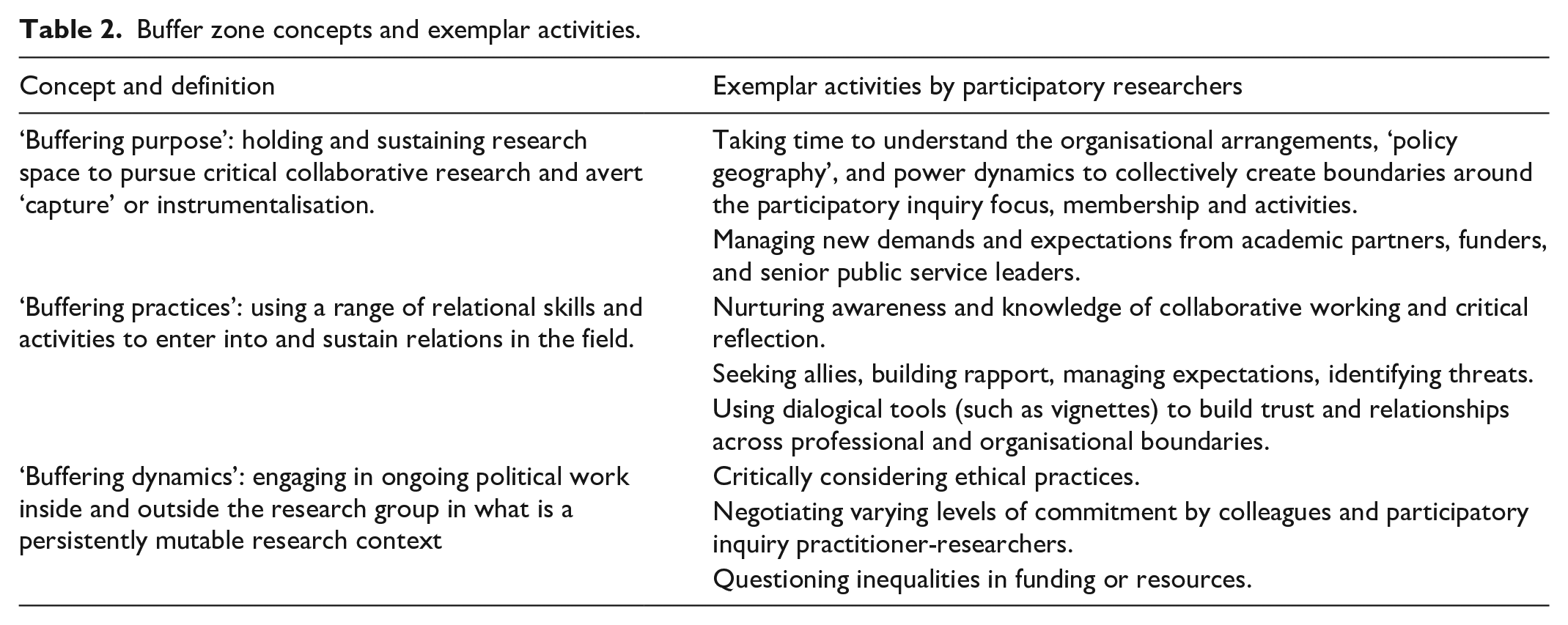
Reflecting how participatory research ‘rejects traditional commitments to researcher distance, external expertise, and scientific agreement’ (Fine and Torre, 2004: 29), utilising the buffer zone concept involves three core elements. First, ‘buffering purpose’: acknowledging the necessary work of holding and sustaining the research space to pursue collaborative research and avert ‘capture’ or instrumentalisation. Second, ‘buffering practices’: using a range of relational skills and activities to both enter into and then sustain relations in the field. For example, using rapport in multiple, ongoing ways with a changing range of gatekeepers and powerholders. Third, ‘buffering dynamics’: understanding the necessity of engaging in ongoing political work inside and outside the research group in what is a persistently mutable research context (Bennett and Brunner, 2022).
These three core elements are not discrete but intertwined and omni-present; realising the buffer zone means acknowledging, preparing for, and reflecting on the diverse encounters and decisions that researchers and co-researchers construct and experience. Such encounters are underpinned and shaped by a myriad of elements such as researcher expectations, historical relationships between different actors, epistemological positions, values and ethical frames. The buffer zone concept offers researchers a way to not only position and undertake participatory research, but also a guide for activities in the field. It encourages the analysis and sharing of research experiences, dilemmas and responses, which this article demonstrates by drawing on the WWS programme.
The buffer zone in action: WWS programme and collaborative action research
Over the last 10 years, UK research bodies have provided fixed-term funding to nine What Works centres and tasked them with improving evidence-based decision-making in public services. Most focused on single policy domains, such as crime, or economic development initiatives and adopted traditional evidence hierarchies/ranking processes, systematic reviews and evidence-use models (see Bristow et al., 2015). In contrast, the WWS research team and co-directors possessed diverse disciplinary and methodological backgrounds including housing, education, social policy, health, disability studies, evidence-use, sociology and public policy. The centre reflected the Scottish Government’s public service reform agenda seeking to address social inequalities, improve outcomes and adapt to public spending constraints (Christie Commission, 2011) by utilising collaborative and participatory approaches, combining action research models exploring evidence gaps with localised situated research.
The ambitious participatory approach underpinning the WWS programme initially centred on an innovative CAR workstream led by a senior academic/WWS co-director with previous experience of CAR, with four fixed-term researchers employed to facilitate the CAR activities. The programme was intended to enable four Community Planning Partnership (CPP) partners in Scotland to identify priority areas for public service reform, support them to each develop, implement and assess three action research inquiries in each site, and provide opportunities to share learning across all 32 CPPs. 1 Introduced in Scotland in 2003, CPPs are statutory high-level public service partnerships whereby all key public and third sector partners must collaborate to develop and implement service delivery plans to address local issues such as inequalities, neighbourhood planning, crime, community development and poverty (see Sinclair, 2008). An integral CPP feature is the requirement for these public services to work across traditional organisational boundaries and professional ‘silos’ at a senior planning level and in service delivery.
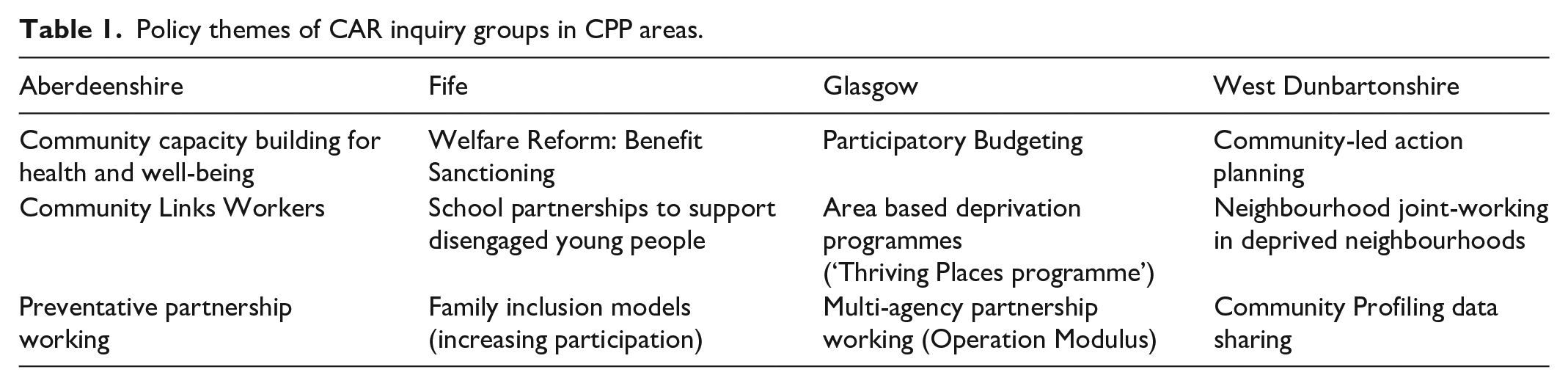
In pursuing the ethos of CAR there was no singular WWS CAR model (see Brunner et al., 2018). Each CPP partner initially proposed tentative policy problems to address through CAR inquiries. Over a period of 4 years, this resulted in 12 inquiry groups spanning a range of policy issues (Table 1). The four WWS researchers working flexibly with each of the CPP partners responding to pragmatic, knowledge and capacity issues to create communicative spaces that would nurture critical reflection, knowledge production and action learning. This involved creating and sustaining inquiry groups, each of which combined practitioners from diverse service areas, organisations and professional backgrounds, to identify and examine ‘real-world’ questions. 2 Each WWS researcher also conducted a range of complementary collaborative activities in each site, such as workshops, methods training, bespoke research projects and evaluation support that underpinned evidence-use or policy development (see Brunner et al., 2018). In each case site the WWS researcher led the CAR work with a WWS co-director formally attached.
Policy themes of CAR inquiry groups in CPP areas.
Ethical procedures, data collection, selection and analysis
Ethical approval for research that adopts a collaborative approach to problem identification, data collection and analysis (particularly where there are multiple inquiries running concurrently) is complex. The structure of the WWS programme and its influence on research activities including ethical procedures is critically analysed in our first ‘dilemma’, within the academy, below. In addition to formal ethical approval forms, completed by all inquiry members, each researcher pursued ‘revisited’ ethical approval throughout the research period. Ethical approval encompassed ‘second order’ data captured by the researchers for analytical purposes (e.g. recordings of inquiry group discussions, contemporaneous notes), ‘first order’ data (e.g. materials co-produced in and for the inquiries, formal group outputs, reports), formal data collection (reflective diaries, interviews) and data from complementary collaborative events (e.g. cross-site retreats). All notes and emails captured by the researchers were stored and analysed on secure servers at their respective universities. The Professional Learning Community (see ‘Dilemmas within the academy’, below) took notes of its deliberations and decisions, again stored on secure servers.
Building on our earlier work (Bennett and Brunner, 2022), we purposively select data and experiences from the WWS programme and two inquiries from two case sites (Benefit sanctioning in Fife, and Participatory Budgeting in Glasgow) to explore political and ethical dilemmas and the ‘buffering work’ required to manage these tensions. A first dilemma, of the instigation of a Professional Learning Community to guide the WWS methodological work, takes the form of a reflexive description drawn from the authors’ contemporaneous notes and WWS documents and minutes. Analysis of this body of data was an iterative process; throughout the study the WWS researchers met to explore CAR-related literature and to reflect on in-site and in-university experiences. It is purposively selected to advance thinking about power dynamics and ethical considerations within university teams framing participatory research.
The second and third dilemmas we draw from the benefit sanctioning and Participatory Budgeting inquiries to illustrate ethical and political dilemmas that participatory researchers navigate in the buffer zone. As we demonstrate, dilemmas may be both political and ethical in nature, with underpinning issues of power, research ethics and positionality. The inquiry groups were each facilitated by an author of this article, allowing ease of access to contemporaneous notes and data captured when working with the inquiry groups. Moreover, while dilemmas were experienced in all CAR work, these two inquiries shared commonalities: responding to pressing policy issues (rather than longer-term public service reform processes), situated in urban localities with stubborn inequalities, and offering opportunities for potential research impact in keeping with aforementioned university impact expectations (see Smith et al., 2020). Our analysis of these inquiries involved drawing together ‘second order’ data, minutes and contemporaneous notes that illustrated political and ethical dynamics experienced by the authors. Below we describe the three dilemmas.
Navigating dilemmas in participatory research: power, politics and ethics
The first dilemma demonstrates structural aspects of academia and university processes and the resultant buffering required by researchers to create the space to pursue CAR in a complex, multi-institutional and multi-disciplinary context. The second describes how this context shaped research practice in an inquiry responding to benefit sanctions. The third sets out how researchers sought to leverage the university as a change agent for a Participatory Budgeting CAR inquiry and the emergent dynamics and tensions, requiring work within the buffer zone.
Dilemmas within the academy: Professional Learning Community
WWS, its funders and partners sought to achieve transformational change to improve services and address inequalities, using collaborative methodologies and practices. However, to understand and craft their role, the WWS researchers needed time to understand the various resources, structures, political interests and policy agendas in each site, what Locock and Boaz (2004: 382) term the ‘policy geography’. WWS researchers also needed to consider the challenge of how to conduct CAR inquiries concurrently in four different sites, with various research partners, agencies, policy agendas, problem pressures and service areas. The WWS programme involved an equally complex inter-university arrangement.
The research team (appointed 6 months after the grant start date) were appointed in multiple subject areas, across two universities, in two different cities with variations in access to resources. Each researcher had a different WWS co-director attached to their site, each with a different collaborative style, understanding of participatory values and ambitions from their involvement in WWS. While all seven initial co-directors were employed through open-ended contracts, all the researchers were fixed-term employees. When the experienced co-director responsible for leading the CAR workstream left the project shortly after inception, a co-director from a different research background with more limited participatory experience took responsibility for the workstream. This weakened institutional leadership of the CAR work and created ruptures across the programme relating to ethical, methodological and collaborative practice and placed the researchers in the position of advocacy and leadership on these issues.
The diverse disciplinary backgrounds of the varied WWS team unearthed micro-politics rooted in competing disciplinary perspectives, behaviours and values relating to participatory work and academic research (as seen in the ethical application discussed below). The time needed to unify the WWS team was limited; external reporting expectations from funders and partners pressured WWS researchers and CPPs to be ‘delivering’ faster research outputs. Furthermore, the pushing and pulling of interests from CPP partners, the lure of in-vogue policy ideas, Scottish Government research management practices, changing political priorities and so forth, created both everyday and momentous ethical and political dilemmas undermining inquiry work. By acting as primary contacts with practitioners, the WWS researchers quickly realised their practitioner partners were unclear about CAR, had huge time pressures and performed multiple roles, were commonly precariously employed and reported to hierarchies also demanding ‘deliverable’ outputs from CAR. At the same time, the WWS researchers had to manage practitioner expectations as a sought-after university collaboration met the reality of a mutable, developmental, reflexive, often painstaking CAR process led by unevenly supervised researchers operating in a temporary project structure and with uneven access to resources.
As a ‘buffer’ to hold this dilemmatic, changeable context, the four researchers created and self-managed a Professional Learning Community (PLC) to offer cross-site learning and pragmatic support to develop the theory and practice of CAR in complex multi-agency contexts. Building on the key principles of a PLC (see Hord, 2008) the group committed to work as a collective, become intentional learners, co-develop ethical practice, provide peer support, alternate the PLC coordinator role (which also acted as the de facto CAR workstream lead) and develop CAR-related ‘tools’. The PLC met more than 60 times, connecting formal theory to collaborative practice and theory development by engaging with the participatory literature, sharing insights from ‘the field’ and establishing a ‘critical friend’ arrangement to encourage challenge and reflection. The researchers identified skills gaps and undertook advanced facilitation training to manage the dynamics of multi-agency working. Alongside and informed by these ‘buffering practices’ the PLC produced a range of papers, blogs and presentations at academic conferences and policy events to share learning about CAR with multiple public services as a methodological innovation (see Brunner et al., 2018).
The PLC offered strengths, but it was not a panacea to the structural and relational limitations, or ‘buffering dynamics’, facing the researchers. Dilemmas relating to the PLC emerged due to the additional, unequal and opaque workload involved in coordination, reporting and decision-making. While the PLC was formally agreed as a necessary mechanism by the wider WWS team, over time the depth of the researchers’ situated and theoretical participatory research knowledge advanced beyond other WWS colleagues (including the official workstream lead), who problematically maintained control over resourcing, formal reporting and agenda setting. The researchers regularly created space at WWS team meetings, with the ‘buffering purpose’ of sharing insights, knowledge and explaining the challenges of CAR to the wider team but were only intermittently successful at engaging the wider WWS team in understanding methodological and conceptual advancements, outputs or practice requirements.
The PLC could not fully address dilemmas that were institutional in nature, such as negotiating different institutional ethics processes and participatory research approaches (Manzo and Brightbill, 2007). The well discussed tension between procedural ethics, which requires pre-determined research design and identifiable risks, and context-sensitive ethics in practice (Guillemin and Gillam, 2004) was further complicated by diverse disciplinary backgrounds, research experience and ‘competing ethical communities’ (Dougherty and Atkinson, 2006: 293). Prior to the PLC forming, one researcher and the initial co-director devised an ethics framework to apply across all WWS workstreams. However, two directors (one responsible for the overall WWS programme, and the other who took over the responsibility for the CAR workstream) possessed limited experience with CAR ethics and did not think a shared WWS framework was necessary. Instead, their ethics application to the lead institution’s ethics committee was not approved and they were unable to engage in the subsequent necessary work to address the procedural versus practice tensions of institutional ethics processes. Without consensus on the use of the WWS framework, it could not be submitted in good faith to the other university committee.
With CAR activities progressing in each site in ‘real time’, the PLC made a second attempt to address the ethical approval dilemma by co-producing a data collection framework, identifying data sources, considering practical issues and furthering the ‘first order’ and ‘second order’ approach for the CAR workstream only. The PLC co-determined what could be generated relating to second order data, including field diaries, minutes from meetings, email exchanges between researchers and practitioners and co-produced inquiry outputs. Again, while this approach was supported by one university, the proposals were not approved by the other (who again requested specific researcher-led plans that contradicted participatory and co-production principles). With inquiries needing to move on, researchers therefore submitted the necessary institutional paperwork to each university ad hoc for each different inquiry and discrete sub-project activity, revising regularly where inquiry groups refined or changed aims.
Each researcher developed their own in-site practices such as frequently revisiting discussions about ethics (Dewing, 2007), co-determining ground rules for inquiry groups, 3 and co-writing research reports, constructing ethics as something that is ‘always-in-process and unfinished’ (Renold et al., 2008: 427). The PLC did not hold the power to change the ‘projectified’ (Herschberg et al., 2018) rather than programmatic, character of WWS, creating an unsatisfactory ‘buffering’ outcome involving variations and inefficiencies: for example, diverging consent forms, different levels of dialogue about consent and second-order data collection, and added complexities about cross-institutional data storage, data sharing and subsequent data use. Thus, this ethical dilemma is reproduced: the same tensions await the next round of participatory researchers working across institutions and disciplines.
Buffering practice: Resource inequities and inclusive facilitation
WWS researchers sought to pool knowledge and offer peer support via the PLC. However, each researcher had different access to resources depending on the priorities of the co-director associated with their case site, and their employing university (University of Glasgow was primarily responsible for budget management). This example illustrates buffering practices associated with accessing WWS resources and developing an inquiry based on experiential knowledge, facilitative dialogue and skills development closely aligned to the WWS researcher’s interest.
One inquiry group focussed on benefit sanctioning, part of the UK Government’s welfare reform agenda, where the state reduces benefit entitlement and eligibility to alter recipients’ behaviour (see Fletcher and Wright, 2018). Through UK parliament legislation and UK government policies the Department for Work and Pensions (DWP) and Jobcentre Plus, can remove an individual’s access to social security payments for up to 156 weeks for perceived infringements (Wright et al., 2020). Sanctioning processes are highly prescriptive and local Jobcentre Plus workers are subject to managerial surveillance to meet organisational targets (Kaufman, 2020; Redman and Fletcher, 2022). From 2010 to 2015 a quarter of all Jobseeker’s Allowance recipients across Britain entered the sanctioning process and up to 1.5 million people per month were subject to a sanction (NAO, 2016). Researchers have directly linked benefit sanctions to increased health issues, food and fuel poverty, rent arrears and council tax debt (see Audit Scotland, 2013; Watts and Fitzpatrick, 2018). Consequently, the Scottish Government, local authorities, and various public and third sector organisations explicitly seek to ‘mitigate’ UK welfare reform policies (Scottish Affairs Committee, 2021–2022; Sommerville, 2019).
The inquiry group comprised of practitioners working in a post-industrial, low-income Scottish town with a population of 230,000 working age people. Local Jobcentre Plus offices initiated over 68,000 sanctioning processes (of which 31,000 led to the removal of benefits) to recipients of unemployment and ill-health related benefits from 2010 to 2017 (the end of the inquiry period). At the start of the CAR conversations in 2015, a local practitioner emotively described a local suicide linked to benefit sanctions, mental health, poverty and debt. She argued for the need to examine how to mitigate and reduce the number of benefit sanctions in the town. This inquiry group consisted of 11 ‘core’ members (community development, housing, local authority policy and research officers, Community Planning, and welfare rights and advice workers, DWP worker, anti-poverty charity worker), and operated for 90 weeks, meeting 19 times. The inquiry group examined sanctioning statistics and held a 1-day event (42 practitioner attendees) where they presented data and evidence, facilitated discussions, gained insights on local activities and developed multi-agency relationships (see Bennett, 2017).
Creating and mediating this inquiry posed numerous dilemmas. With limited direct influence on high-level UK Government policies this group focussed on street-level and managerial practices associated with benefit sanctioning, and accessible data to better understand sanctioning patterns and prevalence. Through the inquiry they hoped to nurture collaborative action and reduce the volume and severity of sanctions in the town. Aware that street-level practices are shaped by habitual routines and power relations, institutional dynamics and resource tensions (Bartels, 2018), to reduce benefit sanctioning, the group sought to engage with local Jobcentre Plus practitioners to understand and influence their sanctioning practices. It took significant buffering practices (such as personal engagement, rapport and trust building) to engage the essential local practitioners to collectively create, shape and hold a temporary research space. Developing such necessary relationships and bonds through on-going communication, informal conversations and formal organisational requests was difficult and emotional work for inquiry members, often raising what Batty (2020: 785) describes as ‘issues of blurred boundaries’.
The WWS centre provided practitioners the opportunity to engage in a university-led research project endorsed by the Scottish Government and as such, a valid means to seek permission from their home departments/line-managers to engage in new research activities. Yet, the WWS ‘offer’ was also restricted. The researcher assigned to this locality happened to be a researcher focused on UK social security, however, the co-director formally assigned to this site and responsible for resourcing had no academic interest in this topic or first-hand engagement with the CAR inquiries and therefore did not recognise the potential dilemmas associated with the work. Thus, it was difficult to adeptly access WWS resources and the ‘offer’ became limited to the skills, support and resources of the individual WWS researcher. This situation shaped mediating and knowledge-generating opportunities and created tense interactions about UK government policy and DWP practices, with criticism directed towards the single DWP employee.
These interactions created both ethical and political dilemmas; on the one hand the inquiry offered an opportunity to conduct pragmatic yet value-driven research that could challenge the practices of local actors and reduce benefit sanctions. On the other hand, the WWS researcher had ethical concerns about ensuring ‘safe’ encounters for practitioners participating in inquiry groups that actively sought to unearth the ‘clash and contest of ideas’ (Geddes, 2019: 240). These inquiry spaces, key to the CAR approach and operating within the buffer zone, create new forms of dialogue and simultaneously remove existing protective rituals and formalities of practitioners’ traditional spaces of encounter. Without access to resources to commission a long-term specialist facilitator, the WWS researcher held sole responsibility for buffering dynamics and ‘managing emotional knowledge within the process’ (Wheeler et al., 2020: 60).
In response, the WWS researcher proposed developing anonymised vignettes (texts, images or other forms of stimuli, see Hughes and Huby, 2004) of practitioners’ experiences supporting people who had experienced a benefit sanction. These offered an affordable and pragmatic option to act as a dialogical tool to mediate different professional perspectives. The WWS researcher and a local government researcher organised a training workshop to introduce vignettes and facilitate a group discussion on their use. Five practitioners from different organisations in the inquiry group each wrote about their experience with a service user who had experienced a benefit sanction, capturing the nature of the conversation and the various agencies and support services involved. Each practitioner presented their vignette to the group reflected on the encounters and tweaked to maintain anonymity.
There are many different forms of knowledge (Nutley et al., 2008), and ‘not all knowledge has to be turned into research to be of use’ (Locock and Boaz, 2004: 318). For example, developing and using vignettes offered three key functions. First, vignette development created a group-building exercise to ‘buffer dynamics’ by unearthing and prioritising the different professional and experiential knowledge based on several real-world experiences. Second, when used to facilitate table discussions at the 1-day event, the vignettes acted as a tool to ‘buffer practice’ by shaping difficult conversations to improve and sustain relations across professions and organisations in the locality. Third, the co-produced vignettes avoided creating hypothetical situations and elucidating only hypothetical answers (see Hughes and Huby, 2004) and drew on a range of service experiences. As such, they ‘buffered purpose’ by reducing opportunity for antagonistic criticism of a single organisation.
Situated within the local context, the vignette tools encouraged practitioners to critically reflect on a range of services, practices and values. For example, event attendees began asking ‘could we have done more at this point?’ ‘I sign-posted to the charity but maybe that wasn’t enough’. Co-produced vignettes shaped interactions and relational practice and were an effective way for the university researcher to operate within the limitations of the WWS structure, maintain participatory values and generate local knowledge to create change. As one group member reflected: “I learned that all groups want to do their best to support customers and how lack of knowledge of the different support available can impact on this. Once communication channels were opened it became clear where different agencies were able to work together and work through ‘red tape’”. (Extract from Bennett, 2017: 19)
The buffer zone concept, and particularly buffering practices and buffering dynamics, provides a conceptual and methodological terminology to frame the necessary activities involved in such inquiry work. The next dilemma demonstrates buffering in a different inquiry group context.
Buffering practice: Practitioner learning and university power
As CAR is a ‘flattening’, collaborative and deliberative methodological innovation (Boezeman et al., 2014), so Participatory Budgeting (PB) is a democratic innovation that challenges traditional political power structures through deliberative forms of citizen decision-making over how public money is spent. Cabannes and Lipietz (2018: 67) distinguish three logics underpinning PB in practice, which mirror CAR axiology:
‘. . . political (for radical democratic change), good governance (to improve links between the public and citizens’ spheres), and technocratic (to optimize the use and transparency of public resources for citizens’ benefit).’
In Scotland PB has had increasing political, legislative and policy support matched by grassroots growth (Harkins et al., 2016). Glasgow CPP asked WWS to facilitate a CAR inquiry to develop a PB evaluation framework to measure outcomes from ‘mainstreaming’ PB across the City. The purpose of the inquiry group was to collaboratively determine, through dialogue and evidence gathering, what to include in a bespoke evaluation toolkit applicable to small and large PB activities in Glasgow. Two WWS researchers facilitated the group who met 15 times in 18 months, with seven practitioner-researchers involved, including the lead PB officer and practitioners from other public services and the third sector with a stake in PB. The WWS researchers sought to build ‘safe spaces’ for dialogue and deliberation whilst maintaining group focus and momentum to ‘buffer’ competing priorities amongst participants and hold institutional ‘habits’ at bay (Bartels and Wittmayer, 2014; Escobar, 2011).
The everyday dilemma the researchers faced centred on ensuring that established organisational practices towards functional evaluation didn’t quash the democratic and deliberative ethos of both CAR and PB, so that the temporary research space could be ‘held’, enabling the group to pursue an autonomous CAR inquiry. Throughout the sessions, the researchers consciously worked to shape the group’s activities accordingly. They persistently reiterated their role to support the group to develop a bespoke evaluative framework, as distinct from WWS providing an ‘off the peg’ framework. This demanded persistent ‘buffering practices’ to nurture shared ownership across group members and to cultivate knowledge generation and critical thinking: for example, through group reading and discussing academic and international policy literature to develop analytical tools. This approach inverted traditional university-practitioner research hierarchies, with practitioner-researchers drafting the Toolkit themselves and WWS providing comments and design support.
Through the CAR inquiry, the researchers sought to leverage their academic roles and knowledge to advocate to the inquiry group that PB could and should be a process for pursuing social justice, not simply a resource allocation device. This ‘buffering purpose’ was given space by the autonomous character of the inquiry group, being located outside traditional public service hierarchical meeting and decision-making structures. However, persistently mutable ‘buffering dynamics’ arose when, during the CAR process, the Scottish Government offered funding for ‘community budgeting’ activities in every CPP, with a strongly determined set of PB questions and processes. With the offer of funding, practitioners were inexorably drawn into working with this model, stretching the capacity of the inquiry. However, the CAR group reconvened and continued its work, informed afresh by this diversion, the researchers’ buffering practices successfully holding ‘capture’ at bay.
There was no guarantee that the inquiry group would not collapse or revert to traditional functional approaches to policy-and-evaluation-making, but the capacity-building dimension of CAR plus the substantial resources available at WWS, combined to avert this. At the first inquiry meeting, as part of exciting and sensitising members to the international character of PB, the WWS researchers hypothetically nominated an overseas learning visit. One year later, on behalf of the elected member responsible for PB, the lead PB officer requested WWS facilitate and fund a learning visit to Paris, Europe’s leading city for PB. Through a combination of the openness of CAR and access to large research centre resources, WWS had enabled elected officials and officers to enlarge their traditional scope for evidence generation and collaboration, entering the arena of international learning, the form of knowledge foundational to university researchers. However, the practice of this led to several momentous dilemmas.
WWS agreed to fund and facilitate an international learning visit but had a set of ‘quid pro quo’ demands shaped by ethical principles, CAR principles, the university impact agenda and the ‘brute fact’ that WWS was funding the learning visit. First, to cultivate cross-site collaboration, other Scottish localities involved in WWS would also be invited. As such, three Glasgow practitioners, three Fife practitioners and the elected member from Glasgow visited the Paris PB team for 2 days in 2016, with two WWS researchers acting as facilitators and critical friends. Second, WWS required ethical consent from each participant for WWS to take ‘second order’ observational notes to capture processes of international learning for potential use in academic papers. Third, WWS commissioned a filmmaker to capture the visit and interview participants as part of the WWS impact agenda. Fourth, WWS sought commitment from both Glasgow and Fife practitioners to write learning blogs. Prior to the visit WWS organised a capacity-building meeting between Glasgow and Fife, actively facilitating relationships and developing mutual aims. Here, the participants requested that no-one, including WWS, use social media ‘live’ during the visit, in order to avert any political sensitivities about the officers’ visit abroad.
The Paris visit focused on the use of technology, equality monitoring, co-ordination and staffing implications of mainstreaming PB. Discussions with Paris practitioners revealed the ‘backstage’ of how their PB mainstreaming model was organised and evaluated, not only technically, but also politically. The ‘Chatham House’-style principles agreed for the visit meant that officers were also able to explore foundational social justice principles: is PB simply a different way of delivering services, or is it a model to redistribute public funding and political power? Is the Paris approach to equality, diversity and PB compatible with, or distinct from, the Glasgow and Fife PB ethos’? 4 The researcher’s diary notes: ‘The last meeting of visit is more direct, argumentative almost – perhaps as people are more confident of facts and with each other. Several discussions within the Scotland team about the differences between them’. By utilising a combination of empirical, experiential and international knowledge (see Nutley et al., 2008) and evolving in real time, the Paris visit widened practitioner critical engagement about PB practices, potentials and ethics beyond the functional pursuit of devising the evaluation toolkit, thus expanding the potential for transformative change (Brunner et al., 2018: 44).
For the PB CAR group, WWS not only acted as a mediator for new forms of knowledge, but also as an economic actor (Perry and May, 2010) able to fund and legitimise an international visit for public sector workers. However, this also generated unanticipated capacity pressures for the researcher; co-ordinating the visit involved weeks of administrative and budgetary and international liaison. This included enlisting a French-speaking colleague, agreeing a mutual agenda with Paris that reflected the co-produced needs of the Scottish visitors and Paris’ capacities, contracting with the filmmaker, sourcing an interpreter and co-ordinating hotels and transport and meeting times. The temporary nature of research projects limits access to ‘internal’ university resources to support these expanded research tasks. Universities need a more reciprocal model to enable time-limited research projects, and the fixed-term researchers on which they rely, to leverage mainstream institutional resources. By ‘seeing through’ CAR principles and having the potential to co-produce in momentous ways due to the significant WWS budget, these practical tasks reduced time for the researcher to focus on traditional research outputs expected for university career progression.
The PB work highlights the tensions arising when pursuing ethical participatory research work on a fixed-term contract: holding at bay competing interests, managing multiple types of research relationship, strategically utilising economic resources and prioritising practical tasks that support empowerment of the group over activities that would traditionally support individual advancement within the academy – all whilst needing to find the next fixed-term employment contract. These demonstrate how fixed-term university participatory researchers, precarious staff on which the university sector relies, themselves face multiple buffering dilemmas. This issue forms part of the discussion which follows.
Discussion
To contribute to debates about conflicts and dilemmas of university-led participatory research, this article argues that participatory researchers need to approach their work through the concept of the buffer zone (Bennett and Brunner, 2022). This concept encapsulates the management of political and ethical dilemmas that emerge when universities collaborate with public service organisations. The evidence explains how dilemmas are generated when participatory research butts up against academic institutional practices and project funding and governance constraints. The three contexts (within the academy, benefit sanctioning and Participatory Budgeting) demonstrate various ethical and political dilemmas, offering a critical perspective on the practices that participatory researchers engage in to make these types of collaboration work, and the conflicts that result.
As part of this narrative, we identify the use of a Professional Learning Community for fostering ethical practice, co-produced vignettes as a dialogic tool, and how a learning visit abroad using research centre resources, can empower practitioner-researchers. The three practice examples address an empirical gap on the experience of conducting participatory research with public service professionals (in contrast to community members) and offer practical guidance. Below, we first consider how well-designed and responsive the CAR approach was to deal with emergent dilemmas. Second, we discuss university-centred tensions and the learning from these. Third, we discuss what additional knowledge this study provides about the buffer zone. Finally, we describe limits to the study, including generalisation, before concluding with wider implications.
There are four themes we wish to discuss. First, CAR demands and generates ‘the active researcher’ who must nurture relationships, cede power and maintain participatory principles to draw out participants’ critical reflection and empowerment, in an effort to enhance real-world utility and challenge existing bureaucratic power. Our work demonstrates how using participatory methods, such as mediation, knowledge plurality and relational practice can disrupt power when the researcher-facilitator role prioritises dialogue (Escobar, 2011), unites competing perspectives and knowledge, and cultivates critical thinking. The two ‘field dilemmas’ demonstrate how a CAR approach, participatory values, and focussing on ‘actors’ interpretations, attitudes, beliefs and everyday behaviours’ (Geddes, 2019: 240) creates space for research collaborations to shape practice and policy change.
Our evidence demonstrates the painstaking labour this demands from the participatory researcher. This includes facilitating CAR groups through the practice shift that CAR expects in which the university is not positioned as the ‘expert’ prescribing answers, but a critical friend offering tools. Such work involves applying ‘buffering practices’ to enable different professional cultures to collaborate (e.g. cultivating a creative and ‘open’ mindset, and managing and unpicking agendas). Furthermore, the administrative labour required by researchers, even when resources arise to enable a CAR group to fulfil its potential, as for the international fact-finding visit. Finally, the work to explain, justify, advocate and defend CAR-in-practice and its non-linear essence to senior academic colleagues, funders and practitioner gatekeepers.
Second, the participatory researcher must, simultaneously, actively manage the complex and often constraining internal university processes that govern fixed-term research collaborative projects. These include ethical procedures that may conflict with participatory values, the ability to access both project and mainstream university funding, the variety of levels of knowledge and commitment to participatory values across the project team, and the incentives shaping senior academic colleagues’ actions. Using CAR raises further dilemmas for fixed-term university researchers, even in a well-resourced, multidisciplinary university research programme. Research funding is competitively acquired and temporary, with such research ‘projectification’ creating research employment that is often ‘organised in a hasty and informal manner. . .heavily shaped by project conditions’ and dominated by short-term thinking (Herschberg et al., 2018: 308).
This structure undercuts participatory research values around trust and power-sharing. It also positions research projects as ‘black boxes’; unscrutinised, detached research spaces where internal workings (whether innovation or poor practice) can be unknown to the university ‘mothership’. The creation of the PLC in response to an unsatisfactory situation enabled researchers to collectively mobilise and advocate for the participatory values of CAR within the wider project. The challenge for universities and funders is how to instil a participatory ethic from the outset, flattening power within research projects to enable ‘whole team’ axiological learning.
Third, the buffer zone concept seeks to encourage the researcher, co-researcher, Principal Investigator, funding agency and other involved parties to understand the inherent tensions and dynamics of participatory research. The data demonstrate how the buffer zone creates a framework for the political and relational work that participatory researchers need to do to ‘hold’ the space for collaboration. The ‘buffering purpose’ of each presented dilemma is plain: to advocate and defend the principles and practices of CAR within the academy using the PLC; to enable public services to enter productive dialogue on benefit sanctions to seek to reduce negative effects on residents and local services; to enable the ‘seeing through’ of a bespoke PB evaluation toolkit and international learning process. The awareness of the buffer zone challenges linear, pre-planned and positivist-inspired notions of research collaborations by focussing on creating collaborative spaces for critical questioning and power sharing. It also enables participatory researchers to plan their work, identify time-demands, constraints and resource needs, as exemplified in Table 2 below:
Buffer zone concepts and exemplar activities.
Fourth, in terms of limits, the buffer zone concept seeks to support participatory researchers to make sense of, adapt to, and shape the complexities of their direct research environment, bringing the necessary practices to the fore. It does not explain the wider inequities of research or the power of funding frameworks and employment structures that currently dominate how university-led participatory research operates (Levin and Greenwood, 2016). WWS focused on public service professionals including third sector organisations, meaning that the buffer zone concept is yet to be applied in participatory research with citizens or marginalised groups, the more typical form of participatory research. Some may argue that the Scottish policy context is peculiarly ‘open’ to dialogical work (Christie Commission, 2011); while more research is needed to explore and apply the buffer zone concept in other political and organisational geographies, collaborative governance is an international trend shaping public service reform (Bennett and Brunner, 2022). Finally, co-productive approaches more widely may also find the buffer zone concept a useful heuristic to identify and understand the co-productive research ‘space’ and the invisible labour, necessary skills and institutional support required for successful collaboration.
Conclusion
Participatory research offers a means through which university researchers can collaborate with a wide range of practitioners, communities, organisations and agencies to create new forms of knowledge, action and change. To achieve these ambitions, it is necessary to acknowledge and seek to address the political and ethical dilemmas of such work. These dilemmas arise both within the academy and in the relationship between the university researchers and external organisations.
The buffer zone concept seeks to both acknowledge and hold these practice tensions. The context for participatory research demands not only research design and technical research skills, but more importantly wider relational and political skills to navigate and assert the co-productive research space. The university is a power-driven system in which researchers need to persistently work to ethically pursue participatory research principles. The dilemmas arising in the complex multi-agency research programme of WWS suggest a wider need for far greater consideration of the context of participatory research and power over research agenda, including research funding programmes, along with the ethics and politics of how participatory research is conducted and the support and recognition needed for participatory researchers in the academy.
Footnotes
Acknowledgements
While the authors are responsible for this article, it forms just one output from a large collaborative research programme. As such, we would like to thank all CAR group participants and research partners in both sites, who committed time and effort to this collaborative work, and are anonymised in this paper. Thanks to What Works Scotland colleagues, in particular PLC members Dr Claire Bynner and Dr James Henderson, and to Dr Oliver Escobar for co-facilitating the PB evaluation group. Thoughtful feedback from Prof. Tim May and Prof. Beth Perry on drafts was invaluable. Insights from two anonymous reviewers further contributed to improving this paper. Finally, many thanks to the ESRC and Scottish Government who funded the research.
Declaration of conflicting interests
The author(s) declared no potential conflicts of interest with respect to the research, authorship, and/or publication of this article.
Funding
The author(s) disclosed receipt of the following financial support for the research, authorship, and/or publication of this article: This work was supported by the Economic and Social Research Council and Scottish Government, grant number ES/Moo3922/1.