




Abstract
This article presents the findings of a research study that used Q methodology to explore educators’ understandings of cultural competence. Cultural competence has been acknowledged as an important concept in the education profession and has also been the subject of considerable debate across other disciplines. It is a multifaceted concept in that there is a multiplicity of meanings associated with it. This article describes the application of Q methodology as a comprehensive and rigorous approach to explore educators’ understandings of cultural competence. Data collected from 18 participants were subjected to a by-person factor analysis that yielded two significant factors. The findings validate some common elements of existing understandings of cultural competence, however, discrepancies between factors pointed to a more nuanced understanding of the role of families and communities in developing understandings about cultural competence. The findings reported are specifically in an Australian context, however, given the current importance of the nature of cultural competence across a range of disciplines worldwide, it is suggested that the findings may resonate across disciplines locally and globally.
Introduction
The early years of a child’s life from birth to 8 years are a crucial stage where children undergo substantial physical, cognitive, language and social development. A wide range of literature shows that positive early learning experiences in the early years nurtures children’s holistic development and contributes to successful outcomes later in life (Elliot, 2006; Sims, 2011). Over many years, there has been extensive research on education in Australia. Some of this research indicates that inequalities in early childhood for Aboriginal and Torres Strait Islander 1 children are significant for educational outcomes in later years (Bowes and Grace, 2014). Adding to this, research shows that early childhood education and development outcomes are lower for Aboriginal and Torres Strait Islander children than for non-Aboriginal and Torres Strait Islander children (Australian Governments Department of the Prime Minister and Cabinet, 2018). Responding to this, the Australian Government acknowledges that the provision of culturally competent early childhood services is fundamental to improving the educational outcomes of Aboriginal and Torres Strait Islander children. In the past decade, the Australian government has introduced several measures to achieve educational equality for Aboriginal children. One such measure includes the push for culturally competent practice through the Australian Early Years Learning Framework (EYLF; Australian Governments Department of Education, Employment and Workplace Relations (AGDEEWR), 2009).
The EYLF (AGDEEWR, 2009) is the first national curriculum framework published as a result of the Council of Australian Governments’ (COAG) vision that ‘All children have the best start in life to create a better future for themselves and the nations’ (AGDEEWR, 2009: 5). The Council of Australian Government is also committed to ‘closing the gap in educational achievements between Indigenous and non-Indigenous Australians within a decade’ (AGDEEWR, 2010: 3). The EYLF is one such measure that seeks to reach this aim and sets out explicit statements and expectations relative to improving outcomes for all children. Cultural competence is a key practice in the framework and is interwoven throughout. In addition, a specific pedagogical practice for educators, ‘The Journey for Educators: Growing competence in working with Aboriginal and Torres Strait Islander Cultures’, is identified in the framework (AGDEEWR, 2010: 24).
In the EYLF, culturally competent educators are described as educators who ‘respect multiple cultural ways of knowing, seeing and living, celebrate the benefits of diversity and have an ability to understand and honour differences’ (AGDEEWR, 2010: 21). Although frequently cited in the literature, a degree of uncertainty surrounds the term ‘cultural competence’. One of the most commonly cited definitions of cultural competence is described as ‘a set of congruent behaviours, attitudes and policies that come together in a system, agency or among professionals and enable that system, agency or those professionals to work effectively in cross-cultural situations’ (Cross et al., 1989). The EYLF describes culturally competent practice as ‘the ability to interact respectfully, constructively and positively with children, families, staff and community’ (AGDEEWR, 2010: 21).
However, recent research (Dean, 2001; Kumagai and Lypson, 2009; Lum, 2011; Morris, 2010) suggests a lack of common understanding of the meaning of cultural competence. Furthermore, there is criticism about the methodology and operationalisation of cultural competence (Lum, 2011: 1). Moreover, the ways in which educators envisage cultural competence is not well understood nor has it been well established in the literature. Bowes et al. (2010) identify in their research that cultural competence is important for all staff to effectively engage with Aboriginal children and families. The Secretariat of National Aboriginal and Islander Child Care (SNAICC) (2012), the Australian national peak body representing the interests of Aboriginal and Torres Strait Islander children, also asserts that within early childhood settings, educators’ participation in ‘cultural competence training is an important commitment’ (p. 9). Sims (2011) also highlights the importance of educators undertaking ‘development of cultural competency’ (p. 12). The term is afforded considerable significance in the EYLF and within the early years’ literature, yet there remains a degree of uncertainty as to its meaning. Essentially, words are insufficient to capture the true meaning of the term ‘cultural competence’.
This article demonstrates how Q methodology can be applied rigorously to explore educators’ understandings and perspectives of cultural competence. This article has the potential to bring some clarity around the term cultural competence and what constitutes cultural competence in practice and also contribute to ongoing research conversations on this topic. By way of introduction, a brief introduction to Q methodology is provided and an explanation of the process of Q methodology. This is followed by a discussion of the findings of this research in terms of offering insight into educators’ understandings and perspectives of cultural competence.
An introduction to Q methodology
Q methodology was originally developed in 1935 by British physicist-psychologist William Stephenson (1953) to explore individual phenomena such as opinions, perspectives and attitudes (McKeown and Thomas, 1988). Q methodology works to capture and reflect the richness and complexity of various points of view. This is achieved through the Q sort technique of Q methodology, which conventionally involves the rank-ordering of a set of statements from most agree to most disagree (Brown, 1980; McKeown and Thomas, 1988), thus highlighting perspectives and viewpoints (Cross, 2005: 209) through the analysis of Q sorts using intercorrelation and by-person factor analysis (Watts and Stenner, 2012). Q methodology includes an association with quantitative studies ‘because of its reliance on factor analysis’ and qualitative studies ‘because of its subjectivity’ (Brown, 2004: 1).
Q methodology allows researchers to investigate research questions that involve determining the various views within a group about a specific topic (Newman and Ramlo, 2010). Q methodology represents a unique way for participants to provide their perspectives through the sorting of statements (McKeown and Thomas, 1988). In Q methodology, a person is presented with a set of statements about a topic and is asked to rank-order them on a Q sort grid with a scale from, for example, −4 representing strongly disagree to +4 representing strongly agree. This process is referred to as Q sorting. Each participant ranks the statements from his or her own point of view and it is this process that brings their perspective into the picture (Brown, 1980).
Q methodology assumes that people’s subjective experiences, perspectives and understandings are diverse, and its aim is to explore and to record that diversity. As Stainton Rogers et al. (1995) assert, ‘Q methodology is ideal for addressing the critical kinds of research questions which are concerned to hear ‘many voices’’ (pp. 250–251). In Q methodology, participant’s understandings and perspectives emerge from the sorting process. Furthermore, it is important to note that Q methodology aims to reveal research participants’ understandings, and not measure participants’ understandings in relation to an operational definition imposed on them by the researcher. The next section outlines the stages in Q methodology from the design to the selection of participants.
Stages of Q methodology
The Q method includes five phases: (1) development of the concourse, (2) development of the Q sample, (3) selecting the P set, (4) the Q sort and (5) data analysis. These sections are briefly outlined drawing on the works of Q scholars Brown (1993), Van Exel and de Graaf (2005), Watts and Stenner (2005) and Webler et al. (2009)
Development of the concourse
The first step in Q methodology is the development of the concourse. The concourse consists of a set of general statements about a topic and could derive from ‘interviews, publications and essays’ (Valenta and Wigger, 1997: 504), including published research, articles, websites and focus groups (Brown, 1993: 93). The main issue here is to ensure that ‘the collection of items in the concourse should reflect the range of perceptions on a particular topic of interest’ (Brown, 2004: 4). The concourse on cultural competence was obtained from the literature available. The search of the literature was limited to Australia because this was where most of the literature on cultural competence was located. The American literature primarily focused on ‘culturally responsive teaching’ and ‘culturally responsive pedagogy’. From the review of the literature, 100 statements were selected. From this, a sample of Q statements was strategically selected to form the Q set. The selection process is described in detail below.
Development of the Q sample
The second step in Q methodology is selecting a subset of statements from the concourse to form the Q sample. The Q sample is developed through a filtering process, the goal of which is to provide a final set of statements without losing the representativeness of the content. Brown (1970 cited in Webler et al., 2009: 10) highlights that the most important quality of the Q statements is that they should accurately represent the concourse. A second important quality of Q statements is that they should be able to be interpreted in the context of all the other statements, that is, Q participants should be encouraged to interpret the statement in the context of each other (Webler et al., 2009: 10).
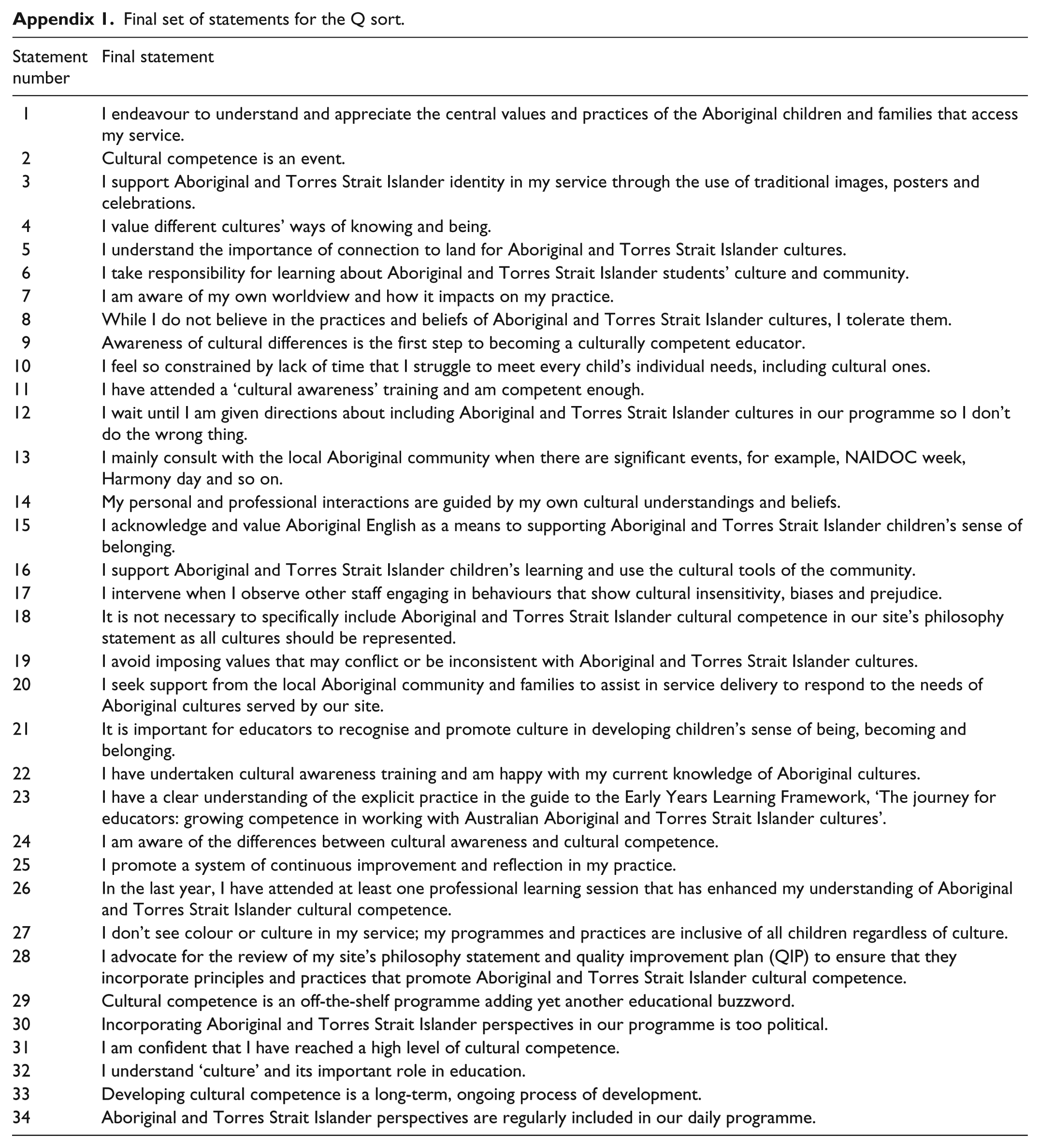
The Q sample is developed through a filtering of the concourse, the goal of which is to provide a final set of statements without losing the representativeness of the content. It is acknowledged that the Q sample ‘can never really be complete (as there is always something else that might be potentially said)’, but needs to ‘contain a representative condensation of information’ (Watts and Stenner, 2005: 75). Brown (1970 cited in Webler et al., 2009: 10) highlights that the most important quality of the Q sample is that they should accurately represent what is said in the concourse. In the process of devising the final Q sample, an expert group were approached to participate in this phase of the study. The expert group consisted of six educators from the South Australian Department for Education and Child Development, Early Learning and Quality Reform (ELQR) unit. The ELQR unit consists of members of the teaching profession who have been seconded to the Department to work on specific projects. Participants from the ELQR unit were invited to participate in this phase of the research. As a result, six participants responded. Each participant was informed about the aims and objectives of the research and were asked to check the appropriateness of the Q sample in line with the research topic and to ensure that they were clear and unambiguous. The participants did not sort the statements, but checked the Q sample statements for appropriate semantics, clarity, balance and representativeness and to ensure that the Q sample was ‘comprehensive, balanced and representative’ of the topic (Brown, 2004: 4). In this study, the concourse was reduced to generate a representative subset of 34 statements, called the Q sample to be used in the Q sort (see Appendix 1).
Selecting the P set
The P set comprises the selected group of participants sorting the Q statements. In Q methodology, the variables are the participants performing the Q sort rather than the statements they are sorting. This rests with the purpose of Q methodology, which is to find patterns of thought between and among people. It has also been suggested that to find such patterns of thought and that considering the variables are the participants, the number of participants should be kept to a minimum (McKeown and Thomas, 1988). McKeown and Thomas (1988) advise that the size of the P set ‘depends upon the nature and purpose of the study’ (p. 37).
Merriam (2002) affirms that ‘qualitative research inquiry seeks to understand the meaning of a phenomenon from the perspectives of the participants, [and] it is important to select a sample from which the most can be learned’ (p. 12). Therefore, purposive recruitment was used to ensure that participants participated in the Q sort ‘based on a specific purpose rather than randomly’ (Tashakkor and Teddlie, 2003: 713). Using purposeful recruitment ensures that it attends to ‘the real purpose and objectives of the research of discovering, gaining insight and understanding into a particular phenomenon’ (Burns, 2000: 465). An invitation to participate in the research was emailed to all educators in South Australian Preschool sites. To set the context, all preschools within South Australian are managed by the State’s Department of Education and Child Development. Within South Australia there are over 400 preschool sites and most of the sites have Aboriginal and Torres Strait Islander children enrolled. Adding to this, Aboriginal and Torres Strait Islander children are entitled to attend preschool once they turn 3 years of age to contribute to their long-term success within education (Sylva et al., 2004). The invitation sent to South Australian preschool sites resulted in 18 educators who completed the Q sort. Although this may seem a very low response rate, an advantage of the Q sort method is that it is the diversity of respondents that is more important than the number of respondents. All that is required is a sound number of participants to identify differing perspectives as factors for purposes of comparison (Watts and Stenner, 2005; Webler et al., 2009).
Method
Participants
In all, 18 early childhood educators participated in the study, of which 13 participants identified as female, 2 as male and 3 participants chose not to disclose gender. Self-disclosed age of participants ranged from 31 to 50+ years, with three participants in their thirties, four participants in their forties and seven participants in their fifties. Four participants did not disclose age on the demographic data survey. Participant’s self-disclosed cultural backgrounds included: seven Anglo Australians, one British/German, one Italian, one English/Irish, one European, one participant identified as Aboriginal or Torres Strait Islander and six participants did not respond to this question.
The Q sort
The primary purpose of a single participant conducting a Q sort is to reveal perspectives from the standpoint of the person conducting the Q sort (Brown, 1980). Participants complete the Q sort according to their own perspective of each statement’s meaning and how those statements fit into their own understandings relevant to the topic. This ‘relative rankings of statements often give insight into the structure as well as the content of an individual’s thinking’ (Redburn, 1975: 767). A total of 18 participants sorted 34 statements into a quasi-normalised grid per their agreement or disagreement with a statement. The sorting process is intrinsically subjective because participants judge each Q statement relative to the others while placing them into the distribution based on a condition of instruction, both of which are provided by the researcher (Newman and Ramlo, 2010: 509). This is explained further in the following sections.
This study used an online web platform for the Q sort. Qsortonline is an online software program designed to support both an initial pre-sort and the final rank-order sort of the Q statements and ensure that all steps in the Q sort process occurred in the correct order. The online platform also had scope to collect other required data elements of the study, that is, consent, demographic information and reflection questions regarding individual statement placement. Qsortonline is accessible from any computer and is compatible with all current Internet browsers. To use Qsortonline, participants access the Internet site via a secure web link. The Qsortonline application then loads into the participant’s browser and leads the participant through the following steps of the Q methodology research process:
An introduction that explains the study and process.
The first-order sort of the Q sample into ‘agree’, ‘neutral’ and ‘disagree categories.
The rank-ordering of each of the statements into the Q grid.
From the start, participants are instructed to familiarise themselves with the 34 statements and then to first-order sort the Q sample into ‘agree’, ‘neutral’ and ‘disagree’ categories relevant to their understandings and perspectives concerning cultural competence. At this stage, all of the statements can be moved around until the participant is completely satisfied with his or her choice. When sorting was completed each participant was asked to re-examine the entire selection of statements and rearrange them if they wished. This ranking of statements allowed participants to determine what is meaningful, valuable and significant from their perspective. At the end of the sorting process, participants were invited to explain their reasons for choosing the statements with which they ‘strongly agreed’ and ‘strongly disagreed’ with to better inform the researchers’ interpretations of the results. Once a participant completes the Q sort, the server collects all data which are stored in a secure gateway where the researcher can access information which is provided on an Excel spreadsheet and later imported into an appropriate analysis package.
Data analysis in Q methodology
Q methodology is designed so that the Q sample (the statements) becomes the ‘subjects’ and the individual Q sorts (the participants’ viewpoints) become the ‘variables’, hence it becomes possible to correlate the way in which individual Q sorts cluster together to form similar or shared viewpoints. Therefore, by-person factor analysis highlights patterns between Q sorts by comparing the value of one variable (e.g. a Q sort from participant 1) with the value of another variable (a Q sort from participant 2) for the same Q sort statement (Webler et al., 2009). Data analysis was carried out using a specialised freeware program. PQ method (Schmlock, 2014) is a commercial Windows-based DOS program designed to statistically analyse Q data. The analysis of Q sorts involve correlation, factor analysis and the calculation of factor scores (Brown, 2008). The by-person factor analysis determines the extent to which individual Q sorts correlate highly with one another and therefore can be considered to resemble, and thus be classed, as a ‘factor’ (Brown, 1993). The purpose of factor analysis is to determine the underlying factors from the data, which can summarise the pattern of correlations (Watts and Stenner, 2012). The number of factors extracted from the data and the way in which these are interpreted and described is dependent on the researcher’s judgement as well as statistical and theoretical processes. The most subjective part of the entire Q methodological process is in the interpretation of factor arrays. When interpreting a factor array, a probable story becomes apparent about the choices made by the participants to explain the pattern of their rankings. The following sections explore the findings and outline the process of interpretation.
Results
Q methodology evaluates participants’ Q sorts using factor analysis to identify shared and distinct points of view or perspectives. PQMethod (version 2.35; Schmlock, 2014) was used to analyse the 18 Q sorts in this study. Several statistical procedures were conducted to arrive at a two-factor solution: correlation matrix; factor extraction and varimax rotation (Brown, 2004: 6). PQ method correlates the Q sorts (people who conduct the sort) rather than the statements themselves. In this phase of the study, 18 participants sorted 34 statements into a quasi-normalised grid per their agreement or disagreement with a statement to determine the strength of feeling towards the statement. Once the statements from each Q sort are entered into the PQMethod program, the program automatically calculates the correlation matrix. The correlation matrix reflects the nature and extent of the relationships of each Q sort with every other Q sort in the study (Watts and Stenner, 2012). As in other factor analyses, researchers need to then choose the method of extraction and rotation. Watts and Stenner (2012) suggest a principal component analysis is undertaken to examine unrotated factors. In this study, it was determined that two factors would be extracted for varimax rotation. Varimax rotation was considered appropriate as a ‘purely technical objective procedure’ (Van Exel and de Graaf, 2005: 11). After experimenting with various alternatives offered by varimax rotation, the two factors were retained. The two factors were also chosen because they represented some attributes of the larger narrative related to cultural competence. For further information relating to Q analysis, I invite the reader to explore primers on Q methodology (see Brown, 1980; Watts and Stenner, 2012).
The researcher’s role is to then develop a narrative that describes each of the identified factors (Webler et al., 2009). The first factor was represented by 12 respondent sorts, and the second by 6. Each factor is named with a descriptive phase or sentence that focuses on the most prominent feature of the factor. The names given to the two factors are intended to act as an abbreviated narrative title as it encapsulates some essence of the larger narrative. Although interpretive in nature, the narratives explain the viewpoint being expressed by a particular factor.
Both factors provide insight into participants’ viewpoints about cultural competence. The factors were labelled as:
Factor 1: Beginning the journey towards cultural competence.
Factor 2: Learning with Aboriginal families and communities.
Both factors are communicated as narratives that offer insight into educators’ understandings and perspectives about cultural competence. In the following narratives and for ease of interpretation, the statements are followed by numbers in brackets. The first of these represents the number of the statement being highlighted, and the second number signifies the position within the factor array. For example, in factor 1, for statement 2 participants loaded significantly on −3. This is displayed as (2: −3). The 2 representing statement number 2 and the −3 representing the significant loading. Similarly, for factor 2, for statement 5 participants loaded significantly on +1. This is displayed as (5: +1). Statements are also highlighted within the narrative using italics. By way of example, in factor 1, statement 2 is presented as Cultural competence is an event (2: −3). In addition to the factor analysis data, each participant was invited to make a comment. Of the 18 participants, 6 participants provided comments, and these were used in the factor interpretation and to support the factors overall narrative.
Factor 1: beginning the journey towards cultural competence
Factor 1 had 12 participants loading onto it and this explains 32% of the study variance. The demographics of these participants include eight participants who had been teaching for 10+ years; one participant between 6 and 9 years and two between 3 and 5 years. Table 1 highlights the high positive and high negative statements that participants loaded significantly on in factor 1.
Factor 1 high positive and high negative statements.
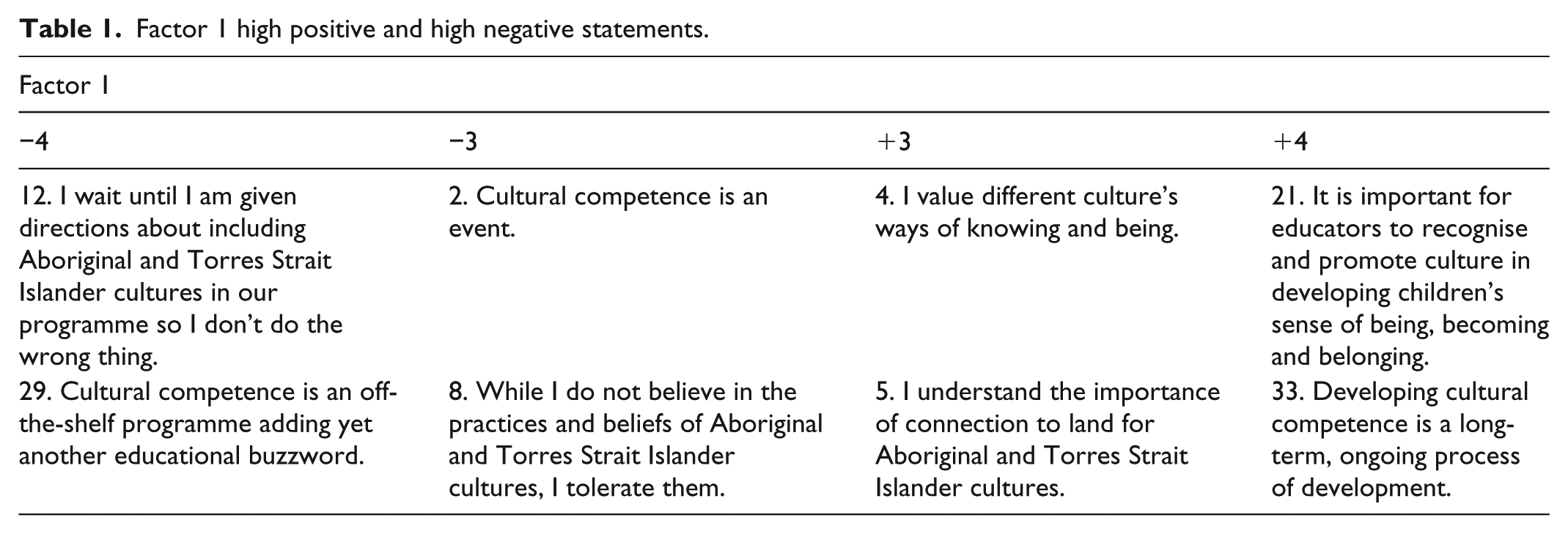
Factor 1 is defined by the view that developing cultural competence is a long-term, ongoing process of development (33: +4). Participants deny that cultural competence is an event (2: −3) nor an off-the-shelf program adding yet another educational buzz word (29: −4). Participant 18 stated: I disagree with the statement that cultural competence is a buzz word because it should be happening each day in your own service not just when we have to add cultural competence in the service.
Similarly, participant 8 commented: Cultural Competence is a way of life.
Participants in Factor 1 value different culture’s ways of knowing and being (4: +3) and understand ’culture’ and its important role in education (32: +1). There is also awareness among participants of acknowledging cultural differences as the first step to becoming culturally competent (9: +1). Participants also acknowledge the importance of connection to land for Aboriginal and Torres Strait Islander cultures (5: +3). Participant 18 commented: I strongly believe this is their history and where they have come from and this belongs to each culture and where the cultures come from, so much stories and history. They are connected to the land through their culture.
Participants were unsure the role and place of their own cultural understandings and beliefs, this is evident in the ‘neutral’ placing of the statement, my personal and professional interactions are guided by my own cultural understandings and beliefs (14: 0). But participants are aware of their own worldview and how it impacts on practice (7: +1).
Participants in factor 1 believe in the importance of the educators’ role to recognise and promote culture in developing children’s sense of being, becoming and belonging (21: +4). By way of example, participant 8 stated: Children’s culture needs to be acknowledged and included as part of the whole child development.
Contradictory to this, participants ranked low when it came to seek support from the local Aboriginal community and families to assist in service delivery to respond to the needs of Aboriginal cultures served by our site (20: −1), nor do participants support Aboriginal and Torres Strait Islander children’s learning and use the cultural tools of the community (16: −1). Interestingly, participants consider they take responsibility for learning about Aboriginal and Torres strait Islander students’ culture and community (6: +1). Inconsistent with their perspectives on engaging with their local Aboriginal community to support children’s learning, participants suggest that they endeavour to understand and appreciate the central values and practices of the Aboriginal children and families that access my [their] service (1: +2). Participant 7 detailed: We have a number of Aboriginal families attending – it is part of my way to ensure their voice is heard: and to ensure sensitivity to planned learning experiences occurs and is culturally appropriate.
Participant 8 commented: Every parent needs to feel valued.
Participants affirmed that using traditional images, posters and celebrations was not conducive to supporting Aboriginal land Torres Strait Islander identity in the service (3: −1). Subsequently, participants view continuous improvement and reflection (25: +2) as vital in their service and particularly in relation to Aboriginal children and families. Participants claim to advocate for the review of my [their] site’s philosophy statement and Quality Improvement Plan to ensure that they incorporate principles and practices that promote Aboriginal and Torres Strait Islander cultural competence (28: +3). Participant 7 affirmed: I believe it is necessary to include Aboriginal and Torres Strait Islanders in our site philosophy as well as all cultures being represented.
A comment by participant 18 emphasised this point: I believe this is part of the QIP–to promote inclusion and diversity in the service is a big factor to improve the service and the practices in the service. Educators having more understanding about cultural competence will benefit the service and the connections between cultures and each child having a sense of belonging.
Overall, participants in factor 1 advocate the importance of including ‘culture’ in their sites philosophy statement and are consistent with the belief that educators should have an understanding of cultural competence. Feelings were neutral in relation to professional learning that has enhanced my [their] understanding of Aboriginal and Torres Strait Islander cultural competence (26: 0). For this reason, participants were also impartial in their understanding of the explicit practice in the Guide to the EYLF, ‘The Journey for Educators: Growing competence in working with Australian Aboriginal and Torres Strait Islander cultures’ (23: 0), but claim to be ‘aware of the differences between cultural awareness and cultural competence’ (24: +2). Furthermore, participants can recognise that they have not reached a high level of cultural competence (31: −2).
Factor 2: learning with Aboriginal communities and families
Factor 2 has the smallest number of participants loading onto it. Six individuals loaded onto this factor and it explains 25% of the study variance. Out of these individuals, two claim to have been teaching for 10+ years, one between 6 and 9 years and one between 3 and 5 years. Two participants did not provide any demographic details. Table 2 highlights the high positive and high negative statements for those participants that loaded significantly on factor 2.
Factor 2 high positive and high negative statements.
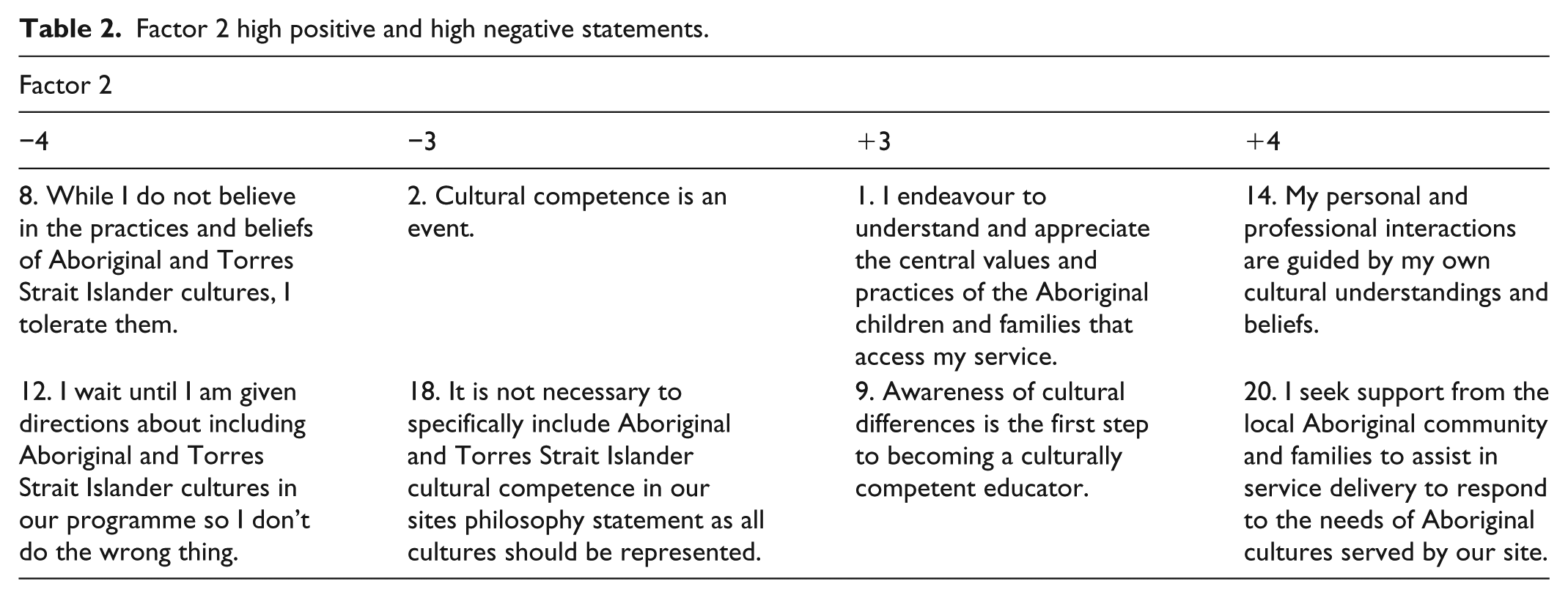
Participants in factor 2 believe that their personal and professional interactions are guided by my [their] own cultural understandings and beliefs (14: + 4) and are aware of how my [their] own worldview … impacts on my [their] practices (7: + 2). Referring to statement 7 about being aware of personal worldviews, participant 14 acknowledged that: It is often the line taken by those beginning on their journey towards cultural competency. Knowing and acknowledging one’s own world view is the basis for all reflective practice.
Conversely, participants endeavour to understand and appreciate the central values and practices of the Aboriginal children and families that access my [the] service (1: +3). They also agree that awareness of cultural differences is the first step to becoming a culturally competent educator (9: +3). Equally, participants value different culture’s ways of knowing and being (4: +2) and affirm that it is important for educators to recognise and promote culture in developing children’s sense of being, becoming and belonging (21: +2). This includes acknowledge[ing] and value[ing] Aboriginal English as a means to supporting Aboriginal and Torres Strait Islander children’s sense of belonging (15: +2) and also understand[ing] the importance of connection to land for Aboriginal and Torres Strait Islander cultures (5: +1).
Participants who loaded significantly on this factor do not wait until [they are] given directions about including Aboriginal and Torres Strait Islander cultures in our [the] program (12: −4) and regularly include Aboriginal and Torres Strait Islander perspectives in the daily program (34: +1). Participant 14 stood strong in her assertion: I am not felled by fear: as an educator, it is my responsibility to begin the journey with children and families and not wait until I believe that I have all of the information needed.
Consequently, participants support Aboriginal and Torres Strait Islanders children’s learning by using the cultural tools of the community (16: +3). This is reinforced by participant 14 who insisted: … where else would you start with when working with families and children?
Participants within this factor seek support from the local Aboriginal community and families to assist in service delivery to respond to the needs of Aboriginal cultures service by their sites (20: +4). Participant 15 stated: I try hard to learn from my Aboriginal parents and families their values and beliefs.
Participants endeavour to understand and appreciate the central values and practices of the Aboriginal and families that access their services (1: +3). Participant 17 affirmed: I attempt to learn about all of the cultures represented in our service.
Interestingly, participants were neutral in their stance of promoting a system of continuous improvement and reflection in my [their] practice (25: 0). Hence, participants were impartial in advocate[ing] for the review of my [their] site’s philosophy statement and Quality Improvement Plan to ensure that they incorporate principles and practices that promote Aboriginal and Torres Strait Islander cultural competence (28:0). Consequently, participants disagreed with the statement that it is not necessary to specifically include Aboriginal and Torres Strait Islander cultural competence in our (their) sites philosophy statement as all cultures should be represented (18: −3). This is consistent with their understanding that acknowledge[ing] and value[ing] Aboriginal English as a means to supporting Aboriginal and Torres Strait Islander children’s sense of belonging (15: +2) and is congruent with participants valuing of different culture’s ways of knowing and being (4: +2).
Participants confirm that they have not attended one professional learning session within the last 12 months that has enhanced their understanding of Aboriginal and Torres Strait Islander cultural competence (26: −1). Participant 14 reflected: Most training that I have undertaken has been adhoc and somewhat haphazard. I would appreciate a systematic approach so that my understanding could grow.
Participant 15 elaborated: If only there was more support from leaders and the system around how we begin this journey towards growing cultural competence.
Participants in this factor claim to have a clear understanding of the explicit practice in the Guide to the EYLF, ‘The Journey for Educators: Growing competence in working with Australian Aboriginal and Torres Strait Islander cultures’ (23: +1); which corresponds with their beliefs that awareness of cultural differences is the first step to becoming a culturally competence educator (9: +3). Furthermore, participants affirm that developing cultural competence is a long-term, ongoing process of development (33: +1). Participant 17 asserted: One can’t claim to be culturally competent; it’s not a skills checklist to tick off.
Participants disagreed with the statement I have attended a ‘Cultural awareness’ training and am competent enough (11: −2). Equally, opposed the statement I have undertaken cultural competence training and am happy with my current knowledge of Aboriginal cultures (22: −1). Similarly, participants disagreed with the statement that they have reached a high level of cultural competence (31: −1).
Discussion
In this study, Q methodology was used to explore as many alternative perspectives as possible and, with the use of correlation and factor analytic techniques, group and describe educators’ understandings of and perspectives about cultural competence. Two factors emerged from the factor analysis. Participants loaded on one of two factors that were labelled as: (1) beginning the journey towards cultural competence and (2) learning with Aboriginal families and communities. The findings validate some common elements across both factors, but they also provide some innovative perspectives on educators’ understandings of cultural competence.
Factor 1 is characterised as beginning a journey towards cultural competence. Within this factor, participants placed value in understanding and recognising culture in developing children’s sense of belonging, but did not seek support from or use the cultural tools of their local Aboriginal and Torres Strait Islander community. This is contrary to the best practice as advocated by the review of the literature and the EYLF (AGDEEWR, 2010; Milgate, 2016). The EYLF calls for educators to work closely with their local Aboriginal families and communities to promote positive learning outcomes for all children (AGDEEWR, 2010). Participants within factor 1 also agree that cultural competence is a long-term ongoing process of development. However, participants were somewhat aware of their own worldviews and how it impacts on practice but unsure of the role and place of their own cultural understandings and beliefs in their personal and professional interactions. A willingness to engage in a journey of critical reflection prompts individuals to make sense of experiences leading to personal transformation that can disrupt dominant narratives. Reflective practice is recognised by the Australian SNAICC organisation as an essential component to developing cultural competence (SNAICC, 2012: 6). Reflective practice is a form of ongoing learning that involves engaging with questions of philosophy to explore our professional practice. The EYLF supports the view that critical thinking and reflection are important practices to undertake with the aim to ‘develop new insights into what we do and why we do it’ (AGDEEWR, 2010: 7). A stance that interrogates what we know and how we have come to know is a critical underpinning to learning and, thereby, we become more self-reflective in our approaches to understanding cultures and multiple and competing discourses. This is noteworthy as these multiple and competing discourse inform teaching practices, and these meanings affect ‘differing effects of power’ (Ryan and Grieshaber, 2005: 39). Rouse (2012: 9) affirms that educators who undertake critical reflection see change as a process of ongoing learning and development and consider learning as a lifelong journey. The EYLF asks educators to ‘critically reflect on their own views and understandings of early childhood theory, research and practice for the ‘degree of fit’ with local understandings, experiences and expectations’ (AGDEEWR, 2010: 27). However, contradictorily, the EYLF refers to cultural competence as also being ‘about assisting Aboriginal and Torres Strait Islander people to build their capacity’ (AGDEEWR, 2010: 27). This discourse while ‘seemingly neutral and compassionate’ (Castagno, 2014: 35), may imply that Aboriginal communities do not have the current capacity. It has been identified that when educators fail to engage with and build on existing Aboriginal community strengths and instead focus on deficits, the status quo is maintained in terms of curriculum and pedagogical choices (Hunt, 2013). One of the most effective ways to challenge dominant discourse and ‘share culturally valued ways’ is through developing strong respectful relationships with and learning from Aboriginal families and communities (AGDEEWR, 2010: 28).
Conversely, Factor 2 is characterised by educators understanding cultural competence as a long-term journey that happens in relationships with Aboriginal families and communities. Participants in Factor 2 valued input from their local Aboriginal families and communities to assist in service delivery. Collaboration and empowering relationships between educators and communities contribute to building cultural capital. The literature makes clear that drawing on the strengths of the community to develop two-way partnerships is important (Milgate, 2016). Understandings of cultural competence for participants in factor 2 centred on relationships to ensure that cultural competence is relevant and responsive to the children and families they work with.
Both factors are congruent that cultural competence is a long-term, ongoing process of development. Consensus that one cannot reach a fixed level of competency is also evident between both the factors. Dean (2001) advocates for the position of not knowing about cultural competence and states that ‘there is no thought of competence–instead one thinks of gaining understanding (always partial) of a phenomenon that is evolving and changing’ (p. 624). As previously established, a process of undertaking a journey is ‘critical to the development of cultural competence’ (AGDEEWR, 2010: 21). Furthermore, taking time to critically examine concepts in line with our values, biases and stereotypes is important and raises our social-consciousness to better inform our understandings and perspectives of issues that are relevant to the children, families and communities we work with.
Limitations
Both factors provide insight into participants’ understandings and perspectives of cultural competence. However, there are also several methodological considerations that need to be taken into account. Although participants were not interviewed post Q sort, participants were provided the opportunity to respond to several questions related to their statement selections and these responses were included in the interpretation of both factors. Another important consideration is that the concourse was derived from the literature and this may have potential limitations regarding the depth of discourse about cultural competence. However, the researcher used recent literature within the early childhood field which was considered familiar to the participants. Furthermore, the two factors identified in this study are not representative of all of the possible perspectives available, however, they do provide a point of discussion that may bring about patterns of understandings to better inform a collective awareness of cultural competence.
Conclusion
It has been substantiated that the discourse of cultural competence is undoubtedly a multifaceted concept with various meanings and connotations attached to it. It has also been established that Q methodology is an appropriate method that can be used across multiple disciplines to explore any topic that is interested in understanding other people’s perspectives. This research argues that although the concept of cultural competence is complex, there is opportunity for educators to work with their Aboriginal families and communities to rethink what we think we know to transform what we do (Mac Naughton, 2009: 190–191) to broaden our understandings of cultural competence. As a final point, critically examining the various discourses of cultural competence and recognising that there may be many meanings or understandings, and not attempting to reduce or essentialise concepts to fit preconceived ideas and criteria is important.
Footnotes
Appendix
Final set of statements for the Q sort.
| Statement number | Final statement |
|---|---|
| 1 | I endeavour to understand and appreciate the central values and practices of the Aboriginal children and families that access my service. |
| 2 | Cultural competence is an event. |
| 3 | I support Aboriginal and Torres Strait Islander identity in my service through the use of traditional images, posters and celebrations. |
| 4 | I value different cultures’ ways of knowing and being. |
| 5 | I understand the importance of connection to land for Aboriginal and Torres Strait Islander cultures. |
| 6 | I take responsibility for learning about Aboriginal and Torres Strait Islander students’ culture and community. |
| 7 | I am aware of my own worldview and how it impacts on my practice. |
| 8 | While I do not believe in the practices and beliefs of Aboriginal and Torres Strait Islander cultures, I tolerate them. |
| 9 | Awareness of cultural differences is the first step to becoming a culturally competent educator. |
| 10 | I feel so constrained by lack of time that I struggle to meet every child’s individual needs, including cultural ones. |
| 11 | I have attended a ‘cultural awareness’ training and am competent enough. |
| 12 | I wait until I am given directions about including Aboriginal and Torres Strait Islander cultures in our programme so I don’t do the wrong thing. |
| 13 | I mainly consult with the local Aboriginal community when there are significant events, for example, NAIDOC week, Harmony day and so on. |
| 14 | My personal and professional interactions are guided by my own cultural understandings and beliefs. |
| 15 | I acknowledge and value Aboriginal English as a means to supporting Aboriginal and Torres Strait Islander children’s sense of belonging. |
| 16 | I support Aboriginal and Torres Strait Islander children’s learning and use the cultural tools of the community. |
| 17 | I intervene when I observe other staff engaging in behaviours that show cultural insensitivity, biases and prejudice. |
| 18 | It is not necessary to specifically include Aboriginal and Torres Strait Islander cultural competence in our site’s philosophy statement as all cultures should be represented. |
| 19 | I avoid imposing values that may conflict or be inconsistent with Aboriginal and Torres Strait Islander cultures. |
| 20 | I seek support from the local Aboriginal community and families to assist in service delivery to respond to the needs of Aboriginal cultures served by our site. |
| 21 | It is important for educators to recognise and promote culture in developing children’s sense of being, becoming and belonging. |
| 22 | I have undertaken cultural awareness training and am happy with my current knowledge of Aboriginal cultures. |
| 23 | I have a clear understanding of the explicit practice in the guide to the Early Years Learning Framework, ‘The journey for educators: growing competence in working with Australian Aboriginal and Torres Strait Islander cultures’. |
| 24 | I am aware of the differences between cultural awareness and cultural competence. |
| 25 | I promote a system of continuous improvement and reflection in my practice. |
| 26 | In the last year, I have attended at least one professional learning session that has enhanced my understanding of Aboriginal and Torres Strait Islander cultural competence. |
| 27 | I don’t see colour or culture in my service; my programmes and practices are inclusive of all children regardless of culture. |
| 28 | I advocate for the review of my site’s philosophy statement and quality improvement plan (QIP) to ensure that they incorporate principles and practices that promote Aboriginal and Torres Strait Islander cultural competence. |
| 29 | Cultural competence is an off-the-shelf programme adding yet another educational buzzword. |
| 30 | Incorporating Aboriginal and Torres Strait Islander perspectives in our programme is too political. |
| 31 | I am confident that I have reached a high level of cultural competence. |
| 32 | I understand ‘culture’ and its important role in education. |
| 33 | Developing cultural competence is a long-term, ongoing process of development. |
| 34 | Aboriginal and Torres Strait Islander perspectives are regularly included in our daily programme. |
Acknowledgements
This manuscript is an original work that has not been submitted for publication elsewhere
Declaration of conflicting interest
The author(s) declared no potential conflicts of interest with respect to the research, authorship and/or publication of this article.
Funding
The author(s) received no financial support for the research, authorship and/or publication of this article.