



Abstract
Previous research on the far transfer effects of music performance training has primarily focused on its impact on general cognitive ability. However, it remains unclear whether such training could enable children and adolescents to be creative in other domains through the acquisition of self-regulation skills, which are essential for long-term creative achievement. To start addressing this gap, we develop a new perspective on how self-regulation skills acquired during music performance training, supported by parental psychological support, could transfer to other creative domains. This new perspective also highlights the relevant role of the parental psychological support in early childhood and adolescence, which is often understudied in research on transfer of music performance training. We build our new perspective on previous studies on the connection between music and far transfer, and self-regulation and creative achievement as well as studies on the link between social/parental support and self-regulation (in the music context). This paper constructs a new theoretical framework that could explain how different styles of parental psychological support (instructive, guiding, emotional, motivational, autonomous) are involved in the possible transferability of self-regulation skills from music performance training (e.g., self-setting goals, self-reinforcement, self-support) to other creative domains.
Mastering a musical instrument is a difficult and complex task (Galera et al., 2013). Learning to play a musical instrument at a young age (primary and secondary school age) may influence creative skills to the extent that they could enhance performance on other creative tasks, the so-called far transfer phenomenon (Concina, 2019; Frischen et al., 2021; Jaschke et al., 2018). Therefore, it remains an open scientific and practical question what precisely music performance training could offer beyond technical mastery, such as the potential for the development of broad creative skills that are transferable to creative domains beyond music performance. To start to address this open question, a new perspective is needed on the far transfer effects of music performance training and especially how these far transfer seeds of music are implanted and grow throughout childhood and adolescence.
Far transfer is defined as “a learning or exercise effect that goes beyond the primary effect of practice” (Degé, 2021, p. 1). Recent research suggests that self-regulation skills could be applied across diverse creative activities, including music performance (Zielińska et al., 2023). Numerous studies associate music performance training with enhanced self-regulated behavior and practice (Cheng & Southcott, 2023; Faulkner et al., 2010; McPherson & Renwick, 2001, McPherson & Zimmerman, 2011; Pike, 2017; Williams, 2018; Zachariou & Whitebread, 2015, 2019). In light of the varying definitions of instrumental music training in current literature, for clarity, what we mean by instrumental music performance training is the deliberate, individual practice (at home) and application of both formally and informally learned (or not learned) techniques, theoretical knowledge, performance goals, methods, and strategies, serving as a potential basis for advanced and autonomous music performance learning. The interconnection between music performance training and learning has also been delineated by previous research on self-regulated instrumental learning and practice, suggesting that music performance training could serve as framework to endorse students’ own learning (McPherson et al., 2017). To explain potential longer-term effects of learning instrumental music, we propose that music performance training could also support the development of self-regulation skills, and that these could also be transferable to other creative domains. Self-regulation is generally defined as “self-generated thoughts, feelings, then actions that are planned and cyclically adapted to the attainment of personal goals” (Zimmerman, 2000, p. 14).
Recent studies have attempted to develop a new concept of self-regulation of creative action (an evolving theory and currently under research) that could explain the process and mechanisms of achieving long-term creative goals across various creative domains due to its adaptive and domain-general role in regulating emotions, motivation, cognition, and behavior (Ivčević & Nusbaum, 2017; Ivčević et al., 2024; Lin et al., 2024; Zielińska et al., 2022, 2023). According to Ivčević et al. (2024), self-regulation of creative action is the process of methodological and deliberate behavior control, emotions management, and “persistence in the face of obstacles” (p. 4) to define and actualize long-term creative goals. Self-regulation of creative action has previously predicted creative achievement (i.e., “real-life creative accomplishment” (Jauk et al., 2014, p. 96)) across different domains, such as art, music, science, and invention, designating the (at least partly) domain-general nature of this skill (Ivčević et al., 2024; Zielińska et al., 2022, 2023). Overall, the previous findings of Ivčević et al. (2024) and Zielińska et al. (2022, 2023) demonstrate that self-regulation bolsters the transformation of a creative action into short-, medium-, and long-term achievement in the everyday realm (e.g., cooking, room decoration, and arts and crafts hobbies) and the professional realm (e.g., science, writing, performing arts, visual arts, and music). Hence, the relationship between music performance training and self-regulation of creative action may be crucial to understanding long-term far transfer in terms of creative achievement across domains.
Previous studies have also highlighted the empowering role of the social support of teachers, peers, and family in children's music engagement, progress, and performance achievement (Creech, 2006, 2009; 2010; Creech & Hallam, 2003, 2009; Dai & Schader, 2001, 2002). Social support (peers, teachers, and family) has been previously connected to increased self-regulated behavior in the context of school, and music training and play (Kesawa & Primana, 2017; Koops 2019a, 2019b; McPherson & Renwick, 2001; McPherson & Davidson, 2002; McPherson, 2009; Upitis et al., 2016; Zachariou & Whitebread, 2015, 2017, 2021). Parental support is one example (out of several) of how self-regulation of creative action and far transfer can be supported that merits further investigation because of its relevance to our perspective and its particular developmental importance. Positive parenting and parental support in the early developmental phase have been previously linked to the emergence of self-regulation capabilities (e.g., high levels of internalization of rules, effort, emotion, and behavioral control, attention) (Kiss et al., 2014). Parental support, therefore, crucially extends our perspective into the developmental sphere of self-regulation skills.
According to McPherson and Zimmerman (2011), parents could help music performance learners to develop awareness of their own “functioning”, cognitive, motivational, and self-regulatory abilities (p. 134). In this developmental process, parents’ role accelerates self-regulatory behaviors that continue throughout the school, teenage, and adult life of children (Warton, 1997, as cited in McPherson & Zimmerman, 2011, p. 135). Hence, parents position themselves as critical facilitators in the transferability of self-regulation skills because they could teach children how to acquire self-regulation skills through music learning. The supportive role of others in stimulating self-regulation skills has also been found in previous studies that place teachers and peers as significant factors in the context of music learning (Zachariou & Whitebread, 2017, 2021). If we see transfer of self-regulation as an acquired skill in the family context that is then applied to music learning, far transfer could be learned through the family's rules and parents’ modeling of self-regulatory behaviors at a very young age (McPherson, 2009; McPherson & Zimmerman, 2011). An interesting open question that arises is whether parents could also play a role in ensuring that transfer effects “land” in other creative domains.
Overall, the connection between self-regulation and far transfer in music performance training context remains underexplored (Concina, 2019; Lin et al., 2024; Zielińska et al., 2022, 2023). Most prior studies have focused on how instrumental music education impacts general cognitive ability (intelligence, verbal, and mathematical ability), often described as “cognitive transfer” or “far transfer,” or “far transfer effects” or “transfer” primarily in academic achievement and school performance contexts like literacy, mathematics, and foreign languages (Mosing et al., 2015; Sala & Gobet, 2017, 2020; Schellenberg et al., 2023). Despite the plethora of empirical studies on (instrumental) music training and far transfer, several meta-analyses and an annual review study highlight methodological issues in this research, including inadequate differentiation between near and far transfer, insufficient use of active control groups, over-utilization of small school samples, and systematic use of underprivileged student samples, which might have artificially led to positive results due to non-musical benefits or cognitive maturation (Bigand & Tillmann, 2021; Cooper, 2020; Schellenberg & Lima, 2024). These issues call for rethinking far transfer to better understand its mechanisms.
In the present paper, we offer a new perspective on far transfer that highlights the central relevance of self-regulation skills of creative action that can be acquired though music performance training in early childhood and adolescence. The significance of this study is to develop a theoretical framework to explain how self-regulation skills not only could be cultivated through music performance training, but also could possibly support the creation of diverse creative products. Far transfer is thus defined here as the application of self-regulation skills to distant creative tasks, encompassing a broader range of abilities that not only could support overall cognitive ability (“Self-regulation and executive function”, 2024) but could also extend beyond traditional learning tasks to include the development of creative products.
Additionally, most studies have explored parental support in relation to music competence, development, and engagement (Creech, 2006, 2010; Creech & Hallam, 2009; Dai & Schader, 2001, 2002; Kesawa & Primana, 2017; Koops, 2019a, 2019b; McPherson & Renwick, 2001; McPherson & Davidson, 2002; McPherson, 2009; McPherson & Zimmerman, 2011; Upitis et al., 2016), rather than in relation to the transferability of creative skills. This perspective paper explores how children in early childhood and adolescence, with parental psychological support, may develop and transfer self-regulation skills from music to other creative domains, with long-lasting effects in adolescence. Understanding this could help researchers, educators, and policymakers design music curricula that foster creative skills for broader application. The following sections examine the connections between music performance training, far transfer, self-regulation of creative action, and social and parental psychological support, introducing three new theoretical frameworks explained through a fictional scenario.
Instructional Music Performance Training and Far Transfer Effects
Music performance training challenges learners to store, manipulate, integrate, assess, shift, interpret, and monitor musical signals. This process involves memorizing and reading scores and passages, discriminating auditory signals, training motor skills, and learning music structure (Degé, 2021). Such demands may help learners preserve cognitive benefits from their training and potentially transfer these skills to other cognitive tasks. Studies suggest that group or ensemble instruction in music performance training enhances cognitive abilities, including working memory, attention, concentration, planning, cognitive flexibility (task shifting), and inhibition (repressing a dominant response) (Bugos & DeMarie, 2017; Frischen et al., 2019, 2021; Habibi et al., 2018; Hennessy et al., 2019; Jaschke et al., 2018; Shen et al., 2019). Most studies on instrumental performance training utilized structured curricula in classroom settings (Bugos & DeMarie, 2017; Frischen et al., 2019; Shen et al., 2019) or established programs like “El Sistema,” which offers ensemble lessons to underprivileged students without prior music experience (Habibi et al., 2018; Hennessy et al., 2019). These programs encompassed a wide range of instruments (e.g., electronic, drums, Orff instruments, keyboards, strings) and music learning and training activities, including group singing, listening, rhythm (e.g., reading, perception, meter execution), pitch (e.g., discrimination, intonation, joint singing), harmony, melody, motor skills, theory, and improvisation (Bugos & DeMarie, 2017; Frischen et al., 2019, 2021; Hennessy et al., 2019; Jaschke et al., 2018; Shen et al., 2019). Some of these music training programs have been more beneficial than others. For example, Frischen et al. (2019) found that rhythm-based training, but not pitch-based training, improved motor inhibition in preschool children, many from low socioeconomic backgrounds and with no or limited prior experience in music learning.
Music performance trainings designed with high cognitive load seem to achieve sustained cognitive results (Frischen et al., 2019). Instrumental performance programs with increasing difficulty were found to enhance students’ ability to control impulsive movements, and behavior, wait their turn to play music in ensembles, and reflect on mistakes and learning strategies (Jaschke et al., 2018). Structured, standardized, and long-term trainings support “the input and learning outcomes of students” (Jaschke et al., 2018, p. 9) and maintain cognitive effects even after the program ends. Conversely, programs with minimal cognitive load show limited or no sustained effects on cognitive abilities like visual working memory (Roden et al., 2012, 2014). Long-term and incrementally challenging music performance training seem to enhance self-regulation as learners engage with progressively complex learning and training materials over time (Cheng & Southcott, 2023; McPherson & Renwick, 2001; Pike, 2017).
Studies on early childhood self-regulatory development (in the first 5 or 6 years of life) suggest that formal (e.g., rhythmic movement, beat synchronization, games and instrumental play) and informal music play (e.g., guided home activities), that aim at the production of a song or piece, positively associate with general short-term (emotional, attentional, motivational) and long-term self-regulation skills (e.g., classroom behavior, academic achievement) (Williams, 2018; Zachariou & Whitebread, 2015, 2019). However, most studies that implement interventions based on Western music pedagogy may fail to infuse students with intrinsic self-regulation and autonomy because they are externally regulated by teachers’ goals (de Bézenac & Swindells, 2009). Non-Western and informal music learning contexts (e.g., jazz, folk, world music) may better cultivate intrinsic self-regulation and motivation. Awareness of these limitations is crucial when reviewing related literature.
Focusing on self-regulation skills is essential, as classical frameworks of general cognitive skills might be more relevant for the performance of short-term creative tasks that require idea generation and less relevant to the realization of long-term goals into creative products (Zielińska et al., 2023). The next sections will explore the theoretical framework of self-regulation of creative action, its role in long-term, gradual music performance training, and its benefits for long-term creative process, idea activation, and achievements across domains.
A Theoretical Framework of Self-Regulation of Creative Action
Self-regulation skills can grow when ill-defined creative goals and actions exist (Ivčević et al., 2024). Music performance training is characterized by such ill-defined goals and actions because the outcome is not always clear, and experts or reviewers need to evaluate the outcome and decide whether the final creative product is successful (Ivčević & Nusbaum, 2017). For example, music learning as a creative goal requires everyday management of time, workspace, organization of rehearsals and relevant resources, constant balance of control over the rehearsal or training process, and clarification of vague ideas that might relate to the learning process and strategies of music literature or technique or performance expression. Therefore, music performance learners need to discover, formulate, activate, and adjust their goals to meet the requirements of their assessors. According to the theoretical model of Ivčević and Nusbaum (2017), self-regulation is used in three different stages of a creative process: (1) the forethought stage (preparatory strategies, planning and setting goals), (2) the performance stage (working on the actual creative task, monitoring performance and modifying actions if necessary) and (3) the self-reflection stage (completion of a creative process, self-evaluation and self-improvement) (Zielińska et al., 2023, p. 3). In this sense, self-regulation could be the most appropriate skill to measure far transfer effects from music performance training due to the variety of its regulatory mechanisms (e.g., acceptance of uncertainty, anticipation of obstacles to overcome, adjusting approach, managing and reframing ambiguous goals, managing emotions and persisting in the face of obstacles, readiness for sharing the outcomes with others, and improving approach) (Ivčević & Nusbaum 2017, p. 353, 355; Zielińska et al., 2023, p. 8) that are used throughout all of the phases of a creative process.
In other words, when a music learner has spent an immense amount of time developing self-regulatory strategies, knowledge, and abilities to deal with creative challenges and problems to reach a creative end-goal (the performance of a music piece that requires the practice of expressive and interpretive elements of a written score) then these skills and strategies could be used across different domains (Zielińska et al., 2023). Therefore, we argue that self-regulation could predict long-term transfer effects compared to the classical models of executive functions (Zielińska et al., 2023).
Self-Regulation and Far Transfer Through Creative Achievement
Music performance learners constantly confront ill-defined goals (goals that require management, planning, and organization on a routine basis (Ivčević & Nusbaum, 2017; Zielińska et al., 2022)) and strategies to achieve musical competence. This process requires self-regulation for controlling actions, emotions, behaviors, and cognitions, enabling adaptability during music performance training. General cognitive mechanisms alone cannot fully explain regulatory processes in long-term tasks, such as learning to compose or perform complex musical pieces (e.g., a piece by Mozart) (Zielińska et al., 2023). The reason for this is that self-regulation of creative action is a versatile skill that supports not just the coordination of cognition, but also the control and adaptation of non-cognitive skills that underlie personality traits, for the successful completion of creative projects. Achieving long-term creative goals, like mastering an instrument, requires self-regulatory mechanisms to persist, manage, and adjust emotions, behaviors, intrinsic motivation, mental and learning strategies, ideas, goals and problem-solving, while enabling planning, reflection, and correction (Ivčević & Nusbaum, 2017; Zielińska et al., 2022, 2023). These self-regulatory mechanisms have been found to predict creative achievement in both everyday activities (e.g., crafts, cooking) and professional domains (e.g., music, art performance, science, writing) (Zielińska et al., 2022, 2023; Ivčević et al., 2024). In summary, Zielińska's findings indicate that self-regulation can intensify the conversion of creative activity into achievement in the everyday realm. Additionally, Ivčević et al. (2024) demonstrated that certain self-regulation processes of creative action such as embracing risk and planning positively predicted creative achievement. These studies suggest that when self-regulation is synthesized with creative action or used in the creative process it could further benefit creative achievement in multiple domains. Self-regulation, metaphorically, could thus serve as a screw that fits different objects and devices (in this case diverse creative activities) with distinct functions, but the common goal is to make them work successfully for a long time.
Long-term engagement in music performance training that is incrementally challenging could mirror other long-term creative tasks requiring flexibility and clear methodology. Recent empirical studies involving primary and secondary school students, including samples from schools with low and high socioeconomic status (McNaughton et al., 2022), suggest that acquiring self-regulation skills in specific domains—such as music playing, games, instrumental performance (that lasted for more than 5 weeks), or long-term creative activities like writing (over 5 years) or designing and conducting experiments (spanning more than 15 weeks)—can facilitate the transfer of these skills to distant activities, including everyday life situations and real-world problems (McNaughton et al., 2022; Schuster et al., 2020; Sternberg et al., 2024; Zachariou & Whitebread, 2015, 2019). For example, Zachariou and Whitebread (2019) found that self-regulatory behaviors trained during five music play sessions over more than five weeks (including instrumental, singing, and movement activities) in early childhood (ages 6 to 8) could serve as a means for the development of general self-regulation skills. They specifically examined developmental differences in self-regulation (e.g., metacognitive, emotional, motivational, and socially shared regulation) during music play and general regulation in game tasks (using cubes) between 6- and 8-year-olds. Their findings revealed that domain-specific regulation in music play emerges earlier (around age 6) and progressively transitions from being domain-specific to fully generalized.
General cognitive skills alone may not allow the study of intrinsic motivation or persistence embedded in self-regulatory mechanisms during music performance training (Ivčević & Nusbaum, 2017; Zielińska et al., 2023). Measuring self-regulation might enable researchers to explore how learners not only generate creative ideas or think in diverse ways but also manage uncertainty in musical activities. Focusing on self-regulation rather than general cognitive skills may open up the possibility of being seen as a learnable skill, implying its transferable and long-lasting effects. We propose self-regulation as a measurable effect and transfer effect of music performance training. The following sections explore the connections between parental support, music learning, and far transfer, drawing on literature about self-regulated learning in music practice and performance to support the main perspective of this paper.
Social Support and Self-Regulation: The Role of Parental Psychological Support
Previous studies have suggested that supportive social and home environments (peers and family) may impact the development of children and adolescents in terms of (neuro) plasticity in self-regulation (Belsky & Beaver, 2010; Kiss et al., 2014; Meredith & Silvers, 2024). Studies suggest that the development of self-regulation is based on the bidirectional relationship between child/adolescent self-regulation and quality of relationship in the context of parents and peers relations (Farley & Kim-Spoon, 2014; Kiss et al., 2014; Kim, 2025). In particular, developmental researchers emphasize the importance of the quality of the relationships children/adolescents have with their parents, teachers, peers, friends, and romantic partners for the acquisition of self-regulation (Farley & Kim-Spoon, 2014; Kiss et al., 2014). Additionally, positive and responsive parenting may provide children with a good model of self-regulation strategies and promote feelings of reciprocity and enlarged internalization of rules (Kiss et al., 2014). Thus the parent–child interaction could serve as a good, though not unique, basis for the growth and expansion of self-regulation in a child's later developmental phases.
Self-regulated music performance learners (ages 5–18) often seek and benefit from social support from family, peers, and teachers, who assist in setting music performance training goals, identifying and evaluating mistakes, and adapting for improvement (Cheng & Southcott, 2023; Faulkner et al., 2010; Kesawa & Primana, 2017; McPherson & Davidson, 2002; McPherson, 2009; McPherson & Zimmerman, 2011; Upitis et al., 2016; Zachariou & Whitebread, 2017, 2021). In particular, Zachariou and Whitebread (2021) found that group music play in the classroom, whether involving the absence or full involvement of teachers, increased the self-regulatory behaviors (e.g., planning, monitor, control, evaluation, emotional/motivational regulation) of students aged 6–8. In the absence of teachers students assumed more responsibility for their play. The active participation of teachers in group music play, however, also encouraged self-regulatory behaviors in students by allowing them to articulate themselves. Another study by Zachariou and Whitebread (2015) found that instrumental play in groups or pairs that was less teacher-led and mostly teacher-initiated, but child-led, enhanced 6-year-olds’ self-regulation behaviors. These behaviors included metacognitive control, monitoring, and planning. Students were able to monitor their peers’ behavior and modeled actions and ideas for them. Others encouraged their peers to preserve their efforts in the face of difficulties.
Besides the significant role of teachers and peers in the development of self-regulation skills at a young age, previous studies suggest that parental involvement and support in the music learning process of children may serve as a basis for effective communication between parents, teachers, and children, which can enhance pupils’ instrumental performance strategies and progress (Creech, 2006, 2009; Koops, 2019a; McPherson & Davidson, 2002; McPherson, 2009). In particular, Creech (2009) found that harmonious relationships between teachers, parents, and music students are built when parents and teachers respond to the needs of music learners for trust, autonomy, and initiation of new ideas. Creech's study highlights that parents who are personally involved in their children's daily music learning process by providing emotional support and being aware of their children's learning environment can reinforce the harmonious collaboration between teachers and parents. Parents’ positive involvement in their children's music learning enabled teachers to transform parents’ involvement into teaching strategies that shaped students into independent learners. When parents support their children in understanding their motivation to learn an instrument, teachers can benefit from this knowledge when structuring their teaching to support the goals of music learners (Koops, 2019a). Overall, these studies imply that harmonious relationships between teachers, parents, and students are formed based on a pre-existing parental support system. As this paper focuses on individual music practice at home, emphasis is placed on the parent–child interaction in developing self-regulation skills during early childhood. We argue that very young students could significantly benefit from this interaction, particularly when practicing music at home.
Notably, several studies highlight the potential importance of parental cognitive/intellectual support (e.g., goal-setting stimulation) and emotional/personal support (e.g., encouragement, active listening) in enabling emotional and cognitive resilience and regulation over the course of long-term music performance training (Creech, 2010; Faulkner et al., 2010; Kesawa & Primana, 2017; McPherson & Davidson, 2002; McPherson, 2009; Upitis et al., 2017). When parents meet certain psychological needs of their children, for example, their need to make autonomous music performance choices, to feel competent to musically challenge themselves, to feel related to their music performance training goals and activities, then young learners are more likely to internalize self-regulation (McPherson, 2009). Internalizing an externally guided self-regulated behavior during early years may help children manage challenging tasks across various creative domains, as the ability to manage negative emotions is deeply embedded in the creative processes and achievement (Zielińska et al., 2023, 2022). For this reason, this perspective paper emphasizes parental psychological support, which could encompass diverse styles of parental involvement, including emotional encouragement, cognitive and behavioral instruction, and autonomy-supportive approaches.
Zimmerman (1998) initially introduced six psychological dimensions that learners use to boost their self-regulatory skills: motive, method, time, behavior, physical environment, and social factors. McPherson and Zimmerman (2011) adapted this framework to music learning, highlighting intervention processes (e.g., teaching, instructions, feedback, social support, evaluation, reward, direct or indirect reinforcement) that stimulate self-regulation (e.g., goal-setting, self-reinforcement, self-initiated strategies, self-planned and managed time, self-evaluated and monitored performance, self-structured environments, self-support). These intervention processes are the central focus of this paper, as they provide insight into how parents could support the development of children's self-regulated behavior in music, ultimately enabling them to master self-regulation skills applicable both within and beyond the musical context.
We see parental psychological support as an important part among other types of social support (teachers and peers) of the everyday music performance training of children (ages 5–17) to help them enhance and use their self-regulatory skills for music learning and other tasks that require the same skills. Zimmerman (2000) highlights the importance of such support in developing a self-regulated reaction to daily activities. For example, music students benefit from parental reinforcement, such as rewards for task completion or breaks during training, which might enhance children's control over their persistence, self-esteem, self-efficacy, self-reinforcement, and self-reward when it comes to their everyday instrumental practice. McPherson and Zimmerman (2011) emphasize parents’ roles in monitoring their children play through demonstrations and modeling. If parents cannot provide instructional support due to lack of musical expertise, they could stimulate their children emotionally by calming their negative thoughts, discussing their learning challenges, listening to their training, and creating a safe environment to support their children's music performance training and overall self-regulation development.
Several quantitative studies showed that parental involvement in their children's music learning has helped students engage in the long run with music learning and become more autonomous with their learning and practice (Cheng & Southcott, 2023; McPherson & Renwick, 2001; McPherson & Davidson, 2002). McPherson and Renwick (2001) conducted a 3-year study on seven novice music learners (ages 7–9), analyzing their instrumental practice through parental (mainly maternal) videotaping. Practices included error correction, body-movement monitoring, foot-tapping, and reflective thinking. Key findings revealed significant differences between first- and third-year students. Initially, students focused on completing new pieces rather than effective practice, practicing less and often requesting to stop, necessitating parental time-setting. By the third year, students practiced longer and more independently. Parents played crucial roles in, e.g., creating a supportive environment, minimizing distractions, and providing equipment like proper chairs, aiding students in developing instrumental skills. Self-regulated performance learners sought parental help. The majority of students practiced in the presence of their parents.
McPherson and Renwick (2001) noticed the following parental involvement: a) the parent having a teaching and instructive role, b) the parent having a guiding role and c) the parent (mostly mothers) having a motivating and praising role which lessened by the third year as their involvement shifted to passive observation. The extensive use of a practice diary during their training declined in the third year, suggesting that students initially lacked the ability to set clear practice goals or self-monitor their mistakes, control their training environment, and reflect on the efficiency of their own practice strategies, indicating again the pivotal role of parental support in the first years. Furthermore, Upitis et al. (2017) found that parental support styles, such as monitoring, practical assistance, and instructional guidance, diminished by up to 41% over a 10+ year period as students developed these skills, while emotional and moral encouragement remained stable throughout the years of music performance training. Creech's (2010) survey showed behavioral support (e.g., monitoring and participating in music) increased among 9- to 11-year-olds, while personal support was highest among 16- to 18-year-olds. Overall, parental support is likely to evolve over time based on children's development and their progressive autonomy in regulating their music performance training actions.
On the other hand, the lack or quality of parental support can hinder music students’ self-regulated learning and overall motivation and satisfaction with music learning (Cheng & Southcott, 2023; Creech, 2010; Dai & Schader, 2001; Ryan & Deci, 2000; McPherson & Renwick, 2001). McPherson & Davidson (2002) found that students with minimal emotional (encouraging comments on children's music practice) and practical support (setting reminders for practicing or allowing very little music practice) support often quit lessons in the first year. Overly forceful mothers in developing their children's daily routine of practice negatively affected students’ motivation. Additionally, parents who stopped encouraging practice hindered students’ progress. Thus, the type of support and autonomy parents offer and their perceptions about it could play a crucial role in students’ motivation, persistence, and positive emotions in music learning. Lastly, the type of parental support could also influence the way parents collaborate with teachers and the way teachers guide music learners in developing independent learning skills.
The next section aims to illustrate how the far transfer of self-regulation could take place, under the parental support, across different (learning) contexts using the dimensions of musical self-regulation theoretical framework (McPherson & Zimmerman, 2011) in combination with the framework of development of motivation across children's schooling (Grolnick & Kurowski, 1999).
Parental Psychological Support and the Far Transfer of Self-Regulation (A New Perspective)
Parental support may go beyond influencing children's development of self-regulation skills. Parental support may be an essential factor among other social factors (teachers and peers) for young novice music performance learners to understand how to control their learning, environment, strategies, emotions, time, mental energy, and motivation to align their actions with their learning goals, values, and outcomes (Grolnick & Kurowski, 1999; McClelland & Tominey, 2015; McPherson & Davidson, 2002; McPherson & Renwick, 2001; McPherson & Zimmerman, 2011). Grolnick and Kurowski's (1999) theoretical framework supports the positive effects of parental support on young learners. This framework suggests that parental involvement could enable young learners (infants and preschoolers) to develop initial self-regulation skills to cope with school challenges (e.g., transition to school), which are later (at an older age) internalized to consolidate the values of their actions, make them consistent with their goals, and ultimately transfer them to other domains. The study by Grolnick and Kurowski (1999) showed that parents who supported their children's autonomy were able to facilitate their children's “control understanding, perceived competence and self-regulation” (p. 9) and reduce their learning problems.
School challenges require autonomous self-regulation skills (intrinsic motivation, emotion regulation, understanding of control, and perceived competence) that could be fostered and reinforced by a supportive parental environment in early and middle childhood. Through the internalization of regulated behavior, students learn the self-regulation skills needed to move through different school levels (Grolnick & Kurowski, 1999). A self-regulated (young) learner internalizes the regulation of an extrinsic behavior and incorporates it into his/her sense of self (Grolnick & Kurowski, 1999). Although this internalization process of an extrinsically regulated behavior happens naturally, parents in the first place and later on peers and teachers could facilitate and reinforce it. This is because young people who have not yet mastered their regulatory skills need an autonomous environment that values their feelings and perceptions and empowers them to think and act autonomously to solve their problems, make decisions, and take responsibility (Grolnick & Kurowski, 1999). Returning to McPherson and Zimmerman's (2011) theoretical framework of musical self-regulation described in the previous section, we will see that intervention processes shape the development of specific self-regulatory processes in the context of music performance training. The theoretical frameworks of Grolnick and Kurowski (1999) and McPherson and Zimmerman (2011) underpin similar intervention processes and mechanisms that enable young music performance learners to develop self-regulatory resources that carry over into other creative and learning domains. We will adapt these two theoretical frameworks to generate new theoretical frameworks that illustrate how certain parental support practices and behaviors might facilitate the broad transfer of specific self-regulatory resources to other domains.
Frameworks for the Far Transfer of Self-Regulation Skills from Music Performance Training Through Parental Support
We propose that self-regulation in music performance training may be viewed as a learnable skill that could be initially reinforced by certain parental support styles and is continuous across various learning and creative contexts. By synthesizing theoretical frameworks from Grolnick and Kurowski (1999), McPherson and Zimmerman (2011), and Zielińska et al. (2023), we present a theoretical framework that illustrates how parental support may enable self-regulation through forethought, performance, and self-reflection stages, potentially enabling skill transfer across creative contexts (see Table 1).
Parental support, self-regulation and far transfer framework.
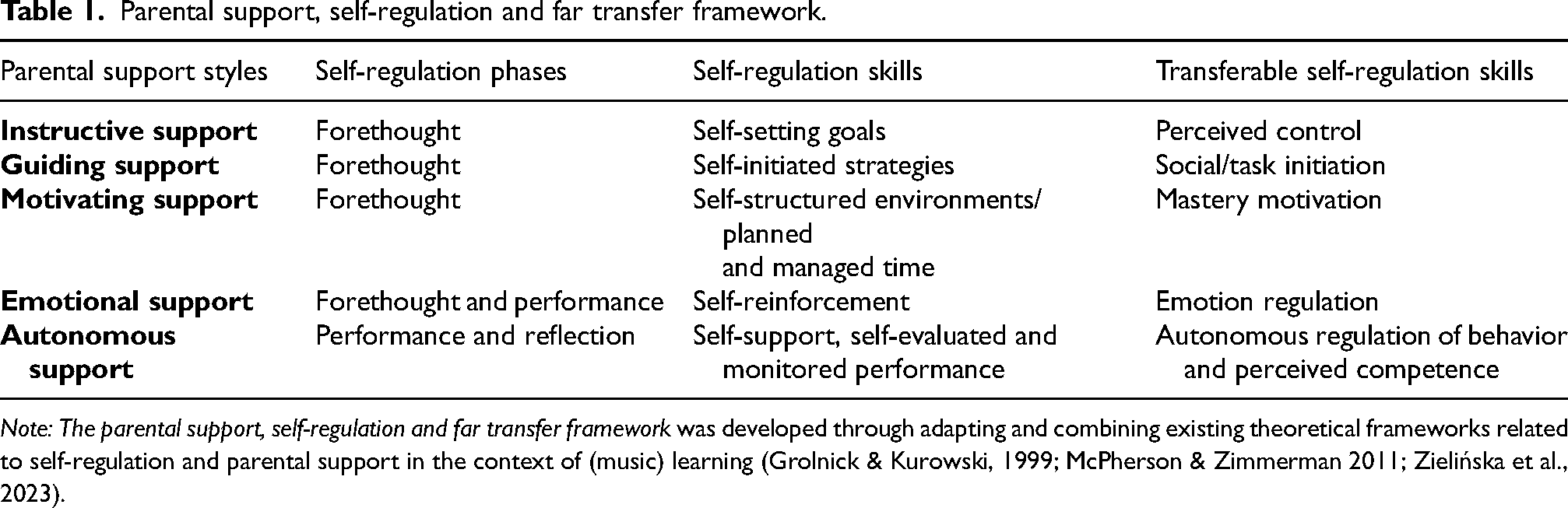
Note: The parental support, self-regulation and far transfer framework was developed through adapting and combining existing theoretical frameworks related to self-regulation and parental support in the context of (music) learning (Grolnick & Kurowski, 1999; McPherson & Zimmerman 2011; Zielińska et al., 2023).
Hypothetical Scenario
The application of this theoretical framework (Table 1 and Figures 1 and 2) is described by the following fictional paradigm to illustrate how the far transfer of self-regulation skills could be achieved through the psychological support of parents to enable their child to succeed in his music performance training and academic goals. Dan is currently preparing for a musical performance at his music school. His goal is to prepare for an ensemble piano performance. He needs to memorize the piece and improve his rhythmic, musical style, and sight-reading skills. Dan also needs to practice intensively to improve his endurance, flexibility, and articulation in order to keep up with the rhythm and tone of the ensemble. At the same time, Dan has to work on a separate individual school assignment relating to a physics experiment. Part of the assignment is to write up the methodology he used and a review of the skills and knowledge he gained during the physics project. Dan's training goals in music performance require a plan and a timetable, as do the goals of his assignment. Although he has some initial guidance from his teachers, he needs to better define them and develop the strategies that will help him achieve his goals. Dan often seeks for help from his parents and discusses his performance goals and plans with them, for example, advising him to use specific methods such as the S.M.A.R.T. framework (“an acronym for Specific, Measurable, Achievable, Relevant, and Time-bound” (Reti, 2023)) to help him break down his big music performance training and physics experiment's goals into smaller ones. According to Table 1 and Figures 1 and 2, self-initiated goals and strategies are essential components of self-regulation as they could enable learners and creators to design their methodology and establish a workflow for their creative projects in three stages (forethought, performance, and reflection). Therefore, parental guidance could be crucial for music performance learners at this point.

The relationship between self-regulation skills and parental support styles in the context of music performance training. Note. Music learning and training goals, and tasks that music students need to attain and perform during their music studies. Adapted from the Instrumental Music Curriculum, by the Department of Education, Queensland Government (2021).

The far transfer of self-regulation skills and phases in the context of music performance training. Note: A block diagram that shows how the five styles of parental support connect to different music learning and training stages and the music learner's five regulatory skills that are transferable to other creative domains as is shown in Table 1 and Figure 1.
Dan's time is divided between preparing for his music performance and his assignment. His study schedule is quite tight as he has to do his music performance training every day and work on his assignment for two weeks before the presentation. Therefore, he needs a quiet workspace to do his music performance training. He has two other siblings who are younger than him. This means that he needs to organize his space to ensure a quiet room. During his music performance training, his parents take their children to the playground to help him isolate himself. In this way, Dan feels more motivated to start the training and to concentrate on his playing. Dan also needs regular breaks in between his music performance training tasks and physics experiment project. To support him, his parents encourage regular breaks such as walking outside or taking time to relax before returning to his assignment. This motivational support could help Dan learn how to structure a flexible work schedule by shifting in between his tasks, prioritizing his responsibilities, and allocating time for his personal needs based on his mood and alone time at home. As shown in Table 1 and Figure 2, the motivational support of Dan's parents could enhance his ability to manage his motivation, thereby enabling him to initiate his training as well as structure his study time effectively, and maintain control over his actions and workspace.
Dan often discusses his progress with his parents. This discussion helps Dan to reflect on the mistakes he has made and the strengths he has gained in the course of his music performance training, as well as to regulate his stress and inner negative talk. His parents often encourage Dan to communicate his feelings about his performance and experiment project, especially when he seems dissatisfied with his results, and to keep a diary to record his feelings. According to Table 1 and Figure 2, emotional support from parents could enable children build the emotional resilience needed to continue working on their creative projects and studies. In this case, through this discussion with his parents, Dan learns how to recognize and regulate his negative thoughts, which are not realistic and could prevent him from focusing on areas where he could improve during the performance phase and adjusting his methods and strategies to increase his progress.
All in all, the emotional, motivational, and guidance support provided by Dan's parents could lead him to the point of developing autonomous regulated behavior (Table 1 and Figure 2). The supportive home environment could give him the opportunity to relate to his parents, share his own concerns and fears, and eventually find his own solutions to his problems. Through this supportive relationship with his parents, he learns to develop an autonomous way of thinking and acting. Discussing his mistakes with his parents could gradually increase his ability to understand his actions and strategies better and to relate them to his desired goals. In other words, Dan is learning how to regulate his actions and thoughts, which will help him to increase his competence and control over any creative work he does.
Consequently, the self-regulation skills Dan develops through his music performance training, supported by his parents, could transfer to his physics experiment. Designing the experiment requires him to (1) set initial goals and plan strategies (forethought stage), (2) implement those goals and strategies (performance stage), and (3) evaluate his work upon completion (self- reflection stage) (Figures 1 and 2). This suggests that creative projects with ill-defined goals may enable creators to leverage self-regulation skills, mechanisms, and motivational resources cultivated in other projects (Ivčević et al., 2024).
The Practical and Future Promises of the New Perspective
Our new perspective and theoretical framework could explain how far transfer across creative domains (e.g., everyday creative tasks or professional creative projects) may be partly or largely facilitated by the impact of music performance training on self-regulation. This is because music performance learners must engage in significant cognitive, emotional, and behavioral effort. As with every creative goal and task, music performance training is an ill-defined goal that obliges learners to define, set clear goals, and design learning strategies (that execute on a routine level) to achieve musical competence (Ivčević et al., 2024). Also, music performance training requires constant reflection and rectification of mistakes (McPherson & Renwick, 2001). For this reason, music performance training could enable students to develop further their self-regulatory skills.
Self-regulation may predict transferability to other creative domains beyond music through the critical role of the family (McPherson & Renwick, 2001; McPherson & Zimmerman, 2011). Here, among other types of social support (teachers and peers), the psychological support of parents may be crucial in teaching self-regulation skills to young music learners, as they set the rules for children to regulate their behavior and manage everyday responsibilities such as studying (McPherson & Zimmerman, 2011). When parents provide their children with guiding, instructive, motivational, emotional, and autonomous support, novice music performance learners might feel empowered to initiate their music performance training, motivate themselves to organize their workspace, focus on their training, reflect positively on their mistakes, keep track of their successes and mistakes, readjust their workflow and learning strategies, and finally connect their actions with their desired goals (Grolnick & Kurowski, 1999; McPherson & Zimmerman 2011). First, parents, and later on, peers and teachers, could model self-regulation for music learning to help music learners to learn how to regulate their actions to achieve their learning goals, essentially learning how to internalize an extrinsically regulated behavior (Grolnick & Kurowski, 1999).
Taken together, past studies have focused primarily on the transferability of general cognitive skills, which may be more suitable for short-term creative tasks (Bugos & DeMarie, 2017; Habibi et al., 2018), rather than self-regulation skills, which could be more crucial for long-term creative goals and activities like music performance training (Zielińska et al., 2023). Measuring only cognitive skills may limit the understanding of far transfer, as they may not capture behavioral and emotional aspects essential for success (Zielińska et al., 2023). Music psychology researchers should focus on self-regulation skills when exploring far transfer. Parental psychological support could also play a relevant role in enhancing these skills through modeling and emotional encouragement (McPherson & Renwick, 2001; McPherson & Zimmerman, 2011), potentially helping learners transfer self-regulation to other creative activities. This aspect remains underexplored, and future research on music psychology and transferability of skills could examine the quality or lack of parental support during music performance training and its impact on the transferability of skills. Also, researchers should consider the process and developmental phase of self-regulation skills to potentially reveal what could hinder the transferability of such skills. Lastly, our theoretical framework could potentially have practical implications for educational practice, as music education professors could collaborate with pre-service music teachers to design self-regulated music performance training sessions for students and their parents.
Footnotes
Acknowledgments
The graphic design of the tables and figures was possible thanks to my friend and user experience designer Alexandria Schultz.
Action Editor
Beatriz Ilari, University of Southern California, Thornton School of Music.
Peer Review
Adam Ockelford, University of Roehampton, Applied Music Research Centre.
Peter Webster, University of Southern California, Thornton School of Music.
Contributorship
All authors discussed, edited, commented the manuscript. TK wrote the initial draft of the manuscript. AdR and HvB provided feedback on the writing. All authors contributed to developing the argument presented in the manuscript. TK wrote the final draft.
Data Availability Statement
Data sharing not applicable to this article as no datasets were generated or analyzed during the current study.
Declaration of Conflicting Interests
The authors declared no potential conflicts of interest with respect to the research, authorship, and/or publication of this article.
Ethical Approval
This research did not require ethics committee or IRB approval because it is purely theoretical and therefore data collection did not take place. This research did not involve the use of personal data, fieldwork, or experiments involving human or animal participants, or work with children, vulnerable individuals, or clinical populations.
Funding
The authors received no financial support for the research, authorship, and/or publication of this article.
