




Abstract
Music is a common resource for the regulation of emotions, moods, and stress. This study aimed at determining the individual and relative impact on stress reduction of two of the main factors involved in musical affect regulation: regulation strategies and music itself. The current study took place in an experimental setting and followed a factorial within-subjects design. First, the participants (n = 34) filled in an online survey where they identified their self-perceived “adequate”/“inadequate” music examples for the purpose of reducing stress and self-perceived “adequate”/“inadequate” strategies for the same purpose. In the lab they went through a stress induction procedure and then were instructed to calm down. They did so by listening to their “adequate”/“inadequate” music and employing the “adequate”/“inadequate” strategy, depending on the experimental condition. The primary outcome measure was self-reported tension, complemented by self-reported energy and valence, skin conductance levels (SCL), startle blink amplitudes, and risk aversion. The results showed that both music and strategy had a strong significant effect on the self-reported tension. Additionally, music had strong significant effects on energy, valence, SCL, and risk aversion. Pairwise comparisons revealed that the condition “adequate strategy-adequate music” was consistently more beneficial for stress reduction than condition “inadequate strategy-inadequate music”. However, it did not outperform all the other conditions, nor did the “inadequate strategy-inadequate music” underperform all the others. Moreover, close inspection of the results showed a larger impact of music on the short-term outcomes of self-regulation in comparison to strategy. These findings suggest that successful affective regulation depends on the adequacy of the chosen strategies and music, but that music is more determinant for the affective outcomes in the short term. The results are discussed considering previous research and the implications for the understanding of musical affect regulation are explored.
Keywords
Introduction
Stress is integral to our daily life. If a friend arrives at our house and complains about being stressed we can immediately see the whole picture: the stressor (intense traffic), the symptoms (faster breathing, increased perspiration), the changes in behaviour (t-shirt dressed inside out), and the solution (mellow jazz). Indeed, stress responses are quite common, as all sorts of events can trigger them. Stress can be managed in a variety of ways. One typical way of regulating stress in daily life is through music listening. Music has been widely shown to be an effective tool for reducing stress (Pelletier, 2004), and it has been shown to support a broad range of generally adaptive affect regulatory strategies such as distraction and reappraisal (Baltazar & Saarikallio, 2016, 2017). Yet, it remains an open question whether the efficacy of music as a stress regulation resource can be better explained by the presence of these efficacious regulatory strategies per se, or whether there is something more music-specific. For example, we do not know yet whether our friend eventually relaxed because the mellow jazz served as a distraction (strategy) or because its slow tempo helped to modulate our friend’s breathing (music itself).
Stress: Implications for affect, physiology, and cognition
Stress is an interesting response to examine in light of its manifestations and its regulation: on the one hand, it plays an adaptive homeostatic function by responding to a demand for change and preparing the organism to act (Selye, 1936), and on the other hand the responses it triggers can be experienced as highly unpleasant and, in the long-term, translate into poorer well-being and health (McEwen & Stellar, 1993; Schneiderman, Ironson, & Siegel, 2005). The impact of stress on the individual’s well-being and health depends greatly on their ability to self-regulate the high tension and negative valence concomitant to stress responses (Lazarus, 1974; Shallcross, Troy, & Mauss, 2015).
As stress is a multidimensional phenomenon, it is inadequate to study it using a single measure (Lazarus, 1990). In the current study, self-reported tension is our main focus due to its close link to the affective experience of stress. Importantly, we complement our approach with self-reported energy and valence and with measures from two other modalities: physiology and cognition.
The valence of the affective experience triggered by a stressor depends on the appraisals generated. The same stressful situation can be appraised, for example, as an opportunity to show one’s skills (thus triggering positive affect) or as a threat to one’s image (thus triggering negative affect). In this work, we focus on responses triggered by situations that are perceived as a threat of harm, overwhelming, or difficult to cope with, and that lead to reports of tension, anger, fear, or anxiety (Lazarus, 2000; Lazarus & Folkman, 1984; Smith, Haynes, Lazarus, & Pope, 1993).
The physiological responses are activated by the hypothalamus, which acts as a central control system (Tsigos & Chrousos, 2002) and manages two major systems that are closely involved in stress: the hypothalamus-pituitary-adrenal (HPA) axis and the sympatho-adrenomedullary (SAM) system. As the first signals are sent from the SAM system, catecholamines such as epinephrine are released. This leads to a number of physiological changes: pulse and blood pressure increase, breathing accelerates, skin conductance levels rise, and overall alertness is increased (Mandrick, Peysakhovich, Rémy, Lepron, & Causse, 2016). In turn, the endocrine system of the HPA axis prompts the production of cortisol, which mobilizes the body’s energy supply and increases the availability of energy (Munck, Guyre, & Holbrook, 1984).
These endocrine changes impact the prefrontal cortex (Arnsten, 2009) and thereby hinder core executive functions such as working memory and cognitive flexibility (Shields, Sazma, & Yonelinas, 2016). In this study, we explore the impact of acute stress on one cognitive process relying on executive functions: decision-making under risk. A large body of research has shown that people tend to be risk-seeking in the loss domain (i.e. they risk losing more for the chance of not losing anything) and risk-averse in the gain domain (i.e. they settle for smaller gains instead of taking risky—and larger—gains) (Kahneman, 2003; Kahneman & Tversky, 1979). However, this pattern seems to change under specific affective states, including acute stress (for a review, see Starcke & Brand, 2012). Acute stress has been found to decrease risk-taking in gain situations and increase in loss situations (Porcelli & Delgado, 2009). According to dual-process approaches (slow, rational process vs. fast, intuitive process; Epstein, Pacini, Denes-Raj, & Heier, 1996; Tversky & Kahneman, 1983), this can be explained by an overall shift from cognitive and slow approaches to intuitive and fast reactions, as demanded by the emergency created by the stressor (for a review, see Yu, 2016). Based on this, we will use risky decision-making as an implicit measure of stress (Västfjäll, 2010).
Music listening: A resource for reducing stress
Music listening is one of the resources most commonly used for the self-regulation of affect (Van Goethem & Sloboda, 2011). Affect self-regulation can be defined as any attempt at maintaining, increasing, decreasing, or replacing any affective state, 1 whether positive or negative (Gross, 2015; Gross & Thompson, 2007). In the present work we will focus on the down-regulation of stress responses, i.e. the goal of relaxing and decreasing tension.
When faced with high levels of stress in their lives, people tend to listen to more music (Getz, Marks, & Roy, 2014). This is arguably a wise strategy since music has been shown to have a range of beneficial effects on stress reduction (Chanda & Levitin, 2013; Pelletier, 2004). Several psychological, neurological, and biochemical pathways are involved in processing and responding to music (Fancourt, Ockelford, & Belai, 2014) and some of these capture quite well the stress reduction effect of music. For example, music listening can decrease cortisol levels (Khalfa, Dalla Bella, Roy, Peretz, & Lupien, 2003; Linnemann, Ditzen, Strahler, Doerr, & Nater, 2015), increase serotonin levels and activate brain areas involved in reward (Evers & Suhr, 2000; Menon & Levitin, 2005), and enable a faster recovery of the autonomic nervous system after exposure to a stressor (Chafin, Roy, Gerin, & Christenfeld, 2004; Thoma et al., 2013).
While there is ample evidence for the efficacy of music listening for stress reduction, there is currently little knowledge about the underlying factors behind this efficacy. One line of research has investigated how music is able to induce emotions in the listener (e.g. Juslin & Västfjäll, 2008; Scherer & Coutinho, 2013). The BRECVEMA framework posits a number of psychological mechanisms that mediate between music itself and the emotional reaction, ranging from brain stem reflexes to associative memories (Juslin & Västfjäll, 2008). The experimental testing of this framework has revealed that the activation of different mechanisms translates into different emotional reactions (e.g. Juslin, Barradas, & Eerola, 2015). These psychological mechanisms help to understand how, for example, music that is perceived as peaceful facilitates stress reduction (e.g. Sandstorm & Russo, 2010). However, many of these mechanisms are highly dependent on the individual’s previous experiences and set of attitudes/preferences. That is the case of visual imagery, evaluative conditioning, episodic memory, and aesthetic judgement (Juslin, 2013). Scherer and Coutinho’s (2013) process approach explicitly highlights individual differences as one factor in emotion induction (the others being structural features, performance, and context). The authors summarize the listener features into musical expertise (including explicit training and implicit cultural exposure) and stable dispositions (including age, gender, prior experience…). In line with this proposition, numerous empirical studies have observed that preference and familiarity of music are influential mediators for music’s effect on affective states (Jiang, Rickson, & Jiang, 2016; Liljeström, Juslin, & Västfjäll, 2012, Pereira et al., 2011; Tan, Yowler, Super, & Fratianne, 2012).
Another line of research has focused on music as a tool for affect regulation, showing that music is often (and successfully) used as a way of reducing subjective feelings of stress (DeNora, 1999; Skånland, 2011; Ter Bogt, Vieno, Doornwaard, Pastore, & Eijnden, 2017). Music supports affect regulation through a wide range of regulatory strategies, i.e. behavioural or cognitive tools used to reach an affective goal (for a review, see Baltazar & Saarikallio, 2016). Regulation strategies operate through the management of diverse components: attention (e.g. diversion, rumination), cognition (e.g. perspective taking, memory recall), subjective experience (e.g. inhibition of feelings, sensation seeking), physiology (e.g. energization, relaxation), and behaviour (e.g. venting, expressive suppression) (Baltazar, 2018; Koole, 2009; Parkinson & Totterdell, 1999). Although the use of a certain strategy is not, per se, beneficial or harmful, its continuous use might reflect on the individual’s adaptation to the environment (Marik & Stegemann, 2016). The tendency to often use certain strategies such as distraction or rumination—which are known to differ in terms of their adaptiveness—while regulating through music, has been able to (at least partially) explain the impact of music listening on health and well-being outcomes (Carlson et al., 2015; Chin & Rickard, 2014; Garrido & Schubert, 2013). These studies support the claim that in order to understand music’s influence, one needs to go beyond musical attributes such as genre, lyrics, and valence, and explore the underlying strategic uses.
In sum, two major factors are involved in musical affect regulation: music itself and regulation strategies. It can be argued that stress reduction—as a goal of affect regulation—occurs in interplay between personal strategies of music use and affordances of music (Baltazar, in press; Baltazar & Saarikallio, 2017). The effects of these two factors have been studied separately; thus, their relative and combined impact is yet to be revealed.
Aim of current study
This study aimed at assessing the individual and combined impact of the strategies employed and the music listened to on stress responses.
Based on the literature suggesting that successful self-regulation of affective states depends on the use of adaptive and effective strategies (Marik & Stegemann, 2016) and that different pieces of music foster different emotional processes in the individual (DeNora, 2000), the following hypotheses were formulated:
H1: Efficacious music will lead to a larger reduction in acute stress than inefficacious music.
H2: Efficacious regulatory strategies will lead to a larger reduction in acute stress than inefficacious strategies.
H3: The combination of efficacious regulatory strategy and efficacious music will lead to the largest reduction in acute stress, while the combination of inefficacious strategy and inefficacious music will lead to the smallest reduction.
The independent variables (music listened to and strategies employed) will be treated as categorical variables with two categories (efficacious and inefficacious). Given the deep influence that preferences, individual differences, and sense of control have on the outcomes of music (e.g. Liljeström et al., 2012, Pereira et al., 2011) and employed strategies (e.g. Bonanno & Burton, 2013; Doré, Silvers, & Ochsner, 2016; Tamir & Ford, 2012), the selection of music and strategies and their categorization will be performed by the participants. 2
Method
This study follows an experimental approach in laboratorial context. Ecological validity and inter-subject variability were addressed by using strategies and music stimuli chosen by the participants themselves. Therefore, two stages were required: online survey and experiment.
Phase 1: Recruitment and online survey
The participants were recruited from the population of registered students and staff of Linköping University, Sweden. The individuals that agreed to participate filled out an online survey in Qualtrics (12.2016, Provo, UT) with background information, questions on musical self-regulation, and pre-screen questions. The pre-screen questions helped to exclude participants who were taking anxiolytics, antidepressants, or pain relievers. Eligible participants were invited to take part in the experiment at the laboratory.
Selection of musical examples and regulation strategies
The participants were instructed to imagine a situation of acute stress with a specific affect regulation goal (specific instructions in Appendix A). Then they identified a musical piece they liked and were familiar with and that, according to their experience, was efficacious for calming down. They could name up to three examples. For each song, the participants rated several aspects of the music (e.g. memories, rhythm, lyrics) in terms of their contribution for the affective outcome (continuous sliding scale from no contribution to very strong contribution). 3 Then, the opposite question was also asked, i.e. which would be the songs they liked and were familiar with, but that hindered the goal of calming down. Again, they rated the relevance of each aspect of the music. Then, participants were asked to identify the most efficacious and the least efficacious regulation strategy for relaxing while listening to music. The presented musical aspects and strategies were retrieved from a literature review (Baltazar & Saarikallio, 2016) and a study exploring the simultaneous use of both (Baltazar & Saarikallio, 2017). The regulation strategies presented were major strategies, i.e. they represented a type of approach and may include more than one specific strategy (e.g. cognitive work includes reappraisal and perspective taking, amongst others). The items can be found in Appendix A.
Phase 2: Experiment
Participants
Thirty-five participants (14 female, 21 male), between the ages of 19 and 44 (M = 23.71, SD = 4.91) took part in the experiment. The sample can be characterized as highly engaged in music, since a clear majority (88%) reported listening to music six or more times per week and no participant reported listening less than once per week. On average, they reported purposely listening to music 2.75 hours per day. Seventy-six percent of the participants had at some point played an instrument or sung, and 38% still did. Most of the participants had musical education at school, with the most common being until high-school level (44%), followed by elementary school (32%). Only two participants had formal musical education outside of the school curriculum—one at the conservatory and the other at bachelor level. One female participant was excluded due to an error in the lab protocol. Participants were paid 100 SEK (approximately 9.60 EUR / 10.75 USD) as a show-up compensation plus or minus the amount from one randomly selected decision (decision task described further in the paper). All participants gave written, informed consent in accordance with the Declaration of Helsinki. 4 The study was approved by the Regional Ethics Board for East Gothland.
Design and procedure
The present study implemented a within-subjects 2×2 factorial design, with complete counterbalancing of conditions. 5 The two factors were regulation strategy and musical piece, both with two levels—efficacious and inefficacious. Note that the efficacy of the two factors corresponded to the participants’ self-perceived efficacy. The efficacious and inefficacious levels will be labelled as adequate and inadequate from now on. Four experimental conditions resulted from the combinations between strategy (adequate—AS, inadequate—IS) and music (adequate—AM, inadequate—IM): AS-AM, AS-IM, IS-AM, and IS-IM.
Before starting the experiment, a setting-up period took place. Then, as depicted in Figure 1, the experiment had two blocks (stress induction and musical stress regulation) with measurement points after each one (A and B). Each participant went through this sequence four times, once per experimental condition. During the measurement points A and B, the degree and direction of change in affective states were assessed. Next, we will briefly describe the three stages forming the experiment (setting up, stress induction, and musical stress regulation).

Study design with two blocks: stress induction and musical stress regulation. A and B mark the measurement points. Note. Measures used in A and B: self-reported affective experience (tension, energy, valence), SCLs, and startle blink amplitudes. In B, the decision-making task was repeated. Each participant went through this sequence four times (one for each condition).
Setting up
Upon arrival, participants were welcomed and informed about the study. Instructions were given in relation to the self-report scales, the importance of employing the indicated strategies throughout the study even if they did not seem suitable for the moment, and the overall sequence of the experiment. The apparatus for physiological measurement were set up and, after that, the pain threshold for heat was determined following Perini, Bergstrand, and Morrison’s (2013) procedure, described in Koppel et al. (2017). The heat-induced pain was delivered using a 3 x 3 cm thermode placed on the participants’ non-dominant dorsal forearm (Thermal Stimulator Probe, Q-sense, Medoc).
Participants were seated in a comfortable chair in front of a computer screen (Philips 241E), one loudspeaker (Genelec 8010 AP-6), and a standard mouse. The experiment ran through Presentation (Neurobehavioral Systems, version 18.0). Participants followed the instructions on the screen and completed the tasks with a mouse.
Stress induction
Acute stress was induced through a combination of heat-based pain and a fast-paced decision-making task. This block had the duration of 60 seconds, during which the temperature varied between the participant’s pain threshold and 2°C below it. Simultaneously, the participant performed a monetary decision task in which they chose between a safe and a risky option with a time limit of 9 seconds for each decision. Stress responses are expected to be activated by this task due to the highly unpleasant component of pain and to the exhausting and demanding component of repeated choices under time-pressure (Vohs et al., 2008). The task was adapted from Koppel et al. (2017) and is explained under “Outcome measures”, since the participants’ choices were analysed as their risk-taking preferences.
Musical stress regulation
Before each musical stress regulation block, the participants received instructions regarding the regulation strategy that they should use. Based on the answers in the survey and depending on the experimental condition, they were given a card with the description of a strategy. Two musical pieces per participant (one per condition) were downloaded to a smartphone through the streaming service Spotify. 6 With the purpose of facilitating the affective impact of the musical pieces, the participants also received a card instructing them to focus on a certain musical aspect while listening to music (e.g. “Let yourself be immersed by the lyrics and rhythm of this song”). 7 The musical pieces were played through headphones (Beyerdynamic DT700). The volume was adjusted to each participant’s preference at the beginning of the experiment and was kept fixed throughout the experiment. Only a three-minute clip was played to the participants, unless the audio file was just slightly over three minutes, in which case we preferred not to cut the piece. The three-minute length was chosen based on the typical length of pop songs (longer songs could be cut) and on the need to keep each section of the experiment short enough to accommodate several repetitions. Participants were informed that they would have three minutes of music listening, during which they should try to calm down by using the given strategy and focusing on the given musical aspects. The songs listened by the participants and the frequencies of the strategies chosen as adequate or inadequate can be found in Appendix B.
Outcome measures
The outcome measures covered different modalities (subjective experience, physiology, and cognition) to better portray the changes in affective states. The experiential dimension was measured through self-reported affect. Self-reports were collected through three continuous visual analogue scales (VAS): relaxed – tense (tension arousal), negative – positive (valence), and drowsy – alert (energy arousal). Additional synonyms to the poles of the scales, as used in Schimmack & Grob (2000), were given before the start of the experiment.
The psychophysiological measures included electrodermal activity (EDA) and facial electromyography (EMG). EDA was registered in terms of skin conductance levels (SCLs). SCLs respond to arousal and consequently increase when experiencing acute stress responses (Witvliet & Vrana, 1995) and when exposed to emotionally arousing music (Khalfa, Peretz, Blondin, & Manon, 2002). The facial EMG registered the startle blink magnitude, which has been shown to increase when negatively valenced and high arousal affect is induced (Lang, Bradley, & Cuthbert, 1990). For recording EDA, surface Ag/AgCl electrodes (8 mm in diameter) were attached to medial phalanges of the index and middle fingers of the participants’ non-dominant hand. As for startle responses, surface Ag/AgCl electrodes (4 mm in diameter) were placed on the right obicularis oculi muscle. The startle responses were elicited by acoustic probes (40 ms long white noise played at 100dB), which were presented six times. The recording of the EMG started with a silent period, during which the participants were instructed to keep their eyes open and fixate on the cross displayed at the centre of the screen. The first auditory probe was presented 10 to 15 seconds after the beginning of the startle period. Intervals between two consecutive startle probes were randomly set between 8 to 15 seconds. Both EDA and EMG were recorded through a BIOPAC MP150 system (amplifiers GSR100C and EMG100C, respectively). The data collection was controlled by AcqKnowledge software (version 4.1), which amplified and sampled the physiological signals at a rate of 1000 Hz.
The cognitive dimension of acute stress was approached through the choice patterns in risky gains and losses. The decision-making task was one element of the stress induction procedure, but since this task was repeated after the musical stress regulation block, the proportions of risky choices were kept as a self-regulation outcome (Koppel et al. 2017; Koppel et al., submitted). During the task, the participants made four choices regarding two types of decisions: risky gains and risky losses. The trials were time-locked to 9 seconds and were presented in random order. In the risky gains trials, participants had to choose whether they preferred to receive a smaller but safe amount of money (with 100% probability) or a larger but risky sum in a coin toss (with 50% probability). In the risky losses trials, participants chose between losing with certainty a smaller sum of money (with 100% probability) and losing a larger sum of money in a coin toss (with 50% probability). The proportion of times the participants chose to toss the coin instead of accepting the secure (but less advantageous) gain or loss was used as a measure of risk-taking. Participants were informed beforehand that one of their decisions would be randomly picked at the end of the experiment to count for their final payment (either adding to or subtracting from the base amount).
Amongst these measures, the self-reported tension arousal was our primary outcome as it has the closest link to the experience of stress, while the other scales and measures were considered complementary information regarding the affective reactions. Overall, reduction in acute stress was operationalized as lower values in the tension self-report scale, lower skin conductance levels, smaller startle blink amplitudes, higher risk-taking in gains, and lower risk-taking in losses.
Data analyses
Before the statistical analyses, we proceeded to some preliminary data treatment. The data from the self-reports was rescaled to the range of -1 (left pole of the VAS) to +1 (right pole of the VAS). Both EDA and EMG signals were inspected individually for possible artifacts. EMG signals were band-pass filtered from 20 to 480 Hz. The filtered signal was full-wave rectified and low-pass filtered at 40 Hz for smoothing. Startle responses were scored as the peak response within a 20–200 ms window following startle probe onset if the peak exceeded three times the mean activity during the 50 ms preceding the startle probe onset. Response amplitudes were calculated as the average startle response over the six probe presentations during each affect assessment session. Only the participants who reacted at least once during each trial were included in the analysis of EMG data (n = 23). The raw EDA signals were resampled at 10 Hz and low-pass filtered at 1 Hz. To compute skin conductance levels (SCLs), we applied a 5-second moving average filter. Then the signal was averaged into time blocks. Each time block consisted of the mean activity for 10 seconds while at rest, between the self-report of affect and the startle blink test. The decision-making data was computed as the proportion of risky choices in the gain and loss trials.
The changes in the outcome measures were calculated as the difference between the levels after stress induction and the levels after musical stress regulation (points A and B in Figure 1). Following the recommendations of Braithwaite, Watson, Jones, and Rowe (2015), the physiological data were standardized after calculating the individual changes between measurement points.
Affective experience measured by self-report was a multidimensional variable following a normal distribution. Physiological and decision-making data, on the other hand, did not follow a normal distribution. Consequently, factorial effects of strategy and music on the self-reported affect were investigated through a two-way repeated-measures MANOVA. The multivariate effects were tested by means of Wilks’ lambda, after which univariate t tests were performed. The effects of the experimental factors on physiological and decision-making data were investigated by calculating first the marginal means for each factor and then analysing through Friedman and Wilcoxon signed rank tests. The planned pairwise comparisons between conditions were conducted through t tests for self-report and Wilcoxon signed ranks tests for the other variables.
Given the sensitivity of parametric tests to outliers, participants exhibiting responses in the VAS above or below 1.5 times the interquartile range were excluded from the analyses on that variable. After the exclusion of outliers, the Shapiro–Wilk and Levene’s tests failed to reject the null hypotheses that the self-report data have equal variances and belong to a population with normal distribution. 8
Relevant effects were examined through statistical significance testing (α = .05) and estimation of effect size (ES): Cohen’s d for paired t tests (Cohen, 1988; Dunlap, Cortina, Vaslow, & Burke, 1996), partial eta squared—ηp 2—for ANOVA and MANOVA (Cohen, 1977; Pallant, 2007), Kendall’s W for Friedman tests (Kendall, 1938), and correlation—r—for Wilcoxon tests (Rosenthal, 1994). Cohen’s (1988) guidelines were used for the interpretation of effect sizes; ηp 2 follows the scale .01 = small, .06 = moderate, and .14 = large, d follows the scale .2 = small, .5 = moderate, and .6 = large, while both r and W follow the scale used for correlations: .1 = small, .3 = moderate, and .5 = large.
Results
Stress manipulation check
In order to estimate the success of the stress induction, the scores obtained before and after the induction block throughout the four conditions were compared. Separate one-way ANOVAs were conducted on self-report ratings and statistically significant differences were found on the three scales: tension increased—pre-stress: M = -0.25, SD = 0.38, post-stress: M = -0.15, SD = 0.31, F(1, 238) = 20.83, p < .001, ηp 2 = .08, energy increased—pre-stress: M = 0.11, SD = 0.41, post-stress: M = 0.23, SD = 0.30, F(1, 238) = 7.10, p = .008, ηp 2 = .029, and valence became more negative—pre-stress: M = 0.38, SD = 0.33, post-stress: M = 0.24, SD = 0.29, F(1, 246) = 12.52, p < .001, ηp 2 = .048. The SCLs were submitted to a Wilcoxon signed ranks test, which revealed higher levels after stress induction, pre-stress: M = 9.54, SD = 4.31, Mean rank = 60.58, post-stress: M = 10.65, SD = 4.41, Mean rank = 70.40, Z(135) = -5.70, p < .001, r = .49. Similarly, startle blink amplitudes were analysed through a Wilcoxon signed ranks test, but no manipulation effects were found, pre-stress: M = 0.05, SD = 0.04, Mean rank = 52.96, post-stress: M = 0.05, SD = 0.03, Mean rank = 51.94, Z(104) = -0.94, p = .35, r = .092. Due to the lack of modulation of the blink amplitudes by the experimental manipulation, this measure was removed from further analyses.
Influence of strategy and music on affective states
Self-reported affect
Figure 2 depicts the mean change in all the outcome measures across experimental conditions. The MANOVA conducted on self-reported affect revealed a main effect of both factors (strategy: F(3, 23) = 3.25, p = .04, ηp
2 = .30; music: F(3, 23) = 6.73, p = .002, ηp
2 = .47) and no statistically significant effect for the interaction: F(3,23) = 0.46, p = .713, ηp
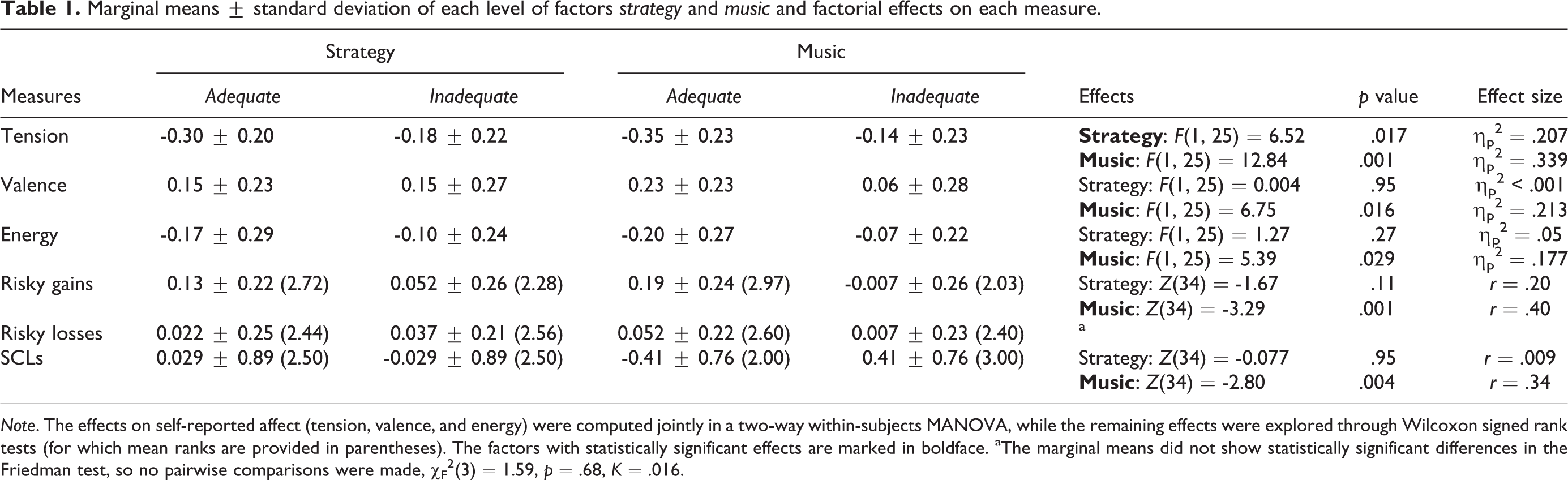
2 = .06. As Table 1 shows, the univariate F tests revealed that the main effect of strategy was significant for the dependent variable tension with a large effect size, but not for energy or valence. This effect was expressed by a higher reduction in tension when using adequate strategies (mean difference = 0.12, std. error = 0.046, p = .017). The factor music showed a significant effect for all the three self-report scales: adequate music—compared to the inadequate music—had a larger contribution in reducing tension (mean difference = 0.21, std. error = .059, p = .001), increasing positive valence (mean difference = 0.17, std. error = 0.065, p = .016), and decreasing energy (mean difference = 0.13, std. error = 0.057, p = .029). Even though the effect size for the three scales was large (ηp
2 > .14), the effects were larger for the reduction of tension than for valence and energy. There was no interaction effect between strategy and music on any of the affect dimensions. Affective, physiological, and cognitive changes in function of the experimental condition. Marginal means ± standard deviation of each level of factors strategy and music and factorial effects on each measure.
Note. The effects on self-reported affect (tension, valence, and energy) were computed jointly in a two-way within-subjects MANOVA, while the remaining effects were explored through Wilcoxon signed rank tests (for which mean ranks are provided in parentheses). The factors with statistically significant effects are marked in boldface. aThe marginal means did not show statistically significant differences in the Friedman test, so no pairwise comparisons were made, χ
F
2(3) = 1.59, p = .68, K = .016.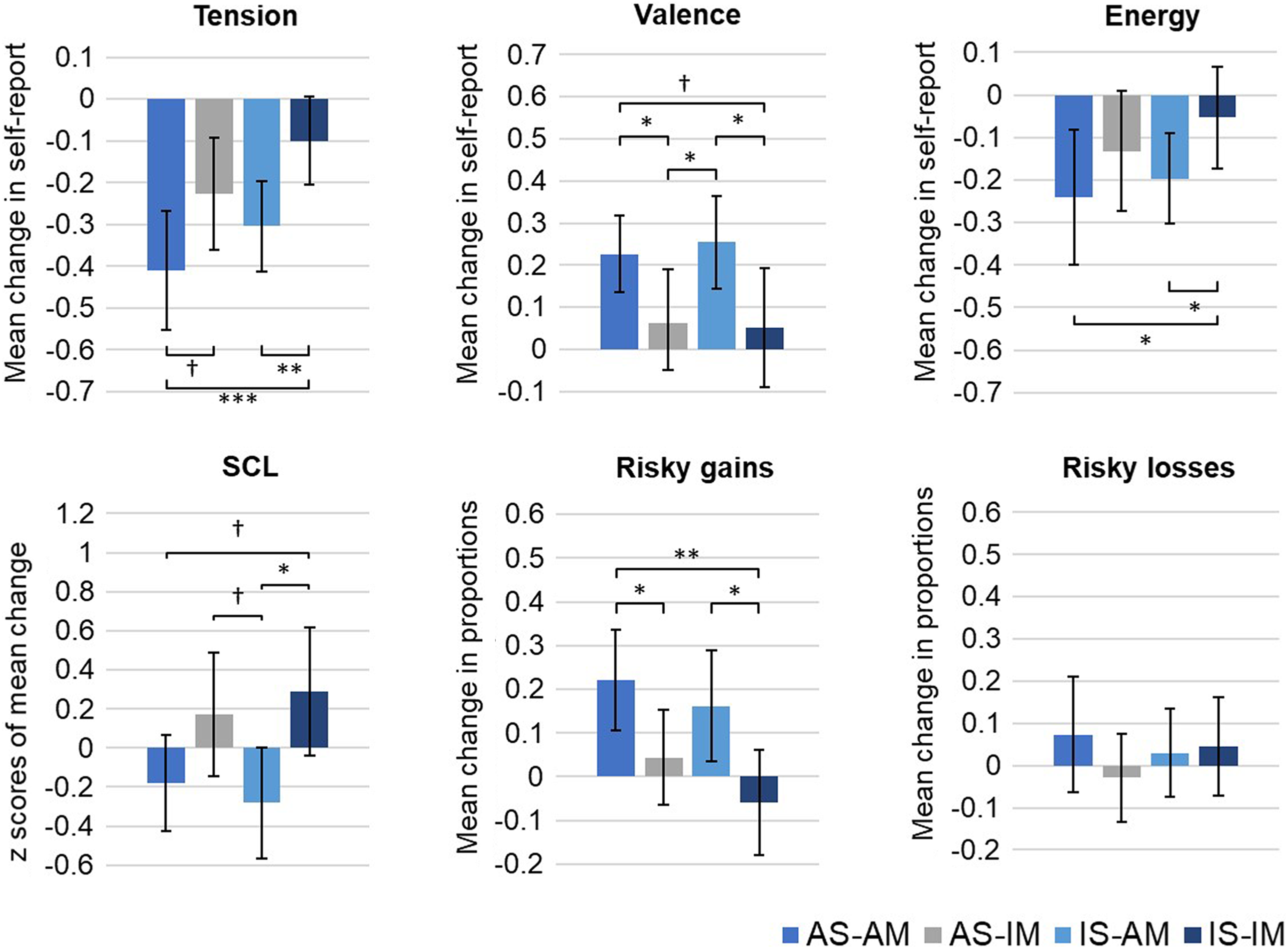
Physiological activity: Skin conductance levels
SCLs related to the factors strategy and music revealed statistically significant differences: χ F 2(3) = 10.20, p = .016, W = .10. As reported in Table 1, mean SCLs did not significantly vary in function of strategy, but exhibited statistically significant differences in function of music. The effect of adequate music in decreasing more successfully SCLs than inadequate music reached a moderate effect size.
Cognitive processing: Risky choices
During the experiment, the decision task was performed eight times: four times as part of the stress induction task and four times in the post-regulatory measurement period. In comparison to the moment of stress induction, participants made more risky choices after listening to music and self-regulating in the gain trials: Z(34) = -2.34, p = .020, r = .21. However, no significant differences were found in the loss trials, Z(34) = -1.40, p = .18, r = .07. Friedman tests revealed that there were changes in decision-making as a function of condition in the gain trials, but not in the loss trials (Table 1).
Post-hoc analyses were performed on the marginal means of strategy and music to explore the effect of these factors. The Friedman test pointed at a significant effect of the experimental factors, χ F 2(3) = 19.42, p < .001, W = 0.19. The gain trials with adequate music playing registered greater proportions of risky choices than the ones with inadequate music, but no statistically significant differences between the adequate and inadequate strategy were registered (Table 1).
Pairwise comparisons between conditions
The mean changes registered after conditions AS-AM and IS-IM (Figure 2) were compared for each outcome measure across all conditions. The changes can be visualized in Figure 2 and the test statistics, p values, and effect sizes can be consulted in Table 2.
Test statistics, p values, and effect sizes of pairwise comparisons between conditions.

Note. The first column shows the two conditions being compared. AS – adequate strategy, IS – inadequate strategy, AM – adequate music, IM – inadequate music. † p < .10, *p < .05, **p < .01, ***p < .001
The condition AS-AM exhibited a higher success in stress reduction than the condition IS-IM as shown by a larger reduction of tension and energy, and a higher risk-taking behaviour in the gain trials. Also, there was a non-significant tendency for more positive affect (p = .056, d = .46) and lower SCLs (p = .077, r = .21). In comparison to the condition AS-IM, AS-AM supported a larger (but only marginally significant, p = .059) reduction of tension, a larger increase of positive affect, and a higher proportion of risky choices in gain trials. The condition IS-IM differed from condition IS-AM in terms of lower reduction in tension, lower increase of positive affect, lower decrease of energy, higher SCLs, and lower risk-taking in gain trials. There were no statistically significant pairwise comparisons in the risky choices in the loss domain.
Discussion
While psychology and music research have consistently found beneficial effects of music on stress responses, the present study contributes to the existing literature by experimentally testing two of the underlying components of musical self-regulation: the specific music listened to and the employed regulatory strategy. We hypothesized that both factors would have a positive effect on stress reduction (H.1 and H.2) and that the combination of efficacious music and strategy would lead to the most successful reduction in stress while the combination of inefficacious music and strategy would lead to the least successful stress reduction (H.3). The results corroborated hypotheses 1 and 2, while not fully supporting hypothesis 3. No hypotheses were formulated regarding the relative impact of strategies and music; nevertheless, music seemed to have a more visible impact than strategies on the measures used in this study.
Music’s support for stress reduction (hypothesis 1)
As expected, music perceived as efficacious led to a larger reduction of acute stress than music perceived as inefficacious. This reduction was translated into lower tension levels, more positive affect, lower energy arousal, lower SCLs, and higher risk-taking in the gain trials. All the measured modalities (self-reported affect, physiological activity, and cognitive processing) were affected by the efficacy of music. These results provide solid support for hypothesis 1.
The changes in the self-report VAS portray a multidimensional modulation of affect in the direction of stress reduction. Aside from the predicted reduction of tension, our results suggest that the down-regulation of stress was also approached through creating a more positive/pleasant state and through decreasing the energy levels. These results are supported by previous literature that has already highlighted music’s potential to support each one of these dimensions, albeit separately (tension reduction: Thayer, Newman, & McClain, 1994; increase of positive affect: Van Goethem & Sloboda, 2011; and decrease of energy levels: DeNora, 1999; Saarikallio, Baltazar, & Västfjäll, 2017).
Regarding the physiological dimension, SCLs were responsive to the stress manipulation and to music’s efficacy, increasing after stress induction and decreasing especially after the adequate music. Surprisingly, the startle blink amplitudes were not sensitive to the stress manipulation. The startle blink is an aversive response and it is expected to exhibit increased amplitudes in relation to negative valence (Lang et al., 1990). However, some authors have suggested that acute stress is a specific state that favours alertness and focused attention and that, consequently, does not increase the startle blink amplitudes during the experience of stress (Deuter et al., 2012; Pinkney, Wickens, Bamford, Baldwin, & Garner, 2014) but only after recovery (Herten et al., 2016).
Music’s efficacy also influenced decisions in the gain trials of risk-taking. As expected, listening to the adequate music pieces was linked to increased risk-taking. Given that acute stress and anxiety have been reported as lowering risk-taking (Porcelli & Delgado, 2009), it can be concluded that the participants were under higher stress while listening to the inadequate music. Moreover, positive affective priming can lead to calculating probabilities in a more optimistic way or perceiving gains as more attractive, thus promoting risk-taking (for a review, see George & Dane, 2016). In our case, adequate music would have induced more positive affect than the inadequate music. Alternatively, the increase in risk-taking might be explained by the ongoing affect regulation. Andrade and Cohen (2007) posit that when individuals believe they can regulate their affect, they focus more on the gains of the risky activity and become more risk-taking. In our case, adequate music would have been perceived as adjuvant of self-regulation of stress, while inadequate music would have impeded the process. Both interpretations presented lead to the same conclusion: the adequate music was more supportive of stress reduction than the inadequate music. Even though research on music and decision-making is still slim, there is already some evidence for an increased subjective value of risky options while listening to preferred music (Halko & Kaustia, 2015) and to motivating music (Elvers & Steffens, 2017).
The loss trials registered stable behaviours across moments (stress induction and musical stress regulation) and across conditions. Since there were no trials before the stress induction, it is not possible to assess how this decision-making was impacted by the affect manipulation. However, one possible explanation for the lack of variation is that the procedure was not propitious for manipulating the loss domain. According to Pabst, Schoofs, Pawlikowski, Brand, and Wolf (2013), loss framing is slower and more complex; thus, depending on the time passed after the stressful stimulus, risk-taking might be increased, decreased, or unchanged.
Strategic support for stress reduction (hypothesis 2)
Strategies perceived as efficacious showed a larger contribution to stress reduction than the ones perceived as inefficacious by leading to lower levels of self-reported tension arousal. Given the relevance of tension for the experience of stress responses and the large effect size observed, we consider our results in line with H.2. The positive effect of the adequate strategy on experienced tension confirms previous claims that the use of adequate regulatory strategies while listening to music is responsible for a considerable part of its affective outcome (Chin & Rickard, 2014; Garrido & Schubert, 2013).
Comparisons between conditions (hypothesis 3)
Hypothesis 3 could not be verified, since condition AS-AM was not significantly more successful in reducing stress than all the other conditions, and condition IS-IM was not significantly worse than all the other conditions. Yet, condition AS-AM consistently led to better results after stress induction than IS-IM.
Interestingly, the pairwise comparisons failed to reveal a statistically significant difference between conditions when music was adequate and strategy changed from adequate to inadequate (AS-AM v IS-AM), and when music was inadequate and strategy changed (AS-IM v IS-IM). In a similar vein, statistically significant differences were obtained when the employed strategy was the same and music changed from efficacious to inefficacious (AS-AM v AS-IM and IS-AM v IS-IM). This suggests that despite the overall main effect of the employed strategy, in the short term the selected music brings a larger impact to the listener’s affective states. This phenomenon was not predicted and might explain why H. 3 could not be supported. Differences in the affective impact will be discussed next.
Larger effect of music in the short term
Despite the observed effects of both factors (music and regulatory strategies), their contribution to the participants’ stress reduction was not equal in this experimental setup. While the regulatory strategies showed a significant effect in the principal outcome measure, music exhibited a larger effect size and, additionally, its effect was registered in complementary measures across the three dimensions. Also, in the pairwise comparisons music seemed to have a stronger impact, as it was a decisive factor when changing or maintaining the efficacy level.
We interpret the less visible role of regulation strategies in comparison to music as a product of several aspects:
Automatic and non-deliberate nature of affect regulation. One of the difficulties in experimentally studying affect self-regulation emerges from the fact that most of its processes do not happen at the conscious level (Bargh & Chartrand, 1999). Part of affect regulation happens automatically, triggered by sensory inputs, and based on previous experiences (Braunstein, Gross, & Ochsner, 2017; Koole, Webb, & Sheeran, 2015; Mauss, Bunge, & Gross, 2007). Given the organisms’ drive to self-regulate, the participants might have taken unconscious and parallel efforts to reduce stress responses despite the instructions to use a specific inefficacious strategy.
Music’s immediacy and salience. Music, as a highly emotionally-charged auditory stimulus, is particularly impactful (Panksepp & Bernatzky, 2002)—it activates the brain areas linked to emotion processing and induces neurochemical changes in the domains of reward, motivation, and pleasure (Chanda & Levitin, 2013). Music might have been, then, more salient and stimulating than the instructions regarding the strategy to employ.
Temporal dynamics of strategies. Regulatory strategies have varying onset times (Paul, Simon, Kniesche, Kathmann, & Endrass, 2013; Thiruchselvam, Blechert, Sheppes, Rydstrom, & Gross, 2011) and their effects can be sustained even after active regulation (Walter et al., 2009). It is possible that the strategies’ effects (positive or negative) were still unfolding at the time of measurement.
Not all emotions are the same. The efficacy (and even adaptiveness) of strategies is relatively sensitive to varied aspects related to the origin and type of affective reaction. For instance, previous research has shown that reappraisal’s positive effect depends on the origin of the emotion (McRae, Misra, Prasad, Pereira, & Gross, 2012) and on its intensity (Sheppes, Scheibe, Suri, & Gross, 2011). In our study, mismatches between the imagined affect (online survey) and experienced affect (laboratory) might have influenced the strategies’ efficacy.
Moreover, it is possible to adopt a broader view on how music and strategies come together. Referring to Krueger’s idea of “musical scaffolding” (2011, 2014), there is part of the affective work that is done in the music and by the music, as if we could transfer our internal processes to this external resource. During musical scaffolding, internal processes (such as regulatory strategies) are enhanced by the possibilities offered through music. It might be thus that, in practice, it is hard to separate the musical characteristics from the strategy, since all the components intertwine and become part of the same experience for the user. This interpretation is supported by the results obtained by Baltazar and Saarikallio (2017), which show deep connections between musical mechanisms and strategies alongside the dimensions of affective experience, cognition, and bodily reactions. Also, in the model suggested by Baltazar (in press), these same connections mediate the relationship between music engagement and affective outcomes. The intrinsically regulatory attributes of music mean that music offers wide affective possibilities beyond the regulatory strategy consciously applied.
Health implications
A growing position defends that music’s health impact does not depend solely on its overall features (e.g. genre) but mainly on the personal use that individuals make of it (McFerran, 2016; McFerran, Garrido, & Saarikallio, 2013; Saarikallio, Gold, & McFerran, 2015). Regulatory strategies have been one link between the resource (music) and health outcomes (e.g. Carlson et al., 2015; Chin & Rickard, 2014). However, the ability of choosing what music to listen to can be equally relevant. As our results show, for each individual there is certain music that facilitates or hinders a certain affective goal in a certain context, regardless of the strategy used. When, for some reason, the chosen music is not adequate for the situation, it can lead to undesired mood shifts or worsening of negative mood (McFerran, Garrido, O’Grady, Grocke, & Sawyer, 2015; Randall & Rickard, 2017). Importantly, studies with vulnerable or distressed groups indicate that not everyone has the same ability of regulating through music (Baker, Bor, & William, 2008; McFerran et al., 2015; Miranda & Claes, 2009). We suggest the term musico-emotional competence to encompass the skills necessary for picking the right song and coupling it with the right emotional processing (see also Saarikallio, 2017). While the emotional skills include, among others, skills related to the identification and regulation of emotions (Mayer & Salovey, 1997), the musical skills would include, among others, skills related to recognizing the emotions expressed by music and their impact on own affective states, selecting music in accordance with the affective goal, and matching the strategy to the music (Saarikallio, 2017).
In the current study, our healthy, adult participants could identify the adequate music and strategy for themselves. But to what degree can this competence be influenced by individual traits and in what situations would participants be unable to make the adequate regulatory and musical decisions? Further research with group comparisons (such as between ages, genders, psychological symptoms, etc.) is needed to better understand musico-emotional competence.
Limitations
A few limitations should be considered when interpreting our results and planning future research. Some derive from the four points presented above in relation to the contrasting effects of music and regulatory strategy. That is, the lack of control of the strategies used by the participants due to automatic self-regulation, the potential differences in salience of the two factors (music played versus instruction to use a certain strategy), the relatively short time constrain for each regulation period, and the compromise of ecological validity for the sake of experimental control. Also, it should be noted that only one strategy was contemplated at a time; however, some studies have been showing that people use more than one strategy simultaneously or sequentially (Aldao & Nolen-Hoeksema, 2013; Baltazar & Saarikallio, 2017). Investigating individual factors was not in the scope of this study; however it is likely that the sensitivity to the experimental manipulation and to the effects of the two factors, music and strategy, varies across groups in function of age (Cohrdes, Wrzus, Wald-Fuhrmann, & Riediger, 2018; Leipold & Loepthien, 2015), personality traits (Liljeström et al., 2012), reactivity to stress (Thoma, Scholz, Ehlert, & Nater, 2012), and profile of music use (ter Bogt, Mulder, Raaijmakers, & Gabhainn, 2011). In future studies, the individual factors could be approached by using larger samples with different groups; the contextual factors could be addressed by using methodologies that integrate them, such as experience sampling method; and the effect of regulatory strategies could be maximized by including a practice time before the experiment and by giving a longer period for self-regulation.
Conclusion
If we had to answer the title question, we would be inclined to answer: both. Both the adequacy of the music and the adequacy of the strategy expressed themselves in the affective outcomes of stress reduction. Yet, given that music creates the platform where the process takes place, its adequacy has an immediate and decisive impact on the regulatory efforts. There are intricate and deep links between music and regulatory strategies (and, in the same line, affective goals) that are built on a matrix of associations, memories, individual traits, acoustic features, and emotion induction processes (Baltazar, in press; Baltazar & Saarikallio, 2017; DeNora, 1999; Juslin & Västfjäll, 2008). These links are at the foundation of musical affect self-regulation and, as in everything, solid and adequate foundations are needed for the construction of healthy structures. Our results highlight the relevance of musico-emotional skills by demonstrating the contrasting effects of using the “adequate” or “inadequate” music and the “adequate” or “inadequate” regulatory strategy.
Supplemental material
Supplemental Material, Appendices_(1) - Is it me or the music? Stress reduction and the role of regulation strategies and music
Supplemental Material, Appendices_(1) for Is it me or the music? Stress reduction and the role of regulation strategies and music by Margarida Baltazar, Daniel Västfjäll, Erkin Asutay, Lina Koppel and Suvi Saarikallio in Music & Science
Footnotes
Acknowledgements
The authors wish to thank Kajsa Hansson, for her relentless help during recruitment and data collection, Dr. India Morrison, for generously sharing resources with us, Per Andersson, for volunteering his skin and ears during our testing phase, and all the participants who bravely came down to the laboratory.
Authors’ contributions
MB and DV conceived the study. MB, DV, EA, LK, and SS developed the design. EA coded the experiment script and handled the physiological data. LK assisted MB with the participant recruitment. MB collected and analysed the data. MB wrote the first draft of the manuscript, and all authors reviewed and edited the manuscript, and approved the final version of the manuscript.
Declaration of conflicting interests
The author(s) declared no potential conflicts of interest with respect to the research, authorship, and/or publication of this article.
Funding
The author(s) disclosed receipt of the following financial support for the research, authorship, and/or publication of this article: This work was funded by the Finnish Cultural Foundation and the Science Council of the University of Jyväskylä to MB and by the Swedish Research Council to DV, EA, and LK.
Supplemental material
Supplemental material for this article is available online.
Notes
Peer review
John Sloboda, Guildhall School of Music and Drama, Research Department.
Kimberly Moore, University of Miami.
Eduardo Coutinho, University of Liverpool, Department of Music.
One anonymous reviewer.
References
Supplementary Material
Please find the following supplemental material available below.
For Open Access articles published under a Creative Commons License, all supplemental material carries the same license as the article it is associated with.
For non-Open Access articles published, all supplemental material carries a non-exclusive license, and permission requests for re-use of supplemental material or any part of supplemental material shall be sent directly to the copyright owner as specified in the copyright notice associated with the article.
