



Abstract
Music training is robustly associated with cognitive skills, and with tonal and verbal memory more specifically. However, it is unclear whether these associations reflect near or far transfer and/or whether they indicate pre-existing differences between those who do or do not take music lessons for long durations. Dance training may similarly rely on or train visuospatial memory abilities and produce exercise-induced benefits for working memory, but there is far less research on its associations with cognition. In Study 1, women with varying durations of formal music and dance experience completed measures of visual and auditory memory, general intelligence, demographics, and personality. Music training was associated with auditory immediate and delayed memory, as well as visual working memory, but all associations disappeared when other variables were held constant. Furthermore, dance training was not associated with any memory measure. Study 2 was similar but focused on visual memory and included both men and women. We replicated the simple association between duration of music training and visual working memory, which once again ceased to remain significant when controlling for other variables. Similarly, dance training failed to correlate with any visual memory measure despite the use of more valid visual memory tasks. Our findings suggest that memory advantages among musicians most likely result from pre-existing differences rather than near transfer and provide no evidence of transfer from dance training to visual memory.
Participation in extracurricular activities—such as sports, music, and dance—is influenced by several factors; for example, parents enroll their children in music training because of assumed benefits outside of the activity itself (e.g., better discipline and higher intelligence; Dai & Schader, 2001). Participating in extracurricular activities is also associated with positive adolescent development (see Feldman & Matjasko, 2005 for a review), including both academic achievement (Eccles & Barber, 1999; Gerber, 1996) and cognitive abilities (Hötting & Röder, 2013; Schellenberg & Weiss, 2013). However, questions remain about whether cognitive advantages result from training and/or whether they predict participation in the first place. Furthermore, little research has been conducted on associations between dance training and cognitive skills in young adults. In the current studies, we focused on memory, an area of cognition that may be heightened in musicians (Talamini et al., 2017) and by long-term exercise (e.g., Haverkamp et al., 2020; Rathore & Lom, 2017). Even though dance consists of physical exercise in time with music, much is unknown about its associations with memory.
Early studies focused on the benefits of music training (e.g., Chan et al., 1998; Ho et al., 2003; Rauscher et al., 1997; Schellenberg, 2004) and prompted much research on both near and far transfer. In near transfer, the skills learned in one domain (e.g., pitch processing in music training) transfer to a highly similar domain (e.g., pitch processing in language). In far transfer, the skills learned in one domain transfer to a dissimilar context, such as from music training to general intelligence. Although there is strong evidence for associations between music training and general cognition (see Swaminathan & Schellenberg, 2019 for a review), most studies are correlational or quasi-experimental and therefore cannot address questions about causation; however, unsupported causal inferences are nevertheless common (Schellenberg, 2020). More recent research has placed doubt on claims of far transfer; for example, in a comprehensive meta-analysis that included over 7,000 participants and 254 effect sizes, Sala and Gobet (2020a) found no experimental evidence that music training improved cognitive or academic skills when study design quality was high (but see Bigand & Tillmann, 2021 for a reanalysis of the data that produced small effects). As such, large positive associations between music training and cognition are likely to reflect reverse causation—where high functioning individuals are more likely to take music lessons, especially for long durations—and/or the causal influence of other variables, such as socioeconomic status (SES) or personality.
Far transfer is controversial because of its implausibility. Early work focused on uncovering potential mechanisms of far transfer, such as executive functions (Degé et al., 2011; Schellenberg, 2011; Zuk et al., 2014), which unsurprisingly produced mixed findings. By contrast, near transfer is more plausible because of closer overlap between the area of training and the area of transfer. Nevertheless, it is important that causation is not simply assumed because a near transfer effect appears plausible. For example, Mosing and colleagues (2014) found that associations between duration of music practice and music discrimination abilities were largely explained by genetic factors, suggesting that those with good auditory discrimination skills are more likely to pursue music training in the first place. That is, even though musical abilities are directly targeted in music lessons and practice, their association with music training does not reflect an exclusively experience-based, causal relationship. Rather, their link is better explained by a complex gene–environment interplay (e.g., Hambrick & Tucker-Drob, 2015; Mosing et al., 2014; Mosing & Ullén, 2018; Wesseldijk et al., 2019; see Ullén et al., 2016 for a review).
Near transfer from music training to auditory memory is often assumed. For example, one meta-analysis of non-experimental studies on adults found that musicians had better short-term and working memory for tonal and verbal stimuli than non-musicians, but there was no musician advantage for visuospatial stimuli (Talamini et al., 2017). As with general cognition, there are many fewer true experiments on memory (i.e., those with random assignment to group), and there is reason to doubt that music training causes robust improvements in auditory memory. First, in their meta-analysis, Sala and Gobet (2020a) found no effect of outcome measure type (e.g., memory, non-verbal ability, verbal ability, speed) on effect sizes, suggesting that transfer effects to memory were no more likely than to other cognitive skills. Second, of the seven memory-focused experiments included in Sala and Gobet's (2020a) meta-analysis (i.e., Alemán et al., 2017; D'Souza & Wiseheart, 2018; Guo et al., 2018; Hallberg et al., 2017; James et al., 2019; Kaviani et al., 2014; Moreno et al., 2011), the largest—which included over 1,800 participants—found no significant effect of music training despite having one of the longest and most intensive training durations (8–12 months of lessons several times per week) and despite using verbal memory tasks (Alemán et al., 2017). Finally, even working memory training itself produces only small- to medium-sized effects on working memory, with the largest effect sizes occurring for testing that is highly similar to training and in children rather than in adults (Sala et al., 2019a, 2019b; Sala & Gobet, 2020b). Sala and colleagues suggested that training likely improves task familiarity and performance rather than memory capacity or processing. Given these findings, transfer from music training to verbal memory might be considered as bordering on near and far transfer, and multiple meta-analyses and second-order meta-analyses have suggested that far transfer is very unlikely (e.g., Sala et al., 2019a, 2019b; Sala & Gobet, 2020a, 2020b).
Evidence of associations that would be consistent with near or far transfer from correlational and quasi-experimental studies is also offset by methodological issues. For example, researchers frequently fail to control for SES, general intelligence, and personality, even though the inclusion of these variables can reduce or eliminate associations between music training and other skills (e.g., Butkovic et al., 2015; Corrigall & Schellenberg, 2015; Corrigall et al., 2013; Schellenberg, 2011; Schellenberg & Mankarious, 2012). Previous research has also been limited by small sample sizes, and often only one or a small handful of memory measures are administered. In the current studies, we addressed these issues by examining memory more extensively (10 individual subtests in Study 1, and 6 in Study 2) and by testing a larger number of participants (185 in Study 1, and 119 in Study 2). One aim was to test whether music training was still robustly associated with verbal memory in a correlational design when other variables were held constant.
If music training is robustly associated with tonal and verbal memory, then it is reasonable to examine whether dance training is associated with visual memory. Dancers often memorize long, complex motor sequences (e.g., choreography) that express a story, theme, or emotion visually to an audience. The reliance on visual memory is also reflected in dance training techniques, which involve practicing visuomotor transformations as dancers first watch and then imitate movements (Bläsing et al., 2012), a skill at which experienced dancers excel (Karpati et al., 2016). Dancers also tend to learn new choreography by watching themselves in a mirror, which may be initially more difficult than learning without a mirror but better for facilitating long-term memory (Dearborn & Ross, 2006). Professional dancers notice subtle differences between two similar novel movements, while non-dancers perform poorly on this task (Orlandi et al., 2017). By contrast, with a few exceptions (e.g., tap, flamenco), most dancers use music as a cue to execute certain steps, rather than as core information that must be memorized, which suggests that auditory memory is less important in dance training. Finally, dance is often emotional and narrative, with dancers frequently feeling and expressing emotions, as well as telling a story through their performance. The memory advantage for emotional information (Cahill & McGaugh, 1998) as well as for coherent stories (Thorndyke, 1977) provides an additional reason to examine associations between dance training and memory.
In addition to relying on memory for movement and visual information, dance training involves aerobic physical exercise, which may improve working memory. For example, although studies on the impact of long-term physical activity on working memory in children and adolescents have produced mixed results (Álvarez-Bueno et al., 2017; de Greeff et al., 2018; Vazou et al., 2019; Xue et al., 2019), there is evidence of larger effect sizes in adults, especially older adults (Haverkamp et al., 2020; Rathore & Lom, 2017), perhaps because physical activity already tends to be high in children but declines with aging. Physical exercise may produce general cognitive benefits that are more robust than the weak and narrow effects of cognitive training (e.g., Noack et al., 2009; but see Ciria et al., 2023), as physical exercise targets underlying neural functioning and plasticity. Exercise increases brain-derived neurotrophic factor (BDNF) and insulin-like growth factor 1 in the hippocampus, which interact and influence synaptic plasticity and neurogenesis, both of which are important in learning and memory (see Gomez-Pinilla & Hillman, 2013, for a review). As such, the physical demands of dance training provide an additional rationale for examining its potential connection with memory.
Research on associations between dance training and cognition is sparse. Several studies have focused on memory for movements, which could reflect the nearest type of transfer. Smyth and Pendleton (1994), for example, found that dancers had better memory spans for both dance-like and non-dance-like movements compared to non-dancers. Experienced dancers also have better recall of choreographed, structured movements compared to less experienced dancers or non-dancers, and evidence is mixed regarding memory advantages for non-structured movements (random, unchoreographed ballet sequences or movements that lack conventional verbal labels; Starkes et al., 1987, 1990). As such, dancers’ better recall may not be specific to dance-like movements, but rather it may extend more generally to memory for various types of movements. This advantage may be due to dancers’ tendency to employ more memory strategies than novices (Poon & Rodgers, 2000).
Dancers’ superior memory for movements compared to non-dancers is less surprising because it is a skill that is relevant and practiced regularly in dance training. A remaining question is whether dance training is associated with other types of memory. Most studies that have examined verbal, visual, or working memory have focused on special populations (e.g., children, professional dancers, older adults, or those with particular medical conditions) and have produced mixed results. Among children, 7 to 8 weeks of dance training increased verbal working memory (Oppici et al., 2020; Shen et al., 2020), but 3 weeks of more intensive dance training did not significantly improve verbal or visual working memory or auditory short-term memory (D'Souza & Wiseheart, 2018). Among younger adults, fibromyalgia patients randomly assigned to 12 weeks of Zumba dance training improved more in working memory than did controls (Norouzi et al., 2020), but highly experienced or professional dancers did not perform better than controls on visual recognition memory, spatial memory, or verbal working memory (Giacosa et al., 2016; Hüfner et al., 2011). Older adults—including those with mild cognitive impairment—comprise the most frequently studied group as they are at higher risk for cognitive (and especially memory) decline. In healthy older adults, there are reports of positive (Kosmat & Vranic, 2017; Marquez et al., 2017; Müller et al., 2017) and negative (Marquez et al., 2017; Merom et al., 2016; Noguera et al., 2020; Rehfeld et al., 2018; Verghese, 2006) effects for both visual and verbal memory. Similar mixed findings on memory have been reported for older adults with mild cognitive impairment or other health conditions (Doi et al., 2017; Douka et al., 2019; Kim et al., 2011; Lazarou et al., 2017; McKee & Hackney, 2013; Qi et al., 2019; Zhu et al., 2018). Interestingly, studies that have examined dance training compared to other exercise have typically found that memory improvements were equivalent in both groups (Müller et al., 2017; Norouzi et al., 2020; Rehfeld et al., 2018; but see Oppici et al., 2020). As with research on music training, most studies on dance training have included only a small handful of memory tasks and small sample sizes. Furthermore, few studies have examined visual memory in dancers compared to non-dancers, and there is a lack of research on young adults.
To investigate associations between extracurricular activity participation and specific aspects of memory, we conducted two studies. Our goals were to examine whether 1) duration of music training predicted auditory memory scores and 2) duration of dance training predicted visual memory scores, even when demographic, general cognitive, and personality variables were held constant. We also examined associations between duration of non-dance extracurricular physical activities and memory. Robust links between music and auditory memory, as well as dance and visual memory, could indicate near transfer and/or pre-existing differences between those who train in those domains and those who do not. On the other hand, a lack of significant associations after controlling for other individual difference variables would provide more evidence in favor of pre-existing differences.
Study 1
In Study 1, we examined both auditory and visual memory comprehensively in women who varied widely in their extracurricular activity history. Given the lack of research on dance training and the underrepresentation of men among those with dance experience, we recruited only women to minimize demographic differences between individuals with and without dance training. Participants also completed measures of personality and general intelligence, and a background questionnaire on demographic variables.
Method
We took a similar approach to several previous studies on music training and cognition (Corrigall & Schellenberg, 2015; Corrigall et al., 2013; Degé et al., 2011; Schellenberg, 2006) in terms of our sample size, number and choice of measures, and approach to statistical analyses. The sample size was large enough to allow us to test associations of interest while controlling for other variables known to be associated with extracurricular activity participation, memory skills, or both. It also provided sufficient variability in duration of activity involvement and cognitive abilities.
Participants
We recruited 185 participants from MacEwan University (mean age = 20.3 years, SD = 3.5, range: 17–37). An additional 16 participants were tested but excluded from final data analyses. Of these, 11 were excluded because English was not their first language, which may have artificially impaired their performance on cognitive tests, and 5 were excluded due to incomplete data sets. Additionally, four participants were excluded from analyses involving a specific variable: three for incorrectly entering dance (2) or music (1) activity history, and one for completing the delayed memory tasks after too long of a delay. Data for these participants were still included in analyses that did not include the problematic variable. Most participants (n = 175) completed the study to earn course credit in their introductory psychology course. A small subset of participants (n = 10) was recruited through advertisements posted around MacEwan University and email; this was to recruit individuals with seven or more years of dance or music training, who were compensated with a gift card. All participants provided written, informed consent prior to participating in the study.
Dance training was collapsed across diverse dance styles due to the small number of individuals who trained in each style. Like previous studies on music training (e.g., Corrigall et al., 2013; Swaminathan & Schellenberg, 2018; Swaminathan et al., 2017), the cumulative sum of years of lessons in each style of dance was calculated to determine duration of dance training. For example, 6 years of jazz dance and 4 years of ballet was calculated as 10 years of dance training, even if these lessons were taken concurrently. Music training (across different instruments) and extracurricular physical activities (across type, such as team sports, running, and swimming) were calculated similarly. Out of our sample, 77% had participated in dance training (average duration across all participants = 13.0 years, SD = 17.7, range: 0–94), 75% in music training (average duration = 6.5 years, SD = 6.9, range: 0–32), and 85% in physical activities (average duration = 13.2 years, SD = 11.2, range: 0–48). Standard deviations were sometimes higher than the average duration of training because—as in previous research (e.g., Corrigall et al., 2013)—the distributions were positively skewed: A large proportion of the sample had no, little, or moderate training, with fewer individuals obtaining extensive training. As such, we used a square-root transformation of cumulative training duration in all analyses.
Because parental education level is a good indicator of SES (Hauser, 1994), we measured parents’ education on a five-point scale (1 = less than high school, 5 = graduate degree). A value was assigned to each parent and then averaged (for participants with two parents). The average score for parent education was 3.2 (SD = 0.8, range: 1.5–5), which is approximately equivalent to a college or skilled trade training program level of education. Additionally, we asked participants for their household annual income on a six-point scale (1 = less than $30,000, 2 = $30,000–$60,000, …, 6 = greater than $150,000). The average score for household annual income was 3.4 (SD = 1.8, range 1–6), which falls between the ranges of $60,000–$90,000 and $90,000–$120,000; however, a quarter of our sample (45 participants, 24.3%) selected “prefer not to answer” for this question.
Measures
The outcome measures were scores on the Wechsler Memory Scale III (WMS-III; Wechsler, 1997). Only the core subtests were administered: logical memory, face recognition, verbal paired associates, family pictures, letter-number sequencing, and spatial span. Scores were obtained for auditory (logical memory I and verbal-paired associates I) and visual (faces I and family pictures I) immediate memory, auditory (logical memory II and verbal-paired associates II) and visual (faces II and family pictures II) delayed memory, and auditory (letter-number sequencing) and visual (spatial span) working memory. All scores for these categories were age-adjusted scaled scores and served as our outcome variables in analyses. Table 1 shows the means and standard deviations for all the memory outcomes using the equivalent index scores, where the average for each measure is 100. 1 The mean scores for both immediate and delayed visual memory were significantly below the published norms (both ps < .001), whereas the mean scores for auditory delayed memory and working memory were significantly above published norms (both ps < .05). The mean score for auditory immediate memory in our sample did not differ significantly from 100 (p > .6).
Means and standard deviations for outcome variables in study 1.

General intelligence, personality, and demographic variables were used as control measures. The vocabulary and matrix reasoning subtests of the Wechsler Abbreviated Scale of Intelligence II (WASI-II; Wechsler, 2011) were administered to obtain a score for general intelligence. The mean score for the WASI-II was 101.6 (SD = 10.1, range: 62–134), which was slightly higher than the published average of 100, t(184) = 2.185, p = .030, Cohen's d = .16. The Big Five Inventory (John et al., 1991) was completed by participants to obtain personality scores. Participants also completed a questionnaire on their history of participation in extracurricular activities and demographic information. General intelligence, personality scores, demographic variables, and extracurricular activity involvement served as our predictor variables.
Procedure
The six core subtests of the WMS-III (Wechsler, 1997) were administered first, followed by the Big Five Inventory (John et al., 1991) to ensure a proper delay between subtests of the WMS-III (25–35 min; Wechsler, 1997). The initial four subtests of the WMS-III (Wechsler, 1997) were then administered again to assess delayed memory skills, followed by the WASI-II (Wechsler, 2011). Finally, participants filled out the remaining questionnaire on their extracurricular activity participation and demographic information. The study took 60 to 90 min to complete.
Statistical Analyses
We first examined associations among the predictor variables (i.e., general intelligence, demographics, personality, dance training, music lessons, and extracurricular physical activities) and among the outcome measures (i.e., visual and auditory immediate, delayed, and working memory) in preliminary analyses. Our main analyses focused on 1) simple associations (Pearson correlations) between the predictor and outcome variables, 2) the variance explained by predictors of each outcome variable (multiple linear regression), and 3) whether significant associations between each predictor and outcome variable persisted after controlling for other predictors. These analyses allowed us to examine whether duration of dance training, music lessons, and extracurricular physical activities were associated with different types of memory even when other variables were held constant.
Results and Discussion
Table 2 indicates Pearson correlations between the predictor variables. Consistent with previous research (Corrigall et al., 2013; Schellenberg, 2011), music training was positively associated with parent education, openness, general IQ, and duration of extracurricular physical activities. By contrast, duration of dance training was associated only with household income, as was duration of extracurricular physical activities. The outcome variables (i.e., memory scores) were all significantly intercorrelated (see Table 3).
Pearson correlations between predictor variables in study 1.
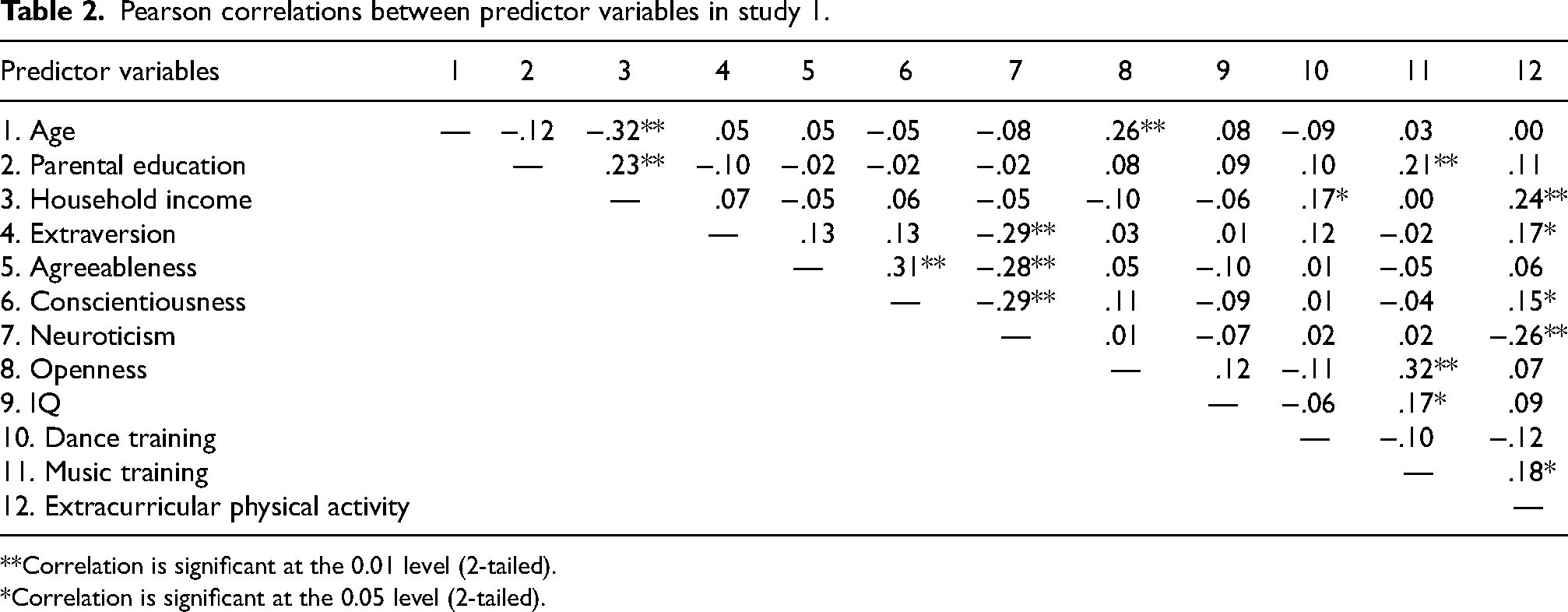
Correlation is significant at the 0.01 level (2-tailed).
Correlation is significant at the 0.05 level (2-tailed).
Pearson correlations between outcome variables in study 1.

Correlation is significant at the 0.01 level (2-tailed).
Correlation is significant at the 0.05 level (2-tailed).
Table 4 shows Pearson correlations between the predictor variables and the outcome variables. None of the predictors correlated significantly with visual immediate memory, and only general intelligence predicted visual delayed memory. Both auditory immediate and auditory delayed memory were positively associated with age, general intelligence, and music training, but negatively associated with agreeableness. Visual and auditory working memory were both correlated with general intelligence and extracurricular physical activities; visual working memory was additionally correlated with household income, neuroticism, and music training. Dance training was not significantly associated with any memory measure.
Pearson correlations between predictor and outcome variables in study 1.

Correlation is significant at the 0.01 level (2-tailed).
Correlation is significant at the 0.05 level (2-tailed).
Separate multiple linear regressions were completed for each outcome measure that was significantly associated with music training or extracurricular physical activity. In each linear regression analysis, we also controlled for other predictor variables that were significantly associated with the outcome variable. 2 Based on simple associations, age, agreeableness, general IQ, and music training were included in the models for both auditory immediate and auditory delayed memory. Regressions and partial correlations are reported in in Tables 5 and 6. The first model explained 18.7% of the variance in auditory immediate memory scores, and the second model explained 21.1% of the variance in auditory delayed memory scores. In both models, age and general IQ made significant unique contributions; agreeableness also uniquely explained the auditory delayed memory scores. Notably, music training was no longer associated with either memory score when age, general IQ, and agreeableness were controlled for.
Multiple linear regression results for auditory immediate memory in study 1.

Multiple linear regression results for auditory delayed memory in study 1.

Multiple linear regression analyses were also completed for visual and auditory working memory. For visual working memory, household income, neuroticism, general IQ, duration of music training, and duration of extracurricular physical activity were included (see Table 7), which explained 28.2% of the variance. General IQ and extracurricular physical activity were both uniquely associated with visual working memory, but once again, the association with duration of music training disappeared after accounting for other variables. For auditory working memory, general IQ and extracurricular activity involvement were included, which explained 11.3% of the variance, R = .34, F(2,182) = 11.61, p < .001. Both general IQ, pr = .27, p < .001, and extracurricular physical activity, pr = .20, p = .007, remained significantly associated with auditory working memory when the other variable was statistically controlled.
Multiple linear regression results for visual working memory in study 1.
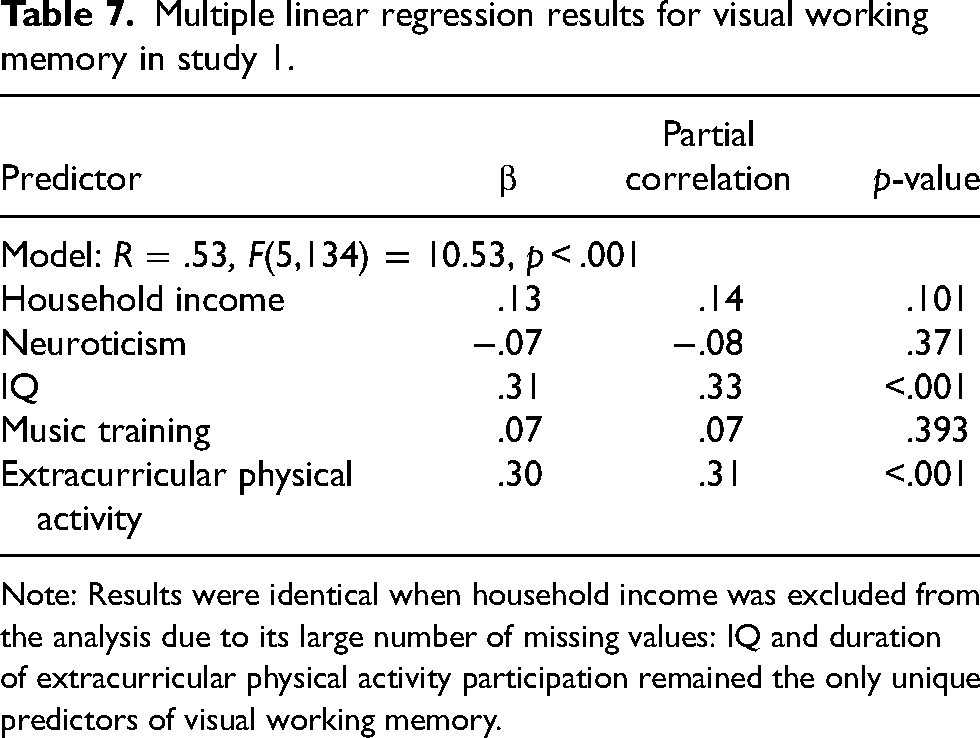
Note: Results were identical when household income was excluded from the analysis due to its large number of missing values: IQ and duration of extracurricular physical activity participation remained the only unique predictors of visual working memory.
In Study 1, we found no evidence of near transfer from dance to visual memory or from music to auditory or working memory: Duration of dance training was not significantly associated with any outcome measure, and the associations between music training and several measures of memory (auditory immediate, auditory delayed, and visual working memory) disappeared after controlling for other variables. Only extracurricular physical activities continued to predict both visual and auditory working memory when other variables were held constant. Our results suggest that the link between music training and memory is best explained by pre-existing differences between those who take music lessons and those who do not: Musically trained individuals are high functioning across a wide variety of cognitive areas, particularly in the auditory domain.
However, there are two main limitations to Study 1. First, normative data for determining scaled scores was updated in the Wechsler Memory Scale, Fourth Edition (WMS-IV; Wechsler, 2009), and most of the subtests from the WMS-III (Wechsler, 1997) have been modified or replaced with entirely new subtests. For example, the visual tasks in the WMS-IV (Wechsler, 2009) may be more representative of visual memory ability as they do not require the participant to respond verbally, whereas some tasks from the WMS-III (e.g., family pictures) are more accurately defined as visual-verbal (Pearson, n.d.). Because our visual memory measures may have had questionable psychometric properties (Pearson, n.d.), the main goal of Study 2 was to examine whether associations between dance training and visual memory would emerge with more reliable and valid measures. Another limitation was the lack of men in Study 1 as gender may affect the strength of the associations between participation in extracurricular activities and memory. No men were included in Study 1 as they are less likely to participate in dance training, and including them would have introduced an imbalance between dancers and non-dancers. However, to address these limitations in Study 2, we examined visual memory abilities more thoroughly and specifically using subtests from the WMS-IV (Wechsler, 2009), and we included men in the sample. By contrast, auditory memory measures were not examined in Study 2 because there were fewer changes to auditory memory subtests from the WMS-III to the WMS-IV, and to keep administration time reasonable.
Study 2
As in Study 1, undergraduate students in Study 2 completed a visual memory battery, as well as measures of personality, non-verbal intelligence, extracurricular activity history, and demographics.
Methods
Participants
The sample comprised 119 participants from MacEwan University (mean age = 20.6 years, SD = 3.5, range: 17–39, 81 women) who completed the study for course credit. As some of the tasks included extensive verbal instructions, only native English speakers were recruited to participate. An additional six participants were tested but excluded from analyses for the following reasons: incomplete data set (1), previous exposure to the WASI-II (Wechsler, 2011) (1), or misunderstanding one or more tasks (4). All participants provided written, informed consent prior to participating in the study. Dance training, music training, and extracurricular physical activities were measured as in Study 1.
In our sample, 45% had received dance training (average duration across all participants = 6.1 years, SD = 15.9, range: 0–106), 71% had taken music lessons (average duration = 5.4 years, SD = 6.6, range: 0–42), and 82% had participated in extracurricular physical activities (average duration = 10.1 years, SD = 9.2, range: 0–37). As such, extracurricular activity participation was lower in Study 2 than in Study 1, particularly for dance training. Women had more dance training than men on average, t(83.07) = 3.73, p < .001, Cohen's d = .59 (unequal variances test), and men participated in more extracurricular physical activities than women, t(58.85) = 2.15, p = .04, Cohen's d = .44 (unequal variances test), but the groups did not differ in terms of their duration of music training, t(117) = 0.49, p = .62, Cohen's d = .11. As in Study 1, SES was estimated with parent education levels on a five-point scale and household income on a six-point scale (data missing for 21 participants). The average parent education level was 2.9 (SD = 1.0, range: 1.5–5), which is approximately equivalent to some college or post-secondary training, and the average household income was 3.3 (SD = 1.69; approximately $60,000 to $90,000 per year, range 1–6). The average non-verbal IQ of 102.21 (SD = 10.44, range: 75–135) was significantly higher than the published average of 100, t(118) = 2.31, p = .023, Cohen's d = .21.
Measures
Selected subtests from the WMS-IV (Wechsler, 2009) were used to assess visual memory: visual reproduction, designs, symbol span, and spatial addition. Three dependent measures of interest were calculated: visual immediate memory, (visual reproduction 1 and designs 1), visual delayed memory (visual reproduction 2 and designs 2), and visual working memory (symbol span and spatial addition). The average visual working memory score of 104.30 (SD = 10.79) was higher than the published average of 100, t(118) = 4.351, p < .001, Cohen's d = .40; the WMS-IV does not provide separate index scores for visual immediate and delayed memory.
As in Study 1, the WASI-II (Wechsler, 2011) was administered to obtain a score of intelligence. However, because of our focus on visual rather than auditory memory measures, we chose instead to control for perceptual reasoning (i.e., non-verbal IQ). As such, participants completed the block design and matrix reasoning subtests of the scale. Finally, participants completed the Big Five Inventory (John et al., 1991) as well as a demographics and extracurricular activities questionnaire as in Study 1.
Procedure
Participants completed tasks in the following order: visual reproduction I, spatial addition, visual reproduction II, designs I, symbol span, the personality, extracurricular, and demographic questionnaires, designs II, and finally, the block design and matrix reasoning subtests of the WASI-II (Wechsler, 2011). This order ensured the required 20- to 30-min delay between the two visual reproduction and designs tasks. All visual memory tasks were completed in the same order as suggested in the WMS-IV manual (Wechsler, 2009). The procedure took approximately 90 min to complete.
Statistical Analyses
The same statistical approach was taken as in Study 1.
Results and Discussion
Preliminary analyses examined Pearson correlations between the predictor measures (see Table 8). An initial analysis revealed that gender was not significantly associated with any outcome measure, so it was not considered further. Dance training was not associated with any other predictor; by contrast, music training was associated with parent education and non-verbal intelligence, and extracurricular physical activities were positively correlated with parental education, agreeableness, and conscientiousness, and negatively correlated with neuroticism. The three outcome measures were also significantly intercorrelated: visual immediate memory was associated with both visual delayed memory, r = .64, N = 119, p < .001, and visual working memory, r = .44, N = 119, p < .001, which were also significantly correlated, r = .28, N = 119, p = .002.
Pearson correlations among predictor variables in study 2.

Correlation is significant at the 0.01 level (2-tailed).
Correlation is significant at the 0.05 level (2-tailed).
Non-verbal intelligence was the only predictor of both visual immediate and visual delayed memory; as such, no further analyses were conducted on these outcome measures. Visual working memory, however, was significantly associated with both non-verbal intelligence and duration of music training, although not with extracurricular physical activities as was found in Study 1. A linear regression analysis revealed that together, these two predictors explained 28.6% of the variance in visual working memory scores, R = .54, F(2,116) = 23.28, p < .001. Non-verbal intelligence remained a unique predictor of visual working memory scores when duration of music training was controlled, pr = .51, p < .001, but music training was no longer significant, pr = .10, p = .26.
Despite differences in the tasks, sample size, gender distribution, and activity participation in Studies 1 and 2, the results of Study 2 replicated our two main findings of Study 1. First, dance training still failed to correlate significantly with any memory measure, despite the use of better visual memory tasks (all rs < .15; all ps > .10). Second, music training was once again associated with visual working memory, but the association disappeared after controlling for other predictors, as in Study 1. The main difference between Study 1 and 2 was our failure to replicate the association between extracurricular physical activity and working memory. Taken together, the results of both studies suggest a consistent lack of evidence of near or far transfer from activity participation to memory performance.
General Discussion
We examined whether duration of music training was uniquely associated with auditory memory and whether dance training was uniquely associated with visual memory after controlling for IQ, demographic variables, and personality. Associations were weak to nonexistent despite large sample sizes and comprehensive measures of memory. In Study 1, music training was no longer correlated with auditory immediate, auditory delayed, or visual working memory when other variables were held constant, and dance training was not associated with any type of memory. In Study 2, we again found that the association between music training and visual working memory disappeared when controlling for other variables, and dance training once again failed to predict any memory measure despite our use of better visual memory measures. Our results provide no support for near transfer from music or dance training to memory. Rather, links between music training and (usually) auditory memory are likely to result from more general associations with cognition or from other pre-existing differences between musicians and non-musicians.
Although there is a large body of research on the link between music training and memory, particularly in the auditory domain (see Talamini et al., 2017 for a meta-analysis), our results suggest that the link is weak. First, we found that music training was not consistently associated with auditory memory: In both Studies 1 and 2, music training predicted visual working memory, but it did not predict auditory working memory in Study 1 even though it was linked to auditory immediate and delayed memory. Second, even simple correlations were weak given the wide variability in duration of music training and compared to the strength of associations between duration of extracurricular physical activities and working memory. Finally, all associations disappeared when we controlled for demographic variables, personality, and intelligence. We emphasize this last point, as many previous studies have neglected to control for such variables, especially personality. It is likely that associations between music training and memory largely reflect general pre-existing differences between those who take music lessons, especially for long durations, and those who do not. For example, those who engage in music lessons tend to be high functioning, especially on auditory tasks (see Swaminathan & Schellenberg, 2019, for a review). Although we did not assess music perception skills or aptitude in the current work, it may be important for future studies to do so, especially when making claims about near or far transfer. For example, Swaminathan et al. (2017) found that the association between music training and intelligence disappeared after controlling for music aptitude, whereas music aptitude continued to correlate with intelligence after other variables—including duration of music training—were controlled. Similarly, Silas and colleagues (2022) found that music training and visuospatial working memory were unrelated when musical working memory was considered. In short, neglecting to control for important individual differences is bound to lead to hasty conclusions about skill transfer rather than more likely explanations that center on how different individuals self-select into different environments.
Contrary to our hypothesis, duration of dance training was not associated with visual memory, nor with any other aspect of cognition (auditory memory, intelligence). Rather, dance training was associated only with household income, likely because dance lessons and attire can be costly and therefore are more accessible to those with greater monetary resources. Our results add to the body of research on mixed associations between dance training and memory skills, which has also focused mostly on older adults (D'Souza & Wiseheart, 2018; Doi et al., 2017; Douka et al., 2019; Giacosa et al., 2016; Hüfner et al., 2011; Kosmat & Vranic, 2017; Kim et al., 2011; Lazarou et al., 2017; Marquez et al., 2017; McKee & Hackney, 2013; Merom et al., 2016; Müller et al., 2017; Noguera et al., 2020; Norouzi et al., 2020; Oppici et al., 2020; Qi et al., 2019; Rehfeld et al., 2018; Shen et al., 2020; Verghese, 2006; Zhu et al., 2018). This pattern of results is inconsistent with a near transfer account, or even reverse causation, where individual differences in memory could influence self-selection into dance training. Rather, our findings are consistent with the weak and inconsistent effects of exercise on memory in younger individuals (e.g., Álvarez-Bueno et al., 2017; de Greeff et al., 2018; Vazou et al., 2019; Xue et al., 2019). This interpretation is further supported by non-significant differences in improvements when dance training is compared to other exercise (Müller et al., 2017; Norouzi et al., 2020; Rehfeld et al., 2018; but see Oppici et al., 2020). Our own results on the associations between extracurricular physical activities and working memory scores mirror the inconsistent effects of exercise in younger individuals, as we found significant links when other variables were controlled in Study 1, but not in Study 2.
Among older individuals, the effects of exercise on memory may be stronger for dance because it frequently includes cognitive complexity (e.g., memorizing complex motor sequences), creativity through improvisation, and a social component. For example, there is some evidence that dance training increases brain-derived neurotrophic factor (BDNF) levels more than other exercise (Müller et al., 2017; Rehfeld et al., 2018), and BDNF plays an important role in synaptic plasticity, neurogenesis, learning, and memory (Gomez-Pinilla & Hillman, 2013). By contrast, associations or even causal effects may be less likely to emerge or be more transient in younger individuals and children who tend to have higher levels of physical activity in general—whether or not dance is one of those physical activities—and who are not experiencing declines in memory performance. Memory skills in these younger individuals are likely at their peak and therefore less susceptible to intervention. Furthermore, a recent review and meta-analysis of randomized control trials suggests that the robust positive effects of exercise on cognition in healthy individuals may be due primarily to publication bias, a lack of active control groups, and baseline differences between groups (Ciria et al., 2023). Future intervention research should continue to examine which aspects of memory are most likely to be impacted by dance training in older individuals—especially those with memory impairments—using sound methodology (e.g., active control groups, random assignment to group), as well as identifying which components of dance (physical exercise, cognitive complexity, creativity, socialization) contribute to the effect.
Associations between environmental experiences—such as participation in different types of extracurricular activities—and other skills are bound to reflect gene–environment correlations to a large degree, where genetic predispositions influence the tendency to experience certain environments (Plomin et al., 1977; Scarr & McCartney, 1983). Passive influences are strong early in life and reflect the impact of the parents’ genotypes (which are passed on to children) on a child's environment. Evocative or reactive influences reflect the impact of the child's genotype on their social environment and how others behave toward them; these influences have a steady influence throughout life. Finally, active influences—or niche-picking—become stronger with age and indicate the influence of children's own genotypes on the environments and experiences they choose. Regarding music training, for example, Corrigall and Schellenberg (2015) found that in younger children aged 7 to 9 years, parents’ openness-to-experience was the strongest and one of the only significant predictors of children's duration of music training when other variables were held constant, consistent with passive gene–environment correlations. By contrast, children's own openness predicted duration of music training in 10- to 12-year-olds—not parents’ personality—reflecting the shift to active gene–environment correlations that occurs as children become more independent and in control of their own choices (Corrigall et al., 2013). As such, the initial decision to enroll a child in an extracurricular activity is likely influenced by parental genetic predispositions, but decisions to remain in those lessons for long durations may become increasingly influenced by children's own tendencies. For music training, having better cognitive and auditory skills and greater openness-to-experience may make music lessons easier, more interesting, and more stimulating than they would be to other individuals. Evidence suggests that genetic predispositions even influence an individual's musical instrument of choice, the musical genre that they play, and how much they practice their instrument (Hambrick & Tucker-Drob, 2015; Mosing et al., 2014; Mosing & Ullén, 2018). Music training may also appeal to such individuals because of its association with prestige, success, and excellence, especially after widespread and long-standing media reports on links between music and intelligence (Bangerter & Heath, 2004; Mehr, 2015). For dance training, different and as-yet-to-be-identified genetic predispositions may be more important, such as physical fitness and ability or social skills.
It is also possible that such predispositions vary more widely with different dance styles than they do with different music styles or instruments. Because we recruited a general population of undergraduate students rather than individuals with training in specific dance styles, it was necessary to collapse our data across dance styles such as ballet, jazz, contemporary/lyrical, and hip-hop. However, dance styles may differ considerably in the demands they place on memory, as well as the degree to which they induce and express emotions and tell coherent stories, both of which facilitate memory (e.g., Cahill & McGaugh, 1998; Thorndyke, 1977). Future research should examine whether cognitive skills are associated with specific styles—such as ballet, which is highly structured and technical, and similarly associated with prestige among the arts—but not others. Furthermore, dance exercises like improvisation may place greater demands on working memory because they require the manipulation of existing knowledge (e.g., of dance steps or sequences) to create a dance on the spot. Research with older adults has shown that dance improvisation improves cognition (Coubard et al. 2011; Fisher et al., 2020). Future research could examine whether particular dance exercises improve memory, especially in older adults.
It should be noted that answers to questions about causation are not mutually exclusive; it is possible that cognitive skills influence the tendency to engage in extracurricular activities, which in turn further enhance cognitive skills. However, the pattern of weak experimental evidence (e.g., Alemán et al., 2017; Sala & Gobet 2020a) but more robust correlational or quasi-experimental evidence (e.g., Talamini et al., 2017) points to pre-existing differences as a much larger influence. It is also possible that extracurricular activities are more likely to improve cognition in certain groups of people compared to others. For example, gene × environment interactions describe genetic predispositions that influence an individual's susceptibility to certain environmental influences (Plomin et al., 1977). In the domain of music, several recent twin studies suggest that gene × environment interactions are at play in musical achievement (Hambrick & Tucker-Drob, 2015; Wesseldijk et al., 2019; see Ullén et al., 2016, for a review and theoretical model). In essence, self-selection into different activities may also influence the degree to which meaningful growth is achieved from those activities. Because true experiments attempt to eliminate issues of self-selection and instead examine widespread or general group-level effects, they may miss subtleties that occur in more natural settings where individual differences are important. Significant effects of training may also emerge among those with poorer skills to begin with, as they have more room to improve. For example, in one study, children taking group music lessons improved more in empathy and prosocial skills over the course of the year than those in the control group, but only if they had relatively low scores to begin with; children who scored high on these abilities initially showed no difference over time (Schellenberg et al., 2015). A similar pattern of results was found in a group of low-SES children who initially performed high or low on a Stroop task of executive functions (Holochwost et al., 2017), although the researchers did not find the same pattern with other measures of executive functions. Finally, Swaminathan and Schellenberg (2018) found that duration of music training predicted musical perception skills (with other variables held constant) only in individuals with relatively low cognitive scores, although these findings were not replicated when a larger sample size was analyzed (Swaminathan et al., 2021). In sum, future research could better capture the complexities of extracurricular experiences by examining individual differences rather than only considering group-level effects or associations.
There are several limitations to the current work. First, our recruitment strategies were slightly different between Study 1 and Study 2, making it more difficult to compare the two sets of results. For example, we recruited only women in Study 1 but both women and men in Study 2, and average extracurricular activity participation was generally lower in Study 2, as was the overall sample size. Although we replicated our original findings on music training and visual working memory, we did not replicate our Study 1 findings on extracurricular physical activities. It is possible that more consistent results would have occurred with more similar samples; however, we prioritized the reduction of potential demographic confounds in Study 1, which was the first comprehensive examination of associations between dance training and memory in young adults. A second limitation is our use of the WMS-III in Study 1, which includes widely criticized visual memory tasks (Pearson, n.d.). However, we administered more accurate tests of visual memory in Study 2 and still found no associations with duration of dance training. Unfortunately, this also meant that we were unable to examine both auditory and visual memory in Study 2 due to time constraints, although the auditory memory tasks changed only slightly in the WMS-IV. Third, participant fatigue may have impacted our results to some degree as participants were required to complete up to 90 min of cognitively demanding tasks. Finally, because we used a correlational design, we were not able to assess near transfer directly. However, given that correlational and quasi-experimental effects tend to be much larger (e.g., 15 IQ points in one study; Schellenberg & Mankarious, 2012) than experimental effects (e.g., 3 points; Schellenberg, 2004), non-significance even in the former design type implies that there is no effect.
In sum, we found no support for near transfer from music training to auditory memory or from dance training to visual memory in young adults. Such associations were initially present for music training only but disappeared after controlling demographic variables, intelligence, and personality. Given the modest impact of even working memory training on working memory performance (e.g., Sala et al., 2019a, 2019b; Sala & Gobet, 2020b), we suggest that links between music training and memory skills best reflect common genetic predispositions rather than training effects, and that different, still unknown genetic predispositions influence involvement in dance training. Future research could examine more thoroughly whether dance training is associated with memory in older adults, as well as other predictors (e.g., demographic, physical, social) of involvement in dance training.
Footnotes
Acknowledgements
We thank Leigh Dunn, Marina Casavant, and Linnea Velikonja for their assistance with data collection.
Action Editor
Youn Kim, The University of Hong Kong, Department of Music.
Peer Review
Valentin Begel, McGill University, Department of Psychology.
E. Glenn Schellenberg, ISCTE-Instituto Universitario de Lisboa, CIS-IUL.
Contributorship
RKS and KAC conceived of, designed, and completed the data analysis for Study 1, and KNR and KAC conceived of, designed, and completed the data analysis for Study 2. RKS wrote the first draft of the introduction, general discussion, and Study 1 methods and results, and KNR wrote the first draft of Study 2. All authors reviewed and edited the manuscript and approved the final version of the manuscript.
Ethical Approval
The MacEwan University Research Ethics Board approved these studies (Study 1 number: 100154; Study 2 number: 100506).
Declaration of Conflicting Interests
The author(s) declared no potential conflicts of interest with respect to the research, authorship, and/or publication of this article.
Funding
The author(s) disclosed receipt of the following financial support for the research, authorship, and/or publication of this article: Financial support for this research was provided by MacEwan University.
