



Abstract
Anxiety is among the most commonly experienced affective states—prominent in both everyday emotions, and a range of mood disorders. Music seems to be an effective tool for managing negative mood states, but recent research indicates that anxiety may be a particularly challenging state to self-regulate, even for those without diagnosed anxiety disorders. In this study, the use of music for anxiety self-management in everyday life is explored. Data consist of free descriptions by adult participants (N = 36), collected through an online survey and analyzed with data-led thematic analysis. Findings indicate that music listening is often considered helpful with milder states of anxiety—particularly when an individual has control over the choice of music—and that different regulatory strategies are required to deal with different forms of anxiety. These strategies can provide help in a number of ways, such as recognizing or validating emotions, or positive refocusing. In future research, the possibility of unrecognized maladaptive strategies in music listening should be addressed, as well as the mechanisms behind avoidance of music related to high levels of anxiety.
Introduction
One of the most common reasons for listening to music is to regulate our affective states (Baltazar & Saarikallio, 2019; Saarikallio, 2008; van Goethem & Sloboda, 2011). The affective state of anxiety—commonly experienced both through mood disorders and as an everyday emotion—increased in the general population during the global coronavirus pandemic (Calling et al., 2017; Salari et al., 2020). A number of studies have shown that to music can be used successfully to decrease anxiety, particularly in the context of music therapy for people with clinical anxiety disorders (Elliott et al., 2011; Guetin et al., 2009; Knight & Rickard, 2001) or coping with chronic illness or surgery (Bradt, Dileo, & Potvin, 2013a; Bradt, Dileo, & Shim, 2013b; Harney et al., 2023). A systematic review and meta-analysis by Harney et al. (2023) showed that music listening can decrease anxiety in various settings but stated that many previous studies focus on music listening interventions for experimentally manipulated anxiety. When it comes to music listening as an everyday strategy to manage naturally occurring anxiety, the evidence is less clear. In a recent experience-sampling study, Randall et al. (2023) found that listeners in an anxious state were less successful in reaching their self-regulation goals, when compared with all other negatively valenced states. Along similar lines, Carlson et al. (2021) noted that some participants surveyed about their music use during the first coronavirus lockdown reported negative emotional responses to music, which in many cases was related to severe levels of anxiety. One reason for this may be that anxiety is understood to be multidimensional and includes somatic and cognitive elements (Bishop, 2007; Endler et al., 1991; Sharp et al., 2015), and may thus represent a more complex regulatory problem than, for example, using music to elevate low mood or energy. Research into music listening for regulation of negative affect has primarily explored how music listening may relate to depression or risk for depression (e.g., Garrido & Schubert, 2015; Stewart et al., 2019), with comparatively little focus on anxiety, particularly everyday (nonclinical) anxiety. To address this, this study explores how listeners use music for managing naturally occurring anxiety, to better understand how musical engagement relates to this everyday experience.
Anxiety as a Condition
The American Psychological Association (APA, 2018) defines anxiety as “an emotion characterized by apprehension and somatic symptoms of tension in which an individual anticipates impending danger, catastrophe, or misfortune.” Compared with acute fear, which is a reaction to immediate danger, anxiety is a longer-lasting and more future-oriented emotion, often built on negative future expectations (Barlow, 2004). Anxiety is a multidimensional state, which can vary from feeling debilitated to experiencing hyperactivity or obsessive behavior (Barlow, 2004); thus, both low and high arousal can be characteristic of anxious states. Anxiety is a natural human experience that serves an evolutionary purpose in keeping us safe and cautious in certain situations where danger may arise from the environment but becomes problematic if the feeling of anxiety becomes chronic or greater than the situation would require (Storch & McKay, 2013). If the anxiety is long-lasting, intense, or interferes with daily life, there is a possibility of an anxiety disorder (Barlow, 2004).
The Diagnostic and Statistical Manual of Mental Disorders (APA, 2013) recognizes 11 different types of anxiety disorder, of which the most common are generalized anxiety disorder, panic disorder, and phobias. Anxiety is currently among the most commonly diagnosed mental disorders in the adult population (Storch & McKay, 2013) and the most common mental illness in adolescents and young adults (Teunisse et al., 2022). According to the World Health Organization, 301 million people, worldwide, were living with anxiety disorders in 2019 (WHO, 2022).
The experience of anxiety can also be a common part of everyday life for people recruited to studies from nonclinical settings (Carstensen et al., 2000; Zelenski & Larsen, 2000), although it remains unclear how many people experience anxiety at subclinical levels. A number of paradigms distinguish between state anxiety—which is focused on a specific situation or place—and trait anxiety, which is related to personality traits, and closely connected to a person's overall thinking or worldview (Julian, 2011). Trait anxiety tends to correlate with neuroticism, a personality trait related to a tendency to experience negative affect (Eid et al., 2022). Knowles and Olatunji (2020) have argued that trait anxiety might not be meaningfully distinct from neuroticism. For the purpose of this study, we focus on anxiety as an everyday emotion, which some individuals may experience more often than others, rather than as a clinical disorder.
The main treatment methods for anxiety disorders are psychotherapy and medication (APA, 2022). Studies on anxiety self-management are often related to hospital environments, medical procedures, and subsequent recovery periods (Chlan, 2009; Eyles et al., 2015; Hill et al., 2013). Such studies have shown breathing exercises to be a common and effective self-management strategy for postoperative anxiety (Chandler et al., 2019; Fredericks et al., 2012). Music and relaxation therapy are recommended to postoperative patients for managing anxiety (Fredericks et al., 2012), as they are evidently effective techniques in anxiety management. In contrast to research within medical environments, anxiety self-management across the contexts of everyday life has received less attention in the literature.
Adaptive cognitive emotion regulation strategies, which an individual may use independently or develop in therapy, include acceptance, positive refocusing, refocusing on planning, putting into perspective, and positive reappraisal, while maladaptive strategies include rumination, self-blame, catastrophizing, and other-blame (Garnefski et al., 2002). In the case of arousal anxiety—which involves physiological hyperarousal, tension, panic, phobias, and somatic reactivity—there is no strong correlation with frequent use of any specific cognitive emotion regulation strategy. In contrast, apprehension anxiety—which can appear as worrisome thoughts and reduced attentional control—is related to more frequent use of rumination (Domaradzka & Fajkowska, 2018; Fajkowska et al., 2018).
Music in Anxiety Management
In music therapy settings, the effects of music in managing anxiety have been widely studied in relation to other mental health issues, and across various healthcare settings. For example, music has been found to be an effective tool in reducing anxiety related to medical procedures (Mackintosh et al., 2018; Thoma et al., 2015; Vachiramon et al., 2013), critical illness (Chlan, 2009), postoperative pain (Kuhlmann et al., 2018), childbirth (McCaffrey et al., 2020), and psychiatric care (Yang et al., 2012). In each of these cases, music was used to relieve anxiety caused by a very specific situation, and the music was provided as an intervention guided by another person. In studies addressing music in the treatment of anxiety, the music used is often classical (Pelletier, 2004), and the majority of the interest appears to be related to musicians’ performance anxiety.
Labbé et al. (2007) conducted an experiment with 56 college students and found that listening to relaxing music and the ability to influence the selection of music seemed to reduce perceived and physiologically measured anxiety, anger, and stress levels, while heavy metal music seemed to slightly support relaxation but increase anxiety levels. A meta-analysis of music listening for alleviating anxiety in a healthy adult population suggests that the beneficial effects are related more to underlying individual processes, rather than the type or mode of the music (Panteleeva et al., 2018).
Previous research has shown that engagement with music (e.g., listening, playing, or dancing to music) is often used in the self-management of mood and emotion (Saarikallio, 2011), a process that involves a choice of both specific music and cognitive strategies. While listening to music appears to be a successful strategy overall for emotion management, some patterns in music engagement have been associated with more negative outcomes for mental wellbeing (Carlson et al., 2015; Saarikallio et al., 2015). For example, young people with symptoms of depression use music frequently for mood regulation but are often attracted to music that intensifies rather than alleviates their symptoms, and they may not be aware of the impact of their music listening on their wellbeing (Stewart et al., 2019). While maladaptive regulation strategies such as these have been extensively studied in relation to depression, the corresponding literature on anxiety is relatively lacking, despite the prevalence of anxiety as an everyday emotion.
Previous anxiety research has largely been focused on the use of classical music, treatment of situational anxiety, and music interventions provided by professionals, while the role of nonclassical genres, everyday anxiety management strategies, and the nuances of anxiety self-regulation remain unexplored. Studies in laboratory and clinical settings suggest that music can be an effective intervention for reducing anxiety (Elliott et al., 2011; Harney et al., 2023), but information about the music choices and cognitive strategies used by average listeners in everyday anxiety management, and which factors affect whether anxiety is effectively managed, is lacking in the literature.
In a recent experience-sampling study examining self-regulation goals through listening to music (Randall et al., 2023), it was found that listening to music appears to work particularly well for adults and adolescents for regulating negatively valenced mood states, as compared with positive states. Among the affective states that participants most frequently aimed to change through their listening, anxiousness was the least successfully regulated negative state for adolescents, and the least successfully regulated of all states for adults. This finding suggests that, compared with other negative mood states, anxiety may be more difficult to self-regulate by listening to music. Relatedly, in an investigation of the role of music in everyday life during the coronavirus pandemic (Carlson et al., 2021), it was found that highly anxious people reported having negative responses to music. These findings seem contradictory with a meta-analysis of listening to music for anxiety reduction, in which music was seen to decrease self-reported anxiety levels (Panteleeva et al., 2018). Thus, this topic warrants further investigation.
Aims of the Study
Former research has been focused on clinical levels of anxiety and the alleviation of anxiety in various healthcare settings. While music has been used to help alleviate anxiety in various situations, some results suggest that anxiety might be an especially challenging affective state in terms of independent emotion regulation. The aim in this study is to explore the use of music in anxiety management in participants’ everyday lives. By examining the role of listening to music in the management of nonclinical levels of anxiety, we can better understand the underlying mechanisms and strategies in successful and unsuccessful self-regulation with music. This study offers novel insights to participants’ own descriptions of their everyday music use for different levels of naturally occurring anxiety.
The aim of the study was to answer the following research question:
What are the characteristics of successful and unsuccessful attempts at using music to self-manage anxiety?
Methods
Data Collection and Participants
The data were collected in English using an online survey, which was open between the end of January and the end of March 2023. A total of 36 participants, ranging in age from 20 to 70 (M = 46.71; SD = 15.57; 11 identified as “male”, 24 as “female”, and 1 as “other,” when replying to a forced-choice question), were recruited using social media and mailing lists. Approximately half of the participants were from Finland (47%), while the rest came from elsewhere (including Asia, Europe, North America, and South America). On accessing the survey, participants were provided with information about the topic of the survey and the survey duration. The information page clearly stated the age requirement (at least 18 years), that participation was voluntary, and that consent to participate could be withdrawn at any time by closing the survey before completion. The information page also included a full privacy notice regarding protection of participants’ data.
The participants were asked to describe situations in which music engagement had been successful for them as a means of managing anxiety, as well as situations when music engagement had been unsuccessful for managing anxiety. In these open-ended questions, participants were asked to describe each situation in detail, and provide, for example, types of music or situational details that influenced anxiety management. Participants used a Likert scale to report how various types of musical engagement (listening, playing, singing, dancing, composing, or imagining music) in different social contexts (alone or with others) related to their anxiety management with music. Additionally, they filled out the 21-item Depression Anxiety and Stress Scale (DASS-21; Lovibond & Lovibond, 1995) and provided general demographic information. On the anxiety subscale of the DASS-21, most participants’ scores were quite low overall: as defined by the DASS-21, 15 participants registered scores that reflect normal levels of anxiety (0–7); 7, mild (8–9); 7, moderate (10–14); 4, severe (15–19); and 3, extremely severe (20+) (M= 8.94; SD = 6.74). Thus, most of the results can be considered representative of a population without clinical symptoms. Finally, participants were asked to provide the name and artist of at least one song that might help them in managing anxiety.
Analysis
Qualitative data were analyzed using data-led thematic analysis (e.g., Braun & Clarke, 2006), to identify common themes within the experiences of using music to manage anxiety. Coding took place in three stages. In the first stage, the first author coded the data using the data-led approach and developed a preliminary set of codes. The second and third authors completed the second round of analysis by coding the data using the same codes as the first author. They also made additions to the set of codes when necessary. During this second stage, the codes were discussed and negotiated together by the three coders, the codes were thematically grouped, and, as a result, the main themes were formed. Finally, the analysis and interpretations were discussed with all the authors. Basic statistical analysis was applied to Likert-scale and DASS-21 answers to provide additional information about the participants’ backgrounds and styles of music engagement. Background information, such as gender (F = female; M = male; N = nonbinary), age, level of musicianship (nonmusician, amateur musician, or professional musician), and DASS-21 anxiety score (mild, normal, moderate, severe, or extremely severe anxiety) of the respondent are provided with each data extract in the results section.
Results
The overview of demographics (Figure 1) shows that the survey reached people from all age groups, with the majority being working age adults. A majority of the participants were female. Participants from different educational backgrounds and occupations were represented; however, the data did not include, for example, any unemployed persons. All participants estimated their proficiency in the English language to be at least intermediate, and there was a fairly even distribution in terms of musical background.
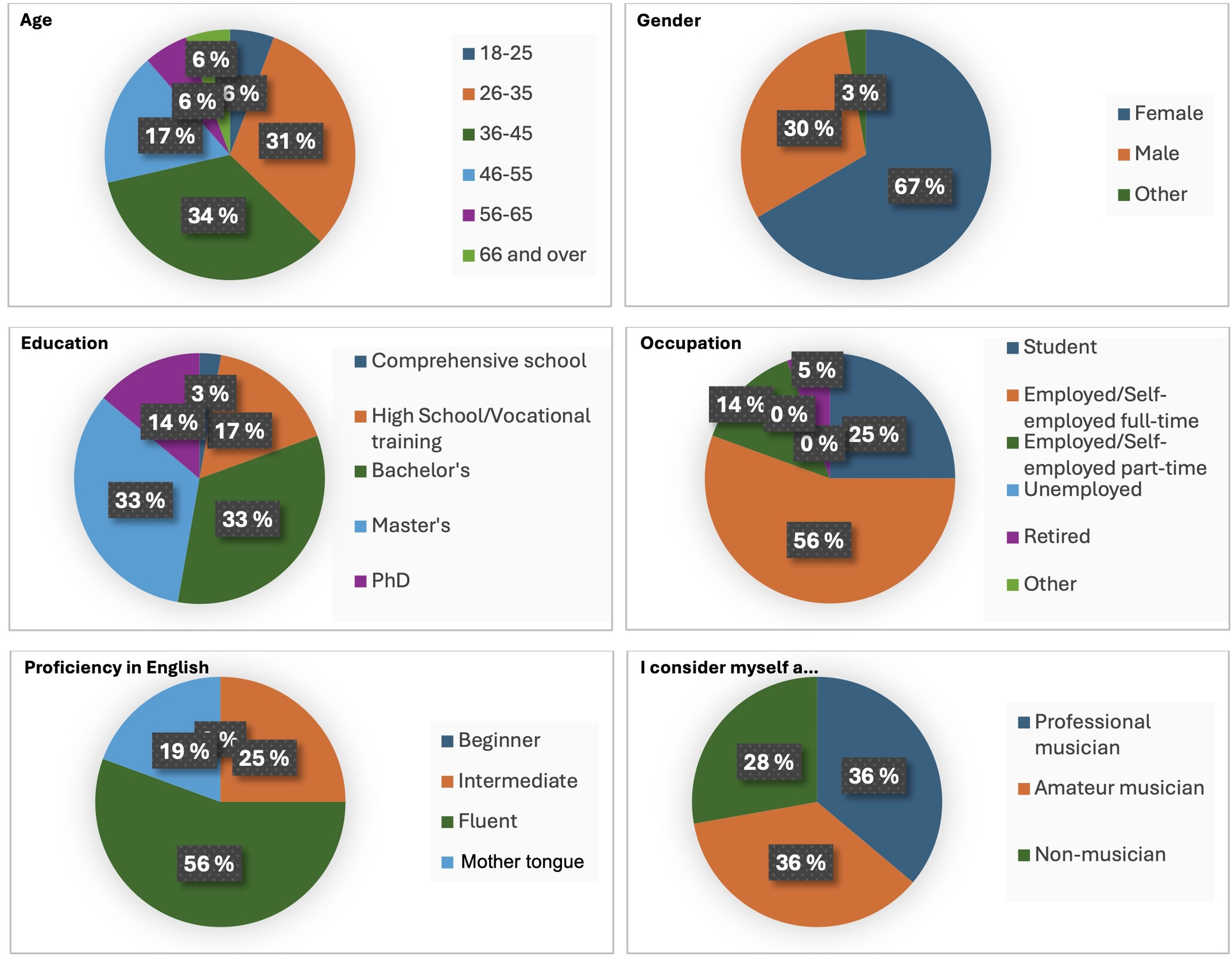
Demographics: participants’ age, gender, education, occupation, English language proficiency, and level of musicianship.
A clear majority of the participants engaged with music or other audio (or audiovisual) content (such as podcasts or videos) while feeling anxious (Table 1). “Imagining music” was slightly more common way to engage with music than “singing or playing an instrument”; this is a surprising finding. According to Mitani et al. (2019), simply imagining music that is self-selected and easy to imagine may have similar relaxing effects to listening to music for relaxation. Voluntary musical imagery (i.e., imagining music) has also been studied specifically with relation to anxiety management, and it was suggested to lead to decreased anxiety and increased positive mood (Ulor, 2020).
“How do you usually engage with music to manage anxiety?”

The songs mentioned by participants as helpful in anxiety management spanned a wide range of musical genres and styles (Appendix A). This resonates well with the multidimensionality of anxiety (Barlow, 2004), where the desired outcome can be at very different extremes for different individuals, or even within the same individual across different situations. However, a further analysis of the music examples was not within the scope of this study.
In the analysis, we identified two broad main themes: successful strategies for using music for anxiety—consisting of three subthemes—and unsuccessful strategies—consisting of two subthemes. It is important to acknowledge that the data describe only participants’ experiences and perceptions of managing anxiety in retrospect, and not necessarily actual strategies per se. As there may be a common bias toward the belief that music always has a positive effect, we must keep in mind that certain music listening episodes might have been regarded as successful by the participants, but that the actual behavior might have been maladaptive and resulted in feeling worse over time.
Strategies of Successful Music Use
The situations in which participants reported that music works for anxiety management can be grouped into three subthemes: (a) changing the current state, (b) strengthening the current state, and (c) distraction.
Changing the Current State
For many participants, feelings of anxiety, pressure, and stress were managed by trying to calm down with music. For this purpose, the strategy was often to use calm, slow, and peaceful music, which resulted in calming down, reducing stress, and slowing down heart rate.
Easy jazz type of music or my favorite songs typically help reduce stress and calm my pulse down.
Sometimes I might need very relaxing songs to help me calm down.
When I’m really troubled by something, metal music helps me to detach myself from unpleasant feelings.
If I listen to music as a tool to manage anxiety, usually heavy metal or peaceful (yes, opposite) music works best. I can feel more calm after I have played or listened to music.
In addition to calming down, some people turned to energizing and exciting music to cheer themselves up instead. Actively aiming to change their emotional state to a more positive and energized one with the help of music was a way to achieve a more relaxed and focused state, which for some, was needed for problem solving.
I choose something groovy to release myself from the stiffness caused by anxiety.
I will play some exciting classical music to cheer me up. I will feel relaxed and can be more focused to solve the problem.
Some strategies were cognitively insightful, with different music choices leading to a restorative state, back to a nonanxious mindset, or slowing down an anxious train of thought. Music was also considered to offer empowerment, peer support, and a means for perspective-taking, when participants were alone with their anxious thoughts.
When anxious, familiar music helps to remind me of how far I’ve journeyed so far in life.
It helps calm my nerves and restore a bit of a “regular” mind.
The benefit of taking a break from stress, however short, is that it helps me gain a little perspective. This reduction in stress can be quite long-term.
Listening to music was also used to decrease arousal, especially when going to sleep. Familiar music (as well as meditative, classical, and instrumental music) was considered helpful for trying to relax, slowing down the train of thought, and finding comfort.
There are specific pieces by Bach and Beethoven, specific movements I use to try to calm down before sleep.
I sometimes try to breathe calmly and slowly, but more than often, playing some meditative music helps the most. I also play meditative music every night when I’m in bed, as I read and start winding down. It really helps me to get rid of any stressors from the day.
I choose something peaceful, usually classical music to calm myself down if anxiety has led to hyperactivity.
I use music to help me sleep when my mind is wandering at night with thoughts of anxiety about the days to come. I usually turn to very familiar music.
Strengthening the Current State
Some participants used music to strengthen their current emotions. This was done by listening to calm music when feeling down, or metal music when feeling angry, for instance. This strategy can be considered as having two separate goals: on the one hand, the music matches the listener's emotions and validates them, so the listener does not need to let go of a current emotion to tune into the emotion represented by the music. On the other hand, music can strengthen the current emotion, in which case experiencing the emotion with more intensity makes it easier to process it and move on.
Sometimes I like to listen to very sad music, sad pop songs usually, to really feel the feelings and move on.
When choosing music to listen to while feeling anxious, the music tends to be rather emotionally introspective.
I want to increase the anxiety by a certain type of music so that the feeling reaches the “intensity cutpoint” and then passes.
It was almost as if I craved the bad feelings to get the same drug of comfort again.
Distraction
In anxiety management with music, distraction emerged as a common strategy. Music helped to avoid thinking about anxiety and offered something else to focus on instead of troubles and anxious thoughts. Distraction was achieved with various types of music: some preferred calm, simple, beautiful, and familiar music, while others turned to upbeat or complicated music to not think about their anxiety.
Contemporary music is hard to understand and to think about music is a good way to not think about my anxiety.
What is important is that music is loud and fast enough that my brain will only focus on the music and not on my feelings.
Music gives me something to focus on besides my internal feelings of nervousness.
Some participants reported having developed self-regulation strategies for selecting certain types of music in situations which require concentrating on some task or blocking other distracting sounds.
When working or studying, I have used calm, instrumental music that is not too interesting to follow and “analyze”, but still gives some content for the mind to focus on a little. Mind wanders less!
I use various genres of music (rock, indie, alternative, classical) and headphones to mask some of the things that increase my anxiety (the sound of toxic coworkers talking in my office, repetitive beeping from the hallway). So music can be preventative for me.
Music is also a great way to block surrounding sounds when I’m feeling sensory overload.
If I don’t have the possibility of actually listening to music, I play through familiar songs in my head.
However, sometimes music itself was considered too distracting if the situation required attention and concentration.
There are cases, usually demanding immediate attention, where any music would be an annoying distraction. I have learned when I can go to music for relief.
When Music Does Not Help with Anxiety
The majority of the descriptions of the situations when music did not help to manage anxiety were not so much about failed music use attempts, but about situations where some factor made music unfavorable for the purpose of alleviating anxiety. These factors can be divided into two main themes: internal factors, such as (a) unwanted memories and triggers or (b) problematic initial states, and external factors, such as (c) lack of control when it comes to selecting music or (d) how appropriate the music is. While describing the situations in which music did not help manage anxiety, participants also described some alternative solutions to the problems they had faced, such as using noise-cancelling headphones, not listening to music at all when they knew silence would be more helpful, and making playlists with helpful songs beforehand so that they would not need to search for the music when feeling anxious.
Internal Factors: Memories and Triggers Evoked by Music
The emotional content of the music was one explanation for music not helping with anxiety. When music expressed an emotion that was too strong to handle, it could make some participants feel more anxious. Music that sounded too negative was considered unhelpful, as well as music that reminded of bad experiences in the past, brought back painful memories, or triggered unwanted emotions.
[It does not work] when the subject matter or certain songs relate too closely to my trauma.
There are some specific songs I tend to stay away from, because they bring back some aspects or situations from my past life that I don’t want to be faced with anymore.
Lyrics or other associations with music that have to do with the possible source of my anxiety.
Internal Factors: Problematic Initial State
In some cases, the anxiety felt by participants was too high for music to serve as an effective distraction. Several participants reported that when their anxiety level rises too high, they do not engage with music at all.
Usually music does not sound too good to me when anxiety is hitting hard, and I feel like it is maybe not enough in itself to distract me from anxious thoughts.
If the music does not help, my experience is that the anxiety is too strong.
Only rarely, when I’m feeling really anxious, music will not make me feel better. In these situations my anxiety is too bad and I am not able to focus only on the music.
As my anxiety manifests as racing thoughts, or physical sensations (tight chest, lightheadedness), some music can have the effect of overshooting the mark.
I was already in a bad mood and Spotify on shuffle played only emotional, mostly acoustic sad songs. It was difficult to get out of the bad mood after breaking down.
If the initial state was panic, or even psychosis, music was not considered helpful.
I do not use music to manage my anxiety when I’m having a severe attack.
It can’t help when anxiety becomes stronger or even clinical. It does not soothe panic attacks, for instance.
I’ve suffered a couple of occasions of psychosis and during those episodes music with a notable amount of violence in it certainly hasn’t helped.
Furthermore, in some situations, music can add to the anxiety. In cases of feeling sensory overload, music would only add to the load.
Sometimes I’m anxious due to sensory overload, and I long for silence. That’s when music makes me feel worse.
Music is not helpful at times when I am anxious but I need to concentrate. For example, driving in a congested city when I’m running late or receiving an important email I need to read quickly. Music overstimulates me in these situations.
When I am very very very anxious and I have fear that it is not possible to solve the situation I can’t listen to music.
External Factors: Lack of Control Over Music Selection
Cases in which music did not help to alleviate anxiety—or even made it worse—were often related to the participants not being able to choose the music, or just being around music when they would not want to hear it. This phenomenon was related to social situations and public places, such as stores or bars. In addition, radio and Spotify's ready-made playlists were reported as not helpful when the offered music did not match the listener’s own state.
Music at the gym drives me crazy. I have to bring my noise cancellation headphones and play my own music (loud enough to cover the gym music). Also, the various music played in stores and airports almost gives me a headache.
When I have to listen to music that I don’t like at all (for example radio at work).
If I am going out at night to some sort of night club and the beat of the music doesn’t match the pace of my body, then I can get more anxious.
There were rare cases in which self-chosen music did not feel helpful: one participant had often faced trouble finding the right music to use, while another participant chose music that ended up making her feel worse.
Sometimes it can be difficult to find suitable music to calm myself, cannot play the favorite songs all the time not to get bored. Then I try to find some music with Spotify and it can get irritating if cannot find it easily.
Music I chose was too fast and angry. Anxiety increased.
External Factors: Appropriateness of Musical Content
Many participants reported that they sometimes try to avoid certain music, certain singers, specific songs, or music itself because they know already that these choices would make them feel worse. I do not find dissonant music helpful when I am stressed.
I know myself well enough to know when I need silence.
Music was considered unhelpful in anxious situations if it was too dark, too loud, too heavy, too fast, too angry, or too happy, in the listener’s opinion. These descriptions could be partly related to the participants’ taste of music, but also to the music not matching a listener’s own emotional or desired state, or to music that would exacerbate a negative emotional state.
If I’d need to listen to something dark or heavy music while being anxious, I think I would start to feel even more anxious. Also if the music is too chirpy, it makes me feel irritated when I’m anxious.
Maybe the music feels forced: it forces me to experience some emotion that I couldn’t handle at that moment. The music sometimes feels too direct, I can’t protect myself from its effects.
If the music they [other people] choose expresses energy and happiness but I’m actually feeling sad or frustrated or with anxiety and fear.
Summary of Results
In our analysis, we identified three main strategies for using music in self-management for anxiety (Figure 2). Changing the current state, by actively engaging with music that helps the listener to calm down, relax, or cheer up, can be seen as a conscious strategy to regulate bodily symptoms of anxiety. In contrast, strengthening the current state by discharging negative emotions and finding solace with the help of music seems to be a different kind of strategy. The third strategy involved using music for distraction from both anxious thoughts and anxiety-inducing triggers from the listening environment. In the cases of unsuccessful anxiety management, we identified internal and external factors associated with music that made listening ineffective in dealing with anxious states. Music might evoke unpleasant memories or otherwise remind listeners about the sources of their anxiety; it could increase high-level anxiety or an otherwise problematic initial affective state by adding to the emotional or sensory overload. For listeners, a lack of control over music selection diminished their agency, especially in social situations and public places, or the musical style or emotional expression of the music did not match their affective state and regulative goals.

Music listening in anxiety self-management.
Successful strategies of music engagement can be conceptualized as a dynamic, intentional, process of: (1) recognizing an initial emotion, state, or situation; (2) choosing the right kind of music or the best way to engage with the music; and (3) achieving the desired emotion, state, or outcome. However, in situations where music did not help, these strategies were not useful because of: (1) a problematic initial state or a state of being too anxious; (2) a lack of choice over whether or not to hear the music; or (3) an inability to find or engage with music that would match the listener’s own needs. Of these two different processes, the first illustrates a quite conscious, active, and goal-oriented approach to music engagement, whereas the second relates to situations where music might be present but not chosen by the listener, or where the listener cannot engage with the kind of music that would alleviate an anxious state. On a broader level, our conceptualization can be seen to resemble the access–awareness–agency model presented by Saarikallio (2019), according to which emotionally competent music engagement involves allowing music to access one’s emotions, choosing music that provides reflective awareness to emotional experiences, and experiencing agency over one’s emotions and one’s music engagement. Understanding the meaning of these three key elements can help interpret successful strategies, whereas an absence of these elements may explain those situations where music does not work. While the main themes in our findings resemble more general theoretical concepts, some anxiety-specific details are prevalent in our qualitative examples.
Discussion
The aim in this research was to examine the characteristics of successful and unsuccessful attempts of everyday music engagement to self-manage anxiety. Participants reported mostly successful outcomes when engaging with music to manage their anxiety. Most participants considered self-chosen music as helpful, or at least not something that would exacerbate their anxiety. The few descriptions of situations in which music did not ease an anxious state or sometimes made participants feel worse were not necessarily unsuccessful attempts to use music, but rather moments in which participants would have avoided music altogether because of their high anxiety, or because they felt they had no control over the choice of music.
A clear majority of accounts emphasized the positive effects of music. However, there were also situations in which music was not considered to be helpful. Based on these data, it seems that music can sometimes be negatively distracting, especially in cases of high-level anxiety. Music was reported to sometimes produce too much sensory input and lead to overstimulation, especially for those who were generally more anxious. Even participants with lower general anxiety levels reported that music does not help them in situations where the anxiety feels too overpowering, or the situation seems unsolvable. Our findings about the difficulty of regulating high anxiety are consistent with those of Wylie et al. (2023), who found a link between intense emotions and decreased success in momentary emotion regulation. Lennarz et al. (2019) also found that acceptance—an adaptive regulation strategy—is more likely to be used with low-intensity negative emotions, whereas high-intensity negative emotions more often lead to more complex strategies, such as suppression, problem solving, distraction, avoidance, social support, or rumination.
Listening to music or other audio (or audiovisual) content, such as podcasts or videos, was used by many to feel less alone while feeling anxious. This is not surprising, considering that the fear of being alone is related to different forms of anxiety, such as adult separation anxiety. More anxious individuals often become highly reliant on close relationships, and their sense of stability and safety becomes dependent on the presence of other people (George et al., 2020).
Overall, these results are in agreement with previous findings and theories concerning affect regulation and everyday music engagement, but there were also some nuances specific to anxiety. For instance, the strategies identified from our data overlap some of the seven strategies measured by the Music in Mood Regulation scale (Saarikallio, 2008). In particular, the three strategies used for coping with negative mood states—diversion, solace, and discharge—bear a resemblance to our analytical themes. However, diversion was reported by listeners not only as a strategy for distraction from anxious thoughts, but also from the sounds or other stimuli of the surroundings. Furthermore, the more active, bodily-level, strategy of changing ones current affective state with the help of music (e.g., calming down or cheering up) seems to be different from that of diversion. Similarly, reasons for not engaging with music resemble those reported by participants who do not have anxiety, since situational aspects, lack of control, or a poor fit between the music and the current affective state are common reasons to avoid music (Krause et al., 2021; Peltola & Vuoskoski, 2022).
The experience of anxiety covers a broad range of symptoms, which can vary from tension and worry to depressed and debilitating states. Different forms of anxiety require different approaches to emotion regulation. Most of the descriptions within our data focused on downregulation (relaxation, calming down), but there were a few examples of regulation toward more activity (getting things done, cheering up). The different emotion regulation strategies utilized by participants may reflect individual types of anxiety, such as arousal or apprehension anxiety. In addition, the severity of a person's current anxiety may be a determinant of which self-regulation strategy might work for them: in very high levels, it might not be helpful to strengthen the anxiety because it would feel overwhelming or turn toward rumination, whereas for milder levels it might provide some potential for reappraisal, working through, validation, or consolation. However, since the majority (81%) of our participants registered scores of normal, mild, or moderate levels of anxiety on the DASS-21, we do not know if more severely anxious people have more difficulties in using music for regulating their anxiety. For instance, one participant with a rating of extremely severe anxiety reported that even self-selected music increased anxiety. Because of the small sample and the qualitative approach, we cannot draw further conclusions concerning maladaptive music engagement and high-level anxiety.
Because of the overlap and comorbidity between anxiety and depression, it is likely that similar strategies have been recognized among people with depression. Stewart et al. (2019) studied young people with tendencies to depression and presented categories in which their participants’ music choices mirrored their current moods or differed from their current moods, which are quite similar to our categories of strengthening or changing the mood. Both intensifying a mood and avoidance of music were also identified. While these results may resemble one another, there is a difference in the common initial state and the desired regulatory direction: when regulating a depressive state, the initial state was often that of feeling down, which required upregulation, while in our examples with anxiety the initial state was often a more active negative state that required downregulation, such as calming down.
The findings of unsuccessful music use can also be discussed in relation to the Healthy-Unhealthy Music Scale, of which eight unhealthy types of music engagement have been shown to have a connection with, for example, depression and stress (Saarikallio et al., 2015). Unhealthy scale items related to getting stuck in bad memories, blocking out other people or the environment, and mood worsening were also present in our findings related to anxiety; whereas items concerning low self-esteem (“feeling bad about who I am”) and possible self-harm (“music leads me to do things I shouldn’t do”) were not present in the data.
These successful and unsuccessful attempts can also be reflected in the model of emotion dysregulation presented by Marik and Stegemann (2016), which considers both effective or ineffective and adaptive or maladaptive strategies, all of which can still lead to emotion dysregulation through overuse or situational factors. An interesting detail is that our participants mostly experienced distraction with music as helpful, while in some theories distraction is considered to be a maladaptive emotion regulation strategy. The distraction presented in these results may actually reflect healthy, positive refocusing, or it may represent an anxiety-specific behavioral pattern toward an avoidant solution.
Rumination is closely related to the development of anxiety and depression disorders (McLaughlin & Nolen-Hoeksema, 2011). Among the participants in our study, rumination was not a frequently reported strategy in anxiety self-management with music. It might be that rumination is uncommon among individuals with nonclinical but mild anxiety. However, some participants reported that, in extremely anxious moments, music would not help them, so engagement with music was avoided. This raises questions about whether, in the context of music, avoiding excessively negative behavior, such as rumination, is somehow easier, compared with nonmusical contexts, or if people do not recognize music listening as maladaptive behavior, even when this might be the case.
Limitations and Future Directions
The findings of this study should be considered in the light of some limitations. The responses of our participants were given in retrospect and were possibly related to more general examples than to descriptions of specific situations where music was used with a predetermined goal to manage anxiety. Participants were asked to describe their memories of anxiety-related music listening, instead of systematically concentrating on their music listening episodes over a limited timeframe.
This study provides novel insight on the characteristics related to anxiety and music listening and can offer inspiration for more-controlled study settings. The ability to recognize and regulate emotions is linked to normal interoception (Zamariola et al., 2019); anxiety is known to increase interoceptive sensitivity, thereby complicating the regulatory processes (Domschke et al., 2010). A mixed-methods study that examines both individually experienced (qualitative) and measured (quantitative) emotional changes in anxiety alleviation with music could provide a better understanding of the underlying mechanisms and reveal potential matches or mismatches between experienced and measured emotional states.
This study's main purpose was to explore the variety of experiences related to anxiety and music use, but future studies could further examine the mechanisms behind music use, as well as the parameters of the music used. The sample size was small, and the study was based on a population with mild levels of anxiety. Even these individuals with nonclinical levels of anxiety often avoided music when their anxiety became too high. In future research, participants can be recruited from clinical settings, to find out whether and how people engage with music when experiencing high levels of anxiety.
There may be a common bias that music is always good for you or that any musical intervention is positive (Moss, 2021, p. 16), and people may be unaware of maladaptive behavior related to a creative leisure-time activity. Music's potential maladaptiveness remains an open question for the future. Avoidance is a common mechanism among anxious individuals, and can be seen as an adaptive coping mechanism, but it can also lead to the maintenance of anxiety disorders (Hofmann & Hay, 2018). Anxiety also seems to lead to the avoidance of music in some situations, and future research should examine whether that music avoidance is actually helpful or not. Another area for future research relates to the conditions in which listeners—consciously or unconsciously—identify that music would not help them, and whether this is easier for populations with nonclinical anxiety.
Conclusions
This qualitative survey study provides insight into the successful and unsuccessful strategies of music listening for the self-management of anxiety across everyday life contexts. The findings indicate that listening to music is often considered helpful and can provide self-regulatory aid for mild levels of anxiety by changing the mood state, strengthening the mood state, or distracting from one's own anxiety or the surrounding world. In accordance with previous research, the results underline the importance of self-selected music and control in the listening situation, with a lack of these factors leading to increased anxiety. Our main conceptualization has a resemblance to existing frameworks, such as the access–awareness–agency model presented by Saarikallio (2019), the Healthy-Unhealthy Music Scale (Saarikallio et al., 2015), and the model of emotion dysregulation presented by Marik and Stegemann (2016), while some information unique to anxiety may be found in our subcategories and qualitative examples. Higher levels of anxiety and other problematic initial states seem to complicate self-regulation with music, even for individuals with nonclinical anxiety. Both the mechanism of music avoidance and the possibility of unrecognized maladaptive musical behaviors raise some questions for future research.
Footnotes
Action Editor
Kelly Jakubowski, Durham University, Department of Music.
Peer Review
Michelle Ulor, independent researcher.
Cristina Harney, University of Leeds, School of Music.
Contributorship
MT was responsible for the data collection, analysis, and writing of the manuscript; MT conducted the first round of coding, wrote the first draft of the article, and created the figures and tables. H-RP contributed to the second round of coding, analyzing the data, and writing of the article, especially to the method section, analysis, and discussion. GM created the survey. EC contributed to coding, writing, and language checking. SS participated in the study design and provided feedback on the results and manuscript text. WMR assisted with the study design and language checking. All authors contributed to the study planning, reviewed the results, participated in writing, and approved the final version of the manuscript.
Declaration of Conflicting Interests
The authors declared no potential conflicts of interest with respect to the research, authorship, and/or publication of this article.
Ethical Approval
The ethical issues were discussed with the Ethics Committee of the University of Jyväskylä prior to data collection. The Ethics Committee of the University of Jyväskylä assessed the research plan and concluded that this study did not need to be reviewed according to the national guidelines. Therefore, an ethical review and statement from the Committee is not needed.
Funding
The authors disclosed receipt of the following financial support for the research, authorship, and/or publication of this article: This work was supported by the Research Council of Finland (project number 346210) and the European Research Council under the European Union's Horizon Europe research and innovation program (grant agreement number 101045747), funded by the European Union. Views and opinions expressed are however those of the authors only and do not necessarily reflect those of the European Union or the European Research Council Executive Agency. Neither the European Union nor the granting authority can be held responsible for them.
ORCID iDs

Data Availability Statement
Appendix A
Songs and music styles that were reported to help manage anxiety.

| Artist or composer | Song | Year | Genre |
|---|---|---|---|
| Mustan Kuun Lapset | Morfiinisiivet | 2007 | Black metal |
| Enochian Crescent | Väkisinkastettu | 2000 | Black metal |
| Tiziano Manca | Sui moti apparenti | 2010–2014 | Classical |
| Beach House | Space Song or any song from the albums Depression Cherry, Thank Your Lucky Stars, or Teen Dream | 2010–2015 | Indie pop |
| Bon Iver | Flume or any song from the albums For Emma, Forever Ago, and Bon Iver | 2007–2011 | Indie folk |
| J. S. Bach | Erbarme dich from St. Matthew Passion (Andreas Scholl) | 1727 | Classical |
| J. S. Bach | Air (Thomas Enhco & Vassilena Serafimova) | 1731 | Classical |
| Norah Jones | Don't Know Why | 2002 | Pop, jazz |
| J. Karjalainen | Sinulle, Sofia | 2015 | Rock, blues |
| L. van Beethoven | Piano concerto (unspecified) | — | Classical |
| S. Rachmaninoff | Elegie for piano (unspecified) | — | Classical |
| Queen | Don’t Try So Hard | 1991 | Rock |
| Kirk Franklin | My Life Is in Your Hands | 1997 | Religious hip hop, soul |
| Ida Paul & Kalle Lindroth | Hiekkalaatikolla | 2020 | Pop |
| — | Various saved music combinations on the Relax Meditation app | — | — |
| Ola Gjeilo | Playlist of songs: The Rose, The Ground | 2012–2017 | Classical |
| Ludivico Einaudi | Nuvole Bianche | 2003 | Classical |
| Sara Bareilles | Breathe Again | 2010 | Pop |
| Radiohead | Exit Music (For a Film), Street Spirit | 1995–1997 | Alternative rock |
| Samuli Putro | Jokainen tarvitsee | 2021 | Pop |
| Gregory Porter | Hey Laura | 2013 | Jazz, blues |
| Pekka Ruuska | Rafaelin enkeli | 1990 | Pop |
| Egotrippi | Matkustaja | 2004 | Pop |
| Beach House | Lazuli | 2012 | Indie pop |
| Red Hot Chili Peppers | By the Way | 2002 | Alternative rock |
| Sonata Arctica | Wolf & Raven | 2001 | Power metal |
| Amorphis | Death of a King | 2015 | Heavy metal |
| — | Hymns | — | — |
| Antti Tuisku | Blaablaa | 2015 | Pop |
| The 1975 | Give Yourself a Try | 2018 | Alternative, indie pop |
| P!nk | Raise Your Glass | 2010 | Pop |
| Becky Hill | Remember | 2021 | Dance, electronic |
| Sigala & Rita Ora | You for Me | 2023 | Dance, electronic |
| Tiësto | Ritual | 2019 | Pop |
| Ola Gjeilo | The Rose | 2017 | Classical |
| Keane | Watch How You Go | 2012 | Alternative rock |
| Stam1na | Kadonneet kolme sanaa | 2005 | Thrash metal |
| Arvo Pärt | Spiegel im Spiegel | 1978 | Classical |
| Amorphis | The Moon | 2022 | Heavy metal |
| P. I. Tschaikovsky | Classical pieces | — | Classical |
| G. Mahler | Symphonies, especially second and fourth movements | — | Classical |
| D. Shostakovich | — | — | Classical |
| J. Suk | — | — | Classical |
| Queen | — | — | Rock |
| Stevie Wonder | — | — | Soul |
| Tina Turner | — | — | Rock |
| — | — | — | Jazz, rock all over the world |
| T. Albinoni (arr. R. Giazotto) | Adagio in G minor | 1958 | Classical |
| J. Sibelius | Finlandia | 1899 | Classical |
| L. van Beethoven | Piano concerto no. 5 | 1809 | Classical |
| J. S. Bach | Violin concerto in E major, BWV 1042, second movement | 1717–1723 | Classical |
| Voces8 | Luxæterna | 2015 | A cappella, classical |
| Arvo Pärt | Spiegel im Spiegel | 1978 | Classical |
| Forgotten Tomb | Todestrieb | 2003 | Black metal |
| Radiohead | The Bends | 1995 | Alternative rock |
| Ella Fitzgerald & Louis Armstrong | Cheek to Cheek | 1956 | Jazz |
| — | — | — | Instrumental jazz |
| Five Finger Death Punch | IOU, War Is the Answer | 2009–2022 | Heavy metal |
| — | — | — | Favorite music |
| Captain Beefheart | Frownland | 2004 | Rock, blues |
| Counting Crowns | Sullivan Street | 1993 | Rock |
| Theodore Shapiro | Main titles, Severance (Season 1) | 2022 | Film music, classical |
| The Doobie Brothers | Long Train Runnin’ | 1973 | Rock |
| P. I. Tschaikovsky | Swan Lake | 1875–1876 | Classical |
| Erykah Badu | Green Eyes, Bag Lady | 2000 | R&B, soul |
| Maná | No Ha Parado de Llover | 1995 | Pop |
| Ani DiFranco | Out of Range | 1994 | Alternative rock |
| L. van Beethoven | Symphony 9, fourth movement; late quartets | 1822–1824; 1825–1826 | Classical |
| J. S. Bach | Cello suites, BWV 1007–1012; really anything | 1685–1750 | Classical |
| Howard Shore | Lord of the Rings soundtrack | 2001 | Film music, orchestral |
| Miles Davis | Fran-Dance | 1991 | Jazz |
| Behm | Päästä varpaisiin | 2020 | Pop |
| Led Zeppelin | Immigrant Song | 1970 | Hard rock |
| Fool’s Garden | Lemon Tree | 1995 | Pop, rock |
| Sara Gazarek | And So It Goes | 2007 | Jazz |
| Sarah McLachlan | Answer | 2003 | Pop |
| Jane Siberry & K .D. Lang | Calling All Angels | 1991 | Pop |
| W. A. Mozart | Chamber pieces, e.g., Eine kleine Nachtmusik | e.g., 1787 | Classical |
| The Wailin’ Jennys | Arlington | 2004 | Folk |