



Abstract
Bodily gestures are essential in piano performance. They allow sound production and, at the same time, facilitate the communication of the expressive content of music. From pianists’ perspective, music expression-related parameters include not only single performance parameters (timing, sound intensity, articulation, etc.), but also more complex parameters (named hereafter abstract parameters), such as music structure features (e.g., phrasing) and extra-musical ideas (e.g., emotions, narratives, etc.). This systematic review aimed to investigate the impact of both performance and abstract parameters related to music expression on kinematics and muscle activity of expert pianists. As complementary objectives, we documented ontological and methodological differences between the studies included, and we addressed how music expression-related parameters affect pianists’ exposure to risk factors of injuries. The search strategy consisted of using concepts and keywords in Medline, Embase, SPORTDiscus, and Web of Science databases, and we followed the PRISMA guidelines. Sixteen studies were included. Eleven studies focused on performance parameters, four studies focused on abstract parameters, and one study addressed both performance and abstract parameters. Performance and abstract music expression-related parameters impacted pianists’ kinematics and muscle activity in a variety of ways. The specific effects were dependent on the type of task and the gestural variable investigated by studies. Important differences in ontological (performance or abstract parameters studied, gestural variable investigated) and methodological choices (experimental task and instrument used, data acquisition and processing procedures) prevent the establishment of a thorough dialogue between music research studies and biomechanics and motor control studies. A set of performance parameters (playing loud, playing fast, staccato articulation, large handspan chords) were identified as potential risk factors of injuries. Further interdisciplinary research mixing methods from empirical music research and biomechanics would help enhance knowledge on the impact of music expression on pianists’ gestures for both performance and injury prevention purposes.
Introduction
In music research, musicians’ body movements are usually characterized as gestures. The notion of gesture encompasses both the physical movement and its mental or cognitive aspects (e.g., expression of an idea or meaning; Jensenius et al., 2010). Analyzing pianists’ gestures is complex, as a great variety of multi-joint kinematic strategies and muscular activities can be used to produce a single piano tone (Furuya & Altenmüller, 2013). Moreover, pianists’ gestures are expertise-dependent, as novice and expert pianists show different movement strategies and muscle recruitment while playing similar tasks (Furuya & Kinoshita, 2007; Furuya et al., 2011). Musicians’ gestures during performance have been classified according to their function. Four functional categories of musical gestures have been reported in the literature: sound-producing gestures, sound-facilitating gestures, communicative gestures, and sound-accompanying gestures (Dahl et al., 2010; Jensenius et al., 2010). Sound-producing gestures are responsible for the effective production of sound (e.g., the striking of a piano key). Sound-facilitating gestures usually refer to bodily movements used to support sound-producing gestures for different music expression needs (e.g., the coordinated movements of musicians’ arms and trunk to shape the musical phrasing of the performance). These gestures are also called ancillary gestures in the relevant literature (Wanderley & Depalle, 2004). Communicative gestures are intended for communication with another performer and/or with the audience. Finally, sound-accompanying gestures are made in response to the music. Sound-producing and sound-facilitating gestures have been the primary object of study in the experimental research focusing on musicians’ gestures. These two gestural functions have been typically associated with different music expression-related parameters.
Music expression is a complex concept encompassing different phenomena and can be studied from a variety of disciplines (music theory, musicology, semiotic, semantics, psychology, neurosciences, performance science, biomechanics, among others). From pianists’ perspective, music expression-related parameters can be grouped in at least two main categories. First, performance parameters such as timing (related to management or adjustment of rhythm and tempo at both micro and macro levels of a musical piece; Repp, 1998), sound intensity (Drake & Palmer, 1993), and articulation (Repp, 1995). Parameters of this type are often called performance parameters because they are sound features effectively manipulated by pianists during practice and performance (i.e., piano tones can be louder/softer, longer/shorter, and time between tones can be longer/shorter). While performance parameters are defined (to a certain extent) by the composer in the musical score, pianists shape their performance of musical pieces by modulating these parameters according to their personal interpretation of the score (see, e.g., Gabrielsson, 1999). Pianists’ sound-producing gestures are generally associated with the effective control of performance parameters and have been investigated by research focusing on music biomechanics and motor control (for a review, see Furuya & Altenmüller, 2013; Goebl, 2017). One of the main goals of biomechanics and motor control studies focusing on music performance has been to assess if the manipulation of performance parameters may have an impact on exposure to risk factors of playing-related musculoskeletal disorders (PRMDs) (e.g., Degrave et al. (2020) focused on articulation and touch; Furuya et al. (2012) addressed loudness and tempo). This is an important topic for musicians, as lifetime prevalence of PRMDs ranges between 62% and 93% among professional instrumentalists (Kok et al., 2016). However, to the best of our knowledge, no systematic review has yet synthesized the current findings on how performance parameters affect pianists’ kinematics and muscle activity.
Music performance implies not only the effective control of performance parameters, but also the production and communication of more complex artistic content (either musical or extra-musical). Therefore, a second category of music expression-related parameters is needed to account for this essential aspect of the creative work of music performers. This category encompasses both music structure elements and concepts (e.g., phrasing, melodic and harmonic tension; Bigand & Parncutt, 1999) and extra-musical or semantic content (extra-musical ideas, such as a specific narrative, a picture, an emotion, a physical movement metaphor, and so on; Héroux & Fortier, 2015; Juslin & Västfjäll, 2008). As these music expression-related parameters usually refer to complex musical and extra-musical ideas rather than to specific parameters, we name them abstract parameters in this review for writing and reading simplification purposes. These abstract parameters are usually associated with sound-facilitating gestures in music research literature addressing musicians’ gestures, which have been studied in relation to structural music elements (e.g., phrasing and music tension; Vines et al., 2006) and music expression playing conditions (Davidson, 2007; Massie-Laberge et al., 2019; Thompson & Luck, 2012). Studies investigating sound-facilitating gestures have used various data collection tools similar to the ones used in the field of biomechanics, particularly 3D motion capture systems, while focusing often on markers’ linear kinematics rather than on more advanced methods intended to analyze human movement. These studies have shown that changes in music expression conditions (e.g., normal, exaggerated, and deadpan playing conditions) impact both movement of markers placed on performers’ body and the overall duration of the musical excerpt played (Massie-Laberge et al., 2019; Thompson & Luck, 2012).
Performance and abstract parameters are closely interrelated: abstract parameters can impact or inform performers’ choices in relation to performance parameters, and changes in performance parameters might result in changes in abstract parameters. Despite this interrelated nature, sound-producing gestures have been mainly addressed by studies focusing on the biomechanics of music performance, while sound-facilitating gestures have been addressed by empirical music research studies focusing on cognitive, musical, and learning aspects of music performance, usually from an embodied cognition theoretical perspective. As a result, there appears to be a limited dialogue between the studies examining the impact of performance and abstract parameters related to music expression on pianists’ kinematics and muscle activity. Ding (2024) reported a similar observation in violin performance research related to music expression, where biomechanical elements (e.g., muscle activity, joint kinematics) and musical elements (e.g., acoustical features) have been generally addressed in isolation.
This systematic review aimed to establish a dialogue between experimental research on expert pianists’ sound-producing and sound-facilitating gestural functions by investigating how both performance and abstract parameters related to music expression impact the kinematics and muscle activity of expert pianists. In addition, we addressed the following two complementary research questions: i) what are the ontological (i.e., focus of studies, gestural variable investigated) and methodological (i.e., data collection tools, experimental tasks, musical instrument used) differences between the available studies on music expression and pianists’ gestures, and ii) how do music expression-related parameters affect pianists’ exposure to risk factors of PRMDs.
Methods
The present systematic review was reported in accordance with Preferred Reporting Items for Systematic Review and Meta-analysis (PRISMA) guidelines (Page et al., 2021).
Search Strategy
A professional university librarian assisted with the creation and execution of the search strategy. Keywords within each concept were combined with the OR Boolean operator, and three concepts were combined with the AND Boolean operator (Table 1). The electronic databases OVID (Medline, Embase), EBSCO (SPORTDiscus with Full Text), and CLARIVATE (Web of Science) were systematically searched. The last search was performed on December 14, 2022. Following the search, all identified studies were collated and uploaded into EndNote (X9, Clarivate Analytics, USA) and duplicates were removed. Then, references were uploaded to the Web-based system review software Covidence for the study selection process.
Concept and keywords used to identify relevant articles.

Eligibility Criteria
Publications in English in peer-reviewed journals were included. Specifically, the focus centered on experimental studies on piano involving expert or professional adult pianists. The task was required to be a musical excerpt or a series of notes, encompassing either isolated keystrokes (such as repeated notes or octaves) or technical melodic exercises (such as scale or arpeggio tasks). Consistency across participants was a key requirement: all participants were to undertake the same task. Moreover, the designated task had to incorporate at least one change in expression-related parameters: performance parameters (e.g., sound intensity, articulation, tempo), abstract parameters (e.g., use of experimental conditions such as deadpan, immobile, normal, exaggerated), or type of playing context used (e.g., tone sequences, chord sequences, etc.). The dependent variable for analysis was required to be based on the measurement of pianist muscle activity and/or kinematics during the piano task. Lastly, studies comparing novices and experts were included.
Conversely, studies with only novices were excluded, as novice and expert pianists show different movement strategies and muscle recruitment while playing (Furuya et al., 2011). Additionally, studies focusing on the analysis of performance parameters without a formal analysis of gestural features (muscle activity or kinematics) were excluded. Finally, studies involving duo performance were excluded (as it involves additional elements, such as synchronization and communication with the other performer, that are not present in a solo piano performance and may therefore introduce risk of interference).
Study Selection
A first screening was performed using only titles followed by a second screening of abstracts performed by two independent reviewers (authors RM and CT). This process determined whether a study was to be included based on the predetermined eligibility criteria, while minimizing reviewer bias. Subsequently, a final sorting was performed by two authors (RM and CT) using the full texts of the remaining studies. The list of selected articles was discussed between authors until consensus was achieved. All authors’ conflicts were discussed internally and resolved by a third author (FV).
Quality Assessment
In line with the PRISMA guidelines, the methodological quality of the studies included in this review was evaluated by two independent reviewers (RM, FV) using a modified version of the Downs and Black checklist (Downs and Black, 1998). Out of 27 items, 11 items were identified as relevant by the authors, which allows the evaluation of overall reporting bias (items 1, 2, 3, 4, 6, 7, 10) and internal validity bias (items 16, 18, 20, 23) in the included studies. For this review, two items were replaced to ensure relevance for the investigated literature: item 4 (“Are the interventions of interest clearly described?”) was replaced by “Are the experimental conditions clearly described?”, and item 23 (“Were study subjects randomized to intervention groups?”) was replaced by “Were experimental conditions randomized for participants?”. The items were scored as 1 (“yes”), 0 (“no”), or “UD” (“Unable to Determine”). The maximum total consists of 11 points per study. Each study was assigned a score of “high” (≥75%), “moderate” (60–74%), or “low” (≤60%) (Desmyttere et al., 2018). When the quality scores differed among the reviewers, consensus was finally reached through discussion.
Data Extraction
Main Results
The details of each study were extracted by the author RM and were verified by two authors (CT or FV) in a table containing i) general information (author names and year of publication, study design); ii) methodological information (participant characteristics, study type, body segment studied, device used, experimental task, independent variables, and dependent variables); and iii) main findings.
Risk Factors of PRMDs
PRMDs can be the result of a vast variety of biomechanical, psychosocial, and environmental risk factors (Adams & Turk, 2018). Biomechanical risk factors of PRMDs relate to overuse and misuse factors, including repetitive movements, increased muscle load, muscle fatigue, and poor/static postures (Rousseau et al., 2021). Therefore, to determine how expression-related parameters affect pianists’ exposure to risk factors of PRMDs, RM and FV assessed the main findings of each study included in the present review in relation to the above-listed overuse and misuse risk factors of PRMDs.
Inter-Rater Agreement
Cohen's kappa was calculated to analyze inter-rater agreement for the overall study selection process. Kappa values 0.00–0.20 indicate poor, 0.21–0.40 fair, 0–41–0.60 moderate, 0.61–0.80 substantial, and greater than 0.81 almost perfect agreement.
Results
Search Results
The search yielded a total of 657 results. Following screening, 38 full-text articles were assessed for eligibility, of which 22 were excluded. A total of 16 studies (including a total of 167 participants) were eligible for this review (Figure 1). Inter-rater agreement for the overall study selection process yielded a Cohen's kappa of 0.78, suggesting a substantial agreement between the two authors (RM and CT).
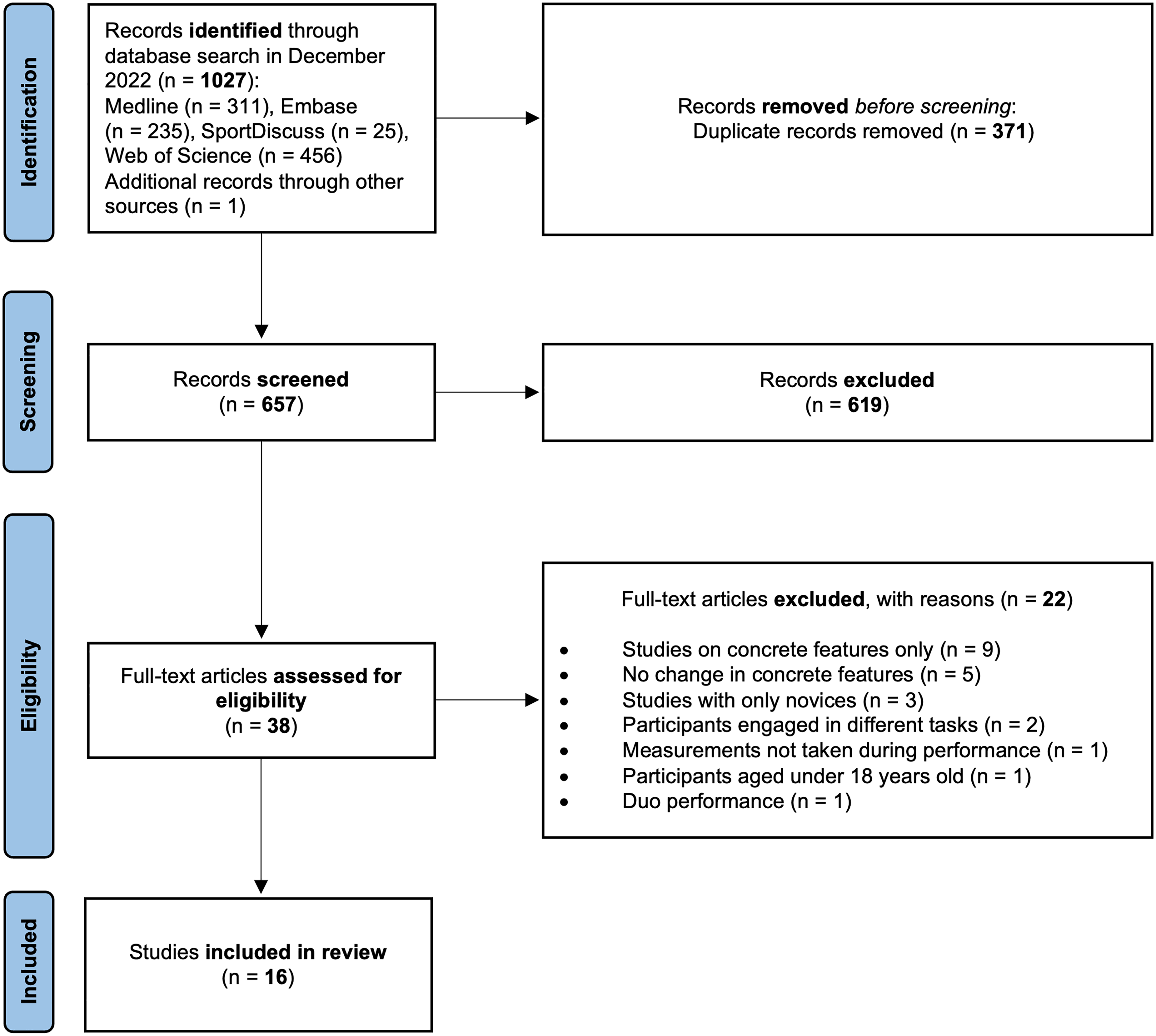
PRISMA diagram of the study screening process and article selection.
Quality Assessment
The median quality score of the included studies was 82% (range from 55% to 100%), indicating a moderate to high quality (Table 2). Eleven studies were of high quality (Dalla Bella & Palmer, 2011; Degrave et al., 2020; Furuya et al., 2010, 2011, 2012; Goebl & Palmer, 2013; Goubault et al., 2021; Massie-Laberge et al., 2019; Thio-Pera et al., 2022; Verdugo et al., 2020a, 2020b; Wong et al., 2022), four studies were of moderate quality (Sforza et al., 2003; Shoda & Adachi, 2012; Thompson & Luck, 2012; Turner et al., 2022), and one study was of low methodological quality (Castellano et al., 2008).
Methodological quality assessment scores of included studies using the modified version of Downs and Black checklist.

1 = Yes; 0 = No; UD = Unable to Determine. Quality score: “High” (≥75%), “Moderate” (60–74%), “Low” (≤60%). Studies have been classified by the performance/abstract parameter manipulated. Q1: clear aim, Q2: clarity of reporting outcomes, Q3: clarity of participants’ characteristics, Q4: clarity of experimental conditions, Q6: description of main findings, Q7: estimation and report of random variability, Q10: reporting actual probability values, Q16: clarity of probable data dredging, Q18: appropriate statistical tests, Q20: accuracy of outcome measures, Q23: randomization of experimental conditions.
Studies’ Characteristics
Out of the 16 studies included, 13 were cross-sectional studies (Dalla Bella & Palmer, 2011; Degrave et al., 2020; Furuya et al., 2010, 2011, 2012; Goebl & Palmer, 2013; Goubault et al., 2021; Massie-Laberge et al., 2019; Sforza et al., 2003; Thio-Pera et al., 2022; Thompson & Luck, 2012; Verdugo et al., 2020b; Wong et al., 2022), and three were cross-sectional case studies (Castellano et al., 2008; Shoda & Adachi, 2012; Turner et al., 2022). Eleven studies focused on the modification of performance parameters (Dalla Bella & Palmer, 2011; Degrave et al., 2020; Furuya et al., 2010, 2011, 2012; Goebl & Palmer, 2013; Goubault et al., 2021; Sforza et al., 2003; Thio-Pera et al., 2022; Turner et al., 2022; Verdugo et al., 2020a, 2020b), four studies focused on the modification of abstract parameters (Castellano et al., 2008; Massie-Laberge et al., 2019; Shoda & Adachi, 2012; Thompson & Luck, 2012), and one study addressed both performance and abstract parameters (Wong et al., 2022). To enhance the readability and clarity of this systematic review, Table 3, which summarizes the findings in each study, has been subdivided in three sections: Table 3.A reports on studies investigating changes in performance parameters, Table 3.B reports on studies investigating changes in abstract parameters, and Table 3.C reports on the only study investigating changes in both performance and abstract parameters. The studies in Table 3.A are classified by the performance parameter manipulated, and the studies in Table 3.B are presented in chronological order.
Summary of studies included in the review that investigated the impact of changes in performance parameters on kinematics and/or muscle activity of pianists (the column “Main outcome” summarizes one or maximum two main outcomes relevant for the present literature review).

*As this study compared novices and experts, the main outcome has been reported according to experts only.
Summary of studies included in the review that investigated the impact of changes in abstract parameters on pianists’ kinematics.

Summary of the study included in the review that investigated the impact of changes in both performance and abstract parameters on pianists’ kinematics.

Impact of Performance Parameters on Pianists’ Kinematics
Technical Melodic Exercises
As tempo increased in technical melodic exercises, one study showed that mean movement vertical amplitude averaged across all fingers increased (from ∼17 mm with a tempo of 60 beats per minute (bpm) to ∼27 mm with a tempo of 250 bpm) and key velocity increased (from ∼43 MIDI units with a tempo of 60 bpm to ∼68 MIDI units with a tempo of 250 bpm; Dalla Bella & Palmer, 2011). Another study showed that finger joints did not change their relative contributions to the vertical fingertip movements across tempi; only the wrist vertical movement contributed slightly more to the fingertip motion at fast tempi than at slow tempi (from a wrist vertical efficiency score of ∼0/1 with a tempo of 7 tones per second to a wrist vertical efficiency score of ∼0.3/1 with a tempo of 15 tones per second; Goebl & Palmer, 2013).
Isolated Keystrokes
With an increase in tempo (from 180 bpm to 360 bpm and with a loudness of forte) during isolated keystrokes, Furuya et al. (2012) showed that peak angular velocities increased at the shoulder (from ∼0.3 to ∼0.37 rad/s) and the wrist (from ∼−1.8 to ∼−2.1 rad/s), but decreased at the elbow (from ∼−2.2 to ∼−1.3 rad/s). During alternate keystrokes, elbow velocity (pronation/supination) increased with an increase in tempo (from 70 bpm to 260 bpm; Furuya et al., 2011). As loudness increased (from piano to forte and with a tempo of 180 bpm), peak angular velocities increased at all joints (shoulder: from ∼0.14 to ∼0.3 rad/s, elbow: from ∼−0.7 to ∼−2.2 rad/s, wrist: from ∼−1.2 to ∼−1.8 rad/s, and finger joints: from ∼−1.8 to ∼−2.5 rad/s; Furuya et al., 2012). Verdugo et al. (2020b) found that shoulder-girdle joints contribution to finger upward velocity was greater during staccato articulation compared to tenuto articulation (absolute difference = 0.207 m/s, percentage difference = 206%). These authors also showed that pianists produced systematically forward upper-limb velocities during isolated keystroke attack and key holding/release phases, regardless of the choice of articulation and touch.
Repertoire Excerpts and Mixed Tasks
Wong et al. (2022) found that spine joint angles showed an average posture closer to neutral while playing an excerpt (head tilt of 3.2 ± 8.3° in projected playing), compared to playing a scale (head tilt of −4 ± 8.9°). One study showed that trunk and right-hand movement were more synchronized at faster tempi when playing an excerpt (Turner et al., 2022). Moreover, when averaging between the three musical sections, the shortest pianist (1.65 m) had the greatest trunk range of motion (276 mm), and the tallest pianist (1.90 m) had the smallest trunk range of motion (101 mm).
Impact of Abstract Parameters on Pianists’ Kinematics
Three out of five studies found that playing conditions with a higher level of expressiveness (e.g., deadpan compared to normal, normal compared to exaggerated) resulted in more head and proximal movements compared to deadpan condition (Castellano et al., 2008; Massie-Laberge et al., 2019; Thompson & Luck, 2012). For example, Thompson and Luck (2012) found that the distance traveled by the right and the left shoulder was between ∼200 and ∼300 mm per measure for the exaggerated conditions, and between ∼10 and ∼50 mm per measure in the deadpan condition. Similarly, Shoda and Adachi (2012) found that a pianist increased upper body movements in the artistic and exaggerated conditions compared to the deadpan condition. In addition, one study found that spine joint angles showed an average posture closer to neutral in the deadpan playing (craniovertebral angle of 43.5 ± 7.6°), compared to the other two conditions (craniovertebral angle of 38.3 ± 7.6° and 37.9 ± 9° for the projected and exaggerated conditions, respectively; Wong et al., 2022).
Impact of Performance Parameters on Pianists’ Muscle Activity
Studies investigating muscle activity focused on isolated keystrokes and musical excerpts.
Isolated Keystrokes
Both the activation level of six muscles (anterior and posterior deltoids, biceps brachii, triceps brachii, flexor digitorum superficialis, and extensor digitorum communis) and the co-activation index between the anterior-posterior deltoid, biceps-triceps brachii, and flexor digitorum superficialis-extensor digitorum communis muscle pairs increased at a tempo of 5 keystrokes per second or higher (Furuya et al., 2012). As loudness increased (from p to mp, mp to mf, and mf to f), the activation level of the above-mentioned muscles and their co-activation index increased (Furuya et al., 2012). The activation level particularly increased for distal muscles (the flexor digitorum superficialis, and the extensor digitorum communis increased their muscle activity from ∼4–5% maximum voluntary contraction (MVC) at slow tempi, to ∼10% MVC at faster tempi). During and after key descent and release, staccato articulation showed a higher activity in the shoulder muscles, compared to tenuto articulation (upper trapezius +2.1% MVC, anterior deltoid +2.5% MVC, great pectoralis +3.8% MVC; Degrave et al., 2020). One study showed that professional pianists activated more finger/wrist extensor muscles than finger/wrist flexor muscles when performing octaves (Thio-Pera et al., 2022).
Musical Excerpts
Thio-Pera et al. (2022) showed that professional pianists activated more finger/wrist flexor muscles than finger/wrist extensor muscles when performing repertoire excerpts compared to octaves. Constant repetition of a digital exercise and a chord musical excerpt, both performed loud and fast, showed higher levels of muscle fatigue at finger/wrist extensor muscles (the EMG median frequency decreased between 10 and 20 Hz at task termination) compared to the respective flexors (the EMG median frequency decreased between 2 and 10 Hz), and pianists showed different levels of endurance in their time-to-task termination (from around 2 min to 12 min, which was the maximum time allowed for the task; Goubault et al., 2021).
Ontological and Methodological Choices
Ontological choices (focus of studies, gestural variable investigated) and methodological choices (kinematic and EMG data collection tools, experimental tasks, musical instrument used) are reported in Figure 2.
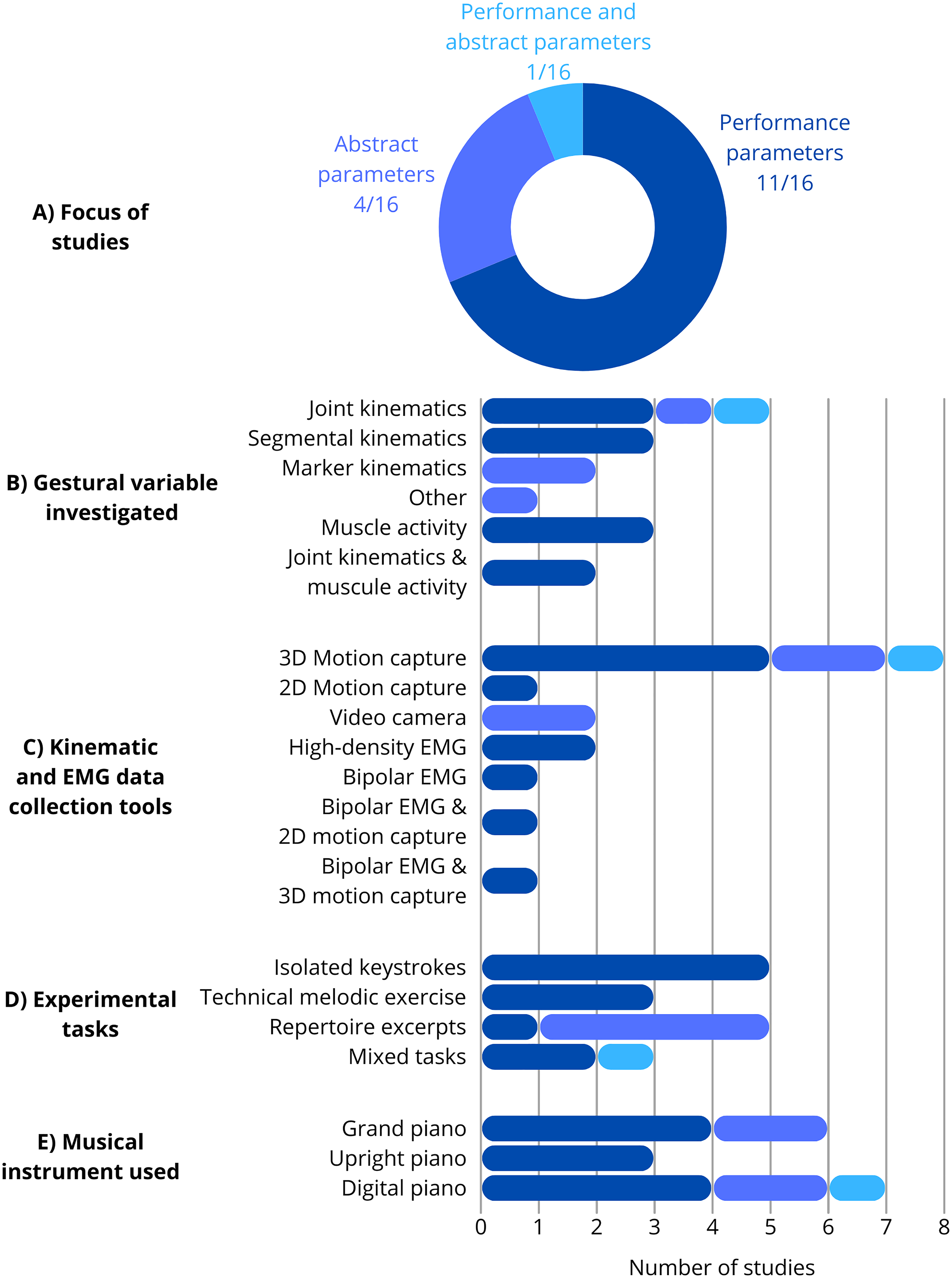
Overview of the included studies. Distribution of A) Focus of studies, B) Gestural variable investigated, C) Kinematic and EMG data collection tools, D) Experimental tasks, and E) Musical instrument used. Definition of experimental tasks: isolated keystrokes (isolated notes, octaves, or alternating keystrokes), technical melodic exercise (scale or arpeggio type of tasks), repertoire excerpts (actual excerpts from the repertoire), mixed tasks (studies using both repertoire and other types of tasks). Other: analysis of head movements and other body segments using 2D videos of performances.
Regarding kinematic analysis, the gestural variables investigated were different between studies focusing on the modification of performance parameters and studies focusing on abstract parameters. Studies focusing on the modification of performance parameters assessed either i) finger and/or wrist linear velocities (Dalla Bella & Palmer, 2011; Turner et al., 2022), joint angles (Goebl & Palmer, 2013), and movement repeatability (Sforza et al., 2003); or ii) right upper limb (Furuya et al., 2010, 2011, 2012) or upper body (Verdugo et al., 2020b) linear and joint kinematics (e.g., joint angular velocities, segmental linear velocities, etc.). Studies focusing on abstract parameters measured either i) the quantity of motion, (i.e., an approximation of the amount of detected movement, based on Silhouette Motion Images, which represent all variations of a simplified white-body silhouette, obtained using background subtraction; Castellano et al., 2008), and the cumulative distance traveled by markers (Massie-Laberge et al., 2019; Thompson & Luck, 2012); or ii) postural angles of the spine (Shoda & Adachi, 2012; Wong et al., 2022). Regarding EMG analysis, three studies calculated mean muscle activation over the entire trial (Furuya et al., 2011, 2012; Thio-Pera et al., 2022), one study calculated time series muscle activation (Degrave et al., 2020), and one study calculated the EMG median frequency to assess the myoelectric manifestation of muscle fatigue (Goubault et al., 2021).
Risk Factors of Playing-Related Musculoskeletal Disorders
A complementary objective was to address how music expression affects pianists’ exposure to risk factors of PRMDs. Risk factors of PRMDs associated with music expression could only be extracted from the studies focusing on performance parameters. The main results of four of these studies were directly or indirectly linked to an increase in muscle load (Dalla Bella & Palmer 2011; Degrave et al., 2020; Furuya et al., 2012; Thio-Pera et al., 2022), while one study showed an increase in muscle fatigue (Goubault et al., 2021). Among these five studies, the following four playing factors were identified as potential risk factors of PRMDs: playing loud, playing fast, staccato articulation, and large handspan chords (Table 4). The type of task, playing factor, biomechanical impact, and PRMDs risk factor addressed by these studies are summarized in Table 4.
Type of task, playing factor, biomechanical impact, and PRMDs risk factor of included studies.

*At the hand level, an increase in pianists’ fingertip height during melodic excerpts is primarily driven by the metacarpophalangeal joint (extension movement) (Goebl & Palmer, 2013). Therefore, the increase in fingertip height with faster tempi reported by Dalla Bella and Palmer (2011) points to an increase in both metacarpophalangeal joint extension and fingers’ extrinsic extensor muscles activity, a muscle group more prone to developing fatigue (Goubault et al., 2021).
Discussion
This systematic review investigated how both performance and abstract parameters of music expression impact pianists’ gestures. It also addressed ontological and methodological differences of the included studies and the impact of music expression-related parameters on exposure to risk factors of PRMDs. Sixteen studies were included. Eleven studies focused on the modification of performance parameters (i.e., sound intensity, tempo, articulation), four studies focused on the modification of abstract parameters (structural and/or semantic), and one study focused on both. Performance and abstract parameters impacted pianists’ kinematics and muscle activity, the specific effects being dependent on the type of task (i.e., isolated tones, digital task, chord task) and the gestural variable investigated by studies. Important differences in ontological (performance or abstract parameters studied, gestural variable investigated) and methodological choices (experimental task and instrument used, data acquisition and processing procedures) prevent the establishment of a thorough dialogue between studies focusing on performance and abstract parameters. Risk factors of PRMDs associated with music expression parameters included playing loud, playing fast, staccato articulation, and playing large handspan chords.
Impact of Music Expression on Pianists’ Gestures
Loudness and Articulation
In isolated keystrokes, loudness and articulation had clear and consistent effects across studies. An increase in loudness led to greater angular velocities and muscle activity at both distal and proximal joints/segments of the right upper limb (Furuya et al., 2012). These results are consistent with piano sound-production mechanics, as loudness is closely related to the key attack velocity (e.g., Dannenberg, 2006). To increase the targeted key velocity of louder tones, pianists increased velocity and muscle activity at upper-limb joints (shoulder, elbow, wrist). Moreover, this pattern appears consistent across skill levels, as novices and amateurs showed greater levels of muscle activation during repetitive octaves at wrist extrinsic extensor and flexor muscles as loudness increased (from pp to mf, and mf to ff; Oikawa et al., 2011). Articulation had a similar effect, but in relation to the release motion. Staccato articulation (in opposition to tenuto articulation) increased upper-limb upward/forward velocities (Verdugo et al., 2022a, 2022b) and shoulder muscle activity (Degrave et al., 2020) during and after the key descent in the context of isolated keystrokes, as the shoulder-girdle joints were the primary mover of the rapid lifting motion of the arm and hand after the attack (Verdugo et al., 2022a, 2022b). In brief, the production of faster key attack (louder tones) and key release (staccato tones) movements demands an increased velocity and muscle activity at the joints responsible for those faster endpoint movements. These studies have been conducted on simple performance tasks (repetitive isolated keystrokes). However, in more complex musical contexts, it seems possible to hypothesize that the same relation may prevail (i.e., increase of joint velocity and muscle activity allowing faster key attack and release movements).
Tempo
In the case of technical melodic exercises, an increase in tempo led to an increase in the height of the fingers before the keystroke (Dalla Bella & Palmer, 2011). The most important finger joint to produce the fingertip vertical movement during this type of melodic exercises was the metacarpophalangeal joint, and its contribution remained stable across different tempi (Goebl & Palmer, 2013). These results point to two ideas. First, faster tempi impose spatiotemporal constraints that led to an increased distance between the fingertip and the key before the attack to produce the targeted key attack velocity. Second, this increased height of the fingertip might increase the extension motion of the metacarpophalangeal joint. Furuya et al. (2011) showed that during fast alternate keystrokes (i.e., tremolo), expert pianists used hand pronation/supination (a degree of freedom at the elbow) to reduce metacarpophalangeal muscle load. As pianists can use pronation/supination not only during alternate keystrokes but also during a wide range of melodic passages (scales, arpeggios, etc.), the increased finger height at faster tempi reported by Dalla Bella and Palmer (2011) could be achieved by multi-joint hand/forearm movements rather than by isolated metacarpophalangeal joint movements. Dalla Bella and Palmer (2011) did not address interactions of loudness and tempo in their study. However, as louder sounds entail faster joint and key velocities, the required finger height needed to play at a certain tempo might also be affected by the targeted sound intensity. This must nevertheless be confirmed by future research.
During repetitive isolated keystrokes, varying the tempo produced distinct effects on peak angular velocities at different joints. Despite the interactions between loudness and tempo reported in Furuya et al. (2012), these authors observed that an increase in tempo resulted in faster peak flexion/extension velocities at the shoulder and wrist and slower peak velocities at the elbow. Similarly, two recent studies showed a reduction of elbow flexion/extension range of motion while playing repetitive chords at faster tempi (Turner et al., 2023; Wang et al., 2023). If elbow extension was the main contributor of the fingertip downward attack velocity during slow isolated keystrokes (Verdugo et al., 2020b), the results of the above-mentioned studies show that the leading role of the elbow to produce the attack downward velocity of the fingertip decreases while tempo increases. However, this tempo-dependent change of inter-joint coordination did not imply a reduction of elbow muscle activity, as faster tempi produced greater mean muscle activity at proximal and distal joints of the upper limb and higher co-contraction levels of elbow and finger muscles (Furuya et al., 2012).
Type of Task
Thio-Pera et al. (2022) found different task-dependent finger/wrist muscle loads regardless of tempo, where consecutive octaves induced greater activations at extrinsic extensors while other types of excerpts (melodic “finger” passage, slow-loud chord passage) induced greater activations at extrinsic flexors. To play consecutive octaves, pianists constantly hold the hand in a fixed position characterized by finger extension/abduction (which is coherent with the increased activity of extrinsic extensors reported by the authors). This is not the case in the other excerpts used in Thio-Pera et al. (2022), as distal joint posture and movements can be adapted at each keystroke or group of keystrokes. Chong et al. (2015) also found that muscle activation in hand extrinsic muscles was dependent on the configuration of the notes imposed in the score. However, Goubault et al. (2021) found higher levels of fatigue at finger/wrist extrinsic extensor muscles (compared to flexors) regardless of the type of task. Extensor muscles showed higher signs of fatigue during both a chord passage (involving octaves) and a melodic “finger” passage played repetitively in cycles. These results suggest that even though muscle load is dependent on note configuration (i.e., task-dependent muscle load), muscle fatigue might greatly affect specific muscles due to their intrinsic characteristics or the duration of the repetitive activations.
Abstract Parameters and Gestural Functions
Regarding abstract parameters, Thompson and Luck (2012) and Massie-Laberge et al. (2019) found that playing conditions with a higher level of expressiveness (e.g., deadpan compared to normal, normal compared to exaggerated) resulted in more movement at markers placed on the head and proximal segments. These findings underline the role of performers’ whole-body movements as a tool to encode or embody the expressive content of music while playing (Krumhansl, 2002; Leman & Maes, 2015). These gestures have been associated with sound-facilitating gestures (or ancillary gestures) by the cited studies and the related literature (Massie-Laberge et al., 2019; Thompson & Luck, 2012; Wanderley et al., 2005). However, delimitation of what body movements are labeled as sound-facilitating and as sound-producing is not clearly addressed. Typically, in this literature, sound-facilitating gestures involve the trunk and the head, while sound-producing gestures involve distal segments close to the performer-instrument interface (forearm, hand, fingers; Jensenius et al., 2010). Thus, these two types of gestures are usually understood as distinct gestures and have been studied separately in the literature. However, Verdugo et al. (2020b) showed that pianists’ pelvis and thorax movements can play a role in the control of performance parameters related to articulation and loudness. Moreover, other recent studies have also highlighted the role of trunk motion in pianists’ sound-production strategies (Turner et al., 2022, 2023; Verdugo et al., 2022a, 2022b). In the case of piano performance, it therefore seems clear that sound-producing and sound-facilitating gestures are not distinct gestures but are rather gestural functions embedded in the same gestural space incorporating the entire kinematic chain (pelvis, thorax, upper limbs, and potentially lower limbs). To enhance dialogue and coherence between the literature addressing the impact of performance and abstract parameters on pianists’ gestures, we recommend a more systematic use of the concepts of sound-producing and sound-facilitating gestural functions, rather than sound-producing and sound-facilitating gestures.
Ontological and Methodological Differences of the Targeted Literature
One of the main ontological differences of the studies in this review relates to the type of music expression-related parameters investigated. The 11 studies addressing performance parameters focused on “score-imposed” variations of performance parameters. For example, playing the same task at the piano with different imposed tempi (e.g., Sforza et al., 2003), different articulation (e.g., Degrave et al., 2020), and different loudness levels (e.g., Furuya et al., 2012). In addition, these studies, generally from the field of biomechanics and motor control, did not consider abstract parameters (music structure parameters and extra-musical or semantic ideas) from research questions. On the contrary, studies from the music research domain addressing abstract parameters investigated the effect of music expression on pianists’ gestures in relation to the performers’ interpretation of the score. By using notions such as expressive intentions and experimental conditions based on different levels of expression (deadpan, normal, exaggerated), these studies addressed music expression from the performers’ point of view. This different focus on expression (score-imposed features versus performers’ interpretation features) is a key difference that hampers the establishment of a connection between research on musicians’ gestures from biomechanics and motor control, on one hand, and from music research and empirical musicology, on the other hand. Biomechanical studies addressing the impact of pianists’ personal management of abstract parameters would be necessary to strengthen the link between literature from biomechanics and music research, and enable a deeper understanding of the impact of music expression (linked to the creative work not only of the composer but also of the performer) on pianists’ gestures.
A key methodological difference in studies focusing on pianists’ kinematics relates to the choice of the kinematic variable investigated. It is noteworthy that most studies (9 out of 13 focusing on pianist's kinematics) used 3D motion capture systems (Figure 2). Despite one exception (Wong et al., 2022), studies on pianists’ sound-facilitating gestures analyzed segmental kinematics based on data of markers placed on the body (e.g., quantity of motion, distance traveled by markers), with little or no attention to joint kinematics or more thorough methods for the computation of segmental kinematics (using for example segment endpoint or center of mass). Therefore, studies in music research do not usually take advantage of methods from biomechanics to analyze and address the interdependent nature of movements of multi-body systems such as the human body. An interdisciplinary approach mixing methods from empirical musicology and biomechanics would, first, facilitate a better understanding of the interrelated nature of sound-producing and sound-facilitating functions in the context of multi-joint movements of pianists. Second, as abstract parameters might not only affect pianists’ kinematics (Turner et al., 2024) but also muscle activity (Verdugo et al., 2020a, 2022a, 2022b), this interdisciplinary approach would allow the assessment of the impact of pianists’ expressive intentions on their muscle load, with implications for both embodied cognition and injury prevention research. As an example, in a recent case study on two participants, Mailly et al. (2024) showed that pianists can embody their expressive intentions in different musical contexts through upper-body muscle activity, including proximal (upper trapezius, external oblique) and distal muscles, such as flexor digitorum superficialis and extensor digitorum communis.
Another important methodological difference was associated with the instrument used. Six studies used a grand piano, seven studies used a digital piano, and three studies used an upright piano (Figure 2). Acquiring pianists’ movements using optoelectronic cameras and passive markers remains a challenge due to marker occlusions caused by the piano itself. Despite this obstacle, several studies have been conducted with grand piano using these motion capture systems (Turner et al., 2021, 2022, 2023; Verdugo et al., 2020b, 2022a, 2022b). The grand piano is the actual instrument where pianists usually perform and practice, and its specific key action mechanism influences pianists’ touch and sound control (Traube et al., 2017). Therefore, the use of digital instruments to facilitate motion capture procedures may change how pianists manipulate both performance and abstract music expression-related parameters, and consequently, influence research results. This methodological limitation was highlighted in a previous literature review on piano touch (MacRitchie, 2015). However, it remains relevant for the current state of the literature.
Risk Factors of PRMDs and Considerations for Injury Prevention
The following four playing factors were associated with increased muscle load or muscle fatigue: playing loud, playing fast, staccato articulation, and playing large handspan chords. These results might be applicable to other instruments, as they support the results of a violin study that showed greater muscle activation in the forearm muscles caused by playing loud and playing fast (Mann et al., 2023). The included studies in this review did not address the relationship between the reported increase of muscle activation or fatigue and PRMDs history in the participants recruited. Nevertheless, increases in muscle load and muscle fatigue are typically considered prominent risk factors of musculoskeletal disorders in music (Ling et al., 2018), sports, and daily life activities (Côté, 2014). In addition, questionnaire-based studies have shown that large handspan chords (such as octaves; Allsop, 2007; Sakai, 2002; Shields & Dockrell, 2000), and playing chords loudly (Furuya et al., 2006) were associated with the development of PRMDs. In this direction, future studies should investigate gestural strategies that can reduce exposure to the four risk factors listed above. Moreover, considering that these playing factors are extremely common in the piano repertoire, quantification of practice load based on these playing factors might also help reduce occurrence of pianists’ PRMDs.
Recent studies in sport science literature focusing on injury prevention (e.g., running, tennis) have centered on the concept of “training load” (Coutts et al., 2011; Drew & Finch, 2016; Gabbett, 2016). Training load is quantified by multiplying the duration of each training session by its intensity, usually assessed using the perception of effort on a scale of 1 to 10 (Foster et al., 1996). Subsequently, the evolution of the training load is assessed on a weekly basis. Literature has shown that when training load increases by more than 15% above the previous week training load, prevalence of injury increases by 21% to 49% (Gabbett, 2016). Therefore, it has been concluded that to minimize the risk of injuries in athletes, it is advisable to maintain training load weekly increases below 10%. While the concept of playing load has recently been studied in relation to music performance (McCrary et al., 2022), monitoring playing load based on the playing factors identified in this review as a prevention strategy of PRMDs has yet to be studied. Therefore, future studies could develop playing load models to both quantify playing load and its fluctuation and predict occurrence of PRMDs in pianists, especially during the preparation process of upcoming performances or music competitions.
Limitations
Limitations of this systematic review include search strategy and methodological differences between studies. First, limitations in database coverage may have resulted in some relevant studies being overlooked. However, the search strategy was performed in four databases, which improved coverage, and decreased the risk of making inappropriate conclusions (Ewald et al., 2022). Second, the included studies differed in their design (cross-sectional studies or case studies). The studies also varied in their focus, addressing different parameters (performance or abstract parameters, or both), types of tasks (i.e., isolated tones, digital task, chord task, musical excerpts), and gestural variables investigated (linear segmental kinematics, joint angles, muscle activity), which limited the comparison between studies. However, most of the included studies showed a moderate to high methodological quality assessment score, suggesting that the overall quality of the results was not compromised.
Conclusion
This systematic review addressed how both performance (timing, sound intensity, articulation) and abstract parameters (related to music structure and extra-musical or semantic content) impacted pianists’ kinematics and muscle activity, showing that the specific effects were dependent on the type of task and the gestural variable investigated by studies. Therefore, findings on the relationship between musical expression and pianists’ gestures are specific to the studied contexts and cannot be generalized to other musical settings or gestural variables. The present review also highlighted important methodological and ontological differences in the included studies. These differences prevent the establishment of both a more unified view on the impact of music expression parameters on pianists’ gestures and a thorough dialogue between studies focusing on performance and abstract parameters of music expression. Future research on music expression and pianists’ gestures should develop a deeper interdisciplinary approach to bridge the gap between studies from empirical music research and biomechanics. In this direction, empirical music research could make use of joint kinematics and muscle activity analysis used in biomechanics. Similarly, biomechanics and motor control studies could also integrate abstract parameters of musical expression in research questions and protocols. Finally, this systematic review also identified four playing factors associated with performance parameters of music expression as potential risk factors of PRMDs (playing loud, playing fast, staccato articulation, and large handspan chords). The proposed interdisciplinary approach for future research could help enhance knowledge on the impact of abstract parameters of music expression on pianists’ exposure to risk factors of PRMDs.
Footnotes
Acknowledgments
We would like to thank Denis Arvisais (librarian at University of Montreal) for his help in the creation and execution of the search strategy.
Action Editor
Eckart Altenmüller, Hochschule für Musik, Theater und Medien Hannover, Institut für Musikphysiologie und Musikermedizin
Peer Review
Two anonymous reviewers
Author Contributions
RM: Conceptualization, methodology, writing – original draft, writing – review and editing. CT: Methodology, writing – review and editing. EG: Methodology, writing – review and editing. FDM: Methodology, writing – review and editing. FV: Conceptualization, methodology, supervision, writing – original draft, writing – review and editing, funding acquisition.
Declaration of Conflicting Interests
The authors declared no potential conflicts of interest with respect to the research, authorship, and/or publication of this article.
Ethical Approval
This research did not require ethics committee or IRB approval. This research did not involve the use of personal data, fieldwork, or experiments involving human or animal participants, or work with children, vulnerable individuals, or clinical populations.
Funding
The authors disclosed receipt of the following financial support for the research, authorship, and/or publication of this article: Social Science and Humanities Research Council of Canada, (grant number Insight Development Grant 430-2021-00384).

Data Availability Statement
Data sharing not applicable to this article as no datasets were generated or analyzed during the current study.