




Abstract
Parents play a variety of important roles in their children's musical development. However, whether they impact upon children's music performance education and experience has only begun to be considered. The current study sought to examine whether student perception of parent involvement in music and performance education is related to their experience of music performance anxiety. Sixty-two piano students aged 11 to 17 completed a questionnaire regarding their piano studies, their parents’ involvement in them, and their parents’ prior music education. They also completed measures of performance anxiety and self-esteem. Results indicated that parents’ prior music education was significantly associated with performance anxiety in their children. Participant age, self-esteem, and practice time were also significant variables. Measures of parent involvement in music studies and parent response to weak performances were not found to be significantly related to performance anxiety scores. Implications of these findings and directions for furthering this line of research are discussed.
Parents play a key role in their children's musical lives, education, and development (Addison, 1990; Davidson et al., 1995, 1996; Davidson & Scutt, 1999; McPherson, 2009; Howe & Sloboda, 1991; Zdzinski, 1992). The initial decision to study music often comes from the parents (Upitis et al., 2017) and the long-term continuation of lessons may be predicted by parents’ openness to their children's experience (Corrigall & Schellenberg, 2015). Reasons reported by parents for studying music include: “to develop enough proficiency to enjoy music as an adult, for well-roundedness, to develop self-discipline, for enjoyment, and to engage in an activity that did not involve technology” (Upitis et al., 2017).
Factors such as the home musical structure, attitudes toward music, home musical environment, music program support, and family musical participation have been associated with child perseverance in music learning (Zdzinski, 2013). Children benefit from family support in the continuation of music lessons even when their parents have limited knowledge of music (Davidson et al., 1996). However, some parents question the value of persisting with music learning, which may be perceived by children as a lack of parental support (Ho, 2009). Additionally, family support has been associated with self-efficacy in public performance, directly and mediated through musical performance anxiety (Zarza-Alzugaray et al., 2020).
The intensity of parental involvement varies, with engagement ranging from paying for lessons, financing instruments and books, and bringing their children to lessons and rehearsals, whereas others are more involved in managing daily practice, attending lessons, and taking notes and videos during lessons to review with the child at home. Highly involved parents may also listen to and aid children during their practice, offering guidance and support (Bugeja, 2009). Furthermore, differences have been noted in music parenting practices according to culture and socioeconomic status (Cho, 2015; Comeau et al., 2015; Huang & Cho, 2019; Ilari et al., 2016; Wang, 2009). A theoretical model based on the pivotal role played by the parents in a child's musical development has been proposed by McPherson (2009). It suggests a “feedback loop in which child and socio-contextual characteristics interact with parenting goals, styles and practices to help shape children's musical competence and achievement, their sense of musical identity and accomplishment, and their continuing desire to participate, exert effort, overcome obstacles and succeed musically”.
Researchers have also found that parental involvement in learning music can be associated with achievement (Zdzinski, 1992) and the affective domain, which includes feelings, emotions, attitudes, and motivation (Zdzinski, 1994; 1996). Parental involvement has been seen to differ by gender, with higher correlations noted for female students than for male students on the affective domain. Additionally, stronger correlations between the affective domain and parental involvement have been noted for mothers than for either fathers or both parents. In relation to achievement, fathers’ involvement had higher correlations than mothers and parents in general (Zdzinski, 1994). Furthermore, in a study on school-age musicians (grades four to 12), the strongest correlation was found between affective outcomes and parental involvement (Zdzinski, 1996) and the strength of the association increased with student age. Moreover, parental influence and the development of self-efficacy in musical performances may be interconnected for both boys and girls, with the dimensions of early context and helplessness being greater in girls (Zarza-Alzugaray et al., 2020).
While parental involvement can be helpful, private studio teachers have reported concerns about parent behaviors described as “killing the child's interest” (Ang et al., 2020). Teachers noted the need for parental support, but also highlighted parental demands that are unrealistic. Specific concerns included wanting the child to pass to a higher grade each year; making comparisons with other children's performances; and overly monitoring the child's progress in relation to examinations. Another issue reported in the literature is that familial support may also be more fragile during the teenage years, a point in time when developing musicians seem to be more sensitive to and fearful of evaluative judgments and experience heightened performance anxiety (Robson, 1987 in Creech, 2010).
Given the important role that parents play in young musicians’ education, the question then arises as to whether they may also play a key role in the development of performance behaviors, attitudes, anxieties, and responses. Little research could be found that focused on the role of parents regarding performance anxiety in music. However, one dissertation explored a wide range of factors pertaining to the learning and performing environments of student musicians – it indicated a strong positive correlation between students’ negative attitudes to playing a musical instrument and their perception of having unsupportive parents with high expectations (Papageorgi, 2007). As well, children's perception of critical parents with high expectations was a significant predictor of music performance anxiety (MPA).
In one of the few studies that looked at the familial antecedents of MPA, known social phobia factors (family environment and parenting practices) were considered in relation to social anxiety and MPA (Huston, 2001). “Parental shaming behavior” during childhood was associated with adult participants’ MPA, while excessive parental concern for the opinion of others had an inverse association with MPA. In other words, those musicians whose parents paid more attention to the impression they were making on others were better prepared to manage the heightened self-awareness engendered by an audience. This was the case for both male and female participants. Contrary to the generally accepted expectation, there was only a weak association between social anxiety and MPA. One area that seems not to have been considered in the literature is the role that parents’ own background and education in music may play with regard to their involvement in their children's musical education, performance experiences, and MPA. We could find no studies, published or unpublished, that addressed these areas.
Research into the experience of MPA in developing musicians has received an increasing amount of attention in recent years. It has become clear that young musicians experience responses to the performance context similar to those of their more experienced counterparts, for whom MPA has been well documented as a pervasive issue (e.g., Cohen & Bodner, 2019; Diaz, 2018; Fishbein, et al., 1988; Juncos & Markman, 2015; Lin, et al., 2008; Nicholson, et al., 2015; Spahn, et al., 2016; van Kemenade et al., 1995; Zarza-Alzugaray, et al., 2018). The growing body of literature on school-age musicians indicates that performing in both solo and ensemble contexts is anxiety-inducing for many, and that students as young as third grade anticipate this anxiety in advance of the actual performance (e.g., Allen, 2011; Braden et al., 2015; Fehm & Schmidt, 2006; MacAfee & Comeau, 2020; Osborne & Kenny, 2008; Osborne et al., 2007; Papageorgi, 2006; Rae & McCambridge, 2004; Ryan, 2005; Sarbescu & Dorgo, 2014). Research on preschoolers indicates that anxiety may be experienced from the very first performance and presents with both innate and learned components (Boucher & Ryan, 2011).
While young learners’ self-esteem has been found to benefit from music education (Costa-Giomi, 2004; Rickard et al., 2013; Shin, 2011; Zapata & Hargreaves, 2018), it has also been shown to bear a negative relationship with MPA (Ryan, 1998; Ryan & Andrews, 2021). Indeed, low self-esteem has been associated with increased MPA across both the age-span and the musical genre of the performer (Cooper & Wills 1989; Kenny, 2011; Ryan et al., 2021; Sinden, 1999). Another factor that appears to play a role is gender; differences, though absent in the scant literature on third and fourth graders, are noted from late elementary school through high school, with the onset of puberty seeming to play a role in how children respond through their adolescent years (Dempsey & Comeau, 2019; González et al., 2018; Papageorgi, 2022; Ryan, 1999; Ryan, 2004, 2005). As young musicians progress into the high school years, the familiar adult pattern of higher anxiety response in females becomes more consistent and is noted throughout the literature (e.g., LeBlanc et al., 1997; Osborne et al., 2005; Rae & McCambridge, 2004).
Unlike adult performers, student musicians’ lives, education, and performance opportunities are typically led and managed by influential adults – primarily teachers and parents. Yet the role of these adults in young musicians’ development of performance anxiety has only begun to be considered. Recently, researchers have begun to examine the role of the teacher in students’ experience of anxiety (Fehm & Schmidt, 2006; Ryan & Andrews, 2009; Ryan et al., 2021; Zarza-Alzugaray et al., 2020)., and it is clear from these studies that young musicians perceive high expectations from their teachers with regard to their work and their future lives as musicians. Many feel anxious about attending their private lessons and receive limited performance education or effective coping advice from their teachers (Ryan, 2021). Studies also indicate that young musicians greatly value their teachers’ opinion; they want to talk openly with them about performance anxiety and to receive their guidance and support (Fehm & Schmidt, 2006; Papageorgi, 2006). Teachers have also been found to influence their students’ levels of MPA, which in turn appeared to impact upon their perception of self-efficacy (Zarza-Alzugaray et al., 2020).
Although there is limited research on parental impact on MPA in young musicians, studies in the related fields of sports performance, high-stakes testing, public speaking, social anxiety, and giftedness have shown that parents can affect their children's enjoyment, anxiety, fear of negative evaluation, fear of disappointing others, and neurotic perfectionism in these domains (Anderson et al., 2003; Biran & Reese, 2007; Bois et al., 2009; Gould et al., 2006; Neumeister, 2004; Norton et al., 2000; Segool et al., 2013; Sideridis & Kafetsios, 2008; Power, 1982). Given this body of research and the pervasiveness of MPA among musicians across the age spectrum, further investigation into the parental role with regard to the field of music performance seems warranted. While these factors noted in non-music literature are clearly linked to the music performance and/or performance anxiety experience, Creech's (2009) theoretical model includes three types of social support that can be offered by parents specifically to their child musician: behavioral, cognitive-intellectual, and personal. The first one, behavioral, includes tasks similar to those performed by a teacher, such as providing organization of studies or homework at home. The second, cognitive-intellectual support, consists of taking part in activities to support the child's musical skill development, such as attending concerts, listening to recordings, or participating in extracurricular musical activities. Finally, the third type of support, personal, consists of helping to establish goals and expectations and offering help with motivation to attain these goals.
It seems clear from the research that parents play a wide range of important roles with regard to their children's access to, participation, and success in music learning. Music performance is an inherent part of music education in many places, and music performance anxiety has been linked in a few studies to parenting behaviors. We hypothesized that parental involvement in music learning or their own background in music may be associated with their children's performance experiences or MPA. The purpose of the present pilot study was to add to the existing literature by examining the role of parents’ involvement and musical background in young musicians’ experience of performance anxiety. Specifically, the research questions were: 1) What do students perceive to be the ways in which their parents impact upon or are involved in students’ participation in music lessons, practice, and future plans? 2) Does student perception of parental involvement in practice and performance preparation impact upon their experience of performance anxiety? 3) Is parents’ prior education in music related to student performance anxiety? 4) Does student self-esteem and/or self-esteem pertaining to the parent-child relationship correlate with MPA?
Method
Participants
Participants were 62 piano students (36 female; 26 male) from primarily two-parent homes (n = 51) between the ages of 11 and 17 with a mean age of 13.63 (SD = 2.01). All had been studying the piano for at least two years, and as many as 10 years, with an average of 6.6 years of lessons. The average age of entry into piano study was seven years. The study took place in a large urban center in Canada and the majority of participants received their music lessons from piano teachers affiliated with a large traditional conservatory preparatory program that focused on Western Classical music. Admittance to the conservatory program was based on availability of instructors, not audition, and a large number of studios were represented. All students performed at least once, and as many as 10 times per year, intermediate to advanced level repertoire. Of the 62 participants who completed the questionnaires, 32 reported that one or more of their parents (16 mothers; six fathers; 10 both parents) had studied music as children (27 on piano; five on other instruments). Most indicated that their parents studied for a short period of time as a child or that they did not know how long their parents had studied; only one participant noted that their parents had graduate degrees in music. Sixteen participants indicated that their parent(s) still play on their instrument, while 46 indicated that they do not.
Measures
Young Pianist Performance Experience Questionnaire
The Young Pianist Performance Experience Questionnaire is an author-constructed questionnaire designed to elicit information in three key areas: 1) Your Piano Studies, 2) Your Lessons and Teacher, and 3) Your Practice Time and Parents (in order to focus on the role of the parent, questions pertaining to teachers will not be examined in this paper). We found no existing questionnaire to address our research questions, therefore we designed a new tool for this study. The questionnaire sought information specific to participants’ piano studies, practice, performances, and experience of performance anxiety, as well as some general background information. We drew our questions from the findings in Ryan (2000), which explored MPA in young musicians. A combination of closed- and open-ended questions were included (see Appendix). The primary researcher coded open-ended responses, which were typically short and unambiguous phrases that presented clear codes. The data and codes were reviewed by an independent observer, an expert in music education; then the primary researcher and independent observer discussed and agreed together on the final codes.
The Coopersmith Self-Esteem Inventory – School Short Form
The Coopersmith Self-Esteem Inventory – School Short Form (Coopersmith, 1987) is a tool designed to measure children's evaluative attitudes toward themselves. It has been used extensively throughout the general education and music education literature. The internal consistency of the form has been found to be between r = 0.8 and r = 0.92, varying according to school grade. The short form takes significantly less time than the original scale, while maintaining a high (r = 0.86) total score correlation with the original. Since a negative relationship between self-esteem and performance anxiety has been seen in the literature on young musicians (Ryan, 1998), it was deemed to be an important factor to consider in this study. In the packet of survey items participants completed, the Coopersmith Self-Esteem Inventory corresponds with the questions under the heading: “How You Usually Feel”.
The Kenny Music Performance Anxiety Inventory for Adolescents (MPAI-A) – Modified
The Kenny Music Performance Anxiety Inventory for Adolescents (MPAI-A) (Osborne et al., 2005) is a scale designed specifically to measure music performance anxiety in young musicians. It comprises 15 questions across three categories: Somatic and Cognitive Features of Anxiety, Performance Context, and Performance Evaluation. The internal consistency of the measure has been shown to be quite high across large samples of 11- to 19-year-olds. In each case, Cronbach's alpha for the full measure was .91 (Kenny & Osborne, 2006; Osborne & Kenny, 2005; Osborne et al., 2005). Construct validity has been demonstrated through high correlations with commonly employed measures of trait anxiety and social phobia. The MPAI-A modified scale has 16 items, with an additional question pertained to performing without the aid of the score. This item was added after communications with the original author (Dianna Kenny), who had considered it, but ultimately decided against including it in the overall measure. As performing from memory is a variable that has been found to increase MPA (Leglar, 1978) and is a typical component of piano performance – and since this study focuses on piano students – we decided to include the additional question about memory to the original questionnaire. In the packet of survey items participants completed, the MPAI-A-Modified corresponds with the questions under the heading: “What You Think About When You Perform on the Piano”.
Procedure
Once approval was granted by the researchers’ university research ethics board, participants were solicited for the study through notices posted in a large urban conservatory that was housed in and affiliated with a large university music school. Recruitment letters were also sent out to all students on the mailing list of the music conservatory. All parents and students provided written informed consent for participation in the study and publication of the findings.
Participants met with research assistants in a university classroom to complete the questionnaire packet, consisting of the Young Pianist Performance Experience Questionnaire, followed by the Coopersmith Self-Esteem Inventory (entitled: “How You Usually Feel”), and ending with the MPAI-A (entitled: “What You Think About When You Perform Music”). Instructions for each individual questionnaire were written on the student papers and were also read aloud by the research assistants. In most cases, one participant attended each session. In a few instances, two participants attended the same session. This was deemed to be appropriate since no oral responses were required. Participants were interviewed in November and December. As the study was administered in a large bilingual city, questionnaires were translated into French by a professional translator and reviewed for accuracy of translation by one of the researchers fluent in both languages. Nine students completed the study in French and 53 completed it in English. All sessions were administered by one of two researchers fluent in both languages. Instructions were given in the preferred language of the student. The time required to complete the questionnaire and both inventories was approximately 30 min.
Results
Student perceptions of parental involvement
To examine the first research question, What do students perceive to be the ways in which parents impact upon or are involved in students’ participation in music lessons, practice, and future plans?, we calculated percentages to reflect student responses on a variety of questions.
The majority of participants said that they like taking piano lessons (85%), with only 8% of this group indicating that they take piano lessons because their parents make them. Even among the 15% who said they do not like taking lessons, only 11% said their parents make them do so. Nevertheless, virtually all (97%) participants indicated that piano lessons are “important” or “very important” to their parents. When asked if the lessons were as important to parents as to them, more than half (55%) indicated that the importance was equal across them and their parents. Twenty-six percent indicated that it was more important to their parents, and 18% said it was more important to them.
With regard to parent participation in their at-home practice, participants indicated a high degree of engagement, in particular with regard to listening and asking the child to perform for them. Results are given in Table 1.
Parent involvement in practice.

When asked what they believe their parents’ expectations are with regard to the outcome of their piano studies, the vast majority (75%) indicated that their parents expected a high level of achievement from them. Examples of student responses include: “I think they believe that I will be a professional…”; “They want me to excel.”; and “To be a very talented musician.” Eleven percent of participants indicated that their parents expect them to enjoy playing the piano, and 5% said their parents expect both enjoyment and a high level of achievement. Just over a quarter of participants (27%) indicated their belief that their parents expected them to become professional musicians.
When asked how parents encourage them to succeed in their piano studies, participants responded that this is experienced primarily through encouraging remarks and engagement in musical activities. Examples of responses include: “They tell me I am good”; “They make sure that I practice every day, even though I do, they also bring me to a lot of live performances so I can observe how others perform”; and “My mom, whenever she sees an example of a professional musician who made it, she always tells me ‘you can be that if you want’”. A summary of student perception of forms of parental encouragement are given in Table 2.
Parental encouragement.

About half of the participants (52%) indicated that their parents help them prepare for performances. Examples of responses include: “They make me (and my brother) do performances and help me on how to prepare when I’m playing.”; “I play for them and my mom records me so I can listen to myself play.”; “They bring me to fun places to relax”, and “They keep me relaxed prior to performing.” Participants’ responses about how their parents help are summarized in Table 3.
Parental help in preparation for performances.

Almost all participants reported that their parents typically attend their performances (95%) and that they like their parents to be there (95%): “Because they’ll like my performance even if I mess up.”; “They help me feel less nervous.”; “I’m not alone, plus they get to see my progress”. Participants whose parents do not attend performances indicated that they prefer this because their parents’ presence would make them nervous or could result in additional practice time: “After they’ll bug me: “Practice more!”; “Because when they are adults I know well, it becomes nerve wracking”. Participants who wished their parents would not attend their performances said performances are very personal, their parents make them nervous, or they do not want their parents to hear if the performance does not go well: “Because it makes me more nervous.”; “A performance is like writing in a diary – I don’t want them to read my diary.”; “It depends on how well the performance goes…”
When asked whether parents help when they are nervous for a performance, 74% indicated that they do. The most common ways shared were: saying “You’ll do well/You have nothing to worry about” (19%), telling them to ‘relax’ (11%) and calming them down (10%). All but two participants (who did not respond) indicated that their parents like them to perform in concerts and competitions. The most common reasons cited are given in Table 4.
Perception of why parents like participants to perform.

When asked how parents respond following their performances, students indicated a variety of congratulatory responses to strong performances. Regarding weaker performances, student perceptions were divided into negative responses such as, “They are a little bit mad and they get me to practice more if I do really badly.”; “Tell me I should’ve practiced more.”; and “Is this why I pay your teacher?”, and more encouraging ones like “Applaud, say it was very good, I did my best, I will do better next time.”; “They are encouraging and say ‘well, you did better than I would have’ or ‘could’ve been worse.’”; and “Well you tried and that’s all that matters.” A summary of responses is given in Table 5.
Parent responses to weak performances.

Parental involvement and prior music education
A Parental Involvement index was created to answer the second and third questions: 2) Does student perception of parental involvement in practice and performance preparation impact upon their experience of performance anxiety? and 3) Is parents’ prior education in music related to student performance anxiety? The index was generated by summing responses to the following items: Parent Monitors Practice Time, Parent Helps Practice, Parent Listens to Practice, Parent Asks Child to Perform, and Parent Helps Prepare for Performance. The Cronbach's alpha for the Index was 0.52, indicating a moderate inter-item reliability. The item-total statistics indicated that deletion of any items reduced the reliability score, so we kept all items. This index was then included in a regression analysis with Performance Anxiety as the dependent variable and Parent Studied Music (n = 32), Participant Age, Sex, Self-Esteem, Years of Study, and Practice Time as the additional independent variables. Two participants were dropped from the analysis because of their extreme positions in a leverage plot. Results (Table 6) indicated significant predictors for Self-Esteem, Age, Practice Time, and Parent Studied Music. In other words, children with lower self-esteem; who were older; who practiced less; and whose parents had studied music reported higher levels of MPA than their counterparts. The adjusted R-squared for the model was .354 (std. error = 15.56).
Regression analysis for MPA: Parent index.

Self-esteem
To examine the fourth research question, Does student self-esteem and/or self-esteem pertaining to the parent-child relationship correlate with MPA?, we conducted two correlation analyses.
Previous research has found that self-esteem may be associated with music performance anxiety in young musicians (Ryan, 1998) and that parenting practices in childhood may be associated with adult MPA (Huston, 2001). Therefore, it seemed pertinent to the question of parental role to examine the parent-specific components of the self-esteem inventory and their relationship with students’ performance anxiety. Four items from the CSE were selected: #9 “My parents usually consider my feelings.”, #11 “My parents expect too much of me.”, #20 “My parents understand me.”, and #22 “I usually feel as if my parents are pushing me.” These were summed to provide a Self-Esteem Parent index with a high internal reliability (Cronbach's alpha = .81). Pearson correlation analysis between this index and overall Performance Anxiety did not yield significant results.
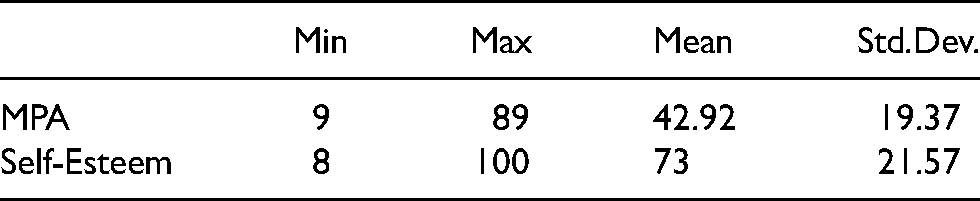
Second, to consider overall self-esteem and its relationship with performance anxiety, practice, and achievement, a second set of correlation analyses was calculated on the following variables: Self-Esteem, Performance Anxiety, Practice Time, Score on Most Recent Piano Examination, Number of Annual Performances (including Examinations), and Age. Significant correlations were indicated for Performance Anxiety and Self-Esteem (r = −0.49; p < 0.001), Performance Anxiety and Practice Time (r = −0.26; p = 0.045), Performance Anxiety and Age (r = 0.29; p = 0.023), Self-Esteem and Age (r = −0.356; p = 0.005), Practice Time and Score on Most Recent Piano Examination (r = 0.332; p = 0.021), Practice Time and Number of Performances (r = .346; p = .01), and Number of Performance and Score on Most Recent Piano Examination (r = .376; p = .01). The means and standard deviations for MPA and Self-Esteem are given in Table 7.
Descriptive data for MPA and SE.
Discussion
The purpose of this pilot study was to examine the role of parents in student pianists’ experience of performance anxiety. Participants responded to a questionnaire regarding their piano studies, their parents’ involvement in them, and their parents’ prior musical education. They also completed measures of performance anxiety and self-esteem. Results showed that self-esteem, age, practice time and having parents who had studied music were positively associated with MPA, but the Parent Involvement Index was not. Furthermore, no significant correlations were found for the Self-Esteem Parent Index and MPA. While participants were interviewed at two different times in the year, it is possible that the timing right before or after a concert could yield different results. Almost all participants indicated that piano lessons were important to their parents. They also reported that their parents are involved through monitoring practice time, helping them practice, listening to them practice, and asking their children to perform for them. The children said that their parents encourage them to succeed in their piano studies, help them prepare for performance, and like them to perform in concerts and competitions.
Participants with parents who had studied music reported higher levels of performance anxiety than those whose parents did not have musical education. Given that a large proportion of music students appear to have musically educated parents – 52% in this sample – this seems to be a relevant factor to consider. It is possible that performance anxiety is simply part of the performance culture for many musicians and that musically educated parents may unknowingly propagate this anxiety in their children. It would be interesting to know what percentage of these parents were anxious performers themselves and how parent anxiety correlates with child anxiety. It is also possible that parent music education affects children's anxiety because students are aware that their parents can more effectively judge how well they are doing, as compared with parents with no musical education.
A variety of components were included in The Parent Involvement index: monitoring practice time, helping to practice, listening, asking the child to perform, and helping to prepare for performance. However, this index did not yield significant results. It was not clear whether parent involvement truly did not relate to anxiety in these participants, or whether this measure was not effective in capturing the effect. The types of parent involvement examined were typical behaviors of parents whose children study music. However, it is possible that a parent-involvement relationship with MPA is more complex and involves more components still than the present study considered. An examination of the issue using the four-factor model of parental involvement (including Active Involvement, Directive Behaviors, Praise & Understanding, and Pressure) proposed in the literature on youth sports (Bois et al., 2009; Lee & MacLean, 1997) might be a next step in understanding a potentially complex issue. Furthermore, it may be worthwhile to interview parents in future studies to get a better sense of their musical education and involvement, in addition to their child's perceptions of these parental experiences and behaviors which we have considered in the current study. Musical parenting is likely to vary both across families and within families as children develop. In the current study adolescents of various ages reported their experiences, though the needs of an 11-year-old are likely to be different from those of a 17-year-old. Still, Davidson and Burland (2006) have suggested that parents’ interactions with their adolescent may be influential in the child's engagement with music, and Illari (2018) similarly challenges the idea that musical parenting tends to be of lesser influence in adolescents. Indeed, researchers report that relationships exist between music preferences of parents and adolescents (Boer & Abubakar, 2014; Serbun and DeBono, 2010; ter Bogt, Delsing, van Zalk, Christenson, & Meeus, 2011) and that teenagers enjoy playing music for and with family members (Driscoll, 1999).
Forty-three percent of parents were reported as giving negative responses to weak performances. Yet, contrary to the models proposed by Leblanc (1994) and Papageorgi et al. (2007), this feedback was not found to be significantly associated with anxiety. In the present study, participants were asked for an open-ended response regarding what their parents say to them if a performance does not go well. While this provided detailed information about types of parent responses, it also made interpretation of some responses, and the student perceptions of them, difficult. For example, when participants responded that their parents said “nothing”, it was unclear whether the participant interpreted this as a positive or negative response. Did saying nothing imply a “disappointed silence”, or did it simply mean that the parents did not make a big deal about it, or perhaps that they did not even notice that the performance was substandard? In the analysis, we chose not to include these ambiguous responses (five in total), which could have provided valuable additional information had they been clearer. Other responses, such as “You did well and you will do better next time.” were categorized as positive responses; however, in the mind of a young musician, it is conceivable that the latter half of that phrase resonates negatively and should be interpreted as such. A clearer positive/negative response format seems warranted for future studies.
Twenty-seven percent of participants said that if they do not perform well their parents ascribe this to not enough practice. However, there are many factors that can sideline a performance – anxiety being one of them. And while less practice was clearly indicated as a predictor variable in the performance anxiety regression, the correlation between practice and anxiety (r = −0.26) was not as large as one might expect, given the value that is typically assigned to practice when it comes to performance feedback and preparation. It seems clear that practice is only one component of the anxiety equation and that students may be unfairly admonished to practice more when performances do not go well.
When asked how parents help them to prepare for performances, 18% responded that they ask them to play for them. However, when participants were asked previously if their parents ask them to perform, 82% responded in the affirmative. Given the design of the questionnaire, it was not clear whether participants in the 64% differential simply did not see asking them to perform as performance preparation, or if they felt it was an issue they had already addressed and were considering what other form of performance preparation their parents help provide. In either case, it was encouraging to find that so many parents were involved to the point of asking to hear their children perform their pieces at home in advance of a performance.
It was likewise positive to note that, for the most part, young musicians wanted their parents to be present at their performances and that parents wanted them to perform. While many participants noted that their parents enjoyed hearing them perform and demonstrate what they have achieved, 11% of parents reportedly encouraged their children to perform in the hopes that it would help reduce their anxiety. Yet, comments such as “They say it would help me to socialize – be less shy,”; “So I can become less nervous in front of people; and “Ca me rend moins timide” (it will make me less timid/shy), seem to indicate that the anxiety referred to was of the social kind, not specific to music performance. Since the literature on music performance typically has considered music performance anxiety as a form of social anxiety, it was interesting to see the issue viewed from a slightly different angle, where the music performance experience was used as a potential aid for a broader social anxiety.
As seen in previous studies on young musicians (Ryan, 1998; Ryan & Andrews, 2021), self-esteem was an important predictor variable, as was age, which has been a less consistent finding in the literature (Steptoe & Fiddler, 1987; van Kemenade et al., 1995; Wolfe, 1989); self-esteem was also significantly negatively correlated with age. Given the lower correlation between age and performance anxiety, and considering that some studies on adult musicians have not found age to be a significant factor, it is possible that this relationship is actually driven by the lower self-esteem reported by the older adolescents. Since neither self-esteem nor age were found to be significant predictors of anxiety across a wide range of adult musicians in a study by Papageorgi et al., (2013), it would be worth exploring whether or not these relationships are specific to the adolescent years. If this were found to be the case, then the question of how to raise music students’ self-esteem during the critical adolescent years might be a key one in reducing overall levels of performance anxiety.
Limitations and future research
Because we were interested in understanding factors related to children's level of MPA, we felt that the children's perspectives on their parents’ involvement was a critical feature. However, it is also conceivable that parental involvement may be more subtle, nuanced, or strategic and not always obvious to children. As such, it would be helpful to examine the level and type of parental involvement from the parent perspective as it relates to MPA, and to compare parent and child views on this involvement. The moderate Cronbach's alpha for the parental involvement index, another limitation of the current study, could be reflective of the child's perspective on their parent(s)’ engagement. As each component of the measure appears to consider specific aspects of parental involvement in children's music learning, it would be worth examining these same items again, but in a study that directly asks the adults about their role. Additionally, employing a standardized measure of parental involvement, in addition to asking questions pertinent to the music learning context, would be an important next step. As this was a pilot study with a small sample of 62 piano students, future studies may benefit from larger sample sizes.
Piano students typically come from middle- to high-income families (Costa-Giomi, 2015; Duke et al., 1997). We did not ask about socioeconomic background of families in the current study; however, it would be interesting to know if this factor might play a role in parents’ level or type of participation. Similarly, we did not ask about families’ cultural backgrounds, which could make for an excellent contribution to the literature in future studies. The third component of families that should be examined going forward is whether parents self-identify as musicians, as opposed to simply having studied music, as it is possible that children from families of professional musicians have a different experience of music learning and that their parents play a more or less extensive role.
Conclusion
While previous research on parents of music students indicates that they play an important role in their children's musical education, their impact on performance experiences remains unclear. Specific parent-focused components of the self-esteem inventory were examined for a relationship with performance anxiety, but none was found. It seems that the only clear connection that can be made at this point between parents and performance anxiety is whether or not the parents are musically educated. The reason for this connection bears some consideration in further studies. And while parent involvement in music studies should be re-examined using clearer measures, at present it cannot be linked with children's experience of performance anxiety. This finding may ultimately be an encouraging one for parents – that the only significant parent variable with respect to performance anxiety is one that is beyond their control.
Footnotes
Action Editor
Elaine King, University of Hull, School of Arts.
Peer Review
Beatriz Ilari, University of Southern California, Department of Music Teaching and Learning.
Maria Varvarigou, Mary Immaculate College, Arts Education and Physical Education.
Contributorship
C. Ryan researched literature, conceived the study, received ethical approval, analyzed data, and wrote the initial draft. G. Ryan and H. Boucher recruited participants, collected data, contributed research literature, added new and revised components to subsequent drafts, and approved the final version of the manuscript.
Declaration of Conflicting Interests
The author(s) declared no potential conflicts of interest with respect to the research, authorship, and/or publication of this article.
Ethical Approval
The ethics committee of McGill University approved this study (REC number: 27-0605).
Funding
The author(s) disclosed receipt of the following financial support for the research, authorship, and/or publication of this article: This work was supported by the Social Sciences and Humanities Research Council of Canada, (grant number 410-2005-0895).
Appendix
Young Pianist Performance Experience Questionnaire
INSTRUCTIONS: The following questions are about your private
Years of private piano study_________ Years with current piano teacher_________ Gender of teacher: ___________ Did you have another teacher prior to this one? Yes No
a. How many others? _________ b. How long did you study with each one? _______________________________ c. Why did you change teachers? ______________________________________ Average number of times you perform Do you take piano examinations? Yes No
1. What grade are you now studying for? __________ 2. Which exams (e.g., [Names of examining bodies removed for anonymous review]? _____________________ c. What was your result/score in your last examination? ______________ Do you play in competitions? Yes No
Do you like taking piano lessons? Yes No Why do you take piano lessons?
Do you practice enough? Yes No
How many days a week do you practice? ___________ For how long each time? _________________ Do you like performing for an audience? Yes No
Why/why not?
________________________________________ Are you usually well prepared for your performances? Yes No Do you usually play your very best for an audience? Yes No
Are you usually happy with your performances? Yes No
Is piano your primary instrument? Yes No
I
like
it
My parents
make me
My friends
take
lessons
Other reason:
____________
Please describe your family structure:
Do you have siblings? Yes No
If yes, how many?____________ Are they older or younger than you?_______________________ Do they also take piano lessons? Yes No Do either of your parents perform on piano or another instrument? Yes No Did either or both of your parents study music? Yes No
If yes, which parent? __________________________ Which instrument? ____________________________ What grade or degree level did they reach? _________________________ How important are your music lessons to your parent(s)? ___________________ Do either of your parents take you to your lessons? Yes No Do either of your parents sit in on your lessons? Yes No Are your lessons as important to your parent(s) as they are to you? More important Just as important Less important Do either of your parents:
monitor your practice time? Yes No help you practice? Yes No listen while you practice? Yes No ask you to perform for them? Yes No What do you think your parent(s)’ expectations are for your success in lessons and performances?
________________________________________ Do your parent(s) expect you to become a professional musician? Yes No How do your parent(s) encourage you to succeed as a musician?
________________________________________ Do your parents help you prepare for performances? Yes No
Do your parent(s) attend your performances? Yes No
Why/why not?
________________________________________ Why/why not?
______________________________________ What do your parent(s) say or do when you perform well?
________________________________________
1. What do your parent(s) say or do if you do not perform well?
_______________________________________ 2. If you are nervous for a performance, do your parent(s) try to help you in any way? Yes No 3. Do your parents like you to perform in concerts and competitions? Yes No Why/ why not?
________________________________________
One parent at
home
Both parents at
home
No parents at home/ Other
adult: (e.g., grandparent)
_______________