



Abstract
Variability is inevitable in human movement and posture, including piano performance, although little research has been conducted in this area. The purpose of this study was to determine if, when comparing individuals to themselves, pianists demonstrate consistent postural angles within a task across multiple measurements and to ascertain if, between various tasks, there are discernible task-related postural patterns. Fifteen pianists participated in this study. Each pianist returned for a total of three measurement sessions. The tasks they were required to perform at each session were quiet sitting, raising their hands on and off the keyboard, playing an ascending and descending scale, sight reading, and playing a piece in three expressive conditions (i.e., deadpan, projected, exaggerated). The following postural angles were calculated based on motion capture data collected during the performance of these tasks: craniovertebral angle, head tilt, head-neck-trunk angle, trunk angle, thoracic angle, thoracolumbar angle, and lumbar angle. The within-person variability ratio across the three measurements was calculated for each angle and across all tasks. Task-related patterns in angles were examined by comparing the same postural angle across different tasks. Results showed that there is a considerable amount of within-person variability, but not enough to be inconsistent over time. Task-related patterns indicate that reading a musical score or playing at the extreme ends of the keyboard tend to involve leaning closer to the instrument. Implications for future studies, intervention studies in particular, include taking more than a single baseline measurement to provide a more accurate picture of an individual pianist's typical posture.
Introduction
It is generally accepted that there are multiple degrees of freedom involved in human movement which result in a multitude of ways that a task can be completed (Bernstein, 1967; Rosenbaum, 2010). Even after much training and practice, skilled individuals demonstrate changes while performing repeated tasks and cannot replicate them identically (Bartlett et al., 2007; Dhawale et al., 2017; Preatoni et al., 2013). This is known as “motor variability” which is when multiple repetitions of the same task result in varying patterns of kinetics, kinematics, muscle activation, and spatiotemporal measures (Chau et al., 2005; Latash et al., 2002). Variability is not necessarily a negative aspect of performance. Rosenblatt et al. (2014) differentiated between two types of variability, good variability and bad variability. Good variability does not affect the resulting performance and may potentially be beneficial for musicians who perform repeated tasks while needing to avoid injury. Bad variability can affect the outcome (e.g., resulting in a fall in an older adult). For the purposes of this paper, variability will simply refer to changes in an outcome measure. Variability is not limited to movement alone. It also includes variation in posture (Srinivasan & Mathiassen, 2012). Variation is inevitable due to the numerous combinations of joint movements and muscle activities available to complete a task as well as the constraints that influence the resulting performance (Furuya & Altenmüller, 2013; Lipke-Perry et al., 2019). Types of constraints include individual (e.g., height, weight, motivation), environmental (e.g., temperature, lighting, sociocultural norms), and task constraints (e.g., goals of the task, equipment used) (Haibach et al., 2011; Newell, 1986). When researching variability, there are two variables that relate to task performance: execution and result variables. Joint angles are considered an execution variable while distance travelled is an example of a result variable (Müller & Sternad, 2009). It should be noted that variability seen in a result variable does not necessarily reflect differences in execution variables (Preatoni et al., 2013).
Many studies that research variability examine athletics or daily human movement. Little research has been conducted with musicians, in particular pianists, although the field of music lends itself well to the study of variability. Timing is often the topic that is examined when researching piano performance and variability. Van Vugt, Jabusch, and Altenmüller (2012) examined how motor sequencing impacts the timing patterns of scale playing at the piano. Findings revealed that there were variations in timing throughout scale playing. In another study (Demos et al., 2016), the researchers began with the assumption that there would be variability between repeated performances by the same pianist. The results showed that the performer tended to vary the tempo at phrase boundaries by slowing down. Variability in timing relative to task constraints were examined in the study by Lipke-Perry et al. (2019). Seven pianists played scales on three different pianos to determine if the equipment (i.e., piano) influenced timing consistency. The findings showed that similar patterns in timing were demonstrated across keyboards. However, when examining the repeated performance of scales, irrespective of the instrument, consistent deviations in timing were observed. Tominaga et al. (2016) began their research with the assumption that variation exists across performances. Their purpose was to identify possible causes of rhythmic and loudness inconsistencies in expert pianists from a kinematic perspective. The results showed that joint angle and angular velocity were related to variability in rhythm and loudness.
These studies have offered insight into repeated piano performances, but with a focus on result variables. Studying result variables increases our understanding concerning different performance outcomes, but they do not address variability within the performers themselves. It is important to examine execution variables as it is the action of the performer that produces the resulting performance. Because variability in result variables is not necessarily an indicator of variability in execution variables (Preatoni et al., 2013), it is necessary to make a separate study of the kinetics and kinematics of an individual during performance. Piano performance is an area that requires a substantial amount of coordination from the individual (Furuya & Altenmüller, 2013). In studies that do examine the kinematics of pianists, but not necessarily variability, there is a focus on the upper extremities (Degrave et al., 2020; Furuya et al., 2011, 2012; Minetti et al., 2007). Little attention is given to the posture of the performer, specifically spinal posture. Studies have shown that posture can affect movement in the upper limbs, which is of importance to piano playing. Forward head posture and the degree of thoracic kyphosis can affect shoulder range of movement (Lewis et al., 2005) while an upright sitting posture, in comparison with an individual's natural sitting and slouched posture, can increase the distance between the acromion and the humerus, increasing the subacromial space. A decrease in this space can lead to pain in the shoulder joint and rotator cuff disorders (Kalra et al., 2010). It is worthwhile, then, to examine posture during piano performance tasks.
It is also interesting to examine whether the task influences spinal posture. Different tasks involve different task constraints, and it is important to determine if postural behavior changes in various circumstances. This is applicable to future studies, including intervention studies. These types of studies involve a pre-intervention test, an intervention, and a post-intervention test. To determine if the intervention had an effect on the variables measured, it must be established prior to the intervention what influence the task may have on the behavior of the participant. It is important to take into consideration the task and its influence on the outcome before drawing conclusions about the effect of the intervention on changes in the variables measured.
Most of the studies mentioned in this paper begin with the assumption that there will be variability between performances. If this is the case, what does it mean for intervention studies? If there are variations between performances, is a single measurement prior to an intervention sufficient to establish a baseline or a pianist's typical playing posture? If only one baseline measurement is taken and assuming there is variability between performances, can any changes that appear in post-tests be attributed to the intervention itself or to variability? In light of these questions, the purpose of this study is twofold:
To determine if individual pianists demonstrate consistent postural angles within a task across multiple measurements. To determine if there are discernible postural patterns associated with specific tasks.
Method
Participants
Fifteen pianists participated in this study. All participants had to meet at least one of the following requirements: completed Level 9 training in keeping with the standards of the Royal Conservatory of Music its equivalent, studied piano as their major instrument in university at the time of data collection, or studied piano as their major instrument in university prior to data collection. While those in the latter category were no longer active students, all still maintained some level of piano playing at the time of the study. These requirements ensured that all pianists were able to play at an advanced level. There were 12 females and three males with a mean age of 35.33 ± 18.16 years.
Procedure
Prior to the beginning of the test session, reflective markers were placed on the tragus of the right ear; the spinous processes of C7, T5, T10, and L3; the sacrum; and the left and right greater trochanters of the femur. A headband was also placed on participants’ heads with two markers at the front to indicate the glabella and two markers at the back indicating the external occipital protuberance. In addition, markers were placed on the posterior side of participants’ left and right forearms (i.e., palm facing down) approximately 7–10 cm above the wrist joint (see Figure 1). Pianists sat on a height-adjustable bench in front of a digital piano (Yamaha Digital Piano P-255) and were permitted to change the height of the seat as well as the distance from the keyboard. This was done to reduce potential bias in the data from forcing a particular sitting arrangement. A 7-camera VICON Nexus motion capture system (Oxford Metrics) was used to record the position data of each reflective marker at 100 Hz while the participants performed tasks. Video recordings were taken in the case that anomalies appeared in the data that required explanation. Participants performed a series of tasks during each test session. Tasks and task conditions (if applicable) were randomized for each participant and for each session. The first measurement, which will be referred to as “Measurement 1”, was performed, following which a one-hour break was given to the participant. After the hour, the participant returned and performed the series of tasks again in a different order (“Measurement 2”). The markers were left on the participant during this time to minimize measurement errors. A week after the second measurement, the participant returned and performed the series of tasks again (“Measurement 3”). The spacing of the test sessions was to determine if participants exhibited similar postures over time. Each session lasted approximately 20 min in length.

Marker placement. Panel A: Marker placement on head, spinous processes, and trochanter. Panel B: Marker placement on forearms and trochanter.
Tasks
Pianists were to complete the following tasks: quiet sitting, raising both hands simultaneously from their laps onto the keyboard and back down to their laps (“raising hands task”), playing a bi-manual C-major scale in sixteenth notes at a tempo of 104 bpm, sight reading, and playing mm. 1–12 of Sonatina in C Major, op. 36, no. 3, First Movement by Muzio Clementi. Pianists received the score for the playing task at least a month in advance of their first test session and were informed of the exact excerpt they were to play. This excerpt was chosen because it required minimal lateral motion. Because the scale would allow for a study of posture during lateral motion, the piece was chosen to allow for a study of posture from a more central position relative to the keyboard. Participants were unaware that their postural behavior was being measured during the quiet sitting task to prevent any alteration of posture from the knowledge that they were being assessed. The researcher stood in front of the participants as they sat in front of the keyboard and reviewed the protocol for the test session to ensure that participants would face the same direction for each trial while the measurements were being taken. For the raising hands task, pianists were asked to leave their hands on the keyboard until further instructions were given to lower their hands. This was to provide a clear indication to distinguish between when the hands were being raised onto the keyboard and when they were being lowered. For the scale, participants were requested to play an ascending and descending C-major scale from the lowest C on the keyboard to the highest C. This was to explore the pianist's full range of lateral motion. The participants were also asked to pause at the top of the scale as well as when they reached the bottom of the scale. This was to provide a clear marker for the researcher to distinguish between the ascending and descending portions of the scale. The tempo of the scale was selected in keeping with the Royal Conservatory of Music's Level 9 requirements. For the sight reading task, pianists played an excerpt from a piece of music they had never seen before. Confirmation that participants had never seen the piece prior to the test session were given following the playing of the excerpt. All participants played the same excerpt for the sight reading task with a new selection from a different piece given at each measurement session. At the first measurement session, participants sight read mm. 1–15 of The Old Man's Story by Cheng Joe Hing. At the second measurement session, participants sight read mm. 344–368 of Toccata (Good Tidings) by Ding Shan De. At the third measurement session, participants sight read Afflict Meditation by Song Tong. Pianists were asked to play the excerpt (mm. 1–12) from the Sonatina a total of three times, each time in a different expressive condition: deadpan, projected, and exaggerated musical expression (Davidson, 1993). In the deadpan condition, participants were to play with as few expressive features as possible (e.g., no variation in dynamics or tempo). In the projected condition, pianists played as they normally would as for a peer, a teacher, or in a performance. In the exaggerated condition, pianists were to exaggerate all expressive features (e.g., tempo, dynamics). The various conditions were employed to determine that any changes seen in spinal angles were not the result of pianists’ musical interpretation of the piece (Thompson & Luck, 2011). The score was placed on a fixed stand that was attached to the keyboard.
Data Collection
The following postural angles were calculated from the measurements of the right side in the sagittal plane:
Craniovertebral angle: formed by connecting the tragus and C7, relative to the horizontal Head tilt: formed by connecting the glabella and external occipital protuberance, relative to the horizontal Head-neck-trunk angle: formed by connecting the tragus, C7, and the greater trochanter of the right femur Trunk angle: formed by connecting C7, T10, and the greater trochanter of the right femur Thoracic angle: formed by connecting C7, T5, and T10 Thoracolumbar angle: formed by connecting T5, T10, and L3 Lumbar angle: formed by connecting T10, L3, and the sacrum
Negative angles for the thoracic, thoracolumbar, and lumbar angles indicated lordosis while positive angles indicated kyphosis.
Data Analysis
Data were exported into MATLAB (MathWorks, R2017b) to calculate the angles. For the quiet sitting task, 10 s of data were taken from the middle to the end of the task, to assess pianists’ typical spinal postures. This was done so that it was possible to examine participants’ posture after they had time to adjust to sitting on the bench. Exceptions were made if there were missing data points in the stated time frame. For the raising hands task, data were taken from the point when the forearm markers began to rise from participants’ laps to the point where they settled back onto the participants’ laps. Data for the scale were taken from when the participant began playing the scale, as indicated by the forearm markers moving to the right of the keyboard, to the end of the scale when the forearm markers rested on the left side of the keyboard. For the sight reading and playing tasks, data were taken for the entire duration of the excerpt from when the pianist placed their hands on the keyboard to when they began to lower their hands back onto their laps, as indicated by the forearm markers.
The mean for each individual's set of angles were calculated across time points (hundredths of a second). Outliers (i.e., any value with a z-score greater than 1.96 or less than −1.96) were identified and Winsorized and expectation maximization was used to impute any missing data points. To examine whether individual pianists demonstrate consistent postural angles within a task across multiple measurements, the method described by Salthouse (2007) was used to determine whether participants varied substantially from one measurement to another. In this method, the ratio of the mean within-person standard deviation across the three measurements to the standard deviation of the between-person means across the three measurements was obtained. The ratio is therefore a direct comparison of the within-participant variability to the between-person variability. Stated more simply, the ratio compares the typical amount of change that a single person undergoes from one time point to another with the amount of change observed from one person to another. This ratio is compared against a value of 1 (Fagot & Mella, 2015), with the latter representing the situation where individuals differ as much within themselves over time as they do from each other. This will be referred to as the within-person variability ratio.
To examine if there were task-related postural patterns, repeated-measures ANOVAs were run to determine if there were significant differences between tasks for each postural angle. As sphericity was violated (p > .05) for all analyses, a Huynh–Feldt correction was applied. Twenty-one pairwise comparisons were conducted with Holm–Bonferroni corrections for each angle to determine if there were significant differences between tasks.
Results
Postural Angles Within Tasks
Overall, when comparing angles and tasks across measurements, the within-person variability ratio was .46 (see the median of medians in the bottom right corner of Table 1). This means that individuals’ postural angles changed about half as much over time as postural angles changed across participants. In other words, within-person variability is about half as much as between-person variability. This is a substantial amount of within-person variability (Salthouse, 2007), though it is far enough below a value of 1 to indicate that people show fair consistency over time (Fagot & Mella, 2015). The differences from angle to angle are informative: people demonstrated relative consistency over time in their craniovertebral angle and their thoracic angle (with median ratios of .37 and .34, respectively), while they showed relative variability over time in their trunk angle (with a median ratio of .60). The within-person variability ratios were remarkably consistent across repeated performances of the tasks, though people were a little more consistent over time when playing a scale and when engaged in exaggerated playing (median ratios of .38 and .39, respectively) and a little less consistent over time when engaged in deadpan playing (median ratio of .53).
Within-person variability ratios.
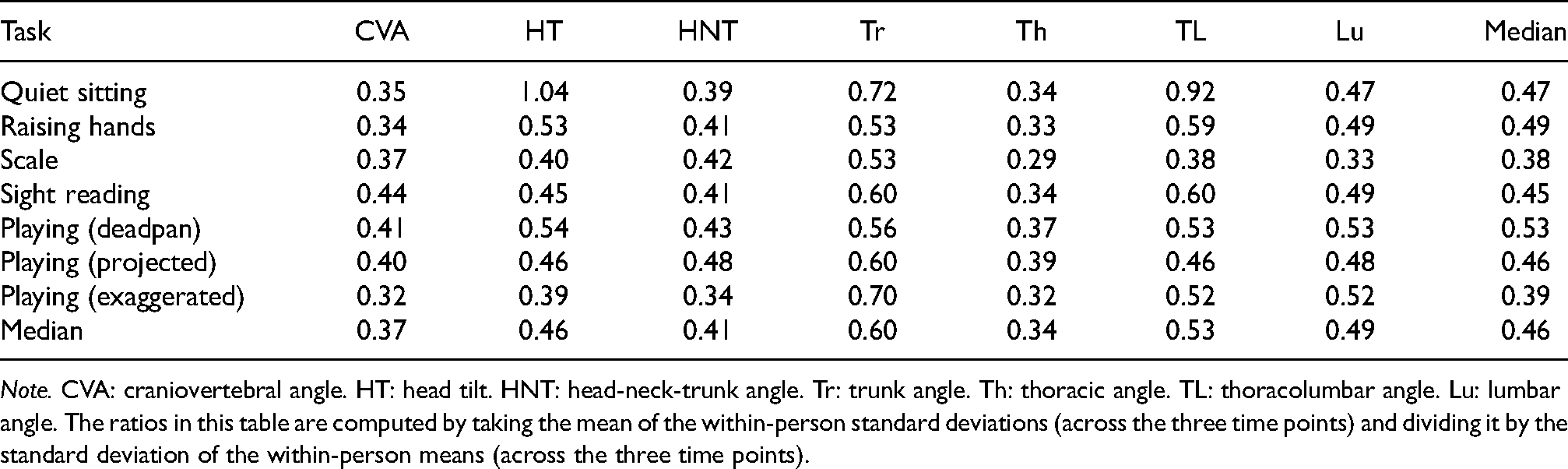
Note. CVA: craniovertebral angle. HT: head tilt. HNT: head-neck-trunk angle. Tr: trunk angle. Th: thoracic angle. TL: thoracolumbar angle. Lu: lumbar angle. The ratios in this table are computed by taking the mean of the within-person standard deviations (across the three time points) and dividing it by the standard deviation of the within-person means (across the three time points).
Task-Related Postural Patterns
Comparisons of postural angles across tasks are presented in Table 2. Results showed that for each angle, significant differences were found across all tasks with moderate to large effect sizes, indicating that participants’ postures varied widely between tasks.
Comparison of postural angles across tasks.

Note. CVA: craniovertebral angle. HT: head tilt. HNT: head-neck-trunk angle. Tr: trunk angle. Th: thoracic angle. TL: thoracolumbar angle. Lu: lumbar angle. Cell entries are means across all three measurements along with the standard deviation of these means in parentheses. Means with differing superscripts differed significantly in pairwise comparisons following a Holm–Bonferroni post-hoc correction. Holm–Bonferroni corrections are for all 21 pairwise comparisons between tasks for a given angle.
Pairwise comparisons showed that the craniovertebral angle was significantly larger in the quiet sitting and raising hands tasks in comparison with the playing task in all conditions (i.e., deadpan, projected, and exaggerated) as well as the scale and sight reading tasks. The craniovertebral angle was also significantly larger in the deadpan playing task in comparison with the projected playing, exaggerated playing, scale playing, and sight reading tasks. In addition, the craniovertebral angle was significantly larger in the projected and exaggerated playing tasks in comparison with the sight reading task.
For head tilt, a significantly larger angle was displayed in the quiet sitting task in comparison with all other tasks. Head tilt was also larger in the raising hands and deadpan playing tasks in comparison with the projected playing, exaggerated playing, scale playing, and sight reading tasks. Both projected and exaggerated playing tasks exhibited significantly larger head tilt angles in comparison with the scale and sight reading tasks.
Concerning the head-neck-trunk angle, significantly larger angles were demonstrated in the quiet sitting and raising hands tasks in comparison with all other tasks. Again, a significantly larger angle was displayed in the deadpan playing task in comparison with the projected playing, exaggerated playing, scale, and sight reading tasks. The head-neck-trunk angle was also significantly larger in the projected playing and exaggerated playing tasks in comparison with the sight reading task.
The trunk angle was significantly larger in the sight reading task in comparison with the exaggerated playing, projected playing, deadpan playing, quiet sitting, and raising hands tasks. The exaggerated playing task demonstrated a significantly larger trunk angle than the deadpan playing, quiet sitting, and raising hands tasks. The trunk angle was also significantly larger in the projected playing task in comparison with the quiet sitting and raising hands tasks. The angles demonstrated in the scale and deadpan playing tasks were significantly larger than the one exhibited in the raising hands task.
For the thoracic angle, a significantly larger angle was found in the sight reading task in comparison with the playing task in all conditions (i.e., deadpan, projected, exaggerated) and with the quiet sitting and raising hands tasks. The thoracic angle demonstrated in the scale playing task was significantly larger than the ones shown in the quiet sitting and raising hands tasks. Thoracic angles demonstrated in the projected playing and exaggerated playing tasks were significantly larger than the one exhibited in the raising hands task.
Results for the thoracolumbar angle demonstrated significantly larger angles in the scale task in comparison with the projected playing, deadpan playing, quiet sitting, and raising hands tasks. The thoracolumbar angle displayed in the sight reading task was also significantly larger than in the deadpan playing, quiet sitting, and raising hands tasks. The thoracolumbar angles exhibited in the projected playing and exaggerated playing tasks were significantly larger than those in the quiet sitting and raising hands tasks.
Concerning the lumbar angle, the angle displayed in the scale playing task was significantly larger in comparison with those shown in the quiet sitting and raising hands tasks as well as all conditions of the playing task.
Discussion
Many studies have examined variability by focusing on the outcome of the performance (e.g., loudness, tempo changes). Those that have studied pianists’ kinematics and kinetics often focused on the upper extremities, but this present study focused on posture which can affect the upper extremities (Kalra et al., 2010; Lewis et al., 2005). Variability within a task was examined by determining if similar postural angles were demonstrated across multiple measurements. The findings show that in general, there is a considerable amount of within-person variability, but not so much as to be too inconsistent over time. When comparing within individuals, pianists’ postural angles may change half as much as when comparing with other pianists. The craniovertebral and thoracic angles exhibit the least amount of variability across multiple measurements and across tasks while the trunk angle demonstrated the most amount of variability. These variabilities in postural angles may also imply some variabilities in the motion of the hands, arms, and shoulders due to the influence of spinal posture on the movement of the upper extremities, but further investigations are needed to explore this phenomenon.
The results of this study also revealed task-related postural patterns. The craniovertebral angle, head tilt, and head-neck-trunk angle appeared to be larger in tasks that required less movement (i.e., quiet sitting, raising hands, and deadpan playing tasks) while the trunk, thoracic, and thoracolumbar angles were generally larger in the sight reading task in comparison with other tasks. These results may indicate that tasks requiring less movement may allow pianists to sit in a more upright position. The angles demonstrated in the scale playing task were also significantly different in comparison with the quiet sitting and raising hands tasks, indicating that pianists may lean closer to the keyboard to reach keys at the extreme ends of the keyboard. In addition, the smaller craniovertebral angle, head tilt, and head-neck-trunk angle along with simultaneously larger trunk, thoracic, and thoracolumbar angles demonstrated during the sight reading task may indicate that pianists need to lean closer to the keyboard in comparison with other tasks. While both the playing and sight reading tasks required pianists to read a score, the overall shape of pianists’ spines appeared to be more kyphosed with increased forward head posture in the sight reading task than in the playing task, which may indicate that pianists lean in closer to read an unfamiliar score than when reading a score with which they are familiar. Further studies would need to be made to verify if this supposition is true by either asking participants their opinion of the sight reading piece (i.e., if they felt the piece was difficult) or recording the number of errors made while sight reading. The craniovertebral angle, head tilt, head-neck-trunk angle, trunk angle, and thoracic angle displayed in all conditions of the playing task indicated a more upright posture in comparison with those demonstrated in the sight reading tasks.
A limitation of this study was its small sample size. However, based on the variety of tasks that were examined individually in this study and their results, it can still be seen that although individual pianists display postural variability, it is not enough to be inconsistent between measurements. Another limitation was the placement of the bench. Because each participant was permitted to adjust the bench to their liking, bench placement may have affected variability within the individual as it is uncertain whether pianists place the bench in the same place between sessions.
The results of this study have implications for future studies, in particular intervention studies. While it may be possible to take a single baseline measurement prior to beginning an intervention, it may not be the best practice. Spinal posture, although demonstrating some consistency, still demonstrates variability across time. It may be better practice to take the average of several baseline measurements to present a more comprehensive picture of the pianist's typical postural behavior. Additionally, it may be beneficial to examine posture in a variety of tasks to ensure that the findings of future studies are not a result of the task's influence.
Conclusion
Pianists exhibit variability in postural angles between multiple measurements within a task. This raises the issue of whether the postural angles seen on one day are representative of pianists’ postural behavior every day in the context of that task. In an intervention study, changes attributed to the method that are being researched would be less reliable as it would be uncertain whether those differences were due to variability or to the method itself. This study took a total of three measurements which was sufficient to demonstrate variability, but at the same time establish individual pianists’ average playing postures. Because of the relatively consistent posture demonstrated across measurements within individuals, it is possible to take an average of the angles demonstrated at each measurement to represent a pianist's typical posture. Another finding of this study shows that the task influences the posture of the pianist. The benefit of examining a variety of tasks is the possibility of studying pianists’ postures in different contexts. Taken together, this is a more comprehensive representation of a pianist's typical playing posture and can be used as a baseline in future intervention studies.
Footnotes
Action Editor
Andrew Goldman, Indiana University, Department of Music Theory, Jacobs School of Music.
Peer Review
Benjamin Michaud, Université de Montréal, Faculté de Médecine.
Sara D’Amario, Universität fur Musik und darstellende Kunst Wien, Music Acoustics.
Author Contributions
GKW researched the literature, gained ethical approval, recruited participants, collected data, and wrote the manuscript. GKW, GC, and DR conceived and designed the study as well as reviewed and edited the manuscript. GKW and VH analyzed the data.
Declaration of Conflicting Interests
The author(s) declared no potential conflicts of interest with respect to the research, authorship, and/or publication of this article.
Ethical Approval
Ethical approval was given by the Research Ethics Board of the University of Ottawa prior to the commencement of this study.
Funding
The author(s) received no financial support for the research, authorship, and/or publication of this article.
