



Abstract
One of the most important skills for a pianist is sight-reading, which is the ability to read an unknown music score and play it. In recent years, research has analysed eye movement during sight-reading. However, the definition of sight-reading has varied. In addition, the participants enlisted as experts in most studies have been music college students. The present study aimed to compare eye movements during sight-reading between experts, teachers at a music college and pianists, and non-experts, music college students studying to become pianists, using an eye tracker. Using easy and difficult music scores for two-handed playing, we investigated whether there were differences in the number of eye fixations, fixation duration, and eye-hand span. The definition of sight-reading in this study is to read a novel music score once without playing the piano, and then to play it while looking at the music score. The results showed that the higher the piano performance rating, the longer the eye-hand span. Areas of interest (AOIs) were defined every two rows, including a treble and bass staff in each music score. We conducted a two-factor repeated measures ANOVA (group × AOI) for each dependent variable to analyse fixation count and fixation duration per eye fixation. There was a significant interaction for the fixation count between groups and AOIs both without and with performance in the difficult score. In experts, the number of eye fixations on the difficult part of difficult score increased compared with other part both without and with performances. By contrast, there was a significant interaction for the duration per eye fixation between groups and AOIs in easy score with performance. The duration per eye fixation in experts was shorter than that in non-experts in the easy score with performance. These results suggest that experts get information through short gaze fixations.
Introduction
The transcendental performance techniques, finger movements, and expressive power of pianists have attracted the hearts of many audiences worldwide. To play the piano, pianists must move their right and left hands separately, while moving 10 fingers at high speed for a long and difficult piece of music (Schlaug et al., 1995). While playing the piano, pianists pre-read the score (Rayner & Pollatsek, 1997; Truitt et al., 1997), process the score information in the brain (Meinz & Hambrick, 2010), and in some cases, press the pedal with their foot (Shaffer, 1984). Furthermore, the music score must be memorized for a concert (Schulze et al., 2010). Immeasurable practice is required for the process of acquiring these excellent piano performance skills (Krampe & Ericsson, 1996). Therefore, it is thought that pianists’ excellent performance techniques are not an innate talent but the result of practice accumulated since early childhood. For example, pianists need to set goals, learn techniques, repeat practices, memorize music scores, and correct mistakes with enormous effort and concentration (Lehmann & Ericsson, 1997).
Sight-reading Required for Pianists
One of the most important skills needed by pianists is the ability to read music correctly. Sight-reading is considered particularly important. Sloboda (1974) collected 10 subjects of approximately equivalent age and musical experience, covering a wide range of sight-reading ability. Each music score slide was displayed twice during the experiment, once being switched off early in the piece, and once later in the piece. Subjects started playing a piece as soon as the material was displayed, and their speed was regulated by a metronome which started sounding a few seconds before the slide was displayed. When the slide was switched off subjects simply continued playing until they could not remember any more notes, and it was observed that subjects tended to stare at the blank screen in the seconds following the cut-off as though they were still “seeing” the music. As a simple measure of sight-reading ability, the number of mistakes made prior to the slide being switched off was recorded for each subject. The best sight-reader made only three mistakes in the whole series; the worst made 73 mistakes.
In sight-reading, pianists must ascertain many things such as tempo, time signature, tonality, and the composition of songs in a short time just before playing, and then perform accurately without stopping. Furthermore, it is a skill that is invaluable for repetiteurs and accompanists, and an especially useful skill-set for piano teachers, performers, and musicians (Arthur et al., 2016). Sight-reading consists of extracting visual information from a score to perform by simultaneous motor responses as in playing or singing, relying on auditory feedback (Drai-Zerbib et al., 2012). Expert musicians can hear in their mind what they read from a score and visually represent the music that they are listening to.
Many music researchers have mentioned sight-reading, but there is no clear definition. Some describe sight-reading as occurring only the first time an unfamiliar piece of music is played, whereas others consider that familiarisation with a piece before playing it also constitutes a sight-reading task (Lehmann & McArthur, 2002). Puurtinen (2018a) defined sight-reading as reading a music score during a music performance at first sight. In some studies, sight-reading tasks were performed with no preview of the music score (Ahken et al., 2012; Hadley et al., 2018; Huovinen et al., 2018; Penttinen & Huovinen, 2011; Rosemann et al., 2016). However, in others, sight-reading was defined as performing a music score after reading it silently (Drai-Zerbib et al., 2012). To specify sight-reading, it is important to make a distinction between performance tasks and tasks where music notation is only read and not performed in any way (Puurtinen, 2018b).
The studies above suggest that sight-reading can be broadly divided into two categories: with and without performance. Although sight-reading is based on the requirement that the musician is playing or singing the music score for the first time, it is necessary to understand both sight-reading without performance just before the actual performance and sight-reading with performance. Therefore, in this study, we distinguished between sight-reading without piano performance and sight-reading with piano performance.
Gaze Analysis in Reading Music
As mentioned earlier, sight-reading ability is necessary to become an expert pianist, and research is needed to identify the mechanism of this ability. Visual processing is one such area of research. When we read, look at a scene, or search for an object, we continually make eye movements called saccades. Between the saccades, our eyes remain relatively still during fixations. New information is acquired only during fixations (Rayner, 1998). When pianists are learning a new score and utilising sight-reading, their eyes are focused not on every single note, but rather on the score, and are instantaneously reading the notes around it (Truitt et al., 1997). Therefore, it is possible to quantify sight-reading ability from the movement of the line of sight during the time the pianist is reading the score. Visual gaze studies have several weaknesses in their methods. For example, the gaze measuring device used in one study was a video camera attached to the head during the performance, which restricted the performer's actions (Salvucci & Anderson, 2001). In addition, various definitions and measurements, such as those of sight-reading or eye-hand span, have resulted in different scores on the gaze measure, making it difficult to compare these studies.
Studies on eye movement in music reading have been reviewed by Madell and Héébert (2008) and Puurtinen (2018a). In contrast to similar research on text reading, research on the eye movements used to read music is relatively undeveloped (Madell & Héébert, 2008). This is because music reading usually requires either sung or instrumental production, both of which involve head movements that are hardly comparable to reading text aloud and can introduce measurement problems (Madell & Héébert, 2008). In recent years, with the development of eye trackers, it has become possible to analyse gaze without restraining the head, and problems related to accuracy of measurement or methodology are getting solved. However, there are still few studies focusing on statistical gaze analysis in music.
Waters et al. (1997) devised the pattern-matching test to measure sight-reading ability, and administered it to eight full-time music students, eight psychology students who had passed an examination in a monophonic instrument, and eight non-musicians. At the same time, eye movements while reading music were measured and compared among the three groups. In this task, the participants were shown two music scores composed of 10 notes (2 bars of 5 notes each) presented on the screen of a computer monitor. The original melodies were randomly assigned to the same pitch difference and duration difference conditions. The participants were required to compare the stimuli as quickly and accurately as possible and press one of the two response buttons to register their decision (same/different). The researchers found that the more experienced musicians were able to perform the comparisons with fewer and shorter glances between the patterns. Based on the results, they suggested that skilled sight-reading was associated with the ability to rapidly perceive notes or groups of notes in the score.
In recent years, Hadley et al. (2018) conducted experiments to investigate how proficient pianists comprehend pitch relationships in music score when they first encounter it by tracking their eyes while they read and played single line melodies. The melodies were either congruent or anomalous, with the anomaly involving one bar being shifted in pitch to alter the implied harmonic structure. Twenty-four active pianists who had nine or more years of formal musical tuition participated in these experiments. The melodies were all 8 bars long, played with the right hand on the piano, and the left eye movement was measured. The fourth bar with the pitch change (target bar), the third bar before the target (pre-target bar), and the fifth bar after the target (post-target bar) were used as areas of interest (AOIs) to analyse the gaze. It was observed that participants were more likely to have rapid disruption in their eye movements in the anomalous condition than in the congruent condition. Furthermore, as predicted in the exploratory analysis of pupil dilation, in the post-target bar, mean pupil size was significantly greater in the anomalous condition than in the congruent condition.
Eye-hand Span
Eye-hand span is a known characteristic of the eye movements of a performer. This measure could be defined as the number of notes between the note being played, and the note being fixated on (Rayner, 1998; Rayner & Pollatsek, 1997; Weaver, 1943). Sloboda (1974) showed that when performers played the piano while reading the score, their eyes tended to see the note of the score ahead of the sound corresponding to the part of the score being played, indicating that they were using a skill called prefetching. Eye-hand span was measured by the number of notes between the hand and eye position. In an early study on eye-hand span, pianists read a score that they had not seen before, following which they were tested to see how well they had memorized the score. Pianists with a high sight-reading ability were able to play 6–7 notes whereas those with a low sight-reading ability could play only 3–4 notes (Goolsby, 1994; Sloboda, 1984). Furthermore, in Furneaux and Land’s (1999) research, eye-hand span, measured by the note index rather than the time index, was shown to be related to the professional competence of sight-reading.
There are several factors that influence eye-hand span. For example, Sloboda (1984) demonstrated that eye-hand span is not a constant and unchanged scale, rather it becomes larger or smaller depending on the musical structure. Other studies show that eye-hand span is influenced by expertise (Truitt et al., 1997) and skill level (Furneaux & Land, 1999; Sloboda, 1974; Truitt et al., 1997). In addition, it is influenced by the tempo (Furneaux & Land, 1999) and complexity of the score (Rayner & Pollatsek, 1997), which suggests that a skilled player displays a larger eye-hand span (Furneaux & Land, 1999; Gilman & Underwood, 2003; Truitt et al., 1997). These results suggest that expert pianists have a longer eye-hand span than non-expert pianists, which results in different eye movements during sight-reading.
Research Questions and Study Purpose
This study aimed to clarify eye movements during sight-reading by teachers who are active pianists at the highest level of a music college. In previous studies, most of the proficient pianists examined have been music majors, and there have been few studies on more experienced and advanced pianists. Moreover, most sight-reading studies have used simple music scores with fewer bars and only one hand. We wanted to compare the differences in gaze and eye-hand span in a situation similar to that in which pianists and aspiring pianists actually perform sight-reading. The music scores used were also actual, two-handed music scores with two different difficulty levels. It is conceivable that a score with more bars would show eye movements that more closely resemble the actual reading situation.
In eye gaze research, the number and duration of gaze fixation is measured. The former is known to be related to interest and concerns (Yamamoto & Imai-Matsumura, 2013), whereas the latter is related to gathering information from the gaze object (Hutton & Nolte, 2011; Uzzaman & Joordens, 2011). Arthur et al. (2016) used these measures to examine eye movement during sight-reading, but the eye movement was for a short score of four bars played with the right hand only. In addition, they used a type of eye tracker that held the heads in place. Therefore, this study aimed to analyse the number of eye fixations, fixation duration, and eye-hand span of pianists and aspiring pianists in both easy and difficult musical scores using a monitor-type eye tracker that does not restrict the head and can be used for normal performance. In previous studies, the definition of expert pianists varied. However, in this study, experts were defined as teachers at a music college who were also pianists, and non-experts were defined as music college students studying to become pianists. To the best of our knowledge, the study of eye movements during sight-reading in expert and non-expert pianists, as defined in this study, has not been seen before.
Based on the above, the following hypotheses were developed and examined for the eye movements of expert and non-expert pianists during sight-reading.
(1) The duration of an eye fixation on a music score in experts will be shorter than that in non-experts because the processing speed of sight-reading is thought to be faster for experts. (2) For the difficult part of the difficult music score, the number of eye fixations will increase compared with other part because the sight-readers care about these notes. This tendency will be stronger in experts than in non-experts. (3) Eye-hand span will be longer in experts than in non-experts. (4) The piano performance in experts during sight-reading will be rated higher than that of the non-experts. (5) The higher the evaluation score of the piano performance, the longer the eye-hand span will be.
Method
Participants
At a music college in Japan, candidates for participation were informed in writing about the purpose of this research, details of their participation, and ethical considerations. We explained to the candidates that they had the right to refuse to participate in the study, that participation was voluntary, and that non-participation would not have any negative consequences. Forty-one people agreed in writing to participate.
The participants included 23 teachers (6 males, 17 females) and 18 students (2 males, 16 females) majoring in piano at a music university. In addition to teaching students how to play the piano at college, the teachers also performed at concerts as pianists. In this study, we called the teachers experts and the students non-experts. The average age of the experts was 49.0 years (SD: 9.9, range: 30–65 years) and that of the non-experts was 22.4 years (SD: 3.8, range: 19–32 years). The average piano playing experience of the experts was 45.6 years (SD: 10.1, range: 27–62 years) and that of the non-experts was 19.4 years (SD: 4.3, range: 14–30 years). The t-test results showed a significant difference between the experts’ and non-experts’ average piano playing experience (t (39) = 10.20, p < .001), with the experts having significantly longer years of experience than the non-experts. However, even the non-experts had an average of 19.4 years of experience, with one of them having 30 years of experience. Therefore, the non-experts in this study were not beginners, but those who have trained in playing the piano for many years.
Musical Materials
We prepared two double-line music scores for the participants: easy and difficult (Figure 1). Scores were selected from a Sight Playing Workbook within the YAMAHA music ability test system. This system ranges between grade 13 (the easiest) and grade 2 (the most difficult). The grade 1 scores have not been created. This system is used in more than 30 countries. We have received permission from YAMAHA for the use and publication of this score in this study.
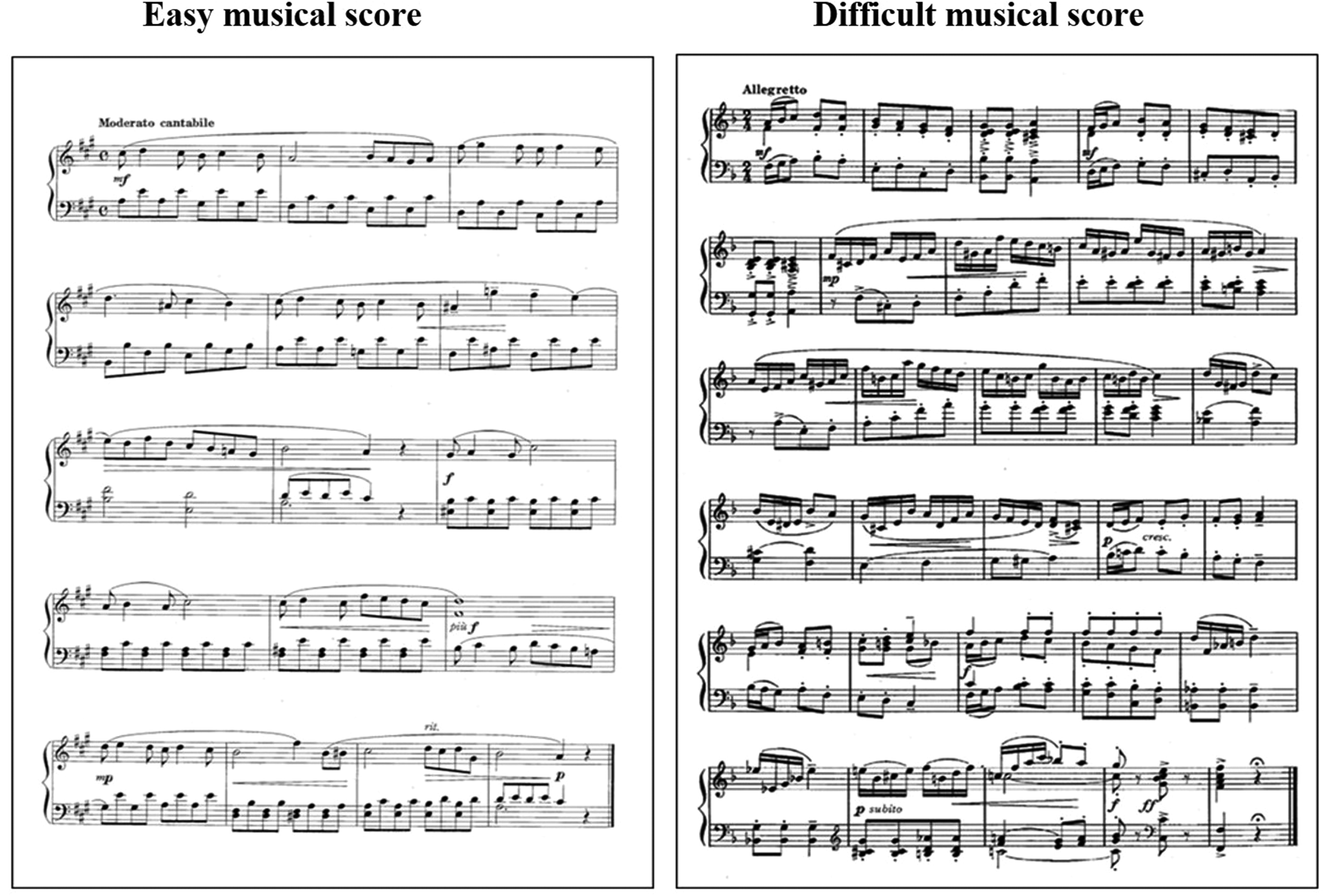
Musical scores as shown on the screen of an eye tracker.
In this study, a grade 5 music score (16 bars) was included as the easy score and a grade 3 music score (30 bars) was included as the difficult score for playing the piano with both hands. The tempo of the easy score was moderate and that of the difficult score was allegretto. We confirmed that all the participants did not know both the music scores after their performance.
Apparatus
We used the Tobii 17-inch display eye tracker (Tobii T120). By using this eye tracker, the gaze of both eyes can be measured without restraining the head. The sampling rate was 120 Hz. The resolution in the display was set to 1024 × 768 pixels. We placed a piano (CASIO privia PX-150 electronic piano with 88 keys) in front of the display, which was set to the correct height for playing the piano. The computer operating the eye tracker was being controlled by an experimenter; it was set aside from the display and separated by a partition.
Procedure
Calibration, measurement, and analysis were performed using the application software Tobii Studio. The eye tracker was calibrated for each participant using a 5-point calibration, wherein each participant followed the location of a red dot shown on the screen with both eyes. If the calibration was not correct, instructions appear on the screen to try again. We followed the instructions and did it again. After the calibration, the following instruction was shown on the display screen of the eye tracker. ‘Please sight-read the music score on the display for one minute. During the sight-reading, do not make any vocal sound or touch the piano.’ Then, eye gaze recording started. At the beginning, a fixation cross was shown on the centre of the display screen for three seconds to fixate the participant's gaze followed by the music score on the screen. Each participant watched the easy music score on the display screen for 60 s (sight-reading without piano performance).
After that, the experimenter showed the participants the tempo with a metronome and asked them to play the piano at that tempo. A fixation cross was shown on the centre of the display screen for three seconds to fixate the participant's gaze, followed once again, by the display of the easy music score. Participants played the piano while watching the music score (sight-reading with piano performance) and their gazes were measured. The playing time varied among participants. At the end of the performance, the experimenter ended the gaze measurement.
After the participants had performed the easy music score task, they performed the difficult music score task with the same procedure. Eye movements in all participants were recorded with the eye tracker. The order of the conditions was performed in the same order for each participant. For all participants, the order of the conditions was the same: 30 s of reading without playing, checking the tempo with a metronome, and then playing while looking at the music score. The piano performances were recorded on a sound recorder for the evaluation of the performances.
Measurements
Gaze Analysis
In this study, we defined fixation as having a gaze standing within a radius of 35 pixels according to the default setting of Tobii Studio. AOIs were defined every two rows, including a treble and bass staff in each music score (Figure 2). Each AOI was defined using the Tobii Studio AOI tool, used to draw an outline of the target. All AOIs were rectangular and had the same size. The area of each AOI for the easy music score was 15.01% of the score area, and the area of each AOI for the difficult music score was 15.85% of the score area. In Tobii Studio, the total number and duration of eye fixations to the AOI during each sight reading are measured. However, the gaze fixation duration increases as the number of gaze fixations increases. Therefore, we divided the duration of fixations by the number of fixations to obtain the fixation duration per fixation. In other words, it shows how long the gaze fixation lasted for one eye fixation.

AOIs in musical scores.
Computation of the Eye-hand Span
Tobii Studio can record eye movements and sound on a music score as a video. We made video recordings of all subjects’ eye movements and piano sounds. The eye-hand span was measured by playing back the video. When the subject played the first beat of each bar in the played video, the video was stopped, and the position of the subject's gaze at that time was counted as the number of beats from the first beat of each bar. For each subject, the number of beats of eye-hand displacement for all 16 measures in the easy score and all 30 measures in the difficult score were examined, and the average value was calculated for each music score. In this study, the eye-hand span was shown as the number of beats of displacement between the eyes and hands.
Evaluation of Performance
To determine the level of each participant's performance, two pianists who were not participating in the experiment were asked to evaluate each participant's recorded piano performance. The contents of the evaluation were as follows: the number of mistakes in sound, beat, and rhythm; tempo; quality of sound; and accent of sound. The maximum score was 50 points. The average of the evaluation scores of the two evaluators was obtained.
Statistical Processing
SPSS Statistics version 25 was used for statistical processing. An independent sample t-test was conducted to compare the performance scores and eye-hand spans of the experts and non-experts. We conducted two-way repeated measures ANOVA (group × AOI) for each dependent variable to analyse fixation count and duration per eye fixation on each music score. If the interaction was significant, a simple main effect test was conducted.
Results
Evaluation of the Performances of Experts and Non-experts
Table 1 shows the mean (M) and standard deviation (SD) of the performance skill scores out of the perfect score of 50 for both groups by two professional pianists. The performance score was significantly higher for experts than for non-experts on both the easy and difficult music scores. The effect sizes were large for both music scores.
Performance Scores in Experts and Non-experts.

Eye Gaze on Music Scores During Sight-reading Without Piano Performance
Examples of Eye Movements Based on the Scores of Experts and Non-experts
The gaze plots of an expert having a high piano performance rating during sight-reading without piano performance are shown in Figure 3. The gaze plots of a non-expert having a low piano performance rating during sight-reading without piano performance are shown in Figure 4. The circles in the figures show the eye gaze fixation, and the larger the circle, the longer the eye gaze fixation. The numbers in the circles indicate the order of the fixation. Both the figures show the 60-s gaze plots of the participants’ sight-reading of music scores they have never seen before.

Gaze plots of an expert having high performance rating during sight-reading without piano performance. The circles in the figures show the eye gaze fixation, and the larger the circle, the longer the eye gaze fixation. The numbers in the circles indicate the order of the fixation.

Gaze plots of a non-expert having low performance rating during sight-reading without piano performance. The circles in the figures show the eye gaze fixation, and the larger the circle, the longer the eye gaze fixation. The numbers in the circles indicate the order of the fixation.
In Figure 3, the gaze of the expert proceeded from the beginning in order, with a constant number and duration of gaze fixation from the beginning to the end of the score, in both the easy and difficult music scores. Particularly, for the easy score, the expert read to the end of the score within a determined time and then returned to the beginning. By contrast, Figure 4 showed that the non-expert did not read in any particular order, and neither the number nor the duration of gaze fixation was constant for the non-expert in either the easy or difficult music scores.
Fixation Count
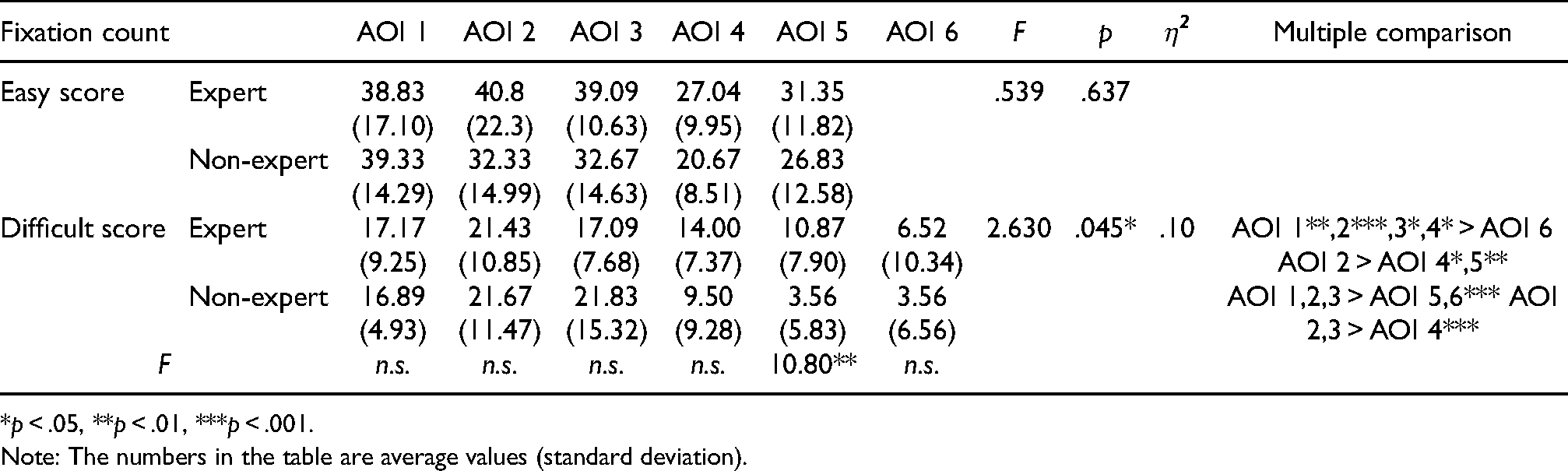
In the easy music score, there was no significant interaction for the fixation count between groups and AOI (F (2.68, 104.46) = . 539, p = .637); however, in the difficult music score, there was a significant interaction for the fixation count between groups and AOI, and the effect size was moderate (F (3.47, 135.19) = 2.630, p = .045, η2 = .10). The result of the simple main effect test showed that the fixation count was significantly larger in experts (M = 10.87, SD = 7.90) than in non-experts (M = 3.56, SD = 5.83) in AOI 5 (p = .002). Multiple comparisons of the fixation count in experts showed that the fixation count in AOI 1, 2, 3 or 4 was significantly larger than that in AOI 6, and the fixation count in AOI 2 was significantly larger than that in AOI 4 or 5; whereas multiple comparisons of the fixation count in non-experts showed that the fixation count in AOI 1, 2 or 3 was significantly larger than that in AOI 5 or 6, and the fixation count in AOI 2 or 3 was significantly larger than that in AOI 4 (Table 2).
Fixation Counts in Each AOI During Sight-reading Without Piano Performance.
*p < .05, **p < .01, ***p < .001.
Note: The numbers in the table are average values (standard deviation).
Fixation Length per Eye Fixation
In this study, we calculated the time per gaze fixation, because fixation length is affected by fixation count. There was no significant interaction for the fixation length per fixation count between groups and AOI in the easy music score (F (2.39, 93.31) = .399, p = .708) or the difficult music score (F (3.53, 137.46) = 2.176, p = .083) (Table 3).
Fixation Duration per Fixation in Each AOI During Sight-reading Without Piano Performance.

Note: The numbers in the table are average values (standard deviation).
Eye Gaze on Music Scores During Sight-reading With Piano Performance
Fixation Count
In the easy music score, there was no significant interaction for the fixation count between groups and AOI (F (2.79, 108.63) = 1.972, p = .127); however, in the difficult music score, there was a significant interaction for the fixation count between groups and AOIs (F (3.39, 132.03) = 2.913, p = . 031, η2 = .06). A simple principal effect test found that experts had a significantly larger fixation count than non-experts in AOI 1 (p = .025), AOI 2 (p = .050), AOI 5 (p = .007), and AOI 6 (p = .013). There was no significant difference in the fixation count of experts and non-experts in AOI 3 and 4. Multiple comparisons for the fixation count showed that the fixation count in AOI 2 was significantly larger than that in AOI 3 or 4 in experts and showed that the fixation count in AOI 3 was significantly larger than that in AOI 4 in non-experts (Table 4).
Fixation Counts in Each AOI During Sight-reading With Piano Performance.

*p < .05, **p < .01, ***p < .001.
Note: The numbers in the table are average values (standard deviation).
Fixation Length per Eye Fixation
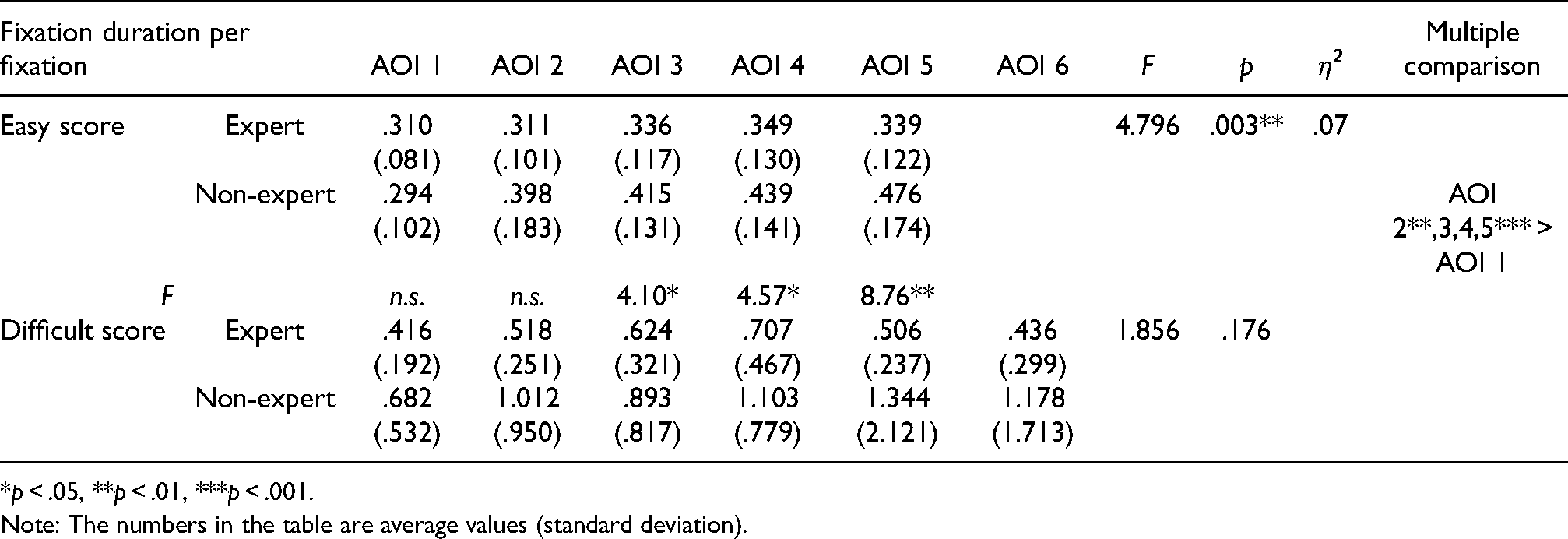
In the easy music score, there was a significant interaction for the fixation length per fixation count between groups and AOI (F (3.28, 127.73) = 4.796, p = .003, η2 = .07). A simple main effect test found that the fixation length per fixation count in experts was significantly shorter than that in non-experts in AOI 3 (p = .050), AOI 4 (p = .039), and AOI 5 (p = .005). Multiple comparisons for the fixation length per fixation count in non-experts showed that the fixation length per fixation count in AOI 1 was significantly longer than that in AOI 2, 3, 4 or 5 (Table 5). In the difficult music score, there was no significant interaction for the fixation length per fixation count between groups and AOI (F (1.40, 54.56) = 1.856, p = . 176).
Fixation Duration per Fixation in Each AOI During Sight-reading With Piano Performance.
*p < .05, **p < .01, ***p < .001.
Note: The numbers in the table are average values (standard deviation).
Eye-hand Span
Table 6 shows the mean and standard deviation of the eye-hand span of the experts and non-experts on the easy and difficult music scores. The eye-hand span was significantly larger in experts than in non-experts on both the easy and difficult music score. The effect sizes were large for both the easy and the difficult music scores. These results indicate that the experts were able to look further ahead in the music sheet than the non-experts.
Eye-hand Span in Experts and Non-experts.

We examined the relationship between eye-hand span and performance evaluation scores. The correlation coefficients between eye-hand span and performance evaluation scores were calculated, controlling for age, gender, and teacher/student. The partial correlation coefficients between the eye-hand span and the performance evaluation scores in the easy and difficult music scores were r = .635 (p < .001) and r = .685 (p < .001), respectively, indicating a strong correlation. In other words, it is clear that the more proficient the player, the larger the eye-hand span.
Discussion
This study aimed to compare the number of eye fixations, fixation duration, and eye-hand span between experts and non-experts during sight-reading on easy and difficult musical scores using a monitor-type eye tracker. Our sight-reading consisted of two stages: one without playing the music, followed by sight-reading with a piano performance. We analysed the eye movements during both stages of sight-reading. Five hypotheses were tested. The duration of an eye fixation differed between experts and non-experts only in the easy music score when accompanied by a piano performance. Hypothesis (1) was partially supported, and the duration of an eye fixation on a music score in experts was shorter than that in non-experts in the easy music score with piano performance. Hypothesis (2) that the number of eye fixations on the difficult part of the difficult music score increased compared with other part in experts without and with performances was supported. All hypotheses regarding eye-hand span were supported. That is, the eye-hand span was longer in experts than in non-experts and the piano performance in experts during sight-reading was rated higher than that of the non-experts. Furthermore, the higher the piano performance rating, the longer the eye-hand span.
Performance Skill Scores and Eye-hand Spans of the Experts and Non-experts
In this research, we aimed to compare and examine the sight-reading ability of pianists by measuring the movement of their line of sight at the time of their reading the music score, and their eye-hand span using an eye tracker. Our participants included teachers at a music university as the experts and students majoring in piano from the same university as the non-experts. Specifically, we used easy (16 bars) and difficult music scores (30 bars), focused on viewpoints of the music score by proficiency degree, and examined whether there was a difference in eye fixation. Importantly, two other pianists evaluated the individual performances of the experts and non-experts in this study to ensure that the experts had better playing skills than the non-experts. The results showed that the experts had significantly higher performance scores than the non-experts. The results also indicated that the eye-hand span in experts was significantly greater than that in non-experts. Previous studies have shown that experienced sight-reading players exhibit greater eye-hand span (Furneaux & Land, 1999; Gilman & Underwood, 2003; Truitt et al., 1997). Furthermore, in the research by Rayner and Pollatsek (1997), the size of the eye-hand span was found to be inversely correlated with the complexity of the score, indicating that the eye-hand span is larger for easier scores. This was true in this study as well, where the eye-hand span beats were significantly larger in the easy music score. The effect of performance tempo on the eye-hand span has also been shown (Furneaux & Land, 1999; Rosemann et al., 2016), wherein eye-hand span has been seen to increase at a slow tempo and decrease at a fast tempo. In this study, the larger eye-hand span in the easy score was considered to be because the specified tempo was slower than the tempo in the difficult score.
Furthermore, we found that there was a strong correlation between eye-hand span and performance evaluation scores for both easy and difficult scores, that is, the larger the eye-hand span, the better the piano performance. Hence, the size of the eye-hand span is related to sight-reading achievement and the performance technique score. Thus, the results of this research show that skilled piano players display a bigger eye-hand span (Furneaux & Land, 1999; Gilman & Underwood, 2003; Truitt et al., 1997). This may mean that excellent pianists have a larger eye-hand span because of their superior information processing speed in the brain (Jäncke et al., 1997; Jäncke et al., 2000). Such eye-hand span can be developed through years of practice and training (Rosemann et al., 2016).
Eye Movements During Sight-reading Without Piano Performance
During sight-reading without piano performance, in the easy music score, there was no significant interaction in the fixation counts nor duration per fixation between experts and non-experts. The non-experts in this study are piano students who aspire to become pianists, so they have had many years of experience in playing the piano since childhood. Even though they are non-experts, they can be considered highly skilled in sight-reading. This may be the reason why the easy score did not show a significant difference between experts and non-experts.
In the difficult music score, there were no significant interactions in the durations per fixation between experts and non-experts. However, there were significant interactions in the fixation counts between experts and non-experts. The experts had significantly greater fixation counts at AOI 5 of the music score. As the time for reading the music score in the sight-reading without piano performance condition was limited, it is likely that the non-experts took longer to extract information about the first half of the music score and had difficulty moving on to the second half. This can be seen from the fact that the number of fixations for AOIs 1–3 of the non-experts is significantly higher than the number of fixations for AOIs 5, 6. By contrast, the fixation counts of the experts were significantly lower for AOI 6 than for AOIs 1–4, indicating that the reading progressed with a constant frequency of eye movement except for AOI6. In addition, both the experts and non-experts had most fixation counts for AOI 2, which was the most difficult part of the music score. More fixation counts are indicative of a strong interest in and awareness of the gaze target (Yamamoto & Imai-Matsumura, 2013). These results suggest that both experts and non-experts pay more attention to the notes in AOI 2 than to other parts of the music score.
Eye Movements During Sight-reading With Piano Performance
During sight-reading with piano performance, in the easy music score, there was a significant interaction in the duration per fixation, but not in the fixation counts between experts and non-experts. The duration per fixation was significantly longer in the non-experts than in the experts while playing the piano. That is, it is suggested that the non-expert took a long time to read the information from the score. This may be because pianists who are not good at sight-reading tend to search for information written on the score (Goolsby, 1994). There was no significant difference in the duration per fixation of the experts’ AOIs 1–5, indicating that the time to get information from each AOI was almost the same.
In the difficult music score, there was a significant interaction in the fixation counts, but not in the duration per fixation between experts and non-experts. The experts had the most fixation counts for AOI 2, which was the most difficult part of the music score. However, non-experts showed an increase in the number of fixations to AOI 2 during sight-reading without piano performance but did not show an increase in the number of fixations to AOI 2 with piano performance. These findings suggest that the experts were aware of AOI 2, which is a difficult part of a difficult score, with or without piano performance. In addition, experts gazed at AOI 2 significantly more frequently than non-experts during piano performance. This result supports a previous study employing eye tracking that indicated that experts gaze more repeatedly at valuable clues than beginners (Wolff et al., 2016).
The duration per fixation of experts during the sight-reading with piano performance is longer for the difficult score than for the easy score, indicating that the experts needed to read more information for the difficult score than for the easy score. The duration per fixation increased for non-experts as well. The SD of the duration per fixation was larger for non-experts, indicating that there were large individual differences.
Difference Between Eye Movements With and Without Piano Performance During Sight-reading
The present study aimed to compare eye movements during sight-reading between experts and non-experts. Although not for this purpose, based on the results of this study, we will also discuss the differences in eye movements with and without piano playing during sight-reading.
Fixation Count
In both experts and non-experts, the fixation count decreased with piano playing in both the easy and difficult music scores. However, in the difficult music score, the fixation counts of AOI 4, 5, and 6 at the end of the score decreased for both experts and non-experts during sight-reading without piano performance. In sight-reading without piano performance, time was limited. Therefore, the non-experts could not read the last part of the music score sufficiently. During the performance, the fixation count did not decrease because the non-experts could gaze at the end of the music score. The number of eye fixations on the difficult part of the difficult music score in experts increased compared with other part both without and with piano performance, though that in non-experts increased only without piano performance. These results suggest that, especially in sight-reading with piano playing, non-experts were not able to read the score to the end within a certain period of time or were not sufficiently able to direct their gaze to the difficult part of the difficult music score.
Fixation Duration per Fixation
In the easy music score, experts showed similar duration per fixation for both with and without piano performance. By contrast, that for non-experts increased more without piano performance than with piano performance. In the difficult music score, both experts and non-experts showed an increase in the fixation duration per fixation without piano performance than with piano performance. The difference in duration per fixation between with and without piano performances was especially large for non-experts.
The finding that it took more time to read the music score with performance is thought to be because of the necessity for obtaining accurate information about the score to perform. However, experts did not increase the duration per fixation in the easy music score even when playing. This may indicate that the easy music score did not require more time to read. By contrast, the duration per fixation of the non-experts was longer than that of the experts, and increased significantly with piano performance, suggesting that the non-experts required more time to read the music score.
Conclusion
This study aimed to compare eye movements during sight-reading between experts and non-experts. The novel aspect of this study is that it is designed considering the limitations of previous studies. As such, it includes piano teachers who were both teachers at a music college and pianists as the experts and music college students studying to become pianists as non-experts, and makes use of an eye-tracking instrument that does not restrict the performers’ movements. In addition, using an easy (16 bars) and a difficult (30 bars) music score for two-handed playing, we investigated whether there were differences in the number of eye fixations, fixation duration, and eye-hand span between experts and non-experts. Our goal was to investigate eye movements during sight-reading under conditions similar to those experienced by real pianists. As a result, our hypotheses were largely supported, and we obtained the following results.
(1) The duration of an eye fixation on a music score in experts was shorter than that in non-experts in the easy music score with piano performance. (2) The number of eye fixations on the difficult part of the difficult music score increased compared with other part in experts without and with performances. (3) Eye-hand span was longer in expert than in non-experts. (4) The piano performance during sight-reading was rated higher for experts than for non-experts. (5) The higher the evaluation score of the piano performance, the longer the eye-hand span was.
Footnotes
Acknowledgments
The authors thank Prof. Satoshi Inagaki, Ms. Marie Amamoto and their collaborators in SOAI University for their participation in our research.
Action Editor
Elaine King, University of Hull, School of Arts.
Peer Review
Two anonymous reviewers.
Author Contributions
MM and KI-M researched literature and conceived the study. MM was involved in participant recruitment and data analysis. KM-I was involved in study design, gaining ethical approval, data analysis and writing.
Declaration of Conflicting Interests
The authors declared no potential conflicts of interest with respect to the research, authorship, and/or publication of this article.
Funding
The authors received no financial support for the research, authorship and/or publication of this article.
