



Abstract
Situated within the context of higher music education, the empirical orientation of this study is on the reflective accounts of young musicians participating in collaborative ensemble work in an educational institution in Norway. Drawing on theories of regulated learning from educational psychology, this study explores the affective and relational aspects of music students’ experiences of small ensembles. Specifically, it examines students’ perceptions of an ideal ensemble environment, socio-emotional challenges encountered during rehearsals, and the emotion-regulation strategies employed within these contexts. Eleven participants, 4 women and 7 men, with a median age of 22, were interviewed. The data were analyzed using a combination of inductive and deductive approaches to thematic analysis. The findings reveal that music students highly value collaborative ensembles as a gateway to acquiring new knowledge and performance skills, which are predominantly gained through peer interaction and active participation in the learning processes. Respect and receptivity emerged as critical qualities for fruitful musical collaborations. Notably, participants prioritized the well-being of the socio-emotional climate over musical competency, underscoring the formative role of emotions in these social learning environments. Furthermore, the study explored the self-reported emotion-regulation strategies employed by student musicians to maintain and/or re-establish a positive socio-emotional group climate. These regulation strategies involved both self- and other- directed processes.
Keywords
Introduction
Collaboration plays an important role in higher music education (HME) curricula; it is an essential skill for young musicians and indeed critical for professional careers (Gaunt & Westerlund, 2013). Collaborative learning environments, such as small music ensembles, refer to those that comprise students working together toward a shared goal (Schoor et al., 2015). Learning by way of collaboration is a group-level phenomenon; it is a situated and socially mediated activity with dynamically interacting cognitive, relational, and socio-emotional components (Miyake & Kirschner, 2014).
Research on collaborative learning within ensemble practices has gained impetus in recent years, focusing mainly on instructional designs that enhance collaborative creativity (see Creech et al., 2022), musical problem solving (e.g., Slette, 2019) and students’ experiences of ensemble work (e.g., Kokotsaki & Hallam, 2007). Prior research has documented that participating in ensembles can improve students’ aural skills, theoretical understanding, and technical abilities on the instrument through interactions with and scaffolding by others in the group (Cangro, 2016; de Bruin, 2022; King, 2021). Discussions taking place in small ensemble settings were found to improve students’ problem solving skills by encouraging negotiation and brainstorming (Slette, 2019). The social benefits of ensemble participation included an increased sense of community, belonging, and further engagement with the institution (Jääskeläinen, 2022; Kokotsaki & Hallam, 2007; Zhukov & Sætre, 2022).
More recently, researchers have utilized instructional designs to enhance students’ collaborative creativity. Informed mainly by neo-Vygotskian notions, these studies focused on different aspects of scaffolding emerging in communities of practice comprising student and professional musicians (e.g., de Bruin, 2022; Virkkula, 2016). Most of this research has been conducted as a series of workshops within jazz and popular music ensembles in HME. The designs were found to be successful as they provided students with a means of entry to expert knowledge; domain-specific concepts were learned, listened to, and practiced by not only conversing with the professionals but also through imitation and internalization of their skills (de Bruin, 2022; Virkkula, 2016).
While musical collaboration offers many benefits, it is not without its challenges. Collaborating musicians are bound to encounter confrontational issues that can give rise to socio-emotional challenges and conflicts among the ensemble members (e.g., Blank & Davidson, 2007; Davidson & Good, 2002; Hill et al., 2018; Murnighan & Conlon, 1991). The issue of socio-emotional dynamics is a crucial aspect of collaborative ensemble work, particularly in unsupervised educational contexts such as rehearsals, where the opportunities for peer learning are heightened (King, 2021). In a case study of collaboration, Davidson and Good (2002) explored the role of social interaction and musical interplay in a newly formed student string quartet. Their findings suggest that interpersonal dynamics and musical considerations are indeed intertwined, and the role of positive group dynamics is significant for a fruitful collaboration. In their study of nine string quartets, Murnighan and Conlon (1991) investigated the dynamics of intense group work. The researchers discovered that effective string quartets engage in productive discussions and debates, and resolve their conflicts by encouraging an environment where different ideas and perspectives could be explored. Interestingly, this study highlighted the positive role of task-related conflict within collaborating groups. By engaging in open debates, the quartets enhanced their task understanding and overall collaboration. In a similar vein, Blank and Davidson (2007) conducted a study on professional piano duos and documented that resolving disagreements between the players was crucial for the musicians to achieve success and ensure the sustainability of their collaboration. Strategies such as open communication (63%) and experimentation with each other's ideas (48%) were identified as significant approaches. Some of the duos studied even combined these methods and also utilized a “cooling-off” period to address conflicts (Blank & Davidson, 2007, p. 240). These studies collectively underscore the important role of socio-emotional dynamics and conflict resolution in fostering musical collaboration.
Interestingly, despite the growing empirical attention, research exploring these themes in small ensembles within specialist HME is still considered to be an underexplored field, in particular at interdisciplinary or transdisciplinary levels (Gaunt & Treacy, 2020). There is very little research, for example, on students’ experiences of small ensembles with respect to socio-emotional dynamics and emotion regulation. The existing literature is limited in scope and mainly centers around professional ensembles, particularly string quartets, within the Western classical tradition. The current study addresses this gap in the literature by employing the following overarching research questions:
How do HME students describe the characteristics of an ideal ensemble collaboration? How do HME students describe the socio-emotional challenges they face in collaborative ensembles? What types of regulation strategies do HME students use to regulate their own/others’ emotions in these contexts?
Theoretical Framework
Academic Emotions
When defined broadly, the word emotion refers to “affectively charged cognitions, feelings, moods, affect and well-being” (Boekaerts, 2011, p. 412). Academic emotions are those that are directly tied to learning, instruction, and achievement (e.g., anxiety, pride, boredom, Boekaerts & Pekrun, 2015; Pekrun et al., 2014). Although emotions are relatively short-term events (Rosenberg, 1998), they are motivationally important in learning as they incite operations that influence students’ attention, problem solving, and interactions with others (Järvenoja et al., 2017; Linnenbrink-Garcia & Pekrun, 2014; Lobczowski et al., 2020; Tahirbegi, 2022).
Collaborative learning situations add a layer of complexity to students’ emotional experiences (Mänty et al., 2020), in that personal attributes and students’ individual affective states interact with situational variables and shape the socio-emotional climate of the group and learning at large (Bakhtiar et al., 2018; Lobczowski, 2020). Students working in small group settings experience a variety of emotional reactions that are associated with themselves, the others, the task, or the group's performance (Hareli & Parkinson, 2008; Järvenoja & Järvelä, 2009; Pekrun & Linnenbrink-Garcia, 2012), all of which have an influence on the group's socio-emotional climate. A positive climate is imperative to a fruitful collaboration, and it is reciprocally linked to students’ emotional experiences and vice versa (Bakhtiar et al., 2018). For instance, when a violist perceives the climate within their quartet as reliable and encouraging, they may feel more confident and less anxious during rehearsals. Ultimately, these perceptions may instigate further positive socio-emotional interactions, helping the ensemble maintain an ideal working climate. In that respect, the socio-emotional interaction is characterized here as the deliberate interchanges between the members of an ensemble that “shape perceptions of emotions …, such as developing trust and cohesion, providing and seeking support, and building confidence and motivation” (Bakhtiar et al., 2018, p. 11).
Unfortunately, collaborating learners face a variety of challenges, and finding ways to work productively may be agonizing for some groups (Järvenoja & Järvelä, 2013; Lobczowski et al., 2020; Näykki et al., 2014). The challenges experienced in these settings are intricate and stem from multiple sources (i.e., cognitive, motivational, and relational), such as difficulties in task negotiation, level of engagement, or personal differences (Järvelä et al., 2010; Järvenoja & Järvelä, 2013; Linnenbrink-Garcia et al., 2011; Lobczowski et al., 2020), all of which, if not regulated, may agitate the affective atmosphere of the group and disrupt collaboration. Arguably, not all conflict is bad for learning; for example, cognitive challenges (e.g., confusion) were found to be the driving force behind an individual's academic development, and they have been positively linked to group work through negotiation and knowledge exchange (Murnighan & Conlon, 1991; Näykki et al., 2014). The added complexity is that addressing these challenges at a group level requires a great deal of social interplay which, on occasion, may bring about socio-emotional challenges if negative interactions dominate group discussions (Linnenbrink-Garcia et al., 2011; Näykki et al., 2014). This view implies that the challenges alone are not the cause for concern; rather it is the manner in which the group responds to a challenge that is important. Thus, a group's ability to optimize interpersonal relationships and regulate various aspects of their learning becomes crucial for a productive and enjoyable collaboration (Hadwin et al., 2018; Schoor et al., 2015). Surprisingly, empirical work on these themes have been slow to emerge in HME research despite their well documented role in other domains. As of yet, little is known about the socio-emotional challenges students experience in small music ensemble settings and how collaborating musicians regulate their emotions in the service of their learning and performance goals.
Understanding Regulation in Collaborative Learning Contexts
Research on regulation is vast, and the context in which an individual regulates is important (Schoor et al., 2015). Regulated learning in educational contexts refers to an active constructive process where learners plan, monitor, and adapt their cognition, motivation, emotions, and behaviors (Hadwin et al., 2018). Earlier conceptualizations of the construct mainly focused on the individual processes that are formed by personal, social, and situational variables (see: Zimmerman & Schunk, 2001). More recently, however, researchers have begun differentiating between levels and modes of regulated learning taking place in collaborative contexts (Bakhtiar & Hadwin, 2022; Hadwin et al., 2018).
In that respect, it is posited that three types of regulated learning emerge in the context of collaborative learning: self-regulation of learning (SRL), co-regulation of learning (CoRL), and socially shared regulation of learning (SSRL) (Bakhtiar & Hadwin, 2022; Hadwin et al., 2018). While SRL “refers to a learner's deliberate planning, monitoring, and regulating of cognitive, behavioral, and motivational/emotional processes toward completion of an academic task/goal” (Hadwin et al., 2011, p. 68), SSRL refers to “group-level” regulation of these processes (e.g., co-creating a rehearsal plan to rehearse through intonation challenges). It “occurs when groups regulate as a collective, such as by construction and maintenance of interdependent or collectively shared regulatory processes, beliefs and knowledge” that are geared toward the joint goal (Miller & Hadwin, 2015, pp. 576–577). Although SRL alone is not adequate for a fruitful collaboration, effectively regulating oneself in a group setting is a necessary condition for collaboration, and students’ SRL needs orienting toward the collaborative goal (Miller & Hadwin, 2015) (e.g., familiarizing oneself with the repertoire prior to the first group rehearsal so that higher-order discussions can take place).
CoRL, on the other hand, occurs when group members help each other regulate, either as individuals or as a group (e.g., a student suggests a breathing strategy to a friend to help them regulate their anxiety before their rehearsal) (Bakhtiar & Hadwin, 2022; Hadwin et al., 2018). It requires group members’ individual attention to one another (e.g., to their mood, level of engagement, or on-going contribution), as well as the will to guide and prompt when individual performances begin to deteriorate (Miller & Hadwin, 2015). Although co-regulation prompts individuals to self-regulate, the wider aim of the regulation is to pursue the group goal; it is done, however, through investing in the assets of each member so that the group as a unit can perform at a higher level (Miller & Hadwin, 2015).
SRL has been positively linked to higher academic achievement both in general education (Schunk & Greene, 2018) and in music performance education research (see review by Varela et al., 2016). Particularly, its essential role in music students’ skill acquisition, metacognitive strategy use, and self-efficacy beliefs are well documented (McPherson et al., 2018; Nielsen, 2001, 2004). A limited, but emerging body of literature on SSRL in music education has shown that students jointly negotiate, and evaluate musical activities through verbal and non-verbal interactions (i.e., joint musical participation) (see de Bruin, 2017; Hurme et al., 2019). Through this understanding, these authors suggested that joint musical interaction can be interpreted as a form of SSRL unique to this domain. Of the different targets of regulation (i.e., cognition, motivation, emotion, and behaviors), a special interest here concerns the regulation of emotions in collaborative ensembles.
Emotion regulation (ER) implies “shaping which emotions one has, when one has them, and how one experiences or expresses these emotions” (Gross, 2014, p. 7). In educational settings, ER also involves one's capacity to understand and modify aspects of one’s emotional responses in order to maintain an optimal engagement to the learning task (Boekaerts, 2011). Ultimately, ER functions to both sustain a positive affect or exert control over a negative one; in that respect, it is different from coping, which involves management of negative affect alone (Gross, 2014).
Collaborative learning contexts require both monitoring and exerting control over one's own emotions, as well as attending to the needs of the others and the socio-emotional climate of the group through purposeful interactions (Bakhtiar et al., 2018; Järvenoja & Järvelä, 2009; Lobczowski, 2020). For example, individual musicians can regulate their own emotions to manage anxiety on stage during ensemble concerts (i.e., intrapersonal self-regulation), or they can direct their regulation efforts to help a friend in distress (i.e., interpersonal regulation) by providing comfort (e.g., humor) or validation. Interpersonal ER, alternatively referred to as socio-emotional regulation, encompasses processes “targeting the emotions of the group” (e.g., disappointment after a poor chamber music concert), maintenance of the positive group climate, or the relations between the group members (Lobczowski, 2020, p. 3). The quality of the interaction becomes highly significant here as it is argued to be the main channel through which socio-emotional regulation is cultivated (Isohätälä et al., 2020; Törmänen et al., 2021).
Researchers concerned with musicians’ ways of attending their emotions have mainly focused on music's role in expressing and/or inducing a certain kind of emotion to the listener (e.g., Juslin & Laukka, 2004; Sloboda, 1991) or describing the means by which performers express particular emotions (e.g., Juslin, 2001; Van Zijl & Sloboda, 2011). Musicians reported using different forms of inner techniques, such as visualization, to achieve the desired emotional state needed for performance (Persson, 2001). A particular relevance of this line of inquiry to the current study is that musicians’ use of these inner techniques can be interpreted as a form of emotion-regulation strategy specific to this domain: that is, tempering various aspects of one's emotions (Gross, 2014) to perform with the intended expressivity. In that respect, these studies highlight the important connection between the “self-induced” emotions and their role in construction of musical expression; they do not, however, invoke the role of emotions and emotion-regulation strategies in reference to learning and performing music in collaborative ensemble contexts.
With relatively few studies exploring ensembles as sites of collaborative learning, coupled with the emerging call to further interdisciplinary research (Gaunt & Treacy, 2020), there is an opportunity here to draw on the well-established field of educational psychology to explore music students’ experiences of ensembles as sites of collaborative learning, with particular attention to the socio-emotional dynamics and relevant ER.
Methods
Research Context and Participants
Given the lack of research-based perspectives on small ensembles, the current study adopted a qualitative interview approach to generate knowledge about student musicians’ experiences of ensemble work with respect to the research questions in hand (Polkinghorne, 2005).
The sample comprised 11 young musicians with a median age of 22, from 3 different ensembles. Two of the ensembles performed music in the Western classical tradition, and one band performed jazz, folk, and rock music. Seven participants were men and four were women. Most of the participants were full-time music students (n = 9), one participant was a very recent graduate of the same institution, and one participant studied part-time. The names have been changed to maintain anonymity. Some additional information is provided below (e.g., instrument, age) to support reader interpretation (See Table 1).
Main characteristics of the sample, including instrument, gender, age, years on the instrument, and genre.

The selection criteria for the participants in this study consisted of three main components. First, participants were required to be either current students or recent graduates within the past six months. Second, they needed to be actively involved in an ensemble that had plans to perform a concert. Last, in addition to their current ensemble involvement, participants were expected to have completed a minimum of two semesters of ensemble work within educational settings. These criteria were established to ensure that the recruited participants possessed a substantial amount of past ensemble experiences that they could refer to when responding to retroactive interview questions. It is worth mentioning that this study is part of a broader project that explores small music ensembles as contexts for collaborative learning. Therefore, the inclusion of the second criterion regarding “current” ensemble work primarily aimed to meet the requirements of a separate study within the larger project.
The students were recruited through in-person invitation. Such an approach allowed the researcher to address any questions or concerns that the potential participants had, enabling better communication between all the parties involved (Creswell & Poth, 2017). The recruitment process involved the researcher attending one of the rehearsals and explaining the main objectives of the study. Subsequently, within a week, provided that all the ensemble members met the selection criteria, an email was sent to follow up and inquire about the ensemble's interest in participating in the study.
Data Collection
The interviews were conducted in a meeting room within the participants’ educational institution, and each session was audio-recorded. The students were interviewed individually by the author in a semi-structured, face-to-face manner, with an average duration of approximately 40 min per interview. The decision to utilize an individual interview approach stemmed from the rationale of creating a comfortable setting that would encourage the students to express their thoughts and experiences on ensemble work more freely (Creswell & Poth, 2017). The individual interviews also aligned better with the study's objectives, which aimed to capture the affective aspects of ensemble work through the students’ reflective accounts. Such nuanced insights would be challenging to capture in a group setting where the entire ensemble was interviewed collectively (Kvale & Brinkmann, 2015).
The conversation began with broad, scene-setting questions that were aimed to elicit responses about the participants’ experiences of ensemble work; they were asked what they liked about the collaborative aspects and how they defined an ideal ensemble environment.
Then, considering the theories guiding this inquiry, the participants were directly probed to comment on the challenges, interaction, and relevant regulation – for example: What are some of the challenges that come with rehearsing with others in a group setting? What did you, as a group, do to overcome the challenges you just described? How did you regulate your own emotions? How did you help your group to get going? The combination of open-ended and targeted interview questions allowed data reflecting students’ experiences to be gathered while addressing the study's a priori theoretical orientation (Kvale & Brinkmann, 2015).
Analysis
The interview data were transcribed verbatim and analyzed through thematic analysis (TA). TA is a pragmatic and flexible tool for identifying, analyzing, and interpreting patterns of meaning (“themes”) within qualitative data (Braun et al., 2019). For the most part, the analyses were done inductively following the six-step framework by Braun and Clarke (2006). The initial step involved repeated and active reading of the entire data set to become familiar with the content. Then the preliminary coding began for the key concepts related to students’ experiences of ensemble work. The gathered codes were sketched in a chart-form using a mind-map software called Mindmeister. Utilizing mind-maps helped to visualize and organize the thematic information effectively.
Before the themes for the final thematic map were refined a theory-informed approach was employed to enhance the level of granularity in coding with regard to the research question concerning ER. The data were manually searched for emotion-related statements and strategies, which were then deductively coded for the level of regulation. Once a statement was coded as “emotion-regulation strategy,” a deductive coding scheme (see Table 2) was utilized to identify the level of regulation (e.g., self or other).
Coding scheme for level of ER (these definitions were adopted from Hadwin et al., 2018 to small ensemble contexts).

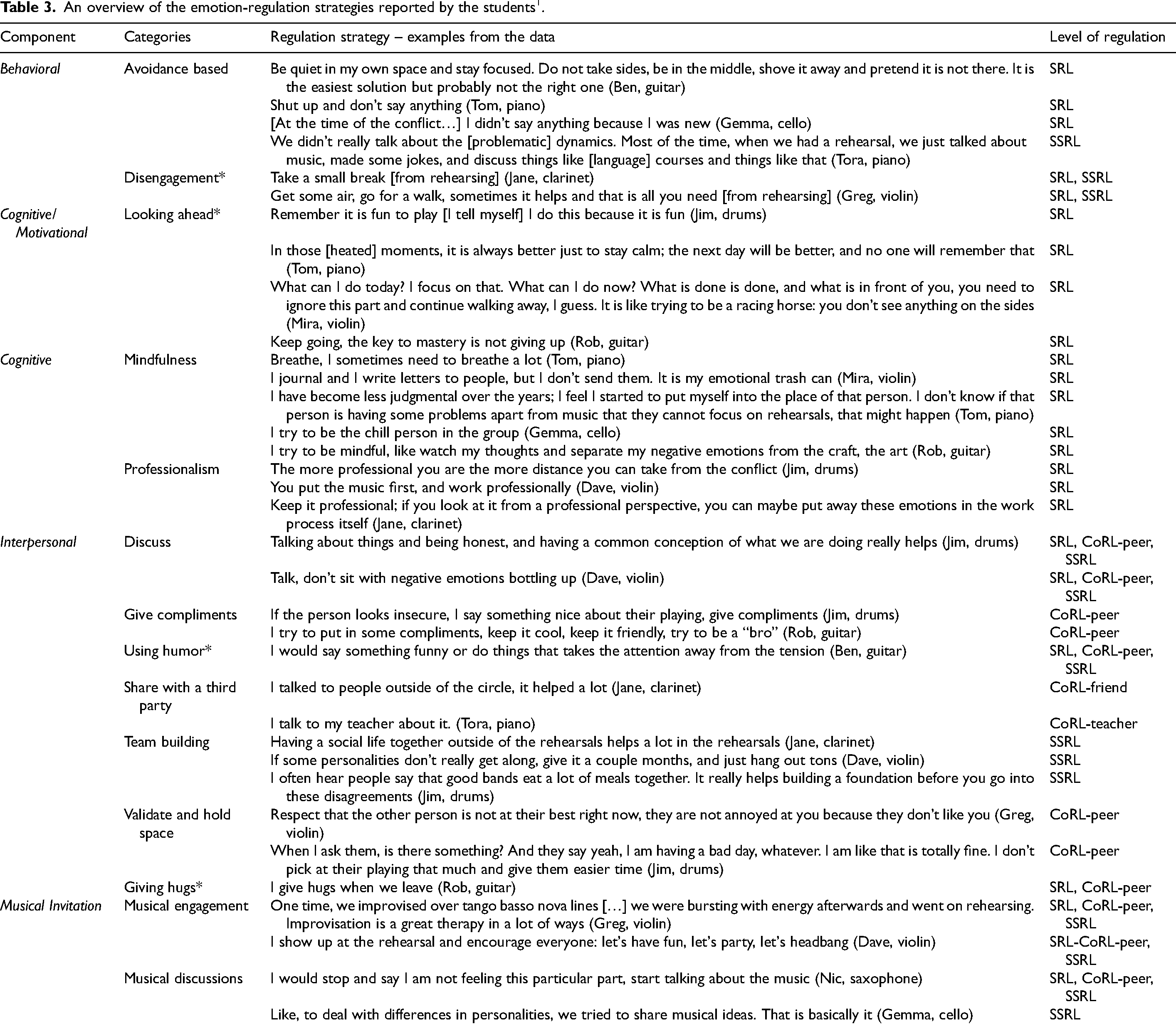
It should be noted that the analyses pertaining to the further categorization of strategies in this study draw inspiration from Lobczowski et al.’s (2021) extensive research on interpersonal ER in the context of general education. Lobczowski et al. (2021) found that emotions in social learning contexts can be regulated through various strategies targeting distinct processes, including motivational, behavioral, cognitive, and interpersonal (see also Järvenoja et al., 2019; Törmänen et al., 2021 for cognitive ER strategies). To identify such nuances within the reported strategies in this study, a code mapping approach was employed: the reported ER strategies were organized into a comprehensive table, grouped under similarity, and presented with direct quotations to enable reader interpretation (See Table 3). The strategies that were found to be similar to Lobczowski's findings were assigned the same “strategy label” (See Appendix B. in Lobczowski et al., 2021, p. 15). The newly identified and emerging strategies (e.g., musical invitation, mindfulness, team building) were assigned new labels by the author.
Taken together, a blended inductive and deductive approach to analysis here allowed room to explore new information while identifying the constructs in line with the theoretical premises of the study (Patton, 2014). After the first draft of the thematic map was outlined, the names of each theme to be presented in the final report were refined to ensure that they were concise and descriptive. Finally, the themes were revisited considering the relevant literature and presented with compelling extracts reflecting their meaning with relation to the research questions posed (Braun & Clarke, 2006; Braun et al., 2019).
Findings
The TA revealed three main themes and several sub-themes with respect to the research questions guiding this inquiry (see Figure 1). Students recurrently expressed their subjective feelings of ensemble work by contrasting solo versus collaborative engagements (sub-theme 1.1 – the notion of “togetherness”). While specifying the collaborative learning conditions that provided the greatest benefits to their learning and performance, all students highlighted the importance of interpersonal relationships; notions of respect and receptivity (sub-theme 1.2) were common in these discussions.

Overarching themes and sub-themes emerging from the 11 interviews.
The second overarching theme accounted for the socio-emotional challenges encountered by the students and their subjective experiences related to these challenges. Students frequently described these experiences within the context of interpersonal interactions, primarily through descriptions portraying differences in genre-related self-identifications (sub-theme 2.1) and level of engagement (sub-theme 2.2). The self-reported ER strategies denoted the overarching theme 3. These strategies aimed to either maintain a positive emotional climate within the ensemble or exert control over negative self- or other-related emotions. The reported strategies revealed several sub-themes that were further categorized based on their similarities. In what follows, the findings relevant to these themes are presented in detail with quotations that best encapsulate their meaning.
Theme 1. Ensembles as Sites of Collaborative Learning
The first research question, How do HME students describe the characteristics of an ideal ensemble collaboration?, serves as a starting point for the exploration of students’ experiences of small ensembles within educational settings. The analysis revealed a positive overall association between ensemble work and learning, as well as performance at large. Students predominantly expressed their perceptions of collaborative learning in small ensemble settings in relation to shared knowledge construction, joint goals, and interpersonal connections.
The notion of “togetherness” (sub-theme 1.1) was mentioned by all students as the central characteristic of collaborative work. Regardless of their musical genre, all students interviewed described their involvement in small ensembles by drawing a comparison to their solo endeavors. Some students articulated this in terms of creating “something” they would not be able to achieve alone. For instance, Nick described collaborative work as an opportunity to align his existing knowledge to create new meaning by “coming together” with fellow musicians: …it is undoubtedly the feeling of coming together with other musicians. This may sound a bit pretentious, but creating something that you wouldn’t be able to do on your own. It is quite different from practicing on my own. Because there is so much more room for music when you are interacting with other musicians in a group. The feeling of playing with someone else and the impulses of where the music actually happens – which I often feel does not happen when practicing alone. When you play with others you actually get to use the stuff you have been practicing, try to make something out of it (Nick, saxophone).
Tom described a similar view in another way, defining ensemble work as “giving something together”: For me playing with people is an opportunity of sharing something and giving something together because if I play a solo, I am giving something myself. If I can give it with other people, it is a completely different experience (Tom, piano)
Some students directly aligned small ensemble work with active participation, particularly through opportunities afforded by the social setting, which allowed room for closer interactions and conversations. Jane's comparison to her other performance engagements here led her to define small ensembles as sites to “discuss” and “learn a lot”: When you are a soloist, you are on your own and when you play in an orchestra you don’t get to speak. But, in an ensemble, I think we learn a lot. Because all of us can discuss various things. We can really go into details and have conversations about music, which is very good (Jane, clarinet).
Tora made a similar observation but referred explicitly to the feeling of loneliness and the significance of collaborative interaction for her. She thought how chamber music provided her, as someone who has largely been positioned as a soloist, with a platform for conversation: The best thing is… as a soloist for so long you always feel so lonely. Even when I get a repertoire I really want to play, I am so excited in the beginning, but after maybe three weeks, I get really bored because I don’t have anyone to talk to. Maybe I can talk to my teachers, but that again depends on their teaching style; some just tell you, oh “here you should play slower” and that is it. So, you don’t really have someone to talk with. I think that is the best thing about chamber music, you can get so many different opinions (Tora, piano).
Tom, the other pianist interviewed, also spoke about loneliness and how chamber music helped alleviate some of that by providing opportunities to be with friends: Spending time with friends, enjoying time with them, enjoying new music, learning to listen. This is a bit of a sad thing, especially for solo instruments. Piano is seen usually as a soloistic instrument, and we spend so much time practicing alone. So, chamber music breaks a bit of that. Because we are all humans after all. We need it. Loneliness is a very big issue and sometimes people don’t think about it (Tom, piano).
These descriptions suggest that music students not only value but desire social interaction in their learning, particularly through domain-bound conversations and activities with peers. In parallel, the setting that nurtures this need the most in educational settings appears to be the small ensemble context.
When drawing on the socio-interactional aspects of these settings, students described the types of interpersonal interactions that facilitated collaborative learning. Often, the students perceived those interactions that provided socio-emotional comfort as facilitating collaboration. The definitions the students provided in relation to this centered around respect and receptivity (sub-theme 1.2). For example, in her interview, Gemma spoke at length about her understanding of an ideal ensemble climate. She further emphasized that having respect for one another was above musical competency, and how the feeling of being judged led to repression in these settings: [In the past] I have had some people who were quite bossy, and I don’t think that helps. I think the most important thing is to have respect. Even if people are playing at different levels. The respect is the base line. Because if there is no respect, it is not possible to have an enjoyable experience as a group, that is the most important thing for me. I think you need to also feel comfortable. Because you have to play, and you need to communicate the things you think [about music]. If you feel like you are being judged every time you talk, that is not nice (Gemma, cello).
Mira had a similar view as she laid out the basic tenets of collaboration in her understanding: For me, being in a warm and respectful environment would be the number one. If the personalities don’t click, no matter how well we play it doesn’t matter anymore. Because if the environment becomes toxic, even though we sound fabulous I just don’t want to be there anymore (Mira, violin).
Tom spoke about “respecting everyone equally” and how it involved holding space for what they had to say musically and otherwise: For my case, it is important to have a good connection with the people we are working with. One of the most important ingredients is respecting each other in all levels and being able to listen not only to what we are playing, but also to what people have to say about us or about the group. So, it is about respecting everyone equally, that is very important (Tom, piano).
Some students contextualized their experiences by specifically amplifying the importance of communication in a collaboration. Having the freedom to provide constructive feedback or opportunities to express unusual opinions appeared to be sought-after qualities in an ideal collaboration. Nick talked about level of engagement and receptivity; here he is describing how the two feed each other in social learning contexts: I think it is really important for a thriving group that all the members are engaged, so that everyone feels like they are able to contribute with ideas – where they dare to propose something, musically or whatever. Also, that it is an open-minded place; everyone is accepting proposals, as well as people don’t get hurt by proposals being heard in a way (Nick, saxophone).
Other participants expressed similar views. Rob articulated “I think it is important to engage in respectful communication with one another, while being direct about expressing one's thoughts without worrying about potentially hurting someone's feelings” (Rob, guitar). Ben explicitly referred to freedom to communicate as well, and he said “I really think something that is so important is to get to a stage where you all can communicate freely. Then you need to know each other really well, both the playing style and the personality, often those things mirror each other” (Ben, guitar).
Taken together, these accounts indicate that the quality of interpersonal relationships is central to students’ framing of an ideal collaboration. There appears to be a link between positive relationships among the group members and students’ motivation to collaborate. Furthermore, despite the subtle differences in their perceptions of an ideal collaboration, virtually all participants classified respectful ensemble climate above musical competency, suggesting that an ideal musical collaboration requires socio-emotionally well-functioning musicians who are open to new ideas and expressions.
Theme 2. Socioemotional Challenges: Feeling and Meaning in Ensemble Contexts
The second overarching theme emerged in response to the research question, How do students describe the socio-emotional challenges they face in collaborative ensembles? and revealed two sub-themes. The students often described these in relation to interpersonal dynamics, mainly through examples depicting differences in genre-related self-identifications (sub-theme 2.1) and level of engagement (sub-theme 2.2).
The differences in artistic choices can, for example, stem from different musical backgrounds. Jim drew a connection from this to one's genre-related self-identification. He reflected on how much he attributed being a jazz musician to his personal identity, and how being challenged in that sense felt so personal in a way: We all come from different backgrounds. I play a lot of Jazz and beat music, while the guitarist plays metal, rhythmical, technical, and progressive thing. The bassist has played a lot of Motown, and another member has played a lot of traditional folk music. When we clash together, we have different ways of thinking about music. Everyone's music is deeply personal, sometimes one has a difficulty distinguishing oneself as the musician and the person that you are. So, your musical ideas are somewhat related to who you are. When you’re challenged on your musical ideas that could be taken as “oh you don’t like me?” (Jim, drums).
He further described that such situations, at times, created frustration for him: “you can get a lot of anger and […] helplessness, because sometimes you feel like you know better and ‘ah, why don’t you listen to me? I have experience in this!’.”
Rob also defined a similar challenge, and he spoke explicitly about the dangers of egotistical thinking in collaborative contexts: For me, the biggest challenge is getting over your own ego – and the same for the others. If you get really stuck with the identity that you are a jazz musician, for example, and you don’t want to go out of your comfort zone and play a half-time backbeat or something like that. Or like, “I am a metal guitarist, I don’t do that, it's too cheesy for me,” and so on. [ha-ha] I catch myself doing it all the time (Rob, guitar).
Despite performing in the Western classical tradition, Jane made the same observation as Jim and Rob about the interwoven link between artistic choices and one's individual identity. While commenting on these issues, she highlighted her feelings of uncertainty stemming from these challenges: In a chamber group, you’re just a few people, and you all have these opinions. If you have a bigger group, like an orchestra, the conductor is the one saying “ok do it like this,” and of course you do. But a chamber group in a way is about each person's personality. If your personal opinions don’t work together, it doesn’t go in any direction, really. You know you always get a bit upset when people don’t believe in our opinions. In a way, you start saying to yourself, maybe your opinion is not good. You start doubting yourself and saying to yourself, “maybe I am not right; maybe the other person is” (Jane, clarinet).
In common with the students above, Dave also talked about the difficulties related to various “identities” that come into play in such circumstances: If you have an opinion that is very personal in a way, even though it is music, but you know, music is such a personality thing that sometimes you form an opinion over something that you are very convinced by, and it becomes kind of a personal issue. So, if the group decides against it, it feels like a personal thing. You should, of course you want the music to be personal but also, just understand that it doesn’t have to be (Dave, violin/ Hardanger fiddle).
Thus, these accounts highlight the impact of musical identities on students’ self-relevant thinking, which offers insights into better understanding the triggers of negative socio-emotional interactions in ensemble contexts. Here, it is worth noting that self-conceptions in this regard appear to intensify as a result of external input and at times lead to egotistical thinking patterns creating socio-emotional challenges.
Challenges associated with varying levels of engagement emerged as another sub- theme (sub-theme 2.2) when some students expressed their disappointment in that regard. A variety of issues, such us “lack of focus,” “level of preparation,” and “scheduling,” were brought up by the participants. These experiences were often described as resulting in feelings of annoyance, even exhaustion. Some of these experiences are illustrated in the following examples by Greg, Mira, and Gemma: Sometimes, if one person is unfocused, then it can be a bit of a problem. If they don’t go along, especially if the other members are really focused, and then there is this one person lagging, dragging down the group. For me, it starts with a bit of frustration on this member, and then it quickly escalates – you know, you get a bit annoyed if they are still unfocused at an annoying level. Then you really start giving up quite fast. It leads to you becoming more unfocused yourself and as a group, and the energy level really drops. In a matter of minutes, you can be exhausted (Greg, violin).
It is about the work ethic. How much you prepare before coming into the rehearsal. Some people practice at the rehearsal. The rehearsal is not to practice your own part, it is to play with others and rehearse, literally. So, I lose interest and get angry. I am annoyed, I am like “you signed up for this you are not prepared” (Mira, violin).
Scheduling was really challenging for [our ensemble]. We wasted so much time discussing and voting on it and so on. I am not sure what to do in these situations. Honestly, I don’t want to be the one making the final decision, so I end up being like a middleman and that can be frustrating (Gemma, cello).
Such accounts suggest that subjective feelings of annoyance, as well as anger and tension, are likely to disengage students from ensemble work, which as a result may negatively affect individual students’ performance while undermining their collaborative efforts.
Students’ descriptions provide evidence that collaborative ensemble work can be challenging in that it may bring about interpersonal interactions that trigger various emotions, which need to be effectively regulated in order to restore collaboration.
Theme 3. Emotion Regulation in Collaborative Contexts
The third theme responds to the last research question, What types of regulation strategies do HME students use to regulate their own/others’ emotions? It covers the ER strategies described by the students that are directed toward either sustaining a positive affect or exerting control over a negative one (Gross, 2014). The manual coding of statements relating to ER strategies revealed 56 strategies. These were then sorted based on their similarity into one of five categories: behavioral, cognitive, cognitive/motivational, interpersonal, or musical invitation (See Appendix II for definitions). The categories marked with an asterisk (See Table 3) exhibit similarities to some of the categories documented by Lobczowski et al. (2021) in an earlier work on interpersonal ER, thus were given the same name to establish cumulative evidence on ER strategies within the larger field of educational sciences.
An overview of the emotion-regulation strategies reported by the students1.

1Coding scheme for level of emotion regulation, adopted from Hadwin et al. (2018)
Overall findings suggested that students utilized various ER strategies to maintain (e.g., keep it friendly) and/or re-establish (e.g., saying something funny) a positive socio-emotional group climate. They also expressed having various self-regulation strategies to alleviate their own negative emotions (e.g., keeping a journal) or to foster positive ones (e.g., staying mindful). The interpersonal regulation strategies included showing empathy (e.g., validation or giving hugs) and praising each other's playing during rehearsals (e.g., compliments). The group-level regulation strategies put forward by the participants included encouraging musical participation and building social connections outside of the rehearsal room. Table 3 provides an overview of the ER strategies with direct quotations capturing their essence.
The behavioral strategies involved modifying certain behaviors as a means of ER. Examples of such strategies included pretending that conflicts did not exist, remaining quiet, or taking breaks from the situation, for example by going for a walk. The cognitive strategies involved changing the way one thinks about an interaction or an event to alter its emotional impact (i.e., cognitive reappraisals; Gross, 2014). Students reported engaging in moment-to-moment awareness strategies, such as breathing mindfully or practicing non-judgment in an attempt to self-regulate the negative emotions arising in these social learning contexts. Thinking professionally was another reoccurring strategy mentioned by the student musicians.
Strategies categorized as “looking ahead” involved both cognitive and motivational elements (i.e., Lobczowski et al., 2021). This category encompassed students redirecting their attention away from the current situation to overcome negative emotions (cognitive aspect, e.g., remember it is fun to play) and maintain motivation to carry on with the rehearsal in hand (motivational aspect, e.g., keep going). The interpersonal regulation strategies involved leveraging peer support within the ensembles, including giving compliments, working on creating a safe space, and engaging in open discussions to address arising issues. Additionally, musical invitation emerged as another category where students reported engaging in music in different ways to regulate the socio-emotional climate; for example, taking a break from the repertoire to improvise on another musical work, or by initiating a conversation about the repertoire to break from the deteriorating socio-emotional climate.
Taken together, although students varied in their descriptions of ER strategies, there were overlapping approaches across the data set. The reported strategies highlight the significance of both interpersonal connections and self-related efforts in managing emotions within rehearsal contexts.
Discussion
The purposes of this study were to explore three overarching research questions concerning small ensembles as sites of collaborative learning. The first intention was to obtain descriptive data on students’ characterizations of an ideal ensemble environment. The second objective was to investigate the perceived socio-emotional challenges encountered during ensemble rehearsals, including students’ subjective feelings in that respect. Finally, the ER strategies students utilized in these contexts were explored.
First and foremost, the students perceived small ensemble collaboration as highly beneficial to their learning and performance. This was mainly attributed to the size of the group, which enabled them to engage in social interaction and enter dialogue with peers. Students’ comparisons to other educational activities within institutional settings (e.g., large ensembles or one-to-one tuition) further highlighted the perceived significance of collaborative learning in small ensembles, where they felt more active participants of the learning experience itself. These findings corroborate those of other studies in music education on the role of social interaction in knowledge construction among collaborating learners (de Bruin, 2022; Kokotsaki & Hallam, 2007; Zhukov & Sætre, 2022).
Furthermore, students’ descriptions highlighted the important role of peers in supporting conceptual change in informal learning contexts (Folkestad, 2006). Higher engagement in the learning process was attributed to various factors, such as being able to express opinions or exchange ideas with “status equals” in the absence of an ensemble teacher. In a recent article, Nielsen and Johansen (2021) suggested that such informal learning contexts amplifies students’ ownership of their decision-making and learning processes, dimensions that have been linked to making music education more democratic. The authors further argued that learning in these contexts takes a form of apprenticeship where the high degree of peer interaction between learners of different expertise and backgrounds results in conceptual change and, at its best, creates a “sense of group unity and a safe social space” (p. 422). Findings of the current study not only align but extend the literature on peer learning emerging in “free-form” collaborative learning contexts.
Students’ perceptions about the collaborative conditions that led to better learning and performance outcomes were also considered. Central to students’ framing of an ideal ensemble environment was the quality of interpersonal interactions within the ensemble. Factors that were recurrently mentioned as critical in this regard were having respect for one another, communicating in courteous ways, and having the freedom to express opinions without fear of retribution, all of which pointed out to the socio-emotional well-being of the ensemble. Disrespectful, aggressive, or judgmental collaborative partners disheartened students from participating in discussions and therefore influenced the learning experience in a negative way. Consequently, is it plausible to suggest that music students are more likely to engage and express opinions when the overall atmosphere of the rehearsals is built on positive socio-emotional interactions. This finding, in part, is supported by earlier research in general education (Näykki et al., 2014) and HME (Davidson & Good, 2002) documenting that socio-emotionally well-functioning groups provide the receptive atmosphere needed for different ideas, points of views, and socio-emotional expressions to emerge.
A striking aspect of the interviews was the extent to which the students talked about the socio-emotional atmosphere and how they prioritized its well-being over the musical competency of the group. This, however, did not mean to preclude the quest for high-level musicianship; rather it was discussed as a mere necessity of making music together: “if we don’t have a good relationship, or at least a positive one with the people we are working with, we are not going to deliver anything good,” as one student (Tom, piano) simply put it. The findings also suggested that the socio-emotional dynamics of group work constitute a salient component in students’ emotional appraisals of the ensemble (Bakhtiar et al., 2018; Järvenoja & Järvelä, 2009, 2013). A positive, or at least well-balanced, socio-emotional atmosphere, then, may improve an individual student's learning experiences while subsequently enhancing the collaborative effort. These findings extend the earlier observations of Hallam and Papageorgi (2016) to small ensemble contexts; these authors concluded that positive emotional experiences in one-to-one music lessons encourage students’ motivational and cognitive efforts, which in turn promotes higher levels of musical expertise.
The participants in this study expressed that most of the socio-emotional challenges within ensembles they participated in arose from clashes between personalities. This was specifically described through the intertwined nature of one's personality to one’s musical identity and self-expression, all of which appeared to become more prominent in group contexts. Students expressed how opposing musical ideas between the ensemble members at times turned into personality disputes leading to self-relevant appraisals (e.g., maybe I am wrong; or do you not like me?), egotistical thinking, and thus further conflict. This finding seems understandable, considering that musicians’ instrumental competence evolves in tandem with their ego and social maturation (Nagel, 2009). Over time, as individuals engage in playing and performing music, their sense of identity becomes deeply intertwined with their instrumental practice (Hargreaves et al., 2002), and as a result, when their skills are challenged, it is not uncommon for them to perceive it as a personal affront. Although it is not surprising that such feelings run deep in HME students, providing them with a platform to openly express what inhibits or fosters collaboration has implications for designing ensemble curricula to meet the psychological, musical, and expressive dynamics of group work.
Another finding in relation to challenges was the level of engagement with the learning task during the rehearsals. A fellow ensemble member's lack of interest or preparation appear to invoke negative emotions in some students in the form of annoyance, fatigue, and disengagement from the task. Reviewing the workload of music students in that respect may provide a valuable insight into their collaborative commitments. Then, if needed, pedagogical guidance may be provided to help prioritize educationally meaningful collaborative engagements (Jääskeläinen, 2022).
Finally, students discussed the ER strategies that they utilized in small ensemble contexts. These strategies appeared to be context-sensitive, in that some were instigated because of the perceived benefits of long-term goals to the ensemble, such as team building or becoming friends, while some others were quick solutions to the issues arising in rehearsals, for example joking around to relieve tension or choosing silence to cope with the demands of the situation. Taking a closer look at the components of the ER strategies described by the students revealed that emotions can be regulated through various processes; behavioral, cognitive, cognitive/motivational, interpersonal, and musical invitation.
These categories were in part aligned with previous research conducted in the field of general education looking at group-level ER in authentic collaborative contexts (Lobczowski et al., 2021). Lobczowski et al.'s (2021) study exploring socio-emotional regulation strategies employed by pharmacy majors collaborating in groups found that students frequently utilized strategies such as showing empathy, reappraisal, or venting/complaining to regulate emotions at group level. While the present study employed a self-report measure, some of the strategies identified were similar to those observed by Lobczowski et al., such as giving hugs, using humor, or looking ahead. Furthermore, earlier studies on ER in various collaborative contexts have also concluded that cognitive strategies, in particular those aimed at redirecting attention from the negative aspects of the situation back to the learning task, can effectively regulate emotions (e.g., Järvenoja et al., 2019; Törmänen et al., 2021). In line with these earlier findings, the students in the current study also reported employing strategies as such to reframe the situation in order to continue rehearsing effectively.
The category of “musical invitation,” wherein students engaged with music in different ways to regulate their emotions, provided some domain-specific insights. Among the strategies reported in this category, the use of improvisation to regulate the socio-emotional climate at group level stood out as particularly interesting. It should be noted that this strategy was mentioned by a student in the Western classical tradition, shedding light on the genre's need to incorporate “play” during chamber music rehearsals. In an earlier study, Todd & King (2022) discussed the understanding and experience of “play” in professional chamber music ensembles and documented that embracing playfulness fostered creativity and enhanced the overall rehearsal experience. The authors recommended further exploration of the role of play within the formal constraints of ensemble rehearsals. This is relevant to the current study, as integrating “playfulness” in the rehearsal room, specifically within the Western classical genre, which predominantly relies on score-based music, could potentially enhance the socio-emotional climate within student ensembles by fostering joint-engagement with music through playful means.
Individual ER in academic contexts emerges when students attempt to monitor, assess, and adjust their own emotions, including the type, intensity, and duration of the given emotion, in order to complete their academic tasks (Boekaerts & Pekrun, 2015). While individual ER in academic contexts is focused on personal adjustments, in collaborative contexts, it becomes a social process (Mänty et al., 2023), so it is likely that the individual ER strategies differ from those utilized in group contexts. Importantly, the findings of the current study suggest similarities between students’ self-reported emotion-regulation strategies at the individual level and to those observed at group level in authentic learning contexts (e.g., Järvenoja & Järvelä, 2013; Lobczowski et al., 2021). This is particularly interesting as earlier studies on individual students’ strategy use in group work suggested their critical role in stimulating the group's shared regulatory processes (Järvelä et al., 2008; Koivuniemi et al., 2018). Therefore, understanding how individual music students participate in socio-emotional interactions and attempt to regulate their emotions in collaborative contexts provides insight into potential manifestations of regulation at group level as well. Based on these results, however, further research with more of a fine-grained approach is needed to better understand self- and group-level processes emerging in these contexts (Bakhtiar & Hadwin, 2022).
In conclusion, the three overarching research questions explored in this study deepen our understanding of small ensembles as sites of collaborative learning while offering valuable insight for educational implications and curriculum design. Understanding what collaborative conditions lead to better learning outcomes, as well as noting the socio-emotional challenges and relevant regulation, may help educators design ensemble curricula that are more enjoyable and productive.
The findings suggest that future higher music performance education curricula should support the growth of interpersonal skillsets that are aimed at regulating socio-emotional challenges surfacing during collaborative engagements. Providing students with tools, such as collaboration scripts (e.g., Miller & Hadwin, 2015), may help increase their socio-emotional awareness during ensemble rehearsals and help them regulate their emotions both as individuals and as a collective. Self-awareness techniques, such as mindfulness exercises, offered as part of the ensemble curricula may help students cultivate clarity, resilience, and situational awareness, which can be transferred to ensemble contexts and beyond (Kabat-Zinn & Hanh, 2009; Schonert-Reichl & Lawlor, 2010).
In conclusion, it is argued here that a comprehensive approach to curriculum design addressing musical, individual, and socio-emotional components of ensemble participation should be adopted in HME. This can be offered through various modules throughout the semesters dedicated to developing practical, collaborative, and interpersonal skills that are taught by various professionals and not only by the ensemble coach.
The limitations of this study should be noted. The first limitation is the sample size; while this low number provided valuable insight into music students’ experiences of collaborative learning within small ensembles, generalizations on the topic cannot be made. Second, as the current study focused on individual students’ subjective descriptions of ER strategies, the group-level emergence of such strategies was not explored. Designing observation studies in rehearsal settings would provide a better understanding of the socio-emotional dynamics and regulatory processes manifesting in authentic ensemble contexts. Therefore, further research is needed to gain a more comprehensive understanding of these constructs. Despite the limitations associated with the small sample size and the reliability arising from the actual use of the reported regulation strategies, the current study's findings merit some attention as they lay the groundwork in a newly emerging field.
Footnotes
Action Editor
Graham Welch, University College London, Institute of Education
Peer Review
Dimitra Kokotsaki, Durham University, School of Education
Lindsey Fillingham, Guildhall School of Music and Drama, Research
Data Availability
The interview data that support the findings of this study are available upon reasonable request.
Declaration of Conflicting Interests
The author(s) declared no potential conflicts of interest with respect to the research, authorship, and/or publication of this article.
Ethical Approval
The study received ethical approval from the Norwegian Centre for Research Data (NSD). Participation was voluntary with the right to withdraw at any time. To maintain transparency, the students were encouraged to ask questions and obtain copies of their interview transcriptions (Lincoln & Guba, 1985). Anonymity was affirmed by using pseudonyms. Informed consent was signed, and students received a modest gift card for their participation.
Funding
The author(s) received no financial support for the research, authorship, and/or publication of this article.

Appendix I – Interview Guide
Appendix II – Definitions of Regulation Strategies
Component
Category
Definition
Level of Regulation
Behavioral
Avoidance-based
Engaging in avoidance-based strategies involved actively avoiding or distancing oneself from sources of distress, for example staying silent or pretending the problem is not there during the rehearsals.
SRL
Disengagement*
Taking a break from rehearsing to alleviate negative emotions.
SRL, SSRL
Cognitive/ Motivational
Looking ahead*
These strategies involved both cognitive and motivational components where students reframed the situation to carry on with the task.
SRL
Cognitive
Mindfulness
The mindfulness strategy involved cultivating a moment-to-moment awareness, specifically focusing on self-relevant thinking, and refraining from judgmental behavior in an attempt to reframe negative interactions.
SRL
Professionalism
The professionalism strategies involved adhering to respectful boundaries within the ensemble and putting the “music” first in order to foster productive collaborative environment.
SRL
Interpersonal
Discuss
Openly discussing the problems that cause challenges with other members of the ensemble.
SRL, CoRL-peer, SSRL
Give compliments
Using domain-based compliments in an attempt to enhance positive emotions in others (e.g., nice playing).
CoRL-peer
Giving hugs*
Hugging ensemble members to increase positive emotions.
SRL, CoRL-peer
Using humor*
Joking around in an attempt to lighten the mood and increase positive emotions in the ensemble.
SRL, CoRL-Peer, SSRL
Share with a third party
Opening up to the instrumental teacher or to a close friend in an attempt to regulate negative emotions about the ensemble work.
CoRL- peer
CoRL- teacher
Team building
Team building strategies that revolve around participating in shared experiences and activities that take place outside of regular rehearsals or formal educational settings.
SSRL
Validate and hold space
These strategies involved offering emotional comfort through various methods, either to regulate negative emotions or to enhance and sustain positive ones.
CoRL-Peer
Musical Invitation
Musical engagement
Employing various strategies using music in an attempt to improve the socioemotional climate, for example engaging with other musical material (e.g., improvisation) or inciting an elevated mood on the repertoire (e.g., let's headbang!).
SRL, CoRL-peer, SSRL
Musical discussions
Initiating a discussion on musical content in an attempt to alleviate a deteriorating socioemotional climate.
SRL, CoRL-peer, SSRL