



Abstract
Cultural and societal settings in which an individual is raised, and the role of music and musical training during an individual’s upbringing, shape the relation to music and the conception of the self with regard to music in the present and in the future. Accordingly, differing cultural and musical biographical backgrounds are reflected in differences of musical self-concepts. The aim was to assess distinct musical self-concept types of Chinese, Taiwanese, and Swiss university music students with an adapted version of the Musical Self-Concept Inquiry (MUSCI), and to analyze these types in terms of the manifestation of different dimensions of the musical self-concept as well as sociodemographic and further personal characteristics. 805 university music students took part in the study. The sample included 293 Swiss, 356 Chinese, and 156 Taiwanese students. An adapted version of the Musical Self-Concept Inquiry was administered, and the data subjected to a principal component and a confirmatory factor analysis to determine the factors of the musical self-concept. A cluster analysis was carried out to identify self-concept clusters. H-, U-, Chi2, and two-sample Kolmogorov–Smirnov Z-tests were carried out to assess cluster differences in the factor manifestations, as well as sociodemographic and further personal aspects. The Musical Self-Concept Inquiry-SwisSino could be confirmed with regard to three factors (ability, mood management, dance), while other factors could not be retained. Three significantly distinct clusters were identified, which differed regarding the factor manifestation and the students’ origin, gender, course of study, main instrument, practice hours, and parental educational background and musical activity. However, due to only a few dimensions of the musical self-concept being verified, the broadness of the concept was restricted. Advances in quantitative comparative music studies will thus require further work on conceptional issues as well as the clarification of cultural notions and adequate translations.
Keywords
Introduction
How do we assess our own capabilities in music? How may music move us emotionally? How do we use music to regulate our mood? How easily do we move to music or rhythms? How eager are we to achieve a certain musical level? Or how much do we like to make or listen to music together with others? The responses to these questions are part of the musical self-concept.
The musical self-concept can be defined as the conscious perceptions and evaluations someone has about themself with regard to music; the “who-am-I” and “what-can-I-do” in music (Spychiger, 2017a). It can be seen as one aspect of the self-concept in general, which was first presented by Shavelson et al. (1976). Other aspects of the self-concept, such as the academic self-concept, have been well-researched, in both Western and non-Western settings (e.g., Arens et al., 2021; Kadir & Yeung, 2016; Marsh & Hau, 2004; McInerney et al., 2012). Research on the musical self-concept, or related constructs such as musical sophistication, has also gained momentum lately (e.g., Buchborn & Painsi, 2010; Busch & Kranefeld, 2012; Fiedler & Spychiger, 2017; Müllensiefen et al., 2014; Petersen & Camp, 2016; Shouldice, 2020). While there are numerous survey instruments to measure the ability aspect of the musical self-concept (Kruse, 2012; Morin et al., 2016; Vispoel, 1996), a questionnaire focusing not only on ability but also on other dimensions, such as emotional, physical, or communicative aspects, was first presented by Spychiger et al. (2009, 2010) to assess the musical self-concept with musicians and non-musicians: the Musical Self-Concept Inquiry (MUSCI), which was further developed for adolescents (Fiedler et al., 2018; Fiedler & Müllensiefen, 2016). In her latest book chapter on the topic, Spychiger (2017b) also further reflected on the musical self-concept as an important mediating psychological structure and on options for measuring this construct.
It can be assumed that culture influences conceptions of the self (e.g., Heine, 2001; Markus & Kitayama, 1991; Wang, 2006b) and thus also the musical self-concept. Culture can be understood as “the whole complex of distinctive spiritual, material, intellectual and emotional features that characterize a society or social group. It includes not only arts and letters, but also modes of life, the fundamental rights of the human being, value systems, traditions and beliefs” (UNESCO, 1982). However, it is not only cultural, but also societal, familial, or educational circumstances—the social environments (Spychiger, 2017b)—that play a role in shaping the musical self-concept. In this regard, aspects such as socialization, the available music education, or beliefs about inborn potential or practice to achieve musical competence are of importance (Evans et al., 2000; Petersen, 2018). If Chinese students tend to emphasize achievement, this could possibly be explained culturally, since disciplined practice, training, and effort have historically been an important part of the Chinese educational system (e.g., Huang & Gove, 2015). How parents themselves see music is also influenced by the society; as such, families can be seen as carriers of cultural values (Wang, 2006a). Depending on the environment and personal conditions, individuals have different experiences and develop different views of the self in relation to music. If, for example, a child has very supportive parents who praise them for musical activities, the child is more likely to succeed and develop a positive musical self-concept than a child who is rather held back, and barely or not supported at all (Gembris, 2002; Kull, 2021; McPherson, 2009). Moreover, because the self-concept influences the students’ interests, beliefs, and actions (Oyserman et al., 2011), an understanding of the musical self-concept by the educators can offer a greater understanding of the students. This is especially important regarding the growing number of students studying abroad, who all bring differing conceptions and culturally shaped views about themselves.
A study by Petersen and Camp (2016), which used the MUSCI to assess the musical self-concept of Chinese music students in China, revealed three distinct musical self-concept types and resulted in an adjusted survey instrument, the MUSCI-CN. The development of the MUSCI-CN also followed some cultural considerations, for example regarding the wording or the emphasis that was placed on certain aspects. The final questionnaire included eight factors, namely Achievement and Ambition; Mood Management; Ability and Expertise; Technique and Information; Dance; Rhythm and Movement; Spiritual Experiences; and Community and Communication. The three self-concept types included (1) “Motivated achievers”: students who want to achieve, regard themselves as musically talented, and use music in various ways in their daily lives; (2) “Nay-sayers”: students who have comparatively low ambitions and perceived abilities, and who seem not to use music to the same extent as students in the other groups; and (3) “Young dreamers”: students who are rather young, like to dance, and have average achievement motivation and self-evaluations of musical abilities.
In the present study, in which we assessed music students’ musical self-concept in Switzerland, China, and Taiwan, the cultural aspect is also significant, and the survey instrument was revised (see “Questionnaire”). The study's aim was to assess and characterize musical self-concept clusters with Swiss and Chinese music students. Therefore, the focus is not on a direct comparison of the Swiss and Chinese sub-samples but on a characterization of different clusters based on a re-evaluated version of the MUSCI-CN. Thus, the following questions are of interest: can the factors of the MUSCI-CN be replicated with the different sample? Which clusters or types can be identified and how can they be described in relation to the dimensions of the musical self-concept? Are the clusters similar to those identified in the study by Petersen and Camp (2016)? How do the clusters differ regarding sociodemographic and other personal parameters such as origin, age, course of study, or familial background?
The study faced the specific challenge of operating in two different cultural settings. Yeung (2005) has pointed to the difficulties which can occur due to self-concept scales developed in one culture being used in another one. The problems in the use of our survey instrument—originally developed in a Western setting—in both cultures (China and Switzerland), might have been mitigated through the first adaptation based on the data obtained by Petersen and Camp (2016) in China and a second, even more thorough, adaptation before the present study. However, the problematic issue of differing understandings and the existence of culture-dependent associations cannot be completely resolved, as cultural concepts are embedded in language and cannot necessarily be translated one-to-one in other languages (Filep, 2009). As such, certain differences in the Swiss and Chinese students’ understanding and interpretation of the items and questions of the questionnaire cannot be ruled out and must be considered in any discussion of the validity and limitations of the results.
Materials and Methods
The present study was part of the research project SwisSino Musical Talent Study, 1 which comparatively assessed the talent development of music students in China and Switzerland and analyzed the institutional framework for musical talent development in Beijing. The survey instrument was administered between April 2018 and June 2019 at music conservatories and music departments of universities in Beijing, Shanghai, and Suzhou (China), Chiayi (Taiwan), and Lucerne, Zurich, Basel, Lugano, and Geneva (Switzerland).
Participants
Participants in the survey were music students (N = 805) at universities in Taiwan, China, and Switzerland. The questionnaire was distributed in a paper-and-pencil form during lessons in a classroom setting and in some cases in the context of individual biographical interviews. Participation was voluntary, and the students were given as much time as necessary for completing the questionnaire (on average 15 min). Written consent was sought, and the students were informed verbally and in writing that their data would be processed confidentially and only used for research purposes.
Questionnaire
The questionnaire included three parts, (1) the musical self-concept, (2) the students’ views on musical practice and talent development, and their musical preferences, and (3) familial and personal aspects. The second part is not the topic of this paper and is discussed elsewhere (Petersen, 2022).
The first part assessed the musical self-concept of the participants on a 5-point Likert-scale. The items were based on the Musical Self-Concept Inquiry-China (MUSCI-CN) that was developed in a study with music students in China (Petersen & Camp, 2016), which in turn was built upon the Musical Self-Concept Inquiry (MUSCI) designed by Spychiger et al. (2010) with a German sample of musicians and non-musicians. The scales and item compositions of the study by Petersen and Camp (2016) aligned with other follow-up studies of the MUSCI (e.g., Fiedler & Spychiger, 2017), which points to the validity of these results. However, as the sample of the present study with Chinese and Swiss music students was different—for example, including students from three countries—and due to the critical points identified in Petersen and Camp (2016) as well as discussions in the project team, and feedback from translators, scholars, and students, the questionnaire was reassessed and re-translated. The feedback and discussions encompassed differing topics such as the precise wording of items or the definition and translation of concepts such as “musical talent” (see examples in the description of the development of the Chinese version of the questionnaire below). These considerations also covered broader themes, such as differences between the educational systems and the attendant implications for the individual student such as, for example, the fact that Chinese music students often seem to study music as a way of entering a good university despite lower grades in school since fewer points are needed on the Gaokao (the Chinese university entrance exam) for music than for other subjects. Discussions about this particular example led to the addition of an item asking for the possibility of social (upward) mobility through music (Gaining musical ability increases my reputation in society) in the factor Community and Communication.
The re-conceptualization process of the questionnaire in German, Chinese, and French is described hereafter. The adaptation of the Chinese version is described in the most detail, as many of the adjustments were made following discussions about the implementation of the questionnaire in the Chinese context, (back) translations and tests of the questionnaire with Chinese students, as well as checks by translators and experts.
German version: The German version of the MUSCI-CN was the basis for initial modifications to the current study design, for corresponding adjustments in the Chinese version, and for the translation into French. The modified German version was then adapted according to feedback from scholars, translators, or students mainly regarding the Chinese version, as outlined below. The adapted version was tested with one student. The modified German version was translated into French by an independent bilingual German–French translator and educational psychologist, and then checked by the first author (fluent in French) and by a native French speaker with basic knowledge of Chinese and a background in music and ethnology. Then, the French version was adjusted following the further adaptations made in the Chinese and German questionnaires and checked by the translator. The questionnaire was tested with one student.
Chinese version: Following the initial modification of the German version, the Chinese version was first revised by a translator and by three Chinese music students, and then cross-checked by a bilingual German–Chinese music student. The questionnaire was adapted again following a 2-day workshop in January 2018 with a group of Swiss/German and Chinese scholars and students from the fields of music, educational and music psychology, and ethnomusicology, as well as musicians. While the feedback was generally positive, we also received valuable critique and linguistically important inputs. For example, again
2
there were intense discussions about the term “talent” as Chinese language is frequently very precise, and many words are available to describe “talent” or “a talented person” depending on the exact meaning one wants to transmit. Finally, we used 音乐才能 / yīnyuè cáinéng or 音乐才华 / yīnyuè cáihuá or 乐天赋 / lè tiānfù – all meaning “musical talent” with the use depending on the context or item. Consideration was also given to what it means to confirm one's own talent which, it was argued, might not be a humble thing for Chinese students to do because, as one student put it, “you owe everything to your parents and teachers.” For example, the item I am an expert with regard to certain musical styles did not sound modest enough, so it was reformulated to I know a lot about certain musical styles. Another change was made following a discussion about the item Dancing satisfies my need for physical movement as it was argued that “satisfies my need” seems problematic in a Chinese setting because of the ambiguity. The item was then deleted while the item I easily move to the rhythm of music was not seen as problematic and was left unchanged. A long debate was held regarding an item that asked for the sense of belonging to others: Music strengthens my sense of belonging to others (the German “Zugehörigkeitsgefühl”) which was added in an attempt to supplement the factor Community and Communication from the MUSCI-CN but proved to be difficult regarding the appropriate wording in Chinese. Also, after long discussions with the experts, the factor “Spiritual Experience” was not included, as it touched the very sensitive issue of spirituality or religious beliefs which was seen as too difficult to include in a cross-cultural study focusing on the musical self-concept.
This version was then discussed thoroughly with the first translator and with reference to the German and French questionnaires. Three Chinese music students checked the final version in Chinese, and five other Chinese music students tested the questionnaire.
The part of the questionnaire addressing the sociodemographic and further personal characteristics included questions about the students’ familial background (e.g., parental musical activity or parental highest educational level), the students’ educational level and current course of study, their musical practice, their professional aims, and their age, gender, and origin. This part of the questionnaire included both closed-ended questions (e.g., gender with the options male, female, other, or no answer 3 ) and semi-closed-ended questions (e.g., instrument(s) played, or career goals).
In sum, the questionnaire consisted of the following aspects of one's musical self (in brackets the item numbers compared to the MUSCI-CN
4
) and additional background information:
Achievement and Ambition (5 instead of 11 items) Mood Management (5 items) Ability and Expertise (6 instead of 5 items) Dance (3 items) Rhythm and Movement (3 instead of 2 items) Community and Communication (8 instead of 2 items) Sociodemographic and other personal data
Results
Descriptive Statistics
916 students filled out the questionnaire. Missing data were excluded listwise when items of the MUSCI questionnaire were not answered or when SPSS identified cases with an extraordinary high number of missing values. Three students studying in a pre-college program were excluded, as the sample was only intended to include participants studying in a regular undergraduate or postgraduate course. Students with nationalities other than Swiss, Chinese, or Taiwanese or who identified as not having mainly grown up in the respective country (e.g., middle school certificate from abroad) were excluded, as were Chinese or Taiwanese participants who studied at a Swiss university at the time of questioning or the other way round. The remaining sample consisted of 805 cases. The frequency distribution of the sociodemographic and further personal variables are shown in Table 1.
Frequency and percentage distribution of sociodemographic and further personal variables.

The participants studied at four Chinese, one Taiwanese, and five Swiss music conservatories or universities with a music department. 5 At the time of questioning, the students were 19–46 years old (M = 23.54, Mdn = 23, SD = 3.48, missing = 15). 6
Regarding the course of study at the time of questioning, it is worth noting that in Switzerland, music students often complete a postgraduate performance degree as well as a postgraduate music education degree to increase their chances on the labor market, which tend to be higher in the teaching sector. 7 Also in China, even if the students study performance, they nonetheless often report aiming at teaching positions as the competition is very high for orchestra positions, for example. This is also reflected in the students’ career goals, with a majority aiming at a teaching position, followed by a career as a performer or a combination of teaching and performing, while only a small number of students have other professional aims such as working as composer, producer, conductor, or outside the field of music.
The main instruments played by the participants ranged from string or wind instruments to keyboard or percussion instruments. Most of the students’ instruments could be classified as Western; only a few students were studying something other than an instrument or voice—for example, computer music or composing. 429 (61%) of the students reported that they played a second instrument, 153 (19%) a third instrument, while only a small number of students played four or more instruments (57 or 7.1%).
The students started playing their main instrument at the age of 2 to 27 years (M = 9.34, MD = 8, SD = 4.17, missing = 13). Around one third each started younger than 7 years old, between 7 and 10 years of age or at 11–17 years of age. The minority of students who were 18–27 years old when they started with their main instrument includes persons who, for example, used to play the violin for years before switching to viola at university. The average daily practice hours on the main instrument at the time of questioning varied considerably between 0 and 10 h (M = 2.82, MD = 2.5, SD = 1.45, missing = 20), while most of the students practiced for 2 h per day (Mo = 2). On average, the performance students practiced more hours per day than the education students.
As shown in Table 2, around half of the students had either one or both parents who play or used to play an instrument, while also around half of the students grew up in a household where neither parent played an instrument. The highest parental educational levels varied, ranging from no diploma or a secondary school diploma to postgraduate degrees.
Parental educational level and instrumental activity.

Data Analysis
Sequence of Analyses
To assess normal distribution criteria of the variables measuring the musical self-concept, skewness and kurtosis were examined. All variables met the criteria for skewness <2 and for kurtosis <7 and can be assumed to be normally distributed (West et al., 1995).
The total sample of n = 805 was randomly divided into three samples to carry out a principal component analysis (PCA) using SPSS with sample 1 (40% of the sample), followed by confirmatory factor analyses (CFA) using SPSS AMOS with samples 2 and 3 (60% of the sample; exclusion of five cases with missing data in the self-concept variables) in order to perform a cross-validation; Sample 2 was used to test the factor structure with respect to the model derived from sample 1, while sample 3 was used to cross-validate the model identified with sample 2. Finally, a CFA was carried out with the total sample (additionally excluding three cases with missing data in the self-concept variables which had been in sample 1, leading to n = 797). After adjustment and verification of the model, a cluster analysis was performed to identify self-concept clusters or types, which in turn have been analyzed with suitable tests regarding the manifestation of the factors in the clusters and their sociodemographic and further personal similarities and differences. Figure 1 illustrates the process of the analysis.

Process of the development and analysis of the self-concept clusters.
Statistical Values and Validation of the Factors
As the MUSCI-CN variables had been revised and some items been added or deleted, a PCA (varimax rotation with Kaiser normalization) was performed with SPSS to re-examine the factor structure of the adapted questionnaire. The items were successively screened to meet the cut-off values. Items not meeting the criteria were eliminated unless there were theoretical reasons for maintaining them, as was the case with the items dealing with community aspects. Finally, a 4-factor solution could be meaningfully interpreted. Another PCA with a fixed number of 4 factors was carried out and the suitability of the data proved to be good.
The correlation coefficients on the correlation matrix were ≥ .3 for all items with at least one other item. The values on the diagonal of the inverse correlation matrix were all clearly higher than those off-diagonal. The Kaiser–Meyer–Olkin measure of sampling adequacy resulted in a good measure of KMO = .774, and Bartlett's Test of Sphericity was significant (Sig. = .000). The Measures of Sampling Adequacy (MSA) were >.7. Communalities ranged between .485 and .745. The scree plot pointed to a 4-factor-solution and four factors had eigenvalues >1, which in combination explained 61.228% of the total variance. All factor loadings on the rotated component matrix were above .5 (loadings < .4 were suppressed) and for most items on one factor only (see Table 3 for the new factors). The following items had cross-loadings > .4: I am capable of achieving the musical goals that I have set (cross-loading on “Ability and Ambition” and “Mood Management”; assignment to the “Ability and Ambition” factor due to a higher loading and content coherence); I can relax by listening to music (cross-loading on “Mood Management” and “Rhythm”; assignment to “Mood Management” due to higher loading and content coherence); I easily move to the rhythm of music (cross-loadings on “Dance” and “Rhythm” which is explainable as it touches on the dance as well as the rhythm aspects; assignment to “Dance” due to a higher loading and content coherence).
Reliability statistics.

Some factors from the eight factors of the MUSCI-CN could be replicated in the principal component analysis (e.g., “Mood Management”), while others fell together (e.g., “Achievement and Ambition” and “Ability and Expertise” fell together into “Ability and Ambition”) or were not even included in the questionnaire after the revision process (e.g., “Spiritual Experiences,” see “Questionnaire”). In the discussion section, we come back to this result.
The four factors found in the PCA are theoretically plausible, and reliability analysis showed a satisfactory reliability for all factors (scales), with Cronbach's alpha between .609 and .817 as shown in Table 3. The inter-item correlations (IIC) were > .2 and the corrected item-total correlations (CITC) > .4. Despite the comparatively low Cronbach's alpha of “Rhythm,” the factor will be retained, as it was argued that increasing a (low) number of items would also increase Cronbach's alpha (Griethuijsen et al. as cited in Taber, 2018). Furthermore, scales can be seen as acceptable even if there are less than four items loading on the factor if the sample size is ≥ 300 (Bortz & Schuster, 2010), as was the case for our study. Additionally, Cronbach's alpha of “Dance” would increase to .851 if the item I easily move to the rhythm of music would be deleted. However, as the increase is only minor, the item will be retained.
In the following, the factors and item assignments after the PCA with sample 1 will be displayed (the text in brackets indicates the factor structure resulting from the subsequent CFA, see Figure 2):
My musical ability is above average. (cf. Figure 2: musical ability) I have a very good instrumental/vocal technique. (cf. Figure 2: instrumental/vocal technique) I have a great ability to express myself on my instrument/with my voice. (cf. Figure 2: expressiveness)
I know a lot about certain musical styles.
I am capable of achieving the musical goals that I have set.
Clapping a given rhythm is difficult for me_recode.
I have a good sense of rhythm.
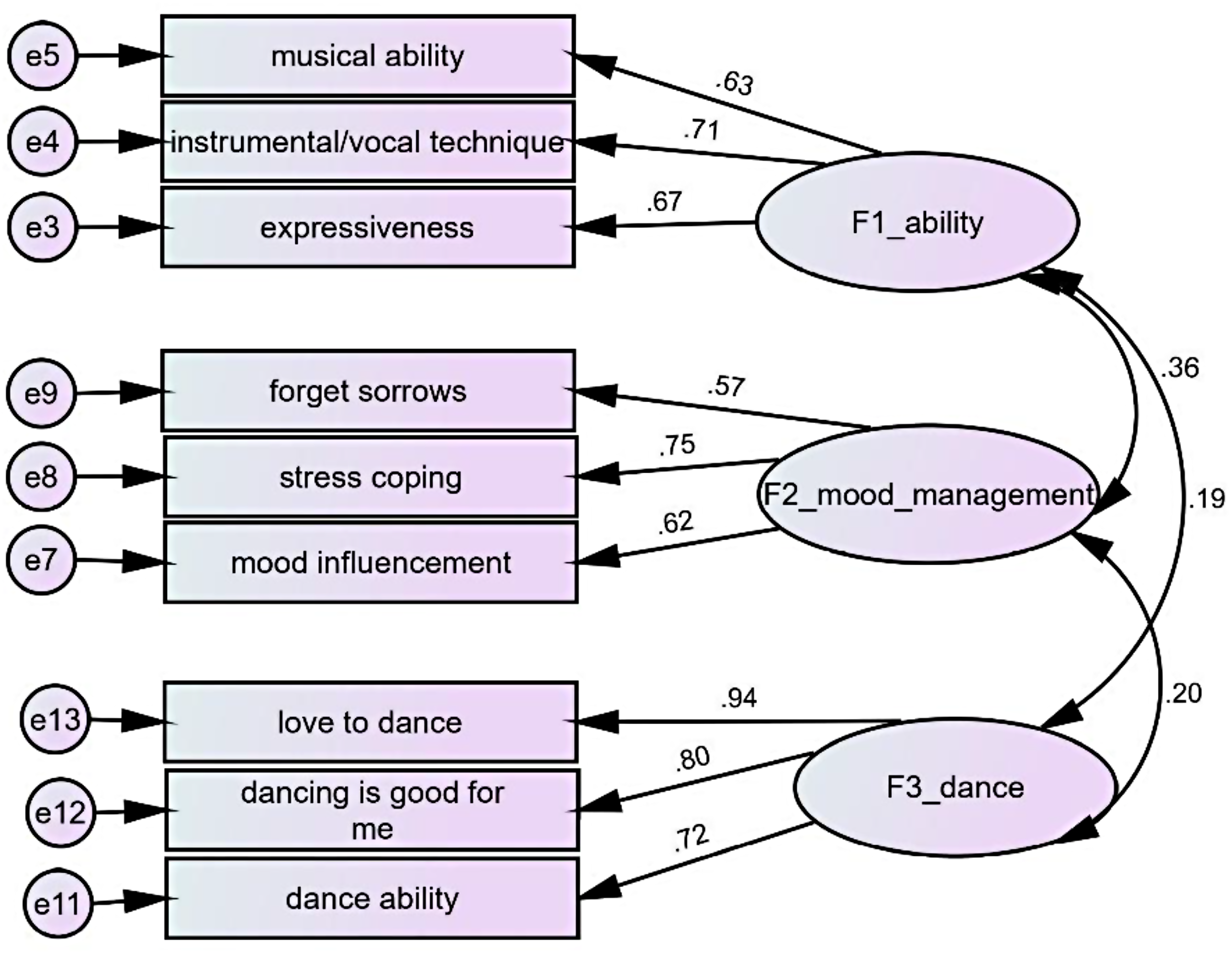
Model for total sample.
This factor structure was re-specified in a CFA with sample 2 using SPSS AMOS, the resulting adjusted factor structure cross-validated in a CFA with sample 3, and then a CFA repeated with the total sample (see Figure 1). The fit-indices of the model for each sample are displayed in Table 4. In the process of the model re-specification according to the modification indices and the model fit, the above-mentioned factors 1–3 could be verified with three items each, while factor 4 could not be maintained. This is in line with the results of the PCA described above as, for example, items with cross-loadings have now been deleted, and the fourth factor with the low reliability could not be retained. Interestingly, Spychiger (2017b) also reports “musical ability,” “mood management,” and “movement and dance” being the empirically strongest factors, which points to the validity of our results. Figure 2 displays the structure of the model.
Fit indices of the model per sample.

Table 4 reports the following model fit-indices for the CFA: CHI2, Adjusted-Goodness-of-Fit-Index (AGFI), Tucker–Lewis Index (TLI), Bentler's Comparative Fit Index (CFI), Bayesian Information Criterion (BIC), Root Mean Square Error of Approximation (RMSEA), Standardized Root Mean Square Residual (SRMR), and PCLOSE.
In the CFA with both sample 2 and sample 3, the SMC (Squared Multiple Correlations) of the item With music, I can forget my sorrows (see “forget sorrows” in Figure 2) was low (.319 and .235, respectively). However, running the model without this item did not increase the model fit; instead, it was lowered minimally, so the item was retained.
Cronbach's alpha as measure of internal consistency of the factors, and the quality criteria of the second generation, factor reliability (FR) and average variance extracted (AVE), were measured and are reported for the CFA with the total sample in Table 5. While Cronbach's alpha was very good for factor 3 “Dance” and adequate for factor 1 “Ability,” it was only acceptable for factor 2 “Mood Management.” The proposed cut-off value for Cronbach's alpha is .7, following, for example, a number of studies analyzed for the respective cut-off value by Taber (2018), or as proposed by Cohen et al. (2007) or Hair et al. (2010). The latter, as well as Nunnally (1967), further suggest accepting lower Cronbach’s alpha values in exploratory stages of the research—which can, to a certain extent, be assumed here. Although the questionnaire builds upon previous work (see “Introduction” and “Materials and Methods”), it was revised and adapted with another sample and has not yet been further applied. Also, the remaining three items per factor after analysis are rather few. However, Cronbach's alpha tends to rise with the number of items (Cortina, 1993), so for only three items it might be seen as sufficient—this said in the context of the carefully conducted analysis process and with the awareness that further studies should probably work with a greater number of items per factor again (regarding number of items and score reliability see e.g., Hellman et al., 2006).
Summary statistics, reliability coefficients, and quality criteria of the factors after CFA with the total sample.

FR was > .6 for all factors, while AVE was above the threshold of .5 for factor 3 “Dance” only, the AVE of factor 1 and 2 below. However, the Fornell–Larcker criterion to test discriminant validity was met for all factors (Weiber & Mühlhaus, 2010).
Emerging Clusters
In this subsection, the process of the cluster analysis including the statistical differences between the clusters as well as a summary characterization of the clusters are presented, while a more detailed discussion of the clusters can be found under “Characterization of the Clusters.”
Following the confirmatory factor analysis, a hierarchical cluster analysis with Ward linkage and squared Euclidean distance as distance measure was carried out to assess the number of clusters or groups with differing characteristics regarding the three factors “Ability,” “Mood Management,” and “Dance.” This analysis was done with new variables of the factor means, as this reflects the 5-point Likert-scale and can be better illustrated (see Figure 3). The coefficients in the agglomeration schedule table pointed to a 3-cluster-solution, maybe also a 4-cluster-solution, even if the greatest increase is generally observed between 1 and 2 clusters (Backhaus et al., 2010). Likewise, a dendrogram indicated a 3- or less likely a 4-cluster-solution. A second cluster analysis with three clusters was carried out and the cluster membership of the cases saved as a variable (cluster 1: n = 339 [42.1%]; cluster 2: n = 229 [28.4%]; cluster 3: n = 237 [29.4%]).

Manifestation of factor means per cluster and in total.
A discriminant analysis was executed to test which factors influence a possible significant differentiation between the clusters. The canonical correlation coefficients, a measure of how well the clusters are separated, were very good (.904) for function 1 with an eigenvalue of 4.482, but unsatisfactory (.229) for function 2 with an eigenvalue of .56. However, Wilk's Lambda was highly significant for both discriminant functions (p < .000). Following the standardized canonical discriminant function coefficients, the highest influence on cluster membership has factor 3 “Dance” for function 1 and factor 2 “Mood Management” for function 2. To test if the groups differ significantly regarding the factor variables, a test of equality of group means was carried out which was highly significant for all factors with p = .009 for factor 1 and p < .001 for factors 2 and 3. Classification results showed that 92.2% of the original grouped cases have been correctly classified. Cross-validation with the stepwise method led to the same result, with 92.2% of the original grouped cases correctly classified, thus validating the discriminant analysis.
A Kolmogorov–Smirnov test (p < .000) showed that the factor variables were not normally distributed, so a non-parametric test was needed, to assess whether cluster membership is significantly affected by the manifestation of the factors. The Kruskal–Wallis H-test was significant for all factors (highly significant for factors 2 and 3 with p < .000, on a lower significance level for factor 1 with p = .011; see Table 6). This result is in line with the results of the test of the equality of group means, where factor 1 also had a lower significance level than factors 2 and 3.
Kruskal–Wallis H-test.

*p < .05; **p < .0001.
To examine to what extent the factors each contribute to the cluster membership, pairwise comparisons with the Mann–Whitney U-test were executed and showed significant differences for seven of the nine 2-cluster-comparisons (Table 7), albeit with differing effect sizes. However, effect sizes can be critically questioned and might have different thresholds for different areas: it was recently supported that an effect size > .1 can be seen as small, > .2 as middle, and > .3 as large (Gignac & Szodorai, 2016).
Mann–Whitney U-tests.
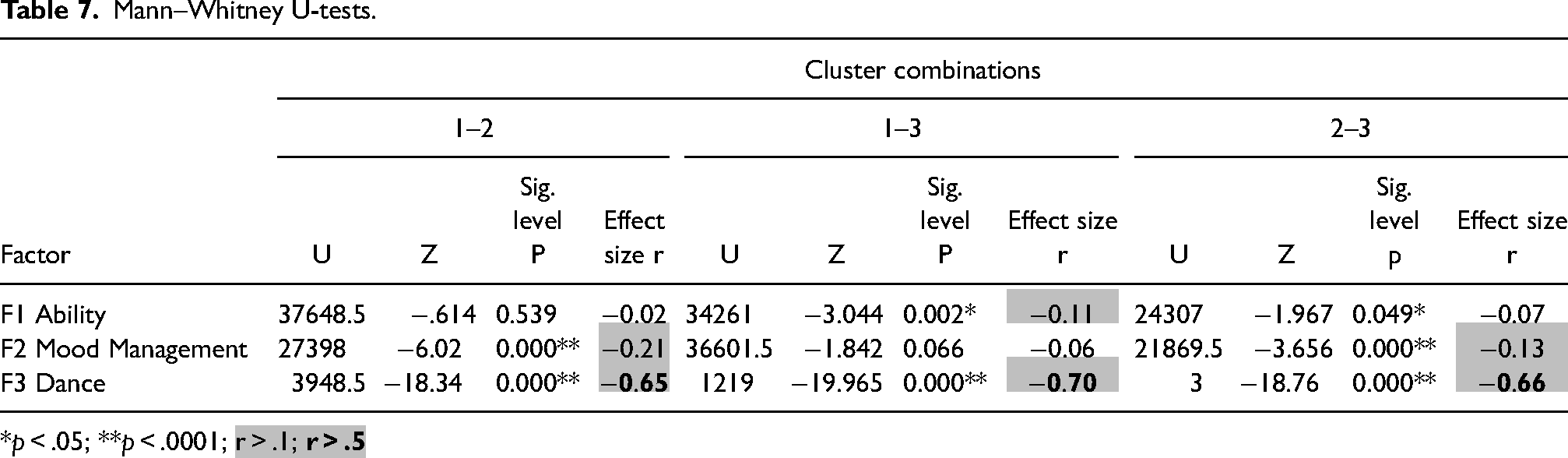
*p < .05; **p < .0001; r > .1;
Thus, factor 3 “Dance” significantly differentiated all clusters from each other with large effect sizes, while factor 2 “Mood Management” only significantly differentiated clusters 1 from 2 and 2 from 3, each with acceptable effect sizes. Factor 1 “Ability” significantly differentiated cluster 1 from 3 and cluster 2 from 3, but the latter with very low effect size. Figure 3 illustrates these differences of the clusters regarding the factor manifestations. A high value points to a higher agreement and a higher importance of this factor in a cluster.
To assess the differences in sociodemographic and other personal characteristics between the clusters, a two-sample Kolmogorov–Smirnov Z-test was executed for all sociodemographic variables in each of the cluster combinations (cluster 1 and 2; cluster 1 and 3; cluster 2 and 3). Pearson's chi-square test could not be used to measure the significance of the cluster differences as for most of the variables the test criteria were not met (more than 20% cells with expected counts less than 5); however, next to information from descriptive frequency tables, the standardized residues of the Pearson's chi-square test were observed to determine the direction of the differences. Table 8 shows the significant cluster differences regarding sociodemographic and further personal aspects.
Sociodemographic differences between the clusters.

*p < .05; **p < .01.
Note: The p-value is reported from the two-sample Kolmogorov–Smirnov Z-test. The information in the details columns reports the direction of the differences between the clusters as indicated by the percentages observed in frequency tables (which sometimes leads to duplicate mentions such as when comparing clusters 1 and 3, for example, there were more Chinese and fewer Swiss students in cluster 1, and more Swiss and fewer Chinese students in cluster 3), and the Pearson's chi-square test (in brackets if not significant in the two-sample Kolmogorov–Smirnov Z-test, but the standardized residuals of the Pearson's chi-square test have been >2, indicating a deviation from the expected count in a given cell).
Summary of the Cluster Characteristics
Based on the above analysis of the factors as well as the sociodemographic and further personal aspects of the clusters, the following descriptions sum up the clusters’ characteristics, including tendencies.
Cluster 1—Predominantly young, female Chinese from a non-musical family who regulate their mood through music, perceive their musical and dance abilities 8 as average, do practice rather little, and aim at a teaching career.
Persons in cluster 1 think that they can influence their mood and regulate stress through music quite well—significantly more so than persons in cluster 2, and they perceive their musical abilities as average, which is significantly lower than cluster 3. They likewise perceive their dancing skills as average, and their appreciation of dance is also average.
Cluster 1 includes persons who are comparatively often Chinese and female. They tend to be younger than 24 years old and have completed a middle school degree. Accordingly, almost half of the undergraduate students are in cluster 1. Most cluster 1 students are studying performance, but of all theory/science students, half are in cluster 1. Cluster 1 also had the highest share of students who play a Chinese instrument, and a considerable number of students studying voice. The age of beginning to learn the main instrument was quite evenly distributed from younger than 7 to 17 years old. Students in cluster 1 tend to practice less than 2.6 h per day, some 2.6–4 h per day. They are more likely to consider a teaching career than students in the other clusters. Parental musical activity was the lowest for this cluster, with almost half of all parents who do not play an instrument being in this cluster. The parents’ highest educational level is most likely a middle school or an undergraduate degree.
Cluster 2—Predominantly Chinese undergraduate students from a non-musical family, playing a Western instrument, who tend not to influence their mood through music, do not like to dance, perceive their musical ability as average, practice a lot, and aim at a teaching career.
Persons in cluster 2 assess their musical skills as average. They use music significantly less often and less effectively to influence and raise their mood compared to persons in the other clusters. The recognition of their ability to dance and their liking of dance is far below the average, and significantly lower than in clusters 1 and 3.
Cluster 2 includes a higher proportion of Chinese rather than Western students and has the highest share of males. Most of the students are younger than 24, but at least a quarter are 25–29 years old. Almost two thirds of the students have a middle school degree and slightly less than one third an undergraduate degree. They are currently enrolled in a performance course of study at the undergraduate level but tend not to be in theory/science.
Cluster 2 includes very few persons studying a Chinese instrument and has the lowest share of voice students; thus, this cluster is dominated by students playing a Western instrument. The starting age for the main instrument was quite evenly distributed from very young until 11–17 years old. Students in this cluster were the most likely to practice their main instrument for 4 h or more per day and the least likely to practice less than 2.6 h. When comparing the combination of working as a musician and teacher across all clusters, students in cluster 2 chose this option the least often, and—as all clusters—mainly aim to work as music teachers. Most of the parents of this cluster's students do or did not play an instrument, and this cluster also has the lowest proportion of students with only one parent being or having been musically active. The highest educational degree of most of the parents in this cluster was a high or middle school degree or an undergraduate degree.
Cluster 3—Predominantly Western female education students with a musical family background, playing a Western instrument or studying voice, who are older than the students in the other clusters and already hold a postgraduate degree, who like to dance, perceive their musical ability as average to good, do not practice a lot, and aim at a teaching career, partly in combination with artistic musical activities.
Persons in cluster 3 rate their musical skills as rather good, and significantly better than those in cluster 1. Their likeliness to manage their mood through music is average, but significantly higher than those in cluster 2. They love to dance, and their perceived dancing skills are high; significantly higher than in the other clusters and well above average.
Compared to the other clusters, cluster 3 includes a greater number of persons who are Western. The students are more often female, and more likely to be over 30 years old than in the other clusters, although in this cluster also, the majority of students are 19–24 years old. Cluster 3, proportionally, also has the most students who have already completed a postgraduate degree (and are currently studying for a second masters). Compared to the other clusters, the share of students who study education and whose instrument is the voice is the highest. Although performance students are the majority in this cluster, they are proportionally less represented than in the other clusters. Most of the students play a Western instrument. This clusters’ students tended to have started playing their main instrument at a younger age than 7 years old and were the least likely to start as adults 18–27 years old. They generally practice less than 2.6 h per day and were the least likely to play for 2.6–4 h. The career goal of these students was predominantly to be a teacher, but the proportion of those aiming at combining a teaching and performance career is the highest compared to the other clusters. Also, a comparatively high number of students in this cluster had parents who both played or still play an instrument, and they were less likely to have musically non-active parents. The parents also often had a postgraduate degree.
Discussion
The discussion section first addresses the item compositions of the musical self-concept factors in the adapted version of the MUSCI presented here: the Musical Self-Concept Inquiry-SwisSino. Subsequently, the clusters are reviewed regarding the factor manifestations, the factors’ individual importance for the cluster membership, and their sociodemographic and further personal characteristics. Finally, the relevance of the results and the study's limitations will be addressed, and further research potential identified.
The Musical Self-Concept Factors
Factor 1,
Factor 2
The third factor,
Items from the MUSCI-CN which could not be retained include those dealing with rhythm and those centered on community in terms of communication and social/societal aspects. The movement and rhythm aspect, which was an individual factor in the MUSCI-CN, built a fourth rhythm factor in the principal component analysis, but these items could not be confirmed when the model was subjected to a confirmatory factor analysis (see “Statistical Values and Validation of the Factors”). The movement and rhythm dimension might have been less clear and associations more open or diverse than for “Dance,” for example (see also “Methods Discussion, Limitations, and Implications”), and it had the difficulty of encompassing items that touch on both the ability and the dance aspect. The community and societal items could likewise not be confirmed, but could have given illuminating insights, for example regarding the importance of communicating with other people through music or at musical events. This aspect might have been perceived as further away from the self and thus been more difficult to grasp. Spychiger (2017b) also noted the comparatively low importance of the social and community dimension in their study about the musical self-concept, with one possible reason being the individualization process which has taken place over the last decades. For example, children have fewer experiences of community music-making activities like singing folk or religious songs compared to earlier times (Spychiger, 2017b). Furthermore, in a qualitative study with Swiss and Chinese music students undertaken by Petersen (2018) the Chinese students did not often mention having played together with others before university (while the Swiss students did), so at least a large part of the sample had not had many social music-making experiences. Additionally, the new item in the community dimension Music gives me a hold on life was subject to continuing and intense discussion about content and wording beforehand, and it could not be retained. It might also be that these community and societal items were perceived differently by Chinese and Western students due to distinct conceptions of the relationships between self and society, as pointed out in the study by Petersen and Camp (2016) and in the introduction.
Characterization of the Clusters 9
In this section, the three clusters will be evaluated first for factor differences, and second for their sociodemographic variations. Finally, a parallel to the clusters from the study by Petersen and Camp (2016) is attempted.
Differences of the Clusters Based on the Factor Manifestations
Persons in clusters 1 and 2 agree significantly less with “Ability” than persons in cluster 3; however, the difference between 2 and 3 has a negligible effect size, and the effect size for the difference of cluster 1 and 3 is small. Clusters 1 and 3 agree significantly more with “Mood Management” than cluster 2, with effect sizes being small for the difference between cluster 2 and 3, and medium for the difference between cluster 1 and 2. Meanwhile, “Mood Management” did not significantly differentiate clusters 1 and 3 from each other. “Dance” significantly differentiates all clusters from each other with high effect sizes. Cluster 3 is characterized by a substantially high agreement with “Dance” and cluster 2 by a comparatively very low agreement, while the agreement of cluster 1 is in the middle of the other clusters.
The rather low differentiating potential of the factor “Ability” could be explained by the fact that the sample consisted of music students only, who might all consider themselves as musically talented in one way or another compared to the general population. This seems to be reflected in the results of a study by Demorest et al. (2017), with musical self-concept (measured with items focusing on the perceived musical ability) being a predictor of students’ performance in singing and of choosing music as school subject (next to peers and family musical engagement). Although participants in this study were pupils in the 6th grade, it might be assumed that pupils with a higher musical ability self-concept also tend to choose music as a field of study on university level. In contrast, the factor “Dance” is more specific within the field of music and might not be at the center of the musical activities of many of the participants, a possible cause of its higher differentiating potential. The factor “Mood Management,” with its average capacity to differentiate between the clusters, might again be closer to the students’ feelings and musical activities than “Dance” but not as obviously present as musical ability.
Differences of the Clusters Based on Sociodemographic Aspects
Cluster 3 included significantly more Western and fewer Chinese students compared to clusters 1 and 2. While three quarters of the cluster 1 students are Chinese and one quarter Western, and in cluster 2 two thirds are Chinese and one third Western, the distribution approaches 50% in cluster 3, making it the “most Western” cluster.
Persons in cluster 2 are significantly more likely male than female compared to the other clusters, as males and females are almost equally distributed in this cluster, while in clusters 1 and 3 the majority of the students are female.
There were no significant age differences between the clusters, as most of the students in each cluster (two thirds to three quarters) are younger than 24 years, one fifth to a quarter 24–29 years, and a small number 30+ years old. However, the students in cluster 1 have a slightly higher share of young students (<24 years old), which is reflected in the fact that their highest completed educational level tends to be a secondary or middle school degree rather than a graduate degree; accordingly, of all current undergraduate students, 45% are in cluster 1. Still, across all clusters, most of the students (around two thirds each) have completed a secondary or middle school education and are currently enrolled in an undergraduate course of study. Students in cluster 3 have a slightly higher proportion of persons 30+ years old, which is in line with 44% of all students having completed a postgraduate degree being in cluster 3. Cluster 2 falls in between clusters 1 and 3 and shows no deviations from the average age or educational level.
In all clusters, most students study performance. The field of study (grouped into performance, education, theory/science, or other) was significantly different only between clusters 1 and 3, with cluster 3 having more education students (one third of the students in cluster 3 were studying education compared to less than one quarter in clusters 1 and 2). While more than two thirds of the students in clusters 1 and 2 study performance, the same is only true for a little over half of the students in cluster 3. Comparing the theory/science students across all clusters, cluster 2 contains the fewest, with only 20% of all theory/science students, and cluster 1 the most, with almost 50%. Other study courses such as computer music were very few and did not differ between the clusters.
In every cluster, most of the students were studying a Western instrument. But compared across all clusters, cluster 1 had the highest proportion of students who play a Chinese instrument, significantly more than in cluster 2. The high share of students with a Chinese instrument in cluster 1 is reflected in the highest proportion of Chinese students. Therefore, cluster 1 is the most Chinese cluster in terms of origin and instrument distribution. Cluster 2 had significantly fewer voice students than clusters 1 and 3; in the latter more students studied voice (one quarter of all students in cluster 3). Also, cluster 2 has the highest share of students studying a Western instrument: 87% compared to 74% and 72% in clusters 1 and 3, respectively.
The ages at which the students started to play their main instrument were grouped into <7 years, 7–10 years, 11–17 years, and 18–27 years old. The clusters did not show any significant differences. On the contrary, the distribution was very similar in every cluster, with around 30–40% of the students in each cluster beginning at <7, 7–10, or 11–17 years old, respectively. Only a slight difference was detectable in cluster 3, with slightly more students starting <7 years old, and fewer students starting 7–10 years old, while students in cluster 2 were the least likely to start before 7 years of age. Perhaps unsurprisingly, the number of students who had started to play their main instrument between 18 and 27 years old was very low in all clusters (1.7–3%).
Regarding the grouped practice hours per day (<2.6 h; 2.6–4 h; >4 h), cluster 2 was significantly different from clusters 1 and 3, which did not differ from each other. Cluster 2 had significantly more students practicing >4 h per day on their main instrument and fewer who practiced <2.6 h per day. More than half of the students in clusters 1 and 3 practiced for fewer than 2.6 h per day and around one third 2.6–4 h, while less than 10% in both clusters practiced more than 4 h per day – almost half of the 19% in cluster 2.
No significant cluster differences could be ascertained regarding the students’ career goals. The pattern in all clusters is quite similar with around or slightly below 20% of the students in each cluster aiming for a career either as a musician or for a combination of musician and teacher, while slightly below to exactly 50% of the students plan to work as music teachers. On average, 12% of the students in each cluster were aiming for a career in other areas of music (e.g., music manager or conductor), or outside of music (e.g., business manager or translator). If slight tendencies are considered, students in cluster 1 are more teaching affine, while cluster 3 is more open to a combination of working as musician and teacher. When comparing the latter category across all clusters, it is the least likely option for cluster 2.
Clusters 1 and 3 differed significantly regarding the parental instrumental activity. Cluster 1 contained comparatively more students with parents who never played an instrument and fewer students whose parent/s both do or did play an instrument than did cluster 3. Students in cluster 2 tended not to have only one parent who is or was musically active but rather were more likely to have both or neither parent playing an instrument. Across all clusters, most of the students (46%) had no parent who plays or used to play an instrument, 25% one parent, and 29% both parents.
The highest educational level of the students’ parents could be observed in cluster 3, where parents were significantly more likely to have a postgraduate degree, and less likely to only have a middle school degree than the parents in clusters 1 and 2. Regarding parents with a secondary school degree only, all clusters are quite similar, around 4–5%. Looking at the parents with an undergraduate degree, almost half of them are in cluster 1. This is also the case for parents with a middle school degree, albeit somewhat less markedly (Figure 4).

Illustration of the most important cluster characteristics and differentiating tendencies.
Link to the Clusters from the Study by Petersen and Camp
The clusters just discussed are obviously not the same as in the study by Petersen and Camp (2016; see “Introduction”). However, cluster 1 here resembles the “Young Dreamers” from the previous study, in their tendency to be young and to perceive their skills as average. However, while the “Young Dreamers” aimed for a performance career, the students in cluster 1 instead plan to teach in their future. Cluster 2 resembles the “Nay-Sayers” in the fact that they do not use music to regulate their mood or to dance to, however, while students in cluster 2 practice a lot, the “Nay-Sayers” had a low practice motivation, which resembles cluster 1 in this study. The “Motivated Achievers” resemble cluster 1 with regard to the low amount of parental musical activity. Apart from these relationships, the clusters differ considerably from the clusters of the study by Petersen and Camp (2016), probably due to the substantial differences in samples and evaluation methods, which is further elaborated upon in the following section “Methods, Discussion, Limitations, and Implications”. So, while we would not argue that the clusters presented here replace the ones found in the previous study by Petersen & Camp, they also tend not to confirm them. As the sample in the present study was much larger, it would be interesting to use the MUSCI-SwisSino from the present study with a sample that is similar to the one in Petersen & Camp's study: Chinese (undergraduate) students of music education. Due to the relatively stable factors “Ability,” “Mood Management,” and “Dance,” one could assume that the clusters could be replicated regarding these aspects (although obviously not regarding the origin of the students). On the other hand, because the clusters are not as pronounced in terms of sociodemographic and further personal characteristics, it could be argued that a replication of the clusters might be difficult to achieve—and perhaps is also not the point. Instead, one might reason that the main achievement is not the clusters, but the factors which could now be used to assess the various aspects in differing samples in future studies (in China or Switzerland), thereby providing the possibility of comparing measurements based on the MUSCI-SwisSino (see the next subsection).
Methods Discussion, Limitations, and Implications
Our study design reflects the challenges of a comparative research undertaking. First, translation-specific difficulties exist: words or sentences of different languages—and thus their translations—often do not have single meanings, but can evoke wide-ranging associations and can imply certain conceptions (Filep, 2009; Nugroho, 2007). Although this problem always arises when working with language, the problem is accentuated with questionnaire versions in different languages used in differing cultures (Katan & Taibi, 2021). For example, it is conceivable that the Chinese students understood items differently and had different associations regarding the items of, for example, “Achievement and Ambition” than the Swiss students, even if the intended meaning was the same. Differences between Swiss and Chinese students from the same sample regarding the importance of discipline and practice for becoming a good musician might be an indication of that (Petersen, 2022). We have tried to address these problems with thorough translations, back-translations, and consultations with native speakers and scholars. However, certain misunderstandings or other interpretations cannot be excluded (van Nes et al., 2010).
Second, and despite having a Chinese researcher and musician in our team, the research team was mainly of Western origin and, as we were also assessing Chinese students, we had to be conscious of the individual approach to the research field and of the distance and closeness to the participants. A close collaboration with Chinese students and scholars was of utmost importance in order to grasp culturally specific connotations of terms and to understand the data in a culturally appropriate way (Kull et al., 2019). In addition, the Western researchers in the project team were confronted with university structures in China that are state-controlled and seemingly clearly hierarchically organized, but where the responsibilities for project collaborations were not always clear. The process of getting permissions to undertake research at a Chinese university was quite complicated as someone was in charge on the paper to confirm the research collaboration, but on the ground a different person had to be involved who was not in a position of responsibility per se—generally, the issue of who must be involved is very important in Chinese society, and respect towards (implicit) authorities must be demonstrated (e.g., Zhai, 2017). In contrast, when we were on-site, it was rather easy to distribute the questionnaires as we were allowed to get into the classrooms, and we did not have the impression of being monitored. What had to be taken into account was the importance of socializing activities in collaborations, which are not only important in China, but are very pronounced there.
Third, the adaptation of the original MUSCI questionnaire by Petersen & Camp (MUSCI-CN; 2016) and the further development for the present study may have influenced the results. The statistical analysis was more advanced in the present study in comparison to the study by Petersen and Camp (2016), which made the musical self-concept stable regarding only a few factors. The samples of Petersen & Camp's study and the present study are not directly comparable, as only Chinese students were surveyed before, and the sample was considerably larger in the present study, which might have led to more accurate results. However, other studies investigating the suitability of adapted versions of the MUSCI have also revealed some limitations in applicability (e.g., a validation study of the MUSCI_youth; Fiedler et al., 2018). The development of the individual musical self-concept is dependent on the environment and the related social experiences of a person (Spychiger, 2017b), and it has been suggested that the construct of the musical self-concept may vary depending on the context in which it is surveyed (Spychiger et al., 2010). It is possible that part of the results of our study precisely underpin this fact: The aspects of ability, mood management or dance seem easier to understand in differing contexts (of Swiss and Chinese music students) than for instance social or community aspects – which depend more heavily on the context. For example, if ability is narrowly focused on the “what-I-can-do” (Spychiger, 2017b), as is the case for the confirmed factor “Ability,” it is much easier to assume a similar understanding by Chinese and Swiss students, compared to the initial factor “Community and Communication,” which addresses a broader spectrum of associations or cultural connotations regarding social expectations or societal rules. Additionally, as Spychiger (2017b) reflects, some dimensions of the musical self-concept, which appeared in her analyses seemed to be more focused on the “communication within the person” (p. 274). Further, as with “Ability,” the same probably applies to the factor “Dance”: it is rather clear what is meant—namely moving your body to music—without being specific about the type of dance or the occasion (or context). This is perhaps comparable to “listening to music,” which was not part of the questionnaire, but where one can agree to like doing it or not, independent from the type of music one likes to listen to.
Apart from these possible reasons, the contrast between the intended broadness of the musical self-concept with its various dimensions, and the diminution of factors in the course of assessment is striking. The factor of perceived ability can possibly even be measured better with other instruments. The factor dance proved to be strong but is not at the center of interest if studying music. The most interesting, confirmed factor is probably “Mood Management” as this factor explicitly assesses an active dimension of the self: how an individual can use music to influence their mood or manage bad feelings. The individual thus has an active role in using music in their life in various ways. But as the musical self-concept undoubtedly encompasses more dimensions, such as the very interesting social or community aspect (e.g., listening to or making music with others; speaking about music), the ambition aspect (e.g., the striving for a high level of musicianship), or the spiritual aspect (e.g., the importance of music to feel closer to a higher entity), the survey instrument used here cannot claim to comprehensively capture the musical self-concept in an intercultural setting. Thus, the current approach to measuring the musical self-concept has room for improvement and should be further developed.
Perhaps—especially in intercultural research—it is more worthwhile to proceed qualitatively and provide an even more thorough clarification of underlying concepts, which must be carefully compared and examined for commonalities. Particularly when working with fundamentally different languages such as Chinese and German or English, the illumination of abstract concepts such as “community” or “achievement motivation” could be informative. Based on this, a survey instrument of the musical self-concept could be further developed to specify and evaluate the individual aspects regarding their potential to really capture the underlying views of oneself in relation to music in different societal and cultural settings. Additionally, the measures from the MUSCI-SwisSino could be analyzed using the Chinese sub-sample only; this result could then be compared to the results from the Chinese sample from the study by Petersen and Camp (2016).
If using the MUSCI-SwisSino, one could also aim at comparing the manifestation of the musical self-concept factors of “Ability,” “Mood Management,” and “Dance” in similar samples in different countries. The samples could be similar regarding sociodemographic or other variables such as study course or instrumental group. 10 Further, one could analyze the data of differing samples in one country regarding the factor manifestations. Comparing first-year students with graduates to assess possible changes of the musical self-concept at different points during the course of study could also be an interesting undertaking, and given financial and personal resources, a longitudinal study assessing the same students over time, could be even more valuable. These comparisons of measurements could offer valuable insights into specific aspects of the musical self-concept and thus help to gain a deeper understanding of the concept and its development in differing populations. If distinctive characteristics of persons with certain manifestations of the factors could be elicited (through an extended study design including for example teaching styles the individuals have experienced), it might, for example, also be possible to strengthen aspects which might have led to a more positive musical self-concept (such as a certain teaching style). Another possible use of the questionnaire could be the comparison of Chinese and Swiss lay musicians with professional musicians including a retrospective qualitative analysis of their biographies—however, including qualitative data would set certain limits on the size of the sample. Nevertheless, the additional value of qualitative data must not be underestimated, especially in the context of intercultural research, as stated above. In summary, while we think that improvements regarding the measurement and the instruments to assess the musical self-concept are possible (and would perhaps also lead to more pronounced differences in clusters), the three factors of the MUSCI-SwisSino might be valuable in certain research settings with specific foci on the ability, mood management, and dance aspects.
Conclusion
To summarize, we assessed the musical self-concept of a large sample of music students in China, Taiwan, and Switzerland through the application of a musical self-concept questionnaire: an adapted version of the MUSCI-CN; the MUSCI-SwisSino. The factors of the musical self-concept that were included—Achievement and Ambition, Mood Management, Ability and Expertise, Dance, Rhythm and Movement, and Community and Communication—were subjected to statistical analyses which were able to verify three dimensions of the self-concept questionnaire: Ability, Mood Management, and Dance. Depending on the respective manifestation of the three dimensions, the students could be divided into three clusters. These clusters differed in terms of the students’ origin, gender, course of study, main instrument, practice hours, and parental educational background and musical activity. However, even if three distinct factors could be validated, it can be assumed that the musical self-concept consists of more dimensions, which is supported, among other things, by former research undertakings as mentioned above. Consequently, it is possible that these three clusters only partially map out musical self-concept types.
These results reveal the culturally and linguistically challenging setting in which the research took place. We operated in cultural environments with very different languages, which might have led to obstacles regarding interpretation or understanding of specific parts of the questionnaire. Thus, quantitative comparative studies in music must be further developed methodologically to better account for cultural differences. It might be necessary to include additional qualitative assessments as an integral part of such a questionnaire in order to better capture conceptions and connotations. Nevertheless, the study of the musical self-concept and its domains is a worthwhile undertaking as it strongly influences how someone navigates in the world of music and, more specifically, how music students see themselves and act within one of the most important parts of their lives—music.
Footnotes
Acknowledgments
The authors would like to thank Xavier Bouvier for his support and comments during the research process; Li Huaqi for translations, and discussions; Lukas Park for translations, comments, and his assistance during the data collection in China; Eugénie Grenier Borel, Frank Kouwenhoven, Wu Wei Xi, and Basile Zimmermann for their input on the project; Daniel Fiedler for his very helpful input during the statistical analysis; Maria Spychiger for encouragement and valuable discussions about the musical self-concept; Gavin Lee for his valuable input and support during the data collection in China; Tseng Yu-Fen for her support during the data collection in Taiwan; Le Yizhen, Wen Deqing, Guo Lanlan, and Kuai Weihua for their support during the data collection in China; Lin Wei-ya for establishing contacts and giving inputs; Isabelle Halberkann, Lee Maria, and Zhang Yunjing for translations; and Natalie Kirschstein for her helpful review of the manuscript. Furthermore, we would like to thank the students who worked with us in preparing, adapting, and translating the questionnaire; the teachers in China and Switzerland who gave us access to their students during class time; and, finally, all the music students who kindly participated in our study.
Action Editor
Alexandra Lamont, Keele University, Department of Psychology.
Peer Review
Maria Spychiger, Hochschule für Musik und Darstellende Kunst Frankfurt am Main.
Karen Burland, University of Leeds, School of Music.
Author Contributorship
SP and MC developed the study and the main conceptual ideas. SP was responsible for the survey, including the adaptation of the questionnaire. SP collected the data at the universities in Switzerland, AK in China, and MC in China and Taiwan. SP did the statistical analysis of the data. All authors discussed the results. SP wrote the whole manuscript, AK and MC commented on the manuscript.
Ethical Approval
The study was approved by the research committee of the School of Music at the Lucerne University of Applied Sciences and Arts.
Declaration of Conflicting Interests
The author(s) declared no potential conflicts of interest with respect to the research, authorship, and/or publication of this article.
Funding
This project was funded by the Swiss National Science Foundation (SNSF, grant number 169711) and by the Lucerne University of Applied Sciences and Arts, School of Music.
