




Abstract
A differential benefit of external focus of attention (FOA) relative to internal focus has been demonstrated across a wide variety of athletic and rehabilitative pursuits; however, very little research has been undertaken in the performing arts. Given the unique aesthetic context of the arts and obvious transdisciplinary parallels, particular attention is warranted. This study examines nine pianists’ pedaling while performing Bartók’s Romanian Folk Dance Sz. 56, No. 2, and directing attention to three different focus conditions relative to a baseline condition. Differences in global pedal use and technique emerged and appeared to be modulated by level of expertise and the length of time spent preparing the piece. The two most experienced pianists and the least experienced pianist demonstrated greatest consistency in pedaling, as measured by Z scores calculated across eight performance parameters. Results corroborate previous FOA research demonstrating performance variability when adopting different focus strategies. Implications include the need to deliberately align focus strategies in music training and performance. To the authors’ knowledge, this is the first study to examine performance effects of external against internal FOA on pianists’ pedaling. The critical conceptual aspect of the work is beginning to illuminate the relationships between a performer’s attention and motor output, and perceived artistic or musical effects.
Introduction
Musically and scientifically, playing the piano is a remarkable ecologically valid dual-task endeavor, unique in the integration of primary and secondary motor tasks. Despite the obvious role of the fingers in piano performance, the feet play a subtle yet critical role with pedaling. Presuming obligatory pedal use, indicated either in the musical score or by stylistic convention, artistic performance requires unique multilimb coordination. The integration of motor tasks toward a singular artistic goal raises important questions with regard to the dynamics of dual-task performance in the performing arts, and music specifically, dimensions of human motor performance currently understudied in this context. To the authors’ knowledge, this is the first study to examine the performance effects of external against internal focus of attention (FOA) on pianists’ pedaling. Beyond the aspect of studying pedaling (as opposed to the fingers) in relationship to performance, the critical conceptual aspect of the work is in beginning to illuminate relationships between a performer’s attention and motor output, and the perceived artistic or musical effects.
Focus of Attention
From anecdotal observation in the 1890s (Bliss, 1895) and the first experimental studies in the 1990s (Wulf et al., 1998; Wulf & Weigelt, 1997), there is significant evidence demonstrating a correlation between the way in which an individual directs his or her attention while undertaking an activity and the effects on both motor performance and motor learning. The literature makes a distinction between internal focus, focus on one’s self in executing a particular movement or skill, and external focus, or focusing attention on movement effects.
A differential benefit of external focus has been demonstrated across a wide variety of athletic and rehabilitative activities (for a review see Wulf, 2013). In other words, performance is variable when adopting external against internal focus, and those performance differences are attributable to changes in attention. For example, studies repeatedly demonstrate enhanced accuracy (Lohse et al., 2010; Zachry et al., 2005); maximal movement outcomes (i.e., highest, longest, fastest) (Freudenheim et al., 2010; Wulf et al., 2010; Zarghami et al., 2012); and physiological efficiency (Lohse et al., 2011; Neumann & Brown, 2013) with external focus. According to the constrained action hypothesis (McNevin et al., 2003), external focus may facilitate performance by allowing automated processes and adjustments to movement. The performance degradation observed with internal focus is thought to arise from interference with those same processes by constraining the degrees of freedom involved.
An important consideration, however, is level of experience or expertise, particularly as related to stages of learning, development of automaticity, and potential implications related to attentional focus. Previous research has demonstrated, for example, that performance of well-learned skills is disrupted when directly monitored via attention while performance of developing skills benefits from that same procedural attention (Beilock et al., 2002; Ford et al., 2005).
While the performing arts remain comparatively understudied in the context of human performance science, a growing body of literature demonstrates differential focus effects while also presenting opportunities to enhance and refine understanding of the FOA phenomenon. The particular significance of aesthetic endeavors relative to sport or therapy, in the context of FOA, is the additional subjective assessment of performance. In the performing arts, human perception, at least in part, plays a role in determining or quantifying task success.
A complicating yet intriguing complexity in music is that no two performances, not even by the same artist, are the same (Repp, 1998). Variability is an inherent aspect of human motor performance (Bernstein, 1967), an aspect that emerges in both coordination and achievement of task goals (Fitts & Posner, 1967). The question in aesthetic endeavors is the extent to which performance variability is measurable, noticeable (i.e., just noticeable difference), whether or not it is perceived as being meaningful (i.e., expressive), and the role it might serve in learning and performance.
Focus of Attention in Music
Given the variability of human performance, a fascinating aspect of musical performance is repeatability, the observation that a variety of musical effects are reproducible and identifiable across performances. Similarities in timing microstructure across repeated performances have been well-documented (Gabrielsson, 1987; Shaffer & Todd, 1987), even to the level of identifying a particular pianist based on the timing structure of scales (Lipke-Perry et al., 2019; Van Vugt et al., 2013). Given that repeated performances share some similarities, what aspects are unique across performances, and what might underlie these attributes? In particular, what performance effects are attributable to FOA?
Several studies have been undertaken to address the effects of external against internal focus on music performance. The majority have singularly employed expert listeners’ responses to assess performances across different FOA conditions. Significant effect of focus condition has been reported for the tone quality of novice singers (Atkins & Duke, 2013), trained singers (Atkins, 2017), and, more recently by Mornell and Wulf (2019), across a range of musicians. In only one prior study, however, has an attempt been made to measure the motor output of musicians objectively while focusing externally against internally (Duke et al., 2011). Comparing the timing and dynamic evenness of pianists performing oscillating thirds, Duke, Cash, & Allen (2011) correlated better performance with more distal (external) focus. However, these results should be interpreted cautiously for several reasons. No control condition was employed, so it is not possible to truly determine treatment effects. Further, while “evenness” describes performance mathematically across time and loudness dimensions, questions remain as to the implications of results perceptually (i.e., expressively).
This Study
This study builds on FOA research in music by investigating how pianists might modulate performance while adopting different focus strategies and analyzing and correlating results in terms of objective motor performance measures and expert listener perception. Specifically, the purpose of the study was to determine the effect of internal against external focus on pianists’ pedaling (i.e.: amount of pedal used; number of pedal changes; timing of pedal changes relative to keystrokes); and the extent to which any differences might be meaningful perceptually.
To the authors’ knowledge, this is the first study to measure motor performance objectively in an aesthetic task and address a gap in the broader context of FOA research, illuminating the relationship between motor performance and the perceptual effects of the tasks being undertaken. Similar to the work of Mornell and Wulf (2019), participants performed a piece from the standard piano repertoire. However, unique to this study, the piece was standardized across participants to facilitate both inter- and intrapianist analysis.
Pedaling
One of the unique aspects of this study, considered against the FOA literature as a whole, is that it investigates pedal technique. In the context of pianism and dual-task performance, pedaling is a secondary motor task. The fingers, of course, carry out the primary motor task. Pedaling, however, plays an important, if subtle role in piano performance. Called “the soul of the piano” by Anton Rubinstein, (Hull, 1913, p. 32); particularly intriguing aspects of pedal technique are the dynamic underlying technical and artistic processes, that is, the reading of the musical score (Broomhead, 2001) and the realization of an aural image across a variety of instruments and acoustic environments.
The modern grand piano is equipped with three pedals used individually or in combination, modulating the duration, magnitude, and quality of tone. The left pedal, or una corda pedal, shifts the entire piano action such that the hammers strike one string fewer than usual for any given note, resulting in a softer sound and a more muted tone color. The middle pedal, or sostenuto pedal, sustains any note held by the fingers prior to depressing the pedal. The right pedal, the damper pedal, raises the dampers so that vibrating strings continue to vibrate and sympathetic vibration is facilitated. For example, in playing a key without engaging the right pedal, only the strings associated with harmonics of that key are involved in sound production. However, when playing the same key while depressing the right pedal, the entire complement of strings inside the piano also vibrates sympathetically. It is important to note that the left and right pedals are not simply binary mechanisms, but instead facilitate an infinite spectrum of micro-adjustments, based on the depth that each pedal is depressed.
When engaging the damper pedal, there are two primary pedal techniques, direct pedaling and syncopated pedaling. With direct pedaling, the onset and release of both pedal and keys are synchronous. As such, there is nothing mechanical to sustain the piano sound in between successive keystrokes. With syncopated pedaling, the pedal is depressed or changed asynchronously relative to key depression. The result is continuity of sound, since either the finger or pedal is sustaining sound perpetually.
Very few systematic studies of pedaling have been undertaken. Some of the earliest rigorous studies were undertaken simply to “establish […] the damper-pedal as an important, indispensable means and device for expressing individuality of taste in the interpretation of a given musical composition” (Heinlein, 1929, p. 490). More recent studies have investigated particular aspects of pedaling, such as the effect of tempo on the timing of pedaling (Repp, 1996, 1997). In general, this body of work acknowledges both the inherent variability in pedaling and the need to focus on the forces underlying variability. There are no simple answers or recipes when it comes to pedaling, making it both particularly challenging and ripe for study. “Indeed, one of the most serious reasons for the neglect to define more accurately where the damper-pedal is to be used is that the greatest virtuosos do not agree among themselves as to where or where not a particular pedal effect should be introduced” (Heinlein, 1929, p. 492).
This study draws on both traditions, exploring expressive effects of pedaling and attempting to better understand processes and forces affecting pedal use, by studying pedaling similarities and differences modulated by focus strategy.
Methods
Overview
In this multiple-case study, performance data, background and self-assessment questionnaires, and expert listeners’ ratings, were used to address the following questions of interest: (a) whether trends in the data suggested differential pedaling performance across different focus conditions; (b) the extent to which any performance differences were perceived; and (c) whether the data suggested any differences in the group’s performances.
Participants
Thirteen pianists volunteered to participate in the study. Nine (five women, four men, age = 35.7 ± 11.7 years) met the criteria for inclusion, the ability to comfortably perform the required piece (Table 1). Pianist 11’s performances were excluded from analysis and discussion, however. Despite 22 intended pedals across the piece, pianist 11 pedaled a total of two times across all trials, rendering the performances outliers relative to the musical score. Further, with such few instances of pedaling, it was not possible to achieve any meaningful observation related to the study’s purpose. Participants were naive to the purpose of the study. The study was approved by the relevant review board, and all participants signed an informed consent statement.
Pianists’ experience and preparation.

Note: All student participants were degree-seeking. “Livelihood” refers to the level of current performance engagement as part of vocation. Previous knowledge of the piece was rated on a Likert scale: (1) previously performed the piece publicly; (2) previously studied the piece; (3) played the piece informally, i.e., reading session; (4) heard the piece; or (5) no previous knowledge of the piece.
Repertoire
In preparation for the study, participants were asked to prepare Bartók’s Romanian Folk Dance, Sz. 56, No. 2. The excerpt was ideal for several reasons. First, Bartók indicated (right) pedal markings in the score, nearly assuring performances integrating both the fingers and right foot. Second, the style of the piece lent itself quite naturally to the development of task-relevant external and internal focus cues. The staccato markings facilitated focus on the fingers (internal cue), and the title of the piece literally suggested the character of a non-Western folk dance (abstract external cue). Third, part of standard teaching and performance repertoire, graded Level 7 in Magrath’s (1995) The pianist’s guide to standard teaching and performance literature, the piece was generally accessible. Finally, the brevity and structure of the excerpt, one passage of 16 measures that was to be repeated, facilitated detailed analysis and within-pianist comparison.
Instrument
Pianists performed on a Kawai MIDI-enabled MP 11 keyboard featuring a full-size keyboard, 88 fully weighted and touch-sensitive wooden keys with ivory touch key surfaces. The keyboard action is considered to be the same as that of Kawai acoustic concert instruments. A Kawai F-30 triple pedal was connected to the keyboard using a quarter-inch jack. While many electronic pedals function only in binary fashion, either on or off, the right pedal of the F-30 triple pedal facilitated a continuum of expression, the ability to vary performance based on the depth of pedal depression. The keyboard was connected to a MacBook Pro through a USB MIDI interface. Each pianist’s performances were recorded in GarageBand and subsequently parsed using custom Python script.
Procedures
Task
On agreeing to participate, each pianist was provided with a copy of the Universal edition of Bartók’s Romanian Folk Dance, Sz. 56, No. 2, and asked to prepare to perform the piece. This edition included 11 damper pedal indications, as well as fingering suggestions. While largely marked staccato in both hands across the piece, articulation was highly specific with nearly every note marked with either a staccato, tenuto, accent, or legato phrase marking. No other preparatory or performance instructions were given. After arriving at the testing location, participants completed a questionnaire providing demographic information and answering questions related to their level of expertise and preparation of the required piece. Participants then acclimated to the Kawai instrument and environment, warming up and making any necessary adjustments to the bench to be seated comfortably. When participants felt ready, they were told that they would perform the required piece four times and that, in advance of each performance, they would be given a specific condition on which to focus their attention.
Participants then performed the piece four times in total, each time with a different focus instruction: baseline (B), without any instruction; internal (I), focusing on the fingertips and creating staccato (detached) articulation; external (E), focusing on creating the style of the dance; and metronome (M), focusing on the beat of a metronome set at 144 beats per minute (b·min−1), the tempo printed in the Universal edition, and presumed to be the composer’s indication. Each trial began with performance in the baseline condition, without instruction, followed by the other three conditions, randomized in advance for each participant. In between performances, participants completed a 1 min typing task to wash out the effects of the most recent focus instruction.
Expert Listeners’ Rating of Performances
Two expert listeners, both mid-career university keyboard faculty members, were recruited to evaluate the performances. Blinded to the purpose of the study and focus conditions, performances were rated on a Likert scale of 1 (poor) to 9 (excellent) for pedal technique and overall expressivity on the basis of audio-only recordings. Recordings were presented in randomized order, first by pianist and then by focus condition. On the basis of the ratings, performances were sorted in rank order from 1 (best) to 4 (worst) by participant and focus condition. Rank-order agreement between raters was 34% for pedal technique, 31% for overall expressivity, and 62.5% in ranking the external focus condition best of participants’ four performances.
Participant Exit Surveys
After completing the performance components of the study, pianists completed exit surveys reporting their overall adherence to the focus conditions. Adherence was rated on a Likert scale of 1 (high) to 5 (low). Pianists also rated the perceived performance challenge and overall performance by focus condition. As these data are peripheral to the current focus, they are excluded from further discussion.
Data Analysis
Pedal Performance
As discussed in the introduction, pedaling is a crucial facet of piano performance. The question of interest in this study pertains to variability in pedaling (use of the damper pedal) and expressive implications relative to the adoption of different attentional foci. MIDI keystroke and pedal data, including onset and offset times and velocity, were recorded and parsed using custom Python script. Velocity pedal data indicate the depth of pedal depression on a scale of zero (not depressed) to 127 (fully depressed). The percentage of the excerpt pedaled was calculated by determining the percentage of total performance time with a MIDI value greater than zero. Pedal frequency was calculated by counting the number of pedal changes. The duration of each pedal was determined by subtracting normalized pedal onset values from normalized pedal offset values. The timing of pedal onset or offset relative to keystrokes was determined by subtracting the normalized MIDI-on right-hand keystroke value from the normalized MIDI-on pedal value. Comparisons with right-hand keystrokes were desirable since in the piece performed in this study the right hand generally plays eighth notes while the left hand generally plays quarter notes. Right-hand keystrokes therefore facilitated finer-grained, more intuitively meaningful analysis. The coefficient of variation was calculated across parameters to assess relative variability in pedal performance across focus conditions. JMP Version 15.0 was used to carry out statistical analyses, using 4 × 2 repeated-measures analysis of variance (ANOVA) (focus condition × repeat).
Z Scores
To compare participants’ pedaling across the four performances, Z scores were calculated based on coefficients of variation for eight performance parameters: percentage of excerpt pedaled; number of pedal changes; pedal-on or pedal-off accuracy and duration in Events 12 and 13; and pedal-on accuracy and duration in Events 26 and 27, the ends of the first and second phrases. “Event” refers to the printed right-hand note in the score: “Event 12” refers to the 12th printed right-hand note, for example. Specifically, the time period of interest was in between two Events, 12 and 13, for example, to determine how phrase endings or transitions were pedaled. Right-hand notes were again chosen for consistency and their greater frequency relative to left-hand notes. Pedal-on scores were determined by subtracting the normalized onset time of the first keystroke event of interest from the normalized pedal onset time in the same region, where time was expressed as a percentage and the duration of the quarter note = 3.125%. Pedal-off scores were calculated by subtracting the normalized keystroke event onset time of the subsequent event of interest from the normalized pedal offset time in the same region. The difference between pedal duration and keystroke duration was also calculated. Pedal duration was calculated by identifying the normalized amount of time between the onset of each note of interest, where the MIDI value associated with the damper pedal was greater than zero. Keystroke duration was calculated by subtracting the normalized onset time from the normalized offset time. The difference of these values was then obtained. Figure 1 illustrates the process for Pianist 1 in the baseline condition, for Measures 1–16 and Events 12 and 13. Pianist 1 depressed the damper pedal after depressing the key at the downbeat of Measure 4 and released the pedal almost exactly simultaneously with the keystroke at the downbeat of Measure 5, resulting in clarity at the beginning of the subsequent phrase. The difference between the pedal and keystroke duration indicates greater reliance on the damper pedal to sustain the sound at Measure 4.
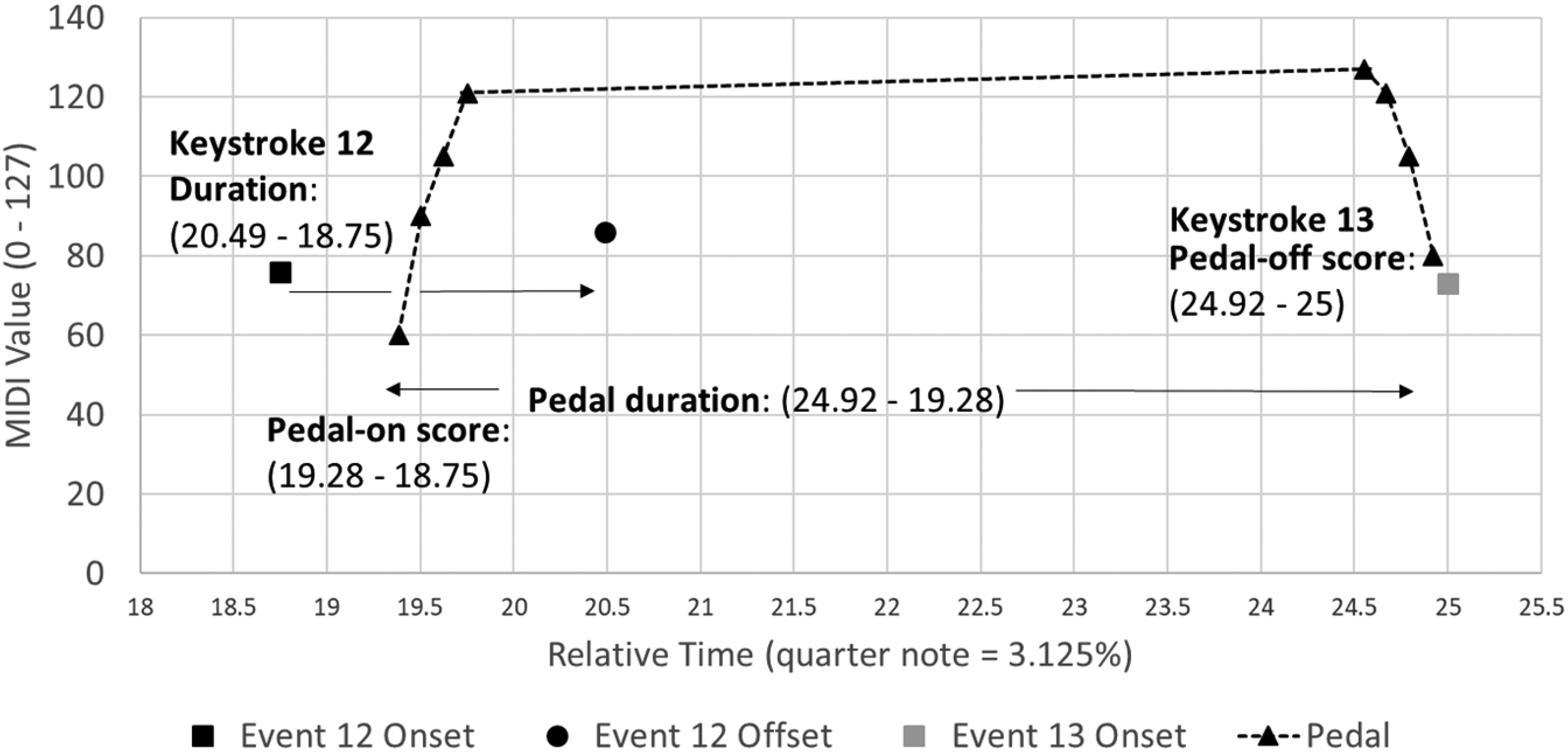
Calculations for Keystrokes 12 and 13: keystroke duration, pedal-on score, pedal-off score, and pedal duration.
Based on performance across the aforementioned eight parameters and the individual Z scores, composite Z scores were calculated to examine each pianist’s pedaling relative to the average performance of the group. Each pianist’s composite Z score (PCompZ) was calculated by first subtracting the mean of the group’s average Z scores (
Performance Ratings: Pianists’ Adherence and Expert Listeners’ Perceptions
After completing the performances, each participant completed an exit survey reporting his or her ability to adhere to the focus conditions during performance. Pianists’ ranked adherence on a Likert scale: 1 (high) to 5 (low).
Perception of performance was examined by averaging expert listeners’ scores across focus conditions for pedal technique and overall expression. Scores were analyzed using repeated-measures ANOVAs across the focus conditions (baseline; internal; external; metronome). Each pianist’s four performances were then sorted in rank order, 4 (best) to 1 (worst), based on the numerical score for both pedaling and overall expression. The number of times each focus condition was rated as the “best” or “worst” performance by each listener was then calculated.
Results
This section reports individual performance data for: (a) percentage of excerpt pedaled and number of pedal changes; (b) pedal implementation; (c) pedal duration and onset or offset relative to keystrokes for Events 12 and 13 and 26 and 27, respectively; (d) individual and composite Z scores for each of the aforementioned parameters; (e) perceptual ratings of performance; and (f) participants’ self-report ratings of focus adherence.
Percentage of Excerpt Pedaled; Number of Pedal Changes
Global pedal use, the percentage of the excerpt pedaled, that is with MIDI value > 0, and the number of pedal changes (lifting the foot to release the pedal and subsequent depression), were determined for both halves of the piece across the focus conditions (Table 2) to examine potential group performance trends. To determine how individual pianists responded to the different focus conditions, the coefficient of variation was calculated for both parameters (Table 3
Percentage of excerpt pedaled and number of pedal changes across focus conditions for each pianist.

Summary data: percentage of excerpt pedaled and number of pedal changes for each pianist (P#) across conditions and repetitions: B1, B2, I1, I2, E1, E2, M1, M2.

Note: Range values were calculated by subtracting minimum values from maximum values.
Pedal Implementation
Damper pedal use (i.e., on or off) relative to the printed quarter note was determined and plotted for each pianist by focus conditions and half of the piece without regard for MIDI velocity. Figure 2 presents data for three pianists with binary (i.e., on or off) graphic representation of the relationship between pedaling and the structure of the piece. Each vertical tick line spanning the x-axis represented four measures in relative time of Measures 1–16 performed without the repeat, with 1 quarter note = 3.125% of excerpt duration. This facilitated examination of the pedaling strategies employed, pedaling according to rhythm (e.g., based on steady beat) or structure (e.g., phrase endings), or both, and identifying potential shifts in strategy correlating with the different focus conditions. Results indicated remarkably stable pedaling strategies across conditions for Pianists 3 (Figure 2B) and 12. Pedaling characteristics were more variable by condition for the other pianists. Beyond changes in the amount of pedal and number of pedal changes (see the previous section), differences in the stability of pedaling strategy were observed. For example, the pedaling of Pianists 3 and 10 was consistently beat-oriented, whereas Pianist 8 pedaled the structural points differently across conditions, with syncopated pedaling in the first phrase ending in the baseline and metronome conditions, for example, and direct pedaling at the same point in the internal and external conditions (Figure 2C).

Individual pedal profiles across the excerpt: (2A) Pianist 3; (2B) Pianist 3; (2C) Pianist 10.
Pedal Duration and Onset or Offset Relative to Keystroke Events
To examine the technical implementation of pedaling between the pianists, vertical slices of time were identified where all pianists were engaging the damper pedal, Events 12 and 13 and 26 and 27, the ends of the first and second phrases, respectively. The purpose in examining the timing relationships was to parse the extent to which individuals relied on finger technique versus damper pedal depression to sustain the sound; aspects of physical coordination on one level but synergy of aural image, fingertip, and foot on another.
First Phrase Ending (Downbeat of Measure 4 to Downbeat of Measure 5)
Pianists were generally consistent in depressing the pedal after the keystroke at Measure 4; however pianists were inconsistent in the particular timing between pedal and keystroke onset, which varied from −0.85 to 4.52% in relative time, where the duration of a quarter note = 3.125% (Supplemental Figure 1A). Across the group, several trials seemed indicative of a rhythmic approach to pedaling, with observed values near 1.56% coinciding with the length of the eighth note.
Stability of pedal offset was consistent across conditions (either all before the beat or vice versa) across performers, with the exception of Pianist 13, although the timing of the offset varied considerably within each pianists’ performances (Supplemental Figure 1B).
Differences between pedal and keystroke duration ranged from 0.04 to 3.58% (relying on pedal to aid in sustaining the note) (Supplemental Figure 1C). Differences in stability within individual pianists ranged from 0.68 (Pianist 12) to 2.36% (Pianist 10).
Second Phrase Ending (Downbeat of Measure 8 to Downbeat of Measure 9)
Pedal onset was quite stable, occurring after keystroke onset across all pianists, repetitions (Measures 1–16 vs. repeat of Measures 1–16), and focus conditions (Supplemental Figure 2A), with the exception of three performances across the group and Pianist 10’s performances. Pianist 10 was excluded because the damper pedal had been depressed approximately one to two beats early, prohibiting conceptual and technical comparison with the other pianists. The difference between pedal and keystroke onset varied from −0.23% (indicating pedal onset before note onset) to 2.91% in relative time (duration of a quarter note = 3.125%).
Pedal offset was inconsistent both within and across pianists, with Pianist 10 releasing the pedal prior to the downbeat of Measure 9, four pianists (Pianists 1, 3, 12, and 13) releasing the pedal after, and three pianists releasing the pedal inconsistently (Supplemental Figure 2B). The difference between pedal offset and measure nine keystroke onset varied from −3.54% (e.g., Pianist 10, indicating pedal onset before keystroke onset) to 3.34% (e.g., Pianist 13) in relative time.
Differences between pedal and keystroke duration ranged from 0.57% to 4.98% (i.e., relying on pedal to aid in sustaining the note) (Supplemental Figure 2C). Instability was observed across both focus condition and repetition.
Z Scores
To gain a broad sense of individual participants’ performances in comparison with the group, Z scores were calculated for the eight parameters of performance presented in the preceding sections: percentage of the piece performed with pedal; number of pedal changes; pedal onset against keystroke onset; pedal offset against keystroke offset; and the difference between pedal and keystroke duration for both the first and second phrase endings (Table 4
Ranked Z scores across eight performance parameters and rank order as scored by expert listeners.

Note: Z scores are ordered from lowest (top) to highest (bottom) in the first nine columns (left to right), where each number represents the particular pianist. Composite Z score rankings are ordered from 1 (highest, most consistent) to 8 (lowest, least consistent). Shading groups two pairs of pianists: Pianists 12 and 3 (light gray: most experienced) and Pianists 7 and 10 (dark gray: least experienced pianists, who also spent the greatest amount of time preparing the piece). Listener rank order of pianists based on the average of their overall performance scores is presented on a scale from 1 (best) to 8 (worst).
Pianist 10 had already depressed pedal at the beginning of each measure prohibiting comparison with the other participants.
Expert Listener Rating of Performances
Pedal Technique
Scores for pedal technique are given in Supplemental Table 1. Participants’ scores were slightly better when adopting an internal focus (M = 7.39, SD = 1.41) but were similar otherwise: external (M = 7.00, SD = 1.95); metronome (M = 7.00, SD = 1.85); baseline (M = 6.78, SD = 2.09). The main effect of focus condition was not statistically significant (p > .05). In ranked ordering (1 = best, 4 = worst) of each pianist’s four performances, best performance was achieved most frequently in the internal condition (5.42 times), but results were similar across conditions: external (4.75); metronome (4.92), and baseline (2.92). In the event of a two-way tie for “best” performance, the score for that pianist was obtained by calculating the average between the tied ordinal number and the ordinal number that had not been used.
Overall Artistry
Scores for overall artistry achieved in performance are given in Supplemental Table 1. Participants’ scores were better when adopting an external focus (M = 6.17, SD = 1.71) followed by the baseline (M = 5.28, SD = 1.84), internal (M = 4.94, SD = 1.18), and metronome conditions (M = 4.72, SD = 1.35). The main effect of focus condition was not statistically significant (p > .05). Based on the aforementioned scores, pianists were ranked by averaging the individual artistic scores after dropping each listener’s highest and lowest scores (Table 4). In ranked ordering (4 = best, 1 = worst) of each pianist’s four performances (Table 5), the best overall artistry was achieved in the external focus condition as rated by each listener individually and as a result of their averaged rankings for seven of the eight pianists.
Expert listeners’ perceptions of pianists’ overall expression across performances.

Note: Ratings are presented in rank order, best (4) to worst (1). Bold font represents the highest rank score of overall expression for a pianist across the four performance conditions by a single expert listener. Asterisks indicate the highest average ranking of overall expression across performances.
Participants’ Self-Ratings
Focus Condition Adherence
Scores for focus condition adherence are given in Supplemental Table 2. On a Likert scale of 1 (high) to 5 (low), participants’ scores ranged from 1 to 3 as follows: 1, four pianists; 2, one pianist; and 3, four pianists.
Discussion
This study investigated pianists’ pedaling of a standard repertoire piece under different focus conditions. No group trends were observed; however, differences in pedaling across the conditions were clearly evident for seven of eight participants, with the exception of Pianist 3. A key observation across these seven pianists was reduction of global pedal use in the internal focus condition (Table 2). Furthermore, pianists’ external focus condition performances were rated better in terms of overall performance (averaged rank order = 3.59) than baseline (2.28), internal (2.06), or metronome conditions (2.06) by expert listeners (Supplemental Table 1 and Table 5). Quantitative data suggest that level of expertise and amount of focused practice in preparation influenced performances. The most experienced pianists, Pianists 12 (keyboard faculty member) and 3 (staff pianist), were remarkably consistent in the quantitative and qualitative attributes of pedal across conditions (Table 4). Pianist 10 (undergraduate student pursuing a music minor; 300 min in preparation time) was also quite consistent, particularly in the number of pedal changes and amount of global pedal across conditions (Tables 2 and 4).
Overall, less experienced pianists and pianists who spent less time preparing the piece seemed to exhibit less stability in pedaling in the dimensions reported in this study. For Pianists 1, 5, and 13, variability emerged quantitatively, in the amount of pedal used across the excerpt or in the number of pedal changes (Figure 2). For Pianists 7 and 8, pedaling was variable qualitatively, in technical and conceptual implementation of the pedal, changes in the application of the pedal musically and with regard to multilimb coordination (Figure 2 and Supplemental Figures 1 and 2). Observations are discussed in greater depth next, and future directions for research based on study findings are presented.
Adopting Different Attentional Foci Influences Pedaling
Quantitative Effects: Global Pedaling
The results of this study demonstrate that focus conditions differentially affected global pedal use (Table 1), despite the lack of instruction specific to pedaling. An important observation was the constraining effect of the internal and metronome focus conditions on overall pedal use. Specifically, the internal focus condition constrained the percentage of the piece that was pedaled and the number of pedal changes by all participants, with the exception of Pianist 3. Focus on the metronome’s beat had a similar effect for half of the participants, Pianists 1, 5, 8, and 13. The magnitude of the constraining effect was particularly obvious in the internal condition (Pianists 1, 8, and 13) and in the metronome condition (Pianists 5, 8, and 13).
Qualitative Effects: Individual Pianists’ Pedal Profiles
Supporting studies by Repp (1996, 1997), the variability in pedal timing observed in this study was not surprising. However, variability in the type of pedaling, and therefore the coordination between the hands and right foot, was intriguing. With the imposition of different focus instructions, qualitative differences in pedaling, shifts between direct and syncopated pedaling (see Section “Pedaling”), were observed in several pianists’ performances. Figure 2 demonstrates the range of variability observed across performances, an inverted U-shaped spectrum (i.e., lowest variability anchored at either end), probably influenced by these pianists’ respective levels of experience and preparation. Pianist 3, one of the most experienced participants, consistently utilized direct pedal technique across all conditions. Pianist 10, the performer with the least amount of formal training, also employed direct pedal technique throughout the performances, although with less timing consistency than Pianist 3. Pianist 8 frequently utilized direct pedal technique across the performances, but there were obvious exceptions where pedal onset occurred inconsistently and in syncopated style, at the end of the first phrase, for example, and seemingly more frequently in the internal and external focus conditions. Presumably, the differences exemplified among these participants, and a likely explanation for the variable performance characteristics, was the disparate levels of experience, an undergraduate student pursuing a music minor (Pianist 10), a graduate pianist (Pianist 8), and a university staff pianist (Pianist 3), the latter more likely having achieved stability of pedaling coordination and relying on and integrating aural feedback to a greater extent to engage the pedal than the less experienced pianists. The stability of Pianist 10’s pedaling was more likely to reflect earlier stages of learning at the instrument, such that general consistency in executing direct pedals had been achieved through significant practice but without consistent integration of aural feedback. Similar to the performance of novice soccer players observed by Beilock, Carr, MacMahon, & Starkes (2002), Pianist 10 was probably focused on the procedural elements of the performances. Ranking third in level of formal training and fourth in preparation time (i.e., 30 min), 20 min more than Pianist 3, the interplay of Pianist 8’s expertise and preparation was insufficient to stabilize pedaling patterns over the course of the excerpt. Whether or not Pianist 8 might have achieved greater qualitative consistency with additional time spent in preparation or in practicing with either an internal or external focus, the conditions appearing most vulnerable, are intriguing questions, ones the authors surmise would have resulted in a more singular approach to pedaling.
Task Repeatability, Flexibility, and Stability in Motor Skill Performance
One of the fundamental aspects of skilled motor performance is flexibility, the ability to perform reliably and consistently, but also to transfer performance to other contexts or environments (Johnson, 1961). Flexibility is a crucial component of pianism in transfer of a conceptualized ideal performance across numerous task constraints (e.g., variety of instruments) and environments (e.g., acoustics, dynamic audience response, lighting). An implicit gauge of pianists’ flexibility in this study was repeatability, both across focus conditions but also within each focus condition performance in executing the repeat of the piece.
Two obvious measures of repeatability in this study include global pedal use and the number of pedal changes. Pianists 3 (staff pianist), 10 (undergraduate music minor), 12 (piano professor), and 13 (choral professor) demonstrated greatest stability of global pedal use and number of pedal changes across repetitions (Table 2). Pianists 3 and 12 were the most experienced participants, while Pianists 10 and 13 spent the most time in preparing the repertoire piece, 300 min and 180 min, respectively (Table 1). The authors hypothesize that the similarity of performance in terms of repeatability was modulated by experience, that the most seasoned pianists performed the task having achieved automaticity, facilitating adaptability, while Pianists 10 and 13 achieved stability in these two parameters through deliberate practice and perhaps online attention to task performance. The repeatability of Pianist 13’s performances begs further scrutiny, however. While Pianists 3, 10, and 12 demonstrated repeatability both within and across focus conditions, Pianist 13’s performances were similar within focus conditions (Measures 1–16 and the same measures repeated) but only across baseline and external conditions, an observation suggesting a differential effect of condition, perhaps as a result of an intermediary level of expertise between Pianist 10, on the one hand, and Pianists 3 and 12, on the other.
Performance Ratings
Composite Z Scores and Expert Listener Ratings
In this study, pianists’ pedaling was assessed objectively via composite Z scores and subjectively by expert listeners. It was rather curious that, with the exception of the two most experienced Pianists (12 and 3), the ranked order of pianists as determined by the composite Z scores did not align with the expert listener rankings. Two aspects of these results were particularly noteworthy. First, the top four performers as ranked by the experts were those pianists with the greatest amount of training. Further, none of those four spent more than 30 min in preparing the piece, which suggests that expertise was a significant factor contributing to the quality of their performances. Second, the top four pianists, according to the composite Z scores, were the two most experienced pianists and the two least experienced pianists.
On first glance, the dichotomy of rankings may seem peculiar, but it may in fact reflect important principles related to motor skill learning and performance. The consistency of Pianists 3, 7, 10, and 12 can perhaps be understood within the framework of an inverted U-shape (Fitts & Posner, 1967) of performance variability relative to experience. These pianists anchor the inverted U on opposing ends such that the well-rehearsed but procedural nature of performance constrains performance variability of Pianists 7 and 10, while the expertise of Pianists 3 and 12 facilitates consistency, comparable results but correlating with different underpinnings across stages of learning. Considered holistically, it is clear from the two sets of rankings that, at least in this particular repertoire piece, among these pianists, overall expertise was a greater factor than pedal consistency in assessing overall performance.
Differential Benefit of External Focus
Expert listeners’ average ratings of pedal technique across the focus conditions were similar: baseline, 6.78; internal, 7.39; external, 7.00; and metronome, 7.00 (Supplemental Table 1). The constraining effect of internal focus resulted in a dryer approach to pedaling (e.g., as measured by global pedal use), which listeners preferred, albeit slightly. However, listeners rated performances in the external condition as being most expressive overall: baseline, 5.28; internal, 4.94; external, 6.17; and metronome, 4.72. The authors conclude that although pedal technique was rated marginally higher in the internal focus condition, overall pedal technique was sufficient and consistent enough across conditions to facilitate perception of greatest overall expressivity in the external focus condition.
Performance Self-Assessment
Pianists reported average to high levels of focus condition adherence during the performances (Supplemental Table 2). Despite the inherent limitations of self-reporting, the data support reasonable ability to measure performance effects in relationship to disparate foci. An important aspect of future work in the field will be to investigate the role of focus condition relative to training experience. It is possible but unknown, for example, whether any of the participants explicitly utilize focus strategies as part of their practice or performance strategies.
Pedagogical Implications
“Internal” versus “External” Focus Instructions
Based on the study results, it appears that any cue or instruction used to focus attention will result in deviation from baseline (without instruction) movement patterns for all except the most experienced, and perhaps most inexperienced, performers, even without any mention of the motor task specifically. In this study, absolutely no mention of the pedal was made. The only pedal indication was in the printed notation of the score.
Further, one of the notable aspects of the study was the conditions themselves: internal (focusing on the fingertips and creating a staccato touch); external (focusing on creating the idea of a dance); and metronome (focusing on the metronome’s beat). In FOA literature, internal focus generally refers to focusing on a particular movement, whereas external focus refers to focusing on the effect of the movement (Wulf & Prinz, 2001). Overwhelmingly, across a wide variety of motor tasks, research indicates that external focus generally facilitates performance, while internal focus tends to constrain performance (for a review, see Wulf, 2013). In this study, although the metronome condition (synchronizing playing with the beat) promoted external focus, it had a constraining effect on performance. This is contrary to the general conclusion in the literature that external focus facilitates performance, in theory, by facilitating automated processes underlying movement (Wulf et al., 2001). Evidence from this study supports the idea that a more valid distinction between cues may be abstract against concrete rather than external against internal. Therefore, a piano instructor may be well-advised to consider when to offer instruction, since any focus instruction is likely to influence performance, and to carefully word pedagogical cues to support the desired learning or performance goal. The benefit of an external focus cannot be presumed or taken for granted simply because it is an external cue. Perhaps the most significant implications are that both cognitive and motor familiarity influence individual performance in the context of a secondary task (MacMahon & Charness, 2014), and that these aspects can be modulated to produce differential performance outcomes.
Optimizing Focus Strategies in Practice and Performance
Several studies indicate that some performers adopt an internal focus when not specifically instructed otherwise (Land et al., 2013; Pascua et al., 2015). Further, research in dance has demonstrated that performers’ preferred focus, either external or internal, does not always correlate with success (Chua et al., 2018) and that not all dancers employ optimal focus at all times (Guss-West & Wulf, 2016). These studies highlight an opportunity to reimagine training and performance strategies, leveraging evidence-based research and extending application through systematic inquiry.
For the musician, as for the dancer, the transfer task is the public performance. According to Newell’s model (Newell, 1986), constraints on motor performance emerge in three areas: task, environment, and those related to the individual. Given that performance is enhanced when training and performance conditions match (Proteau et al., 1987; Tremblay & Proteau, 1998), performers must consider attentional focus as a dimension of their training, deliberately and consistently honing focus cues in practice that can then be called on in performance. In practice, for example, a musician might conjure a visual image of a piece or a descriptive word associated with it, and integrate focus on this singular aspect every time the piece is played to prime and focus performance. Based on athletic and rehabilitative research, and research undertaken thus far in the performing arts, musicians would do well to develop and incorporate external focus strategies in training and performance.
Limitations of This Study
One of the rudimentary challenges of formulating a study such as this is selecting an excerpt that is challenging enough to require pianistic expertise while also being accessible enough to facilitate recruitment and participant adherence to preparation guidelines. Limitations of this study include a relatively small, heterogeneous participant pool, differing comfort levels in technical and artistic aspects in performing the required excerpt, and the inability to determine participants’ adherence to the focus conditions. A larger participant pool, and a pool naturally self-selecting performance tempi close to 144 b·min−1 in the baseline focus condition, would increase confidence that performance variability was a result of explicit changes in focus. Similarly, self-reporting regarding training and performance strategies could reveal distinctions between participants and provide insight into future directions and the ways that research may be applied pragmatically in the applied performance setting.
Focus of Attention in the Performing Arts
In comparison with athletic and therapeutic endeavors, very little research has been undertaken to parse the attentional effects of performance in the performing arts. As demonstrated by the results of this study, however, the performing arts may be key in developing understanding of the phenomenon, particularities, and mechanisms revealed in motor skills rooted in abstraction and evaluated based on aesthetic quality. It is quite clear that the differential effect of focusing attention is more complex than adopting either an external or internal focus. Context clearly matters, and the implications have the potential not only to enhance instruction and performance in the arts, athletics, and therapeutic endeavors, but to parse the layers of the FOA phenomenon itself, discern implications for human performance across disciplines, and develop best practice across myriad contexts.
Supplemental Material
sj-docx-1-mns-10.1177_20592043221123225 - Supplemental material for Probing Focus of Attention: Multiple Case-Study Analysis of Pianists’ Pedaling Under Different Foci Conditions in Performance of Bartók’s Romanian Folk Dance Sz. 56, No. 2
Supplemental material, sj-docx-1-mns-10.1177_20592043221123225 for Probing Focus of Attention: Multiple Case-Study Analysis of Pianists’ Pedaling Under Different Foci Conditions in Performance of Bartók’s Romanian Folk Dance Sz. 56, No. 2 by Tracy Lipke-Perry, Morris Levy and Darren J. Dutto in Music & Science
Footnotes
Acknowledgement
Thank you to the Motion and Media Across Disciplines (MMAD) laboratory for technical support and to the pianists who volunteered to participate.
Action Editor
Andrew Goldman, Indiana University, Department of Music Theory, Jacobs School of Music.
Peer Review
One anonymous reviewer.
Sarah Allen, Southern Methodist University, Music Faculty.
Contributorship
TLP, DJD, and ML conceived and designed the study, participated in data collection, performed data reduction and analysis, interpreted results, and approved the final version of the manuscript. TLP wrote and revised the manuscript.
Data Availability Statement
The raw data supporting the conclusions of this manuscript will be made available by the authors, without undue reservation, to any qualified researcher.
Declaration of Conflicting Interests
The authors declared no potential conflicts of interest with respect to the research, authorship, and/or publication of this article.
Ethical Approval
All experimental procedures were ethically approved by the Institutional Review Board of the University of Minnesota and were undertaken with informed consent of each participant.
Funding
The authors received no financial support for the research, authorship, and/or publication of this article.

Supplemental Material
Supplemental material for this article is available online.
Correction (July 2023):
The ethical approval statement has been added.
References
Supplementary Material
Please find the following supplemental material available below.
For Open Access articles published under a Creative Commons License, all supplemental material carries the same license as the article it is associated with.
For non-Open Access articles published, all supplemental material carries a non-exclusive license, and permission requests for re-use of supplemental material or any part of supplemental material shall be sent directly to the copyright owner as specified in the copyright notice associated with the article.
