



Abstract
Despite more than a century of research on music memorization and practicing strategies, there is a lack of comprehensive evidence on how instrumental music teachers teach memorization to children and adolescents in one-to-one lessons. The present qualitative study investigated the diversity of ways in which music memorization is taught in one-to-one piano lessons. Piano teachers (N = 37) completed an online survey collecting qualitative responses regarding music memorization. Participants were asked to give a brief description of music memorization, how they memorize as performers and how they teach music memorization to their students, amongst other questions. Results indicate that music memorization is perceived by most teachers as a skill that develops through practice rather than a natural talent. Reported strategies for teaching memorization fell into four categories: aural, visual, kinesthetic, and analytical, which align with previous theoretical conceptualizations of musical memorization. Recurring mentions of muscle memory practice and music theory knowledge suggest that kinesthetic and analytical methods are qualitatively dominant in the way teachers 1) define music memorization, 2) memorize as performers, and 3) teach music memorization. This suggests that aural and visual memorization methods might be less explored by piano teachers of children and adolescents and future research could be conducted in this area.
Keywords
Introduction
Theories of Music Memorization
When Clara Schumann performed Beethoven's Piano Sonata No. 23 in F minor, Op. 57 entirely from memory in 1837, this was quite an uncommon practice and was received by some critics as arrogant and flamboyant, since the attention was on the performer rather than the music (Chissell, 1983; Litzmann, 1925). However, by the early 20th century, performing from memory had become a fairly standard practice. Now, almost two centuries later, performing from memory is to a great extent expected from professional instrumentalists when performing solo music, especially in competitions. It is a topic that has been discussed by performers and pedagogues, and more recently by psychologists and neuroscientists, still with no clear consensus on which techniques are most effective for teaching music memorization.
Memory is the neurocognitive capacity to encode, store, and retrieve information (Tulving, 2000). In musical memorization, the initial encoding of a piece is often a multimodal process, combining visual, acoustic, and/or semantic information (McLeod, 2007). This information is stored in long-term memory and retrieved within a performance via these multimodal cues. The process of memorization in music often involves a combination of deliberate/explicit memorization strategies and incidental learning that happens during music performance and practice. Sometimes performers memorize sections of a piece incidentally through repetitive practice, even if they do not aim to deliberately memorize the whole piece; for example, this often happens with fast passages when there is no time to actually read each note whilst performing.
An example of deliberate memorization is the use of performance cues which are features of the music to which a musician pays attention during practice and rehearsal, which, as a result, become mental “landmarks” when the piece is performed (Ginsborg & Chaffin, 2011). These cues act as a mental map of the piece and assist the performer to monitor the musical structure of the piece as it unfolds and to recover from memory lapses and mistakes (Chaffin et al., 2009). A recent study suggests that a performer's ability to recall long musical sequences from memory by using performance cues facilitates recovery from mistakes and omissions (Chaffin et al., 2023). In this study, an experienced singer was asked to write out the music of a vocal piece that she had memorized and performed previously six times over a five-year period. When recall failed, the singer was able to recover at the start of a new phrase or section where a performance cue provided a content-addressable retrieval cue: a cue accessed based on its content rather than its location (Chaffin et al., 2016). This provided renewed access to the memorized musical sequence.
Chaffin et al. (2016) describe multiple memory systems related to the encoding of music in memory; these include auditory, motor, structural, emotional, visual, and linguistic memory. The earliest references and analysis of some of these memory systems and their importance to music memorization can traced back more than a century to Hughes (1915) and Matthay (1968). Hughes and Matthay were two of the first pedagogues to write extensively on how musicians memorize. They focused on three principal ways in which performers can learn music when preparing for a memorized performance: aural, visual, and kinesthetic. Interestingly, Hughes and Matthay, do not include analytical memory (“structural memory”, in Chaffin et al.'s (2016) terminology) as one of their memorization categories. Analytical memory is a type of memory in which the performer memorizes according to the harmony, melody, and structure of the piece. However, both pedagogues suggest that aural, visual, and kinesthetic memory cannot work without analytical memory. In Hughes’s words, “no really intelligent memorizing is possible without a knowledge of harmony and musical form, and, for the stricter polyphonic forms of composition, of counterpoint and fugue as well” (Hughes, 1915, p. 599).
During the past few decades, most research on memorization methods in music has centered around these four categories (aural, visual, kinesthetic, and analytical memory) (Chaffin et al., 2016; Chaffin & Imreh, 1997; Cohen et al., 2011; Hallam, 1997; McPherson, 1997, 2005; Miklaszewski, 1989; Mishra, 2002, 2007, 2010a, 2010b; Seddon & Biasutti, 2010). According to a review article by Mishra (2010a), the majority of 185 articles on music memorization and related topics written between 1872 and 2006 were focused on at least one of these four memorization methods. Several studies have focused on the importance of using more than one of the above methods when memorizing. For example, when kinesthetic memory is combined with aural or visual memory it could increase performance success, as it has been shown that musicians who use multimodal strategies feel more confident in their memorization than those who use single-modality strategies (Hallam, 1997; Williamon & Egner, 2004; Williamon & Valentine, 2002).
Visual Memory
In one-to-one instrumental lessons the first point of reference for visual memory is often the music score. Visual memory is typically used at the preliminary stages of learning a piece, in which students attempt to become familiar with the music score. Visual memory may be used to remember the music score like an image in one's mind or identify where one is in the music score even when playing from memory. Novice students are usually required to spend a significant amount of time in the visual memorization of conventional notation symbols. A study by Kuo and Chuang (2013) introduced a new color music notation system that may improve the recognition of notation symbols. Results showed that this system helped novice students to memorize music scores faster than learning with traditional notation since each pitch is represented by a color and this connection enhances the visual memory of the student. In addition, the importance of visual memory can be seen in the way musicians might find it difficult to use a different edition than the one they have initially used to memorize a piece. It is very common for novice musicians to rely on the spatial organization of music by pages, rather than the formal structure of the piece, to organize their practice (Williamon & Valentine, 2000). A study which examined the skill development during the beginning stages of learning an instrument of 157 children in school grades 3 and 4 in Australia suggests that when children were requested to play a melody by ear, they tried to visualize how this looks on a music score and whether subsequent notes were going up or down (McPherson, 2005). Furthermore, visual memory can also be implicated in non-score based visual imagery, such as imagining how one's fingers look on the keyboard, one's hand position and visualization of a performance in general.
Aural or Auditory Memory
Aural memorization strategies include the encoding of auditory information and use of auditory imagery when performing a piece. For instance, during performance, performers typically have a mental template of how the music should sound, and this auditory representation allows them to anticipate upcoming notes but also evaluate the correctness of notes they have played (Finney & Palmer, 2003). Keller and Koch (2008) found that one way in which auditory imagery may benefit music performance is by enabling rapid and thorough action preplanning, as demonstrated in speeded reaction time tasks. In addition, the relationship between aural and rote instruction, with aural instruction focusing on training the ears and rote instruction focusing on the repetition, has been examined by many researchers (Bernhard, 2004; McPherson, 1997; McPherson & Gabrielsson, 2002). Playing by ear has been found to provide groundwork for students to be able to sight-read, play from memory, improvise, and perform rehearsed music (McPherson & Gabrielsson, 2002).
Kinesthetic or Motor Memory
Kinesthetic or motor memory involves motor representations that facilitate performance of previously-learned movements (Haaland et al., 2019). The most common paradigm of sole kinesthetic memory is when novice musicians repeat a new piece of music continuously until they learn it; this is a common example of “muscle memory”, or associative chains in the terminology of Chaffin et al. (2016). The main problem that musicians experience when relying primarily on this type of memory organization is that if one makes a mistake in the middle of the piece it is difficult to continue without starting again from the beginning of the piece or from a previous section. Music performance relies heavily on associative chaining: what you are playing reminds you of what comes next (Chaffin et al., 2016), and in the case a mistake occurs, the performer is not able to move forward but attempts to restart from the beginning.
Analytical or Structural Memory
This type of memory is related to the hierarchical organization of a piece of music into sections and sub-sections based on harmony, melody, and meter. Professional musicians often divide their music into such sub-sections and analyze the music before they start the process of memorization (Chaffin & Imreh, 1997). Analytical memory develops gradually during a student's music education, as music theory knowledge is essential for this method of memorization and the more advanced a student is, the more he/she can apply analytical memorization methods into his/her practice. At a beginner's level, this method can be instilled by the teacher, who can teach the student basic building blocks of harmony (e.g., tonic and dominant chords), meter (e.g., recognition of time signatures), and melody (e.g., similarities and differences between melodic phrases). This can be considered as an early stage of analytical memory which can assist very young students in memorization.
A recent study on collegiate string players’ short- and long-term recall of an etude indicates that engaging in analytical thinking about a piece can improve musical recall even in the initial stages of memorization. Participants were asked to learn an unfamiliar etude either through repetition alone or through repetition followed by the completion of a verbalization worksheet. The verbalization worksheet included questions on the musical character of the etude, the characteristics of the phrase structures and rhythmic motives, and the piece's tonality. Recall was tested both immediately following initial practice and 24 hrs later. Findings showed no differences between groups on immediate recall performance but significant differences at the 24-hr recall task with participants in the verbalization condition recalling more material (Timperman & Miksza, 2019). This suggests that analytical approaches to memorization, in particular verbalization, can be beneficial when memorizing music.
Almost all previous studies on analytical memory have focused on the memorization of Western Classical tonal music written before the 20th century. A recent study which examined how six professional pianists memorize contemporary music suggests that pianists memorize this genre of music in much the same way as other musical styles (Fonte et al., 2022). On the other hand, new memorization strategies specific to this repertoire were identified; the visual layout of the score for segmentation, idiosyncratic musical analysis, and the use of chunking based on contemporary models of composition.
Rationale for the Current Study
The topic of music memorization is unarguably one which has attracted the interest of many researchers since the beginning of the 20th century (Aiello & Williamon, 2002; Chaffin & Imreh, 1997; Hughes, 1915; Sloboda & Ginsborg, 2004; Snyder, 2000, and others). However, most previous research on music memorization has focused on professional musicians and college students, with a relative lack of previous studies on how music teachers perceive and explicitly teach memorization, especially when working with beginning or intermediate level students.
To the authors’ knowledge, only one previous study has investigated memorization methods used by instrumental teachers (Dakon & Dvorak, 2014). This study surveyed 126 string instructors about memorization conceptualization, curricular importance, perceived benefits, personal level of ease and enjoyment, and application in string-based learning environments. Results showed that the majority of the participants perceived music memorization as cognitive recall without the presence of visual stimuli (e.g., a score). In addition, results indicated that teachers most often encourage aural and visual memorization strategies; however, they rarely used these strategies in order to teach fundamental technique or solo material (Dakon & Dvorak, 2014). The present study takes some inspiration from the design used by Dakon and Dvorak (2014), although with a novel focus on piano teachers and taking a more open-ended, qualitative approach to capture the full diversity of strategies piano teachers use both to teach memorization and when memorizing music themselves. Given various inherent differences between the instruments (e.g., the harmonic and fixed pitch nature of the piano vs. the monophonic and variable pitch nature of string instruments), our study also provides a novel point of comparison to Dakon and Dvorak's approach, which allows us to begin to explore whether their findings extend to teaching of memorization on other instruments.
The primary aim of the present study is to examine the diversity of strategies piano teachers use when teaching memorization in one-to-one piano lessons, and secondly to identify any common themes across these strategies. We focus on piano teachers who teach children and adolescents (under age 18), who were asked to complete an online questionnaire comprising both open- and closed-ended questions. Specifically, we aimed to explore the relationship between 1) how a teacher defines music memorization, 2) how he/she memorizes as a performer, and 3) how he/she teaches memorization as a teacher (see Figure 1). This study provides new evidence on what teachers perceive to be the most effective ways to teach music memorization in piano lessons, and how memorization strategies they use in preparing for their own performances relate to their teaching practices. This work has implications for informing pedagogical practice in piano lessons, and for future comparisons across different types of instruments and ability levels.
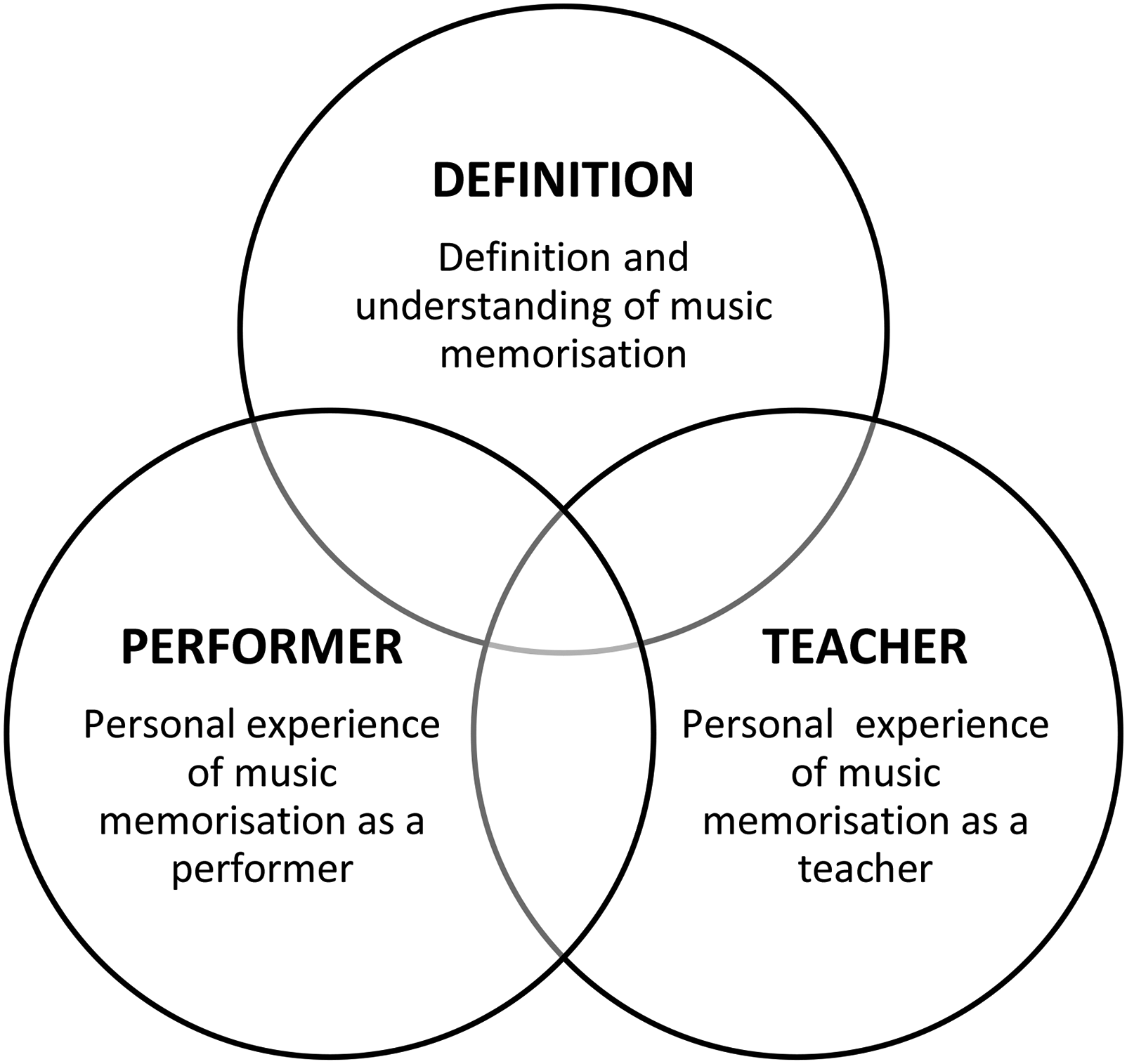
Relationship of the three qualitative questions.
Our focus on this specific age group – children and adolescents – aims to fill the gap within existing literature which has focused overwhelmingly on adult participants: college students and professional musicians. Much debate surrounds whether the learning and teaching process differs from childhood to adulthood, as supported by the concept of “andragogy” which was developed by Malcolm Knowles in the 1970s and examines the differences between the ways children and adults learn (Knowles et al., 2005). Although enduring debate surrounds the idea of andragogy, adult educators generally agree that there are unique approaches to working with adult learners that differ to the ways in which educators work with children (Roulston et al., 2015).
Method
Questionnaire Design
We developed an online questionnaire, the Piano Teachers’ Memorization Questionnaire, implemented using Qualtrics, which consists of both open-ended and closed-ended questions. It was designed using a limited sample of past literature, since no other similar questionnaire which surveys piano teachers’ perceptions of memorization in one-to-one piano lessons exists. Some of the questions we included were adapted versions of those used by Dakon and Dvorak (2014) and Mishra (2007), who designed a Musical Memorization Inventory (MMI) to measure preferred memorization styles (aural, visual, and kinesthetic) in instrumental college students.
Participants
Participants were piano teachers recruited via online advertisements on social media, and international local schools in the United Arab Emirates. In total 70 participants completed some portion of the survey; however, only the data of 37 participants who completed 75% or more of the survey were used in the current study. These 37 participants had a mean age of 43.65 years (range = 25–81, SD = 12.74), with the sample comprising 32 females and 5 males. They were born in Australia (1), Canada (2), Cyprus (7), Georgia (1), Greece (10), Kenya (1), Lebanon (1), Malaysia (3), the United Kingdom (1), and the United States of America (10).
In general, most of the participants (92%) had completed at least a Bachelor's degree in Music, whilst 35% reported having studied in both a university and a conservatoire. Participants’ mean years of teaching experience was high (M = 20.65), with a range of less than a year to 49 years, and number of current students ranging from 1 to 55 students (M = 19.89). Although the sample ranged widely in their teaching experiences, most (92%) had more that 5 years of piano teaching experience, and most (81%) had more than 5 students. Participants reported teaching students as young as 4 up to 84 years old; however, in the instructions to the study, participants were requested to provide responses based on their teaching practices for students up to the age of 18.
Table 1 provides details on the sample size, mean age, gender, highest degree, and teaching experience of the participants who responded to each of the three open-ended questions on which the present study focuses. The difference in sample size reflects the fact that not every participant chose to respond to every question.
Sample size, age, gender, highest degree, and teaching experience data for participants who responded to each of the three open-ended questions.

Materials
To assess the internal validity of the questionnaire items, two cognitive interviews were carried out before the launch of the experiment, with one female and one male piano teacher as participants. Both teachers completed the questionnaire in the presence of the first author, and they were asked to think out loud and point out any difficulties they found throughout the process of understanding and completing the questionnaire. The cognitive interviews allowed for an empirical understanding of the ways in which participants mentally process and respond to the questionnaire (Lavrakas, 2008). According to the results and feedback received by the two participants, minor changes were made to ensure the questions were more understandable and easier to answer.
The full questionnaire comprised 44 items in total, including 12 demographic questions, 3 open-ended questions, 17 questions on aural, visual, kinesthetic, and analytical memorization strategies, and 12 general questions on mental practice, formal rehearsals before concerts, musical imagery, and memory lapses. A 5-point Likert scale was used for the closed-ended questions. The primary focus of the present study is on three open-ended questions, specifically: 1) Give a brief description of music memorization, 2) How do you memorize as a performer? and 3) How would you teach memorization in Kabalevsky's Gallop? (participants were provided with the music score while completing the online questionnaire; see Appendix A). Dmitri Kabalevsky's Gallop is an ABRSM Grade 2 piano piece, and was selected due to its simple form and beginner's level in order to understand how teachers teach memorization from the earliest stages of learning the instrument. Analyses of the quantitative, rating-scale questions will be presented in a separate article, in which these data will be integrated within a larger sample of teachers of other musical instruments.
Procedure
Prior to commencement of the survey, participants were informed that this study aims to investigate the extent to which piano teachers teach memorization during one-to-one piano lessons and the different types of strategies/methods they use to do so. However, memorization strategies/methods were not defined in terms of specific categories (e.g., aural, visual, kinesthetic, analytical) in order to prevent participants from giving biased responses. Participants gave written informed consent, and all data were collected in a fully anonymized format. Firstly, they completed demographic questions and questions regarding their teaching background. Then, they completed open-ended and closed-ended questions about their memorization teaching strategies. The survey took around 20 minutes to complete and was approved by Durham University Ethics Committee. Upon completion, participants were debriefed on the aims of the current study and its potential impacts on future research, and were provided relevant contact details to request further information regarding the results of the completed study.
Analysis
Qualitative responses were analyzed using thematic analysis (Braun & Clarke, 2006): Raw data were coded in terms of relevance for the study, with primary codes grouped into themes of similarity and association; next, themes were further categorized and grouped into broad top-level themes that best represented the data. The thematic analysis of the data was solely focused on memorization methods (including both incidental and deliberate strategies). Text that simply provided a definition of memorization (e.g., “playing without a score”) was not coded here. An inductive approach was used, in which codes and then themes emerged out of the data. Thematic analysis was accommodated by NVivo software (Version 12.6.1). Thematic analysis of the data was mainly conducted by the first author. However, all responses to the first question were also coded by the second author and cross-checked with the first author's original coding. In total, 91% of all codes were in agreement, and 100% agreement was reached after discussion of discrepant cases. Given this high rate of agreement, the second two questions were coded only by the first author.
Results
The first section of the survey showed that 53% of participants “Sometimes” teach their students memorization methods throughout the course of an academic year, 33% “Almost Always”, 8% “Rarely”, and 6% “Always”, whilst none of the participants reported “Never”.
Music Memorization Definition
Participants were firstly asked to “give a brief description of music memorization”. From the raw data, 11 codes were grouped into broader themes, with two accounting for the majority of responses: natural memorization, and memorization through practice (see Table 2). Memorization through practice was the most-mentioned theme, showing that participants generally believe that music memorization happens through practice rather than a natural talent that a student possesses. Repetition/muscle memory was the most frequently described music memorization method with 9 codes, followed by music theory knowledge with 7 codes. This suggests that kinesthetic memory and analytical memory are the two most dominant strategies considered when piano teachers describe memorization through practice. The following is an example of a response that includes repetition/muscle memory practice: In my experience, in order to achieve memorisation students must undergo through the process of practising hands separately in such a way that each hand can play its part automatically in order to build muscle memory separately. Only then do the hands/fingers build enough memory to come together. (Participant 10)
Themes and codes that emerged from the question “Give a brief description of music memorization”; numbers in parentheses indicate number of codes extracted from raw data.

The memorization through practice theme also included many responses on music theory knowledge: Memorisation involves a number of processes that work collectively to secure and facilitate performance from memory! These include a thorough understanding of the music (structure, harmony, dynamics, phrasing…) (Participant 6)
Less frequently reported were codes of sight-singing (1), sight-reading (1), exam aural training (1) and rote learning (1), which involve aural and visual memory. In contrast, the natural memorization theme was less frequently used, with only 3 references to music memorization being a natural ability that a student is born with and 1 reference to perfect pitch. Nine participants did not provide any usable information that could be used in the two main themes below (either did not answer the question or provided information unrelated to specific memorization methods), whilst some other participants provided responses that were coded into more than one of the categories.
How Do You Memorize as a Performer?
Participants were subsequently asked to describe “How do you memorize as a performer?”. From the raw data, 5 main themes emerged. Participants reported methods of aural (7), visual (4), kinesthetic (20), analytical (17), or no memorization (4). The two most frequently occurring themes here, analytical (17) and kinesthetic (20), align with the results of the “definition of music memorization” question above, in which analytical and kinesthetic memorization were dominant as well (see Table 3).
Codes that emerged from the question “How do you memorize as a performer?”; numbers in parentheses indicate number of codes extracted from raw data.

The following are some examples of responses under the themes aural, visual, kinesthetic, and analytical memorization: During the learning process I am able to memorise the sounds in the music, so it is mostly through aural means. (Participant 34, aural) Practice a lot from the sheet, memorise the hard parts first (where my attention needs to be on the keys) and the rest comes naturally. (Participant 4, visual) As a pianist, I learn separately the left and the right hand. Sometimes, I try to learn the whole piece both hands together, but always I return to memorise each hand separately… (Participant 21, kinesthetic) Structure of the composition – form – harmonic analysis – rhythmic and melodic motifs… (Participant 9, analytical) To be very honest I find it incredibly challenging to memorize music as it wasn’t something my own piano teacher encouraged much. (Participant 2) Too hard for me as I never learned or try it as a student. It was too difficult for me and I was too good to turn my pages! That's why I encourage my students to do it from the beginning of their musical journey! (Participant 37)
Finally, it is worth observing that participants 2 and 37 who reported that they do not use memorization as performers gave very detailed responses to the next question, which required them to describe how they teach memorization. This suggests that even though a teacher might not use memorization because he/she finds it difficult or was never taught how to memorize, they might still choose to introduce memorization early in the learning process of their students.
Case Study: Gallop Op. 39, No. 18 by D. Kabalevsky
In the last section of the survey, participants were asked to explain how they would teach memorization in the piece “Gallop” by Dmitri Kabalevsky (music score included in Appendix A). All 20 codes that emerged from the data align with previous theoretical conceptualizations on four main themes: aural, visual, kinesthetic, and analytical (Table 4). Some of the codes can be categorized into two themes, for example the code “clap the rhythm” falls under both the kinesthetic and the analytical themes (codes that fall into multiple themes are marked in bold in Table 4).
Themes and codes that emerged from the question “How do you teach memorization in Kabalevsky's Gallop?”; numbers in parentheses indicate number of codes extracted from raw data. Codes in bold fall into multiple themes.

The analytical theme refers to codes of phrase structure, tonality/scales, split into sections, chords, repetitive motifs, form, clap the rhythm, structure, and colors (e.g., marking the score with different colors to highlight different aspects of the structure). This category dominated responses to this question, with 61 total codes, for example: In regards to phrasing, we recognise that the piece is broken down in 8 bar phrases. So first we work on the first phrase, then the second, and to relieve them from stressing, we note the differences of the third phrase with the first, if there are any. (Participant 5)
The kinesthetic theme refers to practice including separate hands, hands together, repetitive motifs, repetition/muscle memory, clapping the rhythm, slow practice, and playing on the piano lid. Participants mainly used these 7 codes to describe kinesthetic memory, with separate hands being the most commonly used, followed by hands together and repetitive motifs. Examples involving separate hand practice and repetitive motifs were: Lots of hands separately work. Getting the left hand to have complete control and muscle memory. (Participant 10) Before we start, the student will identify similarities, will find same patterns, when the student is aware that there are repeated patterns, psychologically they get stronger to learn in a short period of time. (Participant 1)
The aural category refers to singing back, listening, and the teacher playing the piece. This was the category with the fewest number of codes (11). In this category participants described activities used to teach memorization in this piece mainly by singing or listening, for example: I would play it again and ask them to sing it back. (Participant 2)
The visual category refers to playing with the score, playing without the score, photographic memory and colors (marking the score with different colors to highlight different aspects of the structure). In this category, 8 of the references suggested alternation between practice with and without the score, for example: I would have the student play the first beat with looking, then close the book and play the first beat without looking. Then I would have them play the first two beats with looking then without looking, etc. (Participant 12)
Discussion
The current study aimed to provide a first direct, qualitative investigation of how piano teachers conceive of and teach music memorization to children and adolescents. This approach revealed nuanced and detailed results on the use of memorization methods during piano lessons and the understanding of music memorization by piano teachers. This work adds to a growing body of literature on music memorization, which has primarily focused on college students (Gerling & Dos Santos, 2017; Herrera & Cremades, 2014; Mishra, 2007; Timperman & Miksza, 2019), professional musicians (Aiello & Williamon, 2002; Chaffin, 2007; Chaffin & Imreh, 1997; Chaffin et al., 2002; 2010; Fonte et al., 2022; Ginsborg, 2002; Ginsborg et al., 2014), and novice musicians (Dakon, 2013; Kuo & Chuang, 2013; Lisboa et al., 2015; McPherson, 2005), contributing new insights from a relatively unexplored population of study (piano teachers). Previous theoretical conceptualizations that music memorization can be predominantly divided into aural, visual, kinesthetic, and analytical methods (Chaffin et al., 2016; Chaffin & Imreh, 1997; Cohen et al., 2011; Hallam, 1997; McPherson, 1997, 2005; Miklaszewski, 1989; Mishra, 2002, 2007, 2010a, 2010b; Seddon & Biasutti, 2010) align with the results of the current study, which suggests that these four memorization methods are used when teaching music memorization to children and adolescents. Indeed, despite our broad, inductive qualitative approach, we did not identify any other methods that did not fit within these four categories, suggesting that these categories provide a comprehensive taxonomy for approaches to musical memorization. Although our findings did not identify any new broad categories of memorization methods, our study is the first to show that piano teachers who teach this age group report a greater diversity of analytical and kinesthetic memorization methods than aural and visual methods.
Central findings in the responses to all three qualitative questions suggest that analytical and kinesthetic memorization methods are qualitatively dominant in how the participants understand music memorization, both in their performance and their teaching. That is, these two methods were the most frequently mentioned in terms of how a teacher 1) defines music memorization, 2) memorizes as a performer, and 3) teaches memorization. This suggests that aural and visual memorization methods might be less explored by piano teachers when teaching music memorization to children and adolescents. Future research could be conducted to develop a more well-rounded memorization method utilizing all the four memorization strategies more equally (multimodal method), to test whether such an approach provides further benefits to students in terms of their confidence and accuracy compared to the strategies currently used by their teachers (cf., Hallam, 1997; Williamon & Egner, 2004; Williamon & Valentine, 2002).
The parallels between responses to the three questions, where analytical and kinesthetic methods were consistently dominant, provide a novel finding on music memorization and piano pedagogy. One might assume that the way a piano teacher memorizes differs tremendously from the way he/she teaches memorization, due to his/her higher playing level and more difficult repertoire. Our results suggest the contrary and indicate a common pattern underlying the way piano teachers understand music memorization, use it as teachers, and memorize as performers (Figure 1). Nevertheless, we cannot determine from these data whether the approach of teaching memorization in a similar way to how a teacher memorizes as a performer is actually effective. For instance, teachers may just be more confident in teaching the memorization methods they know, whereas using an entirely different approach for beginner students might prove more useful.
Our results indicate that most participants use memorization methods in teaching during the course of an academic year either “Sometimes” or “Almost Always” (86% total). Interestingly, no participants reported “Never”, indicating that all participants use memorization methods during teaching, but some more than others. In this case, the premise that participants who do not use memorization methods as performers will subsequently not use music memorization in their piano lessons fails. This could be related to the level of students, since most teachers reported teaching beginners to intermediate students, in which memorization might be easier to teach than at a more advanced level. In addition, piano teachers might see their own lack of memorization abilities as a shortcoming that they do not want to replicate in their students.
Although our study focused on music memorization teaching practices for children and adolescents, our results show several parallels with previous research on college students and professional musicians. In particular, Herrera and Cremades (2020) found that college students in Mexico reported that they mainly use analytical methods when memorizing music. In addition, a study by Chaffin (2007) who recorded the thoughts of a professional pianist trying to memorize “Claire de Lune” in a few hours of practice suggests that the pianist tried to memorize the music right from the start by using the musical structure of the piece to organize the practice session. The use of analytical methods by both college students and professional pianists indicates that analytical memory is dominant and aligns with the findings of our study. A potential explanation as to why analytical memory might be the most frequently used in both teaching and performing might rely upon the relation between musical and narrative structure. Chaffin and colleagues suggest that musical and narrative structure stem from the same cognitive system; musical form and the narrative of a musical program are both manifestations that require the ability to identify large-scale structural relations between events (Chaffin et al., 2008). Previous research has demonstrated that the ability to process and produce narrative structures is already present in preschool children and underlies the development of episodic memory (Fivush & Nelson, 2004; Kulkofsky et al., 2008). Thus, teaching of analytical memory in music may be facilitated by these preexisting narrative abilities in the language domain.
Several findings of our research parallel those of Dakon and Dvorak (2014), who examined string teachers’ perceptions of music memorization. In particular, both studies showed that instrumental teachers primarily believe that memorization ability develops with practice (rather than as an “innate” ability). Most of our participants said they “sometimes” or “almost always” use memorization methods in teaching throughout the course of the academic year, whilst the majority of Dakon and Dvorak's participants indicated using memorization strategies “rarely” or “sometimes” over the course of an academic year. This may be due to greater pressure placed on pianists to memorize, as they often perform solo, whereas string players might more often be performing in groups, where there is traditionally less emphasis on memorizing. However, this difference could also be driven by demographic and pedagogical differences between the two samples.
Both our and Dakon and Dvorak's questions on how teachers teach music memorization during their lessons were open-ended; however, our study gave a specific piece to the participants to comment on, in contrast to Dakon and Dvorak's study who asked a broad question on which memorization methods string teachers use during their lessons. Regardless of the different methodology, we found similarities in the dominance of analytical memory between the two studies. Dakon and Dvorak's study used a different analysis protocol in which participants responses were divided into 14 categories; however, the main themes that emerged align substantially with the categorization of four themes in our study (e.g., they included “analysis” and “segmental” categories separately, whereas both of these strategies were subsumed in the “analytical” category of our highest-level theme).
Limitations and Future Research
This first study on piano teachers’ perceptions of music memorization included a small sample of participants from various countries with variety in terms of education, age, and number of students. However, the study lacked a well-balanced population in terms of gender (32 female and 5 male participants). Variations across the sample in terms of cultural backgrounds, teaching experience, performing experience, number of students, and educational background may also have impacted the results. For example, teachers with many years of experience may have had more time to systematically test which memorization methods are the most helpful for their students than those who have only recently started teaching. Future work could make comparisons across groups of teachers with different levels of teaching experience, as well as comparing groups of teachers who teach only beginners versus intermediate students, to test for any systematic differences in memorization teaching methods.
The focus on Kabalevsky's Gallop within the question on memorization teaching strategies could also be considered a limitation of this study. We chose to present a specific piece of music, rather than asking a broad question on how our participants teach memorization, in order to help participants focus and elaborate their responses via a concrete example. Nevertheless, our particular choice could have biased the participants toward analytic memory-related responses since Kabalevsky's Gallop is a very simple piece in terms of harmonic structure. In addition, the fact that we focused on only one piece of music limits the degree to which our results may extend to broadly different styles of music. However, our findings in relation to Kabalevsky's Gallop did parallel the results of the more open questions (e.g., “how do you memorize as a performer?”), suggesting that both approaches tap into similar conceptions of memorization. A minor detail that should also be noted is the fact that the question on Kabalevsky's Gallop appeared at the end of the survey, and it took longer to complete as participants had to study the piece of music and then answer the question (responses were longer in this question). As such, the attrition rate for this question was greater than for the others. Finally, this preliminary study was particular to piano teachers, and future research should explore the degree to which our findings are instrument-specific or may generalize across all types of instrumental music teaching.
Conclusion
In conclusion, this research presents the first study, to our knowledge, to examine how piano teachers teach music memorization in one-to-one piano lessons, specifically to children and adolescents. The survey highlighted various aspects of piano teachers’ perceptions of music memorization. Most teachers conceived of memorization as a skill that students develop through practice rather than a natural talent, and all the participants reported teaching memorization during the course of an academic year. Kinesthetic and analytical memorization strategies were the most frequently reported methods by teachers for both their own performance and their teaching. The relation between the way piano teachers 1) perceive music memorization, 2) memorize themselves as performers, and 3) teach music memorization suggests a learning process triangle, which shows that music memorization is perceived by piano teachers as an important quality in the early stages of learning how to play the piano. Future research should probe why aural and visual memorization methods are not considered as frequently as kinesthetic and analytical methods in teaching practices and develop an understanding of a multimodal memorization teaching model. Furthermore, research on the ways different instrumental teachers teach music memorization will assist in shedding light on whether music memorization changes according to the nature of the musical instrument.
Footnotes
Acknowledgements
Thanks to the members of the Music and Science Lab (Durham University) for advice and feedback on the results of this study. Also, many thanks to my second supervisor John Snijders (Durham University) for his advice on the questionnaire design.
Action Editor
Eckart Altenmüller, Institut für Musikphysiologie und Musikermedizin, Hochschule für Musik, Theater und Medien Hannover.
Peer Review
Edoardo Passarotto, University of Music, Drama and Media, Hannover.
Tania Lisboa, Royal College of Music, Centre for Performance Science.
Declaration of Conflicting Interests
The authors declared no potential conflicts of interest with respect to the research, authorship, and/or publication of this article.
Ethical Approval
The ethics committee of Durham University approved this study (REC number: MUS-2020-11-21T18_42_28-hkxj54).
Funding
The authors received no financial support for the research and authorship of this article. The Article Processing Charge (APC) was funded by Durham University.

Data Availability Statement
The datasets generated during and/or analyzed during the current study are available from the corresponding author on reasonable request.
Appendix A.
Gallop Op. 39, No. 18 by Dmitri Kabalevsky, as presented in the questionnaire.