




Abstract
Variation in one form or another is an inevitable aspect of human motor performance as the body negotiates the degrees of freedom problem while also adapting to ever-changing task constraints. The constraints to action model suggests that movement patterns arise from within a framework of environmental, task, and personal constraints. Like athletes, musicians adapt to a wide variety of constraints such as the presence and effect of spectators; acoustics in different performing spaces; humidity affecting tuning; and interpersonal interactions characterizing chamber and ensemble music. A crucial constraint particular to piano performance is adapting to the unique attributes of a wide variety of keyboard instruments. Pianists often refer to the distinct “feel” of a particular instrument: its responsiveness and sensitivity; key resistance; and the evenness and predictability of the instrument. Movement control both within and across pianos is essential for optimal performance, and in that sense, each instrument presents a type of task constraint. In this study, seven pianists performed 10 bimanual, two-octave, C major scales on 3 different piano keyboards to facilitate comparison of performance characteristics across instruments. Pianists performed 4 keystrokes per second, paced by a metronome set at 60 BPM. No timing differences were observed among keyboards as consistent patterns emerged, specifically anticipatory adjustments prior to thumb strokes. These results suggest that pianists are able to produce performances of similar musical structure across different instruments.
Introduction
Pianism, the act of playing the piano, is of interest across a wide variety of populations in both the arts and sciences due to the specificity and multi-modal nature of the skill. The intensity of training across the lifespan correlating with well-documented neuromuscular plasticity and reorganization offers unique opportunities to better understand motor performance musically and more generally (Herholz & Zatorre, 2012; Schlaug, 2015). Several questions naturally arise. For example, how do musicians, and in this case pianists, learn motor patterns? To what extent are these patterns stable and/or flexible with regard to varying performance constraints? Is pianistic skill relevant to the general development and training or retraining of motor skills? Finally, how might training be structured to facilitate learning and reliable performance?
Pianists of every level, piano teachers, and researchers alike seek the most efficient methods of skill acquisition and performance with respect to constraints affecting performance. Newell (1986) proposed three categories of potentially interacting constraints influencing performance: “organismic,” “environmental,” and those related specifically to the task. Individual constraints might be structural or functional, for example hand size or motor processing speed (Newell, 1986). Examples of piano-related environmental constraints might be the temperature or location of the practice space (i.e. living space; garage). The instrument also presents obvious task constraints, those related to the size, arrangement, and resistance of the keys, for example. Similar to other instrumental musicians, one of the first decisions pianists face is acquisition of an instrument for home practice, in which factors such as the type of instrument in which to invest, the characteristics of instruments at different price points, and the suitability of a particular instrument relative to technical and artistic goals and development must be considered. Pianists are unique among the majority of musicians, however, in that they do not typically travel with their instruments, meaning that in most situations, they will take a lesson or perform on a different instrument than the one on which they practice. This is very different from a typical wind, brass, or string player, who consistently plays the same instrument. Pianists therefore face two particularly unique task constraints: choice of instrument on which to hone their craft and the implications of transfer of performance to multiple instruments due to the inherent variability and peculiarities of each keyboard instrument.
Constraints and motor performance
Variation in one form or another is an inevitable aspect of motor performance as the body negotiates the degrees of freedom problem while also adapting to ever-changing constraints. Degrees of freedom (DOF) refers to redundancy inherent in the motor system, the idea that the same movement can be performed utilizing a variety of combinations of muscle and joint activities (Bernstein, 1967). The constraints to action model suggests that movement patterns arise from within the framework of environmental, task, and personal constraints (Newell, 1986). Performance effects associated with personal constraints including fatigue (Williams, Daniell-Smith, & Gunson, 1976), focus (Bell & Hardy, 2009; Singer, Cauraugh, Murphy, Chen, & Lidor, 1991), motivation (Meadows, Gable, Lohse, & Miller, 2016; Neumann & Lotze, 2016), and vision (Moradi, Movahedi, & Salehi, 2014) have been studied.
Effects of environmental constraints such as factors underlying the “home field advantage” phenomenon (Jones, 2015; Legaz-Arrese, Moliner-Urdiales, & Munguía-Izquierdo, 2013; Nevill, Balmer, & Wolfson, 2005; Nevill & Holder, 1999) and several task constraints such as use of particular equipment have been examined. Legg, Glaister, Cleather, and Goodwin (2016), for example, observed differences in posture, ankle flexion, and knee flexion in weightlifters performing squats while wearing weightlifting shoes vs. athletic shoes. Similarly, Southwell, Petersen, Beach, and Graham (2016) reported an effect of footwear (barefoot, running shoes, weightlifting shoes) on the distribution of biomechanical loading patterns in the barbell back squat and suggested that those differences might spur differences in musculoskeletal adaptation. In both studies, successful lifts were performed despite differences in equipment; however, the characteristics of the movements were unique. This is an intriguing notion from a pianistic point of view when playing a variety of instruments. The challenge is optimizing practice to facilitate consistent and reliable performance across conditions and constraints, to transfer learning to novel contexts. To that end, a variety of training strategies have been examined. An overview of representative results indicates: benefit in systematic increases in contextual interference in learning a golf and basketball skill, respectively (Porter & Magill, 2010); more effective learning of a motor skill with variability in practice schedule compared to either blocked or constant schedules (Hall & Magill, 1995; Lage et al., 2015; Ranganathan & Newell, 2013); and the essential nature of matching training and performance conditions to facilitate transfer of learning (Gray, 2017; Portus & Farrow, 2011; Ruitenberg, De Kleine, Van der Lubbe, Verwey, & Abrahamse, 2012). These aspects of training have been widely studied across a wide variety of athletic pursuits (Schmidt & Lee, 2011) and in both physical (Drabsch, Lovenfosse, Fowler, Adams, & Drabsch, 1998; Khallaf, Gabr, & Fayed, 2014) and occupational therapy (Hubbard, Parsons, Neilson, & Carey, 2009), but they have been studied to a lesser degree in the performing arts. However, the performing arts represent a novel context in which to study motor performance.
Setting aside motor skills conceived particularly for research purposes, some of the obvious differences between athletic performance and musical performance include discipline-specific task constraints, type of training undertaken in practice sessions, and the types of measurements used to assess performance. These are much different performance paradigms. An athlete running the 100 m dash is called upon to run as fast as possible to win a race. The rate at which a pianist performs a Beethoven sonata is largely determined by the composer’s tempo indication and previous norms established over the course of musical history. The kinds of strength, endurance, and coordination required are also different. Whereas an athlete’s practice session might involve a combination of cardiovascular, strength, and discipline-specific training, a pianist’s practice session is focused almost entirely on skill acquisition (Watson, 2006). Objective measures such as speed, jumping ability, or number of successful bench press repetitions might be used to quantify an athlete’s performance. Relative success in a transfer condition might be described by data-driven individual and team statistics and the outcome of a race, game, or match (Kosiewicz, 2014). While objective assessments of piano performance could involve the duration or timing of keystrokes, in practice, the interest is on the greater musical outcome or aesthetic, something not easily quantified. A musician’s movements are performed within a continuum of task constraints bounded by artistic parameters, much less frequently by the limits of human performance such as endurance or strength. Musical performance relies to a great extent on motor control. This unique framework of task and performance constraints and the combination of cognitive, sensory, and motor domains involved in music performance deserve attention in extending understanding of motor performance.
Piano keyboard as task constraint
Performing musicians, like athletes, adapt to a wide variety of constraints such as the presence and effect of spectators; interpersonal interactions characterizing both team sports and music ensembles; ever-changing performance environments/venues; and even weather, humidity affecting both the path of a fly ball in baseball and the responsiveness of a bassoonist’s bamboo reed. Unlike bassoonists or most other musicians, however, pianists face the additional constraint of adapting to the particular attributes of each instrument they play. A keyboard instrument is a constraint to the movement of musicians’ hand and finger movements, which in turn are of primary importance to the rhythm and structure of a musical performance. The unique attributes of each keyboard instrument include the responsiveness, evenness, and resistance of the keys; sound quality and color of the instrument in a particular room; sensitivity of the pedals; and tuning. An instrument’s responsiveness is largely determined by its action, the parts connecting the mechanical aspects of the piano key to the sound producing mechanism: hammer and strings in an acoustic instrument vs. springs and sensors in an electronic instrument (Igrec, 2013). Despite general similarities in the way that sound is produced, acoustic pianos vary in feel. For example, piano keys vary in resistance, both within the same instrument and across instruments. A common way of measuring key resistance, specifically downweight resistance, is to place increasingly heavier (gram) weights on the edge of the key until it begins to descend. Harder or softer hammers, heavier or lighter action parts that are pinned more tightly or loosely also affect how it feels to play a particular acoustic instrument.
Nevertheless, there is a general commonality among acoustic instruments, a basic playing sensation that electronic instruments attempt to replicate, the length of an acoustic piano key and the lever action. Manufacturers are now producing electronic instruments built with increasingly longer keys and lever action in some cases, although no manufacturer has completely replicated the specifications typical of a grand piano. The action of an electronic instrument is typically determined by 2–3 sensors monitoring the key from initial descent to the bottom of the keybed. Often the action is regulated by a spring underneath the key, which offers a very different playing experience. Due to the different ways in which the sounds are produced, either physically (by levers and hammers hitting strings) in acoustic instruments, or via sampling in electronic instruments, the sound and “feel” of acoustic and electronic instruments are different. All of these factors influence the quality of a performance and the extent to which a pianist is able to communicate his/her musical ideas. Similarity of performance is crucial, however; the ability to achieve musical consistency across performances despite playing a variety of pianos, each with its own unique characteristics.
Pianism
Pianism, in particular, lends itself to study because of the fundamental coordination necessary to play the instrument; the intense multi-modal aspects of training; the potential for playing the piano throughout the lifespan; the possibility that piano performance relies on unique movement patterns not typically associated with other activities (abduction of the thumb, crossing of the digits, reliance on coordinating wrist, hand, and finger movements bilaterally); and the opportunity to draw comparisons to similar activities such as typing (Schmuckler & Bosman, 1997). Such comparisons could facilitate better understanding of underlying motor control processes. Seemingly similar aspects of typing and playing the piano include coordination of hand and finger movements in rapid keystrokes (Gentner, 1983; Lashley, 1951; Rumelhart & Norman, 1982); interkey timing (Mackenzie & Van Eerd, 1990; Schmuckler & Bosman, 1997); emergence of timing patterns (Rumelhart & Norman, 1982; Salthouse, 1986; van Vugt, Jabusch, & Altenmüller, 2013); and similar biomechanical constraints relating to limits of finger independence (Furuya, Tominaga, Miyazaki, & Altenmüller, 2015; Larochelle, 1984).
The timing of pianists’ movements has been studied in relationship to attributes of expressive performance (Repp, 1999; Shaffer, 1984); kinematics (Dalla Bella & Palmer, 2011); focal dystonia (Furuya et al., 2015; Jabusch, Vauth, & Altenmüller, 2004); and the ability to identify a particular pianist by performance characteristics (Saunders, Hardoon, Shawe-Taylor, & Widmer, 2004; Stamatatos & Widmer, 2002; Wang, 2013).
Musical scales to study movement control
Scales are an appealing and practical choice for research for several reasons. They are fundamental to the structure of Western music, meaning that they are part of the building blocks from which musical works are constructed. The most basic one-octave scale requires 15 sequential keystrokes involving eight adjacent keys, typically ascending first and then descending. Scales or parts of scalar figures are widely employed throughout the classical canon, from J. S. Bach’s Minuet in GM, BWV Anh. 114 to Haydn’s Sonata in E-flat Major, Hob. XVI/52 and beyond. From a performance standpoint, scales are well-learned and ubiquitous across performers. They also naturally present inherent performance constraints (i.e., evenness, fluidity, steady tempo) compared to musical pieces, which therefore facilitates comparative analysis both within and across performers. In contrast to live or recorded performances of specific musical compositions, in which variations, nuances, and the unique essence of every iteration are prized, there is significant uniformity in performance of scales among pianists as individuality is neither desired nor a positive attribute of scale performance. Realizing a musical score, for example, results in natural variations in temporal relationships and intensity relative to the printed score, a layer of performance deviation that is not applicable to performance of scales which are intended to be even (Palmer, 1997).
Studies that have utilized scales to investigate a particular performance issue have often employed a metronome to impose a specific tempo as part of the experimental protocol. Even with a metronome, systematic timing deviations have been identified (MacKenzie & Van Eerd, 1990; van Vugt, Jabusch, & Altenmüller, 2012). In other words, performance of scales is uneven, even by highly skilled pianists (Jabusch et al., 2004). What is particularly interesting, however, is that definite patterns of scale performance have been observed, systematic tempo-related temporal relationships among keystrokes (van Vugt, Furuya, Vauth, Jabusch, & Altenmüller, 2014) and anticipatory modifications prior to thumb keystrokes and translation of the hand (Engel et al., 1997; Furuya & Altenmüller, 2013; van Vugt et al., 2014). The individual qualities of a pianist persist and are clearly evident within global temporal relationships that are consistent across scale performance. Questions remain, however, regarding the extent to which characteristics of these patterns might vary across different instruments.
Current study
With interest in both musical and scientific application, the current study investigated performance of a C major scale across three different piano keyboard instruments to determine whether performance characteristics, timing in particular, might differ with respect to instrument. Musically, the question is directly relevant to both performance and pedagogy in determining factors influencing choice of instrument on which to practice and optimizing training to facilitate transfer of learning from one instrument to another. From a motor control perspective, the question is one of performance and variability relative to task constraint (Newell, 1986). Performances on three instruments were compared: a Kawai MP11, a Kurzweil PC2, and a Yamaha upright piano. These instruments, typical of the variety a pianist might play at home, in a lesson, or in the community, were selected for differences in sound production and haptic feedback (due to differences in the mechanics of electronic vs. acoustic instruments); material construction of the keys; and the extent to which the keyboards were weighted. The idea was to test instruments representative of the greatest span of differences. It was hypothesized that differences in performance would emerge across the different instruments. Temporal characteristics of performance were analyzed. Results have potential implications related to piano pedagogy and hand motor control and performance.
Methods
Participants
Seven pianists (5 women, 2 men, mean age = 34 years (SD ±16) participated in the study. Criterion for participation was the ability to perform a 2-octave C major (CM) scale at a rate of 4 keystrokes per second, paced by a metronome set at 60 Hz. The level of participants’ overall experience varied with three undergraduates pursuing music degrees; one graduate student pursuing a music minor; two university keyboard faculty; and one university conductor. All pianists signed an informed consent approved by the IRB of the University of Minnesota.
Piano keyboards
Three piano keyboards were used: a Kawai MP11, a Kurzweil PC2, and a Yamaha upright piano. These instruments were chosen because they are typical of the range of instruments a pianist might encounter. While it is possible that participants may have played one of these instruments at some point in their career, none of the participants regularly played these particular instruments.
The Kawai had a full-size keyboard, 88 fully weighted, touch-sensitive, wooden keys with ivory touch key surfaces. The action was the same as that of Kawai concert artist (acoustic) instruments. Each MP11 key is a long lever, constructed from a single piece of wood. Depression of the key results in a “seesaw” movement creating action similar to that of a grand piano. The significance of wooden keys is the ability of wood to absorb energy and flex slightly at the bottom of key descent (key bed) while the lever-action more closely replicates the feel of an acoustic instrument. From an applied perspective, the goal of the performer is to control the speed of the lever (and therefore the force of the hammer) resulting in tones of different colors and intensities. The feel of this model instrument, due to the key material and construction, distinguishes it from other electronic instruments.
The other electronic instrument, the Kurzweil PC2, was a 76-note semi-weighted keyboard, an instrument marketed as a controller/synthesizer, an instrument not necessarily focused on replicating acoustic instrument characteristics. The PC2’s key is not a lever; there is no hammer action so the key functions like an on/off switch. The semi-weighted nature combines a spring-loaded key mechanism, typical of synthesizers, with the addition of light weights to each key. The keys themselves are plastic.
The Yamaha upright was a standard fully weighted acoustic instrument with 88 wooden keys. White key surfaces (only white keys were used in the study) were acrylic resin. The most significant difference between the Yamaha and Kawai was the sound-producing mechanism. In the Yamaha piano, the force of the fingers pressing the keys activates levers which cause hammers to strike the strings. Vibrations are amplified within the body of the instrument. In addition to the vibration of the strings that were struck directly, other strings vibrate sympathetically, producing a unique sound. Therefore, the characteristics of an acoustic piano sound depend not only upon the particular qualities of that instrument, but the way in which it is played, the complex effects of resonance. A digital instrument such as the Kawai MP11 has no strings. Each key operates like a switch producing a specific sound. A tone generator produces the sounds, which are then amplified by a speaker. The timbre and sound quality of an electronic instrument are consistent for a note that is repeatedly struck with the same force.
Keyboard instruments have changed and varied significantly over the course of history, both in physical dimensions, chromatic range of the instrument (the number of notes), and size of the keys. Acoustic pianos manufactured since the late 19th century are generally standardized, most having 88 keys, while electronic instruments vary in the number of keys (typically 61, 76, or 88), touch sensitivity, the extent to which the keys are weighted, and the resistance of the keys. Pianists rely on the general standardization of modern instruments. Black keys are uniform in width, as are white keys (measured from the edge closest to the player). However, width is typically measured not by individual key, but by the span of an octave (seven adjacent white notes) from the left edge of a C to the left edge of the C above. This measurement incorporates not only the key width but the distance in between keys as well. The octave span of a typical modern instrument is 164–165 mm. The physical construction of the instruments in this study were standard while also exemplifying the variation of key resistance to which pianists must adjust (Table 1). The perception of heavy or light action in playing a keyboard instrument is related to the force required to depress, release, and balance the piano key. For the purposes of this study, downweight, or the force required to depress the key, was critically related to the question of interest. The downweight of each keyboard key used in the study was measured and recorded. To measure the downweight of a particular key, the damper (right) pedal was depressed to take the weight of the dampers out of the system. (This step was unnecessary for the Kawai and Kurzweil because their respective pedals do not operate mechanical dampers.) Gram weights were then placed on the edge of the key such that the center of the weight was approximately 13 mm from the edge. The key was then pressed down to approximately 4 mm to overcome the friction and leverage at the top where they are highest. The least amount of weight required to make the key descend from that point was recorded as the downweight (Igrec, 2013).
Average key resistance in grams over the 2-octave scale.

All values are mean ± SD.
C major (CM) piano scale
Several factors determined the playing material utilized in this study. First, a technical exercise, as opposed to an excerpt from the repertoire, was chosen to focus analysis on aspects of movement. The object was to compare performances of the most basic, least artistic playing across instruments without further confounding performances with interpretive considerations such as changes in tempo, intensity, or articulation. Furthermore, scales are learned ubiquitously among pianists; they are a rudimentary aspect of technical development. Third, the C major (CM) scale was chosen for technical reasons as the requisite cross-over and cross-under maneuvers involving the thumb are more challenging than in other keys. In the CM scale, the hands are positioned on the white keys closer to the player than in other scales. This results in lateral transition of the hand that is more difficult than in other keys utilizing black notes where the natural patterns more easily fit the rounded shape of the hand. The rationale was that the comparative difficulty of the CM scale might reveal differences more readily than more ergonomic scales. In addition, both the choice of scale and the performance criteria of “2 octaves at 60 Hz with 4 notes per second” is representative of an intermediate level of pianistic development and achievement. For example, it is the level of performance necessary to pass Level 6 exams of the Associated Board of the Royal Schools of Music (ABRSM), an examinations board based in London, UK, and utilized around the world. Therefore, performances required significant, but not expert-level, honing of pianistic skill.
Procedures
For each participant, anthropometric measurements of fingers were taken, including fingertip width and thickness for the purpose of reconstructing models during the analytic processes. Each hand was then fitted with 22 retro-reflective markers to create a hand and finger model (Figure 1). Markers were 3 mm in size and placed on the tip (nail), interphalangeal and metacarpophalangeal joints of each finger, and on both the medial and lateral styloid processes of the wrist, and a point in the middle of the wrist (to form a triangle with the other two wrist markers). For the fingertip markers, the marker was placed in the middle of the distal nail, but for the thumb the marker was slightly offset to allow for depression of a piano key. Marker locations were tracked with an 8-camera (240 Hz) Optitrack motion capture system (Natural Point, Corvallis, OR). The fingertip marker was used for analysis since it is the fingertip that directly engages the piano key.

Hand placement on the keys. Finger and wrist markers are visible.
After a brief opportunity to acclimate to the instrument, each pianist was asked to perform 10 subsequent two-octave bimanual ascending/descending C-Major scales using a legato style. Legato articulation is characterized by a smooth, continuous transition between subsequent notes, so that there is no audible break between notes. Fingers were identified by side (left/right) and given a number from 1 to 5, with the thumb identified as 1 and the little finger as 5 (Figure 2, upper image). Prior to the performance of each scale, both hands were situated in a “ready” position on the keyboard with the hands resting lightly on the piano keys and all markers clearly visible to the cameras (Figure 1). When playing the scale, both hands moved simultaneously with the right hand beginning on Middle C (C4, middle of the keyboard) and the left hand on the C one octave below (Figure 2, lower figure). The typical fingering for the C major scale was used by all pianists (Figure 2, table). Scales were performed synchronously with an electronic metronome set at 60 Hz, with 4 notes played per second (creating a consistent, constraint of a 0.25 s inter-onset interval). There was a 3-second delay separating each scale performance within the set of 10. Finally, the order in which the keyboards were played was randomly assigned for each pianist.

Left and right hands with finger numbers (upper image). Keyboard with corresponding fingering for each hand (bottom image). Arrows indicate the ascending scale performance, with the descending performance playing the indicated fingering just in the direction opposite to the displayed arrows.
Data processing and statistical analysis
Position-time finger data were tracked and processed using a 12-Hz low-pass filter. Variables for the analysis were derived from the position-time data of the fingertip markers (Figure 3). Dwell time was calculated as the time the piano key was depressed (the time between the fingertip marker passing down through the z coordinate of the key and moving up past that coordinate), Overlap as the time that two subsequent keys were simultaneously depressed, and Movement as the time between initiation of two subsequent keystrokes). Values for each variable were averaged across the middle eight performances of the scale (the first and final scale trials were omitted from the analysis) for each piano. The average value for that variable was then used for further analysis. The left hand (UP scale) and right hand (DOWN scale) finger sequences are the same and were compared together, as were the left hand (DOWN scale) and right hand (UP scale) sequences. Time data measures (Dwell, Overlap, and Movement times) were compared for each hand and keyboard using a 3 x 3 x 2 (Keyboard x Finger x Hand) repeated measures Analysis of Variance (ANOVA) and subsequent post-hoc tests when appropriate. Additionally, the Euclidean distance of time of the keystroke relative to predicted for each hand was calculated in accordance with previously established protocol (van Vugt et al., 2012) to compute the expected timing and then deviation of timing compared to the actually measured onset.

A portion of the vertical (z) position for three fingertips during performance of a scale. Examples indicating from whence dwell, overlap, and movement times were taken are illustrated. See text for definition of the variables used for analysis.
Results
When the entire scale sequence was plotted for the variables of interest (Figure 4), obvious patterns of peaks and valleys emerged across keyboards and both hands, clear variations across the scale in both Dwell and Overlap times. When grouping hands by homologous key presses (i.e. LH 2-3-1 descending and RH 2-3-1 ascending), however, fairly consistent Movement timing patterns were observed. These timing patterns, corroborating observations by van Vugt, Furuya, Vauth, Jabusch, and Altenmüller (2014), are apparent in both Figure 5a which illustrates the left hand ascending and right hand descending scale times (both start with the 5th finger) and Figure 5b which shows the left hand descending and right hand ascending scale times (both starting with the thumb). Ascertained from visual inspection of the aforementioned graphs, obvious triads, recurring groups of 3 sequential keystrokes that are clearly different from the pattern of the other keystrokes, are present. In Figure 5a, these triads consist of the fingering pattern 3-2-1 (which will be referred as 321), and in Figure 5b they are 2-3-1 or 3-4-1 (231 sequence). The common element within these triads is that they end with the thumb (numbered Finger 1 in Figure 5).

Dwell (upper), movement (middle), and overlap (lower) times for both hands and all three pianos. “Ascending” refers to playing up the scales along the keyboard (Scale pairs 1–15) and “Descending” to playing both hands down the scale (15–29) with pair 15 as the turning point. “Pair” refers to the simultaneous LH/RH keystroke occurring at each event across the scale. Each line represents the average across participants for the hand-piano combination.

The top figure (a) represents left hand during the ascending scale and right hand during the descending phase of the scale and (b) presents the left hand during the descending scale and the right during the ascending scale. Dwell, movement, and overlap times are shown in each figure. The sequences used for primary analysis are indicated as the 3-2-1 triads in A and 2-3-1/3-4-1 in B. See text for additional explanation of hand movements.
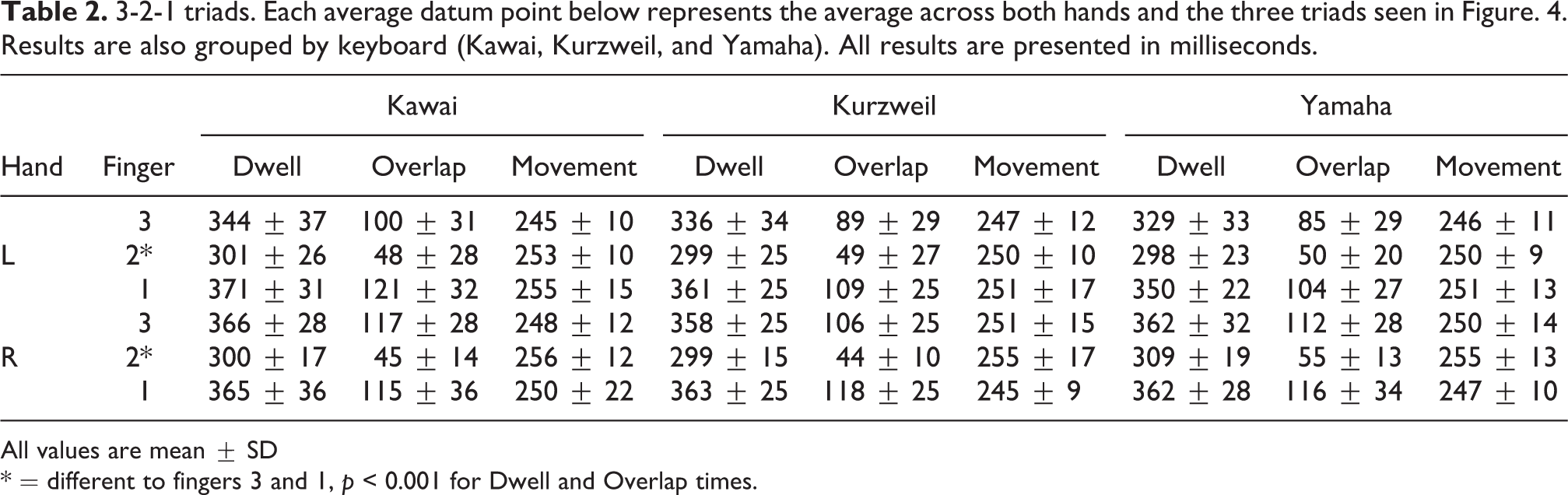
There were no observed differences between the three keyboards in any measure (p > 0.05 for all variables). Each figure (5a and 5b) contains time for both hands, one hand moving up the scale and the other down. It is clear that timing (Dwell and Overlap) for the finger prior to the thumb (Finger 1) is altered for both the 321 and 231 sequences. Dwell time and Overlap times in the 321 sequence were significantly lower for Finger 2 (Table 2: Dwell – F(2, 12) = 38.06, p <0.001, Overlap – F(2,12) = 39.56, p < 0.001) and Finger 3 or 4 in the 231 sequence (Table 3: Dwell – F(2,12) = 15.60 p <0.001, Overlap – F(2,12) = 15.45, p < 0.001) compared to instances when the same fingers (2, 3, and 4 respectively) did not immediately precede a keystroke by the thumb. There were no differences between fingers 3 and 1 in the 321 triad (Table 2), and between fingers 2 or 3 (first finger of the triad) and finger 1 in the 231 triad (Table 3) in either Dwell or Overlap times. Furthermore, in calculating the Euclidean distance of time of the keystroke relative to predicted for each hand (as described by van Vugt et al., 2013), results indicate that participants played similarly across the three instruments (Table 4).
3-2-1 triads. Each average datum point below represents the average across both hands and the three triads seen in Figure. 4. Results are also grouped by keyboard (Kawai, Kurzweil, and Yamaha). All results are presented in milliseconds.
All values are mean ± SD
* = different to fingers 3 and 1, p < 0.001 for Dwell and Overlap times.
2-3-1/3-4-1 triads. Each average datum point below represents the average across both hands and the three triads seen in Figure. 4. Results are also grouped by keyboard (Kawai, Kurzweil, and Yamaha). All results are presented in milliseconds.

All values are mean ± SD
* = different to fingers 3 and 1, p < 0.001 for Dwell and Overlap times.
The Euclidean distance of time of the keystroke relative to predicted for each hand (as described by van Vugt et al., 2011) across the three keyboards. Effect of keyboard was not significant (p=0.47 for the left hand and p=0.96 for the right hand). All values are in milliseconds.

All values are mean ± SD.
Discussion
Consistency of timing in scale performance on three different instruments was assessed in this study. Participants produced similar patterns across repeated performances and instruments; no timing differences were observed across keyboards. However, despite the imposed articulation and timing constraints, playing with a metronome in a legato style, clear timing deviations appeared within the scale patterns and were relatively consistent amongst all pianists across instruments. In particular, Dwell and Overlap time of the fingers immediately preceding the thumb were significantly lower at each occurrence throughout the scale with similarities between the hands. The similarity between hands was not surprising since the fingering patterns mirror one another.
Musical scales
Musicians practice scales to develop fluency, and this naturally involves parallel assimilation of cognitive (theoretical) and physical components toward automaticity and ease in performance. Movements necessary to perform a scale are directly related to the particular characteristics (physical, mechanical) of the instrument. Consider the movements necessary to perform a scale on a violin, trumpet or flute, for example. Pianists face several idiomatic physical challenges: controlling movement and force of individual fingers and coordinating digits of various lengths and different joint properties to enact fluid lateral translation of the hands across the breadth of the instrument. Ideal scales are regular, rhythmic, rudimentary exercises reflecting command of the instrument. In this study, legato scales were performed at a basic tempo, 60 BPM with 4 notes per second. Regularity of note distribution and timing of each keystroke was constrained, creating an implicit assumption of evenness by both listeners and performers. Results were surprising: there was no significant difference in performance among the three keyboards despite differences in average grams of key resistance (Kawai: 59±3; Kurzweil 80±4; Yamaha 50±4). However, systematic anticipatory adjustments in timing made prior to thumbstrokes were observed on all keyboards and in both hands (Figures 5a and b). These adjustments were consistent regardless of playing direction or the finger used prior to the thumbstroke and occurred even when playing the straight 5-4-3-2-1 finger pattern (Figure 5a).
Context
Unique aspects of the current study were bimanual performance (as opposed to unimanual), a scale performed over 2 octaves, synchronous performance with a metronome throughout, the variety of participants’ experience, and the comparison of performance across instruments. From a kinematic perspective, previous studies have typically measured inter-onset intervals (i.e. Movement time) (Jabusch, Alpers, Kopiez, Vauth, & Altenmüller, 2009; Jabusch et al., 2004; MacKenzie & Van Eerd, 1990; van Vugt et al., 2013) as a measure of unevenness although observations regarding tone durations (Dwell time) and Overlap of keystrokes have also been reported as in the current study (Jabusch et al., 2004). Unlike previous studies, there was no obvious difference in timing due to the change in direction when transitioning from ascending to descending scale performance (van Vugt et al., 2012). Perhaps the bimanual nature of the current study influenced the transition musically, physically, or both. It is important to consider, for example, both the differences in motor control of the left and right hands as well as performance of unimanual vs. bimanual movements. Differences in motor control of the left and right hands are well-documented, with observations that movements are faster and controlled more accurately for the non-dominant hand (Barthelemy & Boulinguez, 2001). A related question therefore, is the extent to which the current bimanual piano task represents summation of independent unimanual movements or an integrated pattern (Carson, Riek, Smethurst, Párraga, & Byblow, 2000; Gribova, Donchin, Bergman, Vaadia, & Cardoso de Oliveira, 2002; Obhi, 2004; Srinivasan & Martin, 2010; Walsh, Small, Chen, & Solodkin, 2008).
Despite the pacing of the metronome, Movement time for the first finger of each triad was less than the two subsequent fingers, and the Dwell and Overlap times were lower for the finger preceding the thumb. Importantly, these changes in timing were consistent across hands and pianos. The consistency across hands is intriguing and occurs without any coupling of the hands since the fingering sequences are offset with respect to the thumb. Based on these observations, particular constraints influencing task performance appear to be related to anatomical/biomechanical structure and/or neuromuscular control of the thumb.
Previous studies have suggested a variety of reasons underlying timing anomalies: limitations of human sensory perception, pathology, system noise, and residual expressive biases (van Vugt et al., 2012). Interaction of several factors is plausible. However, due to the relatively clinical (non-expressive) nature of musical scales and the consistency of observed timing patterns preparatory to the thumb across keyboards and pianists, it is plausible that pianists anticipate the cross-over or thumb-under movements required for the thumb to depress the key and begin to adjust two fingers prior. This anticipation in either case would be required for producing the hand movement necessary to maintain musical consistency and the structure of the performance within the task constraints.
Future directions
Mechanical considerations
One of the challenges in practice, due to the multiple degrees of freedom of hand muscles, is that activation of those muscles is not necessarily associated with repeatable patterns, an observation further complicated by variation related to joint angles and the possible stabilizing activation of particular muscles facilitating increasingly independent movement of digits (Schieber & Santello, 2004). The thumb is unique both anatomically and physiologically, lacking the multi-digit, multi-tendon muscles typical of the fingers (Moore, 1992). Motor control of the thumb is complex and not well understood. Many recent hand and thumb studies involve grip (Bohannon, 2008; Kozin, Porter, Clark, & Thoder, 1999; Leyk et al., 2007) or pinch (Fowler & Nicol, 2001; Kozin et al., 1999; Shurrab, Mandahawi, & Sarder, 2017), but fewer functional movements have been studied. The thumb keystroke is a combination of flexion and abduction, whereas the other fingers utilize flexion. Perhaps this creates a scenario where more control of the thumb is required to produce the keystroke. EMG has been used to distinguish activity of different thumb muscles (Cooney, An, Daube, & Askew, 1985; Oudenaarde et al., 1995), but it is noteworthy that only two thumb muscles, the extensor pollicis longus (EPL) and flexor pollicis longus (FPL) have been identified as capable of individually activating (Birdwell, Hargrove, Kuiken, & Weir, 2013). Challenges exist in identifying the function of other thumb muscles (Gangata, Ndou, & Louw, 2010) and in describing interactions between the thumb and fingers (Fuglevand, 2011; Hockensmith, Lowell, & Fuglevand, 2005), particularly with regard to the overlapping kinematic function of individual muscles (Gustafsson, Johnson, Lindegård, & Hagberg, 2011; Johanson, Skinner, & Lamoreux, 1996). Further research regarding the thumb, fingers, and their interaction is warranted.
Neurological considerations
Neurologically, it is possible (though more recently contested) that the thumb is also represented differently in the brain with larger and more distinct representation (Penfield & Rassmussen, 1950; Schieber, 2001), but it is also possible that brain regions are devoted to movements and not particular digits (Kleinschmidt, Nitschke, & Frahm, 1997; Zartl, Kapfer, & Muellbacher, 2014). An additional pianistic complication is the relationship between control of the thumb movement and the translation of the hand that often occurs during the triads associated with the thumbstroke. Further research relating to piano performance in particular could be fruitful due to the inherent relationships among digits during performance and the unique nature and complexity of the activity.
Pianistic considerations
There are several interrelated future paths of inquiry: neurological, muscular, and specifically pianistic. The present study suggests clear relationships among piano keystrokes that appear to be essential although perhaps not intuitive to scale performance. It remains to be determined the extent to which these observations, the patterns of timing, persist at faster/slower performance tempi. It is possible that at faster tempi, similar timing patterns exist, but in a more compressed, distinct, fashion (MacKenzie & Van Eerd, 1990; van Vugt et al., 2014). It would be beneficial to replicate and extend this path of inquiry. Additionally, questions remain related to (1) whether these differences persist between hands (Heuer, 2007; Sainburg, 2002; Sainburg & Kalakanis, 2000; van Vugt et al., 2013), (2) the control mechanisms of the wrist, hand and digits during thumb transitions, (3) the extent to which performance of unimanual and bimanual scales is similar (MacKenzie & Van Eerd, 1990), and (4) whether or not analogous patterns and relationships persist in performance of actual pieces of music. Furthermore, there are obvious and significant conceptual lines of inquiry related to the means by which the pianist overcomes the differences among instruments to achieve consistency of performance.
Summary
Better understanding of piano technique implies reciprocally more detailed conception of neuromuscular function and control of the hand, fingers, and thumb in general. Muscular aspects include identifying and distinguishing function of thumb muscles and quantifying variability (angular; efficiency; electrical) across movement in general and pianistic movements specifically. Neuromuscular attributes involve identifying the degree to which areas of the brain are correlated with particular movements and/or the hand, fingers, and thumb anatomically and how training influences cortical structure and motor skill performance. The implications are far-reaching, with obvious application in therapeutic environments and the performing arts, but they extend well beyond particular populations and the spectrum of either disease or specialized skill. We rely on our hands to interact with the world, a function that ubiquitously changes over time regardless of health or kinesthetic expertise.
Footnotes
Acknowledgments
Thank you to the Motion and Media Across Disciplines (MMAD) laboratory for technical support, to Liz Penshorn and Claire Sylvestre for their help with data collection and processing, and to Joseph Skufca for assistance with statistical analysis.
Author contribution
TLP and ML conceived and designed the study. DD performed data reduction and analyses and interpreted results. All authors participated in data collection, reviewed and edited the manuscript, and approved the final version of the manuscript.
Declaration of conflicting interests
The author(s) declared no potential conflicts of interest with respect to the research, authorship, and/or publication of this article.
Funding
The author(s) received no financial support for the research, authorship, and/or publication of this article.

Peer review
Jennifer MacRitchie, Western Sydney University, The MARCS Institute.
Floris van Vugt, McGill University, Department of Psychology.