



Abstract
Movement science research indicates that an external focus of attention benefits learning as well as performing movement. Despite these findings from the field of sports, research on the effects of external focus in music pedagogy is sparse, especially in naturalistic settings. This in-depth, small-sample study investigated the effect of external focus on musical learning in terms of accuracy, self-efficacy, confidence, motivation, and engagement, as well as the qualitative performance experience. Seven conservatoire (natural trumpet) students practiced challenging, unfamiliar pieces in short practice sessions using their normal practice methods, followed by a trial using the instructions of the Audiation Practice Tool (APT). This tool was developed to enhance auditory and kinaesthetic engagement as well as detailed musical intention through vivid imagination, singing, gesturing, playing, and seeking musical variation. Use of the APT resulted in higher performance accuracy than participants’ usual practice methods, and a non-significant trend for improvement in self-efficacy and confidence compared to practice as usual. Logbook scores were inconclusive on motivation and engagement; however, exit questionnaire answers showed that most participants experienced audiation or external focus as engaging and enjoyable. Although none of the participants initially favored external focus, participants generally intended to continue using elements of the APT. This study suggests that the use of external focus could be more explicit and prominent in teaching and in practicing music.
Most musicians will have recognized a connection between the success of a performance and what they focused on whilst playing. Knowing what to focus on is the key to an optimal performance as well as optimal practice. The goal of a musician – to be expressive and to move the audience – is often left out of the practice room, where one is busy analyzing and exploring technical issues or exercising, observing, or steering parts of the body. Musicians also tend to spend a great deal of attention on criticism and judgment – either intrinsically or from teachers and critics.
According to studies in sports and movement sciences as well as music psychology, focusing on steering and controlling the body (internal focus), as well as focusing on avoiding error or on analysis or judgment (self-focus), and even thinking about technical details (technical focus) is not conducive to an optimal performance (Kenny, 2011; Masters, 2012; Maxwell et al., 2000; Wulf, 2007; 2013). To be entirely engaged in the task at hand, a performer needs to focus on their intended result – to have an external focus of attention. For example, athletes would imagine where they want the ball to go, or on steering the movement of their golf club or tennis racquet rather than their own arm. For musicians, external focus means focusing on the music that is about to be played.
Because music-making involves extremely complex motor control (Altenmüller, 2008), it is not possible to consciously understand or steer the movements whilst playing (e.g., using internal focus) without disrupting their execution. Complex motor movements are argued to be best learned and controlled implicitly (e.g., Masters, 2012). Focusing on technical aspects and thinking about how to play a phrase during playing involves declarative processes that are too slow and cumbersome, as well as a high cognitive load. Judgmental thinking, thinking about avoiding errors, the opinions of others, or the consequences of a performance brings the performer out of their task focus. Although internal focus, focusing on instructions 1 , analysis and self-focus, are not the most optimal type of focus for the practice room or on stage, these are common strategies and pedagogical approaches for many musicians.
Leading researcher in attentional focus for motor learning Gabriele Wulf defined external focus as focus on the intended movement effect, and internal focus as focus on the body movements (Wulf, 2013). In multiple studies over the last 20 years, Wulf and colleagues compared external and internal focus (i.e., focus on the body movements whilst executing a task versus focusing on the desired outcomes) for balancing tasks, as well as movements involved in golf, volleyball, tennis, throwing, football, and basketball. Their results showed that external focus is more beneficial than internal focus for movement effectiveness and efficiency, for beginners as well as more experienced players (Wulf, 2007; 2013; Wulf et al., 1998; Wulf & Lewthwaite, 2009; 2016). As both sports and music involve complex movements there are compelling reasons to extend the research into the benefits of external focus to the field of music. For musicians, effectiveness translates to accuracy of pitch and timing, technical proficiency, and expressivity. Efficiency means economy of movement and would result not only in a better quality of sound and more flexibility for virtuosic passages, but also in higher endurance, and a smaller likelihood of injury.
External focus has also been found to have a positive effect on self-efficacy. Self-efficacy refers to a person's belief in their ability to carry out a specific task (Bandura, 1997) and is known to have an effect on motor performance (Moritz et al., 2000). Self-efficacy has also been found to have a strong influence on achievement in general (Zimmerman et al., 1992). A positive effect of focusing externally on self-efficacy was previously shown in a motor learning study where participants’ ratings of their confidence were measured (Pascua et al., 2015). In Wulf and Lewthwaite's (2016) OPTIMAL theory of motor learning, external focus is presented, along with motivation (enhanced expectancies and autonomy), as the key to movement success, as it contributes to high task focus and low self-focus, resulting in enhanced performance and learning. In this framework, being totally engaged in task-related focus is at the center of good practice and performance.
External focus has not yet been researched in depth in the field of music performance. The primary reasons for this are the subjective nature of assessing musical performance and the difficulties of researching in a complex field environment. Previous studies involving musicians and external focus have monitored the effects of external focus on finger movements (Duke et al., 2011), the tone quality of singers (Atkins, 2017), sound quality of wind players (Stambaugh 2017; 2019), bow control of violinists (Allingham et al., 2021; Allingham & Wöllner, 2022), and on perceived skill level and expressivity by outside jurors (Mornell & Wulf, 2019) as well as measuring the movement and sound (Van Zijl & Luck, 2013). There is very little research on the effects of external focus on musical learning and in a naturalistic setting.
It is worth pointing out a discrepancy amongst researchers in the interpretation of what external focus is for musicians. In the research of Allingham et al., Atkins, and Stambaugh, external focus has been interpreted as meaning focus on the sound produced. The research presented here emphasizes the importance of focusing on the intended sound or music, making a distinction between focusing on the sound you are hearing (which has already happened) and the sound or the music or the expression that is intended (thus causing a priming of the body to produce the intended result).
In the field of music, external focus – anticipating the desired effect of one's movements – would translate to imagining the movements of the instrument's mechanisms, the sounds that are about to be created, or the expression of the sounds (for examples, see Table 1). Wulf (2007) suggested that the more expert the performer, the more distal the focus should be and when under pressure, a performer's attention tends to become less distal – which can degrade the performance (p. 150).
The continuum of internal and external focus for musicians in four levels.

In order to test the effect of external focus on musicians’ performance, a practice tool was developed to practice musical intention. The Audiation Practice Tool (APT) is based on the concept of audiation – a term first coined by Edwin Gordon in 1975 and further developed into a music learning theory (Gordon, 2001) – referring to being able to imagine sound that is not present as well as having an understanding of music as a language and expressing meaning. In order to have maximum effect for both learning and performance, imagery should be clear, vivid, rich, and multi-modal (Davidson Kelly et al., 2015; Nanay, 2018; Schaefer, 2017). The APT invites musicians to engage – with nuance and detail – in auditory and kinesthetic activity as well as prompting them to imagine characters and emotions. The instructions for practicing using this tool are to first (a) imagine the phrase you are about to play with as much nuance as you can evoke (e.g., pitch, tone quality, volume, articulation, transition from one note to another…), then to (b) sing and gesture the phrase dramatically, (c) play the phrase, and then (d) play another version (or multiple versions) of the phrase by focusing on a clearly different emotion or character.
In all four steps of the APT procedure, the musician is engaged in external focus – evoking and exploring the intended sounds and expressions. In doing so the musician is engaging in a form of mental practice, as it involves various forms of auditory imagery. However, where mental practice generally focuses on imagining the sound and perhaps kinesthetic sensations of playing while not moving (thereby supporting performance with rehearsed simulations, memorizing repertoire, reducing performance anxiety, as well as reducing strain on the body, Bernardi et al., 2013; Davidson Kelly et al., 2011; 2015), the APT uses images in order to explore the musical content, and firmly place one's focus here. The APT procedure enhances the experience of external focus by exploring and experiencing the intended music result using singing, gesturing, and variations. Making variations – especially varying the entire character of a phrase – enhances the flexibility of the motor program in the brain (Schmidt & Wrisberg, 2008) and keeps the player engaged and alert.
Purpose of this Study
The effects of external focus on musicians’ learning and performance were explored in a study involving conservatoire students, all of whom played natural trumpet. Through implementing a practice tool designed to induce external focus, the research questions of the current study mainly concerned the effect of using the APT on the participants’ playing accuracy and self-efficacy, while in a sub-question, the subjective experience of the musicians was addressed, specifically their experience of confidence, engagement, satisfaction, and enjoyment.
Positive results for both performance accuracy and self-efficacy were expected, in accordance with previous research in the field of movement sciences. Measuring accuracy gives a clear indication of effectiveness and efficiency (in line with Wulf's claim that both of these benefit from external focus) and whether a skill has improved. Improved self-efficacy, confidence, and motivation are indicators that the subject's ability to learn has been positively influenced (Bandura, 1997; Dweck, 2000; 2008; Wulf & Lewthwaite, 2016). Confidence, engagement, satisfaction, and enjoyment are, according to the researcher's pedagogical experience, all beneficial to both learning and performing and closely related to focus.
Method
Design
The effects of external focus as elicited by the APT procedure were compared to the effects of the participants’ “usual” way of practice, the expectation being that all of the dependent variables would be positively affected by the external focus inherent to the APT procedure. In order to obtain a rich representation of the effects of external focus, a mixed methods design was used, combining quantitative findings and qualitative results from questionnaires, logbooks, and interviews. In order to see if the use of the APT was retained, 3 months after the intervention, the participants were asked to what extent they still engaged in the type of focus that they used in the study.
The reason for limiting the study to natural trumpet players deserves some explanation. One of the problems of rating musical performance is the subjectivity of the listener – especially for complex music, and where musicality is also taken into account. For this reason, the current study has limited the quantitative outcome measure of performance to accuracy – for which the natural trumpet is particularly suited. The natural trumpet is a metal tube with a mouthpiece at one end, flaring out to a bell at the other. As the instrument has no mechanisms (valves) and its range and repertoire is limited to around 14 tones of the overtone series, the accuracy of the sound is entirely dependent on the form and speed of the airstream produced by the player. Even a small discrepancy in efficiency results in a “cracked” (unclear) or incorrect note that is clearly audible – even to a non-expert. As such, this method provides an unambiguous index of the note accuracy in each performance.
Participants
The seven participants were all students of the first author and were a diverse mixture of age (24 to 45 years, M = 30.6, SD = 8.7), gender (five male and two female), nationalities (Canadian, Singaporean, German, Dutch, and Russian), years of experience playing the trumpet (ranging from 12 to 38 years) as well as experience on the natural trumpet (from 1.5 to 3.5 years). Study levels ranged from first year minor through bachelor to second year masters. As the participants ranged from beginners on the natural trumpet to players with several years of experience there was a wide skill level difference between the players (see Table 2 for further details).
Participants’ demographics and musicianship information.

Note. a Can = Canadian; Sing = Singaporean; D = German; NL = Dutch; RU = Russian. b Trpt = trumpet; Nat = natural trumpet; SW = Susan Williams. c M = masters; B = bachelor; Min = minor. d Sight-reading errors refers to the sight-reading test performed at the beginning of the control phase.
As no ethical committee was present in the conservatoire hosting the experiment, formal ethical approval could not be sought. However, the study was discussed and approved internally by the institution prior to starting, and the procedure was explained to all participants before providing written consent for their participation and use of their data. As the larger project included additional, largely qualitative elements, this also included the use of video material from the related concerts, in addition to the practice audio and questionnaires reported here. All aspects of the study complied with the Declaration of Helsinki.
Materials and Measures
Test Pieces (Repertoire)
The test pieces for each learning condition (four for the control phase and four similar pieces for the intervention phase, counterbalanced for condition) were excerpts from baroque trumpet literature chosen by the first author. The chosen pieces were representative excerpts (some with slight adaptations by the researcher) from works by J.S. Bach and C.P.E. Bach. Excerpts were chosen from relatively unfamiliar pieces to ensure that the subjects did not know them well (they were asked at the beginning of each phase whether they recognized the excerpt). Two groups of four pieces were chosen so that each group of pieces was matched in style, difficulty, and length. Each group of four pieces needed to be both challenging for all of the players as well as containing all of the main technical difficulties and challenges for natural trumpet playing. These challenges included large and/or awkward intervals, high range, low range, endurance, fast passages, entrances after rests, entrances on the note d′′ and combinations of the aforementioned challenges. In addition to the test pieces, a sight-reading piece, that was unknown to all participants, was used to determine the skill level and usual practice style of the participant. The scores for the pieces used in both stimulus groups are shown in Supplementary Materials S1.
Questionnaires, Practice Guidelines, and Interview
Several questionnaires were created to be used in different stages of the study. A general information questionnaire was used at the beginning of the project, asking for details about participants’ trumpet playing experience and practice habits to establish their experience of natural trumpet playing, how much time they spent on it as well as their perception and awareness of the difficulties involved in playing and performing on the natural trumpet. A pre-sight-reading/performance questionnaire was filled out by each participant prior to playing the test pieces and the sight-reading piece, as well as prior to each performance to check extraneous reasons for the players’ playing ability. This questionnaire asked them to note how they felt at that moment – including embouchure strength, energy, motivation, and confidence.
In order to ascertain to what extent each participant already used external focus, a practice style assessment form was created, asking what the participant was focusing on during the initial 10-minute practice session of the sight-reading piece (see procedure for full details). The answers could be tabulated into categories (Internal focus, Technical focus, External focus, see Table 1) to ascertain a “practice profile”, and see to what extent the participants already used external focus during practice. A short difficulty assessment form was created to assess the subjective difficulty of each piece before playing. In order to calculate how external focus affected the participants’ self-efficacy in both learning conditions, Ritchie & Williamon's (2010) scale on self-efficacy for musical performance was used. This scale contains nine items like “I am confident that I can give a successful performance”. It was developed as a reliable (α = 0.78, test-retest on standardized summative scores: t(50) = −0.72, p = 0.48) and valid (EFA: VAF = 39.1%, Eigenvalue = 3.31) measure of self-efficacy for musical performance situations (Ritchie & Williamon, 2010). The original seven-point scale was changed to a nine-point scale in order to obtain a more nuanced result. Participants were given logbook session sheets – one for each practice session – so they could record how they felt before and after each session in terms of embouchure condition, energy, and the dependent variables motivation and confidence, by self-rating an answer to a direct question for each of these topics.
For questionnaires and assessment forms where self-ratings were required, a 10-cm visual analogue scale (VAS) was used, consisting of a line with a statement at each end where the participant indicates their answer with a mark on the line.
At the beginning of the intervention phase, the participants were shown how to use the APT and given a sheet with guidelines and rules for using the APT (see Supplementary Materials S2). After the intervention phase, the participants were also asked about their experience with using the APT. Some questions were designed to gather qualitative data about how the participants experienced practicing with the APT and how external focus (as implemented in the APT) affected them.
After performing the pieces at the end of both the control and the intervention phases, the participants rated their own performance and once again rated the difficulty of each of the test pieces using a post-performance questionnaire. Three months later they were asked in an audio recorded interview, whether and to what extent they continued to use the APT.
Procedure
The participants were personally invited by the first author to take part in research involving “practice style”. The participants met with the researcher on days 1 and 5 for each phase. Participants received verbal explanations at the beginning of the project and signed a release statement agreeing to the use of all data collected during the project (audio, video, questionnaires). At the beginning of the project, each participant filled out the general information questionnaire and reported their playing condition in the pre-sight-reading/performance questionnaire, after which they assessed the sight-reading piece for difficulty and then played it through. The participant then practiced the sight-reading piece for 10 min. The initial sight-reading as well as the practice session was audio and video recorded. Immediately after this practice session the participant filled out the practice style assessment form.
The four test pieces were then handed out and the participant assessed each one for difficulty. Four subjects played Group A pieces in the control phase and Group B pieces in the intervention phase, and three did the reverse (to account for any unexpected differences in difficulty through counterbalancing). The groupings were randomly assigned. The participants were also asked afterwards which group of pieces they found more challenging (to check whether the selection was biased). The self-efficacy scale for musical learning was filled out, after which the participant played each of the four test pieces. The playing through of the test pieces was recorded and served as the starting point measure. Log sheets were handed out and the guidelines and rules for practicing explained, in order to ensure that all participants followed the same protocol.
For the next three days (control phase) the participants practiced three times a day for five minutes each session, at home. They were instructed to practice in their “normal” way and to fill out the log sheet immediately after each session. Here, participants provided self-report scores for confidence, motivation, and engagement levels at the beginning and end of each practice session in a logbook. The scores were added together for each participant to provide an index of these subjective measures. The participants were also asked to provide any other explanations for an inability to play well (e.g., illness, tiredness, playing too much previously, mental problems).
On day 5, each participant came back in and reported their playing condition, filled out the self-efficacy scale for musical performance and played through the four test pieces. This performance was recorded and served as the end-point measure. The participants rated their performance and the difficulty of each piece in the post-performance questionnaire.
The intervention phase took place eight weeks after the control phase. The order of the phases was not counterbalanced, as practicing with the APT in the beginning might affect the control phase if it were to come afterward. The intervention phase differed from the control phase in that instead of practicing in their usual way, the participants were asked to practice the same amount, but using (only) the APT. Each participant was given a demonstration by the researcher of how to practice by using the APT. The post-performance questionnaire at the end of the intervention phase included questions asking the participants to comment on their experience using the Audiation Practice Tool (APT), such as “What did you learn and notice about practicing with the APT?” and “How did you feel when practicing this way?” Three months later the participants came in again for a final interview to ask questions such as “to what extent do you still use the APT?” The order of the different questionnaires in both phases is also shown in Figure 1.

Order of measures taken in the control and intervention phase.
Analysis
The hypotheses on accuracy, self-efficacy, and subjective performing experience were tested by statistically comparing the difference scores of quantitative measures taken pre- and post-practice between the control and APT phases using a paired t-test, after checking the assumptions of a normal distribution. In case of a non-normal distribution, a Wilcoxon signed-rank test was used (α = .05). All tests were two-sided.
Differences in accuracy based on the training were determined by comparing the changes in accuracy (correct note placement) from the first audio recording of the intervention pieces (Day 1) to the second recording (Day 5), after a phase where the players used their normal practice methods to a phase where they used external focus (the APT). The first step in this process was to count the number of mis-pitched notes based on the audio recordings. However, the range of expertise within the group of participants needed to be taken into account. Also, during a very fast passage a player may stumble at the beginning, resulting in the whole passage going wrong. In order to incorporate these factors, an ordinal scale was implemented where the absolute number of mistakes had incrementally less value (for precise transformation, see Table 3).
Metric scaled values for accuracy transformed to an ordinal scale.

Note. A higher score means lower accuracy.
The differences in self-efficacy between the two learning conditions were determined by comparing the scores obtained at the end of each phase using the self-efficacy score (Ritchie & Williamon, 2010). To compare confidence, motivation, and engagement, the scores derived from the practice logs were used, again using a difference score of ratings given before and after each practice session in either phase.
The participants’ experience of using the APT was qualitatively assessed; the answers from the final exit interview were analyzed using a global coding method (Frick, 2011) and identifying the themes that emerged (see Williams, 2019 for the coding methods). Specific issues and themes connected with the research inquiry (e.g., evidence of positive or negative effects from using the APT; evidence of experiencing external focus) were identified and analyzed.
Results
Participant Data and Design Findings
Whether external focus can be beneficial to all skill levels – as claimed by Wulf (2013) – can be tentatively explored with this participant group, even though the group is relatively small. The results of the sight-reading and practice session on day one of the control phase revealed a large range of skill and sight-reading ability (e.g., ranging from 5 to 42 mistakes) and a diverse range of practice profiles amongst the seven participants although all seven participants initially favored a technical (and in one case, internal) focus over an external focus (as can be seen in Table 4). The selection of musical pieces for each group appeared to be successful in matching difficulty; the participants did not consistently find one group of pieces to be more difficult than the other.
Practice profile results.

Note. Scores on practice style assessment questionnaire: highest scoring focus type is in bold face.
Main Results
Accuracy
As the data were non-normally distributed, a Wilcoxon signed-rank test was used to compare the control and intervention phases. The results indicated that the group's accuracy scores were improved when using the APT (Mdn = 1.5) as compared to using their standard practice method (Mdn = 0.75), Z = 2.214, p = 0.012. Both inexperienced and experienced players were positively affected. One participant appeared to play worse at the end of the control phase and showed no obvious improvement using the APT, and another showed no difference in improvement between control and the APT at all. The individual accuracy scores are depicted in Figure 2.
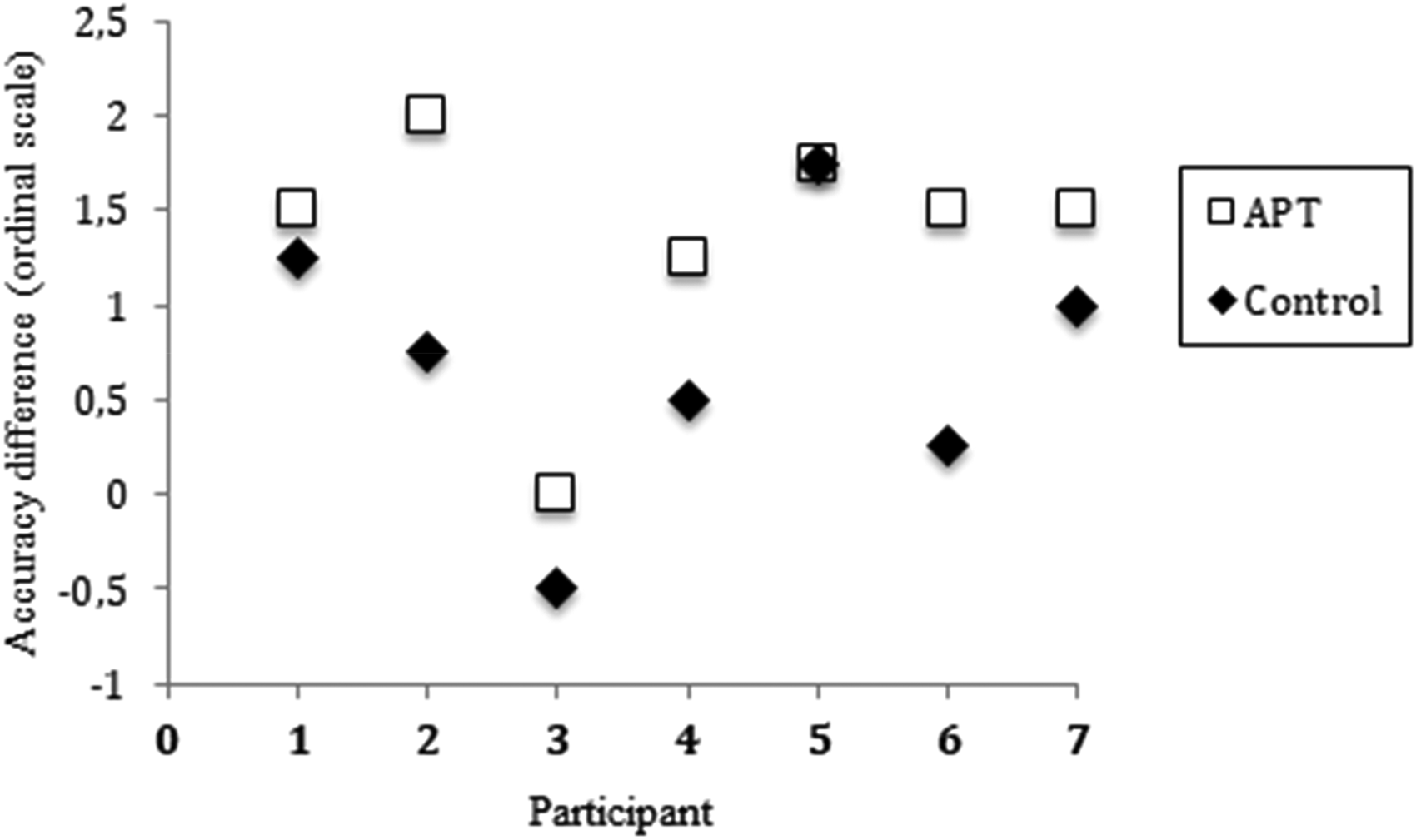
Changes in pre- and post-practice accuracy for the APT and Control phases.
Self-Efficacy
The ratings of self-efficacy for performance in each phase met the assumptions for parametric testing, but the comparison indicated no statistical difference between the control (M = 58.43, SD = 17.377) and the APT (M = 65.14, SD = 15.225), t(1.754), p = 0.130. The absolute mean difference between the conditions is in the expected direction, suggesting a trend that the APT could be beneficial to higher self-efficacy in performance, as five out of seven participants improved. Individual scores, relevant in the context of this modest sample, can be seen in Figure 3.

Self-efficacy scores for performance for the APT and Control phases.
Confidence, Motivation, and Engagement
The difference scores for ratings of confidence, motivation, and engagement also met the assumptions required for parametric testing. However, paired t-tests gave no statistical indication that changes in confidence level through practicing were more positive in the APT phase (M = 0.302, SD = 0.523) than in the control phase (M = −0.259, SD = 0.664), t(1.619), p = 0.160. Individual scores, again relevant in the context of this modest sample, can be seen in Figure 4, showing that six out of seven students’ confidence ratings increase more for the APT condition. There was no statistically significant difference between changes in motivation ratings in the control phase (M = 0.067, SD = 0.418) and the APT phase (M = 0.201, SD = 0.702), t(0.575), p = 0.586. Individual scores are shown in Figure 5. Paired-samples t-tests for the participants’ self-reports of engagement changes through practice also indicated no difference between the control phase (M = 5.389, SD = 2.128) and the APT phase (M = 7.284, SD = 1.569), t(2.064), p = 0.108. Due to missing data in the engagement scores, these results are based on an even more modest sample. Individual scores are shown in Figure 6.

Changes in confidence ratings for the APT and Control phases.

Changes in motivation ratings for the APT and Control phases.

Changes in engagement level ratings for the APT and Control phases.
The Participants’ Experience of Using APT
To assess the experience of using the APT for each of the participants, the responses to a post-performance questionnaire were qualitatively analyzed. Four main themes emerged, which are summarized here (for full transcripts of the answers to this questionnaire, see Williams, 2019).
Firstly, there was clear evidence that using the APT promoted external focus. Six of the seven subjects described experiences of external focus with comments such as “I was actively thinking about the way I really wanted it to sound”; “APT encourages my sound imagination”; “[…] a great way to really get to know what you actually want”; “I get into expressing and audiating”.
Then, four of the participants mentioned that they thought APT helped them to learn: “[…] helps with learning the music”; “Faster result by playing less”. However, two participants expressed frustration when there was no immediate evidence of improvement: “it was uncomfortable that it did not help with developing endurance and mechanical securities”; “When it worked, I was motivated, when not, I was unmotivated”.
Next, using APT was reported as enjoyable, engaging, and comfortable. Five of the participants said something about enjoyment and engagement or how easy it felt: “The practice sessions were never boring…how easy it was to focus”; “It felt easy for the brain; it was always active and everything I practice feels fresh even though I am physically tired…I enjoyed this practicing process overall”; “It was a lot of fun and never boring”.
Finally, for some, gesturing was new and/or uncomfortable and not all believed gesturing was helpful: “I did not feel that dramatic gestures help much”. Some noticed that the method used less physical playing than usual, which was useful in avoiding too much physical strain to the embouchure muscles (as is true more generally for mental training): “It also spares the lips”.
Answers to the interview question 3 months afterwards about whether they continued to use the APT, indicated that using the tool had a strong impact on the participants, and that they all continued to use it to some extent (displayed in Table 5).
The number of participants indicating further use of APT in a typical practice session.

Note. Participants’ reports were 3 months post intervention.
Summary of Individual Cases
Alternatively, the presented findings can be viewed as an elaborate seven-subject case study. For such an interpretation, Table 6 summarizes each student's main characteristics and results. While not going into depth in the analysis of each individual, notable points can be extracted, for instance that the only participant who did not show more improvement after using the APT, also reported a slightly lower self-efficacy score (ppt 5), with the longest number of years of trumpet experience (see Table 2), potentially indicating more ingrained practice habits as compared to the other participants. Another example is how the participant that showed the least improvement with any kind of practice, albeit a bit more with the APT (ppt 3), who had the least experience playing the trumpet and showed the most sight-reading errors initially, also showed the largest increase in self-efficacy when using the APT.
Individual case studies.
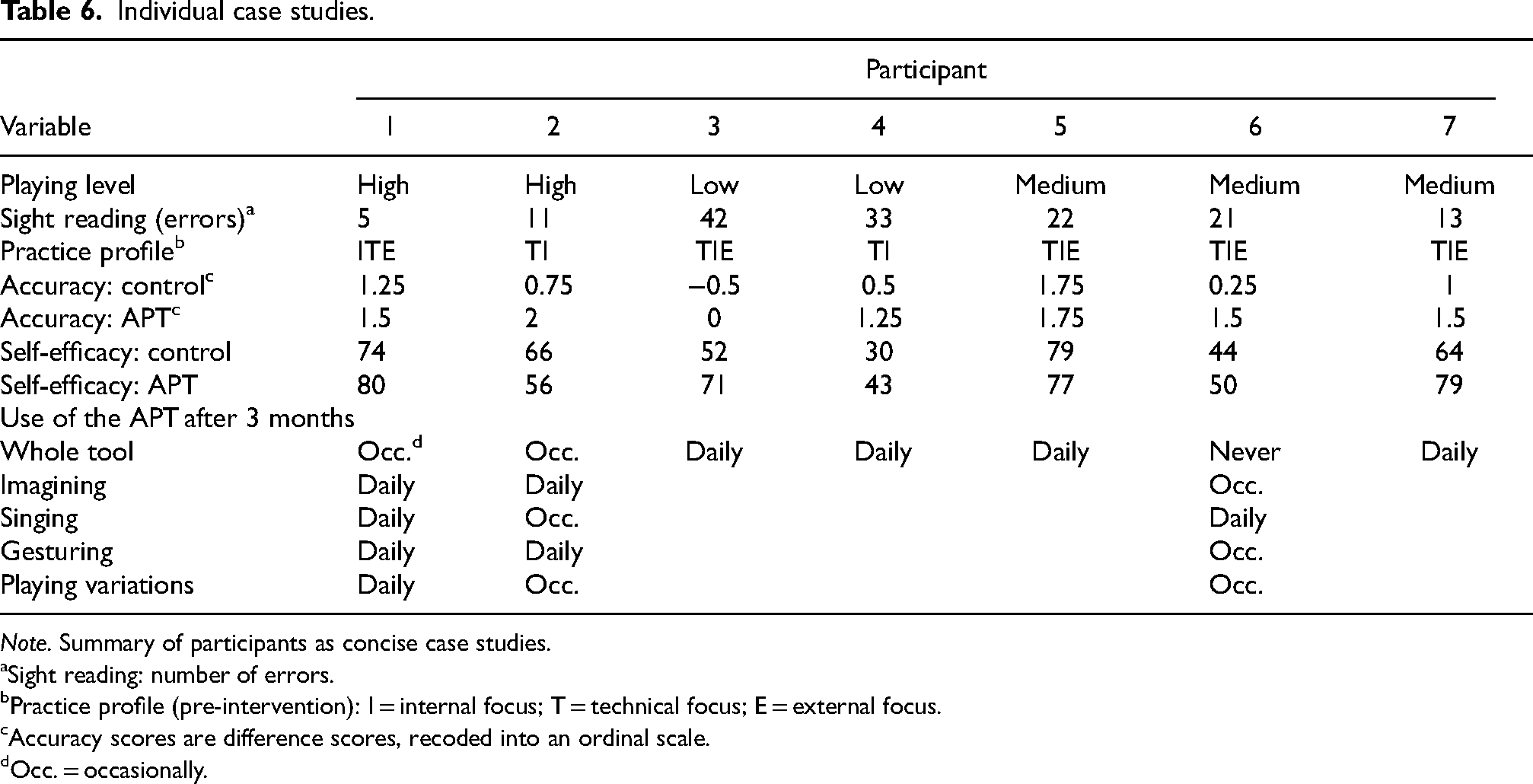
Note. Summary of participants as concise case studies.
Sight reading: number of errors.
Practice profile (pre-intervention): I = internal focus; T = technical focus; E = external focus.
Accuracy scores are difference scores, recoded into an ordinal scale.
Occ. = occasionally.
Discussion
The study was designed to investigate the effects of external focus in musical learning and on the performance experience in a sample of seven trumpet players, focusing specifically on note accuracy and self-efficacy as well as subjective indications of confidence, motivation, and engagement levels. Positive effects of practicing with the APT procedure, designed to practice external focus, on playing accuracy were found. Accuracy for natural trumpet players – the production of a centered tone of the desired pitch – is an indication of fine motor skill acquisition. Thus, Wulf's (2013) claim that external focus can benefit movement effectiveness and efficiency (measured here as note accuracy) in both skilled and unskilled players is reflected in the results of this experiment. The findings showed a positive result for accuracy overall. None of the participants showed evidence that using the external focus tool was less effective than his or her regular practice methods, while several appeared to benefit. The more complex the piece, the more dramatic or obvious the effect of external focus during a short time period seemed to be.
The results for self-efficacy and confidence were not significant. As the absolute difference for the majority of participants was present in the expected direction for both of these variables, it may be worth it to explore the relationships between self-efficacy, confidence, and external focus further in future research. The quantitative scores for motivation and engagement from the participants’ logbooks were not conclusive (and thus did not support the hypothesis), but the qualitative analysis of exit questionnaire answers revealed that the APT encouraged most of them to audiate/experience external focus, and that they found it engaging and enjoyable to use. Participants all indicated that the APT became a practice tool that they continued to use, either as a whole tool or parts thereof.
It was noteworthy to discover that none of the participants initially favored external focus in their regular practice, based on their initial practice profile results. All of the participants initially most often used internal focus – mainly focusing on controlling their lip muscles (embouchure) and breathing mechanisms. Whether internal and technical focus is also more favored than external focus for musicians in general could be further investigated. Along with accuracy and technical proficiency, expressiveness was mentioned as an element of effectiveness for a musicians’ performance. Although expressiveness was not tested in the current study, the APT procedure specifically includes asking the player to be expressive. As a next step, the investigation of the APT in terms of its effect on the expressiveness of the performance appears warranted. By focusing on the character of or emotion behind the music means the player is focusing on musical intention: i.e., to express something and to move the listener. Further research could involve outside adjudicators’ assessment of performers’ expressiveness and musicality.
Limitations
A number of limitations should be considered when interpreting the findings. Firstly, the intervention dosage (5 min 3 times a day for 3 days) was kept deliberately short in order to ensure that even the most advanced players would not fully master the group of pieces in the given time period and thus allow for clear differences in accuracy ratings. While this facilitated more variability in the accuracy outcome, determining effects on confidence and motivation was arguably harder as a result of the short period.
Then, the fact that there were only seven participants, with large differences in playing level, allowed an in-depth controlled study with external validity, but did not yield enough data to give more robustly interpretable results. Although all of the participants were students of the first author, some potential resulting bias was reduced by the fact that they were not informed about the true subject of the research, or anything about external focus. As the first phase only included practice as normal, and did not differ from the music students’ normal activities, this functioned as a baseline and can be argued to not predispose them to perform differently than they would have if presented with the APT tool without the first phase eight weeks earlier. As there was no placebo condition, there is no guarantee that the participants did not react positively to the APT simply because it was novel. This can be argued in two ways, as while novel methods potentially lead to more preference (Rose, et al., 1982), the mere exposure effect, leading to more preference due to previous familiarity (cf. Zajonc, 1968) would argue against this. However, in the current setting, inspection of single-subject outcomes indicates that individuals who expressed discomfort with the new method were among those who improved the most, arguing against a simple response to novelty. More generally, measuring musical results is difficult, complex, and contentious (Schmidt and Lee, 2012). For this reason, note accuracy and the participants’ own subjective experience were chosen as independent variables. It is not possible to know exactly how they practiced during the practice sessions, as the sessions themselves were not recorded. For future studies video recording each session would be recommended; however, if they did indeed not use the APT during practice sessions, this would lead to under- rather than overestimation of the differences, further supporting the currently presented findings. A fruitful elaboration of the present study would be to treat the seven participants as separate case studies, which may further elaborate the usefulness of the APT for specific learners, depending on playing level, practice habits, and potentially aspects such as gender, culture, language experience, and so on.
New Questions and Future Research
The overall success of the APT in a study involving a small group of trumpeters suggests that using similar methods and approach could potentially be of benefit to musicians in general. The results suggest that musicians’ motor skill learning benefits from using external focus in terms of playing accuracy. Further studies using more participants and longer practice phases could give more strength to this claim, as well as clearer results for self-efficacy and confidence. Experiments studying external focus for musicians could include other forms of external focus – for example using metaphors, narrative, or scenarios for practicing repertoire. Testing participants over a longer period of time may also bring added information as to the possible long-term benefits.
Conclusions and Recommendations
External focus as it was investigated here is not a new concept. It is a new term for what good musicians have always done: focusing on their musical intention. However, the use of external focus could be more explicit and prominent in teaching and in practicing. We could develop methods and approaches that encourage external focus in learning and teaching and during practice and rehearsal, as well as developing explicit ways to rely on external focus during performance – even (and especially) when under pressure. Findings on external focus of attention suggest ways of practicing and teaching that involve exploring repertoire or skills rather than treating them as problems to be solved. Getting to know a piece of music or a specific technique involves knowing what the result should sound like, or express. Research on external focus implies that musicians could spend more time practicing what they want to say – their musical intention – rather than focusing on how it works. Embedded in the context of previous research on this topic, this naturalistic, applied study is among the first to show that this can be directly applied in music pedagogy, warranting further exploration in both fundamental and applied settings.
Supplemental Material
sj-pdf-1-mns-10.1177_20592043231151416 - Supplemental material for Practicing Musical Intention: The Effects of External Focus of Attention on Musicians’ Skill Acquisition
Supplemental material, sj-pdf-1-mns-10.1177_20592043231151416 for Practicing Musical Intention: The Effects of External Focus of Attention on Musicians’ Skill Acquisition by Susan G. Williams, Joram E. van Ketel and Rebecca S. Schaefer in Music & Science
Supplemental Material
sj-pdf-2-mns-10.1177_20592043231151416 - Supplemental material for Practicing Musical Intention: The Effects of External Focus of Attention on Musicians’ Skill Acquisition
Supplemental material, sj-pdf-2-mns-10.1177_20592043231151416 for Practicing Musical Intention: The Effects of External Focus of Attention on Musicians’ Skill Acquisition by Susan G. Williams, Joram E. van Ketel and Rebecca S. Schaefer in Music & Science
Footnotes
Acknowledgements
Thanks to Professor Dr. Henk Borgdorff and Dr. Michiel Schuijer for their invaluable contributions toward this research and to directorship, staff and students of the Royal Conservatoire The Hague for their inspiration and support.
Action Editor
Liila Taruffi, Durham University, Department of Music.
Peer Review
Eckart Altenmüller, University of Music, Drama, and Media Hannover, Institute of Music Physiology and Musicians Medicine
Veronika Lubert, University of Vienna, Department of Occupational, Economic, and Social Psychology
Author Contributions
SGW designed and conducted the study, and wrote the first version of the manuscript in consultation with RSS, JEvK designed and conducted statistical analysis on the data, RSS and SGW structured and interpreted the results. All authors provided critical feedback and contributed to the final manuscript.
Ethical Statement
As the conservatory where this research was performed did not have an ethical committee at the time of this study, no approval number is available. It was informally approved by the responsible institution. As all participants gave their written consent to take part, and the study was carried out in accordance with the Declaration of Helsinki, the study was carried out according to current ethical standards.
Declaration of Conflicting Interests
The first author (SGW) is the developer of the practice tool evaluated in the current paper, and has also written about this in her book “Quality Practice”, developed with the support of the Netzwerk Musikhochschulen (Network of Music Conservatoires), Germany, the German Federal Ministry for Education and Research, and the Royal Conservatoire The Hague.
Funding
The authors disclosed receipt of the following financial support for the research, authorship, and/or publication of this article: The authors received no financial support for the research or authorship, and are grateful to the Academy of Performing Arts of the University Leiden and the Royal Conservatoire The Hague for contributing to the publication costs.

Supplemental Material
Supplemental material for this article is available online.
Notes
References
Supplementary Material
Please find the following supplemental material available below.
For Open Access articles published under a Creative Commons License, all supplemental material carries the same license as the article it is associated with.
For non-Open Access articles published, all supplemental material carries a non-exclusive license, and permission requests for re-use of supplemental material or any part of supplemental material shall be sent directly to the copyright owner as specified in the copyright notice associated with the article.
